

Submitted:
26 March 2026
Posted:
30 March 2026
You are already at the latest version
Abstract
Counterion-deficient liquid states are formulated within a solvent-general framework for charge-selective forcing under rapid electrostatic relaxation. When the Maxwell relaxation time is short relative to the forcing or chemical timescale, persistent bulk space charge is not an admissible long-lived description: the liquid interior relaxes toward near electroneutrality, finite residual charge localizes predominantly at the interface, and the compensating opposite charge need not be stored as an ordinary dissolved counterion in the same phase. On that basis, two complementary forcing branches are developed. In the negative branch, low-entry-energy electron delivery reduces dissolved cations or plates neutral material by populating the lowest accessible acceptor manifold, leaving anion-rich dissolved states. In the positive branch, low-entry-energy noble-gas dications act as formally universal two-electron scavengers that remove electrons from the highest available occupied density, including solvated-electron populations, lone-pair-rich molecular donors, and halide anions. A solvent-general admissibility window is derived in terms of entry kinetic energy, Maxwell relaxation, interfacial field, Rayleigh stability, leakage time, and heat-removal capacity. From these constraints, explicit operatingcurrent bounds are obtained, and an illustrative aqueous benchmark shows how Rayleigh, dielectric, and thermal limits separate in practice. Water, electron-solvating media such as calcium in tetrahydrofuran, and halide-containing liquids such as LiCl in tetrahydrofuran serve as representative realizations. The framework therefore yields predictive bookkeeping relations, dimensionless admissibility parameters, a noble-gas dication energy ladder, operational current ceilings, and experimentally falsifiable signatures that distinguish counterion-deficient chemistry from ordinary dissolved countercharge compensation.
Keywords:
counterion-deficient states
; charge-selective forcing
; Maxwell relaxation
; interfacial charge localization
; liquid-state electrostatics
; nonequilibrium physical chemistry
; Rayleigh limit
; leakage-limited charge storage
; solvated electrons
; proton transport
1. Introduction
Conventional liquid-state chemistry is usually written in terms of dissolved ionic countercharge. The present paper examines a narrower regime in which one charge-bearing population is generated, removed, or retained selectively while the compensating opposite charge is not co-stored as an ordinary dissolved partner in the same liquid phase. The resulting state is counterion-deficient in a chemical sense without violating global charge conservation. The question is therefore not whether electroneutrality applies, but how it is realized in a forced liquid state. [1,2]
Two features motivate a solvent-general treatment. First, the same bookkeeping problem appears in chemically different media. In water, excess positive and negative charge is carried by hydrated protonic and hydroxidic defects rather than vacuum-like bare ions. [3,4,5] In electron-solvating liquids, solvated electrons can coexist with metal-derived cations. [6,7,8] In salt solutions, one may force either cation removal or anion oxidation, again changing which charge-bearing species remain in solution. Second, the physical constraints that determine whether such states are admissible are not water-specific or THF-specific. They are set by the same electrostatic and transport laws: charge continuity, Maxwell relaxation, interfacial localization of finite net charge, dielectric admissibility, and capillary stability.
The present work therefore develops the theory from a physics-constrained starting point rather than from chemistry alone. The physical argument is simple but powerful. If the Maxwell relaxation time
is short compared with the characteristic chemical forcing time, then persistent macroscopic bulk space charge is not an admissible steady-state description of the liquid interior. Instead, the bulk approaches near neutrality while any finite residual charge is carried predominantly at the boundary. Counterion deficiency must then be interpreted chemically: it concerns which dissolved species remain in the liquid, not whether the liquid stores unlimited bulk charge.
A second organizing idea is the separation of entry energy from reaction energy. In the present paper, is defined as the kinetic energy of the incoming forcing particles at the point of entry into the liquid. A positive forcing carrier such as Ng2+ may therefore enter a liquid with very low kinetic energy and yet still release a very large neutralization energy after charge transfer. The noble-gas family is useful as a formally uniform set of two-electron sinks whose principal distinction is thermodynamic scale rather than stoichiometric structure. This perspective makes it possible to discuss He2+, Ne2+, Ar2+, Kr2+, and Xe2+ within one common framework.
The present regime also sits adjacent to, but is not identical with, several familiar physical-chemistry descriptions. It is not a restatement of ordinary dissolved-counterion bookkeeping, because the compensating opposite charge need not be co-stored as an ordinary dissolved species in the same phase. It is not a standard double-layer or electrospray analysis alone, because the central reduction is imposed by rapid bulk relaxation together with chemically selective forcing and leakage-limited charge storage rather than by interfacial structure alone. It is likewise broader than any single solvent-specific plasma–liquid or reactive-droplet scenario because the same admissibility logic can be written across donor classes and geometries. [1,10,11]
The paper is organized as follows. Section 2 presents the theoretical methods and general formalism. Section 3 develops the universal positive and negative branches and discusses molecular liquids, electron-solvating liquids, and halide-containing liquids as representative classes. Section 4 converts the admissibility conditions into operational bounds and benchmark estimates. Section 5 then states hard falsifiers and explicit limits of the framework. The aim is to establish a predictive physical-chemistry theory that turns charge-selective forcing into calculable current, field, and thermal bounds across solvent classes.
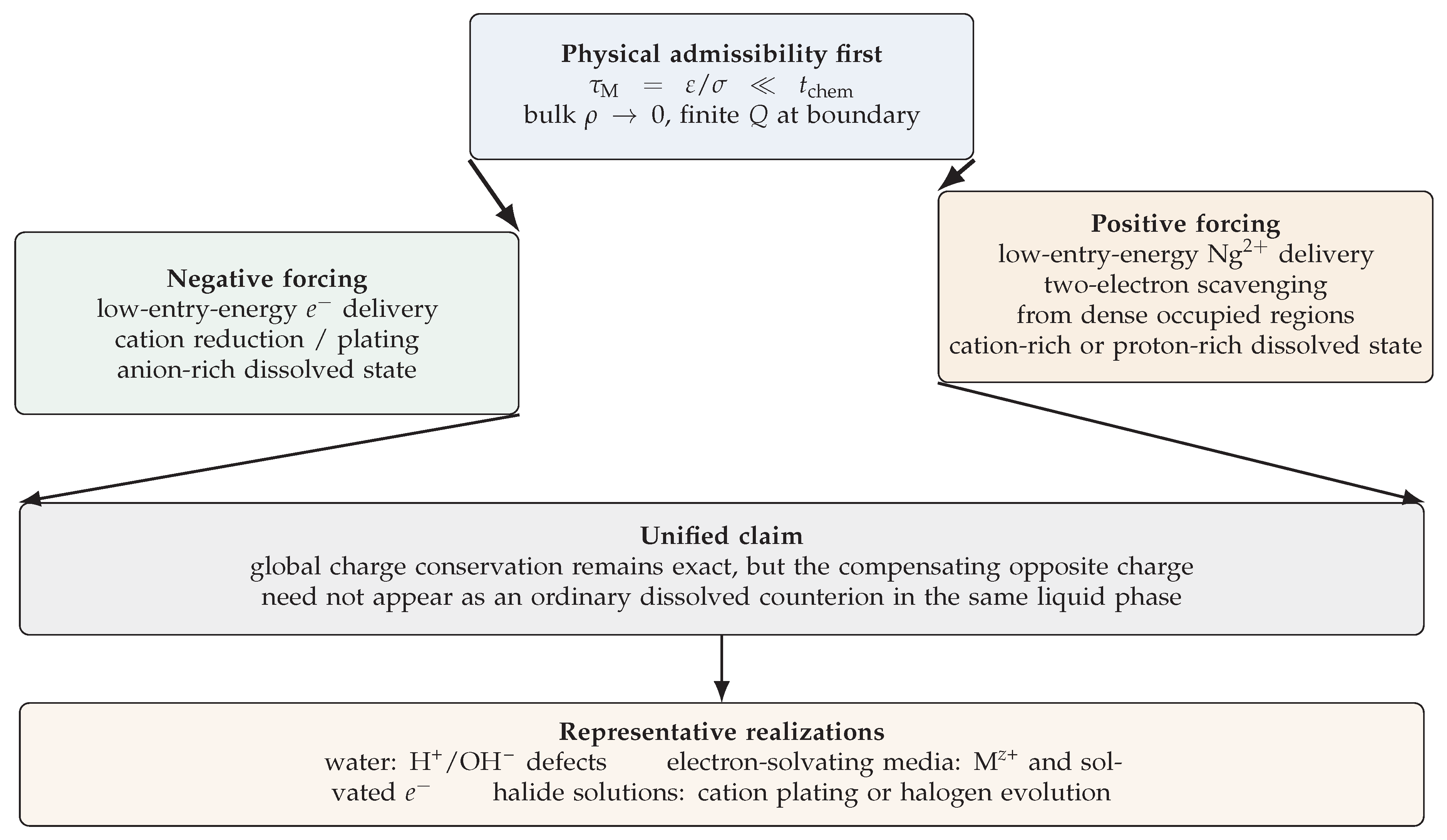
Figure 1.
Paper logic. The framework is organized so that electrostatics and transport define the admissible liquid state first; positive and negative forcing chemistries are then written within that state.
Figure 1.
Paper logic. The framework is organized so that electrostatics and transport define the admissible liquid state first; positive and negative forcing chemistries are then written within that state.
2. Theoretical Methods and General Formal Development
2.1. General Liquid Reservoir and Charge Continuity
Consider a liquid containing one or more mobile charge-bearing populations i with concentrations and signed valences . The local charge density is
and charge continuity requires
For each carrier, a reaction-transport form of the Nernst–Planck equation is written as
where is a diffusion coefficient, is the mobility, is the electric potential, is any convective velocity, and collects local reaction source and sink terms. Equations 2–4 are deliberately general and apply whether the charge carrier is a hydrated protonic defect, hydroxidic defect, solvated electron, metal cation, halide anion, or any other dissolved charged species.
2.2. Maxwell Relaxation and Boundary Localization
The electric field obeys Poisson’s equation,
with . In a conducting liquid with linear-response current , Eqs. 3 and 5 yield exponential bulk-charge decay,
Accordingly, when or , sustained bulk space charge is not the natural long-lived state of the liquid interior. The remaining nontrivial electrostatic solution is then boundary-controlled rather than bulk-controlled.
For a spherical liquid body of radius R carrying finite net charge Q after bulk relaxation,
The corresponding surface charge density is . Equation 7 is not used because all systems are spherical, but because it provides a compact geometry benchmark. The same logic extends to other shapes with modified capacitance and field prefactors.
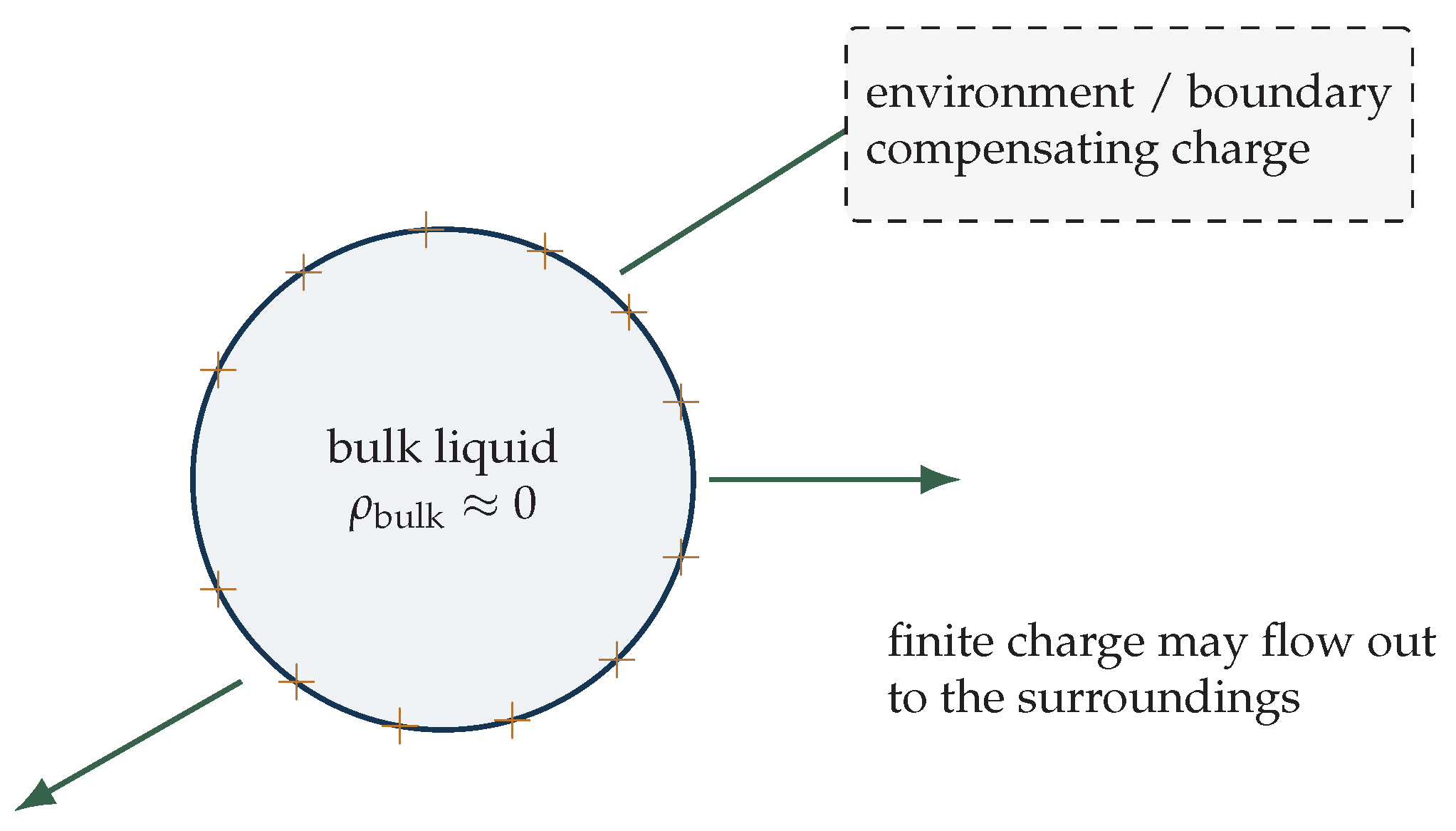
Figure 2.
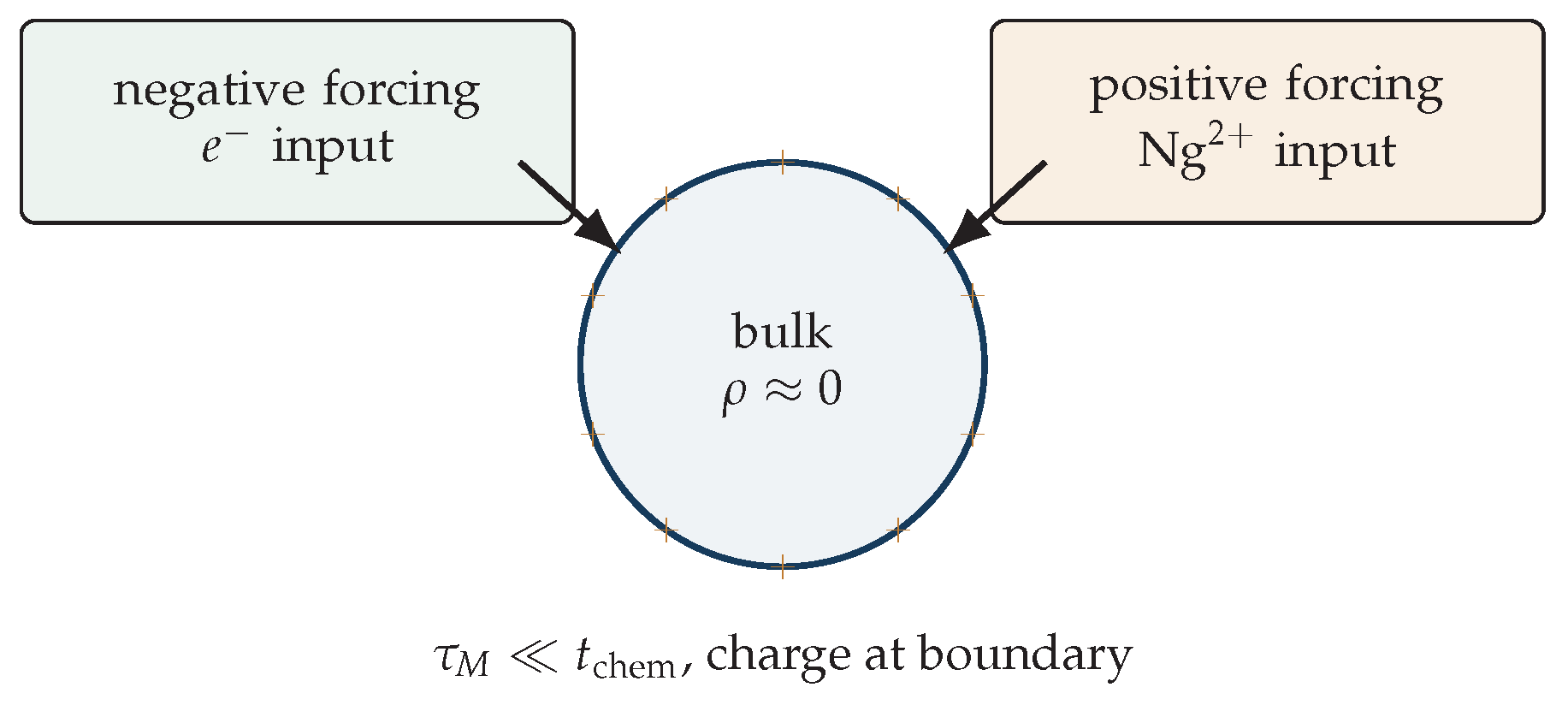
Minimal electrostatic picture for a forced counterion-deficient liquid. The bulk relaxes toward electroneutrality, any finite net charge is localized predominantly at the boundary, and compensating opposite charge is realized in the surrounding environment rather than as dissolved counterions inside the same phase.
Figure 2.
Minimal electrostatic picture for a forced counterion-deficient liquid. The bulk relaxes toward electroneutrality, any finite net charge is localized predominantly at the boundary, and compensating opposite charge is realized in the surrounding environment rather than as dissolved counterions inside the same phase.
2.3. Leakage-Limited Charge Storage and Dimensionless Admissibility Parameters
The net liquid charge is not assumed to equal the full integrated Faradaic throughput. Instead, it obeys the leading-order leakage law
This distinguishes two operational limits. In a bounded-storage regime, finite interfacial charge is maintained. In a throughflow regime, excess charge is passed rapidly to the surroundings and only modest is stored. Both limits can remain chemically counterion-deficient.
A compact solvent-general admissibility set is obtained from
A practically admissible regime requires
with providing a useful indicator of how local screening compares with system size.
2.4. Operational Current Bounds from the Admissibility Set
Equations 8–14 can be rearranged into operating-current ceilings for any chosen geometry and leakage time. Using the Rayleigh expression
the bounded-storage condition with gives the Rayleigh-limited current ceiling
Likewise, combining Eq. 7 with yields
The admissible current in the bounded regime is therefore
For the positive branch, the thermal inequality in Eq. 34 can also be written directly in current form because :
Equations 16–19 sharpen the framework from a qualitative admissibility statement into a predictive one: geometry, leakage, and heat-removal capacity map directly onto the current window within which counterion-deficient operation remains admissible.
2.5. Entry-Energy Criterion and Separation from Reaction Enthalpy
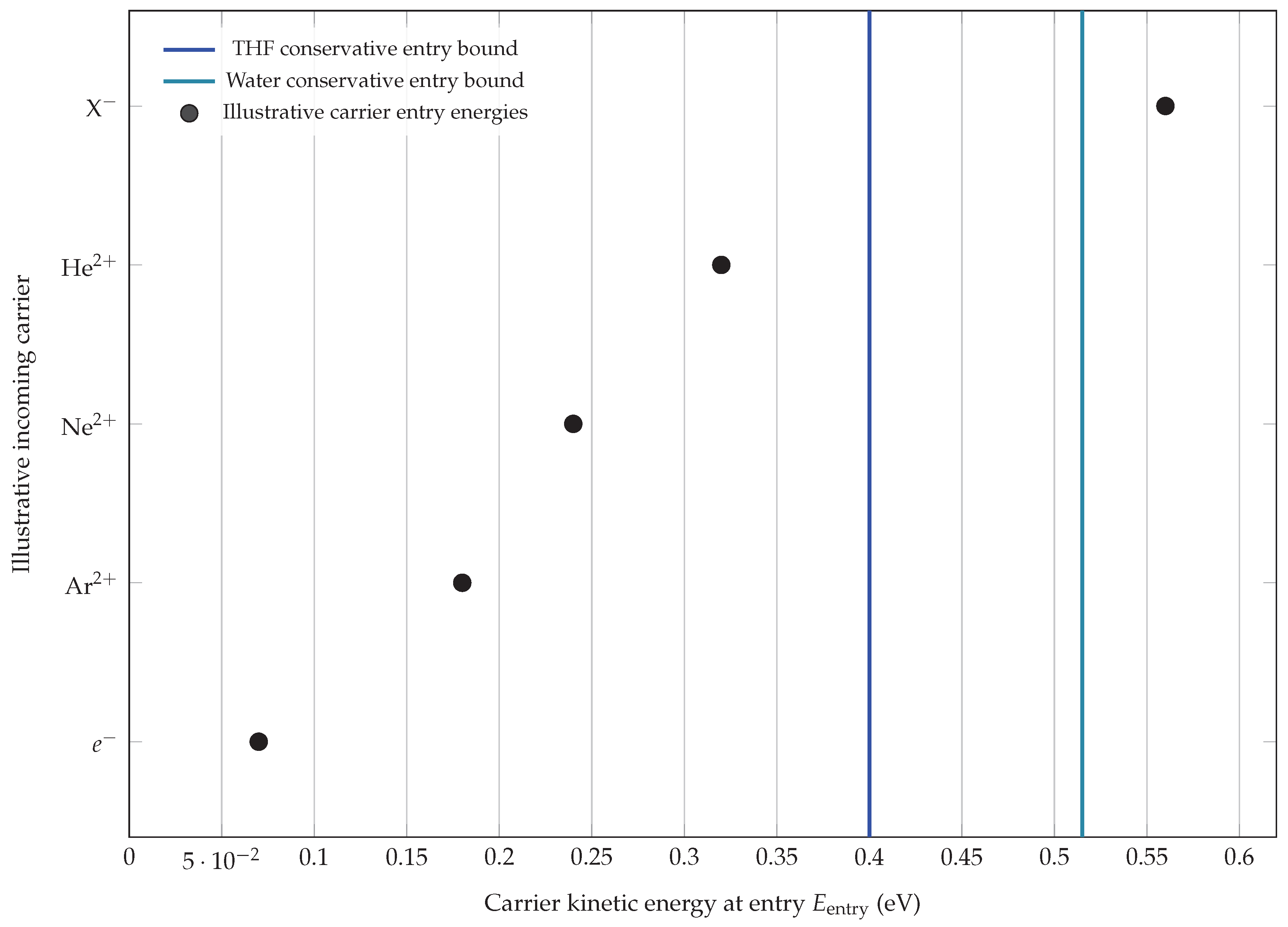
The forcing carrier must enter the liquid as a selective charge-transfer agent rather than as a source of indiscriminate fragmentation. Here refers specifically to the kinetic energy of the incoming particle at the liquid interface, not to the later neutralization enthalpy or the total energy released by the overall chemical branch. The entry criterion is therefore written in solvent-general form as
For water, taking an O-H bond energy of approximately eV gives the conservative bound . For THF, taking the weakest relevant bond to lie near 4.0 eV–4.25 eV gives . [12,13] These entry limits are conceptually distinct from the much larger thermodynamic energy released by a carrier after electron transfer.
2.6. Generalized Positive and Negative Forcing Chemistry
The framework is built around two classes of forcing events.
Positive branch.
A positive carrier removes electrons from the liquid without co-storing the opposite charge in the same phase. For a noble-gas dication,
The identity of the electron donor depends on the medium. It may be a solvated electron population, a lone-pair-rich solvent donor, or an anion such as a halide.
Negative branch.
A negative carrier injects electrons that reduce cations, plate neutral material, or otherwise remove positive charge from the dissolved phase. The generic step is
with C remaining in the liquid or separating as a neutral condensed phase.
These two relations are formal duals. Positive forcing removes electron density and favors cation-rich or proton-rich retained states. Negative forcing removes cationic charge and favors anion-rich retained states.
2.7. Representative Stoichiometric Realizations
Table 1 lists a representative set of channels that instantiate the framework in chemically different liquids without altering the basic bookkeeping.
2.8. Noble-Gas Dication Thermodynamic Scale
The noble-gas family is especially useful because the formal positive branch is the same for every nonradioactive noble gas, while the leading neutralization energy varies strongly. Table 2 lists the first and second ionization energies from the NIST Atomic Spectra Database and their sums. [14]
The table makes three points clear. First, any of the common nonradioactive noble gases can in principle be discussed within the same two-electron bookkeeping. Second, the family spans a broad neutralization range, from roughly kJ mol−1 for xenon to kJ mol−1 for helium. Third, Ar2+ is a particularly natural practical benchmark because it is formally identical to He2+ in electron count while substantially reducing the neutralization heat load. Heavier noble gases remain chemically valid members of the family, but fluoride-rich environments introduce a separate caution because krypton and especially xenon can engage in competing fluoride chemistry, making them less clean exemplars in those media. [15,16]
3. Results and Discussion
3.1. Universal Positive Branch: Electron Removal from the Highest Available Occupied Density
The positive branch is not tied to one special donor type. What matters is the availability of electronically dense occupied states from which two electrons can be removed. Figure 3 summarizes three representative classes.
3.1.1. Molecular Liquids and Lone-Pair Donors
In a lone-pair-rich molecular liquid, the most natural positive-branch entrance site is the highest localized occupied electron density available on heteroatoms or anions. Water is the clearest example because oxygen-centered lone pairs are coupled chemically to proton generation and oxygen evolution,
The same idea extends more broadly to other molecular liquids whose highest occupied localized density is likewise associated with lone pairs. The exact stoichiometric coproducts differ by solvent chemistry, but the mechanistic pattern does not: low-entry-energy dicationic forcing removes electron density, and the retained dissolved state is left deficient in ordinary dissolved negative countercharge.
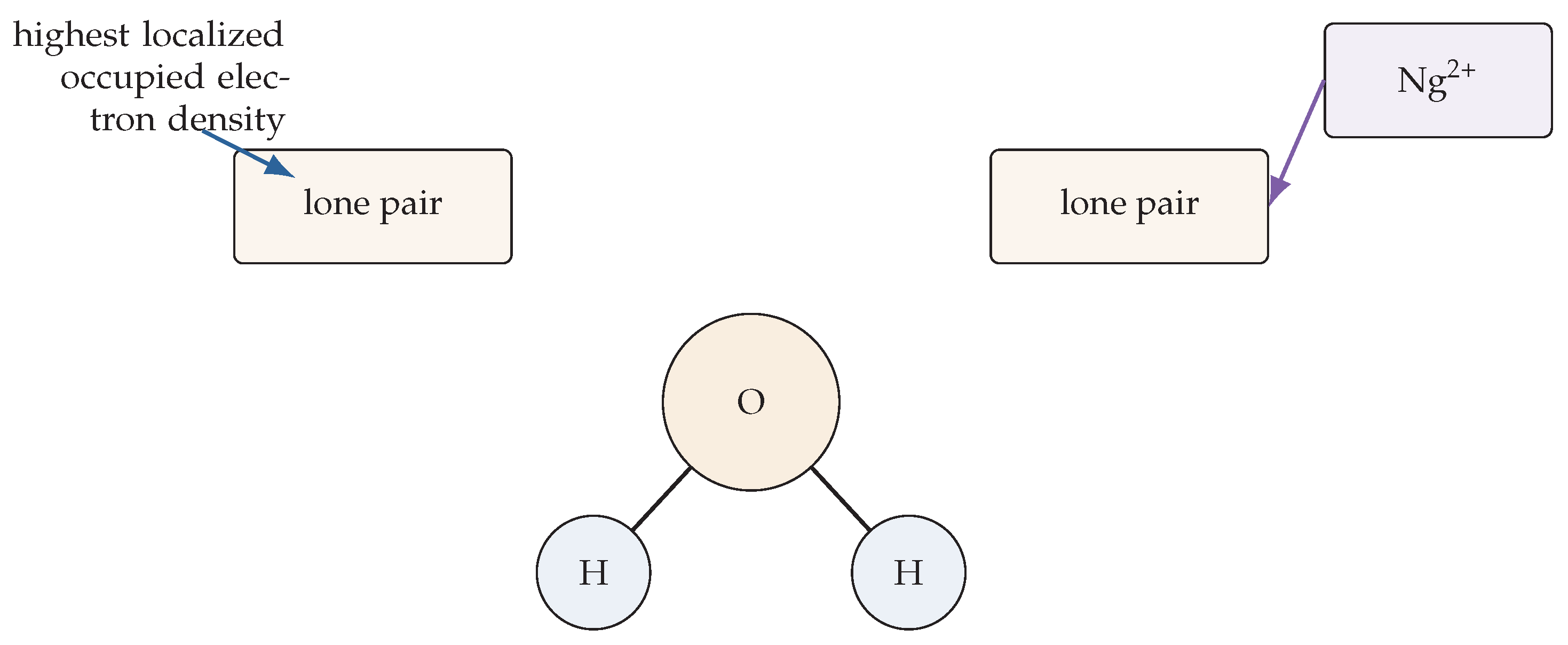
Figure 4.
Interpretive lone-pair donor picture in generalized form. Oxygen lone-pair regions are shown as a representative example of high localized occupied electron density, illustrating why lone-pair-rich molecular liquids provide a natural entrance site for low-kinetic-energy noble-gas dication forcing.
Figure 4.
Interpretive lone-pair donor picture in generalized form. Oxygen lone-pair regions are shown as a representative example of high localized occupied electron density, illustrating why lone-pair-rich molecular liquids provide a natural entrance site for low-kinetic-energy noble-gas dication forcing.
3.1.2. Electron-Solvating Liquids
In an electron-solvating liquid, the donor population is explicit:
For the common divalent case,
so the solution becomes cation-rich in the chemically relevant sense. Calcium in THF is a compact example because the source dissolution is easily written as
The earlier THF-specific framework can therefore be recovered as a direct specialization of the present solvent-general picture.
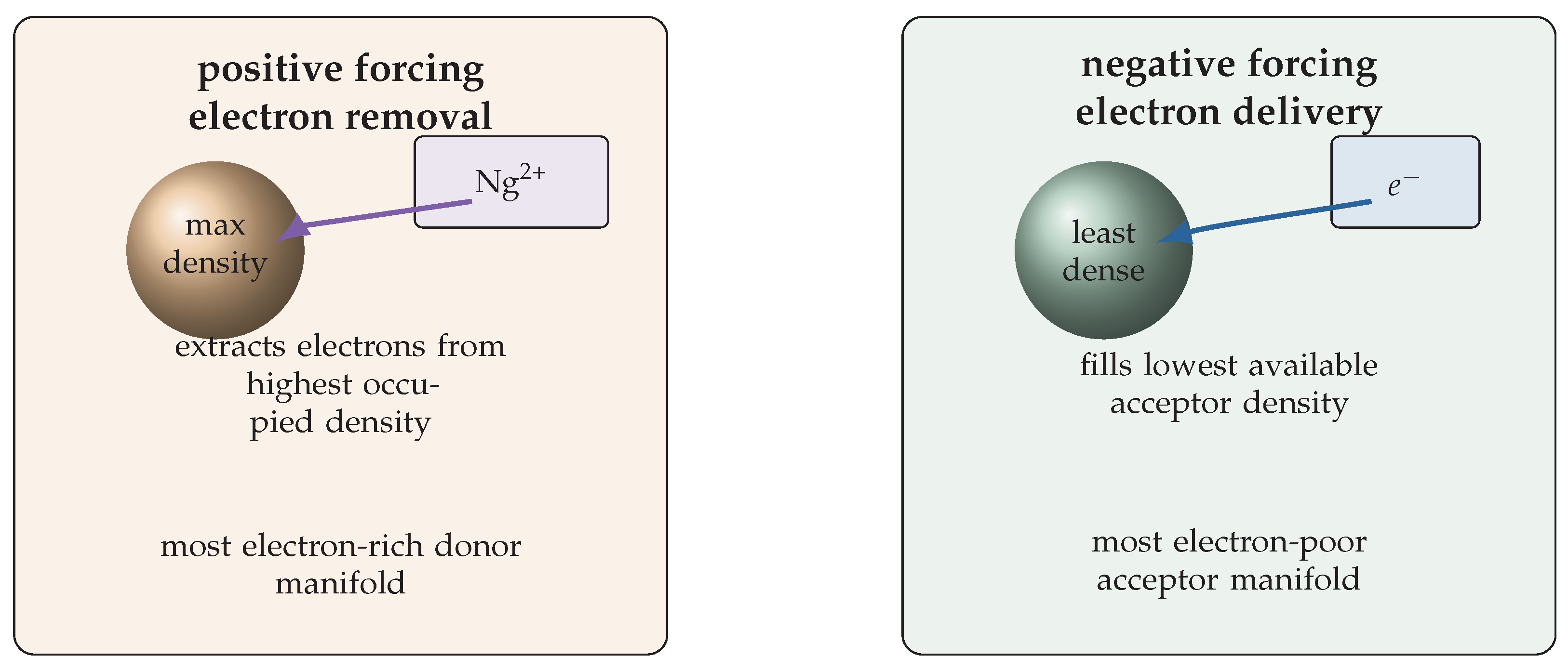
Figure 5.
Density-selective forcing principle. Noble-gas dications remove electrons from the highest available occupied density, whereas incoming electrons populate the lowest available acceptor density, that is, the most electron-poor or least electron-dense chemically accessible region.
Figure 5.
Density-selective forcing principle. Noble-gas dications remove electrons from the highest available occupied density, whereas incoming electrons populate the lowest available acceptor density, that is, the most electron-poor or least electron-dense chemically accessible region.
3.1.3. Halide-Containing Liquids
In a halide-containing liquid, the positive branch can be written as direct anion oxidation by the dicationic sink,
For LiCl dissolved in THF,
so the retained dissolved state is relatively enriched in Li+. This relation is chemically distinct from the electron-solvating case because the donor is now the halide rather than a solvated-electron population. Yet the same formal positive-branch logic still applies: the dication removes two electrons and the opposite dissolved countercharge is not reintroduced locally.
3.2. Universal Negative Branch: Electron Delivery Removes Dissolved Positive Charge
The negative branch is the formal dual of the positive branch. Electron delivery is also density-selective: the injected electron is accepted first by the lowest available acceptor manifold, that is, by the most electron-poor or least electron-dense chemically accessible region of the liquid. Electron delivery therefore removes dissolved positive charge by reduction,
leaving the liquid relatively enriched in the accompanying negative charge. Three representative examples show the generality.
Water.
Electron-solvating media.
For a metal-derived cation,
with the remaining solution retaining the negative dissolved population. In orbital language, the added electrons populate the lowest available acceptor density rather than an arbitrary location in the liquid.
Salt solutions.
For LiCl in THF,
so removal of Li+ leaves a chloride-rich retained state. The negative branch therefore complements Eq. 28: electron delivery drives cation removal, whereas dicationic forcing drives anion oxidation.
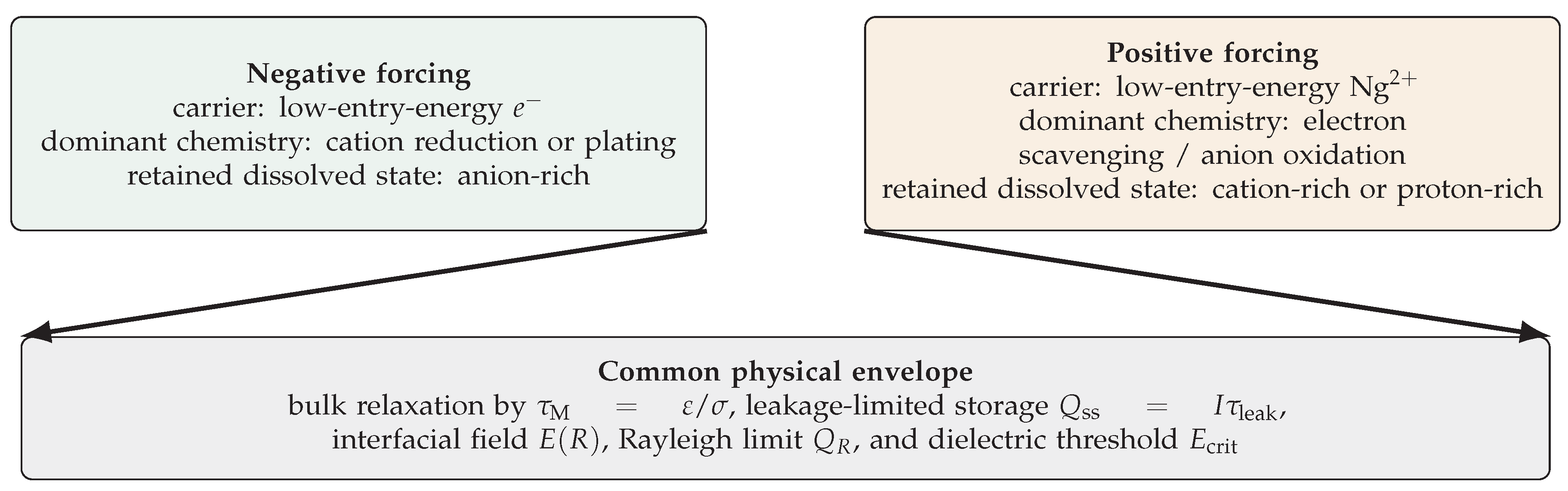
Figure 6.
Dual-control picture. Positive and negative forcing produce opposite retained dissolved charge characters, but both operate inside the same electrostatic envelope.
Figure 6.
Dual-control picture. Positive and negative forcing produce opposite retained dissolved charge characters, but both operate inside the same electrostatic envelope.
3.3. Solvent Classes and Carrier Manifolds
The theory is intentionally broader than the benchmark examples. A useful way to classify candidate liquids is by the identity of their dominant donor or acceptor manifold:
- Protic molecular liquids: donor density is strongly coupled to proton-transfer chemistry and hydrogen-bonded defect transport.
- Aprotic lone-pair-rich molecular liquids: donor density resides predominantly on heteroatom lone pairs and solvated anions.
- Electron-solvating liquids: donor density includes long-lived or metastable solvated-electron populations.
- Salt-containing liquids: carrier balance may be shifted by selective cation reduction or anion oxidation even when the neat solvent is not itself electron-rich.
The same formalism can therefore be applied to a neat liquid with no added solute, to a liquid with dissolved salts, or to a liquid containing reactive metals, provided the solvent-specific admissibility inequalities remain satisfied and the local chemistry is written honestly for that medium.
3.4. Noble-Gas Selection as a Control Parameter
Figure 7 shows the neutralization ladder associated with the idealized gas-phase reference step Ng2+ + 2e− → Ng. The physically important point is not that the liquid reproduces this reference enthalpy exactly, but that the dication family naturally spans a large energy window while preserving formal two-electron stoichiometry.
This ladder suggests a natural interpretation. He2+ is an upper-energy reference that stress-tests the framework under extreme positive-branch heat release. Ar2+ is a lower-heat benchmark that often gives a cleaner balance between formal simplicity and thermal manageability. Kr2+ and Xe2+ remain formally valid, but fluoride-rich media introduce competing chemistry that makes them less ideal if one seeks a chemically clean realization of the general mechanism.
3.5. Entry Energy and Reaction Energy Are Independent Design Axes
A key conceptual result of the present work is the strict separation of the entry condition from the neutralization scale. Figure 8 illustrates this point schematically. All members of the noble-gas family can, in principle, be brought into the same low-entry-energy admissibility window, even though their subsequent reaction enthalpies differ by several thousand .
Figure 7.
Reference neutralization scale for the noble-gas dication family. Ar2+ retains the same two-electron role as He2+ while substantially lowering the heat load.
Figure 7.
Reference neutralization scale for the noble-gas dication family. Ar2+ retains the same two-electron role as He2+ while substantially lowering the heat load.
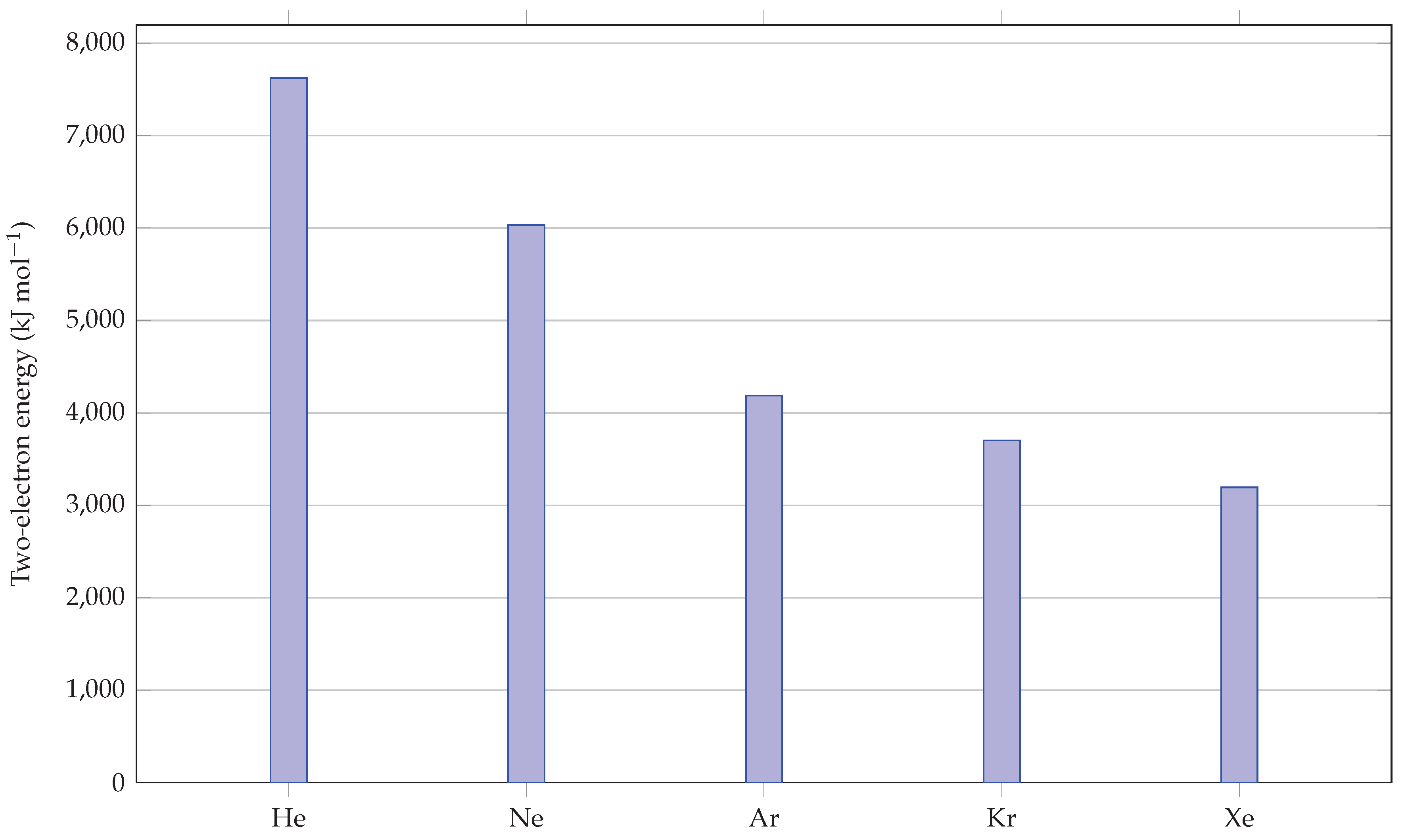
Figure 8.
Schematic kinetic-energy map for carriers entering the liquid. The threshold applies to the kinetic energy of the incoming particle at the interface; different carriers may enter with different admissible kinetic energies relative to the conservative solvent bounds.
Figure 8.
Schematic kinetic-energy map for carriers entering the liquid. The threshold applies to the kinetic energy of the incoming particle at the interface; different carriers may enter with different admissible kinetic energies relative to the conservative solvent bounds.
4. Thermal, Mechanical, and Leakage Constraints
The admissibility parameters become most useful when they are read as coupled design bounds rather than as independent inequalities. The positive branch can release large energies on a molar basis, while the leakage and capillary constraints convert stored charge directly into current ceilings. If a forcing flux processes moles per second, the leading heat-release rate is
where is represented at first pass by the noble-gas dication ladder in Table 2. This observation is not a minor engineering footnote. Large heat release directly feeds back into solvent temperature, gas evolution, conductivity, viscosity, dielectric strength, and geometry, and therefore into nearly every admissibility condition already introduced.
At minimum, the following coupled constraints must remain satisfied during sustained operation:
where is the system-scale heat-removal capacity. If the heat load raises the temperature enough to change , , or appreciably, then the electrostatic and mechanical admissibility window can contract during operation. This is one reason why Ar2+ is often a more balanced theoretical benchmark than He2+: the formal chemistry is unchanged while the leading thermal burden is much smaller.
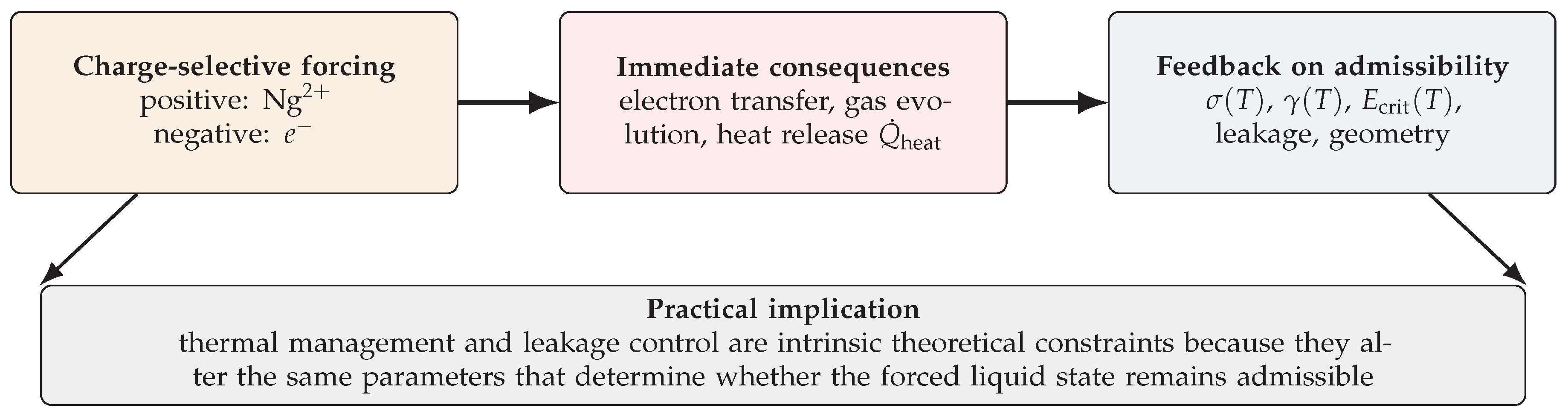
Figure 10 collects the couplings schematically. The positive branch loads the thermal axis most strongly, the negative branch generally loads it less strongly, and both branches remain subordinate to the same leakage and stability envelope.
4.1. Illustrative Aqueous Benchmark
To make the framework operational, consider an illustrative room-temperature water benchmark using a spherical droplet of radius in the bounded-storage regime. Representative values are taken as for liquid water, [17] , 18] for high-purity water at , , , and as a conservative water-breakdown benchmark for short-pulse, small-gap operation. [19] Table 3 collects the corresponding scales.
With these values, so that . The Rayleigh charge for the droplet is , whereas the chosen operating point gives and therefore . The corresponding interfacial field is , which gives . Under these representative conditions the droplet is therefore Rayleigh-limited before it is dielectric-limited, while Maxwell relaxation remains much faster than the forcing time.
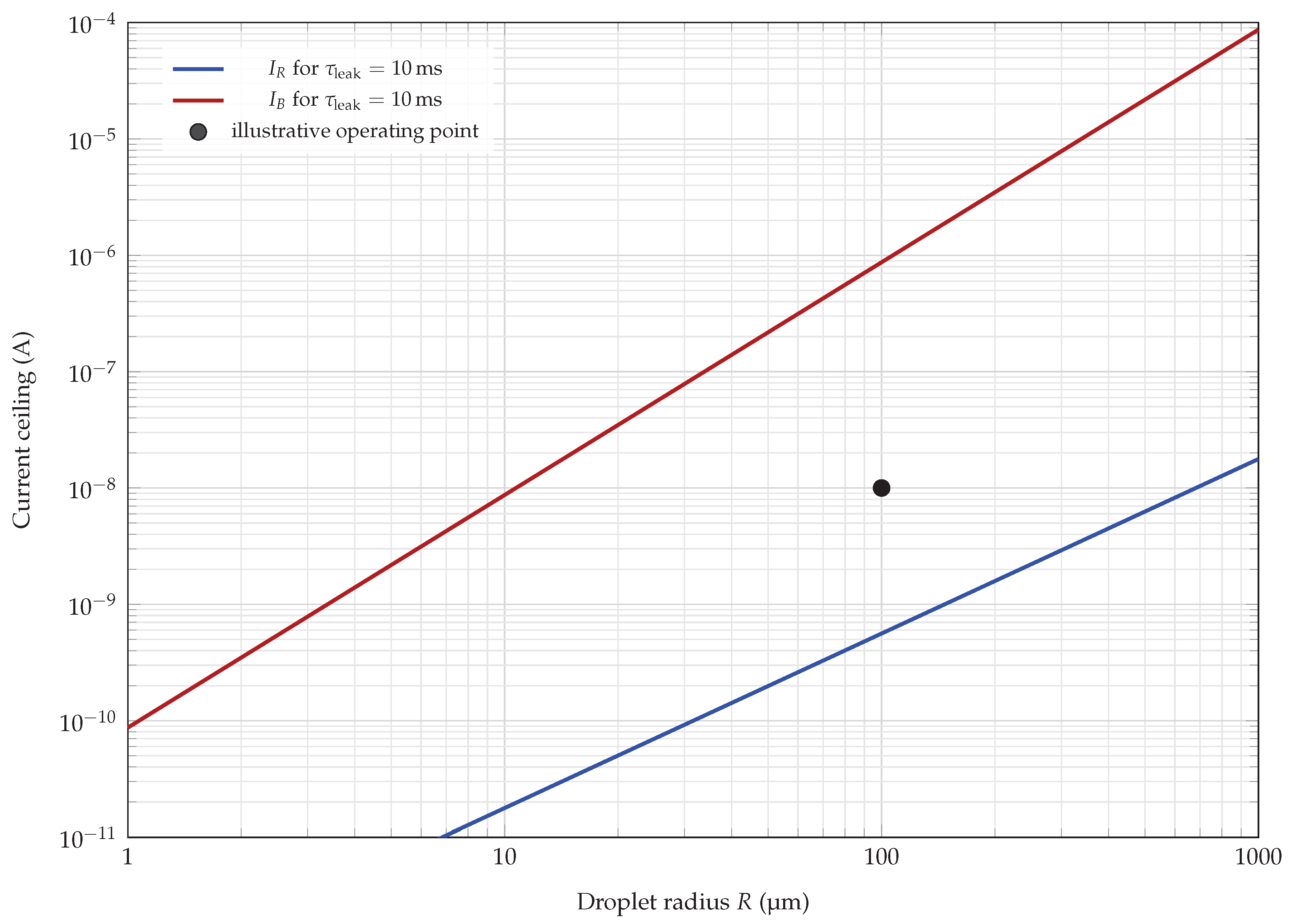
The current ceilings make the same point more transparently. Equation 16 gives , while Eq. 17 gives for the same geometry and leakage time. The Rayleigh limit therefore controls the admissible operating window for this benchmark. For the positive branch, the associated heat load at 10 nA is also modest but explicit: using Table 2, for Ar2+ and W for He2+. The thermal margin is thus comfortable at this microscale operating point, but the linear scaling of Eq. 19 makes clear that the positive branch can become heat-limited first in larger or less efficiently cooled systems even when the charge-storage inequalities are still satisfied.
Figure 9.
Representative current ceilings for the aqueous benchmark. For the parameter set in Table 3, the Rayleigh ceiling lies below the dielectric ceiling across the plotted range, so capillary instability controls the admissible current before dielectric failure does.
Figure 9.
Representative current ceilings for the aqueous benchmark. For the parameter set in Table 3, the Rayleigh ceiling lies below the dielectric ceiling across the plotted range, so capillary instability controls the admissible current before dielectric failure does.
4.2. What This Benchmark Predicts Experimentally
The benchmark sharpens the theory into several immediate predictions. First, raising at fixed should drive the system toward the Rayleigh threshold before it approaches the dielectric threshold for the parameter set above. Second, lengthening tightens the admissible current window linearly because both and scale as . Third, changing the noble gas at fixed leaves the charge-storage inequalities unchanged while changing the heat burden through . This is precisely why Ar2+ functions as the cleaner benchmark for the positive branch: it preserves the same formal two-electron sink while relaxing the thermal penalty relative to He2+.
Figure 10.
Why heat removal belongs in the theory. Reaction enthalpy changes transport, electrostatics, and geometry through temperature-dependent solvent properties and therefore cannot be separated from admissibility.
Figure 10.
Why heat removal belongs in the theory. Reaction enthalpy changes transport, electrostatics, and geometry through temperature-dependent solvent properties and therefore cannot be separated from admissibility.
5. Predictions, Falsifiers, and Limits
Because the present study is theoretical, its value depends on observations that could support it, sharpen it, or reject it outright.
5.1. Chemical Falsifiers
The first predictions are chemical rather than purely electrical.
- In the positive branch of water, positive forcing should correlate with proton-equivalent aqueous charge and with neutral coproducts Ng and O2.
- In the positive branch of halide-containing liquids, positive forcing should correlate with halogen evolution and retention of the corresponding cation-rich dissolved state.
- In the negative branch of salt solutions, electron delivery should correlate with cation reduction or plating and retention of an anion-rich dissolved state.
A persistent wrong-sign coproduct family relative to the forcing branch would falsify the bookkeeping chemistry as written.
5.2. Electrostatic Falsifier
The second prediction follows directly from Maxwell relaxation. If remains much shorter than the forcing timescale, then the theory requires
Accordingly, observation of a central liquid volume that sustains bulk field or bulk space charge on timescales long compared with would falsify the rapid-relaxation reduction used throughout the theory.
5.3. Mechanical and Current-Limit Falsifiers
The Rayleigh condition remains a direct stability discriminator. If
then reproducible operation above should not remain stably stored under the assumptions of the present theory. Instead, discharge, emission, or electrohydrodynamic restructuring should reduce the interfacial charge back toward the admissible regime. Likewise, if the measured onset of instability does not track the current ceilings in Eqs. 16 and 17 as geometry or leakage time is varied, then the leading-order storage model in Eq. 8 is incomplete.
Figure 11.
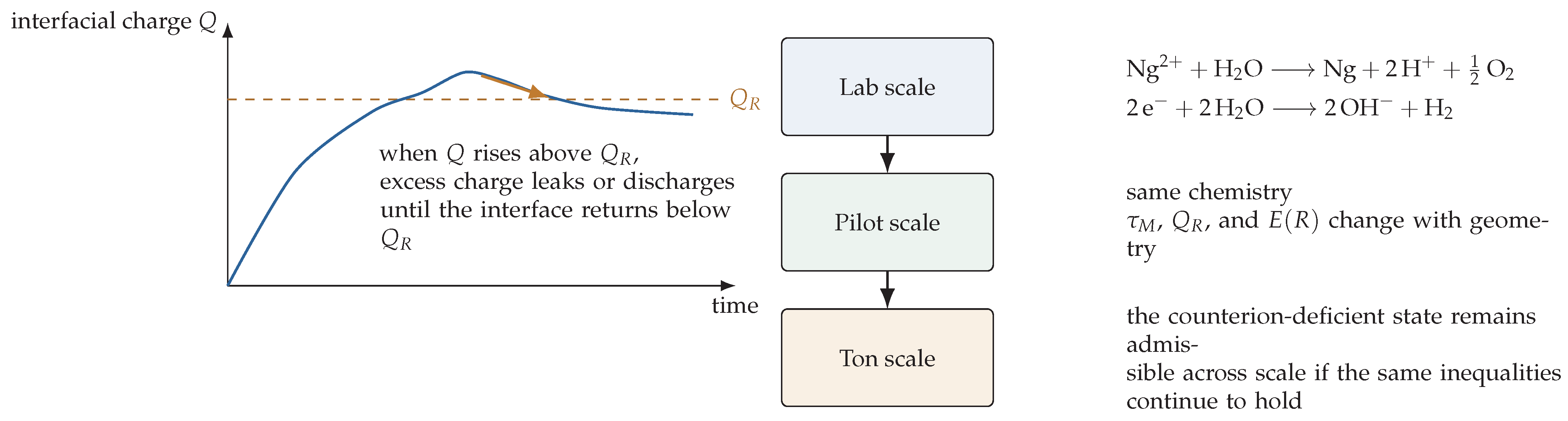
Scale and Rayleigh picture in generalized form. Left: qualitative charge evolution in the bounded regime. The interfacial charge may transiently cross the Rayleigh threshold , after which excess charge leaks or discharges until the interface returns below the admissible limit. Right: scale-general interpretation from laboratory to pilot to ton scale.
Figure 11.
Scale and Rayleigh picture in generalized form. Left: qualitative charge evolution in the bounded regime. The interfacial charge may transiently cross the Rayleigh threshold , after which excess charge leaks or discharges until the interface returns below the admissible limit. Right: scale-general interpretation from laboratory to pilot to ton scale.
5.4. Scaling and Thermal Falsifiers
Geometry should change observable quantities such as , , C, , and the leakage time without changing the underlying chemical bookkeeping. The same forcing logic should therefore remain admissible from laboratory droplets to larger reactors provided the dimensionless conditions of Eq. 14 continue to hold. For the positive branch, the thermal bound introduces a second binary test: at fixed chemistry, the maximum sustainable current should scale inversely with if heat removal is the active bottleneck. Failure of that scaling would indicate missing dissipative physics.
5.5. Explicit Limits of the Present Reduction
The present framework is intentionally narrow in one important sense: it is built for the regime in which rapid relaxation and selective forcing permit a reduced description. Several boundaries of applicability are therefore clear.
- If or larger, the bulk-charge-free interior is no longer guaranteed and a full space-charge treatment is required.
- If strong ion pairing, complexation, or specific adsorption dominates the carrier inventory, the phrase “counterion-deficient” can become chemically ambiguous because charge may be hidden in associated species rather than absent from the dissolved population.
- If electrohydrodynamic circulation, vigorous gas evolution, or strong convection sets the leakage path, the single-time-constant storage law in Eq. 8 should be regarded as a first approximation rather than a closure.
These limits do not weaken the central argument; they define the regime in which its predictions should be tested most directly.
6. Conclusions
A solvent-general theoretical framework has been developed for counterion-deficient states in liquids under charge-selective forcing. The central conclusion is that such states are not restricted to one special solvent, one special reagent pair, or one special dissolved carrier family. Instead, they arise whenever four ingredients coexist: exact local charge conservation at the chemical event, rapid bulk relaxation compared with the forcing timescale, finite residual charge carried predominantly at the boundary rather than in the bulk, and chemistry that selectively removes one dissolved charge population without reintroducing the opposite population locally.
Within that framework, positive and negative forcing are natural duals. Negative forcing injects electrons and removes cationic dissolved charge by reduction or plating, leaving anion-rich retained states. Positive forcing injects a formally universal two-electron sink, Ng2+, that removes electron density from the highest available occupied manifold in the liquid, leaving cation-rich or proton-rich retained states. The noble-gas family is especially useful because it preserves the same formal two-electron chemistry while spanning a large thermodynamic range in neutralization energy. He2+ therefore acts as an upper-energy reference, whereas Ar2+ provides a more moderate and often more practical benchmark.
The present revision sharpens that conceptual picture into a predictive one. The admissibility set now yields explicit operating-current ceilings through Eqs. 16–19, and the illustrative aqueous benchmark shows how Rayleigh, dielectric, Maxwell-relaxation, and thermal constraints separate quantitatively in a representative case. For the benchmark chosen here, capillary instability limits admissible current before dielectric failure does, while noble-gas identity primarily loads the thermal axis rather than the entry-energy axis.
The framework is deliberately broader than the illustrative examples. Water, calcium–THF, and LiCl–THF are best understood as representative realizations that expose three different donor manifolds: protonic/hydroxidic defects, solvated-electron populations, and halide lone pairs. The same mathematical structure extends to other liquids with or without dissolved species so long as the solvent-specific entry, leakage, dielectric, thermal, and capillary constraints remain satisfied.
Finally, the paper now states hard falsifiers rather than only qualitative expectations. Persistent bulk space charge for , wrong-sign coproduct families, failure of the current ceilings to scale with geometry and leakage, or breakdown of the thermal scaling with would each signal that the present reduction is incomplete. The contribution of this work is therefore not merely a unifying vocabulary. It is a physically explicit theory that yields equations, benchmarks, and experimental failure criteria by which counterion-deficient charge-selective forcing can be tested, refined, or rejected.
Acknowledgments
The author thanks the broader electrochemistry, electrodynamics, and liquid-state chemistry literature that motivated this solvent-general formulation.
AI-Assisted Writing Disclosure
Generative AI tools were used during drafting for language polishing, LaTeX editing, and figure-layout iteration. The scientific arguments, equations, chemical interpretations, and final manuscript text were reviewed and approved by the author.
Supporting Information Available
No separate Supporting Information file accompanies this manuscript; the operational-bound derivations and benchmark calculations are included in the main text.
References
- Bard, A. J.; Faulkner, L. R. Electrochemical Methods: Fundamentals and Applications, 2nd ed.; Wiley: New York, 2000.
- Jackson, J. D. Classical Electrodynamics, 3rd ed.; Wiley: New York, 1998.
- Agmon, N. The Grotthuss Mechanism. Chem. Phys. Lett. 1995, 244, 456–462. [CrossRef]
- Marx, D.; Tuckerman, M. E.; Hutter, J.; Parrinello, M. The Nature of the Hydrated Excess Proton in Water. Nature 1999, 397, 601–604. [CrossRef]
- Tuckerman, M. E.; Marx, D.; Klein, M. L.; Parrinello, M. On the Quantum Nature of the Shared Proton in Hydrogen Bonds. Science 1997, 275, 817–820. [CrossRef]
- Jortner, J. Energy Levels of Bound Electrons in Liquid Ammonia. J. Chem. Phys. 1959, 30, 839–846.
- Tuttle, T. R., Jr.; Golden, S. Solvated Electrons: What Is Solvated? J. Phys. Chem. 1991, 95, 5725–5736.
- Chaban, V. V.; Prezhdo, O. V. Electron Solvation in Liquid Ammonia: Lithium, Sodium, Magnesium, and Calcium as Electron Sources. J. Phys. Chem. B 2016, 120, 2500–2506. [CrossRef]
- Rayleigh, L. On the Equilibrium of Liquid Conducting Masses Charged with Electricity. Philos. Mag. 1882, 14, 184–186. [CrossRef]
- Taflin, D. C.; Ward, T. L.; Davis, E. J. Electrified Droplet Fission and the Rayleigh Limit. Langmuir 1989, 5, 376–384. [CrossRef]
- Lee, J. Y.; Kottke, P. A.; Fedorov, A. G. Electrohydrodynamics of Gas-Assisted Electrospray Ionization Mass Spectrometry. J. Am. Soc. Mass Spectrom. 2020, 31, 2073–2085. [CrossRef]
- Luo, Y.-R. Comprehensive Handbook of Chemical Bond Energies; CRC Press: Boca Raton, FL, 2007. [CrossRef]
- Auzmendi-Murua, I.; Charaya, S.; Bozzelli, J. W. Thermochemical Properties of Methyl-Substituted Cyclic Alkyl Ethers and Radicals for Oxiranes, Oxetanes, and Oxolanes: C–H Bond Dissociation Enthalpy Trends with Ring Size and Ether Site. J. Phys. Chem. A 2013, 117, 378–392. [CrossRef]
- Kramida, A.; Ralchenko, Yu.; Reader, J.; NIST ASD Team. NIST Atomic Spectra Database, ver. 5.12 [Online]; National Institute of Standards and Technology: Gaithersburg, MD, 2024; (accessed 2026-03-26). [CrossRef]
- Bartlett, N. Xenon Hexafluoroplatinate(V) Xe+[PtF6]-. Proc. Chem. Soc. 1962, 218.
- Holloway, J. H.; Hope, E. G. Recent Advances in Noble-Gas Chemistry. Adv. Inorg. Chem. 1998, 46, 51–100.
- Malmberg, C. G.; Maryott, A. A. Dielectric Constant of Water from 0 to 100 °C. J. Res. Natl. Bur. Stand. 1956, 56, 1–8.
- Vargaftik, N. B.; Volkov, B. N.; Voljak, L. D. International Tables of the Surface Tension of Water. J. Phys. Chem. Ref. Data 1983, 12, 817–820.
- Schoenbach, K. H.; Cooper, J.; Garner, A.; Goan, B.; Joshi, R. P.; Kolb, J.; Katsuki, S.; Kono, S.; Laroussi, M.; Leipold, F.; Lu, X.; Mallot, C.; Qian, J.; Xiao, S. Electrical Breakdown of Submillimeter Water Gaps. In BEAMS 2002: Proceedings of the 14th International Conference on High-Power Particle Beams; AIP Conf. Proc. 650; American Institute of Physics: Melville, NY, 2002; pp 111–114. [CrossRef]
Figure 3.
The positive branch is unified by the sink, not by the microscopic identity of the donor. Different liquids supply the two electrons from different occupied manifolds.
Figure 3.
The positive branch is unified by the sink, not by the microscopic identity of the donor. Different liquids supply the two electrons from different occupied manifolds.
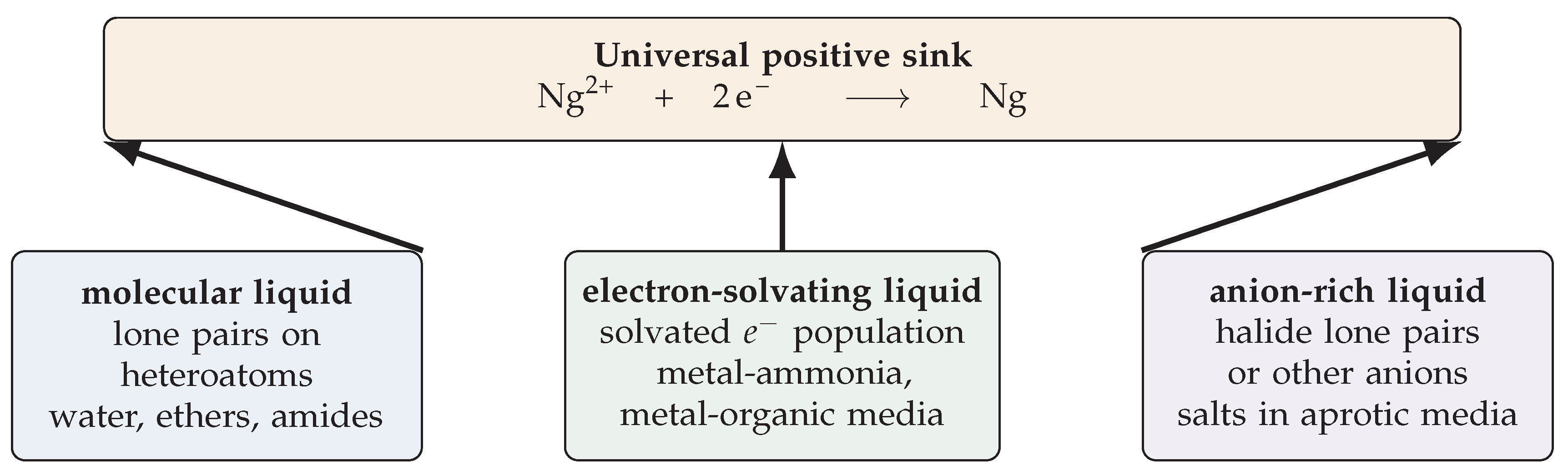

Table 1.
Representative charge-selective forcing channels in different liquid classes. The examples are illustrative rather than exhaustive.
Table 1.
Representative charge-selective forcing channels in different liquid classes. The examples are illustrative rather than exhaustive.
| Case | Representative stoichiometric relation | Retained dissolved charge character |
|---|---|---|
| Water, positive branch | Ng2+ + H2O(l) → Ng + 2H+(aq) + O2(g) | proton-rich aqueous charge |
| Water, negative branch | 2e− + 2H2O(l) → 2OH−(aq) + H2(g) | hydroxide-rich aqueous charge |
| Electron-solvating liquid, source step | M(s) → Mz+(solv) + z e−(solv) | latent paired charge reservoir |
| Electron-solvating liquid, positive branch | Ng2+ + 2e−(solv) → Ng | cation-rich dissolved state |
| Electron-solvating liquid, negative branch | Mz+(solv) + z e− → M | electron-rich or anion-rich dissolved state |
| Halide-containing liquid, positive branch | Ng2+ + 2X−(solv) → Ng + X2 | cation-rich retained state after anion oxidation |
| Salt solution, negative branch | M+(solv) + e− → M | anion-rich retained state after cation removal |
Table 2.
Noble-gas dication ladder. The sum sets the leading neutralization scale for the idealized gas-phase reference step Ng2+ + 2e− → Ng.
Table 2.
Noble-gas dication ladder. The sum sets the leading neutralization scale for the idealized gas-phase reference step Ng2+ + 2e− → Ng.
| Gas | (eV) | (eV) | Total (eV) | Total (kJ ) |
|---|---|---|---|---|
| He | 24.587 | 54.418 | 79.005 | 7622.8 |
| Ne | 21.565 | 40.963 | 62.528 | 6033.0 |
| Ar | 15.760 | 27.630 | 43.389 | 4186.4 |
| Kr | 13.999 | 24.360 | 38.359 | 3701.1 |
| Xe | 12.130 | 20.975 | 33.105 | 3194.1 |
Table 3.
Illustrative room-temperature aqueous benchmark used to convert the general admissibility set into explicit scales. The conductivity is chosen as a representative high-purity-water value at .
Table 3.
Illustrative room-temperature aqueous benchmark used to convert the general admissibility set into explicit scales. The conductivity is chosen as a representative high-purity-water value at .
| Quantity | Value | Role |
|---|---|---|
| Droplet radius R | 100 | geometry benchmark |
| Relative permittivity | 78.3 | electrostatic scale |
| Surface tension | mN m−1 | Rayleigh limit |
| Conductivity | S m−1 | Maxwell relaxation |
| Leakage time | 10 ms | bounded storage |
| Characteristic chemical time | s | forcing timescale |
| Breakdown benchmark | V m−1 | dielectric ceiling |
| Illustrative forcing current | 10 nA | sample operating point |
Disclaimer/Publisher’s Note: The statements, opinions and data contained in all publications are solely those of the individual author(s) and contributor(s) and not of MDPI and/or the editor(s). MDPI and/or the editor(s) disclaim responsibility for any injury to people or property resulting from any ideas, methods, instructions or products referred to in the content. |
© 2026 by the authors. Licensee MDPI, Basel, Switzerland. This article is an open access article distributed under the terms and conditions of the Creative Commons Attribution (CC BY) license (http://creativecommons.org/licenses/by/4.0/).
Copyright: This open access article is published under a Creative Commons CC BY 4.0 license, which permit the free download, distribution, and reuse, provided that the author and preprint are cited in any reuse.