
Submitted:
18 March 2026
Posted:
19 March 2026
You are already at the latest version
Abstract
This paper addresses the output and employment impacts of a climate self-financed taxation/subsidy policy on CO2 emission-reduction. We model a balanced climate fiscal expenditure by a two-regime CO2-based threshold autoregressive model that separates the periods of rising emissions by negative CO2 log-differences and falling emissions by positive CO2 log-differences. Applied to data sets of 16 OECD countries over 23 years (1995-2018), we find that self-financing of equal amounts of tax and subsidy over the lifespan of the data set produces an outcome in which the CO2-reducing regime dominates with significant threshold and marginal policy impacts, on both output and employment. The policy impacts by the panel data variance decomposition forecast show policy shock to total output variance outweighs other effects up to three years and to total employment variance up to four years. The assessment of a two-regime/threshold model of neutral fiscal policy constitutes our contribution to the literature.
Keywords:
panel data threshold estimator
; fiscal neutral balanced budget
; decarbonization
; OECD
1. Introduction
The search for public policy that can effectively address decarbonisation has become a critical field of climate research encompassing a range of fiscal, monetary, and financial policy tools. One approach that has in general been received with some reservation is tax-based fiscal policy for decarbonisation based on the perception that the public and hence policy makers in market economies would be reluctant to support taxation of sufficient scope to have a credible impact on fossil fuel reduction. In this study, we address that policy feasibility of a climate subsidy fiscal expenditure policy that is entirely financed by an equal amount of taxation -- so as to result in a budget-neutral fiscal expenditure. We address this approach by implementing an empirical approach to identify the turning point at which the budget-neutral fiscal policy impacts that transition.
1.1. Empirical Implementation of Neutral Budget Policy
The realization of environmental climate policies on structural change is likely to manifest itself slowly, so tracking its evolution over time is important for an accurate assessment of policy effectiveness. Most studies usually focus on application to a single equation for one country or one region to assess climate public policy at the expense of dispensing with cross-sectional variation across countries, without control for cross-sectional heterogeneity. Panel data climate policy analysis represents a step forward and is very common nowadays because of the increased availability of climate data for numerous countries. However, it comes at the cost of disregarding the variation across countries; yet more recent panel data for a large number of countries have been typically available for only short time spans.
Until fairly recently, panel data econometric theory has followed that route over a short timespan to establish asymptotic consistency with T fixed as N→, imposing homogeneity on the time dimension of individual panel data; IV-based dynamic fixed effects (DFE) models are of this type. With the increasing long time series of panel data available, econometric theory and application have focused on demonstrating the serious consequences of disregarding time-series heterogeneity and have developed more flexible models for consistent estimation that consider richer models, allowing long-run homogeneity, short-run heterogeneity, and cross-sectional dependence. This type of econometric analysis is crucial for the modelling and assessment of a balanced budget policy with slow evolution that seeks evidence of long-run policy impact and its short-run dynamics.
Public policy can play a significant role in emission mitigation and a large number of studies have explored tax and spending proposals solutions for that challenging task. One in particular that has attracted attention is a climate fiscal expenditure proposal that pays for itself by a “balanced budget”, equal in size of tax and subsidy, that requires no fiscal expenditure increase. Empirical evidence on measuring the impact of an environmental balanced budget is clearly of critical importance in demonstrating the feasibility of its adaption. Kato et. al. (2014) examined environmental balanced budget policy in nine OECD economies over 1995-2012 by adopting a least squares VAR estimation approach that traces the emission impact of one unit of tax and subsidy shock to output and employment. That approach treats output and employment as a system of ordinary least squares endogenous equations affecting each other through a jointly unobservable innovation to the variance-covariance matrix of the error terms; resulting in a time-series VAR in log-level difference specification that excludes country-specific effects of policy outcomes for high and low carbon output and employment economic sectors. However, a large body of panel data studies demonstrate that purely time-series pooled analysis of panel data displays substantial cross-section estimation error due to an ever-increasing economic and financial interdependence, especially among the OECD economies, ignoring the cross-sectional interdependence results in bias policy estimation but also inefficient policy impact estimation.
The extent of the bias and/or inefficiency depends on the type of panel data model employed and that is determined by the relative sizes of N and T dimensions of the panel data available. If panel cross-sectional dependence with unobserved shared common factors through the VAR residual terms are uncorrelated with the included predictors, the usual FE and random effects are consistent, though due to potential serial correlation over time, or cross-sectional heteroskedasticity, the standard errors are inefficient and require either correction or employing an efficient estimator. However, the FE and RE estimators are both biased and/or inconsistent if the cross-sectional interdependence unobserved error terms are correlated with the included regressors. If the time span of the panel is small relative to the cross-section, and its cross-sectional observations are large, we can then employ the FE or instrumental FE approach of Hausman and Taylor (1981) cross-sectionally, though it may be difficult to find such instruments; otherwise, an alternative such as Pesaran (2004) can provide a panel cross dependence test, see below. However, in dynamic panel data with a moderately short T dimension, at least no more than ten, the influence of cross-sectional dependence is more pronounced. If the dependence is ignored when cross-sectional dependence is large, the loss of efficiency can become so large that the application of pooled panel least squares can prove no better than the single-equation OLS, as demonstrated in Phillips and Sul (2003). Moreover, Sarafidis and Robertson (2006) have argued that under those conditions, dynamic FE by GMM such as Arellano and Bond (1991) will be inconsistent since the panel GMM relies on the assumption of growing N relative to fixed T as N1 to obtain N-asymptotic consistency. However, when T>N, we can test cross-sectional dependence by the Lagrange multiplier (LM) test of Breusch and Pagan (1980) before fitting any panel data model2; the test can be applied in a panel-data modified VAR model. Nonetheless, a VAR approach is not robust to the number of variables included, to the lag structure adopted, Cooley and LeRoy (1985); VAR assumes all variables are endogenous, each with multiple lags appears in each equation, may result in inefficiency due to severe loss in degrees-of-freedom. However, if the time-span of the data is relatively large, we can employ the single-equation ARDL approach of Pesaran and Smith (1995) which permits both long and short run effects estimation, for a fiscal policy balanced budget climate application see Koohi-Kamali, et. al. (2025). Given panel data availability with moderate time span, a different approach is to explore the panel cross-sectional interdependence with the dynamic panel data approach as a single-equation method for estimation of employment and output equations in the high and low fossil-fuel sectors of the economy, see Koohi-Kamali and Flaherty (2021) for application to environmental disasters. Moreover, one alternative if panel data has only a moderate time-span, is to apply the single-equation threshold model of Tong (1983) proposed for longitudinal data by Henson (1999). A particularly attractive feature of the panel data threshold model to emission reducing estimation of policy impact is that it offers estimates for observations of increasing and decreasing emissions over the sample time span and its cross-sectional units. Since the data set for this study have moderate time span, we employ a single-equation dynamic panel data approach with a longitudinal threshold model in order to assess the fiscal balanced budget policy impact; the threshold is defined for high and low emissions and cross-sectional interdependence.
2. Materials and Methods
2.1. Literature on Threshold Regression Climate Fiscal Policy
The global fiscal policy decarbonization agenda should address two tasks that are difficult to reconcile, namely the importance of fiscal policy as an essential tool for transitioning to low-carbon economies while ensuring macroeconomic stability. In this context, the concept of neutral fiscal policy—where governments impose environmental taxes while offsetting the resulting revenue loss with equivalent tax reductions or transfers—has garnered attention, see Kato et. al. (2015) or Koohi-Kamali et. al. (2025). This approach is attractive for OECD countries, where limited fiscal capacity and public opposition to tax increases create significant challenges for implementing climate policies. However, recent research suggests that the effects of fiscal instruments on decarbonization are often non-linear, depending on the strength of the policies and the specific institutional context. Consequently, the studies in the field have employed two-regime theoretical threshold models combined with various panel data approaches to examine fiscal policy dynamics.
The autoregressive and self-exiting are common threshold models first proposed by Tong (1983); Hansen (1999) further introduced a threshold model that detects endogenous regime shifts within panel data, differentiating between low and high policy effectiveness based on threshold values of fiscal or environmental factors. The cross-sectional threshold model of Caner and Hansen (2004) proposed a generalized method of moments (GMM) type instrumental variable estimators that allow estimation with endogeneity. Below, we briefly review the effectiveness of the threshold regression in the field of environmental taxation and green economics, where policy tools often exhibit non-linear effects.
Al Shammre et al. (2023) utilized a panel threshold model to investigate the effects of various environmental tax categories (transport, resource, pollution, and energy) on CO2 emissions in 34 OECD countries between 1995 and 2019. The dynamic panel threshold regression indicates that CO2 emissions decrease in the upper regime when the total environmental tax, energy tax, and pollution tax exceed specific threshold levels. These thresholds are set at 3.002% of GDP for the total environmental tax, 1.991% for the energy tax, and 0.377% for the pollution tax. They conclude countries should use different types of environmental tax to reduce decarbonization. Similarly, Aydin and Esen (2018) employed a dynamic panel threshold regression model to examine the impact of environmentally related taxes on carbon dioxide (CO2) emissions in EU member states between 1995 and 2013. Their results confirm asymmetrical relationships, in which the thresholds of the environmental taxes for total environmental taxes, energy taxes (including CO2 taxes), transport taxes, and taxes on pollution and resources are 3.02%, 2.20%, 0.88%, and 0.23%, respectively. They concluded that, after exceeding the threshold level, the effect of environmentally related taxes (excluding transport taxes) on CO2 emissions changes from insignificantly positive to significantly negative. Another study using a quantile fixed-effect panel data method, Albulescu et al. (2022) examined how environmental policy stringency, that is a specific pollution price imposed by environmental policies, affects CO2 emissions in a group of 32 countries from 1990 to 2015. Their findings indicated that an increase in policy stringency negatively impacts emissions, and that environmental stringency has a stronger effect in countries with lower levels of carbon emissions. Thi Nguyen and Ho (2024) employed a Bayesian approach along with threshold estimation to quantitatively assess the interaction between economic growth, fiscal policy instruments, and environmental degradation in Vietnam from 1990 to 2021. Their findings on CO2 reveal that fiscal policy tools have a significant positive impact on the climate change, leading to higher environmental degradation, reinforced with government spending exerting a larger effect than taxation. However, they also find that a threshold model of growth demonstrates that climate change initially affects growth negatively at lower income levels and positively at higher income levels, consistent with an inverted Environmental Kuznets Curve (EKC) hypothesis. Yiadom et al. (2024) examined the threshold effects of the relationship between finance, development, and carbon emissions across 97 countries, including 50 low-income and 47 high-income nations, during the period from 1991 to 2019. They employ indicators of financial development consisting of access, depth and efficiency combined into an index that ranges between -1 to 1. They show that there is significant in threshold difference between low and high financially developed economies; low-income countries require financial development based on threshold of at least 0.354 to effectively reduce carbon emissions. Conversely, high-income countries require a higher threshold of 0.662 to address finance-driven carbon emissions. These results affirm the existence of a finance-led Environmental Kuznets Curve (EKC). However, dynamic panel data estimation must address the endogeneity of the autoregressive terms by instrumenting them, a critical issue not addressed in the above threshold regression. Hanson (1999) proposed a superior estimation methodology based on the GMM estimate of the dynamic panel data of Arellano and Bond (1991) extended for threshold model application. This estimation technique offers estimates for all coefficients, including control variables, in both the lower and upper regimes while accounting for endogeneity, heteroscedasticity, and serial correlation. Kremer et al. (2011) is an example of a dynamic panel data threshold model based on GMM for a large sample of 124 industrialized and non-industrialized countries over 1950-20040 to estimate the inflation threshold for long-run growth; they found the inflation threshold that triggers growth is 2% for developed and 17% for developing economies.
Except for the last paper, all the above studies employ a threshold model approach to estimate the turning point at which an environmental tax can start decarbonisation. However, the scope for relying on climate taxation alone to achieve effective fossil fuel reduction in private market economies is limited and faces policymakers’ reluctance to implement it. That raises the question of examining an alternative that moderates the effects of tax increases on the economy, either on private businesses or on consumers. This is the gap in the literature we intend to examine in this study. We propose a neutral green fiscal policy that finances decarbonization through a green subsidy, financed entirely by an equal amount of fossil fuel taxation. The incorporation of two-regime panel threshold models into decarbonization studies presents a promising avenue for refining fiscal strategies that are both growth-neutral and environmentally effective. We address this gap in the literature by employing a threshold model estimator to assess the effectiveness of a neutral fiscal policy for a heterogeneous group of OECD economies to and to identify the climate tax-subsidy threshold for long-run growth
2.2. Econometric Model
The principal issue is how to define an identification for periods of high and low fossil-fuels over time rather than each year. We employ the lagged differenced observations of each year for that purpose; negative when the economy is going through increasing emissions and positive through decreasing emissions
Applying this criterion, the next question is how to allocate the tax and subsidy to periods of rising and declining emissions to implement a balanced budget fiscal policy. We deal with this critical question by adopting a demeaned series defined in lagged differences after incorporating the policy penalty/incentive, namely a $ value of equivalent of each unit of emission in tons. That is, subtracting a unit of taxation to the series in dollars during periods of increasing emissions and adding a unit of subsidy during its decreasing periods so as to have a balanced fiscal expenditure over the timespan of the study rather than each year.
We start with the simplest linear dynamic first-differenced autoregressive model for GDP and EMP with a continuous CO2 policy, and control for employment to test a model specified below, also with a continuous CO2 policy but inclusive of regime change threshold variable.
And
where indicates first differenced regressors and its lagged values, G and E upper cases stand for GDP and EMP and their lower cases used for corresponding coefficients and residual terms. We note endogeneity of (2) and (3) in differenced variables are resolved with internal instruments in levels; for details, see Arrellano and Bond (1991) or Cameron and Trivedi (2005).
We contrast estimation of (2) and (3) with estimation of a two-regime with a single tax-subsidy threshold value based on threshold variable written in general as
where
The mode; estimates by the least squares regression of (14) to obtain
where y* and X* are within-group deviations, and (RSS)= . The threshold estimator searches in a subset of rather than the full sample within interval range of (for quantiles of the threshold variable . Minimizing RSS of (4) results in value of threshold parameter over restricted quantiles of range of the threshold variable to produce.
where is the RSS of threshold estimator. This is a standard east squares estimator if the sample splitting threshold parameter is known, if not then estimator has nonstandard asymptotic distribution. Hansen (1997, 1999) proposed a likelihood-ration (LR) test for consistency of based on the computation of the quantile significance level to obtain the corresponding threshold significance level of from
For example, for , the corresponding quantile by (6) is 7.35, etc. Testing for a threshold effect of the linear versus the single-threshold model provides a test of whether the effect is the same in each regime by
where and are the two regimes coefficient and the parameter represents the cross-section units. A similar F statistic can be constructed from the difference between the linear RSS of the linear model and threshold estimates to test that under the threshold is not identified
has nonstandard asymptotic distribution and requires bootstrapping to obtain the F statistic critical values to test the threshold effect, involving several bootstrap steps. First, we fit the model to obtain the residuals and then make a cluster resampling of with replacement to obtain which in turn are used to create a new series under the null hypothesis DGP to estimate β under and in order to compute the statistic. Repeating the steps B times produces the proportion of probability of F > for the F distribution probability Pro =I (F > ), see Hansen (2011) a survey of threshold models in economics.
The specification of a longitudinal threshold model requires the specification of a threshold function for based on our CO2 policy regressor (5). Defining =Δ.log, we specify the output self-exiting threshold model as
The model is equivalently estimated by combining (7) and (8) into a single equation model presented.
The employment threshold model as
and single equation panel data threshold for
We note the threshold variable based on (9) for , and in (12) for , identifies periods of increasing CO2 emissions by negative lag difference periods of and decreasing CO2 emissions by positive lag difference periods.
2.3. Data description and transformation.
The data for this study comes from the following three sources: (CO2 emission measured in million metric tons of CO2 equivalent (MTCO2e)) https://climatedata.imf.org/pages/greenhouse-gas-emissions#gg3, Employment: Employment to population ratio, 15+, total (%) (modelled ILO) estimate)) https://data.worldbank.org/indicator; GDP per capita: https://data.un.org/Search.aspx?q=gdp.
The data sets cover 16 OECD countries for which data were available for all three sets over 1995-2018, namely Belgium, Denmark, Estonia, Finland, France, Germany, Hungary, Japan, Italy, the Netherlands, Poland, Portugal, Spain, Sweden, the UK, and the USA. All values are in annual terms. Table 1 displays the sample descriptive data. We transform the CO2 data set by (1) above for each country into a two-regime time series defined as above/below the medium of CO2 as regimes of emission increasing and decreasing periods. Table 2 presents the descriptive data for the de-meaned data sets employed in this study, with the total sum of mean between and within values approximately zero.
The cross-sectional independence for output (GDP) is firmly rejected. Next, we test for cross-sectional independence for employment, which is also rejected. We therefore move ahead with a longitudinal approach, and we estimate the single-equation dynamic panel version of the Fixed Effects model (DFE), as in Arellano-Bond (1991), in first differences using as instruments from lags in levels further back in time, uncorrelated with current period error terms, to correct for endogeneity of the AR terms.
3. Results
Before a decision is made on a panel data approach, we test for cross-sectional dependence in Table 3.
3.1. Overall Policy Impact
We estimate separately longitudinal models (2) and (9) for GDP, and (3) and (12) for EMP, respectively for GDP in Table 4 and for EMP in Table 5; in each case, we also specify versions (9) and (12) with one-regime threshold and a continuous policy regressor for easy test of (2) v. (9) and (3) v. (12). Finally, we estimate and test of one-regime with continuous CO2 regressors for policy impact.
Two key features of the threshold model are notable. First, a decision has to be made on specification of the threshold variable and estimated form of parameter, the threshold estimator. Modelling a two-regime threshold impacts on output and employment makes it hard to interpret the policy impact in terms of a single estimated value. The model adapted here adds the policy CO2 as a continuous variable and to avoid multicollinearity between the threshold and CO2 variables, the threshold model is estimated with one regime left out as the base. This solution produces a single estimate for the marginal of policy impact, controlling separately for threshold marginal below the threshold value estimates. We also note that which single threshold variable is retained by the threshold estimator can differ as above or below for the GDP and EMP Equations (9) and (12) depending on the distribution of emission increasing and emission decreasing observations in each case. As shown in Table 4 and Table 5 below, this rearrangement represents the same threshold parameter and other coefficient estimates with single or two-regime coefficients, and is only taken so as to have a conveniently interpretable policy estimate. Therefore, the first notable feature of our approach is that the regime threshold change is based on the medium CO2 of each country and year values, while the policy variable is entered separately as a continuous CO2 variable. Second, entering the policy CO2 as a continuous variable allows a more direct interpretation of the policy impact as simultaneous tax v. subsidy effects since the variable contains both periods of increase CO2 (negative) lag-difference and decrease CO2 (positive) in lag-difference. Finally, one-regime with a continuous CO2 policy variable makes a simple test of linear (2) v. nonlinear (9) since the former is nested in the latter.
We employ single equation models, one for GDP and one for EMP; in each case, we test the estimated model with CO2 modified policy effects against the same model without the CO2 policy transformation. All variables are demeaned so the tax-subsidy effects sum up to zero over the time span of the sample. Taking as an example the middle columns, show conditional on the policy transformed variable reaching CO2-reducing negative regime as in (1), that is, [], of less than 0.405, the policy makes have negative threshold marginals of -0.0715 for GDP and -0.009 for EMP. However, controlling for that, the policy tool correlate positively with GDP and EMP with marginal contributions output by 0.041% and to employment by 0.004% for one % change in the policy tool; and the Hausman tests of no difference between with and without policy (last columns of Table 4, left and right sections) are rejected in both cases, decisively so for output.
3.2. Output Estimates by Equation (9)
Table 4, column 2 for GDP presents estimates for the linear dynamic FD model. We note a negative impact significant at 1% for the continuous (log-diff) CO2 regressor, a sign contrary to the simulated policy predictions of Section 2 above Figure 1 and Figure 2. Two possible sources for potential misspecification are reported at the bottom of Table 4 notes for column 2 estimates. The Sargan test of internal instrument validity reject the hypothesis of weak instrument set, or to detect first/second/third-order serial correlation. That leaves another source of misspecification, namely a model a nonlinear model with policy impact based on CO2 reducing regime change. The rest of Table 4 explores hat nonlinear alternative and test it against (2) estimated model.
Table 4, columns 3-5 show the threshold DFE estimation results in standard form of two-regime and one threshold. As noted above, columns two and three have identical coefficient estimates with the former column (threshold-co2) with one threshold and two discrete CO2-based regimes and the latter (threshold+co2) also with one threshold regime but also one continuous CO2 regressor. The standard threshold of 0.405% indicates that values below that belong to the negative fossil fuel reducing CO2, and above that to fossil-fuel increasing CO2, with a 95% confidence interval that the threshold value is never less than 0.32% or greater than 0.54%. The marginal contributions, reported in order of the regime which makes most policy impact, are also significant at 1% (z values in brackets) of -0.03% (5.76) in the CO2 reducing regime, and of 0.04 (3.5) in the CO2 increasing, indicating the CO2 reducing regime appear to dominate over-all impact.
We note that column 3 (threshold+co2), our baseline model, shows controlling for policy in the emission reducing regime interpreted in terms of Equation (1) of less than 0.405, the policy variable has a negative threshold marginal impact on employment of -0.0701 but contributes positively to output by 0.041% in terms of the continuous policy marginals, both significant at 1%. We also note a very strong AR term, and significant threshold and lagged EMP estimates for the baseline model. Expressed the model in terms of one-regime with a continuous CO2 policy regressor the policy impact has now changed from the linear model negative in column 2 model to positive CO2-reducing policy, significant at 1%; moreover, the size of the impact is also twice as large in the column 4 model compared to column 2 model. Table 4 provides a straightforward test of (12) v. one-regime threshold version of (3); the Hausman test at the bottom of Table 4, last line, supports the nonlinear.
Column 5 (without policy) presents the same model without transformation of balanced tax-subsidy CO2. We note the estimated coefficient values, except for the threshold parameter of 0.212 (0.18-0.21), are quite similar in column 4 compared to the baseline column 3; in particular, both CO2 continuous marginals are positive, though untransformed estimates are half as large, and notably of much less significant (just barely at 10%). This raises the question of whether the transformed fiscal policy CO2 baseline is significantly different from the model without policy. The answer is given at the bottle of Table 4, GDP left portion; null hypothesis of model similarity is strongly and decisively rejected in favor of policy transformed model (threshold+co2).
3.3. Employment Estimates by Equation (12)
Table 5, column 2 presents EMP estimates for the linear dynamic FD model. We note a positive impact significant at 1% for the continuous (log-diff) CO2 regressor, in line with the prediction of our study-guide regarding CO2 reducing policy impact. However, the size of the coefficient estimate is small, and smaller than that for GDP. We test again for two possible sources for potential misspecification are reported at the bottom of Table 5 notes for the linear column 2 estimates. The Sargan test of internal instrument validity reject the hypothesis of weak instrument set, and cannot detect first/second/third-order serial correlation. Similar to the GDP estimates, that leaves another source of misspecification, namely a model a nonlinear EMP model with policy impact based on CO2 reducing regime change. The rest of Table 4 explores the nonlinear alternative and test it against (13) estimated model.
Table 5 columns 3-5 shows the nonlinear threshold estimates in standard form with threshold value at 0.517 with 95% confidence interval of [- 0.1.40 to 0.70] splitting the CO2 into policy reducing emission below 0.517 and policy increasing emission above 0.517; with threshold marginal effects significant at 1% for the lower (negative) regime with, respectively, -0.0044 (2.90) contribution, and the upper (positive) regime with 0.0049% (2.90) contribution to EMP. We also note that the model estimates represent very strong short-run dynamics.
Expressed the model in terms of one-regime with a continuous CO2 policy regressor, the policy impact has remains positive and significant at 1%; moreover, the size of the impact though relatively small is larger than in the column 2 linear model. Table 5 provides a straightforward test of (3) v. one-regime threshold version of (12); the Hausman test at the bottom of Table 5, last line, supports the nonlinear threshold model.
In the case the baseline EMP model of Table 5 with continuous policy CO2, conditional on the same threshold as column 4 above (0.517), negative regime threshold marginal estimate at -0.0093% (1.90) is barely significant at 10%; conditional on lower negative regime, the continuous emission reducing marginal of the transformed policy makes a positive contributes 0.0044% (2.90) to employment (EMP); twice as large as the linear model impact. Once again with strong AR term and lagged EMP significant at 1%.
Finally, the threshold model untransformed of final column 7 of Table 4 has equally significant threshold and continuous CO2 marginals but in the opposite negative direction with discrete emission marginal and increasing impact on EMP condition; otherwise, the remaining estimates are quite similar without policy and with policy- columns 7 compared to column 6. However, the Hausman test of model comparison once again rejects the null hypothesis of model similarity at 5%. We therefore proceed with columns 3 and 6 as our baseline model of GDP and EMP, respectively.
3.4. post-Estimation Test and Policy Forecasting
Figure 1 presents the predicted values of the GDP dependent variable with CO2 transformed policy regressor (in blue) compared to the CO2 regressor without policy change (in red). There are differences around 2008-2010 and again post 2015 with the blue curve below and above the red. Figure 2 shows the same curves for EMP, and in this case, there are also divergences between the predicted dependent variables before 2010, the blue curve below the red earlier and the reverse later. Nonetheless, as the plots mostly follow each other very closely for both GDP and EMP to be sufficiently informative as one-step-a-head forecasts. We therefore examine a panel data causality test for impact of balanced policy CO2 on GDP and EMP in Table 6.
The causality tests provide a clear one-directional answer to innovation shocks initiated from the policy regressors to GDP and EMP Equations (9) and (12) regression results. The causality test results in Table 6 show that policy has a positive impact at 1% on both GDP and EMP, but neither GDP nor EMP has a significant impact on the CO2 tax-subsidy effect. Therefore, it is the neutral balanced budget policy innovations that drive the changes in GDP and EMP in the OECD over 1995-2018, and not the reverse. This provides a part of the answer to the policy forecast impacts; we still need to quantify the impacts. Next, we turn to this task with a Variance-Decomposition analysis more readily available for longitudinal data.
3.5. Panel Data Variance -Decomposition Forecast
The next question is how to obtain and quantify the policy impact.
Table 7 presents our longitudinal VDA for policy innovation effects on GDP and EMP. They offer a measure of a policy impact, expressed in terms of a shock of a unit standard deviation away from the mean, by quantifying how much of the h-step-ahead forecast error variance of the log-differenced variables GDP and EMP is explained by innovations initiated from the policy variable log-differenced CO2 for h=1, 2, 3, …. Table 7 presents the outcome in total variance, the left portion for GDP and right portion for EMP, decomposed into shocks by policy variable innovations (middle column) and shocks by all remaining variables in Equations (9) and (12)-the last right and left portion columns. We note the following. The policy shock to GDP up to period 4 is larger than the combined impact of shocks from all remaining variables; disregarding the first period, this suggests that policy impact is the main driver of GDP for three years. The policy impact on EMP lasts longer, up to period 5, after which the policy impact on the total variance of log-differenced EMP remains the main driver of future EMP, implying that the policy lasts for 4 years. For instance, in the final period 5, the impact accounts for 0.84% of policy compared to 0.65% for non-policy variables.
4. Conclusions
We employed a longitudinal threshold model for periods of rising and falling CO2 emissions to examine the impact of a fiscal policy decarbonization tax and subsidy balanced budget on output and employment. We specify the CO2 increase by negative observations on the log-differenced tax/subsidy CO2 transformed policy variable and CO2 deceasing by positive observations on that policy variable. Applied to a sample of 16 OECD economies over 1995-2018, we find balanced tax/subsidy threshold effects are dominated by negative emission reducing threshold regime and with significant threshold marginals, but once controlling for negative threshold effects, the (continuous) CO2 policy makes positive marginal contributions to output and employment, both significant at 1%. The Hausman tests of threshold models with CO2 policy specification against the threshold model with business as usual-no CO2 policy modification, decisively reject no policy emission impacts. We further obtained evidence that causality transmitted from policy to output and employment is in a clear one-directional route. Our evidence by variance decomposition also suggests the policy impacts are of notable duration, lasting 3 to 4 years. The main contribution of the paper is to account for CO2 regime change by a threshold model and to do so in the context of budget-neutral fiscal policy.
Author Contributions
Conceptualization, F.K.K. and W.S.; methodology, F.K.K.; software, Stata; validation, F.K.K, S.O.; formal analysis, F.K.K. and S.O.; investigation, F.K.K.; data curation, S.O.; writing—original draft preparation, F.K.K.; writing—review and editing, F.K.K., W.S. and S.O.; funding acquisition, F.K.K. All authors have read and agreed to the published version of the manuscript.”.
Funding
Feridoon Koohi-Kamali would like to thank the Ontology Foundation for generously supporting this research; the funder had no involvement in this research paper.
Data Availability Statement
Our data are publicly available from the web sources cited in section 2.3 of the paper.
Conflicts of Interest
We have no conflicts of interest to report.
| 1 | [Plim N] then becomes a function of the common unobservable errors (εitεit−1); with T fixed, the common unobservable errors do not average to zero as N→∞. |
| 2 | The LM test evaluates maximum likelihood coefficient estimates of a panel data model by restricting each coefficient estimate to obtain and regress the resulting residuals on the N vector of β derivatives to obtain its R2, then the product of N.R2 yields a ML statistic of cross-sectional interdependence; rejection suggests cross-sectional interdependence. |
References
- Albulescu, C. T.; Boatca-Barabas, M. E.; Diaconescu, A. The asymmetric effect of environmental policy stringency on CO2 emissions in OECD countries. Environmental Science and Pollution Research 2022, 29(18), 27311–27327. [Google Scholar] [CrossRef] [PubMed]
- Arellano, M.; Bond, S. Some tests of specification for panel data: Monte Carlo evidence and an application to employment equations. Review of Economic Studies 1991, 58, 277–297. [Google Scholar] [CrossRef]
- Aydin, C.; Esen, Ö. Reducing CO2 emissions in the EU member states: Do environmental taxes work? Journal of Environmental Planning and Management 2018, 61(13), 2396–2420. [Google Scholar] [CrossRef]
- Baumol, W. “Macroeconomics of Unbalanced Growth: The Anatomy of Urban Crisis”. American Economic Review 1967, 57, 415–426. [Google Scholar]
- Breusch, T.; Pagan, A. The Lagrange multiplier test and its application to model specification in econometrics. Review of Economic Studies 1980, 47, 239–253. [Google Scholar] [CrossRef]
- Caner, M.; Hansen, BE. Instrumental variable estimation of a threshold model. Economic Theory 2004, 20, 813–843. [Google Scholar] [CrossRef]
- Cooley, T.F.; LeRoy, S.F. Atheoretical Macro econometrics: A Critique. Journal of Monetary Economics 1985, 16, 283–308. [Google Scholar] [CrossRef]
- Hansen, B.E. Inference in TAR models. Studies in Nonlinear Dynamics and Econometrics 1997, 2(1), 1–16. [Google Scholar] [CrossRef]
- Hansen, B.E. Threshold effects in non-dynamic panels: Estimation, testing, and inference. Journal of Econometrics 1999, 93, 345–368. [Google Scholar] [CrossRef]
- Hansen, B.E. Threshold autoregression in economics. Statistics And its Interface 2011, 4, 123–12. [Google Scholar] [CrossRef]
- Hausman, I. A.; Taylor, W.E. Anel data and Unobserved Individual Effects”. Econometrica 1981, 49, 1377–98. [Google Scholar] [CrossRef]
- Kao, C. Spurious Regression and Residual-Based Tests for Cointegration in Panel Data. Journal of Econometrics 1999, 90, 1–44. [Google Scholar] [CrossRef]
- Kato, M.; Mittnik, S.; Semmler, W.; Samaan, D. Employment and Output Effects of Climate Change Policies. In The Macroeconomics of Global Warming (with L. Bernard) (Hrsg.); Handbook of Oxford University Press, 2015. [Google Scholar]
- Kato, M.; Mittnik, S.; Semmler, W.; Samaan, D. Modelling the Dynamics of the Transition to a Green Economy. In Dynamic Optimization in Environmental Economics; Veliov, V., Moser, E., Trakel, G., Semmler, W., Eds.; Springer Publishing House, 2018. [Google Scholar]
- Kremer, S.; Bick, A.; Nautz, D. Inflation and growth: new evidence from a dynamic panel threshold analysis. Empirical Economics 2013, 44, 861–878. [Google Scholar] [CrossRef]
- Koohi-Kamali, F.; Semmler, W.; Owusu, S. The dynamic impact of budget-neutral policies on preferences, output, and employment. 2025. Available online: https://www.ontofuture.org/_files/ugd/f0da52_f090d52567d647039a29a94a86fd6e86.pdf.
- Koohi-Kamali, F.; Flaherty, M. Static and Dynamic Panel Data Analyses of Insurance for Escalating Climate Change. 2021. Available online: https://www.fkoohi.com/_files/ugd/95f6d9_ed1174d39c034c538c95cdbeaf564fa7.pdf.
- Pesaran, M. H. General diagnostic tests for cross section dependence in panels. University of Cambridge, Faculty of Economics, 2004; Cambridge Working Papers in Economics No. 0435. [Google Scholar]
- Phillips, P.; Sul, D. Dynamic panel estimation and homogeneity testing under cross section dependence. Econometrics Journal 2003, 6, 217–259. [Google Scholar] [CrossRef]
- Sarafidis, V.; Robertson, D. On the impact of cross section dependence in short dynamic panel estimation. 2006. Available online: http://www.econ.cam.ac.uk/faculty/robertson/csd.pdf.
- Sharma, V.; Fatima, S.; Alam, Q.; Bharadwaj, Y. P. Modelling the role of fiscal and monetary policy instruments on carbon emission in non-linear framework: a case of emerging economy. International Social Science Journal 2023, 73(248), 435–461. [Google Scholar] [CrossRef]
- Thi Nguyen, M. L.; Ho, T. L. Do fiscal policy and economic growth improve or harm the environment? An empirical analysis with a Bayesian approach and threshold estimation in one of the emerging and growth-leading economies. Cogent Economics & Finance 2024, 12(1), 2408271. [Google Scholar] [CrossRef]
- Tong, H. Threshold models in non-linear time series analysis. In Lecture Notes in Statistics; Brillinger, D., Fienberg, S., Gani, J., Hartigan, J., Krickeberg, K., Eds.; Springer: Berlin, 1983; p. 21. [Google Scholar]
- Yiadom, E. B.; Mensah, L.; Bokpin, G. A.; Dziwornu, R. K. Analyzing financial and economic development thresholds for carbon emission reduction: a dynamic panel regime-switching study across income levels. Management of Environmental Quality: An International Journal 2024, 35(1), 18–37. [Google Scholar] [CrossRef]
Figure 1.
GDP (POLICY AGAINST NO POLICY).
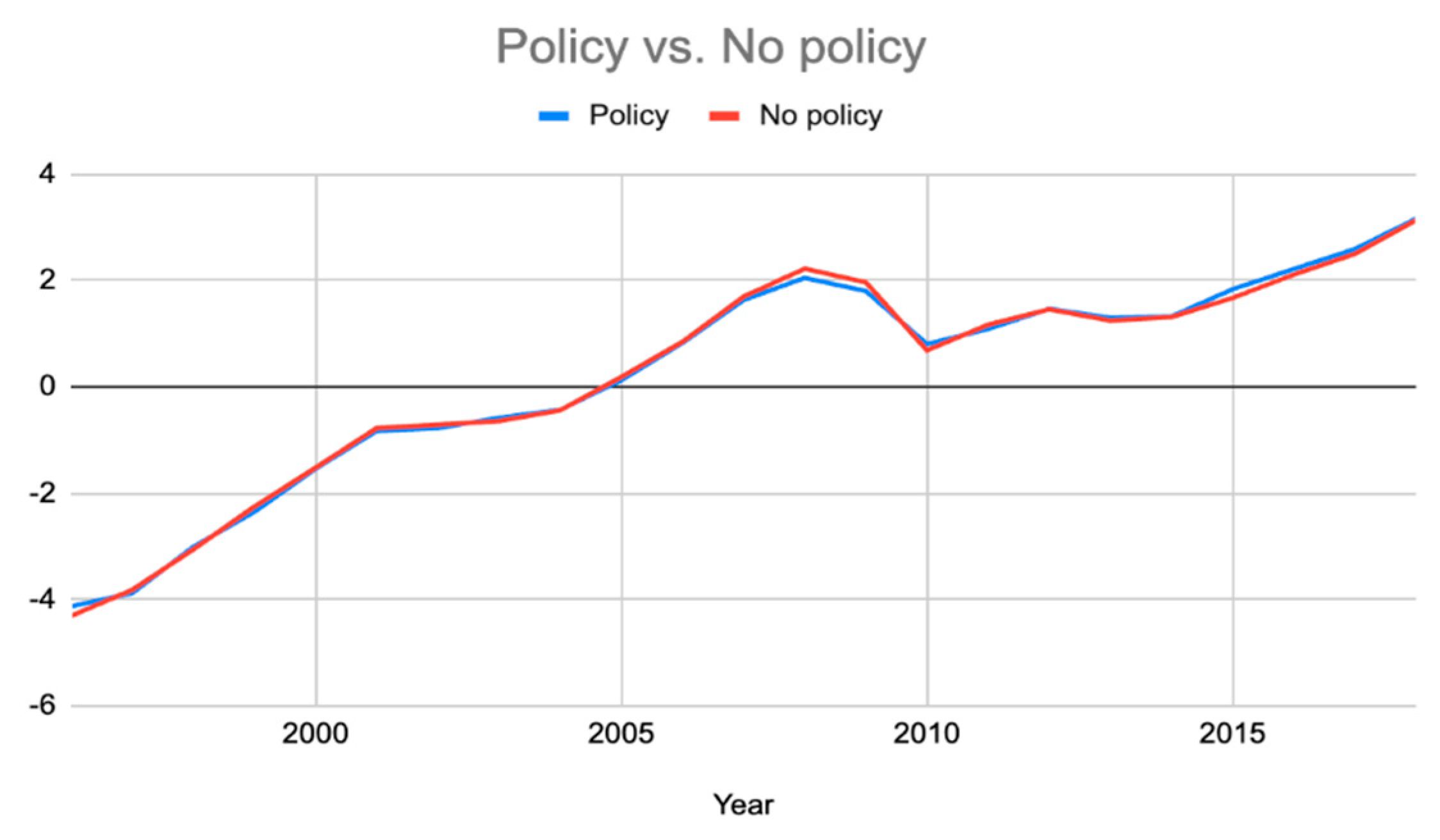
Figure 2.
EMP (POLICY AGAINST NO POLICY).
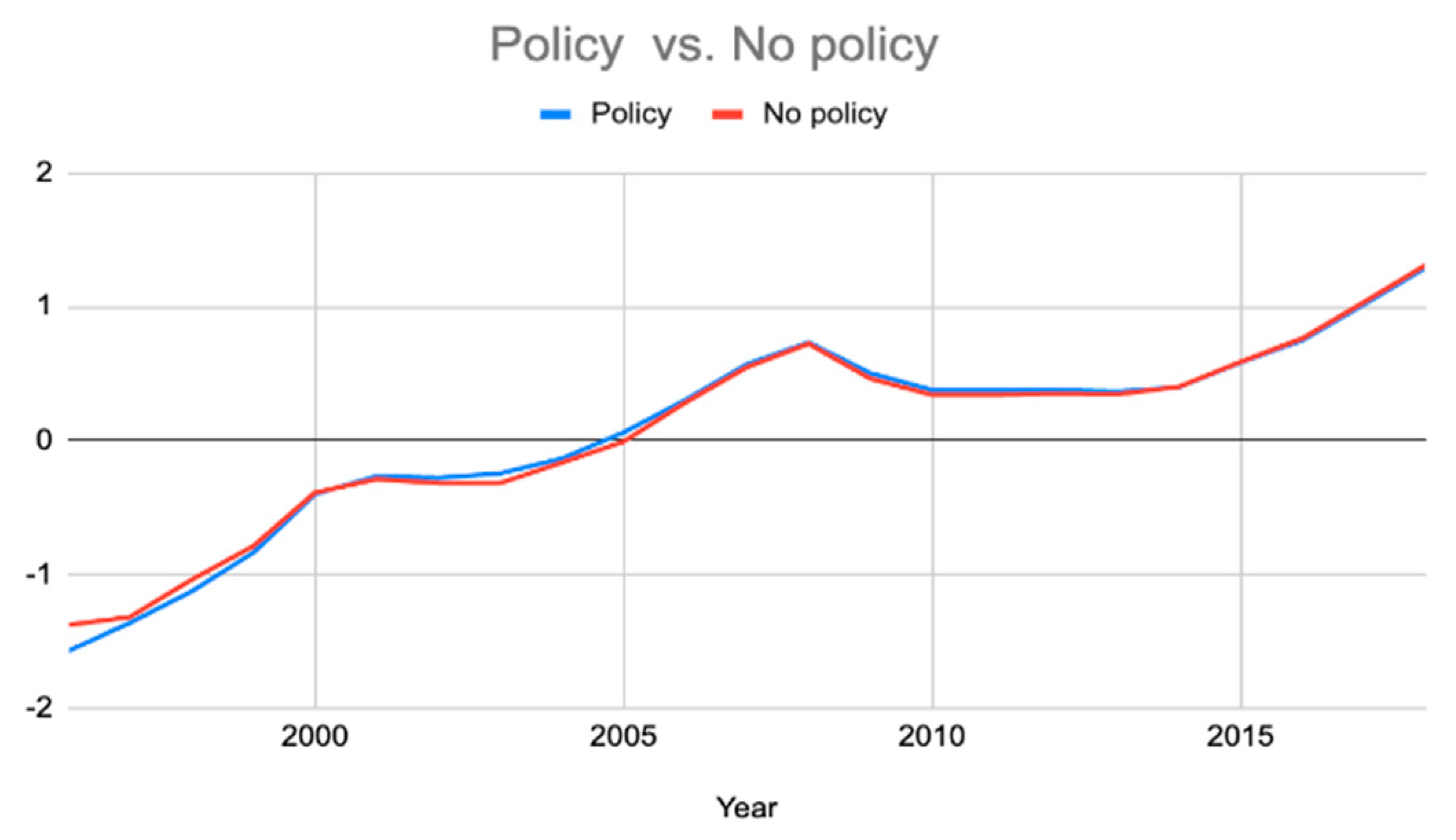

Table 1.
Descriptive Data: raw data log-levels for GDP, EMP, and CO2; 16 OECD economies, 1995-2018.
| Mean | Std. | Dev | Min | Max | Obs | |
|---|---|---|---|---|---|---|
| lnCO2 | overall | 1.294 | 1.397 | -1.137 | 4.664 | N=384 |
| between | 1.437 | -1.013 | 4.575 | n=16 | ||
| within | 0.107 | 0.958 | 1.645 | T=24 | ||
| lnGDP | overall | 12.036 | 2.295 | 5.907 | 17.848 | N=384 |
| between | 2.343 | 7.253 | 17.774 | n=16 | ||
| within | 0.327 | 10.691 | 12.876 | T=24 | ||
| lnEMP | overall | 7.349 | 3.317 | 3.547 | 16.239 | N=384 |
| between | 3.420 | 3.612 | 16.146 | n=16 | ||
| within | 0.061 | 7.078 | 7.522 | T=24 |
Table 2.
Demeaned descriptives for GDP, EMP, and CO2; 16 OECD economies, 1995-2018.
| Mean | Std. | Dev | Min | Max | Obs | |
|---|---|---|---|---|---|---|
| DM_CO2 | overall | 5.43e-09 | 0.858 | -1.576 | 0.953 | N=368 |
| between | 4.44e-08 | -5.22e-08 | 9.57e-08 | n=16 | ||
| within | 0.857 | -1.576 | 0.953 | T=24 | ||
| DM_GDP | overall | 1.51e-08 | 0.166 | -0.661 | 0.480 | N=384 |
| between | 3.45e-07 | -4.17e-07 | 7.50e-07 | n=16 | ||
| within | 0.166 | -0.661 | 0.480 | T=24 | ||
| DM_EMP | overall | 3.23e-08 | 0.061 | -0.271 | 0.173 | N=384 |
| between | 1.75e-07 | -2.00e-07 | 3.83e-07 | n=16 | ||
| within | 0.061 | -0.271 | 0.173 | T=24 |
Table 3.
Cross-sectional dependence test.
| GDP | EMP | |||||
|---|---|---|---|---|---|---|
| Test | Statistic | d.f | Prob. | Statistic | d.f | Prob. |
| Breusch-Pagan LM | 1777.213 | 120 | 0.0000 | 464.040 | 120 | 0.0000 |
| Pesaran scaled LM | 106.973 | - | 0.0000 | 22.208 | - | 0.0000 |
Table 4.
GDP Threshold estimation (abs. t-ratio in brackets).
| Model | linearco2 | thresh-co2 | thresh+co2 | thresh-poly |
|---|---|---|---|---|
| L.D.CO2 |
-0.0109033 (0.001)*** |
_ | 0.0411448 (3.53)*** |
0.0225537 (1.87)* |
| L.GDP | 0.9325669 (0.046)*** |
_ |
0.0411448 (3.53)*** |
0.0225537 (1.87)* |
| EMP | 0.5026824 (0.055)*** |
0.7885988 (41.98)*** |
0.7885988 (41.98)*** |
0.7710482 (33.81)*** |
| L.EMP | _ | 0.531105 (8.54)*** |
0.5311051 (8.54)*** |
0.5922085 (9.37)*** |
| GDP |
_ |
_ | _ | _ |
| thresh-below | _ | _ | _ | _ |
| Thresh-above | _ | -0.030317 (5.76)*** |
-0.0714616 (4.44)*** |
-0.0717009 (2.46)*** |
| Threshold: thrsh-co2 |
_ | -0.007525 (1.27) |
-0.0075246 (1.27) |
0.0201867 (10.08)*** |
| Threshold thrsh+co2 |
_ | 0.405[0.32 -0.54] | _ | _ |
| Threshold: thrsh-pol |
_ | _ | 0.405 [0.32-0.54] |
_ |
| Constant | 0.0184241 (0.002)*** |
0.0411448 (3.35)*** |
_ | _ |
| Hausman Tests |
(2)=21.99 prob > chi2=0.0000 |
(2)=31.19. prob > chi2=0.0000 |
||
Notes to Table 4: Column 2-Linear dynamic FD (2) without regime change threshold. The Sargan test of overidentification for instrumental: (229)=13.07277; prob > chi2=1.0000; serial correlation z values (prob> z): 1st-order -2.9123 (0.0036), 2nd-order= 0.24388 (0.8073), 3rd-order=0.06223 (0.9504). Column 3- estimates of output Equation (9) with two regimes/one threshold excluding a continuous linear log-diff CO2 transformed demean balanced budget policy variable. Column 4- estimates of output Equation (9) with two regimes/one threshold plus a continuous linear log-diff CO2 transformed demean balanced budget policy variable. Column 5- estimates of output (9) with two regimes, one threshold a continuous linear log-diff CO2 demean without transformation for tax-subsidy. Hausman GDP model selection of col. 2 linear model with a continuous policy regressor v. col.4 threshold model with a continuous policy regressor; col. 4 one-regime threshold with continuous CO2 policy-modified regressor v. col. 5 threshold one-regime threshold without a CO2 regressor without policy modification.
Table 5.
EMP Threshold estimation (abs. t-ratio in brackets).
| Models | lin+co2 | thresh-co2 | thresh+co2 | thresh-poly |
|---|---|---|---|---|
| L.D.CO2 |
0.0024882 (0.001)*** |
_ | 0.0044117 (2.90)*** |
-0.0172061 (3.02)*** |
| L.GDP | -0.2320622 (0.035)*** |
_ | 0.0044117 (2.90)*** |
-0.0172061 (3.02)*** |
| EMP | _ | -0.280499 (12.22)*** |
-0.280499 (12.22)*** |
-0.259 (11.15)*** |
| L.EMP | 0.9204825 (0.061)*** |
_ | _ | _ |
| GDP | 0.366047 (0.029)*** |
0.7410142 (25.81)*** |
0.7410142 (25.81)*** |
0.7312499 (25.47)*** |
| thresh-below | _ | 0.3957234 (18.94)*** |
0.3957234 (18.94)*** |
0.3753182 (18.46)*** |
| Thresh-above | _ | 0.0044117 (2.90)*** |
_ | _ |
| Threshold: thrsh-co2 |
_ | 0.0015222 (1.08) |
0.0015222 (1.08) |
-0.0030197 (2.82)*** |
| Threshold thrsh+co2 |
_ | 0.517[-1.40-0.70] | _ | _ |
| Threshold: thrsh-pol |
_ | _ | 0.517 [-1.40-0.70] |
_ |
| Constant | -0.0012842 (0.0018404) |
-0.004857 (2.90)* |
-0.0092683 (1.90)* |
0.0586601 (3.93)*** |
| Hausman Tests |
(4)=35.69. prob > chi2=0.0000 |
(2)=11.16. prob > chi2=0.0248 |
||
Notes to Table 5: Column 2-Linear dynamic FD (3) without regime change threshold. The Sargan test of overidentification for instrumental validity: (229)=11.483 (prob > chi2=1.0000); serial correlation z values (prob> z): 1st-order=-1.5967 (0.1103), 2nd-order= -0.7223 (0.4701), 3rd-order=1.0492 (0.2941). Column 3- estimates of employment Equation (12) with two regimes/one threshold excluding a continuous linear log-diff CO2 transformed demean balanced budget policy variable. Column 4- estimates of employment Equation (12) with two regimes/one threshold plus a continuous linear log-diff CO2 transformed demean balanced budget policy variable. Column 5- estimates of employment (21) with two regimes, one threshold a continuous linear log-diff. CO2 demeaned without transformation for tax subsidy. Hausman EMP model selection of col. 1 linear model with a continuous policy regressor v. col.4 threshold model with a continuous policy regressor; col. 4 one-regime threshold with continuous CO2 policy-modified regressor v. col. 5 threshold one-regime threshold without a CO2 regressor without policy modification.
Table 6.
Pairwise longitudinal Causality Tests.
| Null Hypothesis: | Obs | F-Statistic | Prob |
|---|---|---|---|
| Policy does not Granger cause EMP | 336 | 3.182 | 0.043 |
| EMP does not Granger cause Policy | 1.629 | 0.198 | |
| Policy does not Granger cause GDP | 336 | 3.198 | 0.042 |
| GDP does not Granger cause Policy | 0.758 | 0.470 |
Table 7.
Threshold model and Variance Decomposition Estimates.
| GDP | EMP | |||||
|---|---|---|---|---|---|---|
| Period | Total Variance |
Policy L.D.CO2 |
W/T Policy L.D.CO2 |
Total Variance |
Policy L.D.CO2 |
W/T Policy L.D.CO2 |
| 1 | 100.0000 (0.00000) |
0.000000 (0.00000) |
0.000000 (0.00000) |
100.0000 (0.00000) |
0.000000 (0.00000) |
0.000000 (0.00000) |
| 2 | 99.42700 (0.588671) |
0.541937 (0.50740) |
0.031068 (0.20751) |
99.50546 (0.53401) |
0.359024 (0.43353) |
0.135517 (0.29199) |
| 3 | 99.22846 (0.98003) |
0.736412 (0.83348) |
0.035131 (0.39671 |
99.02795 (1.02028) |
0.875207 (0.99271) |
0.096845 (0.36746) |
| 4 | 99.13310 (1.19739) |
0.661814 (0.89875) |
0.205088 (0.70557) |
98.89851 (1.19414) |
0.885351 (1.12696) |
0.216139 (0.40075) |
| 5 | 98.79467 (1.43482) |
0.601549 (0.83566) |
0.603777 (1.10956) |
98.50662 (1.30741) |
0.840506 (1.04966) |
0.652877 (0.61997) |
| 6 | 98.14271 (1.80485) |
0.646570 (0.74554) |
1.210723 (1.56576) |
97.63624 (1.61906) |
0.970953 (0.95443) |
1.392805 (0.96863) |
| 7 | 97.21910 (2.30578) |
0.805949 (0.69598) |
1.974953 (2.04288) |
96.38379 (2.12241) |
1.304822 (0.91237) |
2.311387 (1.69398) |
| 8 | 96.09882 (2.88382) |
1.060135 (0.73106) |
2.841047 (2.51747) |
94.96595 (2.67772) |
1.762940 (0.99907) |
3.271114 (2.11630) |
| 9 | 94.85752 (3.48674) |
1.382162 (0.84765) |
3.760319 (2.97352) |
93.56340 (3.19982) |
2.253166 (1.13759) |
4.183433 (2.49188) |
| 10 | 93.55889 (4.07955) |
1.746524 (1.01209) |
4.694583 (3.40173) |
92.27117 (3.66736) |
2.717522 (1.28271) |
5.011313 (2.82796) |
Disclaimer/Publisher’s Note: The statements, opinions and data contained in all publications are solely those of the individual author(s) and contributor(s) and not of MDPI and/or the editor(s). MDPI and/or the editor(s) disclaim responsibility for any injury to people or property resulting from any ideas, methods, instructions or products referred to in the content. |
© 2026 by the authors. Licensee MDPI, Basel, Switzerland. This article is an open access article distributed under the terms and conditions of the Creative Commons Attribution (CC BY) license (http://creativecommons.org/licenses/by/4.0/).
Copyright: This open access article is published under a Creative Commons CC BY 4.0 license, which permit the free download, distribution, and reuse, provided that the author and preprint are cited in any reuse.


