

Submitted:
18 March 2026
Posted:
23 March 2026
You are already at the latest version
Abstract
Background: Discrepancies are frequently observed between liver steatosis grading assessed by conventional B-mode ultrasonography and vibration-controlled transient elastography (VCTE) with controlled attenuation parameter (CAP). This study aimed to identify factors associated with these differences and to evaluate whether the two imaging methods provide comparable steatosis classifications.
Methods: We conducted a retrospective cross-sectional observational study including 130 hospitalized patients evaluated over a two-year period who underwent laboratory testing, abdominal ultrasonography, and transient elastography. The analyzed variables included demographic characteristics, nutritional status, comorbidities, and biochemical parameters such as alanine aminotransferase (ALAT), total cholesterol, triglycerides, gamma-glutamyl transferase (GGT), and the fibrosis-4 index (FIB-4). Patients were classified into two groups: concordant steatosis grading between the two methods (n = 61) and discordant results (n = 69).
Results: Concordant steatosis grading was more frequently observed in patients with serum total cholesterol >200 mg/dL (45.9%) and FIB-4 values between 1.45–3.25 (44.2%). A trend toward higher concordance was also observed in patients with elevated triglycerides. In contrast, viral liver disease was significantly associated with discordant results (26.2%). Higher fibrosis stages assessed by VCTE (F ≥ 2) and FIB-4 values >3.25 showed a non-significant trend toward discordance.
Conclusions: Several clinical and biochemical factors influence the agreement between ultrasound and VCTE-based CAP in the assessment of hepatic steatosis. Elevated cholesterol and intermediate FIB-4 values were associated with concordant results, whereas viral liver disease was associated with discordance between the two imaging modalities.
Keywords:
liver steatosis
; liver fibrosis
; viral hepatitis
; conventional ultrasound
; transient elastography
; Fib 4 score
; serum total cholesterol
; metabolic syndrome
1. Introduction
Fatty liver disease represents a growing concern in modern pathology and defines as accumulation of lipid molecules in hepatocytes, impairing liver function. The liver plays a central role in systemic lipid metabolism, and disturbances in these pathways may lead to excessive lipid accumulation within hepatocytes, resulting in hepatic steatosis.
From a pathological perspective, fatty liver disease encompasses a spectrum ranging from simple steatosis to steatohepatitis and, in more advanced stages, fibrosis and cirrhosis. Etiologically, hepatic fat accumulation is associated with several conditions, including excessive alcohol intake, hepatitis C virus infection, and metabolic disorders [1]. Diagnostic approaches vary from basic clinical and laboratory evaluation to advanced qualitative and quantitative imaging techniques. Nevertheless, the mechanisms determining why some individuals remain at the stage of simple steatosis while others progress to steatohepatitis or cirrhosis remain incompletely understood.
Histological assessment remains the reference standard for the evaluation of hepatic fat content. In normal liver tissue, fat is present in less than 5% of hepatocytes [1]. Hepatic steatosis is defined by triglyceride accumulation in more than 5% of hepatocytes without hepatocellular ballooning or necrosis [2]. According to the proportion of affected hepatocytes, steatosis is conventionally graded as mild (5–33%), moderate (33–66%), or severe (>66%) [3,4]. When steatosis is accompanied by inflammation and fibrosis, the condition is defined as steatohepatitis [2].
Distinguishing alcoholic from non-alcoholic fatty liver disease may be difficult, especially in former alcohol users. The pathological substrate includes inflammation, necrosis, fibrosis, and features such as Mallory–Denk bodies, ballooning, activated Kupffer cells, acidophil bodies, iron deposition, or lipo-granulomas, spanning alcoholic hepatitis, MASH (Metabolic Dysfunction - Associated Steatohepatitis), viral hepatotropic infections, inherited metabolic disorders, and reactive hepatitis [5]. These overlapping pathological features may contribute to variability in the assessment and grading of hepatic steatosis, highlighting the importance of accurate and reliable diagnostic methods.
The term “liver fat overload” therefore includes both alcoholic and nonalcoholic forms. MASLD (Metabolic Dysfunction - Associated Steatotic Liver Disease) is strongly associated with metabolic syndrome, type 2 diabetes mellitus, and obesity, as widely documented in international studies [6,7,8,9,10,11,12]. Several non-invasive scores (Fatty Liver Index, Hepatic Steatosis Index, SteatoTest, MASLD liver fat score) have been developed for screening purposes, although they cannot precisely quantify hepatic fat.
Imaging techniques used for the evaluation of hepatic steatosis include CT (Computed Tomography), qualitative and quantitative ultrasound methods (Attenuation Imaging, Speed of Sound), and magnetic resonance modalities such as MRI-PDFF (Magnetic Resonance Imaging – Proton Density Fat Fraction) and MRS (Magnetic Resonance Spectroscopy)—considered the most accurate but also costly and less accessible [6]. Liver biopsy remains the gold standard, although it is limited by sampling variability, with documented differences between left and right lobe specimens [5].
In daily clinical practice, the most commonly used rapid tools for diagnosing liver steatosis are B-mode ultrasound and transient elastography, which evaluate fibrosis and the Controlled Attenuation Parameter (CAP), providing information on hepatic fat content [13]. Although some studies have reported suboptimal performance of transient elastography and CAP in assessing steatosis [14], numerous others have demonstrated strong correlations between CAP-derived fat quantification and liver biopsy findings [15,16,17,18,19,20,21,22,23], as well as with Magnetic Resonance Imaging - based assessments [24,25].
However, discrepancies between steatosis grading obtained by conventional ultrasound and elastography-derived CAP may occur in clinical practice. Understanding the factors that may influence these differences is important for improving the diagnostic evaluation of hepatic steatosis.
The aim of this paper is to identify the factors causing concordance and discrepancies between the two steatosis assessment methods and to determine whether their results should align. To achieve this, we conducted a retrospective study evaluating the correlations between conventional B-mode ultrasound and the controlled attenuation parameter measured by transient elastography—as well as their relationships with various clinical and paraclinical parameters.
2. Materials and Methods
2.1. Study Design and Population
We conducted a cross-sectional, retrospective observational study including 130 patients admitted to the Clinical County Emergency Hospital Bihor, Romania, in the Internal Medicine and Gastroenterology Departments between February 2023 and February 2025.
Inclusion criteria: All included participants underwent same-day laboratory testing, abdominal B-mode ultrasound, and transient elastography using the extra-large probe (XL). Ultrasound and FibroScan examinations were performed in fasting patients, in the morning of admission, after blood sampling and prior to the administration of chronic medication.
Exclusion criteria: Patients were excluded if the two imaging methods were not performed on the same day, if the M probe was required, or if active oncological disease was present.
The baseline characteristics of the included patients are presented inTable 1. Data are presented as number (percentage).
2.2. Ultrasound Examination
Liver ultrasound (US) evaluation was performed according to international standards, with patients examined in the supine position using sagittal, transverse, and oblique sections on a Hitachi system equipped with a 1–5 MHz convex probe. All examinations were conducted by the same operator, who assessed liver size, surface, echogenicity, echotexture, hepatic and portal vein caliber, and the presence of normal hepato-petal portal flow.
The operator performing the ultrasound examination was not aware of the CAP-derived steatosis grading at the time of the ultrasound assessment, because US assessment was performed before Transient Elastography was. The present sequence of paraclinical investigations was also selected in order to identify potential anatomical variations in hepatic positioning, thereby minimizing the risk of obtaining invalid Fibro Scan measurements.
Steatosis grading followed established ultrasonographic criteria, including increased liver brightness, reduced visualization of hepatic veins, focal fat sparing, and diminished visualization of the diaphragm and deep parenchyma [27,28,29,30,31]. Mild steatosis (grade 1) was defined by increased echogenicity; moderate steatosis (grade 2) by posterior beam attenuation; and severe steatosis (grade 3) by poor visualization of deep hepatic veins, diaphragm, or deep parenchyma [30,31].
2.3. Transient Elastography and CAP Measurement
Transient elastography was performed after ultrasound, using standard protocols, with patients in the supine position and measurements obtained in the 9th–10th intercostal space along the mid-axillary line. Ultrasound preceded elastography to ensure optimal probe placement over the right hepatic lobe.
Assessments were conducted using the Echosens FibroScan (XL probe), which provides liver stiffness and steatosis estimation via the Controlled Attenuation Parameter (CAP). Only measurements with ≥10 valid readings, a success rate >60%, and an interquartile range <30% of the median were included. All transient elastography examinations included in the study were performed using the XL probe. This approach was adopted in order to ensure methodological consistency and to minimize potential variability related to probe selection. In some patients with lower BMI, the XL probe was used when adequate intercostal acoustic windows were available, allowing reliable measurements while maintaining a uniform acquisition protocol across the study population.
Steatosis and fibrosis were classified using the Interpretation Guide developed by Echosens, which is based on internationally accepted cut-off values for the Controlled Attenuation Parameter (CAP) and liver stiffness measurement (LSM), as validated across different liver disease etiologies, including metabolic dysfunction–associated steatosis liver disease (MASLD), metabolic dysfunction–associated steatohepatitis (MASH), viral hepatitis, alcohol-related liver disease, autoimmune hepatitis, and cholestatic liver diseases. Steatosis was assessed using CAP values (expressed in dB/m) and graded as follows: S0 < 248 dB/m, S1 248–267 dB/m, S2 268–279 dB/m, and S3 ≥ 280 dB/m. Fibrosis staging was based on LSM values (expressed in kPa) and defined as: F0–F1 < 7.0 kPa, F2 7.0–9.5 kPa, F3 9.5–12.5 kPa, and F4 ≥ 12.5 kPa.
2.4. Definition of Concordance and Discordance
Concordance between conventional ultrasound and transient elastography–derived CAP measurements was defined as the assignment of the same steatosis grade by both imaging modalities. Discordance was defined as any discrepancy in steatosis grading between the two techniques, including 1 degree difference.
The extent of discordance was further characterized by recording the number of grading categories separating the two modalities, distinguishing between a one-grade difference and discrepancies of two or more grades.
We acknowledge that a one-grade difference between ordinal categories may partly reflect the inherent variability of ultrasound-based steatosis grading; however, this definition was adopted to capture the full spectrum of potential discrepancies between the two imaging techniques.
Based on these criteria, patients were categorized into two groups: Group 1, including cases with concordant steatosis grading, and Group 2, including cases with discordant steatosis grading between the two imaging modalities.
2.5. Clinical and Biochemical Variables
Collected variables included age, sex, residential environment, nutritional status, hepatic, metabolic, and cardiovascular comorbidities, as well as some biochemical markers (ALAT, GGT, total cholesterol, triglycerides). Viral etiology included patients with chronic hepatitis B or chronic hepatitis C infection, diagnosed based on standard serological criteria. The patients with C virus infection were patients with finalized treatment and with obtained SVR. All patients with B virus infection were receiving ongoing antiviral therapy with nucleos(t)ide analogues.
Fibrosis severity was estimated using the FIB-4 score as follows: FIB-4 = age (years) x ASAT(U/L) / Platelets (109 /L) x √ALAT (U/L) [26]. Laboratory investigations were performed using the automated Abbott diagnostic platform. All clinical assessments, laboratory analyses, and imaging procedures were carried out on the same day, using the same equipment and operator, to reduce procedural variability.
2.6. Statistical Analysis
Statistical analysis was performed using MedCalc software (MedCalc Software Ltd., Belgium). The distribution of numerical variables was assessed using the Kolmogorov–Smirnov test. Continuous variables with normal distribution were expressed as mean ± standard deviation, whereas non-normally distributed variables were reported as median and range. Comparisons between numerical variables were performed using parametric (Student’s t-test) or nonparametric tests (Mann–Whitney or Kruskal–Wallis), as appropriate according to data distribution. The chi-square (χ²) test, with Yates’ correction for continuity when appropriate, was used to compare categorical variables expressed as percentages. A p value < 0.05 was considered statistically significant.
Factors associated with discordance between liver steatosis assessed by abdominal ultrasound and transient elastography were first evaluated by univariate analysis. Variables with p < 0.1 in the univariate analysis were entered into a multivariable logistic regression model to identify independent predictors of concordant steatosis grading between ultrasound and transient elastography. In this model, the dependent variable was the presence of concordant steatosis grading (coded as 1 = concordant and 0 = discordant). Results of the multivariable analysis were expressed as odds ratios (OR) with 95% confidence intervals (CI) and a p value < 0.05 was considered statistically significant.
Agreement between conventional ultrasound and CAP-derived steatosis grading was evaluated using a 4×4 contingency table representing the full distribution of steatosis grades obtained by the two imaging modalities. The overall level of agreement was quantified using weighted kappa statistics with quadratic weights, appropriate for ordinal categorical variables.
3. Results
1. A total of 130 patients were included in the study. The baseline characteristics of the study population were presented in Table 1
2. From 130 patients, 61 (46.92%) had the same degree of steatosis using non-invasive methods (ultrasound and transient elastography) and 69 patients (53.08%) had discordant results. Among these 69 patients, 45 patients (34.61% from all patients) showed a one-grade discrepancy, 23 patients (17.71% from all patients) had a two-grade discrepancy, and 1 patient (0.76% from all patients) had a three-grade discrepancy. (Figure 1)
3. Among the discordant cases (n = 69), ultrasound yielded a higher steatosis grade than CAP in 48 patients (69.56%), whereas CAP provided a higher grade than ultrasound in 21 patients (30.44%).
4. To further explore the level of agreement between the two imaging modalities, the full distribution of steatosis grades obtained by conventional ultrasound and CAP was analyzed using a 4×4 contingency table (Table 2). Weighted kappa analysis demonstrated substantial agreement between the two methods (WK = 0.63). The full cross-tabulation of steatosis grades between ultrasound and CAP is presented in Table 2.
5. To explore the factors associated with this variability, the study population was divided into two groups: Group 1, including patients with concordant steatosis grading between conventional ultrasound and transient elastography (n = 61), and Group 2, including patients with discordant results between the two imaging modalities (n = 69).
6. Gender, environment, age, alcoholic and autoimmune etiology, BMI, cardio-metabolic comorbidities (such as heart failure, ischemic heart disease, atrial fibrillation, hypertension, ectopic heart beats, dilated cardiomyopathy), the level of ALAT and a predicted stage of fibrosis by calculated FIB-4 score < 1.45 or >3.25, did not influence the assessment of steatosis by abdominal ultrasound and transient elastography. (Table 3.)
7. Variables that appeared to influence the liver steatosis grading by conventional US and VCTE included high serum total cholesterol >200 mg/dL, and a calculated FIB 4 score between 1.45 and 3.25. These factors were significantly associated with concordance in steatosis grading between the two imaging modalities. In addition, a trend toward better correlation was observed in patients with elevated serum triglycerides (>150 mg/dL), although this did not reach statistical significance (p = 0.07). (Table 3.)
8. By contrast, viral etiology emerged as a significant determinant of discordant steatosis grading between US and VCTE (p=0,01). Advanced fibrosis, defined by an elastography-assessed fibrosis stage ≥ F2, and calculated fibrosis risk (FIB-4 >3.25) showed a borderline association with discordance; however, these last two variables did not reach statistical significance and demonstrated only a non-significant trend toward reduced agreement. (p=0,055 respectively p= 0,09) (Table 3)
9. Multivariable logistic regression analysis was performed to identify independent predictors of concordant steatosis grading between ultrasound and transient elastography. Among the variables entered in the model, serum cholesterol levels >200 mg/dL remained independently associated with concordant steatosis grading (OR 2.23, 95% CI 1.07–4.66, p = 0.03), whereas viral etiology and FIB-4 were not significant predictors (Table 4).
4. Discussions
1.The present study evaluated the agreement and disagreement between conventional ultrasound and transient elastography–derived CAP in the assessment of hepatic steatosis in a real-world clinical setting.
2. Overall, concordant steatosis grading between the two imaging modalities was observed in 61 of 130 patients (46.92%), whereas discordant results occurred in 69 patients (53.08%).
3. Agreement analysis based on the full distribution of steatosis grades demonstrated substantial agreement between the two techniques (weighted κ = 0.63), according to the Landis and Koch classification. The weighted kappa coefficient indicated substantial agreement between the two imaging methods. Importantly, most discordant cases involved only a one-grade difference, suggesting that discrepancies were generally minor and may partly reflect the semi-quantitative nature of ultrasound-based steatosis grading.
4. Among discordant cases, ultrasound yielded a higher steatosis grade than CAP in the majority of patients (69.56%). This directional difference likely reflects the distinct physical principles underlying the two techniques. While ultrasound grading is based on changes in hepatic echogenicity across the entire liver parenchyma, CAP measurements assess ultrasound attenuation within a more limited sampling region. Consequently, heterogeneous fat distribution or structural liver alterations, including those related to fibrosis or inflammation, may differentially affect the two modalities and contribute to the observed discordance. Thus, ultrasound echogenicity may be influenced not only by hepatic fat accumulation but also by structural changes related to fibrosis or inflammation.
5. An additional aspect that should be considered when interpreting discordant results is the magnitude of disagreement between the two imaging modalities. As shown in the Results section, most discordant cases involved only a one-grade difference between ultrasound and CAP (45 of 69 cases), whereas larger discrepancies were less frequent. Because ultrasound-based steatosis grading is semi-quantitative and partly dependent on visual assessment, minor differences between grading categories may occur even when examinations are performed by a single experienced operator.
6. In our groups, there were some variables which did not reveal a statistical significance between the two groups, even though some of them were expected to be. These variables included age, environment, gender, alcoholic and autoimmune etiology of the hepatic disease involvement, mild fibrosis degree obtained by performing transient elastography; also, in accord to other international studies, neither the BMI [32], nor the presence of T2DM (type 2 Diabetes Mellitus), high blood pressure, or other cardiovascular and metabolic comorbidities [33] such as hypothyroidism did not appear to represent factors that influence the concordance or discordance of hepatic steatosis measurements using the two methods. At the same time, contrary to different studies [34,35,36], the serum level of aminotransferases did not appear to be a good indicator of discordance between ultrasonography and elastography interrogation of the liver regarding the fatty overload.
7. The Results showed several clinical and biochemical factors which were associated with agreement or discordance between the two imaging modalities, including viral etiology, elevated serum cholesterol levels, and intermediate FIB-4 values.
8. A very interesting result of our study was that the viral etiology of liver disease showed a high statistical significance. There was a clear difference between the two study groups, showing that viral etiology of the liver steatosis is most likely associated with a high degree of discordant results in assessment by ultrasonography and transient elastography. [37] Our study is in agreement with previously published data in the scientific literature.
9. In viral hepatitis, inflammatory changes may alter hepatic tissue characteristics, potentially influencing both ultrasound echogenicity and attenuation parameters. These mechanisms could contribute to differences in steatosis grading between the two imaging modalities. [38,39,40,41]. CAP samples a limited hepatic region, whereas conventional ultrasound evaluates a broader portion of the liver parenchyma, which may contribute to variability in steatosis grading between the two techniques in viral hepatitis. [42,43,44].
10. Another aspect that should be considered when interpreting CAP-based steatosis grading is the variability of proposed diagnostic thresholds. Although the CAP cutoffs used in the present study are widely reported in the literature, several studies have suggested that optimal thresholds may vary depending on factors such as disease etiology, BMI, and fibrosis stage. In particular, CAP performance may differ in patients with chronic viral hepatitis or advanced fibrosis, indicating that fixed cutoff values may not perform equally across all clinical contexts. [42,43,44]
11. The second variable that significantly influenced concordance between the two imaging methods was an elevated serum cholesterol level exceeding the upper limit of normal (serum cholesterol level > 200mg/dL), even tough, in the literature the presence of hypercholesterolemia is not directly associated with liver steatosis. In other words, hypercholesterolemia itself (under treatment or not) is not necessarily a direct marker of hepatic fat accumulation, but it may reflect underlying metabolic alterations. The higher this variable in our study was, the greater was the likelihood that ultrasound and elastography will yield concordant assessments of liver steatosis. This observation can be interpreted cautiously, as serum cholesterol may reflect underlying metabolic characteristics, nutritional status, or the use of lipid-lowering therapy rather than a direct influence on hepatic fat content.
12. Although hypercholesterolemia does not directly affect liver enzyme levels or elastography measurements, its presence is consistent with the well-established links between dyslipidemia, hepatic steatosis, and the progression of liver fibrosis. This association highlights the necessity of accounting for underlying metabolic risk factors when interpreting non-invasive hepatic imaging findings [45,46,47].
13. High triglyceride levels (>150 mg/dL) were more common in Group 1 with concordant imaging results (36.1%) than in Group 2 (21.7%), representing a borderline difference (p = 0.07). Although not statistically significant, this trend suggests that concordance between ultrasound and elastography is more likely in patients with a metabolically driven lipid profile. Elevated triglycerides are associated with diffuse steatosis [48,49], which produces more uniform hepatic echogenicity and attenuation, whereas lower levels in the discordant group may reflect heterogeneous, non-metabolic patterns of steatosis.
14. Another association with concordance or discordance in liver steatosis assessment was observed for an estimated parameter, namely fibrosis stage based on the FIB-4 score.
15. In patients with low fibrosis risk (FIB-4 <1.45), no significant difference in steatosis agreement was observed between the two groups (p = 0.40); in contrast, patients with intermediate FIB-4 scores (1.45–3.25) demonstrated a statistically significant difference between the two groups. (p=0.04). At the same time, the patients with calculated advanced fibrosis (FIB-4 >3.25), although with a borderline p-value, suggested a trend toward discordance (p = 0.09)
16. Comparison between elastography-based and FIB-4-estimated fibrosis revealed moderate concordance across categories. Group 1, characterized by similar steatosis grades on both imaging modalities, showed predominantly mild fibrosis on elastography (F0–F1 = 85.2%) and low FIB-4 values (< 1.45 = 49.2%). In contrast, Group 2, with discordant steatosis results, demonstrated higher frequencies of advanced fibrosis on elastography (≥ F2 = 29.0%) and higher FIB-4 categories (> 3.25 = 15.9%). The association between higher fibrosis stage (by either method) and imaging discordance has showed a trend toward increased discordance between the two imaging modalities.
17. A relatively recent study from July 2024 [50] confirmed the discordance between the results provided by FIB-4 score and transient elastography regarding fibrosis severity, suggesting that the degree of steatosis may be influenced.
18. The parallel trends observed between elastography-derived fibrosis stages and FIB-4 categories suggest that both tools capture the overall fibrosis burden, albeit with different sensitivities. The higher prevalence of moderate-to-advanced fibrosis among patients with discordant steatosis assessments (Group 2) suggests that fibrosis heterogeneity and architectural distortion may influence the agreement between different imaging modalities.
19. In early fibrosis (predominant in Group 1), the hepatic parenchyma remains relatively homogeneous, allowing both modalities to measure fat content consistently. In advanced fibrosis (especially in Group 2) structural changes such as collagen deposition, heterogeneous fat distribution, and alterations in acoustic impedance may influence the imaging characteristics detected by both ultrasound and elastography. These tissue modifications may therefore contribute to discordant steatosis grading between the two methods.
20. Our findings are consistent with recent studies that reported similar associations between FIB-4 scores, fibrosis severity, and steatosis degree. [51,52,53]
21. These findings underscore that fibrosis stage is a key modifier of agreement between non-invasive imaging methods for steatosis assessment. Integrating FIB-4 or elastography-based stiffness into the interpretative framework can help identify cases where ultrasound and elastography may yield divergent results.
22. The lack of statistical significance of fibrosis-related variables in the multivariable model may reflect partial collinearity between markers of liver disease severity, such as viral etiology and the FIB-4 score, which capture overlapping aspects of hepatic injury and fibrosis. Because these variables represent different clinical dimensions of liver disease, both were considered in the analysis, although neither remained an independent predictor in the final model.
23. Our findings regarding the presence of discordant steatosis grading between ultrasound and CAP are consistent with previous reports describing variability among non-invasive imaging techniques combined with histological investigations used for hepatic fat assessment [53,54].
24. The overall results suggest that concordance between ultrasound and CAP-based steatosis assessment is more likely in patients with a metabolically driven lipid profile, whereas discordance tends to occur in the presence of viral liver disease and increasing fibrosis severity, likely reflecting structural and inflammatory alterations of hepatic tissue.
25. Based on our findings, it can be hypothesized that in metabolic steatosis, hepatic fat deposition is typically diffuse and relatively homogeneous throughout the liver parenchyma. In contrast, in viral liver disease, inflammation and fibrosis may alter the hepatic microarchitecture, resulting in a more heterogeneous pattern of fat distribution.
26. Our results suggest that certain clinical and biochemical factors may influence the agreement between non-invasive imaging techniques used for hepatic steatosis assessment. Further prospective studies including reference standards such as MRI-PDFF or liver biopsy and larger, more homogeneous cohorts are needed to better clarify the mechanisms underlying these discrepancies.
Limitation of the study
27. An important limitation of the present study is the absence of a reference standard such as MRI-PDFF or liver biopsy. Consequently, the study design does not allow determination of which imaging modality more accurately reflects the true hepatic fat content. Our analysis therefore focuses on the presence of discordance between the two methods and on the clinical factors associated with this discordance.
28. Another limitation of the present study is that only examinations performed with the XL probe were included. Although only examinations performed with the XL probe were included, which may limit generalizability to settings where both M and XL probes are used, this approach also reduced probe-related measurement variability and ensured greater methodological consistency across the study population.
29. An additional limitation of the present study is that all ultrasound examinations were performed by a single experienced operator, precluding the assessment of interobserver variability. Although this approach ensured methodological consistency, future studies involving multiple operators would allow a more comprehensive evaluation of interobserver reproducibility.
30. In the present study, the viral hepatitis subgroup included patients with chronic hepatitis C infection who had achieved sustained virological response and patients with chronic hepatitis B infection receiving ongoing antiviral therapy with nucleos(t)ide analogues. However, detailed information regarding residual inflammatory activity or other disease-related characteristics was not systematically assessed. These factors may influence both CAP measurements and ultrasound echogenicity and could therefore represent potential sources of variability.
31. Another limitation of the present study is that the population consisted of hospitalized patients. Acute illness, systemic inflammation, or metabolic disturbances related to hospitalization may influence liver imaging measurements, including both ultrasound echogenicity and CAP values. Therefore, the findings should be interpreted with caution when extrapolated to outpatient populations.
5. Conclusions
High serum total cholesterol levels (>200 mg/dL) and an intermediate FIB-4 score (1.45–3.25) were associated with concordant steatosis grading between conventional ultrasound and transient elastography in the studied population. Although not statistically significant, elevated serum triglyceride levels showed a tendency toward greater concordance between the two imaging modalities.
Viral hepatitis associated with hepatic steatosis showed a statistically significant association with discordant results between ultrasound and transient elastography. In addition, higher fibrosis risk, reflected by a FIB-4 score >3.25 or elastography-derived fibrosis stage ≥F2, showed a tendency toward discordance in steatosis grading.
Consequently, metabolically driven steatosis appears more likely to yield concordant steatosis grading between conventional ultrasound and vibration-controlled transient elastography (VCTE). By contrast, in steatosis associated with viral liver injury, structural and inflammatory alterations of the hepatic parenchyma may reduce the level of agreement between these two non-invasive imaging modalities
Consent for publication
We investigated all the patients retrospectively, and the manuscript did not reveal the patients’ personal clinical information or their images. There for this section is not applicable.
Author Contributions
Conceptualization : M.-C.B., E.-E.B. and C.B.; methodology: M.-C.B., S.B., C.-M.B. and C.B.; software: S-F.C-Ș., L.M, C.-M.B. ; validation: M.-C.B., C.B., S.B.; formal analysis: L.M., C-M.B.; investigation: all authors; resources: M.-C.B., and C.B; data curation: M.-C.B., S-F.C-Ș, L.M.; writing- original draft preparation: M.-C.B. C.-M.B, L.M.; writing—review and editing: all authors; visualization: all authors; supervision, C.-M.B., S.B., C.B.; project administration, M.-C.B.,C.B. and E.-E.B . All authors have read and agreed to the published version of the manuscript.
Funding
The APC was funded by University of Oradea, Oradea, Romania.
Institutional Review Board Statement
The study was approved by Institutional Ethics Committee and Council of the Clinical County Emergency Hospital Bihor (Approval Number: 10193/27.03.2025) and followed the ethical standards laid out in the 1975 Declaration of Helsinki.
Informed Consent Statement
Not applicable. We only reviewed the patient files for this study, and we guaranteed that we would not use the information for anything other than for research purposes. This was approved by the Ethics Committee.
Data Availability Statement
Patients’ information is private and is archived in the electronic databases of the medical units where the research was done.
Acknowledgments
The authors wish to thank the University of Oradea, Oradea, Romania, for financial support in publishing this paper.
Conflicts of Interest
The authors declare no conflicts of interest.
Abbreviations
The following abbreviations are used in this manuscript:
ALAT- Alanine Aminotransferase
ASAT – Aspartate Aminotransferase
BMI – Body Mass Index
CAP - Controlled Attenuation Parameter
CI – Confidence interval
CT – Computed Tomography
F0 – Stage 0 of Liver Fibrosis or No Liver Fibrosis
F1- Stage 1 of Liver Fibrosis
F2 – Stage 2 of Liver Fibrosis
F3 – Stage 3 of Liver Fibrosis
F4 – Stage 4 of Liver Fibrosis, or Advance Liver Fibrosis, or Liver Cirrhosis
FIB 4 score- Fibrosis -4 Index
GGT – Gamma-Glutamyl Transferase
LSM – Liver Stiffness Measurement
MASH – Metabolic Dysfunction – Associated Steatohepatitis
MASLD - Metabolic Dysfunction – Associated Steatotic Liver Disease
MRI - Magnetic Resonance Imaging
MRI-PDFF - Magnetic Resonance Imaging – Proton Density Fat Fraction
MRS – Magnetic Resonance Spectroscopy
OR – Odds ratio
TE- Transient elastography
T2DM – Type 2 Diabetes Mellitus
US – Ultrasound
VCTE - Vibration-Controlled Transient Elastography
XL probe – Extra-Large probe
WK- Weighted Kappa
References
- Fatiha Nassir, Jamal A. Ibdah - Pathogenesis and Prevention of Hepatic Steatosis Gastroenterol Hepatol (N Y). 2015 Mar; 11(3): 167–175.
- Streba LAM, Vere CC, Rogoveanu I, Streba CT. Nonalcoholic fatty liver disease, metabolic risk factors, and hepatocellular carcinoma: An open question. World J Gastroenterol 2015; 21(14): 4103-4110 [PMID: 25892859 DOI: 10.3748/wjg. v21.i14.4103].
- Fatiha Nassir - NAFLD: Mechanisms, Treatments, and Biomarkers Biomolecules. 2022 Jun 13;12(6):824. doi: 10.3390/biom12060824.
- Dina G. Tiniakos,1 Miriam B. Vos,2 and Elizabeth M. Brunt3 - Nonalcoholic Fatty Liver Disease: Pathology and Pathogenesis. Annual Review of Pathology: Mechanisms of Disease Volume 5, 2010 Tiniakos, pp 145-171.
- Elizabeth M. Brunt. Nonalcoholic Fatty Liver Disease: Pros and Cons of Histologic Systems of Evaluation Int. J. Mol. Sci. 2016, 17(1), 97; https://doi.org/10.3390/ijms17010097.
- Marchesini G, Brizi M, Morselli-Labate AM, Bianchi G, Bugianesi E, McCullough AJ, Forlani G, Melchionda N. Association of nonalcoholic fatty liver disease with insulin resistance. Am J Med. 1999; 107:450-455.
- Marchesini G, Brizi M, Bianchi G, Tomassetti S, Bugianesi E, Lenzi M, McCullough AJ, Natale S, Forlani G, Melchionda N. Nonalcoholic fatty liver disease: a feature of the metabolic syndrome. Diabetes. 2001; 50:1844-1850.
- Hsiao PJ, Kuo KK, Shin SJ, Yang YH, Lin WY, Yang JF, Chiu CC, Chuang WL, Tsai TR, Yu ML. Significant correlations between severe fatty liver and risk factors for metabolic syndrome. J Gastroenterol Hepatol. 2007; 22:2118-2123.
- Jimba S, Nakagami T, Takahashi M, Wakamatsu T, Hirota Y, Iwamoto Y, Wasada T. Prevalence of non-alcoholic fatty liver disease and its association with impaired glucose metabolism in Japanese adults. Diabet Med. 2005; 22:1141-1145.
- A Lum Han - Validation of fatty liver index as a marker for metabolic dysfunction-associated fatty liver disease Diabetology & Metabolic Syndrome (2022) 14:44 https://doi.org/10.1186/s13098-022-00811-2.
- Ah Reum Khang, Hye Won Lee, Dongwon Yi, Yang Ho Kang, Seok Man Son- The fatty liver index, a simple and useful predictor of metabolic syndrome: analysis of the Korea National Health and Nutrition Examination Survey 2010–2011 - Diabetes, Metabolic Syndrome and Obesity: Targets and Therapy 2019:12 181–190.
- Kavya Koneru 1, Varsha Bhatt 1, Arjun Kakrani 1, Manaswini Edara 1, Vuluvala T Reddy 1, Pranav Gopal Jawade 1- A study of non-alcoholic fatty liver disease-liver fat score in overweight and obese individuals J Family Med Prim Care. 2022 Aug;11(8):4368-4374. doi: 10.4103/jfmpc.jfmpc_58_22. Epub 2022 Aug 30.
- Amir M. Pirmoazen, Aman Khurana, Ahmed El Kaffas, Aya Kamaya Quantitative ultrasound approaches for diagnosis and monitoring hepatic steatosis in nonalcoholic fatty liver disease Theranostics, 2020; 10(9): 4277-4289. doi:10.7150/thno.40249 1335–48.
- Sasso, M; Beaugrand, M; de Ledinghen, V; Douvin, C; Marcellin, P; Poupon, R; et al. Controlled Attenuation Parameter (CAP): A Novel VCTETM Guided Ultrasonic Attenuation Measurement for the Evaluation of Hepatic Steatosis: Preliminary Study and Validation in a Cohort of Patients with Chronic Liver Disease from Various Causes. Ultrasound Med Biol. 2010, 36, 1825–35. [Google Scholar] [CrossRef] [PubMed]
- Karlas, T; Petroff, D; Garnov, N; Böhm, S; Tenckhoff, H; Wittekind, C; et al. Non-invasive assessment of hepatic steatosis in patients with NAFLD using controlled attenuation parameter and 1H-MR spectroscopy. PLoS One 2014, 9, e91987. [Google Scholar] [CrossRef]
- Chan, W-K; Mustapha, NRN; Mahadeva, S. Controlled attenuation parameter for the detection and quantification of hepatic steatosis in nonalcoholic fatty liver disease. J Gastroenterol Hepatol. 2014, 29, 1470–6. [Google Scholar] [CrossRef]
- de Lédinghen, V; Wong, GL-H; Vergniol, J; Chan, HL-Y; Hiriart, J-B; Chan, AW-H; et al. Controlled attenuation parameter for the diagnosis of steatosis in non-alcoholic fatty liver disease. J Gastroenterol Hepatol. 2016, 31, 848–55. [Google Scholar] [CrossRef]
- Lee, HW; Park, SY; Kim, SU; Jang, JY; Park, H; Kim, JK; et al. Discrimination of Nonalcoholic Steatohepatitis Using Transient Elastography in Patients with Nonalcoholic Fatty Liver Disease. PLoS One 2016, 11, e0157358. [Google Scholar] [CrossRef]
- Chan, W-K; Nik Mustapha, NR; Wong, GL-H; Wong, VW-S; Mahadeva, S. Controlled attenuation parameter using the FibroScan® XL probe for quantification of hepatic steatosis for non-alcoholic fatty liver disease in an Asian population. United Eur Gastroenterol J. 2017, 5, 76–85. [Google Scholar] [CrossRef]
- Park, CC; Nguyen, P; Hernandez, C; Bettencourt, R; Ramirez, K; Fortney, L; et al. Magnetic Resonance Elastography vs Transient Elastography in Detection of Fibrosis and Noninvasive Measurement of Steatosis in Patients with Biopsy-Proven Nonalcoholic Fatty Liver Disease. Gastroenterology 2017, 152, 598–607.e2. [Google Scholar] [CrossRef]
- Chan, W-K; Nik Mustapha, NR; Mahadeva, S; Wong, VW-S; Cheng, JY-K; Wong, GL-H. Can the same controlled attenuation parameter cut-offs be used for M and XL probes for diagnosing hepatic steatosis? J Gastroenterol Hepatol. 2018, 33, 1787–94. [Google Scholar] [CrossRef]
- Runge, JH; Smits, LP; Verheij, J; Depla, A; Kuiken, SD; Baak, BC; et al. MR Spectroscopy–derived Proton Density Fat Fraction Is Superior to Controlled Attenuation Parameter for Detecting and Grading Hepatic Steatosis. Radiology 2017, 286, 547–56. [Google Scholar] [CrossRef]
- Imajo, K; Kessoku, T; Honda, Y; Tomeno, W; Ogawa, Y; Mawatari, H; et al. Magnetic Resonance Imaging More Accurately Classifies Steatosis and Fibrosis in Patients with Nonalcoholic Fatty Liver Disease Than Transient Elastography. Gastroenterology 2016, 150, 626–637.e7. [Google Scholar] [CrossRef]
- Caussy, C; Alquiraish, MH; Nguyen, P; Hernandez, C; Cepin, S; Fortney, LE; et al. Optimal threshold of controlled attenuation parameter with MRI-PDFF as the gold standard for the detection of hepatic steatosis. Hepatology 2018, 67, 1348–59. [Google Scholar] [CrossRef]
- Sasso, M; Audière, S; Kemgang, A; Gaouar, F; Corpechot, C; Chazouillères, O; et al. Liver Steatosis Assessed by Controlled Attenuation Parameter (CAP) Measured with the XL Probe of the FibroScan: A Pilot Study Assessing Diagnostic Accuracy. Ultrasound Med Biol. 2016, 42, 92–103. [Google Scholar] [CrossRef]
- Sterling, RK; Lissen, E; Clumeck, N. Development of a simple noninvasive index to predict significant fibrosis in patients with HIV/HCV coinfection. Hepatology 2006, 43(6), 1317–1325. [Google Scholar] [CrossRef] [PubMed]
- Hernaez, R; Lazo, M; Bonekamp, S; Kamel, I; Brancati, FL; Guallar, E; et al. Diagnostic accuracy and reliability of ultrasonography for the detection of fatty liver: A meta-analysis. Hepatology 2011, 54, 1082–90. [Google Scholar] [CrossRef] [PubMed]
- Palmentieri, B; de Sio, I; La Mura, V; Masarone, M; Vecchione, R; Bruno, S; et al. The role of bright liver echo pattern on ultrasound B-mode examination in the diagnosis of liver steatosis. Dig Liver Dis. 2006, 38, 485–9. [Google Scholar] [CrossRef] [PubMed]
- Saadeh, S; Younossi, ZM; Remer, EM; Gramlich, T; Ong, JP; Hurley, M; et al. The utility of radiological imaging in nonalcoholic fatty liver disease. Gastroenterology 2002, 123, 745–50. [Google Scholar] [CrossRef]
- Strauss, S; Gavish, E; Gottlieb, P; Katsnelson, L. Interobserver and intraobserver variability in the sonographic assessment of fatty liver. AJR Am J Roentgenol. 2007, 189, W320–323. [Google Scholar] [CrossRef]
- Hepburn, MJ; Vos, JA; Fillman, EP; Lawitz, EJ. The accuracy of the report of hepatic steatosis on ultrasonography in patients infected with hepatitis C in a clinical setting: A retrospective observational study. BMC Gastroenterol 2005, 5, 14. [Google Scholar] [CrossRef]
- Jang, JK; Choi, SH; Lee, JS; Kim, SY; Lee, SS; Kim, KW. Accuracy of the ultrasound attenuation coefficient for the evaluation of hepatic steatosis: a systematic review and meta-analysis of prospective studies. Ultrasonography 2022, 41(1), 83–92. [Google Scholar] [CrossRef] [PubMed]
- Victor de Lédinghen, Julien Vergniol, Maylis Capdepont, Faiza Chermak, Jean-Baptiste Hiriart, Christophe Cassinotto, Wassil Merrouche, Juliette Foucher, Le Bail Brigitte. Controlled attenuation parameter (CAP) for the diagnosis of steatosis: A prospective study of 5323 examinations. Journal of Hepatology, Volume 60, Issue 5, 1026 - 1031.
- Bota, S.; Sporea, I.; Şirli, R.; Popescu, A.; Jurchiş, A. Factors Which Influence the Accuracy of Acoustic Radiation Force Impulse (ARFI) Elastography for the Diagnosis of Liver Fibrosis in Patients With Chronic Hepatitis C. Ultrasound in Medicine & Biology 2013, 39(3), 407–412. [Google Scholar] [CrossRef] [PubMed]
- Özercan M, Melekoğlu Ellik Z, Parmaksız A, Gümüşsoy M, Duman S, Örmeci N. Liver stiffness and steatosis measurements with iLivTouch and FibroScan: A comparative study. Turk J Gastroenterol. Published online June 6, 2024. [CrossRef]
- Wang, M.; Tang, S.; Li, G.; et al. Comparative study of ultrasound attenuation analysis and controlled attenuation parameter in the diagnosis and grading of liver steatosis in non-alcoholic fatty liver disease patients. BMC Gastroenterol 2024, 24, 81. [Google Scholar] [CrossRef] [PubMed]
- Juan Francisco Rozas, Katherine González, Camila Estay, Maximo Cattaneo, Alvaro Urzúa, Juan Pablo Roblero, Alexandra Sandoval, Jaime Poniachik. Concordance between ecography and the Continuous Attenuation Parameter (CAP) by transient elastography for the diagnosis of liver steatosis. Annals of Hepatology,Volume 24, Supplement 1, 2021, 100422, ISSN 1665-2681 https://doi.org/10.1016/j.aohep.2021.100422.
- Tamaki Kobayashi et all - Diagnostic performance of two-dimensional shear wave elastography and attenuation imaging for fibrosis and steatosis assessment in chronic liver disease - Journal of Medical Ultrasonics (2025) 52:95–103 https://doi.org/10.1007/s10396-024-01473-5.
- Mengyun Wang, Shuzhen Tang, Guoqiu Li, Zhibin Huang, Sijie Mo, Keen Yang, Jing Chen, Baishan Du, Jinfeng Xu, Zhimin Ding, Fajin Dong - Comparative study of ultrasound attenuation analysis and controlled attenuation parameter in the diagnosis and grading of liver steatosis in non-alcoholic fatty liver disease patients -BMC Gastroenterology (2024) 24:81 https://doi.org/10.1186/s12876-024-03160-8.
- Andrea Salmi, Luigi di Filippo, Clarissa Ferrari, Stefano Frara, Andrea Giustina - Endocrine. 2022 Nov;78(2):262-269. doi: 10.1007/s12020-022-03157-x. Epub 2022 Aug 18.
- Rosanna Villani, Pierluigi Lupo, Moris Sangineto, Antonino Davide Romano and Gaetano Serviddio - Liver Ultrasound Elastography in Non-Alcoholic Fatty Liver Disease: A State-of-the-Art Summary - Diagnostics 2023, 13(7), 1236; https://doi.org/10.3390/diagnostics13071236.
- Roxana Sirli, Ioan Sporea - Controlled Attenuation Parameter for Quantification of Steatosis: Which Cut-Offs to Use? - Can J Gastroenterol Hepatol. 2021 Mar 26;2021:6662760. doi:10.1155/2021/6662760.
- Dorotea Bozic, Kristian Podrug, Ivana Mikolasevic, Ivica Grgurevic - Ultrasound Methods for the Assessment of Liver Steatosis: A Critical Appraisal - Diagnostics (Basel). 2022 Sep 22;12(10):2287. doi: 10.3390/diagnostics12102287.
- Giovanna Ferraioli et all - Liver Fat Quantification With Ultrasound: Depth Dependence of Attenuation Coefficient - April 2023Journal of ultrasound in medicine: official journal of the American Institute of Ultrasound in Medicine 42(10). DOI:10.1002/jum.16242.
- Chi-Cervera LA, Montalvo GI, Icaza-Chávez ME, Torres-Romero J, Arana-Argáez V, Ramírez-Camacho M, Lara-Riegos J. Clinical relevance of lipid panel and aminotransferases in the context of hepatic steatosis and fibrosis as measured by transient elastography (FibroScan®). J Med Biochem. 2021 Jan 26;40(1):60-66. doi: 10.5937/jomb0-24689. PMID: 33584141; PMCID: PMC7857856.
- Csonka, C., Baranyai, T., Tiszlavicz, L. et al. Isolated hypercholesterolemia leads to steatosis in the liver without affecting the pancreas. Lipids Health Dis 16, 144 (2017). https://doi.org/10.1186/s12944-017-0537-z.
- Sporea, I.; Mare, R.; Popescu, A.; Nistorescu, S.; Baldea, V.; Sirli, R.; Braha, A.; Sima, A.; Timar, R.; Lupusoru, R. Screening for Liver Fibrosis and Steatosis in a Large Cohort of Patients with Type 2 Diabetes Using Vibration Controlled Transient Elastography and Controlled Attenuation Parameter in a Single-Center Real-Life Experience. J. Clin. Med. 2020, 9, 1032. https://doi.org/10.3390/jcm9041032.
- Sweta Tandra, Matthew M. Yeh, Elizabeth M. Brunt, Raj Vuppalanchi, Oscar W. Cummings, Aynur Ünalp-Arida, Laura A. Wilson, Naga Chalasani - Presence and significance of microvesicular steatosis in nonalcoholic fatty liver disease, Journal of Hepatology, Volume 55, Issue 3, 2011, Pages 654-659, ISSN 0168- 8278, https://doi.org/10.1016/j.jhep.2010.11.021. Issue 3.
- Tomizawa M, Kawanabe Y, Shinozaki F, Sato S, Motoyoshi Y, Sugiyama T, Yamamoto S, Sueishi M. Triglyceride is strongly associated with nonalcoholic fatty liver disease among markers of hyperlipidemia and diabetes. Biomed Rep. 2014 Sep;2(5):633-636. doi: 10.3892/br.2014.309. Epub 2014 Jul 1. PMID: 25054002; PMCID: PMC4106613.
- Chang, Madeleine & Chang, Devon & Kodali, Sudha & Harrison, Stephen & Ghobrial, Mark & Alkhouri, Naim. (2024). Degree of Discordance Between FIB-4 and Transient Elastography: An Application of Current Guidelines on General Population Cohort. Clinical gastroenterology and hepatology : the official clinical practice journal of the American Gastroenterological Association. 22. 10.1016/j.cgh.2024.02.008.
- Moini, M., Onofrio, F., Hansen, B.E. et al. Combination of FIB-4 with ultrasound surface nodularity or elastography as predictors of histologic advanced liver fibrosis in chronic liver disease. Sci Rep 11, 19275 (2021). https://doi.org/10.1038/s41598-021-98776-1.
- Chen, Mingxi, Guo, Chang, Ouyang, Ke Liu, Na. Diagnostic role of the fibrosis-4 index and nonalcoholic fatty liver disease fibrosis score as a noninvasive tool for liver fibrosis scoring. Medicine 103(43): p e40214, October 25, 2024. | DOI: 10.1097/MD.0000000000040214. [CrossRef]
- Damjanovska S, Karb DB, Tripathi A, Asirwatham J, Delozier S, Perez JA, Falck-Ytter Y, Cohen S. Accuracy of Ultrasound Elastography and Fibrosis-4 Index (FIB-4) in Ruling Out Cirrhosis in Obese Non-Alcoholic Fatty Liver Disease (NAFLD) Patients. Cureus. 2022 Sep 22;14(9):e29445. doi:10.7759/cureus.29445. PMID: 36299964; PMCID: PMC9587692.
- Kim BK, Bernstein N, Huang DQ, Tamaki N, Imajo K, Yoneda M, Sutter N, Jung J, Nguyen K, Nguyen L, Le T, Madamba E, Richards L, Valasek MA, Behling C, Sirlin CB, Nakajima A, Loomba R. Clinical and histologic factors associated with discordance between steatosis grade derived from histology vs. MRI-PDFF in NAFLD. Aliment Pharmacol Ther. 2023 Jul;58(2):229-237. doi: 10.1111/apt.17564. Epub 2023 Jun 2. PMID: 37269117; PMCID: PMC10330628.
- Lee CM, Kim M, Kang BK, Jun DW, Yoon EL. Discordance diagnosis between B-mode ultrasonography and MRI proton density fat fraction for fatty liver. Sci Rep. 2023 Sep 20;13(1):15557. doi: 10.1038/s41598-023-42422-5. PMID: 37730972; PMCID: PMC10511436.
Figure 1.
Distribution of the patients according the concordant or non-concordant results.
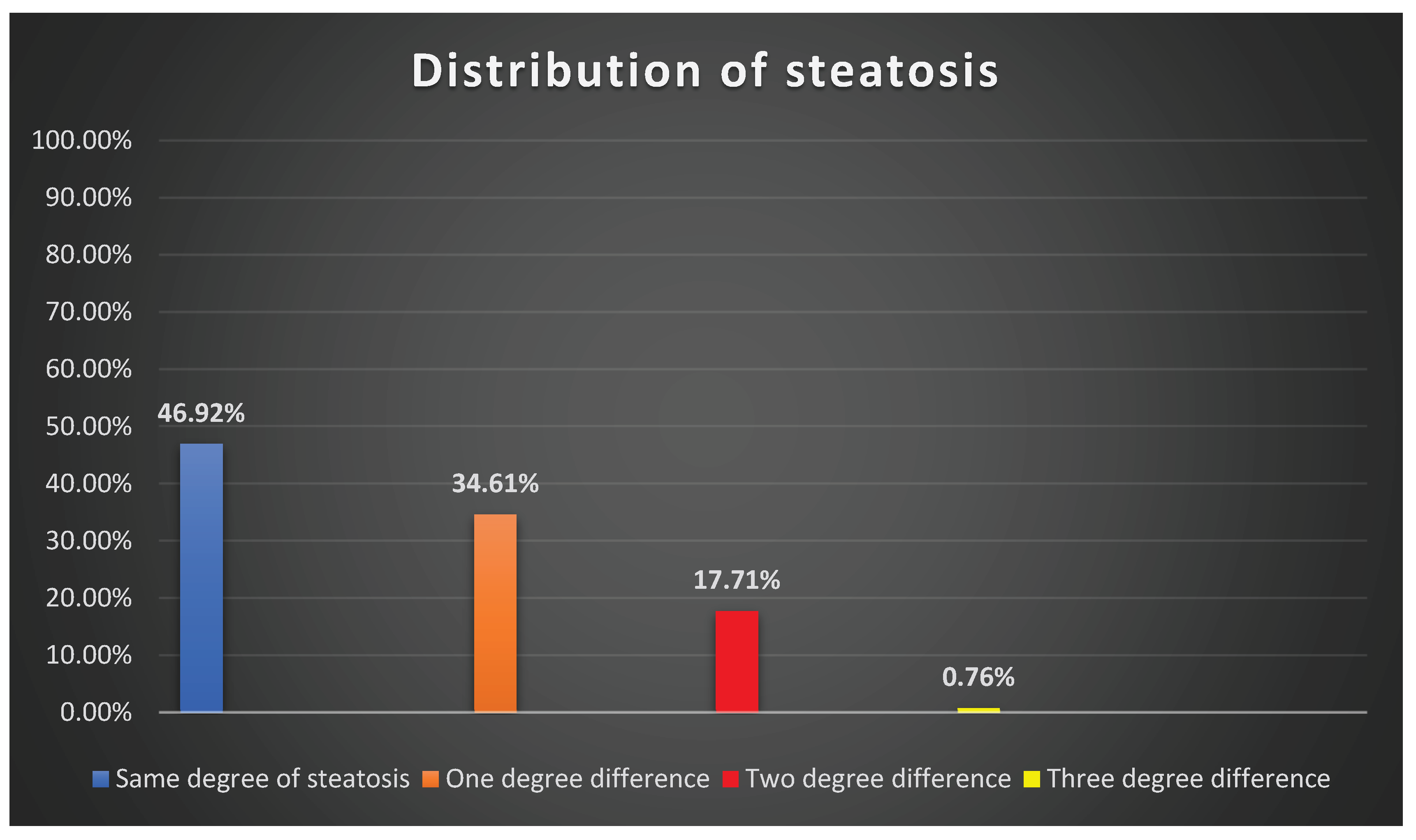

Table 1.
Baseline characteristics of the study population.
| Parameter |
Total of patients N=130 |
|
Gender Male gender Female gender |
62 ( 47.69%) 68 (52.31 ) |
|
Urban area Rural area |
72 (55.38 %) 58 ( 44.62%) |
|
Age (years) - < 50 -50-69 ≥ 70 |
30 (23.07 %) 72 ( 55.38%) 28 (21.55% ) |
|
Etiology - viral -alcoholic -autoimmune - other |
24 (18.46% ) 18 (13.84% ) 2 (1.53% ) 86 (66,17%) |
|
Fibrosis (measured byTE) -F0 -F1 -F2 -F3 -F4 |
39 ( 30%) 62 (47.69% ) 9 ( 6.92%) 6 (4.61% ) 14 (10.78%) |
| BMI (kg/m2) -<20 -20-24.9 -25-29.9 ≥30 |
6 (4.61%) 24 (18.46%) 52 (40% ) 48 ( 36.93%) |
| Type 2 Diabetes mellitus | 43 (33.07% ) |
| Cardiac comorbidities | 21 (16.15% ) |
| Arterial Hypertension | 72 ( 55.38%) |
| Hypothyroidism | 16 (12.30% ) |
| ALAT > ULN | 23 ( 17.69%) |
| GGT > ULN | 32 ( 24.61%) |
| Total Serum Cholesterol >200 mg/dl | 47 (36.15% ) |
| Triglycerides > 150 mg/dl | 37 (28.46% ) |
| FIB 4 - < 1.45 -1,45 -3.25 - > 3.25 |
69 ( 53.07%) 46 (35.38% ) 15 ( 11.5%) |
TE- transient elastography; F- fibrosis stage; BMI- body mass index; ALAT- alanine aminotransferase; ULN - Upper Limit of Normal; GGT - gamma-glutamyl transferase; FIB 4 – Fibrosis 4 index.
Table 2.
Cross-tabulation of steatosis grades between ultrasound and CAP.
| Ultrasound grade | CAP S0 | CAP S1 | CAP S2 |
CAP S3 | Total |
| S0 | 27 | 3 | 0 | 1 | 31 |
| S1 | 12 | 3 | 4 | 3 | 22 |
| S2 | 19 | 13 | 7 | 10 | 49 |
| S3 | 0 | 0 | 3 | 25 | 28 |
| Total | 58 | 19 | 14 | 39 | 130 |
CAP: Controlled Attenuation Parameter; S: Steatosis.
Table 3.
Univariate analysis of factors associated with discordant steatosis grading.
| Parameter | Same degree Steatosis US and TE (n=61) Group 1 | Diferrent degree Steatosis US and TE (n=69) Group 2 | p value | |
| Male gender | 33 (54.1%) | 29 (42.1%) | 0.17 | |
| Urban area | 33 (54.1%) | 39 (56.5%) | 0.78 | |
| Age (years) - < 50 -50-69 ≥ 70 |
16 (26.2%) 30 (49.2%) 15 (24.6%) |
14 (20.3%) 42 (60.8%) 13 (18,9%) |
0.42 0.18 0.43 |
|
| Etiology – viral -alcoholic -autoimmune |
6 (9.8%) 7 (11.4%) 1 (1.6%) |
18 (26.1%) 11 (15.9%) 1 (1.5%) |
0.01 0.45 0.96 |
|
| Fibrosis (TE) -F0 -F1 -F2 -F3 -F4 |
20 (32.8%) 32 (52.4%) 2 (3.3%) 2 (3.3%) 5 (8.2%) |
19 (27.6%) 30 (43.4%) 7 (10.1%) 4 (5.8%) 9 (13.1%) |
0,52 0.30 0.12 0.50 0.37 |
|
| Fibrosis (TE) ≥ 2 | 9 (14.8%) | 20 (29%) | 0.055 | |
| BMI (kg/m2) -<20 -20-24,9 -25-29,9 ≥30 |
4 (6.6%) 8 (13.1%) 24 (39.4%) 25 (40.9%) |
2 (2.9%) 16 (23.2%) 28 (40.6%) 23 (33.3%) |
0.31 0.14 0.88 0.37 |
|
| Type 2 Diabetes mellitus | 22 (36.1%) | 21 (30.4%) | 0.49 | |
| Cardiac comorbidities | 8 (13.1%) | 13 (18.8%) | 0.43 | |
| Arterial Hypertension | 34 (55.7%) | 38 (55.1%) | 0.94 | |
| ALAT > ULN | 10 (16.4%) | 13 (18.8%) | 0.72 | |
| GGT > ULN | 13 (21.3%) | 19 (27.5%) | 0.41 | |
| Total Serum Cholesterol >200 mg/dl | 28 (45.9%) | 19 (27.5%) | 0.02 | |
| Serum Triglycerides > 150 mg/dl | 22 (36.1%) | 15 (21.7%) | 0.07 | |
|
FIB 4 - < 1.45 -1.45 -3.25 - > 3.25 |
30 (49.2%) 27 (44.2%) 4 (6.6%) |
39 (56.6%) 19 (27.5%) 11 (15.9%) |
0.40 0.04 0.09 |
TE- transient elastography; F- fibrosis stage; BMI- body mass index; ALAT- alanine aminotransferase; ULN - Upper Limit of Normal; GGT - gamma-glutamyl transferase; FIB 4 – fibrosis 4 index.
Table 4.
Multivariable logistic regression analysis of factors associated with concordant steatosis grading between ultrasound and transient elastography.
Table 4.
Multivariable logistic regression analysis of factors associated with concordant steatosis grading between ultrasound and transient elastography.
| Variable | Odds Ratio (OR) | 95% CI | p value |
| Viral etiology | 0.59 | 0.18–1.95 | 0.37 |
| Cholesterol >200 mg/dl | 2.23 | 1.07–4.66 | 0.03 |
| FIB 4 | 0.98 | 0.59–1.63 | 0.92 |
Disclaimer/Publisher’s Note: The statements, opinions and data contained in all publications are solely those of the individual author(s) and contributor(s) and not of MDPI and/or the editor(s). MDPI and/or the editor(s) disclaim responsibility for any injury to people or property resulting from any ideas, methods, instructions or products referred to in the content. |
© 2026 by the authors. Licensee MDPI, Basel, Switzerland. This article is an open access article distributed under the terms and conditions of the Creative Commons Attribution (CC BY) license (http://creativecommons.org/licenses/by/4.0/).
Copyright: This open access article is published under a Creative Commons CC BY 4.0 license, which permit the free download, distribution, and reuse, provided that the author and preprint are cited in any reuse.


