

Submitted:
18 March 2026
Posted:
19 March 2026
You are already at the latest version
Abstract
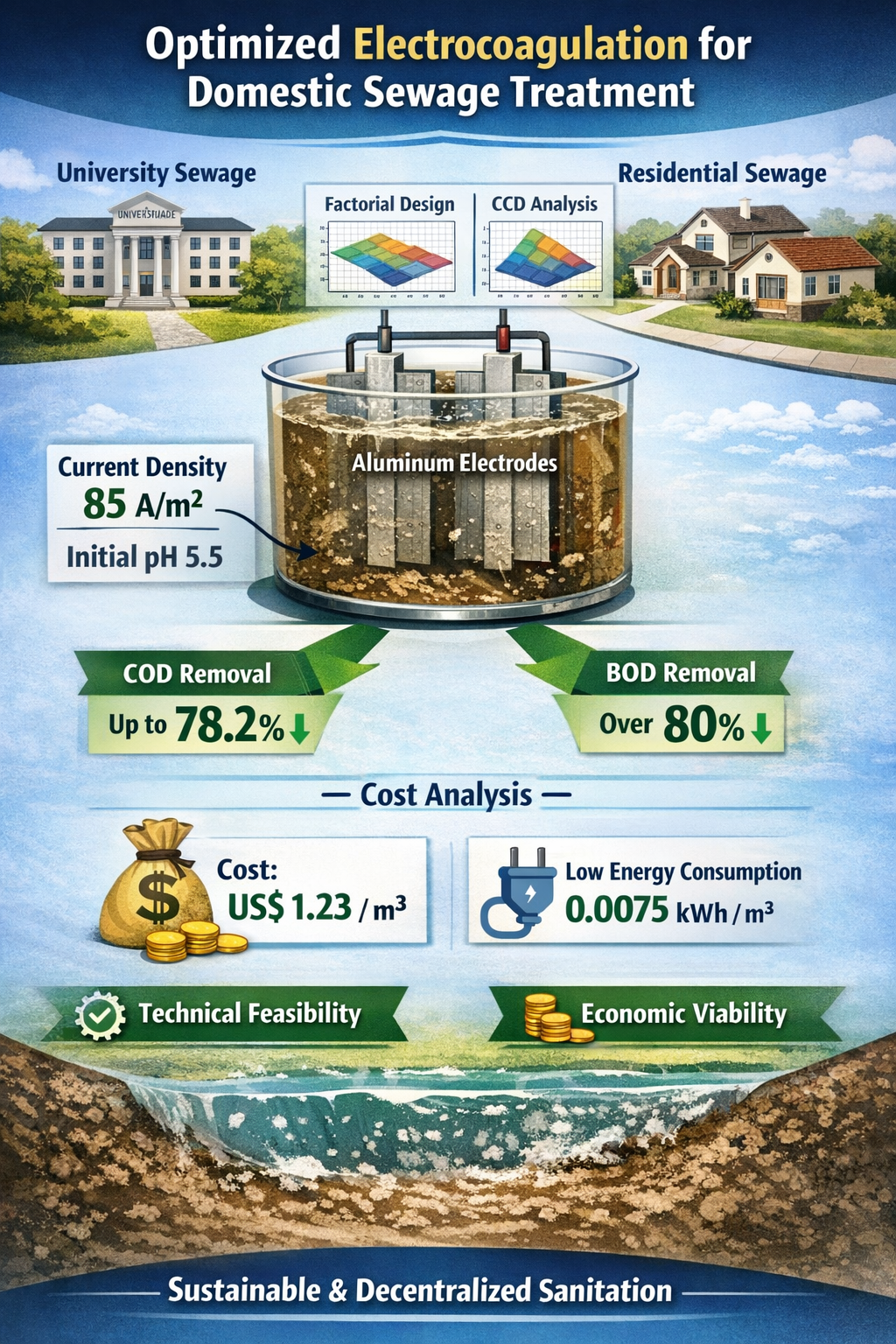
The increasing demand for sustainable water management has prompted the search for efficient domestic wastewater treatment technologies. Electrocoagulation (EC) has emerged as a promising alternative owing to its simplicity, efficiency, and potential for decentralized applications. This study investigated EC for treating domestic wastewater, focusing on optimizing operational parameters via the design of experiments (DoE). Initially, raw wastewater was characterized, followed by a fractional factorial design to screen for significant variables: operating time, current density, initial pH, and NaCl dosage. Results revealed that current density and pH were the most influential parameters on Chemical Oxygen Demand (COD) removal. Subsequently, a Central Composite Rotational Design (CCRD) optimized these key parameters. Optimal conditions were a current density of 85 A/m² and pH of 5.5, achieving COD removal efficiencies up to 78.2%. A cost analysis indicated the economic feasibility of EC for smaller effluent volumes, with an estimated operational cost of US$1.23 per cubic meter treated. Applying this methodology to real sewage matrices (Federal University of Sergipe WWTP and a residential condominium) showed variations in Biochemical Oxygen Demand (BOD), COD, and turbidity removal. These findings confirm EC's potential as a sustainable solution for domestic wastewater treatment in isolated communities.
Keywords:
wastewater treatment
; electrocoagulation
; experimental design
; organic matter removal
; sustainability
1. Introduction
Adequate management of water resources is fundamental to a sustainable future, and efficient treatment of domestic wastewater plays a pivotal role. Through Sustainable Development Goal 6 (SDG 6), the United Nations (UN) has established a target to ensure universal access to sanitation by 2030, emphasizing sustainable management, water quality improvement, and wastewater treatment. In Brazil, the state of basic sanitation remains a challenge, with a significant portion of the population lacking access to wastewater collection and treatment systems [1]. This situation is exacerbated in rural and remote communities, where the absence of centralized treatment networks is prevalent.
Against this backdrop, the pursuit of decentralized, low-cost, and easily maintainable wastewater treatment technologies is imperative. Electrocoagulation (EC), an electrochemical process, has garnered increasing attention as a promising alternative for wastewater treatment, particularly when integrated with renewable energy sources [2,3,4,5,6,7], including domestic wastewater [8]. EC relies on the electrolytic dissolution of metallic electrodes—typically aluminum or iron—to generate coagulants in situ. These coagulants destabilize and aggregate organic and inorganic pollutants within the effluent, facilitating their removal via sedimentation or flotation [9]. Its advantages include operational simplicity, reduced sludge production compared to conventional chemical coagulation, and the feasibility of using inexpensive electrode materials.
The process efficiency is highly dependent on the specific effluent characteristics and chosen operational conditions, underscoring the necessity of optimization studies for each application. Optimizing operational parameters, such as the initial pH, current density, and electrode material, is crucial for maximizing process efficiency [10,11] while minimizing operational costs.
Recent studies have corroborated the efficacy of EC in various configurations and matrices. [12] demonstrated Chemical Oxygen Demand (COD) removal rates exceeding 75% in domestic wastewater using aluminum electrodes, showing potential for non-potable reuse. [3] employed Response Surface Methodology (RSM) to optimize EC for cefazolin removal, achieving an 85.65% efficiency under ideal operating conditions. [13] assessed an electrocoagulation-flotation system, attaining removal efficiencies of up to 78.9% for COD and 90.1% for turbidity, although final pH correction was required to comply with environmental regulations. Furthermore, a systematic review by [14] highlighted that EC can achieve removal efficiencies greater than 90% for both COD and turbidity, particularly with aluminum or combined Al/Fe electrodes. The review also identified pH, current density, and reactor design as the determinant variables for process performance. Moreover, the literature has explored the use of non-conventional electrodes and the coupling of EC with other techniques, such as advanced oxidation processes and electroflotation, to enhance efficiency and mitigate the generation of byproducts [15]. [16] conducted a systematic review and concluded that, beyond removing organic matter and turbidity, EC has been successfully applied to eliminate emerging pollutants, including microplastics and per- and polyfluoroalkyl substances (PFAS).
Design of Experiments (DoE), particularly fractional factorial design and Central Composite Rotational Design (CCRD), coupled with Response Surface Methodology (RSM), are powerful statistical tools for process optimization and identification of optimal operational conditions [17,18]. A factorial design facilitates the simultaneous evaluation of multiple factors and their potential interactions. The CCRD is particularly effective for optimizing processes with nonlinear responses, as it allows the development of quadratic models and visualization of response surfaces. RSM assists in identifying the optimal operating conditions and elucidating the relationship between independent and response variables.
The growing demand for decentralized domestic wastewater treatment solutions, especially for rural and remote communities, reveals a significant gap in the current state-of-the-art sanitation technologies. Despite recent advances, many existing approaches lack operational simplicity, economic viability, and adaptability to diverse matrices. In this context, the present study proposes the application of EC as an innovative solution that combines low cost, ease of maintenance, and potential for integration with renewable energy sources. Beyond its technical merits, this technology offers the potential for direct social impact by promoting access to basic sanitation in underserved areas, thereby aligning with the Sustainable Development Goals (SDG 6).
This study aimed to evaluate the efficiency of the EC process for treating domestic wastewater, focusing on optimizing operational parameters through an experimental design approach. This study focused on identifying the optimal conditions for current density and initial pH to maximize organic matter removal using CCRD and RSM. Furthermore, the applicability of the optimized methodology was assessed using different real wastewater matrices to verify the robustness and flexibility of the process. A detailed analysis of the results and conclusions of this study will contribute to the advancement of knowledge in domestic wastewater treatment and the development of more efficient and sustainable solutions for basic sanitation.
2. Materials and Methods
2.1. Study Site and Sample Collection
This study was based on raw domestic wastewater sourced from a community in Estância, Sergipe, Brazil. Primary samples were collected from a partially decommissioned wastewater treatment plant (WWTP) operated by the local Municipal Water and Sewage Service (SAAE). To assess the robustness of the electrocoagulation process under different real-world conditions, supplementary wastewater samples were obtained from the WWTP at the Federal University of Sergipe (UFS) and from a separate urban residential condominium.
2.2. Wastewater Characterization
The collected wastewater samples were comprehensively characterized physicochemically and microbiologically. The analyzed parameters included Total Organic Carbon (TOC), Chemical Oxygen Demand (COD), Biochemical Oxygen Demand (BOD), pH, Settleable Solids, Oil and Grease, and Total Coliforms. All analytical procedures were conducted in strict accordance with the protocols outlined in the Standard Methods for the Examination of Water and Wastewater [19]. This initial characterization was essential for identifying the target pollutants and guiding the subsequent experimental design.
2.3. Electrocoagulation Reactor Setup
Electrocoagulation experiments were performed in a bench-scale prismatic reactor constructed from polymethyl methacrylate (PMMA) with a working volume of 3.0 L. The system was operated at ambient temperature (24 ± 1 °C) and maintained under constant agitation at 300 rpm. The electrode assembly consisted of four aluminum plates (each with a surface area of 225 cm²) arranged in a monopolar parallel configuration with an interelectrode gap of 1.0 cm. Aluminum was selected as the electrode material because of its proven high efficiency, broad applicability, and low cost [15]. The reactor design and electrode geometry were based on established recommendations to maximize mass transfer and minimize the hydraulic dead zones [11].
2.4. Experimental Design and Statistical Optimization
An initial screening of potentially influential variables was performed using a 2⁴⁻¹ fractional factorial design. The factors investigated were the operating time, current density, initial pH, and NaCl addition. The variables with the highest statistical significance were selected for process optimization. This subsequent stage was carried out using a five-level Central Composite Rotational Design (CCRD).
Response Surface Methodology (RSM) was employed to model the behavior of the system. This allowed the development of a quadratic equation to predict the process response and identify the optimal operating conditions. This statistical approach is widely recommended for systems involving nonlinear interactions and multiple variables, as it significantly reduces the number of experimental runs required while enhancing the statistical robustness [17,20].
2.5. Performance Evaluation and Cost Analysis
The primary response variable for process optimization was the COD removal efficiency, which was calculated from the concentrations before and after treatment. Confirmatory experiments were conducted under the optimal conditions predicted by the CCRD model to validate its accuracy and reliability. The specific energy consumption was determined by monitoring the voltage and current during the operating time. Electrode consumption was quantified gravimetrically by measuring the mass loss of the anodes after each experiment was performed.
An operational cost analysis, expressed in US dollars per cubic meter of treated wastewater (US$/m³), was estimated based on the average consumption of energy and electrode materials. This calculation used local utility rates for electricity (US$ 0.15/kWh) and the market price for aluminum (US$ 0.002/g). Although this analysis does not encompass capital investment or maintenance costs, it provides a practical estimate of the system's economic feasibility, following the methodology reported by [21].
3. Results
A thorough characterization of the effluent is essential to identify its contaminants and quantify their concentrations. This initial analysis provided the necessary baseline to develop and refine the experimental parameters for the EC process, ensuring that the treatment conditions could be optimized for the maximum removal efficiency of the identified pollutants.
3.1. Characterization of Raw Domestic Wastewater
The initial characterization of domestic wastewater from the Estância municipality (Table 1) was consistent with the typical composition of raw domestic wastewater reported in the literature.
3.2. Factor Screening
A 2⁴⁻¹ fractional factorial design with a center point was employed to identify the variables with the most significant influence on the electrocoagulation process. This approach was chosen for its efficiency in reducing the number of experimental runs while still allowing the analysis of the main effects [17,20]. This initial exploratory design simultaneously evaluated the effects of four operational factors: operating time, current density, initial pH, and NaCl concentration. Each factor was tested at three levels, corresponding to the coded values of -1, 0, and +1, which are the standards for statistical studies with continuous variables. The response variable was the COD removal efficiency (%).
Table 2 presents a detailed summary of how each experimental run influenced the reduction in COD.
The results were statistically analyzed using Statistica software, and a Pareto chart was generated to visualize the individual and interactive effects of each variable (Figure 1).
3.3. Process Optimization
Based on the factor screening results, a CCRD was implemented to optimize the two most influential parameters, current density and pH, across five levels (Table 3), while all other conditions were held constant. The CCRD was selected for its ability to fit quadratic models and identify optimal operating regions, a methodology widely employed for complex electrocoagulation processes with interacting variables [27,28].
The CCRD comprised 12 experimental runs, which included factorial, axial (α = ±1.414), and center points. Table 4 presents the CCRD experimental matrix and corresponding results. Response surfaces were generated to visualize the influence of the independent variables and identify the optimal operating region (Figure 2 and Figure 3).
3.4. Validation of the Optimized Model and Cost Analysis
To validate the optimal conditions predicted by the CCRD model (current density of 85 A/m² and pH of 5.5), confirmatory replicate experiments were conducted. The results are shown in Table 5.
A cost analysis of the EC process, which is essential for determining its practical applicability, was performed by measuring the energy consumption (from current and voltage readings) and electrode mass consumed during the experiments (Table 6).
Table 7 provides a comparative summary of these results with those of other studies in the literature.
3.5. Application to Different Sewage Matrices
To assess the robustness and adaptability of the optimized methodology, the EC process was applied to two different sewage matrices: one from the Federal University of Sergipe's WWTP (WWTP-UFS) and another from an urban residential condominium (URC) (Figure 4). This stage was designed to investigate the impact of effluent composition on process efficiency and to test the resilience of the statistical model under distinct real-world conditions.
4. Discussion
4.1. Characterization of Raw Domestic Wastewater
The raw domestic wastewater exhibited high concentrations of COD (688.33 mg/L) and BOD (220 mg/L). These values significantly exceed the discharge limits for water bodies stipulated by Brazilian environmental regulations [22], which set maximums of 120 mg/L for COD and 60 mg/L for BOD for direct discharge into Class 2 receiving waters. These data underscore the necessity of effective treatment prior to disposal, particularly in regions where the receiving water body has a low dilution capacity.
Comparatively, international guidelines such as the [23] and those of the [24] impose stringent standards for treated effluents, with typical secondary treatment limits of 125 mg/L for COD and 30 mg/L for BOD. This comparison highlights that the wastewater analyzed in this study possessed an organic load substantially higher than the permissible discharge standards, thereby justifying the selection of electrocoagulation as a viable treatment alternative. Furthermore, the elevated concentration of total coliforms (>1.6×10⁷ MPN/100 mL) indicates a significant health risk. This reinforces the importance of technologies that not only remove organic matter but also provide complementary disinfection, as recommended by [25] for individual treatment systems.
4.2. Factor Screening
At a 95% confidence level (p = 0.05), none of the variables or their interactions were statistically significant. However, the Pareto chart clearly indicated that the initial pH and current density were the most influential factors, despite not reaching the threshold for statistical significance (p < 0.05). This lack of statistical significance may be attributed to inherent experimental variability and a limited number of replicates, suggesting that future studies could benefit from more replicates or alternative designs with greater statistical power.
These findings align with those of previous electrocoagulation studies, such as the review by [14], which also identified pH and current density as critical parameters for organic matter removal. The minor influence of NaCl has been similarly reported by [26], who attributed it to the sufficient conductivity provided by metallic ions released from the electrodes. Therefore, given the clear predominance of current density and initial pH, a Central Composite Rotational Design (CCRD) was conducted to model the system’s behavior more precisely and determine the optimal operating conditions. As the Pareto chart suggested that higher efficiency could be achieved by increasing the current density and decreasing the pH, the CCRD was ideal for expanding the experimental region through the inclusion of axial points. The results of the optimization stage are presented in Section 4.3.
4.3. Process Optimization
The Table 4 data revealed a pattern consistent with expectations and the literature. A marked increase in the treatment efficiency was observed in the runs conducted at the axial points (Experiments 6 and 7). Consequently, it became necessary to compare the comprehensive model with an analysis of the factorial subset (experiments 1-4 and the center point).
The response surfaces indicated that maximizing the current density was crucial for enhancing the COD removal efficiency. Although the influence of pH was less pronounced, a lower pH also contributed to process optimization, particularly when combined with a higher current density, as evidenced by the curvature of the response surface (Figure 2).
The statistical modeling results of this study are well supported by the specialized literature. The sequential application of a fractional factorial design and CCRD successfully identified current density and initial pH as the most influential variables for COD removal, which aligns with the findings of [12] and [18]. While those authors employed more direct experimental approaches, the present study incorporated Response Surface Methodology (RSM), yielding a predictive model with superior accuracy and broader applicability.
The statistical analysis presented herein also corroborates the results of [28], who utilized a central composite design and RSM to optimize electrocoagulation for the simultaneous removal of micropollutants. Consistent with our findings, they identified significant nonlinear relationships and quadratic effects among operational parameters, particularly between pH and current density. These parallels reinforce the suitability of RSM as a robust tool for exploring the combined effects of operational factors in the EC process, thereby validating the adopted modeling.
4.4. Validation of the Optimized Model and Cost Analysis
The Table 5 results confirm that optimizing the current density and pH can produce significant variations in pollutant removal, as demonstrated by the replicate runs, which is consistent with the findings of [29]. The observed variance in COD removal percentages among replicates can likely be attributed to uncontrolled or unmodeled operational factors inherent to the EC system, a phenomenon extensively discussed by [30].
Based on a local electricity tariff of US$0.15/kWh and a market price for aluminum of US$0.002/g, the operational costs were estimated to be US$0.00369 per hour, and US$1.23 per cubic meter of treated effluent. For comparison, [21] reported a cost of US$0.21/m³ for treating a synthetic dye-containing effluent, albeit with higher energy consumption (0.45 kWh/m³). Despite the cost difference, our results affirm the technical and economic viability of EC for real wastewater, particularly considering the process's adaptability and low environmental impact.
Although this operational cost is subject to variation based on scale and local conditions, it is competitive with other decentralized treatment technologies, especially for smaller effluent volumes. The simplicity of the EC system and its low initial capital cost are additional advantages. However, a comprehensive feasibility analysis requires a more detailed economic evaluation, including the long-term capital and maintenance costs of a full-scale system.
As can be seen in Table 7 this study offers significant advantages over previous studies, primarily through the application of EC to real domestic wastewater from two distinct matrices, which lends greater robustness and practical relevance to the findings. Moreover, when coupling technical performance with economic viability, the average operational cost of US$ 1.23/m ³ in this study is associated with a very low estimated energy consumption of just 0.0075 kWh/m³, establishing it as an efficient alternative for decentralized applications. Similar outcomes were reported by [13], who used an EC-flotation system for domestic wastewater treatment intended for urban reuse. Under their optimized conditions, they achieved 82.9% COD and 95.8% turbidity removal, with an energy consumption of approximately 0.021 kWh/m³. The COD removal efficiency achieved in this study (up to 78.2%) falls within the range reported by [31] for optimized EC systems, reinforcing the robustness of the process. This energy consumption is notably lower than the values from other studies, such as [21], who reported 0.45 kWh/m³ under controlled, synthetic conditions (Table 7). This underscores the attractiveness of EC in contexts where energy is limited or grid access is unavailable to consumers.
The present work is also distinguished from the studies of [13] and [12] by testing the EC process on multiple real domestic wastewater matrices, thereby proving its versatility and operational robustness. The use of CCRD with RSM further enhances statistical rigor and reliability, yielding a model that is replicable in diverse settings.
However, this study has certain limitations. The relatively long operating time (60 min), although effective, could constrain the application of this technology in continuous systems with higher flow rates. Furthermore, the focus on classical parameters (COD and BOD) restricts the analysis of emerging pollutants. In this regard, studies by [28] and [16] suggest that broadening the analytical scope to include contaminants such as pharmaceuticals, PFAS, and microplastics and integrating EC with complementary techniques would further enhance the environmental impact of this technology.
4.5. Application to Different Sewage Matrices
Figure 4 presents a comparative analysis of BOD, COD, and turbidity removal, as well as the changes in conductivity and pH. BOD removal was more efficient for the WWTP-UFS sewage (80.07%), whereas COD removal was superior for URC sewage (66.09%). This discrepancy may be linked to the proportion of biodegradable organic matter in each matrix type. The WWTP sewage, being more diluted and homogeneous, might favor the removal of easily oxidizable compounds, whereas the URC sewage could contain a higher load of refractory compounds, thereby affecting the COD removal efficiency.
Turbidity removal was significant in both matrices, reinforcing the EC's capacity to improve the physical characteristics of the effluent. Conversely, the electrical conductivity increased post-treatment, which was an expected outcome owing to the release of aluminum ions (Al³⁺) during electrode dissolution. This behavior was also reported by [32], who observed increased pH and conductivity in EC-treated effluents intended for reuse in forestry.
The increase in the final pH of both matrices was attributed to the generation of hydroxide ions (OH⁻) at the cathode. This can be advantageous for subsequent disinfection steps but requires careful management if the treated effluent is intended for direct reuse.
These results demonstrate that although the optimized methodology is effective across different contexts, the raw effluent composition directly influences the process efficiency. Therefore, for each new matrix, fine-tuning of the operational parameters, such as the reaction time, current density, and electrode geometry, is recommended to maximize the performance. The application of EC to diverse real-world matrices confirms its versatility but also highlights the importance of contextualized calibration, particularly when aiming for standardized efficiency in decentralized systems.
5. Conclusions
This study demonstrates that electrocoagulation (EC) is an efficient, economical, and technically feasible alternative for domestic wastewater treatment, particularly for decentralized applications and in operationally constrained environments. The successful application of an optimization methodology, based on a Central Composite Rotational Design (CCRD) and Response Surface Methodology (RSM), identified the ideal operating conditions as a current density of 85 A/m² and an initial pH of 5.5. Under these conditions, the process achieved COD and BOD removal efficiencies of up to 78.2% and exceeding 80%, respectively.
Validation of the process across different wastewater matrices sourced from a university wastewater treatment plant and a residential condominium underscored the robustness and adaptability of EC technology, even when challenged by variations in effluent composition. The cost analysis confirmed the economic viability of the process for moderate wastewater volumes, with an estimated operational cost of US$1.23/m³. This was achieved with remarkably low energy consumption of 0.0075 kWh/m³, representing highly competitive energy performance compared to conventional treatment alternatives.
Furthermore, these findings are in alignment with the results of studies such as [13], who reported 82.9% COD and 95.8% turbidity removal using an EC–Flotation system for urban reuse. This congruence indicates that EC, whether as a standalone process or integrated with other technologies, has significant potential for advanced effluent treatment.
In conclusion, based on its strong technical performance, simplicity of construction, and affordability, EC emerges as a strategic technology to help achieve Sustainable Development Goal 6 (SDG 6: Clean Water and Sanitation), particularly in regions with limited infrastructure. Future research should focus on integrating EC with other advanced techniques (e.g., photocatalysis or ozonation) and incorporating renewable energy sources and automated control systems to further amplify its positive environmental and social impacts.
Author Contributions
The present research article had the individual contributions of the following authors: Conceptualization, Joel Alonso Palomino-Romero and João Paulo Lobo dos Santos; methodology, Davi Nascimento dos Santos; validation, Davi Nascimento dos Santos and João Paulo Lobo dos Santos; formal analysis, Davi Nascimento dos Santos and João Paulo Lobo dos Santos; investigation, Davi Nascimento dos Santos; resources, Luciano de Melo; data curation, João Paulo Lobo dos Santos; writing—original draft preparation, Joel Alonso Palomino-Romero; writing—review and editing, Joel Alonso Palomino-Romero and João Paulo Lobo dos Santos; visualization, Davi Nascimento dos Santos and Joel Alonso Palomino-Romero; supervision, Joel Alonso Palomino-Romero; project administration, Joel Alonso Palomino-Romero; funding acquisition, Luciano de Melo. All authors have read and agreed to the published version of the manuscript.
Funding
Please add: This research was funded by CAPES (Coordenação de Aperfeiçoamento de Pessoal de Nível Superior), grant number 23113.007906/2024-69.
Acknowledgments
During the preparation of this manuscript, the authors used Gemini 3 for the purposes of proofread and correct the grammar and spelling of the text. The authors have reviewed and edited the output and take full responsibility for the content of this publication.
Conflicts of Interest
The authors declare no conflicts of interest. The funders had no role in the design of the study; in the collection, analyses, or interpretation of data; in the writing of the manuscript; or in the decision to publish the results.
Abbreviations
The following abbreviations are used in this manuscript:
| EC | Electrocoagulation |
| DoE | Design of experiments |
| CCRD | Central Composite Rotational Design |
| RSM | Response Surface Methodology |
| PFAS | Polyfluoroalkyl substances |
| WWTP | Wastewater treatment plant |
| UFS | Federal University of Sergipe |
| URC | Urban residential condominium |
References
- Agência Nacional de Águas (Brasil). Atlas esgotos: despoluição de bacias hidrográficas; Agência Nacional de Águas, Secretaria Nacional de Saneamento Ambiental; ANA: Brasília, Brasil, 2017; p. 88 p. il. ISBN 978-85-8210-050-9. [Google Scholar]
- Liu, Y.; Li, C.; Bao, J.; Wang, X.; Yu, W.; Shao, L. Degradation of Azo Dyes with Different Functional Groups in Simulated Wastewater by Electrocoagulation. Water 2022, 14, 123. [Google Scholar] [CrossRef]
- Bajpai, M.; Katoch, S.S.; Kadier, A.; Ma, P.C. Treatment of Pharmaceutical Wastewater Containing Cefazolin by Electrocoagulation (EC): Optimization of Various Parameters Using Response Surface Methodology (RSM), Kinetics and Isotherms Study. Chem. Eng. Res. Des. 2021, 176, 254–266. [Google Scholar] [CrossRef]
- Shahawy, A.E.; Ahmed, I.A.; Nasr, M.; Ragab, A.H.; Al-Mhyawi, S.R.; Elamin, K.M.A. Organic Pollutants Removal from Olive Mill Wastewater Using Electrocoagulation Process via Central Composite Design (CCD). Water 2021, 13, 3522. [Google Scholar] [CrossRef]
- Genawi, N.; Ibrahim, M.; El-Naas, M.; Alshaik, A. Chromium Removal from Tannery Wastewater by Electrocoagulation: Optimization and Sludge Characterization. Water 2020, 12, 1374. [Google Scholar] [CrossRef]
- Gong, C.; Ren, X.; Han, J.; Wu, Y.; Gou, Y.; Zhang, Z.; He, P. Toxicity Reduction of Reverse Osmosis Concentrates from Petrochemical Wastewater by Electrocoagulation and Fered-Fenton Treatments. Chemosphere 2022, 286, 131582. [Google Scholar] [CrossRef]
- Perren, W.; Wojtasik, A.; Cai, Q. Removal of Microbeads from Wastewater Using Electrocoagulation. ACS Omega 2018, 3, 3357–3364. [Google Scholar] [CrossRef]
- Marmanis, D.; Emmanouil, C.; Fantidis, J.G.; Thysiadou, A.; Marmani, K. Description of a Fe/Al Electrocoagulation Method Powered by a Photovoltaic System, for the (Pre-)Treatment of Municipal Wastewater of a Small Community in Northern Greece. Sustainability 2022, 14, 4323. [Google Scholar] [CrossRef]
- Posavcic, H.; Halkijevic, I.; Vuković, Ž. Application of Electrocoagulation for Water Conditioning. Environ. Eng. 2019, 6, 59–70. [Google Scholar] [CrossRef]
- Nidheesh, P. V; Khan, F.M.; Kadier, A.; Akansha, J.; Bote, M.E.; Mousazadeh, M. Removal of Nutrients and Other Emerging Inorganic Contaminants from Water and Wastewater by Electrocoagulation Process. Chemosphere 2022, 307, 135756. [Google Scholar] [CrossRef]
- López-Guzmán, M.; Flores-Hidalgo, M.A.; Reynoso-Cuevas, L. Electrocoagulation Process: An Approach to Continuous Processes, Reactors Design, Pharmaceuticals Removal, and Hybrid Systems—A Review. Processes 2021, 9, 1831. [Google Scholar] [CrossRef]
- Bracher, G.; Glusczak, A.; Scheunemann Lovato, É.; Maman, R.; Carissimi, E. Análise Do Desempenho de Um Sistema Eletroquímico No Tratamento de Esgoto Doméstico. Sci. cum Ind. 2018, 6, 12–16. [Google Scholar] [CrossRef]
- Bracher, G.H.; Carissimi, E.; Wolff, D.B.; Glusczak, A.G.; Graepin, C. Performance of an Electrocoagulation-Flotation System in the Treatment of Domestic Wastewater for Urban Reuse. Environ. Sci. Pollut. Res. 2022, 29, 49439–49456. [Google Scholar] [CrossRef]
- Castillo, J.; Moreira, Y.; Banchon, C. Electrocoagulación de Aguas Residuales Domésticas: Revisión Sistemática de Efectos Operacionales. Res. Soc. Dev. 2025, 14, e2814548700. [Google Scholar] [CrossRef]
- Grecco, L.H.A.; Souza, B.C. de A.; Zanoni, M.V.B. Eletrocoagulação/Eletrofloculação Para Tratamento de Águas Residuárias: Eletrodos Não Convencionais e Acoplamento de Técnicas. Quim. Nova 2022, 45, 410–423. [Google Scholar] [CrossRef]
- Mao, Y.; Zhao, Y.; Cotterill, S. Examining Current and Future Applications of Electrocoagulation in Wastewater Treatment. Water 2023, 15, 1455. [Google Scholar] [CrossRef]
- Jeremias, T.C.; Pineda-Vásquez, T.; Lapolli, F.R.; Lobo-Recio, M.Á. Use of Eggshell as a Low-Cost Biomaterial for Coal Mine-Impacted Water (MIW) Remediation: Characterization and Statistical Determination of the Treatment Conditions. Water, Air, Soil Pollut. 2020, 231, 562. [Google Scholar] [CrossRef]
- Graepin, C.; Carissimi, E.; Kuhn, R.; Bracher, G. Electrocoagulation-Flotation: A Novel Proposal for Latin-American Water Treatment Facilities. Desalin. Water Treat. 2020, 202, 241–250. [Google Scholar] [CrossRef]
- American Public Health Association; American Water Works Association; Water Environment. Standard Methods for the Examination of Water and Wastewater, 24th ed.; Lipps, WC, Braun-Howland, EB, Baxter, TE, Eds.; APHA Press: Washington DC, 2023. [Google Scholar]
- Tahreen, A.; Jami, M.S.; Ali, F. Role of Electrocoagulation in Wastewater Treatment: A Developmental Review. J. Water Process Eng. 2020, 37, 101440. [Google Scholar] [CrossRef]
- Najari, S.; Delnavaz, M.; Bahrami, D. Application of Electrocoagulation Process for the Treatment of Reactive Blue 19 Synthetic Wastewater: Evaluation of Different Operation Conditions and Financial Analysis. Chem. Phys. Lett. 2023, 832, 140897. [Google Scholar] [CrossRef]
- BRASIL. Conselho Nacional do Meio Ambiente - CONAMA. Resolução nº 430, de 13 de maio de 2011; Diário Oficial da União: seção 1: Brasília, DF, 2011; Volume ano 148, n. 92, pp. 89–132. [Google Scholar]
- Council Directive 91/271/EEC of 21 May 1991 concerning urban waste-water treatment.
- US EPA, O.W. Effluent Guidelines. Available online: https://www.epa.gov/eg.
- ASSOCIAÇÃO BRASILEIRA DE NORMAS TÉCNICAS. NBR 13969: Tanques sépticos - Unidades de tratamento complementar e disposição final dos efluentes líquidos: Projeto, construção e operação 1997, 60 p.
- Amri, N.; Ismail, S.; Azha, S.F.; Abdullah, A.Z. Behaviors and Mechanism of Color, COD, and Silica Removals in the Electrocoagulation of Batik Wastewater Using Waste Aluminum Electrodes. Int. J. Environ. Res. 2021, 15, 509–525. [Google Scholar] [CrossRef]
- Tomassoni, F.; Schneider, E.; Lisboa, C.; Nagel-Hassemer, M. E.; Lapolli, F. Aplicação do Método Estatístico DCCR na Remoção de Corantes em Efluente Têxtil por Processo de Eletrocoagulação. Engenharia Ambiental e Sanitária: Interfaces do Conhecimento 2 2019, 231–243. [Google Scholar] [CrossRef]
- Mahmoudnia, A.; Mehrdadi, N.; Baghdadi, M.; Moussavi, G. Simultaneous Removal of Microplastics and Benzalkonium Chloride Using Electrocoagulation Process: Statistical Modeling and Techno-Economic Optimization. Environ. Sci. Pollut. Res. 2023, 30, 66195–66208. [Google Scholar] [CrossRef] [PubMed]
- Boinpally, S.; Kolla, A.; Kainthola, J.; Kodali, R.; Vemuri, J. A State-of-the-Art Review of the Electrocoagulation Technology for Wastewater Treatment. Water Cycle 2023, 4, 26–36. [Google Scholar] [CrossRef]
- Al-Rubaye, S.F.A.; Alhaboubi, N.A.; Al-Allaq, A.H. Factors Affecting Electrocoagulation Process for Different Water Types: A Review. Al-Khwarizmi Eng. J. 2024, 20, 17–32. [Google Scholar] [CrossRef]
- Magnisali, E.; Yan, Q.; Vayenas, D. V Electrocoagulation as a Revived Wastewater Treatment Method-Practical Approaches: A Review. J. Chem. Technol. Biotechnol. 2022, 97, 9–25. [Google Scholar] [CrossRef]
- Biassio, V.; Sinézio de Carvalho Campos, J. Aplicação Da Eletrocoagulação Para Reúso de Efluente Na Indústria de Produção de Eucalipto. Rev. DAE 2020, 68, 122–134. [Google Scholar] [CrossRef]
Figure 1.
Pareto chart of the standardized effects on COD removal.
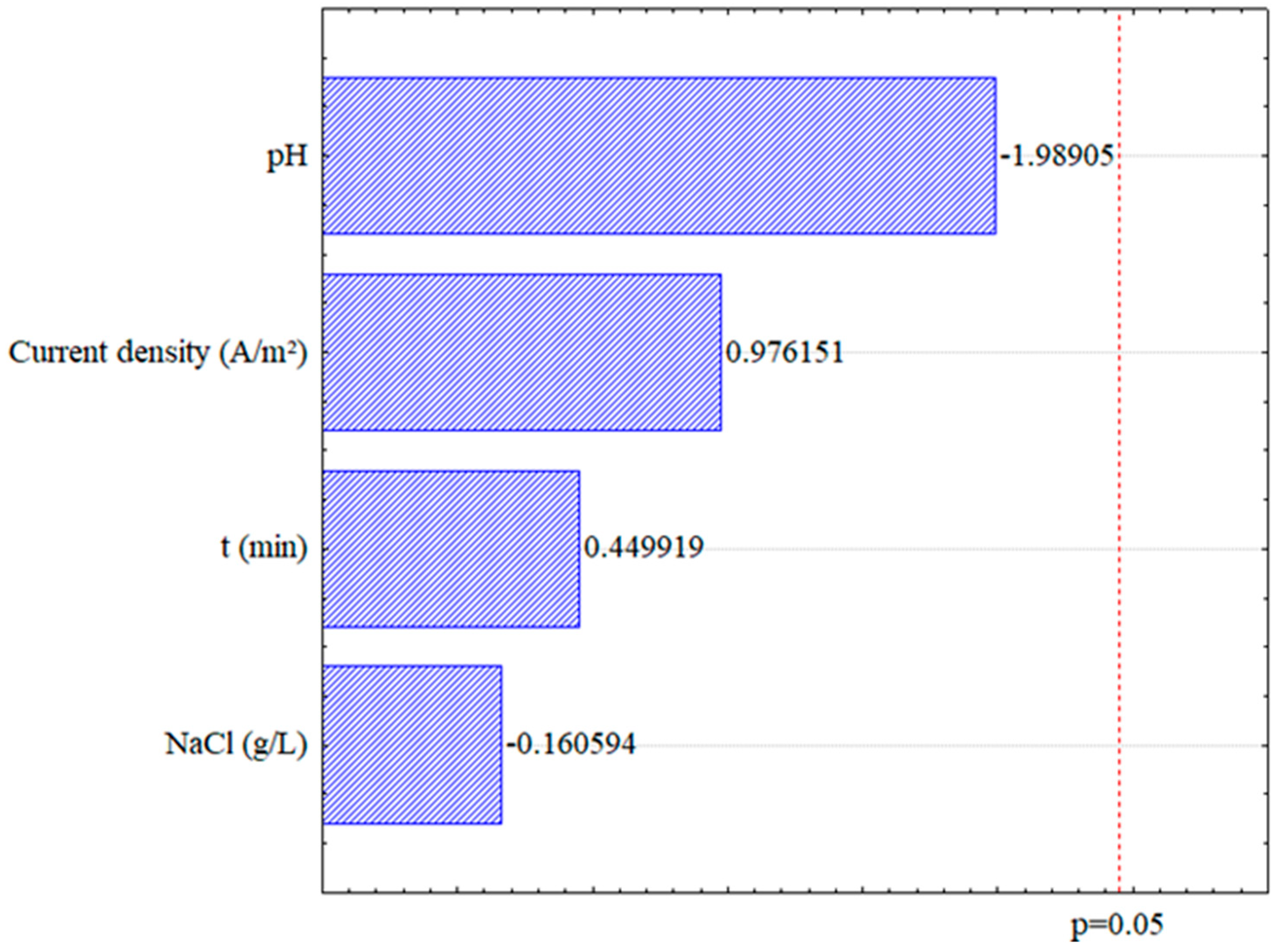
Figure 2.
Response surface methodology (RSM) contour plot (2D) for COD removal.
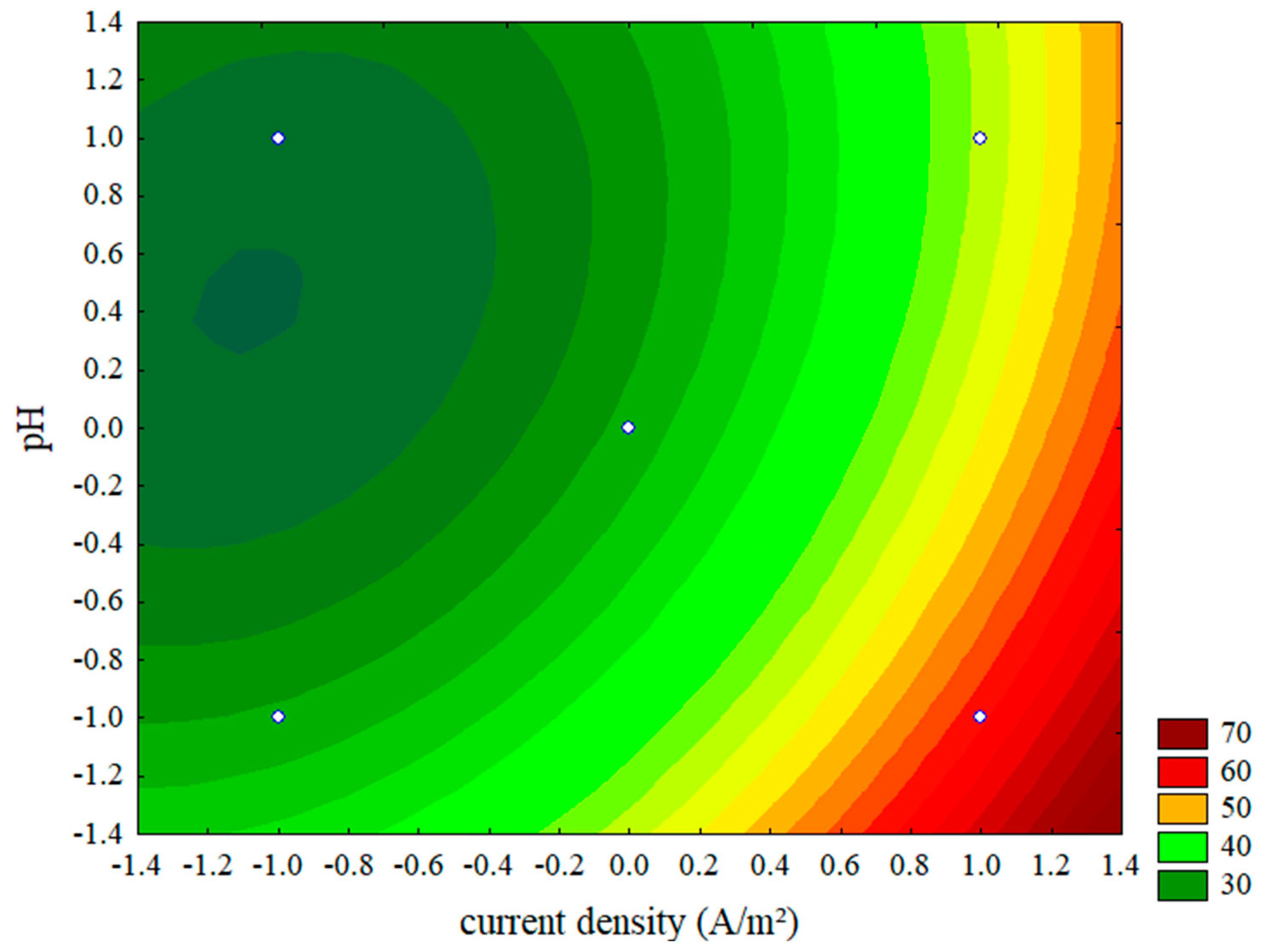
Figure 3.
3D response surface for COD removal, including axial points.
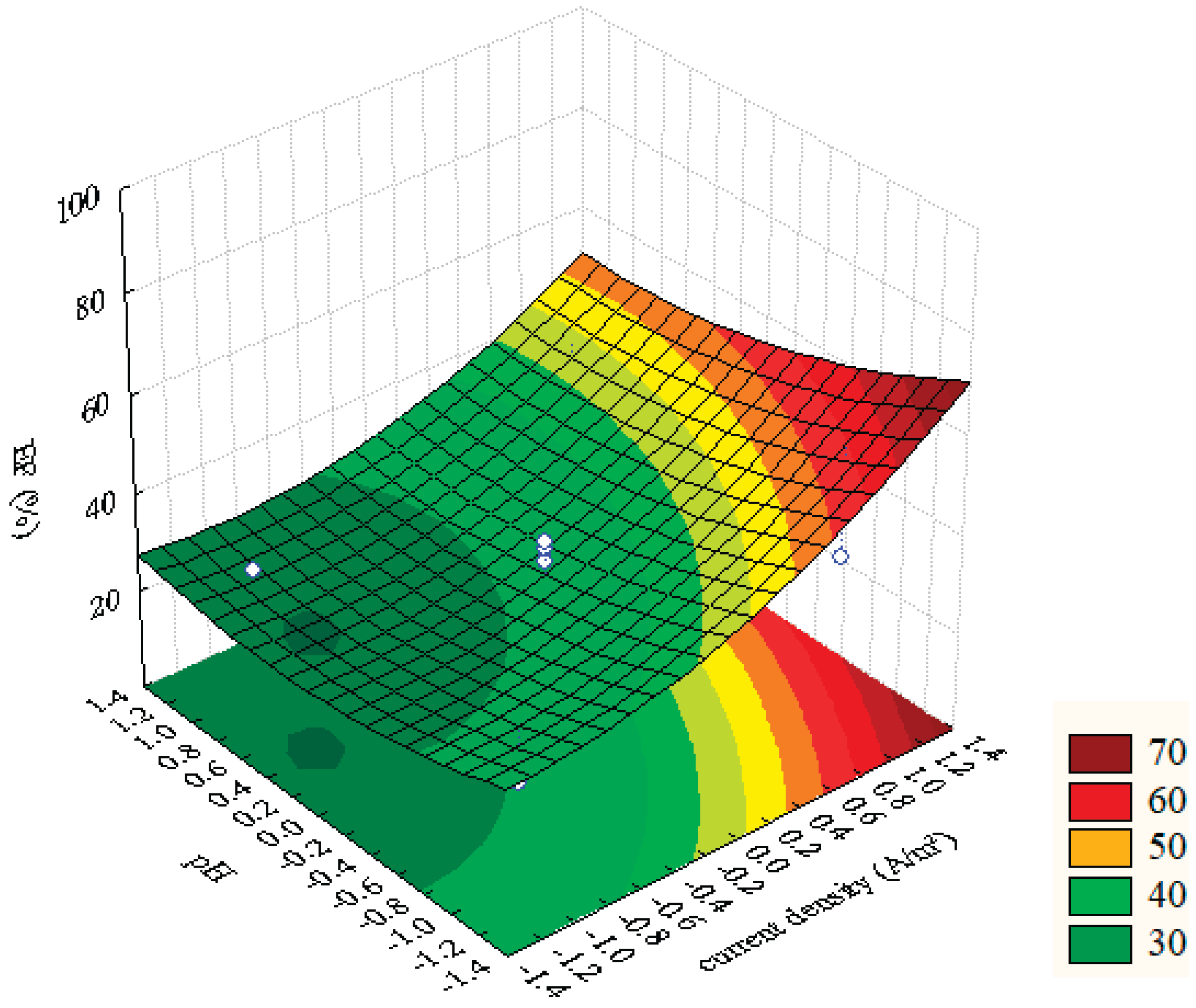
Figure 4.
Comparison of removal efficiencies for WWTP-UFS and URC sewage.
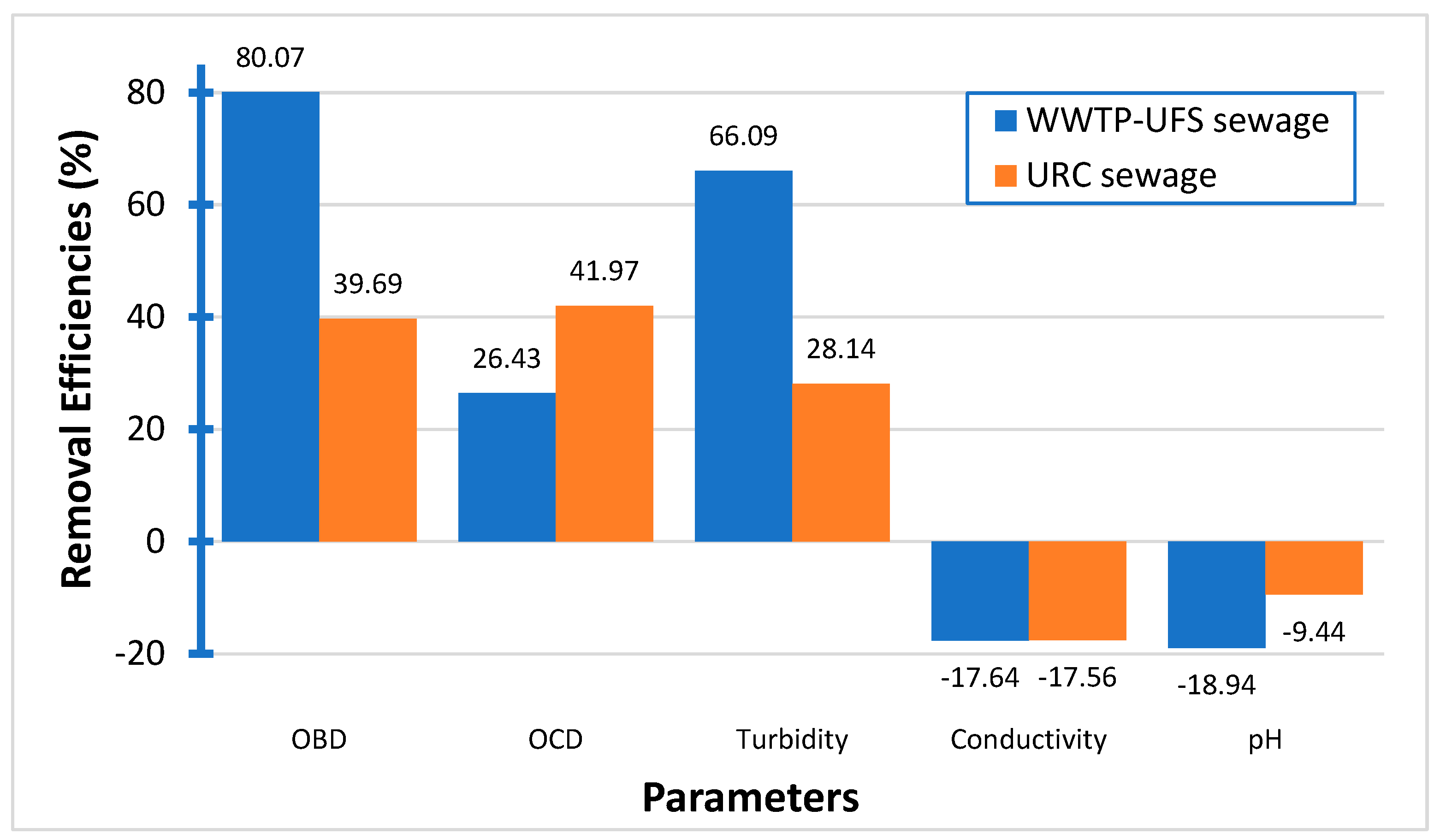

Table 1.
Characterization of the raw effluent collected for the study.
| Analyzed Parameter | Result |
|---|---|
| Total Organic Carbon | 130.0 mg/L |
| Chemical Oxygen Demand (COD) | 688.33 mg/L |
| Total Coliforms | >1.6E+7 |
| Settleable Solids | 8.0 mg/L |
| Oil and Grease | 20.0 mg/L |
| Biochemical Oxygen Demand (BOD) | 220 mgO2/L |
| pH | 6.37 |
Table 2.
Experimental matrix and results for the fractional factorial design.
| Time (minutes) |
Current density (A/m²) |
pH | NaCl addition (g/L) |
COD reduction (%) |
|---|---|---|---|---|
| 30 | 60 | 6 | 0 | 31.66 |
| 60 | 80 | 6 | 0 | 50.32 |
| 60 | 60 | 6 | 0.5 | 28.23 |
| 30 | 80 | 6 | 0.5 | 57.73 |
| 60 | 60 | 8 | 0 | 34.82 |
| 30 | 80 | 8 | 0 | 15.56 |
| 30 | 60 | 8 | 0.5 | 15.53 |
| 60 | 80 | 8 | 0.5 | 24.62 |
| 45 | 70 | 7 | 0.25 | 37.30 |
| 45 | 70 | 7 | 0.25 | 20.45 |
| 45 | 70 | 7 | 0.25 | 50.75 |
Table 3.
Coded and real values for the CCRD factors.
| Parameter | Level (-ɑ) | Level (-1) | Level (0) | Level (+1) | Level (+ɑ) |
|---|---|---|---|---|---|
| Current density (A/m²) | 67.3 | 70 | 75 | 80 | 82.07 |
| pH | 5.79 | 6 | 6.5 | 7 | 7.21 |
Table 4.
CCRD matrix and experimental results for COD removal.
| Experiment | Current density (A/m²) | pH | COD Reduction (%) |
|---|---|---|---|
| 1 | 70 | 6 | 20 |
| 2 | 70 | 7 | 25.64 |
| 3 | 80 | 6 | 34.20 |
| 4 | 80 | 7 | 32.50 |
| 5 | 67.93 | 6.5 | 27.26 |
| 6 | 82.07 | 6.5 | 72.82 |
| 7 | 75 | 5.79 | 61.61 |
| 8 | 75 | 7.21 | 32.38 |
| 9 | 75 | 6.5 | 24.62 |
| 10 | 75 | 6.5 | 30.49 |
| 11 | 75 | 6.5 | 33.32 |
| 12 | 75 | 6.5 | 34.36 |
Table 5.
Confirmatory experimental runs at the optimal setpoint and corresponding COD reduction.
| Experiment | Current density (A/m²) | pH | COD Reduction (%) |
|---|---|---|---|
| 1 | 85 | 5.5 | 45.06 |
| 2 | 85 | 5.5 | 78.20 |
| 3 | 85 | 5.5 | 57.63 |
Table 6.
Operational parameters for energy and electrode consumption analysis.
| Experiment | Power (W) | Time (Hours) | Energy consumption (kWh) | Electrode consumption (g/h) |
|---|---|---|---|---|
| 1 | 14.52 | 0.5 | 0.007258 | 0.1954 |
| 2 | 16.04 | 0.5 | 0.008022 | 0.1919 |
| 3 | 14.33 | 0.5 | 0.007162 | 0.1563 |
| Average | 14.96 | 0.5 | 0.007481 | 0.1812 |
Table 7.
Comparative analysis of electrocoagulation studies for wastewater treatment.
| Effluent Type | Operating Conditions | COD Removal (%) | Energy consumption (kWh) | Cost (US$/m³) | Reference |
|---|---|---|---|---|---|
| Domestic sewage | 85 A/m², pH 5.5, 60 min | 78.2 | 0.0075 | 1.23 | This study |
| Domestic sewage | EC-Flotation, 1.5 A, 20 min (no pH adjustment) | 79.8 | - | - | [12] |
| Industrial wastewater | Al, 20 mA/cm², pH 6, 30 min | 75–85 | 0.15–0.25 | - | [31] |
| Domestic sewage | EC- Flotation, 2.5 A, pH 6, 25 min | 82.9 | 0.021 | - | [13] |
| Industrial textile wastewater | 20 mA/cm², pH 6, 30 min | - | 0.45 | 0.21 | [21] |
Disclaimer/Publisher’s Note: The statements, opinions and data contained in all publications are solely those of the individual author(s) and contributor(s) and not of MDPI and/or the editor(s). MDPI and/or the editor(s) disclaim responsibility for any injury to people or property resulting from any ideas, methods, instructions or products referred to in the content. |
© 2026 by the authors. Licensee MDPI, Basel, Switzerland. This article is an open access article distributed under the terms and conditions of the Creative Commons Attribution (CC BY) license (http://creativecommons.org/licenses/by/4.0/).
Copyright: This open access article is published under a Creative Commons CC BY 4.0 license, which permit the free download, distribution, and reuse, provided that the author and preprint are cited in any reuse.


