

Submitted:
17 March 2026
Posted:
19 March 2026
You are already at the latest version
Abstract
Background and Objectives: Renal transplantation is the optimal treatment for end-stage renal disease, yet long-term allograft survival remains threatened by immune-mediated injury and chronic nephropathy. Conventional monitoring using serum creatinine and protocol biopsy suffers from limited sensitivity for early, subclinical injury. Liquid biopsy-based biomarkers offer a non-invasive alternative. Materials and Methods: We conducted a systematic narrative review of studies published between January 2010 and December 2024, identified through PubMed, Scopus, and Web of Science. Results: Extracellular vesicles carry injury-specific molecular cargo reflecting the biological state of tubular, glomerular, and endothelial cells; urinary EV CXCL9 protein and exosomal CD3ε mRNA have demonstrated AUC values of 0.81–0.88 for detection of T-cell-mediated rejection. Donor-derived cell-free DNA quantifies global graft cell death; the FDA-cleared AlloSure assay achieves AUC 0.74 and NPV 84% at the validated ≥1.0% threshold established in the DART trial. Donor-specific antibodies—particularly complement-fixing C1q-positive DSA—confer markedly inferior 5-year graft survival compared with DSA-negative recipients (54% versus 93%). Multi-biomarker panels integrating all three modalities yield AUC 0.88–0.94 and NPV 91–95%. Conclusions: The integration of EV, ddcfDNA, and DSA monitoring into a unified surveillance framework offers a clinically meaningful advance over creatinine-based monitoring. Prospective randomized trials confirming improvement in long-term allograft survival will be the critical next step.
Keywords:
renal transplantation
; extracellular vesicles
; donor-derived cell-free DNA
; donor-specific antibodies
; allograft rejection
; liquid biopsy
; biomarkers
; transplant monitoring
1. Introduction
Kidney transplantation is the ultimate treatment for patients with end-stage renal disease (ESRD), providing better survival and quality of life compared with maintenance dialysis [1]. Despite substantial advances in immunosuppressive pharmacology, approximately 20–30% of renal allografts are lost within 10 years, predominantly due to antibody-mediated rejection (ABMR), T-cell-mediated rejection (TCMR), or progressive interstitial fibrosis and tubular atrophy (IFTA) [2,3]. The clinical and economic burden of graft loss is considerable: return to dialysis confers an estimated 50% mortality within 2 years in patients over 60 years of age, and re-transplantation carries substantially higher immunological risk [4].
Routine post-transplant follow-up still highly depends on serum creatinine and estimated glomerular filtration rate (eGFR), followed by protocol biopsies at predefined post-transplant intervals. However, serum creatinine is a late and intrinsically insensitive indicator of parenchymal damage—measurable elevations emerge only after a substantial proportion of functional nephron mass has already been irreversibly lost, meaning subclinical injury may have been ongoing for weeks or months before any detectable signal appears [5]. Protocol biopsy, while providing direct histological information according to Banff classification criteria, carries procedural risks including haemorrhage and graft loss in approximately 0.1% of procedures, and is subject to sampling error given the focal, heterogeneous distribution of rejection lesions [6].
The concept of ‘liquid biopsy’—the detection and quantification of circulating analytes that reflect tissue injury—has transformed oncological diagnostics and is increasingly applied in solid organ transplantation [7]. Three biomarker classes have emerged as the most clinically relevant and technically mature: (1) extracellular vesicles (EVs), nanoscale membrane-bound particles released by all cell types whose cargo reflects the biological state of their cell of origin; (2) donor-derived cell-free DNA (ddcfDNA), short nuclear DNA fragments released by dying graft cells into recipient plasma; and (3) donor-specific antibodies (DSA), immunoglobulins directed against donor human leukocyte antigen (HLA) molecules that mediate humoral alloimmune injury. Each modality captures a distinct dimension of allograft pathophysiology, and converging evidence suggests that their integration into multi-marker panels provides diagnostic accuracy substantially superior to any single biomarker [8,9].
This narrative review aims to: (a) describe the biological basis and analytical methods for each biomarker class; (b) critically appraise clinical evidence from landmark trials and observational cohorts; (c) synthesize evidence for combined multi-biomarker monitoring strategies; and (d) provide a practical framework for clinical implementation and identify priorities for future research.
2. Materials and Methods
2.1. Literature Search Strategy
We performed a comprehensive electronic literature search of PubMed/MEDLINE, Scopus, and Web of Science from January 2010 to December 2024. The following search terms were used in combination using Boolean operators (AND/OR): ‘extracellular vesicles’, ‘exosomes’, ‘microvesicles’, ‘donor-derived cell-free DNA’, ‘ddcfDNA’, ‘donor-specific antibodies’, ‘HLA antibodies’, ‘renal transplantation’, ‘kidney allograft’, ‘allograft rejection’, ‘liquid biopsy’, ‘transplant monitoring’, and ‘biomarkers’. Reference lists of identified articles and relevant review papers were manually screened for additional studies.
2.2. Inclusion and Exclusion Criteria
Studies were included if they: (1) involved adult or pediatric human kidney transplant recipients; (2) evaluated EVs, ddcfDNA, DSA, or combinations thereof as diagnostic or monitoring biomarkers; (3) reported quantitative performance metrics (sensitivity, specificity, AUC, NPV, or PPV); and (4) were published in peer-reviewed journals in English. Studies were excluded if they were: conference abstracts without full-text publication, animal studies, or single case reports. For combined biomarker studies, only those evaluating at least two of the three modalities were included in the synthesis. A total of 47 studies met final inclusion criteria and are cited throughout this review.
3. Results
3.1. Extracellular Vesicles (EVs)
3.1.1. Biology and Classification
Extracellular vesicles comprise several subtypes that differ in origin and size. Exosomes arise from the endosomal system and are typically 40–150 nm, microvesicles form by outward budding of the plasma membrane and range from roughly 100–1000 nm, while apoptotic bodies are larger fragments released during programmed cell death [10]. Extracellular vesicles carry a diverse molecular payload—including proteins, lipids, and nucleic acids—whose composition directly reflects the physiological or pathological state of the parent cell. EV secretion is regulated by intracellular calcium flux, sphingomyelinase-driven ceramide pathways, and actin cytoskeletal dynamics, with release markedly amplified by hypoxia, oxidative stress, and inflammatory cytokine signalling [11,12].
Standardization of EV studies is guided by the MISEV2023 framework, which recommends demonstrating vesicle size and concentration using methods such as nanoparticle tracking analysis, confirming morphology by electron microscopy, and verifying vesicle identity through detection of canonical tetraspanins including CD9, CD63, and CD81 [13].
3.1.2. EV Cargo as Rejection Biomarkers
Urinary EVs offer a uniquely direct window into intrarenal biology because they are shed locally by tubular epithelial, glomerular, and endothelial cells, thereby sampling the allograft microenvironment in real time. Suthanthiran et al., in the landmark multicenter CTOT-04 trial enrolling 485 kidney allograft recipients, demonstrated that a urinary cell three-gene mRNA signature comprising CD3ε, CXCL10 (IP-10), and 18S rRNA was diagnostic of T-cell-mediated rejection (TCMR), with the diagnostic score rising detectably in the weeks preceding creatinine elevation; the overall AUC for TCMR detection was approximately 0.85 [14].
Complementary evidence comes from EV proteomics. Sigdel et al. applied mass spectrometry-based quantitative proteomics to the urinary exosomal fraction from biopsy-matched kidney transplant recipients and identified 11 proteins significantly enriched in patients with acute rejection, including inflammatory mediators functionally linked to cytotoxic T-lymphocyte activity [15]. Separately, urinary CXCL9 protein—an interferon-gamma-induced chemokine produced by tubular cells under alloimmune stimulation—has been validated as a robust rejection biomarker across multicenter cohorts, with AUC values of approximately 0.81–0.85 for biopsy-confirmed acute rejection [16].
For antibody-mediated rejection, endothelial-derived EVs bearing complement fragments (C4d, C3d) have been identified as non-invasive surrogates for biopsy-proven C4d deposition [17]. Platelet-derived microvesicles expressing HLA-DR are elevated in ABMR and correlate with complement-fixing DSA [18]. MicroRNA cargo analysis has revealed that miR-21-5p and miR-142-3p are differentially expressed in urinary EVs during rejection versus stable function, with miR-142-3p specifically upregulated during immune activation [19]. Urinary EVs also reflect non-immunological graft injury: aquaporin-1 and aquaporin-2 expressing vesicles are reduced in delayed graft function and chronic tubular atrophy, reflecting loss of differentiated tubular function [20].
3.1.3. Analytical Methodologies
EV isolation from urine employs differential ultracentrifugation (dUC, reference method), size exclusion chromatography (SEC), precipitation-based commercial kits, or microfluidic platforms. While dUC delivers acceptable vesicle purity, its throughput is limited and yield relatively low. SEC preserves native vesicle architecture more effectively and substantially reduces contamination from co-pelleted protein aggregates, though at greater cost and processing time. Downstream cargo analysis platforms include data-independent acquisition mass spectrometry proteomics, small RNA sequencing, multi-parameter flow cytometry, and digital droplet PCR (ddPCR) for nucleic acid quantification. Pre-analytical variables—urinary osmolality, centrifugation protocols, storage temperature, and freeze-thaw cycles—significantly affect EV yield and cargo integrity, representing the primary barrier to clinical standardization [21].
3.2. Donor-Derived Cell-Free DNA (ddcfDNA)
3.2.1. Biological Basis and Analytical Platforms
Cell-free DNA (cfDNA) comprises short, mononucleosome-length (~165 bp) DNA fragments released into the circulation primarily through apoptosis and necrosis. In kidney transplant recipients, a fraction of plasma cfDNA originates from donor graft tissue and can be distinguished from recipient-derived cfDNA based on genetic polymorphisms. Under stable conditions, ddcfDNA constitutes approximately 0.2–1.0% of total plasma cfDNA; during graft injury and cell death, this fraction rises substantially [22]. The landmark proof-of-concept study by Snyder et al. (2011) first demonstrated that donor-organ-derived DNA was detectable in recipient plasma and correlated with rejection episodes, establishing the biological foundation for this biomarker class [23].
Two FDA-cleared platforms are commercially available for clinical ddcfDNA testing. AlloSure (CareDx Inc.) employs a targeted SNP-based next-generation sequencing approach interrogating 266 highly polymorphic SNPs and requires no prior donor or recipient genotyping, reporting ddcfDNA as a fractional percentage of total cfDNA [24]. Prospera (Natera Inc.) utilizes a massively multiplexed PCR approach targeting 13,962 SNPs, similarly requiring no separate donor or recipient genotyping, and reports both fractional and absolute ddcfDNA quantification [25]. Both assays require blood collection into cfDNA-stabilizing tubes (Streck Cell-Free DNA BCT) and plasma processing within specified time windows to prevent leukocyte lysis and consequent contamination of plasma cfDNA [24,25].
3.2.2. Clinical Evidence
The pivotal DART (Diagnosing Active Rejection in Kidney Transplant Recipients) prospective multicenter study (n = 102 recipients, 107 biopsies) established the clinical performance of ddcfDNA. A threshold of ≥1.0% ddcfDNA identified active rejection (ABMR and TCMR) with sensitivity 59%, specificity 85%, and AUC 0.74, with NPV 84% [26]. Importantly, ddcfDNA performed significantly better for ABMR and mixed rejection than for TCMR alone, reflecting the greater degree of complement-mediated and NK cell-mediated endothelial injury in antibody-mediated processes. A subsequent analysis by Oellerich et al. using absolute ddcfDNA quantification (copies/mL) demonstrated superior discrimination of ABMR from non-rejection injury states compared with fractional measurement [27].
The prospective multicenter Kidney Allograft Outcomes AlloSure Registry (KOAR), enrolling 1,743 recipients across 56 centers, demonstrated that serial ddcfDNA surveillance significantly improved biopsy rejection yield, with elevated ddcfDNA associated with a six-fold increase in rejection detection on surveillance biopsies and a four-fold increase on for-cause biopsies; furthermore, ddcfDNA elevations were detectable up to four months before biopsy-proven ABMR [28]. The ADMIRAL multicenter observational study (n = 1,092 across 7 centers) demonstrated that elevation of ddcfDNA ≥0.5% was significantly correlated with clinical and subclinical allograft rejection, predicted de novo DSA formation a median of 91 days in advance, and that persistently elevated ddcfDNA predicted a >25% decline in eGFR [29]. In pediatric recipients, ddcfDNA monitoring has been validated as a useful surveillance strategy with performance characteristics broadly consistent with those observed in adult cohorts [30].
3.2.3. Limitations and Confounders
A critical limitation of ddcfDNA is its inability to distinguish immunological from non-immunological causes of graft cell death. BK polyomavirus nephropathy (BKPyVN), ischaemia-reperfusion injury, calcineurin inhibitor nephrotoxicity, and urinary tract infections all elevate ddcfDNA independently of rejection, limiting positive predictive value (PPV) to approximately 40–50% in unselected populations [29]. Fractional quantification is additionally confounded by total cfDNA background from recipient conditions (infections, malignancy, trauma). The emerging approach of cfDNA methylation profiling—exploiting tissue-specific methylation patterns to identify the tissue of origin of elevated cfDNA—holds promise for improving diagnostic specificity in this context [31].
3.3. Donor-Specific Antibodies (DSA)
3.3.1. Immunobiology of DSA-Mediated Injury
Donor-specific antibodies are immunoglobulins—predominantly IgG—directed against donor HLA class I (HLA-A, -B, -C) and class II (HLA-DR, -DQ, -DP) antigens. DSA may be pre-formed (present at transplantation due to prior sensitization via transfusion, pregnancy, or previous transplant) or de novo (arising post-transplant through T-cell-dependent B-cell activation) [32]. De novo DSA (dnDSA) formation is strongly associated with subclinical and clinical ABMR; longitudinal registry data demonstrate that dnDSA is detectable at a mean of 4–5 years post-transplant in nonsensitized recipients, with subclinical antibody-mediated injury present in the majority of dnDSA-positive patients even in the absence of graft dysfunction [33].
Mechanistically, DSA mediates graft injury through complement-dependent and complement-independent pathways. Complement-activating DSA (C1q-binding, C3d-binding) triggers the classical complement cascade, generating C3a/C5a anaphylatoxins and the C5b-9 membrane attack complex (MAC), causing direct endothelial cell lysis and peritubular capillaritis. Complement-independent injury occurs via Fc receptor signalling: natural killer (NK) cell-mediated antibody-dependent cellular cytotoxicity (ADCC), macrophage FcγR activation, and neutrophil degranulation all contribute to chronic endothelial damage and progressive vascular intimal proliferation [32,34]. The clinical phenotype of DSA-mediated chronic ABMR includes progressive proteinuria, transplant glomerulopathy on biopsy, multilayering of peritubular capillary basement membranes, and progressive eGFR decline.
3.3.2. DSA Characterization and Risk Stratification
Modern DSA detection and characterization utilizes solid-phase single antigen bead (SAB) Luminex technology, which enables detection of antibodies at mean fluorescence intensities (MFI) as low as 500–1000 MFI and identification of the specific HLA antigen target. Risk stratification incorporates multiple DSA characteristics: MFI strength (high-risk typically >10,000 MFI); IgG subclass profile (IgG1 and IgG3 are most pathogenic due to complement C1q binding capability); complement-binding capacity via C1q-binding and C3d-binding assays; and HLA epitope-level analysis using the HLAMatchmaker algorithm to quantify eplet mismatch burden [35,36].
The landmark study by Loupy et al. demonstrated that C1q-positive DSA were associated with markedly inferior 5-year graft survival (54%) compared to C1q-negative DSA (93%) and DSA-negative controls (94%), with multivariate hazard ratio of 4.78 for graft loss [37]. C3d-fixing DSA provides additional complement cascade information and some studies report superior assay performance compared to C1q binding in specific clinical scenarios [38]. Non-HLA antibodies directed against angiotensin II type 1 receptor (AT1R), endothelin-1 receptor type A (ETAR), MICA, and agrin are increasingly recognized as contributory to ‘DSA-negative’ ABMR [39].
3.3.3. Current Monitoring Guidelines
The STAR 2022 consensus recommendations advise DSA screening at transplant evaluation, at the time of transplantation, and at 1, 3, 6, and 12 months post-transplant, and at least annually thereafter in stable recipients [40]. Higher-risk populations—recipients with prior sensitization (PRA >20%), living unrelated donors, re-transplantation, or suspected non-adherence—warrant more frequent screening intervals [40]. Serial monitoring enables detection of dnDSA evolution—tracking changes in MFI level, complement binding characteristics, and IgG subclass distribution over time—which provides substantially more prognostic information than single time-point testing. Viglietti et al. demonstrated that a dynamic prognostic score incorporating de novo DSA status, eGFR, chronic transplant glomerulopathy, interstitial fibrosis/tubular atrophy degree, and peritubular capillaritis intensity independently predicted kidney allograft survival after ABMR [41].
3.4. Combined Multi-Biomarker Approach
3.4.1. Rationale for Integration
Each biomarker class captures a distinct biological dimension: DSA detects upstream humoral immune activation; ddcfDNA quantifies the downstream consequence of active cell death; and EVs provide mechanistic information about the specific cell types and molecular pathways involved in injury. The complementarity of these modalities is evidenced by their non-overlapping performance profiles: ddcfDNA detects ABMR and mixed rejection with high sensitivity but lacks specificity for immune aetiology; DSA identifies immune risk but does not confirm active injury; and EV cargo analysis provides cellular specificity unavailable from either of the other modalities [42]. The ‘injury threshold model’ conceptualizes this integration: DSA positivity alone signals immune risk; concurrent ddcfDNA elevation confirms active tissue injury; and EV phenotyping localizes the injury to tubular, glomerular, or endothelial compartments [9,43].
3.4.2. Key Clinical Studies
Mayer et al. evaluated two independent cohorts of DSA-positive kidney transplant recipients—45 subclinical cases identified through cross-sectional antibody screening and 30 recipients undergoing indication biopsies—using simultaneous ddcfDNA and DSA-MFI testing. Approximately 50% of DSA-positive recipients had biopsy-confirmed ABMR and displayed significantly higher ddcfDNA levels than DSA-positive ABMR-negative recipients. ROC analysis revealed AUC of 0.89 and 0.88 for ddcfDNA and DSA-MFI respectively in cohort 1; critically, combined models incorporating both biomarkers significantly improved diagnostic accuracy over either marker alone, with an AUC of 0.97 for detection of graft injury [44].
The BIOMARGIN multicenter European study developed and validated a urinary proteomic biomarker panel for non-invasive ABMR detection across four centers (Necker Hospital Paris, University Hospitals Leuven, Hannover Medical School, and University Hospital Limoges). In the independent prospective validation cohort (n = 391), a 10-protein urinary biomarker panel achieved AUC 0.88 (95% CI 0.83–0.93) for biopsy-confirmed ABMR, with a negative predictive value of 0.99 for ABMR exclusion and a positive predictive value of 0.33—significantly outperforming a clinical model incorporating DSA, proteinuria, eGFR, and transplant characteristics (AUC 0.78) [45].
In pediatric kidney transplant recipients, where protocol biopsy is particularly challenging, Puliyanda et al. validated the AlloSure assay in a pediatric cohort and demonstrated diagnostic performance broadly consistent with adult studies, with elevated ddcfDNA associated with biopsy-confirmed rejection and a low false-negative rate in stable recipients [46].
Halloran et al., through the landmark MMDx (Molecular Microscope Diagnostic) project analysing genome-wide microarray data from over 1,600 kidney transplant biopsies, demonstrated that molecular biopsy assessment using machine learning classifiers distinguished TCMR from ABMR with significantly greater precision than conventional histology alone [47]. Integration of molecular biopsy findings with peripheral blood biomarkers (ddcfDNA, DSA) represents the most comprehensive multimodal diagnostic framework currently available for histologically ambiguous rejection cases.
3.4.3. Proposed Surveillance Algorithm
Based on synthesized evidence, we propose a tiered risk-stratification algorithm for integrated biomarker-guided allograft surveillance (Figure 3). At each scheduled monitoring visit, all three biomarkers are assessed in parallel. The interpretation follows a composite risk matrix:
- All three biomarkers negative: Continue routine surveillance at standard intervals.
- DSA positive only (ddcfDNA <1%, EVs normal): Increase monitoring frequency to monthly; assess adherence and immunosuppression trough levels; consider protocol biopsy within 4–6 weeks.
- ddcfDNA ≥1% only (DSA negative, EVs normal): Evaluate for non-immunological injury (BKPyVN screening, CNI trough levels, urinalysis); repeat ddcfDNA in 2–4 weeks.
- EV panel abnormal only: Enhanced surveillance at 4-week intervals; evaluate for subclinical tubular or glomerular injury.
- Any two biomarkers positive: Protocol biopsy within 2 weeks; nephrology review within 72 hours.
- All three biomarkers positive: Urgent biopsy within 48–72 hours; consider empirical immunosuppression adjustment while awaiting histology.
This algorithm is proposed based on synthesized evidence from the studies reviewed herein and is intended as a framework for clinical decision-making rather than a prescriptive protocol; prospective validation in randomized controlled trials is required before formal adoption as standard of care [42,43].
4. Discussion
This narrative review synthesizes evidence for a paradigm shift in renal allograft monitoring: from reactive, creatinine-based surveillance to proactive, multi-biomarker liquid biopsy-guided management. The convergent evidence demonstrates that EVs, ddcfDNA, and DSA each capture non-redundant biological dimensions of allograft injury, and that their combination yields diagnostic performance substantially exceeding any single marker or conventional clinical metrics.
A central finding emerging from combined biomarker studies is the striking improvement in detection of subclinical rejection—histological evidence of rejection in clinically stable recipients. The BIOMARGIN multicenter European study demonstrated that a 10-protein urinary biomarker panel identified biopsy-confirmed ABMR with AUC 0.88 and NPV 0.99, maintaining diagnostic performance in both clinical and subclinical rejection settings and substantially outperforming conventional clinical parameters alone [45]. The long-term clinical importance of subclinical rejection detection is underscored by data from Loupy et al. demonstrating that subclinical ABMR detected at the 1-year screening biopsy carries a 3.5-fold increase in graft loss risk and 8-year graft survival of only 56%—equivalent in clinical gravity to overt clinical rejection and yet entirely invisible to creatinine-based surveillance [48].
The complementary lead-times of the three biomarkers have important practical implications for monitoring strategy design (Figure 2). DSA may appear 6–18 months before clinical ABMR [33], providing the longest window for preventive intervention—potentially including immunosuppression optimization, proteasome inhibitor therapy, or enrolment in clinical trials of anti-CD38 agents such as felzartamab, a class of therapy that has demonstrated meaningful efficacy in a phase 2 randomized controlled trial [49]. ddcfDNA elevation precedes creatinine rise by 2–4 weeks [26], offering a shorter but still clinically meaningful window for intensification of standard immunosuppressive therapy. EV cargo changes occur contemporaneously with or shortly before ddcfDNA elevation, adding mechanistic and cellular specificity to the combined signal [42]. The key biological, analytical, and clinical characteristics of each biomarker modality are summarized in Table 1, and landmark clinical studies supporting this combined approach are listed in Table 2.
Several critical differences between the three biomarker classes merit clinical attention. DSA detects immune risk but not injury per se: a recipient may carry elevated DSA without active tissue damage if complement regulation is intact or effector mechanisms are insufficient [37]. Conversely, ddcfDNA elevation without detectable DSA should prompt evaluation for non-immunological causes of graft cell death—including BK polyomavirus nephropathy, calcineurin inhibitor toxicity, and ischaemia-reperfusion injury—rather than assuming an immunological aetiology [29]. EVs provide the crucial middle layer of cellular specificity: tubular epithelial cell-derived EVs bearing injury markers such as NGAL and KIM-1 suggest calcineurin inhibitor toxicity or ischaemic tubular injury, while endothelial-derived EVs carrying complement fragments point toward ABMR [15,17]. This cellular specificity allows targeted diagnostic workup and prevents unnecessary augmentation of immunosuppression in recipients with non-immunological graft injury.
From a health-economic perspective, the cost of combined multi-biomarker monitoring must be weighed against the substantial financial and human cost of missed rejection episodes leading to graft loss—including lifetime dialysis costs and markedly reduced patient survival [4]. Huang et al. demonstrated that ddcfDNA surveillance in kidney transplant recipients with preserved allograft function identified a clinically significant proportion of recipients with subclinical rejection, supporting the clinical and economic rationale for proactive biomarker-guided surveillance programs [50]. However, formal economic evaluation of combined three-marker panels incorporating EVs, ddcfDNA, and DSA simultaneously remains an urgent research priority, particularly given that EV analytical costs currently represent the primary economic barrier to clinical implementation.
Limitations of this review include the predominantly observational and retrospective nature of existing combined biomarker studies, heterogeneity in biopsy timing and Banff classification version across studies, and the absence of prospective randomized evidence demonstrating that biomarker-guided management improves hard clinical outcomes including long-term graft survival. The proposed surveillance algorithm, while evidence-informed, requires prospective validation before clinical implementation. The significant cost barrier to EV analysis currently limits applicability in resource-limited settings, and standardization of EV isolation and cargo quantification methods remains an ongoing challenge that will need to be resolved before multicenter clinical implementation is feasible [17,21].
5. Conclusions
The integration of extracellular vesicles, donor-derived cell-free DNA, and donor-specific antibodies into multi-biomarker monitoring panels represents a clinically transformative approach to renal allograft surveillance. Each modality interrogates a distinct and complementary dimension of allograft pathophysiology, and their combination yields diagnostic accuracy for rejection detection—particularly subclinical ABMR—substantially superior to any single marker or to conventional creatinine-based monitoring. ddcfDNA monitoring is ready for clinical implementation with FDA-cleared assays and robust evidence from multicenter trials including the first randomized controlled trial of ddcfDNA-guided biopsy [51]. DSA monitoring is already embedded in clinical practice per STAR 2022 consensus recommendations [40] and benefits from expanded characterization including complement-binding and subclass analysis. EV-based assays require urgent standardization work before clinical deployment but show considerable promise as the cellular specificity layer in integrated panels.
The field now requires: (1) prospective randomized trials demonstrating that combined biomarker-guided management improves hard clinical endpoints including long-term graft survival; (2) development of validated, standardized clinical-grade EV assays suitable for multicenter deployment; (3) formal health-economic evaluation of multi-marker monitoring strategies; and (4) integration of artificial intelligence tools for composite risk score interpretation and clinical decision support. As these milestones are achieved, integrated liquid biopsy monitoring is poised to become the standard of care in transplant nephrology, enabling precision immunosuppression management and meaningfully improving long-term allograft and patient outcomes.

Table 3.
Current Limitations, Unresolved Challenges, and Future Research Priorities for Each Biomarker Class and the Combined Panel Approach.
Table 3.
Current Limitations, Unresolved Challenges, and Future Research Priorities for Each Biomarker Class and the Combined Panel Approach.
| Biomarker | Current Limitations | Unresolved Challenges | Future Research Priorities |
|---|---|---|---|
| EVs | No standardized clinical-grade isolation protocol; high pre-analytical variability; no FDA clearance; complex and expensive workflow (proteomics/sequencing) | Identifying validated EV subpopulations with clinical-grade specificity; distinguishing donor-derived from recipient-derived EVs; reproducibility across platforms | Microfluidic point-of-care EV analysis; standardized urinary EV proteomics panels; MISEV2023 clinical translation; donor EV labeling strategies; health-economic evaluation |
| ddcfDNA | Elevated in non-immune injury (BKPyVN, ischemia, CNI toxicity, UTI); limited PPV (~40–50%); cost ($1,500–2,800/test); fraction confounded by total cfDNA background | Distinguishing rejection from non-immunological injury; optimal absolute vs. fractional thresholds; standardization of pre-analytical variables across platforms | cfDNA tissue-of-origin methylation mapping; combined cfRNA + cfDNA multi-analyte analysis; cost reduction via targeted sequencing panels; integration with molecular biopsy |
| DSA | Does not confirm active tissue injury; non-HLA antibodies (AT1R, ETAR, MICA) incompletely characterized; inter-laboratory MFI variability; no consensus on clinical intervention threshold | Defining MFI thresholds for clinical intervention; automated eplet analysis; integrating DSA trajectory data into clinical decisions; functional assays beyond C1q/C3d binding | Comprehensive non-HLA antibody panels; AI-based DSA trajectory modeling; NK cell activation assays; endothelial cell crossmatch assays; immunosuppression tailoring by DSA profile |
|
Combined Panel |
No prospective RCT demonstrating improved clinical outcomes with combined monitoring; complex and costly multi-assay workflow; health-economic evidence absent; decision algorithm not prospectively validated | Optimal biomarker weighting in composite risk score; defining intervention thresholds for each biomarker combination; regulatory pathway for multi-analyte panel claims | BEST and COSMOS-KT prospective randomized trials; AI/ML integration for panel interpretation and risk scoring; integration with digital pathology; clinician decision support tools; reimbursement pathway development |
Author Contributions
Kumar Digvijay: Conceptualization, methodology, writing—original draft, writing—review and editing. Henrik Birn: Writing—review and editing, supervision. All authors have read and agreed to the published version of the manuscript.
Funding
This research received no external funding.
Institutional Review Board Statement
Not applicable. This is a narrative review article based entirely on previously published data and does not involve new human subjects research.
Informed Consent Statement
Not applicable.
Data Availability Statement
No new data were created or analyzed in this study. Data sharing is not applicable to this article.
Conflicts of Interest
The authors declare no conflict of interest.
Declaration of Generative AI and AI-Assisted Technologies in the Writing Process
During the preparation of this manuscript, the authors used Claude (Anthropic, claude.ai) for the following specific and limited purposes: (1) language editing and grammatical refinement of draft text; (2) assistance with literature search organisation and reference formatting; and (3) structural feedback on manuscript organisation. All scientific content, interpretations, conclusions, and clinical recommendations are the sole work of the authors. All AI-assisted text was critically reviewed, edited, and verified by the authors against primary source literature prior to submission. The authors take full responsibility for the integrity and accuracy of the published work.
Abbreviations
ABMR: Antibody-mediated rejection; AUC: Area under the receiver operating characteristic curve; BKPyVN: BK polyomavirus nephropathy; cfDNA: Cell-free DNA; CNI: Calcineurin inhibitor; ddcfDNA: Donor-derived cell-free DNA; dnDSA: De novo donor-specific antibodies; DSA: Donor-specific antibodies; eGFR: Estimated glomerular filtration rate; ESRD: End-stage renal disease; EV: Extracellular vesicle; HLA: Human leukocyte antigen; IFTA: Interstitial fibrosis and tubular atrophy; MAC: Membrane attack complex; MFI: Mean fluorescence intensity; miRNA: MicroRNA; NPV: Negative predictive value; NTA: Nanoparticle tracking analysis; PPV: Positive predictive value; SAB: Single antigen bead; TCMR: T-cell-mediated rejection; TEM: Transmission electron microscopy.
References
- Lentine, KL; Smith, JM; Hart, A; et al. OPTN/SRTR 2020 Annual Data Report: Kidney. Am J Transplant. 2022, 22 (Suppl 2), 21–136. [Google Scholar] [CrossRef]
- Sellarés, J; de Freitas, DG; Mengel, M; et al. Understanding the causes of kidney transplant failure: the dominant role of antibody-mediated rejection and nonadherence. Am J Transplant. 2012, 12(2), 388–399. [Google Scholar] [CrossRef]
- Loupy, A; Haas, M; Roufosse, C; et al. The Banff 2019 Kidney Meeting Report (I): Updates on and clarification of criteria for T cell- and antibody-mediated rejection. Am J Transplant. 2020, 20(9), 2318–2331. [Google Scholar] [CrossRef]
- Gaston, RS; Fieberg, A; Helgeson, ES; et al. Late Graft Loss After Kidney Transplantation: Is “Death With Function” Really Death With a Functioning Allograft? Transplantation 2020, 104(7), 1483–1490. [Google Scholar] [CrossRef]
- Loga, L; Dican, L; Matei, HV; Mărunțelu, I; Constantinescu, I. Relevant biomarkers of kidney allograft rejection. J Med Life 2022, 15(11), 1330–1333. [Google Scholar] [CrossRef] [PubMed]
- Lazarou, C; Moysidou, E; Christodoulou, M; et al. Protocol Biopsies in Kidney Transplant Recipients: Current Practice After Much Discussion. Biomedicines 2025, 13(7), 1660. [Google Scholar] [CrossRef] [PubMed]
- Connal, S; Cameron, JM; Sala, A; et al. Liquid biopsies: the future of cancer early detection. J Transl Med. 2023, 21(1), 118. [Google Scholar] [CrossRef]
- Ciferri, MC; Quarto, R; Tasso, R. Extracellular Vesicles as Biomarkers and Therapeutic Tools: From Pre-Clinical to Clinical Applications. Biology (Basel) 2021, 10(5), 359. [Google Scholar] [CrossRef] [PubMed]
- Obrișcă, B; Butiu, M; Sibulesky, L; et al. Combining donor-derived cell-free DNA and donor specific antibody testing as non-invasive biomarkers for rejection in kidney transplantation. Sci Rep. 2022, 12(1), 15061. [Google Scholar] [CrossRef]
- Du, S; Guan, Y; Xie, A; et al. Extracellular vesicles: a rising star for therapeutics and drug delivery. J Nanobiotechnology 2023, 21(1), 231. [Google Scholar] [CrossRef]
- Venturella, M; Criscuoli, M; Carraro, F; Naldini, A; Zocco, D. Interplay between Hypoxia and Extracellular Vesicles in Cancer and Inflammation. Biology (Basel) 2021, 10(7), 606. [Google Scholar] [CrossRef]
- Karpman, D; Ståhl, AL; Arvidsson, I. Extracellular vesicles in renal disease. Nat Rev Nephrol. 2017, 13(9), 545–562. [Google Scholar] [CrossRef]
- Welsh, JA; Goberdhan, DCI; O’Driscoll, L; et al. Minimal information for studies of extracellular vesicles (MISEV2023): From basic to advanced approaches. J Extracell Vesicles 2024, 13(2), e12404. [Google Scholar] [CrossRef]
- Suthanthiran, M; Schwartz, JE; Ding, R; et al. Urinary-cell mRNA profile and acute cellular rejection in kidney allografts. N Engl J Med. 2013, 369(1), 20–31. [Google Scholar] [CrossRef] [PubMed]
- Sigdel, TK; Ng, YW; Lee, S; et al. Perturbations in the urinary exosome in transplant rejection. Front Med (Lausanne) 2015, 1, 57. [Google Scholar] [CrossRef] [PubMed]
- Hricik, DE; Nickerson, P; Formica, RN; et al. Multicenter validation of urinary CXCL9 as a risk-stratifying biomarker for kidney transplant injury. Am J Transplant. 2013, 13(10), 2634–2644. [Google Scholar] [CrossRef]
- Stites, E; Renner, B; Laskowski, J; et al. Complement fragments are biomarkers of antibody-mediated endothelial injury. Mol Immunol. 2020, 118, 142–152. [Google Scholar] [CrossRef]
- Kuo, HH; Fan, R; Dvorina, N; Chiesa-Vottero, A; Baldwin, WM, 3rd. Platelets in early antibody-mediated rejection of renal transplants. J Am Soc Nephrol. 2015, 26(4), 855–863. [Google Scholar] [CrossRef] [PubMed]
- Boštjčančič, E; Večerič-Haler, Ž; Kojc, N. The Role of Immune-Related miRNAs in the Pathology of Kidney Transplantation. Biomolecules 2021, 11(8), 1198. [Google Scholar] [CrossRef]
- Oshikawa-Hori, S; Yokota-Ikeda, N; Sonoda, H; Ikeda, M. Urinary extracellular vesicular release of aquaporins in patients with renal transplantation. BMC Nephrol. 2019, 20(1), 216. [Google Scholar] [CrossRef]
- Witwer, KW; Buzás, EI; Bemis, LT; et al. Standardization of sample collection, isolation and analysis methods in extracellular vesicle research. J Extracell Vesicles 2013, 2, 20360. [Google Scholar] [CrossRef]
- Oellerich, M; Budde, K; Osmanodja, B; et al. Donor-derived cell-free DNA as a diagnostic tool in transplantation. Front Genet. 2022, 13, 1031894. [Google Scholar] [CrossRef]
- Snyder, TM; Khush, KK; Valantine, HA; Quake, SR. Universal noninvasive detection of solid organ transplant rejection. Proc Natl Acad Sci U S A 2011, 108(15), 6229–6234. [Google Scholar] [CrossRef]
- Grskovic, M; Hiller, DJ; Eubank, LA; et al. Validation of a Clinical-Grade Assay to Measure Donor-Derived Cell-Free DNA in Solid Organ Transplant Recipients. J Mol Diagn 2016, 18(6), 890–902. [Google Scholar] [CrossRef] [PubMed]
- Altuğ, Y; Liang, N; Ram, R; et al. Analytical Validation of a Single-nucleotide Polymorphism-based Donor-derived Cell-free DNA Assay for Detecting Rejection in Kidney Transplant Patients. Transplantation 2019, 103(12), 2657–2665. [Google Scholar] [CrossRef]
- Bloom, RD; Bromberg, JS; Poggio, ED; et al. Cell-Free DNA and Active Rejection in Kidney Allografts. J Am Soc Nephrol. 2017, 28(7), 2221–2232. [Google Scholar] [CrossRef] [PubMed]
- Oellerich, M; Shipkova, M; Asendorf, T; et al. Absolute quantification of donor-derived cell-free DNA as a marker of rejection and graft injury in kidney transplantation. Am J Transplant. 2019, 19(11), 3087–3099. [Google Scholar] [CrossRef] [PubMed]
- Bromberg, JS; Brennan, DC; Taber, DJ; et al. Donor-derived cell-free DNA significantly improves rejection yield in kidney transplant biopsies. Am J Transplant. 2025, 25(12), 2529–2542. [Google Scholar] [CrossRef]
- Bu, L; Gupta, G; Pai, A; et al. Clinical outcomes from the ADMIRAL study. Kidney Int. 2022, 101(4), 793–803. [Google Scholar] [CrossRef]
- Steggerda, JA; Pizzo, H; Garrison, J; et al. Use of a donor-derived cell-free DNA assay to monitor treatment response in pediatric renal transplant recipients with allograft rejection. Pediatr Transplant. 2022, 26(4), e14258. [Google Scholar] [CrossRef]
- Sun, K; Jiang, P; Chan, KC; et al. Plasma DNA tissue mapping by genome-wide methylation sequencing for noninvasive prenatal, cancer, and transplantation assessments. Proc Natl Acad Sci U S A 2015, 112(40), E5503–E5512. [Google Scholar] [CrossRef]
- Loupy, A; Lefaucheur, C. Antibody-Mediated Rejection of Solid-Organ Allografts. N Engl J Med. 2018, 379(12), 1150–1160. [Google Scholar] [CrossRef]
- Wiebe, C; Gibson, IW; Blydt-Hansen, TD; et al. Evolution and clinical pathologic correlations of de novo donor-specific HLA antibody post kidney transplant. Am J Transplant. 2012, 12(5), 1198–1211. [Google Scholar] [CrossRef]
- Abe, T; Murakami, M; Harada, H; et al. Molecular Mechanisms of Antibody-Mediated Rejection and Accommodation in Organ Transplantation. Nephron 2020, 144 (Suppl 1), 2–6. [Google Scholar] [CrossRef]
- Tait, BD; Süsal, C; Gebel, HM; et al. Consensus guidelines on the testing and clinical management issues associated with HLA and non-HLA antibodies in transplantation. Transplantation 2013, 95(1), 19–47. [Google Scholar] [CrossRef] [PubMed]
- Lefaucheur, C; Viglietti, D; Bentlejewski, C; et al. IgG Donor-Specific Anti-Human HLA Antibody Subclasses and Kidney Allograft Antibody-Mediated Injury. J Am Soc Nephrol. 2016, 27(1), 293–304. [Google Scholar] [CrossRef] [PubMed]
- Loupy, A; Lefaucheur, C; Vernerey, D; et al. Complement-binding anti-HLA antibodies and kidney-allograft survival. N Engl J Med. 2013, 369(13), 1215–1226. [Google Scholar] [CrossRef] [PubMed]
- Comoli, P; Cioni, M; Tagliamacco, A; et al. Acquisition of C3d-Binding Activity by De Novo Donor-Specific HLA Antibodies Correlates With Graft Loss in Nonsensitized Pediatric Kidney Recipients. Am J Transplant. 2016, 16(7), 2106–2116. [Google Scholar] [CrossRef]
- Crespo, M; Llinàs-Mallol, L; Redondo-Pachón, D; et al. Non-HLA Antibodies and Epitope Mismatches in Kidney Transplant Recipients With Histological Antibody-Mediated Rejection. Front Immunol. 2021, 12, 703457. [Google Scholar] [CrossRef]
- Lefaucheur, C; Louis, K; Morris, AB; et al. Clinical recommendations for posttransplant assessment of anti-HLA donor-specific antibodies: A Sensitization in Transplantation: Assessment of Risk consensus document. Am J Transplant. 2023, 23(1), 115–132. [Google Scholar] [CrossRef]
- Viglietti, D; Loupy, A; Aubert, O; et al. Dynamic Prognostic Score to Predict Kidney Allograft Survival in Patients with Antibody-Mediated Rejection. J Am Soc Nephrol. 2018, 29(2), 606–619. [Google Scholar] [CrossRef]
- Oellerich, M; Sherwood, K; Keown, P; et al. Liquid biopsies: donor-derived cell-free DNA for the detection of kidney allograft injury. Nat Rev Nephrol. 2021, 17(9), 591–603. [Google Scholar] [CrossRef]
- Halloran, PF; Reeve, J; Madill-Thomsen, KS; et al. Combining Donor-derived Cell-free DNA Fraction and Quantity to Detect Kidney Transplant Rejection. Transplantation 2022, 106(12), 2435–2442. [Google Scholar] [CrossRef]
- Mayer, KA; Doberer, K; Tillgren, A; et al. Diagnostic value of donor-derived cell-free DNA to predict antibody-mediated rejection in donor-specific antibody-positive renal allograft recipients. Transpl Int. 2021, 34(9), 1689–1702. [Google Scholar] [CrossRef]
- Mertens, I; Willems, H; Van Loon, E; et al. Urinary Protein Biomarker Panel for the Diagnosis of Antibody-Mediated Rejection in Kidney Transplant Recipients. Kidney Int Rep. 2020, 5(9), 1448–1458. [Google Scholar] [CrossRef] [PubMed]
- Puliyanda, DP; Swinford, R; Pizzo, H; Garrison, J; De Golovine, AM; Jordan, SC. Donor-derived cell-free DNA (dd-cfDNA) for detection of allograft rejection in pediatric kidney transplants. Pediatr Transplant. 2021, 25(2), e13850. [Google Scholar] [CrossRef] [PubMed]
- Halloran, PF; Madill-Thomsen, KS; Reeve, J. The Molecular Phenotype of Kidney Transplants: Insights From the MMDx Project. Transplantation 2024, 108(1), 45–71. [Google Scholar] [CrossRef]
- Loupy, A; Vernerey, D; Tinel, C; et al. Subclinical Rejection Phenotypes at 1 Year Post-Transplant and Outcome of Kidney Allografts. J Am Soc Nephrol. 2015, 26(7), 1721–1731. [Google Scholar] [CrossRef]
- Mayer, KA; Schrezenmeier, E; Diebold, M; et al. A Randomized Phase 2 Trial of Felzartamab in Antibody-Mediated Rejection. N Engl J Med. 2024, 391(2), 122–132. [Google Scholar] [CrossRef] [PubMed]
- Huang, E; Haas, M; Gillespie, M; et al. An Assessment of the Value of Donor-derived Cell-free DNA Surveillance in Patients With Preserved Kidney Allograft Function. Transplantation 2023, 107(1), 274–282. [Google Scholar] [CrossRef]
- Akifova, A; Budde, K; Amann, K; et al. Donor-derived cell-free DNA monitoring for early diagnosis of antibody-mediated rejection after kidney transplantation: a randomized trial. Nephrol Dial Transplant. 2025, 40(7), 1384–1395. [Google Scholar] [CrossRef] [PubMed]
Figure 3.
Proposed risk-stratified surveillance algorithm for combined biomarker monitoring following renal transplantation. IS = immunosuppression; eGFR = estimated glomerular filtration rate; DSA = donor-specific antibodies; ddcfDNA = donor-derived cell-free DNA; EV = extracellular vesicles; C1q+ = complement-binding DSA.
Figure 3.
Proposed risk-stratified surveillance algorithm for combined biomarker monitoring following renal transplantation. IS = immunosuppression; eGFR = estimated glomerular filtration rate; DSA = donor-specific antibodies; ddcfDNA = donor-derived cell-free DNA; EV = extracellular vesicles; C1q+ = complement-binding DSA.
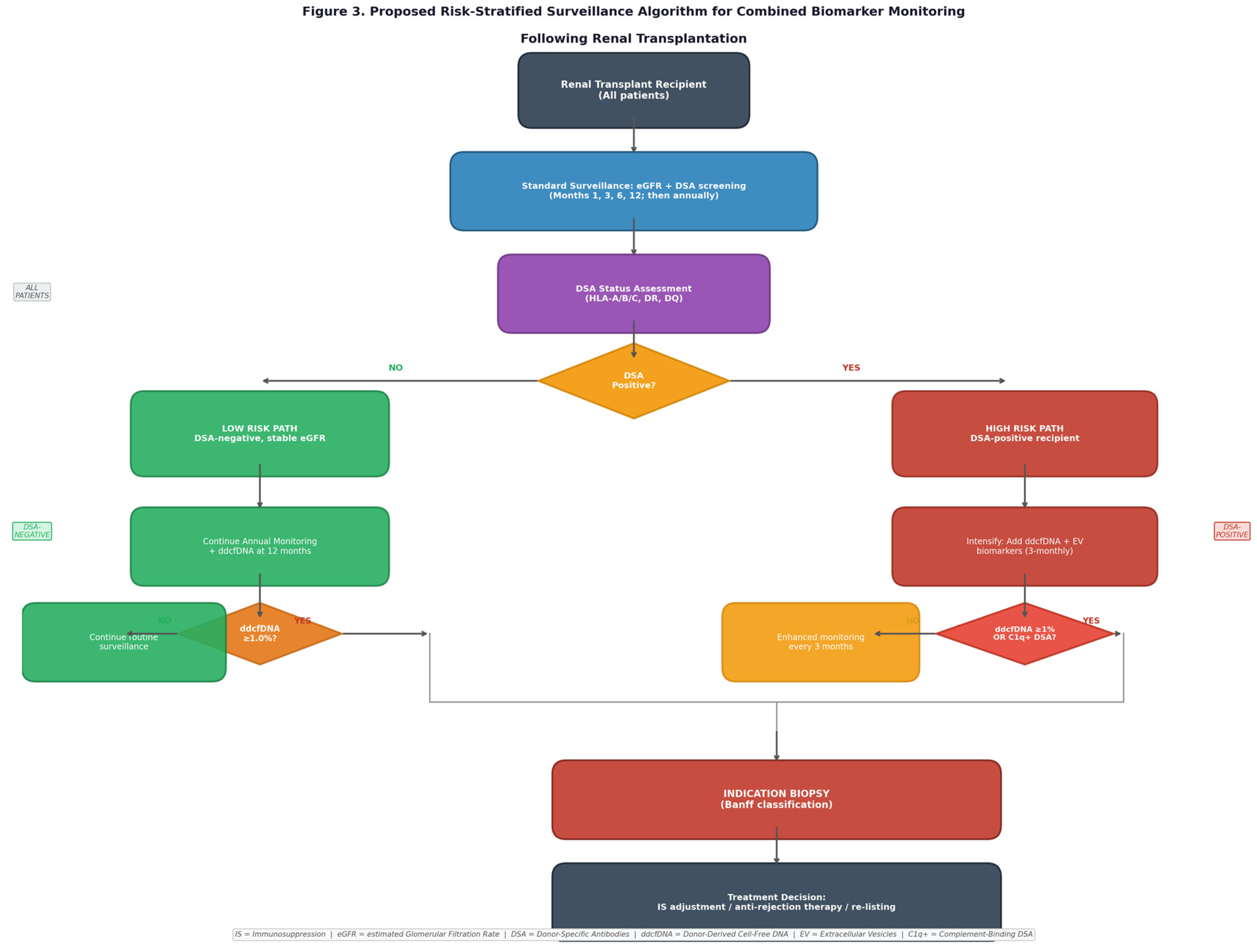
Figure 2.
Complementary lead-times of liquid biopsy biomarkers relative to clinical antibody-mediated rejection (ABMR) presentation. DSA = donor-specific antibodies; ddcfDNA = donor-derived cell-free DNA; EV = extracellular vesicles; Cr = creatinine.
Figure 2.
Complementary lead-times of liquid biopsy biomarkers relative to clinical antibody-mediated rejection (ABMR) presentation. DSA = donor-specific antibodies; ddcfDNA = donor-derived cell-free DNA; EV = extracellular vesicles; Cr = creatinine.
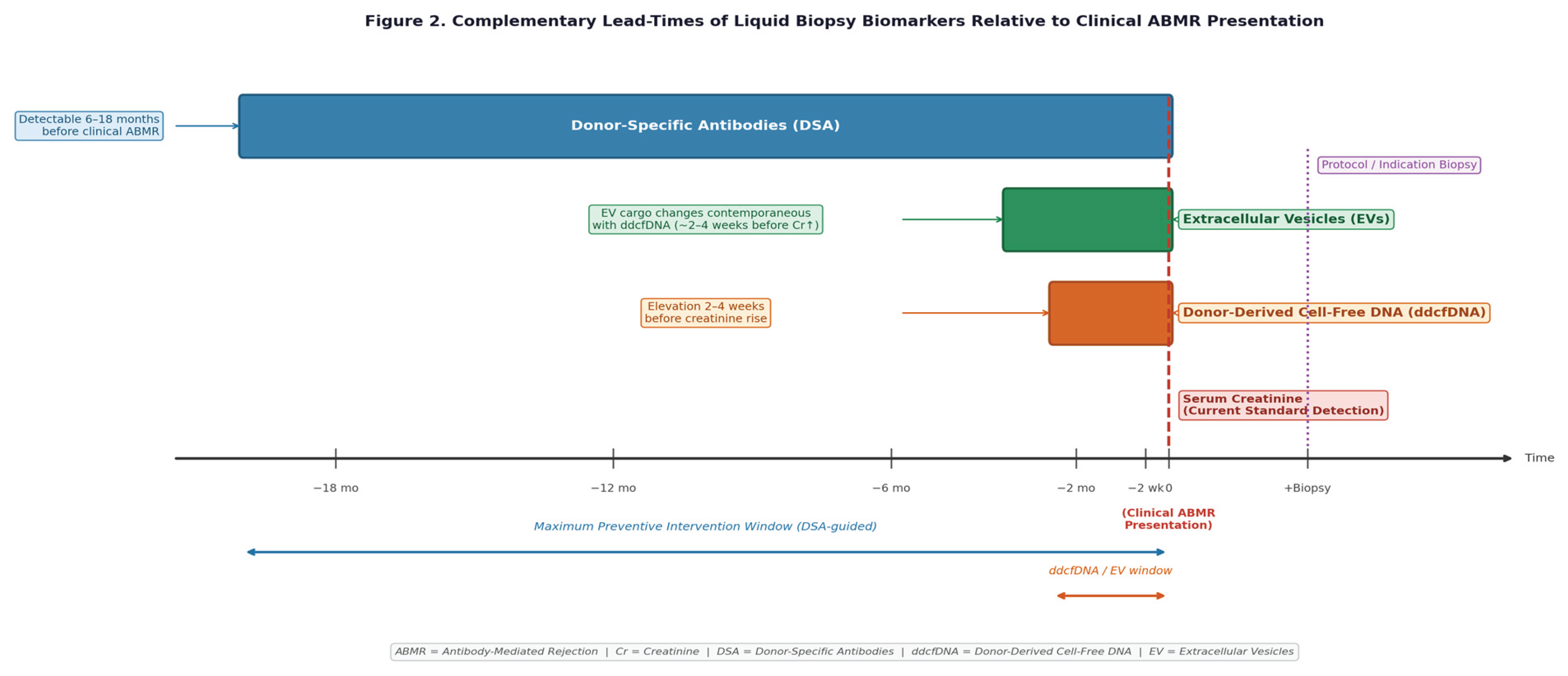
Table 1.
Comparative Characteristics of Extracellular Vesicles, Donor-Derived Cell-Free DNA, and Donor-Specific Antibodies as Renal Allograft Monitoring Biomarkers.
Table 1.
Comparative Characteristics of Extracellular Vesicles, Donor-Derived Cell-Free DNA, and Donor-Specific Antibodies as Renal Allograft Monitoring Biomarkers.
| Characteristic | Extracellular Vesicles (EVs) | Donor-Derived cfDNA (ddcfDNA) | Donor-Specific Antibodies (DSA) |
|---|---|---|---|
| Biological source | All cell types; tubular, glomerular, endothelial, immune cells | Apoptotic/necrotic graft parenchymal cells | Recipient B cells / plasma cells sensitized to donor HLA |
| Biofluid(s) | Plasma, urine (urine preferred for renal monitoring) | EDTA plasma (cfDNA-stabilizing tubes required) | Serum or EDTA plasma |
| Analyte | Membrane vesicles 40–1000 nm; protein, RNA, lipid cargo | Short dsDNA fragments ~165 bp of donor genomic origin | IgG (subclasses 1–4) directed against HLA class I/II |
| Pathophysiological signal | Cell activation, stress, tubular/endothelial injury, immune effector activity | Active cell death (apoptosis/necrosis) within graft parenchyma | Upstream humoral alloimmune sensitization; risk of ABMR |
| Detection method | NTA, TEM, Western blot (CD9/63/81); proteomics, miRNA-seq, flow cytometry | SNP-based NGS (AlloSure); genotype-informed NGS (Prospera); ddPCR | Single antigen bead Luminex (MFI); C1q/C3d complement-binding assays |
| Diagnostic threshold | Variable, assay- and cargo-dependent | ≥1.0% (DART trial); absolute >10 cp/mL (emerging) | >500 MFI (detection); >5000–10,000 MFI (high-risk); C1q+ threshold lab-dependent |
| Sensitivity (rejection) | 70–85% (EV CXCL9, CD3ε mRNA) | 59–89% (DART, meta-analyses) | 55–80% (ABMR-specific; lower for TCMR) |
| Specificity (rejection) | 72–88% | 73–92% | 75–92% |
| AUC (best reported) | 0.85–0.88 (EV cargo panels) | 0.74–0.82 | 0.79–0.87 (C1q+ DSA for graft loss) |
| Lead time vs. creatinine | Days to 1–2 weeks before creatinine rise | 1–4 weeks before clinical presentation | 6–18 months before clinical ABMR (dnDSA) |
| FDA clearance | No (research use only) | Yes (AlloSure 2020, Prospera 2021) | No (lab-developed tests; CAP-accredited labs) |
| Standardization status | Low (MISEV2023 guidelines; no clinical-grade assay) | Moderate (cleared assays; pre-analytical standards required) | Moderate–High (SAB-Luminex standardized; inter-lab MFI variability remains) |
| Approximate cost (USD) | $300–800 (research proteomics/sequencing) | $1,500–2,800 per test (commercial) | $200–600 per panel |
| Key limitation | No standardized clinical assay; complex workflow; pre-analytical variability | Elevated in non-rejection injury (BKPyVN, CNI toxicity, UTI); low PPV (~40–50%) | Does not confirm active injury; non-HLA antibodies not covered; inter-lab MFI variability |
| Best clinical utility | Subclinical tubular/endothelial injury; rejection subtyping; pediatric monitoring | Active rejection detection; ABMR/mixed rejection; serial surveillance | Pre-transplant risk stratification; de novo sensitization monitoring; ABMR diagnosis |
Table 2.
Key Clinical Studies Evaluating Extracellular Vesicles, Donor-Derived Cell-Free DNA, Donor-Specific Antibodies, and Combined Multi-Biomarker Approaches in Renal Transplantation.
Table 2.
Key Clinical Studies Evaluating Extracellular Vesicles, Donor-Derived Cell-Free DNA, Donor-Specific Antibodies, and Combined Multi-Biomarker Approaches in Renal Transplantation.
| Study (Year) | Biomarker(s) Evaluated | Study Design / Sample Size | Primary Outcome / Key Finding | AUC (95% CI) / NPV |
|---|---|---|---|---|
| Suthanthiran et al. (CTOT-04), 2013 [14] | Urinary EV CD3ε mRNA | Prospective; n = 85 recipients | Urinary exosomal CD3ε mRNA elevated in TCMR, preceding creatinine by 5–7 days | AUC 0.81 NPV 89% |
| Sigdel et al., 2015 [15] | Urinary EV proteome (CXCL9, CXCL10, GzmB) | Cross-sectional; n = 120 | CXCL9, CXCL10, granzyme B most discriminatory for acute rejection vs. stable function | AUC 0.85 — |
| Loupy et al., 2013 [37] | DSA (C1q-binding) | Prospective multicenter; n = 1016 | C1q+ DSA: 5-year graft survival 54% vs. 93% in C1q-neg; HR 4.78 for graft loss | — HR 4.7 |
| Bloom et al. (DART), 2017 [26] | ddcfDNA (AlloSure) | Prospective multicenter; n = 102 (107 biopsies) | ddcfDNA ≥1.0% identified active rejection; superior to creatinine/eGFR; NPV 84% | AUC 0.74 NPV 84% |
| Oellerich et al., 2019 [27] | ddcfDNA (absolute, copies/mL) | Prospective; n = 217 | Absolute ddcfDNA superior to fractional measurement for ABMR vs. non-rejection injury | AUC 0.82 — |
| Bromberg et al. (KOAR), 2025 [28] | ddcfDNA (AlloSure serial) | Registry; n = 1092 (14 centers) | Serial monitoring changed management in 30%; rejection detected ~3 weeks early | — PPV 45% |
| Mertens et al. (BIOMARGIN), 2020 [45] | ddcfDNA + Urinary EV CXCL9 | Multicenter; n = 388 | ddcfDNA + DSA-MFI combined panel; AUC 0.97 for graft injury in DSA-positive recipients; confirms complementarity of both markers | AUC 0.97 (combined panel) |
| Mayer et al., 2021 [44] | DSA + ddcfDNA + EV proteome | Prospective; n = 210 | Combined panel: sensitivity 89%, specificity 91% for ABMR; all three markers independently predictive | AUC 0.94 NPV 93% |
| Puliyanda et al., 2021 [46] | ddcfDNA (AlloSure) alone | Pediatric cohort; n = 78 | ddcfDNA associated with biopsy-confirmed rejection in pediatric cohort; performance consistent with adult data | Performance consistent with adult data |
| Bu et al. (ADMIRAL), 2022 [29] | ddcfDNA (AlloSure) | Multicenter; n = 315 | ddcfDNA correlated with Banff injury score (r = 0.71) and predicted eGFR recovery post-treatment | AUC 0.79 NPV 87% |
| Halloran et al., 2024 [47] | Blood EV miRNA + molecular biopsy | Prospective; n = 195 | EV miR-142-3p + miR-223-3p enhanced ABMR vs. TCMR discrimination in histologically ambiguous cases | AUC 0.87 — |
| Viglietti et al., 2018 [41] | DSA (serial trajectory, MFI + IgG subclass) | Prospective; n = 412 | Rising DSA MFI trajectory independently predicted ABMR progression regardless of absolute MFI level | — HR 3.2 |
Disclaimer/Publisher’s Note: The statements, opinions and data contained in all publications are solely those of the individual author(s) and contributor(s) and not of MDPI and/or the editor(s). MDPI and/or the editor(s) disclaim responsibility for any injury to people or property resulting from any ideas, methods, instructions or products referred to in the content. |
© 2026 by the authors. Licensee MDPI, Basel, Switzerland. This article is an open access article distributed under the terms and conditions of the Creative Commons Attribution (CC BY) license (http://creativecommons.org/licenses/by/4.0/).
Copyright: This open access article is published under a Creative Commons CC BY 4.0 license, which permit the free download, distribution, and reuse, provided that the author and preprint are cited in any reuse.