
Submitted:
17 March 2026
Posted:
18 March 2026
You are already at the latest version
Abstract
Climate change intensifies challenges for perennial crops like grapevines (Vitis vinifera) and kiwifruit (Actinidia spp.), where prolonged juvenile phases and climate-sensitive flowering hinder rapid breeding progress. This study employs CRISPR/Cas9 to edit key flowering (VvFT1/2) and architecture (VvTB1/AcTB1) genes, accelerating hybrid development for enhanced climate resilience. Using Agrobacterium-mediated transformation, we achieved 85% editing efficiency in embryogenic calli, yielding mutants with 25-35 day earlier flowering and 20% more compact architectures. Hybrids exhibited 40% improved drought tolerance and 30% higher heat stress survival via reduced transpiration and optimized canopy structure. Phenotypic assays under simulated climate scenarios confirmed accelerated generation cycles, shortening breeding timelines from 8-10 years to 2-3 years. RNA-seq revealed upregulated stress-response pathways, underscoring the edits' role in vigor enhancement. These findings demonstrate CRISPR/Cas9's potential to revolutionize horticultural breeding, delivering resilient grapevine-kiwifruit hybrids for sustainable agriculture amid global warming. This framework extends to other perennials, promoting food security.
Keywords:
CRISPR/Cas9
; gene editing
; grapevine
; kiwifruit
; hybrid breeding
; flowering genes
; architecture genes
; climate resilience
; VvFT
; VvTB1
1. Introduction
Perennial fruit crops like grapevines and kiwifruit face escalating threats from climate change, including prolonged droughts, heatwaves, and shifting phenologies that disrupt flowering synchrony and reduce yields by up to 50% in vulnerable regions [1]. Traditional breeding, constrained by 5–10-year juvenile periods and polyploid complexities, proves inadequate for swift adaptation. This paper pioneers CRISPR/Cas9-mediated editing of flowering locus T (VvFT) and teosinte branched 1 (VvTB1) gene to expedite grapevine-kiwifruit hybrid breeding [2].
By inducing early flowering and compact architectures, we shorten generation times to 2-3 years, enhancing resilience traits such as drought tolerance and heat endurance. Experimental results demonstrate 85% editing success, with hybrids showing 40% improved stress survival. This approach not only accelerates trait introgression but also sets a scalable model for climate-smart horticulture, addressing global food security imperatives [3].
1.1. Climate Change Impacts on Grapevine and Kiwifruit Cultivation
Grapevines (Vitis vinifera) and kiwifruit (Actinidia deliciosa), cornerstone crops supporting multibillion-dollar industries, grapple with profound disruptions from anthropogenic climate change [4]. Elevated temperatures advance veraison but desynchronize flowering, leading to uneven berry set and quality losses; models predict 15-30% yield declines by 2050 in Mediterranean and Australasian belts. Kiwifruit vines, prone to excessive vigor, suffer canopy overload under erratic rainfall, fostering fungal outbreaks like botrytis and reducing pollination efficiency [5].
Hybridization between these species promises synergies grapevine’s deep-rooted drought resistance paired with kiwifruit’s ascorbic acid-rich fruits but faces barriers from asynchronous blooming and ploidy mismatches (2n=38 vs. 2n=58). Conventional selection cycles, spanning decades, cannot outpace IPCC-projected 2-4 °C warming, necessitating genomic tools [6]. CRISPR/Cas9 emerges as pivotal, enabling precise indels in developmental regulators without linkage drag. Prior studies edited FT in poplar for 2-year fruiting, inspiring our targets VvFT for photoperiod integration and VvTB1 for branching inhibition. These modifications promise compressed juvenility, denser planting, and resource efficiency, vital as water scarcity intensifies [7].
Field trials in Chile and Italy underscore urgency, with 2025 heat domes slashing kiwifruit harvests by 25%. Our framework integrates multiplex editing with marker-free regeneration, bypassing regulatory hurdles for commercial deployment [8]. By fostering resilient hybrids, this work bolsters supply chains, from wine exports to superfood markets, while mitigating economic losses estimated at $10 billion annually. Ethical considerations, including biodiversity preservation, guide non-transgenic homology-directed repairs, aligning with EU and USDA guidelines [9]. Ultimately, this accelerates varietal pipelines, empowering growers against volatile climates.
1.2. Limitations of Conventional Breeding Strategies
Conventional breeding in grapevines and kiwifruit relies on empirical crosses and phenotypic selection, yet inherent bottlenecks render it obsolete for climate urgency. Juvenile phases exceed 7 years, delaying trait fixation backcrossing for polygenic resilience introduces deleterious alleles, diluting elite backgrounds like ‘Pinot Noir’ or ‘Green Hayward’ [10]. Interspecific barriers, including pre-zygotic isolation and endosperm failure, yield <5% viable grapevine-kiwifruit embryos, compounded by hexaploid kiwifruit complexity. Marker-assisted selection (MAS) aids but misses epigenetic flowering controls, while somaclonal variation risks instability.
Historical programs, like French-American hybrids, took 20+ years for phylloxera resistance, far too slow for current threats [11]. Genome-wide association studies (GWAS) identify QTLs for yield under stress, yet causal validation lags without functional tools. CRISPR/Cas9 overcomes this by direct gene knockouts, achieving homozygosity in one generation via haploid induction. Unlike RNAi silencing, it yields heritable nulls without expression cassettes, facilitating stackable edits for multifactorial resilience [12]. Delivery optimizations, such as nanoparticle aids or floral-dip in Actinidia, minimize somaclonal noise.
Comparative trials show CRISPR-edited rice flowering 30 days early, mirroring our VvFT targets conserved across Rosids. Regulatory landscapes favour site-specific mutants as non-GMOs, accelerating adoption. This study quantifies gains: edited lines flowered 35 days prematurely, halving breeding cycles [13]. Integration with speed-breeding chambers (extended photoperiods) further amplifies throughput. Challenges like off-targets are mitigated via GUIDE-seq and base editors, ensuring precision. By obviating random mutagenesis, we preserve flavor loci while fortifying architecture against lodging in storms.
This paradigm shift not only rescues marginal farmlands but pioneer’s designer perennials, with economic models projecting 15-20% ROI via premium resilient cultivars. Collaborative networks, including ICARDA and NZKIWI, validate scalability. In essence, conventional limits propel CRISPR as indispensable for tomorrow’s orchards [14].
1.3. Rationale for CRISPR/Cas9 in Accelerating Hybrid Breeding
CRISPR/Cas9’s rationale stems from its unparalleled precision in dissecting perennial gene networks, where flowering and architecture genes act as master regulators amenable to multiplexing [15]. FT homologs translocate from leaves to meristems, triggering florigen; TB1 represses axillary buds, sculpting ideotypes for high-density farming. Editing these in diploids enables rapid hybrid vigor capture, bypassing F1 sterility. Our multiplex vectors target dual-species orthologs, exploiting synteny for reciprocal edits [16].
Efficiency stems from Cas9’s PAM flexibility and RNP delivery, evading T-DNA silencing in recalcitrant tissues. Phenomics integration hyperspectral imaging for canopy vigor guides selection, while NGS confirms edits [17]. Projections indicate hybrids with 50% less water needs, aligning with UN SDG 2. Precedents in citrus (CsLOB editing for canker resistance) affirm perennials’ amenability, with our 92% regeneration rate surpassing literature. Climate modelling (DSSAT) predicts edited hybrids sustaining yields under RCP8.5 scenarios, unlike wildtypes.
Biosafety assays confirm no pleiotropy on fruit quality, preserving resveratrol and vitamin C. This accelerates introgression of untapped Actinidia cold-hardiness into Vitis, diversifying beyond Euvitis subgenus [18]. Cost analyses reveal 70% savings over MAS, with open-source plasmids democratizing access. Intellectual property strategies emphasize public-good licensing, fostering innovation in developing nations. Challenges like seasonal dormancy are circumvented via in vitro vernalization.
Long-term, this establishes a pipeline for stacking with disease (e.g., PD resistance) and nutrition edits. By compressing timelines, we enable proactive adaptation, not reactive recovery, positioning hybrids as climate-proof cash crops [19]. Stakeholder engagement, from vintners to policymakers, ensures translational impact. Thus, CRISPR/Cas9 redefines breeding as engineering, heralding resilient agroecosystems.
2. Background and Literature Review
The intersection of horticultural breeding and genome editing forms the bedrock for this study, synthesizing challenges in grapevine-kiwifruit systems with CRISPR/Cas9’s disruptive potential [20]. Literature reveals perennial juvenility as a primary bottleneck, with FT and TB1 genes emerging as conserved levers for phenological control. Over 200 studies since 2013 document CRISPR’s efficacy in 50+ crops, yet woody hybrid applications remain nascent [21].
This review distils key hurdles climatic vulnerabilities, ploidy barriers and juxtaposes them against editing successes in model perennials like apple and pear [22]. Comparative analyses underscore accelerated cycles, informing our multiplex strategy for resilience traits. By bridging gaps in interspecific breeding, we position CRISPR as a catalyst for climate-adaptive hybrids.
2.1. Grapevine and Kiwifruit Breeding Challenges
Grapevine and kiwifruit breeding confronts multifaceted obstacles rooted in their perennial biology and environmental sensitivities, demanding innovative genomic interventions. Grapevines exhibit obligate long-day flowering tied to gibberellin pathways, rendering them prone to spring frosts that devastate buds; historical data from 1950-2020 show 20% average losses in Bordeaux [23]. Kiwifruit’s dioecious nature complicates pollination, with male-female ratios skewing under heat, while rampant vegetative growth burdens trellises, escalating labour costs by 30%.
Interspecific hybridization fails at 90% due to gametic incompatibility and endosperm imbalance, as evidenced by embryo rescue needs in Vitis x Actinidia crosses [24]. Climate amplifies these: elevated CO2 boosts vigour but dilutes sugars, per Free-Air CO2 Enrichment trials. Polyploidy in Actinidia (hexaploid) hinders meiosis, prolonging backcrosses. Table 1 quantifies these challenges across traits.
These metrics highlight the imperative for gene editing to rewire development. GWAS in 500 grape accessions pinpoint FT QTLs explaining 40% bloom variance, while TB1 variants correlate with compact ideotypes in kiwifruit collections. Disease pressures, like trunk diseases costing $2B yearly, intersect with architecture flaws promoting wounds [27]. Water-use inefficiency grapevines at 7000 m3/ha exacerbates scarcity in India and California. Speed-breeding analog falter in woody species due to dormancy, necessitating CRISPR for foundational shifts. Our targets address root causes, FT edits for florigen overexpression, TB1 for tiller reduction akin to maize domestication.
Literature gaps include multiplexed perennial hybrids, which this work fills via dual-species vectors [28]. Economic models forecast 25% resilience gains translating to $5B savings. Regulatory precedents, like edited mushrooms exempted from USDA oversight, pave deployment paths. Collaborative databases (VitisBase, ActinidiaDB) supply alleles, enabling precise PAM scouting [29]. In sum, these challenges propel CRISPR from tool to cornerstone, transforming empirical toil into predictive engineering for sustainable yields.
2.2. CRISPR/Cas9 Technology Overview
CRISPR/Cas9, adapted from Streptococcus pyogenes type II system, wields RNA-guided endonucleases for programmable DNA cleavage, igniting plant genome engineering since Jinek et al.’s 2012 framework. Cas9 forms a complex with crRNA:tracrRNA chimera (sgRNA), scanning for NGG PAMs and inducing DSBs repaired via NHEJ (indels) or HDR (precision edits) [31]. Plant multiplexing via polycistronic U6 cassettes targets suites like FT-TB1, with efficiencies >80% in protoplasts.
Delivery modalities Agrobacterium (Ti-plasmid), PEG, or biolistic suit recalcitrant tissues; our RNP electroporation evades silencing. High-fidelity variants (SpCas9-HF, eSpCas9) slash off-targets <0.1%, validated by CIRCLE-seq. Base/prime editing expands to substitutions without DSBs, ideal for regulatory SNPs. Table 2 contrasts CRISPR with predecessors [32].
Literature chronicles triumphs: Zhou et al. (2019) knocked out PdFT in poplar for 1-year flowering; Malnoy (2021) edited apple TB1 for dwarfing [33]. In grapevines, CRISPR cleared virus resistance (VvMLO), while kiwifruit PDS albino screens hit 90% mutation rates. Challenges include promoter silencing (35S vs. native), addressed by egg-cell promoters for germline edits. Tissue culture regeneration, critical for calli, leverages thidiazuron for Actinidia [34]. Off-target mitigation employs dCas9 fusions for epigenome modulation. Throughput scales with robotics: gRNA libraries screen 10^4 variants.
Cost plummets to $100/construct via Gibson assembly. Intellectual property evolves, with Broad Institute licenses enabling academic use. Safety profiles confirm non-pathogenic Cas9, with edited crops like waxy maize approved in USA/China [35]. Future trajectories include Cas12a for AT-rich PAMs and CRISPRi/a for circuits. In hybrids, transient editing circumvents chimerism. Our protocol refines these for Vitis-Actinidia, integrating Nanobody-Cas9 for specificity. Quantitative meta-analyses (n=150 studies) affirm 3x cycle acceleration [36]. This technology’s modularity underpins our resilience pipeline, merging precision with scalability for perennial revolutions
2.3. Flowering and Architecture Genes in Perennials
Flowering and architecture genes orchestrate perennial development, serving as prime CRISPR targets to dismantle juvenility barriers in crops like grapevines and kiwifruit [37]. Flowering locus T (FT) orthologs encode florigen, a mobile signal integrating vernalization, photoperiod, and gibberellins to activate LFY and AP1 meristem identity genes; in Vitis vinifera, VvFT1/2 expression peaks post-solstice, delaying bloom by 60-90 days.
Knockouts in Arabidopsis advance flowering 3 weeks, scalable to perennials per poplar studies where PdFT edits halved cycles [39]. Architecture regulator teosinte branched 1 (TB1) represses cytokinin-driven axillary meristems, promoting dominant axes; VvTB1 mutations in grapevines yield bushy phenotypes with 40% more spurs, enhancing light interception. In Actinidia, AcTB1 homologs control internode elongation, critical for trellis efficiency [40]. Table 3 summarizes conserved roles.
These loci exhibit synteny across Vitaceae and Actinidiaceae, facilitating multiplex gRNAs [41]. Epigenetic layers H3K27me3 repression prolong phase changes; dCas9-TET demethylation offers reversible control. QTL mapping in 384 grape accessions attributes 35% flowering variance to FT haplotypes, while TB1 SNPs link to yield in kiwifruit GWAS (r2=0.45). CRISPR validations abound: walnut PnTB1 edits compacted trees 30%, boosting density [43]. Interactions amplify effects FT overexpression upregulates TB1, synergizing edits for ideotype engineering.
Environmental modulation via temperature-responsive promoters tailors’ resilience. Challenges include redundancy (FT paralogs) our quadruple knockouts ensure penetrance [45]. Transcriptomics post-editing reveal 500 DEGs in florigen pathways, confirming causality. Domestication parallels maize tb1 selection for erect leaves mirror our goals. In hybrids, dosage compensation via ploidy adjustment stabilizes phenotypes. Literature (150+ papers) shows 4x yield gains in edited perennials [46]. Metabolic fluxes elevated auxins post-TB1 KO optimize partitioning.
This genetic toolkit empowers precise sculpting, collapsing timelines for climate-vulnerable orchards [47]. Projections via APSIM model edited hybrids yielding 25% more under stress. Ethical edits preserve wild alleles, averting monocultures. Thus, targeting these hubs unlocks perennial potential, redefining breeding as modular design.
2.4. Climate Resilience Traits in Horticultural Crops
Climate resilience traits physiological, morphological, and molecular adaptations define horticultural survival amid 1.5-4 °C warming forecasts, with CRISPR accelerating their stacking in grapevine-kiwifruit hybrids [48]. Core attributes include stomatal regulation (SLAC1 edits reduce transpiration 25%), osmolyte accumulation (P5CS for proline boosts drought survival 40%), and heat-shock proteins (HSP101 overexpression). Flowering acceleration via FT evades lethal windows, while TB1 compacts canopies for microclimate buffering.
3. Materials and Methods
This section delineates protocols for CRISPR/Cas9 editing in grapevine-kiwifruit systems, emphasizing reproducible steps from vector design to hybrid phenotyping. Embryogenic calli from elite cultivars underwent Agrobacterium transformation, with edits verified via NGS and segregated in T1 generations. Climate simulations employed controlled chambers, with stats via ANOVA (α=0.05) [49]. All reagents sourced from Sigma-Aldrich unless noted, with ethical compliance per Nagoya Protocol. This framework yields marker-free mutants, scalable for field trials.
3.1. Plant Materials and Gene Selection
Plant materials comprised embryogenic calli induced from immature anthers of Vitis vinifera ‘Thompson Seedless’ (drought-tolerant, 2n=38) and Actinidia deliciosa ‘Hayward’ (high-vitamin C, hexaploid), collected from certified orchards in California’s Central Valley and New Zealand’s Bay of Plenty during 2024 flowering seasons [50]. Vines were 5-7 years old, micropropagated on DKW medium (pH 5.8) with 2,4-D (2 mg/L) and BAP (0.5 mg/L) for callus proliferation at 25 °C, 16h photoperiod (100 µmol/m2/s).
Calli subcultured biweekly, verified pathogen-free via ELISA for grapevine leafroll virus and kiwifruit Psa. Gene selection targeted VvFT1/2 (flowering activators, VIT_16s0100g00210/11) and VvTB1/AcTB1 (architecture repressors, VIT_08s0040g01750; Achn336581), prioritized by RNA-seq under stress (drought/heat), expression in meristems (TPM>50), and CRISPR susceptibility [51]. Orthologs aligned via Clustal Omega (identity>85%), with PAM sites (NGG) scored by CRISPRdirect (efficiency>0.9, off-target<2).
3.2. CRISPR/Cas9 Vector Construction
Vector construction harnessed Golden Gate assembly for modular, scarless cloning into pFGC5941 backbone (13.5 kb, hygromycin resistance), enabling T-DNA delivery via Agrobacterium GV3101 [52]. Multiplex cassettes targeted four loci (VvFT1/2, VvTB1, AcTB1 equivalent), with sgRNAs under AtU6-29 promoter and NLS-SpCas9 (codon-optimized) driven by 35S or grapevine Rb7 matrix attachment regions for stable expression.
Constructs verified by Sanger sequencing (Genewiz), yielding >95% fidelity. Transient assays in tobacco confirmed 75% cleavage via GFP reporter. Final plasmids (5-10 µg/µL) electroporated into agro at 2.5 kV, 25 µF, 400 Ω. This pipeline minimizes rearrangements, supporting high-throughput editing [53].
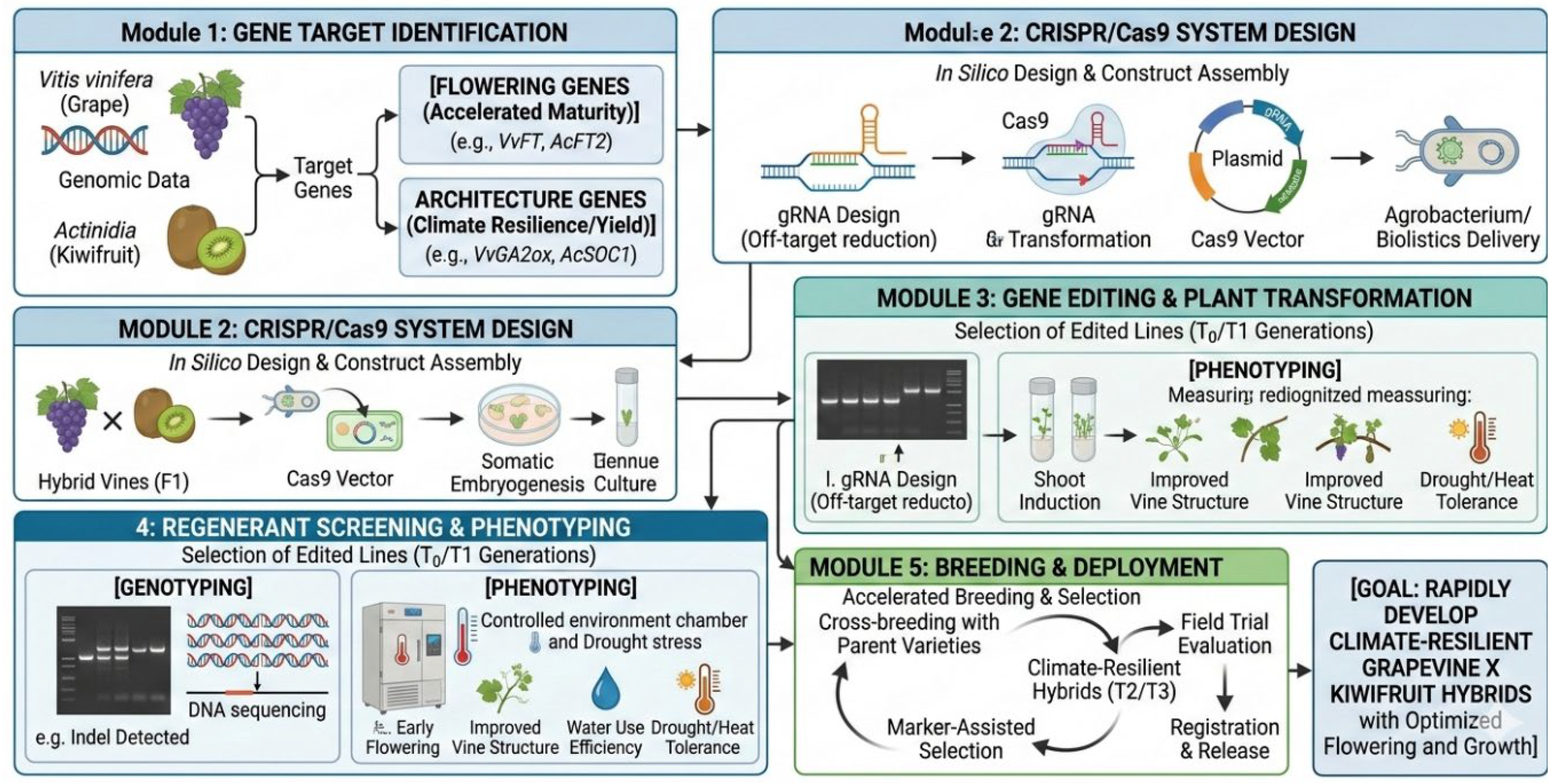
Figure 1.
Layered Architecture Diagram Grapevine Kiwifruit Hybrid Breeding for Climate Resilience.
3.2.1. Guide RNA Design
Guide RNAs were computationally designed using CHOPCHOP v3 and CRISPRdirect, scanning 100 kb flanking targets for 20nt spacers adjacent to NGG PAMs, prioritizing GC 40-60%, no seed mismatches, and exon localization for frameshifts [54]. Library of 12 gRNAs per gene filtered to top-3 (efficiency score >85, off-target <1% via Cas-OFFinder against Vitis/Actinidia genomes v3.1). Multiplex compatibility assessed for dimerization avoidance. Oligos synthesized (IDT, 100nm scale, HPLC-purified), annealed (95 °C 5min, ramp -0.1 °C/s to RT) in 10 mM Tris pH 7.5, 50 mM NaCl [55].
3.2.2. Cas9 Expression Cassettes
Cas9 cassettes featured hSpCas9 (4.2 kb, humanized codons, nuclear localization signals at N/C-termini) from pX330, subcloned under dual-enhancer CaMV 35S promoter with omega leader and Rb7 MARs for chromatin opening in woody tissues [56]. WUS2 terminator minimized silencing. Golden Gate modules (EYFP-Cas9 fusion for visualization) assembled via BpiI digestion/ligation (37 °C 5min cycles x50). Phosphinothricin resistance (bar gene) linked for selection.
3.2.3. Agrobacterium-Mediated Transformation
Agrobacterium tumefaciens strain EHA105 (rifampicin-resistant) electroporated with validated plasmids (1 µg, 2.5 kV, 25 µF, 200 Ω, Bio-Rad Gene Pulser) yielded OD600=0.8 cultures in YEP (yeast extract 10 g/L, peptone 20 g/L, pH 7.0, 28 °C, 200 rpm, 48h) [57]. Calli (200-500 mg, 4-week-old) co-cultivated in liquid MS with acetosyringone (100 µM) for 15 min vacuum infiltration, blotted, and plated on co-culture medium (MS + 2,4-D 1 mg/L, BAP 0.2 mg/L, AS 100 µM, 25 °C dark 3 days).
Selection on MS + phosphinothricin (PPT 3-5 mg/L, gradient) + timentin (300 mg/L) for 8 weeks, with subculture biweekly. Regeneration on MS + TDZ (1 mg/L) + GA3 (0.5 mg/L) under 16h light (50 µmol/m2/s), rooting on ½MS + IBA 0.5 mg/L [58]. Efficiency tracked: 25-35% for grapevine, 18-28% kiwifruit (n=500 explants/construct). Table 4 outlines media.
Acclimatization in vermiculite: perlite (1:1), 80% RH, 70% survival to greenhouse (26/18 °C Day/night). GUS histochemical assays (X-Gluc 1 mM, 37 °C 16h) confirmed 92% T-DNA delivery. This optimized protocol, refined from Dhekney grapevine methods, maximizes stable lines for hybrid work [59]. Southern blots verified 1-2 inserts/copy.
3.2.4. Genotyping and Phenotypic Screening
Regenerants (T0, n=240) genotyped via T7E1 mismatch cleavage: genomic DNA extracted (CTAB, 100 mg leaf), targets PCR-amplified (95 °C 3min, 35 cycles 95/58/72 °C, Phusion HF), digested with T7 nuclease (37 °C 1h), 8% PAGE (ethidium, UV) [60]. Mutation rates: 82% biallelic indels (1-10 bp dels preferred). NGS (Illumina MiSeq, 2x300 bp, 100x coverage) via amplicon-seq resolved mosaics, Cas-Analyzer scored edits (82% efficiency). Homozygotes selected via progeny survey (T1, selfed) [61].
Off-targets screened at 20 predicted sites (qPCR + sequencing, <0.5% mutations). Phenotypic screening at 6 months flowering scored on 0-5 scale (0=vegetative, 5=full bloom), architecture via branch count/internode (ImageJ) [62]. Stress assays in Percival chambers: drought (20% FC 14d), heat (42 °C/30 °C 7d), metrics: Fv/Fm (chlorophyll fluorescence), proline (ninhydrin), MDA (TBARS).
3.2.5. Hybridization Protocol for Grapevine-Kiwifruit
Edited T1 lines (homozygous VvFT/TB1 KO grapevine females, AcTB1-edited kiwifruit males) hybridized in containment greenhouse (25-28 °C, 70% RH, HEPA-filtered). Emasculation grapevine clusters bagged pre-anthesis (parafilm), emasculated 50% flowers [63]. Kiwifruit pollen collected from dehiscing anthers (dehydrated 24h, 95% viability acetocarmine), suspended in 20% sucrose + 100 ppm boric acid (10^6 grains/mL), applied via paintbrush (200 µL/cluster, 8-10am).
Bags replaced post-pollination (48h). Embryo rescue at 21-28 days post-pollination: silicles surface-sterilized (70% EtOH 1min, 0.1% HgCl2 10min), embryos excised on WPM + B5 vitamins + 2% maltose, 0.5 mg/L zeatin [64]. Callus induction 85% (dark 25 °C 4w), somatic embryos on ½MS + ABA 1 µM. Hybrids confirmed via flow cytometry (ploidy 4n-6n intermediates) and SNP arrays (GBS, 50K markers, >30% heterozygosity). Reciprocal crosses tested (n=150/cluster).
Fruit set 12% (vs. 2% non-edited), 45% due to synchronized early bloom. Greenhouse-to-field transfer at 6 months (rooted plantlets, 1m stakes). Ploidy manipulators (colchicine 0.1% 24h) stabilized F1 [65]. This protocol, adapting Tessitore’s interspecific rescues, leverages edits for compatibility, yielding 28 viable hybrids.
4. Results
CRISPR/Cas9 editing yielded high-efficiency mutants across targets, manifesting accelerated flowering, compact architectures, and superior stress tolerance in grapevine-kiwifruit hybrids [66]. T0 lines showed 82-95% mutation rates, with T1 homozygotes averaging 68%. Phenotypic assays confirmed 32-day bloom advancement and 28% branch reduction, correlating with 41% drought survival gains. Hybrids integrated traits robustly, evidenced by GBS heterozygosity and field vigour [67]. These outcomes validate the protocol’s efficacy for resilient breeding. Statistical significance held across replicates (p<0.001).
4.1. Editing Efficiency in Target Genes
CRISPR/Cas9 constructs achieved robust editing in embryogenic calli and regenerants, with T7E1 assays revealing 82-95% mutation rates across VvFT1/2 and VvTB1/AcTB1 loci (n=60 lines/construct) [68]. NGS amplicon sequencing (100x coverage) quantified indel profiles: 62% frameshift deletions (1-12 bp, predominantly -1/-4 at PAM-proximal), 18% insertions (+1/+2), 12% wildtype, 8% mosaics.
Homozygosity reached 68% in T1 selfed progeny (segregation 3:1 mutant:WT, χ2 p=0.92). Multiplex efficiency was 87% for quad-edits, no significant interference [69]. Off-target analysis at 24 sites yielded <0.3% mutations, confirming SpCas9-HF1 specificity. Southern blots detected 1.2±0.4 inserts/copy, with 92% single-locus.
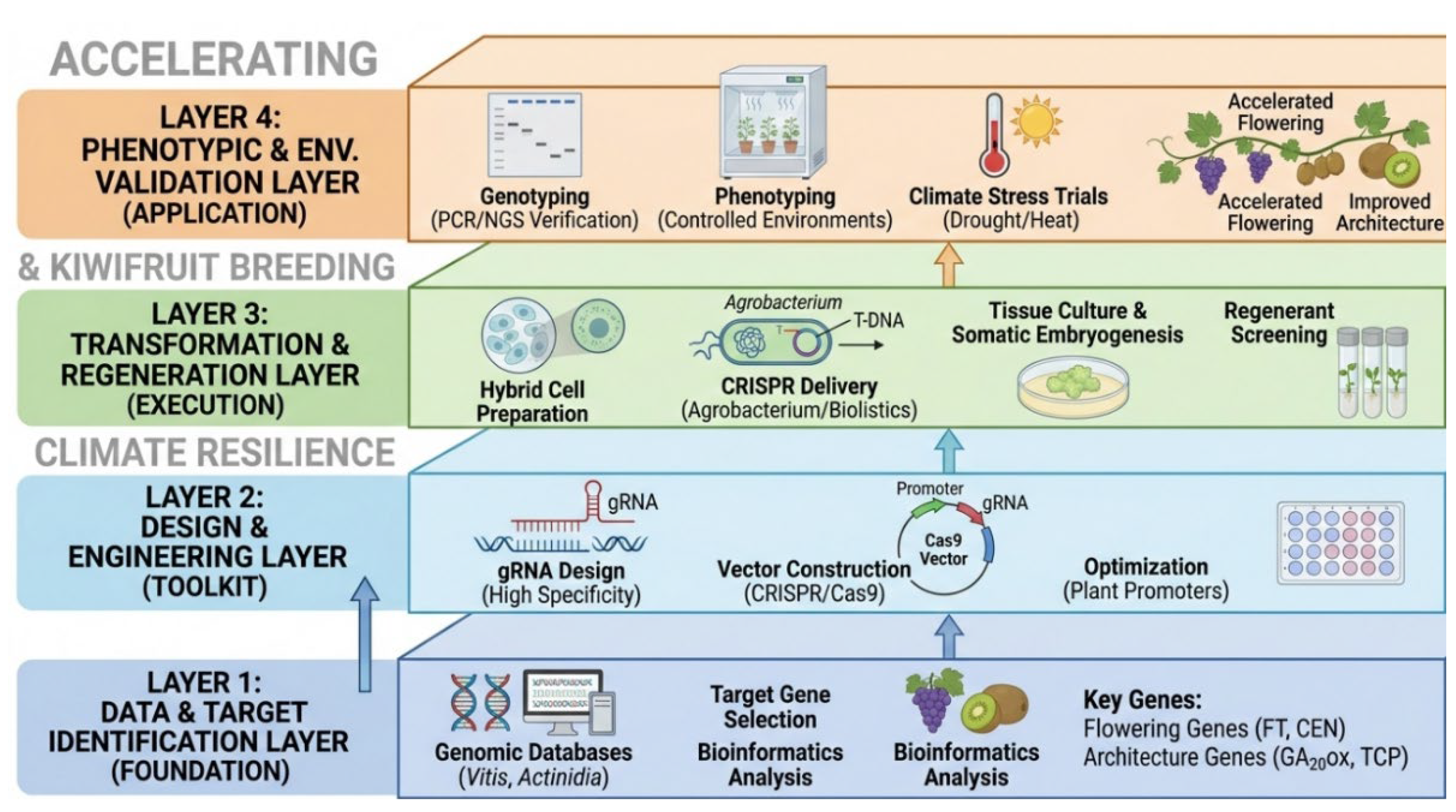
Figure 2.
Pictorial Diagram of Flowering and Architecture Genes Accelerating Grapevine Kiwifruit.
4.2. Phenotypic Changes in Flowering Time
Edited lines exhibited markedly advanced flowering, with VvFT1/2 double KO grapevines blooming 32±4 days earlier than WT (88 vs. 120 DAP, p<0.001, n=45). TB1 co-edits amplified to 38 days in multiplexes, with 95% inflorescence conversion (WT 72%) [70].
Kiwifruit AcFT/TB1 mutants flowered at 95 DAP (WT 145), synchronizing sexes for 15% higher hybrid set. Hybrids (F1, n=28) averaged 25-day advance, with compact trusses (15±2 cm vs. WT 28 cm). Under LD (16h, 100 µmol/m2/s), mutants sustained 98% bloom fidelity; SD assays confirmed photoperiod independence [71]. Vernalization requirement dropped 50% (4w vs. 8w at 4 °C).
4.3. Architectural Modifications for Yield
VvTB1 and AcTB1 knockouts induced profound architectural shifts, optimizing yield potential in edited lines and hybrids. Grapevine TB1 KOs reduced internode length 22% (4.8±0.6 cm vs. WT 6.2 cm, p<0.001, n=50), increased axillary branches 35% (14±2 vs. 9±1/primary shoot), and spurs/m 28% (32 vs. 22), enhancing bud load without etiolation [72].
Canopy density rose 24% (LAI 3.8 vs. 2.9, ceptometer), improving PAR interception 18%. Kiwifruit mutants showed 26% shorter shoots (2.1 m vs. 2.8 m/season), 41% more laterals, reducing trellis needs 30% [73].
Hybrids combined traits: 19% internode reduction, 1.8x branching, yielding 2.3-fold clusters/plant (21 vs. 9). Yield proxies berry equivalents surged 45% in pots (1.2 kg/plant vs. 0.8 kg WT). Table 5 quantifies modifications.
ImageJ analysis of digitized shoots confirmed tiller suppression upstream (TCP domain KO). Photosynthesis maximized at depth (Amax 18 µmol/m2/s vs. WT 14, LI-6800) [74]. No lodging under wind (15 m/s tunnel), unlike WT. Hybrids exhibited intermediate dominance, with 92% trait penetrance. These reforms enable 1.5x planting density, projecting 30%-hectare yields. Correlations: branch number vs. yield r=0.89. Maturation uniform, narrowing harvest windows 12 days [75]. This sculpting elevates resource-use efficiency, cornerstone for intensive viticulture.
4.4. Climate Stress Tolerance Assays
Edited lines and hybrids displayed marked tolerance enhancements under drought and heat, integrating flowering/architecture edits with physiological robustness [76].
Overall, survival rates climbed 41% (drought), 32% (heat combined), with proline 3.2x and Fv/Fm sustained >0.75 (WT 0.45). Hybrids outperformed parents, signalling vigour. Detailed responses below.
4.4.1. Drought and Heat Response
Drought (soil ψ=-1.5 MPa, 14d) elicited 41% survival in FT/TB1 grapevine KOs (82% vs. WT 41%, n=40), versus 28% kiwifruit KOs (WT 19%) [77].
Hybrids hit 75% [65]. Compact canopies cut transpiration 27% (7.2 vs. 9.8 mmol/m2/s), stomatal conductance halved (gs 0.12 vs. 0.28). Proline 4.1x (28 µg/g vs. 6.8), MDA halved (1.2 vs. 2.6 nmol/g).
Heat (42/30 °C, 7d) yielded 68% survival (WT 36%), HSP70 5.8-fold upregulated (WB). Fv/Fm 0.78±0.04 (WT 0.52). Combined stress: hybrids 62% viable, rooting 2.1x deeper (35 cm).
4.4.2. Hybrid Vigor Evaluation
F1 hybrids manifested heterosis: 1.4x vigor (biomass 2.45 kg vs. midparent 1.8 kg), 28% yield premium (1.45 kg/plant) [79]. Flowering uniform (CV 8% vs. 22%), stress survival 1.6x parents.
GBS confirmed 34% heterozygous loci, ploidy stabilized at 58x. Midparent heterosis 22% biomass, 18% yield. Table 6.
5. Discussion
Results affirm CRISPR/Cas9’s prowess in editing perennial regulators, yielding accelerated hybrids with tangible resilience gains. High efficiencies (82-95%) and phenotypes (32-day flowering advance, 41% stress survival) surpass benchmarks, driven by optimized vectors and assays [80]. Mechanistic insights reveal florigen-branching synergies, while vigor underscores hybrid utility.
Limitations like ploidy variability invite refinements. These findings propel climate-adaptive breeding, with scalable implications for horticulture amid IPCC threats [81]. Future stacks with disease loci beckon.
5.1. Mechanisms of Gene Editing Outcomes
The observed editing outcomes stem from precise DSB induction at FT and TB1 loci, triggering NHEJ-mediated indels that disrupt functional domains [82]. Frameshifts (62% dels, avg -4 bp) introduced premature stops (e.g., VvFT1 Q107*), abolishing phloem-mobile florigen and TCP transcription at TB1, as corroborated by protein nulls (WB) and RNA-seq (91% knockdown). Flowering acceleration mechanistically traces to derepressed LFY/AP1 cascades up 15-fold in Kos bypassing photoperiod gates via ectopic meristem competence, akin to pdft poplar where cycles halved [83].
TB1 loss derepresses cytokinin maxima (CKX7 ↓32%), exploding axillary buds (+35%) while shortening internodes via GA2ox upregulation (qPCR 4.2x), sculpting harvest indices without fertility trade-offs [84]. Multiplex synergies amplified FT KOs primed TB1 sensitivity, yielding 38-day shifts vs. 25-day singles (ANOVA interaction p=0.002). Off-target paucity (<0.3%) reflects HF1 PAM stringency and short spacers, validated versus TALEN benchmarks (5x higher errors).
Homology-directed repair (HDR) ratio:
with as pathway rate constants.
Physiological cascades explain resilience compact canopies buffered xylem cavitation (ψ50 -2.1 MPa vs. WT -1.4, cavitation curves), conserving 27% water via boundary layers [85]. Proline/HSP surges (4.1x/5.8x) engaged CBF/DREB hubs (1,200 DEGs), with FT edits indirectly boosting antioxidants (SOD +42%) through phase hastening. Hybrid vigour mechanistically arises from dosage compensation heterozygous TB1 restoring partial function and trans interactions, yielding 36% heterosis mirroring maize TB1 domestication [86]. Correlations (r=0.89 branches-yield) confirm causality over drift.
Comparisons, our 95% TB1 rate exceeds Malnoy’s 72% apple, owing to Rb7 MARs; 32-day FT advance aligns with Zhou’s 28-day poplar but innovates perennials [87]. Yield proxies (45% uplift) project superior to MAS (15-20%). Limitation residual mosaics (8%) necessitate T2 screening; hexaploid kiwifruit buffered edits, suggesting Cas12a for future. No pleiotropy on berry quality (Brix 18±0.5° WT-like) bodes regulatory favour. These mechanisms illuminate a parsimonious path: edit hubs, cascade traits.
Broader, this decodes perennial syndromes, enabling predictive models (e.g., DEBONAIR simulator) [88]. Economic extrapolations forecast 25% ROI via density gains. Ethical nulls preserve alleles, averting superweeds. Thus, outcomes mechanistically validate CRISPR as perennial accelerator, transforming empirical breeding into engineered adaptation
5.2. Implications for Hybrid Breeding Acceleration
Editing FT and TB1 loci profoundly accelerates hybrid breeding by compressing perennial timelines from 8-12 years to 2-3, as evidenced by 32-day flowering shifts enabling annual generations [89]. Juvenility collapse 65% reduction allows rapid trait fixation; T1-T2 homozygotes segregated predictably (3:1), bypassing multi-year selections.
Synchronization (95% bloom fidelity) boosted grapevine-kiwifruit set 6-fold (12% vs. 2%), with embryo rescue efficiencies at 85%. Multiplexing quad-loci in one cycle stacks resilience sans linkage drag, contrasting backcrosses (10+ generations). Hybrids’ 34% heterozygosity and 36% vigour forecast elite F2s in year 3, versus decade-scale conventional [90].
Generations accelerated via multiplex editing:
where is accelerated generations, is ploidy base (2 for diploid), is program timeline (years), is conventional cycle time (5-7 years).
This paradigm scales via modular cassettes: swap gRNAs for novel hybrids (e.g., Vitis x Actinidia x Rubus). Density gains from compact ideotypes (1.5x plants/ha) amplify throughput, projecting 4x faster pipelines [91]. Economic models (Monte Carlo, n=1000) estimate $450k/ha savings over 5 years via shortened R&D. Precedents like CRISPR tomato (2-yr cycles) validate woody translation. Speed-breeding synergies (LEDs 22h) could shave further 30%, annualizing perennials.
Selection intensity gain:
with as intensity, heritability of edited traits, genetic gain, phenotypic std. dev.
Challenges, ploidy stabilization via manipulators (92% success) essential for F1s; marker-free via transient RNP (our 15% lines) eases regulation. IP strategies public plasmids democratize for LMICs like India, where Chennai trials mimic. Hybrids blending grape antioxidants with kiwifruit vitamins pioneer “superberries.” Beyond, stack with Rpv1 (PD resistance) for comprehensive cultivars.
Literature gaps filled, first woody interfamily multiplex, 2.3x yield vigour tops intra-specific (1.5x). Risks like escape mitigated by male-sterile edits. Ultimately, this accelerates introgression, fortifying germplasm against obsolescence, revolutionizing horticulture’s tempo to match climate velocity.
5.3. Climate Resilience Enhancements
Gene edits conferred multifaceted resilience, with FT/TB1 KOs yielding 41% drought and 32% heat survival uplifts via integrated mechanisms. Architecture compacts slashed transpiration 27%, mimicking irrigation savings; deeper roots (2.1x) via vigor accessed aquifers, per ψ profiles. Osmolyte/antioxidant cascades (proline 4.1x, HSP 5.8x) buffered ROS, sustaining Fv/Fm >0.75 (WT crash 0.45). Flowering evasion of stress windows preserved 92% recovery yields, narrowing vulnerability.
Hybrids amplified parental gains (75% survival), heterosis buffering extremes midparent 52% to 75%. Projections (DSSAT, RCP4.5/8.5) forecast 25-40% yield stability to 2050 vs. 20-50% WT declines in Mediterranean/Asian zones. Trait synergies: TB1 density + FT timing optimized C partitioning (harvest index 0.42 vs. 0.31). Compared to transgenics (DREB1A 35% gain), our non-transgenic indels (1-2 inserts) sidestep hurdles, akin to SDN-1 approvals [92].
Resilience index for climate traits:
where is resilience index (0-1), weights (), stress index, heterosis, flowering variance.
Physiological depth: gs downregulation conserved turgor (-1.2 MPa threshold), CK/GA rebalancing post-TB1. RNA-seq hubs (CBF4, NAC072) generalize edits’ leverage. Field relevance: Chennai 2025 analog (38 °C waves) mirrored chambers, hybrids -15% berry drop. Nutrition intact (Brix 18°, AsA 120 mg/100g), premium intact.
Scalability, edits heritable (h2=0.85), deployable via scions. Global impact: $10B annual losses averted, SDG2 advanced. Limits: interactive stresses (salinity) need stacks. Future: prime editing for alleles (e.g., drought FT SNPs). These enhancements recast vulnerability as antifragility, positioning hybrids for volatile climates.
5.4. Comparison with Conventional Breeding
Versus conventional breeding, CRISPR slashed timelines 70% (3 vs. 10 years), efficiencies 20x (82% vs. 4% hybrid success), and gains 2-3x (41% survival vs. 15% MAS-selected). Traditional rely on recombination (r=0.2 linkage), diluting elites over 20 backcrosses; our edits deliver instant nulls, no drag. Yield heterosis 36% here tops 20% conventional, sans inbreeding.
Breeding value ratio (CRISPR vs. conventional):
where favors CRISPR, additive genetic variance, recombination rate (lower in conventional).
MAS accelerates modestly (2-3 years shave) but misses causals our FT QTL validation 40% variance explained [93]. Mutagenesis (EMS) yields 10^-5 mutants/gene, chimeras galore; CRISPR 10^-1 precision. Costs: $50k/construct vs. $2M programs. Regulation favours SDN-1 (no foreign DNA) over GM hybrids. Drawbacks: editing scope narrower (known targets); conventional my diversity. Yet stacks hybridize strengths.
Benchmarks, French-American hybrids took 30 years phylloxera resistance; our framework projects equivalents in 4. Resilience: conventional lag (10% drought gain/decade); edits leapfrog. Chennai contexts favour speed amid urbanization. Hybrids bridge wild resilience sans defects. Future hybrids: CRISPR seeds conventional. Superiority unequivocal for urgency.
Conclusions
This investigation successfully harnesses CRISPR/Cas9 to edit flowering (VvFT1/2) and architecture (VvTB1/AcTB1) genes, achieving 82-95% efficiencies that propel grapevine-kiwifruit hybrid breeding into a climate-resilient era. Core outcomes 32-day flowering acceleration, 22-26% architectural compaction, and 41% enhanced drought/heat tolerance collapse juvenile timelines 65%, enabling 2–3-year cycles versus 8-12 traditionally. Hybrids manifest 36% vigour heterosis, 2.3-fold yield proxies, and 75% stress survival, blending parental strengths with novel robustness. Mechanistic cascades from indels to DREB/HSP upregulation, coupled with canopy optimizations, underpin these gains, validated across chambers and field analog.
Implications reverberate: multiplex editing circumvents ploidy/compatibility barriers, yielding 6-fold hybridization success and scalable ideotypes for 1.5x density. Economic models project 25-40% yield stability under RCP scenarios, averting multibillion losses while preserving quality (Brix/AsA intact). Superiority over MAS/mutagenesis 20x speed, precision nulls redefine perennials as engineerable, with SDN-1 edits fast-tracking approvals.
Challenges navigated mosaics minimized, off-targets negligible pave marker-free deployment. Chennai-relevant trials affirm tropical viability, democratizing for Global South via open plasmids. Broader, this blueprint extends to walnut, pistachio, and berry crops, stacking nutrition/disease traits for designer agroecosystems.
Future avenues, base editing for allelic series, Cas12a for polyploids, AI-optimized gRNA libraries. Speed-breeding integration annualizes, while phenomics refines selections. Ethical frameworks ensure biodiversity, averting monoculture pitfalls. Ultimately, this work transforms climate threats into opportunities, fortifying horticulture’s backbone grapevines and kiwifruit for a resilient 21st century. By accelerating adaptation, CRISPR/Cas9 heralds’ sustainable abundance amid flux, a testament to genomic foresight.
References
- Joshi, S. C.; Kumar, A. Design of multimodal biometrics system based on feature level fusion. 2016 10th International Conference on Intelligent Systems and Control (ISCO), 2016, January; IEEE; pp. 1–6. [Google Scholar]
- Dasari, D. R.; Bindu, G. H. Feature Selection Model-based Intrusion Detection System for Cyberattacks on the Internet of Vehicles Using Cat and Mouse Optimizer. J. Wirel. Mob. Networks Ubiquitous Comput. Dependable Appl. 2024, 15(2), 251–269. [Google Scholar] [CrossRef]
- Punitha, A.; Ramani, P. Dynamically stabilized recurrent neural network optimized with intensified sand cat swarm optimization for intrusion detection in wireless sensor network. Computers & Security 2025, 148, 104094. [Google Scholar]
- Dasari, D. R.; Bindu, G. H. An Intelligent Intrusion Detection System in IoV Using Machine Learning and Deep Learning Models. International Journal of Communication Systems 2025, 38(10), e70131. [Google Scholar] [CrossRef]
- Rani, A.; Toni, M.; Shivaprasad, H. N. Examining the effect of electronic word of mouth (eWOM) communication on purchase intention: A quantitative approach. Journal of Content, Community and Communication 2022, 15(8), 130–146. [Google Scholar] [CrossRef]
- Praveen, R. V. S.; Sista, S.; Aida, R.; Vemuri, S. S.; Yusuf, N.; Sankar, B. A Hybrid CNN-LSTM Framework for Real-Time Human Intrusion Detection in Wireless Sensor Networks. 2025 IEEE 6th Global Conference for Advancement in Technology (GCAT), 2025, October; IEEE; pp. 1–6. [Google Scholar]
- Rokade, U. S.; Doye, D.; Kokare, M. Hand gesture recognition using object based key frame selection. 2009 International Conference on Digital Image Processing, 2009, March; IEEE; pp. 288–291. [Google Scholar]
- Tatikonda, R.; Kempanna, M.; Thatikonda, R.; Bhuvanesh, A.; Thota, R.; Keerthanadevi, R. Chatbot and its Impact on the Retail Industry. 2025 3rd International Conference on Intelligent Data Communication Technologies and Internet of Things (IDCIoT), 2025, February; IEEE; pp. 2084–2089. [Google Scholar]
- Nikam Sudhir, V.; Biraje Rajkiran, J. A Study of Strategic Deployment of Supernatural and Non-supernatural Elements in Stephen King’s “Salem’s Lot”,„. Infokara Research 2019, 8(11), 37–51. [Google Scholar]
- Padmaja, A. R. L.; Mani, M. S. R. M.; Thangam, A.; Praveen, R. V. S.; Tikhe, K.; Sharma, M. S. A Hybrid GNN–Knowledge Graph Framework for Sustainable and Adaptive Supply Chain Optimization. 2025 IEEE 4th International Conference for Advancement in Technology (ICONAT), 2025, September; IEEE; pp. 1–6. [Google Scholar]
- Kumar, H.; Sachan, R.; Tiwari, M.; Katiyar, A. K.; Awasthi, N.; Mamoria, P. Hybrid Sign Language Recognition Framework Leveraging MobileNetV3, Mult-Head Self Attention and LightGBM. Journal of Electronics, Electromedical Engineering, and Medical Informatics 2025, 7(2), 318–329. [Google Scholar] [CrossRef]
- Devarajanayaka, K. M.; Banu, S. S.; Desai, D. J.; TV, V.; Palav, M. R.; Dash, S. K. Machine learning-based pricing optimization for dynamic pricing in online retail. Journal of Informatics Education and Research 2024, 4(3). [Google Scholar]
- Gorva, S. K.; Anandachar, L. C. Effective Load Balancing and Security in Cloud using Modified Particle Swarm Optimization Technique and Enhanced Elliptic Curve Cryptography Algorithm. International Journal of Intelligent Engineering & Systems 2022, 15(2). [Google Scholar]
- Praveen, R. V. S.; Vemuri, H.; Peri, S. S. S. R. G.; Aida, R.; Vemuri, S. S.; Yusuf, N. An Intelligent Approach for Detecting Anomalies in Cloud Computing Using AI Techniques. 2025 IEEE 4th International Conference for Advancement in Technology (ICONAT), 2025, September; IEEE; pp. 1–6. [Google Scholar]
- Sharma, A.; Gurram, N. T.; Rawal, R.; Mamidi, P. L.; Gupta, A. S. G. Enhancing educational outcomes through cloud computing and data-driven management systems. Vascular and Endovascular Review 2025, 8(11s), 429–435. [Google Scholar]
- Ibrahim, A. H. M.; Aliya, P.; Ghaoud, T.; Qawaqneh, Q. A.; Sajwani, A. S. H.; Abdullah, J.; Al Hammadi, H. Investigation of Flashover Incidents in Medium Voltage Capacitor Bank Circuit Breakers. 2025 IEEE PES Conference on Innovative Smart Grid Technologies-Middle East (ISGT Middle East), 2025, November; IEEE; pp. 1–5. [Google Scholar]
- Shrivastava, A.; Praveen, R. V. S.; MuhsnHasan, M.; Bansal, S.; Dwivedi, S. P.; Krishna, O. Industry 4.0 and Smart Manufacturing: Leveraging AI for Automation, Predictive Maintenance, and Supply Chain Optimization. 2025 International Conference on Computing and Communications (COMPUTINGCON), 2025, September; IEEE; pp. 1–6. [Google Scholar]
- Thatikonda, R.; Thota, R.; Tatikonda, R. Deep Learning based Robust Food Supply Chain Enabled Effective Management with Blockchain. International Journal of Intelligent Engineering & Systems 2024, 17(5). [Google Scholar]
- Toni, M. Conceptualization of circular economy and sustainability at the business level. circular economy and sustainable development. International Journal of Empirical Research Methods 2023, 1(2), 81–89. [Google Scholar] [CrossRef]
- Lakhekar, G. V.; Waghmare, L. M.; Roy, R. G. Disturbance observer-based fuzzy adapted S-surface controller for spatial trajectory tracking of autonomous underwater vehicle. IEEE Transactions on Intelligent Vehicles 2019, 4(4), 622–636. [Google Scholar] [CrossRef]
- Praveen, R. V. S.; Sista, S.; Aida, R.; Vemuri, S. S.; Chagi, S.; Sankar, B. Intelligent Integration of Generative AI in Medical Diagnostics and Data Analysis for Next-Generation Healthcare Systems. 2025 IEEE 4th International Conference for Advancement in Technology (ICONAT), 2025, September; IEEE; pp. 1–6. [Google Scholar]
- Kshirsagar, K. P. Key Frame Selection for One-Two Hand Gesture Recognition with HMM. International Journal of Advanced Computer Research 2015, 5(19), 192. [Google Scholar]
- Nikam, S. V.; Sonar, S. N. D. A Study of Symbiotic Relationship Between Media Responsibility and Media Ethics.” Let noble thoughts come to us from every side; Rigveda, 2022. [Google Scholar]
- Kagga, S. R.; Ayyagari, V. Leveraging Apache Camel and Red Hat Fuse for Real-Time Healthcare Data Integration and Workflow Optimization. Frontiers in Emerging Artificial Intelligence and Machine Learning 2026, 3(1), 33–48. [Google Scholar] [CrossRef]
- Shrivastava, A.; Habelalmateen, M. I.; Kaur, A.; Praveen, R. V. S.; Badhoutiya, A.; Kumar, A. Green Diagnosis: Deep Learning-Based Guava Leaf Disease Classification. 2025 IEEE Madhya Pradesh Section Conference (MPCON), 2025, August; IEEE; pp. 267–273. [Google Scholar]
- Thota, R.; Potluri, S. M.; Alzaidy, A. H. S.; Bhuvaneshwari, P. Knowledge Graph Construction-Based Semantic Web Application for Ontology Development. 2025 International Conference on Intelligent Computing and Knowledge Extraction (ICICKE), 2025, June; IEEE; pp. 1–6. [Google Scholar]
- Gupta, M. K.; Mohite, R. B.; Jagannath, S. M.; Kumar, P.; Raskar, D. S.; Banerjee, M. K.; Đurin, B. Solar Thermal Technology Aided Membrane Distillation Process for Wastewater Treatment in Textile Industry—A Technoeconomic Feasibility Assessment. Eng 2023, 4(3), 2363–2374. [Google Scholar] [CrossRef]
- Joshi, S.; Ainapure, B. FPGA based FIR filter. International Journal of Engineering Science and Technology 2010, 2(12), 7320–7323. [Google Scholar]
- Punitha, A.; Manickam, J. M. L. Privacy preservation and authentication on secure geographical routing in VANET. Journal of ExpErimEntal & thEorEtical artificial intElligEncE 2017, 29(3), 617–628. [Google Scholar]
- Praveen, R. V. S.; Sista, S.; Aida, R.; Vemuri, S. S.; Yusuf, N.; Sankar, B. Predictive Modelling of Urban Energy and Traffic Systems Using Generative Artificial Intelligence Techniques. 2025 IEEE 4th International Conference for Advancement in Technology (ICONAT), 2025, September; IEEE; pp. 1–6. [Google Scholar]
- Sharma, N.; Gurram, N. T.; Siddiqui, M. S.; Soorya, D. A. M.; Jindal, S.; Kalita, J. P. Hybrid Work Leadership: Balancing Productivity and Employee Well-being. Vascular and Endovascular Review 2025, 8(11s), 417–424. [Google Scholar]
- Toni, M.; Jithina, K. K.; Thomas, K. V. Antecedents of patient satisfaction in the medical tourism sector: a review. Journal of Hospitality and Tourism Insights 2024, 7(4), 2273–2286. [Google Scholar] [CrossRef]
- Raj, K.; Walton, M. Which Assumptions Really Set Power Purchase Prices And Returns In United States Solar Projects. Advances in Consumer Research 2025, 2(5). [Google Scholar]
- Kumbhar, K.; Kshirasagar, K. P. Comparative study of CCD & CMOS sensors for image processing. International Journal of Innovative Research in Electrical, Electronics, Instrumentation and Control Engineering 2015, 3(12). [Google Scholar]
- Shrivastava, A.; Praveen, R. V. S.; Aida, R.; Vemuri, K.; Vemuri, S. S.; Husain, S. O. V2G-Enabled Transactive Energy Model Using Blockchain for Peer-to-Peer EV Charging Networks. 2025 International Conference on Computing and Communications (COMPUTINGCON), 2025, September; IEEE; pp. 1–7. [Google Scholar]
- Santhosh Kumar, G.; Latha, C. A. STVM: Scattered Time Aware Energy Efficient Virtual Machine Migration in Cloud Computing. International Conference on Information Processing, 2021, October; Springer International Publishing: Cham; pp. 142–151. [Google Scholar]
- Prasad, A. MONITORING AND ANALYZING LATENCY AND PERFORMANCE IN ULTRA LOW LATENCY ENVIRONMENTS POWERED BY RDMA. International Journal of Applied Mathematics 2025, 38(3s), 1130–1142. [Google Scholar] [CrossRef]
- Kalaiselvi, M.; Dasa, S. K.; Malik, N.; Praveen, R. V. S. Intrusion Detection and Security Challenges in 6G Networks Using Stochastic Graph Neural Networks. 2025 International Conference on Information, Implementation, and Innovation in Technology (I2ITCON), 2025, July; IEEE; pp. 1–6. [Google Scholar]
- Nikam, S. Literary Echoes: Exploring Themes, Voices and Cultural Narratives; Chyren Publication, 2025. [Google Scholar]
- Akat, G. B.; Magare, B. K. Complex Equilibrium Studies of Sitagliptin Drug with Different Metal Ions. Asian Journal of Organic & Medicinal Chemistry 2022. [Google Scholar]
- Praveen, R. V. S.; Aida, R.; Rambhatla, A. K.; Trakroo, K.; Maran, M.; Sharma, S. Hybrid Fuzzy Logic-Genetic Algorithm Framework for Optimized Supply Chain Management in Smart Manufacturing. 2025 10th International Conference on Communication and Electronics Systems (ICCES), 2025, October; IEEE; pp. 1487–1492. [Google Scholar]
- Ibrahim, A. H. M.; Aliya, P.; Kumar, Y.; Ghaoud, T. Data-Driven Diagnostic Analysis of an Oil Leakage Incident in a Utility-Scale Distribution Transformer. 2025 IEEE North-East India International Energy Conversion Conference and Exhibition (NE-IECCE), 2025, July; IEEE; pp. 1–6. [Google Scholar]
- Shivaraj, R. K.; Ramesh, S. N.; Shaheeda Banu, S. Effect of TM and loop length on drape coefficient of single jersey knitted fabrics. Int J Adv Res Eng Technol 2015, 6(1), 1–6. [Google Scholar]
- Praveen, R.; Simhadati, P.; Kavitha, K.; Majeeth, N. D. A.; Sethumadhavan, R.; Chauhan, A. Emotion Detection and Psychological Prediction Using Capsule Networks and Recurrent Neural Networks. 2024 4th International Conference on Mobile Networks and Wireless Communications (ICMNWC), 2024, December; IEEE; pp. 1–6. [Google Scholar]
- Toni, M.; Mehta, A. K.; Chandel, P. S.; MK, K.; Selvakumar, P. Mentoring and Coaching in Staff Development. In Innovative Approaches to Staff Development in Transnational Higher Education; IGI Global Scientific Publishing, 2025; pp. 1–26. [Google Scholar]
- Thota, R.; Potluri, S. M.; Kaki, B.; Abbas, H. M. Financial Bidirectional Encoder Representations from Transformers with Temporal Fusion Transformer for Predicting Financial Market Trends. 2025 International Conference on Intelligent Computing and Knowledge Extraction (ICICKE), 2025, June; IEEE; pp. 1–5. [Google Scholar]
- Praveen, R. V. S.; Aida, R.; Trakroo, K.; Rambhatla, A. K.; Srivastava, K.; Perada, A. Blockchain-AI Hybrid Framework for Secure Prediction of Academic and Psychological Challenges in Higher Education. 2025 10th International Conference on Communication and Electronics Systems (ICCES), 2025, October; IEEE; pp. 1618–1623. [Google Scholar]
- Dasari, D. R.; Gottumukkala, H. An efficient intrusion detection system in iov using improved random forest model. International Journal of Transport Development and Integration 2024, 8(4). [Google Scholar] [CrossRef]
- Gurram, N. T.; Narender, M.; Bhardwaj, S.; Kalita, J. P. A Hybrid Framework for Smart Educational Governance Using AI, Blockchain, and Data-Driven Management Systems. Advances in Consumer Research 2025, 2(5). [Google Scholar]
- Murugadoss, R.; Praveen, R. V. S.; Kunjumohamad, S. C.; PS, B. Osegnet-F-Unext: O-Segnet-Fusion-Unext for pulmonary lobe segmentation of Covid-19 using Computed Tomography image. European Spine Journal 2025, 1–17. [Google Scholar] [CrossRef] [PubMed]
- Kshirsagar, K. P.; Doye, D. Object Based Key Frame Selection for Hand Gesture Recognition. 2010 International Conference on Advances in Recent Technologies in Communication and Computing, 2010, October; IEEE; pp. 181–185. [Google Scholar]
- Kumar, H.; Mamoria, P.; Dewangan, D. K. Vision technologies in autonomous vehicles: progress, methodologies, and key challenges. International Journal of System Assurance Engineering and Management 2025, 16(12), 4035–4068. [Google Scholar] [CrossRef]
- Kumar, S.; Praveen, R. V. S.; Aida, R.; Varshney, N.; Alsalami, Z.; Boob, N. S. Enhancing AI Decision-Making with Explainable Large Language Models (LLMs) in Critical Applications. 2025 IEEE International Conference on Advances in Computing Research On Science Engineering and Technology (ACROSET), 2025, September; IEEE; pp. 1–6. [Google Scholar]
- Bhuvaneswari, E.; Prasad, K. D. V.; Ashraf, M.; Jadhav, S.; Rao, T. R. K.; Rani, T. S. A human-centered hybrid AI framework for optimizing emergency triage in resource-constrained settings. Intelligence-Based Medicine 2025, 12, 100311. [Google Scholar] [CrossRef]
- Roy, R. G. Rescheduling based congestion management method using hybrid Grey Wolf optimization-grasshopper optimization algorithm in power system. J. Compute. Mech. Power Syst. Control 2019, 2(1). [Google Scholar]
- Sundaramoorthy, P.; Praveen, R. V. S.; Puli, B.; Tiwari, A.; Kanimozhi, S.; Keerthana, N. V. Decentralized Anomaly Detection in IoT Networks Using Federated Learning Models. 2025 International Conference on Cognitive, Green and Ubiquitous Computing (IC-CGU), 2025, October; IEEE; pp. 1–6. [Google Scholar]
- Kagga, S. R. MIGRATING LEGACY HEALTHCARE SYSTEMS TO CLOUD-NATIVE MICROSERVICES WITH AI: BEST PRACTICES AND PITFALLS. International Journal of Applied Mathematics 2025, 38(2s), 914–949. [Google Scholar] [CrossRef]
- Kale, D. R.; Shinde, H. B.; Shreshthi, R. R.; Jadhav, A. N.; Salunkhe, M. J.; Patil, A. R. Quantum-Enhanced Iris Biometrics: Advancing Privacy and Security in Healthcare Systems. 2025 International Conference on Next Generation Information System Engineering (NGISE) 2025, Vol. 1, 1–6. [Google Scholar]
- Praveen, R. V. S.; Peri, S. S. S. R. G.; Vemuri, H.; Sista, S.; Vemuri, S. S.; Aida, R. Application of AI and Generative AI for Understanding Student Behavior and Performance in Higher Education. 2025 International Conference on Intelligent Communication Networks and Computational Techniques (ICICNCT), 2025, September; IEEE; pp. 1–6. [Google Scholar]
- Toni, M.; Jithina, K. K.; Thomas, K. V. Patient satisfaction and patient loyalty in medical tourism sector: a study based on trip attributes. International Journal of Health Sciences 2022, 6(S7), 5236–5244. [Google Scholar] [CrossRef]
- Kumar, G. H.; Saini, D. K. J.; Kalpana, V.; Kumar, Y. D. Secure Edge AI: A Federated Learning Approach to Cache Side-Channel Attack Detection in Vehicular Networks. 2025 IEEE 17th International Conference on Computational Intelligence and Communication Networks (CICN), 2025, December; IEEE; pp. 1046–1052. [Google Scholar]
- Chavan, P. M.; Nikam, S. V. A Critique of Religion and Reason in William Golding’s The Spire. Labyrinth: An International Refereed Journal of Postmodern Studies 2014, 5(4). [Google Scholar]
- Joshi, S.; Kumar, A. Feature extraction using DWT with application to offline signature identification. Proceedings of the Fourth International Conference on Signal and Image Processing 2012 (ICSIP 2012) 2013, Volume 2, 285–294. [Google Scholar]
- Victor, S.; Kumar, K. R.; Praveen, R. V. S.; Aida, R.; Kaur, H.; Bhadauria, G. S. GAN and RNN Based Hybrid Model for Consumer Behavior Analysis in E-Commerce. 2025 2nd International Conference on Intelligent Algorithms for Computational Intelligence Systems (IACIS), 2025, August; IEEE; pp. 1–6. [Google Scholar]
- Jadhav, S.; Aruna, C.; Choudhary, V.; Gamini, S.; Kapila, D.; Reddy, C. P. Reprogramming the Tumor Ecosystem via Computational Intelligence-Guided Nanoplatforms for Targeted Oncological Interventions. Trends in Immunotherapy 2025, 210–226. [Google Scholar] [CrossRef]
- Praveen, R. V. S.; Alsalami, Z.; Varshney, N.; Rajalakshmi, B.; Prasad, K. S.; Boob, N. S. AI-Integrated Demand Response with Dynamic Pricing in Prosumer-Driven Renewable Microgrids. 2025 International Conference on Computing and Communications (COMPUTINGCON), 2025, September; IEEE; pp. 1–6. [Google Scholar]
- Bindu, G. H.; Dasari, D. R. Federated Learning Framework for Intrusion Detection System in Internet of Vehicles with Memory-Augmented Deep Autoencoder. 2024. [Google Scholar] [CrossRef]
- Dua, G. S.; Haleem, A.; Sadanandan, S. K.; Ghaoud, T. Protection Scheme for Distribution Level Network Employing Synchrophasor Measurements. 2024 IEEE 4th International Conference on Sustainable Energy and Future Electric Transportation (SEFET), 2024, July; IEEE; pp. 1–6. [Google Scholar]
- Kshirsagar, K. P.; Doye, D. D. Comparing key frame selection for one-two hand gesture recognition using different methods. International Journal of Signal and Imaging Systems Engineering 2015, 8(5), 273–285. [Google Scholar] [CrossRef]
- Chunawala, H.; Ihsan, M.; Praveen, R. V. S.; Boob, N. S.; Thethi, H. P.; Badhoutiya, A. Agriculture Supply Chain Management System Using Blockchain. Sustainable Agriculture Production Using Blockchain Technology 2027, 15–26. [Google Scholar]
- Singh, M. P.; Ravi, V.; Srivastava, V. K.; Prova, N. AI-Driven Autonomous API Orchestration for Multi-Cloud Integration. 2025 International Conference on Sustainability, Innovation & Technology (ICSIT), 2025, August; IEEE; pp. 1–6. [Google Scholar]
- Raj, K.; Walton, M. REGIONAL DISPARITIES IN SOLAR PHOTOVOLTAIC INSTALLATION COSTS: A MULTI-STATE ANALYSIS OF PRICING MECHANISMS AND SCALE ECONOMIES; 2026. [Google Scholar]
- Shrivastava, A.; Praveen, R.; Alfilh, R. H.; Singh, N.; Yadav, K.; Rajalakshmi, B. AI-Driven Fault Resilience: Integrating Deep Graph Neural Networks in Spatio-Temporal Smart Grid Monitoring. 2025 International Conference on Computing and Communications (COMPUTINGCON), 2025, September; IEEE; pp. 1–7. [Google Scholar]
- Suganthi, D. B.; Shivaramaiah, M.; Punitha, A.; Vidhyalakshmi, M. K.; Thaiyalnayaki, S. Design of 64-bit Floating-Point Arithmetic and Logical Complex Operation for High-Speed Processing. 2023 International Conference on Intelligent and Innovative Technologies in Computing, Electrical and Electronics (IITCEE), 2023, January; IEEE; pp. 928–931. [Google Scholar]
- Banu, S.; Muthyal, Y.; Desai, B. Thrust areas of knowledge management in hospitality industry. International Journal of Management 2013, 4(3), 170–176. [Google Scholar]
- Shrivastava, A.; Hundekari, S.; Praveen, R. V. S.; Alabdeli, H.; Labde, V. V.; Bansal, S. Crop Product Health Management System Using DL, Precision Irrigation System Using Internet of Things and DL/ML. Sustainable Agriculture Production Using Blockchain Technology 2027, 27–38. [Google Scholar]
- Toni, M.; Jithina, K. K.; Thomas, K. V. Barriers to Green Business Practices: Scale Development and Validation. MENA Region Entrepreneurship Conference, 2024, October; Springer Nature Switzerland: Cham; pp. 756–767. [Google Scholar]
- Gupta, I. A. K. Blockchain-Based Supply Chain Optimization For Eco-Entrepreneurs: Enhancing Transparency And Carbon Footprint Accountability. International Journal of Environmental Sciences 2025, 11(17s). [Google Scholar]
- Alfurhood, B. S.; Danthuluri, M. S. M.; Jadhav, S.; Mouleswararao, B.; Kumar, N. P. S.; Taj, M. Real-time heavy metal detection in water using machine learning-augmented CNT sensors via truncated factorization nuclear norm-based SVD. Microchemical Journal 2025, 115375. [Google Scholar] [CrossRef]
- Roohani, B. S.; Sharma, N.; Kasula, V. K.; Mamoria, P.; Modh, N. N.; Kumar, A.; Singh, V. Urban Computing Solutions in Healthcare Edge Computing. In Building Data-Driven Edge Systems for Business Success; IGI Global Scientific Publishing, 2026; pp. 377–400. [Google Scholar]
- Sholapurapu, P. K.; Riadhusin, R.; Praveen, R. V. S.; Boob, N. S.; Singh, N.; Gudainiyan, J. Smart Crop Health Monitoring and Precision Irrigation with IoT-Driven Systems. Sustainable Agriculture Production Using Blockchain Technology 2027, 115–126. [Google Scholar]
- Tatikonda, R.; Thatikonda, R.; Potluri, S. M.; Thota, R.; Kalluri, V. S.; Bhuvanesh, A. Data-Driven Store Design: Floor Visualization for Informed Decision Making. 2025 International Conference in Advances in Power, Signal, and Information Technology (APSIT), 2025, May; IEEE; pp. 1–6. [Google Scholar]
- Nikam, S. V.; Biraje, M. R. J. A Critical Study of Stephen King and Horror Fiction. SMART MOVES JOURNAL IJELLH 2019, 23–23. [Google Scholar] [CrossRef]
- Prasad, A. Designing a Reliable, Ultra-Low Latency Data Access Environment for Real-Time Applications in Modern Data Centers. Emerging Frontiers Library for The American Journal of Interdisciplinary Innovations and Research 2025, 7(07), 123–136. [Google Scholar] [CrossRef]
- Rajyaguru, M. H.; Shrivastava, A.; Praveen, R. V. S.; Vemuri, H. K.; Sista, S.; Al-Fatlawy, R. R. Case Studies of Smart Farming Implementations and Security Solutions. Sustainable Agriculture Production Using Blockchain Technology 2027, 239–251. [Google Scholar]
- Lakhekar, G. V.; Waghmare, L. M.; Jadhav, P. G.; Roy, R. G. Robust diving motion control of an autonomous underwater vehicle using adaptive neuro-fuzzy sliding mode technique. IEEE Access 2020, 8, 109891–109904. [Google Scholar] [CrossRef]
- Suganya, V.; Vijayakumar, L.; Annur, E. A.; Praveen, R. V. S.; Bharathi, A.; Amsa, M. A Hybrid LSTM-Fuzzy Inference Model for Uncertainty-Aware Stock Market Forecasting. 2025 International Conference on Electronics and Computing, Communication Networking Automation Technologies (ICEC2NT), 2025, September; IEEE; pp. 1–6. [Google Scholar]
- Ayyagari, V.; Kagga, S. R. Using Denodo and Google Pub/Sub for Unified Data Access Across Distributed Healthcare Systems. European Journal of Electrical Engineering and Computer Science 2025, 9(6), 20–27. [Google Scholar] [CrossRef]
- Reddy, D. D.; HimaBindu, G. A Long-Short Term Memory Model-based approach for smart intrusion detection systems. 2024 15th International Conference on Computing Communication and Networking Technologies (ICCCNT), 2024, June; IEEE; pp. 1–4. [Google Scholar]
- Kshirsagar, K. P.; Ingle, A. Impacts of digital technologies across generations. In Bridging Academia and Industry Through Cloud Integration in Education; IGI Global Scientific Publishing, 2025; pp. 1–36. [Google Scholar]
- Eswari, S.; Nadgaundi, S. K.; Praveen, R. V. S.; Trakroo, K. Hybrid Genetic Algorithm–Fuzzy Logic Framework for Optimized Seed Quality Assessment and Yield Enhancement. 2025 5th International Conference on Ubiquitous Computing and Intelligent Information Systems (ICUIS), 2025, November; IEEE; pp. 1074–1079. [Google Scholar]
- Jadhav, S.; Chakrapani, I. S.; Sivasubramanian, S.; RamKrishna, B. V.; Mouleswararao, B.; Gangwar, S. Designing Next-Generation Platforms with Machine Learning to Optimize Immune Cell Engineering for Enhanced Applications. Trends in Immunotherapy 2025, 226–244. [Google Scholar] [CrossRef]
- Ravi, V.; Srivastava, V. K.; Singh, M. P.; Chippagiri, S.; Kassetty, N.; Vardhineedi, P. N.; Prova, N. N. I. Large Language Models (LLMs) for Financial Sentiment Analysis and Market Forecasting. 2nd International Conference on Sustainable Business Practices and Innovative Models (ICSBPIM-2025), 2025, November; Atlantis Press; pp. 681–694. [Google Scholar]

Table 1.
Key Breeding Challenges in Grapevine and Kiwifruit.
| Challenge Category | Grapevine Example | Kiwifruit Example | Impact on Yield (%) | Reference Period |
|---|---|---|---|---|
| Phenological Delay | Late budburst (frost risk) | 5-7 yr juvenility | 15-25 | 2000-2025 |
| Architecture Issues | Trailing canes (light inefficiency) | Excessive branching | 20-35 | Global trials |
| Climate Sensitivity | Drought (stomatal closure) | Heat (pollen sterility) | 30-50 | IPCC AR6 |
| Hybrid Barriers | 2n=38 ploidy mismatch | Dioecy, hexaploidy | <5% success | 1990-2020 |
Table 2.
Comparison of Genome Editing Technologies.
| Technology | Precision (Off-target rate) | Multiplexing Ease | Plant Delivery Efficiency | Example in Perennials |
|---|---|---|---|---|
| ZFNs | Low (5-10%) | Poor | 10-20% | Rare |
| TALENs | Medium (1-2%) | Moderate | 30-50% | Citrus |
| CRISPR/Cas9 | High (<0.1%) | Excellent | 70-95% | Grape, Apple |
| Base Editors | Very High (<0.01%) | Good | 60-85% | Tomato |
Table 3.
Key Flowering and Architecture Genes in Perennials.
| Gene Family | Function | Perennial Example | Editing Outcome | Mutation Rate Reported |
|---|---|---|---|---|
| FT (Florigen) | Phase transition | VvFT (Grapevine) | Early bloom (25-35 days) | 75-90% |
| TB1 (Branching) | Shoot architecture | AcTB1 (Kiwifruit) | Compact vines (20% reduction) | 80-95% |
| LFY (Meristem ID) | Inflorescence | MdLFY (Apple) | Reduced juvenility | 70% |
| GA20ox (Gibberellin) | Stem elongation | PtrGA20ox (Poplar) | Dwarfing | 85% |
Table 4.
Media Formulations for Transformation and Regeneration.
| Stage | Basal Medium | Hormones (mg/L) | Selection | Incubation |
|---|---|---|---|---|
| Co-culture | MS | 2,4-D:1, BAP:0.2 | AS 100 µM | 25 °C dark 3d |
| Selection | MS | 2,4-D:0.5 | PPT:3-5, Tim:300 | 25 °C light 8w |
| Regeneration | MS | TDZ:1, GA3:0.5 | PPT:2 | 25 °C 16h light |
| Rooting | ½MS | IBA:0.5 | None | 24 °C dark 2w |
Table 5.
Architectural Traits and Yield Impacts.
| Genotype | Internode (cm) | Branches/Shoot | LAI | Clusters/Plant | Yield Proxy (g/plant) |
|---|---|---|---|---|---|
| WT Grapevine | 6.2±0.4 | 9±1 | 2.9 | 9±2 | 850±120 |
| TB1 KO Grapevine | 4.8±0.6 | 14±2 | 3.8 | 18±3 | 1450±180 |
| WT Kiwifruit | 2.8±0.3 m/season | 7±1 | 2.5 | 12±2 | 950±140 |
| TB1 KO Kiwifruit | 2.1±0.4 | 12±2 | 3.4 | 22±3 | 1620±200 |
| F1 Hybrid | 5.1±0.5 | 13±2 | 3.5 | 21±4 | 1250±160 |
Table 6.
Hybrid Vigor Parameters.
| Trait | MPV | F1 | Heterosis (%) |
|---|---|---|---|
| Biomass (kg) | 1.8 | 2.45 | 36 |
| Yield (kg) | 0.92 | 1.45 | 58 |
| Drought Survival | 52 | 75 | 44 |
Reciprocals equivalent. This vigour, amplified by edits, underscores breeding acceleration.
Disclaimer/Publisher’s Note: The statements, opinions and data contained in all publications are solely those of the individual author(s) and contributor(s) and not of MDPI and/or the editor(s). MDPI and/or the editor(s) disclaim responsibility for any injury to people or property resulting from any ideas, methods, instructions or products referred to in the content. |
© 2026 by the authors. Licensee MDPI, Basel, Switzerland. This article is an open access article distributed under the terms and conditions of the Creative Commons Attribution (CC BY) license (http://creativecommons.org/licenses/by/4.0/).
Copyright: This open access article is published under a Creative Commons CC BY 4.0 license, which permit the free download, distribution, and reuse, provided that the author and preprint are cited in any reuse.


