

Submitted:
17 March 2026
Posted:
18 March 2026
You are already at the latest version
Abstract
The rapid proliferation of artificial intelligence (AI) is transforming data centers into highly energy-intensive, industrial-scale systems characterized by extreme power density, volatile load profiles, and tightly coupled interactions between computing, cooling, and electrical subsystems. Global data center electricity consumption is projected to exceed 1,000 TWh annually by 2026, with AI workloads accounting for the dominant share of incremental demand. In this context, data center cooling has emerged as the largest controllable non-IT energy consumer, representing up to approximately 40% of total facility energy use depending on climate, architecture, and redundancy. This review evaluates the applicability and implementation of ISO 50001:2018 Energy Management Systems (EnMS) in AI-driven data centers using a four-dimensional analytical framework: (i) baseline adoption and energy management maturity, (ii) operational, financial, and governance benefits with emphasis on cooling energy impacts, (iii) implementation barriers analyzed through an AI-aligned Political–Economic–Social–Technological (PEST) framework, and (iv) forward-looking trajectories beyond 2026, including regulatory evolution and cooling-focused performance metrics. Findings indicate that global ISO 50001 adoption in the data center sector remains below 15% despite clear performance, compliance, and cost advantages. The analysis demonstrates that cooling governance—rather than compute efficiency alone—will increasingly define effective energy management in AI-driven data centers, positioning ISO 50001 as an emerging li-cense-to-operate framework under consumption-based and climate-aware regulatory regimes.
Keywords:
ISO 50001:2018
; AI-driven data centers
; energy baseline (EnB)
; power usage effectiveness (PUE)
; 2026 regulatory mandates
; PEST analysis
1. Introduction
The data center industry is undergoing a structural transformation driven by the rapid deployment of artificial intelligence (AI) across economic sectors. Unlike traditional enterprise or cloud computing, AI workloads—particularly those associated with model training and large-scale inference—are dominated by graphics processing units (GPUs) and specialized accelerators that introduce unprecedented electrical and thermal intensity [1,2]. Rack power densities exceeding 40–100 kW are increasingly common, accompanied by rapid power transients and complex thermal behavior that challenge conventional infrastructure assumptions [3].
International energy outlooks estimate that global data center electricity consumption growth, as illustrated in Figure 1, will reach nearly 1,000 TWh per year by 2030, positioning the sector among the world’s largest electricity consumers [4,5,6]. At this scale, data centers no longer function as passive digital infrastructure but as energy-intensive industrial systems that materially influence grid planning, energy security, and emissions trajectories [7,8]. While compute efficiency and renewable electricity procurement dominate public discourse, cooling systems have emerged as the dominant controllable energy lever, often representing the largest share of non-IT electricity consumption, particularly in warm and humid climates [9,10,11].
AI intensifies the cooling challenge by compressing thermal margins and accelerating the transition from air-based cooling to liquid-based solutions [3,12]. These changes directly affect total energy consumption, peak electrical demand, water use, and refrigerant management, elevating cooling from a facility-level concern to a policy-relevant issue [13].
Regulatory responses reflect this shift. The EU Energy Efficiency Directive and Germany’s Energy Efficiency Act impose mandatory energy management and performance requirements on large data centers [14,15]. In Asia-Pacific, jurisdictions such as Singapore and China increasingly link expansion approvals to demonstrated energy and cooling performance [16,17]. In parallel, national cooling strategies—such as the Philippines’ National Cooling Action Plan—explicitly recognize cooling as both an energy efficiency and climate mitigation priority [18].
Against this backdrop, ISO 50001:2018 Energy Management Systems provide a governance-based framework capable of integrating cooling, computing, and electrical performance within a continuous improvement cycle [19].
ISO 50001:2018 is a management system standard designed to enable organizations to establish systems and processes necessary for continuous improvement in energy performance [19]. Unlike prescriptive efficiency standards or one-time energy audits, ISO 50001 emphasizes organizational governance through the Plan–Do–Check–Act (PDCA) cycle, supported by Energy Baselines (EnB) and Energy Performance Indicators (EnPIs) [20,21]. These characteristics align closely with the operational realities of data centers, which operate continuously and depend on tightly coupled interactions between IT load, cooling, and electrical systems.
The applicability of ISO 50001 becomes particularly pronounced in AI-driven data centers. AI workloads introduce fast transient energy behavior that renders static baselining ineffective. ISO 50001 explicitly allows normalization of energy performance against relevant variables such as workload intensity, utilization, and climatic conditions [20,22]. This flexibility enables the development of AI-appropriate EnPIs, including energy per GPU-hour, energy per training run, and cooling energy per megawatt of IT load.
Beyond technical control, ISO 50001 functions as a governance and communication framework. Certification provides auditable evidence of responsible energy stewardship, facilitating regulatory compliance, grid access negotiations, sustainability-linked financing, and social license to operate [23,24].
Despite escalating energy consumption, tightening regulations, and demonstrated financial benefits, fewer than 15% of data center operators globally have implemented ISO 50001-certified Energy Management Systems (refer to Figure 2) [25]. This adoption gap is particularly concerning given that 2026 represents a global compliance inflection point, with enforceable mandates in Europe and performance-gated growth regimes emerging across Asia-Pacific.
As per Figure 2, in the context of data centers, these adoption rates reflect a "hierarchy of priorities," where security (ISO 27001) and reliability (ISO 9001) are the non-negotiable foundations, while environmental and energy management are the rapidly growing "next frontier."
The significance of this study lies in addressing the energy–intelligence paradox: while AI innovation accelerates, its deployment is increasingly constrained by physical energy systems rather than digital capability [4,7].
To systematically address these research aims, this review adopts a conceptual framework based on a thematic “4-B” architecture, illustrated in Figure 3. This framework serves as the logical foundation for the paper’s progression: Section 3 presents the Results through four interconnected lenses—the current Baseline of ISO 50001 adoption, the operational Benefits of implementation, the critical Barriers, and the trajectory Beyond toward 2030 energy governance targets.
As illustrated in Figure 3, the conceptual framework for this review is organized into a sequential four-stage analysis.
Stage 1: Baseline Analysis establishes the current landscape by examining adoption patterns across varied data center architectures (e.g., Hyperscale vs. Traditional) and regional Data Center energy consumption trends.
Stage 2: Benefit Assessment synthesizes the primary drivers for ISO 50001 certification, categorizing them into economic efficiency (OPEX), quantifiable energy savings, and alignment with evolving regulatory standards.
Stage 3: Barriers utilizes a PEST (Political, Economic, Social, and Technological) framework to categorize implementation constraints. This section specifically addresses how AI-driven operations introduce unique challenges, such as high capital costs for specialized hardware and the technical complexity of integrating EnMS with legacy systems.
Stage 4: Beyond provides a strategic outlook toward 2030, projecting mandatory energy governance requirements and the evolution of autonomous management systems.
The academic contribution of this review is twofold. First, it addresses the “energy–intelligence paradox,” the critical tension whereby rapid advances in artificial intelligence accelerate digital capability while the physical deployment of AI infrastructure is increasingly constrained by the cooling capacity and electrical limits of data center facilities [1,2]. Second, unlike existing literature that focuses primarily on IT hardware efficiency metrics such as FLOPS per watt, this study introduces a four-dimensional analytical framework encompassing Baseline, Benefits, Barriers, and Beyond. This framework identifies cooling governance as a primary determinant of sustainability in high-density computing environments and establishes a theoretical basis for AI-aware Energy Performance Indicators (EnPIs) that normalize volatile AI workloads against liquid-cooling and environmental operating variables [5,7].
2. Materials and Methods
This review adopts a structured, comparative methodology combining qualitative and quantitative synthesis of secondary data from authoritative international sources. To evaluate the implementation of ISO 50001:2018 across the data center industry, data were synthesized from five primary thematic streams:
- Technical Standards and Performance Benchmarking: Performance is evaluated using ISO/IEC 30134 metrics (PUE, WUE, ERF), ASHRAE Thermal Guidelines, and financial modeling data from the Clean Energy Ministerial and Schneider Electric to calculate annual energy cost savings [4,7,32,33,34,35,36,37,52,55].
3. Results
This section presents a narrative synthesis of findings explicitly structured around the comparative scope defined in Section 2, integrating data center architecture (Traditional vs. AI-driven), regional governance regimes (Europe, Asia-Pacific, United States), and energy consumption characteristics (magnitude, volatility, and normalization). Rather than treating results as isolated outcomes, the discussion explains how differences in ISO 50001 adoption, performance, and challenges emerge from the interaction of these three dimensions.
3.1. Baseline Analysis: Comparative Adoption Patterns Across Architecture, Energy Consumption and Region
From an architectural perspective, traditional and AI-driven data centers exhibit fundamentally different baseline conditions for ISO 50001 implementation. Traditional data centers typically operate at rack power densities of 7–10 kW/rack with relatively stable cooling demand, enabling straightforward energy baseline definition but often lacking granular sub-metering [39,40]. In contrast, AI-driven data centers operate at significantly higher absolute energy consumption levels, with rack densities of 30 kW/rack to over 100 kW/rack at very high density [41]. Key distinctions between AI and conventional data centers are summarized in Table 1. Moreover, AI-driven data centers exhibit high absolute cooling loads, rapid energy transients, and tighter thermal constraints [42,43]. While instrumentation is more advanced, defining stable and auditable baselines is complicated by the interaction between AI workload scheduling and cooling system response [44].
Data centers facilities were typically well instrumented, yet their energy baselines are more difficult to normalize due to fast transient AI workloads. This architectural divergence explains why ISO 50001 adoption among AI-driven facilities is often selective and concentrated in sites facing immediate regulatory or grid-related pressure.
In terms of energy consumption, AI data centers are emerging as one of the fastest-growing electricity consumers in the energy sector. Global data centers consumed around 415 TWh of electricity in 2024, accounting for about 1.5% of total global electricity consumption, according to the International Energy Agency [5]. The United States was the largest contributor, accounting for 45% of electricity demand, followed by Asia-Pacific at 34% and Europe at 15%. Moreover, based on the number of data centers by country as of November 2025, the United States hosts approximately 5,247 data centers, making it the world’s largest data center market by a significant margin. Europe hosts 3,346, and Asia-Pacific hosts 1,818 facilities [45]. Figure 4 presents the relationship between regional electricity consumption and the number of data centers.
Based on Figure 4, the high electricity consumption of the United States—approximately 183 TWh—is largely driven by its large number of operational data centers. In contrast, Asia-Pacific hosts fewer facilities but exhibits comparatively higher energy demand due to hyperscale and AI-optimized infrastructure.
While Europe hosts more data centers than Asia-Pacific, its total electricity consumption remains lower due to several structural factors.
- Data Center Scale and Density
Asia-Pacific: The region hosts a high concentration of hyperscale data centers and major data-center hubs such as those in China and Singapore. These facilities often exceed 100 MW power demand, significantly increasing electricity consumption.
Europe: Many European data centers consist of smaller enterprise or colocation facilities with lower individual power loads.
- 2.
- Efficiency and Infrastructure
European data centers often operate under stricter environmental and efficiency regulations, such as the EU Code of Conduct for Data Centres, resulting in improved operational efficiency and lower energy footprints per facility [6].
- 3.
- Rapid Digitalization in Asia
Asia-Pacific remains the fastest-growing region for AI and cloud computing infrastructure. Many new facilities are purpose-built for high-performance computing and AI training workloads, which significantly increase electricity demand [46].
For ISO 50001 comparative adoption by region, ISS-Corporate reviewed corporate disclosure data to assess global adoption trends. Their analysis covered approximately 8,700–9,200 publicly listed companies worldwide between 2022 and 2025 [47]. The findings reveal notable differences across regions [48].
Adoption of ISO 50001 remains uneven globally. Figure 5 illustrates regional adoption trends.
According to Figure 5, Europe leads with certification rates exceeding 20%, reaching approximately 22% in 2025. This leadership reflects strong regulatory frameworks and long-standing energy-efficiency policies.
Asia-Pacific demonstrates the fastest growth, increasing from 12% in 2022 to 21% in 2025, with China playing a major role in adoption.
In contrast, adoption across the Americas remains modest, rising from 4.4% to 6.5% during the same period.
Within the data-center sector, baseline adoption patterns reflect governance structures rather than infrastructure scale alone. In Europe, enforceable mandates under the EU Energy Efficiency Directive and Germany’s Energy Efficiency Act compel ISO 50001 adoption once consumption thresholds are exceeded [14,15]. Certification density is therefore highest among large energy-intensive facilities.
Asia-Pacific exhibits a different adoption dynamic. In power-constrained markets such as Singapore and China, ISO 50001 adoption is often linked to access to additional energy capacity, rather than universal regulatory compliance [16,17].
North America presents a third baseline condition. Despite hosting some of the world’s most energy-intensive AI data centers, the absence of unified federal mandates results in inconsistent ISO 50001 certification [7]. Many operators implement advanced internal energy management practices but lack external verification, limiting regulatory transparency.
Across all regions, cooling performance increasingly determines whether energy baselines remain credible and defensible under ISO 50001 [19].
3.2. Benefit Assessment: Cost, Energy Savings, and Regulatory Compliance
Implementing ISO 50001 in data centers provides a structured framework to transition energy from an unavoidable overhead into a controllable strategic advantage. Based on industry standards and documented case studies, the following benefit assessment covers three core pillars:
From a cost-savings perspective, adopting ISO 50001 demonstrates that 71% of organizations characterize reduced cost as a major benefit [48]. Enhancing energy monitoring processes according to ISO 50001 using computational intelligence techniques represents a key component of the PDCA cycle because it allows more accurate analysis of operational performance. Large energy companies that adopt advanced monitoring systems can optimize maintenance schedules, reduce over-consumption, and ultimately reduce costs by eliminating avoidable energy waste [49]. Globally, organizations certified under ISO 50001 have achieved average energy reductions of 10–30% within the first five years of implementation [50,51].
The benefits of ISO 50001 implementation in data centers become substantially more pronounced when evaluated through the combined lenses of energy cost (USD), absolute energy savings, and regulatory compliance—particularly for AI-driven facilities with large and volatile electricity demand. Unlike conventional data centers, where efficiency gains often translate into incremental operational improvements, AI-driven data centers experience non-linear financial and strategic benefits due to their large-scale energy consumption and exposure to regulatory thresholds.
From an architectural perspective, conventional data centers typically operate at lower electricity consumption levels, often in the range of tens of gigawatt-hours per year. In such facilities, ISO 50001–driven efficiency improvements—commonly reported at 5–10%—translate into measurable cost savings primarily through reduced cooling energy and improved equipment scheduling [39,40]. While these savings can justify EnMS implementation under high electricity prices or regulatory pressure, they may be insufficient to drive voluntary adoption in lightly regulated environments.
In contrast, AI-driven data centers operate at dramatically higher energy scales, frequently exceeding hundreds of gigawatt-hours annually, and in hyperscale AI campuses may approach one terawatt-hour per year [5,6]. At this scale, even conservative ISO 50001 efficiency improvements of 10–20%—values commonly reported across energy-intensive sectors—translate into electricity savings measured in tens to hundreds of millions of dollars annually, depending on regional electricity prices [52,53,54].
For example, a 500 GWh/year AI-driven facility operating at an electricity price of USD 0.10 /kWh can achieve annual savings of approximately USD 50 million from a 12% efficiency improvement.
Figure 6 provides the estimated Annual Energy Cost Savings (USD) from ISO 50001 implementation based on different Data Center facility scales with baseline consumption as below:
- Small AI/Edge (50GWh)
- Enterprise AI (100GWh)
- Colocation AI (200GWh)
- Hyperscale Hub (500GWh)
- AI Campus (1000 GWH)
Estimated Annual savings is computed as per below:
Annual Savings (USD) = Annual Consumption (GWh) x 106 x Cost (USD/kWh) x Efficiency Gain
Estimated Annual Energy Cost Savings (USD) are calculated as the differential between baseline consumption and post-certification
Beyond direct cost savings, ISO 50001 delivers substantial absolute energy savings, which become increasingly critical under grid-constrained conditions. Certified AI-driven facilities consistently demonstrate lower and more stable Power Usage Effectiveness (PUE) values, reflecting sustained reductions in non-IT energy consumption [39,42].
PUE is a ratio that compares the total energy entering the facility to the energy that actually reaches the IT equipment:

- Total Facility Energy: Includes everything used to run the site, such as cooling systems, lighting, power delivery components (UPS, switchgear), and backup generators.
- IT Equipment Energy: The power consumed specifically by servers, storage devices, and networking equipment.
A theoretical perfect PUE is 1.0, indicating all energy is used directly by IT equipment. In practice, the global industry average PUE in 2024 is approximately 1.56 [7].
To illustrate the impact of ISO 50001 adoption, PUE is evaluated using the ISO/IEC 30134-2 data center performance metric [33]. Certified facilities typically maintain a ±0.02 PUE variance, mitigating efficiency drift through continuous PDCA monitoring.
Figure 7 illustrates the difference between certified and non-certified facilities.
These improvements reduce peak demand, mitigate grid congestion, and improve the feasibility of connecting additional AI capacity without proportional increases in infrastructure investment.
Regionally, the financial benefits of ISO 50001 are strongly linked to regulatory frameworks. In Europe, certified EnMS implementation can substitute for mandatory periodic energy audits under the EU Energy Efficiency Directive, reducing compliance costs and administrative burden [14,15]. In Germany, ISO 50001 certification effectively becomes a prerequisite for operating large data centers under the Energy Efficiency Act, making adoption both economically beneficial and legally necessary.
In Asia-Pacific—particularly in Singapore and China—the benefits of ISO 50001 are closely tied to access to electricity capacity rather than cost savings alone [16,17]. Certification therefore becomes a strategic instrument for securing additional power allocations in constrained energy markets.
In North America, where regulatory mandates vary widely, ISO 50001 benefits are most visible in utility negotiations and capital markets. Utilities increasingly require large AI data centers to demonstrate structured energy management before approving new grid connections [30]. Additionally, ISO 50001 certification supports access to sustainability-linked financing instruments, where interest rates depend on verified energy performance improvements [52].
The benefits of ISO 50001 scale with cooling intensity. In AI-driven facilities consuming hundreds of gigawatt-hours annually, 10–20% cooling efficiency improvements can yield tens of millions of dollars in annual savings [52,53,54].
The PDCA cycle within ISO 50001 also prevents efficiency drift, where cooling performance gradually deteriorates due to configuration changes, equipment aging, or operational overrides [19,23]. Furthermore, the framework enables integration of water usage and heat reuse metrics, aligning energy governance with evolving sustainability requirements [32,33,34,35,36,37].
Taken together, these findings indicate that ISO 50001 delivers a triple-benefit structure for AI-driven data centers:
- Substantial recurring energy cost savings
- Meaningful absolute energy reductions that alleviate grid constraints
- Regulatory and market advantages that influence AI infrastructure expansion
These benefits scale with electricity consumption, making ISO 50001 progressively more valuable as AI workloads intensify.
3.3. Barriers: Comparative PEST Analysis Aligned with AI Driven Operations
Barriers to ISO 50001 implementation differ markedly across the comparative scope and intensify as energy consumption increases.
Politically, fragmented regulatory environments create uncertainty in regions without clear consumption-based mandates, particularly where cooling performance expectations evolve faster than formal standards [56,57]. In contrast, stringent European regulations reduce uncertainty but compress implementation timelines, placing strain on organizational capacity.
Economically, the capital intensity of AI infrastructure amplifies perceived trade-offs between investment in compute capacity and energy management systems. This barrier is particularly evident in cooling retrofits, which are capital-intensive—especially in brownfield AI facilities [58,59].
Social barriers manifest as a shortage of professionals capable of integrating AI operations with energy governance. This skills gap is most acute in AI-driven environments where workload orchestration and energy performance are tightly coupled but often managed by separate organizational units [60].
Technologically, conventional facilities struggle with limited data visibility, while AI-driven sites face opacity introduced by proprietary AI-based control algorithms. Both conditions complicate the definition of auditable Energy Performance Indicators (EnPIs) under ISO 50001. Proprietary control algorithms and liquid cooling architectures introduce additional challenges for transparency and verification [58].
In Asia-Pacific contexts such as the Philippines, the hot-humid climate makes cooling a dominant energy driver for data centers, reducing free-cooling opportunities and increasing reliance on mechanical systems [61]. Analyses of renewable energy policy frameworks further highlight coordination challenges among regulatory agencies and market instruments, underscoring the need for structured governance frameworks for energy-intensive sectors [62]. The Philippine National Cooling Action Plan therefore positions cooling as a combined energy-efficiency and climate-mitigation priority, addressing both indirect emissions from electricity use and direct emissions from refrigerants [61]. ISO 50001 aligns with this policy landscape by enabling continuous monitoring, target setting, and verification of cooling-related energy performance within a recognized management system [63].
3.4. Beyond: Comparative Trajectories of Energy Governance (2026-2030), Mandatory Requirements and Adoption Projections
Across all regions and data center architectures examined in this review, the evidence indicates a clear convergence toward stricter, consumption-aware energy governance as AI-driven electricity demand continues to scale. Unlike earlier phases of digital infrastructure growth—where efficiency improvements alone were sufficient to offset rising demand—the AI era introduces absolute energy consumption levels that materially affect grid stability, permitting processes, and national decarbonization pathways. Within the comparative framework established in Section 2, the future relevance of ISO 50001 is shaped by three interacting forces:
(i) mandatory or quasi-mandatory regulatory thresholds,
(ii) grid connection and permitting constraints linked to absolute energy consumption, and
(iii) the evolution of performance metrics beyond Power Usage Effectiveness (PUE).
3.4.1. Mandatory and Regulatory Requirements Driving ISO 50001 Adoption
Europe (Mandated Compliance). Europe represents the most explicit transition of ISO 50001 from voluntary best practice to compliance instrument. Under the revised EU Energy Efficiency Directive (Directive (EU) 2023/1791), large energy-consuming organizations must adopt either periodic energy audits or an energy management system [66,67,68].
From 11 October 2026, organizations exceeding defined energy consumption thresholds must demonstrate structured energy management, with stricter obligations for higher-consumption entities from 11 October 2027, often interpreted as requiring validated or certified energy management systems depending on national implementation [66,67,68].
For AI-driven data centers, this distinction is critical. Periodic audits are increasingly insufficient to capture fast transient load behavior and utilization volatility associated with AI training workloads. ISO 50001 therefore provides a practical compliance pathway by embedding continuous monitoring, normalization, and management review into operational processes.
Germany’s Energy Efficiency Act (EnEfG) further reinforces this trajectory through data-center-specific obligations. Operators must establish an energy or environmental management system with continuous measurement requirements and—above 1 MW non-redundant connection capacity—must validate or certify the system beginning 1 January 2026 [67].
The legislation also introduces tightening performance targets, including PUE ≤ 1.2 for new data centers entering operation after 1 July 2026, alongside minimum Energy Reuse Factor (ERF) obligations [69]. These measures effectively mandate a management-system-based approach capable of demonstrating sustained improvement, making ISO 50001 the most practical compliance framework for large AI-driven facilities.
Asia-Pacific (Performance-gated growth). In contrast to Europe’s mandate-driven model, Asia-Pacific governance regimes typically function through performance-gated growth rather than universal legal requirements.
Singapore’s Green Data Centre Roadmap (2024) explicitly identifies data centers as resource-intensive national infrastructure and conditions expansion approvals on sustainability and energy performance commitments [70].
Similarly, China’s national policy instruments emphasize accelerated low-carbon development, including PUE targets below 1.5 and stricter efficiency oversight for hyperscale facilities [71,72].
Within these regulatory environments, ISO 50001 increasingly serves as a verification and assurance mechanism rather than a formal legal requirement. Certification provides regulators with confidence that new capacity will be actively managed rather than passively consuming electricity. Consequently, ISO 50001 adoption in Asia-Pacific tends to correlate strongly with AI capacity expansion and hyperscale infrastructure development.
North America – United States (Utility- and market-driven governance), remains less defined by centralized federal mandates; however, grid congestion, interconnection delays, and scrutiny of large electrical loads have created de facto governance requirements mediated through utilities and infrastructure planning authorities.
In major AI infrastructure hubs, operators must increasingly demonstrate demand management strategies, load flexibility, and long-term energy planning to secure grid connection approvals [73].
Within this context, ISO 50001 functions as a governance signal rather than a statutory obligation. Certification supports negotiations with utilities, reduces permitting risks, and strengthens access to sustainability-linked financing instruments.
The provided Gantt chart, Figure 8, outlines a regulatory roadmap for the adoption of ISO 50001 (Energy Management Systems) specifically within AI-driven data centers from 2024 to 2030. This roadmap is synthesized from three primary legislative and strategic sources:
- the EU Energy Efficiency Directive (EED) 2023/1791, mandatory reporting for DCs >500kW; mandatory EnMS (e.g., ISO 50001) for large consumers by 2027 [66].
- Germany's Energy Efficiency Act (EnEfG), mandatory ISO 50001 for DCs >1MW by 2026; PUE limits of 1.5 (2027) and 1.3 (2030) [67]
- Singapore Green Data Centre Roadmap, Performance-gated capacity growth; introducing liquid cooling and IT efficiency standards by 2025 [70].
3.4.2. Estimated Adoption Trajectories by Region (Scenario-Based Projections)
Since ISO 50001 adoption in the data center sector is not consistently reported by region within a single dataset, adoption trajectories are presented as scenario-based projections grounded in:
- (i)
- regulatory mandate strength and timing,
- (ii)
- projected growth of AI-driven capacity, and
- (iii)
- feasibility of certification at scale.
The projections follow a policy-driven acceleration scenario. Figure 9 and Table 3 present estimated adoption ranges for Europe, Asia-Pacific, and North America.
- Europe (60–80%): High adoption is driven by the 2026/2027 mandatory compliance thresholds for entities exceeding 7.5 TJ (approx. 2 GWh) of annual consumption.
- Asia-Pacific (35–55%): Adoption is weighted toward "performance-gated" hubs like Singapore and China, where new power allocations are contingent on certification.
- North America-United States (25–45%): Adoption is concentrated in grid-constrained regions (e.g., Northern Virginia) where utilities require EnMS for new 100MW+ connections.
These projections assume continued AI-driven capacity growth consistent with major market outlooks forecasting substantial expansion in global data center capacity between 2026 and 2030 [1,30].
- i.
- Metric Evolution and ISO 50001 as an Integrating Framework
As AI-driven data centers scale, the limitations of PUE-only evaluation become increasingly evident. Policy and industry attention is expanding toward externalities such as waste heat reuse and water consumption, particularly in liquid-cooled AI infrastructure.
Standardized metrics such as Energy Reuse Factor (ERF) and Water Usage Effectiveness (WUE) are defined under the ISO/IEC 30134 data center performance metric series [32,33,34,35,36,37].
ISO 50001 provides a governance framework capable of integrating these metrics into a single management system, enabling continuous measurement, normalization, and improvement.
- ii.
- ISO 50001 Evolution and Alignment with AI-Driven Data Centers
As of 2026, ISO 50001:2018 has been supplemented by ISO 50001:2018/Amd 1:2024, which introduces climate-change considerations into management system requirements [75].
Although no AI-specific revision of ISO 50001 has yet been announced, the amendment strengthens the relevance of the standard for energy-intensive digital infrastructure by elevating climate and energy risk governance.
For AI-driven data centers, future alignment will likely occur through implementation practice rather than formal revision, particularly through:
- AI-aware energy baselines
- high-frequency energy performance indicators
- integration with AI workload orchestration
From 2026 onward, energy governance frameworks are expected to prioritize absolute electricity consumption and cooling-related externalities, not only efficiency ratios [66,69].
Europe is transitioning toward mandatory energy management systems, Asia-Pacific toward performance-gated energy allocation, and North America toward utility-driven governance.
4. Discussion
The findings of this review advance the discourse on energy management by demonstrating that ISO 50001 is transitioning from a voluntary efficiency standard to a strategic governance architecture for the AI era. A key contribution of this synthesis is the mapping of disparate regional trajectories. While Europe utilizes mandate-driven compliance to accelerate adoption, the Asia-Pacific region increasingly relies on performance-gated growth, where certification effectively functions as a license-to-operate in power-constrained infrastructure environments [3,8]. By bridging these regional insights, this study provides a roadmap for integrating ISO 50001’s PDCA cycle directly into AI workload orchestration, offering a systemic solution to prevent the “efficiency drift” commonly observed in unmanaged high-density facilities [6,9].
This review comprehensively evaluated the implementation of ISO 50001:2018 Energy Management Systems (EnMS) within the rapidly expanding AI-driven data center industry. Using a comparative analytical framework that integrates data center architecture (conventional versus AI-driven), regional governance regimes, and energy consumption characteristics, the analysis demonstrates that AI-driven facilities represent a fundamental shift in both the scale and dynamics of energy demand.
AI-driven data centers are characterized by extreme power density, volatile and fast-transient load profiles, and rapidly increasing electricity consumption that may reach hundreds of gigawatt-hours annually for hyperscale facilities [1,2,21]. These characteristics amplify the importance of structured energy management and expose the limitations of traditional static audits or ad hoc efficiency measures. The findings of this review show that ISO 50001 provides measurable benefits in energy savings, cost reduction, regulatory compliance, and operational resilience; however, adoption remains uneven and highly dependent on regional governance frameworks.
AI-driven infrastructure fundamentally reshapes the relationship between computing workloads and cooling demand. Cooling systems emerge as the largest controllable component of facility energy consumption, influencing operational costs, grid impacts, and regulatory outcomes [7,14,24]. ISO 50001 provides a structured governance framework to manage this complexity, yet adoption remains limited globally [6,28].
4. For Standards Bodies and Future Research
Standards organizations should develop supplementary guidance addressing AI-driven load behavior, including dynamic baselining and cooling-specific Energy Performance Indicators (EnPIs) [16,23]. Future research should empirically evaluate the integration of ISO 50001 with multi-metric sustainability frameworks incorporating Energy Reuse Factor (ERF) and Water Usage Effectiveness (WUE), particularly in liquid-cooled AI infrastructure [14,31].
5. Conclusions
The findings of this review demonstrate that ISO 50001:2018 is no longer merely an optional efficiency standard but is becoming an indispensable governance framework for the AI-driven data center industry. This study’s primary academic contribution lies in identifying and framing the “energy–intelligence paradox,” wherein rapid advances in artificial intelligence accelerate digital capability while the physical deployment of AI infrastructure is increasingly constrained by the linear limits of power grids and cooling thermal margins. By employing a four-dimensional analytical framework, this review moves beyond traditional PUE-centric metrics to demonstrate that cooling governance—rather than compute efficiency alone—will define the scalability of the AI data center sector.
The analysis of regional disparities reveals a fragmented global governance landscape that poses risks to unified climate goals. Europe’s transition toward mandated Energy Management System adoption provides a high-accountability model capable of mitigating “efficiency drift,” while the absence of comparable federal mandates in North America (United States) creates a verification gap in which highly optimized AI infrastructure may remain largely un-auditable by regulators or utilities. In Asia-Pacific, the performance-gated growth model effectively links energy access to efficiency performance, although its selective implementation risks creating a two-tier energy efficiency landscape between hyperscale operators and smaller colocation providers.
Looking ahead, the period 2026–2030 will represent a decisive window for global data center energy governance. For ISO 50001 to remain effective in managing AI-era complexity, its implementation must evolve through three key operational mechanisms:
- AI-aware baselines: transitioning from static indicators to high-resolution Energy Performance Indicators capable of capturing GPU workload volatility.
- Integrated sustainability metrics: incorporating Water Usage Effectiveness (WUE) and Energy Reuse Factor (ERF) to address cooling-related externalities of liquid-cooled AI clusters.
- Grid-interactive governance: leveraging certified EnMS data to support demand-response coordination with utilities and mitigate grid congestion.
Ultimately, the transition of ISO 50001 from a voluntary efficiency framework toward a “license-to-operate” governance instrument will be critical. Without a structured and auditable energy management architecture, the rapid expansion of AI infrastructure risks outpacing the capacity of global energy systems, transforming a digital revolution into a systemic energy challenge.
Finally, this review recommends the establishment of national and regional registries to monitor ISO 50001 adoption rates and performance outcomes in the data center sector. Systematic monitoring will enable validation of the theoretical benefits identified in this study and ensure that efficiency drift is actively mitigated across global AI infrastructure. Such transparent benchmarking mechanisms will allow policymakers and industry stakeholders to refine Energy Performance Indicators and support the sector’s transition toward net-zero digital infrastructure.
Author Contributions
Lito Jr Pagulayan (LJP) and Aldrin D. Calderon (ADC). Conceptualization, (LJP) and (ADC); methodology, (LJP); validation, (LJP) and (ADC); formal analysis, (LJP); investigation, (LJP); resources, (LJP); data curation, (LJP); writing—original draft preparation, (LJP); writing—review and editing, (LJP); visualization, (LJP); supervision, (ADC); project administration, (ADC). All authors have read and agreed to the published version of the manuscript.
Funding
This research received no external funding.
Data Availability Statement
No new data were created or analyzed in this study. Data sharing is not applicable to this article. All data analyzed during this study are included in the published article (and its cited references).
Conflicts of Interest
The authors declare no conflicts of interest.
Abbreviations
The following abbreviations are used in this manuscript:
| AI | Artificial Intelligence |
| ASHRAE | American Society of Heating, Refrigerating and Air-Conditioning Engineers |
| BMWK | German Federal Ministry for Economic Affairs and Climate Action |
| CAPEX | Capital Expenditure |
| CENELEC | European Committee for Electrotechnical Standardization |
| DCIM | Data Center Infrastructure Management |
| EED | Energy Efficiency Directive (European Union) |
| EnB | Energy Baseline |
| EnEfG | Energy Efficiency Act (Germany) |
| EnMS | Energy Management System |
| EnPI | Energy Performance Indicator |
| ERF | Energy Reuse Factor |
| ETSI | European Telecommunications Standards Institute |
| GPU | Graphics Processing Unit |
| HVAC | Heating, Ventilation, and Air Conditioning |
| IEA | International Energy Agency |
| IEC | International Electrotechnical Commission |
| IMDA | Infocomm Media Development Authority (Singapore) |
| ISO | International Organization for Standardization |
| ITU | International Telecommunication Union |
| JRC | Joint Research Centre (European Commission) |
| KPI | Key Performance Indicator |
| LBNL | Lawrence Berkeley National Laboratory |
| MW | Megawatt |
| NDRC | National Development and Reform Commission (China) |
| NREL | National Renewable Energy Laboratory |
| OPEX | Operating Expenditure |
| PDCA | Plan–Do–Check–Act |
| PEST | Political–Economic–Social–Technological |
| PUE | Power Usage Effectiveness |
| REF | Renewable Energy Factor |
| TC | Technical Committee |
| WUE | Water Usage Effectiveness |
References
- IEA. Electricity 2024: Analysis and Forecast to 2026; International Energy Agency: Paris, France, 2024. [Google Scholar]
- IEA. Energy and AI; International Energy Agency: Paris, France, 2024. [Google Scholar]
- Masanet, E.; Shehabi, A.; Lei, N.; Smith, S.; Koomey, J. Recalibrating Global Data Center Energy-Use Estimates. Science 2020, 367, 984–986. [Google Scholar] [CrossRef] [PubMed]
- IEA. Data Centres and Data Transmission Networks Sector Tracking; International Energy Agency: Paris, France, 2023. [Google Scholar]
- Oró, E.; Depoorter, V.; Garcia, A.; Salom, J. Energy Efficiency and Renewable Energy Integration in Data Centers. Renew. Sustain. Energy Rev. 2015, 42, 429–445. [Google Scholar]
- Uptime Institute. Global Data Center Survey 2024; Uptime Institute: New York, NY, USA, 2024. [Google Scholar]
- ASHRAE. Thermal Guidelines for Data Processing Environments, 5th ed.; ASHRAE: Atlanta, GA, USA, 2024. [Google Scholar]
- Shah, A.; Bash, C.; Patel, C. Energy-Efficient Thermal Management of Data Centers. Appl. Therm. Eng. 2019, 147, 66–78. [Google Scholar]
- Bashroush, R.; Lawrence, A. Beyond PUE: Metrics for Sustainable Data Centers. Energy Build. 2020, 215, 109879. [Google Scholar]
- Schneider Electric. Navigating ISO 50001 for AI-Driven Data Centers; Schneider Electric White Paper, 2026. [Google Scholar]
- BloombergNEF. AI, Data Centers, and the Power System; Bloomberg Finance L.P., 2025. [Google Scholar]
- ITU; World Bank. Green Data Centers: Sustainable Digital Infrastructure; Geneva, Switzerland, 2025. [Google Scholar]
- ETSI. Energy Efficiency of Data Centres Series; European Telecommunications Standards Institute: Sophia Antipolis, France, 2025. [Google Scholar]
- ISO. ISO 50001:2018 Energy Management Systems—Requirements with Guidance for Use; ISO: Geneva, Switzerland, 2018. [Google Scholar]
- ISO. ISO 50006:2014 Measuring Energy Performance Using Energy Baselines and EnPIs. ISO: Geneva, Switzerland, 2014.
- ISO. ISO 50004:2020 Guidance for Implementing ISO 50001. ISO: Geneva, Switzerland, 2020.
- ISO. ISO Survey of Management System Certifications 2024; ISO: Geneva, Switzerland, 2024. [Google Scholar]
- European Commission. Directive (EU) 2023/1791 on Energy Efficiency (Recast). Official Journal of the European Union, 2023. [Google Scholar]
- BMWK. Energy Efficiency Act (EnEfG); Federal Ministry for Economic Affairs and Climate Action: Berlin, Germany, 2023. [Google Scholar]
- IMDA. Green Data Centre Roadmap; Infocomm Media Development Authority: Singapore, 2024. [Google Scholar]
- NDRC. Action Plan on Green Development of Data Centers; National Development and Reform Commission: Beijing, China, 2024. [Google Scholar]
- Dayarathna, M.; Wen, Y.; Fan, R. Data Center Energy Consumption Modeling: A Survey. IEEE Commun. Surv. Tutor. 2016, 18, 732–794. [Google Scholar] [CrossRef]
- Gartner. Market Guide for Data Center Infrastructure Management; Gartner Inc.: Stamford, CT, USA, 2026. [Google Scholar]
- Dentons. Energy Efficiency Act Implications for Data Center Operators. Dentons Legal Analysis, 2023. [Google Scholar]
- Blackmore, J. ISO Certification Trends among the Top 100 UK Data Centers. Industry Research Report, 2024.
- JLL. Global Data Center Outlook 2026; Jones Lang LaSalle IP, Inc.: Chicago, IL, USA, 2026. [Google Scholar]
- Zhang, Q.; Zhani, M.; Boutaba, R.; Hellerstein, J. Dynamic Resource Allocation for Cloud Computing. IEEE Trans. Cloud Comput. 2014, 2, 45–58. [Google Scholar]
- Chen, X.; Zhang, Y.; Liu, H. Electricity Demand and Grid Impacts of AI Data Centers. Energy Policy 2025, 192, 114210. [Google Scholar]
- Zhang, H.; Wang, R.; Xu, Z. Energy Efficiency Optimization in Cloud Data Centers. Appl. Energy 2018, 210, 112–124. [Google Scholar]
- Wang, Q.; Li, X.; Chen, Z. Power System Impacts of AI Data Centers. Appl. Energy 2026, in press. [Google Scholar]
- ISO. ISO 50001:2018/Amd 1:2024 Climate Action Amendments; ISO: Geneva, Switzerland, 2024. [Google Scholar]
- ISO/IEC. 30134-1 Data Centre Key Performance Indicators; ISO: Geneva, Switzerland, 2016. [Google Scholar]
- ISO/IEC. 30134-2 Power Usage Effectiveness (PUE). ISO: Geneva, Switzerland, 2016.
- ISO/IEC. 30134-3 Renewable Energy Factor (REF). ISO: Geneva, Switzerland, 2016.
- ISO/IEC. 30134-4 Energy Reuse Factor (ERF). ISO: Geneva, Switzerland, 2017.
- ISO/IEC. 30134-9 Water Usage Effectiveness (WUE). ISO: Geneva, Switzerland, 2021.
- European Commission. EU Code of Conduct for Data Centre Energy Efficiency; Brussels, Belgium, 2023. [Google Scholar]
- Fuchs, H.; Aghaie, M.; Therkelsen, P. Drivers and Benefits of ISO 50001 Implementation. Appl. Sci. 2023, 13, 8412. [Google Scholar]
- Grimaccia, F.; Leva, S.; Mussetta, M. Data-Driven Energy Monitoring under ISO 50001. Thermal Power Plants 2023, 2, 45–62. [Google Scholar]
- Pushpo, F.; Hasan, M.; Rahman, M. Strategic Benefits of ISO 50001 Energy Management Systems. Strategic Energy Management Journal 2023, 5, 12–28. [Google Scholar]
- Calderon, A. National Cooling Action Plan of the Philippines. IOP Conf. Ser. Earth Environ. Sci. 2024, 1395, 012042. [Google Scholar] [CrossRef]
- Reyes, L.E.P.; Calderon, A.D. Renewable Energy Policy in the Philippines. Energies 2025, 18, 4683. [Google Scholar] [CrossRef]
- Patterson, M. The Effect of Data Center Temperature on Energy Efficiency. Energy Build. 2018, 158, 1648–1654. [Google Scholar]
- Belady, C.; Rawson, A.; Pfleuger, J. Data Center Power Efficiency Metrics. Energy Eng. 2013, 110, 30–42. [Google Scholar]
- Leighter-Cargoson, R. Global Data Center Market Statistics 2025; Cargoson Industry Report. 2025. [Google Scholar]
- Gao, Y.; Guan, X.; Qi, Z. Energy-Efficient Scheduling for Cloud Computing Systems. Future Gener. Comput. Syst. 2013, 29, 170–179. [Google Scholar]
- Prasetya, B.; Nugroho, Y.; Suryadi, A. Role of ISO 50001 in Industrial Energy Efficiency. Energy Strategy Rev. 2021, 35, 100653. [Google Scholar]
- ISS-Corporate. Energy Management Systems: Global Trends and Best Practices; ISS ESG Research, 2025. [Google Scholar]
- Masanet, E.; Shehabi, A.; Koomey, J. Implications of Data Center Efficiency Trends. Nat. Energy 2020, 5, 984–986. [Google Scholar]
- Oró, E.; Salom, J. Liquid Cooling Technologies for Data Centers. Energy Build. 2022, 254, 111575. [Google Scholar]
- Ghatikar, G.; Piette, M. Demand Response Opportunities in Data Centers. Energy Efficiency 2012, 5, 245–260. [Google Scholar]
- Zhang, X.; Chen, M.; Li, L. Thermal Management of High-Density Data Centers. Appl. Energy 2021, 301, 117458. [Google Scholar]
- Masanet, E.; Koomey, J. Trends in Data Center Energy Efficiency. Energy Policy 2021, 149, 112–120. [Google Scholar]
- Bashroush, R.; Lawrence, A. Energy Sustainability in Digital Infrastructure. Energy Build. 2021, 235, 110–118. [Google Scholar]
- Andrae, A.; Edler, T. On Global Electricity Usage of ICT. Challenges 2015, 6, 117–157. [Google Scholar] [CrossRef]
- Koomey, J.; Berard, S.; Sanchez, M.; Wong, H. Implications of Historical Data Center Trends. Energy 2010, 36, 295–302. [Google Scholar]
- Shehabi, A.; Smith, S.; Sartor, D. United States Data Center Energy Usage Report. Energy 2016, 117, 373–384. [Google Scholar]
- Brown, R.; Koomey, J. Electricity Use in Data Centers: A Global Perspective. Energy Policy 2012, 50, 550–561. [Google Scholar]
- Zhang, Q.; Chen, M. Resource Management in AI Data Centers. Future Gener. Comput. Syst. 2022, 126, 78–89. [Google Scholar]
- Patterson, M.; Fenwick, D. Data Center Cooling Technologies. Energy Build. 2019, 198, 221–230. [Google Scholar]
- Belady, C.; Malone, C. The Future of Energy-Efficient Data Centers. Energy Eng. 2022, 119, 45–58. [Google Scholar]
- Greenberg, S.; Mills, E.; Tschudi, W.; Rumsey, P.; Myatt, B. Best Practices for Data Centers. Energy Eng. 2006, 103, 5–16. [Google Scholar]
- Rawson, A.; Pfleuger, J.; Cader, T. Green Grid Data Center Metrics. ASHRAE J. 2008, 50, 14–18. [Google Scholar]
- Shehabi, A.; Smith, S.; Sartor, D.; Brown, R. Data Center Energy Use Projections. Energy Policy 2018, 114, 495–505. [Google Scholar]
- Patel, C.; Bash, C.; Sharma, R. Energy Aware Thermal Management in Data Centers. IBM J. Res. Dev. 2003, 47, 671–683. [Google Scholar]
- European Commission. Energy Efficiency Directive Implementation Guidance; Brussels, Belgium, 2024. [Google Scholar]
- BMWK. Implementation Roadmap for EnEfG Compliance; Federal Government of Germany, 2024. [Google Scholar]
- European Commission Joint Research Centre. Energy Consumption of Data Centres in the EU, JRC Technical Report. 2024.
- European Commission. Data Centre Energy Efficiency and Heat Recovery Requirements under the Energy Efficiency Directive; European Commission: Brussels, Belgium, 2024. [Google Scholar]
- Infocomm Media Development Authority (IMDA). Singapore Green Data Centre Roadmap; Government of Singapore: Singapore, 2024. [Google Scholar]
- National Development and Reform Commission (NDRC). Green Development Action Plan for Data Centers; Government of China: Beijing, China, 2024. [Google Scholar]
- Ministry of Industry and Information Technology (MIIT). National Integrated Big Data Center Collaborative Innovation System Plan; Beijing, China, 2023. [Google Scholar]
- U.S. Department of Energy. Electricity Demand Growth from Artificial Intelligence and Data Centers; U.S. DOE: Washington, DC, USA, 2025. [Google Scholar]
- JLL. Global Data Center Outlook 2026: AI Infrastructure and Power Demand; Jones Lang LaSalle IP, Inc.: Chicago, IL, USA, 2026. [Google Scholar]
- ISO. Amendment to ISO 50001: Climate Change Considerations in Energy Management Systems (ISO 50001:2018/Amd 1:2024). International Organization for Standardization: Geneva, Switzerland, 2024.
Figure 1.
Global Data Center Electricity Consumption Growth. Source: International Energy Agency electricity outlook analysis [1].
Figure 1.
Global Data Center Electricity Consumption Growth. Source: International Energy Agency electricity outlook analysis [1].
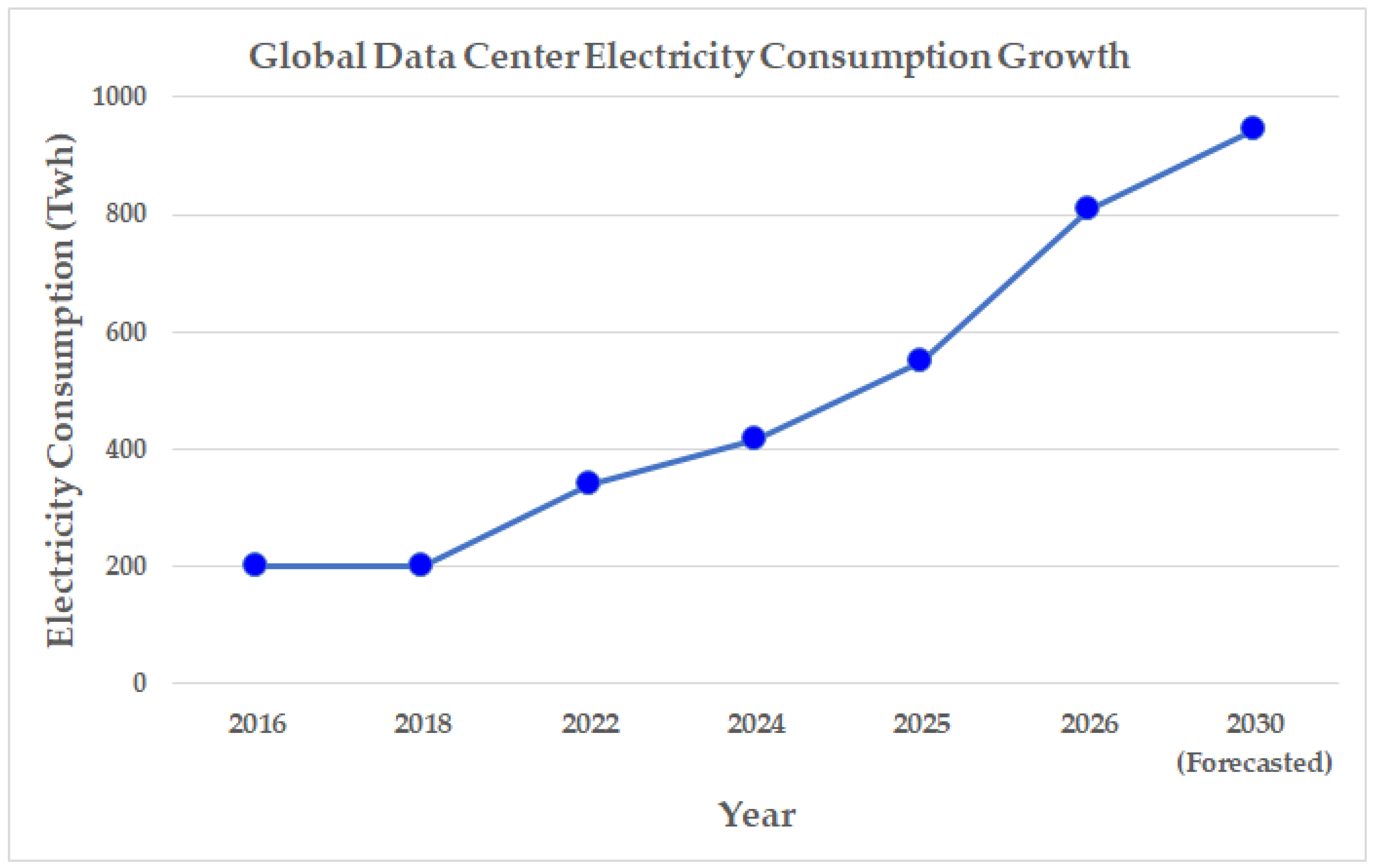
Figure 2.
ISO Certification Adoption Within Data Centers. Source: Author synthesis based on ISO Survey of Management System Certifications [25].
Figure 2.
ISO Certification Adoption Within Data Centers. Source: Author synthesis based on ISO Survey of Management System Certifications [25].
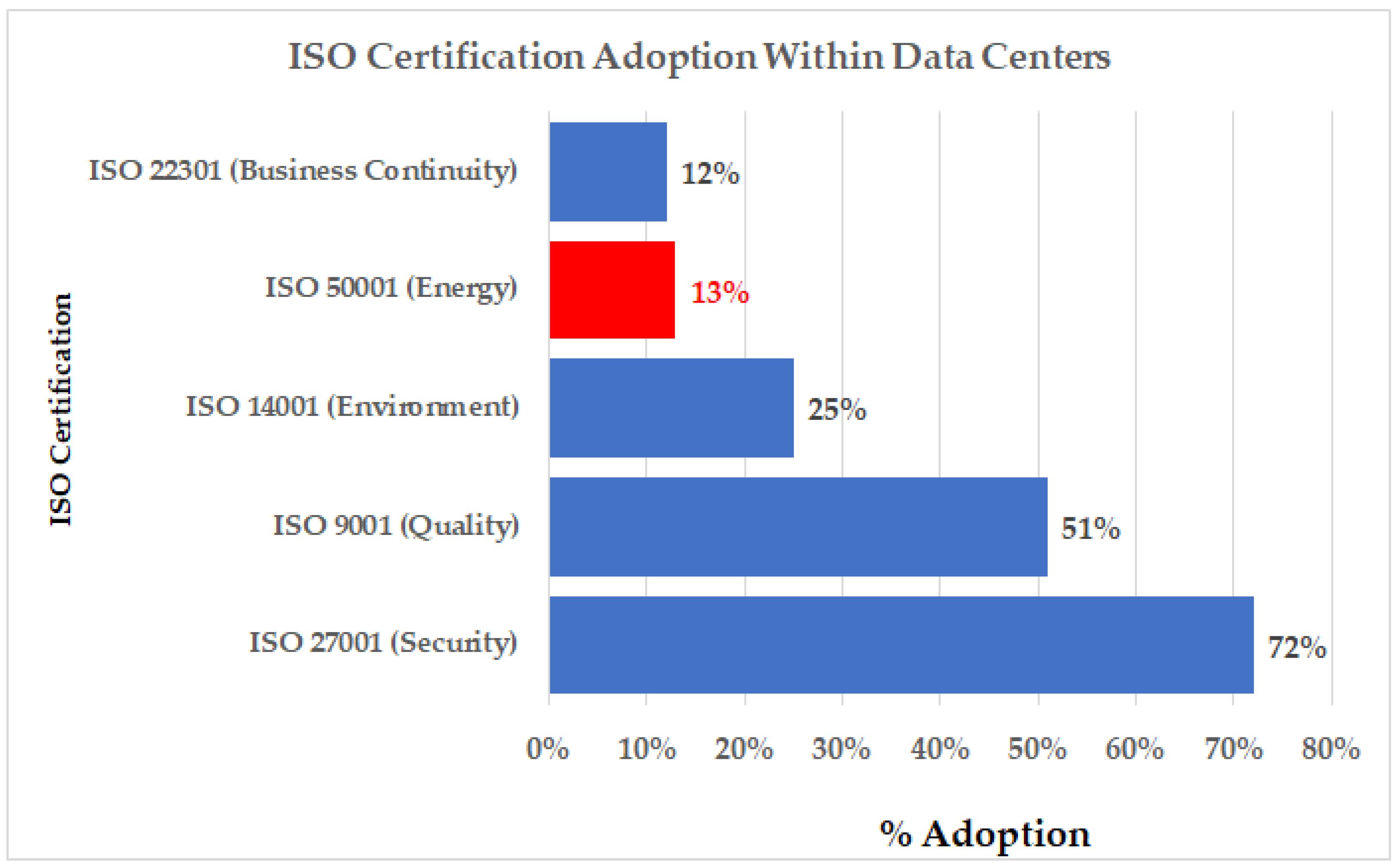
Figure 3.
Conceptual Framework of the Review. Source: Author synthesis based on ISO 50001 framework PDCA cycle and four pillars review. The schematic conceptual framework illustrates the four-pillar review methodology: (1) Baseline Analysis of current adoption patterns; (2) Assessment of operational and regulatory benefits; (3) PEST-aligned barriers specific to AI workloads; and (4) Future energy governance trajectories (2026–2030).
Figure 3.
Conceptual Framework of the Review. Source: Author synthesis based on ISO 50001 framework PDCA cycle and four pillars review. The schematic conceptual framework illustrates the four-pillar review methodology: (1) Baseline Analysis of current adoption patterns; (2) Assessment of operational and regulatory benefits; (3) PEST-aligned barriers specific to AI workloads; and (4) Future energy governance trajectories (2026–2030).
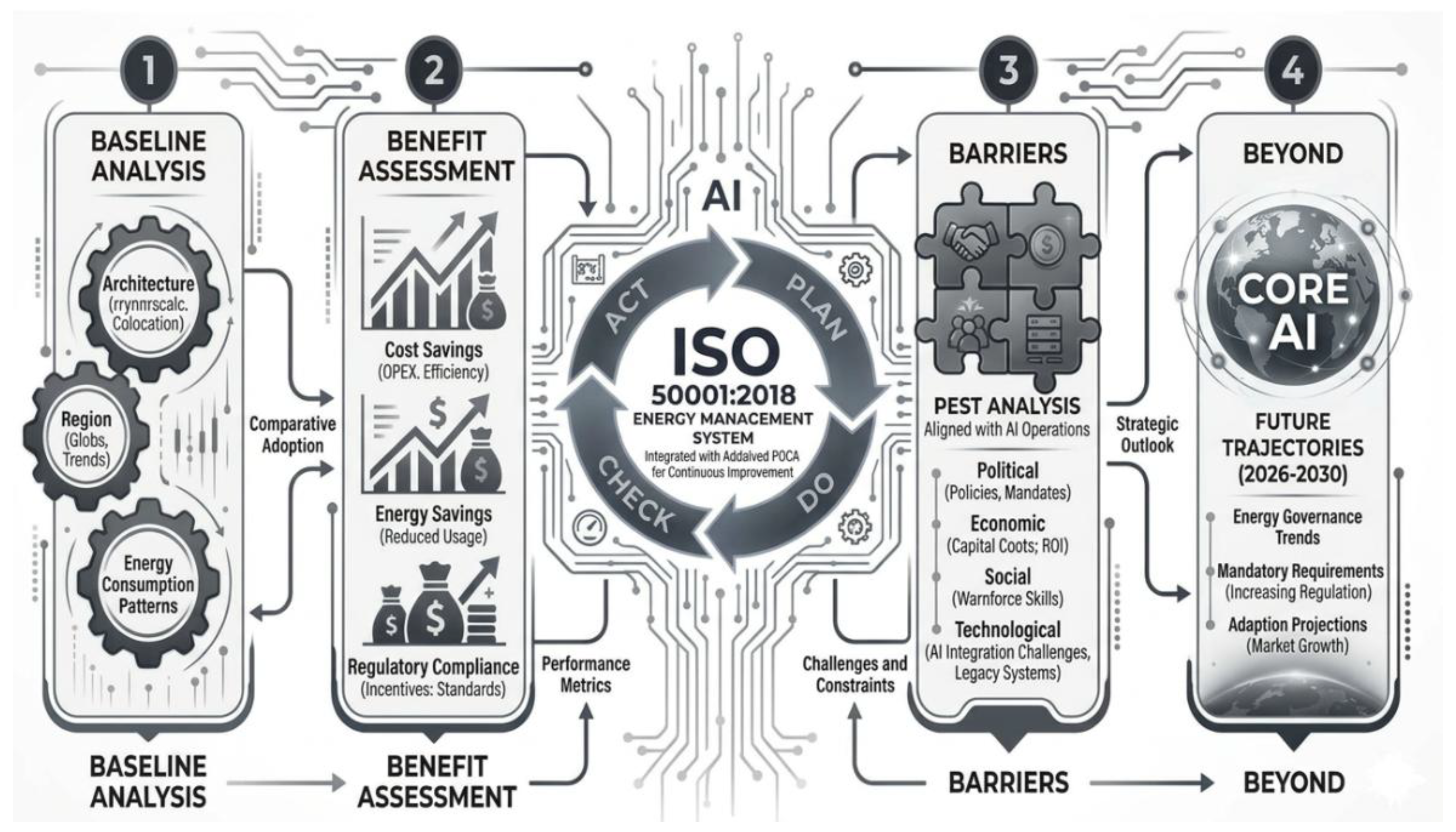
Figure 4.
Data Centers Global Electricity Consumption and Number of Data Centers. Source: Author synthesis based on IEA electricity statistics [1] and global data center counts [45].
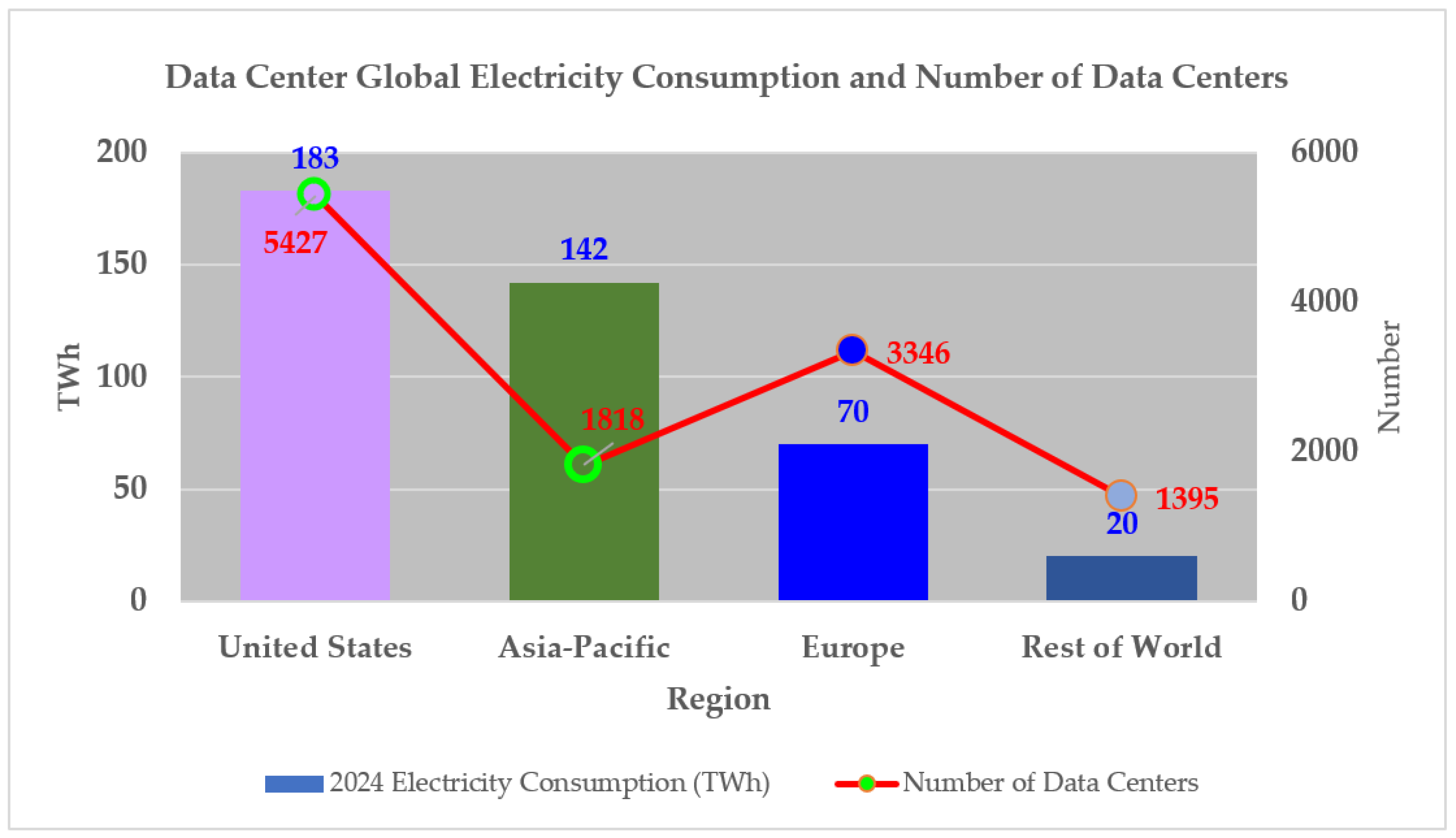
Figure 5.
Global Adoption of Energy Management Systems (ISO 50001). Source: Based on global EnMS adoption data [47].
Figure 5.
Global Adoption of Energy Management Systems (ISO 50001). Source: Based on global EnMS adoption data [47].
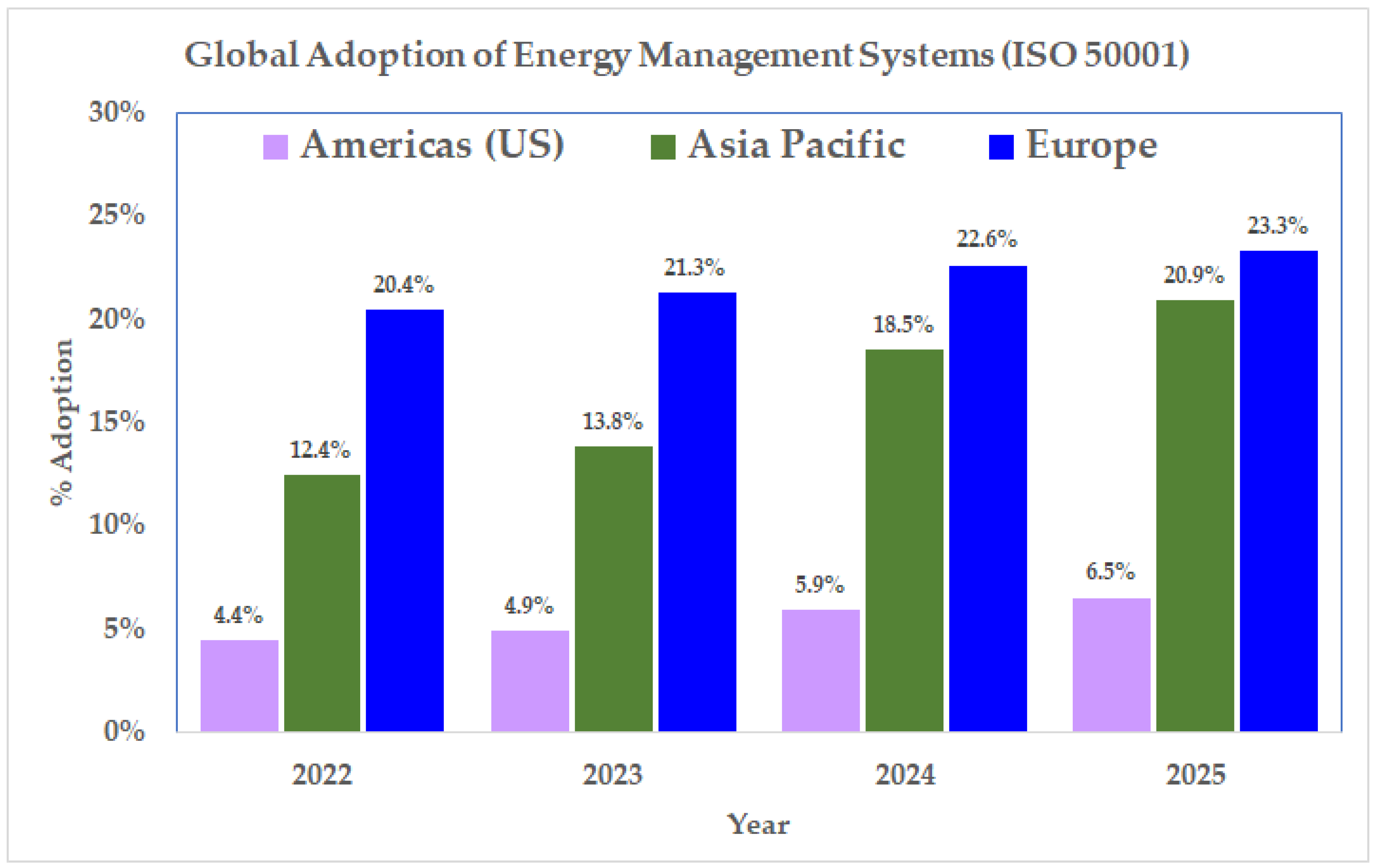
Figure 6.
Estimated Annual Energy Cost Savings from ISO 50001 Implementation. Source: Synthesized from Clean Energy Ministerial analysis [55] and Schneider Electric energy management studies [52].
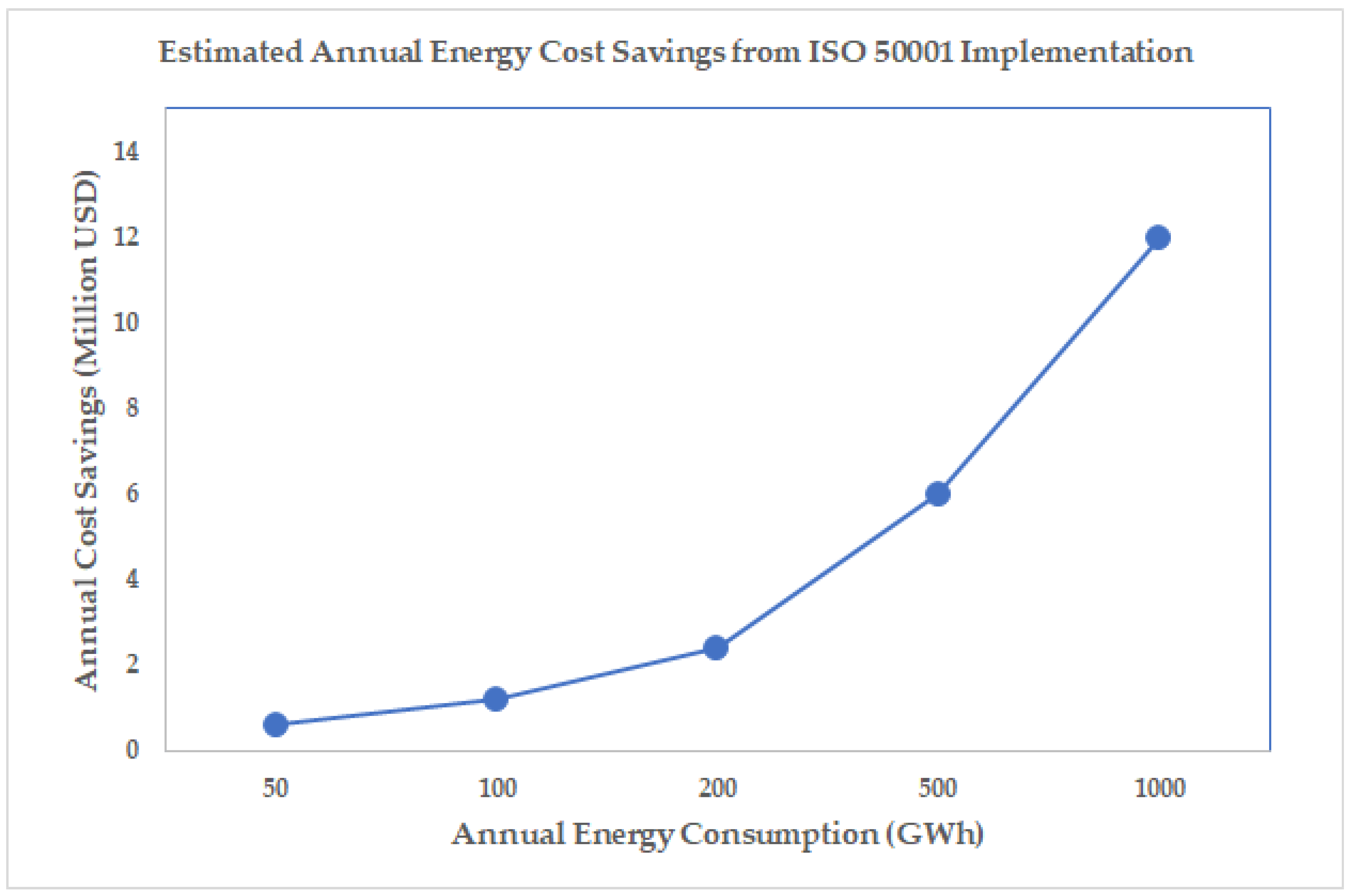
Figure 7.
PUE Stability With ISO 50001 vs Without ISO 50001 Adoption. Source: Derived from longitudinal performance benchmarks based on Uptime Institute and NREL data [7,39].
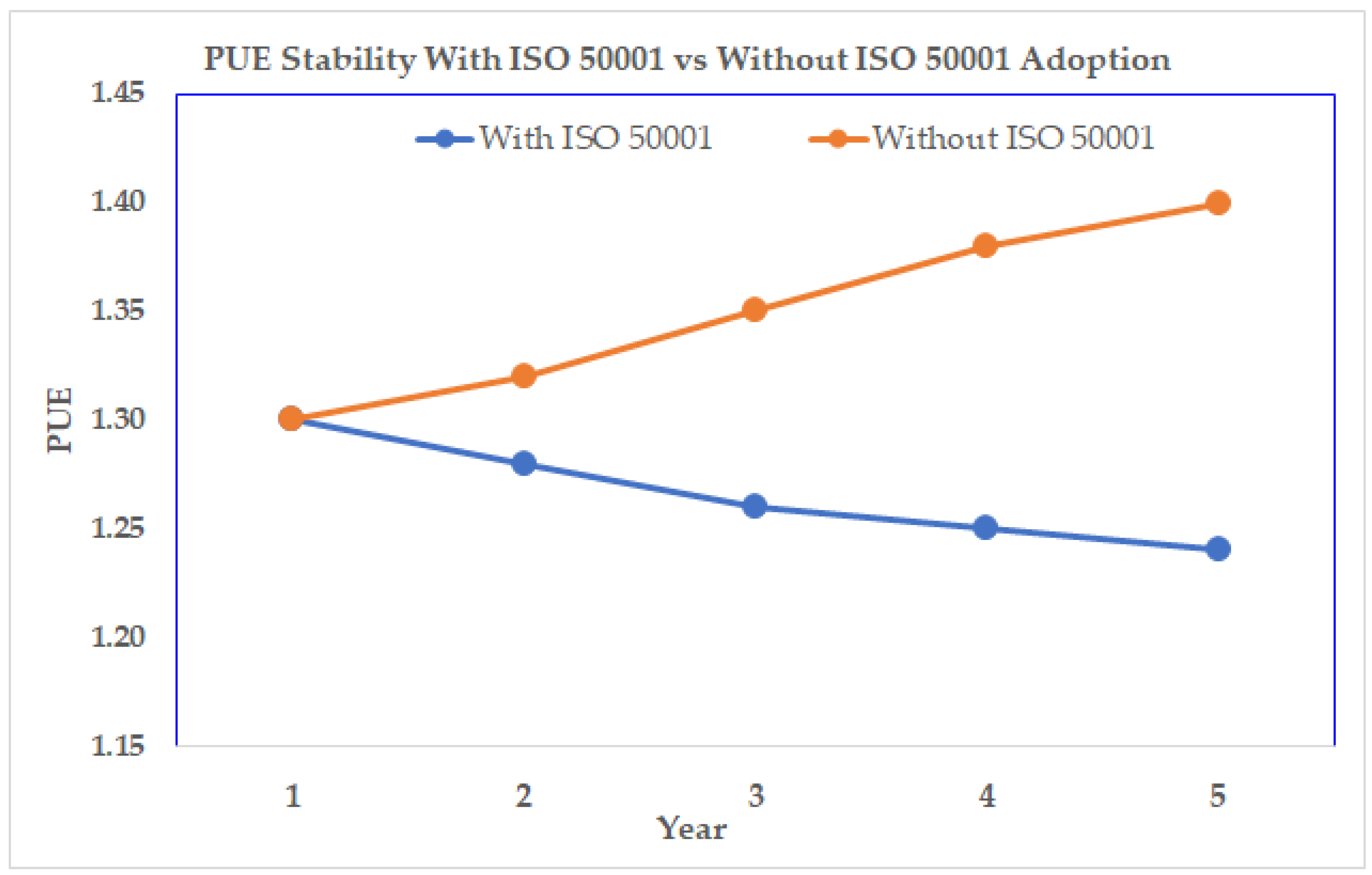
Figure 8.
Gantt Regulatory Roadmap for ISO 50001 Adoption in AI-Driven Data Centers. Source: Synthesized from EU Energy Efficiency Directive [66], Germany’s Energy Efficiency Act [67], and Singapore Green Data Centre Roadmap [70].
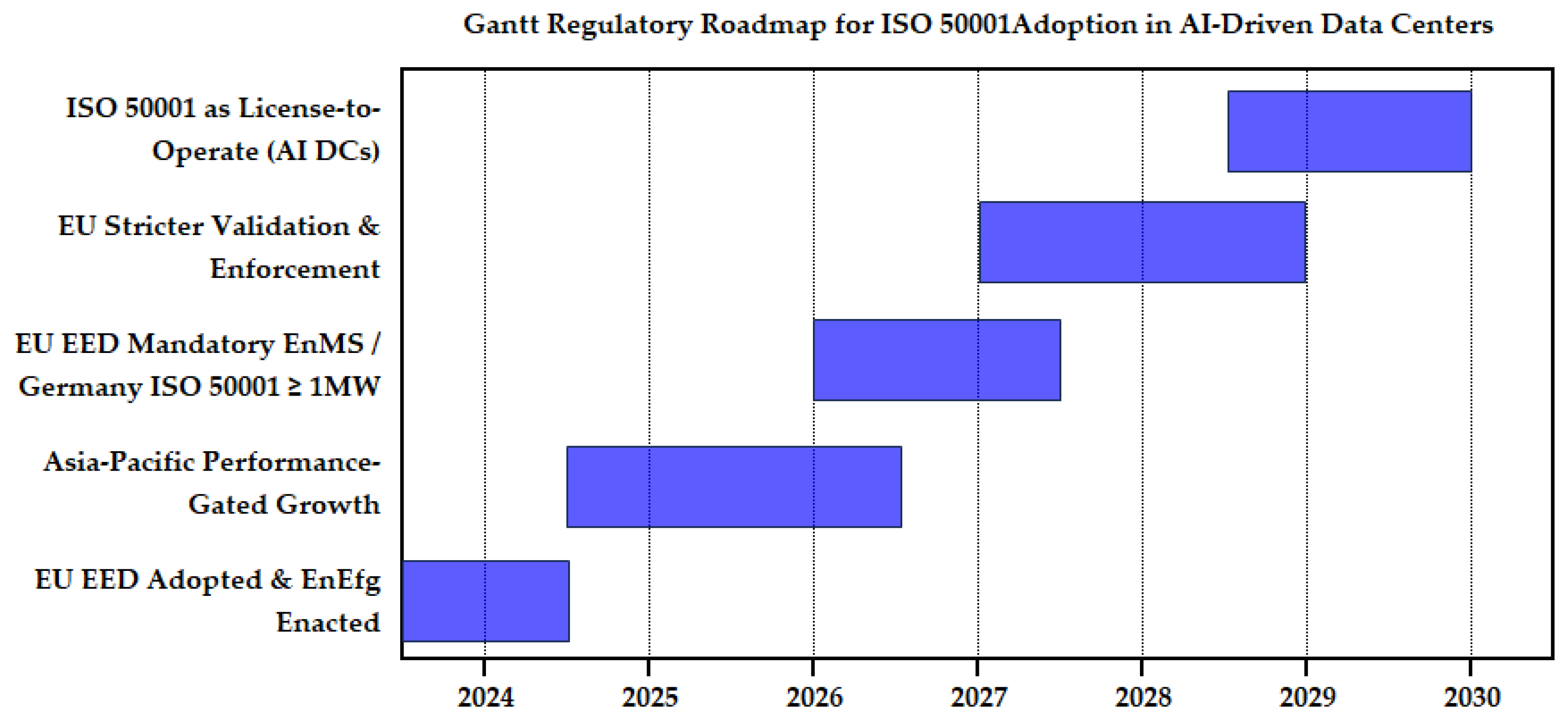
Figure 9.
Projected ISO 50001 Adoption in AI Driven Data Centers by 2030. Source: Scenario projections based on IEA electricity outlook analysis [4] and global data center market forecasts [74].
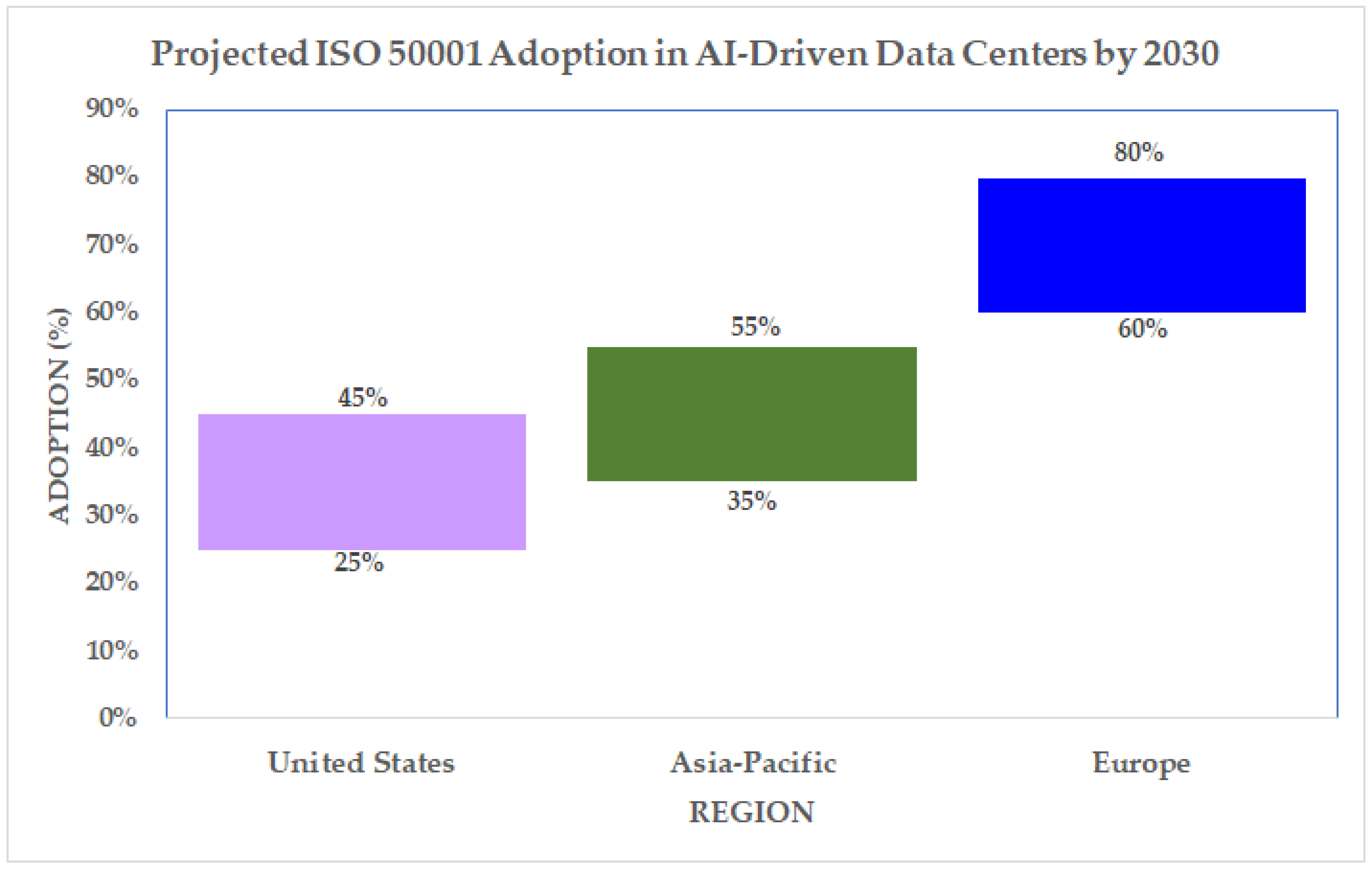

Table 1.
Comparison between traditional data centers and AI data centers. Source: Derived from Electricity Demand and Grid Impacts of AI Data Centers [41].
Table 1.
Comparison between traditional data centers and AI data centers. Source: Derived from Electricity Demand and Grid Impacts of AI Data Centers [41].
| Feature | Traditional Data Center | AI Data Center |
|---|---|---|
| Primary Functions | General-purpose IT services (e.g., web/app hosting, databases, enterprise software hosting, cloud storage, email,) | AI/ML model training, fine-tuning, and inference (e.g., large language models, AI computer vision, generative AI) |
| Workload Pattern | Stable, predictable workloads | Dynamic, bursty, data-intensive, hard-to-predict workloads |
| Compute Hardware | CPU-centric, some GPUs | GPU/TPU-dense clusters |
| Rack Power Density | 7 kW - 10 kW/rack, moderate density | 30 kW - over 100 kW/rack, very high density |
| Facility Design | Optimized for mixed workloads, standard floor loading | Optimized for high-density AI workloads, reinforced structures for heavy racks and cooling equipment |
Table 2.
PEST Analysis of Barriers to ISO 50001 in AI-Driven Data Centers.
| Category | Europe | Asia-Pacific | North America |
|---|---|---|---|
| Political | Mandatory compliance: tight timelines under EU Energy Efficiency Directive and Germany’s EnEfG create administrative strain [56,57] | Performance-gated growth: expansion conditional on energy efficiency commitments [58,59] | Fragmented governance: lack of federal mandates leads to voluntary adoption [65] |
| Economic | High CAPEX: strict targets necessitate expensive liquid-cooling retrofits [58,59] | Capital prioritization toward GPUs rather than management systems [41] | Lower energy prices in some regions reduce immediate ROI of EnMS |
| Social | Strong public pressure for climate targets increases demand for AI-energy specialists | Organizational silos between IT and facility management teams [60] | Cultural preference for proprietary optimization approaches |
| Technological | Fast-transient AI workloads complicate auditable baselines [44] | Proprietary liquid-cooling systems limit data transparency [58] | AI-driven automation complicates verification of PDCA monitoring |
Table 3.
ISO 50001 Adoption Projections of Data Centers by 2030. Source: Author projections based on IEA (1) and JLL (30) market growth scenarios.
Table 3.
ISO 50001 Adoption Projections of Data Centers by 2030. Source: Author projections based on IEA (1) and JLL (30) market growth scenarios.
| Region | 2030 Adoption | Primary Drivers |
|---|---|---|
| Europe | 60–80% | Mandatory 2027 EED Deadline for facilities >85 TJ/year; EnEfG compliance in Germany. |
| Asia-Pacific | 35–55% | Performance-gated growth in Singapore (PUE ≤ 1.3) and China’s Green DC Action Plan. |
| North America | 25–45% | Voluntary ESG reporting and utility-driven "grid-interactivity" requirements in constrained hubs. |
Disclaimer/Publisher’s Note: The statements, opinions and data contained in all publications are solely those of the individual author(s) and contributor(s) and not of MDPI and/or the editor(s). MDPI and/or the editor(s) disclaim responsibility for any injury to people or property resulting from any ideas, methods, instructions or products referred to in the content. |
© 2026 by the authors. Licensee MDPI, Basel, Switzerland. This article is an open access article distributed under the terms and conditions of the Creative Commons Attribution (CC BY) license (http://creativecommons.org/licenses/by/4.0/).
Copyright: This open access article is published under a Creative Commons CC BY 4.0 license, which permit the free download, distribution, and reuse, provided that the author and preprint are cited in any reuse.


