

Submitted:
17 March 2026
Posted:
18 March 2026
You are already at the latest version
Abstract
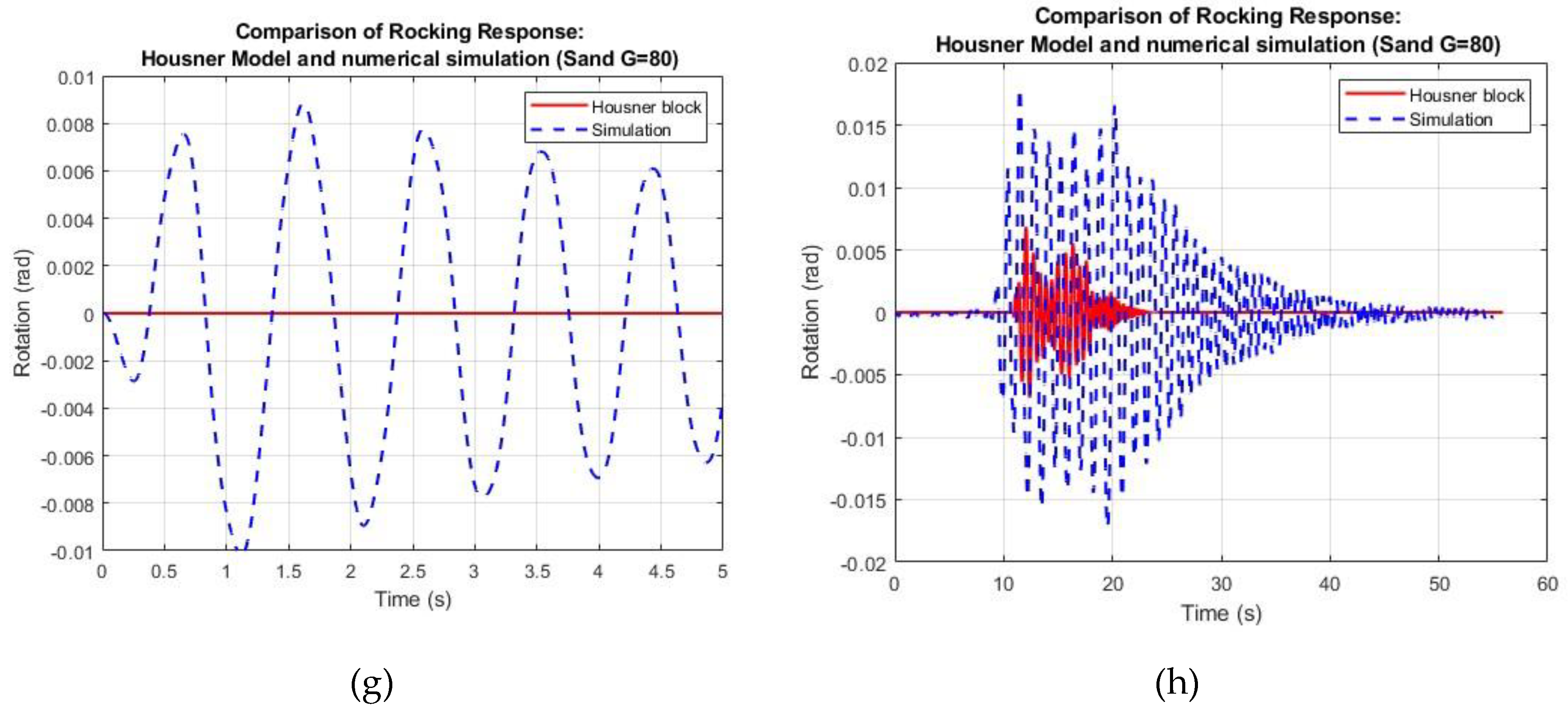
Housner’s classical rocking model assumes a rigid base, often leading to inaccurate seismic assessments in real-world soil conditions. This study quantitatively establishes the applicability limits of the rigid-base assumption and defines a reference range for its validity. To bridge this gap, a novel Soil-Structure Interaction (SSI)-rocking model is formulated via the Lagrange Equation, capturing the coupled dynamics between rocking blocks and compliant foundations. Crucially, a closed-form relationship is derived to correlate the analytical model’s interface stiffness with the shear and Young’s moduli used in industrial finite element (FE) software. Our findings reveal that rocking behavior depends not only on soil stiffness but also on the inherent stiffness of the structure. Consequently, a relative stiffness parameter is introduced to bridge the analytical and numerical frameworks. Validation using LS-DYNA confirms the model’s precision across varying base stiffnesses. Results indicate that softer soils significantly alter rocking initiation thresholds and amplify peak angles. This proposed analytical model provides a computationally efficient, FE-compatible tool to improve stability predictions and design strategies for unanchored structures in earthquake-prone regions.
Keywords:
1. Introduction
2. The Applicability Limits of Housner’s Rocking Block Model
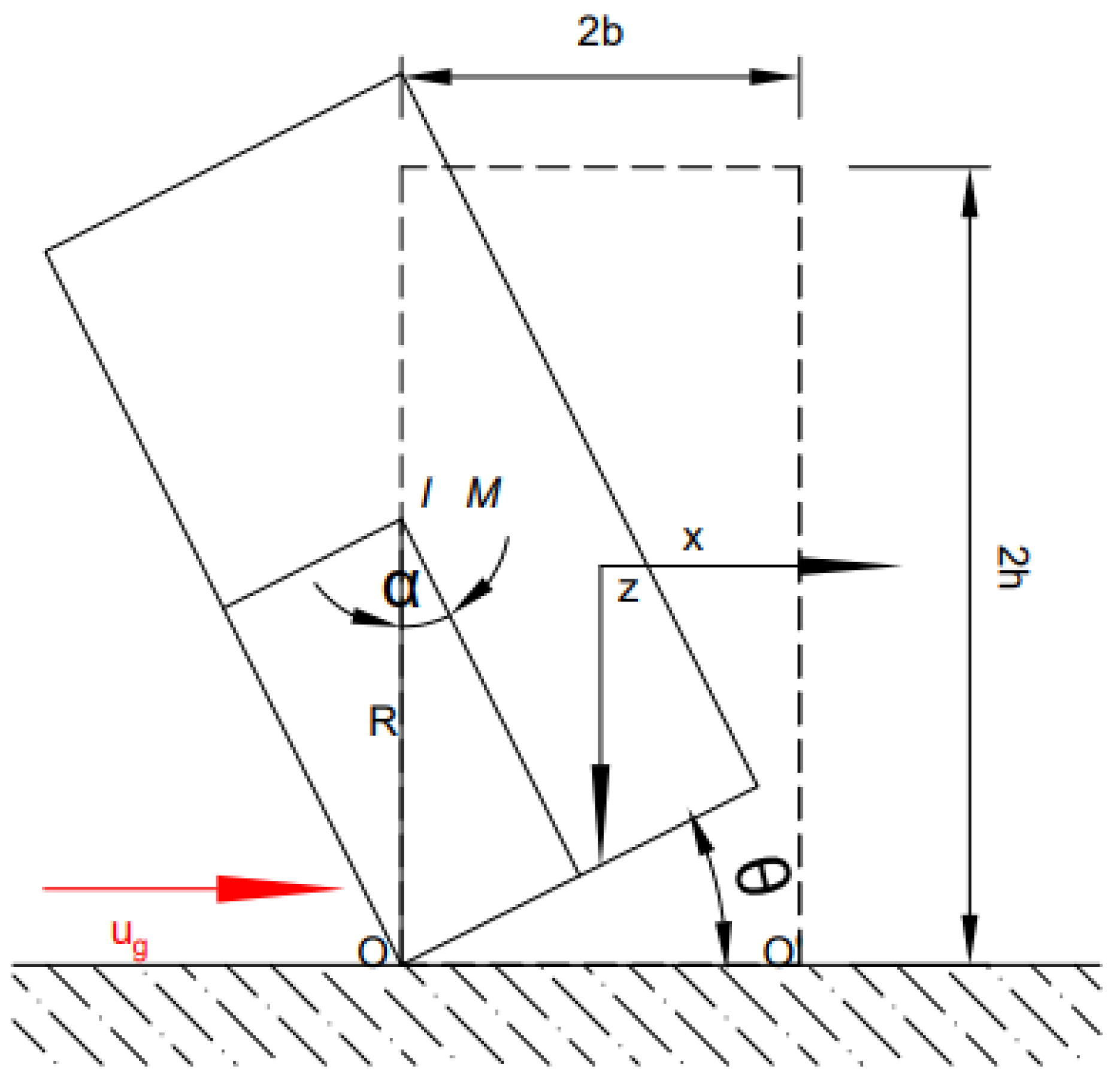
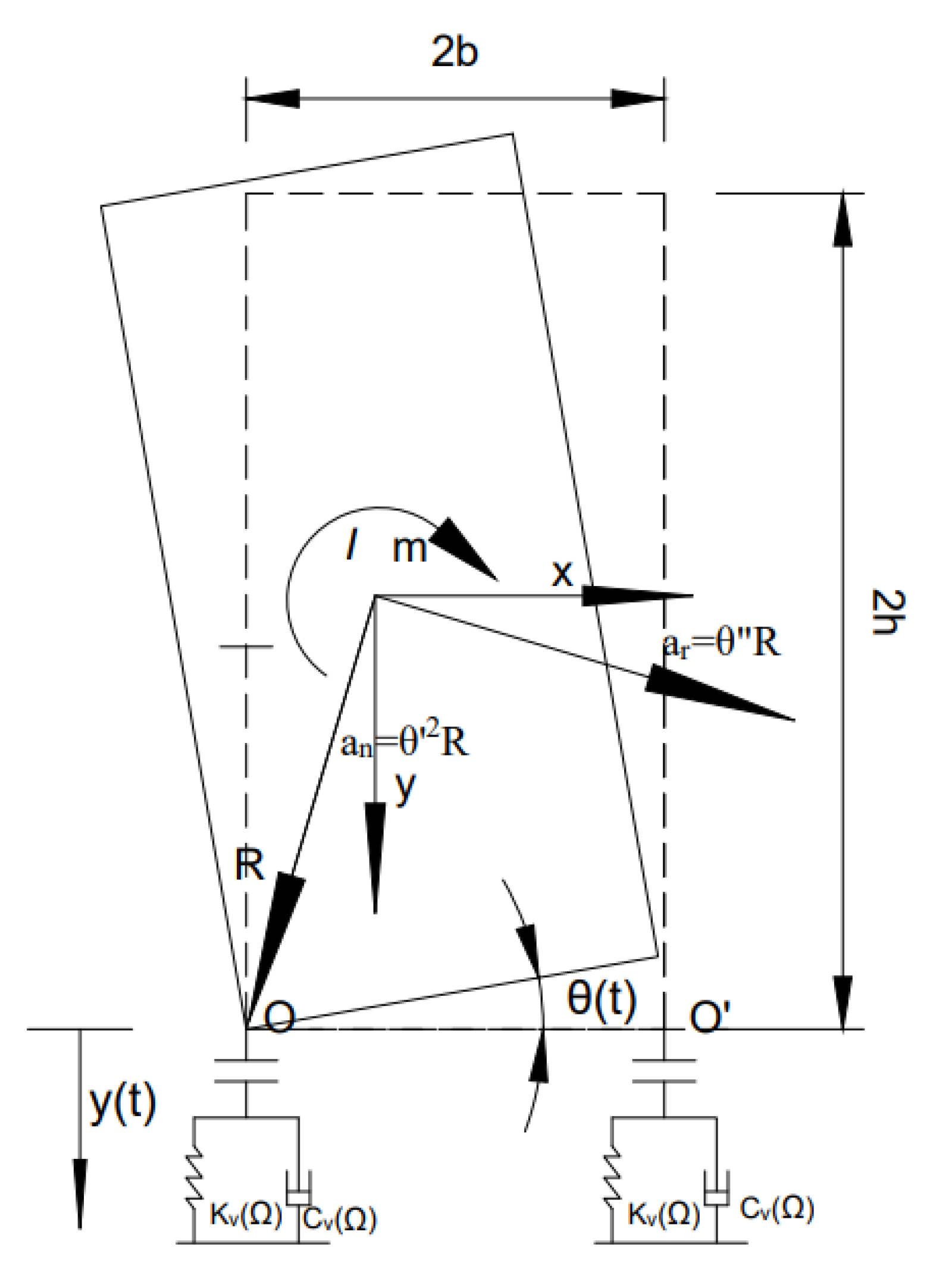
3. Development of a Novel SSI-Rocking Model for Non-Anchored Structure on Compliant Base
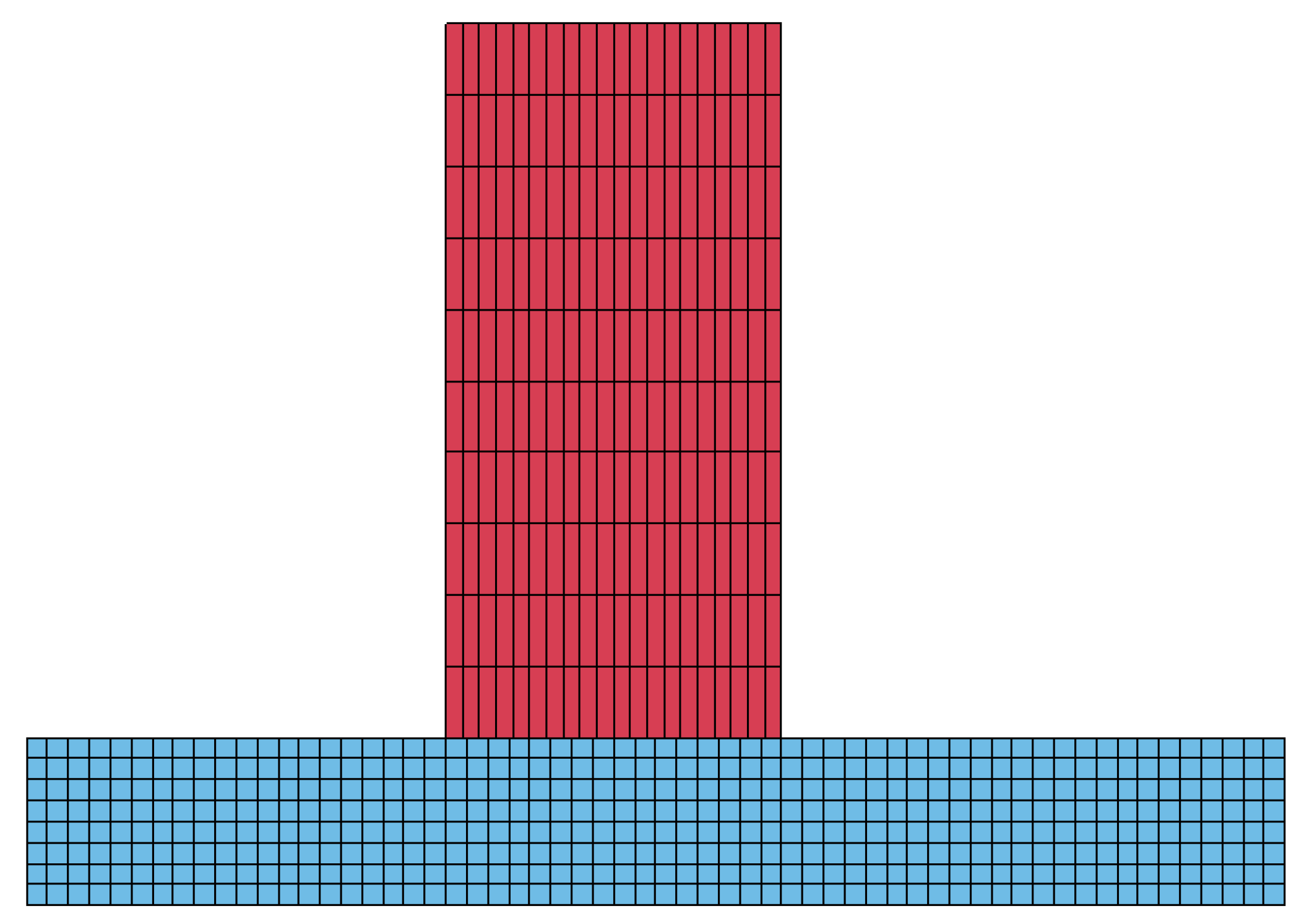
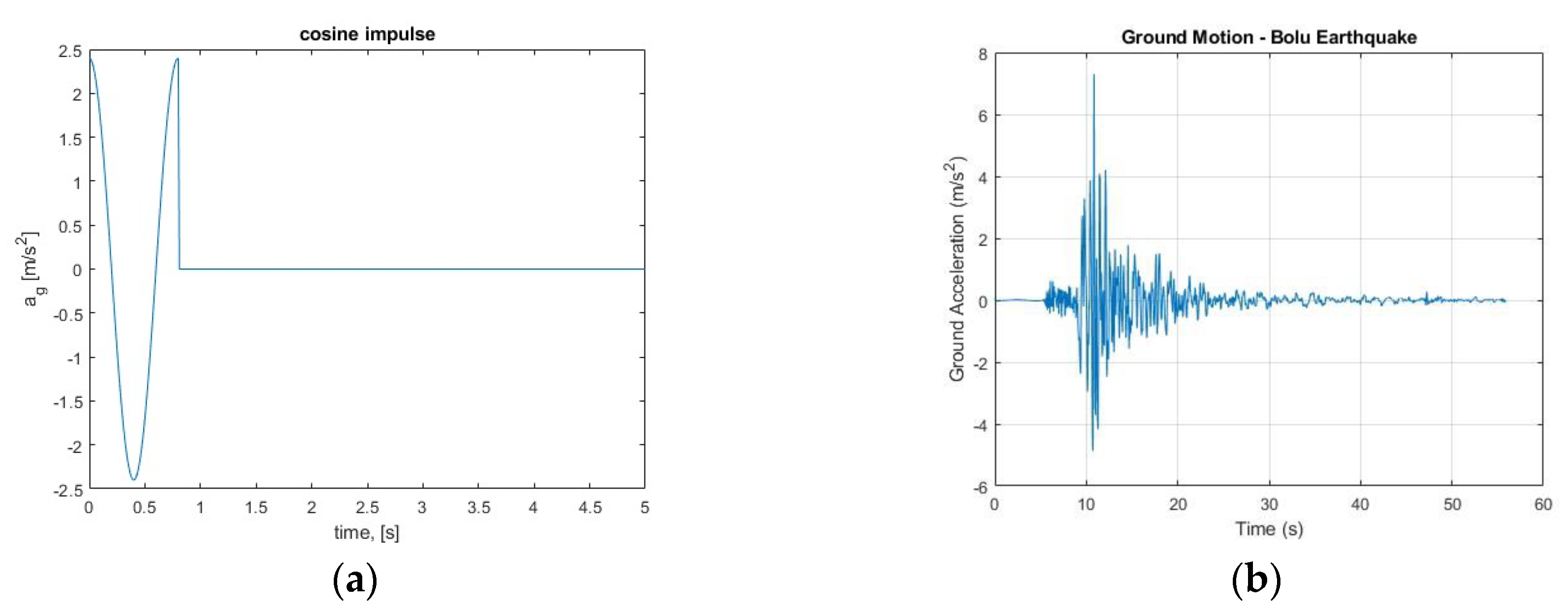
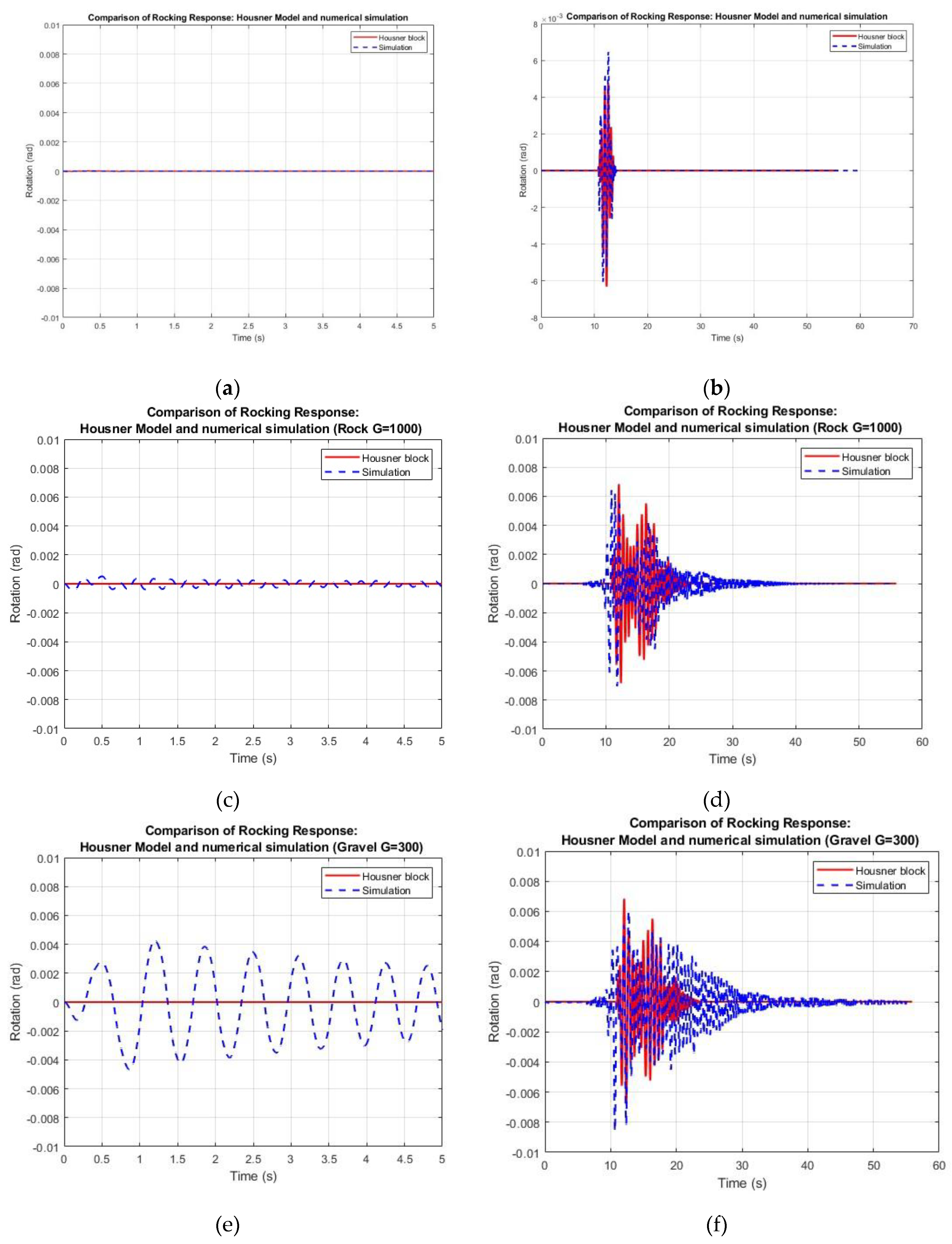
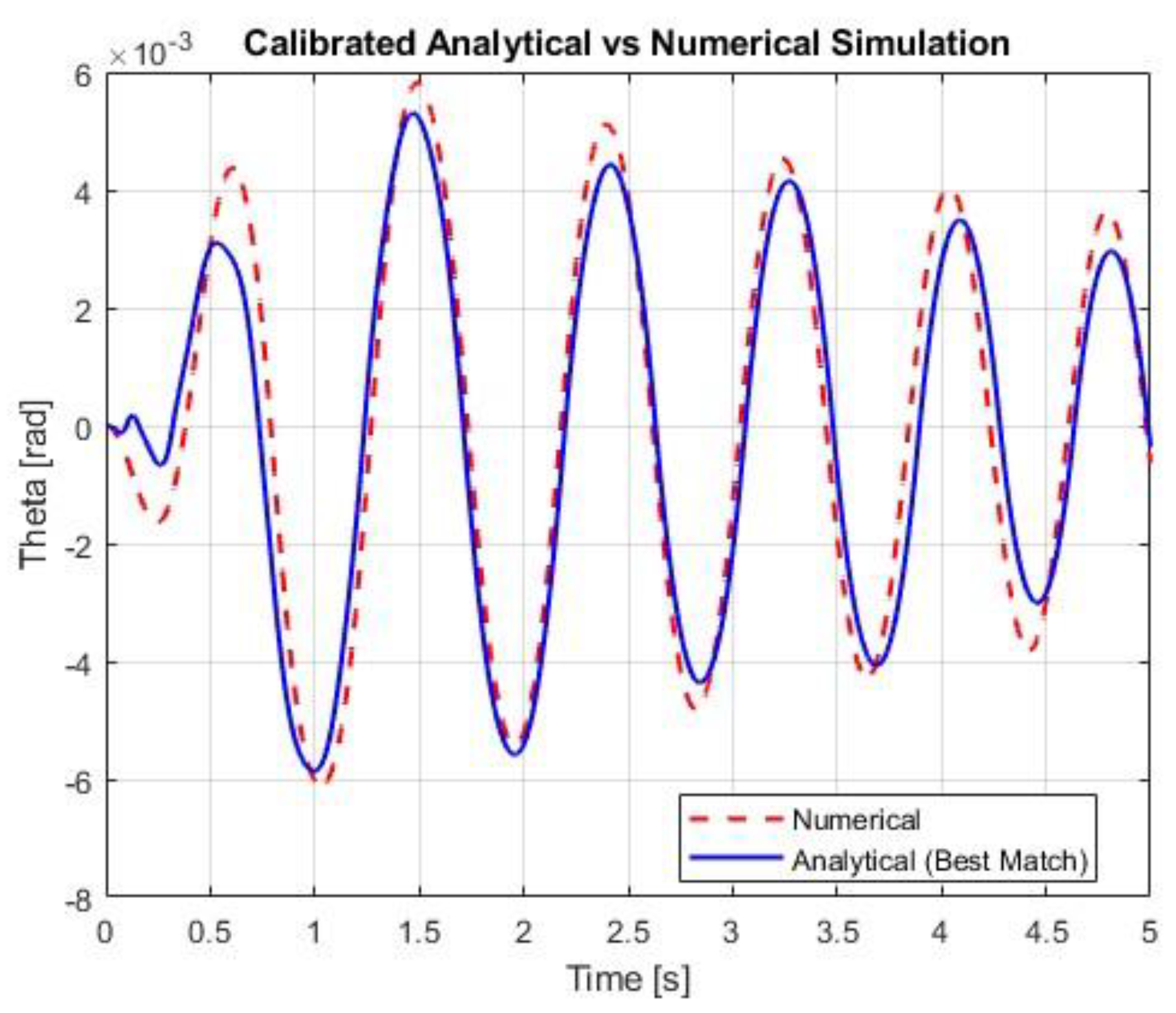
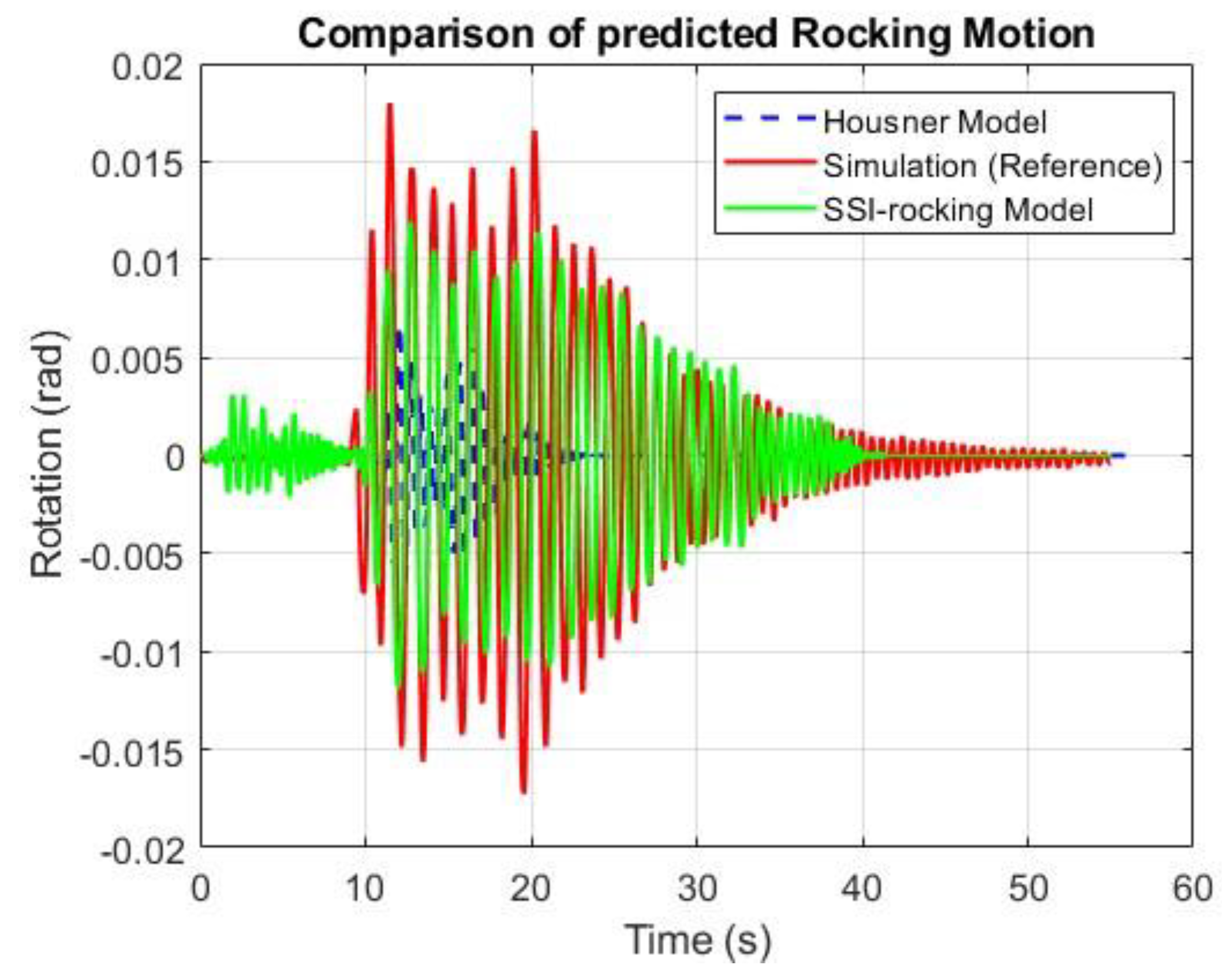
4. Numerical Validation and Implementation
5. The Effective Interface Stiffness for Rocking Motion
Influence of Soil Dynamic Shear Modulus
Influence of Block Elastic Modulus
6. Conclusion
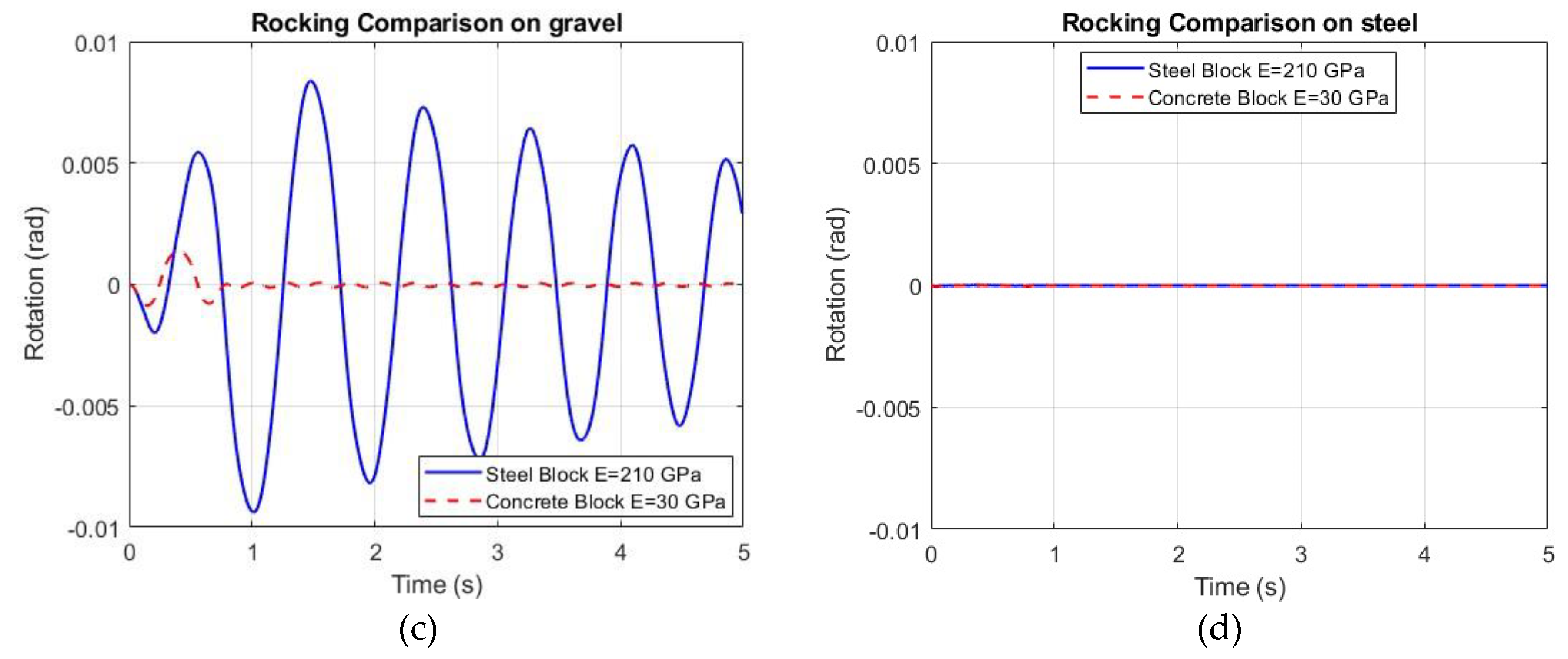
- becomes significantly altered on a compliant base, particularly when the subsoil is softer than rock, rendering the classical Housner rigid block model inadequate.
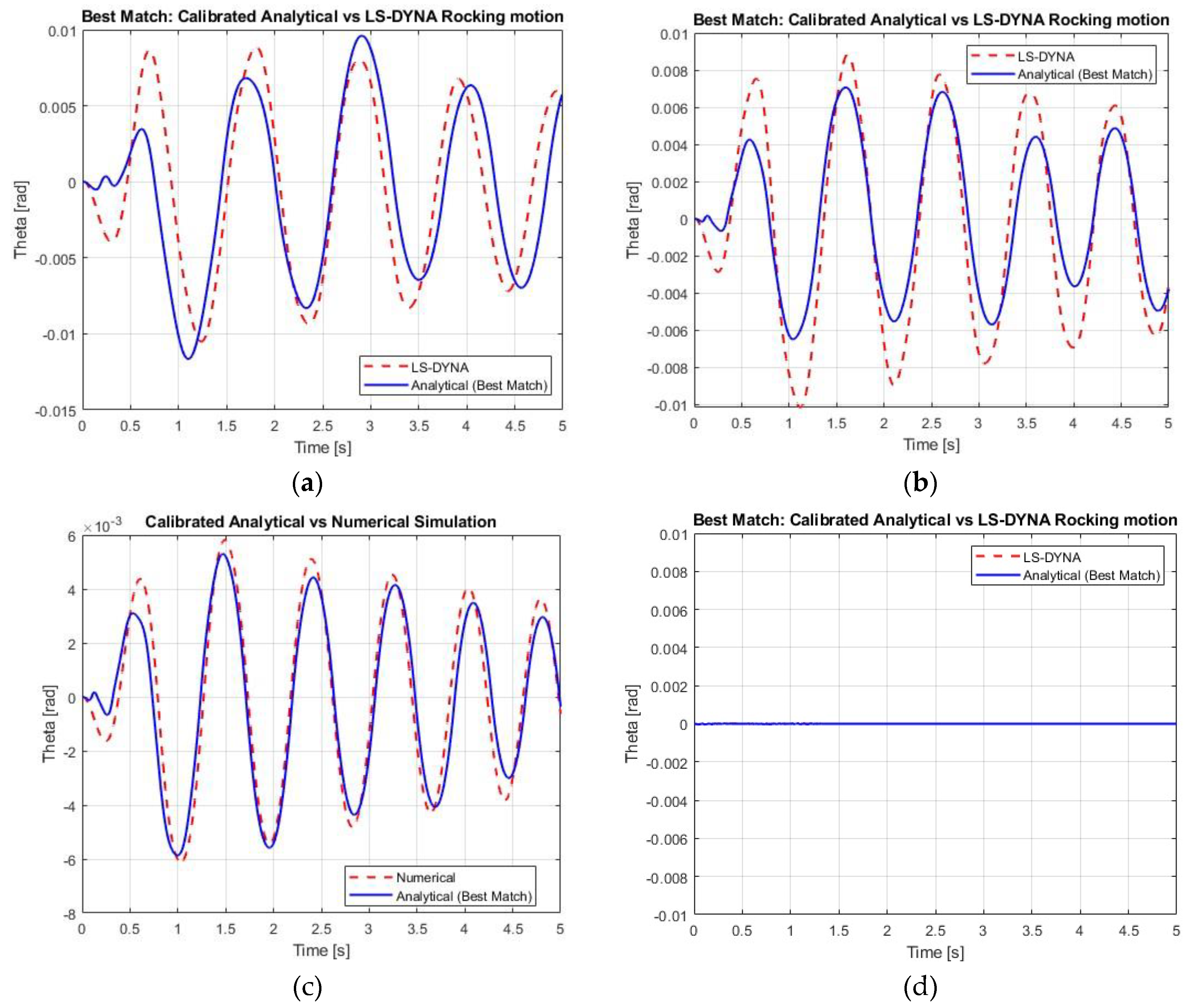
- A novel SSI-rocking model, which considers soil-structure interaction, has been developed and thoroughly tested using LS-DYNA simulations, showing strong accuracy in predicting rocking motion on a flexible base.
- An effective interface stiffness has been introduced to fine-tune the SSI-rocking model. The relationship between equivalent stiffness and effective interface stiffness was studied.
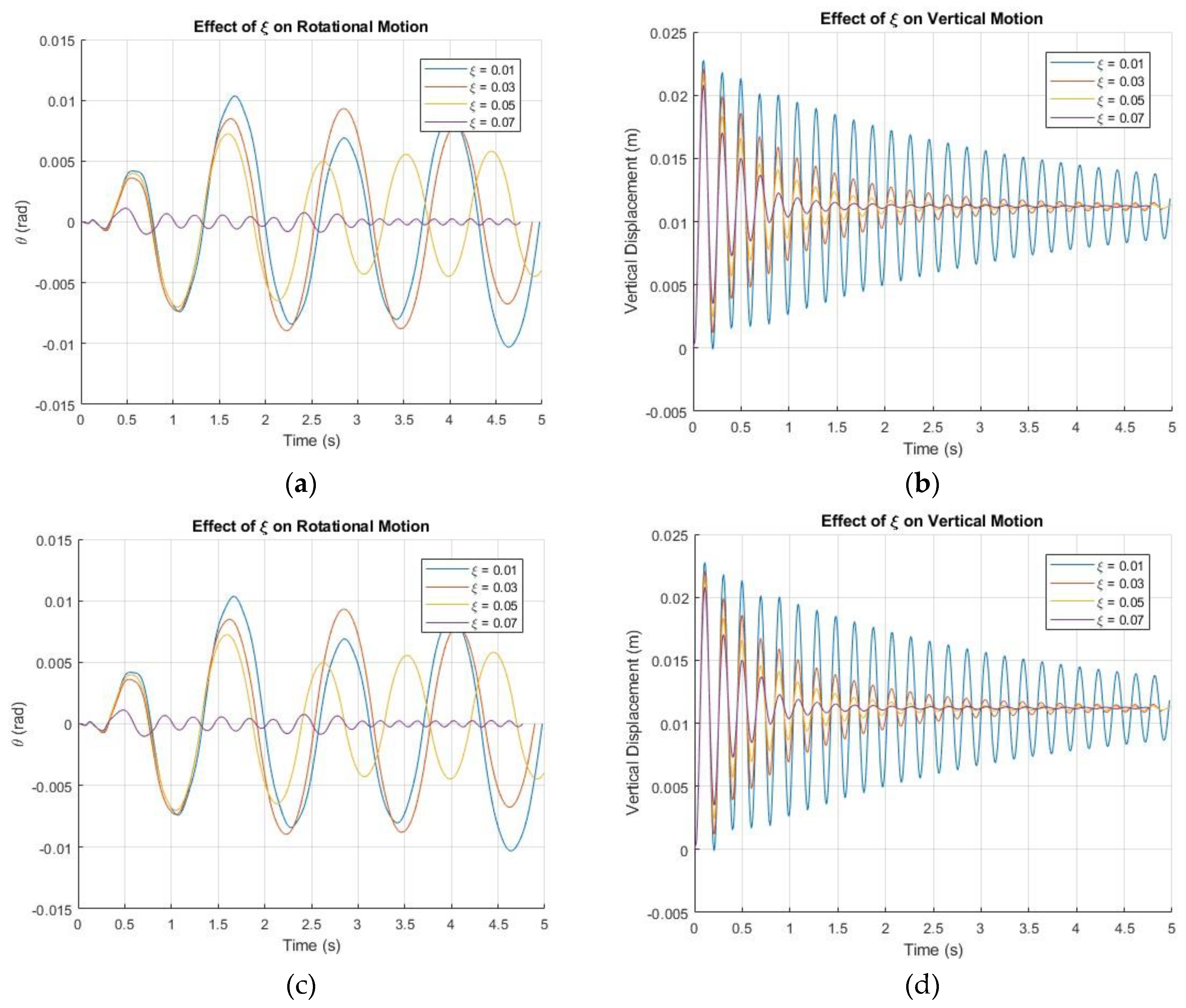
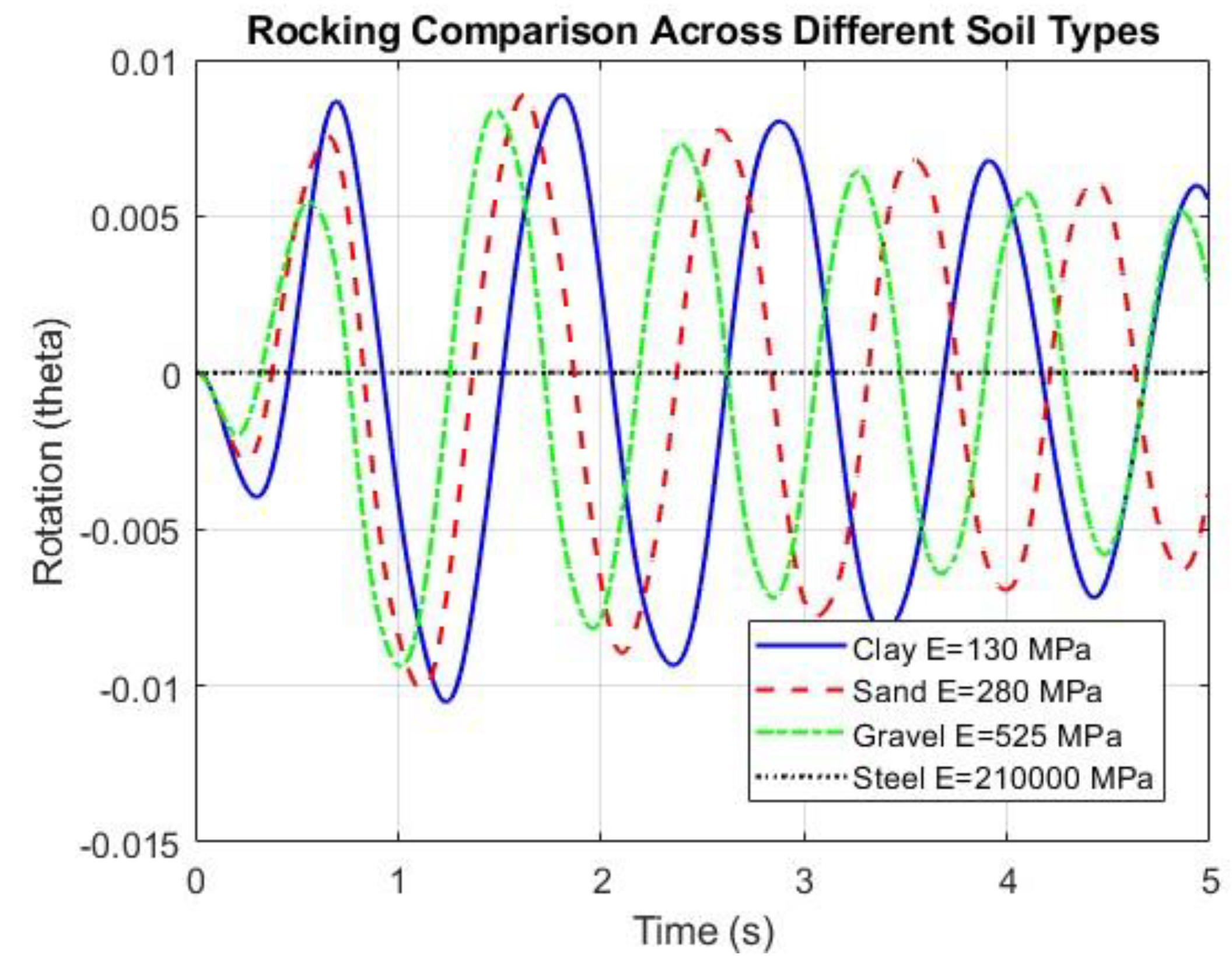
- Soil stiffness plays a more critical role than damping in influencing rocking motion and softer soil may increase the likelihood of overturning.
Author Contributions
Funding
Data Availability Statement
Acknowledgments
Conflicts of Interest
References
- Groß, M.K.N.; Sadegh-Azar, H. Damping approaches in nonlinear seismic time history analysis for large mobile equipment with uplift. Steel Constr. 2023, 17, 119–129. [Google Scholar] [CrossRef]
- Groß, M.; Gaube, D.; Sadegh-Azar, H. Grundsätzliche Untersuchungen zum seismischen Verhalten schienengebundener mobiler Großgeräte der Fördertechnik Teil 2: Seismische Analysen und Validierung. Stahlbau 2021. [Google Scholar] [CrossRef]
- Groß, M.; Gaube, D.; Sadegh-Azar, H. Grundsätzliche Untersuchungen zum seismischen Verhalten schienengebundener mobiler Großgeräte der Fördertechnik Teil 1: Stand der Technik und Berechnungsansätze. Stahlbau 2021, 90, 169–178. [Google Scholar] [CrossRef]
- HousnerG, W. The behavior of inverted pendulum structures during earthquakes. Bull. Seism. Soc. Am. 1963, 53, 403–417. [Google Scholar] [CrossRef]
- Yim, C.; Chopra, A.K.; Penzien, J. Rocking response of rigid blocks to earthquakes. Earthq. Eng. Struct. Dyn. 1980, 8, 565–587. [Google Scholar] [CrossRef]
- Zhang, J.; Makris, N. Rocking Response of Free-Standing Blocks under Cycloidal Pulses. J. Eng. Mech. 2001, 127, 473–483. [Google Scholar] [CrossRef]
- ElGawady, M.A.; Ma, Q.; Butterworth, J.W.; Ingham, J. Effects of interface material on the performance of free rocking blocks. Earthq. Eng. Struct. Dyn. 2011, 40, 375–392. [Google Scholar] [CrossRef]
- Dimitrakopoulos, E.G.; DeJong, M.J. Overturning of Retrofitted Rocking Structures under Pulse-Type Excitations. J. Eng. Mech. 2012, 138, 963–972. [Google Scholar] [CrossRef]
- DeJong, M.J.; Dimitrakopoulos, E.G. Dynamically equivalent rocking structures. Earthq. Eng. Struct. Dyn. 2014, 43, 1543–1563. [Google Scholar] [CrossRef]
- Vassiliou, M.F.; Makris, N. Estimating Time Scales and Length Scales in Pulselike Earthquake Acceleration Records with Wavelet Analysis. Bull. Seism. Soc. Am. 2011, 101, 596–618. [Google Scholar] [CrossRef]
- Vassiliou, M.F.; Mackie, K.R.; Stojadinovic, B. A finite element model for seismic response analysis of deformable rocking frames. Earthq. Eng. Struct. Dyn. 2017, 46, 447–466. [Google Scholar] [CrossRef]
- Vassiliou, M.F.; Truniger, R.; Stojadinović, B. An analytical model of a deformable cantilever structure rocking on a rigid surface: development and verification. Earthq. Eng. Struct. Dyn. 2015, 44, 2775–2794. [Google Scholar] [CrossRef]
- Bachmann, J.; Vassiliou, M.; Stojadinović, B. Dynamics of rocking podium structures. Earthq. Eng. Struct. Dyn. 2017, 46, 2499–2517. [Google Scholar] [CrossRef]
- Bachmann, J.A.; Vassiliou, M.F.; Stojadinovic, B. Rolling and rocking of rigid uplifting structures. Earthq. Eng. Struct. Dyn. 2019, 48, 1556–1574. [Google Scholar] [CrossRef]
- Bachmann, J.A.; Strand, M.; Vassiliou, M.F.; Broccardo, M.; Stojadinović, B. Is rocking motion predictable? Earthq. Eng. Struct. Dyn. 2017, 47, 535–552. [Google Scholar] [CrossRef]
- Lachanas, C.G.; Vamvatsikos, D.; Vassiliou, M.F. The influence of the vertical component of ground motion on the probabilistic treatment of the rocking response of free-standing blocks. Earthq. Eng. Struct. Dyn. 2022, 51, 1874–1894. [Google Scholar] [CrossRef]
- Manzo, N.R.; Lachanas, C.G.; Vassiliou, M.F.; Vamvatsikos, D. Uniform risk spectra for rocking structures. Earthq. Eng. Struct. Dyn. 2022, 51, 2610–2626. [Google Scholar] [CrossRef]
- Manzo, N.R.; Vassiliou, M.F. Displacement-based analysis and design of rocking structures. Earthq. Eng. Struct. Dyn. 2019, 48, 1613–1629. [Google Scholar] [CrossRef]
- Sieber, M.; Vassiliou, M.F.; Anastasopoulos, I. Intensity measures, fragility analysis and dimensionality reduction of rocking under far-field ground motions. Earthq. Eng. Struct. Dyn. 2022, 51, 3639–3657. [Google Scholar] [CrossRef]
- Kazantzi, A.K.; Lachanas, C.G.; Vamvatsikos, D. Seismic response distribution expressions for on-ground rigid rocking blocks under ordinary ground motions. Earthq. Eng. Struct. Dyn. 2021, 50, 3311–3331. [Google Scholar] [CrossRef]
- Lachanas, C.G.; Vamvatsikos, D.; Dimitrakopoulos, E.G. Statistical property parameterization of simple rocking block response. Earthq. Eng. Struct. Dyn. 2022, 52, 394–414. [Google Scholar] [CrossRef]
- Lachanas, C.G.; Vamvatsikos, D. Rocking incremental dynamic analysis. Earthq. Eng. Struct. Dyn. 2021, 51, 688–703. [Google Scholar] [CrossRef]
- Palmeri, A.; Makris, N. Response analysis of rigid structures rocking on viscoelastic foundation. Earthq. Eng. Struct. Dyn. 2008, 37, 1039–1063. [Google Scholar] [CrossRef]
- Vassiliou, M.F.; Makris, N. Analysis of the rocking response of rigid blocks standing free on a seismically isolated base. Earthq. Eng. Struct. Dyn. 2011, 41, 177–196. [Google Scholar] [CrossRef]
- Pelekis, I.; Madabhushi, G.S.; DeJong, M.J. Soil behaviour beneath buildings with structural and foundation rocking. Soil Dyn. Earthq. Eng. 2019, 123, 48–63. [Google Scholar] [CrossRef]
- Pelekis, I.; Madabhushi, G.S.P.; DeJong, M.J. Seismic performance of buildings with structural and foundation rocking in centrifuge testing. Earthq. Eng. Struct. Dyn. 2018, 47, 2390–2409. [Google Scholar] [CrossRef]
- Lu, Y.; Xiong, F.; Ge, Q. Dynamic rocking response of a rigid planar block on a nonlinear hysteretic Winkler foundation. Earthq. Eng. Struct. Dyn. 2021, 50, 2754–2773. [Google Scholar] [CrossRef]
- He, D.; Li, P.; Zhang, Z. Analysis of a Simplified Model of a Rigid Rocking Block on Winkler Foundation. Sustainability 2023, 15, 5095. [Google Scholar] [CrossRef]
- Frost, P.; Cacciola, P. Rocking of rigid blocks standing on a horizontally-moving compliant base. Int. J. Non-linear Mech. 2023, 153. [Google Scholar] [CrossRef]
- Baugrunddynamik, A. Empfehlungen des Arbeitskreises Baugrunddynamik; Herausgegeben von der Deutschen Gesellschaft für Geotechnik e.V. (DGGT), 2019. [Google Scholar]

| Ground Type | ||||
|---|---|---|---|---|
| Sand | 1900 | 80 | 0.3 | 280 |
| Gravel | 2000 | 300 | 0.3 | 1050 |
| Rock | 2500 | 1000 | 0.3 | 3500 |
| Steel | 7800 | 80000 | 0.3 | 210000 |
Disclaimer/Publisher’s Note: The statements, opinions and data contained in all publications are solely those of the individual author(s) and contributor(s) and not of MDPI and/or the editor(s). MDPI and/or the editor(s) disclaim responsibility for any injury to people or property resulting from any ideas, methods, instructions or products referred to in the content. |
© 2026 by the authors. Licensee MDPI, Basel, Switzerland. This article is an open access article distributed under the terms and conditions of the Creative Commons Attribution (CC BY) license (http://creativecommons.org/licenses/by/4.0/).


