Submitted:
15 March 2026
Posted:
18 March 2026
You are already at the latest version
Abstract
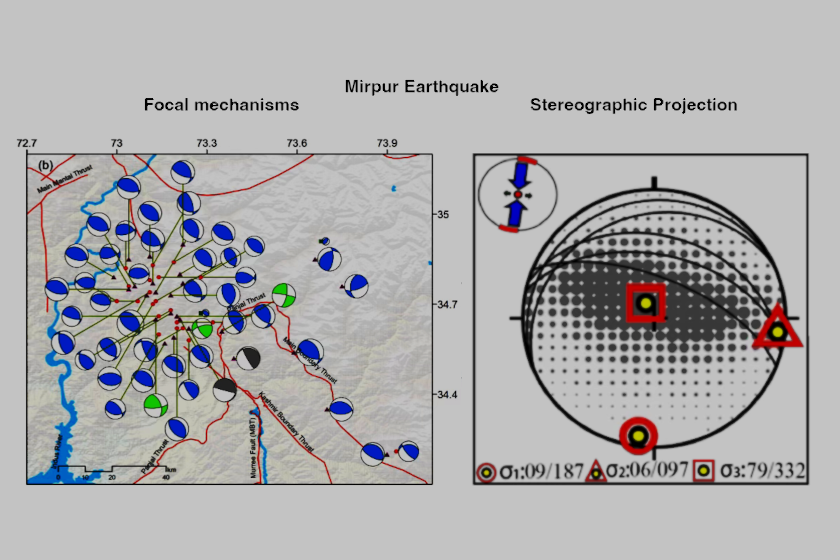
The tectonic framework of the 2019 Mirpur seismic sequence was investigated using local seismic data. Moment tensor inversion was performed for the Mirpur mainshock (Mw=5.8) and its largest aftershock (Mw=4.7). The mainshock exhibited a low dip angle (~10°) and shallow focal depth, suggesting association with the Main Frontal Thrust (MFT). Contrary, the largest aftershock showed a comparatively higher dip angle, indicating deformation along a ramp or ramp-anticline structure. The stress regime was evaluated using moment tensor solutions from two locally inverted events, two Global CMT solutions and a published focal mechanism. The results indicated a maximum horizontal stress (SHmax) orientation of N07°E, consistent with the stress orientation of the 2005 Kashmir earthquake sequence and the regional compression driven by the Indian plate convergence. Aftershock relocation and spatial distribution patterns suggested post-seismic stress relaxation and possible activation of a higher-dip fault segment or ramp-anticline structure. Although a seismogenic depth of approximately 15 km was estimated, the concentration of seismicity around 10 km depth may involve the Main Himalayan Thrust (MHT). The Mirpur mainshock was triggered primarily by the movement along the MFT, whereas the subsequent aftershocks reflected post-seismic relaxation associated with the MHT and related ramp-anticline structures.