

Submitted:
16 March 2026
Posted:
19 March 2026
Read the latest preprint version here
Abstract
There are lots of perennial species that enable multiple harvests over years from one planting in nature. These crops require no repeated tillage and can promote root accumulation, thus leaving rural landowners with time for reproduction and further production, but this model is difficult for complex knowledge and operational difficulty. Focusing on the supplementation of distinctive species in rural household agriculture, this paper sorts out existing problems and compiles a biological resource list including perennial crops and self-reproducing animals. Combined with methods such as using bamboo trellises and other climbing structures to block light for non-crops, a household-based perennial agricultural scheme of "one-time work, continuous harvest" is constructed to ease reproductive pressure and accelerate civilizational development. Studies show that perennial, self-propagating, storable crops allow people to run a food company, avoid repetitive labor, and gain stable family food dividends; some resilient perennial species can gain competitive advantages with simple artificial tools, and combining the innate advantages of plants with the acquired strengths of tools can resist various risks; A diversified species lifespan table helps people plan investment according to species longevity and their own needs, allowing some species to form a cycle where longer lifespan is accompanied by larger root tubers and higher fruit yields.
Keywords:
longevity agriculture
; family plant
; biological resource table
; species lifespan
; simple operation
Introduction
Mainstream global agricultural production remains centered on annual crops, relying on a cyclic model of annual tillage, sowing, management, and harvesting. Although this model has played a vital role in large-scale grain supply, it has also brought about unnecessary repetitive labor and soil erosion caused by soil disturbance (DeHaan et al., 2005). Annual crops consume a great deal of time that rural households could otherwise use for child-rearing and self-improvement. This imposes ongoing time pressure on small-scale producers, rural land managers, and urban vertical growers. Against the backdrop of declining fertility intention and rising demand for organic diets, exploring low-input, sustainable, household-based agricultural production models carries important theoretical and practical significance.
Perennial plants possess the natural advantage of "one planting, multiple years of continuous harvest", which can significantly reduce repetitive tillage, maintain soil stability, and preserve the ecological health of rivers and canals. Systematically integrating biological resources such as vegetables, tuber crops, fish, livestock and poultry (Gill and Singh, 2009), combined with natural materials like bamboo trellises to suppress weeds and improve space utilization, can establish a household agricultural system featuring "one-time labor, sustained harvests". This model takes household agricultural reproduction as its core objective. By extensively adopting self-propagating, storable, and low-maintenance species, it frees laborers from repetitive farming activities and provides a temporal and material foundation for household fertility. Meanwhile, enhancing the light-competitive advantages of perennial plants with simple artificial tools, and organically combining biological traits with natural implements, can offer a low-cost, nutritionally balanced organic food source for ordinary farmers, urban residents, employed and unemployed groups alike.
Based on the concept of perennial crops and longevity agriculture, this paper compiles a list of biological resources suitable for household production, constructs a low-labor, sustainable, and easy-to-operate household agriculture system, and explores its value in saving labor time, supporting household development, and improving overall social stability. It provides theoretical references and practical pathways for the transformation and industrial development of household agriculture.
Literature Review
Perennial Plants and Self-Reproducing Animals
Perennial agriculture is regarded as an important ecological agricultural model in addition to annual cropping. Perennial crops are characterized by continuous ground cover, well-developed root systems, soil and water conservation along ditches and riverbanks, and increased soil organic matter. These advantages have been confirmed by research and institutions in many countries, making them a key approach to enhancing farmland resilience. Compared with annual crops, perennial plants do not require annual sowing and tillage, can produce sustainably, and significantly reduce inputs of seeds, agricultural materials, machinery and labor (Toensmeier and Ferguson, 2014).
Self-reproducing animals refer to livestock, poultry and aquatic animals in agriculture that can mate naturally, hatch or nurse independently, and reproduce stably for a long time without artificial insemination. Such species are suitable for organic agriculture, household free-range farming and ecological circular agriculture systems (Sheikh, et al, 2021). Common types include chickens, ducks, geese, pigeons, rabbits, honeybees, as well as goats and sheep. Some turkeys and guinea fowls also have stable self-reproducing abilities. These animals have strong disease resistance and low feeding costs; a single introduction can support long-term breeding. They provide multiple benefits such as meat, eggs, honey, pollination and weed control, making them core low-cost and sustainable livestock and poultry in subsistence agriculture.
Agricultural Labor Time and Household Reproduction
Agricultural production methods directly affect household labor allocation and development opportunities. Annual agriculture is characterized by concentrated farming seasons, high labor intensity, and fragmented time, which occupies a great deal of time for rural families and smallholder farmers and crowds out time for childbearing and parenting. Existing studies point out that excessively long working hours are one of the main influencing factors in modern family fertility decisions, including many middle-class and wealthy groups, who are not short of money but of time. Similarly, monkeys only need to work four hours a day to get enough food. Poor families are short of both time and material resources, while storable crops can be consumed in winter without purchasing vegetables again in that season.
Reducing agricultural labor intensity and freeing up family time have become common demands of agricultural transformation and social development. Perennial cropping systems effectively extend the labor return cycle by reducing repetitive labor such as annual land preparation, sowing and weeding, making "low-labor-input household agriculture" possible (Steve, 2015). However, most existing studies focus on production efficiency and ecological benefits, and studies directly linking agricultural production models with household reproduction and fertility support are still relatively limited.
Subsistence Agriculture and Permaculture
Subsistence agriculture is a traditional farming practice centered on meeting the basic subsistence needs of producers and their families. Its production purpose is not economic profit, but to obtain sufficient food and materials for daily life by relying on family labor and simple production technologies to grow crops, vegetables and raise livestock. Such agriculture is usually small-scale, with output only guaranteeing basic survival and very few surplus products.
Permaculture is an agricultural system that mimics natural ecosystems. It is characterized by sustainability, low resource consumption and ecological diversity, with the core goal of achieving long-term self-reliance. Permaculture follows natural laws and forms a closed loop between land and organisms through the rational collocation of animals and plants: animals and plants interact and reinforce each other through synergistic and antagonistic relationships, reducing dependence on chemical fertilizers and pesticides (Mollison and Holmgren, 1978). However, it still has many shortcomings. For example, plants are limited by their inability to accumulate continuously over time, making it difficult for them to fully utilize time as a resource; the complicated preliminary design and construction are difficult; and the yield is unstable and greatly affected by natural risks.
Research Review and Perspective of This Paper
According to existing literature, the ecological and labor-saving advantages of perennial crops have been widely confirmed; agricultural labor patterns are closely related to household welfare and time allocation; and permaculture and household planting-breeding systems are practically feasible. However, obvious deficiencies remain: most studies focus on field production and technical improvement, with few taking household reproduction as the core goal; there is a lack of screening research on specific perennial plants and self-reproducing animals suitable for human dietary habits; and insufficient attention has been paid to the mechanism by which "simple tools + perennial plants" enhance competitive advantages and achieve synergistic benefits between humans and nature. Accordingly, this paper takes perennial agriculture as the research object, constructs a low-labor-input production model centered on perennial biological resources and characterized by "one planting, multiple harvests", and discusses its significance in saving household labor, supporting fertility and parenting, reducing living costs and alleviating social pressure, so as to fill the gap between technical models and social effects in existing research.
Result
Perennial agriculture emphasizes the design principles of long-term self-maintenance, simple human operation, and species symbiosis, yet it still has many shortcomings that prevent it from becoming a mainstream model. First, insufficient attention is paid to the sustainable supply of staple foods required by humans, and dedicated crops must meet storage-tolerant conditions. Second, regular weeding and pest control are still required, which contradicts the design concept of self-maintenance and results in high labor input costs. Third, germplasm resources are scarce. Perennial storage-tolerant plants and rapidly self-reproducing animals are themselves extremely rare, and difficulties in access caused by lack of public awareness further necessitate the compilation of a species table. Only after the above problems are solved can perennial plants and self-reproducing animals continuously provide income similar to corporate dividends and offer material support for humanity
The Causes of the Decline of Perennial Agriculture
Perennial agriculture should pay more attention to special staple crops. Although perennial plants have many advantages, one major problem with perennial agriculture is the lack of staples that can be planted on a large scale and stored for a long time. Only by achieving staple food production can it be widely accepted by rural and urban people. Humans need a crop similar to potatoes but capable of demonstrating the advantages of perennial plants. What is the advantage of special perennial plants? It is the continuous accumulation of root nutrients and root networks, which can give perennial plants a head-start advantage. Even with the same germination time, perennial plants grow faster and have stronger stems than annual plants due to their previous accumulation. Perennial grains are far less effective at suppressing weeds than perennial vines, whose understory space can be used to grow insect-repellent plants. This allows perennial plants to win in sunlight competition and suppress weeds by blocking sunlight. The tenacity of perennial plants suggests that insect-repellent plants and fewer pesticides can be used, allowing humans to consume nearly organic crops and promoting human health. In addition, it must be considered that humans need continuous food intake. The staple needs a storage life of one to two years to ensure green vegetables can be available in winter and the following spring, when leafy vegetables wither, thus guaranteeing a continuous vegetable supply.
Perennial agriculture should also involve rapidly reproducing gregarious animals. Human demand for meat is very high. On the one hand, meat supplements human nutrition; on the other hand, meat tastes good and enhances people’s sense of happiness. However, animals such as chickens are born only in spring and mature in autumn, and it is unsustainable to have eggs to be evil every day. This requires small meat animals with rapid reproduction and fast growth. Large animals are destructive and require a long feeding period to provide returns. Summer is a season when meat easily rots, so it is not suitable for slaughtering large meat animals. Small animals can mature rapidly every month, ensuring an adequate meat supply within a week. This model can be called alive storage. When selecting animals, priority should be given to social fish and livestock with parental care instincts. This choice allows parents and groups to take on the nurturing work, requiring little human effort. The combination of small animals and perennial, storable plants can greatly reduce feed costs. At least two kinds of animals are needed to make use of both grass and seeds. Animals can quickly digest plants, and the manure converted from plants can be used as fertilizer for plants. In this way, perennial storable plants and rapidly reproducing animals support each other, forming a cycle that can respond quickly, store resources, and resist risks.
Perennial agriculture should seek plant tools that match specialized species. A major problem in perennial agriculture is that there are not yet clearly defined crops that can overwhelmingly suppress weeds. In rural areas, there are still large numbers of small plots of land and ponds lying idle, each only a few square meters in size. One reason for abandonment is the need for annual tillage and weeding. Some weeds grow back regularly, making repeated weeding no different from repeated planting. For this reason, suspended bamboo trellises or tree-shaped climbing frames are needed. Weeding is repetitive and costly labor. Only by adopting perennial vines that grow rapidly in the early stages and accumulate root mass can plants gain a head start and a light advantage, causing weeds to die off naturally. It is absolutely impossible for such an overwhelmingly dominant suspended climbing frame to evolve in nature. In particular, perennial vines can be combined with bamboo supports to unify their innate advantages with acquired tools. This means perennial vines can utilize vertical space. Given this, annual plants cannot compete with perennial plants that only require irrigation at the root zone. Bamboo is used because it is highly malleable and can be formed into natural trellises, animal cages, and large shelters without the extensive processing required for iron. The trellis and harvesting methods used for grapevines can serve as references. Current trellis designs include X-type, n-type, Y-type, and T-type. Among them, the X-type is the simplest, while the Y-type yields the highest output. For durability and higher yields, bamboo can also be replaced with rows of metal wires. Non-vining plants such as bulbils-forming Amorphophallus can be covered with sturdy tiles or bricks, leaving only one opening for the plant to sprout. The purpose of this practice is to prevent neighboring weeds from competing for nutrients and robbing the crop of its head start. Weeds farther away do not need attention, as the mature crop will block their sunlight. This model allows crops to gain a competitive advantage whether on the Loess Plateau or vast grasslands, and may even make widespread grain production possible.
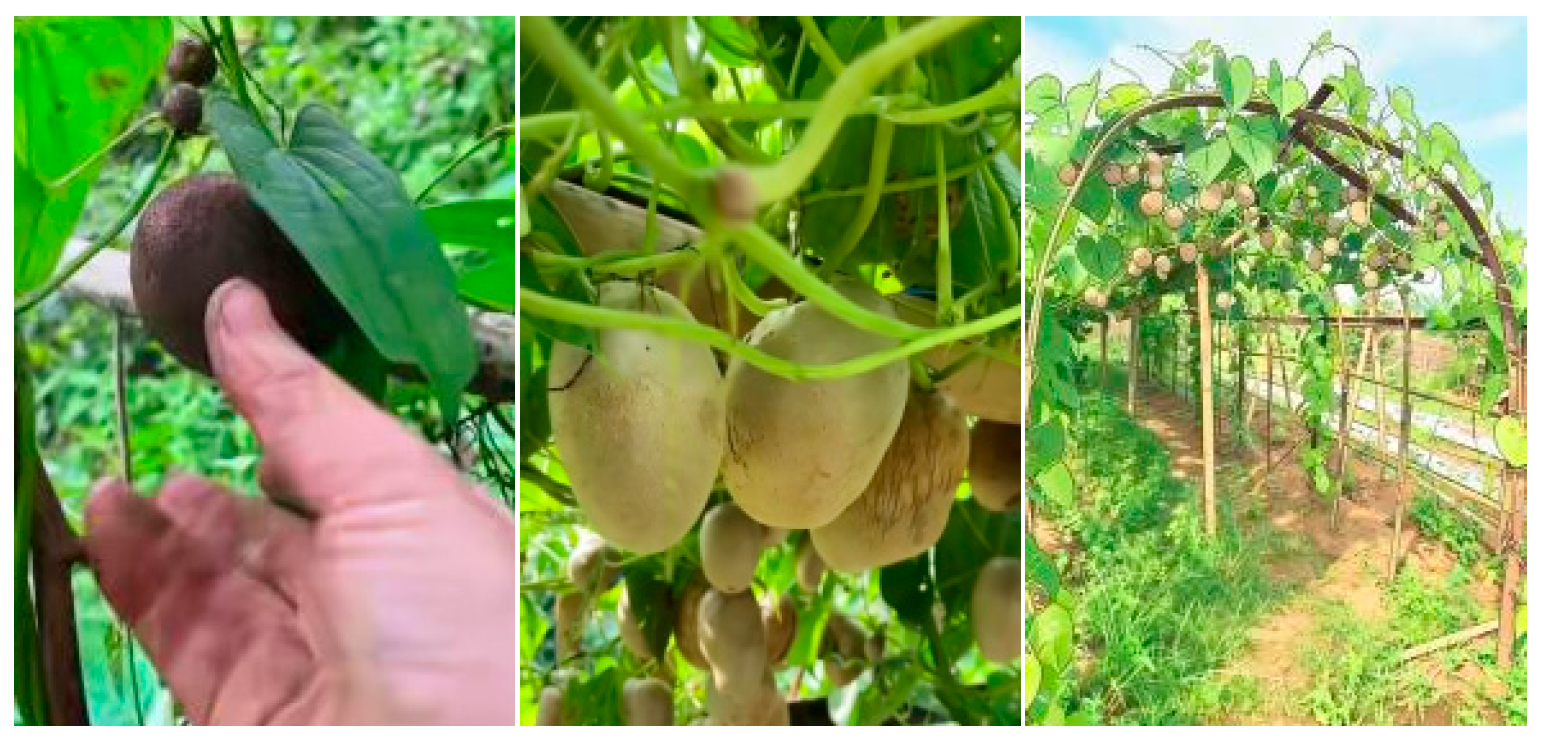
Figure 1.
This is a composite image. This first image shows cold-tolerant, non-bitter giant Chinese yam bulbs at the seedling stage. The second image is an anime adaptation of the collected species images. This species is the air potato, which is cultivated in a similar way to the giant yam beans. The third small picture shows the climbing frame structure of the giant Chinese yam bulbils, which can cover more weeds more densely.
Figure 1.
This is a composite image. This first image shows cold-tolerant, non-bitter giant Chinese yam bulbs at the seedling stage. The second image is an anime adaptation of the collected species images. This species is the air potato, which is cultivated in a similar way to the giant yam beans. The third small picture shows the climbing frame structure of the giant Chinese yam bulbils, which can cover more weeds more densely.
Table of Perennial Species Resources
Perennial agriculture requires attention to seed selection. In the present era, the abundance of perennial species has greatly broadened human choices. Resilient perennial plants can survive without excessive pursuit of a robust and interconnected overall ecosystem, and even a single plant species can thrive when cultivated, which forms the foundation of simple agriculture. At the same time, perennial plants and fast-breeding gregarious animals can be used to offset various risks. Through the collection of underutilized crops and food species from around the world, three biological tables are categorized based on taste and longevity. The tables briefly outline the name, characteristics, and relevant precautions of each species, with a focus on the lifespan of various perennial species and the room-temperature storage time of their products (refrigerated storage lasts longer), ensuring that the agriculture can be easily operated in practice. Focusing on the first entries in the tables, only the first two species of each category are needed to achieve simple perennial agriculture.

Table 1.
is divided into fruits and tubers; most tubers can be stored in the soil almost without harvesting. The supplementary animals and plants are annual or secondary. Perennial crops also include polygonatum, polygonum multiflorum.
Table 1.
is divided into fruits and tubers; most tubers can be stored in the soil almost without harvesting. The supplementary animals and plants are annual or secondary. Perennial crops also include polygonatum, polygonum multiflorum.
| Perennial agriculture staple foods and characteristics | |||||
| Species name | Mother plant lifespan | Storage time at room temperature | Texture category and other key points | Two pictures | |
| Staple crops | Giant yam bean/air potato | 10 years lifetime | Fruits are 1 year | Herbaceous vine, the first species is cold-tolerant |  |
| Chayote | 8 years lifetime | Fruits are 1 year | Herbaceous vine; as a vegetable |  |
|
| Cordifolia | 10 years lifetime | Fruits are eight months | Herbaceous vine; |  |
|
| Cosmos yam (supplement) |
10 years lifetime | Fruits are 1 year | Herbaceous vine; cold-intolerant |  |
|
| Amorphophallus bulbifer | 7 years lifetime | Fruits are 1 year | Herbaceous arborescent; seeds storable |  |
|
| Starchy kudzu | 20 years lifetime | Root tubers are 1 year | Woody vine |  |
|
| Architectural plants | Moso bamboo | 30 years lifetime | Bamboo are 10 years | Woody herb; for staking |  |
Some plant in the table continue to grow in body size over time, and larger body size often leads to higher productivity. Nutrients from the old roots are continuously transferred to the new in some species., continuously growing roots; eventually, the old roots die off, allowing the new roots to grow faster, and the fruit yield from the old root system increases day by day as the root system expands—this kind of agriculture can be called longevity agriculture, representing a new model of agricultural development with four specific principles: (1) Tubers are energy pools rather than disposable items; their underground tubers are storage organs rather than true "roots". Each growing season, the plant uses nutrients produced by leaf photosynthesis to continuously supply the tubers, causing them to expand. During dormancy, some nutrients in the tubers flow back to support sprouting and leaf growth in the following year. (2) "Head-replacing" renewal uses the old tuber as the mother body and a single new tuber as the main body. The tuber has a key structure called an "eye" (or apical bud); each spring, the eye germinates and grows a new aboveground stem. At the base of the new stem, on top of the old tuber, a new tuber primordium differentiates, which quickly expands to become the main tuber of that year and acts as another root supporting the new vine. The original old tuber and the new tuber jointly support the vine for several years before slowly shrinking, eventually acting only as a carrier for nutrient transition before decaying. This pattern—where old tubers support the growth of new ones—allows each generation of tubers to grow larger on the basis of the previous one, using a more mature root system and sufficient photosynthetic products. (3) Strong root support: a fibrous root network plus tuber extension. Beneath the tuber, numerous absorbing fibrous roots develop into a dense network that takes up water and nutrients from the soil. Meanwhile, the tuber itself can keep extending downward into deeper soil layers, breaking through the limitations of topsoil to access more resources. This root strategy of deep penetration and wide absorption provides a steady material foundation for the continuous expansion of tubers. (4) Perennial growth: trading time for space. As a perennial herb, it does not need to be dug up every year under natural or long-term cultivation. Under suitable conditions, it can undergo year-after-year renewal, with each generation of tubers accumulating more nutrients on the previous one, eventually forming huge tubers. As long as the balance of nutrient distribution between fruits and roots is maintained, fruit yield will keep rising as the root system expands. Although old tubers cannot last forever, they represent the best current survival outcome, which explains why certain special varieties of yam can produce such large and abundant fruits. Perennial rice, perennial wheat, and other perennial grains do not possess the accumulation capacity of perennial vines. Only if they can be genetically modified or hybridized to develop tuberous roots can they gain value appreciation and generate "dividends" like giant yam beans.
Table 2.
mostly includes perennial vegetables and fruits, most of which are planted once and harvested for many years with the whole plant edible to avoid waste; there are also Oxalis corymbosa, Sedum sarmentosum, dandelion and Tropaeolum tuberosum, supplemented by long loofah, Peruvian carrot, baby pumpkin and snake gourd.
Table 2.
mostly includes perennial vegetables and fruits, most of which are planted once and harvested for many years with the whole plant edible to avoid waste; there are also Oxalis corymbosa, Sedum sarmentosum, dandelion and Tropaeolum tuberosum, supplemented by long loofah, Peruvian carrot, baby pumpkin and snake gourd.
| Perennial agriculture vegetables,fruits and characteristics | |||||
| Species name | Mother plant lifespan | Storage time at room temperature | Texture category and other key points | Two pictures | |
| Vegetables (dividing roots; nearly unlimited lifespan) | Watercress | 5 years lifetime | Plant bodies are 3 days | Herbaceous; some cold-tolerant |  |
| Water spinach | 4 years lifetime | Plant bodies are 3 days | Herbaceous; cold-intolerant |  |
|
| Chinese chives | 5 years lifetime | Plant bodies are 3 days | Herbaceous; insect-repellent |  |
|
| Fennel | 4 years lifetime | Plant bodies are 3 days | Herbaceous; insect-repellent |  |
|
| Pyrethrum | 7 years lifetime | Plant bodies are 3 days | Herbaceous; insect-repellent; inedible |  |
|
| Rdible rhubarb | 15 years lifetime | Plant bodies are 3 days | Herbaceous |  |
|
| Stinging nettle | 7 years lifetime | Plant bodies are 3 days | Herbaceous; toxic spines plant |  |
|
| Vegetables (plants don't divide roots) | Tree cabbage | 10 years lifetime | Plant bodies are 3 days | Herbaceous; cold-intolerant |  |
| Midnight flower | 5 years lifetime | Plant bodies are 3 days | Herbaceous; cold-intolerant |  |
|
| Peru tree tomato | 10 years lifetime | Fruits are 7 days | Woody; cold-intolerant |  |
|
| Salted vegetables | Ice plant (supplement) | 1 years lifetime | Plant bodies are 3 days | Herbaceous; high salt; cold-intolerant |  |
| Storable fruit tree | Fuji apple | 30 years lifetime | Fruits are 4 months | Woody |  |
| Pomegranate | 65 years lifetime | Fruits are 5 months | Woody |  |
|
There are not many perennial vegetables capable of sustained accumulation. Most perennials are similar to Chinese chives. Only vegetables such as tree cabbage, tree tomato, and castor bean can increase their yield over time, and they mostly grow as trees rather than vines, but most fruits can. They provide humans with steadily growing "dividends," yet no edible value-added benefits can be obtained when their roots are harvested.
Table 3.
features animals of medium and small sizes, not just small ones; guinea pigs and pigeons are selected for their high sociality and can support their children. filter-feeding fish include silver carp, siamese giant carp, catla, american paddlefish, lake whitefish and mullet, none of which can reproduce naturally in ponds. The most perfect fish should be filter-feeding, cold-tolerant, rapid-reproduce in quiet pond and care for its baby.
Table 3.
features animals of medium and small sizes, not just small ones; guinea pigs and pigeons are selected for their high sociality and can support their children. filter-feeding fish include silver carp, siamese giant carp, catla, american paddlefish, lake whitefish and mullet, none of which can reproduce naturally in ponds. The most perfect fish should be filter-feeding, cold-tolerant, rapid-reproduce in quiet pond and care for its baby.
| Self-reproducing animals and their characteristics | |||||
| Species name | parent animals lifespan | Storage time at room temperature | Texture category and other key points | Two pictures | |
| Rapidly reproducting meat animals | Yuanbao pigeon | 12 years lifetime | 1 brood 1 month | Social; flightless; does not crow; feeds seed |  |
| Guinea pig | 6 years lifetime | 1 brood 2 months | Social; large guinea pig; feeds grass |  |
|
| Self-incubating middle level fish | Fujian spotted tilapia | 12 years lifetime | 4 broods 1 year | Middle-lower level fish; cold-intolerant |  |
| American channel catfish | 15 years lifetime | 1 brood 1 year | Middle-lower level fish; carnivorous; |  |
|
| Self-reproducing filter-feeding | Cyprinus pellegrini | 25 years lifetime | 1 brood 1 year | Pond reproduction; cold-tolerant |  |
| Nile tilapia | 8 years lifetime | 4 broods 1 year | Pond reproduction; cold-intolerant |  |
|
Some animals in the table continue to grow in body size over time, and larger body size often leads to higher productivity. Unlike humans and mammals, fish are lifelong-growing animals. As long as they are alive and have food, they can keep growing; reproduction does not mean growth stops, and reproductive ability instead increases over time. There are four specific principles: (1) larger body size provides a larger abdominal cavity, allowing more sufficient ovarian development and significantly higher egg production and spawning volume; (2) large female fish have sufficient nutrient reserves, producing eggs with more yolk and better quality, so the fry are stronger and have higher survival rates; (3) tilapia are mouthbrooded by the female, and large female fish have a larger oral capacity (An enlarged oral cavity allows filter-feeding fish to capture more food particles), allowing fry to instantly retreat into the female’s mouth when in danger; together with social behaviors such as group foraging, the survival rate of fry is higher; (4) large female fish have strong stress resistance (Slow physical decline after multiple breeding cycles per year) and longer lifespan, with much higher total fry production throughout their lives than small female fish. This allows convenient animal breeding, and the development of future meat livestock and poultry can learn from this principle to achieve rapid growth in production.
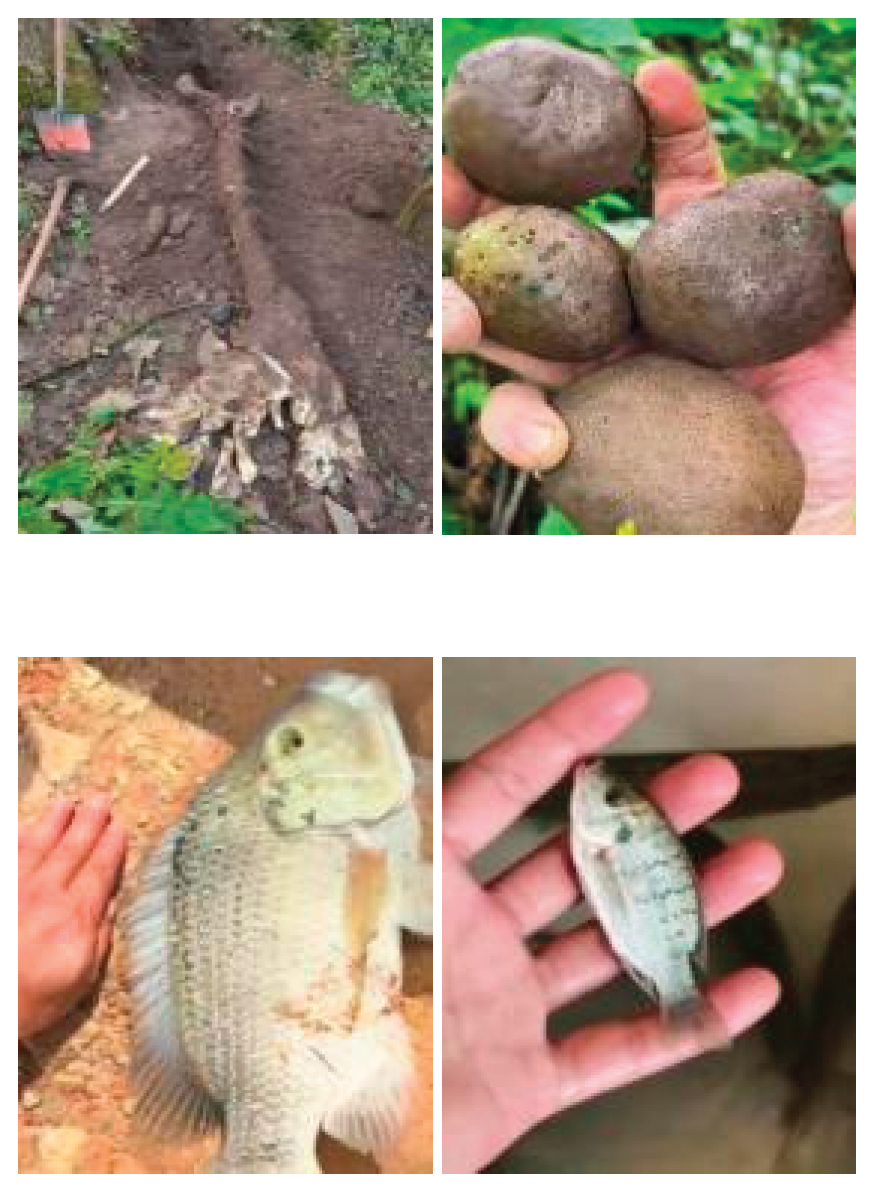
Figure 2.
This is a composite image. The front image of the first photo shows a mother Chinese yam after years of growth, and the back image shows the mother yam at the bulbil stage. The front image of the second photo shows a mother tilapia after years of growth, and the back image shows the mother tilapia at the juvenile stage. The difference in body size between the adult mother and the juvenile represents the increase in yield.
Figure 2.
This is a composite image. The front image of the first photo shows a mother Chinese yam after years of growth, and the back image shows the mother yam at the bulbil stage. The front image of the second photo shows a mother tilapia after years of growth, and the back image shows the mother tilapia at the juvenile stage. The difference in body size between the adult mother and the juvenile represents the increase in yield.
Powerful mother plants mean it can produce more people. This can be understood as farmers investing and owning equity in the company. The difference obtained by subtracting the weight of the bulbils from the weight of the mother tuber is equity appreciation, and the bulbils are equity dividends. Added value can only be obtained when the mother tuber is sold, but the fruits can be obtained year after year. If everyone had a plant company, how abundant the food would be. More food for humans means more humans can be born. The only regret is that terrestrial animals such as guinea pigs cannot continue to grow after reproduction like fish—they can only grow slightly. Only fish can continue to grow extensively after reproduction, with their body size increasing dozens of times, providing abundant nutrition for humans. Perennial and social species all have imperfect endogenous characteristics, which are both complementary and contradictory to industrial products. Humans can use their endogeneity to make up for the defects in human reproduction caused by the industrial products society. This can reduce the population aging, labor shortage, medical burden, shrinking consumption, and weakened innovation capacity caused by difficulties in population reproduction.
The Value of Perennial Agriculture for Dual Reproduction
(1) This model, akin to people owning a plant company and gaining steady dividends, enables one-time labor for multi-year harvests and frees human resources for family life. Perennial species reshape the labor structure fundamentally: chayote yields for over a decade, giant yam beans and air potatoes for nearly 20 years, and other perennial vegetables and root crops for many years after a single planting, slashing repetitive farming and freeing time for family building, caregiving and health maintenance, thus boosting the quality and willingness of human self-reproduction. Their storability and continuous supply provide solid household material security—the bedrock of fertility willingness: staples like chayote and yam have long shelf lives, fruits and vegetables enable cross-season supply, and aquatic and livestock species offer steady animal protein, building a low-cost self-sufficient food system that eases survival anxiety and secures the younger generation’s growth environment. Moreover, the system’s low input, self-circulation and easy management lighten household burdens greatly: salt-containing plants reduce added salt reliance, filter-feeding fish purify water and reproduce naturally, male tilapia and catfish raise fry independently, and guinea pigs, yuanbao pigeons and hens reproduce and rear offspring with natural parental care. This closed-loop system cuts living costs via ecological circulation, supports ordinary families’ daily self-sufficiency and relieves the economic pressure of raising offspring.
(2) From the perspective of plant tools, perennial agriculture uses fast-growing climbing vines to suppress weeds and reduce labor, freeing up human resources. It combines insect-repellent plants and functional plants such as bamboo to help crops resist diseases, pests and natural risks, enhancing the stability and resilience of the whole system. Simple tools like bamboo trellises and bricks further amplify plant growth advantages, ensuring stable supply and increased yields. Relying on moso bamboo and similar plants to make agricultural facilities on-site also cuts input costs. Additionally, the longevity and nutrient accumulation traits of plant tools enable long-term agricultural output, matching the needs of human reproduction. Through the synergy of their biological characteristics and simple carriers, these tools make agricultural reproduction low-labor, low-input and sustainable, continuously releasing various resources for human reproduction and serving as a key technical link connecting the two types of reproduction.
(3) Based on the growth pattern of some perennial plants—the longer their lifespan, the larger their tubers and the higher their yield—a diversified species lifespan table and systematic resource table together form a complete species selection system that provides scientific guidance for the coordinated development of agricultural production and human reproduction. Equipped with a dedicated species list that clearly states the lifespan, product storage time, and cultivation points of various perennial crops and self-reproducing animals, it not only enriches species diversity but also enables more people to understand and utilize perennial plants, greatly expanding human choices so that families can properly select, match and invest according to their needs and environmental conditions. With the lifespan table, the rhythm of planting and investment can be accurately planned to align the increasing yield of perennial plants with the material needs of family raising and intergenerational development, thus realizing the synchronous improvement of agricultural output and family development. Meanwhile, based on the lifespan-yield cycle, species with different growth rhythms are integrated to build a hierarchical yield system, ensuring long-term stable agricultural supply and laying a sustainable and diversified material foundation for human reproduction.
Conclusions
Using longevity animals and plants to enhance agricultural reproductive capacity is not only a transformation of agricultural production methods, but also a profound support for human self-reproduction. Combinations of perennial, self-reproducing, easy-to-manage, and storable species can achieve one-time labor and continuous harvests, freeing people from intensive repetitive work and providing time, energy, and material security for family nurturing, child development, and intergenerational continuity. More long-lived species should be developed in the future to improve production efficiency. By constructing a synergistic system where agricultural reproduction and human self-reproduction promote each other, multiple goals of food security, family stability, and sustainable social development can be achieved. This model is quite bold, but the model compensates for certain social deficiencies by extending species lifespan, supports sustainable populations through perpetual production, and provides an important path for future economic development, livelihood security, and the continuation of civilization.
References
- DeHaan, LR; Van Tassel, DL; Cox, TS. Perennial grain crops: A synthesis of ecology and plant breeding. Renewable Agriculture and Food Systems 2005, 20(1), 5–14. [Google Scholar] [CrossRef]
- Gill, M S; Singh, J P; Gangwa, K S. Integrated farming system and agriculture sustainability[J]. Indian Journal of Agronomy 2009, 54(2), 128–139. [Google Scholar] [CrossRef]
- Toensmeier, E, & Ferguson. Perennial Agriculture Now: A Global Review of Existing Perennial Staple Crops By Climate Region and Nutrient Profile[C]//ASA, CSSA and SSSA International Annual Meetings (2014); ASA-CSSA-SSSA, 2014. [Google Scholar]
- Sheikh, M M; Riar, T S; Pervez, A K M. Integrated farming systems: A review of farmers friendly approaches[J]. Asian Journal of Agricultural Extension, Economics & Sociology 2021, 39(4), 88–99. [Google Scholar]
- The Strong Perennial Vision: A Review and a Response. Agroecology and Sustainable Food Systems 39(5), 469–470. [CrossRef]
- Mollison, B; Holmgren, D. Perma-culture one. A perennial agriculture for human settlements[M]; 1978. [Google Scholar]
- Vaesen, Krist; et al. Reply to Henrich et al.: The Tasmanian effect and other red herrings. Proceedings of the National Academy of Sciences 2016, 113.44, E6726–E6727. [Google Scholar] [CrossRef] [PubMed]
Disclaimer/Publisher’s Note: The statements, opinions and data contained in all publications are solely those of the individual author(s) and contributor(s) and not of MDPI and/or the editor(s). MDPI and/or the editor(s) disclaim responsibility for any injury to people or property resulting from any ideas, methods, instructions or products referred to in the content. |
© 2026 by the authors. Licensee MDPI, Basel, Switzerland. This article is an open access article distributed under the terms and conditions of the Creative Commons Attribution (CC BY) license (http://creativecommons.org/licenses/by/4.0/).
Copyright: This open access article is published under a Creative Commons CC BY 4.0 license, which permit the free download, distribution, and reuse, provided that the author and preprint are cited in any reuse.