

Submitted:
03 March 2026
Posted:
17 March 2026
You are already at the latest version
Abstract
The traditional Japanese dietary pattern, characterized by extremely low fat intake (<15% of energy), has long been regarded as a paradigm of healthy eating. Paradoxically, Japan remains one of the developed countries with the highest gastric cancer incidence globally. Current explanations focusing on high salt intake and Helicobacter pylori infection fail to fully account for this elevated risk. We propose a novel hypothesis: long-term extreme low-fat diet is an independent synergistic risk factor for gastric diseases in Japan. Chronic inadequate dietary fat intake impairs gastrointestinal mucosal barrier integrity through multiple mechanisms—reduced phospholipid synthesis, diminished prostaglandin E2 production, and disrupted gut microbiota homeostasis. This compromised mucosal barrier creates a "vulnerable state" that amplifies the damaging effects of established risk factors such as high salt consumption and H. pylori infection. Supporting evidence includes: (1) animal studies demonstrating that essential fatty acid deficiency impairs gastric mucosal protection and increases susceptibility to injury; (2) the Japan Collaborative Cohort Study showing that a western-style breakfast pattern, characterized by higher fat intake, was significantly associated with lower stomach cancer risk in males (HR 0.49, 95% CI 0.35–0.70) compared with a traditional Japanese-style breakfast; (3) temporal trends showing that increased fat consumption in Japan over 50 years correlates inversely with declining gastric cancer mortality, though concurrent lifestyle changes preclude causal attribution. This hypothesis provides a mechanistic explanation for the Japanese diet paradox and suggests that dietary fat optimization (20–30% of energy) should be considered as a complementary gastric cancer prevention strategy.
Keywords:
extreme low-fat diet
; gastrointestinal mucosal barrier
; gastric cancer
; Japanese dietary pattern
; synergistic risk factor
; prostaglandin E2
1. Introduction
According to GLOBOCAN 2020, Japan’s age-standardized gastric cancer incidence rate reaches 27.5 per 100,000, ranking first among developed countries—far exceeding rates in Western nations (United States: 5.6/100,000; Germany: 7.8/100,000) [2]. This elevated risk persists despite Japan’s advanced healthcare system and globally admired dietary culture.
Concurrently, the traditional Japanese diet has been extensively promoted as a model of healthy eating, associated with the world’s highest life expectancy [3]. A core characteristic of this dietary pattern is extremely low fat intake: traditional Japanese residents consumed less than 10g of cooking oil daily, with fat providing less than 15% of total energy—substantially below the 20–30% range recommended by most international dietary guidelines [4,5].
This creates a striking epidemiological contradiction: a population following an ostensibly “healthy low-fat diet” experiences the highest gastric cancer rates among developed nations.
1.1. Limitations of Current Explanations
The prevailing explanations for Japan’s high gastric cancer incidence focus on high salt intake [6] and Helicobacter pylori infection [7]. However, these explanations face significant challenges:
- 1.
- 2.
- The African/Asian enigma: High H. pylori prevalence does not uniformly predict high gastric cancer rates. This phenomenon—originally described for sub-Saharan Africa [10]—is similarly observed in South and Southeast Asian populations (e.g., India, Bangladesh), where H. pylori seroprevalence exceeds 70% yet gastric cancer incidence remains low.
- 3.
- Residual risk: Despite declining prevalence of known risk factors, gastric cancer incidence in Japan remains higher than in Western countries, suggesting the involvement of additional, underrecognized factors [11].
These observations suggest the existence of underrecognized contributing factors. Notably, no prior hypothesis has systematically examined whether the low-fat character of the Japanese diet itself—long assumed to be purely protective—might constitute a vulnerability modifier.
2. The Hypothesis
We propose the following hypothesis:
Long-term extreme low-fat dietary intake (<15% of energy from fat) is an independent synergistic risk factor for gastric diseases. Chronic insufficient dietary fat impairs gastrointestinal mucosal barrier integrity and diminishes mucosal defense and repair capacity, thereby amplifying the damaging effects of established risk factors (high salt, H. pylori infection) and contributing to elevated gastric disease incidence.
This hypothesis does not suggest that low-fat diet directly causes gastric cancer. Rather, it proposes that extreme low-fat intake creates a state of mucosal vulnerability that magnifies the effects of other carcinogenic factors—a synergistic relationship that explains why Japanese populations experience higher gastric cancer rates despite similar or lower exposure to individual risk factors compared to some other populations.
3. Evaluation of the Hypothesis
3.1. Mechanistic Basis: Dietary Fat and Mucosal Barrier Integrity
The gastrointestinal mucosal barrier comprises multiple defensive layers: the mucus-bicarbonate layer, epithelial cell layer with tight junctions, and underlying lamina propria [12]. Dietary fat contributes to barrier integrity through several interconnected mechanisms.
A conceptual clarification is warranted before reviewing the evidence. The mechanistic literature distinguishes between two nutritional states: (i) essential fatty acid (EFA) deficiency, a clinical condition arising from severely inadequate intake of linoleic and -linolenic acids (typically <0.5% of energy), and (ii) extreme low-fat diet, defined here as fat providing <15% of total energy. These are not equivalent. A diet supplying 15% energy as fat (∼33g/day for a 2000 kcal diet) can meet EFA requirements (approximately 2–4g/day linoleic acid), but may still deliver suboptimal substrate for phospholipid turnover and prostaglandin synthesis in tissues with high metabolic demands such as the gastric epithelium. The experimental models cited below predominantly employed frank EFA-deficient diets in animals; their relevance to the chronic, moderate fat restriction characteristic of traditional Japanese dietary patterns is plausible but should not be assumed equivalent. Wherever possible, this distinction is noted.
3.1.1. Phospholipid Membrane and Mucus Layer
Essential fatty acids—linoleic acid and -linolenic acid—are obligate components of cell membrane phospholipids. Gastric epithelial cells have high turnover rates (complete renewal every 3–5 days), requiring continuous phospholipid supply [13].
Phosphatidylcholine, the predominant phospholipid in gastrointestinal mucus, forms a hydrophobic barrier on the mucosal surface that resists acid and pepsin penetration [14,15]. Animal studies demonstrate that dietary fat composition significantly modulates intestinal tight junction integrity and epithelial permeability [16], while essential fatty acid deficiency impairs mucosal barrier function [17].
3.1.2. Prostaglandin-Mediated Protection
Prostaglandin E2 (PGE2) is a central mediator of gastric mucosal defense, stimulating mucus and bicarbonate secretion, enhancing mucosal blood flow, and promoting epithelial repair [18]. PGE2 synthesis requires arachidonic acid, which derives from dietary linoleic acid [19].
Konturek et al. demonstrated that dietary fat restriction significantly reduces gastric mucosal PGE2 levels, with corresponding decreases in mucus secretion and mucosal blood flow [20]. Animal studies have consistently shown that essential fatty acid deficiency impairs prostaglandin-dependent gastroprotection [21].
3.1.3. Gut Microbiota-Mucosal Barrier Axis
The relationship between dietary fat and gut microbial composition is bidirectional. A systematic review synthesizing 44 human dietary intervention studies documented that dietary fat quantity and quality substantially shape microbiota composition [22]; while this review primarily characterized the effects of high-fat diets, it also noted that very low-fat diets are associated with reduced abundance of fat-dependent commensal species, including Faecalibacterium prausnitzii and Akkermansia muciniphila. These bacteria are essential for short-chain fatty acid (SCFA) production and mucus layer maintenance. The mechanistic inference that extreme fat restriction specifically depletes these taxa is consistent with the review’s findings, though direct human evidence from chronic low-fat dietary interventions remains limited.
SCFAs, particularly butyrate, upregulate tight junction protein expression and stimulate mucin secretion [23,24]. Reduced SCFA production compromises epithelial barrier function throughout the gastrointestinal tract. It is worth noting that the gastric microbiome differs substantially from the colonic microbiome in composition and SCFA contribution; the mucosal barrier effects described above are most directly established for the intestinal epithelium, with extrapolation to the gastric mucosa requiring further direct investigation.
3.2. Experimental and Biomarker Evidence
Multiple experimental studies support the hypothesis:
Essential fatty acid deficiency models: Hollander and Tarnawski reviewed evidence that essential fatty acid-deficient diets impair gastric mucosal protection, with animal studies demonstrating reduced prostaglandin synthesis, spontaneous mucosal injury, and delayed healing [17]. The authors concluded that dietary linoleic and arachidonic acids play a key role in mucosal defense through prostaglandin-dependent cytoprotective pathways.
Dietary linoleic acid studies: Schepp et al. demonstrated that dietary linoleic acid modulates gastric mucosal PGE2 release and protects against stress-induced mucosal damage in rats [21]. Diets deficient in essential fatty acids resulted in impaired gastroprotection, which was reversed by linoleic acid supplementation.
Synergistic dietary effects: The concept of dietary factor interactions in gastric mucosal injury is further supported by population-level biomarker studies. Tsugane et al. demonstrated that biological markers of stomach cancer risk are influenced by multiple dietary factors acting in combination [25], consistent with the hypothesis that inadequate fat intake may exacerbate injury from other dietary aggressors such as high salt.
3.3. Epidemiological Evidence: Japanese Cohort Studies
Large-scale Japanese cohort studies provide robust epidemiological evidence.
The Japan Collaborative Cohort (JACC) Study, which followed approximately 110,792 Japanese adults aged 40–79 years, examined dietary patterns and stomach cancer mortality [1]. The study identified that a western-style breakfast—characterized by higher fat intake—was significantly associated with lower stomach cancer risk in males (HR 0.49, 95% CI 0.35–0.70), whereas a traditional Japanese-style breakfast showed a non-significant trend toward increased risk (HR 1.30, 95% CI 0.98–1.72). These findings are consistent with the hypothesis that dietary patterns incorporating higher fat intake may reduce gastric cancer risk, though the study’s food frequency questionnaire assessed dietary patterns rather than absolute macronutrient intake quintiles.
3.4. Temporal Trends
- Mean daily dietary fat intake increased from ∼10g to ∼55g between 1950–2010
- Fat as percentage of energy increased from ∼8% to ∼27%
- Age-standardized gastric cancer mortality decreased from 80.7 to 24.8 per 100,000 in men
During the same period, salt intake decreased by only ∼30%—an important but quantitatively insufficient change to account for the magnitude of gastric cancer decline. While these temporal trends are consistent with a protective role for dietary fat, the concurrent changes in multiple lifestyle factors (increased refrigeration, antibiotic use, H. pylori eradication campaigns, improved endoscopic screening) preclude attribution to fat intake alone; the temporal co-occurrence should be interpreted as hypothesis-generating rather than causal [26]. The key inferential point is that salt reduction alone cannot explain the full extent of declining mortality, leaving room for additional explanatory variables including increased fat intake.
3.5. International Comparative Evidence
Cross-national comparisons support dietary fat’s role in gastric cancer epidemiology. Gastric cancer incidence data are drawn from GLOBOCAN 2020 [2] and Bertuccio et al. [27]; national dietary fat intake estimates are from FAO Food Balance Sheets and national nutrition surveys [4]. These sources consistently show an inverse ecological relationship between population-level fat consumption and gastric cancer rates (Table 1).
These ecological data suggest a broad inverse trend between national dietary fat intake and gastric cancer rates among Western countries, though such cross-national comparisons must be interpreted cautiously due to substantial confounding. Notably, South Korea presents a partial challenge to a simple fat-protective interpretation: despite higher fat intake (∼22% energy) than the traditional Japanese diet, Korea maintains the highest gastric cancer ASR (32.1/100,000) in the table. This pattern likely reflects the particularly high prevalence of H. pylori virulent strains (CagA-positive) and high-salt fermented food consumption in Korea [6,7], illustrating that dietary fat is best understood as one modifying factor within a multifactorial model rather than a dominant determinant.
Migration studies of Japanese-Americans in Hawaii showed that gastric cancer rates declined across generations as dietary fat intake increased with acculturation [28].
3.6. The Synergistic Mechanism
The hypothesis proposes that extreme low-fat diet amplifies traditional risk factors rather than acting independently (Figure 1).
Amplification of high-salt injury: With thinner mucus layer and reduced phospholipid barrier, salt penetrates more rapidly to the epithelial surface. PGE2-dependent repair mechanisms are compromised, so salt-induced injuries persist longer. The biological plausibility of this synergistic effect is supported by the established roles of both dietary fat (in mucosal defense) and salt (in mucosal injury) [6,18].
EnhancedH. pyloripathogenicity: Compromised mucosal barriers facilitate H. pylori colonization and virulence factor delivery. The intact mucus layer and phospholipid barrier normally impede bacterial adhesion to epithelial cells [15]. When these defenses are weakened by inadequate dietary fat, H. pylori may colonize more effectively and exert greater pathogenic effects.
Cumulative damage: The prolonged course of gastric carcinogenesis (20–30 years) allows small differences in mucosal protection to compound over time, significantly increasing progression through the atrophic gastritis → intestinal metaplasia → dysplasia → carcinoma sequence [29].
4. Consequences of the Hypothesis and Discussion
4.1. Resolving the Japanese Diet Paradox
The hypothesis resolves the apparent contradiction between Japan’s “healthy” low-fat diet and high gastric cancer rates by recognizing that:
- 1.
- The traditional Japanese diet is not uniformly healthy; its extreme low-fat characteristic creates a specific vulnerability
- 2.
- The same dietary pattern carries both benefits (low saturated fat, high fish) and risks (extreme low total fat, high salt)
- 3.
- Net health outcomes depend on the balance of these factors and their interactions
Modern Japanese dietary patterns, with increased fat intake while maintaining other healthy characteristics, may represent an optimization that preserves cardiovascular benefits while reducing gastric cancer risk.
4.2. Implications for Dietary Guidelines
Current dietary guidelines appropriately emphasize reducing excessive fat intake for cardiovascular health. However, our hypothesis suggests guidelines should also caution against extreme fat restriction:
- Recommended range: Fat intake of 20–30% of total energy balances cardiovascular and gastrointestinal health
- Minimum threshold: Fat intake below 15% of energy for extended periods may carry gastrointestinal health risks
- Fat quality: Emphasis on unsaturated fats provides cardiovascular benefits while maintaining mucosal protection
4.3. Implications for Gastric Cancer Prevention
Current gastric cancer prevention focuses on H. pylori eradication, salt reduction, and smoking cessation. Our hypothesis suggests adding dietary fat optimization as a complementary strategy, particularly for individuals with other risk factors.
Clinicians counseling patients with or at risk for gastric diseases should:
- Assess dietary fat intake as part of nutritional evaluation
- Avoid recommending extreme low-fat diets for patients with chronic gastritis
- Consider n-3 PUFA supplementation in patients with inadequate intake
4.4. Limitations and Future Research
The evidence reviewed is predominantly observational, precluding definitive causal inference. Key limitations include:
- Lack of randomized controlled trials with gastric endpoints
- Research paradigm bias (low-fat diets historically assumed healthy)
- Potential residual confounding in epidemiological studies
- Most evidence from Japanese populations
Future research priorities include:
- 1.
- Mechanistic studies: Human mucosal biopsy studies comparing barrier function between extreme low-fat vs. adequate fat consumers
- 2.
- Mendelian randomization: Using genetic variants associated with fat metabolism as instrumental variables
- 3.
- Interaction analyses: Systematic examination of fat × salt and fat × H. pylori interactions in existing cohorts
- 4.
- Intervention trials: Dietary fat optimization in individuals with atrophic gastritis, with histological regression as endpoint
5. Conclusions
We propose that long-term extreme low-fat diet serves as a synergistic risk factor for gastric diseases by impairing mucosal barrier integrity and amplifying the effects of established risk factors. This hypothesis is supported by:
- 1.
- Mechanistic evidence linking dietary fat to mucosal barrier function through phospholipid synthesis, PGE2 production, and gut microbiota
- 2.
- Experimental evidence demonstrating increased mucosal vulnerability with fat restriction
- 3.
- Epidemiological evidence from the JACC Study showing that a higher-fat western-style breakfast pattern is significantly associated with reduced gastric cancer mortality in males (HR 0.49, 95% CI 0.35–0.70)
- 4.
- Temporal trends and international comparisons consistent with a protective role for dietary fat
The hypothesis provides a novel explanation for the Japanese diet paradox and suggests that the assumption “lower fat is always better” requires reconsideration for gastrointestinal health. Dietary fat optimization (20–30% of energy) should be considered as a complementary gastric cancer prevention strategy, particularly in populations with other risk factors.
Funding
This research did not receive any specific grant from funding agencies in the public, commercial, or not-for-profit sectors.
Conflicts of Interest
The author declares no conflicts of interest.
Use of Artificial Intelligence
The author used AI-assisted tools for language editing, grammar checking, and style refinement during the preparation of this manuscript. The hypothesis, analysis, interpretation of literature, and conclusions are entirely the author’s own.
References
- Tokui, N.; Yoshimura, T.; Fujino, Y.; et al. Dietary habits and stomach cancer risk in the JACC Study. Journal of Epidemiology 2005, 15, S98–108.
- Sung, H.; Ferlay, J.; Siegel, R.L.; et al. Global Cancer Statistics 2020: GLOBOCAN estimates of incidence and mortality worldwide for 36 cancers in 185 countries. CA: A Cancer Journal for Clinicians 2021, 71, 209–249.
- Willcox, D.C.; Willcox, B.J.; Todoriki, H.; Suzuki, M. The Okinawan diet: health implications of a low-calorie, nutrient-dense, antioxidant-rich dietary pattern low in glycemic load. Journal of the American College of Nutrition 2009, 28, 500S–516S.
- Ministry of Health, Labour and Welfare, Japan. National Health and Nutrition Survey 2019, 2020.
- Chinese Nutrition Society. Chinese Dietary Guidelines (2022); People’s Medical Publishing House: Beijing, 2022.
- D’Elia, L.; Rossi, G.; Ippolito, R.; Cappuccio, F.P.; Strazzullo, P. Habitual salt intake and risk of gastric cancer: a meta-analysis of prospective studies. Clinical Nutrition 2012, 31, 489–498.
- Uemura, N.; Okamoto, S.; Yamamoto, S.; et al. Helicobacter pylori infection and the development of gastric cancer. New England Journal of Medicine 2001, 345, 784–789.
- Kamada, T.; Haruma, K.; Ito, M.; et al. Time trends in Helicobacter pylori infection and atrophic gastritis over 40 years in Japan. Helicobacter 2015, 20, 192–198.
- Powles, J.; Fahimi, S.; Micha, R.; et al. Global, regional and national sodium intakes in 1990 and 2010: a systematic analysis of 24 h urinary sodium excretion and dietary surveys worldwide. BMJ Open 2013, 3, e003733.
- Holcombe, C. Helicobacter pylori: the African enigma. Gut 1992, 33, 429–431.
- Inoue, M.; Tsugane, S. Epidemiology of gastric cancer in Japan. Postgraduate Medical Journal 2005, 81, 419–424.
- Turner, J.R. Intestinal mucosal barrier function in health and disease. Nature Reviews Immunology 2009, 9, 799–809.
- Papadia, C.; Coruzzi, G.; Montana, C.; et al. Gastrointestinal mucosal injury and repair. In Physiology of the Gastrointestinal Tract, 5th ed.; Johnson, L.R., Ed.; Academic Press, 2012; pp. 1087–1121.
- Hills, B.A.; Butler, B.D.; Lichtenberger, L.M. Gastric mucosal barrier: hydrophobic lining to the lumen of the stomach. American Journal of Physiology 1983, 244, G561–568.
- Lichtenberger, L.M. The hydrophobic barrier properties of gastrointestinal mucus. Annual Review of Physiology 1995, 57, 565–583.
- Kirpich, I.A.; Feng, W.; Wang, Y.; et al. The type of dietary fat modulates intestinal tight junction integrity, gut permeability, and hepatic toll-like receptor expression in a mouse model of alcoholic liver disease. Alcoholism: Clinical and Experimental Research 2012, 36, 835–846.
- Hollander, D.; Tarnawski, A. Is there a role for dietary essential fatty acids in gastroduodenal mucosal protection? Journal of Clinical Gastroenterology 1991, 13, S72–74.
- Wallace, J.L. Prostaglandins, NSAIDs, and gastric mucosal protection: why doesn’t the stomach digest itself? Physiological Reviews 2008, 88, 1547–1565.
- Calder, P.C. Functional roles of fatty acids and their effects on human health. JPEN Journal of Parenteral and Enteral Nutrition 2015, 39, 18S–32S.
- Konturek, S.J.; Brzozowski, T.; Majka, J.; Pytko-Polonczyk, J.; Stachura, J. Implications of essential fatty acid deficiency on stress ulcer and cytoprotection. Journal of Clinical Gastroenterology 1991, 13, S32–43.
- Schepp, W.; Steffen, B.; Ruoff, H.J.; Schusdziarra, V.; Classen, M. Modulation of rat gastric mucosal prostaglandin E2 release by dietary linoleic acid: effects on gastric acid secretion and stress-induced mucosal damage. Gastroenterology 1988, 95, 18–25.
- Wolters, M.; Ahrens, J.; Romaní-Pérez, M.; et al. Dietary fat, the gut microbiota, and metabolic health – A systematic review conducted within the MyNewGut project. Clinical Nutrition 2019, 38, 2504–2520.
- Peng, L.; Li, Z.R.; Green, R.S.; Holzman, I.R.; Lin, J. Butyrate enhances the intestinal barrier by facilitating tight junction assembly via activation of AMP-activated protein kinase in Caco-2 cell monolayers. Journal of Nutrition 2009, 139, 1619–1625.
- Willemsen, L.E.M.; Koetsier, M.A.; van Deventer, S.J.H.; van Tol, E.A.F. Short chain fatty acids stimulate epithelial mucin 2 expression through differential effects on prostaglandin E1 and E2 production by intestinal myofibroblasts. Gut 2003, 52, 1442–1447.
- Tsugane, S.; Tsuda, M.; Gey, F.; Watanabe, S. Cross-sectional study with multiple measurements of biological markers for assessing stomach cancer risks at the population level. Environmental Health Perspectives 1992, 98, 207–210.
- Katanoda, K.; Matsuda, T.; Matsuda, A.; et al. An updated report of the trends in cancer incidence and mortality in Japan. Japanese Journal of Clinical Oncology 2013, 43, 492–507.
- Bertuccio, P.; Chatenoud, L.; Levi, F.; et al. Recent patterns in gastric cancer: a global overview. International Journal of Cancer 2009, 125, 666–673.
- Kolonel, L.N.; Nomura, A.M.Y.; Hirohata, T.; Hankin, J.H.; Hinds, M.W. Association of diet and place of birth with stomach cancer incidence in Hawaii Japanese and Caucasians. American Journal of Clinical Nutrition 1981, 34, 2478–2485.
- Correa, P. A human model of gastric carcinogenesis. Cancer Research 1988, 48, 3554–3560.
Figure 1.
Proposed mechanistic model for synergistic effects of extreme low-fat diet on gastric carcinogenesis.
Figure 1.
Proposed mechanistic model for synergistic effects of extreme low-fat diet on gastric carcinogenesis.
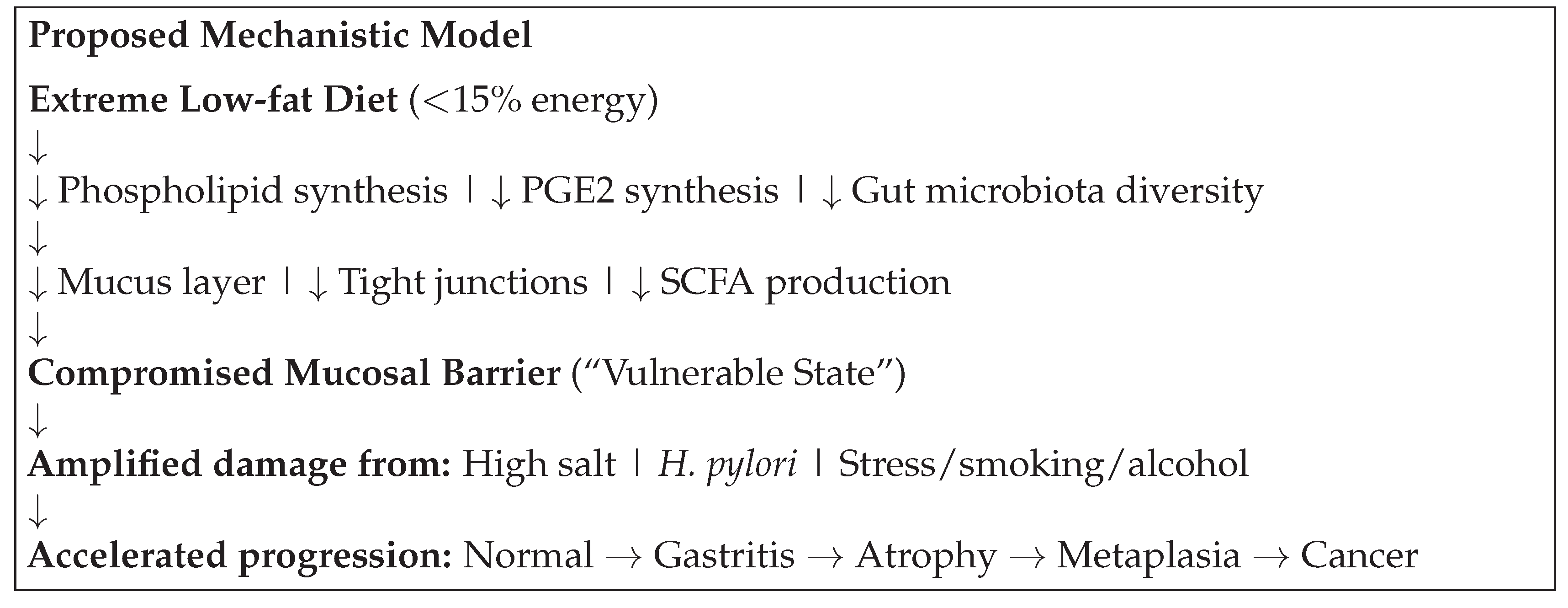

Table 1.
Dietary fat intake and gastric cancer rates in developed countries (ecological data)
| Country | Fat (% energy)a | Gastric cancer ASR (/100,000)b |
|---|---|---|
| Japanc | ∼27 | 27.5 |
| South Korea | ∼22 | 32.1 |
| United States | ∼36 | 5.6 |
| France | ∼40 | 5.8 |
| Germany | ∼38 | 7.8 |
Disclaimer/Publisher’s Note: The statements, opinions and data contained in all publications are solely those of the individual author(s) and contributor(s) and not of MDPI and/or the editor(s). MDPI and/or the editor(s) disclaim responsibility for any injury to people or property resulting from any ideas, methods, instructions or products referred to in the content. |
© 2026 by the authors. Licensee MDPI, Basel, Switzerland. This article is an open access article distributed under the terms and conditions of the Creative Commons Attribution (CC BY) license (http://creativecommons.org/licenses/by/4.0/).
Copyright: This open access article is published under a Creative Commons CC BY 4.0 license, which permit the free download, distribution, and reuse, provided that the author and preprint are cited in any reuse.


