
Submitted:
17 March 2026
Posted:
17 March 2026
You are already at the latest version
Abstract
Background/Objectives: A disadvantage of Descemet stripping automated endothelial keratoplasty (DSAEK) in eyes with prior glaucoma filtration surgery is the difficulty in maintaining air tamponade during the procedure. Herein, we report the use of bleb compressive sutures in managing air tamponade in the anterior chamber during DSAEK in eyes with blebs following trabeculectomy. Methods: This retrospective case series included 34 eyes of 33 patients that developed bullous keratopathy following trabeculectomy. Bleb compression suturing was performed using a10-0 nylon suture in eyes with an intraocular pressure (IOP) < 10 mmHg or a fragile ischemic bleb. Postoperative IOP, air ingress into the bleb, rebubbling, bleb leakage, and bleb damage were evaluated. Results: Of the 34 eyes, 13 underwent bleb compression suturing before DSAEK (suture group), whereas 21 eyes did not (non-suture group). Mean preoperative IOP was lower in the suture group than in the non-suture group, whereas postoperative IOP at 2 h was similar. Preoperative to 2-h postoperative IOP increased by 18±9.3 and 11.7±3.1 mmHg in the suture and non-suture groups, respectively, with no significant differences. At 2-h postoperatively, two eyes in the suture group and one eye in the non-suture group exhibited an IOP spike (≥30 mmHg). One eye in the non-suture group required rebubbling owing to air ingress into the bleb. Postoperatively (1–2 weeks), the mean IOP was 7.1±3.2 and 9.4±4.6 mmHg in the suture and non-suture groups, respectively. Preoperative and postoperative IOP did not significantly differ in either group. No suture-related complications were observed. Conclusion: In DSAEK for eyes with bleb, bleb compression suturing provides effective air tamponade during graft adhesion.
Keywords:
DSAEK
; glaucoma filtration surgery
; air tamponade
; graft dislocation
; bleb leak
; bleb damage
1. Introduction
Bullous keratopathy (BK) is a serious surgical complication that occurs following glaucoma surgery, including trabeculectomy and glaucoma drainage device implantation [1]. Descemet stripping endothelial keratoplasty (DSAEK) has emerged as a viable technique for BK following glaucoma filtering surgery [2,3,4]. However, prior glaucoma filtering surgery represents a significant risk factor for graft failure [4,5,6,7,8,9]. Multiple factors contribute to graft failures: altered anatomy of the anterior chamber, difficulty in maintaining air tamponade during and in the immediate postoperative period in the immediate postoperative period [6,9]., chronic subclinical inflammation due to disruption in the blood-aqueous barrier, and persistent direct communications between the anterior chambers [10]. Moreover, Goshe et al. reported that graft dislocation is closely linked to the presence of postoperative hypotony [11]. Notably, maintaining sufficiently high intraocular pressure (IOP) during the early postoperative period is crucial for ensuring the proper adhesion of the implanted graft to the stroma [11,12,13,14]. This is particularly challenging in eyes with previous trabeculectomy, as they often exhibit low IOP or hypotony due to overfiltration and/or compromised ciliary body function [15].
In the present report, we demonstrate the use of bleb compressive bridging sutures to obtain adequate IOP during DSAEK in patients with blebs following trabeculectomy. We encountered cases in which achieving anterior chamber air filling in eyes with filtering blebs was challenging. Therefore, we instituted a protocol of placing bleb compressive bridging sutures in eyes with blebs to prevent air from escaping from the anterior chamber into the bleb.
2. Materials and Methods
The study protocol was approved by the Nagata Eye Clinic Institutional Review Board (#2025-003) and adhered to the tenets of the Declaration of Helsinki. Written informed consent was obtained from all patients.
A retrospective chart review was conducted for all consecutive patients who underwent DSAEK for BK in glaucomatous eyes with previous trabeculectomy between February 2014 and May 2025 at the Nagata Eye Clinic. All eyes with prior trabeculectomies were identified and designated for this analysis. Patients with less than six months of follow-up after DSAEK were excluded from the study.
2.1. Surgical Procedures and Postoperative Management
All DSEAK procedures were performed by two experienced surgeons (KAS and SK), and bleb compressive suturing was performed by two glaucoma specialists (NT and SK).
The general surgical technique was based on the currently accepted standard practice of peripheral iridectomy in the inferior part of the iris. Compressive bridging mattress sutures were placed on the bleb in eyes with an IOP of less than 10 mmHg or in the presence of a fragile cystic ischemic bleb prior to starting DSAEK. For bleb compressive sutures, a 10-0 nylon suture was passed through the conjunctiva and episclera to compress the bleb surface toward the underlying sclera. One or two mattress sutures were placed.
The design, location, and number of compressive sutures of 10-0 nylon were determined according to the bleb morphology (Figure 1). In some cases, sutures were placed adjacent to the trabeculectomy filter (sclerostomy area) to compress the bleb locally (Figure 1A), whereas in others, compressive sutures were placed to compress the entire fragile ischemic bleb (Figure 1B). IOP was measured at 2 h postoperatively to confirm that pupillary block had not occurred. The topical steroid dose was gradually tapered down from 4 times to once daily over a period of 4–6 months. Topical glaucoma medication was resumed postoperatively as needed. No air removal was attempted in any case.
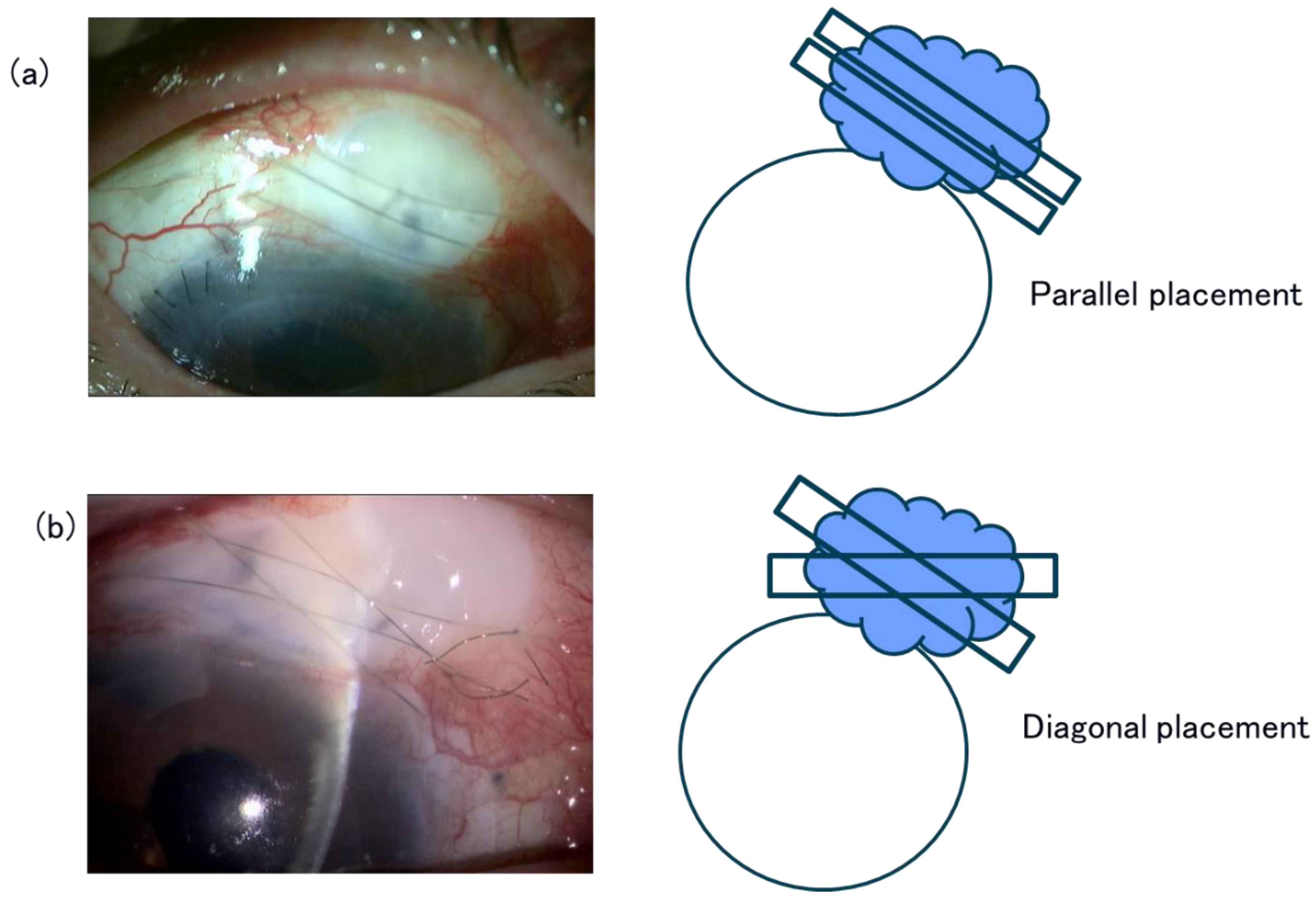
Figure 2.
Slit lamp photographs and schematic images of bleb compressive10-0 nylon sutures for a fragile ischemic bleb. Compressive bridging sutures were placed to compress the entire ischemic thin bleb. Special care is required to avoid bleb injury due to fragile ischemic blebs during suturing. (a) Two compressive mattress sutures are placed parallel to the horizontal boundary of the bleb. (b) Two compressive mattress sutures were placed diagonally over the horizontal boundary of the bleb.
Figure 2.
Slit lamp photographs and schematic images of bleb compressive10-0 nylon sutures for a fragile ischemic bleb. Compressive bridging sutures were placed to compress the entire ischemic thin bleb. Special care is required to avoid bleb injury due to fragile ischemic blebs during suturing. (a) Two compressive mattress sutures are placed parallel to the horizontal boundary of the bleb. (b) Two compressive mattress sutures were placed diagonally over the horizontal boundary of the bleb.
2.2. Data Collection and Analysis
Postoperative demographics, ocular history, previous surgery, glaucoma history, intraoperative and postoperative outcomes, and surgical complications, including air ingress into the bleb, air rebubbling, bleb leak, bleb rupture, and bleb-related infection, were retrospectively reviewed from the patient charts. A paired t-test was used for preoperative and postoperative comparisons of IOP. Differences between the groups were assessed using the Mann–Whitney U test or Fisher’s exact test, as appropriate. IOP was measured using a rebound tonometer (iCare; Tiolat Oy, Espoo, Finland) or a Goldmann applanation tonometer (Haag-Streit, Köniz, Switzerland). Data were analyzed using the StatMate V software (AtmsCorp, Tokyo, Japan). Statistical significance was set at p < 0.05.
3. Results
The study group comprised 34 eyes of 33 patients. These patients included 28 men and 5 women. The mean age at the time of DSAEK was 72.5 ± 9.2 years. All 34 eyes were pseudophakic, and bleb compressive bridging sutures were placed in 13 eyes (suture group), whereas the remaining 21 eyes did not receive sutures (non-suture group). The mean follow-up period after DSAEK was 32 ± 28 months. The IOP was controlled with or without glaucoma medication in all eyes prior to DSAEK.
3.1. Postoperative IOP at the Acute (2 H After DSAEK) and Chronic Phases (a Few Weeks After DSAEK)
In 14 eyes, with 7 eyes each in each group, postoperative IOP was measured 2 h after DSAEK. While the mean preoperative IOP was 8.4 ± 3.0mmHg in the suture group and 11.9± 3.6 mmHg in the non-suture group, postoperative IOP 2 h after DSAEK revealed a mean of 26.1 ± 8.5 mmHg (11–36 mmHg) in the suture group and 25.0 ± 3.5 mmHg (21–31 mmHg) in the non-suture group. The mean IOP increase from the preoperative phase to 2 h postoperatively was 18 ± 9.3 mmHg in the suture group and 11.7 ± 3.1 mmHg in the non-suture group. Although the mean IOP increase tended to be greater in the suture group, this difference between the groups was not statistically significant (p = 0.26). Moreover, while the preoperative IOP was lower in the suture group than in the non-suture group, the magnitude of postoperative IOP elevation did not significantly differ between the groups.
An IOP spike ≥30 mmHg occurred in two eyes in the suture group and one eye in the non-suture group, with no significant difference between the groups. No postoperative pupillary block was observed, and the IOP decreased to below 20 mmHg by postoperative day 1 in all cases. Furthermore, the mean postoperative IOP at 1–2 weeks following DSAEK was 7.1 ± 3.2 mmHg in the suture group and 9.4 ± 4.6 mmHg in the non-suture group, indicating no statistically significant difference between preoperative and postoperative IOP. Notably, none of the eyes exhibited IOP instability during the postoperative follow-up, and no patient required new glaucoma medications for IOP control.
3.2. Air Ingress into the Filtration Bleb
Air ingress into the filtration bleb was observed only in one eye in the non-suture group.
3.3. Air Rebubbling
Rebubbling was required in four eyes (two eyes each in each group) and resulted in successful graft reattachment. Among these four eyes, one exhibited air ingress into the bleb during DSAEK. The incidence of rebubbling did not significantly differ between the two groups (p = 0.5)
3.3. Intraoperative Complications
No significant intraoperative complications, such as posterior dislocation of the donor DSAEK button, intraocular hemorrhage, suprachoroidal hemorrhage, bleb leak, bleb rupture, or bleb-related infection, occurred.
3.4. Removal of Compressive Sutures
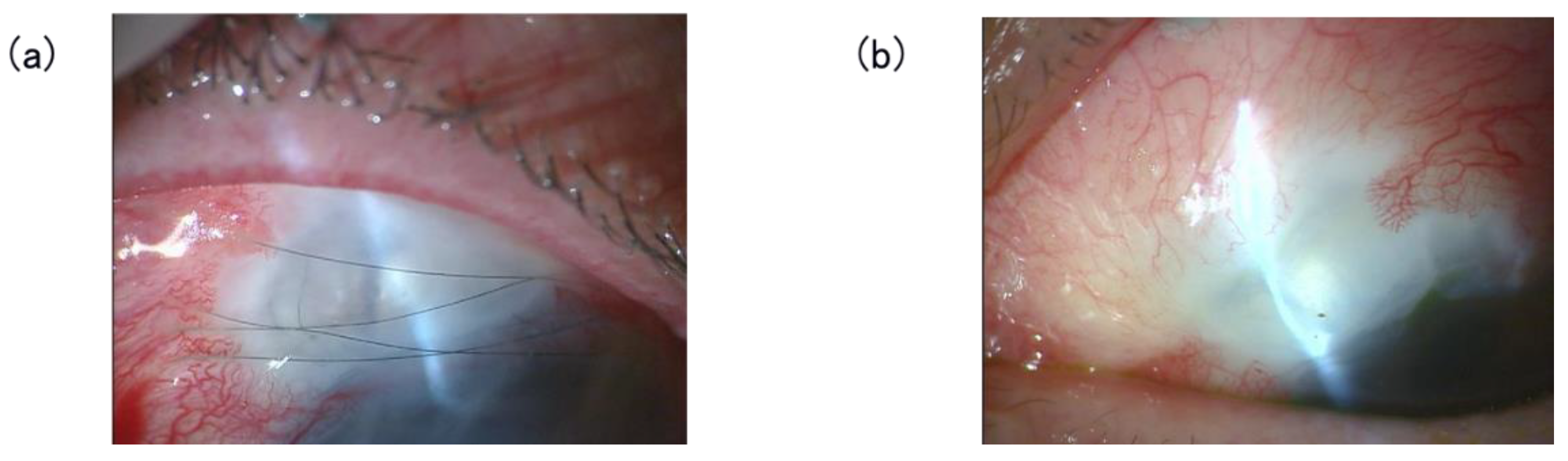
Suture removal was performed in cases where suture loosening or a tendency to embed into the bleb was observed (6/13 eyes). In both suture removal and retention cases, no suture-related complications, including IOP instability, aqueous humor leakage from the bleb, bleb damage, or bleb-related infections, were observed (Figure 3).
4. Discussion
Prior glaucoma filtering surgery is associated with an increased risk of postoperative graft detachment after DSAEK [6,11,12]. This may be attributed to the presence of a filtering bleb which reduces the IOP. Low IOP which allows fluid to enter the graft interface leads to graft detachment [12,13]. We encountered similar situations in which it was difficult to achieve firm anterior chamber air filling in eyes with filtering blebs. Therefore, in the present study, we report the use of bleb compressive bridging sutures to maintain adequate IOP during DSAEK in patients with prior trabeculectomy.
Maintaining adequately high IOP during and immediately after surgery is essential for graft attachment [12,13,14]. In eyes with blebs, aqueous humor and air in the anterior chamber may readily escape into the filtering bleb. Therefore, several surgical approaches to maintain IOP during the early postoperative period in patients undergoing DSAEK with prior filtering surgery have been reported. For example, Banitt et al. achieved this by injecting air into the anterior chamber until the subconjunctival space was filled [12]. Moreover, Oyakawa et al. injected ophthalmic viscoelastic devices into the filtering bleb to achieve as [11,14], sufficiently high IOP following DSAEK [13]. However, as blebs often become thin and fragile following antimetabolite use, any surgical procedure may increase the risk of bleb damage. Notably, bleb leakage and rupture are recognized as surgical complications in DSAEK [11,14]. Large-volume air injection increases the risk of barotrauma of the avascular bleb, potentially leading to bleb dysfunction [11]. Despite additional bleb suturing, bleb leakage and associated hypotony remain common complications following trabeculectomy [15]. Therefore, compression suturing should be performed with strategic and careful consideration of the suture placement site. In the present study, our approach to determine the suture site was as follows: in non-ischemic blebs, compressive sutures were placed adjacent to the trabeculectomy filter (sclerostomy area) to compress the bleb whereas in eyes with ischemic and fragile blebs, compressive sutures were placed to compress the entire fragile ischemic bleb. Overall, given the fragility of these blebs, it is crucial to avoid bleb injuries due to suture needles.
Bleb compression suturing has been applied in cases of persistent hypotony or bleb leakage following glaucoma filtration surgery [16,17]. This technique can help maintain complete air filling of the anterior chamber, resulting in a temporary increase in IOP and protection of the filtration bleb from barotrauma. In the present study, IOP was significantly higher 2 h postoperatively than preoperatively in the suture group (26.1 ± 8.5 mmHg; range 11–36 mmHg; p = 0.004). These findings suggest that bleb compression suturing provides effective air tamponade during the critical period of graft adhesion. Notably, this technique offers the advantage of requiring no specialized surgical instruments and broad applicability to eyes with a history of filtration surgery. However, extreme caution must be exercised when placing compression sutures in eyes with thin and/or fragile ischemic blebs to avoid bleb damage.
This study has certain limitations, including its retrospective design, small sample size, and lack of standardization for compression suturing and suture removal.
In conclusion, this report demonstrates the effectiveness of compressive bridging sutures on the bleb in achieving an adequate IOP during DSAEK in eyes with a history of trabeculectomy. This technique appears to be safe and effective for eyes with blebs undergoing DSAEK, warranting further prospective studies.
Author Contributions
Conceptualization, K.A.-S. and N.T.; methodology, K.A.-S. and S.K.; data curation, N.T.; writing—original draft preparation, N.T.; writing—review and editing, K.A.-S. and H.K. All authors have read and agreed to the published version of the manuscript.
Funding
This research received no external funding.
Institutional Review Board Statement
The study protocol was approved by the Nagata Eye Clinic Institutional Review Board (#2025-003) and adhered to the tenets of the Declaration of Helsinki.
Informed Consent Statement
Written informed consent has been obtained from the patients to publish this paper.
Data Availability Statement
No new data were created or analyzed in this study. Data sharing is not applicable in the study.
Acknowledgments
None.
Conflicts of Interest
The authors declare no conflicts of interest.
Abbreviations
The following abbreviations are used in this manuscript:
| DSAEK | Descemet stripping automated endothelial keratoplasty |
| BK | Bullous keratopathy |
| IOP | Intraocular pressure |
References
- Jung, Y.H.; Choi, H.J.; Kim, M.K.; Oh, Y.J. Etiology and outcome of penetrating keratoplasty in bullous keratopathy after cataract surgery versus glaucoma surgery. PLoS ONE 2023, 18, e0285455. [Google Scholar] [CrossRef] [PubMed]
- Vajaranant, T.S.; Price, M.O.; Price, F.W.; Gao, W.; Wilensky, J.T.; Edward, D.P. Visual acuity and intraocular pressure after Descemet’s stripping endothelial keratoplasty in eyes with and without preexisting glaucoma. Ophthalmology 2009, 116, 1644–1650. [Google Scholar] [CrossRef] [PubMed]
- Wiaux, C.; Baghdasaryan, E.; Lee, O.L.; Bourges, J.L.; Deng, S.X.; Yu, F.; Aldave, A.J. Outcomes after Descemet stripping endothelial keratoplasty in glaucoma patients with previous trabeculectomy and tube shunt implantation. Cornea 2011, 30, 1304–1311. [Google Scholar] [CrossRef] [PubMed]
- Aldave, A.J.; Chen, J.L.; Zaman, A.S.; Deng, S.X.; Yu, F. Outcomes after DSEK in 101 eyes with previous trabeculectomy and tube shunt implantation. Cornea 2014, 33, 223–229. [Google Scholar] [CrossRef] [PubMed]
- Anshu, A.; Price, M.O.; Price, F.W. Descemet’s stripping endothelial keratoplasty: Long-term graft survival and risk factors for failure in eyes with preexisting glaucoma. Ophthalmology 2012, 119, 1982–1987. [Google Scholar] [CrossRef] [PubMed]
- Kang, J.J.; Ritterband, D.C.; Lai, K.; Liebmann, J.M.; Seedor, J.A. Descemet’s stripping endothelial keratoplasty in eyes with previous glaucoma surgery. Cornea 2016, 35, 1520–1525. [Google Scholar] [CrossRef] [PubMed]
- Alshaker, S.; Mimouni, M.; Batawi, H.; Cohen, E.; Trinh, T.; Santaella, G.; Chan, C.C.; Slomovic, A.R.; Rootman, D.S.; Sorkin, N. Four-year survival comparison of endothelial keratoplasty techniques in patients with previous glaucoma surgery. Cornea 2021, 40, 1282–1289. [Google Scholar] [CrossRef] [PubMed]
- Takemori, H.; Higashide, T.; Kobayashi, A.; Yokogawa, H.; Sugiyama, K. Glaucoma-related risk factors for endothelial cell loss and graft failure after Descemet’s stripping automated endothelial keratoplasty. Cornea 2023, 42, e95–e102. [Google Scholar] [CrossRef] [PubMed]
- Kim, P.; Amiran, M.D.; Lichtinger, A.; Yeung, S.N.; Slomovic, A.R.; Rootman, D.S. Outcomes of Descemet stripping automated endothelial keratoplasty in patients with glaucoma drainage devices. Cornea 2012, 31, 172–175. [Google Scholar] [CrossRef] [PubMed]
- Kusano, Y.; Yamaguchi, T.; Nishisako, S.; Matsumura, T.; Fukui, M.; Higa, K.; Inoue, T.; Shimazaki, J. Aqueous cytokine levels are associated with progression of peripheral anterior synechiae after Descemet stripping automated endothelial keratoplasty. Transl. Vis. Sci. Technol. 2021, 10, 12. [Google Scholar] [CrossRef] [PubMed]
- Goshe, J.M.; Terry, M.A.; Li, J.Y.; Straiko, M.D.; Davis-Boozer, D. Graft dislocation and hypotony after Descemet stripping automated endothelial keratoplasty in patients with previous glaucoma surgery. Ophthalmology 2012, 119, 1130–1133. [Google Scholar] [CrossRef] [PubMed]
- Banitt, M.; Arrieta-Quintero, E.; Parel, J.M.; Fantes, F. Technique for air bubble management during endothelial keratoplasty in eyes after penetrating glaucoma surgery. Cornea 2011, 30, 184–188. [Google Scholar] [CrossRef] [PubMed]
- Oyakawa, I.; Hayashi, T.; Shimizu, T.; Kato, N. Modified Descemet stripping automated endothelial keratoplasty: The use of ophthalmic viscoelastic devices in hypotonic eyes that had undergone glaucoma filtering surgeries. Case Rep. Ophthalmol. Med. 2018, 2018, 9387810. [Google Scholar] [CrossRef] [PubMed]
- Phillips, P.M.; Terry, M.A.; Shamie, N.; Chen, E.S.; Hoar, K.; Dhoot, D.; Shah, A.K.; Friend, D.J.; Rao, N.K.; Davis-Boozer, D.D. Descemet stripping automated endothelial keratoplasty in eyes with previous trabeculectomy and tube shunt procedure: Intraoperative and early postoperative complications. Cornea 2010, 29, 534–540. [Google Scholar] [CrossRef] [PubMed]
- Saeedi, O.J.; Jefferys, J.L.; Solis, J.F.; Jampel, H.D.; Quigley, H.A. Risk factors for adverse consequences of low intraocular pressure after trabeculectomy. J. Glaucoma 2014, 23, e60–e68. [Google Scholar] [CrossRef] [PubMed]
- Haynes, W.L.; Akduman, L. Combination of autologous blood injection and bleb compression sutures to treat hypotony maculopathy. J. Glaucoma 1999, 8, 384–387. [Google Scholar] [CrossRef] [PubMed]
- Kosior-Jarecka, E.; Wróbel-Dudzińska, D.; Sweich, A.; Żarnowski, T. Bleb compressive sutures in the management of hypotony maculopathy after glaucoma surgery. J. Clin. Med. 2021, 10, 2223. [Google Scholar] [CrossRef] [PubMed]
Figure 1.
Slit lamp photographs and schematic images of bleb compressive 10-0 nylon sutures. Compressive bridging sutures were placed to compress the bleb adjacent to the trabeculectomy filter (sclerostomy area). (A): Two compressive mattress sutures are placed in parallel. (B): Two compressive mattress sutures are placed diagonally.
Figure 1.
Slit lamp photographs and schematic images of bleb compressive 10-0 nylon sutures. Compressive bridging sutures were placed to compress the bleb adjacent to the trabeculectomy filter (sclerostomy area). (A): Two compressive mattress sutures are placed in parallel. (B): Two compressive mattress sutures are placed diagonally.
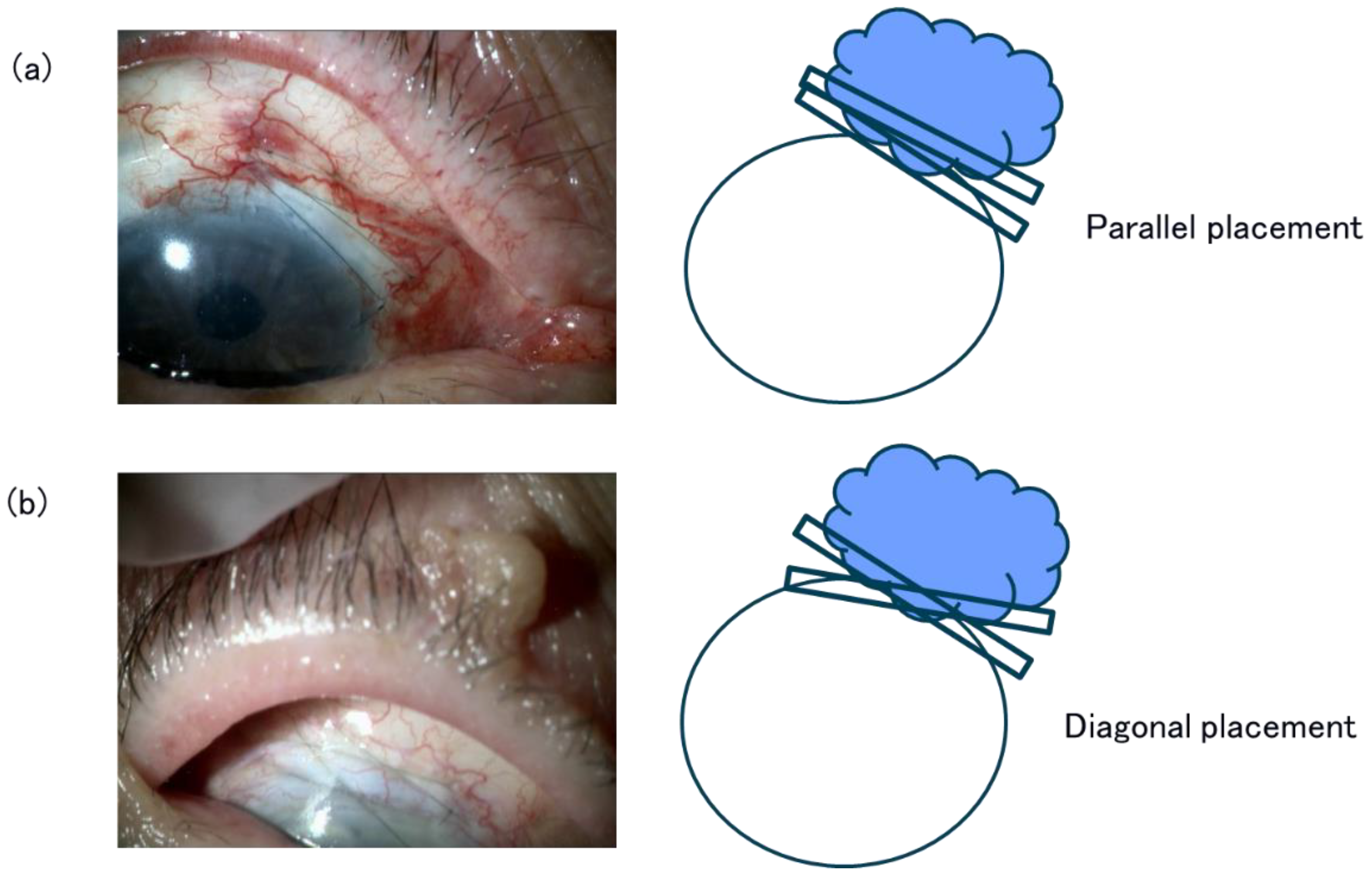
Figure 3.
Before and After Compressive Sutures Removal. (a) Slit lamp photograph depicts bleb compressive10-0 nylon sutures. (b) Slit lamp photograph depicts a functioning bleb after compressive suture removal.
Figure 3.
Before and After Compressive Sutures Removal. (a) Slit lamp photograph depicts bleb compressive10-0 nylon sutures. (b) Slit lamp photograph depicts a functioning bleb after compressive suture removal.
Disclaimer/Publisher’s Note: The statements, opinions and data contained in all publications are solely those of the individual author(s) and contributor(s) and not of MDPI and/or the editor(s). MDPI and/or the editor(s) disclaim responsibility for any injury to people or property resulting from any ideas, methods, instructions or products referred to in the content. |
© 2026 by the authors. Licensee MDPI, Basel, Switzerland. This article is an open access article distributed under the terms and conditions of the Creative Commons Attribution (CC BY) license (http://creativecommons.org/licenses/by/4.0/).
Copyright: This open access article is published under a Creative Commons CC BY 4.0 license, which permit the free download, distribution, and reuse, provided that the author and preprint are cited in any reuse.


