
Submitted:
15 March 2026
Posted:
17 March 2026
You are already at the latest version
Abstract
Universal health coverage (UHC) requires simultaneous gains in service coverage and financial protection, yet these dimensions are often analysed separately. We conducted a secondary ecological panel study using two public indicator files (UHC-SCI and UHC-FH40). Records were first harmonized through a document-oriented non-relational workflow that preserved irregular subgroup structures before flattening to a country-year panel. The analytic sample comprised 981 observations from 159 countries/economies between 2000 and 2023. We estimated pooled trends, correlations, country and two-way fixed-effects models with clustered standard errors, a random-intercept model, a generalized estimating equation, domain-specific models, wealth- and urbanization-based inequality metrics, beta-convergence models, and country typologies. Mean service coverage rose from 58.9 to 74.1, whereas mean financial hardship fell from 24.0% to 17.3%. Each 1-point increase in the service coverage index was associated with a 0.441 percentage-point reduction in hardship (95% CI: -0.707 to -0.175; p = 0.001). The mean poorest-richest and rural-urban hardship gaps were 53.7 and 12.5 percentage points. Low-income settings showed the steepest inequities and the strongest negative slope. UHC progress therefore remains incomplete unless service expansion, financial protection, and inequality monitoring are interpreted together.
Keywords:
universal health coverage
; financial risk protection
; health equity
; out-of-pocket expenditures
; panel data
; global health
1. Introduction
Universal health coverage (UHC) remains one of the central organizing goals of contemporary public health because it links access, protection, fairness, and state capacity. However, the policy and measurement history of UHC also shows a persistent analytical split between service delivery and financial protection. Recent syntheses emphasize that countries can expand contact with services without necessarily reducing the financial burden generated by out-of-pocket spending, particularly where pooling arrangements, primary care financing, and benefit package design remain incomplete [1,2,3,4,5].
This duality is not merely conceptual. The political economy of UHC depends on how systems mobilize, pool, allocate, and govern resources. Evidence from Asia, Africa, and other low- and middle-income settings suggests that gains in service coverage often coexist with vulnerability to catastrophic or impoverishing expenditure, especially for chronic care, medicines, and hospital episodes [6,7,8,9,10]. Accordingly, a country may appear to progress on essential service indicators while households continue to face severe financial hardship.
The tension is especially relevant in the post-pandemic context. UHC is increasingly discussed together with health security, resilience, and workforce adequacy because service continuity and financial protection are jointly tested during shocks. Studies from multiple regions have argued that stronger primary health care, sustained public financing, and resilient human resources for health are necessary to avoid reversals in both access and protection [7,8,9,10]. Yet comparable longitudinal analyses that link these two UHC components across countries are still limited.
A second challenge is inequality. Financial protection is rarely distributed evenly across wealth quintiles, territorial settings, age groups, or disability status. Even where national averages improve, the poorest groups and those living in rural or otherwise underserved areas may remain exposed to delayed care, debt, or medical impoverishment [11,12,13,14,15]. This means that average country performance can hide the very inequities that public health policy is meant to reduce.
The need for more integrated UHC analysis is reinforced by the growing number of domain-specific studies. Research has examined UHC financing reforms, disease burden, non-communicable disease coverage, maternal and child health, insurance expansion, and oral health inclusion, among other themes [11,12,13,14,15,16,17,18]. These strands are highly informative, but they often focus on one domain, one country, or one financing mechanism at a time. What remains comparatively underdeveloped is a multicountry empirical account of how changes in service coverage relate to changes in financial hardship over time and across stratified social groups.
Recent realist syntheses and policy priority exercises further show that UHC implementation is path-dependent and sensitive to governance design, institutional sequencing, and accountability arrangements [3,18,19,20]. For this reason, analytical frameworks need to capture heterogeneity rather than assume a single universal pathway. A country with high service coverage may still tolerate major hardship among poorer households, while another may show lower average coverage but faster progress in financial protection for vulnerable groups.
This study addresses that gap by integrating official UHC service coverage and financial hardship indicator files into a country-year panel that was first organized through a document-oriented non-relational (NoSQL) workflow and then analysed with standard statistical models. The objectives were to estimate whether higher service coverage is consistently associated with lower financial hardship, to quantify wealth- and place-based inequalities, and to identify cross-country typologies relevant for policy learning. We hypothesized that higher service coverage would be associated with lower hardship overall, but that the magnitude of this relationship would vary across continents and World Bank income groups and would coexist with persistent within-country inequality [1,2,3,4,5,19,20].
2. Materials and Methods
2.1. Study Design and Data Sources
We performed a secondary ecological analysis of publicly available UHC indicator data. Two public files from the WHO/World Bank UHC monitoring ecosystem were used: UHC-SCI.csv and UHC-FH40.csv. The SCI file contained 24,840 raw observations from 207 countries/economies for 2000-2023 and included the full UHC service coverage index plus four domain subindices. The FH40 file contained 17,634 raw observations from 180 countries/economies for 1985-2024 and included overall hardship plus subcomponents and disaggregation by wealth quintile and urbanization. Indicator definitions were aligned to the current WHO/World Bank monitoring framework and accompanying metadata [21,22,23,24].
2.2. NoSQL-Oriented Data Architecture
Because the source files mixed national observations with irregular subgroup dimensions, the preprocessing workflow first treated each record as a document-like unit keyed by country, year, indicator family, and stratifier. This document-oriented non-relational logic preserved nested combinations of domain, hardship subtype, wealth quintile, and urbanization without forcing premature flattening or loss of strata.
Three conceptual collections were then derived: one for SCI records (full index and domains), one for hardship records (overall hardship and subcomponents), and one for stratified hardship summaries (wealth quintiles and urbanization). Only after document-level validation of country-year completeness were these collections flattened into rectangular tables for statistical modelling. The NoSQL component therefore served as a transparent data-engineering step for reproducible aggregation rather than as the inferential framework itself.
2.3. Data Cleaning and Analytic Sample
For the overall panel, FH40 observations were restricted to all household types and total urbanization when country-level overall hardship was needed. Subcomponent series (large non-impoverishing burden, impoverishing expenditure, pushed into poverty, and further impoverished) were retained. SCI observations included the full index and the four reported domain subindices. After matching country-year observations across the two datasets and assigning continents, the harmonized analytic panel comprised 981 country-year observations from 159 countries/economies between 2000 and 2023. Countries with partial series were retained because the panel was unbalanced and the estimators selected are valid for unbalanced panels.
2.4. Variables
The primary exposure was the full SCI (0-100 scale). The primary outcome was overall financial hardship due to out-of-pocket spending, expressed as the percentage of the population experiencing hardship. Secondary outcomes were the four hardship subcomponents. To assess inequality, we derived the poorest-richest gap (Q1-Q5) from wealth-quintile records and the rural-urban gap from urbanization-stratified records. We also estimated a slope index of inequality (SII) from quintile-level hardship values using quintile midpoints as the ranked socioeconomic variable. For stratified policy interpretation, countries were grouped by continent and by World Bank income group.
2.5. External Country Stratification
To replace the internal SCI-derived resource proxy used in earlier drafts, countries were stratified using the most recent World Bank analytical income classification available in the Country Analytical History workbook [22]. This external stratifier was used only for descriptive and stratified analyses and not as an exposure variable. Two countries/economies in the analytic panel lacked a stable match and were excluded only from income-group-stratified summaries.
2.6. Statistical Analysis
The analysis had six layers. First, we described pooled global trends in SCI and overall hardship across the available years. Second, we estimated Pearson and Spearman correlations between SCI and hardship in the harmonized panel. Third, we fitted four main association models: a country fixed-effects model with a linear time trend, a two-way fixed-effects model with country and year indicators and cluster-robust standard errors at the country level, a random-intercept mixed model, and a generalized estimating equation with exchangeable working correlation. Fourth, we replaced the full SCI with its four domains in a two-way fixed-effects model to examine which domains were most strongly associated with hardship.
Fifth, we quantified inequality using poorest-richest and rural-urban gaps and by calculating a slope index of inequality (SII) from quintile-specific hardship values, with positive values indicating greater hardship among poorer quintiles. Sixth, we summarized latest available country values by continent and World Bank income group, estimated income-group-specific and continent-specific two-way fixed-effects slopes, tested beta-convergence in annual change, and derived country typologies using k-means clustering. All tests were two-sided, and p < 0.05 was considered statistically significant.
2.7. Software, Reproducibility, and Ethical Considerations
Data processing and analysis were performed in Python using pandas, NumPy, SciPy, statsmodels, scikit-learn, and matplotlib. The harmonized panel, the World Bank income-group crosswalk used for stratified analyses, and the reproducible analysis script are supplied in the supplementary submission package. Data sources and analytic sample construction are summarized in Table 1, and the study used only aggregate public indicators without identifiable individual-level information.
3. Results
3.1. Global Trends in Service Coverage and Financial Hardship
The harmonized analytic panel contained 981 country-year observations from 159 countries/economies (Table 1). The mean SCI across the panel was 65.63 (SD 16.04), and mean overall financial hardship was 20.53% (SD 12.43), as summarized in Table 2. Pooled annual means indicate that SCI rose from 58.9 in 2000 to 74.0 in 2023, whereas overall hardship declined from 24.0% to 17.3% over the same period. The decline in hardship was therefore directionally favourable but markedly slower than the growth observed for service coverage, as shown in Figure 1 and Figure 2.
3.2. Main Association Between Service Coverage and Financial Hardship
The bivariate relationship between SCI and overall financial hardship was strongly inverse (Pearson r = -0.722; p < 0.001; Spearman rho = -0.622; p < 0.001). In the country fixed-effects model with a linear time trend, each one-point increase in SCI was associated with a -0.447 percentage-point change in hardship (95% CI: -0.691 to -0.203; p = 0.0003). The estimate remained very similar in the two-way fixed-effects model (-0.441; 95% CI: -0.707 to -0.175; p = 0.0011), in the random-intercept mixed model (-0.496; p < 0.001), and in the GEE model (-0.521; p < 0.001). Taken together, these models indicate a robust negative association between service coverage and hardship at the country-year level (Table 3), while the overall inverse bivariate pattern is visualized in Figure 3.
3.3. Domain-Specific Associations
When the full SCI was decomposed into its four component domains within a two-way fixed-effects specification, the strongest inverse associations with hardship were observed for the infectious diseases subindex and the non-communicable diseases subindex. The infectious diseases domain was associated with a -0.206 percentage-point change in hardship per point increase (p = 0.0019), and the non-communicable diseases domain with a -0.257 percentage-point change (p = 0.0437). The RMNCH domain and the service capacity and access domain showed negative but less stable or non-significant associations after full adjustment. This suggests that not all service-coverage components translate equally into household financial protection (Table 4).
3.4. Inequalities by Wealth Quintile and Urbanization
Marked inequalities were observed across socioeconomic and territorial strata, as summarized in Table 5 and visualized in Figure 4. The mean poorest-richest gap (Q1-Q5) in hardship was 53.7 percentage points, while the mean rural-urban gap was 12.5 percentage points. In other words, the burden of financial hardship was substantially concentrated among poorer and rural populations wherever disaggregated data were available. The latest available SII summaries reinforced this pattern: mean SII values were highest in low-income countries (68.85) and lower in high-income countries (35.73), while Africa remained the continent with the steepest average wealth gradient (Table 5A and Table 5B).
3.5. Cross-Sectional Heterogeneity in Latest Available Values
Using the latest available country observation, large continental differences were evident (Table 6; Figure 5). Europe showed the highest mean SCI (77.94) and comparatively low hardship (11.57%), whereas Africa showed the lowest mean SCI (49.06) and the highest hardship (31.29%). The Kruskal-Wallis test confirmed significant between-continent differences for both SCI (p = 1.05e-17) and hardship (p = 3.37e-15). When countries were grouped by World Bank income group, hardship was progressively lower from low-income to high-income settings: mean hardship was 36.36% in low-income countries and 11.49% in high-income countries, while mean SCI increased from 42.21 to 80.05 (Table 7).
3.6. Stratified Slopes, Convergence, and Country Typologies
The strength of the SCI-hardship association was not uniform across geopolitical or income strata. In continent-specific two-way fixed-effects models, the inverse association was strongest in Africa (beta = -0.495; p = 0.0006) and was weaker or statistically unstable in other continental groupings. In income-group-specific models, the association was strongest and clearly significant in low-income countries (beta = -1.002; p = 0.0035), whereas it was attenuated and statistically uncertain in upper-middle-income and high-income groups (Table A1 and Table A2). This suggests that marginal gains in service coverage may translate into larger hardship reductions where baseline deficits are greatest.
Convergence analysis showed that countries with lower baseline SCI improved faster over time (baseline coefficient = -0.019; p < 0.001), and countries with worse baseline hardship also changed more rapidly (baseline coefficient = -0.031; p < 0.001), as shown in Table A3 and Figure 6. Although this is encouraging, convergence did not eliminate substantive between-country inequality because country clusters still displayed very different endpoint combinations of coverage, hardship, and distributional gaps.
K-means clustering identified four policy-relevant country profiles. Cluster A combined relatively high final coverage with low hardship; Cluster B captured lower-coverage countries with rapid improvement but still high inequality; Cluster C represented a small fragile group with worsening hardship; and Cluster D included countries with mid-to-high coverage but persistent inequality. The presence of these distinct profiles reinforces the idea that average global progress masks heterogeneous pathways (Table A4 and Figure 7).
At the country level, the latest available highest SCI values were observed in the United States and the United Kingdom (both 88), followed by the Republic of Korea (87) and several European high-income systems. The highest hardship burdens were concentrated in African countries, led by the Democratic Republic of the Congo (60.03%), Burundi (56.64%), and the Central African Republic (52.97%) (Table A5 and Table A6).
4. Discussion
The central finding of this study is that service coverage and financial protection move in the same desirable direction at the global level, but they do not move together tightly enough to justify using one as a proxy for the other. Across 159 countries/economies and 981 country-year observations, higher SCI was consistently associated with lower hardship, yet the magnitude of the relationship varied markedly across contexts and remained compatible with very large socioeconomic gaps. This overarching pattern is visible in the pooled time trends (Figure 1 and Figure 2) and in the country-year association analyses (Table 3 and Figure 3). It is also consistent with regional evidence showing that national UHC progress often coexists with persistent exposure to financial burden for specific subpopulations [25,26,27].
Our results also strengthen the argument that financial protection is not simply a downstream by-product of broader service expansion. The negative association between SCI and hardship remained robust across fixed-effects, mixed-model, and GEE specifications (Table 3), but the size of the coefficient was far from sufficient to erase the average 53.7 percentage-point poorest-richest gap observed in the hardship data (Table 5). This mirrors recent findings from Thailand, Kenya, Georgia, and East Asian comparative work showing that coverage design, cost sharing, pooling depth, and benefit structure mediate whether service use becomes financially safe or financially punitive [28,29,30,31].
The inequality findings are arguably the most policy-relevant. Wealth- and place-based gradients were steep, and SII values were highest in Africa and among low-income and lower-middle-income countries (Table 5, Table 5A, Table 5B, and Figure 4). These results align with recent studies from Indonesia, Malaysia, Mexico, and Vietnam showing that financial protection remains socially patterned even under nominally universal arrangements, especially for lower-income households, people with disability, and groups facing chronic care needs [32,33,34,35,36]. In practical terms, the present analysis suggests that monitoring only national UHC averages can conceal the very inequities that should trigger corrective financing action.
The domain-specific results merit attention. Infectious-disease and non-communicable disease service domains were more strongly associated with hardship reductions than the RMNCH and service-capacity subindices after full adjustment (Table 4). One plausible interpretation is that domains closely linked to recurrent treatment costs, medicines, and long-term disease management may more directly shape household exposure to out-of-pocket spending. This interpretation is compatible with evidence that financial protection is particularly sensitive to chronic illness, ageing-related service needs, and fragmented coverage for ambulatory and pharmaceutical care [27,33,37].
The convergence analyses offer cautious optimism. Countries starting from poorer baseline positions improved faster on average, both for SCI and hardship (Table A3 and Figure 6). This is consistent with recent global and South Asian evidence suggesting that lagging countries can still make substantial gains within a decade when financing reforms, public purchasing, and service expansion are aligned [37,38]. At the same time, the cluster analysis shows that convergence is incomplete: some countries remain trapped in combinations of moderate coverage, high hardship, and severe inequality, while a small fragile group appears to face worsening hardship despite low-to-moderate service coverage (Table A4 and Figure 7).
For policy, the findings support a differentiated approach rather than a single template. High-income countries with residual hardship should focus on medicines, chronic care affordability, and equity-sensitive benefit design. Upper-middle-income and lower-middle-income countries may need simultaneous strengthening of primary care, public purchasing, and explicit redesign of financial protection instruments. Low-income countries, especially in Africa, appear most likely to gain hardship reductions from additional service-coverage progress, but only if that progress is financed through pooled and publicly accountable mechanisms rather than increased household spending. This reading is consistent with the cross-continental and income-group-stratified summaries presented in Table 6, Table 7 and Table A1, and A2, and with the growing literature calling for primary-health-care-centred UHC, stronger accountability, and explicit equity protection [29,30,31,38,39].
4.1. Strengths and Limitations
This study has several strengths. It integrates two major public UHC datasets, uses a document-oriented architecture suited to irregular stratified indicator data, reports multiple complementary models, and extends the analysis beyond national averages to wealth- and place-based inequality. The organization of the data sources (Table 1), the descriptive profile of the harmonized panel (Table 2), the main inferential models (Table 3), and the inequality summaries (Table 5) support this breadth, while machine-readable supplementary tables, the harmonized panel, and the reproducible analysis script strengthen transparency. Several limitations should be acknowledged. First, the design is ecological and cannot establish individual-level mechanisms or causal effects. Second, the panel is unbalanced. Third, country-level hardship data are derived from official monitoring systems whose underlying survey and estimation procedures vary over time. Fourth, World Bank income groups were used as external descriptive strata and do not fully capture fiscal space, pooling depth, or benefit design; two countries/economies lacked a stable match and were excluded from income-group-stratified summaries. Finally, because the source files are pre-aggregated indicators, we could not model within-country household covariates directly.
5. Conclusions
This multicountry analysis shows that UHC progress is real but uneven. Higher service coverage is associated with lower financial hardship, yet the translation from coverage to protection is incomplete and socially unequal. The most affected gradients remain concentrated among poorer and rural populations, and the relationship between coverage and hardship is strongest where resource constraints are greatest. For global health policy, the implication is clear: countries should not treat SCI gains as sufficient evidence of equitable UHC achievement.
Internationally, monitoring frameworks should combine service coverage, hardship subcomponents, and inequality metrics in the same dashboard. High-income countries should concentrate on the affordability gaps that persist despite otherwise strong service systems; upper-middle-income and lower-middle-income countries should align service expansion with deeper risk pooling and more coherent benefit packages; and low-income countries require simultaneous investment in primary care, public financing, and pro-poor protection against out-of-pocket shocks. Continent-specific strategies are also warranted, particularly for African settings where both hardship burdens and socioeconomic gradients remain highest. A document-oriented data architecture can facilitate this agenda by supporting repeated aggregation, subgroup retention, and transparent longitudinal monitoring across heterogeneous country-year records.
Supplementary Materials
Supplementary Files S1-S3 include the reproducible Python analysis script, the harmonized country-year panel with the income-group crosswalk used for stratified analyses, and the machine-readable supplementary tables and figures submitted with this manuscript.
Author Contributions
Conceptualization, methodology, formal analysis, investigation, writing—original draft preparation, visualization, and supervision: A.D.P.; writing—review and editing, interpretation of findings, public health perspective, and critical revision of the manuscript: W.A.P. All authors have read and agreed to the published version of the manuscript.
Funding
This research received no external funding.
Institutional Review Board Statement
Not applicable. This study used publicly available aggregate country-year indicators and involved no individual-level identifiable information.
Informed Consent Statement
Not applicable.
Data Availability Statement
The original UHC indicator files used in this study are publicly available from the WHO/World Bank UHC monitoring ecosystem. For peer review, the harmonized analytic panel, the World Bank income-group crosswalk, and the reproducible analysis script are provided as Supplementary Files S1-S3 with this submission.
Conflicts of Interest
The authors declare no conflict of interest.
Abbreviations
| Abbreviation | Meaning | Abbreviation | Meaning |
| AI | artificial intelligence | CI | confidence interval |
| CICV | Centro de Investigaciones en Ciencias de la Vida | CSV | comma-separated values |
| OOP | out-of-pocket | FH | financial hardship |
| FH40 | financial hardship due to out-of-pocket health spending | GEE | generalized estimating equations |
| 95% CI | 95% confidence interval | WB | World Bank |
| JSON | JavaScript Object Notation | NoSQL | non-relational, document-oriented data architecture |
| ORCID | Open Researcher and Contributor ID | PNG | Portable Network Graphics |
| Q1 | poorest wealth quintile | Q5 | richest wealth quintile |
| RMNCH | reproductive, maternal, newborn, and child health | SCI | service coverage index |
| SD | standard deviation | SDG | Sustainable Development Goal |
| UHC | universal health coverage | WHO | World Health Organization |
References
- Darrudi, A.; Khoonsari, M.H.K.; Tajvar, M. Challenges to achieving universal health coverage throughout the world: a systematic review. J Prev Med Public Health 2022, 55(2), 125–133. [Google Scholar] [CrossRef]
- Ranabhat, C.L.; Acharya, S.P.; Adhikari, C.; Kim, C.-B. Universal health coverage evolution, ongoing trend, and future challenge: a conceptual and historical policy review. Front Public Health 2023, 11, 1041459. [Google Scholar] [CrossRef]
- Endalamaw, A.; Mengistu, T.S.; Khatri, R.B.; et al. Universal health coverage—exploring the what, how, and why using realist review. PLOS Glob Public Health 2025, 5(3), e0003330. [Google Scholar] [CrossRef] [PubMed]
- World Health Organization. Universal health coverage (UHC). Available online: https://www.who.int/news-room/fact-sheets/detail/universal-health-coverage-%28uhc%29 (accessed on 14 March 2026).
- World Health Organization; World Bank. Tracking universal health coverage: 2025 global monitoring report; World Health Organization: Geneva, Switzerland, 2025; Available online: https://www.who.int/publications/i/item/9789240117808 (accessed on 14 March 2026).
- Takura, T.; Miura, H. Socioeconomic determinants of universal health coverage in the Asian region. Int J Environ Res Public Health 2022, 19(4), 2376. [Google Scholar] [CrossRef]
- Hanson, K.; Brikci, N.; Erlangga, D.; et al. The Lancet Global Health Commission on financing primary health care: putting people at the centre. Lancet Glob Health 2022, 10(5), e715–e772. [Google Scholar] [CrossRef] [PubMed]
- Lal, A.; Erondu, N.A.; Heymann, D.L.; Gitahi, G.; Yates, R. Pandemic preparedness and response: exploring the role of universal health coverage within the global health security architecture. Lancet Glob Health 2022, 10(11), e1675–e1683. [Google Scholar] [CrossRef]
- Dhillon, I.; Jhalani, M.; Thamarangsi, T.; Siyam, A.; Khetrapal Singh, P. Advancing universal health coverage in the WHO South-East Asia Region with a focus on human resources for health. Lancet Reg Health Southeast Asia 2023, 18, 100313. [Google Scholar] [CrossRef]
- Lai, Y.; Liang, D.; Bobogare, A.; Yadamsuren, B.; Yam, E.; Yi, S.; Bugoro, H.; Huang, J. Synergising universal health coverage and global health security in the Western Pacific Region. J Glob Health 2025, 15, 04037. [Google Scholar] [CrossRef]
- Hajjar, K.; Moresky, R.T.; et al. Association between universal health coverage and the disease burden of acute illness and injury at the global level. BMC Public Health 2023, 23, 735. [Google Scholar] [CrossRef] [PubMed]
- Khan, M.R.; Mohammad, K.U.; Rabbani, M.S. Impact of health expenditure on universal health coverage (composite index): global evidence. Health Promot Perspect. 2025, 15(3), 268–277. [Google Scholar] [CrossRef]
- Arhin, K.; Frimpong, A.O.; Acheampong, K. Effect of primary health care expenditure on universal health coverage: evidence from Sub-Saharan Africa. Clinicoecon Outcomes Res. 2022, 14, 643–652. [Google Scholar] [CrossRef]
- Fisher, M.; Freeman, T.; Mackean, T.; Friel, S.; Baum, F. Universal health coverage for non-communicable diseases and health equity: lessons from Australian primary healthcare. Int J Health Policy Manag. 2022, 11(5), 690–700. [Google Scholar] [CrossRef]
- Feng, X.L.; Zhang, Y.; Hu, X.; et al. Tracking progress towards universal health coverage for essential health services in China, 2008–2018. BMJ Glob Health 2022, 7(11), e010552. [Google Scholar] [CrossRef]
- Bayked, E.M.; Toleha, H.N.; Kebede, S.Z.; Workneh, B.D.; Kahissay, M.H. The impact of community-based health insurance on universal health coverage in Ethiopia: a systematic review and meta-analysis. Glob Health Action. 2023, 16(1), 2189764. [Google Scholar] [CrossRef]
- Winkelmann, J.; Listl, S.; van Ginneken, E.; Benzian, H. Universal health coverage cannot be universal without oral health. Lancet Public Health 2023, 8(1), e8–e10. [Google Scholar] [CrossRef]
- Hajji, O.; El Abbadi, B.; Akhnif, E.H.; et al. Systematic review of financing functions for universal health coverage in low- and middle-income countries: reforms, challenges, and lessons learned. Public Health Rev. 2025, 46, 1607745. [Google Scholar] [CrossRef] [PubMed]
- Langat, E.; Gesesew, H.A.; Mwanri, L.; Ward, P.R. Factors influencing the adoption of universal health coverage in Africa: insights from a realist synthesis. Soc Sci Med. 2025, 387, 118709. [Google Scholar] [CrossRef] [PubMed]
- Namyalo, P.K.; Wodnik, B.K.; Michaelides, O.; Kane, S.; Essue, B.; Di Ruggiero, E. Identifying implementation science research and policy priorities to advance universal health coverage: a multi-country modified Delphi study. BMJ Glob Health 2025, 10(8), e018562. [Google Scholar] [CrossRef] [PubMed]
- World Health Organization. Financial hardship in health and components (SDG 3.8.2, 2025 definition), % of the population. Available online: https://www.who.int/data/gho/indicator-metadata-registry/imr-details/376 (accessed on 14 March 2026).
- World Bank Data Help Desk. How does the World Bank classify countries? Available online: https://datahelpdesk.worldbank.org/knowledgebase/articles/378834-how-does-the-world-bank-classify-countries (accessed on 14 March 2026).
- World Bank. Universal health coverage (UHC) service coverage index. Data360. Available online: https://data360.worldbank.org/en/indicator/UHC-SCI (accessed on 14 March 2026).
- World Bank. Universal health coverage (UHC) dataset. Data360. Available online: https://data360.worldbank.org/en/dataset/WB_UHC (accessed on 14 March 2026).
- Thomson, S.; Cylus, J.; Evetovits, T.; et al. Monitoring progress towards universal health coverage in Europe: a descriptive analysis of financial protection in 40 countries. Lancet Reg Health Eur. 2024, 37, 100826. [Google Scholar] [CrossRef]
- Antunes, A.F.; Jithitikulchai, T.; Hohmann, J.; Flessa, S. Revisiting a decade of inequality in healthcare financial burden in Cambodia, 2009–19: trends, determinants and decomposition. Int J Equity Health 2024, 23, 196. [Google Scholar] [CrossRef]
- Okamoto, S.; Sata, M.; Rosenberg, M.; et al. Universal health coverage in the context of population ageing: catastrophic health expenditure and unmet need for healthcare. Health Econ Rev. 2024, 14, 8. [Google Scholar] [CrossRef]
- Damrongplasit, K.; Melnick, G. Utilisation, out-of-pocket payments and access before and after COVID-19: Thailand’s universal health coverage scheme. BMJ Glob Health 2024, 9(5), e015179. [Google Scholar] [CrossRef]
- Nungo, S.; Filippon, J.; Russo, G. Social health insurance for universal health coverage in low- and middle-income countries: a retrospective policy analysis of attainments, setbacks and equity implications of Kenya’s social health insurance model. BMJ Open 2024, 14(12), e085903. [Google Scholar] [CrossRef] [PubMed]
- Gorgodze, T.; et al. Financial protection and universal health coverage in Georgia: an analysis of impoverishing healthcare costs using household income and expenditure surveys. BMJ Glob Health 2025, 10(7), e019150. [Google Scholar] [CrossRef]
- Zhang, Q.; Wang, J.S.H.; He, A.J.; et al. Providing financial protection in health for low-income populations: a comparison of health financing designs in East Asia. Int J Equity Health 2025, 24, 215. [Google Scholar] [CrossRef]
- Azizatunnisa’, L.; Probandari, A.; Kuper, H.; Banks, L.M. Health insurance coverage, healthcare use, and financial protection amongst people with disabilities in Indonesia: analysis of the 2021 National Socioeconomic Survey. Lancet Reg Health Southeast Asia 2025, 39, 100631. [Google Scholar] [CrossRef] [PubMed]
- Hussein, N.; Ng, C.W.; Ramli, R.; et al. Assessing catastrophic health expenditure and impoverishment in adult asthma care: a cross-sectional study of patients attending six public health clinics in Klang District, Malaysia. BMC Health Serv Res. 2024, 24, 327. [Google Scholar] [CrossRef]
- Serván-Mori, E.; Gómez-Dantés, O.; et al. Increase of catastrophic and impoverishing health expenditures in Mexico associated to policy changes and the COVID-19 pandemic. J Glob Health 2023, 13, 06044. [Google Scholar] [CrossRef] [PubMed]
- Cerecero-García, D.; Gómez-Dantés, O.; Hone, T.; et al. Catastrophic and impoverishing health expenditures in fragmented public health systems: lessons from Mexico, 2000–2022. Health Econ Rev. 2026, 16, 22. [Google Scholar] [CrossRef]
- Nguyen, P.T.; Le, P.M. Progress and inequalities in financial risk protection toward universal health coverage: insights from Vietnam. Int J Equity Health 2025, 24, 287. [Google Scholar] [CrossRef]
- Rahman, M.M.; Jung, J.; Islam, M.R.; et al. Global, regional, and national progress in financial risk protection towards universal health coverage, 2000–2030. Soc Sci Med. 2022, 312, 115367. [Google Scholar] [CrossRef] [PubMed]
- Rahman, M.M.; et al. Progress towards universal health coverage in South Asia, 2000–2030: an examination of the twin elements of primary healthcare provision and financial protection. BMJ Glob Health 2025, 10(11), e020052. [Google Scholar] [CrossRef] [PubMed]
- The Lancet Regional Health—Europe. Strengthening primary health care to achieve universal health coverage. Lancet Reg Health Eur. 2024, 39, 100897. [Google Scholar] [CrossRef] [PubMed]
Figure 1.
Pooled global mean UHC service coverage index (SCI), 2000–2023.
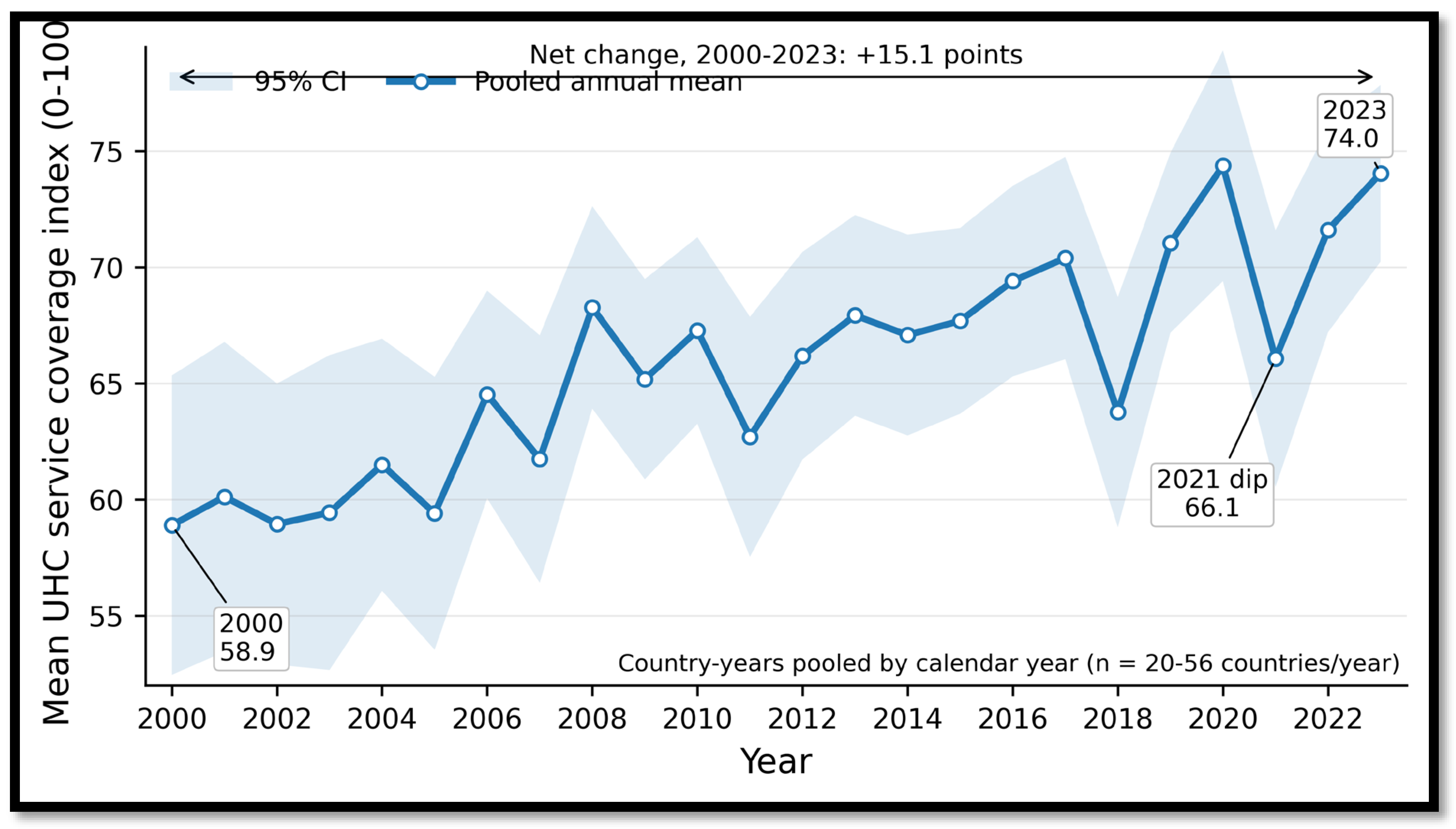
Figure 2.
Pooled global mean overall financial hardship due to out-of-pocket health spending, 2000–2023.
Figure 2.
Pooled global mean overall financial hardship due to out-of-pocket health spending, 2000–2023.
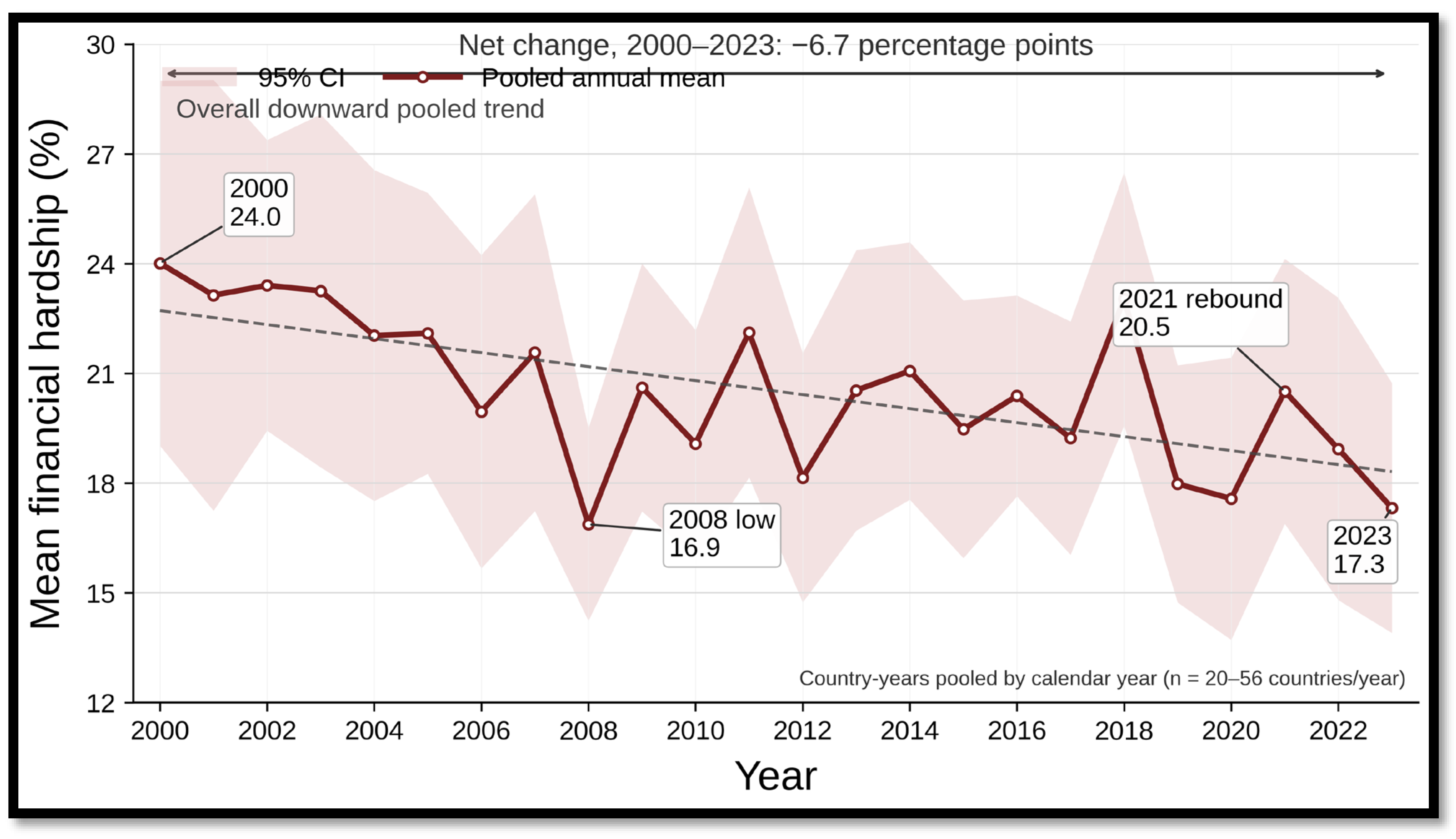
Figure 3.
Scatterplot of SCI and overall financial hardship with fitted linear trend.
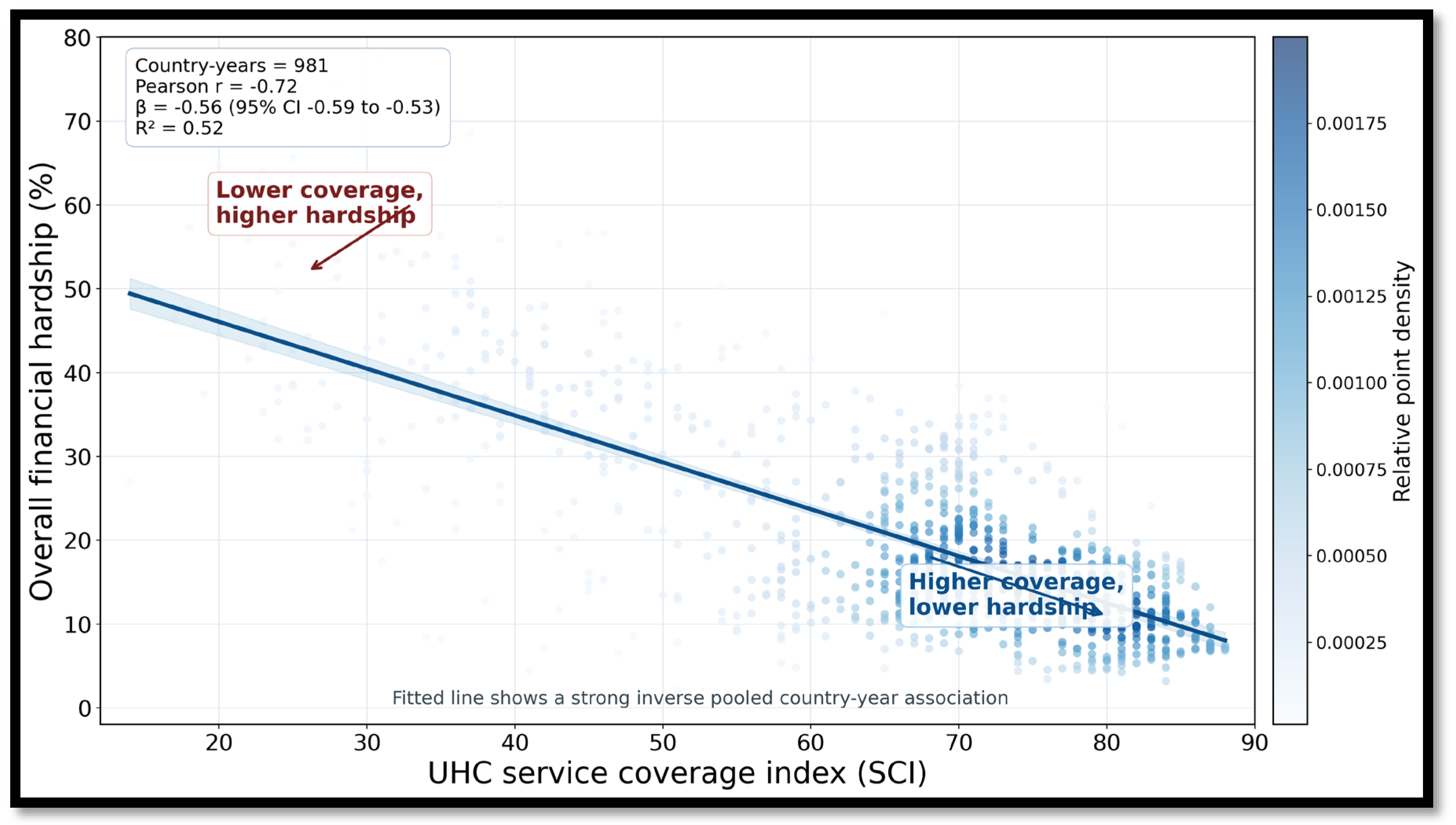
Figure 4.
Distribution of wealth- and urbanization-based hardship gaps across country-years.
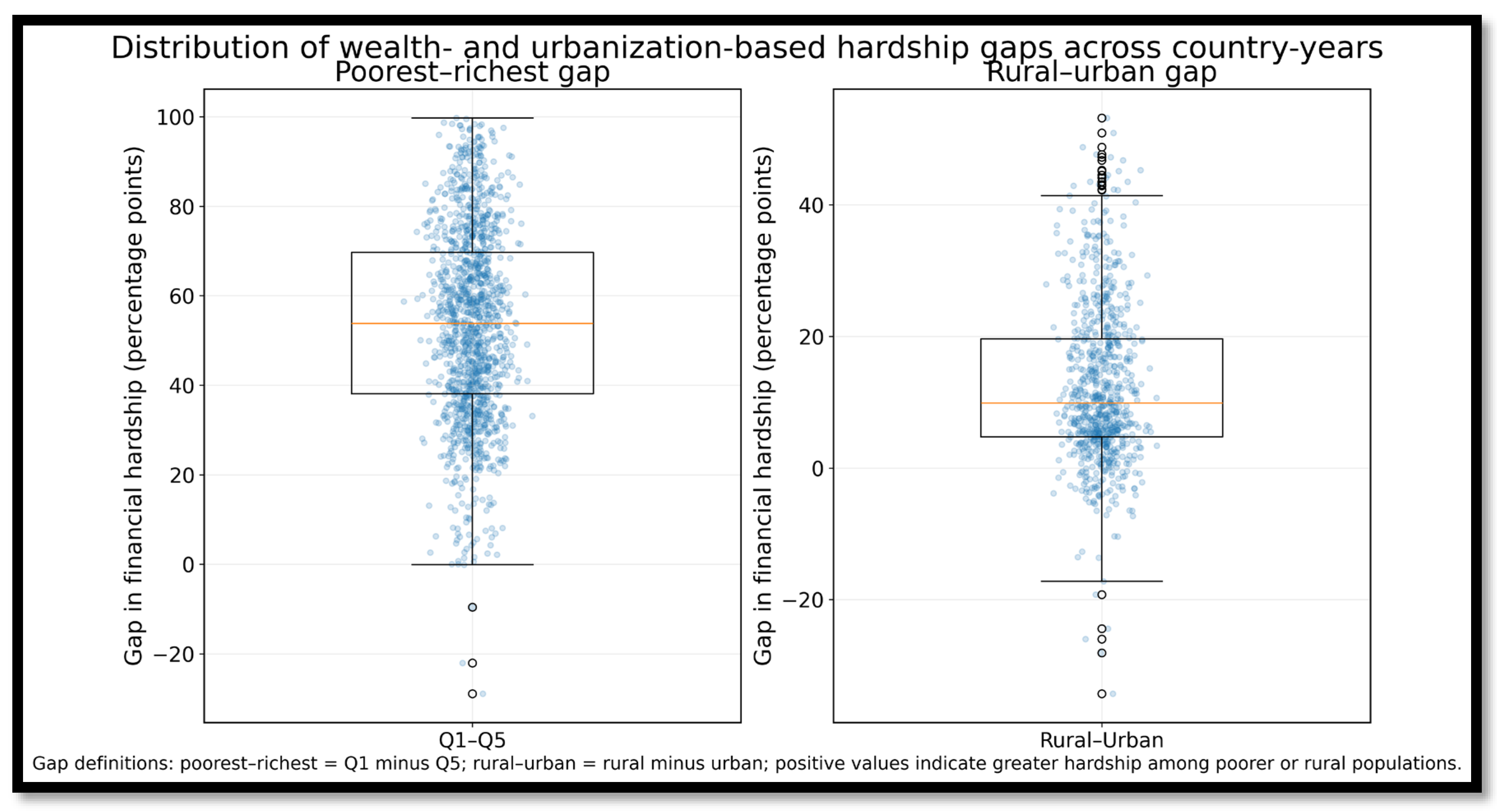
Figure 5.
Distribution of latest available SCI and hardship values by continent.
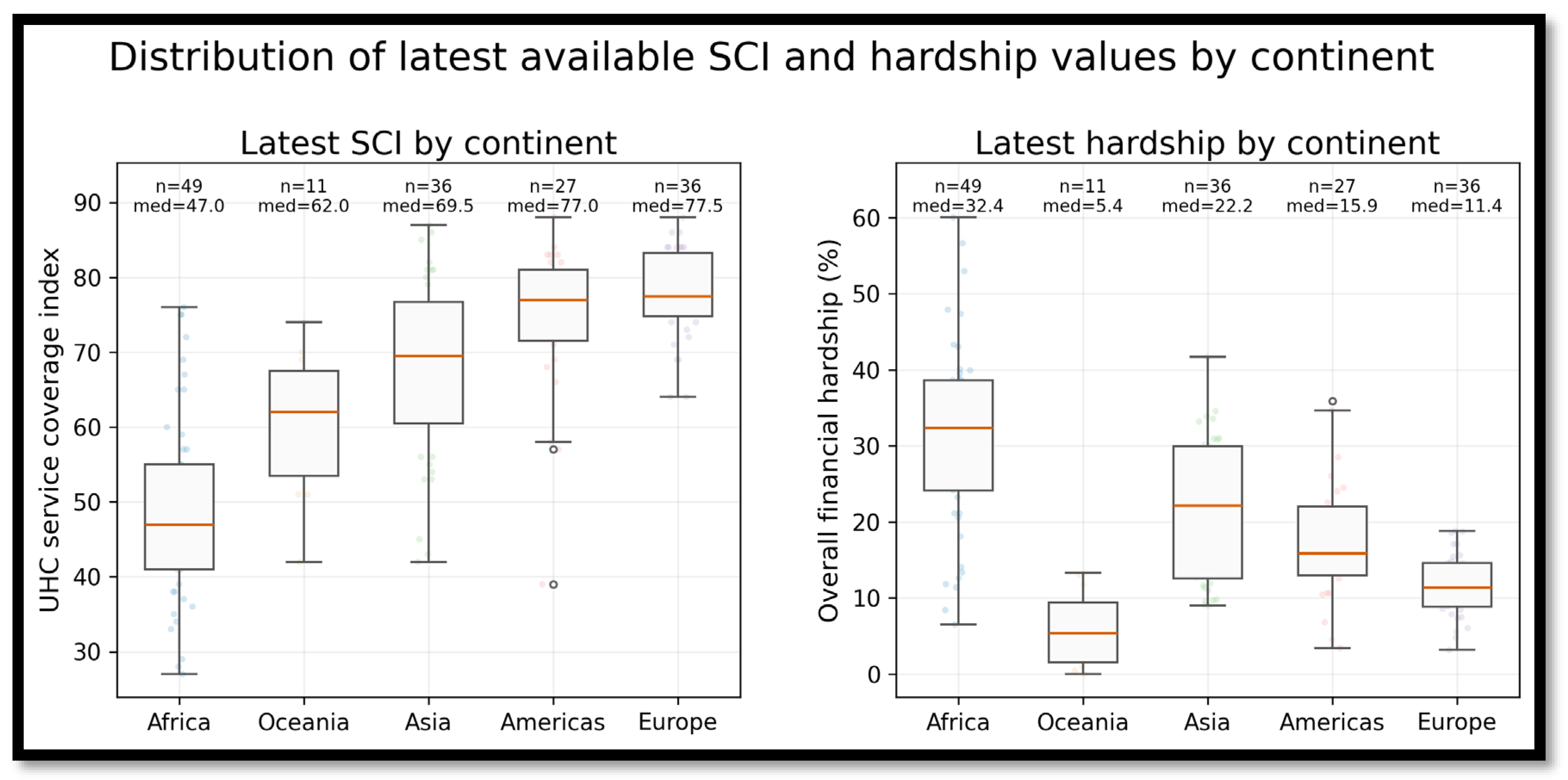
Figure 6.
Convergence patterns linking baseline values to within-country annual slopes.
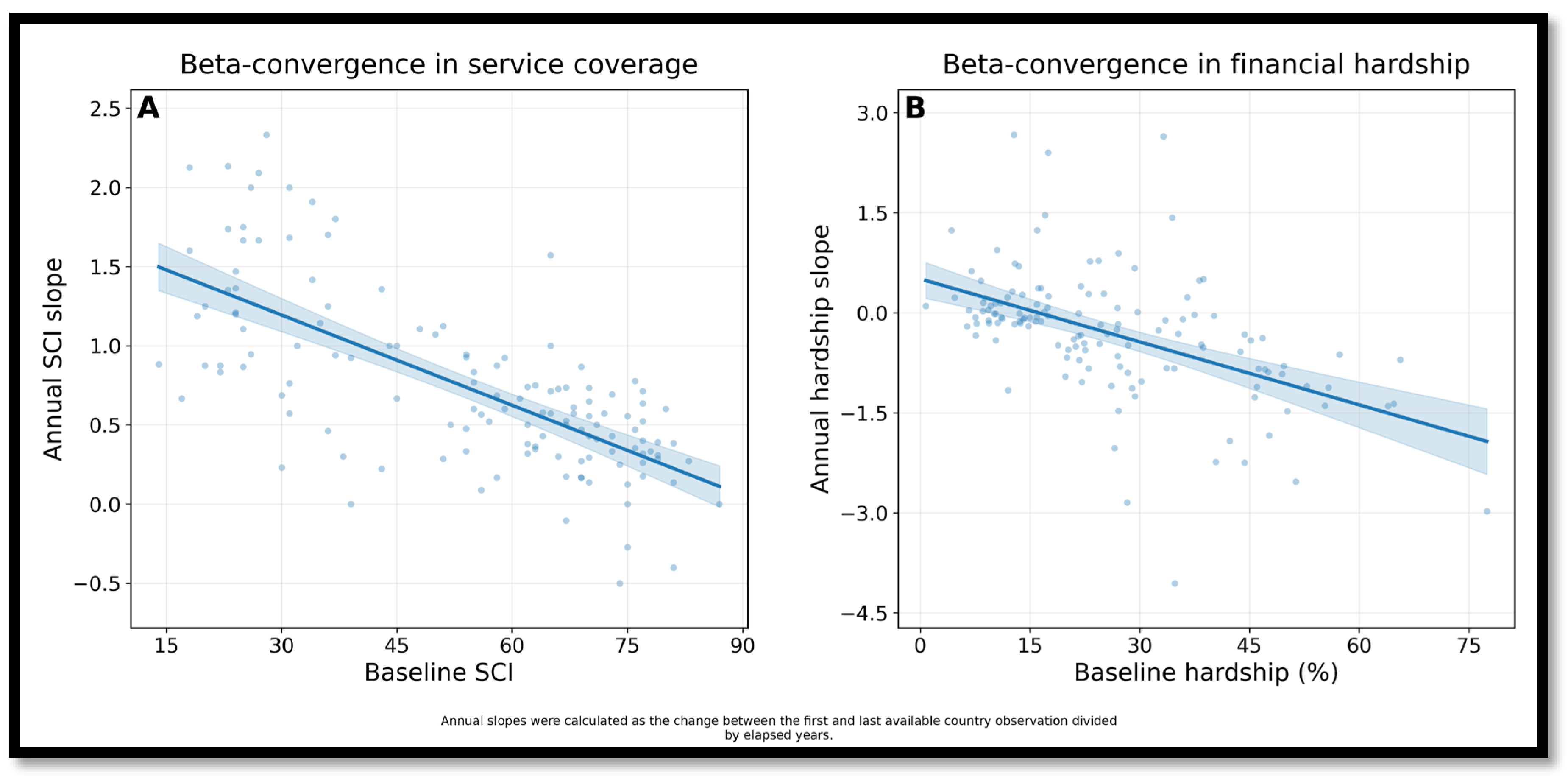
Figure 7.
Country typologies derived from service coverage, hardship, slopes, and inequality features.
Figure 7.
Country typologies derived from service coverage, hardship, slopes, and inequality features.
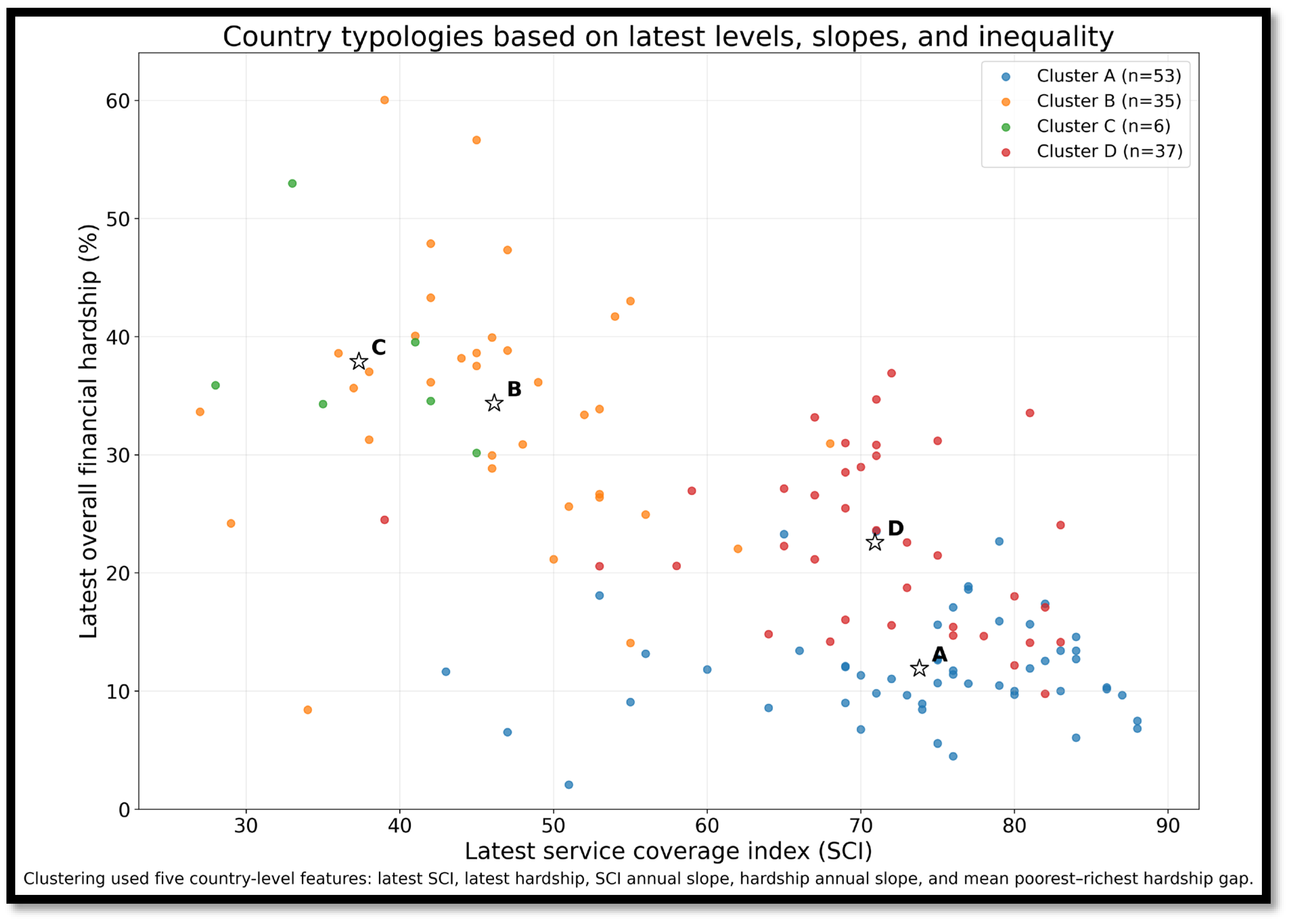

Table 1.
Data sources and analytic sample.
| Dataset | Raw observations | Countries/economies in raw file | Time span | Analytic filters |
|---|---|---|---|---|
| UHC service coverage index (SCI) | 24840 | 207 | 2000-2023 | Full index and four domain subindices |
| Financial hardship (FH40) | 17634 | 180 | 1985-2024 | All household types, total urbanization for overall panel; hardship subcomponents retained |
| Harmonized analytic panel | 981 | 159 | 2000-2023 | Country-year overlap between SCI and FH, continent assigned, and World Bank income group matched where available |
Note. The harmonized panel was produced after matching country-year observations across the two source files and applying the filters described in the Methods section.
Table 2.
Descriptive statistics for the harmonized panel.
| Variable | Mean | SD | Median | IQR | Min | Max | N |
|---|---|---|---|---|---|---|---|
| SCI full index (0-100) | 65.63 | 16.04 | 70.0 | 19.0 | 14.0 | 88.0 | 981 |
| Financial hardship, all (%) | 20.53 | 12.43 | 16.52 | 15.61 | 0.0 | 77.45 | 981 |
| Large non-impoverishing OOP burden (%) | 3.67 | 2.47 | 3.11 | 3.16 | 0.0 | 15.85 | 959 |
| Impoverishing OOP expenditure (%) | 16.85 | 11.87 | 12.45 | 14.49 | 0.0 | 73.89 | 959 |
| Pushed into poverty (%) | 1.7 | 1.19 | 1.42 | 1.21 | 0.0 | 9.53 | 885 |
| Further impoverished (%) | 15.45 | 11.75 | 10.84 | 13.75 | 0.2 | 72.36 | 885 |
Table 3.
Main association models linking SCI to overall financial hardship.
| Model | Beta | CI low | CI high | p-value | N | R2 |
|---|---|---|---|---|---|---|
| Pearson correlation | -0.722 | — | — | <0.001 | 981 | 0.521 |
| Country FE + trend | -0.447 | -0.691 | -0.203 | 0.0003 | 981 | 0.886 |
| Two-way FE | -0.441 | -0.707 | -0.175 | 0.0011 | 981 | 0.889 |
| Mixed model | -0.496 | -0.564 | -0.429 | <0.001 | 981 | — |
| GEE | -0.521 | -0.599 | -0.443 | <0.001 | 981 | — |
| Spline test | — | — | — | 0.0618 | 981 | 0.890 |
Table 4.
Domain-specific two-way fixed-effects model.
| SCI domain | Beta | CI low | CI high | p-value |
|---|---|---|---|---|
| RMNCH subindex | 0.12 | -0.133 | 0.373 | 0.3521 |
| Infectious diseases subindex | -0.206 | -0.336 | -0.076 | 0.0019 |
| Non-communicable diseases subindex | -0.257 | -0.506 | -0.007 | 0.0437 |
| Service capacity and access subindex | -0.076 | -0.172 | 0.019 | 0.1158 |
Table 5.
Summary inequality metrics derived from wealth- and urbanization-stratified hardship data.
| Metric | Mean | SD | Median | IQR | Min | Max | N |
|---|---|---|---|---|---|---|---|
| Poorest-richest gap in financial hardship (Q1-Q5) | 53.73 | 21.40 | 53.81 | 31.57 | -28.91 | 99.75 | 1323 |
| Rural-urban gap in financial hardship | 12.50 | 12.02 | 9.88 | 14.90 | -34.30 | 53.23 | 783 |
Note. Q1–Q5 denotes the difference between the poorest and richest wealth quintiles. SII summaries are provided below as complementary indicators of the socioeconomic gradient.
Table 5A.
Latest available slope index of inequality (SII) by continent.
| Continent | Countries | Mean SII | Median SII |
|---|---|---|---|
| Africa | 49 | 66.93 | 70.59 |
| Americas | 26 | 45.94 | 49.71 |
| Asia | 34 | 56.5 | 59.17 |
| Europe | 36 | 36.8 | 38.81 |
| Oceania | 11 | 20.36 | 20.49 |
Table 5B.
Latest available slope index of inequality (SII) by World Bank income group.
| Income group | Countries | Mean SII | Median SII |
|---|---|---|---|
| High income | 44 | 35.73 | 35.38 |
| Upper-middle income | 45 | 46.51 | 43.38 |
| Lower-middle income | 48 | 60.13 | 70.14 |
| Low income | 24 | 68.85 | 70.29 |
Table 6.
Latest available SCI and hardship by continent.
| Continent | Countries | SCI mean | SCI median | FH mean | FH median |
|---|---|---|---|---|---|
| Africa | 49 | 49.06 | 47.0 | 31.29 | 32.44 |
| Oceania | 11 | 60.45 | 62.0 | 5.96 | 5.38 |
| Asia | 36 | 68.08 | 69.5 | 21.25 | 22.16 |
| Americas | 27 | 74.48 | 77.0 | 17.51 | 15.91 |
| Europe | 36 | 77.94 | 77.5 | 11.57 | 11.38 |
Note. Between-continent Kruskal–Wallis p-values: SCI p = 1.05e-17; hardship p = 3.37e-15.
Table 7.
Latest available SCI and hardship by World Bank income group.
| Income group | Countries | SCI mean | SCI median | FH mean | FH median |
|---|---|---|---|---|---|
| High income | 41 | 80.05 | 81.00 | 11.49 | 11.00 |
| Upper-middle income | 45 | 71.64 | 71.00 | 16.83 | 14.64 |
| Lower-middle income | 47 | 56.91 | 56.00 | 24.39 | 26.02 |
| Low income | 24 | 42.21 | 42.00 | 36.36 | 36.02 |
Note. Between-income-group Kruskal–Wallis p-values: SCI p = 3.79e-23; hardship p = 9.68e-14. Income group reflects the most recent World Bank analytical classification matched to each country; group totals sum to 157 because two countries/economies in the analytic panel lacked a stable World Bank income-group match.
Table A1.
Continent-specific SCI–hardship slopes from stratified two-way fixed-effects models.
| Continent | Beta | CI low | CI high | p-value |
|---|---|---|---|---|
| Africa | -0.495 | -0.779 | -0.211 | 0.0006 |
| Americas | -0.223 | -0.741 | 0.294 | 0.3977 |
| Asia | -0.333 | -0.675 | 0.009 | 0.0567 |
| Europe | -0.175 | -0.689 | 0.339 | 0.5047 |
| Oceania | 0.062 | -0.298 | 0.422 | 0.7344 |
Table A2.
Income-group-specific SCI-hardship slopes from stratified two-way fixed-effects models.
| Income group | Beta | CI low | CI high | p-value |
|---|---|---|---|---|
| High income | -0.021 | -0.383 | 0.341 | 0.9090 |
| Upper-middle income | -0.336 | -0.856 | 0.184 | 0.2059 |
| Lower-middle income | -0.295 | -0.968 | 0.379 | 0.3911 |
| Low income | -1.002 | -1.673 | -0.330 | 0.0035 |
Table A3.
Beta-convergence models.
| Outcome | Baseline coefficient | CI low | CI high | p-value | R2 |
|---|---|---|---|---|---|
| SCI annual slope | -0.019 | -0.022 | -0.016 | <0.001 | 0.487 |
| FH annual slope | -0.031 | -0.041 | -0.022 | <0.001 | 0.260 |
Table A4.
Country typology from clustering.
| Cluster | Profile | Countries | SCI (latest) | FH all (latest) | SCI annual slope | FH annual slope | Mean Q1-Q5 gap |
|---|---|---|---|---|---|---|---|
| A | High coverage; low hardship | 53 | 73.81 | 11.90 | 0.54 | -0.08 | 36.40 |
| B | Low coverage; rapid gains; high inequality | 35 | 46.14 | 34.37 | 1.37 | -0.91 | 65.65 |
| C | Fragile; rising hardship | 6 | 37.33 | 37.90 | 0.63 | 1.79 | 33.91 |
| D | Mid-high coverage; persistent inequality | 37 | 70.92 | 22.57 | 0.48 | -0.40 | 67.87 |
Table A5.
Countries with the highest latest SCI values.
| Country | Continent | SCI (latest) | FH all (latest) |
|---|---|---|---|
| United States | Americas | 88.0 | 6.81 |
| United Kingdom | Europe | 88.0 | 7.47 |
| Korea, Rep. | Asia | 87.0 | 9.65 |
| Finland | Europe | 86.0 | 10.15 |
| Switzerland | Europe | 86.0 | 10.31 |
| Japan | Asia | 86.0 | 11.0 |
| Israel | Asia | 85.0 | 16.57 |
| Netherlands | Europe | 84.0 | 3.17 |
| Germany | Europe | 84.0 | 4.8 |
| Slovenia | Europe | 84.0 | 6.05 |
Table A6.
Countries with the highest latest hardship values.
| Country | Continent | SCI (latest) | FH all (latest) |
|---|---|---|---|
| Congo, Dem. Rep. | Africa | 39.0 | 60.03 |
| Burundi | Africa | 45.0 | 56.64 |
| Central African Republic | Africa | 33.0 | 52.97 |
| Sierra Leone | Africa | 42.0 | 47.89 |
| Nigeria | Africa | 47.0 | 47.35 |
| Liberia | Africa | 42.0 | 43.29 |
| Malawi | Africa | 55.0 | 43.02 |
| Bangladesh | Asia | 54.0 | 41.7 |
| Mali | Africa | 41.0 | 40.07 |
| Sudan | Africa | 46.0 | 39.92 |
Disclaimer/Publisher’s Note: The statements, opinions and data contained in all publications are solely those of the individual author(s) and contributor(s) and not of MDPI and/or the editor(s). MDPI and/or the editor(s) disclaim responsibility for any injury to people or property resulting from any ideas, methods, instructions or products referred to in the content. |
© 2026 by the authors. Licensee MDPI, Basel, Switzerland. This article is an open access article distributed under the terms and conditions of the Creative Commons Attribution (CC BY) license (http://creativecommons.org/licenses/by/4.0/).
Copyright: This open access article is published under a Creative Commons CC BY 4.0 license, which permit the free download, distribution, and reuse, provided that the author and preprint are cited in any reuse.


