

Submitted:
13 March 2026
Posted:
16 March 2026
You are already at the latest version
Abstract
The global food supply chain (FSC) wastes nearly one-third of all food produced—over 2 billion tonnes annually—highlighting the need for technologies to reduce food loss and waste (FLW). Simultaneously, existing solutions are often evaluated in isolation, limiting cross-comparison and informed decision-making. This research develops an explainable decision support system (XDSS) that combines the Best–Worst Method (BWM) and Stochastic Multi-criteria Acceptability Analysis for Group Decision-Making (SMAA-2), providing probabilistic rankings that incorporate preference uncertainty. The framework assesses 100 technology-based strategies for reducing FLW across five criteria: geographic fit, product category, FSC stage, stakeholder role, and technology used. Each scenario undergoes 50,000 Monte Carlo simulations with a fixed seed of 12345 to enable reproducibility. Trade-offs are formalised through penalty functions and weight vectors, while hit-and-run sampling explores feasible weight regions. Example user queries demonstrate how qualitative preferences translate into rank-acceptability profiles: Query 1's maximum rank-1 acceptability is 62%, and Query 2's is 74%. The XDSS provides transparent, robust, and context-sensitive recommendations that support evidence-based technology adoption by SMEs and local authorities. By enabling reproducible and explainable prioritisation, the system advances UN’s Sustainable Development Goal (SDG) 12.3, which aims to reduce FLW along the FSC.
Keywords:
food loss and waste (FLW)
; food supply chain (FSC)
; explainable decision support system (XDSS)
; multi-criteria decision-making (MCDM)
; Best–Worst Method (BWM)
; Stochastic Multicriteria Acceptability Analysis for group decision making (SMAA-2)
; rank acceptability
; Monte Carlo simulation
; hit-and-run sampling
; technology adoption
1. Introduction
1.1. The Global Challenge of Food Loss and Waste
Food Loss and Waste (FLW) is a significant global concern impacting food security, the environment, and the economy. Food Loss (FL) refers to a reduction in food quantity or quality during production, post-harvest, and processing, caused by supply chain decisions. Food Waste (FW) occurs at retail and consumption stages, often due to behavioural factors. [1,2]. The distinction is illustrated in Figure 1.
The systemic issue of FLW is extensive. The United Nations (UN) reports that FLW accounts for 8-10% of global greenhouse gas emissions and consumes land, water, and energy resources [3]. A 2011 estimate suggested that about one-third of total food, approximately 1.3 billion tonnes, was lost or wasted each year [4]. However, recent data show that 1.05 billion tonnes of food were wasted in 2022 at consumer and retail levels, accounting for 19% of the food available at those stages [5]. Large quantities of FW have surged globally, driven by rapid population growth and urbanisation [6], making it one of the most abundant types of waste worldwide [7]. Meanwhile, the Food and Agriculture Organization (FAO) estimates that nearly 14% of food is lost before reaching retail in 2022 [8]. Earlier quantifications, in 2019, placed this volume at over 900 million tonnes [9], but these were later revised to 1.25 billion tonnes [10], an increase from previous figures. Overall, global FLW surpasses 2 billion tonnes annually, highlighting the urgent need for action.
Global policy frameworks have been established to address this issue. Notably, the UN’s Sustainable Development Goal (SDG) 12.3 aims to halve FW per capita and reduce FL by 2030 [11]. This commitment has led to the development of national strategies, industry roadmaps, and research initiatives across various disciplines, stressing the need for practical tools to reduce FLW. However, in 2025, the UN acknowledged a regression in the objective [12]. In addition to being practically unachievable by 2030, recent data indicate that FLW is increasing annually. Complementing the UN’s goal, by 2025, the European Union (EU) will require Member States to adopt measures to achieve a 30% reduction in FW by 2030, relative to the 2021-2023 average [13].
1.2. The Role of Technology in Reducing FLW: From Isolated Solutions to Cohesive Frameworks
A broad range of technological and managerial solutions is available to combat FLW [9,14]. These interventions span the entire food supply chain (FSC), from sophisticated agricultural sensors to consumer mobile apps. Overall, they can be categorised into several main areas [14], for example:
The wide range of options presents a significant challenge for decision-making, as these studies and tools often target specific technologies or contexts, resulting in a fragmented knowledge base [25]. The effectiveness of any technology depends heavily on context, including product type, location, FSC infrastructure, and stakeholder skills [26].
This complexity exposes a crucial gap: decision-makers frequently lack a systematic approach to navigate the options and identify the most suitable solutions for their specific needs [27,28,29]. Additionally, a notable gap also remains between the knowledge produced and its real-world application [30]. A systematic review of household FW reduction strategies found that only 11% of studies reported results after implementation [31]. Many studies also lack rigorous validation techniques, such as focus groups or field testing [32]. Instead of offering easily replicable, context-specific solutions, research primarily aims to understand the problem, suggesting that many theoretical frameworks are still in early development [33]. The absence of standardised, affordable, and user-friendly tools, coupled with the lack of shared methods among FSC actors, hampers accurate FLW mapping [30]. Due to the fragmented technological landscape and ongoing gaps in adopting integrated, evidence-based solutions, it is clear that tackling FLW requires more than isolated innovations [34]. The complexity and variability of FLW call for a comprehensive, adaptable, and user-centred approach—one that dissolves disciplinary barriers and integrates technological, organisational, and behavioural factors. This paper introduces an explainable decision support system (XDSS) to simplify this complexity and assist in prioritising actions according to context.
1.3. Objectives and Contribution of This Study
Decision support systems (DSSs) are vital for optimising FSCs. Research has led to the development of platforms addressing specific challenges, such as logistics planning [35] or sustainable inventory management [36]. However, these systems lack a flexible, multi-actor mechanism for comparing FLW-reduction technologies. This study presents the design and a proof-of-concept (PoC) of a framework with two main objectives:
- Develop an XDSS that integrates Best–Worst Method (BWM) with Stochastic Multicriteria Acceptability Analysis for Group Decision Making (SMAA-2), enabling the conversion of qualitative stakeholder preferences into probabilistic rank-acceptability profiles whilst explicitly modelling preference uncertainty through constrained Monte Carlo sampling.
- Implement a modular and reproducible platform framework and demonstrate its practical use through contextualised queries using synthetic yet structured practice abstracts (PAs). Following the European Commission’s EIP-AGRI guidelines1, these PAs are concise, standardised summaries designed to communicate practical innovations, their specific context, and actionable results to practitioners in an accessible, non-technical format.
Our main contribution is a transparent, uncertainty-aware multicriteria decision framework for FLW mitigation that operationalises: (i) scoring ladders with explicit penalty functions for partial context matches; (ii) BWM-derived feasible weight regions validated by a consistency ratio (CR) threshold below 0.10; (iii) SMAA-2 rank-acceptability indices; and (iv) central weight vectors representing the probabilistic centroid of preference-aligned solutions. This framework provides context-aware, reproducible recommendations, ideal for resource-limited decision-makers such as SMEs and local authorities facing data scarcity and a lack of expert assessments.
2. Literature Review
2.1. Overview of FLW and Its Drivers
FLW represent complex challenges at every stage of the FSC, ranging from agricultural production to household consumption [4,37]. These issues stem from a complex interplay of behavioural, technological, economic, and systemic factors that often work together, requiring well-coordinated standardised solutions [38]. The contributing factors can vary widely depending on the stakeholder involved, the type of product, and the FSC's structural features. One major challenge in addressing FLW is its diversity, which makes implementing universal solutions very difficult. Therefore, standardisation initiatives must be flexible enough to accommodate the complexities of different value chains while allowing for comparability and consistent metrics [39].
Historically, FW was more prevalent in regions with diverse cuisine and wealthier social classes. In 1939, the average FW was around 3%, approximately three times that of rural areas [40], but negligible compared to today's 19% [5].
Nowadays, FW primarily occurs in affluent nations at the consumer and retail stages. Research [41,42] attributes these losses to overproduction, inadequate inventory management, flawed demand forecasting, stringent cosmetic standards for fresh goods, and a lack of consumer awareness [4,43,44]. Retailers often discard food due to expiration dates or visual flaws, while households contribute to waste through improper storage, inadequate planning, or confusion over labels such as "best before" [45]. These behaviours are closely tied to socioeconomic factors, cultural habits, and digitalisation in inventory and logistics processes [45].
In contrast, developing and emerging regions encounter greater FL during the initial stages of the FSC, especially in production, harvesting, and post-harvest handling [46]. The primary factors contributing to these losses include inadequate infrastructure, substandard storage facilities, limited access to refrigeration, and weak logistics networks [4].
A useful analytical distinction categorises FW into avoidable and unavoidable types, often based on perishability, edibility, and the technological feasibility of prevention [47]. This classification not only helps quantify the extent of interventions but also aids in selecting appropriate mitigation strategies, ensuring solutions are tailored to both the product type and the specific stage of the FSC where the loss or waste occurs.
2.2. Technological Interventions to Reduce FLW Across the FSC
A significant body of research highlights the pivotal role of digital and intelligent technologies in mitigating FLW. These innovations provide data-driven, proactive measures that surpass traditional management, addressing systemic inefficiencies and behavioural patterns throughout the FSC [48]. A review of the state of the art reveals a diverse technological landscape, with its primary functions categorised.
2.2.1. Sensing, Measurement, and Monitoring Technologies
A foundational category encompasses technologies that collect real-time data about food products and their surrounding environment. This includes smart bin and scale systems that automatically measure and categorise waste in institutional settings, such as nursing homes or canteens, providing granular data on plate and serving waste [49,50]. In household contexts, similar systems use cameras and sensors to monitor waste over time, facilitating AI-based analysis of consumer behaviour [51]. At the inventory level, Radio-frequency identification (RFID) tags and other IoT devices enable automated stock tracking, helping to prevent overstocking and losses from expired products [52]. These sensing capabilities could be enhanced by edge computing, which enables faster, decentralised data processing near the source, thereby reducing delays in risk detection [53].
2.2.2. Material Science and Smart Packaging
This domain focuses on direct interventions to preserve food quality. Innovative packaging, for instance, incorporates biosensors or indicators that react to temperature changes, gases, or microbial activity, alerting stakeholders to potential spoilage before it is visible [54,55]. Beyond indicators, innovations include MAP [18], active packaging with ethylene scavengers, and edible coatings that provide a protective barrier to slow decay [19,20]. In the home, smart appliances like refrigerators equipped with computer vision can monitor contents, track expiration dates, and suggest recipes to encourage timely consumption [56,57].
2.2.3. AI, Data Analytics, and Optimisation Systems
This category leverages sensor data to provide predictive and prescriptive insights. AI-driven predictive models are revolutionising demand forecasting in supermarkets and restaurants, enabling more accurate procurement and dynamic pricing to minimise surplus [58]. Machine learning (ML) algorithms also identify waste patterns in food service operations, allowing operators to adjust menus and portion sizes based on real-world consumption data [33] or even to support production planning [59]. These advanced analytics are increasingly replacing traditional methods, such as barcode scanning, by integrating with cloud-based dashboards for superior monitoring and timely action [60].
2.2.4. Blockchain and Traceability Platforms
To enhance transparency and accountability, Blockchain technology provides a tamper-proof, decentralised ledger for tracking products across the supply chain [61,62]. When integrated with IoT sensors, it enables the creation of immutable records of handling conditions, such as temperature and humidity during transport [63]. While early studies were conceptual, operational pilots on platforms like IBM Food Trust have now been tested in complex supply chains, such as the Portuguese wine industry, demonstrating faster recalls and reduced waste from logistical errors [64,65].
2.2.5. Automation and Surplus Redistribution Platforms
Finally, a set of technologies addresses labour-intensive processes and the existing food surplus. Robotic sorting systems in food processing plants use computer vision to automatically separate edible produce from waste, improving efficiency and yield [66]. In parallel, digital platforms and mobile applications (e.g., Too Good To Go, Olio) have created efficient secondary markets for surplus food [67]. These platforms connect businesses with consumers or charities in near real-time, facilitating the redistribution of edible food and preventing it from being discarded [68]. Studies have shown that the frequent use of these apps is correlated with a significant decrease in individual food waste [69].
The literature presents a fragmented view of technological solutions, often narrowly focusing on specific tools within particular contexts [70,71], resulting in a 'techno-centric' perspective that overlooks the broader system [72]. This siloed approach hinders the recognition of the advantages of integrating methods—a key idea of Agriculture 4.0 [73]. Consequently, decision-makers face difficulties due to the absence of a unified framework for comparing and selecting appropriate solutions for their specific environments, a concern noted in studies on the adoption of complex digital systems [34]. Acknowledging this issue, there is a clear need for an integrated platform that can organise, rank, and recommend these diverse technologies in a coherent, context-aware manner. This concept will be described next.
2.3. The Role of Decision-Support Systems in Complex Problem-Solving
Choosing strategies to reduce FLW is a complex multi-criteria decision-making (MCDM) challenge. It involves ranking interventions based on factors such as relevance, costs, impact, and evidence strength, often conflicting with one another. [74,75]. The process is further complicated by incomplete data, outcome variability, and decision-maker preferences and simple methods like keyword searches or rule-based systems are inadequate, as they poorly handle trade-offs and lack formal ways to assess recommendation reliability under uncertainty [76]. For example, the FLW Standard [77] explicitly states: “An entity should clearly articulate why it wants to quantify FLW. The rationale or goal for quantifying FLW influences the scope of the inventory and the degree of accuracy needed.” Sometimes the reason is unclear, and in such cases, this methodology should not yield acceptable results. Another approach was needed to make all questions optional, allowing methods to be scored even if the decision-maker (DM) skipped some questions.
The literature recommends integrating DSS with MCDM methods to structure complex problems, combine information, and reflect stakeholder preferences [78], especially in environmental and sustainability management [79]. This highlights DSS's versatility and advocates a specialised approach to FLW management that offers comprehensive, preference-aware recommendations amid uncertainty. MCDM's diverse applications highlight its role in clarifying complex decisions across fields such as environmental, healthcare, engineering, and business [80]. These examples confirm MCDM as a well-established, versatile toolkit.
Within this broad family, BWM and SMAA-2 are prominent due to their complementary strengths. In 2015, Rezaei [81] introduced BWM, which is appreciated for its data efficiency and capacity to derive consistent criterion weights from limited pairwise comparisons. It has been effectively used in supplier selection [82,83], technology assessment [84,85], and solution prioritisation [86]. On the other hand, SMAA-2 [87] is specifically designed to handle preference uncertainty by exploring the entire feasible weight space and providing probabilistic outputs, such as rank acceptability indices, indicating how often each alternative achieves each rank [87,88]. This stochastic approach is especially valuable in group decisions or situations with uncertain or disputed preferences [89], such as in environmental management when evaluating water policies [90]. In these contexts, it is often unrealistic to assume a single, mutually accepted weight vector; instead, the goal is to identify which alternatives remain attractive across various plausible preferences.
The FLW literature confirms MCDM's value, but most applications focus on strategic or design-level questions rather than daily operations. For example, Patel et al. [91] used fuzzy analytical hierarchy process (AHP) to identify barriers in Indian supply chains, structuring expert judgement to highlight challenges but lacking real-time decision support, while Saari et al. [92] created a multicriteria model to help food banks select recovery partners, focusing on strategic planning rather than ongoing, context-specific decisions.
2.4. Identified Gaps and the Need for an Integrated Framework
The literature presents MCDM as a robust, widely accepted method for structuring complex decisions and documents initial applications in the FSC. As studies show, this focus contributes to a persistent gap between academic insights and the needs of practitioners [30], such as SMEs, farmers, and local producers, who often lack integrated frameworks and decision-support tools to translate high-level findings into operational choices.
This study presents an adaptable, knowledge-driven framework serving as a modular digital DSS platform to address this gap. The platform (i) organises evidence on FLW-reduction interventions into a searchable database; (ii) enables users to filter and compare strategies based on their specific context dynamically; and (iii) uses advanced decision logic to deliver contextually relevant recommendations, even with uncertain or incomplete data. It specifically combines BWM to efficiently capture decision-makers’ preferences and encode them as constraints on criterion importance, with SMAA-2, which explores the feasible weight space to produce probabilistic, robustness-aware rankings. Unlike static repositories, this framework offers personalised, evidence-based guidance for daily decision-making in complex food systems, connecting case-study insights to practical implementation and supporting knowledge transfer across disciplines, sectors, regions, and stakeholder groups. Table 1 compares existing approaches with this proposed framework.
3. Materials and Methods
Building upon the theoretical principles and prior research discussed, this section provides a detailed overview of the platform. It explains how the modular components—the knowledge base and the logic framework—collaborate to enable nuanced assessment and ranking of FLW-reduction strategies. The process begins with data representation and deterministic scoring, progresses through preference modelling and constrained weight-space generation, and concludes with uncertainty-aware ranking using SMAA-2.
3.1. Platform Overview
The platform's modular layered design enhances flexibility, scalability, and transparency in FLW-reduction decisions. This approach separates essential components—data storage, business logic, user interface, and integrations—enabling independent development, testing, and maintenance of each module.
The core component is the knowledge layer, which manages structured data derived from PAs. This data is stored as standardised metadata entities that detail essential elements, including the technology used, the product chain involved, key stakeholders, and contextual factors such as geographic region or FSC alignment.
A logic layer sits above the knowledge base, interpreting user inputs and producing context-aware recommendations. It dynamically assesses the relevance and appropriateness of solutions, rather than relying on simple yes/no classifications. This makes it especially useful for supporting complex, real-world decision-making.
The presentation layer, located at the top, provides a graphical interface that allows users to browse ranked strategies and see how each contextual factor influences the final recommendation. This visual layout supports validation and learning by connecting expert insights to practical applications. All components communicate through defined interfaces, offering flexibility and enabling seamless integration with third-party services, external data sources, and evolving user needs with minimal disruption. Figure 2 shows how these platform layers interact.
Furthermore, the platform is designed to support language-independent logic, facilitating multilingual interfaces and metadata localisation in future updates. As the platform extends into new application areas beyond FLW, its core structure and modules can be reused with minimal reconfiguration, owing to its domain-agnostic design. Security, traceability, and data integrity are also strengthened through a token-based access system, activity logs, and integrated validation mechanisms. This guarantees the platform's robustness in both academic and practical applications, particularly when it is expanded to include external contributors or partner organisations.
The platform's backend is built in PHP and uses a MySQL relational database. BWM optimisation employs the linear model proposed by Rezaei in 2016 [93], and SMAA-2 simulations utilise a custom hit-and-run sampler developed in PHP to sample 50,000 weight vectors from BWM-feasible polytopes. The frontend is also created in PHP on a Bootstrap template, incorporating JavaScript libraries for interactive rank-acceptability visualisations. The production environment runs CloudLinux 7.9.0 on an x86-64 server (Intel Xeon Silver 4214R, 64GB RAM); GPU acceleration is not required. Reproducibility is ensured through: (i) fixed random seeds for all stochastic operations and (ii) deterministic ordering of database queries.
3.2. Data Representation and Criteria Definition: The Knowledge Layer
The knowledge base (KB) is an essential component of the recommendation platform, serving as a structured repository of contextual metadata. This metadata, gathered from PAs and documented case studies on reducing FLW, provides the SMAA-2 engine with the descriptors needed to evaluate strategies and match contexts.
Each entry in the KB represents a single documented case (one PA), characterised by contextual metadata fields such as:
- Product category (e.g., fruit, meat, dairy)
- Country and region (NUTS3 classification)
- FSC stage (e.g., production, processing, retail, consumption)
- Type of stakeholder involved (e.g., producer, consumer)
- Technology or intervention used (e.g., smart scale, AI-based system)
3.2.1 Semantic Metatag Extraction
Metadata is collected using two primary methods: semantic extraction via OpenAI API and/or manual curation through the platform interface.
We extract metadata from abstracts using a large language model (LLM) in accordance with strict governance and quality protocols. The output is limited by a JSON Schema and normalised to controlled vocabularies, including NUTS, GSFA product categories, FSC stages, stakeholder types, and technologies.
- Quality evaluation: We develop a gold standard set of 20 PAs with double-blind annotations and adjudication, resulting in substantial inter-annotator agreement (median Cohen’s κ=0.82). We report per-field precision, recall, and F1 scores (both exact and hierarchical — lenient for taxonomies), along with mean absolute error for numeric data. Minimum F1 thresholds are established for each field (e.g., ≥0.85 for NUTS, ≥0.80 for FSC stage). We gather model-reported confidence levels and assess calibration using reliability diagrams and expected calibration error (ECE). Extracted data with low confidence or schema violations is directed to human review.
- Governance and reproducibility: We set the decoding parameters to temperature = 0 and = 0, while recording comprehensive provenance data, including model ID and version, prompts, parameters, timestamps, input hash, output JSON and hash, vocabulary versions, and code/container digests. Any update to prompts or models results in a new extractor version. We conduct canary releases with 10% traffic and halt promotion if gold-set metrics decline by more than 5%. The entire process is logged and can be replayed from a repository snapshot.
- Privacy and security: We only process publicly available documents, applying personal identifiable information (PII) scrubbing before API calls. We send only the abstract text after removing all parts that can identify authors and/or entities, and we utilise regional endpoints in the EU when available. We also enforce encryption in transit and at rest.
- Continuous monitoring and drift: We sample 5 documents monthly to recompute per-field metrics and control charts trigger alerts for drops >5 p.p. We also maintain cross-LLM verification and span-based evidence checks to detect semantic drift.
The extractor supplies the logic layer, SMAA-2 decision engine, only with verified fields; uncertain or missing values are handled carefully (either as neutral values or through exclusion), with comprehensive audit logs. This prevents unreliable inputs from unduly influencing rankings.
When automated extraction is partial or requires verification, authorised users can manually annotate the PA using a structured form accessible via the platform’s secure backend. This interface ensures metadata consistency and allows users to correct or enhance automatically generated labels.
3.2.2 Data Schema and Validation Framework
All metadata adhere to a normalised relational schema comprising four core tables:
- cases: One row per PA, with foreign keys linking to product_categories, fsc_stages, stakeholder_roles, countries, and nuts_regions. Additional fields capture technology type and evidence quality indicators.
- metadata: Auxiliary descriptors including intervention cost bands (low/medium/high), implementation timeframes, and regulatory compliance flags.
- dictionaries: Controlled vocabularies enforcing referential integrity. Geographic codes follow Eurostat NUTS 2021; product categories align with GSFA’s Codex taxonomies; FSC stages and stakeholder roles use fixed values.
- scores: Criterion-level similarity scores for each case–query pair, with provenance metadata (timestamp, algorithm version, parameter hash) enabling auditability.
Missing fields default to the sentinel value "unknown" and are excluded from exact-match ladders but remain eligible for partial-match scoring with an additional 10% penalty. Ambiguous geographic labels (e.g., "Northern Portugal") are resolved to the most specific NUTS code via geospatial lookup; unresolved entries are flagged with ambiguity_score < 0.7 and down-weighted by 20% in final similarity calculations.
Automated Validation: On ingestion, each record undergoes: (i) foreign-key integrity checks; (ii) dictionary membership validation; (iii) score range verification (all scores ∈ [0,1]); (iv) duplicate detection via SHA-256 content hashing. Anomalies are logged in a quality audit table, including timestamps for curator actions.
3.2.3. Deterministic Criterion Scoring Ladders
Each criterion has been normalised to the [0,1] interval. Below, we provide the mapping for four criteria with specific examples.
C1. Geographic Match (NUTS Hierarchy):
- Exact NUTS3 match = 1.00 (Query: PT119, Case: PT119 → score = 1.00)
- Same NUTS2, different NUTS3 = 0.85 (Query: PT119, Case: PT116 [both in PT11] → 0.85)
- Same NUTS1, different NUTS2 = 0.75 (Query: PT119, Case: PT181 [both in PT1] → 0.75)
- Same country, different NUTS1 = 0.60 (Query: PT119, Case: PT200 → 0.60)
- Adjacent country = 0.40 (Query: PT119 [Portugal], Case: ES111 [Spain] → 0.40)
- Otherwise = 0.25
C2. Product Category:
- Exact match = 1.00 (Query: leafy vegetables, Case: leafy vegetables → 1.00)
- Same sub-group = 0.85 (Query: leafy vegetables, Case: root vegetables [both in vegetables] → 0.85)
- Same macro-category = 0.70 (Query: leafy vegetables, Case: citrus fruits [both in fresh produce] → 0.70)
- Otherwise = 0.30
C3. FSC Stage:
- Exact match = 1.00 (Query: retail, Case: retail → 1.00)
- Adjacent upstream/downstream = 0.70 (Query: retail, Case: wholesale [adjacent] → 0.70)
- Non-adjacent = 0.30 (Query: retail, Case: primary production → 0.30)
C4. Stakeholder Role:
- Exact match = 1.00 (Query: consumer, Case: consumer → 1.00)
- Closely related = 0.70 (Query: consumer, Case: retailer → 0.70)
- Otherwise = 0.30
Rationale for Penalty Functions: Penalties reflect decreasing contextual transferability: a NUTS2-level match preserves regional characteristics (climate, regulation) but loses local specificity (municipality size, infrastructure); adjacent FSC stages share operational constraints (e.g., cold-chain logistics between wholesale and retail) but differ in scale and actor incentives. All ladder functions remain constant across queries in this PoC.
Criterion importance is determined using BWM, which yields a central weight vector and a CR that serves as a quality indicator and constrains subsequent uncertainty analysis. Then, we perform SMAA-2 by sampling weights from a BWM-consistent region (using hit-and-run within a feasible polytope) and, where relevant, sampling performance values from narrow distributions around the controlled mappings. This process produces rank acceptability indices and central weight vectors for the top alternatives, thereby supporting robust and explainable recommendations.
3.3. Preference Modelling and Weight Space Generation
BWM is used to determine the significance of decision criteria. This pairwise comparison method is known for needing fewer comparisons than traditional techniques like AHP, while still providing consistent preference assessments. [81]. This feature lessens the cognitive load on DMs during the preference elicitation process.
The BWM procedure involves four main steps:
- Identify criteria: The DM defines a set of decision criteria
- Select best and worst criteria: The DM identifies the most important criterion (Best) and the least important criterion (Worst).
- Best-to-Others comparison: The DM assesses the significance of the Best criterion relative to each of the other criteria using a scale from 1 (equal importance) to 9 (extreme importance). This produces the Best-to-Others preference vectorwhere represents the preference of over and .
- Others-to-Worst comparisons: Similarly, the DM evaluates how much more important each criterion is compared to the Worst criterion, producing the Others-to-Worst vectorwhere represents the preference of over , and = 1.
The optimal weight vector
is obtained through solving an optimisation model that minimises the largest deviation between the weight ratios suggested by the DM’s preferences and those generated by the final solution weights:
subject to:
Although BWM is often presented using ratio expressions such as:
the linear formulation proposed by the method’s author [93] ensures that the optimisation problem remains convex and solvable via linear programming while maintaining the original preference structure. This linear formulation is used in the current study.
BWM also offers a consistency measure through the consistency ratio (CR):
where is the optimal deviation obtained from the optimisation model and represents the maximum permissible deviation for the corresponding comparison value.
Although the original BWM formulation defines how CR is calculated, it does not specify a universal acceptance threshold. Later research has demonstrated that acceptable consistency levels vary depending on both the number of criteria and the comparison scale. Liang et al. [94] derived approximate thresholds for the output-based consistency ratio, showing that acceptable CR values can exceed 0.10 even in relatively small decision problems.
In this study, a conservative acceptance threshold of is adopted. This stricter criterion guarantees a high level of internal consistency in the elicited preferences before uncertainty is carried forward into the subsequent SMAA-2 analysis. In the PoC scenarios shown later, the observed CR values were 0.097 and 0.071 for Queries 1 and 2, respectively, indicating satisfactory preference consistency.
3.4. SMAA-2 for Robust Ranking
To evaluate the robustness of the resulting rankings under uncertainty in criteria importance, the analysis employs SMAA-2 [87,95]. Unlike traditional MCDM approaches that rely on a single fixed set of weights, SMAA-2 explores the space of feasible weights and determines under which preference conditions each alternative becomes preferred.
The method produces three main outputs [88]:
- Rank Acceptability Indices (): This measure expresses the probability that alternative obtains rank given the variability in the model parameters. In particular, the first-rank acceptability index indicates the share of feasible weight combinations that make alternative the top-ranked option.
- Central Weight Vectors (): For each alternative, SMAA-2 estimates the centre of gravity of the weight space that results in that alternative being ranked first. These vectors help interpret which preference structures favour each option.
- Confidence Factor (): This value indicates the probability that an alternative is preferred when the DM’s preferences align with its central weight vector, providing an indication of the stability of the recommendation.
Before applying BWM constraints, the feasible weight space corresponds to the unit simplex:
The BWM constraints reduce this simplex to a smaller feasible region consistent with the elicited preferences:
Uncertainty in the importance of the criteria is therefore explored by sampling weight vectors from this constrained region.
For each sampled weight vector , the overall utility of alternative is computed using the additive value model
where denotes the normalised performance of alternative on criterion .
Alternatives are ranked for each sampled weight vector, and the rank acceptability index is computed as
where is the number of Monte Carlo iterations and is an indicator function that equals 1 when the condition holds and 0 otherwise.
3.5. System Implementation and User Interaction Flow
The proposed framework integrates BWM and SMAA-2 in a sequential process that combines structured preference elicitation with stochastic robustness analysis.
First, BWM is used to capture the DM’s preferences through a questionnaire requiring only pairwise comparisons. If the resulting consistency ratio satisfies the acceptance criterion (), the derived constraints define a feasible polytope within the weight simplex representing all weight vectors compatible with the stated preferences.
SMAA-2 is then applied to explore this feasible region through stochastic sampling. A Monte Carlo simulation with iterations each scenario is executed using a fixed random seed (12345) to guarantee reproducibility. Weight vectors are sampled via a hit-and-run Markov Chain Monte Carlo (MCMC) algorithm with a uniform proposal distribution limited to the BWM-consistent feasible region. To lessen autocorrelation in the sampled weights, the first 5,000 iterations are discarded as burn-in, and every fifth sample is retained thereafter.
For every sampled weight vector, the utilities of all options are computed, and their rankings are stored. Aggregating these rankings across all samples yields the rank acceptability indices, score distributions, and central weight vectors that form the basis of the decision aid. This combined method delivers a recommendation that goes beyond a single, potentially unreliable ranking. It offers a broader view that captures preferences and uncertainty.
Figure 3 illustrates a UML sequence diagram of the system’s workflow within the proposed decision-support framework that integrates BWM preference elicitation and SMAA-2 stochastic robustness analysis. The system initially gathers pairwise comparisons, then verifies preference consistency using the BWM optimisation model and the consistency ratio, and finally performs constrained stochastic sampling of the weight space to compute the rank acceptability indices presented to the user interface.
4. Results
After completing the platform's design and implementation, the next step is to showcase its functionality through test cases. This PoC demonstrates how the system processes input data and generates context-specific recommendations. Although preliminary, a set of 100 simulated PAs has been created in accordance with EIP-AGRI guidelines and structurally validated to represent plausible, context-aware applications of FW reduction strategies across various European regions, FSC stages, and stakeholder profiles. While these abstracts are not from actual pilot projects, they are intended to illustrate potential real-world scenarios. Similar approaches in MCDM systems have demonstrated that limited yet diverse samples can yield reliable results, particularly when supplemented by rule-based filtering and semantic inference [96,97].
The PoC focuses on evaluating the platform’s core functionalities: context-aware strategy matching, user-oriented filtering, and dynamic recommendation ranking. In the absence of real-world deployments, the demonstration relies on logical walkthroughs, internal rule-based testing, and comparisons with conceptually similar platforms in other domains to validate the approach's feasibility.
4.1. Application of the Framework to the Use Case
The database of simulated PAs includes essential technological tools available on the platform, such as blockchain, surplus stock management software, AI-based stock management, smart scales, and others. Each PA provides a detailed description of an FW-reduction solution tailored to a specific food product category, stakeholder type, FSC stage, and European region (NUTS3 classification). Although the representation of technologies varies across countries and product categories, the framework supports cross-context adaptation, enabling the platform to assess relevance even when exact matches are not present.
Regarding the PoC, a carefully selected set of representative user inquiries was chosen to cover a diverse range of parameter combinations. These inquiries were linked to analogous contexts in similar regions through semantic and structural similarities. Such simulated scenarios accurately reflect actual user requirements, enabling the system to showcase its practical capabilities, even without field-validated evidence at this preliminary stage. This methodological approach of simulated testing has been extensively employed in early DSS within the domains of agriculture and environmental planning [98].
4.2. Baseline Ranking without User Preferences
Upon accessing the platform, users are presented with a page where they can specify their preferences using checkboxes for options such as country, FSC stage, and technology. They can also assign weights ranging from 1 to 9 to each criterion, reflecting their relative importance. Alternatively, users may enter a query directly, as demonstrated in section 4.5. Subsequently, the PAs are organised accordingly. Suppose no options are selected, and no query is entered, the PAs are displayed below these fields, arranged in reverse-chronological order by their database entry date, thereby prioritising the most recent solutions. In this scenario, a straightforward list of solutions is available for consultation without the need to prioritise any specific criterion. Unlike other factors, the entry date into the database is an explicit sorting field, eliminating the need for statistical simulation to determine PA prioritisation.
4.3. Impact of "Soft Filters" on Ranking Probabilities
Once a criterion is selected or a query is entered, the list is rearranged to prioritise PAs that are more likely to be compatible with the selected options. For instance, if the 'stakeholder' is specified as “Distribution”, PAs associated with this type of user will be given precedence due to the increased criterion value within the BWM method, making it the “Best” with a score of 3 (on a scale from 1 to 9). In contrast, others remain at a baseline of 1 until they are selected. If the user elects to include a second criterion, such as the country with the value “Portugal”, they will be prompted to specify whether the country should be considered 'ahead' of the stakeholder in preference setting and to assign corresponding weights relative to other options. After these values are specified, the ranking is recalculated, and the abstracts most likely to align with this scenario are displayed. The remaining PAs serve as supplementary references, available for consultation but with diminished initial relevance.
4.4. Impact of "Preference Presets" on Ranking Outcomes
At any time, the user may enter a query in the designated field. This query will be semantically interpreted, affecting the existing ranking and resulting in a revised solution ordering. In this context, there exists an initial hierarchy of criteria that adheres to the following sequence:
- C1 – Region
- C2 – Country
- C3 – Product Category
- C4 – Stakeholder
- C5 – FSC Stage
- C6 – Technology (Tool) — deemed least significant (except when explicitly mentioned in the query)
Based on the query analysis and the extraction of pertinent criteria, weights will be assigned in this predetermined order. Criteria identified in the query will take precedence over others, with higher values increasing their priority further. The sole criterion capable of substantially altering the generated ranking is technology. If not referenced in the query, it holds minimal importance. Conversely, if specified, it is accorded equal priority with the user-specified top criterion. Next, illustrative query examples are presented with their respective rankings, demonstrating how the criteria are prioritised.
4.5. Analysis of Rank Acceptability and Central Weights
To demonstrate the practical application and efficacy of SMAA-2 in real-world decision-making contexts, we simulated authentic inquiries and evaluated the platform's capability to rank relevant PAs. These instances underscore the platform’s proficiency in identifying effective strategies across diverse regions, product categories, stakeholder profiles, FSC stages, and technological domains. The queries were analysed semantically and subsequently matched against the PAs set, and the summarised results are provided in the subsequent query examples.
Methodological notes:
- In these demonstrations, we:
- Elicit user preferences using BWM to create linear constraints over the criterion weight simplex.
- Sample uniformly within the feasible region (Hit-and-Run) and calculate additive utilities.
- Report Rank Acceptability Indices: the probability that abstract attains rank
- Assumptions for these demonstrations:
- BWM inputs differ by query to reflect plausible decision-maker priorities. We document them before each table.
- Scoring ladders for metadata-to- will be fixed and stored in the database. Platform users with administration privileges can tune these.
- Sampling: use Hit-and-Run within the feasible polytope for uniformity: 50.000 samples stabilise
- Reporting: we only show Rank 1–3 acceptability and “Most Likely Rank”.
- The confidence factor () shows the likelihood that an alternative remains optimal at its central weight. In this study, BWM tightly constrained the weight space with a CR below 0.10, stabilising rankings: top alternatives stay optimal near their central weights, giving ≈ 1 (100%) and 0 for others. While provides useful insights into unconstrained SMAA-2 analyses, indicating sensitivity to weight changes, it less effectively distinguishes options under strict BWM constraints.
4.5.1. Query 1 – Food waste reduction for apple distributors in Portugal
Query: "What are the best strategies to reduce food waste in an apple distribution company in Portugal?"
Semantic interpretation:
- NUTS3 Region: Not specified
- Country: Portugal
- Product Category: Fruits (interpreted semantically)
- Stakeholder: Retailer (interpreted semantically)
- FSC Stage: Distribution & Retail
- Technology: Not specified
Dynamic criteria for this query (in order):
- C1 - Country
- C2 - Product Category
- C3 - Stakeholder
- C4 - FSC Stage
- C5 - Region
- C6 - Technology — least important here (not explicitly required in the query)
BWM preferences (Best to Worst): Country ≳ Category ≳ Stakeholder ≳ FSC Stage ≫ Region ≳ Technology. Ratios: C1/C2=2, C1/C3=3, C1/C4=4, C1/C5=8, and C1/C6=9 (region and tool down-weighted). Solving the BWM optimisation model for these preference ratios produces the following optimal weight vector:
W = (0.401,0.233,0.155,0.116,0.058,0.037)
with deviation = 0.065 and CR = 0.097, below the maximum acceptable of 0.10. After 50,000 iterations, the aggregated rank 1–3 probability for each abstract is summarised in Table 4.
PA A042 (surplus stock software) is usually the top choice (62%), fitting well with a distribution-focused Apple setting that emphasises immediate waste reduction and operational compatibility. Its strong Rank 2 acceptability (28%) indicates it remains a resilient option despite varying preferences within the BWM-feasible region. PA A011 (AI stock management) is the second most probable top choice, with a solid Rank 2 acceptability (49%). It serves as a competitive alternative, especially in scenarios focused on predictive optimisation that are less strict about national match. At Rank 3 with 60% acceptability, PA A028 (smart scales) demonstrates practical utility but has a lower direct impact at the distribution level than stock-optimising software. Blockchain options (A019, A037) rarely rank first under these preferences, as they primarily influence physical loss indirectly rather than through stock or operational tools. The vegetable case A009 is rarely in the top 3, highlighting the product-mismatch penalties in C2.
4.5.2. Query 2 – Vision systems in French Services settings
Query: "How can computer vision reduce food waste in restaurants in Nice?"
Semantic interpretation:
- NUTS3 Region: Alpes-Maritimes (interpreted semantically)
- Country: France (interpreted semantically)
- Product Category: Mixed (or undefined)
- Stakeholder: Services (interpreted semantically)
- FSC Stage: Consumption
- Technology: Computer Vision (in fridge)
Dynamic criteria for this query (in order):
- C1 - Region
- C2 - Technology — explicitly stated, so it sits at the same level as Region (top tier)
- C3 - Country
- C4 - Stakeholder
- C5 - FSC Stage
- C6 - Product Category
BWM preferences (Best to Worst): Region = Technology ≫ Country ≳ Stakeholder ≳ FSC Stage ≫ Category. Ratios: C1/C2=1, C1/C3=3, C1/C4=4, C1/C5=5, and C1/C6=8 (category undefined down-weighted). Solving the BWM optimisation model for these preference ratios produces the following optimal weight vector:
W = (0.337,0.337,0.123,0.092,0.073,0.038)
with deviation = 0.031 and CR = 0.071, below the maximum acceptable of 0.10. After 50,000 iterations, the aggregated rank 1–3 probability for each abstract is summarised in Table 5.
PA A066 is most likely the best choice (74%), reflecting perfect alignment on the technology, country, stakeholder, and FSC stage, while PA A067 remains the leading second choice (58%), often rising to first place when C3 becomes more significant within the feasible region. PAs A035 and A022 serve as acceptable third-tier options when the system permits stakeholder or national deviations; they still align with the technology and its related contexts. AI stock management (A018) and smart scales (A051) tools rarely appear near the top in this strictly defined use case because C2 prioritises exact technology congruence.
5. Discussion
5.1. Interpretation of Results: From Ranking Probabilities to Actionable Insights
The previous samples demonstrate the framework’s resilience to data sparsity, a common challenge in emerging or specialised technological fields. This flexibility is crucial in real-world situations, where DMs often work with limited precedent or incomplete datasets, especially when considering innovative or niche interventions.
Some PAs with different product types or partial overlaps scored well due to factors such as stakeholder alignment or common challenges, including SME sectors. This shows that the system is not solely rule-based but instead uses various levels of similarity, balancing local specifics with transferable insights. This supports decision-making, as exact matches are rare but similar contexts are typical, demonstrating its effectiveness in various FW management situations. These results validate that, even with simulated data, the platform produces relevant and explainable rankings. It adapts to different contexts and query ambiguities, demonstrating readiness for real-world use, especially as data volumes increase.
5.1.1. Implications for Local DMs and SMEs
For local DMs and SMEs operating with limited data and analytical capacity, the platform offers two main advantages. First, rank-acceptability profiles replace single, fragile rankings with a probabilistic view of how often each option appears as the best choice under plausible preference configurations. In the illustrative queries, the top alternative in each scenario achieved rank-1 acceptability of 0.62 and 0.74, for queries 1 and 2, respectively, even when weights varied within a BWM-consistent region. This gives DMs a clearer sense of how robust their preferred option is against uncertainty in their own preferences.
Second, scoring ladders make context transfer explicit. For example, an urban retailer query may prioritise exact product and FSC stage matches, while being more flexible on geography; a rural food bank query, by contrast, may accept broader product categories but insist on interventions from similar stakeholder contexts. The ladders show precisely how penalties are applied when moving from NUTS3 to NUTS2 regions or from exact to related product categories, supporting reasoned adaptation when exact matches are unavailable.
5.1.2. Responsible Use of Presets and Soft Filters
Presets and soft filters help users narrow the search space (for example, restricting it to a specific FSC stage), but they can also unintentionally exclude promising alternatives. The rank-acceptability outputs highlight these risks. First, overly strict geographic or technology presets can collapse the set of viable interventions, leading to low rank-1 acceptability even for the “best” remaining option. Second, combining several tight filters (e.g. exact product match and exact FSC stage) can hide alternatives with strong performance on other criteria that might be acceptable in practice.
To avoid these pitfalls, we recommend starting with broad filters, inspecting rank-acceptability profiles and scoring ladders, and then tightening constraints iteratively. The platform indicates when a new filter causes a sharp drop in rank-1 acceptability or confidence factor, prompting users to reconsider whether the constraint reflects a hard requirement or a preference that could instead be modelled through BWM weights.
5.2. Methodological Contribution: Advancing Decision Support for FLW Reduction
Although a direct equivalent for this platform that supports selecting FLW mitigation strategies with SMAA-2, BWM rules, and PAs does not exist, several similar systems are available in related areas. For example, DSSAT focuses on simulation, whereas our study focuses on a transparent decision structure (MCDM). While Irani’s [99] study uses Fuzzy Logic, we use BWM (for comparisons) and SMAA-2 (for handling imprecise data). This study combines practical guidance with the ability to handle uncertainty, such as Irani’s FCM, but on a platform designed for waste mitigation through matching or prioritisation. Table 6 compares the key features of studies.
This comparison highlights the innovative aspect of this work: a metadata- and logic-based system that can manage partial matches and various contexts, even with limited empirical data. As a result, the platform extends existing ideas by combining flexibility with structured domain knowledge (PAs), creating a versatile recommendation engine ready for future growth.
5.3. Limitations of the Study and Future Work: Validation in a Real Context
5.3.1 Threats to Validity
To evaluate the proposed platform and set the stage for detailed analysis, this study uses the taxonomy of validity threats defined by Wohlin et al. [101]. This taxonomy classifies potential experimental biases into four related categories: internal, external, construct, and conclusion validity. We then organise validity threats according to Wohlin et al.'s classification:
- Internal Validity (Simulation and Scoring Design): Dependence on synthetic PAs and fixed scoring ladders could introduce transferability bias. To address this, ladder penalties are calibrated using expert rankings with 5 practitioners.
- External Validity (Generalisation to Sectors/Countries): The ontology (e.g., 5 criteria, 15 product categories, 5 FSC stages) represents European food systems; applying it to Asia-Pacific or Sub-Saharan Africa requires extending the taxonomy. Acknowledged limitation: the NUTS geographic hierarchy is specific to Eurostat; adapting it to other regionalisations (e.g., FIPS for the USA, GADM for global coverage) demands schema modifications while maintaining the core ladder logic.
- Construct Validity (Semantic Mapping): Converting narrative PAs into structured tags such as product category, stakeholder, and FSC stage may lead to misclassification. To reduce this risk: (i) controlled vocabularies like FAO/COICOP for products and a fixed FSC ontology limit ambiguity; (ii) curator audits identify records with confidence scores below 0.7 for manual review; (iii) dual-coder reliability was evaluated on 20 abstracts, yielding Cohen's κ of 0.82 and F1 thresholds above 0.85 for NUTS and 0.80 for FSC stage.
- Conclusion Validity (Residual Uncertainty): Although SMAA-2 explicitly quantifies uncertainty, unmeasured factors, such as implementation context, organisational culture, and regulatory changes, can influence real-world outcomes. To address this, we advise conducting a pilot validation (Section 5.3.2) prior to full-scale implementation.
5.3.2 Proposed Field Validation Plan
To mitigate the limitations, we propose a pilot study in an operational environment (e.g. a living lab for agri-food research or a distribution unit with regular flows of perishable products). The experimental design foresees a purposive sample of 12 to 18 users, including logistics managers, quality controllers, and researchers familiar with FLW. Each participant will complete three representative scenarios using the platform, counterbalanced with a deterministic baseline such as Simple Additive Weighting (SAW), allowing within-subjects comparison.
During the pilot, back-end response times, total task times, and search logs will be automatically recorded. An external expert will rate the relevance of recommendations to compute precision@5, recall@10 and NDCG. After each session, the System Usability Scale (SUS) and a brief perceived-usefulness survey will be administered, followed by a semi-structured interview to gather qualitative feedback on clarity, trust and barriers to adoption. The platform will be deemed suitable for further development if it achieves, on average, precision@5 ≥ 0.70, response time < 1 second, and a SUS score ≥ 68. Divergent results will indicate the need to revise the rule base, optimise data structures or refine the interface.
This empirical validation will allow for assessing actual gains in relevance compared to conventional approaches, identifying performance improvements, and collecting evidence regarding user acceptability. In addition to consolidating the scientific robustness of the solution, the study will provide guidelines for future iterations, including expansion to other multi-criteria decision-making domains and the integration of new modules for automatic knowledge extraction.
6. Conclusions
This study introduces a modular XDSS platform that combines BWM and SMAA-2 to generate context-specific rankings of FLW-reduction technologies, accounting for preference uncertainty. Moving beyond single, deterministic rankings, the platform provides probabilistic rank-acceptability profiles that show how often each alternative is preferred across various plausible weight scenarios. This approach offers DMs a more comprehensive and justifiable basis for evaluation, especially in multi-stakeholder environments such as SMEs and local authorities, where decisions often need to be defended amid incomplete or contested preferences.
A major strength of the platform is its focus on explainability and transparency. It clearly shows decision logic using structured scoring ladders and BWM consistency checks. This enables users to see how factors such as geographic location, product category, FSC stage, stakeholder role, and technology employed affect the rankings. By revealing both the reasoning behind scores and the stability of outcomes across different preference scenarios, the system facilitates learning and decision-making. It helps users understand which contextual factors lead to consistent, robust choices across situations.
The results also emphasise that the success of probabilistic multi-criteria analysis heavily relies on how presets and filters are used. Excessively restrictive or unchecked filter combinations can unintentionally limit the solution space, resulting in fragile rankings that represent modelling limitations rather than truly robust choices. The platform yields the best results when users follow an iterative exploration process, starting with broad contextual filters, examining rank-acceptability distributions, and gradually refining constraints. This approach enables probabilistic reasoning to highlight consistently strong options, rather than outcomes influenced by narrow or preset-dependent assumptions.
While the current implementation focuses on FLW reduction, the platform is intentionally designed to be domain-agnostic. Its core structure can be adapted to other decision-making areas that involve diverse criteria, limited empirical data, and conflicting stakeholder interests. Such adaptation would involve creating domain-specific ontologies, customised scoring schemes, and validation methods suited to sector-specific constraints and data limits.
Future work will focus on several complementary directions. Firstly, empirical validation will be enhanced through comparisons with deterministic benchmarks and field-based case studies to evaluate the platform’s practical influence on real decision-making. Secondly, the knowledge base will be broadened beyond the current European FLW scope, both geographically and conceptually, to test its scalability and generalisability. Thirdly, the development of automated and semi-automated knowledge extraction modules, including natural language processing techniques, will be pursued to lessen manual effort in updating and maintaining the system as new evidence emerges. Lastly, deploying and testing the platform across additional domains — such as industrial process optimisation, healthcare decision-making, or public policy planning — will be crucial for assessing its wider applicability and refining its design to meet sector-specific needs.
Author Contributions
Conceptualization, A.C. and P.C.; methodology, A.C.; software, A.C.; validation, A.C., C.S. and F.B.; formal analysis, A.C. and F.B.; investigation, A.C. and P.C.; resources, P.C.; data curation, A.C.; writing—original draft preparation, A.C.; writing—review and editing, F.B. and J.P.M.; visualization, J.P.M. and C.S.; supervision, J.P.M.; project administration, C.S. and P.C.; funding acquisition, P.C. All authors have read and agreed to the published version of the manuscript.
Funding
This research was funded by the EU project WASTELESS (HORIZON-CL6 2022-FARM2FORK-01) under grant agreement 101084222.
Conflicts of Interest
The authors declare no conflicts of interest.
References
- Ishangulyyev, R.; Kim, S.; Lee, S. Understanding Food Loss and Waste—Why Are We Losing and Wasting Food? Foods 2019, 8, 297. [CrossRef]
- Trevisan, C.; Formentini, M. Digital Technologies for Food Loss and Waste Prevention and Reduction in Agri-Food Supply Chains: A Systematic Literature Review and Research Agenda. IEEE Trans. Eng. Manag. 2024, 71, 12326–12345. [CrossRef]
- United Nations The Sustainable Development Goals Report 2022. SDG Indic. 2022.
- Gustavsson, J.; Cederberg, C.; Sonesson, U.; Otterdijk, R. van; Meybeck, A. Global Food Losses and Food Waste – Extent, Causes and Prevention; FAO: Rome, 2011; p. 37;
- United Nations Environment Programme Food Waste Index Report 2024; UNEP, 2024;
- Xu, C.; Shi, W.; Hong, J.; Zhang, F.; Chen, W. Life Cycle Assessment of Food Waste-Based Biogas Generation. Renew. Sustain. Energy Rev. 2015, 49, 169–177. [CrossRef]
- Mirmohamadsadeghi, S.; Karimi, K.; Tabatabaei, M.; Aghbashlo, M. Biogas Production from Food Wastes: A Review on Recent Developments and Future Perspectives. Bioresour. Technol. Rep. 2019, 7, 100202. [CrossRef]
- Food and Agriculture Organization of the United Nations The State of Food and Agriculture 2024; FAO, 2024; ISBN 978-92-5-139140-2.
- Food and Agriculture Organization of the United Nations The State of Food and Agriculture 2019; FAO, 2019; ISBN 978-92-5-131789-1.
- Sustainable Food Cold Chains: Opportunities, Challenges and the Way Forward; UNEP; FAO;, 2022; ISBN 978-92-5-136618-9.
- Ardra, S.; Barua, M.K. Halving Food Waste Generation by 2030: The Challenges and Strategies of Monitoring UN Sustainable Development Goal Target 12.3. J. Clean. Prod. 2022, 380, 135042. [CrossRef]
- Affairs, D. of E. and S. The Sustainable Development Goals Report 2025; The Sustainable Development Goals Report; 1st ed.; United Nations Research Institute for Social Development: Bloomfield, 2025; ISBN 978-92-1-003475-3.
- European Parliament and the Council Directive (EU) 2025/1892 of the European Parliament and of the Council 2025.
- Oztuna Taner, O. Sustainable Food and Agriculture Production: Reducing Food Waste through Technological Advancements and Assessing Its Economic Impact. Res. World Agric. Econ. 2024, 144–165. [CrossRef]
- Ahmadzadeh, S.; Ajmal, T.; Ramanathan, R.; Duan, Y. A Comprehensive Review on Food Waste Reduction Based on IoT and Big Data Technologies. Sustainability 2023, 15, 3482. [CrossRef]
- Da Costa, T.P.; Gillespie, J.; Cama-Moncunill, X.; Ward, S.; Condell, J.; Ramanathan, R.; Murphy, F. A Systematic Review of Real-Time Monitoring Technologies and Its Potential Application to Reduce Food Loss and Waste: Key Elements of Food Supply Chains and IoT Technologies. Sustainability 2022, 15, 614. [CrossRef]
- European Commission. Joint Research Centre. Using QR Codes to Access Food Information: A Behavioural Study with European Consumers.; Publications Office: LU, 2023;
- Qu, P.; Zhang, M.; Fan, K.; Guo, Z. Microporous Modified Atmosphere Packaging to Extend Shelf Life of Fresh Foods: A Review. Crit. Rev. Food Sci. Nutr. 2022, 62, 51–65. [CrossRef]
- Kumar, P.; Tripathi, S.; Ramakanth, D.; Gaikwad, K.K. Novel Ethylene Scavenger Based on Sillimanite and Bentonite Clay for Packaging Applications: A Sustainable Alternative for Preservation of Fresh Produce. Sustain. Chem. Pharm. 2024, 38, 101516. [CrossRef]
- Li, Z.; Yu, F. Recent Advances in Lycopene for Food Preservation and Shelf-Life Extension. Foods 2023, 12, 3121. [CrossRef]
- Li, K.; Lee, J.-Y.; Gharehgozli, A. Blockchain in Food Supply Chains: A Literature Review and Synthesis Analysis of Platforms, Benefits and Challenges. Int. J. Prod. Res. 2023, 61, 3527–3546. [CrossRef]
- Gupta, R.; Shankar, R. Managing Food Security Using Blockchain-Enabled Traceability System. Benchmarking Int. J. 2024, 31, 53–74. [CrossRef]
- Addanki, M.; Patra, P.; Kandra, P. Recent Advances and Applications of Artificial Intelligence and Related Technologies in the Food Industry. Appl. Food Res. 2022, 2, 100126. [CrossRef]
- Kamble, S.S.; Gunasekaran, A.; Sharma, R. Modeling the Blockchain Enabled Traceability in Agriculture Supply Chain. Int. J. Inf. Manag. 2020, 52, 101967. [CrossRef]
- Etim, E. Bridging the Gap: Transforming Waste Management Awareness into Action. Clean. Waste Syst. 2024, 9, 100173. [CrossRef]
- Dora, M.; Biswas, S.; Choudhary, S.; Nayak, R.; Irani, Z. A System-Wide Interdisciplinary Conceptual Framework for Food Loss and Waste Mitigation Strategies in the Supply Chain. Ind. Mark. Manag. 2021, 93, 492–508. [CrossRef]
- Al-Okaily, M.; Younis, H.; Al-Okaily, A. The Impact of Management Practices and Industry 4.0 Technologies on Supply Chain Sustainability: A Systematic Review. Heliyon 2024, 10, e36421. [CrossRef]
- Thyberg, K.L.; Tonjes, D.J. Drivers of Food Waste and Their Implications for Sustainable Policy Development. Resour. Conserv. Recycl. 2016, 106, 110–123. [CrossRef]
- Touboulic, A.; Walker, H. A Relational, Transformative and Engaged Approach to Sustainable Supply Chain Management: The Potential of Action Research. Hum. Relat. 2016, 69, 301–343. [CrossRef]
- Michelini, L.; Grieco, C.; Ciulli, F.; Di Leo, A. Uncovering the Impact of Food Sharing Platform Business Models: A Theory of Change Approach. Br. Food J. 2020, 122, 1437–1462. [CrossRef]
- Jobson, D.; Karunasena, G.G.; Nabi, N.; Pearson, D.; Dunstan, E. A Systematic Review of Pre-Post Studies Testing Behaviour Change Interventions to Reduce Consumer Food Waste in the Household. Sustainability 2024, 16, 1963. [CrossRef]
- Annosi, M.C.; Brunetta, F.; Bimbo, F.; Kostoula, M. Digitalization within Food Supply Chains to Prevent Food Waste. Drivers, Barriers and Collaboration Practices. Ind. Mark. Manag. 2021, 93, 208–220. [CrossRef]
- Hebrok, M.; Boks, C. Household Food Waste: Drivers and Potential Intervention Points for Design – An Extensive Review. J. Clean. Prod. 2017, 151, 380–392. [CrossRef]
- An, H.; Galera-Zarco, C. Tackling Food Waste and Loss through Digitalization in the Food Supply Chain: A Systematic Review and Framework Development. Technol. Forecast. Soc. Change 2025, 217, 124175. [CrossRef]
- Chaudhuri, A.; Dukovska-Popovska, I.; Subramanian, N.; Chan, H.K.; Bai, R. Decision-Making in Cold Chain Logistics Using Data Analytics: A Literature Review. Int. J. Logist. Manag. 2018, 29, 839–861. [CrossRef]
- Sgarbossa, F.; Russo, I. A Proactive Model in Sustainable Food Supply Chain: Insight from a Case Study. Int. J. Prod. Econ. 2017, 183, 596–606. [CrossRef]
- Caldeira, C.; De Laurentiis, V.; Corrado, S.; Van Holsteijn, F.; Sala, S. Quantification of Food Waste per Product Group along the Food Supply Chain in the European Union: A Mass Flow Analysis. Resour. Conserv. Recycl. 2019, 149, 479–488. [CrossRef]
- Bravi, L.; Murmura, F.; Savelli, E.; Viganò, E. Motivations and Actions to Prevent Food Waste among Young Italian Consumers. Sustainability 2019, 11, 1110. [CrossRef]
- Uhlig, E.; Sadzik, A.; Strenger, M.; Schneider, A.-M.; Schmid, M. Food Wastage along the Global Food Supply Chain and the Impact of Food Packaging. J. Consum. Prot. Food Saf. 2025, 20, 5–17. [CrossRef]
- Cathcart, E.P.; Murray, A.M.T. A Note on the Percentage Loss of Calories as Waste on Ordinary Mixed Diets. J. Hyg. (Lond.) 1939, 39, 45–50. [CrossRef]
- Filimonau, V.; Gherbin, A. An Exploratory Study of Food Waste Management Practices in the UK Grocery Retail Sector. J. Clean. Prod. 2017, 167, 1184–1194. [CrossRef]
- Parfitt, J.; Barthel, M.; Macnaughton, S. Food Waste within Food Supply Chains: Quantification and Potential for Change to 2050. Philos. Trans. R. Soc. B Biol. Sci. 2010, 365, 3065–3081. [CrossRef]
- Manzoor, S.; Fayaz, U.; Dar, A.H.; Dash, K.K.; Shams, R.; Bashir, I.; Pandey, V.K.; Abdi, G. Sustainable Development Goals through Reducing Food Loss and Food Waste: A Comprehensive Review. Future Foods 2024, 9, 100362. [CrossRef]
- Nicastro, R.; Carillo, P. Food Loss and Waste Prevention Strategies from Farm to Fork. Sustainability 2021, 13, 5443. [CrossRef]
- Principato, L.; Mattia, G.; Di Leo, A.; Pratesi, C.A. The Household Wasteful Behaviour Framework: A Systematic Review of Consumer Food Waste. Ind. Mark. Manag. 2021, 93, 641–649. [CrossRef]
- Péra, T.G.; Rocha, F.V.D.; Caixeta Filho, J.V. Tracking Food Supply Chain Postharvest Losses on a Global Scale: The Development of the Postharvest Loss Information System. Agriculture 2023, 13, 1990. [CrossRef]
- Mohamed Yusoff, N.I.B.; Godsell, J.; Woolley, E. Towards Zero Waste: A Comprehensive Framework for Categorizing Household Food Waste. Sustain. Prod. Consum. 2024, 48, 1–13. [CrossRef]
- Laakso, S. Creating New Food Practices: A Case Study on Leftover Lunch Service. Food Cult. Soc. 2017, 20, 631–650. [CrossRef]
- Liu, Z.; Satyanarayana, K.C.; Chaitanya Koppisetty, A.K.; Rousta, K.; Brancoli, P. Tackling Food Waste in Nursing Homes: A Measurement Method Using Smart Bins. Waste Manag. 2025, 203, 114858. [CrossRef]
- Sigala, E.G.; Gerwin, P.; Chroni, C.; Abeliotis, K.; Strotmann, C.; Lasaridi, K. Reducing Food Waste in the HORECA Sector Using AI-Based Waste-Tracking Devices. Waste Manag. 2025, 198, 77–86. [CrossRef]
- Fuqaha, S.; Nursetiawan, N. Artificial Intelligence and IoT for Smart Waste Management: Challenges, Opportunities, and Future Directions. J. Future Artif. Intell. Technol. 2025, 2, 24–46. [CrossRef]
- Tragas, P.; Manolakos, E.S. Traceability from “Farm to Fork” Using RFID Technology. In Proceedings of the 2010 17th IEEE International Conference on Electronics, Circuits and Systems; IEEE: Athens, Greece, December 2010; pp. 958–961.
- Ficili, I.; Giacobbe, M.; Tricomi, G.; Puliafito, A. From Sensors to Data Intelligence: Leveraging IoT, Cloud, and Edge Computing with AI. Sensors 2025, 25, 1763. [CrossRef]
- Chen, S.; Brahma, S.; Mackay, J.; Cao, C.; Aliakbarian, B. The Role of Smart Packaging System in Food Supply Chain. J. Food Sci. 2020, 85, 517–525. [CrossRef]
- Fernandez, C.M.; Alves, J.; Gaspar, P.D.; Lima, T.M.; Silva, P.D. Innovative Processes in Smart Packaging. A Systematic Review. J. Sci. Food Agric. 2023, 103, 986–1003. [CrossRef]
- Farr-Wharton, G.; Choi, J.H.-J.; Foth, M. Technicolouring the Fridge: Reducing Food Waste through Uses of Colour-Coding and Cameras. In Proceedings of the Proceedings of the 13th International Conference on Mobile and Ubiquitous Multimedia; ACM: Melbourne Victoria Australia, November 25 2014; pp. 48–57.
- Jain, P.; Chawla, P.; Masud, M.; Mahajan, S.; Kant Pandit, A. Automated Identification Algorithm Using CNN for Computer Vision in Smart Refrigerators. Comput. Mater. Contin. 2022, 71, 3337–3353. [CrossRef]
- Elgalb, A.; Gerges, M. Optimizing Supply Chain Logistics with Big Data and AI: Applications for Reducing Food Waste. J. Curr. Sci. Res. Rev. 2024, 2, 11.
- Garre, A.; Ruiz, M.C.; Hontoria, E. Application of Machine Learning to Support Production Planning of a Food Industry in the Context of Waste Generation under Uncertainty. Oper. Res. Perspect. 2020, 7, 100147. [CrossRef]
- Derqui, B.; Fernandez, V.; Fayos, T. Towards More Sustainable Food Systems. Addressing Food Waste at School Canteens. Appetite 2018, 129, 1–11. [CrossRef]
- Shiraishi, C.S.H.; Roriz, C.L.; Carocho, M.; Prieto, M.A.; Abreu, R.M.V.; Barros, L.; Heleno, S.A. Blockchain Revolution in Food Supply Chains: A Positive Impact on Global Food Loss and Waste. Food Chem. 2025, 467, 142331. [CrossRef]
- Zhang, D. Application of Blockchain Technology in Incentivizing Efficient Use of Rural Wastes: A Case Study on Yitong System. Energy Procedia 2019, 158, 6707–6714. [CrossRef]
- Treiblmaier, H. The Impact of the Blockchain on the Supply Chain: A Theory-Based Research Framework and a Call for Action. Supply Chain Manag. Int. J. 2018, 23, 545–559. [CrossRef]
- Ellahi, R.M.; Wood, L.C.; Bekhit, A.E.-D.A. Blockchain-Based Frameworks for Food Traceability: A Systematic Review. Foods 2023, 12, 3026. [CrossRef]
- Tokkozhina, U.; Ferreira, J.C.; Martins, A.L. Wine Traceability and Counterfeit Reduction: Blockchain-Based Application for a Wine Supply Chain. In Intelligent Transport Systems; Martins, A.L., Ferreira, J.C., Kocian, A., Eds.; Lecture Notes of the Institute for Computer Sciences, Social Informatics and Telecommunications Engineering; Springer International Publishing: Cham, 2022; Vol. 426, pp. 59–70 ISBN 978-3-030-97602-6.
- Chen, Q.; Huang, S.; Zhang, Y.; Arain, M.M.; Xu, Z.; Xu, X.; Pan, S.; Liu, F. Artificial Intelligence-Driven Improvements in Fruits and Vegetables Processing Fields: From Detection Online to Future Food Design, from Safety to Personalized Nutrition. Food Control 2026, 112110. [CrossRef]
- Vo-Thanh, T.; Zaman, M.; Hasan, R.; Rather, R.A.; Lombardi, R.; Secundo, G. How a Mobile App Can Become a Catalyst for Sustainable Social Business: The Case of Too Good To Go. Technol. Forecast. Soc. Change 2021, 171, 120962. [CrossRef]
- Mazzucchelli, A.; Gurioli, M.; Graziano, D.; Quacquarelli, B.; Aouina-Mejri, C. How to Fight against Food Waste in the Digital Era: Key Factors for a Successful Food Sharing Platform. J. Bus. Res. 2021, 124, 47–58. [CrossRef]
- Harvey, J.; Smith, A.; Goulding, J.; Branco Illodo, I. Food Sharing, Redistribution, and Waste Reduction via Mobile Applications: A Social Network Analysis. Ind. Mark. Manag. 2020, 88, 437–448. [CrossRef]
- Dora, M.; Wesana, J.; Gellynck, X.; Seth, N.; Dey, B.; De Steur, H. Importance of Sustainable Operations in Food Loss: Evidence from the Belgian Food Processing Industry. Ann. Oper. Res. 2020, 290, 47–72. [CrossRef]
- Margaritis, I.; Madas, M.; Vlachopoulou, M. Big Data Applications in Food Supply Chain Management: A Conceptual Framework. Sustainability 2022, 14, 4035. [CrossRef]
- Klerkx, L.; Jakku, E.; Labarthe, P. A Review of Social Science on Digital Agriculture, Smart Farming and Agriculture 4.0: New Contributions and a Future Research Agenda. NJAS Wagening. J. Life Sci. 2019, 90–91, 1–16. [CrossRef]
- Kamilaris, A.; Fonts, A.; Prenafeta-Boldύ, F.X. The Rise of Blockchain Technology in Agriculture and Food Supply Chains. Trends Food Sci. Technol. 2019, 91, 640–652. [CrossRef]
- Demir, G.; Chatterjee, P.; Pamucar, D. Sensitivity Analysis in Multi-Criteria Decision Making: A State-of-the-Art Research Perspective Using Bibliometric Analysis. Expert Syst. Appl. 2024, 237, 121660. [CrossRef]
- Balasbaneh, A.T.; Yeoh, D.; Ramli, M.Z.; Valdi, M.H.T. Different Alternative Retrofit to Improving the Sustainability of Building in Tropical Climate: Multi-Criteria Decision-Making. Environ. Sci. Pollut. Res. 2022, 29, 41669–41683. [CrossRef]
- Cinelli, M.; Kadziński, M.; Gonzalez, M.; Słowiński, R. How to Support the Application of Multiple Criteria Decision Analysis? Let Us Start with a Comprehensive Taxonomy. Omega 2020, 96, 102261. [CrossRef]
- Hanson, C.; Lipinski, B.; Robertson, K.; Dias, D.; Gavilan, I.; Gréverath, P.; Ritter, S.; Fonseca, J.; van Otterdijk, R.; Timmermans, T.; et al. Food Loss and Waste Accounting and Reporting Standard; World Resources Institute, 2016;
- Ali, R.; Hussain, A.; Nazir, S.; Khan, S.; Khan, H.U. Intelligent Decision Support Systems—An Analysis of Machine Learning and Multicriteria Decision-Making Methods. Appl. Sci. 2023, 13, 12426. [CrossRef]
- Wong-Parodi, G.; Mach, K.J.; Jagannathan, K.; Sjostrom, K.D. Insights for Developing Effective Decision Support Tools for Environmental Sustainability. Curr. Opin. Environ. Sustain. 2020, 42, 52–59. [CrossRef]
- Kumar, R. A Comprehensive Review of MCDM Methods, Applications, and Emerging Trends. Decis. Mak. Adv. 2025, 3, 185–199. [CrossRef]
- Rezaei, J. Best-Worst Multi-Criteria Decision-Making Method. Omega 2015, 53, 49–57. [CrossRef]
- Lahri, V.; Shaw, K.; Ishizaka, A. Sustainable Supply Chain Network Design Problem: Using the Integrated BWM, TOPSIS, Possibilistic Programming, and ε-Constrained Methods. Expert Syst. Appl. 2021, 168, 114373. [CrossRef]
- Shang, Z.; Yang, X.; Barnes, D.; Wu, C. Supplier Selection in Sustainable Supply Chains: Using the Integrated BWM, Fuzzy Shannon Entropy, and Fuzzy MULTIMOORA Methods. Expert Syst. Appl. 2022, 195, 116567. [CrossRef]
- Van De Kaa, G.; Scholten, D.; Rezaei, J.; Milchram, C. The Battle between Battery and Fuel Cell Powered Electric Vehicles: A BWM Approach. Energies 2017, 10, 1707. [CrossRef]
- Petru, C.-D.; Breaz, R.-E.; Racz, S.-G.; Crenganiș, M.; Gîrjob, C.-E.; Drașovean, P. Decision Support Methodology for the Selection of Industrial Robots Using BWM and TOPSIS Methods. Procedia Comput. Sci. 2024, 242, 43–50. [CrossRef]
- Malek, J.; Desai, T.N. A Framework for Prioritizing the Solutions to Overcome Sustainable Manufacturing Barriers. Clean. Logist. Supply Chain 2021, 1, 100004. [CrossRef]
- Lahdelma, R.; Salminen, P. SMAA-2: Stochastic Multicriteria Acceptability Analysis for Group Decision Making. Oper. Res. 2001, 49, 444–454. [CrossRef]
- Tervonen, T.; Figueira, J.R. A Survey on Stochastic Multicriteria Acceptability Analysis Methods. J. Multi-Criteria Decis. Anal. 2008, 15, 1–14. [CrossRef]
- Zhang, Q.; Lai, K.K.; Yen, J. Multicriteria Supplier Selection Using Acceptability Analysis. Adv. Mech. Eng. 2019, 11, 1687814019883716. [CrossRef]
- Zhu, F.; Zhong, P.; Cao, Q.; Chen, J.; Sun, Y.; Fu, J. A Stochastic Multi-Criteria Decision Making Framework for Robust Water Resources Management under Uncertainty. J. Hydrol. 2019, 576, 287–298. [CrossRef]
- Patel, V.; Bhatt, Dr.P.; Doshi, Dr.J. Identifying And Prioritizing Barriers To Circular Supply Chain Management Adoption In Indian Manufacturing: A Fuzzy AHP-Based Analysis. Int. J. Environ. Sci. 2025, 1260–1271. [CrossRef]
- Saari, S.; Li, Y.; Avila, S.; Knight, E. Identifying Future Partner Agencies: Helping Brazos Valley Food Bank in the Fight against Food Insecurity. Comput. Urban Sci. 2022, 2, 37. [CrossRef]
- Rezaei, J. Best-Worst Multi-Criteria Decision-Making Method: Some Properties and a Linear Model. Omega 2016, 64, 126–130. [CrossRef]
- Liang, F.; Brunelli, M.; Rezaei, J. Consistency Issues in the Best Worst Method: Measurements and Thresholds. Omega 2020, 96, 102175. [CrossRef]
- Lahdelma, R.; Hokkanen, J.; Salminen, P. SMAA - Stochastic Multiobjective Acceptability Analysis. Eur. J. Oper. Res. 1998, 106, 137–143. [CrossRef]
- Büyüközkan, G.; Göçer, F. Digital Supply Chain: Literature Review and a Proposed Framework for Future Research. Comput. Ind. 2018, 97, 157–177. [CrossRef]
- Herrera-Viedma, E.; Cabrerizo, F.J.; Kacprzyk, J.; Pedrycz, W. A Review of Soft Consensus Models in a Fuzzy Environment. Inf. Fusion 2014, 17, 4–13. [CrossRef]
- Antle, J.M.; Basso, B.; Conant, R.T.; Godfray, H.C.J.; Jones, J.W.; Herrero, M.; Howitt, R.E.; Keating, B.A.; Munoz-Carpena, R.; Rosenzweig, C.; et al. Towards a New Generation of Agricultural System Data, Models and Knowledge Products: Design and Improvement. Agric. Syst. 2017, 155, 255–268. [CrossRef]
- Irani, Z.; Sharif, A.M.; Lee, H.; Aktas, E.; Topaloğlu, Z.; Van’T Wout, T.; Huda, S. Managing Food Security through Food Waste and Loss: Small Data to Big Data. Comput. Oper. Res. 2018, 98, 367–383. [CrossRef]
- University of Florida, USA; Hoogenboom, G.; Porter, C.H.; University of Florida, USA; Boote, K.J.; University of Florida, USA; Shelia, V.; University of Florida, USA; Wilkens, P.W.; International Fertilizer Development Center, USA; et al. The DSSAT Crop Modeling Ecosystem. In Burleigh Dodds Series in Agricultural Science; Burleigh Dodds Science Publishing, 2019; pp. 173–216 ISBN 978-1-78676-240-5.
- Wohlin, C.; Runeson, P.; Höst, M.; Ohlsson, M.C.; Regnell, B.; Wesslén, A. Experimentation in Software Engineering; Springer Berlin Heidelberg: Berlin, Heidelberg, 2012; ISBN 978-3-642-29043-5.
Figure 1.
Framework of the FLW definitions.
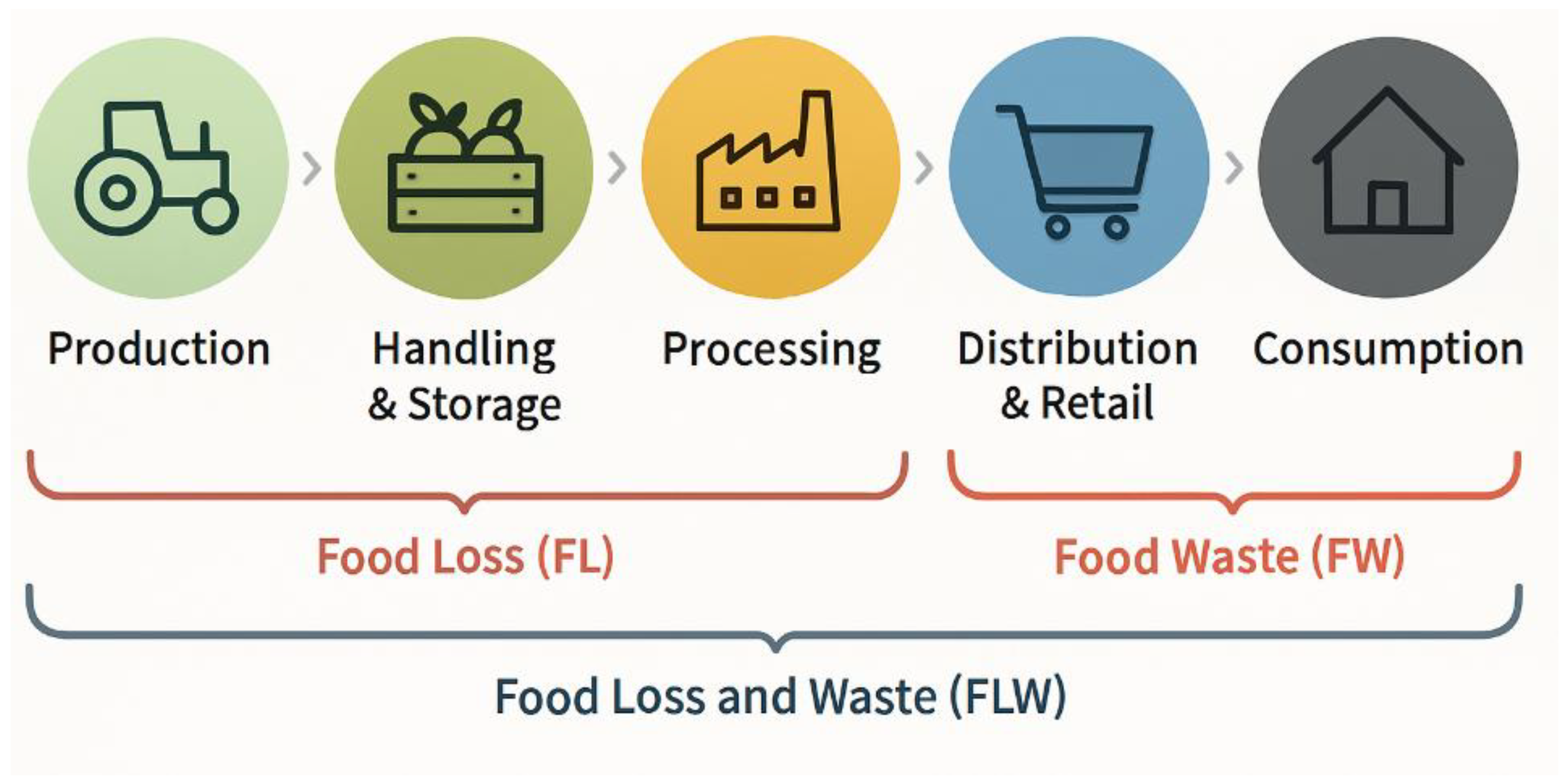
Figure 2.
Platform layers interaction.
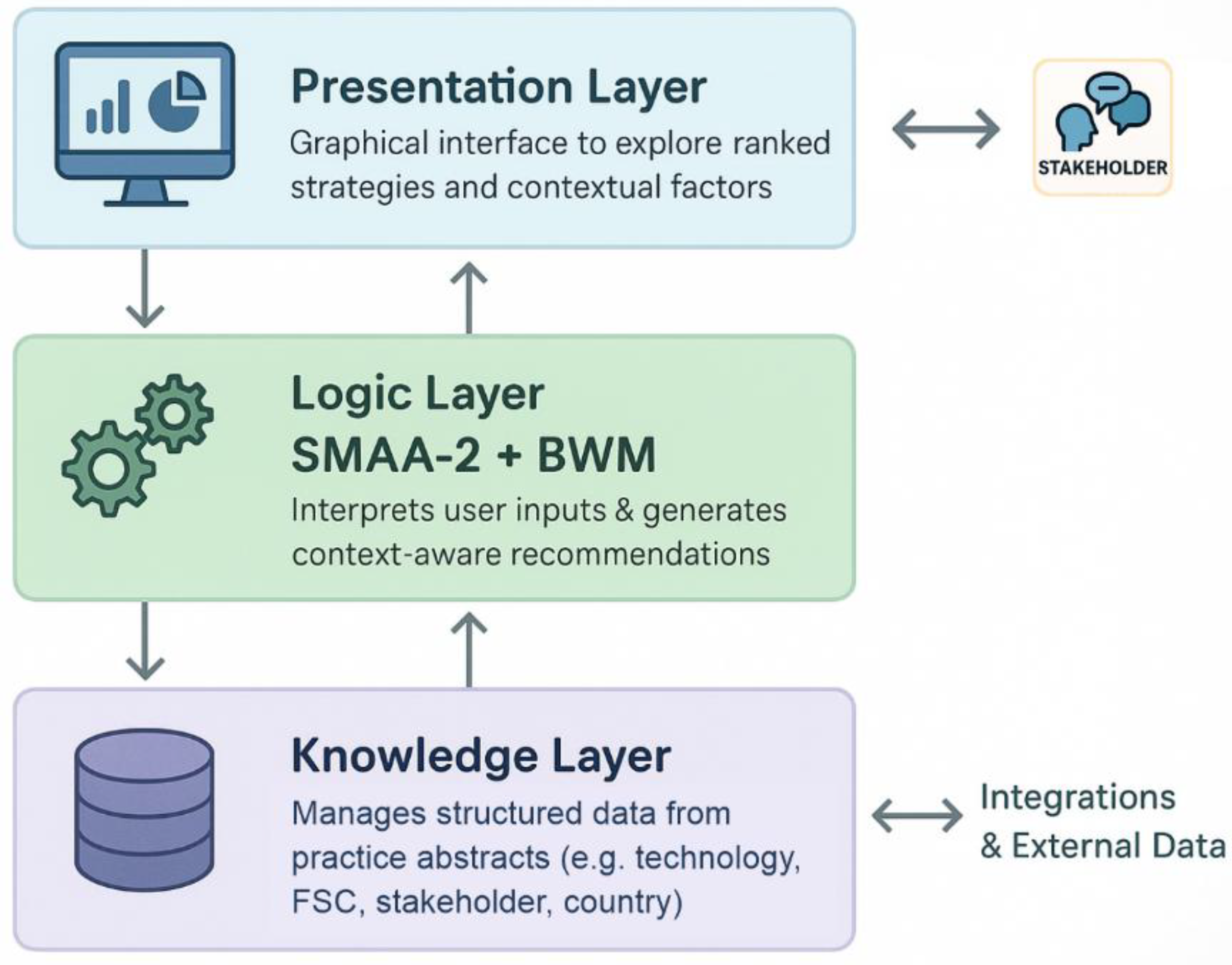
Figure 3.
Operational workflow of the proposed system.
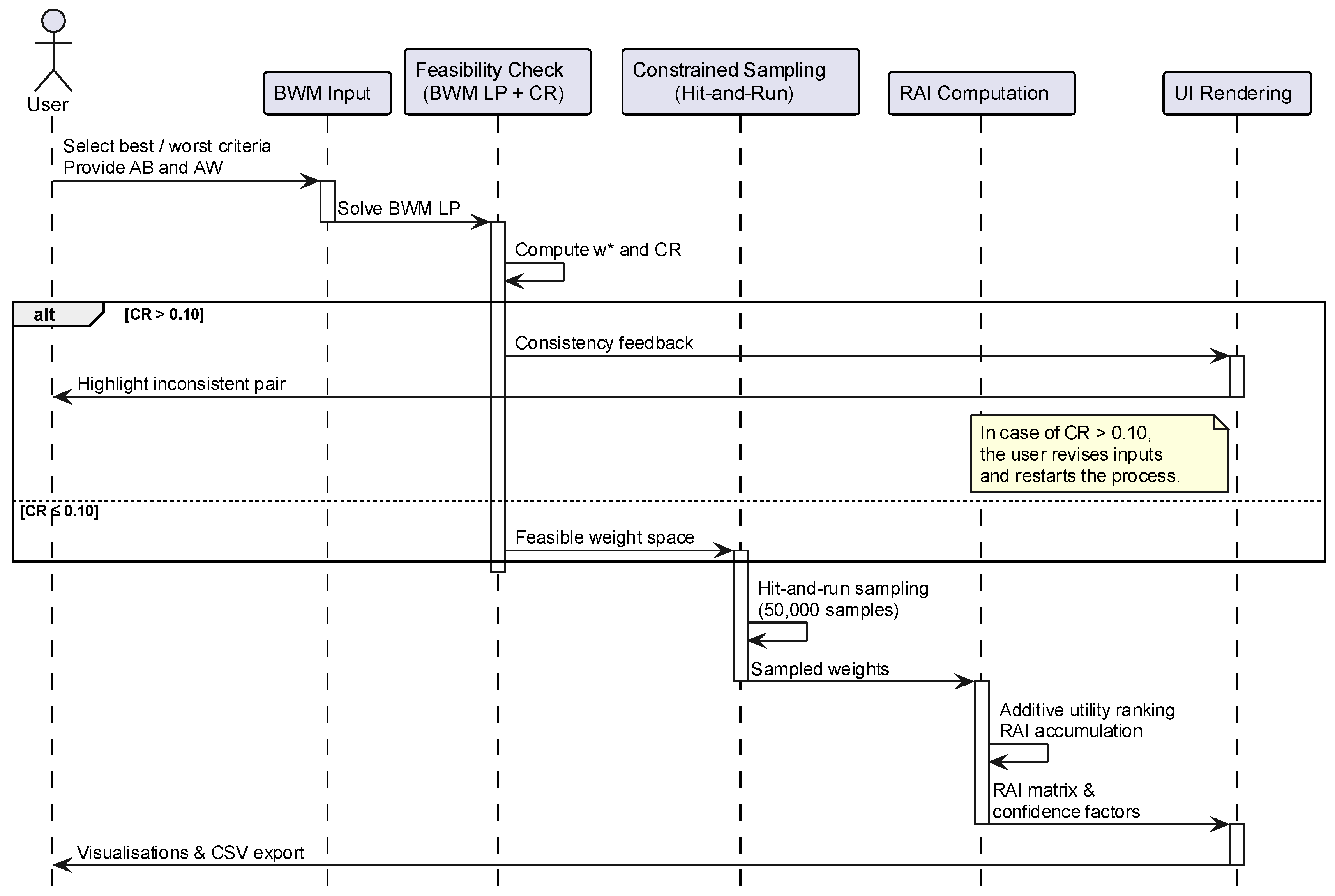

Table 1.
Comparing Existing Approaches with the Proposed Framework in FLW Mitigation.
| Dimension | Existing Approaches | Proposed Framework |
|---|---|---|
| Knowledge structuring | Scattered across a variety of articles, projects, and standalone platforms. |
A centralised digital repository encompassing structured and standardised information. |
| Accessibility | Technical content can be challenging for non-experts to comprehend. | User-friendly interface with clear language and intuitive navigation criteria. |
| Contextual relevance |
Generic recommendations often lack contextual grounding. |
Dynamic filters categorised by country/region, FSC, product type, user profile or technology. |
| Adaptive capacity |
Static approaches show limited flexibility in various contexts. |
Use SMAA-2 combined with BWM to customise suggestions based on contextual variables. |
| Comparability of strategies | Several methods are available to compare the effectiveness of similar solutions. | Multi-criteria evaluation framework featuring comparative metrics and practical application records. |
| Underlying technology | Concentrate on isolated technologies (e.g., blockchain, AI, IoT) without integration. | An integrated framework that combines multiple technologies with context-aware adaptability. |
| Practical application |
Implement pilot initiatives with limited replicability and a narrow case-based focus. | A modular and scalable platform designed for wider replication across different contexts and user groups. |
| Uncertainty handling | Often absent or implicit. | Explicitly modelled via SMAA-2 rank-acceptability profiles. |
| Reproducibility (code/data) | Limited: code and data are rarely shared. | Ensured via versioned code and fixed seeds. |
| Explainability to DMs | Low: typically uses opaque scoring or ad-hoc weighting. | High: provided through scoring ladders and central weight vectors. |
| Retrieval Mode | Mainly rule-based or simple keyword filters. | Hybrid: combines case-based similarity with rule-based constraints. |
| Target users | Often intended for researchers or large companies. | Concentrate on local decision-makers, small and medium-sized enterprises, and non-technical users. |
| Scalability | Limited scalability resulting from a lack of standardisation. | Scalable and continuously updated with new results and solutions. |
| Alignment with SDGs |
Indirect or partial contributions to the Sustainable Development Goals (SDGs). |
Direct support for SDG 12.3 through localised and measurable food waste reduction initiatives. |
Table 4.
Query 1 BWM – SMAA-2 rank acceptability.
| Abstract ID | Country | Product Category | Stakeholder | FSC Stage | Technology | Rank 1 | Rank 2 | Rank 3 | Most Likely Rank |
|---|---|---|---|---|---|---|---|---|---|
| A042 | Portugal | Fruits | Retailer | Distribution | Surplus Stock Software | 62% | 28% | 10% | 1 |
| A011 | Portugal | Vegetables | Retailer | Distribution | AI Stock Management |
23% | 49% | 28% | 2 |
| A028 | Portugal | Fruits | Retailer | Retail | Smart Scale | 9% | 15% | 60% | 3 |
| A019 | Portugal | Fruits | Retailer | Distribution | Blockchain | 4% | 6% | 2% | 4–6 |
| A037 | Italy | Fruits | Retailer | Processing | Blockchain | 1% | 2% | 0% | 5–6 |
| A009 | Portugal | Vegetables | Retailer | Distribution | AI Stock Management |
1% | 0% | 0% | 5–6 |
Table 5.
Query 2 BWM – SMAA-2 rank acceptability
| Abstract ID | Country | Product Category | Stakeholder | FSC Stage | Tool | Rank 1 | Rank 2 | Rank 3 | Most Likely Rank |
|---|---|---|---|---|---|---|---|---|---|
| A066 | France | Mixed | Services | Consumption | Computer Vision | 74% | 20% | 5% | 1 |
| A067 | France | Fruits | Services | Consumption | Computer Vision | 18% | 58% | 20% | 2 |
| A035 | France | Vegetables | Retailer | Retail | Computer Vision | 6% | 15% | 47% | 3–4 |
| A022 | Switzerland | Mixed | Services | Consumption | Computer Vision | 2% | 5% | 20% | 3–4 |
| A018 | France | Dairy | Services | Processing | AI Stock Management | 0% | 1% | 6% | 5–6 |
| A051 | Spain | Fruits | Services | Consumption | Smart Scale | 0% | 1% | 2% | 5–6 |
Table 6.
Platforms Comparison.
| Attribute | DSSAT (Platform) | Food Security FCM (Model) | Present Platform |
|---|---|---|---|
| Domain | Crop Modelling | Food Security and Waste Reduction | Food waste mitigation |
| Logic Type | Biophysical Simulation Models |
Fuzzy Cognitive Maps | BWM + SMAA-2 rules |
| Data Source | Climate history + Soil + Genetics |
Workshops with specialists and stakeholders | Simulated practice abstracts |
| Relevance Scoring | Income Forecast (Numerical Output) |
Centrality Indices (Network Analysis) |
Yes (SMAA-2 rank acceptability) |
| Supports Uncertainty |
Yes (Probabilistic Risk Analysis) |
Yes (Fuzzy Logic) | Yes (SMAA-2 rank acceptability) |
| Open-Source | Partial (Code accessible to collaborators) |
No (Replicable methodology) |
Planned (code/data) |
| Case-Based Reasoning |
No (Based on biological processes) |
No | Yes (similarity ladders) |
| Policy Orientation | Medium (Technical/scientific focus) |
High (Public Policy Planning) |
Medium (local policies) |
| References | [100] | [99] | This study |
Disclaimer/Publisher’s Note: The statements, opinions and data contained in all publications are solely those of the individual author(s) and contributor(s) and not of MDPI and/or the editor(s). MDPI and/or the editor(s) disclaim responsibility for any injury to people or property resulting from any ideas, methods, instructions or products referred to in the content. |
© 2026 by the authors. Licensee MDPI, Basel, Switzerland. This article is an open access article distributed under the terms and conditions of the Creative Commons Attribution (CC BY) license (http://creativecommons.org/licenses/by/4.0/).
Copyright: This open access article is published under a Creative Commons CC BY 4.0 license, which permit the free download, distribution, and reuse, provided that the author and preprint are cited in any reuse.


