

Submitted:
12 March 2026
Posted:
16 March 2026
You are already at the latest version
Abstract
Background: Post-stroke upper-limb spasticity can cause pain, hinder passive care, and lead to secondary musculoskeletal complications. Current minimally invasive treatments have important limitations. Cryoneurolysis, which creates a controlled cold lesion of peripheral nerves, may offer a partially reversible focal denervation alternative. Methods: We conducted a feasibility case series in the outpatient department of a rehabilitation center. Three adults with chronic post-stroke hemi-paresis and a non-functional spastic upper limb underwent ultrasound- and nerve stimula-tion-guided cryoneurolysis of the musculocutaneous, median, and/or ulnar nerves. All had demonstrated a positive response to diagnostic nerve blocks beforehand. Feasibility outcomes in-cluded completion of planned nerve targets, tolerability under local anesthesia, absence of serious adverse events, and completion of 6-month follow-up. Secondary outcomes were Modified Ash-worth Scale (MAS), qualitatively assessed passive joint mobility (video-documented), pain meas-ured by visual analogue scale, sensory testing, and electroneuromyography (ENMG). Results: All procedures were completed as planned. Treatment was well tolerated under local anesthesia, and no serious adverse events occurred. MAS decreased by at least 2 points in targeted patterns, with immediate improvement in passive mobility; these effects persisted at 6 months. Pain remained unchanged in two participants and improved in one. Sensory testing at 6 weeks was stable. ENMG findings were heterogeneous, including reduced ulnar sensory action potential amplitude and biceps denervation activity in one participant. Conclusions: In this small series, cryoneurolysis for post-stroke upper-limb spasticity was feasible and associated with sustained tone reduction and improved passive mobility. Larger controlled studies are required to better define safety, optimize targeting strategies, and assess patient-centered outcomes.
Keywords:
pilot
; spasticity
; cryoneurolysis
; pain
; stroke
1. Introduction
Spasticity is a frequent consequence of upper motor neuron lesions, including stroke, traumatic brain injury, spinal cord injury, multiple sclerosis, and cerebral palsy [1,2] In its strict neurophysiological definition, spasticity refers to a velocity-dependent increase in tonic stretch reflexes with exaggerated tendon jerks, reflecting increased excitability of the stretch reflex pathway [3,4,5]. In routine clinical practice, however, the term is often used more broadly to describe the positive features of the upper motor neuron syndrome, such as involuntary muscle overactivity, co-contractions, abnormal synergies and postures, spasms, clonus, and spastic dystonia [2,6,7]. Because these components may coexist and vary across patients, clarifying which manifestation is being targeted is essential when choosing and evaluating treatment.
In chronic post-stroke hemiparesis, upper-limb spasticity may contribute to rigid postures and impaired voluntary control, often in combination with sensory deficits. When left untreated, sustained muscle overactivity and immobility can promote secondary structural changes—including muscle–tendon shortening, joint stiffness, deformity—and may be associated with pain and skin/trophic complications [6,8]. Beyond impairment, spasticity-related upper-limb postures can interfere with hygiene, dressing, positioning, transfers, and caregiver assistance, and may negatively affect body image and participation [2,7]. Given the projected increase in stroke prevalence in Europe, scalable outpatient approaches that address spasticity-related disability remain highly relevant [9].
A persistent challenge is that spasticity is difficult to quantify with non-instrumental measures and different clinical scales show notable intra- and inter-rater variability [10,11,12,13]. This limitation is amplified when multiple joints are involved and when treatment aims extend beyond tone reduction, including comfort, ease of care, prevention of secondary complications, caregiver burden, autonomy, and quality of life [14,15,16,17,18] . Therefore, spasticity assessment is generally performed through a goal-oriented, multilayered, and comprehensive approach[19,20,21,22,23,24].
Current therapeutic strategies combine non-invasive rehabilitation approaches (e.g., physiotherapy, casting, orthoses, functional electrical stimulation, pharmacological agents) with minimally invasive and invasive procedures according to severity, distribution, and reversibility requirements [25,26,27] . Reversible or partly reversible interventions acting on the stretch reflex/motor overactivity pathway include intramuscular botulinum toxin injections [28,29,30,31,32] and chemical neurolysis with alcohol or phenol [33,34,35,36]. More invasive options include neurosurgical procedures (e.g., peripheral neurotomy, selective dorsal rhizotomy, intrathecal baclofen, neuromodulation) [37,38,39,40,41,42,43], and in selected cases, orthopedic surgery for fixed contractures or deformities [42,43,44] . Despite this armamentarium, access, cost, and workflow constraints may limit availability, and there remains a need for additional outpatient options that are technically feasible and scalable.
In clinical decision-making, an important step is distinguishing the contribution of dynamic muscle overactivity from fixed structural stiffness. Diagnostic motor nerve blocks can temporarily reduce reflex-mediated resistance to passive movement, thereby helping to identify whether limited mobility is primarily due to neural overactivity versus altered passive viscoelastic properties of muscles/tendons or joint structures In addition to supporting goal setting, diagnostic blocks can simulate the expected effect of interventions that reduce neural drive to the target muscles [45,46,47,48].
Cryoneurolysis (CNL) produces a focal, temperature-controlled lesion of a peripheral nerve using a cryoprobe, typically guided by ultrasound with optional electrical stimulation to refine targeting [49,50,51,52,53]. By inducing axonotmesis while preserving the connective tissue scaffold of the nerve (Sunderland grade II) [54,55,56,57] , CNL may allow functional recovery through axonal regeneration and has been used in interventional pain practice to provide prolonged regional analgesia [57,58,59,60,61,62,63,64,65]. There are some published preliminary applications of CNL in spasticity in humans [66,67,68,69,70,71,72,73] including a recent laboratory-verified post-stroke case reporting durable gait improvements after sequential motor-branches CNL [74], but key questions remain regarding feasibility in rehabilitation outpatient settings, tolerability, target selection (including mixed sensorimotor nerves), optimal dosing parameters (e.g., cycle number and duration), and neurophysiological safety signals.
The aim of this feasibility study was to evaluate whether ultrasound and stimulation-guided CNL of selected upper-limb peripheral nerves can be delivered in a rehabilitation outpatient setting, and to describe short- and medium-term changes in tone and ease of passive mobility, alongside pain, sensory testing, and electroneuromyography (ENMG) findings in a small post-stroke case series.
2. Materials and Methods
2.1. Study Design, Setting, and Ethics
We conducted a pilot and feasibility case series in the outpatient setting of the Centre National de Rééducation Fonctionnelle et de Réadaptation. The study was approved by the joint ethics committee of the CNRFR—Rehazenter and Hôpital Intercommunal de Steinfort (approval date: 16 July 2019) and was conducted in accordance with the Declaration of Helsinki. Written informed consent was obtained from all participants, including consent for video recordings.
This case series is reported in line with the Preferred Reporting of Case Series in Surgery (PROCESS) 2020 guideline [75]. However, this case series was not registered in a public registry because it was a local exploratory feasibility work.
2.2. Participants
Three post-stroke upper-limb chronic spastic hemiparetic outpatients were included. The participants’ general characteristics are listed in Table 1. Inclusion criteria were: (1) clinically stable status after stroke occurring >12 months previously; and (2) a non-functional spastic upper limb with Modified Ashworth Scale (MAS) score >2 in the main involved muscle groups (elbow flexors, forearm pronators, wrist flexors, and finger flexors). Exclusion criteria were: (1) cognitive impairment preventing informed decision-making; (2) concomitant invasive spasticity treatment within 4 months before the procedure and until end of follow-up; and (3) contraindications to CNL (cryoglobulinemia, paroxysmal cold hemoglobinuria, cold urticaria, Raynaud’s disease, and open/infected wounds at or near the treatment site).
Participants were recruited between August 2019 and October 2020. CNL procedures were performed between October 2019 and December 2019. Follow-up assessments were completed through 6 months post-procedure; the last follow-up visit occurred in June 2020. Participants were identified through the outpatient setting and were invited to participate if they met eligibility criteria and had goals focused on comfort and passive care of a non-functional upper limb. Cases were non-consecutive during the recruitment period. To ensure de-identification, participants are reported using coded identifiers (#1–#3), and potentially identifying details (exact dates, facial features in images/videos) were removed or obscured in published materials.
All participants presented a similar upper-limb spastic posture (shoulder internal rotation/adduction, elbow flexion, forearm pronation, wrist flexion, clenched hand), corresponding to a previously described upper-limb pattern [76].
2.3. Pre-Procedure Diagnostic Nerve Block (Target Confirmation)
Before cryoneurolysis (CNL), an ultrasound- and nerve stimulation-guided diagnostic motor nerve block was performed for each selected target nerve. A total of 1 mL of 1% lidocaine was injected per nerve using a 50 mm insulated stimulation needle connected to a B. Braun® Stimuplex HNS 12 nerve stimulator (Mesungen, Germany). Ultrasound guidance provided by a GE Logiq S8 and a 6-15 MHz linear probe (General Electric, Boston, MA, USA). Stimulation consisted of rectangular pulses with a duration of 1 ms and a frequency of 1 Hz. The current intensity was initially set at 2 mA and progressively decreased to determine the minimal stimulation threshold, defined as a motor response elicited at less than 0.5 mA.
The diagnostic block was used to support target selection by confirming that the limitation in passive mobility was predominantly due to neural overactivity rather than fixed rheological or structural stiffness. A block was considered positive when a clear reduction in resistance to passive movement was observed, with improved ease of passive mobilization and/or a visible gain in range within the targeted movement pattern.
2.4. Cryoneurolysis Procedure
All procedures (Figure 1A) were performed under strict aseptic conditions by a single operator (J.A.P.), a physician experienced in ultrasound-guided peripheral nerve interventions. Participants were positioned supine. The treated upper limb was positioned with the shoulder in abduction and external rotation, the elbow extended, and the forearm supinated, as tolerated and as required to ensure adequate ultrasound access to the target nerves. The limb was supported to maintain stability while facilitating visualization in the axillary region (musculocutaneous nerve) and along the medial distal arm (median and ulnar nerves). Percutaneous cryoneurolysis was performed using a CO₂-based system (Metrum Cryoflex, Warsaw, Poland) (Figure 1B) under ultrasound guidance with a Logiq S8 device equipped with a 6–15 MHz linear probe.
Electrical stimulation, integrated into the Metrum Cryoflex system, was delivered at 1 Hz with a pulse duration of 0.1 ms. The current was initially set at 2 mA and gradually decreased to determine the lowest motor threshold. Adequate targeting required clear ultrasound visualization of the nerve at the tip of the probe combined with a selective motor response—corresponding to contraction of muscles innervated respectively by the musculocutaneous, median, or ulnar nerve—elicited at ≤ 0.5 mA. Patient #1 did not undergo ulnar nerve cryoneurolysis.
For each targeted nerve, two consecutive freezing cycles of 2.5 minutes were delivered, separated by a 1-minute passive thaw interval. Temperatures were expected to reach approximately −72 to −75 °C at the probe tip (ice-ball core) and around −40 °C in the surrounding tissue, depending on local heat sink effects. Single-use straight cryoprobes were employed (120 mm length, 1.3 mm diameter [16G], triangular tip) Figure 1C. A 14G trocar cannula was used to guide probe insertion through the skin and subcutaneous tissue and to protect the skin during the procedure. Previously, local anaesthesia with 1 mL of 1% Xylocaine was administered in the superficial fascial plane and subcutaneous tissue at the skin entry site of the trocar cannula and cryoprobe.
Participants continued usual care (physiotherapy and/or occupational therapy focused on positioning, stretching, and hygiene-related handling) during follow-up; no additional invasive spasticity procedures were performed during the study period.
2.5. Outcomes and Follow-Up Schedule
Follow-up visits and assessments were conducted in the outpatient rehabilitation setting at baseline (week before procedure), immediate post-procedure, 6 weeks, and up to 6 months post-procedure (Figure 2). No participants were lost to follow-up.
To reduce inter-case variability and to support consistent documentation, outcomes were assessed using a standardized follow-up schedule and a standardized video protocol (same patient positioning, maneuver sequence, and camera viewpoint when feasible).
Primary (feasibility) qualitative outcomes were: (1) technical completion of planned targets; (2) tolerability under local anaesthesia (including pain during the procedure); (3) adverse events and serious adverse events; and (4) completion of planned follow-up. Dysesthesia, new neuropathic pain, skin injury, infection, hematoma, motor deficit beyond expected were the adverse events that were actively looked for.
Secondary outcomes included spasticity clinical assessment with MAS and standardized video recordings before/during/after the procedure to document changes in posture and passive mobility. Passive mobility was assessed qualitatively during standardized clinical handling and documented by video recordings. The examiner evaluated the ease of passive mobilization and resistance to passive movement during passive elbow extension, forearm supination, wrist extension, and passive finger opening in the spastic upper limb.
Videos were used to document observable changes in posture and the ease of passive mobilization; they were not used to quantify joint angles. No goniometric measurements were performed. Therefore, results are reported as changes in muscle tone using the Modified Ashworth Scale and as qualitative changes in passive sequential joint mobility, rather than as measurements of passive range of motion. Video capture has been used in previous cryoneurolysis reports in spasticity to document pre- and post-intervention clinical examination findings and to illustrate both technique and outcomes [77].
Feasibility endpoints were assessed descriptively and were considered met when all planned targets were treated, follow-up was completed, no serious adverse events occurred, and the procedure was tolerated under local anaesthesia.
2.6. Pain and Sensory Testing
Pain and sensory testing were performed by the same occupational therapist 2 weeks before and 6 weeks after CNL. Neuropathic pain screening used the DN4 questionnaire [78]. Pain intensity was recorded on a visual analogue scale (VAS). Sensory testing in the distribution of the lateral antebrachial cutaneous nerve (terminal sensory branch of the musculocutaneous nerve) included pressure perception threshold, static two-point discrimination, and thermal sensation.
2.7. Electroneuromyography
To document peripheral nerve integrity and electrophysiological changes, ENMG was performed 1 week before and 6 weeks after the intervention by an experienced physician. Nerve conduction studies included motor and sensory studies (action potential amplitude, conduction velocity, and F-wave latency) for the median and ulnar nerves. Needle EMG examined the biceps brachii, abductor digiti minimi, first dorsal interosseous, and abductor pollicis muscles, and was specifically used to assess the presence of spontaneous activity (fibrillation potentials and positive sharp waves) in muscles innervated by the cryoneurolyzed nerve, in order to detect possible post-procedural denervation changes.
2.8. Statistical Analysis
Given the small sample size and feasibility design, analyses were descriptive.
3. Results
3.1. Participant Characteristics and Targets
Three chronic post-stroke hemiparetic outpatients (2 men; age range 34–58 years) with a non-functional spastic upper limb were included (Table 1). Time from stroke to CNL ranged from 22 to 36 months. Two participants had hemorrhagic stroke and one had ischemic stroke.
CNL targeted the musculocutaneous and median nerves in all participants; the ulnar nerve was additionally treated in participants #2 and #3 (Table 2). Ulnar nerve CNL was not planned for participant #1 based on pre-procedure target selection.
3.2. Feasibility and Safety Observations
All planned CNL targets were treated as intended, and follow-up assessments were completed as scheduled. No procedure-related complications (e.g., infection, hematoma, skin injury, new neuropathic pain, or unexpected motor deficit) were observed during follow-up. Pain outcomes were unchanged or improved, and no clinically meaningful sensory loss was reported on bedside sensory testing. No clinically apparent autonomic/vegetative changes (temperature or sweating) were noted following the procedure.
3.3. Clinical Spasticity Outcomes (Tone and Joint Mobility)
All three participants demonstrated improvement in spasticity severity at the treated patterns, with a >2-point reduction in MAS for the targeted muscle groups (elbow flexors, forearm pronators, wrist and finger flexors) (Table 2).
The decrease in hypertonicity, changes in posture and improved passive mobility persisted for at least 6 months (Figure 4). Immediate post-procedure changes in posture and passive mobility were also visible in the clinical recordings (Figure 5).
3.4. Pain, Sensory Testing and Ease of Care
DN4 remained unchanged in participants #1 and #3 (0→0) and decreased in participant #2 (6→5). VAS was unchanged in participants #1 and #3 (0→0) and improved in participant #2 (5.5→0).
Sensory testing showed preserved thermal sensation before and after CNL in participants #1 and #2; participant #3 had absent two-point discrimination and impaired hot temperature perception both before and after. Pressure threshold decreased in participant #1 (1 g→0.4 g) and was unchanged in participants #2 and #3 (0.7 g→0.7 g). Two-point discrimination was unchanged in participants #1 and #2.
All participants reported improved ease of passive care (e.g., easier hand opening and hygiene handling) after the procedure; no participant reported new unpleasant sensory symptoms at follow-up.
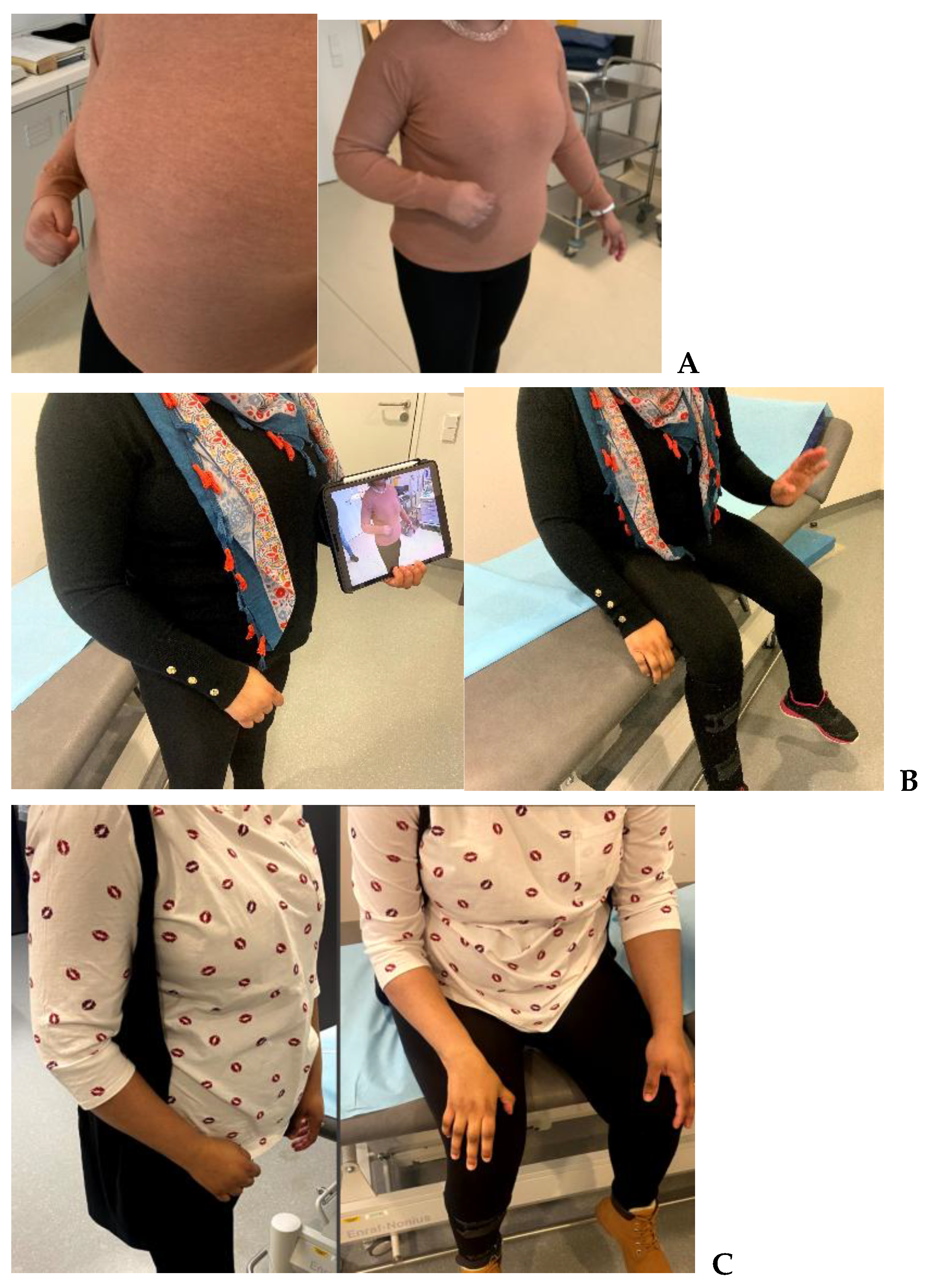
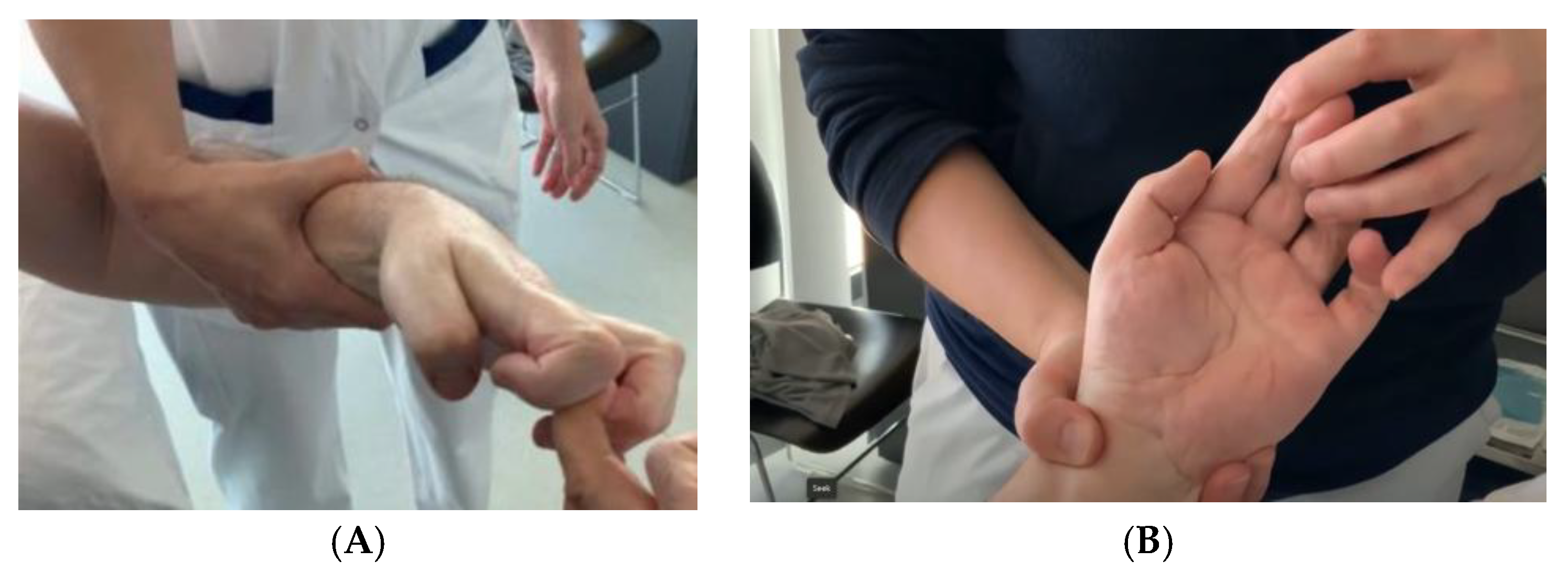
Figure 3.
Effect of cryoneurolysis before (A), 3 months (B) and 6 months (C) after the cryoneurolysis of musculocutaneous, median and ulnar nerves of patient #2.
Figure 3.
Effect of cryoneurolysis before (A), 3 months (B) and 6 months (C) after the cryoneurolysis of musculocutaneous, median and ulnar nerves of patient #2.
Figure 4.
Left spastic wrist and hand before procedure for upper limb in patient #3 (A). Note that the hand is easily opened after the procedure (B).
Figure 4.
Left spastic wrist and hand before procedure for upper limb in patient #3 (A). Note that the hand is easily opened after the procedure (B).
3.5. Electroneuromyography Findings
Electrophysiological findings were heterogeneous (Table 2). Participant #1 showed no change in median nerve motor amplitudes or conduction studies, which were normal at baseline, and no spontaneous denervation activity on post-intervention needle EMG. Participant #2 had no change in median and ulnar motor/sensory amplitudes, conduction velocities, or F-wave latency (baseline normal), although post-intervention EMG interpretation was limited by spasms. Participant #3 had stable median nerve conduction parameters and normal EMG in the first dorsal interosseous and abductor pollicis brevis; however, the ulnar sensory action potential amplitude decreased from ~30% pre-intervention to ~60% post-intervention, with preserved F-wave latency, and biceps brachii EMG showed spontaneous denervation activity (fibrillation potentials and positive sharp waves) after CNL (Table 2).
4. Discussion
This feasibility case series examined whether ultrasound- and stimulation-guided CNL targeting upper-limb peripheral nerves can be delivered in an outpatient rehabilitation setting and whether a multidimensional follow-up (clinical and neurophysiological) can be completed. All planned procedures were completed as intended and follow-up data were obtained, supporting procedural feasibility within this care pathway. Clinically, all participants demonstrated a reduction in hypertonicity with improved qualitatively observed passive mobility (video-documented) in the targeted patterns, and these changes were observed immediately after the intervention and persisted through the 6-month clinical follow-up.
Importantly, passive mobility outcomes in this study were qualitatively observed rather than quantified by goniometry or Modified Tardieu angles. The clinically relevant construct was the ease of passive mobilization (e.g., ease of elbow extension, forearm supination, wrist/finger opening) during routine handling, which is directly aligned with common patient- and caregiver-centered goals in a non-functional spastic upper limb (comfort, hygiene, dressing, positioning, and prevention of secondary complications). This distinction should be considered when interpreting “mobility” in the present case series and when designing future studies that aim to quantify angular changes.
From a mechanistic perspective, CNL is generally considered to induce an axonotmesis-type lesion while preserving the connective-tissue scaffolding of the nerve, which may facilitate regeneration and functional recovery [55,56]. This theoretical reversibility is one reason CNL is attractive as an alternative to more destructive procedures in selected cases. In contrast, chemical neurolysis with phenol or alcohol has a long-standing role in spasticity management but may be associated with neuritis/dysesthesia and local tissue effects, and risk–benefit considerations can be more complex when treating mixed sensorimotor nerves [35,36,37,38,39]. Accordingly, CNL may be clinically appealing when mixed nerves are relevant targets, if patients are counselled regarding the possibility of sensory change and that monitoring is systematic.
Our findings also support considering CNL as part of goal-oriented, multimodal spasticity management rather than as a stand-alone intervention. Because its effect is observable immediately after treatment, CNL enables a stepwise approach across sequential sessions. Subsequent sessions may then include interventions with a slower onset of action, such as botulinum toxin injections [28,29,32]. In principle, CNL could also be used to address broader spasticity patterns (e.g., through mixed nerves or major motor branches), potentially allowing botulinum toxin dosing to be focused on individual muscles that are difficult to access with CNL or where fine-tuning and toxin-sparing strategies are desirable.
However, the clinical value of combined sessions, optimal sequencing, and the incremental benefit over usual care remain unknown and require evaluation in controlled studies [79].
Cryoneurolysis (CNL) represents an innovative therapeutic option for patients with spasticity who have reached a plateau in their functional response to conventional treatments.[71] By reducing spastic overactivity, CNL may also optimize the use of functional electrical stimulation (FES) neuroorthoses and enhance their functional effectiveness [74].
Compared with surgical options such as peripheral nerve neurotomy, CNL is percutaneous and can be performed under local anaesthesia, potentially reducing procedural burden and peri-procedural risk [58,77]. At the same time, wider implementation may be limited by equipment costs, the need for training in peripheral nerve sonoanatomy and ultrasound-guided interventions, and the currently limited evidence base in spasticity relative to interventional pain practice. These constraints highlight the importance of pragmatic feasibility reporting and shared protocols to standardize target selection and dosing parameters.
Safety interpretation deserves particular attention. Clinically, no new sensory deficit was detected on bedside testing at 6 weeks. However, ENMG findings were heterogeneous and included changes in one participant that warrant cautious interpretation (e.g., further reduction in ulnar sensory action potential amplitude and denervation activity in the biceps). Importantly, cryoneurolysis is known to induce a reversible axonotmesis through Wallerian degeneration distal to the lesion while preserving the connective tissue architecture of the nerve. Therefore, the presence of denervation activity on needle EMG may represent an expected electrophysiological consequence of the mechanism of action of the technique rather than a pathological complication.
Although the small sample size precludes any inference about frequency, these observations support the need for systematic neurophysiological monitoring in future studies, particularly when mixed nerves are targeted. They also suggest that future protocols should explore whether targeting more distal motor branches or intramuscular nerve branches can improve the balance between motor benefit and sensory/autonomic safety. In addition to standardized adverse-event reporting, future protocols could explicitly compare mixed-nerve targeting versus more distal motor-branch targeting to test whether motor benefit can be retained while reducing sensory risk signals.
Beyond feasibility in a single center, implementation will depend on local workflow and expertise. The technique requires training in ultrasound-guided peripheral nerve identification and stimulation mapping and may be most effective when embedded in a structured post-procedure rehabilitation program to consolidate newly available movement patterns. Procedural costs vary across health systems, and formal cost-effectiveness analyses are not yet available; these considerations should be incorporated into future pragmatic evaluations.
Strengths of this case series include standardized targeting confirmed by diagnostic nerve blocks, the use of ultrasound and stimulation to support procedural reproducibility, and multimodal follow-up including clinical outcomes, sensory testing, and ENMG. However, several limitations should be acknowledged. First, this feasibility case series was not designed to establish efficacy and included only three participants; results may not generalize across etiologies, spasticity patterns, or levels of residual voluntary function. Second, Second, outcomes were largely descriptive and clinically oriented; more standardized quantification of passive stiffness/biomechanics and patient-centered endpoints (comfort, ease of care, caregiver burden, participation) would strengthen future trials. Third, although immediate changes were observed, durability and optimal re-treatment intervals remain uncertain and may depend on freezing parameters (cycle duration, number of cycles), nerve characteristics, and the balance between neural and structural contributors to resistance.
Future studies should combine feasibility endpoints with a minimal, reproducible outcomes set: Modified Tardieu Scale angles and/or goniometry for passive joint excursion, goal attainment (e.g., hygiene/dressing/positioning goals), caregiver burden measures, and patient-centered outcomes. Where feasible, objective markers of re-innervation and function (e.g., dynamometry and structured electrophysiology) may help characterize dose–response relationships and durability, while instrumented movement analysis can strengthen causal attribution in selected subgroups
Supplementary Materials
The following supporting information can be downloaded at the website of this paper posted on Preprints.org.
Author Contributions
Conceptualization, José Alexandre Pereira.; methodology, José Alexandre Pereira.; software, non-applicable.; validation, José Alexandre Pereira, Frédéric Dierick; formal analysis, Frédéric Chantraine, Frédéric Dierick.; investigation, José Alexandre Pereira ; resources, Frédéric Dierick; data curation, José Alexandre Pereira; writing—original draft preparation, José Alexandre Pereira; writing—review and editing, José Alexandre Pereira, Frédéric Chantraine, Céline Schreiber, Tanja Classen, Evangelia Agneskis, Laurence Medinger, Frédéric Dierick; supervision, Frédéric Dierick.; project administration, José Alexandre Pereira; funding acquisition, José Alexandre Pereira. All authors have read and agreed to the published version of the manuscript.
Funding
J.A.P. was supported by the Clinical Research Program of the Luxembourgish Ministry of Health and Social Security for the spastiCRYO (study on the efficacy of selected peripheral nerves cryoneurolysis to treat the functional problems, disability burden, and pain caused by spasticity due to central nervous system pathology) project. J.A.P. was supported by Metrum Cryoflex Sp. z o.o. (Poland) for the free loan of the cryosurgery device.
Institutional Review Board Statement
The study was conducted in accordance with the principles of the Declaration of Helsinki (1975, revised in 2013). The protocol was reviewed and approved by the joint ethics committee of the Centre National de Rééducation Fonctionnelle et de Réadaptation—Rehazenter and Hôpital Intercommunal de Steinfort (approval date: 16 July 2019).
Informed Consent Statement
Written informed consent was obtained from the patients for the publication of this case series and any potentially identifiable images or clinical data included in the article.
Data Availability Statement
The de-identified videos supporting the findings are provided as Supplementary Materials (Videos S1–S2). Access to any additional de-identified materials can be granted upon reasonable request, subject to ethics and consent constraints.
Conflicts of Interest
The authors declare that they have no conflict of interest.
References
- Barnes, M.P.; Johnson, G.R. Upper Motor Neurone Syndrome and Spasticity: Clinical Management and Neurophysiology.
- In Spasticity: Diagnosis and Management, Second edition.; Spasticity: Diagnosis and Management; Brashear, A., Elovic, E., Eds.; Second edition.; Demos: New York, 2016; ISBN 978-1-62070-072-3.
- Sheean, G. The Pathophysiology of Spasticity. Eur J Neurol 2002, 9, 3–9. [CrossRef]
- Nielsen, J.B.; Crone, C.; Hultborn, H. The Spinal Pathophysiology of Spasticity ? From a Basic Science Point of View. Acta Physiol 2007, 189, 171–180. [CrossRef]
- Ward, A.B. A Literature Review of the Pathophysiology and Onset of Post-Stroke Spasticity: Post-Stroke Spasticity: Pathophysiology and Onset. European Journal of Neurology 2012, 19, 21–27. [CrossRef]
- Li, S.; Francisco, G.E. New Insights into the Pathophysiology of Post-Stroke Spasticity. Front. Hum. Neurosci. 2015, 9. [CrossRef]
- Lorentzen, J.; Pradines, M.; Gracies, J.-M.; Bo Nielsen, J. On Denny-Brown’s ‘Spastic Dystonia’ – What Is It and What Causes It? Clinical Neurophysiology 2018, 129, 89–94. [CrossRef]
- Neurological Rehabilitation: Spasticity and Contractures in Clinical Practice and Research; Pandyan, A., Hermens, H.J., Conway, B.A., Eds.; Rehabilitation science in practice series; CRC Press/Taylor & Francis Group: Boca Raton, FL, 2018; ISBN 978-1-4665-6544-9.
- Wafa, H.A.; Wolfe, C.D.A.; Emmett, E.; Roth, G.A.; Johnson, C.O.; Wang, Y. Burden of Stroke in Europe: Thirty-Year Projections of Incidence, Prevalence, Deaths, and Disability-Adjusted Life Years. Stroke 2020, 51, 2418–2427. [CrossRef]
- Pandyan, A.D.; Price, C.I.M.; Rodgers, H.; Barnes, M.P.; Johnson, G.R. Biomechanical Examination of a Commonly Used Measure of Spasticity. Clinical Biomechanics 2001, 16, 859–865. [CrossRef]
- Malhotra, S.; Pandyan, A.; Day, C.; Jones, P.; Hermens, H. Spasticity, an Impairment That Is Poorly Defined and Poorly Measured. Clin Rehabil 2009, 23, 651–658. [CrossRef]
- Pandyan, A.; Gregoric, M.; Barnes, M.; Wood, D.; Wijck, F.V.; Burridge, J.; Hermens, H.; Johnson, G. Spasticity: Clinical Perceptions, Neurological Realities and Meaningful Measurement. Disability and Rehabilitation 2005, 27, 2–6. [CrossRef]
- Fleuren, J.F.M.; Voerman, G.E.; Erren-Wolters, C.V.; Snoek, G.J.; Rietman, J.S.; Hermens, H.J.; Nene, A.V. Stop Using the Ashworth Scale for the Assessment of Spasticity. Journal of Neurology, Neurosurgery & Psychiatry 2010, 81, 46–52. [CrossRef]
- Aloraini, S.M.; Gäverth, J.; Yeung, E.; MacKay-Lyons, M. Assessment of Spasticity after Stroke Using Clinical Measures: A Systematic Review. Disability and Rehabilitation 2015, 37, 2313–2323. [CrossRef]
- Johnson, G.R. Outcome Measures of Spasticity. Euro J of Neurology 2002, 9, 10–16. [CrossRef]
- Alhusaini, A.A.A.; Dean, C.M.; Crosbie, J.; Shepherd, R.B.; Lewis, J. Evaluation of Spasticity in Children With Cerebral Palsy Using Ashworth and Tardieu Scales Compared With Laboratory Measures. J Child Neurol 2010, 25, 1242–1247. [CrossRef]
- Shu, X.; McConaghy, C.; Knight, A. Validity and Reliability of the Modified Tardieu Scale as a Spasticity Outcome Measure of the Upper Limbs in Adults with Neurological Conditions: A Systematic Review and Narrative Analysis. BMJ Open 2021, 11, e050711. [CrossRef]
- Morris, S. Ashworth And Tardieu Scales: Their Clinical Relevance For Measuring Spasticity In Adult And Paediatric Neurological Populations. Physical Therapy Reviews 2002, 7, 53–62. [CrossRef]
- Hanlan, A.; Mills, P.; Lipson, R.; Finlayson, H. Interdisciplinary Spasticity Management Clinic Outcomes Using the Goal Attainment Scale: A Retrospective Chart Review. J Rehabil Med 2017, 49, 423–430. [CrossRef]
- Turner-Stokes, L.; Jacinto, J.; Fheodoroff, K.; Brashear, A.; Maisonobe, P.; Lysandropoulos, A.; group, S. Longitudinal Goal Attainment with Integrated Upper Limb Spasticity Management Including Repeat Injections of Botulinum Toxin A: Findings from the Prospective, Observational Upper Limb International Spasticity (ULIS-III) Cohort Study. J Rehabil Med 2021, 53, jrm00157. [CrossRef]
- Turner-Stokes, L.; Fheodoroff, K.; Jacinto, J.; Lambert, J.; De La Loge, C.; Calvi-Gries, F.; Whalen, J.; Lysandropoulos, A.; Maisonobe, P.; Ashford, S. The Spasticity-Related Quality of Life 6-Dimensions Instrument in Upper-Limb Spasticity: A First Psychometric Evaluation. JRM 2021. [CrossRef]
- Jacinto, J.; Camões-Barbosa, A.; Carda, S.; Hoad, D.; Wissel, J. A Practical Guide to Botulinum Neurotoxin Treatment of Shoulder Spasticity 1: Anatomy, Physiology, and Goal Setting. Front. Neurol. 2022, 13, 1004629. [CrossRef]
- Molteni, F.; Wissel, J.; Fheodoroff, K.; Munin, M.C.; Patel, A.T.; Althaus, M.; Comes, G.; Dekundy, A.; Pulte, I.; Scheschonka, A.; et al. Improvement in Quality-of-Life-Related Outcomes Following Treatment with IncobotulinumtoxinA in Adults with Limb Spasticity: A Pooled Analysis. Toxins 2023, 16, 19. [CrossRef]
- Gasperini, G.; Rota, M.; Guanziroli, E.; Bissolotti, L.; Balestrieri, F.; Chisari, C.; Currà, A.; Del Felice, A.; Farina, N.; Manganotti, P.; et al. Development and Rasch Validation of an Observational Assessment Tool of Upper Limb Functional Impairment in Stroke Survivors: Functional Assessment Test for Upper Limb. Archives of Physical Medicine and Rehabilitation 2023, 104, 597–604. [CrossRef]
- Khan, F.; Amatya, B.; Bensmail, D.; Yelnik, A. Non-Pharmacological Interventions for Spasticity in Adults: An Overview of Systematic Reviews. Annals of Physical and Rehabilitation Medicine 2019, 62, 265–273. [CrossRef]
- Picelli, A.; Santamato, A.; Chemello, E.; Cinone, N.; Cisari, C.; Gandolfi, M.; Ranieri, M.; Smania, N.; Baricich, A. Adjuvant Treatments Associated with Botulinum Toxin Injection for Managing Spasticity: An Overview of the Literature. Annals of Physical and Rehabilitation Medicine 2019, 62, 291–296. [CrossRef]
- Baricich, A.; Picelli, A.; Carda, S.; Smania, N.; Cisari, C.; Santamato, A.; De Sire, A.; Invernizzi, M. Electrical Stimulation of Antagonist Muscles after Botulinum Toxin Type A for Post-Stroke Spastic Equinus Foot. A Randomized Single-Blind Pilot Study. Annals of Physical and Rehabilitation Medicine 2019, 62, 214–219. [CrossRef]
- Esquenazi, A.; Mayer, N.H.; Elia, A.E.; Albanese, A. Botulinum Toxin for the Management of Adult Patients with Upper Motor Neuron Syndrome. Toxicon 2009, 54, 634–638. [CrossRef]
- Das, T.K.; Park, D.M. Effect of Treatment with Botulinum Toxin on Spasticity. Postgraduate Medical Journal 1989, 65, 208–210. [CrossRef]
- Mancini, F.; Sandrini, G.; Moglia, A.; Nappi, G.; Pacchetti, C. A Randomised, Double-Blind, Dose-Ranging Study to Evaluate Efficacy and Safety of Three Doses of Botulinum Toxin Type A (Botox) for the Treatment of Spastic Foot. Neurol Sci 2005, 26, 26–31. [CrossRef]
- Gracies, J.-M. Physiological Effects of Botulinum Toxin in Spasticity. Mov Disord. 2004, 19, S120–S128. [CrossRef]
- Simpson, D.M.; Alexander, D.N.; O’Brien, C.F.; Aswad, A.; Leon, J.M.; Mordaunt, J.M.; Monaghan, E.P. Botulinurn Toxin Type A in the Treatment of Upper Extremity Spasticity:.
- Karri, J.; Mas, M.; Francisco, G.; Li, S. Practice Patterns for Spasticity Management with Phenol Neurolysis. J Rehabil Med 2017, 49, 482–488. [CrossRef]
- Karri, J.; Zhang, B.; Li, S. Phenol Neurolysis for Management of Focal Spasticity in the Distal Upper Extremity. PM&R 2020, 12, 246–250. [CrossRef]
- Wood, K.M. The Use of Phenol as a Neurolytic Agent: A Review: Pain 1978, 5, 205–229. [CrossRef]
- Bakheit, A.; Badwan, D.; McLellan, D. The Effectiveness of Chemical Neurolysis in the Treatment of Lower Limb Muscle Spasticity. Clin Rehabil 1996, 10, 40–43. [CrossRef]
- Sindou, M.P.; Simon, F.; Mertens, P.; Decq, P. Selective Peripheral Neurotomy (SPN) for Spasticity in Childhood. Childs Nerv Syst 2007, 23, 957–970. [CrossRef]
- Dauleac, C.; Sindou, M.; Mertens, P. How I Do It: Selective Tibial Neurotomy. Acta Neurochir 2020, 162, 1921–1923. [CrossRef]
- Sindou, M.P.; Mertens, P. Surgery in the Dorsal Root Entry Zone for Spasticity in Adults. Operative Techniques in Neurosurgery 2004, 7, 157–162. [CrossRef]
- Thomas, S.P.; Addison, A.P.; Curry, D.J. Surgical Tone Reduction in Cerebral Palsy. Physical Medicine and Rehabilitation Clinics of North America 2020, 31, 91–105. [CrossRef]
- Deltombe, T.; Lejeune, T.; Gustin, T. Botulinum Toxin Type A or Selective Neurotomy for Treating Focal Spastic Muscle Overactivity? Annals of Physical and Rehabilitation Medicine 2019, 62, 220–224. [CrossRef]
- Lazorthes, Y.; Sol, J.; Sallerin, B.; Verdié, J. The Surgical Management of Spasticity. Euro J of Neurology 2002, 9, 35–41. [CrossRef]
- Genêt, F.; Denormandie, P.; Keenan, M.A. Orthopaedic Surgery for Patients with Central Nervous System Lesions: Concepts and Techniques. Annals of Physical and Rehabilitation Medicine 2019, 62, 225–233. [CrossRef]
- Hashemi, M.; Sturbois-Nachef, N.; Keenan, M.A.; Winston, P. Surgical Approaches to Upper Limb Spasticity in Adult Patients: A Literature Review. Front. Rehabilit. Sci. 2021, 2, 709969. [CrossRef]
- Filipetti, P.; Decq, P. Interest of anesthetic blocks for assessment of the spastic patient. A series of 815 motor blocks. Neurochirurgie 2003, 49(2-3 Pt 2):226-38.
- Genet, F.; Schnitzler, A.; Droz-Bartholet, F.; Salga, M.; Tatu, L.; Debaud, C.; Denormandie, P.; Parratte, B. Successive Motor Nerve Blocks to Identify the Muscles Causing a Spasticity Pattern: Example of the Arm Flexion Pattern. J. Anat. 2017, 230, 106–116. [CrossRef]
- Yelnik, A.P.; Hentzen, C.; Cuvillon, P.; Allart, E.; Bonan, I.V.; Boyer, F.C.; Coroian, F.; Genet, F.; Honore, T.; Jousse, M.; et al. French Clinical Guidelines for Peripheral Motor Nerve Blocks in a PRM Setting. Annals of Physical and Rehabilitation Medicine 2019, 62, 252–264. [CrossRef]
- Buffenoir, K.; Decq, P.; Lefaucheur, J.-P. Interest of Peripheral Anesthetic Blocks as a Diagnosis and Prognosis Tool in Patients with Spastic Equinus Foot: A Clinical and Electrophysiological Study of the Effects of Block of Nerve Branches to the Triceps Surae Muscle. Clinical Neurophysiology 2005, 116, 1596–1600. [CrossRef]
- Ilfeld, B.M.; Preciado, J.; Trescot, A.M. Novel Cryoneurolysis Device for the Treatment of Sensory and Motor Peripheral Nerves. Expert Review of Medical Devices 2016, 13, 713–725. [CrossRef]
- Bittman, R.W.; Peters, G.L.; Newsome, J.M.; Friedberg, E.B.; Mitchell, J.W.; Knight, J.M.; Prologo, J.D. Percutaneous Image-Guided Cryoneurolysis. American Journal of Roentgenology 2018, 210, 454–465. [CrossRef]
- Gage, A.A.; Baust, J.M.; Baust, J.G. Experimental Cryosurgery Investigations in Vivo. Cryobiology 2009, 59, 229–243. [CrossRef]
- Amoils, S.P. The Joule Thomson Cryoprobe. Archives of Ophthalmology 1967, 78, 201–207. [CrossRef]
- Whittaker, D.K. Ice Crystals Formed in Tissue during Cryosurgery. Cryobiology 1974, 11, 202–217. [CrossRef]
- Sunderland, S. A CLASSIFICATION OF PERIPHERAL NERVE FNJURIES PRODUCING LOSS OF FUNCTION.
- Shah, S.B.; Bremner, S.; Esparza, M.; Dorn, S.; Orozco, E.; Haghshenas, C.; Ilfeld, B.M.; Gabriel, R.A.; Ward, S. Does Cryoneurolysis Result in Persistent Motor Deficits? A Controlled Study Using a Rat Peroneal Nerve Injury Model. Reg Anesth Pain Med 2020, 45, 287–292. [CrossRef]
- Myers, R.R.; Powell, H.C.; Heckman, H.M.; Costello, M.L.; Katz, J. Biophysical and Pathological Effects of Cryogenic Nerve Lesion. Annals of Neurology 1981, 10, 478–485. [CrossRef]
- Evans, P.J.D. Cryoanalgesia: The Application of Low Temperatures to Nerves to Produce Anaesthesia or Analgesia. Anaesthesia 1981, 36, 1003–1013. [CrossRef]
- Trescot, A.M. Cryoanalgesia in Interventional Pain Management. Pain Phys 2003, 3;6, 345–360. [CrossRef]
- Biel, E.; Aroke, E.N.; Maye, J.; Zhang, S.J. The Applications of Cryoneurolysis for Acute and Chronic Pain Management. Pain Practice 2023, 23, 204–215. [CrossRef]
- Finneran, J.J.; Kobayashi, L.; Costantini, T.W.; Weaver, J.L.; Berndtson, A.E.; Haines, L.; Doucet, J.J.; Adams, L.; Santorelli, J.E.; Lee, J.; et al. Ultrasound-Guided Percutaneous Cryoneurolysis for the Treatment of Pain after Traumatic Rib Fracture: A Randomized, Active-Controlled, Participant- and Observer-Masked Study. Anesthesiology 2025, 142, 532–545. [CrossRef]
- Ilfeld, B.M.; Finneran, J.J.; Swisher, M.W.; Said, E.T.; Gabriel, R.A.; Sztain, J.F.; Khatibi, B.; Armani, A.; Trescot, A.; Donohue, M.C.; et al. Preoperative Ultrasound-Guided Percutaneous Cryoneurolysis for the Treatment of Pain after Mastectomy: A Randomized, Participant- and Observer-Masked, Sham-Controlled Study. Anesthesiology 2022, 137, 529–542. [CrossRef]
- Radnovich, R.; Scott, D.; Patel, A.T.; Olson, R.; Dasa, V.; Segal, N.; Lane, N.E.; Shrock, K.; Naranjo, J.; Darr, K.; et al. Cryoneurolysis to Treat the Pain and Symptoms of Knee Osteoarthritis: A Multicenter, Randomized, Double-Blind, Sham-Controlled Trial. Osteoarthritis and Cartilage 2017, 25, 1247–1256. [CrossRef]
- Müller, L.C.; Salzer, G.M.; Ransmayr, G.; Neiss, A. Intraoperative Cryoanalgesia for Postthoracotomy Pain Relief.
- Cheng, J.-G. Cryoanalgesia for Refractory Neuralgia. 2015.
- Ilfeld, B.M.; Gabriel, R.A.; Trescot, A.M. Ultrasound-Guided Percutaneous Cryoneurolysis for Treatment of Acute Pain: Could Cryoanalgesia Replace Continuous Peripheral Nerve Blocks? British Journal of Anaesthesia 2017, 119, 709–712. [CrossRef]
- Winston, P.; Mills, P.B.; Reebye, R.; Vincent, D. Cryoneurotomy as a Percutaneous Mini-Invasive Therapy for the Treatment of the Spastic Limb: Case Presentation, Review of the Literature, and Proposed Approach for Use. Archives of Rehabilitation Research and Clinical Translation 2019, 1, 100030. [CrossRef]
- Winston, P.; Mills, P.; Ganzert, C.; Reebye, R.; Vincent, D. Cryoneurotomy as a Novel Adjunct to Botulinum Toxin Treatment for the Spastic Elbow: A Case Study. Toxicon 2018, 156, S114–S115. [CrossRef]
- Scobie, J.; Winston, P. Case Report: Perspective of a Caregiver on Functional Outcomes Following Bilateral Lateral Pectoral Nerve Cryoneurotomy to Treat Spasticity in a Pediatric Patient With Cerebral Palsy. Front. Rehabilit. Sci. 2021, 2, 719054. [CrossRef]
- Rubenstein, J.; Harvey, A.W.; Vincent, D.; Winston, P. Cryoneurotomy to Reduce Spasticity and Improve Range of Motion in Spastic Flexed Elbow: A Visual Vignette. Am J Phys Med Rehabil 2021, 100, e65–e65. [CrossRef]
- David, R.; Hashemi, M.; Schatz, L.; Winston, P. Multisite Treatment with Percutaneous Cryoneurolysis for the Upper and Lower Limb in Long-Standing Post-Stroke Spasticity. Eur J Phys Rehabil Med 2024, 60. [CrossRef]
- Hashemi, M.; MacRae, F.; Boissonnault, È.; Vincent, D.; Song, J.; Shi, S.; Winston, P. Measuring the Efficacy of Percutaneous Cryoneurolysis in Participants With Refractory or Plateaued Shoulder, Elbow, Wrist, or Finger Spasticity. Am J Phys Med Rehabil 2025, 104, 896–905. [CrossRef]
- MacRae, F.; Brar, A.; Boissonnault, E.; Winston, P. Cryoneurolysis of Anterior and Posterior Divisions of the Obturator Nerve. Am J Phys Med Rehabil 2023, 102, e1–e2. [CrossRef]
- Pick, A.; Dye, R.; Fleming, M.K. Cryoneurolysis: A Novel Treatment for Management of Spasticity. Presentation of a Case Series. Advances in Rehabilitation Science and Practice 2025, 14, 27536351251340216. [CrossRef]
- Chantraine, F.; Pereira, J.A.; Schreiber, C.; Classen, T.; Areno, G.; Dierick, F. Targeted and Sequential Cryoneurolysis Improves Gait After Botulinum-Toxin Unresponsiveness in Post-Stroke Spasticity: A Laboratory-Verified Case. Neurology International 2026, 18, 13. [CrossRef]
- Agha, R.A.; Sohrabi, C.; Mathew, G.; Franchi, T.; Kerwan, A.; O’Neill, N.; Thoma, A.; Beamish, A.J.; Noureldin, A.; Rao, A.; et al. The PROCESS 2020 Guideline: Updating Consensus Preferred Reporting Of CasE Series in Surgery (PROCESS) Guidelines. International Journal of Surgery 2020, 84, 231–235. [CrossRef]
- Hefter, H.; Jost, W.H.; Reissig, A.; Zakine, B.; Bakheit, A.M.; Wissel, J. Classification of Posture in Poststroke Upper Limb Spasticity: A Potential Decision Tool for Botulinum Toxin A Treatment? International Journal of Rehabilitation Research 2012, 35, 227–233. [CrossRef]
- Winston, P.; Mills, P.B.; Reebye, R.; Vincent, D. Cryoneurotomy as a Percutaneous Mini-Invasive Therapy for the Treatment of the Spastic Limb: Case Presentation, Review of the Literature, and Proposed Approach for Use. Archives of Rehabilitation Research and Clinical Translation 2019, 1, 100030. [CrossRef]
- Bouhassira, D.; Attal, N.; Alchaar, H.; Boureau, F.; Brochet, B.; Bruxelle, J.; Cunin, G.; Fermanian, J.; Ginies, P.; Grun-Overdyking, A.; et al. Comparison of Pain Syndromes Associated with Nervous or Somatic Lesions and Development of a New Neuropathic Pain Diagnostic Questionnaire (DN4). Pain 2005, 114, 29–36. [CrossRef]
- Boissonnault, È.; Pick, A.; Pereira, J.; Li, S.; Winston, P. Emerging Role of Cryoneurolysis in Spasticity Management. Physical Medicine and Rehabilitation Clinics of North America 2026, S1047965126000094. [CrossRef]
Figure 1.
Ultrasound and neurostimulation-guided upper limb, median nerve cryoneurolysis in patient #3 (A) with a Metrum Cryoflex Painless-S device (B) using a single-use cryoprobe (C).
Figure 1.
Ultrasound and neurostimulation-guided upper limb, median nerve cryoneurolysis in patient #3 (A) with a Metrum Cryoflex Painless-S device (B) using a single-use cryoprobe (C).
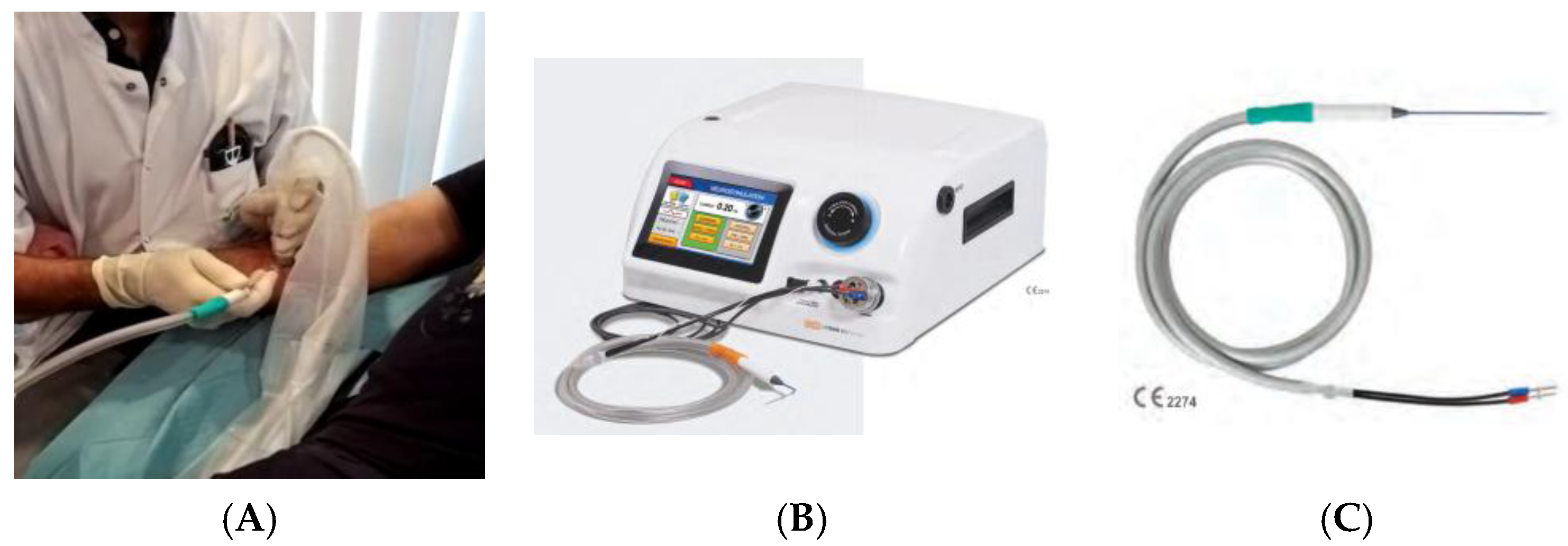
Figure 2.
Study design timeline.
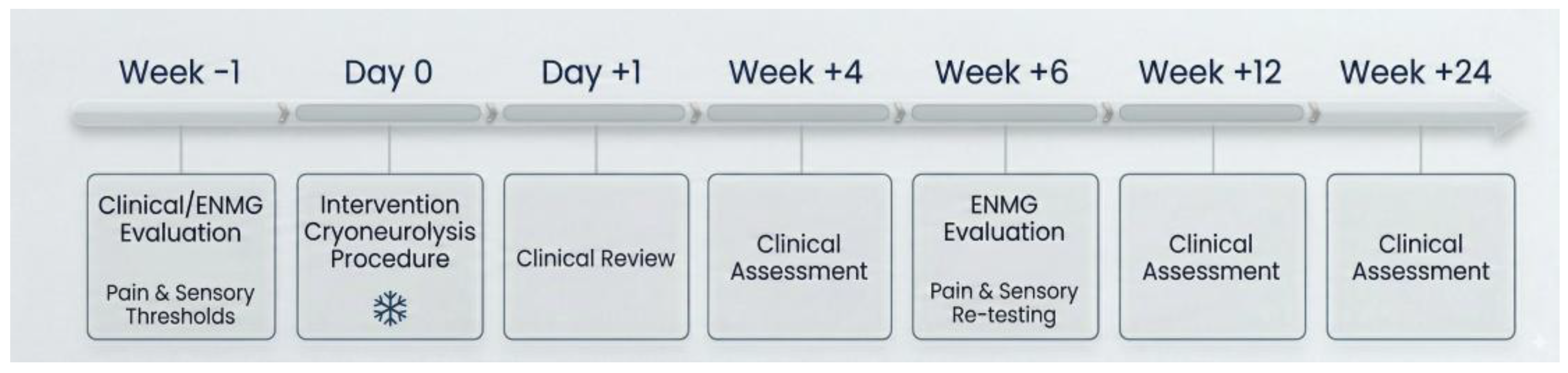

Table 1.
General characteristics of the participants included in the study.
| Patient | Sex |
Age (years) |
Type of stroke | Affected side |
Time delay between stroke and CNL (months) |
| #1 | man | 45 | hemorrhagic | right | 25 |
| #2 | woman | 34 | hemorrhagic | right | 36 |
| #3 | man | 58 | ischemic | left | 22 |
CNL: cryoneurolysis.
Table 2.
Targeted nerves and assessment results for participants.
| Participant | Video | Nerves treated |
Neuropathic pain (DN4) (pre→6 wks) |
Pain VAS (pre→6 wks) |
Sensory testing (6 wks) Pressure (g); 2-point (mm); Thermal |
Spasticity/mobility |
ENMG (6 wks) Median |
ENMG (6 wks) Ulnar / Musculocutaneous |
| #1 | Musculocutaneous; Median | 0→0 | 0→0 | 1.0→0.4 g; 48→48 mm; thermal preserved | MAS ↓ >2 points (elbow flexors, pronators, wrist/finger flexors); Passive mobility improved (no video) | No change (baseline normal); no EMG rest activity post | Ulnar: not treated / not assessed Musculocutaneous: no denervation reported |
|
| #2 |  |
Musculocutaneous; Median; Ulnar | 6→5 | 5.5→0 | 0.7→0.7 g; 25→25 mm; thermal preserved | MAS ↓ >2 points; Passive mobility improved (video 1. Figure 5) |
No change (baseline normal) | Ulnar: no change (baseline normal) Needle EMG: interpretation limited by spasms (rest activity not excluded) |
| #3 |  |
Musculocutaneous; Median; Ulnar | 0→0 | 0→0 | 0.7→0.7 g; no 2-point discrimination pre/post; hot sensation absent pre/post | MAS ↓ >2 points; Passive mobility improved (video 2and? Figure 6) | No change (baseline normal); EMG FDI/APB normal | Ulnar SNAP amplitude reduction progressed (~30%→~60%); F-wave latency normal; ADM EMG normal Musculocutaneous: biceps EMG showed denervation activity post |
DN4, Douleur Neuropathique 4 questionnaire; VAS, visual analogue scale; MAS, Modified Ashworth Scale; ENMG, electroneuromyography; SNAP, sensory nerve action potential; FDI, first dorsal interosseous; APB, abductor pollicis brevis; ADM, abductor digiti minimi.
Disclaimer/Publisher’s Note: The statements, opinions and data contained in all publications are solely those of the individual author(s) and contributor(s) and not of MDPI and/or the editor(s). MDPI and/or the editor(s) disclaim responsibility for any injury to people or property resulting from any ideas, methods, instructions or products referred to in the content. |
© 2026 by the authors. Licensee MDPI, Basel, Switzerland. This article is an open access article distributed under the terms and conditions of the Creative Commons Attribution (CC BY) license (http://creativecommons.org/licenses/by/4.0/).
Copyright: This open access article is published under a Creative Commons CC BY 4.0 license, which permit the free download, distribution, and reuse, provided that the author and preprint are cited in any reuse.


