

Submitted:
13 March 2026
Posted:
13 March 2026
You are already at the latest version
Abstract
The integration of artificial intelligence (AI) into solar energy systems has emerged as a transformative pathway to enhance efficiency, reliability, and sustainability in renewable energy. This review provides a comprehensive examination of recent advances in AI-driven optimization and integration strategies across photovoltaic and solar thermal technologies. A particular emphasis is placed on machine learning and deep learning techniques applied to solar irradiance forecasting, maximum power point tracking, fault detection, energy management, and predictive maintenance. Unlike earlier reviews that focused on isolated applications, this work highlights the systemic role of AI in enabling smart grids, hybrid systems, and large-scale energy storage integration. The novelty of this contribution lies in mapping the evolution from traditional control methods to intelligent, self-adaptive frameworks that couple physical modeling with data-driven approaches, offering a structured roadmap for future developments. Furthermore, the review identifies challenges such as data scarcity, computational demand, and interpretability of AI models, while outlining opportunities for process intensification, resilience, and techno-economic optimization. By bridging technical progress with implementation prospects, this article provides an updated reference for researchers, policymakers, and industry stakeholders seeking to accelerate the deployment of AI-enhanced solar energy solutions.
Keywords:
artificial intelligence
; machine learning
; deep learning
; photovoltaic systems
; optimization
; forecasting
; fault detection
; smart grids
; integration
; renewable energy
1. Introduction
Global commitments to climate stabilization have accelerated the expansion of renewable energy systems, placing solar power at the center of current efforts to shift toward low-carbon development [1,2]. The Paris Agreement, adopted by 196 countries in 2015, places explicit pressure on national energy strategies to reduce greenhouse gas emissions [3], while COP26 reinforced this agenda by calling for a progressive phase-down of coal and a rapid expansion of clean, health-oriented energy systems [4]. These international mandates coincide with structural dynamics already reshaping global energy markets. Between 2010 and 2020, installed photovoltaic capacity increased from 40,334 to 709,674 MW, marking one of the fastest technological expansions in contemporary energy history [5,6,7]. Concentrated solar power also grew significantly, rising from 1,266 to 6,479 MW in the same decade, thereby consolidating solar energy as a globally scalable resource [7].
The physical potential of solar radiation further strengthens its strategic relevance [8]. Estimates indicate that nearly four million exajoules of solar energy reach Earth each year, of which approximately 5x10⁴ EJ are considered technically harvestable [9]. Large regions in Asia, Africa, Australia, and North America receive daily irradiances above 4 to 6 kWh per square meter, and several locations surpass annual values of 2,800 kWh per square meter [7]. This abundance has translated into tangible market behavior. By 2024, global solar PV capacity exceeded 2.2 TW, marking the fastest expansion among all renewable technologies and far surpassing the 256 GW installed globally in 2015 [10]. During the same period, China consolidated its dominant position in the sector, surpassing 610 GW of cumulative capacity by 2024 after adding more than 216 GW in 2023 alone, reaffirming its role as the world’s leading photovoltaic market [11]. Similar upward trends were recorded in India, the United States, and Australia, where annual additions ranged from hundreds to thousands of megawatts [12]. Labor market indicators confirm the magnitude of this transition: solar PV generated more than three million jobs worldwide, accounting for roughly 70% of renewable energy employment in Asia and becoming the largest job creator among renewable technologies [7,13].
Despite these gains, key structural challenges persist. Global CO2 emissions from electricity generation reached approximately 13.8 Gt in 2024, making the power sector the largest single source of energy-related emissions worldwide [14]. Although emissions temporarily declined by 1% in 2019 and 7% in 2020 due to pandemic-related disruptions, sustained long term reductions will depend on the capacity of renewable-dominated systems to operate efficiently under inherently variable and uncertain conditions [7]. Solar power remains highly dependent on weather, intermittency, degradation, and shading effects that can disrupt operational consistency [15,16]. Integration becomes even more complex when considering fluctuating feed-in tariffs, evolving market structures, regulatory shifts, and vulnerabilities along global supply chains [17,18,19]. These factors collectively underscore the need for intelligent, adaptive management tools capable of enhancing performance in real time.
The digitalization of energy systems has opened a promising pathway to address these constraints [20]. Artificial intelligence (AI) has demonstrated superior predictive, optimization, and decision-making capabilities across a wide range of solar-related applications [21,22]. Machine learning (ML) models have consistently outperformed classical statistical approaches in short term and long-term irradiance forecasting [23]. Deep learning architectures, including convolutional neural networks and long short-term memory networks, have achieved high accuracy in performance modeling, fault recognition, and power output prediction [24]. Reinforcement learning strategies enable adaptive and highly responsive maximum power point tracking under rapidly changing conditions [25,26]. AI-based anomaly detection enhances reliability through early diagnosis of faults, enabling predictive maintenance regimes that reduce downtime and operational costs [27,28,29]. Beyond component-level applications, AI contributes to system-level improvements such as enhanced load forecasting, demand response, storage coordination, voltage control, and cybersecurity in smart grids [30].
Even with these developments, the existing literature remains fragmented. Many studies examine specific components of the solar value chain, including forecasting, MPPT algorithms, and grid analytics, but comprehensive evaluations that integrate these elements into a unified optimization perspective are still limited. Recent contributions illustrate the depth of current research efforts. Al-Dahidi et al. [31] present an advanced data-driven framework for PV power prediction. Rajendran et al. [32] analyze technological and regulatory requirements for effective smart-grid integration. Di Leo et al. [33] provide an updated classification of photovoltaic forecasting methodologies. Oshilalu et al. [34] investigate innovative strategies for improving grid interaction and electronic applications. Together, these works demonstrate significant progress across individual domains, yet they also indicate the need for a broader synthesis that links forecasting accuracy, adaptive control, grid stability, uncertainty management, and AI-driven operational intelligence within a coherent system-wide framework.
This review addresses these gaps by providing a comprehensive examination of AI-driven optimization and integration within solar energy systems. Building on quantitative evidence from international deployment trends, sustainability assessments, and performance data reported in recent scientific literature, the review maps the evolution of AI methodologies applied to forecasting, control, diagnostics, storage integration, and smart grid operation. It also identifies emerging research trajectories and outlines the conceptual and technical frontiers that will shape the next generation of intelligent solar energy systems.
2. Methodology
2.1. Literature Collection and Selection
A systematic and comprehensive process was used to review and compile information on how AI is applied in various solar energy technologies in the literature. Four major academic databases were used: Scopus, Web of Science, IEEE Xplore, and ScienceDirect due to their broad coverage in engineering, energy systems, and applied sciences. The keyword strategy combined terms related to artificial intelligence (AI) and its applications in solar energy. Initially, the search terms included: AI, machine learning, deep learning, neural networks, solar energy, photovoltaics, optimization, prediction, fault detection, and integration. Subsequently, in the qualitative section, new filters were incorporated.
Search efficiency was carried out through an advanced Boolean query in Scopus, using the structure recommended by the search tool developers [35]. To maintain the scope's fidelity, additional inclusion filters were included to bound results to English-language journals and reviews, published between 2018 and 2025, and peer-reviewed regardless of being published open access. To keep a narrow scope focused on energy applications, only articles from the following fields were included: Energy, Engineering, Economics, Chemical Engineering, and Environmental Science. Fields such as Computer Science or Material Science were excluded, as their primary objective is the algorithms and/or the materials characterization, and not the system-level integration of solar energy technologies. The original search generated a very large corpus of greater than 1,000-2,000 articles, demonstrating the accelerated growth of AI-driven solar research. Instead of restricting the dataset to a fixed number of papers, a multi-stage screening process was applied to ensure both relevance and representativeness. Table 1 shows the inclusion and exclusion criteria used during the quantitative and qualitative screening stages.
After applying the quantitative and qualitative screening stages to the initially retrieved literature, a total of 154 peer-reviewed journal articles were retained for detailed analysis in this review. The selected studies provide a representative and thematically focused overview of recent advances in the application of artificial intelligence to solar-energy technologies within the defined temporal and disciplinary boundaries.
3. Review of Artificial Intelligence Applications in Solar Energy
Solar energy adoption has increased exponentially due to ambitious global environmental and policy targets [7]. However, this significant increase brings with it challenges related to the efficient use of this technology. This is where the various fields of AI prove to be a fundamental tool for addressing these problems, especially in grid integration, as mentioned by Feng et al. [36].
The usefulness of AI in the context of solar energy lies in the difficulty of approximating the complex nonlinear dynamics of solar power plants with classical methods [37]. This section addresses the different applications of these tools in the context of solar energy, highlighting the use of ML models over statistical models [38].
3.1. Forecasting and Prediction
The literature classifies prediction models according to the time scale at which they operate. When the goal is to predict on very short time scales, they are known as "now-casting" (0 to 3 hours). These predictions are usually based on extrapolations of real-time data [39]. On the other hand, tools are available for short-term prediction (3 to 6 hours). These models are based on the use of satellite imagery, real-time data, and Numerical Weather Prediction (NWP) models [40]. NWP models alone are capable of predicting 2 to 6 days [41]. Figure 1 shows a schematic comparison of the different conventional prediction models and their different scales.
3.1.1. Time-Series and Deep-Learning Forecasting
Time series forecasting methods are widely used tools in the short and medium term, and are especially useful when high-resolution historical data are available [42]. These strategies rely on searching for patterns directly in historical photovoltaic irradiation data [43]. These techniques allow for the development of efficient prediction models without the need for explicit physical models or direct knowledge of atmospheric processes [44].
Among the more classic time-series models are autoregressive models such as ARIMA, which have been implemented to capture diurnal cycles, persistence effects, and short-term autocorrelation in solar generation [45]. Although these models have proven effective in the short term, their efficiency decreases as the forecasting horizon increases, mainly due to a lack of information related to the evolution of atmospheric conditions [46].
This is where AI comes into play. Advances in deep learning models have significantly improved the performance of time-series forecasting methods. Recurrent neural networks (RNNs), particularly Long Short-Term Memory (LSTM) and Gated Recurrent Unit (GRU) architectures, are able to capture nonlinear temporal dependencies and long-range correlations inherent in solar generation data [44,47]. Convolutional neural networks (CNNs) have also been implemented, either by learning local temporal patterns or by processing transformed representations of irradiance signals. More recently, transformer-based models have gained attention due to their ability to model long temporal contexts through attention mechanisms [48].
In the context of solar energy systems, deep-learning time-series models are especially effective for intra-day forecasting [49], where ranges commonly range from minutes to several hours ahead. Their accuracy is strongly associated with data quality, temporal resolution, and the inclusion of exogenous variables such as temperature, cloud cover indices, or outputs from numerical weather prediction models [43]. Hybrid approaches that combine time-series learning with meteorological inputs often outperform purely data-driven or purely physics-based models [50]. Despite its strong predictive performance, time-series and deep-learning approaches face important limitations, they generally exhibit reduced robustness under regime changes, such as seasonal transitions or atypical weather events, and require frequent retraining to maintain accuracy [51]. Furthermore, their black-box nature can limit interpretability [52].
3.1.2. Spatio-Temporal and Image-Based Forecasting
Spatio-Temporal and Image-Based Forecasting has become an essential tool for the efficient use of solar energy due to the influence of cloud dynamics on the variability of solar power output [53]. Unlike prediction models based solely on time series (data-driven models), which rely on data collected from a single point or location, image-based models leverage visual and spatial correlations to capture information related to cloud formation, movement, and dissipation processes that govern short-term solar fluctuations [54].
Regarding Spatio-Temporal Forecasting, these approaches integrate multiple spatially distributed resources, such as networks of pyranometers, PV plants, or satellite pixels [55,56]. By gathering this information over time to capture its temporal evolution, it is possible to anticipate changes in irradiance across entire regions [57]. Since these approaches rely on visual information, they employ ML algorithms geared towards image processing, such as CNNs. These algorithms are used to extract spatial features like cloud density gradients across neighboring locations, while recurrent layers model temporal dependencies [58]. ConvLSTM and spatio-temporal attention mechanisms have shown strong performance for very short-term horizons (minutes to hours), where ramp events are most critical for grid operation [58].
On the other hand, Image-Based Forecasting uses satellite imagery and ground-based sky cameras to directly observe cloud patterns [53]. Both types of imagery provide information at different scales. While satellite imagery allows for coverage of large areas (useful for national-level forecasting), ground-based sky cameras offer high temporal and spatial resolution for plant-level nowcasting [59]. Computer vision is essential for converting the information obtained into power profiles. Using techniques such as optical flow, cloud segmentation, and feature tracking, it is possible to calculate cloud movement vectors, thus obtaining these profiles [54].
The main advantages of these techniques lie in their ability to anticipate rapid changes that are not typically captured by medium- and long-term models, making them particularly valuable for intra-hour forecasting, reserve allocation, and real-time energy management in systems with high solar penetration. However, their heavy reliance on high-quality imagery and information, as well as on proper sensor calibration and image quality, results in high data requirements and computational costs. Figure 2 describes the general process for image-based forecasting.
3.1.3. Feature Engineering and Ensemble Learning
Two of the most important pillars in solar energy prediction are Feature Engineering and Ensemble Learning. While ML algorithms are responsible for generating effective predictions, their effectiveness depends on the quality and structure of the input features [60].
In particular, Feature Engineering allows you to transform raw meteorological, operational, and temporal data into useful representations for the model training process [60]. Typical engineered features include clear sky indices, irradiance variability metrics, solar position parameters such as zenith and azimuth angles, and lagged or rolling statistics of irradiance and power output [60,61]. In AI-driven frameworks, feature engineering also extends to spatial descriptors derived from neighboring sensors or satellite pixels, as well as image-based features extracted through deep learning encoders [53,62].
On the other hand, Ensemble learning addresses model uncertainty by combining the predictions of multiple learners rather than relying on a single model [63]. In the context of solar energy, ensembles commonly integrate algorithms such as tree-based models, neural networks, and support vector regressors, each capturing different aspects of the underlying dynamics [64]. Techniques such as bagging, boosting, and stacking are widely used to reduce variance, mitigate overfitting, and improve generalization across varying weather regimes [63]. Ensemble approaches are particularly effective when solar irradiance exhibits non-stationary behavior, where no single model consistently outperforms others under all conditions [65].
The combination of feature engineering and ensemble learning is especially powerful for short-term and intraday solar forecasting. Carefully engineered features provide meaningful physical and statistical context, while ensembles enhance robustness against sensor noise, forecast errors, and rare events such as rapid cloud transitions [63]. However, these advantages come at the cost of increased model complexity and computational effort, motivating the use of automated feature selection and hybrid ensembles that balance accuracy with operational feasibility [66].
3.1.4. Probabilistic Forecasting and Uncertainty Modeling
Probabilistic and uncertainty-aware predictions are key to the application of AI to solar energy systems, primarily due to the impossibility of generating deterministic models for solar energy production. Unlike deterministic models, which aim to obtain a single estimated value, probabilistic models under uncertainty offer a range of future possibilities and their probability of occurrence. In the context of solar energy, uncertainties arise from multiple sources: atmospheric variability, cloud dynamics, measurement noise, and even model limitations [67]. Probability-based models, therefore, seek to predict probability distributions or probability intervals for solar irradiance and photovoltaic power output. This allows for the estimation not only of energy generation but also the confidence levels associated with each prediction [68].
From an AI perspective, probabilistic forecasting is commonly implemented using techniques such as quantile regression, Bayesian neural networks, and Monte-Carlo-based deep learning [67,69]. Quantile-based models estimate multiple conditional quantiles, enabling the construction of prediction intervals that adapt to changing weather conditions [70]. Bayesian approaches incorporate uncertainty directly into model parameters, producing distributions rather than fixed weights [71]. In deep learning, methods such as dropout-based sampling are used to approximate predictive uncertainty by generating ensembles of plausible forecasts [72]. Uncertainty modeling is particularly valuable for short-term and intra-day solar forecasting, where rapid cloud induces fluctuations that can lead to significant forecast errors. By explicitly characterizing uncertainty, probabilistic forecasts support risk-aware decisions in reserve allocation, storage dispatch, and real-time grid control [73,74]. They also enable the integration of solar forecasts into stochastic optimization and chance-constrained formulations used in energy system planning and operation [75] (see Table 2).
3.2. Optimization and Control
Historically, the optimization and control of solar energy systems have relied on physical models and deterministic control strategies. However, the increasing complexity of modern photovoltaic systems, as well as their widespread integration into the electrical system, including energy storage and smart grids, has driven the adoption of data-driven and ML approaches [76,77].
In recent years, AI has been applied not only at the direct control level but also at the system level. At the direct, local, or device level, techniques such as artificial neural networks, fuzzy logic, and reinforcement learning algorithms have been implemented to improve maximum power point tracking (MPPT), converter control, and inverter operation, achieving higher efficiency and robustness under changing environmental conditions and larger implementations [77,78].
These strategies allow the representation of nonlinear dynamics that are often difficult to capture using conventional modeling approaches. On the other hand, when we talk about the system level, optimization and control extend to energy management and the coordination of multiple components, such as conventional power systems with high inertia and their impact when connecting a considerable number of photovoltaic systems, storage, and highly intermittent loads to the grid. At this level, AI techniques play a fundamental role by enabling the formulation of multi-objective optimization problems and the development of predictive control schemes, where criteria such as energy efficiency, operating costs, and system stability are considered simultaneously [76,79].
3.2.1. MPPT and Power Conversion Optimization
MPPT is essential in the operation of photovoltaic systems, as it allows the highest available power to be extracted under variable irradiance and temperature conditions. Classic MPPT algorithms, such as Perturb and Observe (P&O) and Incremental Conductance (IncCond), perform well under uniform operating conditions and have been widely used due to their simplicity of implementation and low computational cost [80,81]. However, their effectiveness decreases under rapid disturbances or highly intermittent scenarios, such as partial shading, where the power-voltage curve exhibits multiple local maxima. In these situations, such methods may experience steady-state oscillations, slow convergence, or become trapped in local optima, preventing the system from reaching the global maximum power point.
In recent years, techniques based on AI and ML have emerged as complementary tools to improve MPPT decision-making. These approaches allow the identification of complex patterns in the nonlinear relationship between irradiance, temperature, and power, while also anticipating variations in operating conditions, guiding the tracking algorithm toward the global maximum and reducing transient losses caused by rapid environmental fluctuations.
In particular, approaches based on ML and deep learning have gained relevance as robust alternatives for real-time MPPT control. Khan et al. [82] propose a data-driven energy extraction scheme that integrates MPPT control through ML with efficient fault detection in hybrid Photovoltaic-Thermoelectric Generator (PV-TEG) systems, demonstrating simultaneous improvements in energy efficiency and operational reliability. Similar results are reported by Ishrat et al. [83,84], who analyze deep learning models for direct estimation of the maximum power point and their application in optimal energy extraction in hybrid systems, highlighting their capacity to adapt to highly non-linear operating conditions. Robust control is another relevant line of research in MPPT optimization. Yılmaz et al. [85] develop a machine learning-assisted super-twisting sliding mode controller designed to improve both the speed and accuracy of MPPT tracking under severe partial shading conditions. This type of strategy combines the inherent robustness of sliding mode control with the adaptability of data-based methods, achieving superior performance in the face of rapid environmental disturbances.
More recently, studies have explored the integration of predictive information into the MPPT scheme. Khan et al. [86] present deep learning algorithms that incorporate irradiance forecasts to anticipate changes in the optimal operating point, reducing transient losses and improving the stability of the conversion system. This trend reflects a transition from purely reactive MPPT controllers to proactive strategies based on AI. Finally, Roh [87] offers a comprehensive review of ML-based MPPT techniques, summarizing their main advantages, challenges, and areas of application. Taken together, recent literature shows a clear evolution toward intelligent MPPT controllers capable of optimizing power conversion in highly dynamic scenarios, although several challenges remain, particularly those associated with computational complexity and implementation in embedded power platforms.
3.2.2. Thermal and Hybrid PV/T Systems
The efficiency of conventional photovoltaic systems is limited by the increase in the operating temperature of the modules, since a significant fraction of the incident solar radiation is dissipated in the form of heat, reducing electrical performance. This limitation has driven the development of photovoltaic-thermal (PV/T) systems and hybrid configurations, which aim to simultaneously harness electrical generation and thermal energy, increasing the overall energy efficiency of the system [82,88].
Various studies have established the conceptual framework for hybrid systems based on renewable energies, highlighting the importance of optimal sizing, coordinated integration of subsystems, and thermal management as key design elements. In this context, it has been demonstrated that the incorporation of thermal components in photovoltaic systems not only mitigates the negative effect of temperature on electrical efficiency but also enables cogeneration applications and improves the operational stability of the energy system [88,89,90]. More recent research has focused on the design and optimization of PV/T systems, considering thermal and electrical variables together. These studies show that an integrated optimization of the system, which includes operating strategies, coupling with storage, and thermal flow control, maximizes total energy yield and reduces losses under variable climatic conditions [89,91].
A particularly relevant line of research concerns the integration of PV-TEG systems, where the waste heat generated by photovoltaic modules is partially converted into additional electrical energy. The literature reports that this type of hybrid configuration can improve the overall performance of the system, especially under conditions of high irradiance and elevated temperatures, reinforcing the need to consider thermal management as an active component of the design [92,93].
From the perspective of thermal modeling and energy analysis, several studies have addressed the detailed characterization of heat flows, exergy analysis, and the evaluation of the impact of different cooling strategies on the performance of PV/T systems. The results show that thermoelectric performance is strongly influenced by environmental conditions, system geometry, and heat extraction method, underscoring the importance of accurate thermal models for system optimization [94,95,96,97].
3.2.3. Energy Management and Multi-Objective Control
The growing integration of photovoltaic systems, hybrid configurations, and storage devices into electrical grids and microgrids has significantly increased the operational complexity of modern energy systems. In this context, energy management and control (EMC) strategies have become a key component in optimally coordinating generation, storage, and demand, ensuring energy efficiency, system stability, and safe operation under uncertain operating conditions [90].
Several studies have incorporated AI techniques into energy management, aiming to improve the adaptability and robustness of control strategies. In this regard, approaches based on deep reinforcement learning and distributed control schemes have shown strong potential for real-time decision-making, especially in systems with multiple energy agents and shared resources [98]. These strategies allow control policies to be learned from historical and online data, thereby reducing dependence on highly accurate explicit models.
Another relevant line of research focuses on the energy management of microgrids and systems with storage, where coordination between renewable sources, batteries, and loads is essential to ensure reliable system operation. Recent studies show that the integration of energy storage within the EMC, combined with optimization techniques, can mitigate the intermittency of photovoltaic generation and enhance the operational flexibility of the system [91,93]. Likewise, recent works have explored the application of energy management strategies in specific contexts, such as smart buildings and distributed energy systems, emphasizing the role of EMC in improving overall performance and reducing environmental impact [99,100,101].
However, several challenges remain, including computational requirements, real-time implementation constraints, and the integration of heterogeneous energy resources. In addition, limited standardized datasets and strong dependence on site-specific conditions can restrict model transferability. Addressing these issues is essential for enabling scalable AI-based solutions in photovoltaic and hybrid energy systems.
3.3. Fault Detection, Diagnosis, and Predictive Maintenance
Given the increasing deployment of solar energy systems worldwide, effective maintenance strategies have become essential to ensure their reliable operation [102]. AI offers various alternatives focused primarily on a proactive rather than a reactive approach. This method supports decision-making through early fault detection, diagnosis, and predictive maintenance, enabling the early identification of anomalies, reducing downtime, and extending system lifespan [103].
3.3.1. Vision- and Sensor-Based Detection
Sensor-based and vision-based detection systems rely on collecting information from heterogeneous data sources. This means they utilize data associated with electrical measurements from solar energy systems, such as voltage, current, and power output, as well as environmental data like irradiance, temperature, and visual information obtained from external systems such as infrared viewers, drones, or fixed imaging systems [104].
From an AI perspective, these sensor-based detection systems typically employ machine learning and deep learning models to identify deviations from normal operating behavior. By learning baseline patterns under healthy conditions, these models can detect anomalies associated with faults such as partial shading, soiling, degradation, inverter malfunctions, or wiring issues [105]. Time-series models and classification algorithms are commonly used to distinguish between normal variability and fault-induced changes [106]. Vision-based systems, on the other hand, complement the information collected by sensors by integrating spatially explicit information. Among the vision technologies that have been most explored is thermal imaging, which allows for the observation of defects such as hot spots, cracked cells, delamination, or connector failures [107]. CNNs have proven especially useful in this field, as they are used to automatically extract visual features and classify failure types without the need for manual inspection of the systems. The great advantage of these hybrid systems stems from their ability to relate physical measurements to the spatial context, which improves the accuracy and ease with which failures are detected in complex operating environments [108].
3.3.2. Predictive Maintenance and Reliability
One of the main advantages of using AI is its ability to anticipate failures before they occur by estimating the future health and reliability of photovoltaic components. Machine learning models are used to estimate remaining useful life, failure probabilities, or degradation rates of key components such as PV modules, inverters, among others [109]. These predictions support reliability-oriented operation by prioritizing maintenance efforts on the most critical assets. Ensemble learning and probabilistic approaches are often adopted to account for uncertainty in degradation behavior and operating conditions [102]. The application of preventive maintenance has direct implications for the reliability of the system and its economic performance [110]. Preventive maintenance commonly turns out to be cheaper than corrective maintenance. AI-driven maintenance strategies improve availability and energy yield. At the system level, predictive maintenance contributes to higher confidence in solar generation forecasts and supports long-term planning decisions in power systems with high solar penetration [111]. Figure 3 illustrates a simplified AI-based framework for fault detection, diagnosis, and predictive maintenance in solar energy systems, while the main characteristics, data requirements, and operational impacts of AI-based fault detection and predictive maintenance approaches in solar energy systems are summarized in Table 3.
3.4. Integration, Hybridization, and System Intelligence
As the adoption of solar energy increases, the roles of AI expand. Beyond the most obvious practical applications, such as optimizing the use of these technologies, AI is also useful for tasks associated with integration, hybridization, and systems intelligence. AI allows for linking data, models, and control strategies across multiple spatial and temporal scales, supporting the transition from isolated components to intelligent energy ecosystems [112].
Integration and hybridization refer to the coordinated operation of heterogeneous technologies and data sources, while systems intelligence emphasizes adaptive, autonomous, and learning-based decision-making [113]. These concepts are particularly relevant in smart grids, microgrids, and urban energy systems, where operational complexity and uncertainty are high, as shown in the following subsections.
3.4.1. Smart Grids and Microgrids
The literature has explored the use of AI primarily in the real-time monitoring, control, and optimization of solar energy resources. Unlike traditional grids, whose planning is deterministic and typically centralized, smart grids utilize distributed generation, bidirectional power flows, and active participation of end users [114].
For microgrids with high photovoltaic penetration, AI is employed as an energy management system designed to coordinate generation, storage, and controllable loads [115,116]. Meanwhile, machine learning and feedback learning are used in tasks focused on reducing operational costs and enhancing system resilience under variable weather conditions [117,118].
AI has also been implemented to integrate the prediction of generated solar energy with voltage regulations, congestion management, and reserve allocation strategies [119,120]. This is possible through the coupling of predictive models and control algorithms. These intelligent systems are capable of anticipating solar variability and proactively adjusting grid operation, thus enabling the creation of a reliable and flexible system.
3.4.2. Building and Urban Integration
At the urban scale, the integration of photovoltaic energy generates multiple energy generation points when these panels are integrated into the urban infrastructure. This creates multiple potential AI integrations, as AI-based controllers can optimize self-consumption, storage usage, and grid interaction by combining solar forecasts with occupancy patterns and thermal dynamics [121,122].
Urban systems are then seeking to expand this idea by integrating multiple buildings, electric vehicles, and distributed storage units into coordinated frameworks [123]. This translates into managing large volumes of information simultaneously, a task greatly facilitated by the use of AI. At this scale, hybrid approaches that employ solar energy and demand forecasting, along with optimization algorithms, are essential tools for reducing peak loads and mitigating grid stress [124]. Furthermore, integrating these systems into conventional grids allows for the creation of flexible energy systems where buildings participate in grid services by aligning solar availability with controllable loads [125]. This is how intelligent urban systems contribute to demand-side management and support higher levels of renewable penetration.
3.4.3. Federated, Secure, and Intelligent Architectures
Security is a critical aspect when discussing shared data systems, as the integration of AI and digital platforms increases exposure to cyber risks. Secure architectures incorporate encryption, authentication, and anomaly detection techniques, often supported by AI itself, to ensure the integrity and reliability of solar forecasting and control systems. However, there are strategies seeking a paradigm shift. Federated Learning (FL) refers to machine learning (ML) systems that enable a collaborative training process across multiple decentralized devices or servers without exchanging raw data [126]. The idea is to bring the model to the data, rather than the data to the model, in order to address concerns related to data privacy and regulatory compliance. In the context of solar energy, it has not been widely adopted in distributed solar systems. However, its use has been explored in the literature, highlighting collaborative anomaly detection as its main advantage. Through simulations, it has achieved accuracy similar to that of approaches with centralized databases, while maintaining privacy [127].
3.5. Cross-Disciplinary and Emerging Frontiers
Current research increasingly emphasizes the transition from isolated algorithmic improvements toward integrated intelligence frameworks spanning forecasting, control, diagnostics, and system integration. Hybrid renewable energy systems combining photovoltaic generation with storage, thermal subsystems, or auxiliary generation exemplify this trend. State-of-the-art bibliometric analyses highlight that future advances depend not only on prediction accuracy but also on the ability of AI models to support scalable sizing, adaptive operation, and robust decision-making under uncertainty across interconnected energy assets [90]. This perspective highlights the need for AI approaches that transcend component-level optimization and address system-level coordination and deployment constraints.
A key emerging direction within this landscape is the development of distributed and decentralized intelligence architectures. Federated and semi-asynchronous learning frameworks have been proposed to address data privacy, communication overhead, and scalability challenges inherent in large-scale photovoltaic forecasting and control [128]. By enabling collaborative model training across geographically distributed assets without centralized data aggregation, these approaches directly respond to the limitations of traditional cloud-based learning.
Another defining characteristic of these emerging frontiers is the growing emphasis on interpretability, diagnostics, and deployment readiness. Explainable AI has gained relevance in predictive maintenance and fault detection, where transparency and trust are essential for large-scale adoption. Recent studies employing explainable models for photovoltaic system monitoring (often supported by advanced sensing and imaging techniques) demonstrate how interpretable AI can enhance decision support and facilitate remote, scalable deployment [129]. When combined with edge-based deep learning architectures, these approaches enable continuous monitoring, rapid fault response, and reduced communication latency [130].
These developments indicate a transition from centralized, data-intensive AI approaches toward decentralized and interpretable intelligence frameworks for solar-energy systems, enabling more integrated and adaptive decision-making across multiple operational levels. This shift establishes the foundation for the cross-disciplinary research frontiers examined in the following subsections.
3.5.1. Materials Discovery and Device Engineering
In photovoltaic materials research, artificial intelligence has emerged as a revolutionary tool, especially in the creation of next-generation perovskite solar cells (PSCs). High-dimensional design spaces and lengthy trial-and-error cycles frequently limit traditional experimental methods for material discovery and device improvement. According to recent research, ML may greatly speed up the investigation of compositional, structural, and processing characteristics, making it possible to identify stable and high-performing solar materials more effectively [131].
Extensive evaluations of ML applications in PSCs show how quickly supervised and ensemble learning approaches are being used to anticipate device performance, stability, and degradation behavior [131]. By optimizing absorber composition, dopant concentration, and processing conditions, these data-driven techniques have been successfully used to lessen experimental burden and increase predictive accuracy. For instance, by methodically navigating the compositional parameter space, ML-assisted optimization of potassium iodide doping in MAPbI₃ solar cells has shown better material stability and power conversion efficiency [132].
In addition to refining absorber layers, AI-enhanced techniques are progressively utilized in the design of transport layers, which are essential for charge extraction and the performance of devices. Optimizing the parameters of hole (and electron) transport layers using ML in low-lead and inorganic perovskite designs has led to a concurrent enhancement in efficiency and environmental friendliness [133]. Furthermore, automated ML systems have broadened these possibilities by evaluating and prioritizing prospective hole-selective materials according to factors such as interfacial energetics, defect resistance, and stability, thus enabling swift material selection with minimal human effort [134].
Recent advances extend beyond conventional model training toward closed-loop and self-driving experimentation. Autonomous laboratories integrating high-throughput fabrication, real-time characterization, and ML-driven decision-making have been proposed as a new paradigm for perovskite photovoltaic research. Such self-driving platforms enable continuous learning across experimental iterations, dramatically accelerating the discovery and optimization of emerging photovoltaic materials and device architectures [135]. These approaches represent a shift from passive data analysis to active materials exploration guided by AI.
Interpretability and physical insight are also gaining importance in AI-assisted materials discovery. Interpretable ensemble learning models have been employed to predict key electronic properties, such as bandgaps in halide perovskites, while simultaneously revealing structure-property relationships that are consistent with known physical principles [136]. This combination of predictive accuracy and explainability enhances trust in AI-generated recommendations and supports their integration into physics-guided design workflows. AI has additionally demonstrated value in bridging materials discovery and scalable manufacturing. ML-based optimization of blade-coating processes for perovskite mini-modules illustrates how data-driven approaches can improve film homogeneity and device reproducibility under industrially relevant conditions [137]. Such developments emphasize the role of AI not only in laboratory-scale discovery but also in enabling manufacturable and scalable photovoltaic technologies.
3.5.2. Thermochemical and Solar-Fuels Pathways
Beyond photovoltaic-centric optimization, recent research has begun to explore the application of ML techniques to the design and optimization of solar-thermal energy systems. These systems, which operate through the conversion of solar radiation into thermal energy, present complex multi-physics interactions involving heat transfer, fluid dynamics, material behavior, and system-scale efficiency trade-offs. Traditional modeling and simulation approaches often struggle to balance fidelity and computational cost, particularly when large-scale design spaces must be explored.
In this context, digital twins powered by ML have emerged as a promising paradigm for rapid system-level design and optimization. Zohdi [138] proposed a ML-based digital twin framework for large-scale solar-thermal energy systems, enabling accelerated exploration of design configurations while preserving key physical constraints. The approach integrates data-driven surrogate models with physics-informed insights, allowing for near-real-time evaluation of system performance across a wide range of operating and geometric parameters. Such frameworks significantly reduce computational overhead compared to high-fidelity numerical solvers, while maintaining sufficient accuracy for early-stage design and optimization tasks.
Complementary to digital-twin methodologies, efficiency-aware ML-driven design strategies have been introduced to optimize solar energy harvesting devices. Baz and Patel [97] developed a machine-learning-guided optimization framework focused on maximizing system efficiency in solar harvesters, explicitly incorporating performance constraints and energy conversion metrics into the learning process. Their results demonstrate that ML models can effectively navigate high-dimensional design spaces, identifying non-intuitive configurations that outperform conventional heuristic-based designs
3.5.3. Generative and Explainable AI for Solar Forecasting and Optimization
While fully generative and self-driving AI frameworks remain limited in practical solar-energy deployments, recent advances in reinforcement learning (RL), multi-agent coordination, and explainable artificial intelligence (XAI) are progressively enabling autonomous and adaptive system-level optimization. These approaches represent an intermediate yet critical step toward the realization of self-directed digital twins and generative decision-making frameworks in solar-energy systems.
Multi-agent deep reinforcement learning (MADRL) has emerged as a powerful paradigm for managing the distributed and highly coupled nature of modern energy systems. In the context of PV-integrated networks, MADRL has been successfully applied to coordinated voltage regulation, active-reactive power control, and inverter-level decision making, demonstrating improved scalability and robustness compared to centralized control strategies [139,140]. Similar frameworks have been extended to residential hybrid energy systems, where multiple learning agents collaboratively optimize PV generation, energy storage, and electric vehicle charging under dynamic operating conditions [140,141].
Beyond grid-level control, reinforcement learning has also been adopted for energy management in solar-assisted buildings and hybrid energy hubs. Studies integrating deep RL with hydrogen-electric coupling systems and shared energy storage infrastructures illustrate how learning-based controllers can adapt to stochastic renewable generation while preserving operational constraints and privacy through federated learning mechanisms [98,142]. These developments point toward decentralized intelligence architectures capable of supporting large-scale solar-energy deployment without reliance on centralized supervision.
Explainability and safety considerations are increasingly incorporated into these learning frameworks to address trust, transparency, and operational risk. Recent work on explainable predictive maintenance using infrared thermography demonstrates how interpretable models can support fault diagnosis and condition monitoring in PV systems, bridging the gap between black-box learning and actionable engineering insight [129]. Similarly, safety-integrated and constraint-aware RL formulations have been proposed for mobile energy storage scheduling and Volt/VAR control, enabling autonomous decision making while maintaining system reliability [133,143].
The studies discussed in this section illustrate how AI is progressively expanding its role across different layers of solar-energy research. In addition to traditional applications in forecasting and control, recent work explores the use of AI for materials discovery, hybrid system design, and advanced energy management strategies. These developments show a broader transition toward integrated approaches where data-driven models support both device-level innovation and system-level optimization. At the same time, emerging paradigms such as distributed learning, digital twins, and interpretable AI are enabling more adaptive and scalable solutions for complex solar-energy infrastructures. By combining advances in ML, RL, and explainable modeling, current research increasingly seeks to bridge the gap between algorithm development and practical deployment, opening new opportunities for intelligent and resilient solar-energy systems.
3.5.4. Physics-Informed Learning and Edge AI
Although physics-informed neural networks (PINNs) remain relatively scarce in large-scale solar deployments, recent studies increasingly incorporate physical constraints implicitly through hybrid modeling, model predictive control, and system-aware learning architectures. Data-driven stochastic model predictive control frameworks have been proposed for real-time energy management in low-carbon microgrids, demonstrating how physical system dynamics and operational constraints can be integrated with learning-based predictors to achieve stable and adaptive control under uncertainty [144].
Edge-oriented intelligence is gaining particular relevance for PV systems, where rapid response to environmental disturbances and fault conditions is critical. Deep learning approaches deployed close to the physical assets have been applied to real-time snow-cover detection and associated energy-loss estimation in solar modules, enabling localized decision making without reliance on cloud-based processing [145]. Similarly, image-based deep learning models for fault detection and classification using voltage and current signatures illustrate the feasibility of embedded diagnostics for PV systems operating under dynamic conditions [146].
Beyond PV-centric applications, the integration of edge AI with advanced communication infrastructures, such as 6G-enabled Internet of Things (IoT) networks, has been proposed for intelligent energy management across smart grids and sustainable urban environments. These architectures combine decentralized learning, edge computing, and secure data exchange mechanisms to support resilient and autonomous energy systems at scale [147].
These developments highlight a broader transition toward decentralized and system-aware intelligence frameworks for solar-energy systems. While explicit physics-informed formulations remain an open research challenge, current edge and federated learning frameworks already embed physical structure through control constraints, real-time feedback, and operational limits. As such, they represent a critical step toward fully physics-aware, deployment-ready AI systems capable of supporting the next generation of resilient and autonomous solar-energy infrastructures.
3.6. Techno-Economic and Socio-Technical Impacts of AI-Enabled Solar Systems
Although relatively new, the integration of AI into current energy systems has already yielded quantifiable techno-economic and socio-economic benefits. However, it is worth noting that this integration is still considered to be in its initial stages, and therefore, challenges and opportunities remain in this field [148].
Among the observed techno-economic benefits, AI-driven predictive maintenance has been shown to reduce costs by 30% and improve efficiency by 15-20%. Additionally, the automation of inspection and monitoring processes using AI techniques translates into reductions in inspection times, with reported decreases of up to 90%, thus reducing labor requirements and operational interruptions. These improvements imply an increase in system lifespan of around 25%, since early fault detection and condition-based maintenance prevent accelerated component degradation [149]. Furthermore, the use of AI tools for monitoring and fault diagnosis reduces unplanned downtime by approximately 25%, directly increasing system availability. At the operational level, these benefits translate into an increase in energy efficiency of around 15% and a reduction in operating costs of approximately 18%, reinforcing the techno-economic viability of highly automated solar systems [150]. Table 4 summarizes these benefits.
From a socioeconomic perspective, the integration of AI into solar energy systems goes beyond technical and economic performance. AI-based monitoring and decision-support tools enhance the perceived reliability of the system and reduce operational uncertainty, thereby strengthening trust among operators and energy managers [151]. Furthermore, the shift from reactive operational schemes toward predictive and data-driven strategies promotes changes in workforce skills, favoring technical profiles focused on supervision, data interpretation, and system-level decision making supported by intelligent algorithms [152]. At the end-user and urban scale, AI integration enables more active participation in energy management by supporting optimized self-consumption, demand response, and coordination between distributed generation and flexible loads [153]. However, it should be noted that increased automation may also lead to workforce displacement in routine operational roles, highlighting the need for adequate reskilling and institutional adaptation to ensure a just and socially balanced energy transition [152,154].
4. Conclusions and Future Directions
This review showcased the role of AI in the context of solar energy systems, demonstrating that AI is no longer just a set of isolated techniques for solving specific problems, but has become a layer that unifies and connects forecasting, operation, integration, and decision-making across multiple temporal and spatial scales. Rather than replacing physical or traditional models, AI complements these models by collecting information that allows energy systems to operate reliably under complex and highly uncertain conditions or scenarios.
A central subject addressed in the review reveals a trend in the use of AI models toward short-term and very short-term horizons. Operating at these timescales necessitates addressing the cloud dynamics that govern system behavior at this scale. This is why data-driven and deep-learning approaches provide their greatest benefit. Time-series approaches capture recurring temporal patterns, while spatio-temporal and image-based methods extend predictive capability by embedding spatial awareness and visual information. Furthermore, by combining these tools with feature engineering, ensemble learning, and probabilistic forecasting, these approaches form a coherent predictive framework that not only improves accuracy but also enhances robustness and risk awareness, which are essential for real-time operation and grid integration.
The relevance of AI advances in recent years is more noticeable in a broader context, such as system operation and integration, where deterministic management has lost ground. AI-operated systems forecast directly support intelligent control strategies in smart grids, microgrids, and building-level systems, where generation, storage, and demand must be coordinated dynamically. In other words, we can understand artificial intelligence as an adaptive mediator between physical infrastructure and operational objectives, allowing systems to anticipate disturbances, optimize resource allocation, and maintain stability. The same predictive and learning capabilities support AI-driven optimization and maintenance strategies, shifting solar energy systems from reactive operation toward proactive and condition-based management.
From a system-level perspective, the progress of AI in solar energy appears to have a clear direction toward increasingly integrated, secure, and intelligent system architectures. FL paradigms, combined with edge and cloud computing, promise to be pathways to scalable and privacy-preserving solutions that align with the decentralized nature of modern energy systems. At the same time, emerging directions of AI in general, such as physics-informed learning, explainable AI, and generative models, indicate that future developments will extend beyond performance improvements toward greater transparency, interpretability, and support for long-term system planning. However, realizing this potential also entails significant challenges, including data availability and quality, computational and energy costs associated with large-scale AI deployment, and model generalization across regions and climates.
Author Contributions
Conceptualization, R.O.-B., L.D.S.-S., C.R.-M., L.F.L.-B., J.M.P.-O. and F.N.-R.; methodology, R.O.-B., L.D.S.-S., C.R.-M., L.F.L.-B., J.M.P.-O. and F.N.-R.; software, R.O.-B., L.D.S.-S., C.R.-M., L.F.L.-B., J.M.P.-O. and F.N.-R.; validation, R.O.-B., L.D.S.-S., C.R.-M., L.F.L.-B., J.M.P.-O. and F.N.-R.; formal analysis, R.O.-B., L.D.S.-S., C.R.-M., L.F.L.-B., J.M.P.-O. and F.N.-R.; investigation, R.O.-B., L.D.S.-S., C.R.-M., L.F.L.-B., J.M.P.-O. and F.N.-R.; resources, R.O.-B., L.D.S.-S., C.R.-M., L.F.L.-B., J.M.P.-O. and F.N.-R.; data curation, R.O.-B., L.D.S.-S., C.R.-M., L.F.L.-B., J.M.P.-O. and F.N.-R.; writing-original draft preparation, R.O.-B., L.D.S.-S., C.R.-M., L.F.L.-B., J.M.P.-O. and F.N.-R.; writing-review and editing, R.O.-B., L.D.S.-S., C.R.-M., L.F.L.-B., J.M.P.-O. and F.N.-R.; visualization, R.O.-B., L.D.S.-S., C.R.-M., L.F.L.-B., J.M.P.-O. and F.N.-R.; supervision, L.F.L.-B. and J.M.P.-O.; project administration, L.F.L.-B. , J.M.P.-O. and F.N.-R.; funding acquisition, L.F.L.-B. , J.M.P.-O and F.N.-R.
Funding
This research received no external funding.
Data Availability Statement
Not applicable. No new data were created or analyzed in this study. Data sharing is not applicable to this article.
Acknowledgments
The authors acknowledge the financial support provided by the Secretaría de Ciencia, Humanidades, Tecnología e Innovación (SECIHTI), Mexico, and CIC-UMSNH.
Conflicts of Interest
The authors declare no conflicts of interest.
Abbreviations
The following abbreviations are used in this manuscript:
| AI | Artificial Intelligence |
| ARIMA | Auto Regressive Integrated Moving Average |
| CNN | Convolutional Neural Network |
| ConvLSTM | Convolutional Long Short-Term Memory |
| CSP | Concentrated Solar Power |
| DL | Deep Learning |
| EMC | Energy Management and Control |
| EMS | Energy Management System |
| FL | Federated Learning |
| GRU | Gated Recurrent Unit |
| IoT | Internet of Things |
| LSTM | Long Short-Term Memory |
| MADRL | Multi-Agent Deep Reinforcement Learning |
| MAPbI₃ | Methylammonium Lead Iodide |
| ML | Machine Learning |
| MPPT | Maximum Power Point Tracking |
| NWP | Numerical Weather Prediction |
| P&O | Perturb and Observe |
| PINNs | Physics-Informed Neural Networks |
| PSC | Perovskite Solar Cell |
| PV | Photovoltaic |
| PV/T | Photovoltaic-Thermal |
| PV-TEG | Photovoltaic-Thermoelectric Generator |
| RL | Reinforcement Learning |
| RNN | Recurrent Neural Network |
| XAI | Explainable Artificial Intelligence |
References
- Kabeyi, M.J.B.; Olanrewaju, O.A. Sustainable Energy Transition for Renewable and Low Carbon Grid Electricity Generation and Supply. Front. Energy Res. 2022, 9, 743114. [Google Scholar] [CrossRef]
- Gan, K.E.; Taikan, O.; Gan, T.Y.; Weis, T.; Yamazaki, D.; Schüttrumpf, H. Enhancing Renewable Energy Systems, Contributing to Sustainable Development Goals of United Nation and Building Resilience Against Climate Change Impacts. Energy Tech 2023, 11, 2300275. [Google Scholar] [CrossRef]
- Falkner, R. The Paris Agreement and the New Logic of International Climate Politics. International Affairs 2016, 92, 1107–1125. [Google Scholar] [CrossRef]
- Leal-Arcas, R.; Faktaufon, M.; Kasak-Gliboff, H.; Li, C.; Guantai, L.; Smajic, E. Three Steps in the Aftermath of COP26: Trade, Key Players, and Decarbonization. EELR 2022, 31, 298–319. [Google Scholar] [CrossRef]
- Khan, K.U. Solar System: Fundamental Understanding and Its Glorious Expansion to Meet the Global Energy Demand. Ammanif Bulletin of Social Sciences 2024, 1, 61–66. [Google Scholar] [CrossRef]
- Putri, R.I.; Rifa’i, M.; Riskitasari, S. Telemonitoring For Photovoltaic Systems Using Internet of Things. In Proceedings of the 2023 International Conference on Advanced Mechatronics, Intelligent Manufacture and Industrial Automation (ICAMIMIA), November 14 2023; IEEE: Surabaya, Indonesia; pp. 1–5. [Google Scholar]
- Maka, A.O.M.; Alabid, J.M. Solar Energy Technology and Its Roles in Sustainable Development. Clean Energy 2022, 6, 476–483. [Google Scholar] [CrossRef]
- Honegger, M.; Michaelowa, A.; Pan, J. Potential Implications of Solar Radiation Modification for Achievement of the Sustainable Development Goals. Mitig Adapt Strateg Glob Change 2021, 26, 21. [Google Scholar] [CrossRef]
- Hossain, Md.F. Harvesting Global Solar Energy. In Sustainable Design for Global Equilibrium; Springer International Publishing: Cham, 2022; pp. 15–40. ISBN 978-3-030-94817-7. [Google Scholar]
- Feldman, D.; Zuboy, J.; Dummit, K.; Stright, D.; Heine, M.; Grossman, S.; Margolis, R. Spring 2024 Solar Industry Update; 2024; p. NREL/PR--7A40-90042, 2376145 MainId:91820.
- Li, Q.; Ding, Y. Solar Power Generation. In Overview of China’s Non-Fossil Fuel Power Generation;Resources, Climate and Sustainable Development; Feng, Y., Li, Q., Song, M., Chen, J., Ding, Y., Eds.; Springer Nature Singapore: Singapore, 2025; pp. 127–181. ISBN 9789819501595. [Google Scholar]
- Damodaram, A.K.; Sangapu, S.C.; Tulasi, C. Recent Decade Global Trends in Renewable Energy and Investments -A Review. Available online: https://www.researchgate.net/publication/360258653_Recent_Decade_Global_Trends_in_Renewable_Energy_and_Investments_-A_Review.
- Muniyoor, K. Is There a Trade-off between Energy Consumption and Employment: Evidence from India. Journal of Cleaner Production 2020, 255, 120262. [Google Scholar] [CrossRef]
- IEA Emissions – Electricity 2025 – Analysis. Available online: https://www.iea.org/reports/electricity-2025/emissions (accessed on 9 December 2025).
- Yang, H.; Yin, Y.; Abu-Siada, A. A Comprehensive Review of Solar Panel Performance Degradation and Adaptive Mitigation Strategies. IET Control Theory & Appl 2025, 19, e70040. [Google Scholar] [CrossRef]
- Shaker, L.M.; Al-Amiery, A.A.; Hanoon, M.M.; Al-Azzawi, W.K.; Kadhum, A.A.H. Examining the Influence of Thermal Effects on Solar Cells: A Comprehensive Review. Sustainable Energy Research. 2024, 11, 6. [Google Scholar] [CrossRef]
- Koch, B. Supply Chains and Social Stability: Forecasting the Interaction of Energy Markets, Tariffs, and Socioeconomic Fragmentation in 2025. 2025. [Google Scholar]
- Zhu, L. Reconfiguring Globalisation: A Review of Tariffs, Industrial Policies, and the Global Solar PV Supply Chain; OIES paper CE; The Oxford Institute for Energy Studies: Oxford, 2024; ISBN 978-1-78467-259-1. [Google Scholar]
- Meckling, J.; Hughes, L. Protecting Solar: Global Supply Chains and Business Power. New Political Economy 2018, 23, 88–104. [Google Scholar] [CrossRef]
- Aghahadi, M.; Bosisio, A.; Merlo, M.; Berizzi, A.; Pegoiani, A.; Forciniti, S. Digitalization Processes in Distribution Grids: A Comprehensive Review of Strategies and Challenges. Applied Sciences 2024, 14, 4528. [Google Scholar] [CrossRef]
- Ukoba, K.; Olatunji, K.O.; Adeoye, E.; Jen, T.-C.; Madyira, D.M. Optimizing Renewable Energy Systems through Artificial Intelligence: Review and Future Prospects. Energy & Environment 2024, 35, 3833–3879. [Google Scholar] [CrossRef]
- Alzain, E.; Al-Otaibi, S.; Aldhyani, T.H.H.; Alshebami, A.S.; Almaiah, M.A.; Jadhav, M.E. Revolutionizing Solar Power Production with Artificial Intelligence: A Sustainable Predictive Model. Sustainability 2023, 15, 7999. [Google Scholar] [CrossRef]
- Gbémou, S.; Eynard, J.; Thil, S.; Guillot, E.; Grieu, S. A Comparative Study of Machine Learning-Based Methods for Global Horizontal Irradiance Forecasting. Energies 2021, 14, 3192. [Google Scholar] [CrossRef]
- Haider, S.A.; Sajid, M.; Sajid, H.; Uddin, E.; Ayaz, Y. Deep Learning and Statistical Methods for Short- and Long-Term Solar Irradiance Forecasting for Islamabad. Renewable Energy 2022, 198, 51–60. [Google Scholar] [CrossRef]
- Singh, D.; Shah, O.A.; Arora, S. Adaptive Control Strategies for Effective Integration of Solar Power into Smart Grids Using Reinforcement Learning. Energy Storage and Saving 2024, 3, 327–340. [Google Scholar] [CrossRef]
- Zhang, X.; Li, S.; He, T.; Yang, B.; Yu, T.; Li, H.; Jiang, L.; Sun, L. Memetic Reinforcement Learning Based Maximum Power Point Tracking Design for PV Systems under Partial Shading Condition. Energy 2019, 174, 1079–1090. [Google Scholar] [CrossRef]
- Bello, Sakiru Folarin; Wada, Ifeoluwa Uchechukwu; Ige, Olukayode B; Chianumba, Ernest C; Adebayo, Samod Adetunji. AI-Driven Predictive Maintenance and Optimization of Renewable Energy Systems for Enhanced Operational Efficiency and Longevity. Int. J. Sci. Res. Arch. 2024, 13, 2823–2837. [Google Scholar] [CrossRef]
- Nayak, A.; Kalidoss, D.; Sharma, R. AI-Assisted Predictive Maintenance of Renewable Energy Infrastructure. Int. J. Environ. Sci. 2025, 11, 1–7. [Google Scholar] [CrossRef]
- Marangis, D.; Livera, A.; Tziolis, G.; Makrides, G.; Kyprianou, A.; Georghiou, G.E. Trend-Based Predictive Maintenance and Fault Detection Analytics for Photovoltaic Power Plants. Solar RRL 2024, 8, 2400473. [Google Scholar] [CrossRef]
- Arévalo, P.; Jurado, F. Impact of Artificial Intelligence on the Planning and Operation of Distributed Energy Systems in Smart Grids. Energies 2024, 17, 4501. [Google Scholar] [CrossRef]
- Al-Dahidi, S.; Madhiarasan, M.; Al-Ghussain, L.; Abubaker, A.M.; Ahmad, A.D.; Alrbai, M.; Aghaei, M.; Alahmer, H.; Alahmer, A.; Baraldi, P.; et al. Forecasting Solar Photovoltaic Power Production: A Comprehensive Review and Innovative Data-Driven Modeling Framework. Energies 2024, 17, 4145. [Google Scholar] [CrossRef]
- Rajendran, G.; Raute, R.; Caruana, C. A Comprehensive Review of Solar PV Integration with Smart-Grids: Challenges, Standards, and Grid Codes. Energies 2025, 18, 2221. [Google Scholar] [CrossRef]
- Di Leo, P.; Ciocia, A.; Malgaroli, G.; Spertino, F. Advancements and Challenges in Photovoltaic Power Forecasting: A Comprehensive Review. Energies 2025, 18, 2108. [Google Scholar] [CrossRef]
- Oshilalu, Adeyemi Zaheed; Kolawole, Michael Ibukun; Taiwo, Onaopemipo. Innovative Solar Energy Integration for Efficient Grid Electricity Management and Advanced Electronics Applications. Int. J. Sci. Res. Arch. 2024, 13, 2931–2950. [Google Scholar] [CrossRef]
- Picalho, A.C.; Lucas, E.R.D.O.; Amorim, I.S. Lógica Booleana Aplicada Na Construção de Expressões de Busca. AtoZ 2022, 11, 1. [Google Scholar] [CrossRef]
- Feng, C.; Liu, Y.; Zhang, J. A Taxonomical Review on Recent Artificial Intelligence Applications to PV Integration into Power Grids. International Journal of Electrical Power & Energy Systems 2021, 132, 107176. [Google Scholar] [CrossRef]
- Engel, E.; Engel, N. A Review on Machine Learning Applications for Solar Plants. Sensors (Basel) 2022, 22, 9060. [Google Scholar] [CrossRef] [PubMed]
- Voyant, C.; Notton, G.; Kalogirou, S.; Nivet, M.-L.; Paoli, C.; Motte, F.; Fouilloy, A. Machine Learning Methods for Solar Radiation Forecasting: A Review. Renewable Energy 2017, 105, 569–582. [Google Scholar] [CrossRef]
- Paulescu, M.; Paulescu, E.; Gravila, P.; Badescu, V. Weather Modeling and Forecasting of PV Systems Operation; Green Energy and Technology; Springer London: London, 2013; ISBN 978-1-4471-4648-3. [Google Scholar]
- Lorenz, E.; Kühnert, J.; Heinemann, D. Short Term Forecasting of Solar Irradiance by Combining Satellite Data and Numerical Weather Predictions. 27th European Photovoltaic Solar Energy Conference and Exhibition, 2012; 5 pages, pp. 4401–4405 3934 kb. [Google Scholar] [CrossRef]
- Perez, R.; Kivalov, S.; Schlemmer, J.; Hemker, K.; Renné, D.; Hoff, T.E. Validation of Short and Medium Term Operational Solar Radiation Forecasts in the US. Solar Energy 2010, 84, 2161–2172. [Google Scholar] [CrossRef]
- Sultana, N.; Tsutsumida, N. A Review on Data-Driven Methods for Solar Energy Forecasting. Applied Energy 2025, 400, 126631. [Google Scholar] [CrossRef]
- Husein, M.; Gago, E.J.; Hasan, B.; Pegalajar, M.C. Towards Energy Efficiency: A Comprehensive Review of Deep Learning-Based Photovoltaic Power Forecasting Strategies. Heliyon 2024, 10, e33419. [Google Scholar] [CrossRef]
- Abdelsattar, M.; Azim, M.A.; AbdelMoety, A.; Emad-Eldeen, A. Comparative Analysis of Deep Learning Architectures in Solar Power Prediction. Sci Rep 2025, 15, 31729. [Google Scholar] [CrossRef] [PubMed]
- Pasari, S.; Shah, A. Time Series Auto-Regressive Integrated Moving Average Model for Renewable Energy Forecasting. Enhancing Future Skills and Entrepreneurship 2020, 71–77. [Google Scholar] [CrossRef]
- Chodakowska, E.; Nazarko, J.; Nazarko, Ł.; Rabayah, H.S.; Abendeh, R.M.; Alawneh, R. ARIMA Models in Solar Radiation Forecasting in Different Geographic Locations. Energies 2023, 16, 5029. [Google Scholar] [CrossRef]
- Zameer, A.; Jaffar, F.; Shahid, F.; Muneeb, M.; Khan, R.; Nasir, R. Short-Term Solar Energy Forecasting: Integrated Computational Intelligence of LSTMs and GRU. PLOS ONE 2023, 18, e0285410. [Google Scholar] [CrossRef] [PubMed]
- Sharda, S.; Singh, M.; Sharma, K. RSAM: Robust Self-Attention Based Multi-Horizon Model for Solar Irradiance Forecasting. IEEE Transactions on Sustainable Energy 2021, 12, 1394–1405. [Google Scholar] [CrossRef]
- Agga, A.; Abbou, A.; Labbadi, M.; Houm, Y.E.; Ou Ali, I.H. CNN-LSTM: An Efficient Hybrid Deep Learning Architecture for Predicting Short-Term Photovoltaic Power Production. Electric Power Systems Research 2022, 208, 107908. [Google Scholar] [CrossRef]
- Díaz-Bedoya, D.; González-Rodríguez, M.; Serrano-Guerrero, X.; Clairand, J.-M. Solar Irradiance Forecasting With Deep Learning and Ensemble Models: LSTM, Random Forest and Extra Trees With Multivariate Meteorological Data. IET Smart Grid 2025, 8, e70019. [Google Scholar] [CrossRef]
- Wang, H.; Lei, Z.; Zhang, X.; Zhou, B.; Peng, J. A Review of Deep Learning for Renewable Energy Forecasting. Energy Conversion and Management 2019, 198, 111799. [Google Scholar] [CrossRef]
- Li, Y.; Zhou, W.; Wang, Y.; Miao, S.; Yao, W.; Gao, W. Interpretable Deep Learning Framework for Hourly Solar Radiation Forecasting Based on Decomposing Multi-Scale Variations. Applied Energy 2025, 377, 124409. [Google Scholar] [CrossRef]
- Nie, Y.; Paletta, Q.; Scott, A.; Pomares, L.M.; Arbod, G.; Sgouridis, S.; Lasenby, J.; Brandt, A. Sky Image-Based Solar Forecasting Using Deep Learning with Heterogeneous Multi-Location Data: Dataset Fusion versus Transfer Learning. Applied Energy 2024, 369, 123467. [Google Scholar] [CrossRef]
- Paletta, Q.; Arbod, G.; Lasenby, J. Omnivision Forecasting: Combining Satellite and Sky Images for Improved Deterministic and Probabilistic Intra-Hour Solar Energy Predictions. Applied Energy 2023, 336, 120818. [Google Scholar] [CrossRef]
- Benavides Cesar, L.; Amaro E Silva, R.; Manso Callejo, M.Á.; Cira, C.-I. Review on Spatio-Temporal Solar Forecasting Methods Driven by In Situ Measurements or Their Combination with Satellite and Numerical Weather Prediction (NWP) Estimates. Energies 2022, 15, 4341. [Google Scholar] [CrossRef]
- Wang, F.; Lu, X.; Mei, S.; Su, Y.; Zhen, Z.; Zou, Z.; Zhang, X.; Yin, R.; Duić, N.; Shafie-khah, M.; et al. A Satellite Image Data Based Ultra-Short-Term Solar PV Power Forecasting Method Considering Cloud Information from Neighboring Plant. Energy 2022, 238, 121946. [Google Scholar] [CrossRef]
- Amaro E Silva, R.; Brito, M.C. Spatio-Temporal PV Forecasting Sensitivity to Modules’ Tilt and Orientation. Applied Energy 2019, 255, 113807. [Google Scholar] [CrossRef]
- Wang, S.; Huang, Y. Spatio-Temporal Photovoltaic Prediction via a Convolutional Based Hybrid Network. Computers and Electrical Engineering 2025, 123, 110021. [Google Scholar] [CrossRef]
- Straub, N.; Karalus, S.; Herzberg, W.; Lorenz, E. Satellite-Based Solar Irradiance Forecasting: Replacing Cloud Motion Vectors by Deep Learning. Solar RRL 2024, 8, 2400475. [Google Scholar] [CrossRef]
- Chu, Y.; Li, M.; Coimbra, C.F.M.; Feng, D.; Wang, H. Intra-Hour Irradiance Forecasting Techniques for Solar Power Integration: A Review. iScience 2021, 24, 103136. [Google Scholar] [CrossRef]
- Shirazi, E.; Gordon, I.; Reinders, A.; Catthoor, F. Sky Images for Short-Term Solar Irradiance Forecast: A Comparative Study of Linear Machine Learning Models. IEEE Journal of Photovoltaics 2024, 14, 691–698. [Google Scholar] [CrossRef]
- Chen, S.; Li, C.; Stull, R.; Li, M. Improved Satellite-Based Intra-Day Solar Forecasting with a Chain of Deep Learning Models. Energy Conversion and Management 2024, 313, 118598. [Google Scholar] [CrossRef]
- Rahimi, N.; Park, S.; Choi, W.; Oh, B.; Kim, S.; Cho, Y.-H.; Ahn, S.; Chong, C.; Kim, D.; Jin, C.; et al. A Comprehensive Review on Ensemble Solar Power Forecasting Algorithms. J Electr Eng Technol 2023, 18, 719–733. [Google Scholar] [CrossRef] [PubMed]
- Chakraborty, D.; Mondal, J.; Barua, H.B.; Bhattacharjee, A. Computational Solar Energy -- Ensemble Learning Methods for Prediction of Solar Power Generation Based on Meteorological Parameters in Eastern India. Renewable Energy Focus 2023, 44, 277–294. [Google Scholar] [CrossRef]
- Ren, Y.; Suganthan, P.N.; Srikanth, N. Ensemble Methods for Wind and Solar Power Forecasting-A State-of-the-Art Review. Renewable and Sustainable Energy Reviews 2015, 50, 82–91. [Google Scholar] [CrossRef]
- Jing, T.; Chen, S.; Navarro-Alarcon, D.; Chu, Y.; Li, M. SolarFusionNet: Enhanced Solar Irradiance Forecasting via Automated Multi-Modal Feature Selection and Cross-Modal Fusion. IEEE Trans. Sustain. Energy 2025, 16, 761–773. [Google Scholar] [CrossRef]
- Li, B.; Zhang, J. A Review on the Integration of Probabilistic Solar Forecasting in Power Systems. Solar Energy 2020, 210. [Google Scholar] [CrossRef]
- Yang, M.; Peng, T.; Su, X.; Ma, M. Short-Term Photovoltaic Power Interval Prediction Based on the Improved Generalized Error Mixture Distribution and Wavelet Packet -LSSVM. Front. Energy Res. 2021, 9. [Google Scholar] [CrossRef]
- Ahmad, T.; Zhou, N. Ensemble Methods for Probabilistic Solar Power Forecasting: A Comparative Study. 2023 IEEE Power & Energy Society General Meeting (PESGM) 2023, 1–5. [Google Scholar] [CrossRef]
- Mayer, M.J.; Baran, Á.; Lerch, S.; Horat, N.; Yang, D.; Baran, S. Post-Processing of Ensemble Photovoltaic Power Forecasts with Distributional and Quantile Regression Methods. 2025. [Google Scholar] [CrossRef]
- Flesch, M.V.; de Bragança Pereira, C.A.; Saraiva, E.F. A Bayesian Approach for Modeling and Forecasting Solar Photovoltaic Power Generation. Entropy (Basel) 2024, 26, 824. [Google Scholar] [CrossRef]
- Yagli, G.M.; Yang, D.; Srinivasan, D. Ensemble Solar Forecasting and Post-Processing Using Dropout Neural Network and Information from Neighboring Satellite Pixels. Renewable and Sustainable Energy Reviews 2022, 155, 111909. [Google Scholar] [CrossRef]
- Wang, Q.; Tuohy, A.; Ortega-Vazquez, M.; Bello, M.; Ela, E.; Kirk-Davidoff, D.; Hobbs, W.B.; Ault, D.J.; Philbrick, R. Quantifying the Value of Probabilistic Forecasting for Power System Operation Planning. Applied Energy 2023, 343, 121254. [Google Scholar] [CrossRef]
- Li, B.; Feng, C.; Siebenschuh, C.; Zhang, R.; Spyrou, E.; Krishnan, V.; Hobbs, B.F.; Zhang, J. Sizing Ramping Reserve Using Probabilistic Solar Forecasts: A Data-Driven Method. Applied Energy 2022, 313, 118812. [Google Scholar] [CrossRef]
- Doubleday, K.; Lara, J.D.; Hodge, B.-M. Investigation of Stochastic Unit Commitment to Enable Advanced Flexibility Measures for High Shares of Solar PV. Applied Energy 2022, 321, 119337. [Google Scholar] [CrossRef]
- Areola, R.I.; Adebiyi, A.A.; Moloi, K. Artificial Intelligence for Optimizing Solar Power Systems with Integrated Storage: A Critical Review of Techniques, Challenges, and Emerging Trends. Electricity 2025, 6, 60. [Google Scholar] [CrossRef]
- Kurukuru, V.S.B.; Haque, A.; Khan, M.A.; Sahoo, S.; Malik, A.; Blaabjerg, F. A Review on Artificial Intelligence Applications for Grid-Connected Solar Photovoltaic Systems. Energies 2021, 14, 4690. [Google Scholar] [CrossRef]
- Boubaker, O. MPPT Techniques for Photovoltaic Systems: A Systematic Review in Current Trends and Recent Advances in Artificial Intelligence. Discov Energy 2023, 3, 9. [Google Scholar] [CrossRef]
- Zhang, T.; Strbac, G. Artificial Intelligence Applications for Energy Storage: A Comprehensive Review. Energies 2025, 18, 4718. [Google Scholar] [CrossRef]
- Femia, N.; Petrone, G.; Spagnuolo, G.; Vitelli, M. Optimization of Perturb and Observe Maximum Power Point Tracking Method. IEEE Trans. Power Electron. 2005, 20, 963–973. [Google Scholar] [CrossRef]
- Esram, T.; Chapman, P.L. Comparison of Photovoltaic Array Maximum Power Point Tracking Techniques. IEEE Trans. On Energy Conversion 2007, 22, 439–449. [Google Scholar] [CrossRef]
- Khan, K.; Rashid, S.; Mansoor, M.; Khan, A.; Raza, H.; Zafar, M.H.; Akhtar, N. Data-Driven Green Energy Extraction: Machine Learning-Based MPPT Control with Efficient Fault Detection Method for the Hybrid PV-TEG System. Energy Reports 2023, 9, 3604–3623. [Google Scholar] [CrossRef]
- Ishrat, Z.; Gupta, A.; Nayak, S. Optimizing Photovoltaic Arrays: A Novel Approach to Maximize Power Output in Varied Shading Patterns. JREE 2024, 11. [Google Scholar] [CrossRef]
- Ishrat, Z.; Gupta, A.; Nayak, S. A Comprehensive Review of MPPT Techniques Based on ML Applicable for Maximum Power in Solar Power Systems. JREE 2024, 11. [Google Scholar] [CrossRef]
- Yılmaz, M.; Kaleli, A.; Çorapsız, M.F. Machine Learning Based Dynamic Super Twisting Sliding Mode Controller for Increase Speed and Accuracy of MPPT Using Real-Time Data under PSCs. Renewable Energy 2023, 219, 119470. [Google Scholar] [CrossRef]
- Khan, N.M.; Khan, U.A.; Asif, M.; Zafar, M.H. Analysis of Deep Learning Models for Estimation of MPP and Extraction of Maximum Power from Hybrid PV-TEG: A Step towards Cleaner Energy Production. Energy Reports 2024, 11, 4759–4775. [Google Scholar] [CrossRef]
- Roh, C. Deep-Learning Algorithmic-Based Improved Maximum Power Point-Tracking Algorithms Using Irradiance Forecast. Processes 2022, 10, 2201. [Google Scholar] [CrossRef]
- Wen, S.; Zhang, C.; Lan, H.; Xu, Y.; Tang, Y.; Huang, Y. A Hybrid Ensemble Model for Interval Prediction of Solar Power Output in Ship Onboard Power Systems. IEEE Trans. Sustain. Energy 2021, 12, 14–24. [Google Scholar] [CrossRef]
- Nur-E-Alam, M.; Zehad Mostofa, K.; Kar Yap, B.; Khairul Basher, M.; Aminul Islam, M.; Vasiliev, M.; Soudagar, M.E.M.; Das, N.; Sieh Kiong, T. Machine Learning-Enhanced All-Photovoltaic Blended Systems for Energy-Efficient Sustainable Buildings. Sustainable Energy Technologies and Assessments 2024, 62, 103636. [Google Scholar] [CrossRef]
- He, Y.; Guo, S.; Dong, P.; Zhang, Y.; Huang, J.; Zhou, J. A State-of-the-Art Review and Bibliometric Analysis on the Sizing Optimization of off-Grid Hybrid Renewable Energy Systems. Renewable and Sustainable Energy Reviews 2023, 183, 113476. [Google Scholar] [CrossRef]
- Ma, X.; Deveci, M.; Yan, J.; Liu, Y. Optimal Capacity Configuration of Wind-Photovoltaic-Storage Hybrid System: A Study Based on Multi-Objective Optimization and Sparrow Search Algorithm. Journal of Energy Storage 2024, 85, 110983. [Google Scholar] [CrossRef]
- Almarzooqi, A.M.; Maalouf, M.; El-Fouly, T.H.M.; Katzourakis, V.E.; El Moursi, M.S.; Chrysikopoulos, C.V. A Hybrid Machine-Learning Model for Solar Irradiance Forecasting. Clean Energy 2024, 8, 100–110. [Google Scholar] [CrossRef]
- Karthikeyan, M.; Manimegalai, D.; RajaGopal, K. Power Control of Hybrid Grid-Connected Renewable Energy System Using Machine Learning. Energy Reports 2024, 11, 1079–1087. [Google Scholar] [CrossRef]
- Li, N.; Jiang, Y.; Aksoy, M.; Zain, J.M.; Kumar Nutakki, T.U.; Abdalla, A.N.; Hai, T. Exergo-Economic Analyzes of a Combined CPVT Solar Dish/Kalina Cycle/HDH Desalination System; Intelligent Forecasting Using Artificial Neural Network (ANN) and Improved Particle Swarm Optimization (IPSO). Renewable Energy 2024, 235, 121254. [Google Scholar] [CrossRef]
- Wang, Z.; Xiao, F.; Ran, Y.; Li, Y.; Xu, Y. Scalable Energy Management Approach of Residential Hybrid Energy System Using Multi-Agent Deep Reinforcement Learning. Applied Energy 2024, 367, 123414. [Google Scholar] [CrossRef]
- Salari, A.; Shakibi, H.; Soleimanzade, M.A.; Sadrzadeh, M.; Hakkaki-Fard, A. Application of Machine Learning in Evaluating and Optimizing the Hydrogen Production Performance of a Solar-Based Electrolyzer System. Renewable Energy 2024, 220, 119626. [Google Scholar] [CrossRef]
- Baz, A.; Patel, S.K. Efficiency-Aware Machine-Learning Driven Design of Solar Harvester for Renewable Energy Application. Results in Engineering 2024, 24, 103050. [Google Scholar] [CrossRef]
- Lee, S.; Xie, L.; Choi, D.-H. Privacy-Preserving Energy Management of a Shared Energy Storage System for Smart Buildings: A Federated Deep Reinforcement Learning Approach. Sensors 2021, 21, 4898. [Google Scholar] [CrossRef]
- Chen, P.; Tang, H. A Framework for Adaptive Façade Optimization Design Based on Building Envelope Performance Characteristics. Buildings 2024, 14, 2646. [Google Scholar] [CrossRef]
- Gu, Z.; Pan, T.; Li, B.; Jin, X.; Liao, Y.; Feng, J.; Su, S.; Liu, X. Enhancing Photovoltaic Grid Integration through Generative Adversarial Network-Enhanced Robust Optimization. Energies 2024, 17, 4801. [Google Scholar] [CrossRef]
- Yan, X.; He, X. Optimal Cooperative Scheduling Strategy of Energy Storage and Electric Vehicle Based on Residential Building Integrated Photovoltaic. Journal of Building Engineering 2024, 95, 110082. [Google Scholar] [CrossRef]
- Ahmed, A.M.; Li, L.; Khalilpour, K. Predictive Maintenance of Solar Photovoltaic Systems: A Comprehensive Review. IET Renewable Power Generation 2025, 19, e70152. [Google Scholar] [CrossRef]
- Hamza, A.; Ali, Z.; Dudley, S.; Saleem, K.; Uneeb, M.; Christofides, N. A Multi-Stage Review Framework for AI-Driven Predictive Maintenance and Fault Diagnosis in Photovoltaic Systems. Applied Energy 2025, 393, 126108. [Google Scholar] [CrossRef]
- Et-taleby, A.; Chaibi, Y.; Ayadi, N.; Elkari, B.; Benslimane, M.; Chalh, Z. Enhancing Fault Detection and Classification in Photovoltaic Systems Based on a Hybrid Approach Using Fuzzy Logic Algorithm and Thermal Image Processing. Scientific African 2025, 28, e02684. [Google Scholar] [CrossRef]
- Özüpak, Y. Real-Time Detection of Photovoltaic Module Faults Using a Hybrid Machine Learning Model. Solar Energy 2025, 302, 114014. [Google Scholar] [CrossRef]
- Namoune, A.; Chaker, A.; Saouane, I. A Dual-Approach Machine Learning and Deep Learning Framework for Enhanced Fault Detection in Photovoltaic Systems: Incorporating SDM Parameter Analysis and Thermal Imaging. J. Renewable Sustainable Energy 2025, 17, 033502. [Google Scholar] [CrossRef]
- Prasshanth, C.V.; Narayanan, S.B.; Sridharan, N.V.; Vaithiyanathan, S. Fault Detection in Photovoltaic Systems Using Unmanned Aerial Vehicle-Captured Images and Rough Set Theory. Solar Energy 2025, 290, 113348. [Google Scholar] [CrossRef]
- Spajić, M.; Talajić, M.; Mršić, L. Using CNNs for Photovoltaic Panel Defect Detection via Infrared Thermography to Support Industry 4.0. Business Systems Research Journal 2024, 15, 45–66. [Google Scholar] [CrossRef]
- Liu, Q.; Hu, Q.; Zhou, J.; Yu, D.; Mo, H. Remaining Useful Life Prediction of PV Systems Under Dynamic Environmental Conditions. IEEE J. Photovoltaics 2023, 13, 590–602. [Google Scholar] [CrossRef]
- Ali, B.M.; Al-Musawi, T.J.; Mohammed, A.; Fakhruldeen, H.F.; Hanoon, T.M.; Khurramov, A.; Khalaf, D.H.; Algburi, S. Sustainable Strategies for Preventive Maintenance and Replacement in Photovoltaic Power Systems: Enhancing Reliability, Efficiency, and System Economy. Unconventional Resources 2025, 6, 100170. [Google Scholar] [CrossRef]
- Shah, S.; Boozula, A.R.; Lampuse, R.G.; Thakkar, J.J. A Systematic Framework for Reconciling Solar Energy Production Models with Operational Data: A Literature Synthesis and Methodology Development. EJENERGY 2025, 5, 7–23. [Google Scholar] [CrossRef]
- Wang, Q.; Li, Y.; Li, R. Integrating Artificial Intelligence in Energy Transition: A Comprehensive Review. Energy Strategy Reviews 2025, 57, 101600. [Google Scholar] [CrossRef]
- Talaat, M.; Elkholy, M.H.; Alblawi, A.; Said, T. Artificial Intelligence Applications for Microgrids Integration and Management of Hybrid Renewable Energy Sources. Artif Intell Rev 2023, 56, 10557–10611. [Google Scholar] [CrossRef]
- Ahmadi, M.; Aly, H.; Gu, J. A Comprehensive Review of AI-Driven Approaches for Smart Grid Stability and Reliability. Renewable and Sustainable Energy Reviews 2026, 226, 116424. [Google Scholar] [CrossRef]
- Tasmant, H.; Bossoufi, B.; Alaoui, C.; Siano, P. A Review of Machine Learning and IoT-Based Energy Management Systems for AC Microgrids. Computers and Electrical Engineering 2025, 127, 110563. [Google Scholar] [CrossRef]
- Safari, A.; Daneshvar, M.; Anvari-Moghaddam, A.; Safari, A.; Daneshvar, M.; Anvari-Moghaddam, A. Energy Intelligence: A Systematic Review of Artificial Intelligence for Energy Management. Applied Sciences 2024, 14. [Google Scholar] [CrossRef]
- Tian, Z.; Chen, Y.; Wang, G. Enhancing PV Power Forecasting Accuracy through Nonlinear Weather Correction Based on Multi-Task Learning. Applied Energy 2025, 386, 125525. [Google Scholar] [CrossRef]
- Dong, C.; Nemet, G.; Gao, X.; Barbose, G.; Sigrin, B.; O’Shaughnessy, E. Machine Learning Reduces Soft Costs for Residential Solar Photovoltaics. Sci Rep 2023, 13, 7213. [Google Scholar] [CrossRef]
- Zafar, A.; Ahsan, A.; Yousaf, M.Z.; Bajaj, M.; Khan, W.; Ullah, Z.; Abdullah, M.; Zaitsev, I. Enhanced Solar Power Forecasting in Smart Grids Using a Hybrid Autoencoder and Long Short-Term Memory Model. Energy Exploration & Exploitation 2025, 01445987251360490. [Google Scholar] [CrossRef]
- Yamazaki, T.; Toyoshima, I.; Inuzuka, N.; Kato, D.; Mori, Y.; Wakao, S. Method for Optimizing Reserve in Congestion Management Using Weather Forecast Information with Uncertainty. Energy Reports 2025, 13, 5118–5132. [Google Scholar] [CrossRef]
- Babosalam, S.; Kargar, S.M.; Moazzami, M.; Zanjani, S.M. Occupancy-Aware Energy Optimization in Building-to-Grid Systems Using Deep Neural Networks and Model Predictive Control. Journal of Building Engineering 2025, 112, 113714. [Google Scholar] [CrossRef]
- Majnoon, A.; Saifoddin, A. AI-Driven Energy Optimization Enhancing Efficiency in Urban Environments with Hybrid Machine Learning Models. Cleaner Engineering and Technology 2025, 28, 101072. [Google Scholar] [CrossRef]
- Huang, P.; Lovati, M.; Zhang, X.; Bales, C. A Coordinated Control to Improve Performance for a Building Cluster with Energy Storage, Electric Vehicles, and Energy Sharing Considered. Applied Energy 2020, 268, 114983. [Google Scholar] [CrossRef]
- Aziz, A.; Mahmood, D.; Qureshi, M.S.; Qureshi, M.B.; Kim, K. AI-Based Peak Power Demand Forecasting Model Focusing on Economic and Climate Features. Front. Energy Res. 2024, 12. [Google Scholar] [CrossRef]
- Kyriakou, E.G.; Kyriakou, D.G.; Kanellos, F.D.; Ipsakis, D. Integrated, Artificial-Intelligence-Based Power Management for Building Electrical Microgrids. IET Energy Systems Integration 2025, 7, e70015. [Google Scholar] [CrossRef]
- Kea, K.; Han, Y.; Kim, T.-K. Enhancing Anomaly Detection in Distributed Power Systems Using Autoencoder-Based Federated Learning. PLOS ONE 2023, 18, e0290337. [Google Scholar] [CrossRef] [PubMed]
- Abdelmoula, I.A.; Oufettoul, H.; Lamrini, N.; Motahhir, S.; Mehdary, A.; Aroussi, M.E. Federated Learning for Solar Energy Applications: A Case Study on Real-Time Fault Detection. Solar Energy 2024, 282, 112942. [Google Scholar] [CrossRef]
- Zhang, W.; Chen, X.; He, K.; Chen, L.; Xu, L.; Wang, X.; Yang, S. Semi-Asynchronous Personalized Federated Learning for Short-Term Photovoltaic Power Forecasting. Digital Communications and Networks 2023, 9, 1221–1229. [Google Scholar] [CrossRef]
- Qureshi, U.; Rashid, A.; Altini, N.; Bevilacqua, V.; La Scala, M. Radiometric Infrared Thermography of Solar Photovoltaic Systems: An Explainable Predictive Maintenance Approach for Remote Aerial Diagnostic Monitoring. Smart Cities 2024, 7, 1261–1288. [Google Scholar] [CrossRef]
- Ling, H.; Liu, M.; Fang, Y. Deep Edge-Based Fault Detection for Solar Panels. Sensors 2024, 24, 5348. [Google Scholar] [CrossRef] [PubMed]
- Bansal, N.K.; Mishra, S.; Dixit, H.; Porwal, S.; Singh, P.; Singh, T. Machine Learning in Perovskite Solar Cells: Recent Developments and Future Perspectives. Energy Tech 2023, 11, 2300735. [Google Scholar] [CrossRef]
- Jiang, S.; Wu, C.; Li, F.; Zhang, Y.; Zhang, Z.; Zhang, Q.; Chen, Z.; Qu, B.; Xiao, L.; Jiang, M. Machine Learning (ML)-assisted Optimization Doping of KI in MAPbI3 Solar Cells. Rare Metals 2021, 40, 1698–1707. [Google Scholar] [CrossRef]
- Kaur, N.; Pandey, R.; Khalid Hossain, M.; Madan, J. Machine Learning-Aided Optimization for Transport Layer Parameters of Low Lead Inorganic Zn-Based Mixed-Halide Perovskite Solar Cell. Solar Energy 2023, 264, 112055. [Google Scholar] [CrossRef]
- Yildirim, M.O.; Gok Yildirim, E.C.; Eren, E.; Huang, P.; Haris, M.P.U.; Kazim, S.; Vanschoren, J.; Uygun Oksuz, A.; Ahmad, S. Automated Machine Learning Approach in Material Discovery of Hole Selective Layers for Perovskite Solar Cells. Energy Tech 2023, 11, 2200980. [Google Scholar] [CrossRef]
- Zhang, J.; Wu, J.; Stroyuk, O.; Raievska, O.; Lüer, L.; Hauch, J.A.; Brabec, C.J. Self-Driving AMADAP Laboratory: Accelerating the Discovery and Optimization of Emerging Perovskite Photovoltaics. MRS Bulletin 2024, 49, 1284–1294. [Google Scholar] [CrossRef]
- Ren, C.; Wu, Y.; Zou, J.; Cai, B. Employing the Interpretable Ensemble Learning Approach to Predict the Bandgaps of the Halide Perovskites. Materials 2024, 17, 2686. [Google Scholar] [CrossRef]
- Ramírez, E.A.; Velásquez, J.P.; Flórez, A.; Montoya, J.F.; Betancur, R.; Jaramillo, F. Blade-Coated Solar Minimodules of Homogeneous Perovskite Films Achieved by an Air Knife Design and a Machine Learning-Based Optimization. Adv Eng Mater 2023, 25, 2200964. [Google Scholar] [CrossRef]
- Zohdi, T.I. A Machine-Learning Digital-Twin for Rapid Large-Scale Solar-Thermal Energy System Design. Computer Methods in Applied Mechanics and Engineering 2023, 412, 115991. [Google Scholar] [CrossRef]
- Hu, D.; Ye, Z.; Gao, Y.; Ye, Z.; Peng, Y.; Yu, N. Multi-Agent Deep Reinforcement Learning for Voltage Control With Coordinated Active and Reactive Power Optimization. IEEE Trans. Smart Grid 2022, 13, 4873–4886. [Google Scholar] [CrossRef]
- Lim, S.-H.; Yoon, S.-G. Dynamic DNR and Solar PV Smart Inverter Control Scheme Using Heterogeneous Multi-Agent Deep Reinforcement Learning. Energies 2022, 15, 9220. [Google Scholar] [CrossRef]
- Kaewdornhan, N.; Srithapon, C.; Liemthong, R.; Chatthaworn, R. Real-Time Multi-Home Energy Management with EV Charging Scheduling Using Multi-Agent Deep Reinforcement Learning Optimization. Energies 2023, 16, 2357. [Google Scholar] [CrossRef]
- Shi, T.; Xu, C.; Dong, W.; Zhou, H.; Bokhari, A.; Klemeš, J.J.; Han, N. Research on Energy Management of Hydrogen Electric Coupling System Based on Deep Reinforcement Learning. Energy 2023, 282, 128174. [Google Scholar] [CrossRef]
- Jeon, S.; Nguyen, H.T.; Choi, D.-H. Safety-Integrated Online Deep Reinforcement Learning for Mobile Energy Storage System Scheduling and Volt/VAR Control in Power Distribution Networks. IEEE Access 2023, 11, 34440–34455. [Google Scholar] [CrossRef]
- Hou, H.; Gan, M.; Wu, X.; Xie, K.; Fan, Z.; Xie, C.; Shi, Y.; Huang, L. Real-Time Energy Management of Low-Carbon Ship Microgrid Based on Data-Driven Stochastic Model Predictive Control. zggx 2025, 9, 1482–1492. [Google Scholar] [CrossRef]
- Araji, M.T.; Waqas, A.; Ali, R. Utilizing Deep Learning towards Real-Time Snow Cover Detection and Energy Loss Estimation for Solar Modules. Applied Energy 2024, 375, 124201. [Google Scholar] [CrossRef]
- Alsudi, I.; Abulaila, M.; Aubidy, K. Deep Learning-Based Faults Detection and Classification in Photovoltaic Systems Using Voltage and Current Images. JJEE 2024, 10, 1. [Google Scholar] [CrossRef]
- M.R.A., T; B, B.; S.A.P.R., R; Naidu, R.C.; R.K., M; Ramachandran, P.; Rajkumar, S.; Kumar, V.N.; Aggarwal, G.; Siddiqui, A.M.; et al. Intelligent Energy Management across Smart Grids Deploying 6G IoT, AI, and Blockchain in Sustainable Smart Cities. IoT 2024, 5, 560–591. [Google Scholar] [CrossRef]
- Ledmaoui, Y.; El Maghraoui, A.; El Aroussi, M.; Saadane, R. Review of Recent Advances in Predictive Maintenance and Cybersecurity for Solar Plants. Sensors (Basel) 2025, 25, 206. [Google Scholar] [CrossRef]
- Sarah AI-Powered Solar Maintenance That Cuts Costs and Boosts Performance. Available online: https://www.euro-inox.org/ai-powered-solar-maintenance-that-cuts-costs-and-boosts-performance/ (accessed on 6 January 2026).
- Ojuekaiye, O.S. AI-Driven Predictive Maintenance in Renewable Energy Infrastructure. Open Access Library Journal 2025, 12, 1–30. [Google Scholar] [CrossRef]
- Ukoba, K.; Olatunji, K.O.; Adeoye, E.; Jen, T.-C.; Madyira, D.M. Optimizing Renewable Energy Systems through Artificial Intelligence: Review and Future Prospects. Energy & Environment 2024, 35, 3833–3879. [Google Scholar] [CrossRef]
- Bone, M.; González Ehlinger, E.; Stephany, F. Skills or Degree? The Rise of Skill-Based Hiring for AI and Green Jobs. Technological Forecasting and Social Change 2025, 214, 124042. [Google Scholar] [CrossRef]
- Amini Toosi, H.; Del Pero, C.; Leonforte, F.; Lavagna, M.; Aste, N. Machine Learning for Performance Prediction in Smart Buildings: Photovoltaic Self-Consumption and Life Cycle Cost Optimization. Applied Energy 2023, 334, 120648. [Google Scholar] [CrossRef]
- Fabra, N.; Gutiérrez, E.; Lacuesta, A.; Ramos, R. Do Renewable Energy Investments Create Local Jobs? Journal of Public Economics 2024, 239, 105212. [Google Scholar] [CrossRef]
Figure 1.
Schematic comparison between forecasting conventional models for solar energy (adapted from [38]).
Figure 1.
Schematic comparison between forecasting conventional models for solar energy (adapted from [38]).
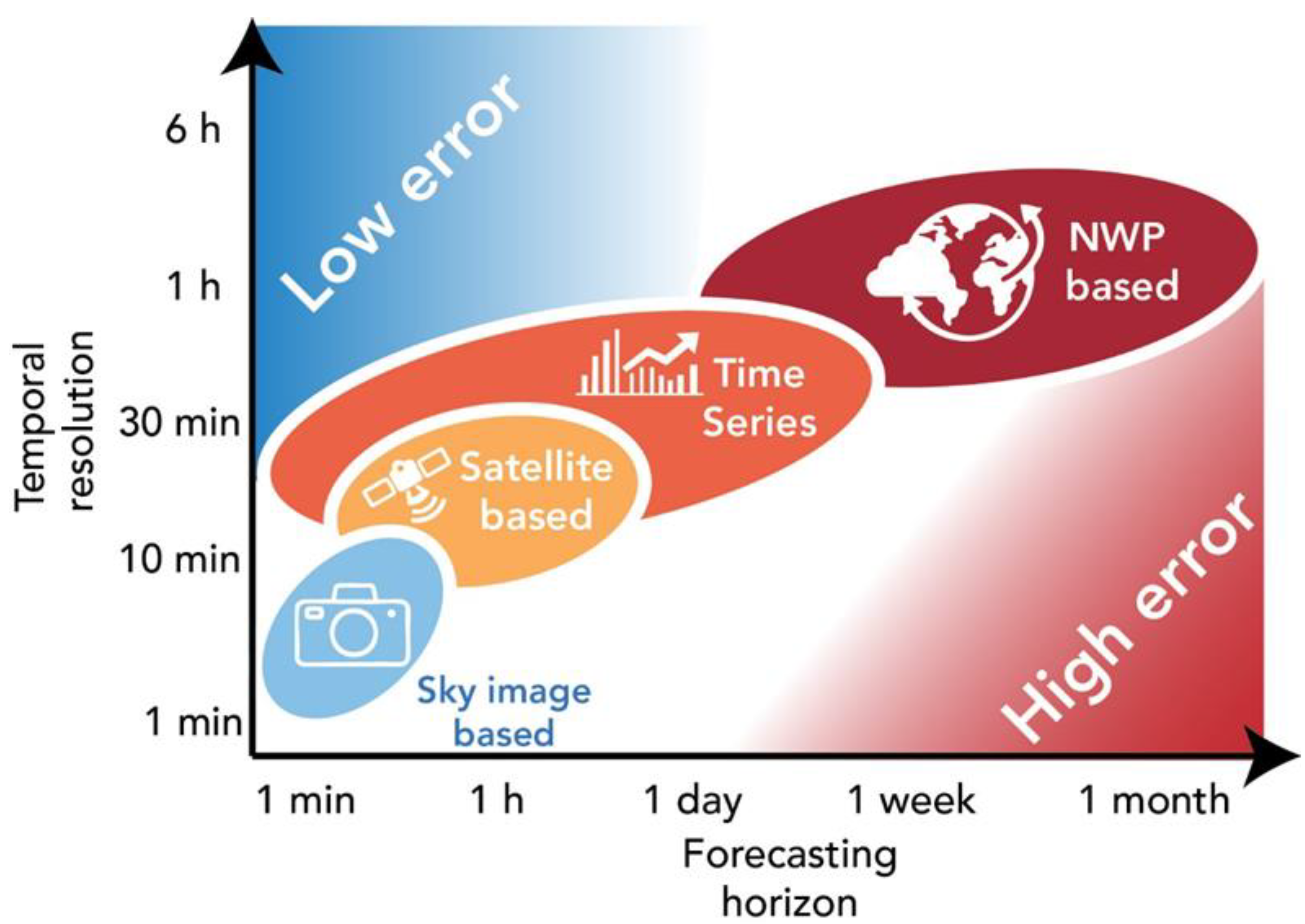
Figure 2.
AI-Driven Image Forecasting in Solar Energy.
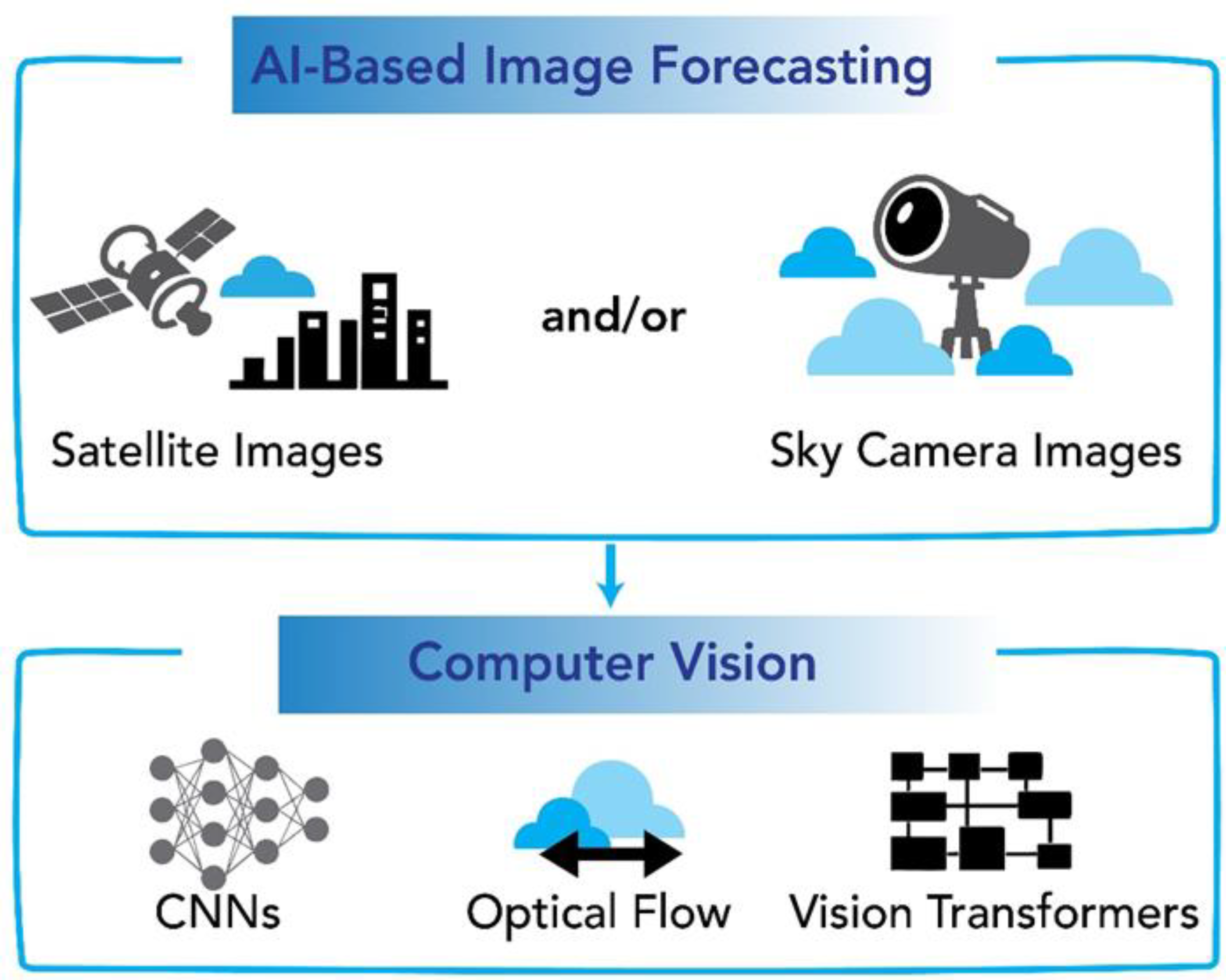
Figure 3.
AI-Based Fault Detection and Predictive Maintenance Framework for Solar Energy Systems.
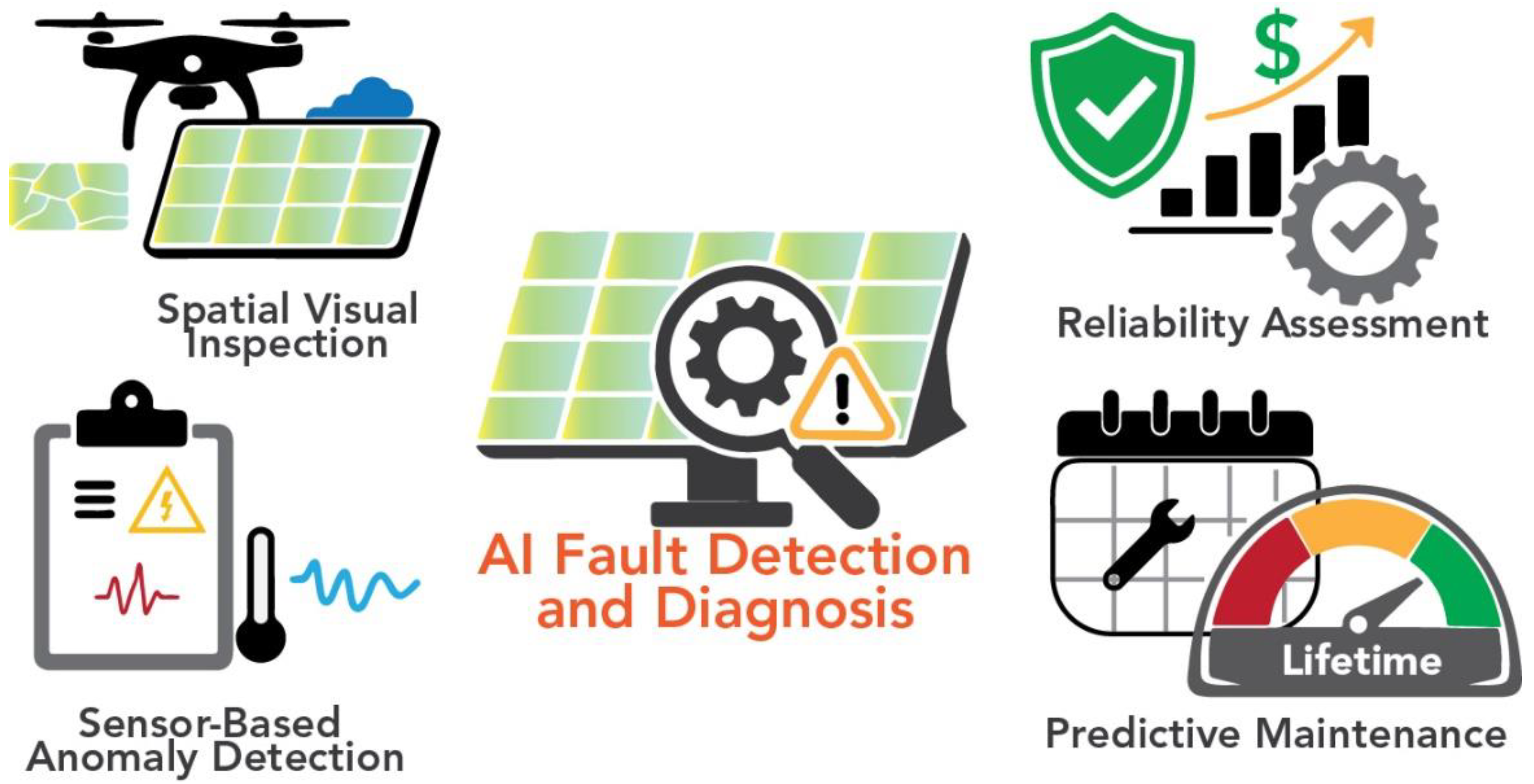

Table 1.
Inclusion and exclusion criteria used during the quantitative and qualitative screening stages.
Table 1.
Inclusion and exclusion criteria used during the quantitative and qualitative screening stages.
| Criteria | Included | Excluded |
| Document type | Journal articles and reviews | Theses, Web Blogs |
| Language | English | Any non-English sources |
| Field | Energy, Engineering, Environmental Science | Computer Science, Materials Science |
| Content focus | AI applied to solar-energy systems | Algorithm development with no energy context |
Table 2.
AI-Based Forecasting Approaches in Solar Energy.
| Approach | Main Methods | Typical Horizon | Key Strengths | Main Limitations |
| Time-Series and Deep Learning | ARIMA, LSTM, GRU, CNN, Transformers | Short to intra-day | High accuracy with historical data, captures nonlinear temporal patterns [42,43,44,45,46,47,48] | Limited robustness under regime changes, low interpretability [51,52] |
| Spatio-Temporal and Image-Based | CNN, ConvLSTM, optical flow, attention models | Very short-term to intra-hour | Anticipates rapid cloud-driven variability, effective for real-time operation [53,54,55,56,57,58] | High data and computational requirements, sensor-dependent [53,59] |
| Feature Engineering and Ensembles | Engineered features, bagging, boosting, stacking | Short-term to intra-day | Improved robustness and generalization under non-stationary conditions [60,61,62,63,64,65] | Increased model complexity and training cost [66] |
| Probabilistic and Uncertainty Modeling | Quantile regression, Bayesian NN, Monte Carlo DL | Short-term to intra-day | Quantifies forecast uncertainty, enables risk-aware decisions [67,68,69,70,71,72,73,74,75] | Requires careful calibration and higher computational effort [70,71,72] |
Table 3.
Comparison of AI-Based Vision and Sensor Detection with Predictive Maintenance Strategies in Solar Energy Systems.
Table 3.
Comparison of AI-Based Vision and Sensor Detection with Predictive Maintenance Strategies in Solar Energy Systems.
| Aspect | Vision- and Sensor-Based Detection | Predictive Maintenance and Reliability |
| Primary Objective | Early fault detection and diagnosis through anomaly identification [102,103] | Anticipation of failures and reliability-oriented maintenance planning [103,109] |
| Main Data Sources | Electrical measurements, environmental variables, thermal and visual images from drones or fixed systems [104] | Historical operational data, degradation indicators, and reliability metrics [109] |
| AI Techniques | Machine learning classifiers, deep learning models, CNNs, time-series analysis [105,106,107] | Regression models, ensemble learning, probabilistic approaches [102,109] |
| Typical Faults Addressed | Partial shading, soiling, degradation, hot spots, cracked cells, inverter and wiring failures [105,106,107] | Component aging, degradation trends, increased failure probability [109,110] |
| Key Advantages | Improved diagnostic accuracy through integration of physical measurements and spatial context [108] | Reduced downtime, extended component lifetime, improved availability, and energy yield [110] |
| Impact on System Operation | Fast and accurate fault localization in complex operating environments [108] | Lower maintenance costs and improved economic performance [110] |
| Role in Solar Energy Systems | Enhances operational monitoring and fault identification [104,105,106,107,108] | Supports long-term reliability, forecasting confidence, and planning in high solar penetration systems [111] |
Disclaimer/Publisher’s Note: The statements, opinions and data contained in all publications are solely those of the individual author(s) and contributor(s) and not of MDPI and/or the editor(s). MDPI and/or the editor(s) disclaim responsibility for any injury to people or property resulting from any ideas, methods, instructions or products referred to in the content. |
© 2026 by the authors. Licensee MDPI, Basel, Switzerland. This article is an open access article distributed under the terms and conditions of the Creative Commons Attribution (CC BY) license (http://creativecommons.org/licenses/by/4.0/).
Copyright: This open access article is published under a Creative Commons CC BY 4.0 license, which permit the free download, distribution, and reuse, provided that the author and preprint are cited in any reuse.


