

Submitted:
12 March 2026
Posted:
13 March 2026
You are already at the latest version
Abstract
The quality of vector images depends on a significant set of geometric and structural factors, which makes objective assessment a challenging task. This paper proposes a comprehensive approach to identifying and prioritizing these factors. Recursive feature elimination based on a random forest model was applied. A reachability matrix of factors was constructed to analyze direct and indirect relationships. Models describing relationships between the factors were developed. The rank and weight of each factor were calculated using a dependency-weighting system. An information system was developed to automate the process of prioritizing factors based on the proposed methodology. The software architecture was implemented in Python using the Tkinter, NumPy, and NetworkX libraries. Experimental results confirmed that the factor «coordinate accuracy» has the highest level of significance, whereas «file format» has the smallest influence on the quality of vector images. Due to the lack of dependence on specific selected factors, the developed system is universal and suitable for prioritizing factors in any application domain. Future research will focus on integrating the developed information system into a fuzzy-logic-based system for assessing the quality of vector images.
Keywords:
vector image
; quality
; reachability matrix
; ranking method
; prioritization
; factor
; model
; algorithm
; information system
1. Introduction
Vector images are a form of visual information representation based on the mathematical description of geometric primitives—points, lines, curves, and polygons—whose parameters determine the shape, size, and color of objects. A distinctive feature of vector graphics is invariance to scaling, which ensures the preservation of contour sharpness and geometric accuracy regardless of the resolution of the output device [1].
The scope of applications of vector images covers a considerable number of high-technology domains, for example, web engineering [2], the development of geographic information systems [3,4], and the automation of production processes [5,6,7]. Vector formats are widely used in modern web design and interface development due to their ability to adapt to multiplatform environments and their use in generative artificial intelligence models for creating graphical content [2]. In geoinformatics, vector data are important for preserving the topological integrity of spatial objects, which increases the accuracy of navigation maps and terrain plans [3,4]. In addition, in industrial engineering, the mathematical description of curves is used to generate tool-movement trajectories; in this case, any deviation from the specified geometry directly affects the quality of the manufactured part [5,6,7]. It should be noted that the above list is not exhaustive; however, it is representative for demonstrating the importance of vector images in the modern information environment.
Despite their clear mathematical structure, the quality assessment of such images remains a challenging task. The problem lies in the presence of a large number of factors that affect vector image quality. Moreover, these factors may have both qualitative and quantitative characteristics, which complicates generalized analysis [8,9,10]. For a clear demonstration of relationships between factors, semantic modeling methods are appropriate, as they allow a complex system of cause-and-effect relationships to be formalized in the form of directed graphs [11,12]. To determine the prioritization of these factors, an effective approach is the ranking method, which involves ordering the elements of a system based on a quantitative assessment of their mutual influences and structural dependencies [13,14]. This makes it possible to transform a complex network of relationships into a clear hierarchical model. In addition, factor prioritization contributes to improving design processes and developing automated quality control systems, which indicates the relevance of the present study.
The main purpose of this work is to develop an information system for determining the prioritization of factors influencing vector image quality using semantic modeling and ranking. To achieve this purpose, the following tasks must be addressed: to select key quality factors of vector images, to construct a reachability matrix of factors, to determine factor ranks, to develop an algorithm, and to implement the information system in software.
2. Literature Review
Quality assessment of visual content is an important task in modern information systems. For a long time, this process was based on subjective expert judgments. However, the development of technologies requires the introduction of automated analysis methods. Most existing solutions focus on detecting visual distortions and artifacts. Nevertheless, for vector graphics it is important to analyze a substantial number of factors that influence image quality.
In particular, study [15] summarizes full-reference, reduced-reference, and no-reference image quality assessment approaches. It emphasizes the difficulty of formalizing human perception and the dependence of results on datasets. In [16], the MUSIQ (Multi-scale Image Quality Transformer) model is presented, which performs multi-scale analysis of images at their original resolution. It enables feature extraction at both local and global levels. However, it provides only a general quality score and does not identify the contribution (weight) of individual technical factors. Random forest algorithms are also effective in relevant factor selection tasks [17,18,19]. However, the application of machine learning requires large training datasets and limits the ability to incorporate expert knowledge regarding the nature of the parameters themselves. In [20], a comprehensive review of HDR image quality assessment methods is provided, including subjective databases and objective metrics. The authors note that the choice of transformation method and the characteristics of datasets significantly affect assessment results, which complicates the comparison of different algorithms. Contemporary studies also extend quality assessment to more complex types of visual data. For example, in [21] the methods for assessing the quality of color images and 3D models are generalized, and algorithms are proposed for analyzing color distortions and geometric structure. This confirms the need to use multi-factor quality models.
Methods for automatic vectorization and SVG image generation are also being actively investigated. For example, [22] proposes an adaptive parameterization method for converting raster images into vector form. This approach improves the accuracy of contour and shape reconstruction. However, quality assessment is performed only using standard image similarity metrics and does not take into account technical factors of vector graphics, in particular path topology, the number of nodes, or coordinate accuracy. In [23], the SVGDreamer++ model is proposed, which increases the editability and diversity of vector primitives. However, quality assessment is focused on visual attractiveness without a formal hierarchy of factors. Study [24] indicates the effectiveness of decision-making based on factor analysis, using graph methods and hierarchical analysis.
An analysis of modern scientific sources shows that most existing approaches focus on overall perceptual quality or the reconstruction of vector primitives. At the same time, there is a lack of studies that form a hierarchy of technical quality factors for vector images (for example, topological correctness, the number of primitives, curve parameterization, and segmentation accuracy). This substantiates the need to develop the proposed information system for comprehensive analysis and ranking of vector graphic quality factors.
3. Materials and Methods
To identify the factors and construct the reachability matrix that illustrates the relationships between them, an expert assessment method was applied [25]. The experts included the authors of this study as well as other specialists in the subject area. The choice of this method is driven by the need for in-depth semantic verification of cause-and-effect dependencies, which cannot always be correctly interpreted using correlation-based methods alone. The procedure involves establishing the presence of a directed binary relationship for each ordered pair of factors , where the value «1» is assigned if the experts confirm a direct influence of the -th factor on the -th, and «0» is assigned otherwise [26,27].
For a graphical representation of relationships between factors in the developed information system interface, the semantic modeling method was used [28,29,30]. Accordingly, the factors are represented at the vertices of a semantic network, and the arcs are directed relationships between the factors.
It is reasonable to state that there are no absolutely identical factors; therefore, their influence is also different. Accordingly, it is possible to determine the intensity of this influence, that is, the significance of factors. The factors with the greatest influence are the most significant among the factors of the analyzed set.
The ranking method makes it possible to determine the ranks and priorities of factors based on information about the number of influences and dependencies of the first and second reachability levels. The initial stage is the development of hierarchical relationship models for each factor. Next, the weights of factors are ranked. It is essential to take into account the difference in weights between reachability levels. This is implemented by assigning different weighting coefficients. In this case, positive weights are used for direct influences, whereas negative weights are used for dependencies [8,10].
There is always a dominant element whose weight is the maximum within the set. This condition ensures the determinism of the model. The formation of initial ranks is carried out by analyzing the number of incoming and outgoing influences of each factor according to the reachability matrix. Four types of structural relationships are considered: direct influence, indirect influence, as well as direct and indirect dependencies. To quantitatively assess the significance of each type of relationship, a weighting system is introduced. Let denote the number of relationships of the -th type for the -th factor, where the index corresponds to the following categories: — direct influence; — indirect influence; — direct dependency; — indirect dependency. The system of weighting coefficients is constructed so that an active influence of a factor increases its weight (positive values), whereas dependence on other elements decreases it (negative values). Considering the above, the following values of weighting coefficients are used for calculations: , , , . The final weight of a factor, which aggregates all types of relationships, is determined by the formula:
Since negative coefficients are used for dependencies in formula (1), the resulting value may become negative, which complicates comparative analysis. To bring the results to a single positive scale, a shift-based normalization procedure is applied, which is implemented by the following expression:
The final normalized values used directly for ranking are computed as the ratio of the shifted factor weight to the sum of the weights of all elements of the system:
Thus, determining the significance of factors is based on a comprehensive analysis of four structural characteristics of each element. The first characteristic, denoted as , represents the number
of factors on which the analyzed element has a direct influence (the number of
unity elements in the corresponding row of the reachability matrix, excluding
the diagonal element). The second characteristic
is computed as the
number of factors on which an indirect influence exists through one
intermediate element. The third characteristic
is defined as the
number of factors that have a direct influence on the analyzed element (the
number of unity elements in the corresponding column of the matrix). The fourth
characteristic
represents the number
of factors that have an indirect influence on the analyzed element through one
intermediate factor.
Based on the calculated structural characteristics, four weighted indicators are formed that reflect different aspects of a factor’s position within the system of relationships. The first indicator is computed as the
product of the first characteristic
and the weighting
coefficient 10. This emphasizes the high significance of direct influences in
determining prioritization. The second indicator
is formed as the
product of the second characteristic
and the coefficient 5
and reflects the smaller, yet still substantial, role of second-level indirect
influences. The third indicator
and the fourth
indicator
are computed in a
similar manner, but with negative coefficients, since dependence on other
factors reduces the independence and prioritization of an element.
The generalized indicator for each factor is
calculated using formula (3), which takes into account all four weighted
components and a normalizing coefficient. Adding the normalizing coefficient
guarantees the non-negativity of the final indicator for all elements. This
simplifies the subsequent interpretation of the results. Factors are assigned
ranks from one to in ascending order of the values of
.
The obtained data serve as a basis for developing a factor significance model, which makes it possible to:
- Order the set of factors by the level of significance;
- Quantitatively assess the weight of relationships;
- Avoid subjectivity during assessment;
- Focus attention on the most significant factors;
- Create a basis for determining an integral indicator of the quality of vector image creation.
Based on the proposed methodology for factor prioritization, a corresponding information system is developed.
The architecture of the developed information system for determining the prioritization of factors influencing vector image quality is based on the principles of object-oriented programming and uses the Model–View–Controller design pattern. This pattern provides a clear separation between data processing logic, information presentation, and user interaction control. The main class of the system encapsulates all functional capabilities, including managing data structures, performing mathematical computations, and coordinating the graphical user interface elements [31].
The software technology stack includes several specialized Python libraries, each of which is responsible for a specific functional area. To create the graphical user interface of the system, the Tkinter library was used, which is a standard tool for developing GUI applications in the Python ecosystem. The use of Tkinter ensures cross-platform compatibility of the software product and allows it to run without modifications on Linux, Windows, and macOS operating systems. To create visually enhanced interface elements, the ttk module was used, which provides access to themed widgets with a native look for each operating system. The interface is organized according to a multi-page structure using the Notebook component. It allows different stages of working with the system to be logically separated: constructing the reachability matrix, analyzing hierarchical structures, and visualizing the prioritization model [32,33,34].
For efficient work with matrix data, the NumPy library was integrated. It provides high performance for operations on multidimensional arrays due to the implementation of basic computational procedures at the compiled-code level. In the developed system, the reachability matrix is represented as a two-dimensional NumPy array with binary elements [35,36,37].
Visualization of the analysis results is implemented using the Matplotlib library. In the developed system, Matplotlib is used to generate several types of visualizations: semantic networks, hierarchical tree-like structures, and factor significance models. Integration of Matplotlib with the Tkinter graphical interface is performed through the specialized FigureCanvasTkAgg module. It allows interactive graphical elements to be embedded directly into the application windows [38,39].
4. Experiment, Results and Discussion
Based on expert assessment, a set of factors was identified:
— coordinate accuracy;
— number of nodes;
— path topology;
— line thickness;
— color model;
— file format. As a
result of expert processing of the factors, a binary reachability matrix was
generated (Table 1).
The influence of coordinate accuracy on the number of nodes is related to the fact that coordinate accuracy determines the possibility of correctly using the required number of nodes without the accumulation of numerical errors. With insufficient accuracy, increasing the number of nodes does not improve the quality of shape description, but instead amplifies geometric artifacts. The influence of on is determined by the dependence of contour closure correctness and intersections on the accuracy of positioning of segments and nodes. The influence of on consists in ensuring stroke stability, since coordinate errors manifest as non-uniform thickness and joint defects. The influence of on is due to the fact that the file format defines the allowable precision and the way coordinates are stored. Formats with limited precision modify or quantize coordinate data. This directly affects the geometric quality of the image.
The influence of the number of nodes on lies in the fact that the number of nodes determines the structural complexity of contours. In addition, node density determines the geometric smoothness of a contour, on which stroke stability depends, which indicates the influence of on . The influence of on is caused by the increase in the volume and complexity of vector data as the number of nodes increases.
Given that stroke correctness depends on path topology, the influence of on is evident. Errors in segment connections and contour closure lead to improper rendering of line thickness, especially at joints and intersections. The influence of on lies in the fact that a correct topological structure determines the regions to which the numerical parameters of the color model and their interpolation algorithms are applied. The influence of on is related to the need to preserve topological rules within the file structure.
The influence of on lies in the fact that the preservation and correct interpretation of colors depend on the color model supported by the file format.
In vector images, the file format plays the role of a passive container for structural data. Geometry, topology, and color parameters are formed at the object model level before saving. The format only records, or in the worst case constrains, the characteristics that have already been defined. Therefore, the number of nodes, path topology, and the color model are logically considered as factors that define requirements for the format, rather than the other way around.
Hierarchical relationship graphs visualize the obtained results. In particular, Figure 1 presents an example of an influence graph for a vector image quality factor .
Table 2 presents the input data and calculation results. According to (3), the ranks of vector image quality factors were computed.
Based on the data in Table 2, a model was constructed that reflects the significance levels of vector image quality factors (Figure 2).
The algorithm of the developed information system is presented in Figure 3. The mathematical model underlying the system is based on the semantic modeling method and the hierarchy ranking method.
The system provides an interactive interface for constructing a reachability matrix of arbitrary dimensionality within the range from one to twenty-five factors. The user can dynamically change the number of factors and their designations. A mechanism for automatic updating of all visualizations when changes are made to the matrix structure has been implemented.
The hierarchical structure analysis module makes it possible to study in detail the position of a selected factor within the system of relationships by constructing two independent graphs. The first graph visualizes the structure of direct and indirect influences. The second graph reflects the structure of dependencies. The visualization is organized as a three-tier hierarchical structure, where the first tier is occupied by the root factor, the second tier contains factors of direct influence or direct dependency, and the third tier includes factors of indirect influence or second-level dependency. The resulting prioritization model is presented in the form of a vertical hierarchical diagram, where factors are arranged in ascending order of their prioritization from lower positions to higher ones.
Practical use of the developed information system requires following a certain sequence of operations, which ensures the correctness of input data formation, the accuracy of computational procedures, and the adequacy of interpreting the analysis results. Work with the system begins with launching the program executable file and is demonstrated using the example of analyzing the factors involved in shaping vector image quality (Figure 4).
The main application window appears on the screen, with the interface organized as a control panel in the upper part and a multi-page structure in the central area. The control panel contains the main system configuration elements and buttons for performing key operations. The page structure provides a logical separation of the different stages of the analytical process.
In the factor designation field, the user can set a prefix that will be used to identify the system elements (any symbol or letter, according to the specifics of the subject area). Next, the required number of factors is specified using the corresponding field. After setting the required parameters, the user activates the matrix creation button. The diagonal matrix elements, which represent the trivial influence of each factor on itself, are highlighted in gray and are not editable. The elements outside the main diagonal are presented as editable white fields. Their initial value is zero. The user can enter zero or one using the corresponding keys on the keyboard. The system ignores any other symbols to prevent erroneous entry of incorrect data.
Each modification of a matrix element is immediately reflected in the visualization of the semantic network located on the right side of the first page of the interface.
After completing the construction of the reachability matrix, the user activates the rank determination button located on the control panel. This initiates the process of computing all structural characteristics of the factors and an automatic transition to the second page of the interface (Figure 5).
On this page, a table of ranking results is located in the upper part. Analysis of the hierarchies of influences and dependencies is performed by selecting the required factor and constructing the corresponding graphs. After completing the analysis of hierarchical structures, the user can proceed to constructing the final model of hierarchical factor influence by activating the corresponding button on the control panel. This action initiates a transition to the third page of the interface and the generation of the resulting visualization (Figure 6).
Thus, the highest level of significance belongs to the factor «coordinate accuracy» , since it is the source of all spatial data and determines the allowable accuracy limits for the remaining parameters. It is through that the ability to describe complex shapes is realized or constrained. Therefore, its influence is systemic and irreversible in nature.
The second level of significance belongs to the factor «number of nodes» , which is directly related to the implementation of coordinate-based description and determines the level of detail of the geometric model within the given accuracy. functions as an optimization parameter between shape adequacy and the complexity of its representation. This determines its substantial, but subordinate, influence. The factor «path topology» occupies a middle position in the hierarchy. It does not create geometry, but it determines the correctness of structural relationships between elements. The influence of manifests itself at the level of logical organization of objects, ensuring the consistency of geometry with processing and interpretation algorithms. The color model has lower significance, since its influence is realized after the geometric structure is formed. It does not change the spatial characteristics of the image, but it determines the correctness of presenting the result in different environments. Line thickness belongs to parameters of visual presentation and has a local nature of influence. Its significance is limited to the level of perception and reproduction. Changing this factor does not violate the integrity of the geometric model, which substantiates its lower position.
The lowest level of significance belongs to the factor «file format» , which is derived from all other factors and reflects only the way they are recorded and transmitted. does not directly form the quality of a vector image, but only determines the degree of preservation and compatibility of the already formed characteristics.
It should be noted that the developed information system allows users to return to previous stages of work and modify the input data in order to explore alternative scenarios of forming the relationship structure.
5. Conclusions
The study implemented a comprehensive approach to determining the prioritization of factors that shape vector image quality. To formalize the system of interdependencies among such parameters as coordinate accuracy, number of nodes, path topology, line thickness, color model, and file format, a reachability matrix was constructed. Hierarchical models were developed that demonstrate the identified relationships and simplify the subsequent ranking procedure.
As a result of the performed ranking, a clear hierarchy of factor prioritization was established. It was determined that the most significant factor that has a systemic influence on vector image quality is «coordinate accuracy». At the same time, this factor received rank 6 and, accordingly, priority 1. In contrast, the lowest level of significance was demonstrated by the factor «file format» (rank 1, priority 6), since it mostly performs the function of data containerization. The obtained results provide a holistic view of the role of each parameter in the process of vector graphics rendering. For the practical implementation of the proposed methodology, an information system for factor prioritization was developed, which automates the full analysis cycle: entering binary data to form the reachability matrix, constructing a semantic network of factors, presenting hierarchical models of relationships between factors, and a model of prioritized factor influence. The information system was developed based on the object-oriented programming paradigm in Python using the Tkinter, NumPy, and NetworkX libraries.
At the same time, the study has certain limitations related to the need to involve experts to verify the directions of influence in the reachability matrix, which may introduce an element of subjectivity. Further research may be aimed at automating the construction of influence matrices using deep learning methods, as well as integrating the developed information system into a fuzzy-logic-based vector image quality assessment system. In addition, due to the absence of dependencies on specific factors, this system is a universal tool and can be used to determine the significance of factors in any subject area.
Author Contributions
Conceptualization, V.S. and L.S.; methodology, I.P. and L.S.; software, A.K.; validation, I.P., A.K. and N.L.; formal analysis, V.S. and N.L.; investigation, A.K.; resources, L.S. and N.L.; data curation, I.P.; writing—original draft preparation, A.K., N.L and L.S.; writing—review and editing, I.P., V.S. and A.K.; visualization, A.K. and V.S.; supervision, V.S.; project administration, I.P., L.S. and V.S.; funding acquisition, I.P., L.S. and N.L. All authors have read and agreed to the published version of the manuscript.
Funding
This research received no external funding.
Data Availability Statement
The raw data supporting the conclusions of this article will be made available by the authors on request.
Conflicts of Interest
The authors declare no conflicts of interest.
References
- Tian, X.; Günther, T. A survey of smooth vector graphics: Recent advances in repr esentation, creation, rasterization, and image vectorization. IEEE Transactions on Visualization and Computer Graphics 2021, 30, 1652–1671. [Google Scholar] [CrossRef]
- Balla, D.; Gede, M. Vector data rendering performance analysis of open-source web mapping libraries. ISPRS International Journal of Geo-Information 2025, 14, 336. [Google Scholar] [CrossRef]
- Tsai, B. S.; Huizer, L.; Giampaolo, M.; Monté, S.; Gong, S.; Garcia, G.; Agugiaro, G. Integration of GIS and CAD data to perform interactive preliminary environmental analyses at district scale. The International Archives of the Photogrammetry, Remote Sensing and Spatial Information Sciences 2024, 48, 169–176. [Google Scholar] [CrossRef]
- Ma, Y.; Li, G.; Zhao, L.; Yao, X. Accuracy evaluation method for vector data based on hexagonal discrete global grid. ISPRS International Journal of Geo-Information 2025, 14, 5. [Google Scholar] [CrossRef]
- Liao, J.; Huang, Z. Data model-based toolpath generation techniques for CNC milling machines. Frontiers in Mechanical Engineering 2024, 10, 1358061. [Google Scholar] [CrossRef]
- Xie, S.; Liu, Z. A review of vector field-based tool path planning for CNC machining of complex surfaces. Symmetry 2025, 17, 1300. [Google Scholar] [CrossRef]
- Pušnik, T.; Hace, A. Robotic surface finishing with a region-based approach incorporating dynamic motion constraints. Mathematics 2025, 13, 3273. [Google Scholar] [CrossRef]
- Senkivskyy, V.; Sikora, L.; Lysa, N.; Kudriashova, A.; Pikh, I. Fuzzy system for the quality assessment of educational multimedia edition design. Applied Sciences 2025, 15, 4415. [Google Scholar] [CrossRef]
- Senkivskyy, V.; Babichev, S.; Pikh, I.; Kudriashova, A.; Senkivska, N.; Kalynii, I. Forecasting the reader’s demand level based on factors of interest in the book. In Proceedings of the CIT-Risk’2021: 2nd International Workshop on Computational & Information Technologies for Risk-Informed Systems, Kherson, Ukraine, 16–17 September 2021; pp. 176–191. Available online: https://ceur-ws.org/Vol-3101/Paper12.pdf.
- Durnyak, B.; Hileta, I.; Pikh, I.; Kudriashova, A.; Petiak, Y. Designing a fuzzy controller for prediction of tactile product quality. In Proceedings of the 1st International Workshop on Digital Content & Smart Multimedia, DCSMart 2019, Lviv, Ukraine, 23–25 December 2019; pp. 70–81. Available online: https://ceurws.org/Vol-2533/paper7.pdf.
- Zhang, L.; Hu, K.; Ma, X.; Sun, X. Combining semantic and structural features for reasoning on patent knowledge graphs. Applied Sciences 2024, 14, 6807. [Google Scholar] [CrossRef]
- Sarica, S.; Han, J.; Luo, J. Design representation as semantic networks. Computers in Industry 2023, 144, 103791. [Google Scholar] [CrossRef]
- Rajeh, S.; Cherifi, H. Ranking influential nodes in complex networks with community structure. Plos One 2022, 17, e0273610. [Google Scholar] [CrossRef]
- Li, W.; Yi, P.; Li, L. Superiority-comparison-based transformation, consensus, and ranking methods for heterogeneous multi-attribute group decision-making. Expert Systems with Applications 2023, 213, 119018. [Google Scholar] [CrossRef]
- Ryu, J. Improved image quality assessment by utilizing pre-trained architecture features with unified learning mechanism. Applied Sciences 2023, 13, 2682. [Google Scholar] [CrossRef]
- Ke, J.; Wang, Q.; Wang, Y.; Milanfar, P.; Yang, F. Musiq: Multi-scale image quality transformer. In Proceedings of the IEEE/CVF international conference on computer vision, 2021; pp. 5148–5157. Available online: https://openaccess.thecvf.com/content/ICCV2021/html/Ke_MUSIQ_Multi-Scale_Ima ge_Qua lity_Transformer_ICCV_2021_paper.html.
- Bulut, O.; Tan, B.; Mazzullo, E.; Syed, A. Benchmarking variants of recursive feature elimination: Insights from predictive tasks in education and healthcare. Information 2025, 16, 476. [Google Scholar] [CrossRef]
- Barzani, A. R.; Pahlavani, P.; Ghorbanzadeh, O.; Gholamnia, K.; Ghamisi, P. Evaluating the impact of recursive feature elimination on machine learning models for predicting forest fire-prone zones. Fire 2024, 7, 440. [Google Scholar] [CrossRef]
- Dewi, C.; Andika, R. A.; Haryani, E.; Riantama, D.; Sajid, A.; Alam, M. M.; Su’ud, M. M. Feature selection for financial data classification using random forest, boruta, and recursive feature elimination. Ingénierie des Systèmes d’Information 2025, 30, 2165–2173. [Google Scholar] [CrossRef]
- Liu, Y.; Tian, Y.; Wang, S.; Zhang, X.; Kwong, S. Overview of high-dynamic-range image quality assessment. Journal of Imaging 2024, 10, 243. [Google Scholar] [CrossRef]
- Gao, M.; Song, C.; Zhang, Q.; Zhang, X.; Li, Y.; Yuan, F. Research progress on color image quality assessment. Journal of Imaging 2025, 11, 307. [Google Scholar] [CrossRef] [PubMed]
- Zhao, K.; Bao, L.; Li, Y.; Su, X.; Zhang, K.; Qiao, X. Less is more: Efficient image vectorization with adaptive parameterization. In Proceedings of the Computer Vision and Pattern Recognition Conference, 2025; pp. 18166–18175. Available online: https://openaccess.thecvf.com/con¬tent/CVPR2025/html/-Zhao_Less_is_More_Efficient_Image_Vectorization_with_Adaptive_Parameterization_CVPR_2025_paper.html.
- Xing, X.; Yu, Q.; Wang, C.; Zhou, H.; Zhang, J.; Xu, D. Svgdreamer++: Advancing editability and diversity in text-guided svg generation. IEEE Transactions on Pattern Analysis and Machine Intelligence 2025, 47, 5397–5413. [Google Scholar] [CrossRef] [PubMed]
- Tymchenko, O.; Kunanets, N.; Khamula, O.; Vasiuta, S.; Sosnovska, O.; Dorosh, S.; Drimaylo, M. Determining the priority of factors influencing the selection of information technology for distance education. In Proceedings of the IEEE 17th International Scientific and Technical Conference on Computer Sciences and Information Technologies, 2022; pp. 279–283. [Google Scholar] [CrossRef]
- Chen, H.; Zhang, Y.; Wang, L. A study on the quality evaluation index system of smart home care for older adults in the community-based on Delphi and AHP. BMC Public Health 2023, 23, 411. [Google Scholar] [CrossRef]
- Pikh, I.; Senkivskyy, V.; Sikora, L.; Lysa, N.; Kudriashova, A. Automated System for Evaluating Alternatives for Developing Innovative IT Projects. Applied Sciences 2025, 15, 1167. [Google Scholar] [CrossRef]
- Senkivskyi, V.; Kudriashova, A.; Pikh, I.; Hileta, I.; Lytovchenko, O. Models of postpress processes designing. In Proceedings of the 1st International Workshop on Digital Content & Smart Multimedia (DCSMart 2019), Lviv, Ukraine, 23–25 December 2019; pp. 259–270. Available online: https://ceur-ws.org/Vol-2533/paper24.pdf.
- Kudriashova, A.; Pikh, I.; Senkivskyy, V.; Merenych, Y. Evaluation of prototyping methods for interactive virtual systems based on fuzzy preference relation. Eastern-European Journal of Enterprise Technologies 2024, 5, 71–81. [Google Scholar] [CrossRef]
- de Barros Pereira, H. B.; Grilo, M.; de Sousa Fadigas, I.; de Souza Junior, C. T.; do Vale Cunha, M.; Barreto, R. S. F. D.; Andrade, J. C.; Henrique, T. Systematic review of the “semantic network” definitions. Expert Systems with Applications 2022, 210, 118455. [Google Scholar] [CrossRef]
- Pikh, I.; Senkivskyy, V.; Kudriashova, A.; Senkivska, N. Prognostic assessment of COVID-19 vaccination levels. In Lecture Notes in Data Engineering, Computational Intelligence, and Decision Making; Springer: Berlin/Heidelberg, Germany, 2022; Volume 149, pp. 246–265. [Google Scholar] [CrossRef]
- Wang, B.; Dai, L.; Liao, B. System Architecture Design of a Multimedia Platform to Increase Awareness of Cultural Heritage: A Case Study of Sustainable Cultural Heritage. Sustainability 2023, 15, 2504. [Google Scholar] [CrossRef]
- Bakker, W.; van Ruitenbeek, F.; van der Werff, H.; Hecker, C.; Dijkstra, A.; van der Meer, F. Hyperspectral Python: HypPy. Algorithms 2024, 17, 337. [Google Scholar] [CrossRef]
- Tsai, P.-S.; Wu, T.-F.; Chen, W.-H. Generalized Vision-Based Coordinate Extraction Framework for EDA Layout Reports and PCB Optical Positioning. Processes 2026, 14, 342. [Google Scholar] [CrossRef]
- Nguyen, H.; Eang, C.; Lee, S. Predicting the Lifespan of Twisted String Actuators Using Empirical and Hybrid Machine Learning Approaches. Sensors 2025, 25, 7387. [Google Scholar] [CrossRef]
- Raschka, S.; Patterson, J.; Nolet, C. Machine Learning in Python: Main Developments and Technology Trends in Data Science, Machine Learning, and Artificial Intelligence. Information 2020, 11, 193. [Google Scholar] [CrossRef]
- Mussabayev, R. Optimizing Euclidean Distance Computation. Mathematics 2024, 12, 3787. [Google Scholar] [CrossRef]
- Mochurad, L. A Comparison of Machine Learning-Based and Conventional Technologies for Video Compression. Technologies 2024, 12, 52. [Google Scholar] [CrossRef]
- Kaur, K.; Kaur, P.; Kaur, J.; Channi, H. K. Comprehensive analysis of domestic energy consumption using Python and Matplotlib. In Proceedings of the 2nd International Conference on Advancements and Key Challenges in Green Energy and Computing (AKGEC), Ghaziabad, India, 1–6 November 2024. [Google Scholar] [CrossRef]
- Plókai, D.; Détár, B.; Haidegger, T.; Nagy, E. Deploying an Educational Mobile Robot. Machines 2025, 13, 591. [Google Scholar] [CrossRef]
- Amiripalli, S. S.; Rampay, V.; Jitendra, M. S. A graph analytics on telecom backbone networks using networkX. Research Advancements and Innovations in Computing, Communications and Information Technologies: ICRAIC2IT 2023, 2796, 150003. [Google Scholar] [CrossRef]
- Hasan, M.; Kumar, N.; Majeed, A.; Ahmad, A.; Mukhtar, S. Protein–protein interaction network analysis using networkX. Protein-Protein Interactions: Methods and Protocols 2023, 457–467. [Google Scholar] [CrossRef]
Figure 1.
Graph of direct influences for the «coordinate accuracy» factor.
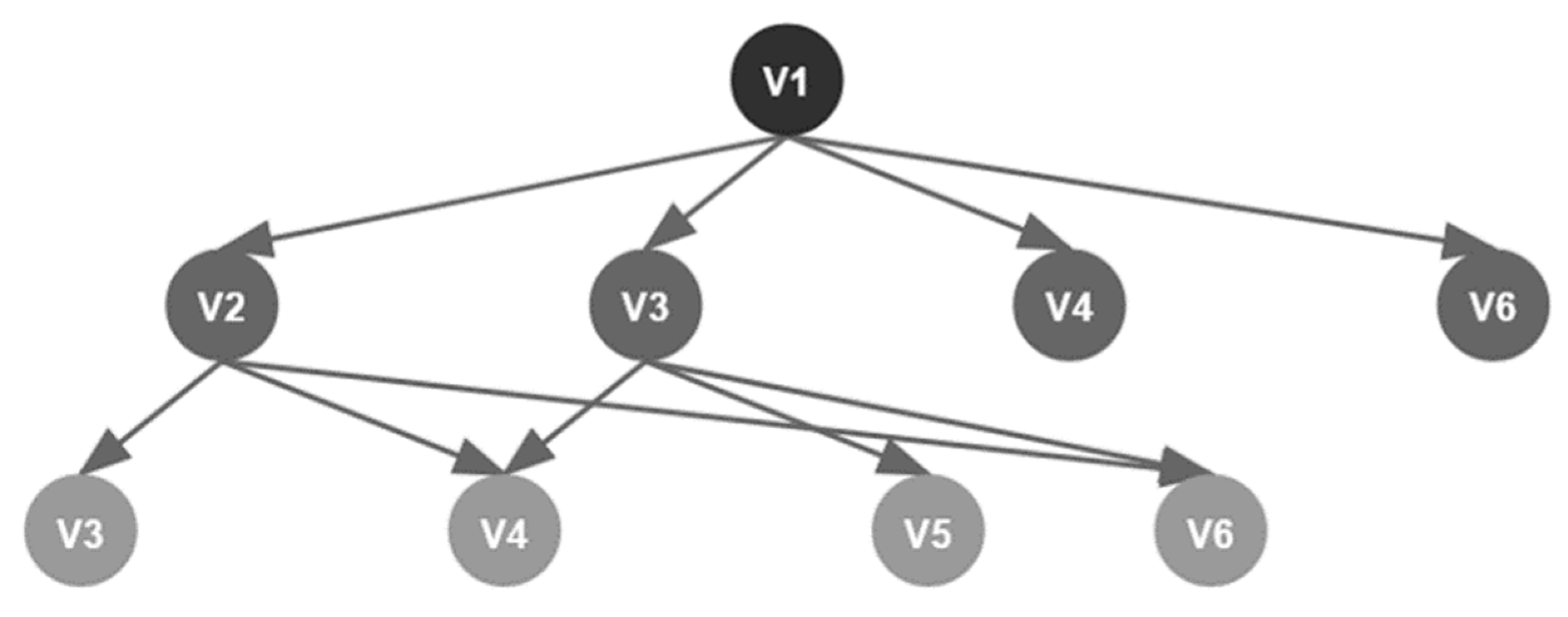
Figure 2.
Hierarchy model of factor influence on vector image quality.
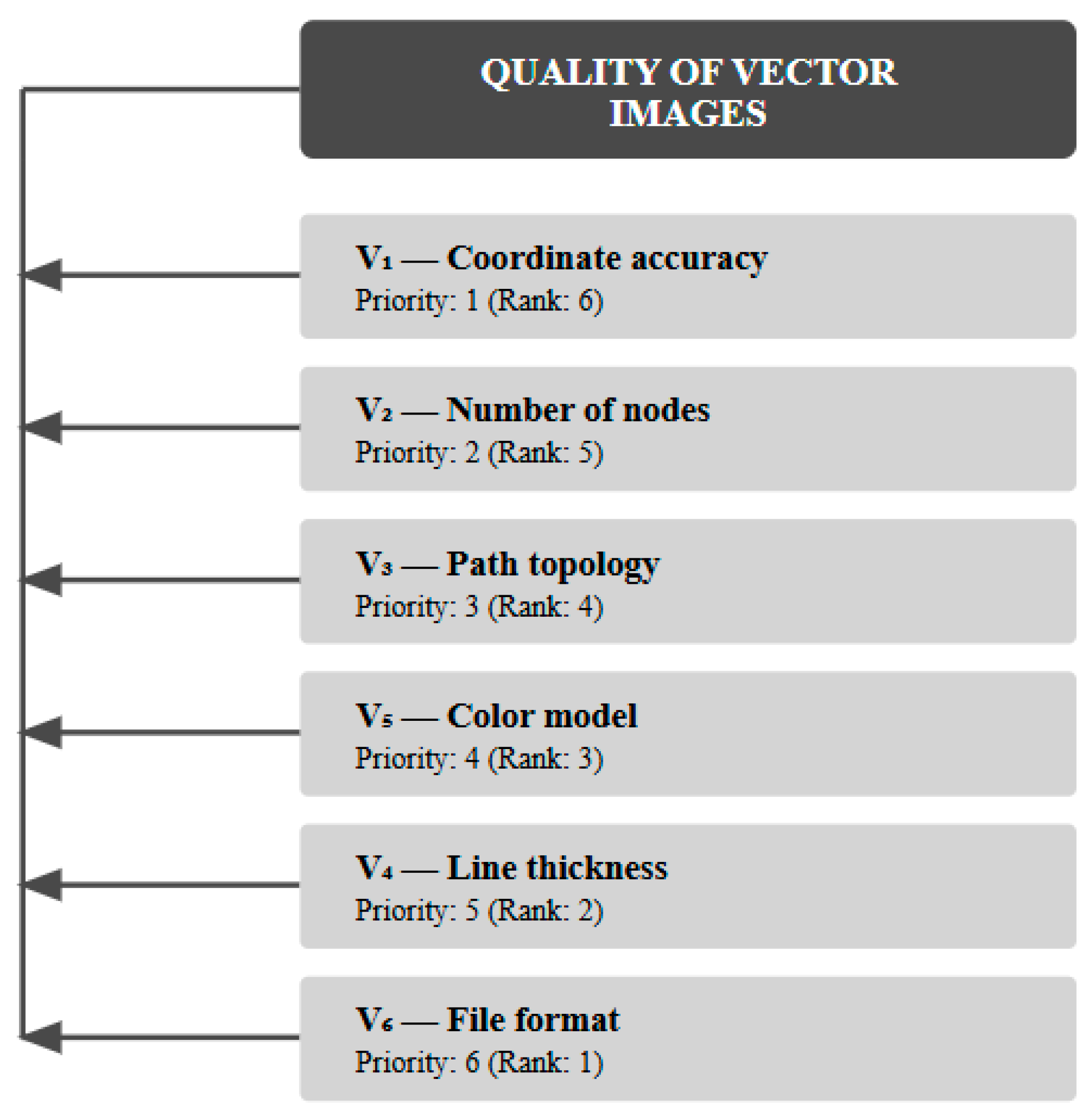
Figure 3.
Generalized flowchart of the algorithm of the developed information system.
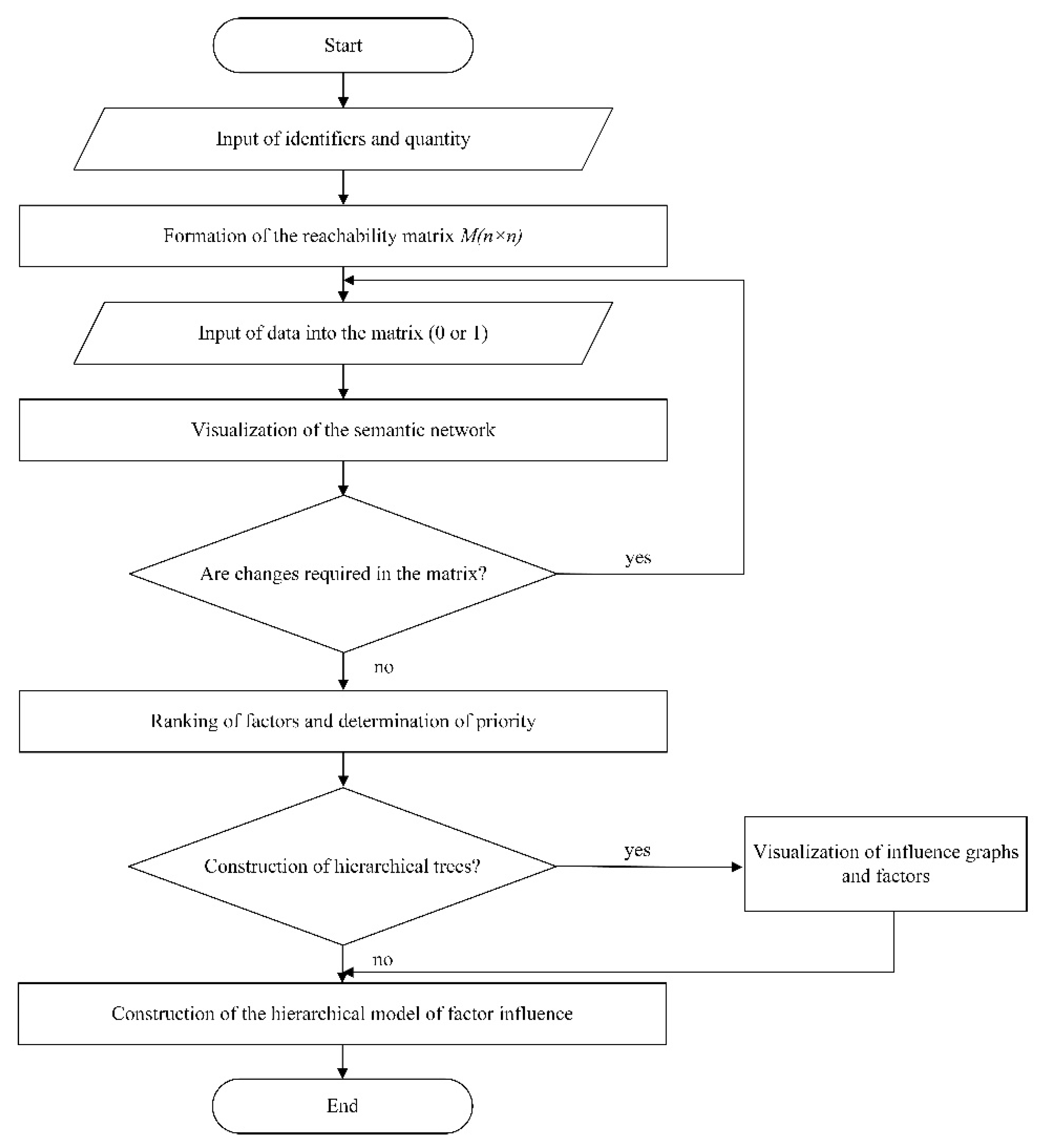
Figure 4.
Initial page of the information system for determining the significance level of factors.
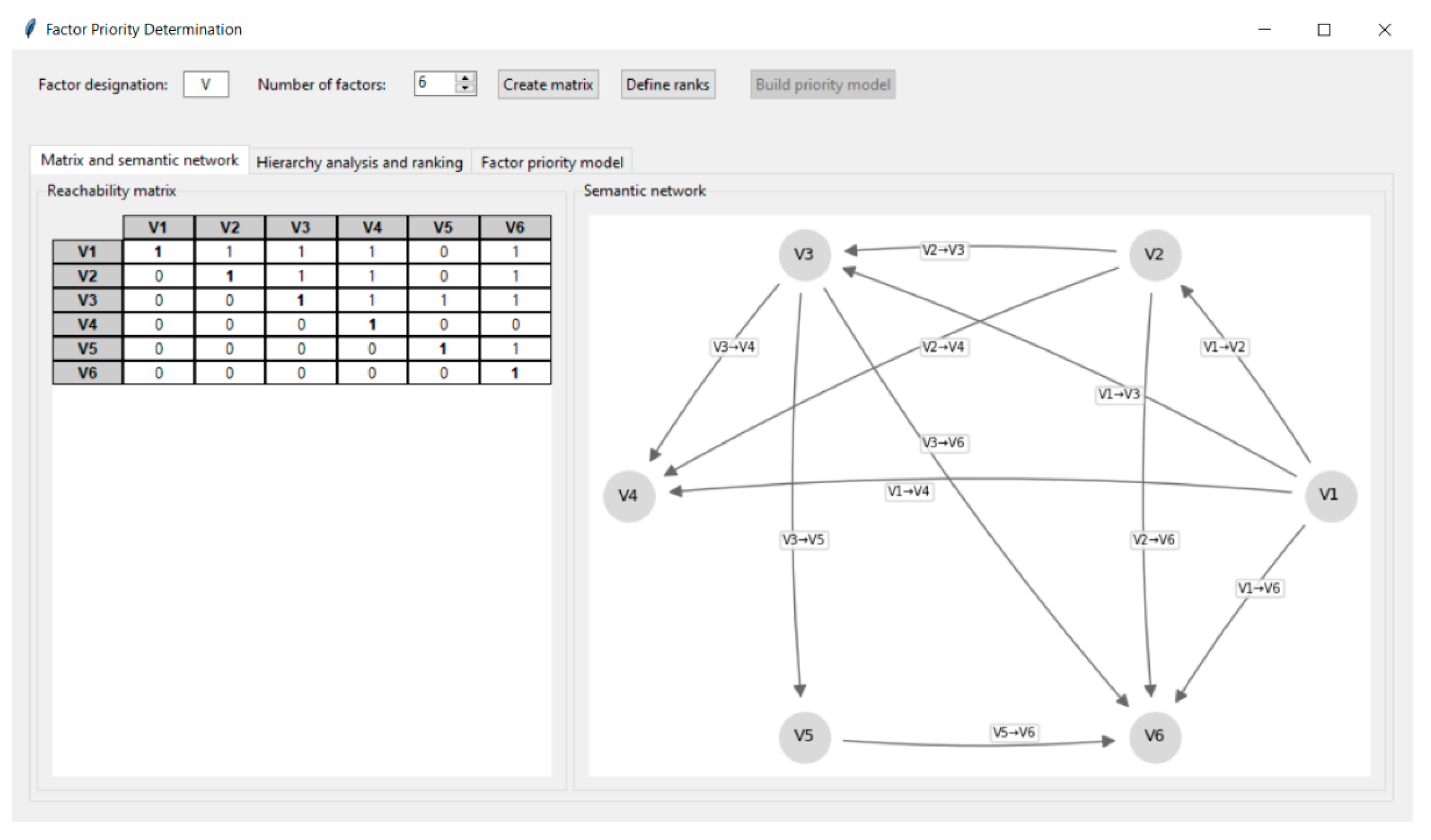
Figure 5.
Hierarchy analysis and ranking.
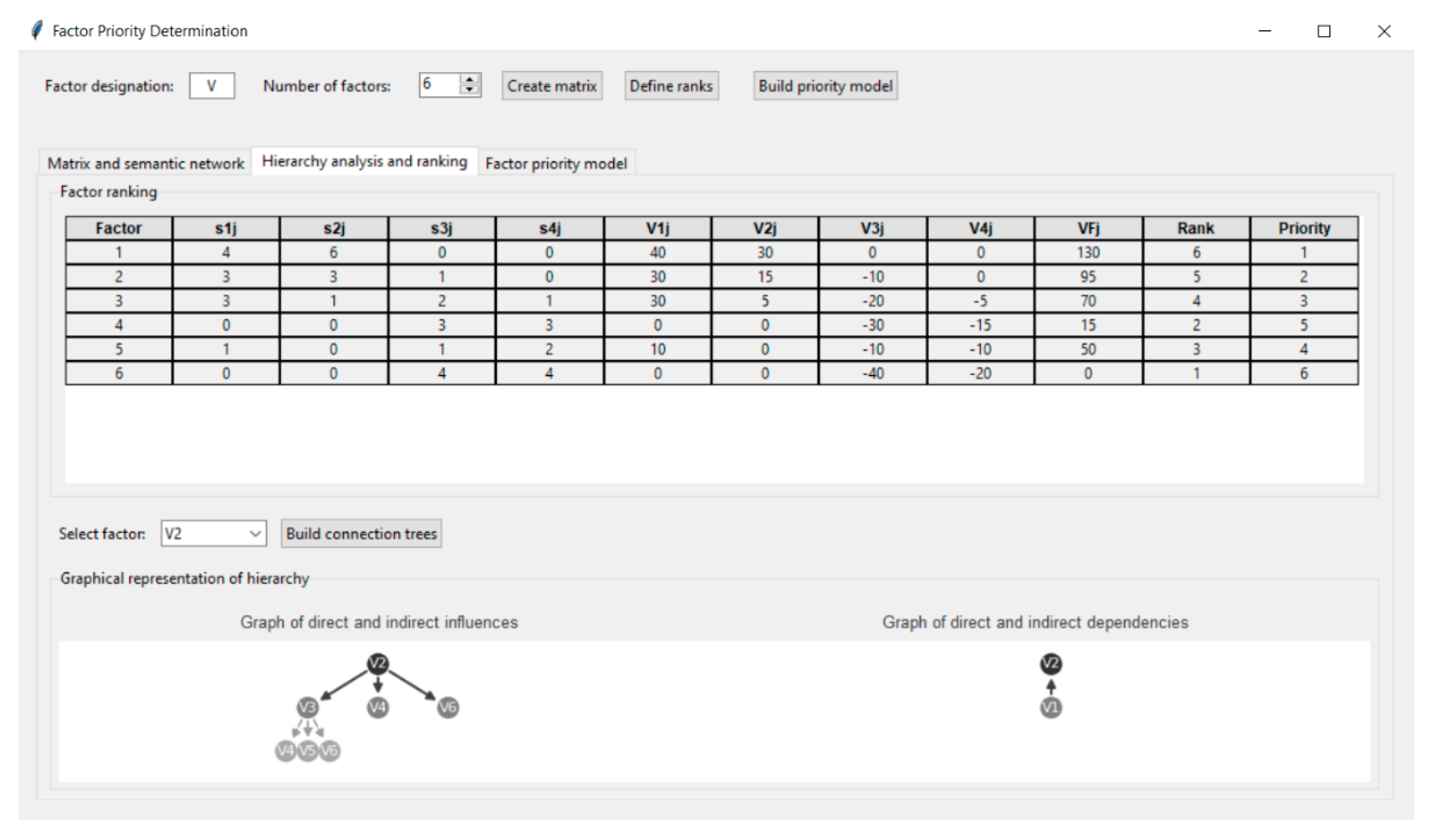
Figure 6.
Construction of the factor influence hierarchy model.
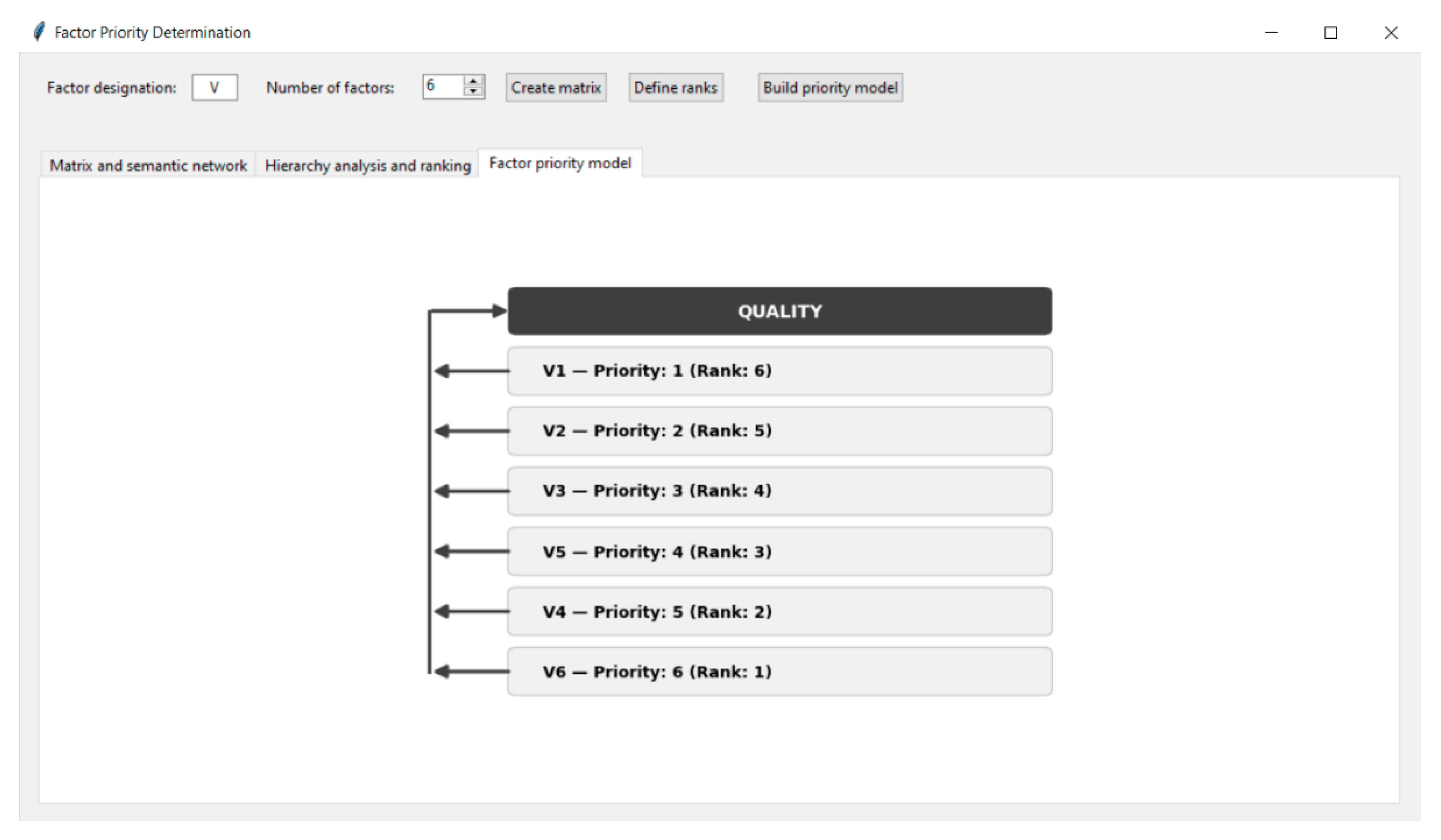

Table 1.
Reference matrix of relationships between factors.
| Factors | ||||||
|---|---|---|---|---|---|---|
| 1 | 1 | 1 | 1 | 0 | 1 | |
| 0 | 1 | 1 | 1 | 0 | 1 | |
| 0 | 0 | 1 | 1 | 1 | 1 | |
| 0 | 0 | 0 | 1 | 0 | 0 | |
| 0 | 0 | 0 | 0 | 1 | 1 | |
| 0 | 0 | 0 | 0 | 0 | 1 |
Table 2.
Determination of significance levels of vector image factors.
| Factors | Priority | ||||||||||
|---|---|---|---|---|---|---|---|---|---|---|---|
| 1 | 4 | 6 | 0 | 0 | 40 | 30 | 0 | 0 | 130 | 6 | 1 |
| 2 | 3 | 3 | 1 | 0 | 30 | 15 | -10 | 0 | 95 | 5 | 2 |
| 3 | 3 | 1 | 2 | 1 | 30 | 5 | -20 | -5 | 70 | 4 | 3 |
| 4 | 0 | 0 | 3 | 3 | 0 | 0 | -30 | -15 | 15 | 2 | 5 |
| 5 | 1 | 0 | 1 | 2 | 10 | 0 | -10 | -10 | 50 | 3 | 4 |
| 6 | 0 | 0 | 4 | 4 | 0 | 0 | -40 | -20 | 0 | 1 | 6 |
Disclaimer/Publisher’s Note: The statements, opinions and data contained in all publications are solely those of the individual author(s) and contributor(s) and not of MDPI and/or the editor(s). MDPI and/or the editor(s) disclaim responsibility for any injury to people or property resulting from any ideas, methods, instructions or products referred to in the content. |
© 2026 by the authors. Licensee MDPI, Basel, Switzerland. This article is an open access article distributed under the terms and conditions of the Creative Commons Attribution (CC BY) license (http://creativecommons.org/licenses/by/4.0/).
Copyright: This open access article is published under a Creative Commons CC BY 4.0 license, which permit the free download, distribution, and reuse, provided that the author and preprint are cited in any reuse.


