

Submitted:
12 March 2026
Posted:
13 March 2026
You are already at the latest version
Abstract
This article introduces a tutorial-style implementation of Quantum Link Prediction (QLP) for citation network analysis in historiographical research, with a specific focus on the transnational historiography of Mongol military campaigns. Using a manually curated citation network of Russian and American military treatises from 1875 to 2012, the study applies simulated quantum random walks to identify previously unknown citation pathways. The article is structured to guide researchers through each phase of the QLP workflow, from network preprocessing and quantum circuit construction to result interpretation, making it accessible to scholars in the humanities new to quantum methods. Through this approach, we discover a previously unknown transmission link connecting the Russian and American corpora. This finding not only reshapes the existing citation network but also demonstrates the potential of QLP as an introductory use case for teaching quantum computing to learners in the humanities. To support reproducibility and future adoption the open-source QuantumRandomWalks package was published in conjunction with this paper.
Keywords:
mongol empire
; military history
; quantum computing
; link prediction
; citation network
Overview
Quantum computing methods have started gaining traction in domain-specific applications such as in the life sciences, finance, music, and linguistics.1 But there is still a lack of knowledge among domain researchers on what quantum computing is, how to apply it and what types of problems could be served by quantum implementations.This gap is further exacerbated in disciplines where quantum physics and/or computer sciences are not a core competency of the domain leading to a higher barrier of entry and no accessible introductory materials that present these methods with domain specific data.
Given this state, the purpose of this paper is to present a small, self-contained tutorial for the use of a quantum computing application for a historical research question that can be run on current/simulated quantum hardware with minimal experience and instruction. It is our hope that by framing the quantum computing method within the historiographical research context that historians and others in the humanities community are encouraged to explore what quantum computing could hold for them.
Introduction
During his years of service General Douglas MacArthur, commanding General of the United States Army during World War II, stated that the future of the US Armed Forces depended on studying the lessons of the past. Specifically, he wrote that:
Were the accounts of all battles, save only those of Genghis Khan, effaced from the pages of history, and
were the facts of his campaigns preserved in descriptive detail, the soldier would still possess a mine of untold wealth from which to extract nuggets of knowledge useful in molding an army for future war. The success of that amazing leader, besides which the triumphs of most other commanders pale into insignificance, are proof sufficient of his unerring instinct for the fundamental qualifications of an army2
Heeding this call, multiple scholars across branches of the military studied the Mongol campaigns for inspiration especially during the period between 1988-2012 in the United States Command & Staff Colleges due to the increased standardization of academic master programs for field grade promotions in the US military.3 In these treatises, American majors and captains used the campaigns of this Central Asian empire as models for logistics and tactics in the definitions of Airland warfare theory, operational warfare, and maneuver warfare definitions. However, this turn toward Mongol inspiration was neither unique to the U.S. nor unprecedented.
Decades earlier, the late Imperial Russian generals and their successors in the Soviet Army had already undergone their own study of the Mongol art of war. In the period from 1875 to 1927 multiple works were produced that describe Mongol tactics, logistics and/or political strategy for the professional development of Russian military commanders.4
These separate academic moments in both time and space have already been studied individually by previous scholars but the work titled Comparing Russian and American Military Studies on the Lessons of Mongol Military Art Utilizing Network Analysis and Close Readings realized the first comparative work for both corpora, focusing on their use of primary and secondary sources as well as avenues of transmission between them.5 In the elaboration of this work, a citation network was assembled to investigate the commonality between their sources and if there had been any influence of the Russian works into the American corpus. (which can be observed in its entirety in Figure 1)
It was here were Chris Bellamy’s Heirs of Genghis Khan: The influence of the Tartar-Mongols on the imperial Russian and Soviet Armies was identified as the sole avenue of transmission between both corpuses excluding any possible overlap of primary and secondary sources of the Mongol campaigns themselves.[6] In this work Dr. Bellamy summarizes the lessons that the Imperial and Soviet armies extracted from the Mongol campaigns as well as provide detailed examples of their practical application in contemporary military campaigns such as the Invasion of the Khiva Khanate of 1874.7 Given this work’s thoroughness and its publication in English it is no surprise that three out of the five American works used it as a reference, creating a direct 2 node link between both of our corpuses.
But the original network and its inclusion of works was and is not complete by any means. The network at the time was assembled through painstaking manual work due to citation formatting and linguistic diversity, containing 183 works and 252 connections. All of the sources of the eight initial works are present (3 Russian and 5 American texts), but the sources of these secondary works were only partially integrated into the network due to time constraints.8 This produced a network that although useful, given the connections found above, remained inherently incomplete.
Therefore, to deepen the network, the next investigative phase aimed to incorporate all tertiary citations and a selection of quaternary ones. However, with nearly 150 works containing tens to hundreds of citations each, this task was beyond the feasible scope of a single researcher. To guide this expansion and avoid exploring the network haphazardly, we needed a method that would allow us to identify the works that were most likely to yield new connections if investigated thoroughly, for which we turned to link prediction.
Link prediction employs algorithmic tools to determine possible links that could exist given an existing network as a collection of nodes and edges.9 These methods can rely on similarity based and/or learning based approaches. Within the similarity based approaches there are those that rely on the topology of the network or on the similarity of the nodes themselves. The former investigates the nature of the actual network, exploring attributes such as number of 2 -node connections between a subset of nodes, centrality, and node communities to perform predictions.10 The latter considers the attributes that categorize or add ‘qualities’ to the network’s nodes or edges.11 For example, in citation networks the information of the work such as author, language, place, and even the year of writing are used to make a calculation of the probable links between similar nodes. But within these methodologies there are many implementation modalities such as statistical approaches, random walks, machine learning, and others.
In its application to citation networks, link prediction has been utilized to research issues such as finding the importance of a particular paper for field-specific literature reviews or calculating the probability of a return citation by authors, among others.12 But in this project, link prediction will be employed not as proof of historical connections but as a heuristic tool to prioritize investigative pathways. The aim was not to validate hypotheses, but to expedite discovery by narrowing the field of inquiry in a data-driven way.
To suit this goal, we selected a topological approach, one that relies solely on the structure of the network without requiring node-specific metadata. This decision reflects the current non-standardization of network formats in the humanities which meant that any method employed needed to explore the network without paying attention to the underlying data standard that encoded our network or its traits, thus ensuring ease of scalability and reuse for different data formats. Additionally, we sought a method that could advance the subfield of link prediction in citation networks, a relatively underdeveloped area compared to its use in social or commercial applications.13 Finally, the method needed to output a probability of a link existing in the network and scale effectively to accommodate an augmented citation network regardless of the encoding modality, consistent with the topological-only criterion.
Given the desire for a new method to be included into the citation link-prediction literature in addition with the probabilistic requirement, quantum computing based approaches became a possibility because they issue probabilistic results to research questions. We acknowledge that the same exploration has been done in the past and is possible with current traditional methods, but we decided to adapt an existing quantum link prediction algorithm to apply it to a specific subset of our network for exploration.
Therefore, to accomplish our methodological goal of introducing a quantum-based approach to citation link prediction as well as the historiographical goal of identifying new avenues of transmission, this paper is divided as follows; The first section summarizes the work done in the elaboration of the original citation network with an in-depth treatment of its frame of reference and the questions that led to its assembly. It will also detail the areas of interest identified for future exploration that led to the link prediction application. After that we will proceed to detail a brief overview of quantum information, quantum circuits, and quantum random walks to provide a base that will allow the reader to grasp what quantum link prediction is and how to interpret its results. Then we will proceed to its implementation for link prediction in the assembled network, present its results, and the manual investigation that followed to verify them. The following section will detail the finer technical details of the quantum implementation such as the specifics of our algorithms and preprocessing for application to the network which may be skipped by readers so inclined without loss of historiographical content. The concluding section shall summarize any discoveries, as well as detail the future work that would be needed to improve, scale, and apply quantum link prediction to other citation networks or even general networks with current and future quantum computers.
Historiographical Context of the Network
Original Works
As stated before the network started as the collection of the sources of eight works, three Russian and five American works, which will be shortly described both in importance and relevant content in the following pages. The Russian works are “On the Military Art and Conquests of the Tartar-Mongols and Central Asian Peoples under Genghis-Khan and Tamerlane” by Gen. Mikhail Ivanin in 1875; “Evolution of Military art” in 1927 by Gen. Alexander Svechin; and “Genghis Khan: A military Commander and His Legacy” by Erenzhen Kara Divan in 1929.14 The first of these was chosen because it was the first serious treatment of the Mongols by a Russian military scholar as a worthy inclusion in a military theoretical text, highlighting their logistics and proposing plans for future inclusions into military curricula.15
The second Russian work in the corpus was included due to Commander Svechin’s prominent position in the Russian military at the time of writing given his influence as a teaching military historian at the Imperial and Soviet academies.16 In his included work, he explores the Mongols especially their political dealings as inspiration for future commanders and specific cavalry tactics relevant to the time.17
Lastly, Khara-Divan’s book is the only one in the initial corpus that was not written by a military commander but by a civilian historian.18 Its inclusion is justified by the fact that it is one of the earliest serious popular history works associated with the Eurasianist movement. Additionally, Khara-Divan cited Ivanin and was later cited by Bellamy, making his work, despite not being military in nature, a crucial transmission point in the network among civilian historians which ultimately found its way back into the hands of military researchers decades later.19
The five American works are “The Mongol Warrior Epic: Masters of Thirteenth Century Maneuver Warfare” by Maj. Richard D McCreight in 1983; “Genghis Khan: Leadership for the Airland Battle”.by Maj. William S. Taylor in 1988; “Back Azimuth Check: A Look At Mongol Operational Warfare” by Maj. Glenn Takemoto in 1992; “Thirteenth century Mongol warfare: Classical Military Strategy or Operational Art?” by Maj. Dana Pittard in 1994; titled “The Mongols: Early Practitioners of Maneuver Warfare” by Lt. Col. Darrel Benfield in 2012.20 The first of these by McCreight, can be considered the American counterpart to M.I Ivanin’s work due to its nature as the first Master’s level thesis in the United States armed forces to study the Mongols and provide them as reference for future scholars.21
After McCreight, all the subsequent studies exhibit a clear focus on the Mongols as they relate to specific military doctrines that were in vogue at the time of writing. For example, Taylor uses the Mongols to support the argument that the Air Land Battle principle of constant readiness can be achieved through rigorous, year-round training and the deliberate induction of exhaustion scenarios to test combat preparedness, drawing direct inspiration from Mongol training practices.22 A similar pattern is evident in the works of Takemoto, Pittard, and Benfield, who each use Mongol lessons to advocate for their integration into the frameworks of operational art or maneuver warfare, positioning them as valuable references and models for future military commanders.23
Therefore, the reasons for the inclusion of all four of these works are one and the same, they all provided a significant analysis of the Mongols with differing levels of historiographical specificity. More importantly, they had the explicit purpose of arguing for the use of the Mongols as reference or as inspiration for future commanders be it for tactics, training or logistics management within the context of their particularly analyzed doctrine.24
Connections
For all eight of the works above we included their primary citations, which immediately highlighted the interconnections inside each corpora. Firstly in the Russian side we can see that both Svechin and Khara-Divan cite Ivanin as the primary source for military work on the Mongols even if they do cite primary sources more familiar to the Mongolist researcher such as the Secret History of the Mongols or Harold Lamb’s Emperor of All Men, a British book that holds a prominent place in most of our network citations.25
In the American corpus, we observe that McCreight’s work, the earliest chronologically, is cited by all subsequent studies except Taylor’s.26 This omission may be deliberate, intended to underscore Taylor’s unique approach at the time, or it may simply be due to disciplinary separation, as the works were produced by different branches of the armed forces. Regardless, it is clear that McCreight has significantly influenced the majority of Mongol-focused military scholarship in the United States since his publication.27
Outside of McCreight’s influence we can note that Takemoto, for example, also cites Taylor. Following this pattern, Pittard references both McCreight and Takemoto, while Benfield, though the most recent of the authors, only cites McCreight. This citation chain demonstrates a degree of intellectual continuity and influence among these American military studies, even if they do neglect to cite some of their predecessors.28
More important than their interconnectedness are the sources cited by each of these authors and how they connect to their Russian counterparts. 29. The corpuses were connected when Pittard explicitly cites Bellamy’s work, which, as previously discussed, references two of the three Russian sources in our corpus. This suggests that at least the final two works in the American corpus were aware of prior Russian scholarship on the Mongols as well as the work of their American predecessors.
Interestingly, this is not the only link to Russian originated work, even if not directly part of our core corpus. In addition to Bellamy’s British-published work, McCreight, Pittard, and Benfield all cite Turkestan Down to the Mongol Invasion by W. Barthold, published in English in 1928.30 While cataloged as a British publication, this is in fact a reissue of a Russian work originally written by Vasily Barthold in 1898 as his doctoral dissertation at the University of St. Petersburgh. This connection points to an additional Russian influence that, while outside our initial corpus, may warrant future exploration.
In addition to the works that serve as intermediaries between the corpora, we can also identify primary texts such as The History of the World Conqueror and The Secret History of the Mongols, written in the 13th-14th centuries.31 These works are sufficiently old and have remained relevant as a primary source on the Mongols throughout the production timeline of all the studies in question. Although they connect the corpora by virtue of their sustained use, they do not demonstrate direct influence or mutual acknowledgment among the authors, unlike the case of Bellamy’s work, which serves as an explicit bridge between traditions.
Future Steps
Upon completing the first version of the network, two key issues emerged that required further investigation. The first was the network’s incompleteness. For instance, many of the sources cited by the primary connecting work, Bellamy’s, were not included in the network, meaning that any potential avenues of transmission through those sources would remain invisible. Additionally, our network was constrained by its initial starting points. This limitation implies that if any American source had a connection to one of the three Russian works via a chain of two to five intermediary links, such a connection would likely remain undiscovered until much later in the research process.
As a result, the most pressing question became: which pair of works is most likely to yield a connection, even if that connection lies three to six layers deep? And which work should be prioritized for further investigation? We determined that the most logical candidate for deeper exploration is the earliest of the Russian works included in our network: M. I. Ivanin’s 1875 publication. This work was chosen both because of its early date, making it more likely to have influenced subsequent texts, and because of its prominence within the Russian theoretical-military tradition that could lead to more intermediate citations with the American corpus.
Methodology
The method employed to explore what possible works Ivanin’s treatise could be linked through intermediate works will be a random walk in a quantum device. Therefore, the following selections provide an introduction to classical and quantum random walks using a small-scale network (see Figure 2) before delving into the full-scale historical citation network implementation.32
A Primer on Random Walks & Quantum Computing
Firstly, random walks are a computational method where probabilities of movement are assigned to a particle that randomly traverses the vertices of a network.33 Therefore, we can use them to estimate the probability of the walker visiting a vertex at a specific point in the walk, which would result in the probability of a link between that node and the starting node for the walker. The best example for understanding how random walks predict nonexistent links is to imagine a network with 4 nodes 0,1,2,3 as shown in Figure 2. In this setup, node 0 is connected to nodes 1 and 2, and likewise, node 3 is connected to nodes 1 and 2. However, nodes 0 and 3 are not directly connected, forming a square-like structure.
Now, imagine that 100 random ‘walkers’ are placed on node 3. In the first time step, 50 of them move to node 1 and the other 50 move to node 2. In the second step, 25 walkers from each of nodes 1 and 2 return to node 3, while the remaining 25 from each node continue forward to node 0. At the end of the second time step, we observe that 50 walkers have returned to node 3 and 50 have arrived at node 0. This distribution suggests a significant number of paths connect node 0 to node 3 via intermediary nodes, even though there is no direct link between them. From this behavior, a high likelihood of a potential or missing link can be inferred between nodes 0 and 3. In larger and more complex networks, this principle still applies: random walks help identify areas of strong connectivity and reveal structural outliers, as nodes with fewer or weaker connections will accumulate significantly fewer walkers over time.
In a quantum computer a random walk takes advantage of the concept of superposition because it utilizes qubits instead of bits to represent information. Bits are the 1’s and 0’s with which we encode information in our digital devices while qubits encode information in the state of a particle. This particle allows information to be encoded in a superposition which means the particle can be in two states simultaneously with different probabilities of each state occurring.34
Although the principle may be hard to grasp, an example may be useful to illustrate this distinction between superposition and classical data encoding. Let’s suppose a computer is storing the numbers 0 and 1, then our classical device would pass those to binary and encode them as 0 and 1 in 2 bits, one for each number. In the quantum example if we were to encode the numbers 0 and 1 we don’t need to use 2 bits, we can only use 1 qubit. In this case our qubit will be in a superposition of 50% 0 and 50% 1, which means that every time we measure the qubits the result has a half-half chance of being either number that was just stored.
Building upon this example, let’s now revisit the 4-node square to see how superposition provides two unique advantages for random walk applications. In the classical case, the walker must choose to go either left or right from node 3. But in the quantum case, we don’t need to track each individual decision, instead, we can say that the walker is in a superposition of both paths: 50% took the left and 50% took the right, without needing to know exactly which direction they took at any moment (see also Figure 3). The second advantage comes from the starting point. In a quantum random walk, we can start from more than one node at the same time by placing the walker in a superposition of starting positions.35 This allows us to run multiple walks simultaneously, dramatically expanding the network we can explore in a single step.
An Introduction to Quantum Circuits & Quantum Link Prediction
But the previously discussed theory is not enough to allow the application of quantum random walks to the historical citation network. To do this, a quantum circuit must be defined to explore the network with a quantum random walk. Quantum circuits are one of the common ways in which algorithms can be run on quantum computers and their diagrams are just composed of a set of lines and gates (or what may be called operators). To illustrate this, Figure 4 is a quantum circuit with 2 qubits and 2 classical bits. Each line with a q in front of it is a qubit and each of the two lines at the bottom are classical bits to store the results once we measure our qubits.
After the qubit lines, gates are the most critical part of a quantum circuit diagram which are the operations applied to the qubits. A useful analogy for the purpose of gates is the light switch in a wall. When the light switch is off there is no change on the cable that carries the light, but if you flip or operate on the light switch then the light turns on. It is the same with the gates on a quantum circuit, once we apply them to a qubit then the state of that qubit changes from its initial state of 0. In Figure 5 we applied a gate denoted as H[37], which creates a superposition of 50% 1 and 50% 0 for the first qubit. The circuit also contains a peculiar box at the end with a dotted line pointing to the first classical bit. This box signals that the qubit will be measured and that measurement will be stored in the first classical qubit. Measurements are critical to quantum computing because the state must always collapse to a specific result and not stay in a superportion of states. Therefore, given the probabilistic nature of quantum algorithms, if this circuit was run 100 times, roughly 50 of those times would store a result of 0 stored in the classical bit and the other 50 would reflect the number 1.
Now progressing to the ‘walkers’ example, Figure 6 showcases how a completed quantum circuit for a quantum random walk application would look like for the 4-node square in 3 separate phases, divided by the present dotted lines. The first phase is the starting node encoding, where the random walk is informed where it must start. This is done by applying what are termed as X gates38, commonly called flip operators. This operator converts the state of the qubit from 0 to 1 or from 1 to 0 wherever it is applied. In this case, the quantum random walk will start at node 3 of the square so X gates have been applied to both qubits encoding the number 11 in binary. 39
To understand the second section of the circuit, it must be noted that quantum random walks don’t use a single operator or gate, instead they use a collection of them to evolve or ‘move’ our walker through the circuit. Therefore, the second section summarizes this collection of gates into what is called a Unitary operator (U) for ease of understanding and diagramming. Lastly the third phase measures the results to see what node did the ‘walker’ finish in and the probability of those measurements will indicate the highest chance of connection with the initial node.
Having completed the assembly of the quantum random walk circuit for the 4-node square, the circuit will be run a 1000 times to see what node is visited by the most walkers when the random walk is started at node 3. Five circuits will be run for each of the time steps 0,0.5,1,1.5, and 2, and their probability results (number of times the circuit measured the resulting node divided by 1000) will be stored on a different row in Table 1. Lastly, summary statistics have been produced in Table 2 detailing the highest probability for all of these nodes across time and the average probability across time of the walkers visiting each node when they start at node 3.
Observing these tables, it can be noted that as expected node 0 has the highest maximum and average probability of ‘walkers’ visiting when the walk starts on node 3. This would signify to an investigator to research a possible connection between nodes 0 and 3. It must be noted that this is a simple example with very good coalescing of the walkers but the larger the network and the more disparate, the smaller the probabilities present in the results, as will be seen in the complete historical citation network implementation.
The completed example illustrates how to extract and interpret results from quantum random walks but at this circuit is only taking advantage of the superpositions of direction and not of the possibility to begin its walk in a superposition of start nodes. For this type of quantum walk the circuit can be improved by utilizing CNOT gates40, which can be seen in the circuits of Figure 7a and b, represented by the blue lines that attach two of the qubits to each other. These gates allow the circuit to change the state of a qubit based on another. For example, here a CNOT gate is applied with qubit 0 as source and qubit 1 as target, therefore it will flip (or X) the state of qubit 1 if qubit 0 is a 1. Therefore, the value of qubit 1 in circuit A will remain 0 because qubit 0 is 0 but the value of qubit 1 in circuit B will change to 1 because qubit 0 was initialized with an X-gate which flipped its value to 1.
Using these CNOTs, a circuit of 4 qubits can be assembled which will run a superpositioned quantum random walk across our 4-node square (as seen in Figure 8). This circuit now uses two qubits that CNOT two others, so the two bottom qubits in our circuit will output the starting node and the two top qubits will evolve through the walk and output the ending node, both in the binary format. By running this multiple times this will give us a probability for the edge represented by those 4 numbers like we can see in Table 3. For these results we have filtered out the edges that already exist in our network such as 0-1 & 3-1, as well as eliminated repeated ones such as 0-3 and 3-0 as well even if they are almost identical at every step given that there is no element of directionality encapsulated in this walk.
For the superpositioned quantum random walk example there are two tables in addition to the results, the first of which illustrates the key starting point of the walk in Tab 4. By measuring the initial states 0-0, 1-1, 2-2, 3-3, it can be noted that the ‘walkers’ are in an almost perfect 25% superpositioned state across all 4 nodes as the walk is set to evolve into the results that can be seen in Table 3. In addition to the results, Table 5 provides similar summary statistics to the previous example to illustrate just how similar the predicted scores for edges 0-3 and 2-1 are. This should come as no surprise given that the topography of the network is completely symmetrical and these edges are essentially equally as likely to exist, by starting in a superposition of all nodes.

Table 4.
– Starting measurements for superpositioned quantum random walk simulated with IBM’s Aer simulator on Qiskit.
Table 4.
– Starting measurements for superpositioned quantum random walk simulated with IBM’s Aer simulator on Qiskit.
| Time | 0-0 | 1-1 | 2-2 | 3-3 |
| 0 | 0.242188 | 0.268555 | 0.240234 | 0.249023 |
Table 5.
– Summary statistics of maximum and average of probability of link existence for superpositoned quantum random walk simulated with IBM’s Aer simulator with Qiskit.
Table 5.
– Summary statistics of maximum and average of probability of link existence for superpositoned quantum random walk simulated with IBM’s Aer simulator with Qiskit.
| 0-3 | 1-2 | |
| Maximum Probability | 0.241211 | 0.242188 |
| Average Probability | 0.107422 | 0.112109 |
Citation Network Circuits
The two circuits that were assembled for the 4-node network can now be expanded to the Mongol treatises’ citation network. But before embarking on the circuit assembly, the network itself must be preprocessed for the usability and readability of the results, for which two critical alterations were made to the network utilizing the Python networkx package.41 The first of these was the removal of every node that only had a one-degree connection, resulting in the network found in Figure 9. (For greater detail on this transformation refer to the Methodological Considerations section).
Once the removal of one-degree connections was performed the resulting network only contained 52 nodes, which for a classical random walk would be appropriate but presents a significant challenge for a quantum one. Revisiting the qubit nature of the circuit we can observe that we need the nodes to be a power of 2 because each additional qubit increases the possible amount of nodes represented by a power of 2. Therefore, to perform the walk with 52 nodes, 12 more unconnected nodes were added to the network to reach 64 nodes, which would require the use of 6 qubits (, and maintain the original topology of the network.
Completing these two transformations, two circuits can be assembled, one for a single node starting walk and another that allows the start from a superposition of all the nodes, found in Figure 10 & 11, respectively. The first of these is identical to our 4-node example in Figure 6 except that the circuit is expanded to 6 qubits. The second of these is again identical to our CNOT 4-node example found in Figure 8 except that we have two qubit registers of 6 resulting in 12 total qubits used for our quantum walk.
Results & Historiographical Exploration
Application of Single Node Quantum Random Walk
Having completed preprocessing and circuit creation this circuit can now be applied in the same manner as was done with the four-node example, by initiating different time steps and running each circuit individually. The circuit found in Figure 10, already has two X gates before the unitary encoding the initial start node which was already identified in the previous section as M.I Ivanin’s text “On the Military Art and Conquests of the Tartar- Mongols and Central Asian Peoples under Genghis Khan and Tamerlane” or in its original Russian “ О вoеннoм искусстве и завoеваниях мoнгoлo-татар и среднеазиатских нарoдoв при Чингисхане и Тамерлане”.42 Starting on this node which can be observed in the top right corner of the tailored network found in Figure 9, walks are run for 20 time steps from 0 to 10 with 0.5 intervals. After this the same summary statistics of maximum and average probability are taken in the final two columns of the table. This implementation produced a spreadsheet with 64 columns and 20 rows which cannot be replicated here in its entirety but the 5 nodes with the largest max probability and average probability were selected and detailed in Table 6.
These results indicate the likeliest connections for Ivanin’s work. Out of these five nodes, three were already connected to the initial starting node, Node 9, which is unsurprising given the previous example, where the highest probabilities tended to favor nodes already connected or those with a high likelihood of coalescing paths during the random walk. Given this, Works 7 and 8 emerge as the only two works with a high probability of visitation by the quantum random walker that are not already connected to Ivanin’s work.
Work 7 is a paper titled Emperor of All Men (1926) by Harold Lamb, and Work 8 is a full-length book that expands on this paper: Genghis Khan: Emperor of All Men, also by Lamb, published in 1928. 43To any western academic Mongolist, this book will be intimately familiar, having served as a seminal treatise on Mongol history since its introduction. Due to the strong relationship between the two works, the investigation into a potential link between Ivanin’s and Lamb’s work prioritized the book over the article.
Exploring the citations in Lamb’s original 1928 edition, we find that he references a wide range of sources in multiple languages, one of which is Jenghiz Khan by B. J. Vladimirtsov, published in 1922 in its original Russian.44 This is an important distinction, as the version most commonly found today is the English translation titled The Life of Genghis Khan, published in 1930. Lamb, however, cited the original Russian edition. This particular work was selected for further investigation because it had also been cited by two works in both of our corpuses: McCreight’s thesis (in its English translation) and Kara Divan’s work (in the Russian original). 45
Pursuing Vladimirtsov’s work further, we note that although the English translation does not include a bibliography, the introduction dedicates significant attention to detailing the primary and secondary sources used, among which is listed Turkestan Down to the Mongol Invasion (1900) by V. V. Barthold, another work found in our network.46 In addition to its citation by Vladimirtsov this same work was also cited by lamb directly but in its german version which was not highlighted until this exploration.
Interestingly enough, Barthold’s work is cited by three of the five American works, specifically in its English translation, the latest edition of which was published in 1968. Given its high degree of connectivity, Barthold’s work became a strong candidate for further investigation.Upon reviewing Barthold’s citations, we found that he indeed cites M. I. Ivanin’s work in its original Russian, creating a new two-node bridge between the selected Russian and American works.
To summarize this historiographical analysis: Three American treatises cite Lamb, Lamb cites Vladimirtsov; Vladimirtsov cites Barthold; and Barthold cites Ivanin. Furthermore, this pathway reveals an even more direct line of transmission from Russian to American scholarship, as Barthold’s work is cited by three of the five American works, directly links to Ivanin and is also cited by Lamb in a separate version.By combining our domain-specific knowledge of the field’s seminal literature with the probabilistic predictions from quantum link prediction, we successfully identified a key pathway of transmission, one that might have been missed or significantly delayed if we had attempted to explore the citation network in a sequential manner, exhaustively testing all potential tertiary and quaternary links. This approach thus saved valuable research time and offered meaningful insight into the structure of scholarly transmission.
Application of Superpositioned Quantum Random Walk
Having completed preprocessing and circuit creation, the circuit found in Figure 11 can now be applied in the same manner by initiating different time steps and running each circuit individually. As explained above and illustrated by the 4-node example, a superposition-initiated circuit such as this one will produce results for all possible combinations of the 64 nodes therefore the resulting spreadsheet contains 4096 columns with 22 rows, one for each time step that was ran and two additional ones for the maximum and average probabilities. Given its size, the top 5 results by maximum probability were extracted and organized in Table 7 with their appropriate summary statistics. In addition, Table 8 specifies the title of each of the work referenced by the top 5 edges
The first element to note is how small these maximum probabilities are compared to the previous walk that started from a single node. This is primarily because, in the current scenario, the superposition is initially spread across all nodes, meaning that 1.56% of the total probability is assigned to the walker at each node. Additionally, each result here represents half or less of the predicted probability for a given link. For example, in our walk, a transition from node 7 to node 10 is considered distinct from a transition from node 10 to node 7. If we take this case specifically and combine the steps with the highest joint probabilities for 7-10 and 10-7, the combined result would be 1.36%, compared to just 0.88% when considering the 7-10 link alone.
But each of these predicted links corresponds to a direct or two-level citation path within our network. While this is unsurprising, it implies that the results are not necessarily useful for predicting new or future links. Rather, they serve as a strong indication that the superposition-based walk accurately reflects the existing network topology. Consequently, no historical analysis will be added in this section. In addition, it must be emphasized that these results are unusually uniform which to those familiar with quantum computing, would seem highly improbable. This uniformity arises because all of the 64-node random walks were executed using a simulator rather than a true quantum device, a decision made due to the constraints imposed by currently available Noisy Intermediate Scale Quantum Computers (NISQ devices) which shall be expounded on in the following section.47
Methodological Considerations
Before proceeding, the following sections assume the reader has a foundational understanding of quantum computing and quantum random walks, beyond the introductory material provided in this paper’s primer. Given the historiographical focus of this study many technical implementation details were intentionally omitted earlier in favor of disciplinary accessibility. However, given the responsibility of introducing this methodology to a new subfield, this section will outline those omitted elements, organized into the following areas:
- Algorithm Selection
- Required Preprocessing
- Hardware Considerations
- Released Research Software Package
Algorithm Selection
The first critical element in the implementation of quantum random walks was to decide between discrete and continuous time quantum random walks. In the current literature continuous time quantum walks had already been applied for link prediction purposes and these works had included circuits that could be replicated by current code making their adoption into our workflow above even smoother.48 Also, these types of walks reduce the number of qubits in our circuit by one, when compared to their discrete counterparts.49 But these walks evolve the walker continuously, so it is impossible to measure at different time steps unless the entire evolution is detained, which is why the generated walk needed individual circuits to be produced and run for each time step.
As mentioned, previous work had already utilized continuous time quantum walks to perform link prediction in which they utilized superposition principles to get results for paths going in and paths going out of one node at the same ‘time’. This is realized by encoding the operators as unitary matrices where A is the adjacency matrix of the network and t is the time variable to be able to do our continuous random walk evolution.50 Then both of these operators are entangled by utilizing an ancillary qubit initialized with a Hadamard gate.
Therefore, to design the algorithm for our historiographical implementation it was decided to only focus on the paths going out of the node given the directed nature of our network, which could not be encoded for the use of the walk under our current data formats. Therefore, the unitary utilized for all of the walks encoded the operator , varying the t depending on the circuit we were measuring at the time.51 This also eliminated the use of the ancillary qubit for entangling both operators.
By eliminating the use of the ancillary qubit, then the circuits for single node walks would be the power of 2 that coincided with the amount of node. Therefore, for the 64 node networks this would mean 6, which is where that number appears from in the previous explanations, which allows the circuit to represent all possible starting and ending nodes for the walks.
Required Preprocessing
Having decided upon the algorithm to be used, several preprocessing steps were undertaken to initialize the network for the algorithm application. As stated, the original network consisted of 183 works, which was too large to run circuits with the required unitary operators on current NISQ quantum devices. Consequently, experiments were conducted on smaller network sizes, specifically for single-node walks, using 8, 16, and 32 nodes. These network topologies were generated randomly using the Python networkX package, enabling us to observe diverse behaviors while also identifying the operational limits of current devices.
During these experiments, it was observed that a node with a single connection often funneled the majority of the “walkers” from the originating node into that single connected node. This phenomenon led to a dissipation of probability, particularly for nodes with many one-off connections, which resulted in reduced maximum and average probabilities (P-max and P-avg) throughout the walk’s duration.52 To address this issue, preprocessing reduced the network to 52 nodes, eliminating all one-off connections to improve the quality and reliability of the quantum simulations for link prediction of significant works in a sparse network.
Hardware Considerations
During the experimentation phase with smaller networks, transpilation and gate depth emerged as primary concerns for a complete implementation in true quantum devices. Transpilation refers to the process of converting abstract, placeholder unitary gates, like those used in our preliminary and final circuits, into the actual quantum gates executable by a quantum computing device. In our implementation, this meant passing the unitary through a transpiler, which often resulted in a significantly larger circuit. If the unitary used for initialization is too complex, this increase in circuit size can lead to decoherence, where quantum information is lost before the computation is completed.53 To mitigate this, we selected a single unitary matrix, allowing us to focus on optimizing transpilation for one operator while effectively halving the decoherence time needed for quantum information to propagate through the system. This is the primary driver for the use of only the operator instead of both with an ancillary entangled qubit.
Even in small test cases, transpiled circuits quickly became large. For instance, an 8-node network resulted in approximately 170 to 190 quantum gates, depending on the transpiler settings provided by IBM’s Qiskit library. 54For larger cases, such as a 64-node network, circuits ballooned to between 18,500 and 21,000 gates, well above the current 5,000 two-qubit gate limit of IBM’s Heron processors.
However, this constraint is not immutable. It was noted that gate counts could be dramatically reduced through the use of fractional gates, which are supported on some, but not all IBM quantum devices. Fractional gates compress sequences of standard operations into more compact forms, such as Rxx and Rz gates, which rotate qubits along alternate axes.55 Earlier-generation quantum devices by IBM lack the hardware to implement these gates, but Eagle-class and newer devices support them fully.
In fractional gate enabled quantum computers, a single Rxx gate can replace approximately five standard gates, while an Rzz gate can replace thirteen. By leveraging fractional gates and using the most optimized transpiler settings available, we were able to reduce a 64-node circuit to around 8,000 gates. While this is still above the current limit, it brings us well within a realistic range for near-future implementation.56Furthermore, the combination of fractional gate support and our decision to use only one of the two unitary components of the algorithm demonstrated that networks of 32 nodes or fewer are already achievable on today’s quantum computers, without the need for distributed quantum computing, circuit knitting or further optimizations.
Released Research Software Package
Given the significant amount of software developed to assemble quantum walks, execute them either in simulation or on actual quantum devices, and compile their results into usable formats, it was decided to consolidate all of these functions into a single Python package titled QuantumRandomWalks. Although still in the early stages of development, the package is intended to serve as a reference for researchers who may wish to use it in their own work.57 The following paragraphs provide an overview of how to do so.
The package is written in Python and built on top of the open-source Qiskit library, developed by IBM, which facilitates interfacing with quantum devices while also allowing for local simulation runs that do not require a cloud connection. The package includes two prebuilt functions that allow a researcher to execute either a quantum walk starting from a single node or a walk initialized in superposition. To use these functions, the user needs to provide the adjacency matrix of the network, the number of time steps, and whether the circuit should initialize the unitary as flowing into or out of each node. This last parameter, while not used in the current work, was included to support future experimentation with variations of quantum walks.
In addition to the prebuilt functions, the package provides two classes. The first, QuantumRandomWalk, generates a quantum circuit with the appropriate number of qubits based on the provided adjacency matrix.58 The second, ResultsDataFrame, enables independent editing and handling of the results dataframe, in addition to the default preprocessing that is occurring in each of the predefined functions.59 The QuantumRandomWalk class inherits from Qiskit’s QuantumCircuit class, which means it supports all standard Qiskit methods for specifying unitaries, measurements, and other circuit modifications. This design allows for flexibility in future experimentation and makes it possible to create custom circuits beyond those generated by the package’s default functions.
Conclusion & Future Steps
Through the use of simulated quantum random walks, this study revealed previously undetected paths of knowledge transference between Russian and American analyses of Mongol military campaigns. In particular, it uncovered a link between three American works and the study of Ivanin via the scholarship of V.V Barthold, Vladimirtsov, & Lamb. Without the use of simulated quantum link prediction, a traditional sequential or exploratory reading of the network would likely have delayed this discovery significantly.
From a methodological standpoint, this work could have been replicated using classical link prediction techniques. However, by applying quantum computing, we hope to demonstrate how future quantum devices could offer a topology-based, encoding-agnostic method for link prediction. Such approaches are particularly valuable in our encoding-diverse HSSA disciplines. (humanities, social sciences, and the arts). In addition it provides a simple and small use case that allows researchers to observe just one way in which quantum computing may be a method to consider for their research endeavors.
Looking ahead, this work opens two key avenues for future research. The first involves adapting to a condensed or cluster-based network structure for true quantum implementation. While this study remained in the realm of simulation, condensed networks, if reduced below 32 nodes, became viable for current quantum hardware. Although such compression risks information loss, linking pre-identified clusters within a network could still offer useful approximations for link exploration in truly large networks (1000’s of nodes).
The second area for development concerns the post-processing of results in the provided software package QuantumRandomWalks. Currently, outcomes are stored in a spreadsheet format, requiring manual inspection by researchers to identify high-probability links. With superposition-based walks producing output spaces of 4096 columns or more, this manual approach becomes unsustainable. As we approach network sizes of 1024 nodes and beyond, even with clustering or condensation strategies, automated result summarization and pre-filtering tools will become essential.
Lastly, we now possess two independent pathways for the knowledge transfer of Mongol military operations between the Russian and American military corpuses, one via Barthold and one via Bellamy, that connect each corpus. This new link, via Barthold and Lamb redefines the topology of our original network and opens the avenues for future work analyzing the impact of Barthold versus the already explored Bellamy through the use of close readings in future works.
Acknowledgments
This project resulted from work undertaken at the Quantum Pivot Initiative at the University of Rhode Island funded by the National Science Foundation under the Experiential Learning for Emerging and Novel Technologies Grant Award # 2321413- Pivots: Creating a Pathway to a Career in Quantum Information Science and Technology.
References
- Barzen, Johanna. “From Digital Humanities to Quantum Humanities: Potentials and Applications.” In Quantum Computing in the Arts and Humanities, edited by Eduardo Reck Miranda. Cham: Springer, 2022.
- Barthold, W. Turkestan Down to the Mongol Invasion. 2nd ed. Oxford: Clarendon Press, 1928. English translation of V. V. Barthold, Turkestan v epokhu mongolʹskago nashestvija (St. Petersburg, 1898).
- Bellamy, Chris. “Heirs of Genghis Khan: The Influence of the Tartar-Mongols on the Imperial Russian and Soviet Armies.” RUSI Journal 128, no. 1 (1983): 52–60.
- Benfield, D. C. The Mongols: Early Practitioners of Maneuver Warfare. Fort Leavenworth, KS: U.S. Army Command and General Staff College, 2012.
- Bernhardt, Chris. Quantum Computing for Everyone. Cambridge, MA: MIT Press, 2019.
- Hernandez, Jose. “Comparing Russian and American Military Studies on the Lessons of Mongol Military Art Utilizing Network Analysis and Close Readings.” University of Chicago, 2022. [CrossRef]
- Hernandez, Jose. QRW-HistoryCitation: Quantum Random Walks Applied in Qiskit to a Historical Citation Network. GitHub repository. Last modified 2025.
- Hernandez, Jose. QuantumRandomWalks. Python package. PyPI. Last updated September 22, 2025. https://pypi.org/project/QuantumRandomWalks/.
- IBM. “IBM Launches Its Most Advanced Quantum Computers, Fueling New Scientific Value and Progress towards Quantum Advantage.” IBM Newsroom, November 13, 2024. https://newsroom.ibm.com/2024-11-13-ibm-launches-its-most-advanced-quantum-computers,-fueling-new-scientific-value-and-progress-towards-quantum-advantage.
- IBM Quantum, “Fractional Gates,” IBM Quantum Documentation, accessed January 14, 2026, https://quantum.cloud.ibm.com/docs/en/guides/fractional-gates .
- IBM Quantum, “Qiskit,” IBM, accessed January 14, 2026, https://www.ibm.com/quantum/qiskit .
- IBM Quantum, “Bits, Gates, and Circuits,” IBM Quantum Learning, accessed January 14, 2026, https://quantum.cloud.ibm.com/learning/en/courses/utility-scale-quantum-computing/bits-gates-and-circuits.
- Ivanin, M. I. O voennom iskusstve i zavoevaniiakh mongolo-tartar i sredneaziatskikh narodov pri Chingiskhane i Tamerlane [On the Military Art and Conquests of the Tartar-Mongols and Central Asian Peoples under Genghis-Khan and Tamerlane]. Saint Petersburg, 1875.\.
- Juvaynī, ʻAlāʾ al-Dīn ʻAta-Malik. Genghis Khan: The History of the World Conqueror. Translated by Steven Runciman. Seattle: University of Washington Press, 1997.
- Khara-Davan, E. Chingis-Khan kak polkovodet͡s i ego nasledie: Kulʹturno-istoricheskiĭ ocherk Mongolʹskoĭ imperii XII-XIV veka [Genghis Khan: A Military Commander and His Legacy]. Izd. avtora, 1929.
- MacArthur, Douglas. A Soldier Speaks: Public Papers and Speeches of General of the Army Douglas MacArthur. New York: Praeger, 1965.
- McCreight, Richard D. The Mongol Warrior Epic: Masters of Thirteenth Century Maneuver Warfare. Fort Leavenworth, KS: U.S. Army Command and General Staff College, 1983.
- Mikhnevich, N. P. Istorīi︠a︡ voennago iskusstva sʺ drevni︠e︡ĭ shikh vremen do nachala deviatnadtsatago stolietīi︠a︡ [History of Military Art from Ancient Times to the Beginning of the Nineteenth Century]. S.-Peterburg: Leshtukovskai︠a︡ skoropechatni︠a︡ P.O. I︠A︡blonskago, 1895.
- Moutinho, João P., André Melo, Bruno Coutinho, István A. Kovács, and Yasser Omar. “Quantum Link Prediction in Complex Networks.” arXiv, December 9, 2021.
- Moutinho, João P., Duarte Magano, and Bruno Coutinho. “On the Complexity of Quantum Link Prediction in Complex Networks.” Scientific Reports 14 (2024): 1026.
- NetworkX Developers. NetworkX Documentation. Release 3.6.1. Accessed January 14, 2026. https://networkx.org/documentation/stable/index.html.
- P., Radhika Dileep, and Deepthi L. R. “Link Prediction in Citation Networks: A Survey.” In Proceedings of the 2022 Third International Conference on Intelligent Computing Instrumentation and Control Technologies (ICICICT), 1194–1200. Kannur, India, 2022. [CrossRef]
- Pittard, Dana. Thirteenth Century Mongol Warfare: Classical Military Strategy or Operational Art. Fort Leavenworth, KS: U.S. Army Command and General Staff College, 1994.
- Preskill, John. “Quantum Computing in the NISQ Era and Beyond.” Quantum 2 (August 2018): 79. [CrossRef]
- Rachewiltz, Igor de. The Secret History of the Mongols: A Mongolian Epic Chronicle of the Thirteenth Century. Leiden: Brill, 2004.
- Svechin, A. Strategi͡a [Strategy]. Moscow: Gos. voennoe izd-vo, 1926.
- Svechin, A. Evoli͡utsii͡a voennogo iskusstva s drevneĭ shikh vremen do nashikh dneĭ [Evolution of Military Art]. Moscow: Gos. izd-vo, 1927.
- Takemoto, Glenn H. Back Azimuth Check: A Look at Mongol Operational Warfare. Fort Leavenworth, KS: School of Advanced Military Studies, 1992.
- Taylor, W. S. Genghis Khan: Leadership for the Airland Battle. Maxwell AFB, AL: Air Command and Staff College, 1988.
- Vladimirtzov, B. J. Jenghis Khan. Berlin and Moscow, 1922.
- Wang, Peng, Baowen Xu, Yurong Wu, and Xiaoyu Zhou. “Link Prediction in Social Networks: the State-of-the-Art.” arXiv, November 19, 2014. https://arxiv.org/abs/1411.5118.
| 1 | Johanna Barzen, “From Digital Humanities to Quantum Humanities: Potentials and Applications,” in Quantum Computing in the Arts and Humanities, ed. Eduardo Reck Miranda (Cham: Springer, 2022). 1-10 |
| 2 | Douglas MacArthur, A Soldier Speaks: Public Papers and Speeches of General of the Army Douglas MacArthur (New York: Praeger, 1965). |
| 3 | Jose Hernandez, “Comparing Russian and American Military Studies on the Lessons of Mongol Military Art Utilizing Network Analysis and Close Readings” (University of Chicago, 2022). 15-18 |
| 4 | Hernandez, “Comparing Russian and American Military Studies.”5-12 |
| 5 | Hernandez, “Comparing Russian and American Military Studies.”47-48 |
| 6 | Chris Bellamy. “Heirs of Genghis Khan: The Influence of the Tartar-Mongols on the Imperial Russian and Soviet Armies.” RUSI Journal 128, no. 1 (1983): 52–60. |
| 7 | Bellamy, “Heirs of Genghis Khan.” 56-57 |
| 8 | Hernandez, “Comparing Russian and American Military Studies.”5-12 |
| 9 | Radhika Dileep P. and Deepthi L. R., “Link Prediction in Citation Networks: A Survey,” in Proceedings of the 2022 Third International Conference on Intelligent Computing Instrumentation and Control Technologies (ICICICT) (Kannur, India, 2022), 1194–1200. |
| 10 | Radhika and Deepthi, “Link Prediction in Citation Networks” 1195 |
| 11 | Radhika and Deepthi, “Link Prediction in Citation Networks” 1196 |
| 12 | Radhika and Deepthi, “Link Prediction in Citation Networks” 1198 |
| 13 | Peng Wang, Baowen Xu, Yurong Wu, and Xiaoyu Zhou, “Link Prediction in Social Networks: the State-of-the-Art,” arXiv, November 19, 2014. |
| 14 | The initial Russian works in the network: 1)M. I. Ivanin, O voennom iskusstve i zavoevaniiakh mongolo-tartar i sredneaziatskikh narodov pri Chingiskhane i Tamerlane [On the Military Art and Conquests of the Tartar-Mongols and Central Asian Peoples under Genghis-Khan and Tamerlane] (Saint Petersburg, 1875). 2)A. Svechin, Strategi͡a [Strategy] (Moscow: Gos. voennoe izd-vo, 1926). 3) E. Khara-Davan, Chingis-Khan kak polkovodet͡s i ego nasledie: Kulʹturno-istoricheskiĭ ocherk Mongolʹskoĭ imperii XII-XIV veka [Genghis Khan: A Military Commander and His Legacy] (Izd. avtora, 1929). |
| 15 | Ivanin, On the Military Art and Conquests of the Tartar-Mongols. 10-20 |
| 16 | N. P. Mikhnevich, Istorīi︠a︡ voennago iskusstva sʺ drevni︠e︡ĭ shikh vremen do nachala deviatnadtsatago stolietīi︠a︡ [History of Military Art from Ancient Times to the Beginning of the Nineteenth Century] (S.-Peterburg: Leshtukovskai︠a︡ skoropechatni︠a︡ P.O. I︠A︡blonskago, 1895). |
| 17 | Svechin, Strategy.147-149 |
| 18 | Khara-Davan, Genghis Khan: A Military Commander and His Legacy.167-200 |
| 19 | Hernandez, “Comparing Russian and American Military Studies.”36-41 |
| 20 | The initial American works in the network:1) Glenn H. Takemoto, Back Azimuth Check: A Look at Mongol Operational Warfare (Fort Leavenworth, KS: School of Advanced Military Studies, 1992). 2) W. S. Taylor, Genghis Khan: Leadership for the Airland Battle (Maxwell AFB, AL: Air Command and Staff College, 1988). 3) Richard D. McCreight, The Mongol Warrior Epic: Masters of Thirteenth Century Maneuver Warfare (Fort Leavenworth, KS: U.S. Army Command and General Staff College, 1983). 4)D. C. Benfield, The Mongols: Early Practitioners of Maneuver Warfare (Fort Leavenworth, KS: U.S. Army Command and General Staff College, 2012) 5)Dana Pittard, Thirteenth Century Mongol Warfare: Classical Military Strategy or Operational Art (Fort Leavenworth, KS: U.S. Army Command and General Staff College, 1994). |
| 21 | McCreight, The Mongol Warrior Epic.140-148 |
| 22 | Taylor, Genghis Khan: Leadership for the Airland Battle.6-18 |
| 23 | Takemoto, Back Azimuth Check. Benfield, The Mongols: Early Practitioners of Maneuver Warfare.Pittard, Thirteenth Century Mongol Warfare.22-35 |
| 24 | Hernandez, “Comparing Russian and American Military Studies.”15-24 |
| 25 | H. Lamb, Genghis Khan, the Emperor of All Men (New York: R. M. McBride, 1927). |
| 26 | Hernandez, “Comparing Russian and American Military Studies.”Appendix- Diagram 1 |
| 27 | Hernandez, “Comparing Russian and American Military Studies.”23-24 |
| 28 | Hernandez, “Comparing Russian and American Military Studies.”41-43 |
| 29 | Hernandez, “Comparing Russian and American Military Studies.”47-48 |
| 30 | W. Barthold, Turkestan Down to the Mongol Invasion, 2nd ed. (Oxford: Clarendon Press, 1928), English translation of V. V. Barthold, Turkestan v epokhu mongolʹskago nashestvija (St. Petersburg, 1898). |
| 31 | ʻAlāʾ al-Dīn ʻAta-Malik Juvaynī, Genghis Khan: The History of the World Conqueror, trans. Steven Runciman (Seattle: University of Washington Press, 1997).; Igor de Rachewiltz, The Secret History of the Mongols: A Mongolian Epic Chronicle of the Thirteenth Century (Leiden: Brill, 2004). |
| 32 | For a thorough introduction to quantum computing we recommend: Chris Bernhardt, Quantum Computing for Everyone (Cambridge, MA: MIT Press, 2019). |
| 33 | Feng Xia, Jiaying Liu, Hansong Nie, Yonghao Fu, Liangtian Wan, and Xiangjie Kong, “Random Walks: A Review of Algorithms and Applications,” IEEE Transactions on Emerging Topics in Computational Intelligence 4, no. 2 (April 2020): 95–107. |
| 34 | J. Kempe, “Quantum Random Walks: An Introductory Overview,” Contemporary Physics 44, no. 4 (July 2003): 307–327, . |
| 35 | Kempe, “Quantum Random Walks.”312-314 |
| 36 | IBM Quantum, “Qiskit,” IBM, accessed January 14, 2026, https://www.ibm.com/quantum/qiskit . |
| 37 | IBM Quantum, “Bits, Gates, and Circuits,” IBM Quantum Learning, accessed January 14, 2026, https://quantum.cloud.ibm.com/learning/en/courses/utility-scale-quantum-computing/bits-gates-and-circuits. . |
| 38 | IBM Quantum, “Bits, Gates, and Circuits.” |
| 39 | 310 = 112 |
| 40 | IBM Quantum, “Bits, Gates, and Circuits.” |
| 41 | NetworkX Developers. NetworkX Documentation. Release 3.6.1. Accessed December 21, 2025. https://networkx.org/documentation/stable/index.html. |
| 42 | Ivanin, On the Military Art and Conquests of the Tartar-Mongols. 10-20 |
| 43 | Lamb, Genghis Khan, the Emperor of All Men. 250-256 |
| 44 | B. J. Vladimirtzov, Jenghis Khan (Berlin and Moscow, 1922). |
| 45 | Vladimirtzov, Jenghis Khan.xi-xiii |
| 46 | Barthold, Turkestan at the Time of the Mongol Invasion. |
| 47 | John Preskill, “Quantum Computing in the NISQ Era and Beyond,” Quantum 2 (August 2018): 79, https://doi.org/10.22331/q-2018-08-06-79. |
| 48 | João P. Moutinho, André Melo, Bruno Coutinho, István A. Kovács, and Yasser Omar, “Quantum Link Prediction in Complex Networks,” arXiv, December 9, 2021, . |
| 49 | Moutinho et al., “Quantum Link Prediction in Complex Networks.”4-7 |
| 50 | João P. Moutinho, Duarte Magano, and Bruno Coutinho, “On the Complexity of Quantum Link Prediction in Complex Networks,” Scientific Reports 14 (2024): 1026. |
| 51 | Moutinho, Magano, and Coutinho, “On the Complexity of Quantum Link Prediction.” 5-8 |
| 52 | Hernandez, Jose, QRW-HistoryCitation: Quantum Random Walks Applied in Qiskit to a Historical Citation Network, GitHub repository, last modified 2025, https://github.com/hernandezj1/QRW-HistoryCitation. |
| 53 | IBM, “IBM Launches Its Most Advanced Quantum Computers, Fueling New Scientific Value and Progress towards Quantum Advantage,” IBM Newsroom, November 13, 2024, |
| 54 | Hernandez, QRW-HistoryCitation. |
| 55 | IBM Quantum, “Fractional Gates,” IBM Quantum Documentation, accessed January 14, 2026, https://quantum.cloud.ibm.com/docs/en/guides/fractional-gates . |
| 56 | Estimated at 1-5 year range depending on manufacturer timeline for quantum hardware and their modalities. |
| 57 | Hernandez, Jose, QuantumRandomWalks, Python package, PyPI, last updated September 22, 2025 |
| 58 | Hernandez, QuantumRandomWalks. |
| 59 | Hernandez, QuantumRandomWalks. |
Figure 1.
Citation Network of Russian and America Military Treatises regarding Mongol military knowledge. (for greater detail it can be found here).
Figure 1.
Citation Network of Russian and America Military Treatises regarding Mongol military knowledge. (for greater detail it can be found here).
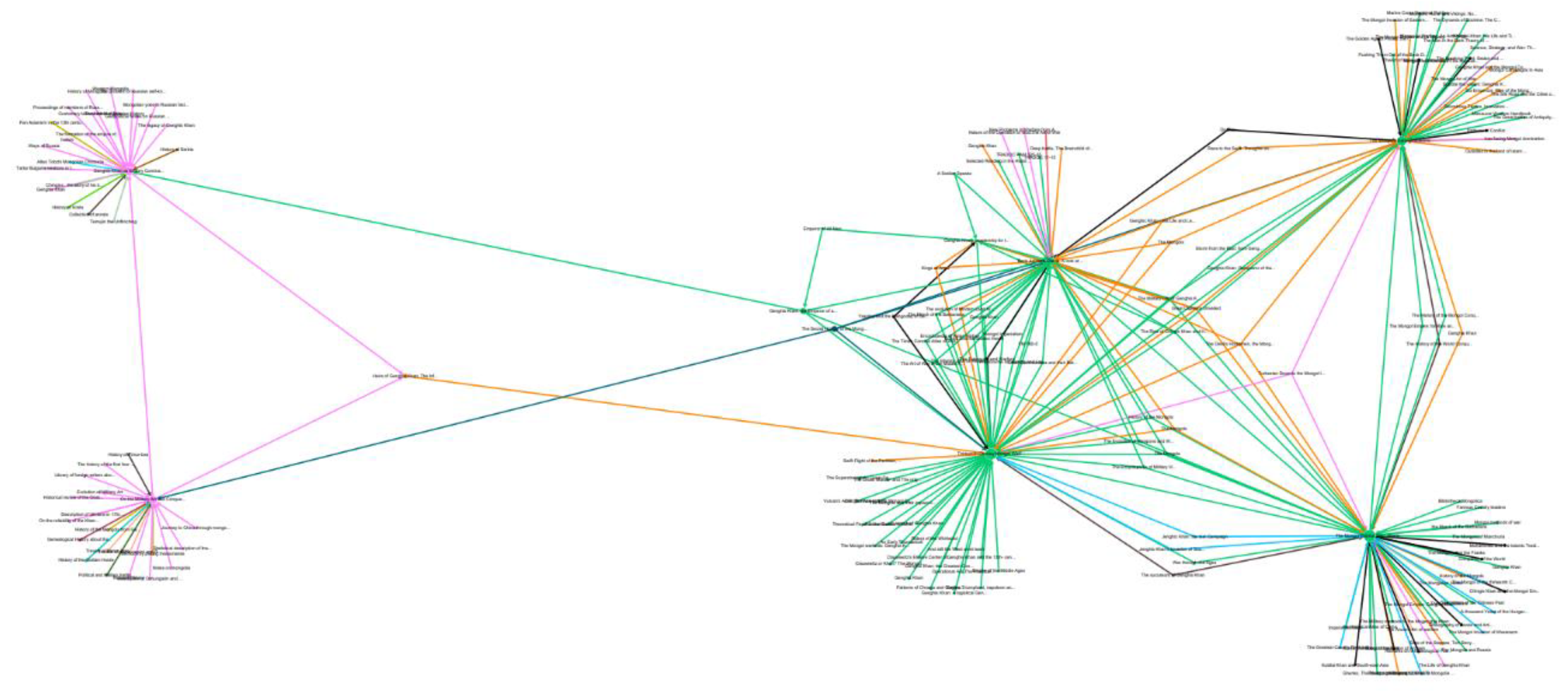
Figure 2.
4-node network for a small-scale implementation of quantum random walk.
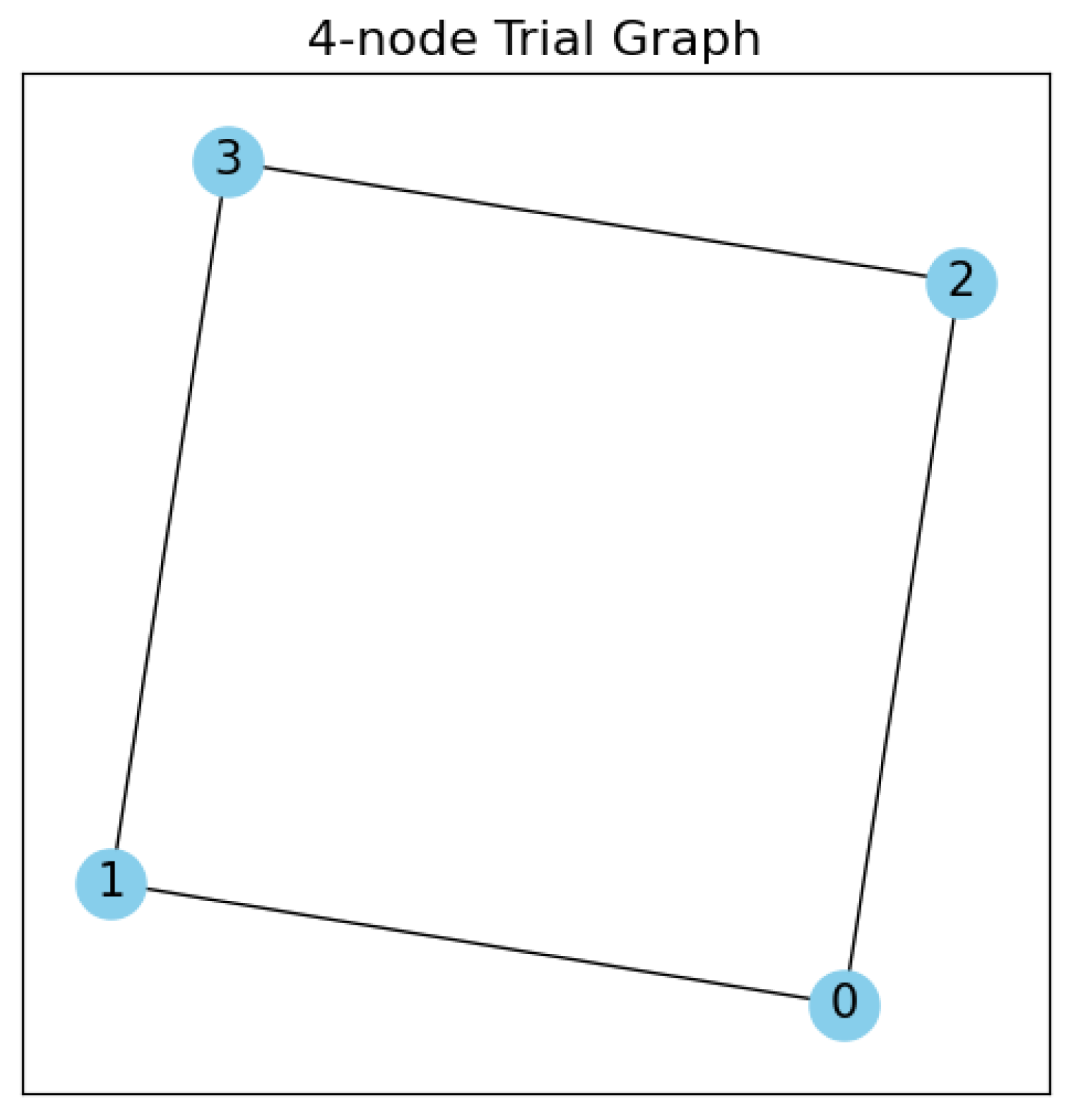
Figure 3.
Distribution of a random walk in quantum and classical fashions (Source: https://www.youtube.com/watch?v=mRIjRbIQyE4 ).
Figure 3.
Distribution of a random walk in quantum and classical fashions (Source: https://www.youtube.com/watch?v=mRIjRbIQyE4 ).
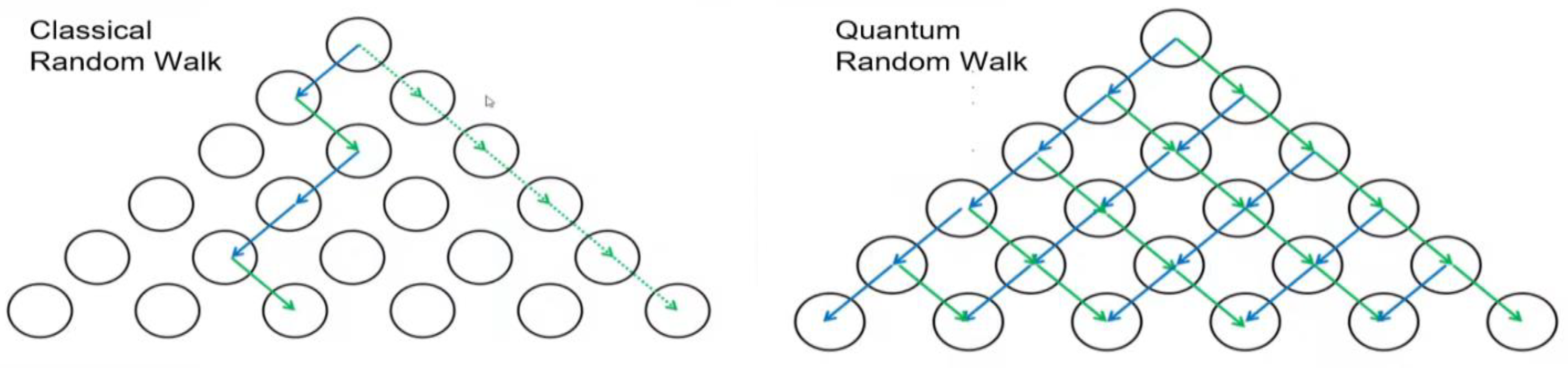
Figure 4.
Sample diagram of a 2 qubit – 2 classical bit quantum circuit utilizing the Qiskit package36.
Figure 4.
Sample diagram of a 2 qubit – 2 classical bit quantum circuit utilizing the Qiskit package36.
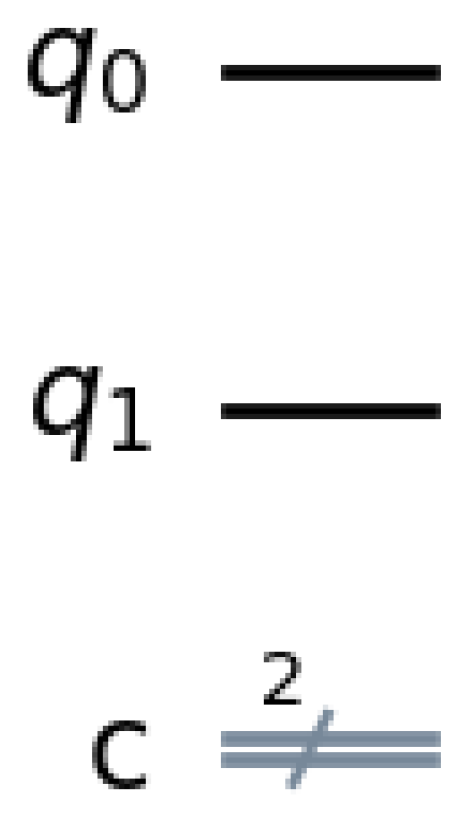
Figure 5.
Sample diagram of a 2 qubit – 2 classical bit quantum circuit with an H ( Hadamard gate) utilizing the Qiskit package.
Figure 5.
Sample diagram of a 2 qubit – 2 classical bit quantum circuit with an H ( Hadamard gate) utilizing the Qiskit package.
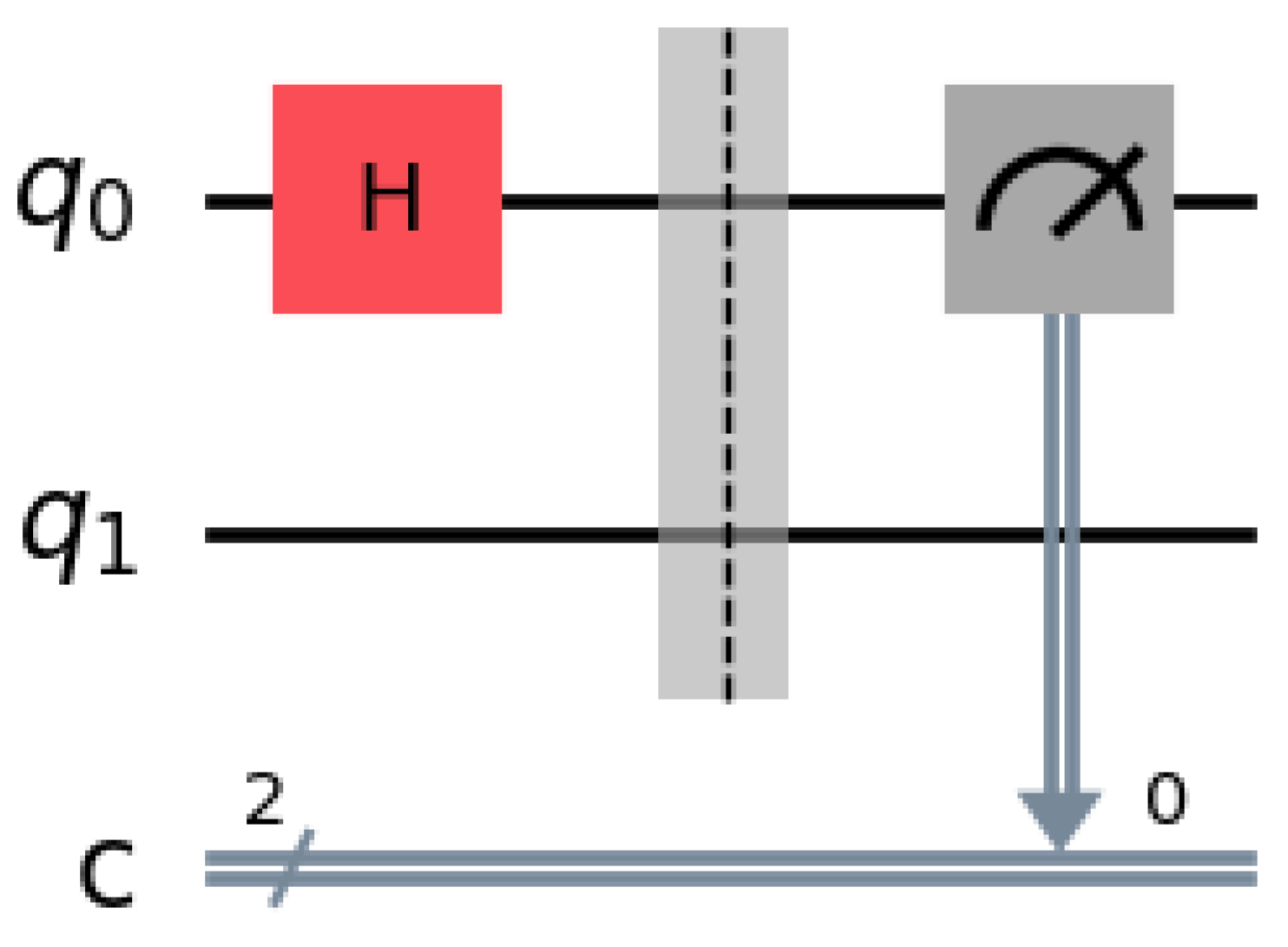
Figure 6.
Sample diagram of a 2 qubit – 2 classical bit quantum circuit that will perform a quantum random walk across the network found in Figure 2.
Figure 6.
Sample diagram of a 2 qubit – 2 classical bit quantum circuit that will perform a quantum random walk across the network found in Figure 2.
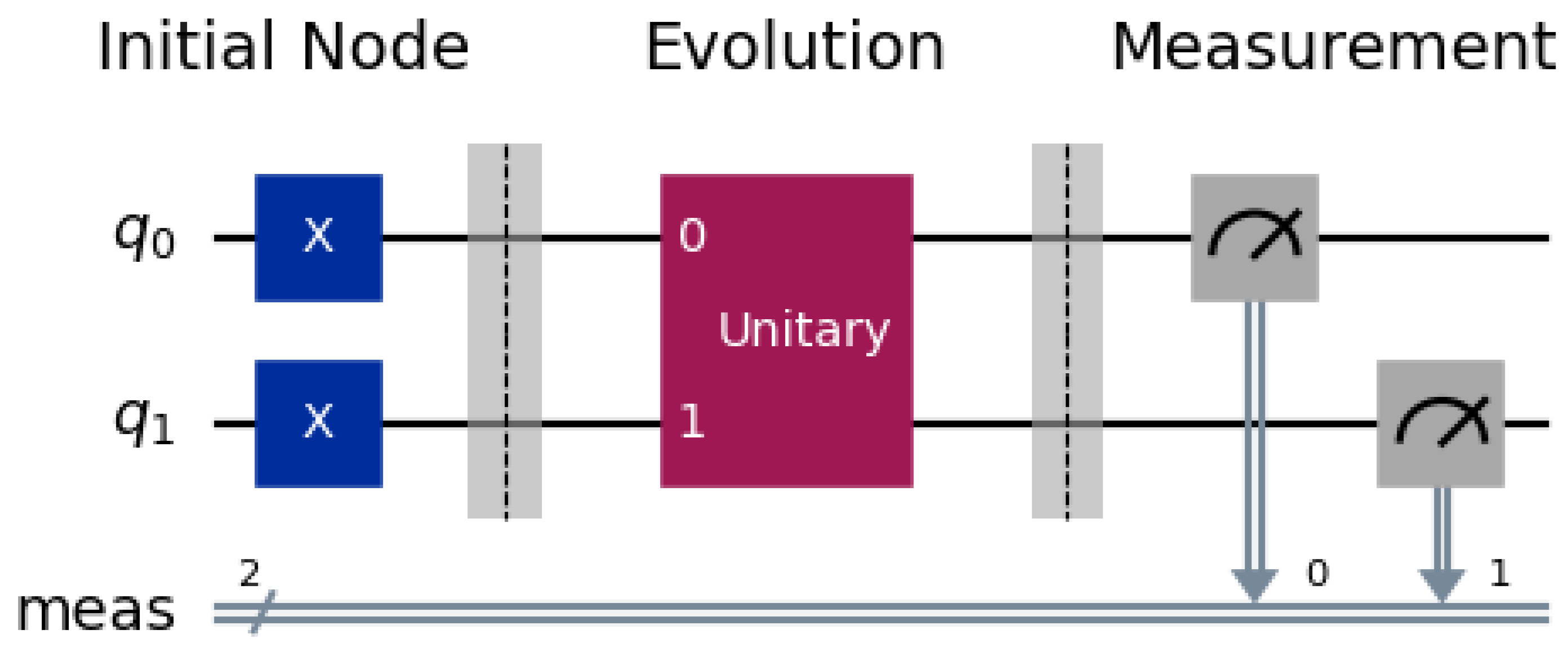
Figure 7.
Sample diagrams of a 2 qubit quantum circuit that illustrate the application of the CNOT gate. Circuit A will always measure 00 and Circuit B will always measure 11.
Figure 7.
Sample diagrams of a 2 qubit quantum circuit that illustrate the application of the CNOT gate. Circuit A will always measure 00 and Circuit B will always measure 11.
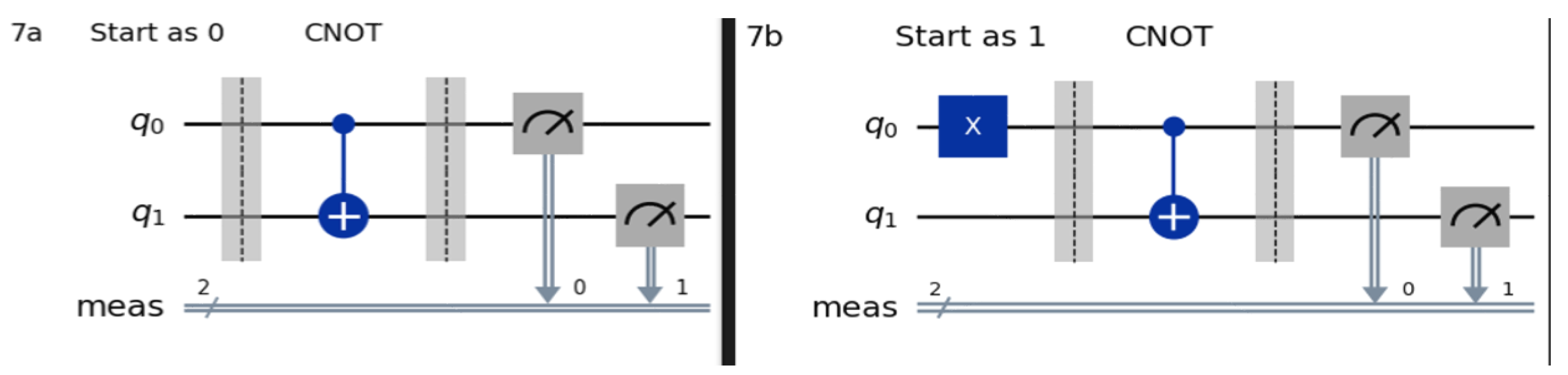
Figure 8.
Sample diagram of a quantum circuit that will perform a superpositioned quantum walk of the network found in Figure 2.
Figure 8.
Sample diagram of a quantum circuit that will perform a superpositioned quantum walk of the network found in Figure 2.
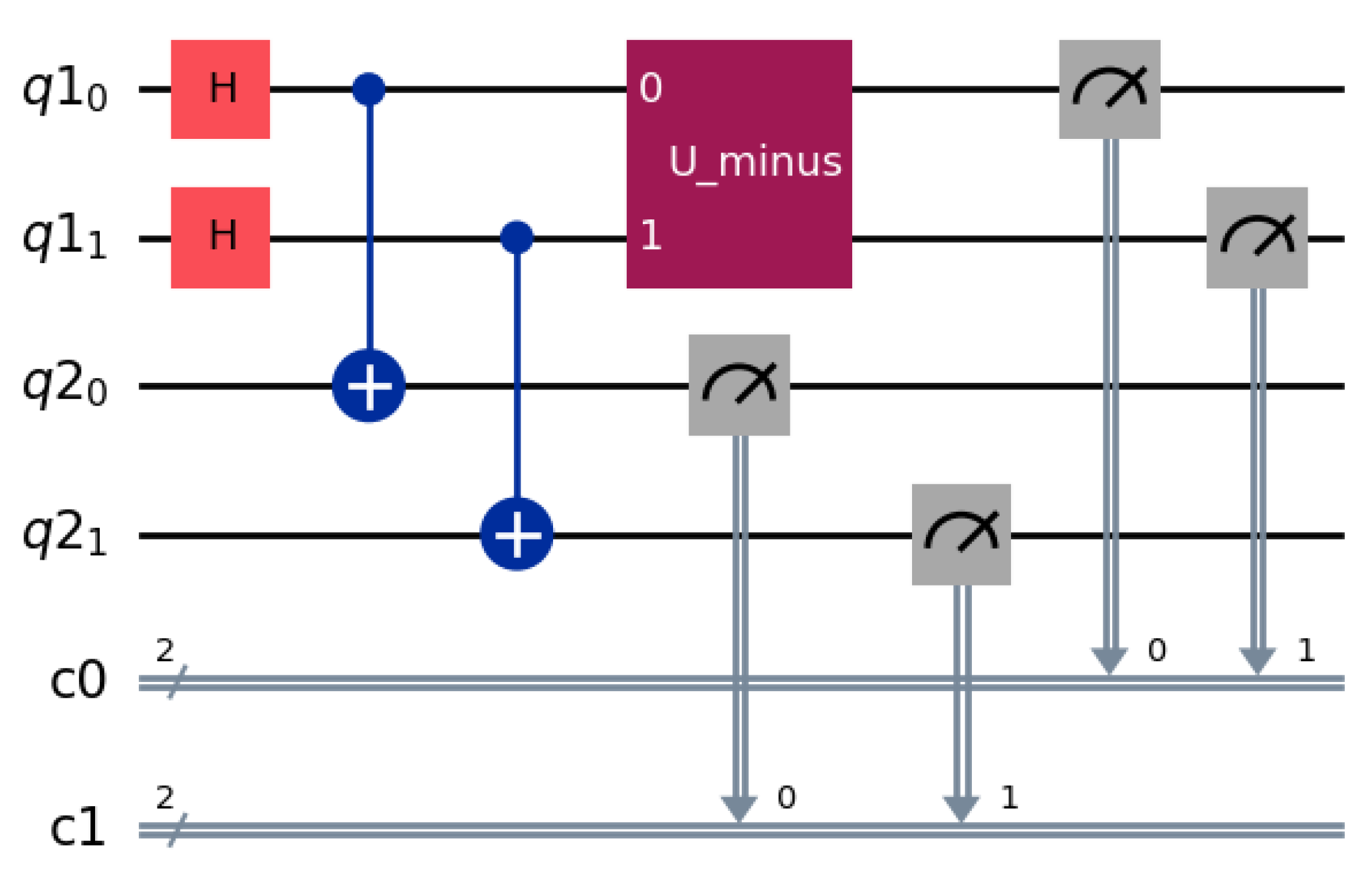
Figure 9.
Reduced network with one-degree nodes eliminated from the original network in Figure 1.
Figure 9.
Reduced network with one-degree nodes eliminated from the original network in Figure 1.
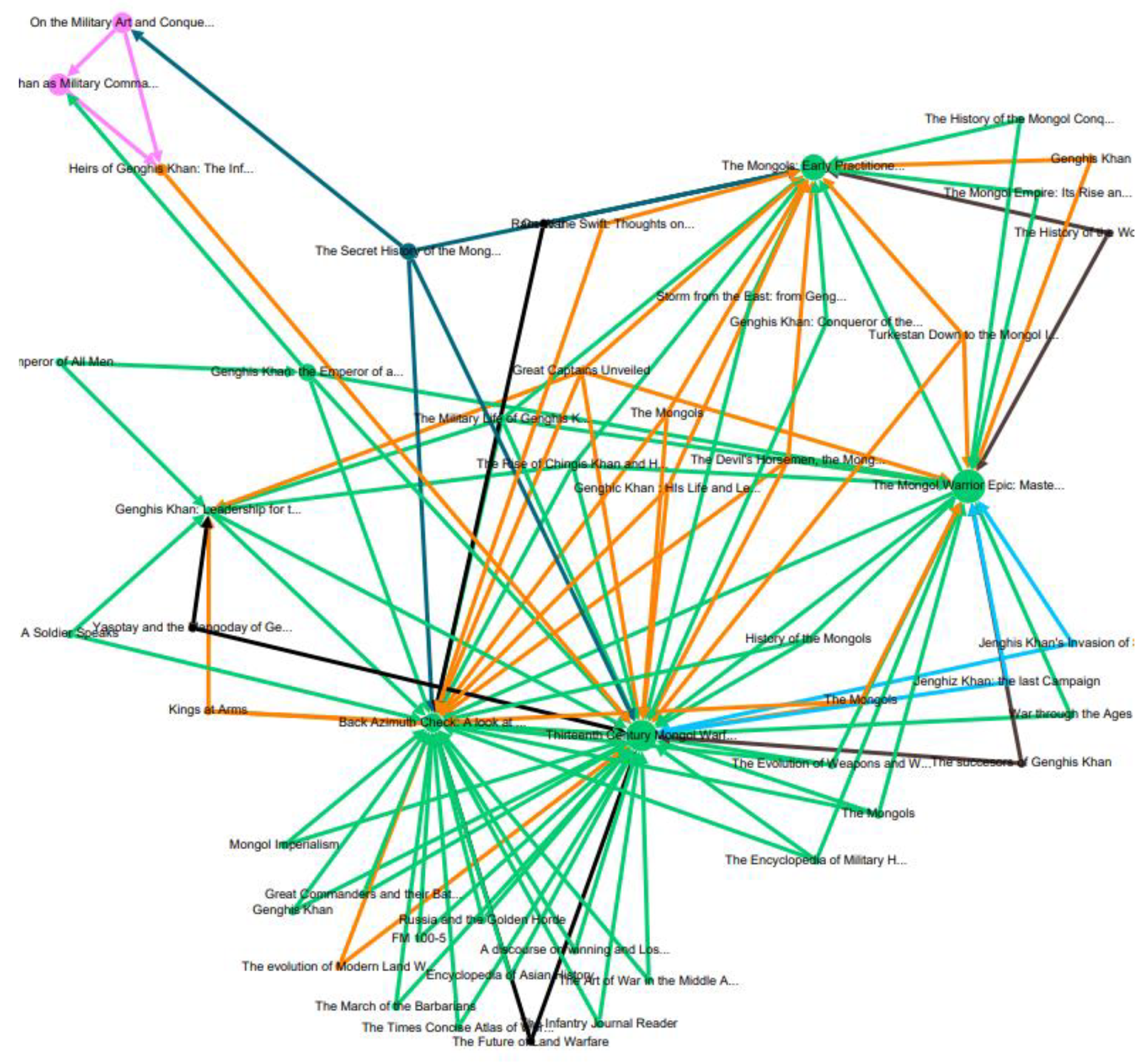
Figure 10.
Circuit diagram that will perform a quantum walk of the network found in Figure 9 staring at node 9.
Figure 10.
Circuit diagram that will perform a quantum walk of the network found in Figure 9 staring at node 9.
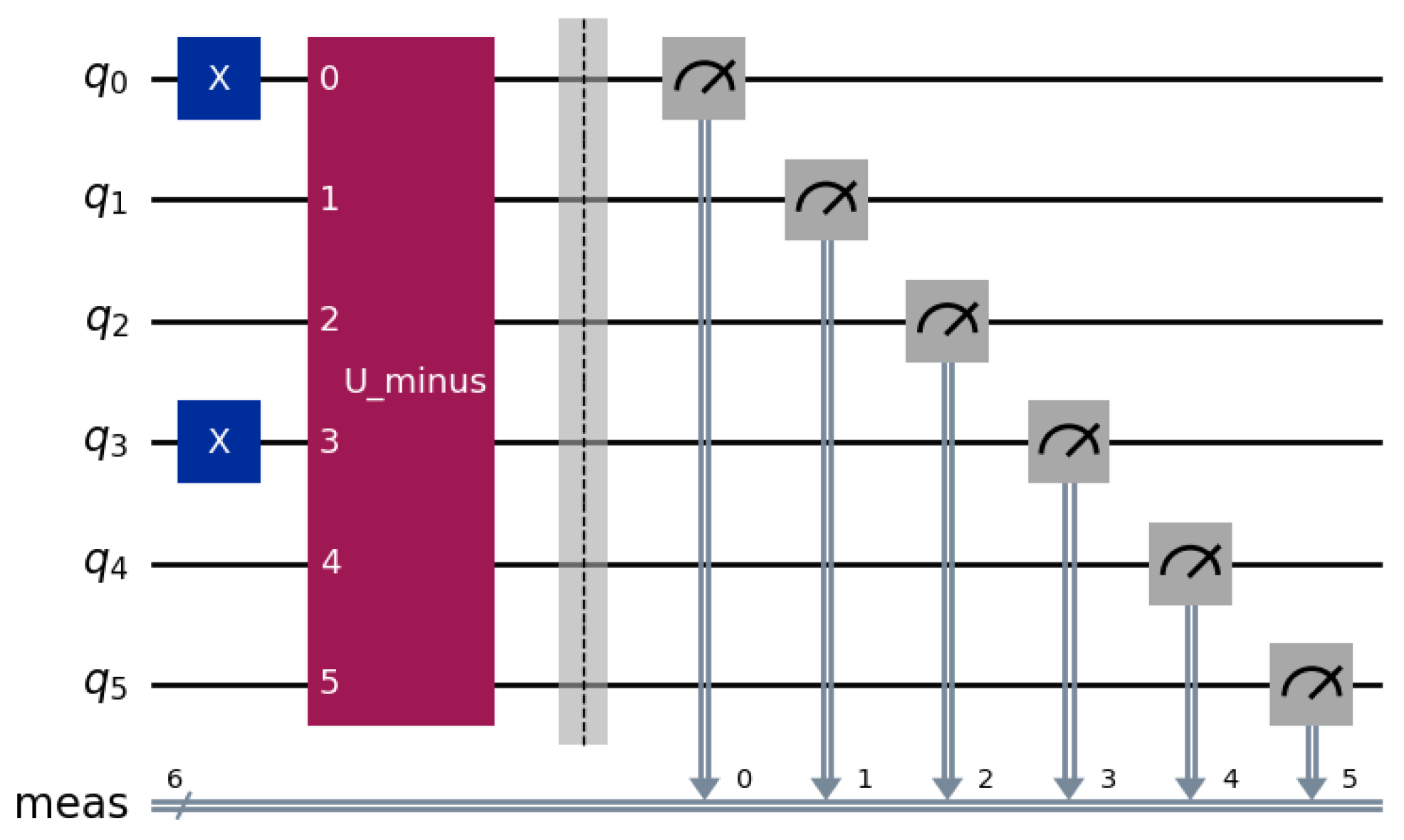
Figure 11.
Diagram of a quantum circuit that will perform a superpositioned quantum walk of the network found in Figure 9.
Figure 11.
Diagram of a quantum circuit that will perform a superpositioned quantum walk of the network found in Figure 9.
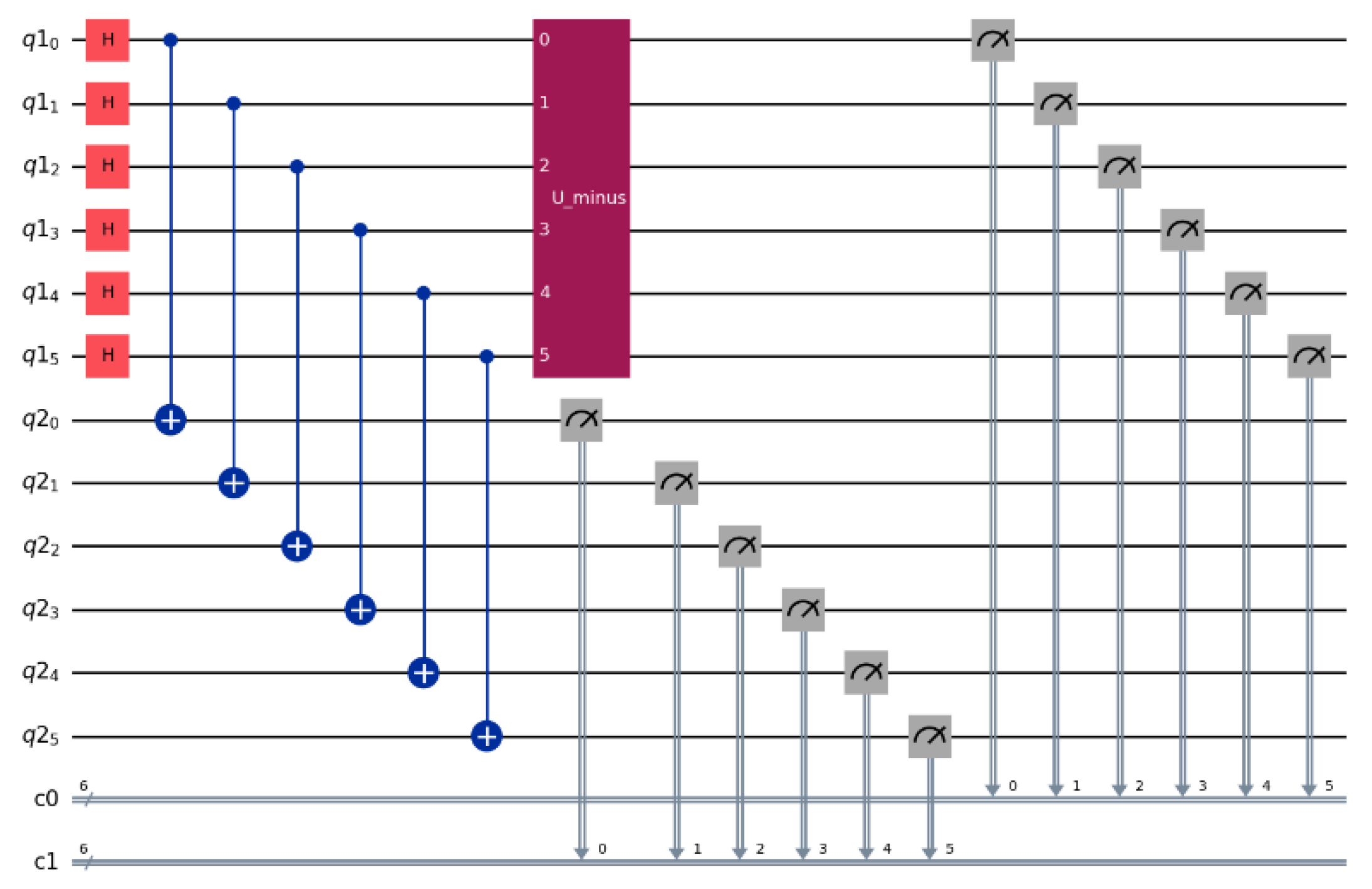
Table 1.
– Results from 4-node quantum random walk starting at node 3 simulated with IBM’s Aer simulator on Qiskit.
Table 1.
– Results from 4-node quantum random walk starting at node 3 simulated with IBM’s Aer simulator on Qiskit.
| Time Step | Node 0 | Node 1 | Node 2 | Node 3 |
| 0 | 0 | 0 | 0 | 1 |
| 0.5 | 0.057617 | 0.164063 | 0.205078 | 0.573242 |
| 1 | 0.511719 | 0.213867 | 0.188477 | 0.085938 |
| 1.5 | 0.988281 | 0.003906 | 0.007813 | 0 |
| 2 | 0.688477 | 0.150391 | 0.139648 | 0.021484 |
Table 2.
– Summary statistics of maximum and average of probability of visit of random walk to each node starting from node 3 for 4-node quantum random walk simulated with IBM’s Aer simulator on Qiskit.
Table 2.
– Summary statistics of maximum and average of probability of visit of random walk to each node starting from node 3 for 4-node quantum random walk simulated with IBM’s Aer simulator on Qiskit.
| Node 0 | Node 1 | Node 2 | Node 3 | |
| Maximum Probability | 0.988281 | 0.213867 | 0.205078 | 1 |
| Average Probability | 0.449219 | 0.106445 | 0.108203 | 0.336133 |
Table 3.
– Results of edge probabilities from superpositioned quantum random walk simulated with IBM’s Aer simulator on Qiskit.
Table 3.
– Results of edge probabilities from superpositioned quantum random walk simulated with IBM’s Aer simulator on Qiskit.
| Time | 0-3 | 2-1 |
| 0 | 0 | 0 |
| 0.5 | 0.015625 | 0.019531 |
| 1 | 0.117188 | 0.115234 |
| 1.5 | 0.241211 | 0.242188 |
| 2 | 0.163086 | 0.183594 |
Table 6.
– Summary statistics of maximum and average of probability of link between them and starting node 9 for the top 5 nodes by average probability.
Table 6.
– Summary statistics of maximum and average of probability of link between them and starting node 9 for the top 5 nodes by average probability.
| Final node | Maximum Probability | Average Probability |
| 7 | 0.152344 | 0.047705 |
| 8 | 0.307617 | 0.111963 |
| 10 | 0.499023 | 0.170557 |
| 13 | 0.533203 | 0.166846 |
| 25 | 0.282227 | 0.102197 |
Table 7.
– Summary statistics of maximum and average of probability of edges for superpostioned walk.
Table 7.
– Summary statistics of maximum and average of probability of edges for superpostioned walk.
| Link | Maximum Probability | Average Probability |
| 7-10 | 0.008789 | 0.001318 |
| 12-14 | 0.007813 | 0.001367 |
| 0-11 | 0.006836 | 0.001123 |
| 13-7 | 0.006836 | 0.001611 |
| 13-46 | 0.006836 | 0.001221 |
Table 8.
– Title of works for each of the top 5 predicted links by the superpositioned walk.
| Link | Work 1 | Work 2 |
| 7-10 | “Emperor of All Men” by Harold Lamb |
“Genghis Khan as Military Commander and His Legacy” by Erenzhen Khara Divan |
| 12-14 | “Thirteenth Century Mongol Warfare; Classical Military Strategy or Operational Art?” by Dana Pittard | “The Mongols: Early Practitioners of Maneuver Warfare” by Darrel Benfield |
| 0-11 | “Genghis Khan: Leadership for the Airland Battle” by William Taylor |
“The Mongol Warrior Epic: Masters of thirteenth Centruy Maneuver Warfare” by Richard D. McCreight |
| 13-7 | “Heirs of Genghis Khan: The Influence of the Tartar-Mongols on the Imperial Russian and Soviet Armies” by Christopher Bellamy | “Emperor of All Men” by Harold Lamb |
| 13-46 | “Heirs of Genghis Khan: The Influence of the Tartar-Mongols on the Imperial Russian and Soviet Armies” by Christopher Bellamy | “The Secret History of the Mongols” |
Disclaimer/Publisher’s Note: The statements, opinions and data contained in all publications are solely those of the individual author(s) and contributor(s) and not of MDPI and/or the editor(s). MDPI and/or the editor(s) disclaim responsibility for any injury to people or property resulting from any ideas, methods, instructions or products referred to in the content. |
© 2026 by the authors. Licensee MDPI, Basel, Switzerland. This article is an open access article distributed under the terms and conditions of the Creative Commons Attribution (CC BY) license (http://creativecommons.org/licenses/by/4.0/).
Copyright: This open access article is published under a Creative Commons CC BY 4.0 license, which permit the free download, distribution, and reuse, provided that the author and preprint are cited in any reuse.