

Submitted:
11 March 2026
Posted:
13 March 2026
You are already at the latest version
Abstract
Multilocular intratesticular cysts are uncommon benign lesions. We report a case associated with testicular microlithiasis in an 85-year-old man presenting with painless enlargement of the left scrotum. Ultrasonography revealed a multilocular cystic lesion with a 3.0-cm main cyst and several adjacent smaller cysts showing posterior acoustic enhancement without mural irregularity or solid components. Bilateral microlithiasis and small epididymal cysts were also detected, and serum tumor markers were normal. The lesions remained stable during 36 months of follow-up. Recognition of the characteristic ultrasonographic features of benign intratesticular cysts is important to avoid unnecessary surgical intervention.
Keywords:
epididymal cyst
; intratesticular cyst
; testicular benign tumor
; testicular microlithiasis
Case Presentation
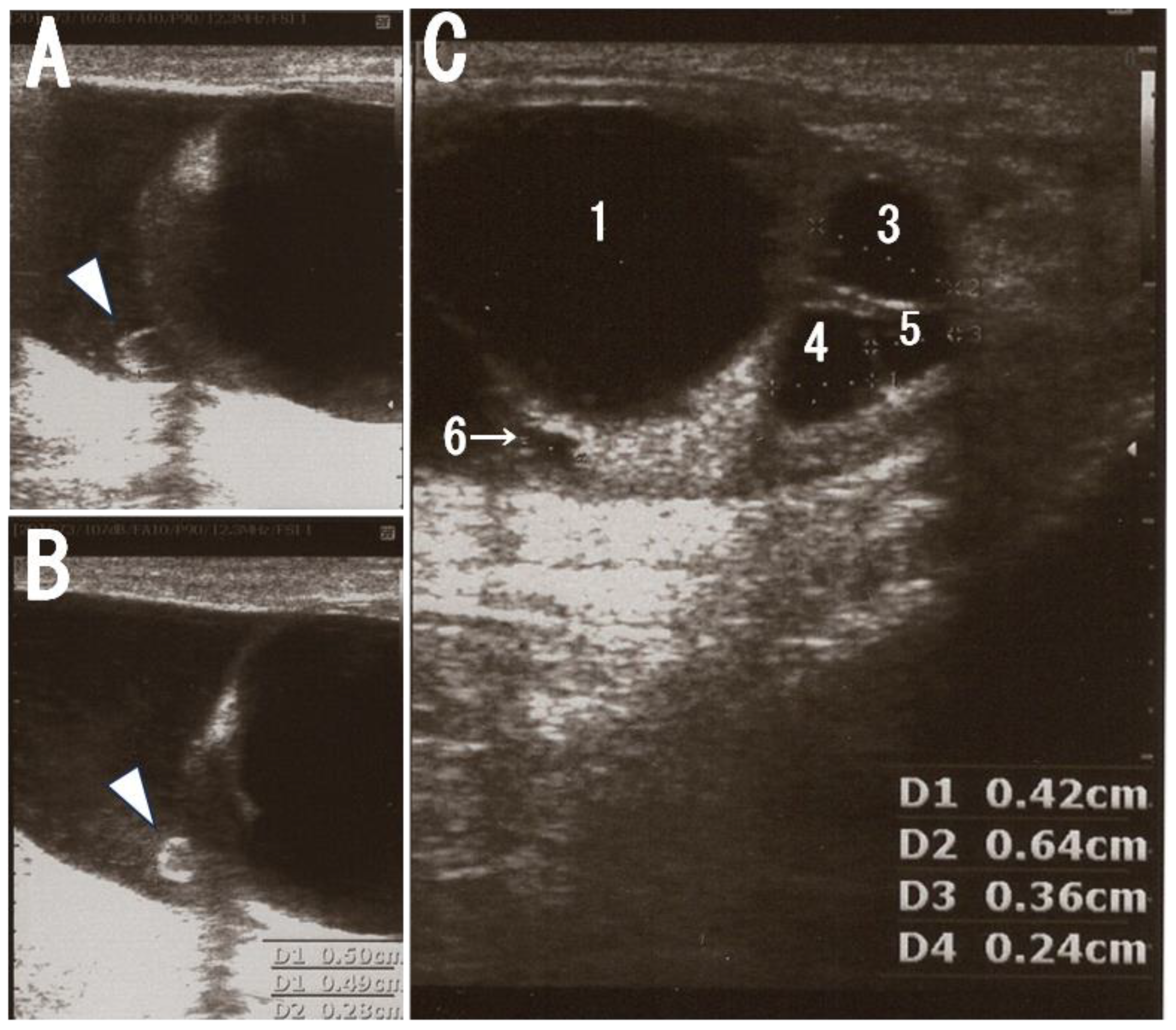
An 85-year-old married man with three children presented to our clinic with painless enlargement of the left scrotum that he had noticed incidentally. Physical examination revealed small bilateral hydroceles, and the left testis was enlarged but had a smooth surface without palpable nodules (Figure 1). Scrotal ultrasonography revealed a multilocular cystic lesion in the left testis with a main cyst measuring approximately 3.0 cm in diameter. Bilateral testicular microlithiasis and small hydroceles were also detected. Serum tumor markers, including lactate dehydrogenase, alpha-fetoprotein, and β-human chorionic gonadotropin, were within normal limits. Computed tomography (CT) demonstrated simple renal cysts in both kidneys but no cystic lesions in the liver, pancreas, or spleen, and no retroperitoneal lymphadenopathy (Figure 2). The patient was managed conservatively with periodic follow-up because no findings suggestive of malignancy were identified at the initial evaluation. At the final evaluation 36 months later, ultrasonography demonstrated a 2-mm subcapsular cyst in the right testis (Figure 3). In the left testis, a multilocular cystic lesion was again identified, consisting of a 3.2-cm main cyst and several adjacent cysts measuring 2.3 cm cranially and 6.4 mm, 4.2 mm, 3.6 mm, and 2.4 mm caudally (Figure 4 and Figure 5). All cysts were well circumscribed, round to oval, and showed posterior acoustic enhancement without mural thickening, irregular walls, or solid components. These findings were not suggestive of malignancy or an epidermoid cyst. Two 3.5-mm epididymal cysts were also observed in the head of the left epididymis (Figure 5). Based on these findings, the patient was diagnosed with a right simple intratesticular cyst, a left multilocular intratesticular cyst associated with testicular microlithiasis, and epididymal cysts. Considering the patient’s advanced age and the absence of suspicious imaging findings during long-term follow-up, the lesions were considered benign and follow-up was discontinued at the age of 88 years.
Discussion
The present case is unusual because a multilocular intratesticular cyst occurred in an elderly patient with testicular microlithiasis. The etiology of simple intratesticular cysts remains unclear. They have been reported in approximately 8–10% of adult men and are typically small, measuring 2 mm to 2 cm, and usually occur as solitary lesions. Multiple or multilocular cysts are uncommon.¹ With the widespread use of ultrasonography, however, such cystic lesions are increasingly detected incidentally in clinical practice. Typical simple intratesticular cysts appear on ultrasonography as well-defined anechoic round or oval lesions with posterior acoustic enhancement. When these characteristic features are present, conservative management with observation is generally appropriate. In contrast, cystic lesions with mural thickening, irregular walls, or solid components require further evaluation because cystic testicular tumors cannot be excluded, and orchiectomy with histopathological examination may be necessary.² Another important differential diagnosis is testicular epidermoid cyst, which may show a characteristic “onion-ring” appearance on ultrasonography. In such cases, testis-sparing enucleation can be considered as a treatment option. Testicular microlithiasis has been discussed in relation to testicular tumors; however, its coexistence with intratesticular cysts has rarely been reported.³ The present case is notable for a relatively large multilocular intratesticular cyst associated with bilateral microlithiasis and epididymal cysts. The long-term stability of these lesions over 36 months suggests that even relatively large multilocular intratesticular cysts may remain benign. Recognition of the characteristic ultrasonographic features of benign intratesticular cysts is therefore important to avoid unnecessary surgical intervention.
References
- Kang SM, Hwang DS, Lee JW, Chon WH, Park NC, Park HJ. Multiple intratesticular cysts. World J Mens Health. 2013 Apr;31(1):79-82. Epub 2013 Apr 23. [CrossRef] [PubMed] [PubMed Central]
- Dogra VS, Gottlieb RH, Rubens DJ, Liao L. Benign intratesticular cystic lesions: US features. Radiographics. 2001;21(Suppl 1):S273–S281. [CrossRef]
- Balawender K, Orkisz S, Wisz P. Testicular microlithiasis: what urologists should know. A review of the current literature. Cent European J Urol. 2018;71(3):310-314. Epub 2018 Aug 21. [CrossRef] [PubMed] [PubMed Central]
Figure 1.
Gross appearance of the scrotum. Both testes were surrounded by a small amount of hydrocele fluid. The right testis measured 4.0 × 2.8 cm, whereas the left testis was enlarged, measuring 6.0 × 4.0 cm, with no palpable nodule.
Figure 1.
Gross appearance of the scrotum. Both testes were surrounded by a small amount of hydrocele fluid. The right testis measured 4.0 × 2.8 cm, whereas the left testis was enlarged, measuring 6.0 × 4.0 cm, with no palpable nodule.
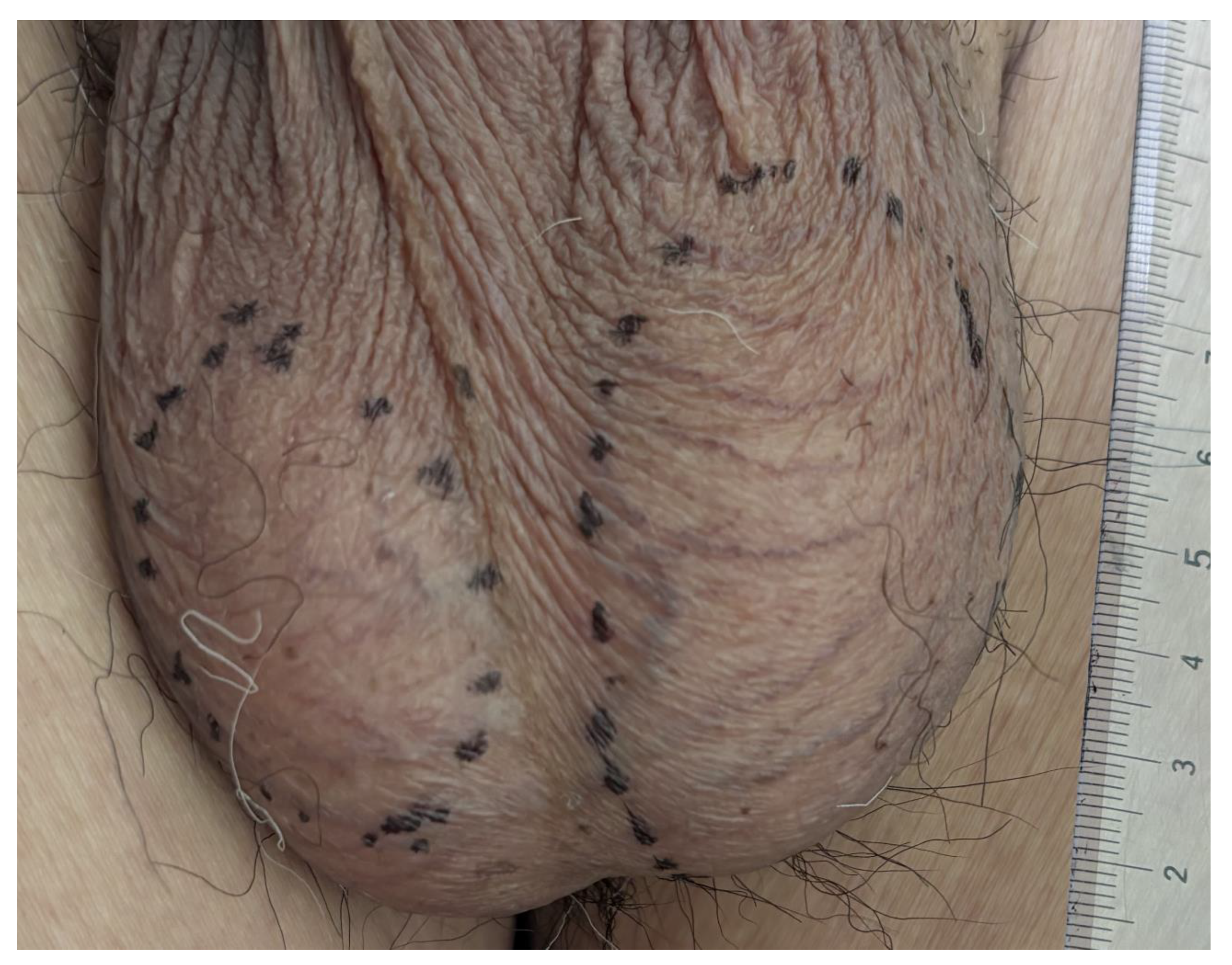
Figure 2.
CT images. (A) Pelvic CT showing a 3-cm intratesticular cyst in the left testis with a small hydrocele (arrowhead). The additional multilocular cysts were not clearly visualized on CT. (B) Abdominal CT showing simple renal cysts in both kidneys (arrowheads). No retroperitoneal lymphadenopathy is present.
Figure 2.
CT images. (A) Pelvic CT showing a 3-cm intratesticular cyst in the left testis with a small hydrocele (arrowhead). The additional multilocular cysts were not clearly visualized on CT. (B) Abdominal CT showing simple renal cysts in both kidneys (arrowheads). No retroperitoneal lymphadenopathy is present.
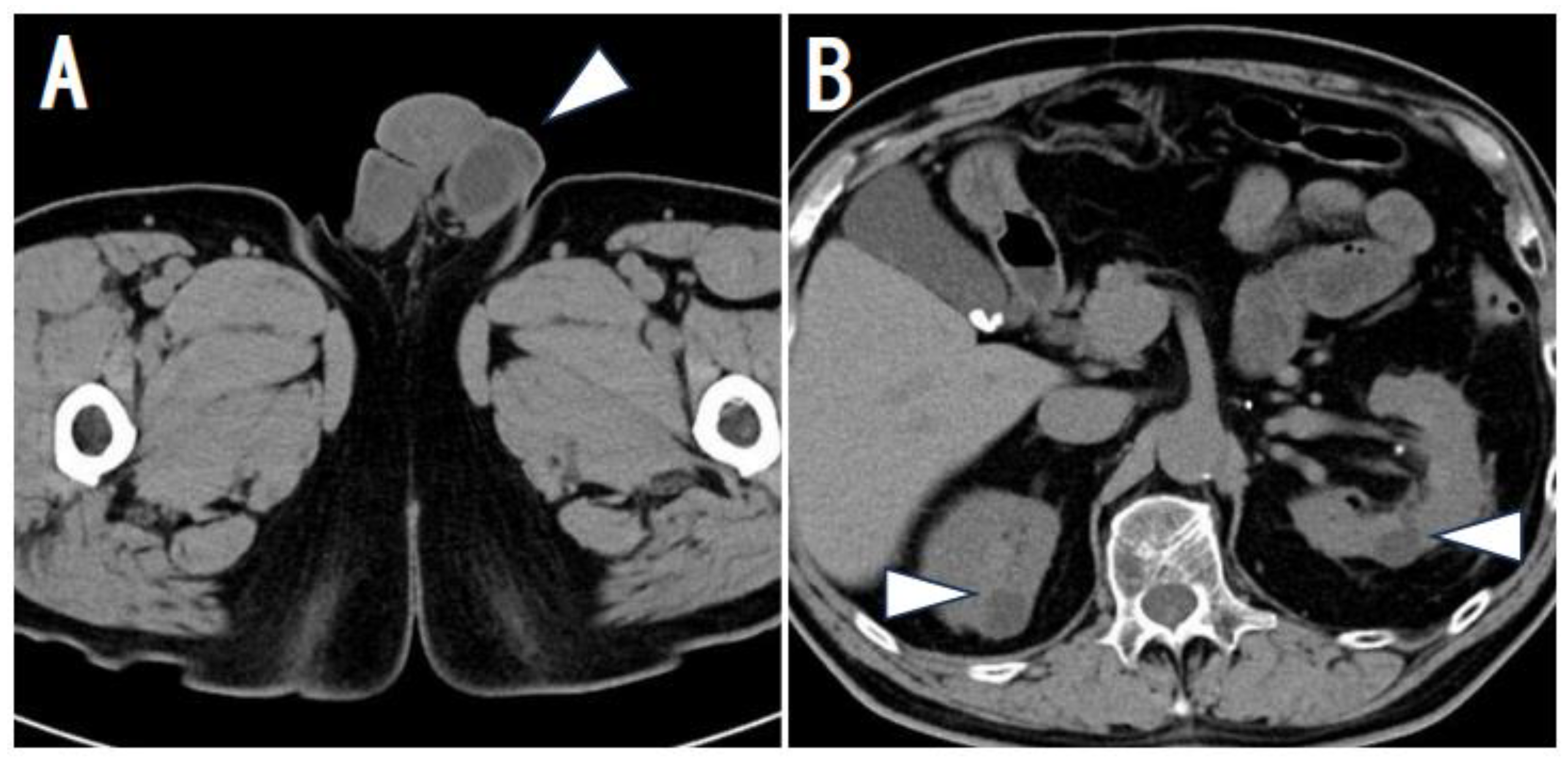
Figure 3.
Ultrasonography of the right testis. A 2-mm subcapsular cyst is present beneath the tunica albuginea. Numerous microliths are seen within the testicular parenchyma.
Figure 3.
Ultrasonography of the right testis. A 2-mm subcapsular cyst is present beneath the tunica albuginea. Numerous microliths are seen within the testicular parenchyma.
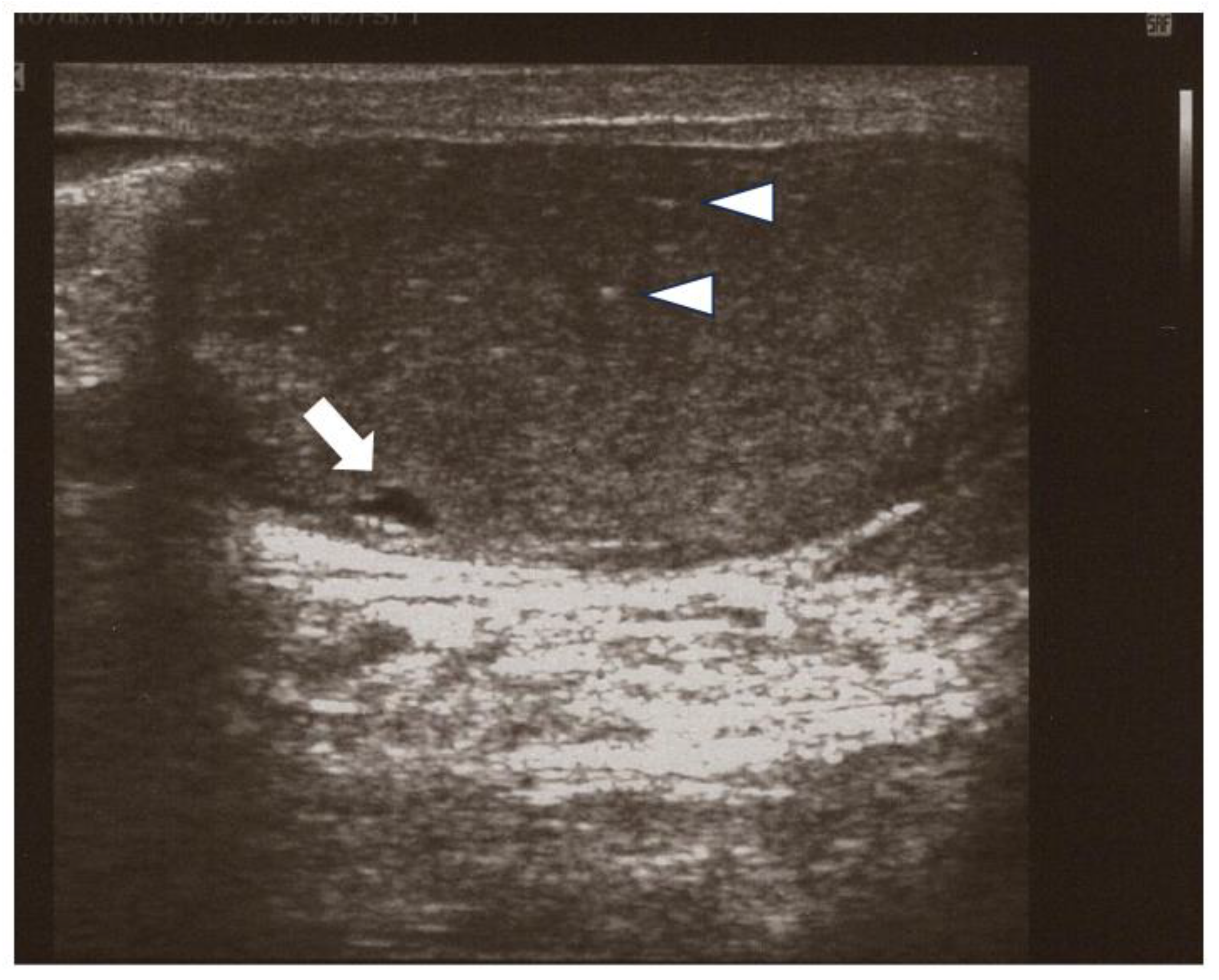
Figure 4.
Ultrasonography of the left testis. A 3.2-cm main cyst (1) and a 2.3-cm cranial cyst (2) are present. The septum between the cysts is thin and not clearly visualized. Posterior acoustic enhancement is present. Numerous microliths are seen in the testicular parenchyma (arrowheads).
Figure 4.
Ultrasonography of the left testis. A 3.2-cm main cyst (1) and a 2.3-cm cranial cyst (2) are present. The septum between the cysts is thin and not clearly visualized. Posterior acoustic enhancement is present. Numerous microliths are seen in the testicular parenchyma (arrowheads).
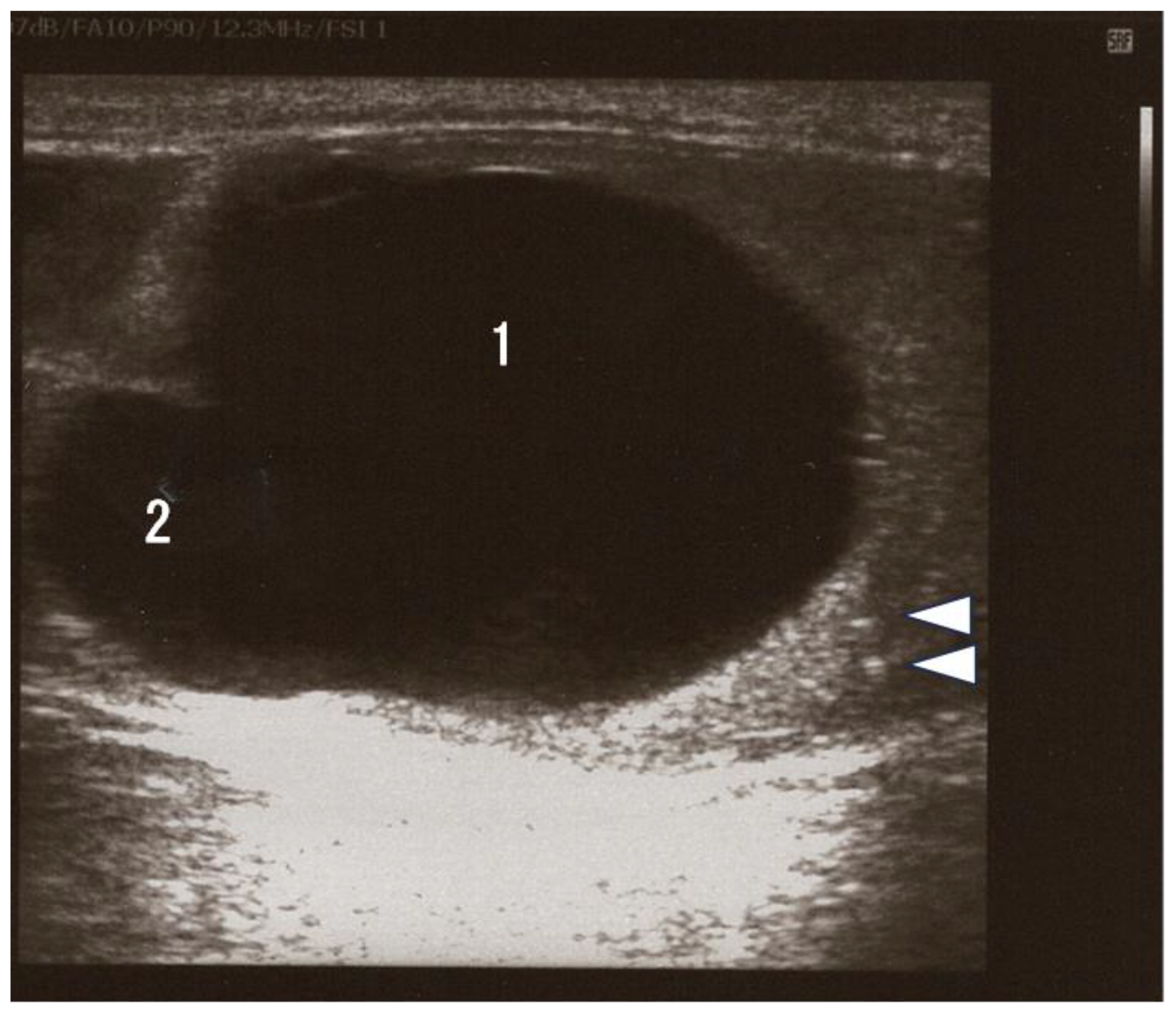
Figure 5.
Ultrasonography of the left testis. (A) A 3.5-mm epididymal cyst in the head of the epididymis (arrowhead). (B) Another 3.5-mm epididymal cyst. (C) Multiple small cysts located caudal to the main cyst (1) measuring 6.4 mm (3), 4.2 mm (4), 2.4 mm (5), and 2 mm (6).
Figure 5.
Ultrasonography of the left testis. (A) A 3.5-mm epididymal cyst in the head of the epididymis (arrowhead). (B) Another 3.5-mm epididymal cyst. (C) Multiple small cysts located caudal to the main cyst (1) measuring 6.4 mm (3), 4.2 mm (4), 2.4 mm (5), and 2 mm (6).
Disclaimer/Publisher’s Note: The statements, opinions and data contained in all publications are solely those of the individual author(s) and contributor(s) and not of MDPI and/or the editor(s). MDPI and/or the editor(s) disclaim responsibility for any injury to people or property resulting from any ideas, methods, instructions or products referred to in the content. |
© 2026 by the authors. Licensee MDPI, Basel, Switzerland. This article is an open access article distributed under the terms and conditions of the Creative Commons Attribution (CC BY) license (http://creativecommons.org/licenses/by/4.0/).
Copyright: This open access article is published under a Creative Commons CC BY 4.0 license, which permit the free download, distribution, and reuse, provided that the author and preprint are cited in any reuse.


