

Submitted:
11 March 2026
Posted:
12 March 2026
You are already at the latest version
Abstract
Background/Objectives: Pes planovalgus is one of the most common misalignments in children. In this study the established biomechanical foot orthoses (BMFO) are being compared with a more recent treatment: sensorimotor foot orthoses (SMFO). SMFO are a more recent treatment and aim to correct malalignment by specifically modulating muscle activity rather than relying solely on passive mechanical support, as is the case with BMFO. Methods: Thirty-two children and adolescents aged six to six-teen participated in this study. After randomized group allocation, the rearfoot angle was analyzed by two-dimensional gait analysis in the SMFO-group (n=18) and the BMFO group (n=14) under three conditions: without foot orthoses (baseline), with foot orthoses (immediate) and after four weeks of use. Results: (1) SMFO and BMFO significantly improved the rearfoot angle immediately after application, (2) the achieved correction was maintained over four weeks in both groups, and (3) despite baseline differences, the superior rate of improvement in the SMFO-group resulted in comparable rearfoot alignment between SMFO and BMFO at the four-week follow-up. Conclusions: Based on the results, it can be concluded that SMFO and BMFO are comparable methods for treating pes planovalgus in children and adolescents.
Keywords:
flat feet
; insoles
; gait analysis
; gait biomechanics
; orthotic therapy
; proprioception
1. Introduction
Pes planovalgus is one of the most common misalignments in children [1]. Up to a certain degree and during a specific growth period, it represents a normal developmental variation in children, in which the longitudinal arch of the foot is flattened and the rearfoot is in an everted position [1,2]. Flexible pes planovalgus in children is usually caused by highly flexible soft tissue (ligaments, tendons, muscles)[1], relatively enlarged fat pads [3] and a tendency toward genu valgum [4] during the growth phase. However, as in pes planovalgus in adolescents or adults, foot orthoses may be necessary, if certain symptoms occur: pain, ankle or knee instability, or gait abnormalities [5].
In such cases, the symptomatic pes planovalgus is often treated with the help of biomechanical foot orthoses (BMFO; also known as conventional insoles or foot orthoses) [5,6]. BMFO are designed to mechanically support the longitudinal arch of the foot and guide the rearfoot into a neutral position [7]. A more recent alternative used in clinical practice are sensorimotor foot orthoses (SMFO) [8,9]. SMFO follow a more active approach that focuses on modulating proprioceptive feedback and optimizing sensorimotor control [10,11]. SMFO are defined as foot orthoses that alter gait pattern using specific elements (e.g., a medial or lateral rearfoot element, toe bridge, retrocapital element) to influence the activity of defined muscles, at a certain point during the stance phase of gait in a specific manner (toning or detoning) [12]. Their elements apply pressure to specific muscle and tendon areas, aiming to tone or detone the muscles, probably by influencing muscle spindle afferents or Golgi tendon organs [10,11]. In particular, the ability of SMFO to activate muscles has already been demonstrated in several studies [8,11,13].
Previous studies suggest that both SMFO [14,15,16,17,18] and BMFO [6,7,14] can cause short-term changes in foot kinetics and kinematics. However, it is unclear whether these effects also occur in children with pes planovalgus, whether they need an adaptation period and how potential effects change after the initial exposure. Treating pes planovalgus in children is particularly interesting from a functional and medical perspective, as the condition is considerably more correctable in this age group than in adults [1] and because activation muscles could counter the criticism that insoles could lead to a weakening of the foot and lower leg muscles. The present study aims to investigate:
- (1)
- Is there a difference between SMFO and BMFO in the treatment of pes planovalgus in children measured by the rearfoot angle?
- (2)
- Does the rearfoot correction change between the immediate effect and after wearing the foot orthoses for four weeks?
To the best of our knowledge, there are no studies on SMFO in relation to pes planovalgus in children or adolescents. Due to the high prevalence of pes planovalgus in children, the long-standing practice of treating this foot deformity with BMFO or SMFO, and the potential benefits of SMFO (muscle activation as opposed to passive support through BMFO), this study is highly relevant, especially since evidence for benefits of foot orthoses on gait remains weak [1,7].
2. Materials and Methods
The sample size was calculated using G*Power (Version 3.1.9.6 for Macintosh, University of Kiel, Germany) for repeated measures ANOVA (within-between factors, f = 0.25, α = 0.05). A minimum total sample size of 30 children was calculated (power = 0.9). Due to possible dropouts, a total of 32 participants (age: 9.8 ± 2.6 years; height: 144.5 ± 16 cm; weight: 38.0 ± 12.4 kg; sex: 8 ♀, 24 ♂) were included in this randomized controlled study and ended without dropouts (Table 1).
Participants were included, if their age was < 18 years and they were diagnosed with pes planovalgus by a physician. The exclusion criteria were all diseases potentially affecting sensorimotor control (e.g. diabetes mellitus, neurological disorders). Furthermore, no acute injury potentially effecting habitual walking was allowed. Lastly, children with previous experience wearing foot orthoses were not included.
The study was conducted in accordance with the current guidelines of Declaration of Helsinki and was approved by the responsible ethics commission (No. 99). All participants and legal guardians were provided with written informed consent after receiving a full explanation of the study and agreeing to participation and publication of the results.
2.1. Foot Orthoses
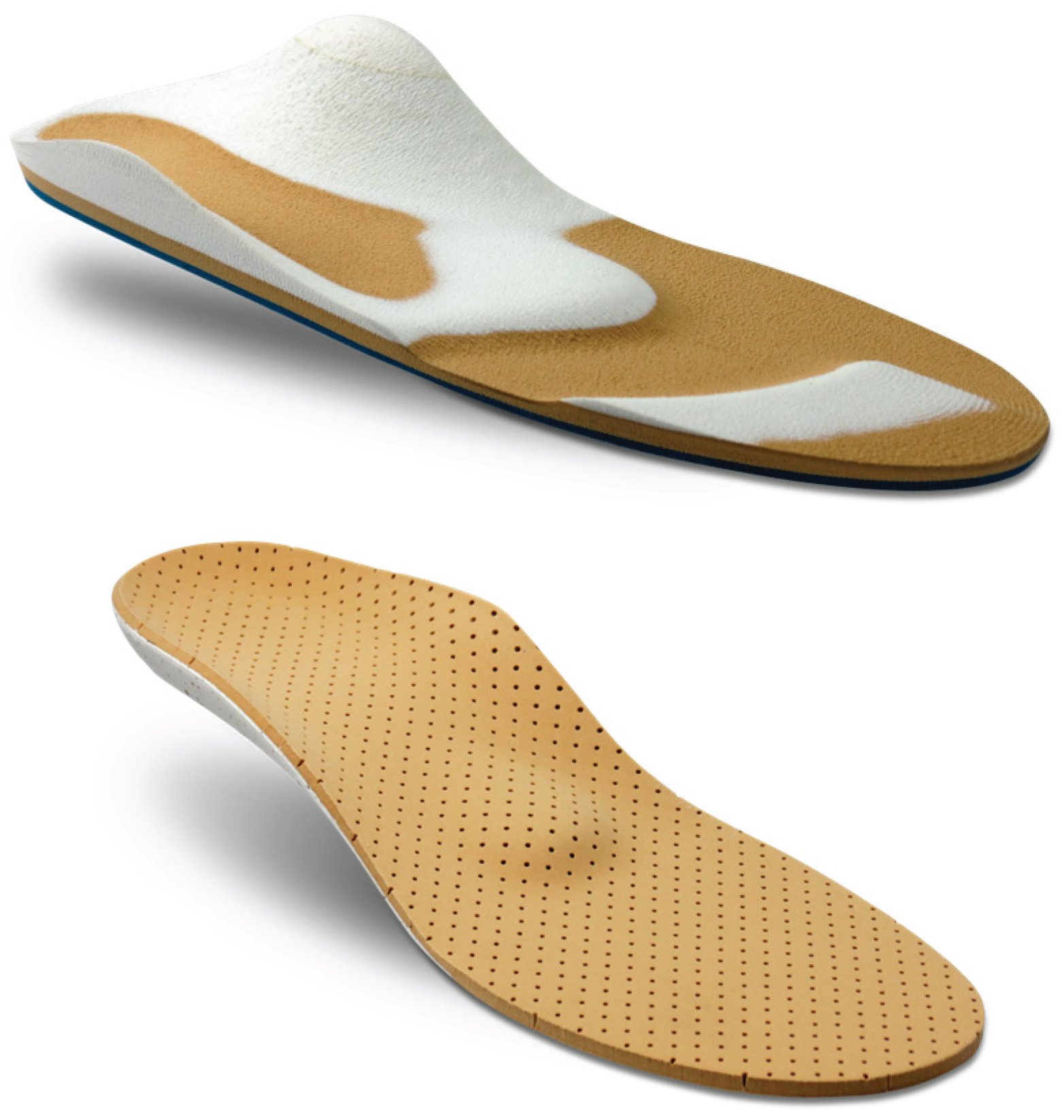
All foot orthoses (SMFO, BMFO) (Figure 1) were manufactured by the same and experienced orthopedic shoe technician. Each foot orthosis (FO) was manufactured individually based on a foot scan with a podometer (Rothballer electronic systems GmbH, Weiden, Germany), a dynamic foot pressure analysis (model: FDM 3, Zebris Medical GmbH, Isny im Allgaeu, Germany) and a video-based gait analysis in frontal and sagittal planes, which was the standard procedure for FO manufacturing in the medical supply store. The children were randomly assigned to the BMFO group or the SMFO group.
BMFO were manufactured by HEMA (HEMA Orthopaedische Systeme GmbH, Soemmerda, Germany) and built using polyurethane material with a Shore hardness of 35. Conventional supination wedges were used to individually correct the rearfoot eversion and midfoot overpronation. A metatarsal pad was applied depending on clinical indication and individual needs.
SMFO were manufactured according to Woltring/Springer (Springer Aktiv AG, Berlin, Germany) and built using ethylene-vinyl acetate (EVA) material with a Shore hardness of 25 (brown) and 35 (white) (Figure 1). The medial element is positioned at the Sustentaculum tali to apply pressure along the tendon of tibialis posterior. The lateral element is placed laterally of the calcaneus to exert pressure on the tendon of fibularis longus and brevis. The retrocapital pad is positioned behind the metatarsal heads II - V. Additionally, a toe bar was placed under the middle and distal phalanges of toes II - V depending on clinical indication and individual needs. The key elements for correcting the rearfoot alignment in this sample are the supination wedge (BMFO) and the medial element (SMFO). The medial element of the SMFO is designed to activate tibialis posterior, which raises the longitudinal arch and thereby stabilizes the rearfoot. As it exerts lateral pressure on the tendons, it does not provide mechanical support for the talus and calcaneus [11].
2.3. Procedure and Data Processing
All children were diagnosed with pes planovalgus by a physician and were asked to obtain FO for midfoot (overpronation) and rearfoot (eversion) correction. Before the actual data collection began, the children visited the medical supply store with their legal guardians so the master orthopedic shoe technician could perform the standard examinations (foot scan, foot pressure analysis, gait analysis), which were necessary to manufacture the individual foot orthoses in a best possible manner (Figure 2).
The children came to the second appointment in a rested state without intensive physical activity within 48 h preceding the measurements. Three markers (Figure 3) with a diameter of 4 mm were fixed at three anatomical landmarks: (1) the center of the calcaneus (represents: rearfoot) (2) the Achilles tendon at the height of the connecting line between the lateral and medial malleoli (represents: ankle joint) (3) approximately 10 cm above the second marker on the middle of the Achilles tendon (represents: lower leg axis). Only one experienced investigator palpated the anatomical landmarks and placed the markers. All participants wore their own footwear. Therefore, the first marker had to be placed on the heel of the shoe. The camera (iPad generation 11, 4K, 60 FPS) was placed at one end of the walkway (length: 6.0 m) at a height of 50.0 cm. The children were instructed to walk at their habitual walking speed on the walkway. To ensure habitual walking in children in a laboratory setting, practice trials were considered important, which is why the number of trials was not fixed. In general, after three to five trials, gait was recorded for three walks on the walkway. At first gait was recorded with shoes but without FO (NFO; no foot orthosis) as a baseline measurement and afterwards with shoes and FO (SMFO or BMFO) to measure immediate effects. After four weeks the measurement with FO (SMFO or BMFO) was repeated with the same shoes worn on the second appointment. In between FO were worn continuously (minimum: 8 h/day).
For each child the mean rearfoot angle (3x left foot, 3x right foot) was calculated for each condition (NFO, FO, 4-weeks FO) during mid stance. Kinematic angle evaluation was performed with Dartfish (Pro Suite 8.0, Fribourg, Switzerland), demonstrating good to excellent reliability for gait analysis [19].
2.4. Statistics
Rearfoot angle was analyzed using a linear mixed-effects model fitted with restricted maximum likelihood (REML) in Python (version 3.11; Python Software Foundation, Wilmington, DE, USA) using the statsmodels [20] package. Time (baseline [NFO], immediate [FO], and 4 weeks [FO]) and orthosis type (SMFO vs. BMFO) were included as fixed categorical factors along with their interaction term (time × type o fFO). A random intercept was specified for each participant to account for repeated measures and inter-individual variability in baseline rearfoot alignment. Model assumptions, including normality of residuals, homoscedasticity, and independence, were assessed using residual plots and quantile–quantile plots and were considered acceptable.
Baseline (time = 0) and SMFO were treated as reference categories. Accordingly, model coefficients for time represent changes from baseline within the SMFO group, and interaction terms quantify how changes in the BMFO group differ relative to SMFO. Because of this treatment coding structure, differences between immediate and 4-week assessments were evaluated using planned contrasts rather than direct model coefficients.
Planned contrasts were conducted to examine (1) within-group changes across time and (2) between-group differences at each time point. Effect sizes were calculated as model-based standardized mean differences (Cohen’s d), defined as the estimated contrast divided by the residual standard deviation. Ninety-five percent confidence intervals (95%-CI) were derived from model-based standard errors. To control for family-wise error across nine planned comparisons, Holm-adjusted p-values were reported. Statistical significance was set at p < .05.
3. Results
Descriptive statistics for rearfoot angle across groups and measurement time points are presented in Table 2. Figure 4 illustrates the raw rearfoot angles and mean changes from baseline for both groups.
3.1. Time × Type of FO Interaction
Significant interaction terms indicated that changes in rearfoot angle over time differed between orthosis types (Table 3). The interaction term for the baseline-to-immediate interval was significant, indicating that the immediate increase in rearfoot angle following orthosis application was 3.19° smaller in the BMFO group compared to the SMFO group.
Similarly, the interaction term for the baseline-to-4-week interval was significant, demonstrating that the long-term corrective effect remained smaller in the BMFO group relative to the SMFO group.
Because baseline served as the reference level in the model, no direct coefficient represents the immediate-to-4-week interval. This comparison was therefore evaluated using planned contrasts. No significant differential change between orthosis types was observed during this period (β = −0.99°, p = .22), indicating comparable stabilization of rearfoot alignment between groups after the initial corrective response.
3.2. Within-Group Changes Over Time
Both orthotic designs produced significant immediate increases in rearfoot angle following application (Table 4). In the SMFO group, rearfoot angle increased by 5.83° from baseline to immediate assessment, representing a very large effect. A similarly sustained improvement was observed at 4 weeks, with a mean increase of 6.22° relative to baseline.
In the BMFO group, the immediate increase was 2.64°, corresponding to a large effect. At 4 weeks, the increase relative to baseline was 2.04°. Between the immediate and 4-week assessments, no additional significant changes were observed in either group.
3.3. Between-Group Differences at Each Time Point
At baseline, the BMFO group exhibited significantly larger rearfoot angles than the SMFO group (β = 4.44°, pHolm < .001, d = 2.75). However, at the immediate assessment and at the 4-week follow-up, the between-group difference were no longer statistically significant (β = 1.25°, pHolm = .52, d = 0.78; β = 0.26°, pHolm = .98, d = 0.16).
Inclusion of the time × type of FO interaction significantly improved model fit compared with a reduced model without the interaction (χ²(2) = 26.87, p < .001). The model explained 53% of the variance through fixed effects (marginal R² = 0.53) and 77% when including random effects (conditional R² = 0.77). Substantial between-subject variability was observed, with an intraclass correlation coefficient (ICC) of 0.52, indicating that approximately 52% of total variance in rearfoot angle was attributable to differences between participants.
4. Discussion
The present randomized controlled trial investigated the immediate and four-week effects of SMFO and BMFO on rearfoot alignment in children with pes planovalgus. The main findings were: (1) SMFO and BMFO significantly improved the rearfoot angle immediately after application, (2) the achieved correction was maintained over four weeks in both groups, and (3) despite baseline differences, the superior rate of improvement in the SMFO-group resulted in comparable rearfoot alignment between SMFO and BMFO at the four-week follow-up.
The rearfoot correction using SMFO appears to be more effective, but the initial situation of the SMFO group was also more severe because the smaller rearfoot angle indicated greater eversion of the calcaneus. Although randomization should theoretically prevent these situations, there was a significant baseline difference between the SMFO and BMFO group. Consequently, it may be expected that rearfoot correction using FO was more effective in this part of the sample [21], and therefore this part of the results should be interpreted with caution. In practice, unequal baselines are common, especially in clinical studies with small sample sizes or populations that are difficult to standardize (e.g., children, orthopedic findings) [22]. For this reason, the effect size and thus the clinical relevance should be considered first and foremost, showing a strong effect for both FO. From the authors' point of view, this represents one of the key interpretations of the results: both FO correct the rearfoot angle significantly and comparably. This is consistent with previous investigations which compared SMFO and BMFO with the help of electromyography [13], subjective perception [9], and kinematic methods [14].
Figure 2 shows a kind of plateauing between the immediate and four-week effect for both FO. It remains to be seen how this effect behaves with a longer treatment duration, but the immediate comparison shows that SMFO can take effect immediately and that no neuromuscular adaptation phase seems to be required. Schmitt et al. (2022) compared the effects of SMFO, BMFO, and placebo FO on 73 adult patients with pes planovalgus and showed that the pedographic contact area in mid stance was significantly reduced in the SMFO group [8]. This change is explained by a corrected longitudinal arch and shows that SMFO has already provided positive evidence for pes planovalgus [8]. In the context of other diseases and settings, a significantly positive influence of SMFO on foot kinematics (pronation, eversion) has been demonstrated in Charcot-Marie-Tooth disease [15], patients with patellofemoral pain [14], and healthy adults [17,23]. The BMFO also reaches a plateau comparable in other investigations with custom-made BMFO after 3 weeks [24] and 12 weeks [25]. Further studies with longer treatment durations are necessary.
A reduction of the eversion movement of the calcaneus toward the vertical axis is a central aspect of the treatment of flexible pes planovalgus [7]. While this mechanism is primarily achieved by a supination wedge in the BMFO, the concept of the SMFO postulates influencing the tibialis posterior muscle, which supports rearfoot inversion, via a medial trigger [10,12]. In a direct comparison, the medial element in the SMFO appears significantly more delicate and flexible and exerts lateral pressure, while the supination wedge in the BMFO is significantly more stable and exerts pressure on the foot structures from below. SMFO are intended to correct less mechanically [10]. Instead, the SMFO approach is to influence the activation patterns of the muscles through increased proprioceptive input [10,11]. This proprioceptive input is primarily achieved through a distinctive profile that targets specific tendon pathways (here: tibialis posterior tendon) and exerts pressure on them. The counterpart to the medial element is a lateral element, which should activate fibularis brevis and longus. A number of authors have already been able to replicate this systematic activation effect for the fibularis muscle [8,11,13]. To date, there is no such evidence for the tibialis posterior muscle. The main reason for this is the lack of possibilities to properly record the activity tibialis posterior muscle using surface electromyography [8,11]. While the tibialis posterior muscle has a greater stabilizing function for the longitudinal arch and the rearfoot than tibialis anterior [26], the synergistic function of tibialis anterior muscle, which has been investigated by surface electromyography instead, does not seem to be influenced by the medial element [8]. Both elements (medial and lateral rearfoot) target the tendon of the ankle stabilizing muscles and thereby achieve a muscle tone-enhancing effect [10]. Physiologically, several mechanisms are possible, although the exact evidence-based cascade of effects remains unclear. The influence on the sensorimotor control loop via the prominent profiling of the SMFO would be expected to occur through the altered afferent signals to the CNS [12]. Mechanoreceptors (Merkel, Ruffini, Meissner cells, Pacini corpuscles) could be responsible for the measurable effect, as their stimulation can lead to altered efferent signals and thus an altered motor response [11]. Furthermore, a muscle activating influence of the muscle spindle through altered type Ia afferents is conceivable [27]. The presumed causal chain is as follows: If the sensorimotor element exerts a targeted push into the tendon during the gait cycle, this can lead to stretching of the tendon, which in turn leads to elongation of the muscle. This signals a disturbance in the form of an increase in muscle length to the muscle-tendon system via the Ia afferents of the muscle spindles [27]. The control system responds with a reflexive increase in muscle activity in order to restore the internal set point [27].
The results of this study are relevant for practical application. Treating symptomatic children with pes planovalgus with SMFO seems to be a promising approach, as the SMFO and conventional BMFO (gold standard) correct the rearfoot in a comparable manner in terms of kinematics [18] and additionally the SMFO has so far been shown to have more muscle-activating effects [8,11,13]. From a general functional point of view, correction with the aid of the young patient's own muscles appears to be more sustainable in the long run than passive support.
Despite the positive results, the study has some limitations. Firstly, it should be noted that two-dimensional gait analysis, despite its high acceptance in practice due to its cost-benefit ratio, is not the gold standard (e.g., parallax error). It would be desirable to be able to replicate the results on a three-dimensional level using optical systems. Furthermore, it should be noted that the authors chose a habitual walking speed on the walking track instead of standardizing the walking speed to increase internal validity, as this can influence the measurement results. However, this had the advantage of allowing natural movement, in contrast to the imposed speeds on a treadmill, which many children and adolescents are unfamiliar with. It should also be noted that the randomized group assignment did not provide a comparable baseline. The SMFO group had the stronger initial rearfoot eversion on average and, in general, pronation was not measured, which could be the subject of future research.
5. Conclusions
Based on the results, it can be concluded that SMFO and BMFO are comparable methods for treating pes planovalgus in children and adolescents. The corrective effect on the rearfoot angle occurred immediately for both FO and remained stable even after four weeks. The follow-up after four weeks showed no further increase in rearfoot correction for either FO. The individual case and pathology must determine whether SMFO or BMFO should be chosen in practice, but the muscle-activating nature of SMFO makes it a promising approach for the treatment of pes planovalgus in children and adolescents.
Author Contributions
Conceptualization, S.B. and O.L.; methodology, S.B., O.L. and C.D.; formal analysis, S.B. and C.D.; investigation, S.B. and O.L.; resources, M.F.; data curation, S.B.; writing—original draft preparation, S.B..; writing—review and editing, O.L., C.D. and M.F. All authors have read and agreed to the published version of the manuscript.
Funding
This research received no external funding.
Institutional Review Board Statement
The study was conducted in accordance with the Declaration of Helsinki and approved by the ethics committee of RPTU Social Sciences (5th February 2026; No. 99).
Informed Consent Statement
Informed consent was obtained from all subjects involved in the study.
Data Availability Statement
The raw data supporting the conclusions of this article will be made available by the authors on demand.
Acknowledgments
We would like to thank all participants for their time and willingness to participate. We would also like to thank Motioncheck GmbH, Ibbenbüren, Germany for their professional and excellent cooperation.
Conflicts of Interest
SB and OL have a freelance collaboration at Springer Aktiv AG, Berlin, which had no influence on the study or the publication of the results. The remaining authors declare no conflicts of interest.
Abbreviations
The following abbreviations are used in this manuscript:
| BMFO | Biomechanical foot orthoses |
| FO | Foot orthoses |
| NFO | No foot orthoses |
| SMFO | Sensorimotor foot orthoses |
References
- Michaudet, C.; Edenfield, K.M.; Nicolette, G.W.; Carek, P.J. Foot and Ankle Conditions: Pes Planus. 2018, 465, 18–23. [Google Scholar]
- Min, J.J.; Kwon, S.-S.; Sung, K.H.; Lee, K.M.; Chung, C.Y.; Park, M.S. Factors Affecting Subjective Symptoms in Children with Pes Planovalgus Deformity. J. Bone Jt. Surg. 2020, 102, 1479–1485. [Google Scholar] [CrossRef]
- Kim, H.; Weinstein, S. Flatfoot in children: Differential diagnosis and management. Curr. Orthop. 2000, 14, 441–447. [Google Scholar] [CrossRef]
- Rodriguez, N.; Volpe, R.G. Clinical Diagnosis and Assessment of the Pediatric Pes Planovalgus Deformity. Clin. Podiatr. Med. Surg. 2010, 27, 43–58. [Google Scholar] [CrossRef]
- Dars, S.; Uden, H.; Kumar, S.; Banwell, H.A. When, why and how foot orthoses (FOs) should be prescribed for children with flexible pes planus: a Delphi survey of podiatrists. PeerJ 2018, 6, e4667. [Google Scholar] [CrossRef] [PubMed]
- Chevalier, T.L.; Chockalingam, N. Foot Orthoses. J. Am. Podiatr. Med Assoc. 2011, 101, 341–348. [Google Scholar] [CrossRef] [PubMed]
- Desmyttere, G.; Hajizadeh, M.; Bleau, J.; Begon, M. Effect of foot orthosis design on lower limb joint kinematics and kinetics during walking in flexible pes planovalgus: A systematic review and meta-analysis. Clin. Biomech. 2018, 59, 117–129. [Google Scholar] [CrossRef]
- Schmitt, A.P.-L.; Liebau, K.-H.; Hamm, A.; Hacke, C.; Mittelmeier, W.; Schulze, C. Comparison of the influence of supportive and sensorimotor insoles in the muscle activity of tibialis anterior and peroneus longus in combat boots. Foot 2022, 52, 101910. [Google Scholar] [CrossRef] [PubMed]
- Simon, S.; Heine, A.; Dully, J.; Dindorf, C.; Ludwig, O.; Fröhlich, M.; Becker, S. Pain Reduction in Patellofemoral Knee Patients During 3-Month Intervention with Biomechanical and Sensorimotor Foot Orthoses: A Randomized Controlled Clinical Study. Biomedicines 2024, 13, 38. [Google Scholar] [CrossRef] [PubMed]
- Becker, S.; Simon, S.; Mühlen, J.; Dindorf, C.; Fröhlich, M. Assessing the Subjective Effectiveness of Sensorimotor Insoles (SMIs) in Reducing Pain: A Descriptive Multicenter Pilot Study. J. Funct. Morphol. Kinesiol. 2023, 8, 66. [Google Scholar] [CrossRef]
- Ludwig, O.; Kelm, J.; Fröhlich, M. The influence of insoles with a peroneal pressure point on the electromyographic activity of tibialis anterior and peroneus longus during gait. J. Foot Ankle Res. 2016, 9, 1–9. [Google Scholar] [CrossRef] [PubMed]
- Becker, S.; Ludwig, O.; Woltring, S.; Simon, S.; Fröhlich, M. Sensorimotor Foot Orthoses. Basics and Functions. In Essentials; Springer: Berlin, Heidelberg, 2024; ISBN 978-3-662-69564-7. [Google Scholar]
- Kerkhoff, A.; Wagner, H.; Nagel, A.; Möller, M.; Peikenkamp, K. Effects of two different foot orthoses on muscle activity in female during single-leg landing. Ger. J. Exerc. Sport Res. 2017, 47, 305–314. [Google Scholar] [CrossRef]
- Simon, S.; Dully, J.; Ludwig, O.; Dindorf, C.; Bartaguiz, E.; Fröhlich, M.; Becker, S. Kinematic effects of sensorimotor foot orthoses on the gait of patients with patellofemoral pain—a randomized controlled trial. Front. Sports Act. Living 2025, 7, 1546821. [Google Scholar] [CrossRef] [PubMed]
- Wegener, C.; Wegener, K.; Smith, R.; Schott, K.-H.; Burns, J. Biomechanical effects of sensorimotor orthoses in adults with Charcot–Marie–Tooth disease. Prosthetics Orthot. Int. 2016, 40, 436–446. [Google Scholar] [CrossRef]
- Klein, T.; Lastovicka, O.; Janura, M.; Svoboda, Z.; Chapman, G.J.; Richards, J. The immediate effects of sensorimotor foot orthoses on foot kinematics in healthy adults. Gait Posture 2021, 84, 93–101. [Google Scholar] [CrossRef]
- Laštovička, O.; Klein, T.; Abrantes, J.; Janura, M. Immediate effect of individual bars of insoles and their combination on gait parameters in asymptomatic healthy adults. Somatosens. Mot. Res. 2020, 37, 125–131. [Google Scholar] [CrossRef] [PubMed]
- Khaliliyan, H.; Bahramizadeh, M.; Khaghani, A.; Mohajeri, S.; Chirico, F.; Batra, K.; Szarpak, L.; Ansari, M.; Afolabi, A.; Ilesanmi, O.; et al. Efficacy of Foot Orthoses With Sensorimotor Bars on Gait, Postural Control, and Muscle Activity in Healthy Individuals and Those With Musculoskeletal Disorders: A Systematic Review. Iran. Rehabilitation J. 2024, 22, 529–546. [Google Scholar] [CrossRef]
- Lu, Z.; Nazari, G.; MacDermid, J.C.; Modarresi, S.; Killip, S. Measurement Properties of a 2-Dimensional Movement Analysis System: A Systematic Review and Meta-analysis. Arch. Phys. Med. Rehabilitation 2020, 101, 1603–1627. [Google Scholar] [CrossRef]
- Seabold, S.; Perktold, J. Statsmodels: Econometric and Statistical Modeling with Python. In Proceedings of the 9th Python in Science Conference, Austin, TX, USA, 28 June-3 July 2010; pp. 92–96. [Google Scholar] [CrossRef]
- Arnold, J.B.; May, T.; Bishop, C. Predictors of the Biomechanical Effects of Customized Foot Orthoses in Adults With Flat-Arched Feet. 2018, 28, 398–400. [Google Scholar] [CrossRef]
- Thorpe, K.E. Common Design and Analysis Issues in Clinical Trials. J. Rheumatol. 2015, 42, 1075–7. [Google Scholar] [CrossRef]
- Klein, T.; Lastovicka, O.; Janura, M.; Svoboda, Z.; Chapman, G.J.; Richards, J. The immediate effects of sensorimotor foot orthoses on foot kinematics in healthy adults. Gait Posture 2021, 84, 93–101. [Google Scholar] [CrossRef] [PubMed]
- Trotter, L.C.; Pierrynowski, M.R. The Short-term Effectiveness of Full-Contact Custom-made Foot Orthoses and Prefabricated Shoe Inserts on Lower-Extremity Musculoskeletal Pain. J. Am. Podiatr. Med Assoc. 2008, 98, 357–363. [Google Scholar] [CrossRef] [PubMed]
- Barton, C.; Menz, H.; Crossley, K. Effects of prefabricated foot orthoses on pain and function in individuals with patellofemoral pain syndrome: A cohort study. Phys. Ther. Sport 2011, 12, 70–75. [Google Scholar] [CrossRef]
- Gluck, G.S.; Heckman, D.S.; Parekh, S.G. Tendon Disorders of the Foot and Ankle, Part 3: The posterior tibial tendon. Am. J. Sports Med. 2010, 38, 2133–2144. [Google Scholar] [CrossRef]
- Macefield, V.G.; Knellwolf, T.P. Functional properties of human muscle spindles. J. Neurophysiol. 2018, 120, 452–467. [Google Scholar] [CrossRef] [PubMed]
Figure 1.
Sensorimotor foot orthosis (SMFO; left) and biomechanical foot orthosis (BMFO, right). The sensory elements of the SMFO are shown in white.
Figure 1.
Sensorimotor foot orthosis (SMFO; left) and biomechanical foot orthosis (BMFO, right). The sensory elements of the SMFO are shown in white.
|
SMFO n = 18 |
BMFO n = 14 |
|
| Age [years] | 9.6 ± 1.9 | 10.2 ± 3.4 |
| Height [cm] | 140.9 ± 10.4 | 148.2 ± 20.0 |
| Weight [kg] | 35.3 ± 10.2 | 41.8 ± 14.5 |
Figure 2.
Overview to the procedure for this investigation.
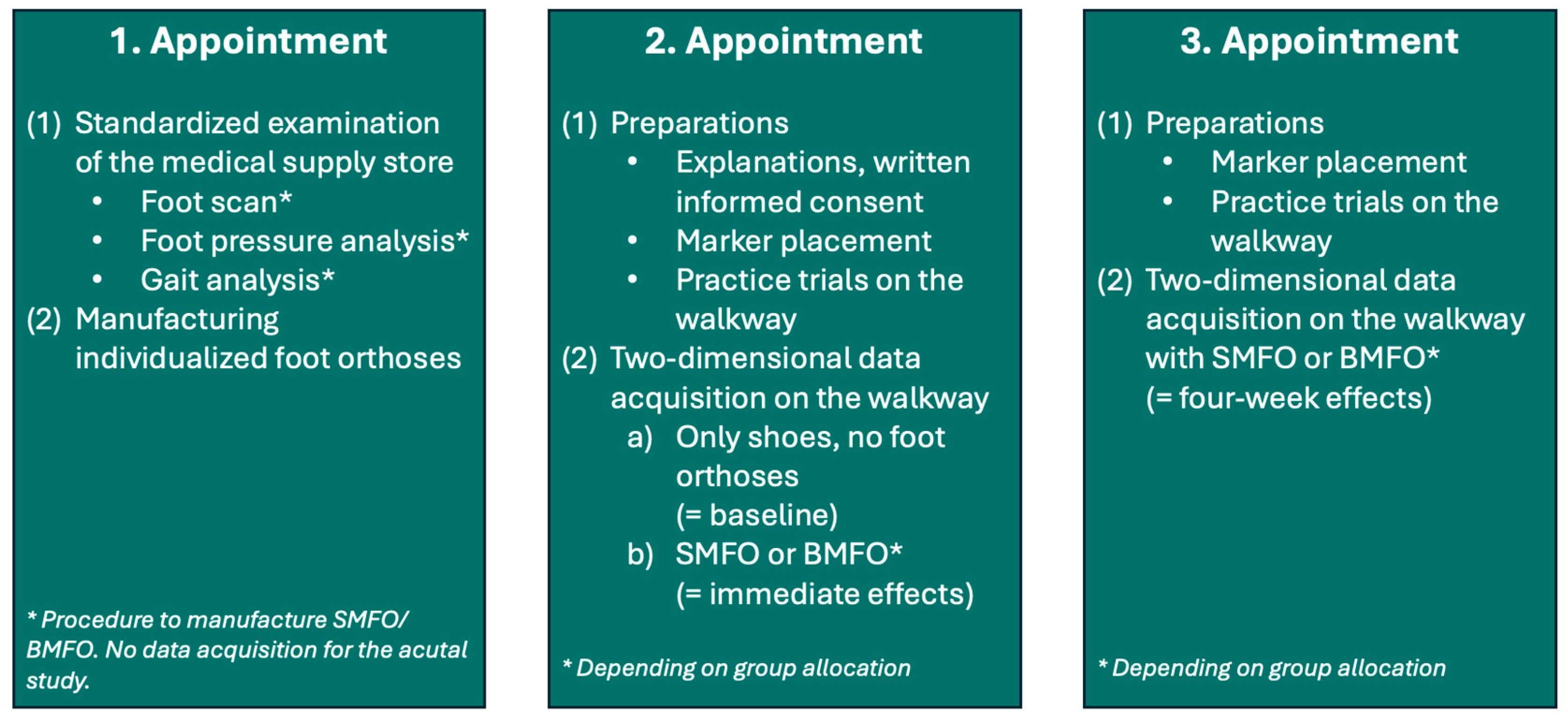
Figure 3.
The participants left rearfoot shows the rearfoot angle. The participants right rearfoot shows the three markers used for the rearfoot angle: (1) the center of the calcaneus (2) the Achilles tendon at the height of the connecting line between the lateral and medial malleoli (3) middle of the Achilles tendon.
Figure 3.
The participants left rearfoot shows the rearfoot angle. The participants right rearfoot shows the three markers used for the rearfoot angle: (1) the center of the calcaneus (2) the Achilles tendon at the height of the connecting line between the lateral and medial malleoli (3) middle of the Achilles tendon.
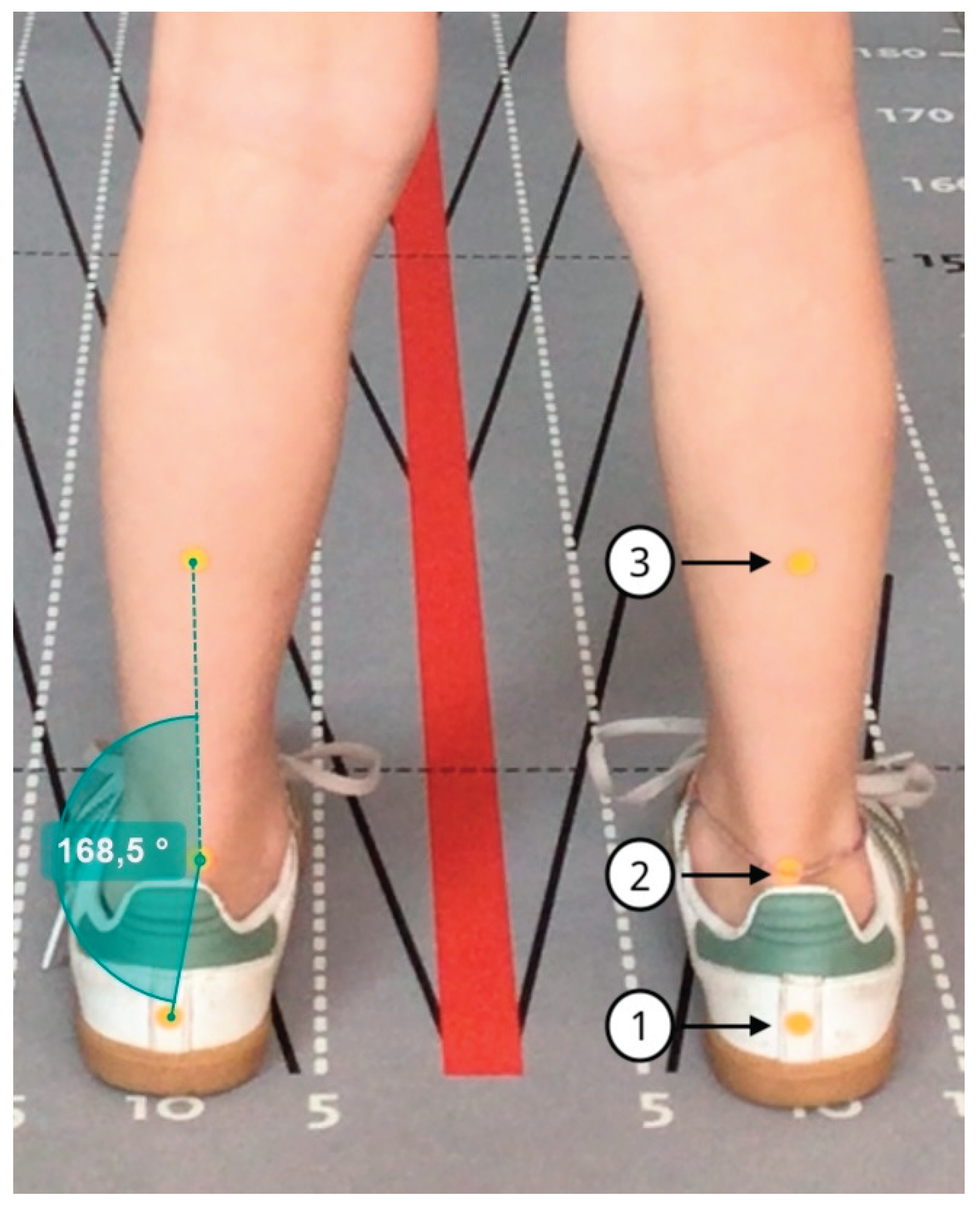
Figure 4.
A) Raw rearfoot angle in degree [°] for SMFO group (blue) and BMFO group (red) without foot orthoses (NFO, baseline), with foot orthoses (FO, immediate) and after four weeks. B) Mean change from baseline in degree [°] for SMFO group (blue) and BMFO group (red) without foot orthoses (NFO, baseline), with foot orthoses (FO, immediate) and after four weeks.
Figure 4.
A) Raw rearfoot angle in degree [°] for SMFO group (blue) and BMFO group (red) without foot orthoses (NFO, baseline), with foot orthoses (FO, immediate) and after four weeks. B) Mean change from baseline in degree [°] for SMFO group (blue) and BMFO group (red) without foot orthoses (NFO, baseline), with foot orthoses (FO, immediate) and after four weeks.
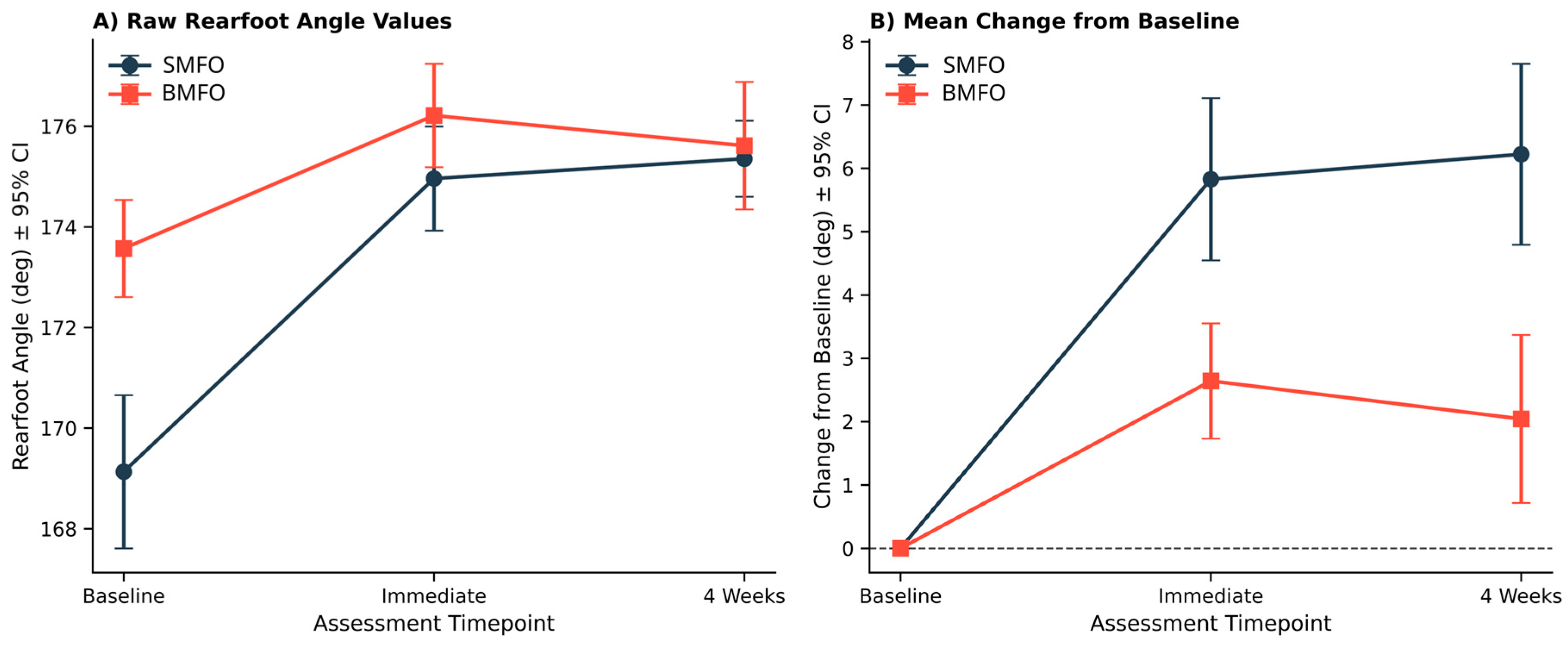

Table 1.
Descriptive statistics of the anthropometric data of the group with sensorimotor foot orthoses (SMFO) and with biomechanical foot orthoses (BMFO).
Table 1.
Descriptive statistics of the anthropometric data of the group with sensorimotor foot orthoses (SMFO) and with biomechanical foot orthoses (BMFO).
|
SMFO n = 18 |
BMFO n = 14 |
|
| Age [years] | 9.6 ± 1.9 | 10.2 ± 3.4 |
| Height [cm] | 140.9 ± 10.4 | 148.2 ± 20.0 |
| Weight [kg] | 35.3 ± 10.2 | 41.8 ± 14.5 |
Table 2.
Descriptive statistics of the rearfoot angle for both groups (sensorimotor foot orthoses (SMFO) and biomechanical foot orthoses (BMFO)) and the three measurements with (1) no foot orthoses (NFO), (2) with foot orthoses (FO) and (3) with foot orthoses after four weeks (4-weeks FO).
Table 2.
Descriptive statistics of the rearfoot angle for both groups (sensorimotor foot orthoses (SMFO) and biomechanical foot orthoses (BMFO)) and the three measurements with (1) no foot orthoses (NFO), (2) with foot orthoses (FO) and (3) with foot orthoses after four weeks (4-weeks FO).
| NFO (baseline) | FO (immediate) | 4-weeks FO | ||||
| SMFO n =18 |
BMFO n = 14 |
SMFO n = 18 |
BMFO n = 14 |
SMFO n = 18 |
BMFO n = 14 |
|
| Mean [°] | 169.1 | 173.6 | 175.0 | 176.2 | 175.4 | 175.6 |
| SD [°] | 3.3 | 1.8 | 2.2 | 2.0 | 1.6 | 2.4 |
| Upper CI-95% [°] | 170.8 | 174.6 | 176.1 | 177.3 | 176.2 | 177.0 |
| Lower CI-95 % [°] | 167.5 | 172.5 | 173.8 | 175.1 | 174.5 | 174.2 |
| IQR [°] | 5.8 | 1.9 | 3.5 | 2.0 | 2.1 | 2.1 |
| Minimum [°] | 163.3 | 169.9 | 170.5 | 174.1 | 171.2 | 171.8 |
| Maximum [°] | 175.1 | 177.2 | 178.0 | 181.8 | 177.9 | 182.4 |
SD = standard deviation, CI-95% = 95% confidence intervals, CV = coefficient of variation, IQR = interquartile range.
Table 3.
Fixed effects from Linear Mixed-Effects Model.
| Predictor | β (°) | SE | z | p |
|---|---|---|---|---|
| Intercept (SMFO baseline) | 169.13 | 0.55 | 308.91 | <.001 |
| Time[T.1] | 5.83 | 0.54 | 10.84 | <.001 |
| Time[T.2] | 6.22 | 0.54 | 11.57 | <.001 |
| Type of FO[T.2] | 4.44 | 0.83 | 5.36 | <.001 |
| Time[T.1] × Type of FO[T.2] | −3.19 | 0.81 | −3.92 | <.001 |
| Time[T.2] × Type of FO[T.2] | −4.18 | 0.81 | −5.14 | <.001 |
Table 4.
Planned contrasts with effect sizes (Holm-corrected).
| Contrast | Estimate (°) | 95% CI | pHolm | Cohen’s d |
|---|---|---|---|---|
| SMFO: Baseline vs Immediate | 5.83 | [4.77, 6.88] | <.001 | 3.61 |
| SMFO: Baseline vs 4 Weeks | 6.22 | [5.17, 7.28] | <.001 | 3.86 |
| SMFO: Immediate vs 4 Weeks | 0.39 | [−0.66, 1.45] | .98 | 0.24 |
| BMFO: Baseline vs Immediate | 2.64 | [1.45, 3.84] | <.001 | 1.64 |
| BMFO: Baseline vs 4 Weeks | 2.04 | [0.85, 3.24] | .004 | 1.27 |
| BMFO: Immediate vs 4 Weeks | −0.60 | [−1.79, 0.59] | .98 | −0.37 |
| Between groups at Baseline | 4.44 | [2.82, 6.06] | <.001 | 2.75 |
| Between groups at Immediate | 1.25 | [−0.37, 2.88] | .52 | 0.78 |
| Between groups at 4 Weeks | 0.26 | [−1.36, 1.88] | .98 | 0.16 |
Disclaimer/Publisher’s Note: The statements, opinions and data contained in all publications are solely those of the individual author(s) and contributor(s) and not of MDPI and/or the editor(s). MDPI and/or the editor(s) disclaim responsibility for any injury to people or property resulting from any ideas, methods, instructions or products referred to in the content. |
© 2026 by the authors. Licensee MDPI, Basel, Switzerland. This article is an open access article distributed under the terms and conditions of the Creative Commons Attribution (CC BY) license (http://creativecommons.org/licenses/by/4.0/).
Copyright: This open access article is published under a Creative Commons CC BY 4.0 license, which permit the free download, distribution, and reuse, provided that the author and preprint are cited in any reuse.


