

Submitted:
11 March 2026
Posted:
12 March 2026
You are already at the latest version
Abstract
The origin of uranium-series imbalance and radiogenic lead excess has long been a subject of debate. Here, based on a novel theory of neutrino oscillation-induced radioactive decay and magma formation, a unified mechanism is proposed to explain uranium-series imbalance, radiogenic lead excess, and excess argon formation. This mechanism indicates that magma originates from the upper mantle, formed by the melting of its constituent materials due to accelerated radioactive decay induced by atmospheric neutrino oscillations. During magma formation, radioactive decay rates typically increase due to Mikheyev-Smirnov-Wolfenstein (MSW) resonance perturbations from neutrino oscillations. This effect causes radioactive isotopes to decay over a shorter period than their normal half-lives would suggest, resulting in overestimated ages based on decay laws. Consequently, radioactive daughter isotopes and radiogenic isotopes become enriched relative to their parent isotopes. The accelerated melting of radioactive materials due to increased decay rates means that both the excess of radioactive daughter isotopes and radiogenic isotopes accompany the magma formation process. When using radiometric dating, careful consideration of the mineral's formation environment is essential. Generally, minerals formed in the crust or at the Earth's surface exhibit relatively normal radiometric ages, whereas minerals formed in the mantle or glassy materials solidified from magma tend to show radiometric ages that are older to varying degrees.
Keywords:
radioactive isotope excess
; Neutrino oscillation-induced radioactive decay
; magma formation
; radiometric dating
1. Introduction
In certain igneous rocks, anomalous abundances of Earth’s major radioactive isotopes and their decay products are frequently observed. These anomalies mainly manifest as disequilibrium within uranium isotope series [1], excesses of radiogenic lead isotopes [2,3] and the presence of excess argon [4,5], among other characteristic signatures.
1.1. Uranium Series Imbalance
The uranium radiochemical series comprises a sequence of short-lived radioactive daughter nuclides. For example, part of the ²³⁸U decay chain is illustrated as follows:
Among the progenitors in the decay chain listed above, ²³⁰Th has a relatively long half-life of 75.3 ka, while ²²⁶Ra has a shorter half-life of 1602 a. The half-life of ²²²Rn is even shorter, at only 3.82 d. Uranium series equilibrium (herein referring to the ²³⁸U decay chain) denotes a state where ²³⁸U and its various daughter products in Equation (1) exhibit equal radioactive intensity per unit time, i.e., equivalent radioactive activity. Mathematically, this equilibrium is expressed as:
In this equation, P and D denote the parent and daughter radioactive isotopes, respectively; N represents the number of atoms of the radioactive element; and λ is the decay constant. When Equation (2) holds true, the parent and daughter isotopes are in a state of radioactive equilibrium. Conversely, when the radioactive activities of the parent and daughter isotopes differ (i.e., their activity ratio is not equal to 1), the system is in a state of uranium series disequilibrium.
Studies have shown[1,6] that newly formed basaltic rocks from mid-ocean ridges exhibit varying degrees of uranium series disequilibrium, primarily characterized by relative excesses of daughter nuclides: (²³⁰Th/²³⁸U) > 1 and (²²⁶Ra/²³⁰Th) > 1 (ratios in parentheses represent alpha decay activity ratios). Furthermore, the relative excess of ²²⁶Ra is significantly greater than that of ²³⁰Th. The ²³⁰Th excess typically ranges from 1% to 40% [[7[–[9], whereas the ²²⁶Ra excess can exceed 200%[10]. In contrast to young basalts, which exhibit uranium series disequilibrium, older basalts flanking mid-ocean ridges are in uranium series equilibrium. Specifically, within the analytical error margin, both the (²³⁰Th/²³⁸U) and (²²⁶Ra/²³⁰Th) ratios in these older basalts are approximately 1. This indicates that the disequilibrium originates from the magmatic processes of basalt formation rather than post-formation physicochemical alterations [11]. Beyond newly formed mid-ocean ridge basalts, varying degrees of uranium series disequilibrium have also been observed in other young volcanic rocks[1,6,12]. Compared to mid-ocean ridge basalts, oceanic island basalts generally exhibit higher (²³⁰Th/²³⁸U) ratios and lower (²²⁶Ra/²³⁰Th) ratios[6]. Regarding the origin of uranium series disequilibrium in young volcanic rocks, scholars have proposed various explanations; however, all these interpretations lack full self-consistency and remain highly debated [6,13,14,15]. It is generally assumed that the uranium series daughter elements in mantle source materials are in or near radioactive equilibrium, and that the excesses of 226Ra and 230Th arise from the differential partitioning of U, Th, and Ra between the melt and residual mantle phases. Under this premise, partial melting experiments that produce uranium series disequilibrium often require extreme physicochemical conditions in the magmatic source region, such as extremely low degrees of partial melting and the influence of garnet-bearing deep-source regions. Nevertheless, these conditions are inconsistent with conventional experimental results and observational data on basalt formation[1,6]. For instance, on a global mid-ocean ridge scale, (²³⁰Th/²³⁸U) ratios exhibit positive correlations with both the degree of partial melting and initial melting depth, increasing as the degree of partial melting rises. This contradicts the interpretation that partial melting drives elemental fractionation, given that smaller degrees of partial melting are generally expected to result in more significant fractionation[6]. With respect to ²²⁶Ra excess, experiments measuring the distribution coefficients of Ba and Th—which, due to Ba's chemical similarity to Ra, can approximate the Ra-Th distribution relationship—can partially explain Ra excess in melts from the source region. However, this explanation is not applicable to newly formed mid-ocean ridge basalts. It is generally accepted that the ascent rate of basalt is comparable to the spreading rate of the mid-ocean ridge, ranging from 2 to 10 cm/year. The substantial ²²⁶Ra excess generated by partial melting of the mantle below 10 km would take far longer than 8 ka (five times the half-life of ²²⁶Ra) to ascend to the surface, meaning this excess ²²⁶Ra cannot be preserved until magma eruption[1]. Furthermore, while most cases of uranium series disequilibrium involve excesses of radioactive daughter nuclides, exceptions exist: some volcanic lavas exhibit excesses of radioactive parent nuclides, characterized by (²³⁰Th/²³⁸U) < 1[16,17]. To date, no unified explanation has been proposed for this phenomenon of parent nuclide excess.
1.2. The Lead Paradox
In nature, lead (Pb) occurs as four stable isotopes: ²⁰⁴Pb, ²⁰⁶Pb, ²⁰⁷Pb, and ²⁰⁸Pb. Among these, ²⁰⁴Pb is primordial (non-radiogenic) with an extremely long half-life of 1.4×10¹⁷ years—far exceeding the Earth’s age (~4.54 billion years)—rendering it effectively stable in geological contexts. The latter three are radiogenic isotopes, derived from the radioactive decay chains of ²³⁸U, ²³⁵U, and ²³²Th, respectively. Over geological time, the abundances of these radiogenic Pb isotopes have increased progressively as their parent nuclides decay. Based on the radioactive decay law, , where N₀ denotes the initial amount of the parent isotope (²³⁸U, ²³⁵U, or ²³²Th) at the time of mineral formation, N is the remaining amount of the parent isotope after time t, and λ is the decay constant of the parent isotope. Using this formula, the quantities of radiogenic daughter products (206Pb, 207Pb, and 208Pb) generated by parent nuclide decay within a mineral can be quantified. If the mineral has maintained a closed isotopic system (i.e., no isotopic fractionation or loss/gain of parent/daughter nuclides) since its crystallization, the mineral’s formation age can be calculated using the half-lives of the respective parent isotopes.
It is widely accepted that the vast majority of meteorites have undergone negligible U-Pb differentiation since their formation. Consequently, the formation age of a meteorite can be calculated by determining its Pb isotopic composition. According to current planetary formation hypotheses, meteorites share the same formation age as planets (including Earth). Thus, inferring the age of meteorites allows for the derivation of planetary and Earth ages. Patterson[18] first employed this method to determine the Geochron age of 4.55 billion years via meteorite Pb isotope composition (Figure 1.), which closely matches the currently measured Earth age of 4.57 billion years[19]. Earth is widely recognized to have experienced magmatic differentiation early in its history. As a result, its distinct layers (core, mantle, and crust) and diverse rock types display unique U/Pb and Th/Pb ratios, as well as characteristic ranges of Pb isotopic compositions. By the law of mass conservation, the Pb isotopic compositions of Earth’s various reservoirs and rock types should generally lie along the "Geochron". However, extensive geochemical datasets reveal that mid-ocean ridge basalts (MORBs) and oceanic island basalts (OIBs) exhibit significantly higher 206Pb/204Pb and 207Pb/204Pb ratios than the Bulk Silicate Earth (BSE), predominantly plotting to the right of the zero-age Geochron (Figure 2)[20]. This phenomenon, known as the lead paradox [3], has long puzzled geochemists.
It is widely believed that the lead paradox indicates the existence of a reservoir within Earth's interior containing lead isotopes of high non-radioactive origin. As the upper mantle constitutes the largest rock reservoir, mid-ocean ridge basalts (MORBs) represent the most voluminous magmatic rocks on Earth. The wide variation in Pb isotopic composition observed in MORBs (Figure 2.) reflects the complexity of their U-Th-Pb isotopic system. Therefore, studying the Th/U values of MORB mantle sources will aid in understanding the evolution of its Pb isotopes. The 232Th/238U value (k value) of MORB can be calculated using two methods: its decay daughter 208Pb/206Pb ratio and the unbalanced uranium series daughter isotope 230Th. However, results from these two methods differ markedly: the 232Th/238U value (kPb) calculated from Pb isotope composition yields approximately 3.7, whereas the 232Th/238U value (kTh) derived from 230Th isotopes yields only 2.5. This indicates that Pb isotopes in the upper mantle did not evolve within a closed system[21]. To resolve these puzzles, researchers have proposed various models or hypotheses, such as the core Pb accretion model[22], the low-radioactive-origin Pb reservoir model in the lower crust[23,24,25], the subduction zone Pb enrichment model[20,26], the low-μ mantle reservoir model[27], and mantle metasomatic enrichment[28]. However, none of these models or hypotheses has been supported by existing observational data[2,3].
1.3. Excess Argon
In low-temperature minerals, ⁴⁰Ar produced by the electron capture decay of ⁴⁰K typically occupies the lattice site originally occupied by its parent nuclide ⁴⁰K. Consequently, radiogenic 40Ar is generally trapped within the mineral lattice and cannot escape. Thus, the crystallization age of the mineral can be calculated based on the half-life of ⁴⁰K and the concentration of radiogenic ⁴⁰Ar. The K-Ar (or ⁴⁰Ar/³⁹Ar) dating method is established on this fundamental principle. Aldrich and Nier [4] first reported the occurrence of excess argon in minerals, a phenomenon where the total 40Ar content in mineral samples exceeds the total "radiogenically produced argon" calculated from the ⁴⁰K content and its decay kinetics. This excess ⁴⁰Ar is attributed to discrepancies between the isotopic composition or age derived from radioactive decay laws and the actual values of the mineral. The closure temperature for K-Ar dating in potassium feldspar is only approximately 150℃, whereas that for U-Pb dating in zircon exceeds 800℃. Under normal magmatic cooling conditions, zircon—being heat-resistant—crystallizes (and achieves isotopic closure) first, followed by the low-melting-point potassium feldspar (which also undergoes isotopic closure subsequently). Hence, zircon should theoretically yield an older age than potassium feldspar. However, field observations have revealed that the dating age of later-crystallized potassium feldspar can be older than that of earlier-formed zircon. For instance, Ke et al.[29] conducted high-precision SHRIMP U-Pb zircon dating on multiple minerals from the eastern Tashkurgan alkaline gneiss within the Pamir tectonic complex, yielding an age of 11 Ma, which is consistent with field geological evidence. In contrast, ⁴⁰Ar/³⁹Ar dating of potassium feldspar from the same gneiss body yielded an age of 23 Ma. This significant age discrepancy can only be explained by the presence of excess argon in the potassium feldspar.
To date, excess argon has been detected in numerous mineral species, with a particular prevalence in young volcanic rocks[5,30]. For example, Li et al.[31] combined ⁴⁰Ar/³⁹Ar, Sm-Nd, and U-Pb dating methods to determine the age of quartz-bearing pyroxene gneiss from Qinglongshan, northern Jiangsu. The results showed that the ⁴⁰Ar/³⁹Ar dating yielded an age of approximately 900 Ma, which is significantly higher than the 226 Ma obtained from Sm-Nd and U-Pb dating. Li et al.[5] investigated the ⁴⁰Ar/³⁹Ar ages of biotite and amphibole from the Kangding Complex, concluding that these minerals yielded ⁴⁰Ar/³⁹Ar ages of 880–920 Ma, whereas their U-Pb ages ranged from 770 to 780 Ma. Calculations indicated that excess argon accounted for approximately 16% of the total argon in the samples.
It is generally accepted that excess argon may derive from two sources: first, "residual" ⁴⁰Ar—initially present in the sample but not fully expelled during preparation or analysis; second, extraneous ⁴⁰Ar—distinct from that produced by in situ ⁴⁰K decay—which can infiltrate the sample via various geologic processes (e.g., hydrothermal activity, fluid migration)[32]. However, Scaillet[33] employed laser microprobe ⁴⁰Ar/³⁹Ar spot-fusion dating of plagioclase feldspar from the Dora-Maira gneiss and documented a concentric radial pattern of decreasing ages from grain core to rim on millimeter-scale individual feldspar crystals. The oldest age (321.6 Ma) was recorded at the core, while the youngest (285.0 Ma) occurred at the rim. This observation implies that excess argon was trapped during early mineral crystallization and subsequently mobilized via volume diffusion during greenschist-facies thermal events. Scaillet’s subsequent investigations further demonstrated that this excess argon was sourced from the garnet peridotite itself, rather than external reservoirs [33].
In summary, the origins of uranium-series disequilibria, the lead paradox, and excess argon remain controversial, with no consensus explanation yet established. To address these unresolved issues, this study analyzes variations in radioactive decay rates during magma genesis and migration, as well as their impacts on radioactive decay series, based on emerging theories of neutrino oscillation-induced radioactive decay and magma formation[3][–[6]. We propose a unified framework to explain the origins of uranium-series disequilibria, the lead paradox, and excess argon.
2. Neutrino Oscillation and Magma Formation
2.1. Neutrino Oscillation-Induced Radioactive Decay
Wolfenstein[37], Mikheyev and Smirnov[38] successively investigated the material effects of neutrino oscillation, establishing the evolution equation for neutrinos propagating through matter. By solving this equation, they derived the flavor conversion probability of neutrinos. Taking two-flavor neutrinos (e.g.,) as an example, the flavor conversion probability in constant-density matter can be expressed as:
Here, E is the neutrino energy, L is the oscillation baseline length, is the mixing angle due to the material effect, and is the effective mass square difference. The corresponding values are given by the following formulas:
In equations (2) and (3), θ is the mixing angle in vacuum, is the mass square difference between the two eigenstates, and is the charge-carrying material potential (where is the Fermi constant and is the electron number density in the material).
Resonance between neutrinos and medium atoms occurs when the following condition is satisfied:
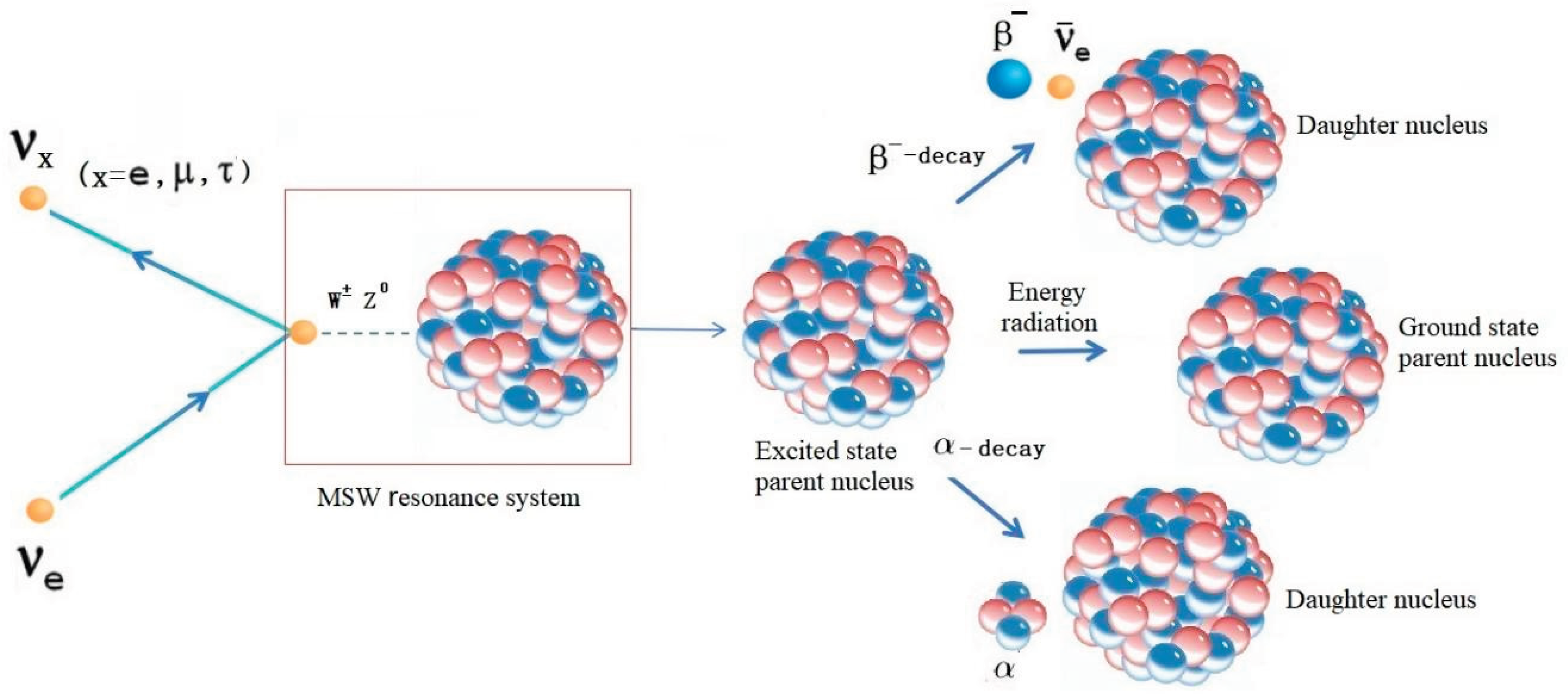
Since this resonance mechanism was jointly discovered by Mikheyev, Smirnov and Wolfenstein, it is named the Mikheyev-Smirnov-Wolfenstein (MSW) mechanism. During resonance, the neutrino flavor conversion probability reaches its maximum value. Zhang and Zhang[34,35,36] studied the MSW mechanism and pointed out that it actually represents physical resonance between neutrinos and medium atoms, involving energy excitation. This resonance strongly influences neutrino oscillation behavior, increasing neutrino flavor conversion probabilities while also affecting medium atoms. It excites unstable radioactive nucleons in the medium into excited states, increasing their decay rates[34,35] (Figure 3.). Since radioactive decay in matter is a tunneling effect[39] and quantum transition phenomenon[40], it is highly energy-sensitive. Even negligible energy excitation can cause decay rates to increase exponentially.
The Earth's interior contains abundant radioactive materials. If neutrinos traversing the planet can resonate with terrestrial matter through MSW resonance, this resonance would undoubtedly excite the Earth's radioactive substances, increasing their decay probability and the heat generated during decay. Based on resonance conditions, it is readily apparent that atmospheric neutrinos traversing the Earth can form MSW resonance within the planet's interior (Note: According to resonance conditions, solar neutrinos possess lower energy and cannot form MSW resonance within the Earth). From equation (4), the energy of atmospheric neutrinos during resonance is obtained as [35,41]:
In the above equation, the relationship between Ne and material density ρ is where is the electron number (i.e., the number of electrons per nucleon) and is the nucleon mass number. When the atmospheric neutrino energy Eres and material density ρ satisfy equation (5), MSW resonance can be formed.
2.2. Formation and Migration of Magma
The four primary radioactive isotopes within the Earth—²³⁸U, ²³⁵U, ²³²Th, and ⁴⁰K—undergo the following decay reactions under neutrino oscillation perturbations [42]:





Research indicates that the atmospheric neutrino energy spectrum is extremely broad, spanning approximately 0.1 GeV to 104 GeV, with the upper limit extending to the TeV scale[43,44]. The density of terrestrial materials ranges from 1 to 13 g/cm³[45]. Based on Equation (5), all materials within the Earth can undergo Mikheyev–Smirnov–Wolfenstein (MSW) resonance with atmospheric neutrinos. This suggests that radioactive materials distributed across all layers of the Earth’s interior may be subject to accelerated decay and enhanced heat production via excitation through MSW resonance. However, owing to the low abundance of radioactive materials in the lower mantle and core, the heat released by neutrino oscillation-induced radioactive decay is insufficient to trigger material melting. As a result, substantial molten reservoirs cannot form, nor can thermally significant effects be generated. While the crust is enriched in radioactive species, MSW resonance between neutrinos and matter involves a distinct initiation phase. Upon penetrating the crust, neutrinos generally remain in this pre-resonance state, with full MSW resonance established only when they reach the upper mantle. For this reason, crustal radioactive materials do not undergo resonant excitation and thus do not contribute to melt formation. Calculations reported in [35] demonstrate that if MSW resonance were to stimulate decay in a mere 3.02% of the primary radioactive materials in the upper mantle, the resultant heat would be adequate to induce melting of upper mantle materials. On the basis of this finding, Zhang and Zhang [35,36] postulate that the majority of Earth’s internal melt (or magma) is derived from the upper mantle and asthenosphere.
The melting effect of neutrino oscillation perturbations first occurs in minute regions enriched with radioactive substances, forming melt pockets of various shapes[35,46]. These tiny melt pockets are typically randomly distributed throughout the upper mantle, disconnected from one another, and represent the embryonic stages of magma. As MSW resonant perturbations persist, radioactive heating intensifies, gradually enlarging the molten zones. These melt pockets progressively transform into massive droplets, coalescing with surrounding melt pockets and droplets to form mobile melts or magmas. Driven by buoyancy, these melts or magmas ascend. Upon reaching the lithosphere, magma migration is further influenced by tectonic stresses. The upper mantle exhibits plastic behavior, allowing magma to ascend primarily through permeation[35,36]. Upon reaching the rigid crust, mineral crystals resist creep, preventing further permeation. Magma then migrates along fractures toward regions of lower stress, thereby driving various tectonic movements on Earth [35,36,47,48].
3. Discussion
3.1. Formation of Uranium-Series Imbalance and the Lead Paradox
The excess of certain elements derived from age and decay equilibrium requires two prerequisites: first, that radioactive decay is constant, and second, that the environment remains undisturbed for a sufficiently long period. The theory of neutrino oscillation-induced radioactive decay and new magma formation reveals that under the disturbance of the MSW mechanism—where atmospheric neutrino oscillations occur—the decay rate of radioactive elements increases, leading to the melting of materials into magma. This is how melts form within the mantle [35,36]. In other words, under specific mantle conditions, radioactive decay rates are not invariant but can be enhanced, providing a straightforward explanation for the observed excess of certain radiogenic isotopes. For the uranium decay series, when the decay constant λ remains stable, the equilibrium condition is satisfied if the system remains undisturbed for millions of years. However, if λ suddenly increases in a localized region, all radioactive isotopes (both parent and daughter nuclides) undergo simultaneous accelerated decay. While the uranium series could re-establish equilibrium over time if the elevated λ were sustained, neutrino oscillations are probabilistic events, and MSW resonance is confined to specific mantle domains [35,36]. Consequently, the enhancement of λ is transient, occurring over relatively short time intervals. For instance, when the entire uranium series resides within an MSW resonance zone, all constituent isotopes experience accelerated decay. As the radioactive isotopes are rapidly transported upward with the magma and exit the resonance zone, their decay constant λ reverts to its baseline value. This transient perturbation inevitably induces uranium series disequilibrium: the elevated λ causes parent uranium isotopes to undergo "compressed decay," wherein the quantity of uranium that would normally decay over an extended period is dissipated in a short timeframe, thereby generating a surplus of daughter isotopes. Over geological timescales, this accelerated decay thus leads to an excess of daughter nuclides in the uranium series. Notably, the uranium decay chain comprises numerous daughter isotopes with distinct decay rates, and the sequential transformation of parent uranium into these daughter nuclides is a time-dependent process. This process may cause later-stage daughter nuclides to be “overdrawn” during λ's increase, temporarily deprived of replenishment from preceding daughter nuclides' decay. Consequently, these later-stage daughter nuclides experience a relative deficit compared to the parent nuclide, resulting in a parent nuclide surplus. For example, in the 238U decay series, the first two daughter nuclides, 234Th and 234Pa, have very short half-lives of 24.1 years and 6.7 hours, respectively. After an increase in the decay rate λ followed by its return to normal, equilibrium can be reached relatively quickly. The subsequent daughter nuclides, 234U and 230Th, possess much longer half-lives of 2.47×10⁶ years and 7.52×10⁴ years, respectively. After disturbance, they may require millions and hundreds of thousands of years, respectively, to return to equilibrium. In other words, when λ increases, accelerating radioactive decay and generating magma, if this magma ascends to the surface within hundreds of thousands of years and is sampled for analysis, it will exhibit a deficit relative to its parent 238U. Therefore, lava showing an excess of radioactive parent material is typically fresh lava that rapidly ascended to the surface after mantle melting. Slow melt ascent or prolonged residence in the mantle or near the surface prevents radioactive parent excess. For example, the Kick'em Jenny (KEJ) submarine volcanic lava, proven to exhibit high 238U excess, is fresh lava erupted in the last century[17].
The formation of radiogenic Pb excess stems from two mechanisms: First, 206Pb、207Pb、208Pb are terminal decay products of 238U, 235U, and 232Th, respectively. An increase in λ followed by its return to normal values leads to excess accumulation of these daughter isotopes. Second, non-radioactively produced 204Pb is not a stable isotope, possessing a half-life of 1.4×10¹⁷ years. Although this half-life is negligible, when 204Pb is resonantly perturbed by neutrino oscillations (MSW), its λ correspondingly increases, accelerating its decay and depletion. This explains the absence of non-radioactive 204Pb.
3.2. Causes of Excess Argon and ⁴⁰K Deficiency
Potassium has three isotopes: 39K、⁴⁰K, and 41K. Of these, 39K and 41K are stable, while ⁴⁰K is a radioactive nuclide that decays to ⁴⁰Ca and ⁴⁰Ar. The K-Ar (or 40Arr/39Ar) dating method calculates geological ages based on the decay of ⁴⁰K to ⁴⁰Ar. When measured ages exceed the true geological ages, researchers typically attribute this discrepancy to excess argon—often assumed to be residual or extraneous[31,32]. However, few studies have explored whether this excess argon could originate from accelerated ⁴⁰K decay. For example, Dalrymple and Moore[49] applied K-Ar dating to pillow basalts and whole-rock cores from lava flows at depths of 500~5000 m on the northeast ridge of Hawaii’s Kilauea Volcano, yielding an age of approximately 43 Ma. Yet multiple lines of geological evidence confirm these lava flows formed during the Quaternary period. This significant age overestimation led the authors to conclude that the pillow basalts contain excess trapped argon. Alternatively, this discrepancy could be interpreted as a depletion of the radioactive parent nuclide ⁴⁰K. If all excess ⁴⁰Ar could be demonstrated to derive exclusively from the decay of its parent ⁴⁰K, there would be no basis for invoking the concept of "excess ⁴⁰Ar." Notably, Wang et al.[50] recently published a study investigating potassium isotopes in various minerals. While the isotopic abundance ratios of potassium’s three nuclides are generally constant in terrestrial minerals, their findings revealed distinct potassium isotopic anomalies in certain samples—all exhibiting varying degrees of ⁴⁰K depletion. However, as the authors’ primary objective was to demonstrate the occurrence of extraterrestrial meteorite impacts during Earth’s early history, they interpreted this 40K depletion as a potential signature of these ancient events. The samples analyzed by Wang et al. [50] were derived from rock powders of the oldest terrains in Greenland and Canada, alongside modern volcanic lavas from Hawaii. These samples exhibited a widespread deficiency of ⁴⁰K, with an average loss of approximately 65 parts per million. Using decay equations, the decay age corresponding to this deficiency can be readily calculated. Let the initial ⁴⁰K content be N0. After time t, the ⁴⁰K content becomes N. Assuming the missing 65 ppm of ⁴⁰K decayed over time t, and considering that electron capture decay accounts for only 10.72% of ⁴⁰K decay, we have: . Solving yields: 1 , since: (or ) , thus 1. In the above equations, λ ≈ 4.962×10⁻¹⁰ a⁻¹ is the electron capture decay constant for ⁴⁰K. From this, we can calculatet=1.4×10⁴a. For modern lava (100 a), if the missing 65 parts per million of ⁴⁰K decayed into ⁴⁰Ar, it would result in a 140-fold excess of ⁴⁰Ar. For Hadean rocks (4 Ga), the relative excess of ⁴⁰Ar would only be 3.5 parts per million. Typically, minerals exist in open environments where material exchange occurs with the surroundings. Over time, excess radiogenic isotopes are continuously diluted and mixed, causing the excess amount to diminish. Therefore, generally speaking, younger volcanic rocks exhibit greater excess radiogenic isotopes, resulting in calculated ages that appear older[51]. Of course, due to significant differences in the physicochemical properties of K and Ar, their interaction with environmental materials varies markedly. Consequently, within the same mineral, ⁴⁰K and ⁴⁰Ar do not strictly decrease or increase in the same proportion. Thus, even if all ⁴⁰Ar in a mineral originates from the decay of ⁴⁰K within that mineral, the amount of excess ⁴⁰Ar does not necessarily match the amount of missing ⁴⁰K. Consequently, this leads to potential discrepancies in the ages calculated from different elements, including both radioactive isotopes and radiogenic isotopes.
Excess argon is frequently encountered in olivine phenocrysts, plagioclase, amphibole, and various mica minerals[6,32]. Notably, micas derive from both magmatic crystallization within the mantle and metamorphic processes in the crust. Previous studies have indicated that MSW resonance typically modulates radioactive decay rates exclusively in the mantle, with no discernible effect on crustal radioactive materials[35,36]. Conversely, if micas were formed entirely through the metamorphism of crustal protoliths, excess argon would be absent—only mantle-derived magmatic micas could potentially retain such excess argon.
Wang[52] determined K-Ar ages of muscovite from selected garnet gneisses and, through comparative analyses, identified excess argon contents in excess of 50% within these muscovite grains. Scaillet [33] further investigated polysilicate muscovite in garnet gneisses, revealing that excess argon was trapped during early-stage mineral crystallization and subsequently reactivated during post-formation thermal events. This finding supports the notion that excess argon may originate from deep mantle magmas.
Furthermore, Chen et al.[53] conducted studies on high-pressure gneisses formed entirely from country rocks—specifically in orthogneisses of the Kunlun Orogenic Belt (western China) and gneisses of the Su-Lu region. Their dating of muscovite derived solely from these country rocks yielded ages that closely align with regional tectonic chronologies. This observation conclusively demonstrates that crustally derived muscovite does not exhibit excess argon.
3.3. On the Issue of Radiometric Dating
The fundamental principle of commonly used radiometric dating methods is that radioactive elements decay at a constant rate. However, if we propose that under specific conditions, the radioactive decay rate can undergo significant modifications, would this render conventional radiometric dating methods invalid? In fact, it would not. This is because the MSW resonance associated with neutrino oscillations is generally not induced in the Earth’s crust and occurs exclusively in the mantle [35]. Consequently, radioactive nuclides in the crust and at the Earth’s surface are generally unaffected by MSW resonance, and their radioactive decay rates remain essentially constant. Thus, radiometric dating remains valid for minerals formed at the Earth’s surface and within the crust.
Given that magma originates from the upper mantle[35,36]—a region affected by MSW resonant oscillations—radioactive decay rates in this region undergo varying degrees of modification. Minerals derived from mantle magma therefore require special consideration. Magma comprises not only molten material but also crystallized minerals. If minerals within magma form in the mantle, they are likely to exhibit an excess of radiogenic isotopes, resulting in radiometric ages that appear older than their true ages. Conversely, if minerals within magma form after the magma ascends into the crust, they contain little to no excess radiogenic isotopes, producing normal radiometric ages.
Notably, even when formed in the crust, the radioactive age of a material may appear older under two circumstances: First, if the melt cools rapidly to form glassy material, radiogenic elements become trapped before sufficient diffusion can occur. Consequently, such glassy material—even when formed during crustal cooling—may retain earlier radiogenic products from the magma, resulting in an artificially older radioactive age[54]. Second, the K-Ar ages of minerals are typically older than ages obtained via other radiometric dating methods[5][–[2]. This is because magma conduits also function as degassing pathways for the Earth, enabling radioactive argon of deep origin to mix with the magma and be expelled through these channels. When magma crystallizes and solidifies in the crust, the argon present in the magma may become trapped in inclusions and crystal lattice defects, leading to the incorporation of excess argon in the minerals. Therefore, excess argon may be generated by the accelerated decay of the mineral's own ⁴⁰K, or it may be captured from the outside world.
4. Conclusions
Drawing on the latest research on neutrino oscillation-induced radioactive decay and magma formation, this paper puts forward the formation mechanisms underlying uranium-series disequilibrium, excess radiogenic lead, and excess argon. Its key arguments are as follows: 1)Magma originates from the upper mantle, resulting from the melting of its constituent materials driven by accelerated radioactive decay induced by perturbations from atmospheric neutrino oscillations. 2)During magma formation, radioactive decay rates generally increase due to MSW resonance perturbations from neutrino oscillations, thereby giving rise to an excess of radioactive daughter isotopes compared to their parent isotopes. 3)When applying radioactive dating, careful consideration of the mineral formation environment is crucial. In general, minerals formed in the crust or at the Earth’s surface exhibit normal radioactive ages, whereas those formed in the mantle or vitreous materials produced by magma solidification display abnormally old radioactive ages to varying extents.
Given that neutrino oscillation-induced radioactive decay has not yet been experimentally verified, the mechanisms proposed in this paper remain hypothetical and require further research and validation.
References
- Zhang, GL; Zeng, ZG; Yin, XB. U-series disequilibrium on magma generation and transportation beneath mid-ocean ridge axes. Marine Geology & Quaternary Geology 2008, 28(1), 77–84. [Google Scholar] [CrossRef]
- Doucet, LS; Li, ZX; Fougerouse, D; et al. The global lead isotope system: Toward a new framework reflecting Earth's dynamic evolution. Earth-Science Reviews 2023, 243, 104483. [Google Scholar] [CrossRef]
- Hofmann, AW. The enduring lead paradox. Nature Geosci 2008, 1(12), 812–813. [Google Scholar] [CrossRef]
- Aldrich, LT. Nier AO (1948) Argon 40 in Potassium Minerals. Physical Review 74, 876–877. [CrossRef]
- Li, DP; Chen, YL; Luo, ZH. 40Ar/39Ar dating of biotites and hornblendes in the Kangding complexes and their significances. Acta Petrologica Sinica 2006, 22(11), 2753–2761. Available online: http://ysxb.ac.cn/article/id/aps_2006011294.
- Zhang, GL; Zheng, ZG. Genesis of 230Th excess in basalts from mid-ocean ridges and ocean islands: Constraints from the global U-series isotope database and major and rare earth element geochemistry. Sci China Earth Sci 2010, 40(10), 1389–1398. [Google Scholar] [CrossRef]
- Beattiea, P. The generation of uranium series disequilibria by partial melting of spinel peridotite: Constraints from partitioning studies. Earth Planet Sci Lett 1993, 117, 379–391. [Google Scholar] [CrossRef]
- Lundstrom, CC; Hoernle, K; Gill, J. U-series disequilibria in volcanic rocks from the Canary islands: Plume versus lithospheric melting. Geochim Cosmochim Acta 2003, 67, 4153–4177. [Google Scholar] [CrossRef]
- Peate, DW; Hawkesworth, CJ; Van Calsteren, PW. 238U-230Th constraints on mantle upwelling and plume-ridge interaction along theReykjanes ridge. Earth Planet Sci Lett 2001, 187, 259–272. [Google Scholar] [CrossRef]
- Rubin, KH; Macdougall, JD. 226Ra excesses in mid-ocean-ridge basalts and mantle melting. Nature 1988, 335, 158–161. [Google Scholar] [CrossRef]
- Volpe, AM; Goldstein, SJ. 226Ra-230Th disequilibrium in axial and off-axis mid-ocean ridge basalts. Geochimica Et Cosmochimica Acta 1992, 57, 1233–1241. [Google Scholar] [CrossRef]
- Zou, HB; Fan, QC. Uranium-thorium isotope disequilibrium in young volcanic rocks from China. Acta Petrologica Sinica 2011, 27(10), 2821–2826. [Google Scholar]
- Turner, S; Blundy, J; Wood, B; Hole, M. Large 230Th-excesses in basalts produced by partial melting of spinel lherzolite. Chem Geol 2000, 162, 127–136. [Google Scholar] [CrossRef]
- Wood, B; Blundy, J; Robinson, J. The role of clinopyroxene in generating U-series disequilibrium during mantle melting:Implications for uranium series disequilibria in basalts. Geochim Cosmochim Acta 1999, 63, 1613–1620. [Google Scholar] [CrossRef]
- Lundstrom, CC; Williams, Q; Gill, JB. Investigating solid mantle upwelling rates beneath mid-ocean ridges using U-series disequilibria,1: A global approach. Earth Planet Sci Lett 1998, 157, 151–165. [Google Scholar] [CrossRef]
- Avanzinelli, R; Casalini, M; Conticelli, S. Carbon fluxes from subducted carbonates revealed by uranium excess at Mount Vesuvius, Italy. Geology 2018, 46(3), 259–262. [Google Scholar] [CrossRef]
- Huang, F; Lundstrom, CC; Sigurdsson, H; et al. U-series disequilibria in Kick’em Jenny submarine volcano lavas: A new view of time-scales of magmatism in convergent margins. Geochimica et Cosmochimica Acta 2011, 75, 195–212. [Google Scholar] [CrossRef]
- Patterson, C. Age of meteorites and the earth. Geochim. Cosmochim. Acta 1956, 10, 230–237. [Google Scholar] [CrossRef]
- Bouvier, A; Blichert-Toft, J; Moynier, F; et al. Pb-Pb dating constraints on the accretion and cooling history of chondrites. Geochim. Cosmochim. Acta 2007, 71, 1583–1604. [Google Scholar] [CrossRef]
- Zhang, JB; Liu, YS; Ducea, MN; et al. Archean, highly unradiogenic lead in shallow cratonic mantle. Geology 2020, 48(6), 584–588. [Google Scholar] [CrossRef]
- Galer, SJG; O^Nions, RK. Residence time of thorium, uranium and lead in the mantle with implications for mantle convection. Nature 1985, 316, 778–782. [Google Scholar] [CrossRef]
- Allegre, CJ; Dupre, B; Brevart, O. Chemical aspects of the formation of the core. Phil. Trans. Royal Soc. London 1982, 306, 49–59. [Google Scholar] [CrossRef]
- Kramers, DJ; Tolstikhim, IN. Two terrestrial lead isotope paradoxes, forward transport modeling, core formation and the history of the continental crust. Chem. Geol 1997, 139, 75–110. [Google Scholar] [CrossRef]
- O^Nions, RK; Evenson, NM; Hamilton, PJ. Geochemical modeling of mantle differentiation and crustal growth. J. Geophys Res 1979, 84, 6091–6101. [Google Scholar] [CrossRef]
- Zartman, RE; Haines, S. The plumbotectonic model for Pb isotopic systematics among major terrestrial reservoirs—a case for bi-directional transport. Geochim. Cosmochim. Acta 1988, 52, 1327–1339. [Google Scholar] [CrossRef]
- Chauvel, D; Goldstain, SL; Hofmann, AW. Hydration and dehydration of oceanic crust controls Pb evolution of the mantle. Chem. Geol 1995, 126, 65–75. [Google Scholar] [CrossRef]
- Murphy, DT; Kamber, BS; Collerson, KD. A refined solution to the first terrestrial Pb-isotope paradox. J. Petrol 2002, 44, 39–53. [Google Scholar] [CrossRef]
- Cortini, M. Uranium in mantle processes. In Uranium geochemistry, mineralogy, geology, exploration and resources; De Vivo, B, Ippolito, F, Capaldi, G, Simpson, PR, Eds.; Springer: Dordrecht, 1984. [Google Scholar] [CrossRef]
- Ke, S; Luo, ZH; Mo, XX; et al. The geochronology of Taxkorgan alkalic complex, Pamir syntax. Acta Petrologica Sinica 2008, 24(2), 315–324. Available online: http://ysxb.ac.cn/en/article/id/aps_20080211.
- Li, DM; Chen, WJ; Li, Q. K-Ar age of young volcanic rocks and excess argon-Binary mixing model and quantitative study of excess argon effect. Chinese Science Bulletin 1999, 44(7), 658–663. [Google Scholar] [CrossRef]
- Li, S; Wang, S; Chen, Y. Excess argon in phengite from eclogite:evidence from the dating of eclogite minerals by the Sm-Nd,Rb-Sr and 40Ar/39Ar methods. Chemical Geology 1994, 112(3-4), 343–350. [Google Scholar] [CrossRef]
- Chen, W; Zhang, Y; Wang, QL; et al. Major Advances in the Research on the Genesis of Excess Argon in High Pressure Muscovite. Acta Geoscientica Sinica 2005, 1(6), 495–498. [Google Scholar] [CrossRef]
- Scaillet, S. Excess 40Ar transport scale and mechanism in high-pressure phengites: A case study from an eclogitized metabasite of the Dora-Maira nappe, western Alps. Geochimica et Cosmochimica Acta 1996, 60(6), 1075–1090. [Google Scholar] [CrossRef]
- Zhang, GW; Zhang, M K. Research on Neutrino Oscillation-Induced Radioactive Decay. Modern Physics 2024, 14, 135–144. [Google Scholar] [CrossRef]
- Zhang, GW; Zhang, MK. Effects of Matter in Atmospheric Neutrino Oscillations and the Formation of Magma. Journal of Geoscience and Environment Protection 2024, 12, 270–287. [Google Scholar] [CrossRef]
- Zhang, MK; Zhang, GW. (2025) Dynamical Mechanisms of Melt Migration Beneath Mid-Ocean Ridges. Open Journal of Geology 15, 358–376. [CrossRef]
- Wolfenstein, L. Neutrino Oscillations in Matter. Physical Review D 1978, 17, 2369–2379. [Google Scholar] [CrossRef]
- Mikheyev, SP; Smirnov, AY. Resonant Neutrino Oscillations in Matter. Progress in Particle and Nuclear Physics 1989, 23, 41–136. [Google Scholar] [CrossRef]
- Gurney, RW; Condon, EU. Quantum Mechanics and Radioactive Disintegration. In Selected Scientific Papers of E.U. Condon; Barut, AO, Odabasi, H, van der Merwe, A., Eds.; Springer: New York, NY, 1991. [Google Scholar] [CrossRef]
- Fermi E (1934) Versuch einer Theorie derβ-Strahlen. I. Zeitschrift für Physik 88, 161.
- Upadhyay, AK; Kumar, A; Agarwalla, SK; et al. Locating the core-mantle boundary using oscillations of atmospheric neutrinos. J. High Energ. Phys. 2023, 68. [Google Scholar] [CrossRef]
- Dye, ST. Geoneutrinos and the radioactive power of the Earth. Reviews of Geophysics 2012, 50(3). [Google Scholar] [CrossRef]
- Honda, M; Kajita, T; Kasahara, K. Calculation of the Flux of Atmospheric Neutrinos. Physical Review D 1995, 52, 4985–5005. [Google Scholar] [CrossRef] [PubMed]
- Gaisser, TK; Honda, M. Flux of Atmospheric Neutrinos. Annual Review of Nuclear and Particle Science 2002, 52, 153–199. [Google Scholar] [CrossRef]
- Dziewonski, AM; Anderson, DL. Preliminary reference Earth model. Phys. Earth Planet. Inter 1981, 25, 297–356. [Google Scholar] [CrossRef]
- Liu, JH. Mineralogy and Geological Significance of the Melting Zone in the Jiaohe Upper Mantle Fragment, Jilin. Earth Science Frontiers 2020, 27, 48–60. [Google Scholar] [CrossRef]
- Zhang, MK; Zhang, GW. Mechanisms for the Formation of Metamorphic Temperature and Pressure Gradients in Orogenic Belts. Journal of Geoscience and Environment Protection 2025, 13, 85–101. [Google Scholar] [CrossRef]
- Zhang, MK; Zhang, GW. Neutrino Oscillation, Radioactive Decay, Magmatic Activity and Earthquake Formation. Open Journal of Earthquake Research 2025, 14, 172–193. [Google Scholar] [CrossRef]
- Dalrymple, GB; Moore, JG. Argon-40: Excess in Submarine Pillow Basalts from Kilauea Volcano, Hawaii. Science 1968, 161, 1132–1135. [Google Scholar] [CrossRef]
- Wang, D; Nie, NX; Peters, BJ. Potassium-40 isotopic evidence for an extant pre-giant-impact component of Earth’s mantle. Nat. Geosci 2025, 18, 1174–1179. [Google Scholar] [CrossRef]
- Wan, JL; Zheng, DW. Several notable problems on dating of young volcanic rocks by FT method-illustrated by dating of Changbaishan volcanic rocks. SEISMOLOGY AND GEOLOGY 2000, 22(s1), 19–24. [Google Scholar]
- Wang, SS. Excess argon-bearing phengite from uhpm eclogite: A new geochronological evidence. Chin.Sci.Bull 1998, 43 (Suppl 1), 140. [Google Scholar] [CrossRef]
- Chen, W; Li, SG; Zhang, Y. 40Ar/39Ar Chronological Study of the Muscovite from Qinglongshan High-Pressure Orthogneiss, Donghai County, Su-Lu UHP-Metamorphic Belt. Geological Review 2003, 49(5), 537–543. [Google Scholar] [CrossRef]
- Jourdan, F; Renne, PR; Reimold, WU. The problem of inherited 40Ar* in dating impact glass by the 40Ar/39Ar method: Evidence from the Tswaing impact crater (South Africa). Geochimica et Cosmochimica Acta 2007, 71, 1214–1231. [Google Scholar] [CrossRef]
Figure 1.
Geochron. This image is quoted from reference Patterson[18].
Figure 1.
Geochron. This image is quoted from reference Patterson[18].
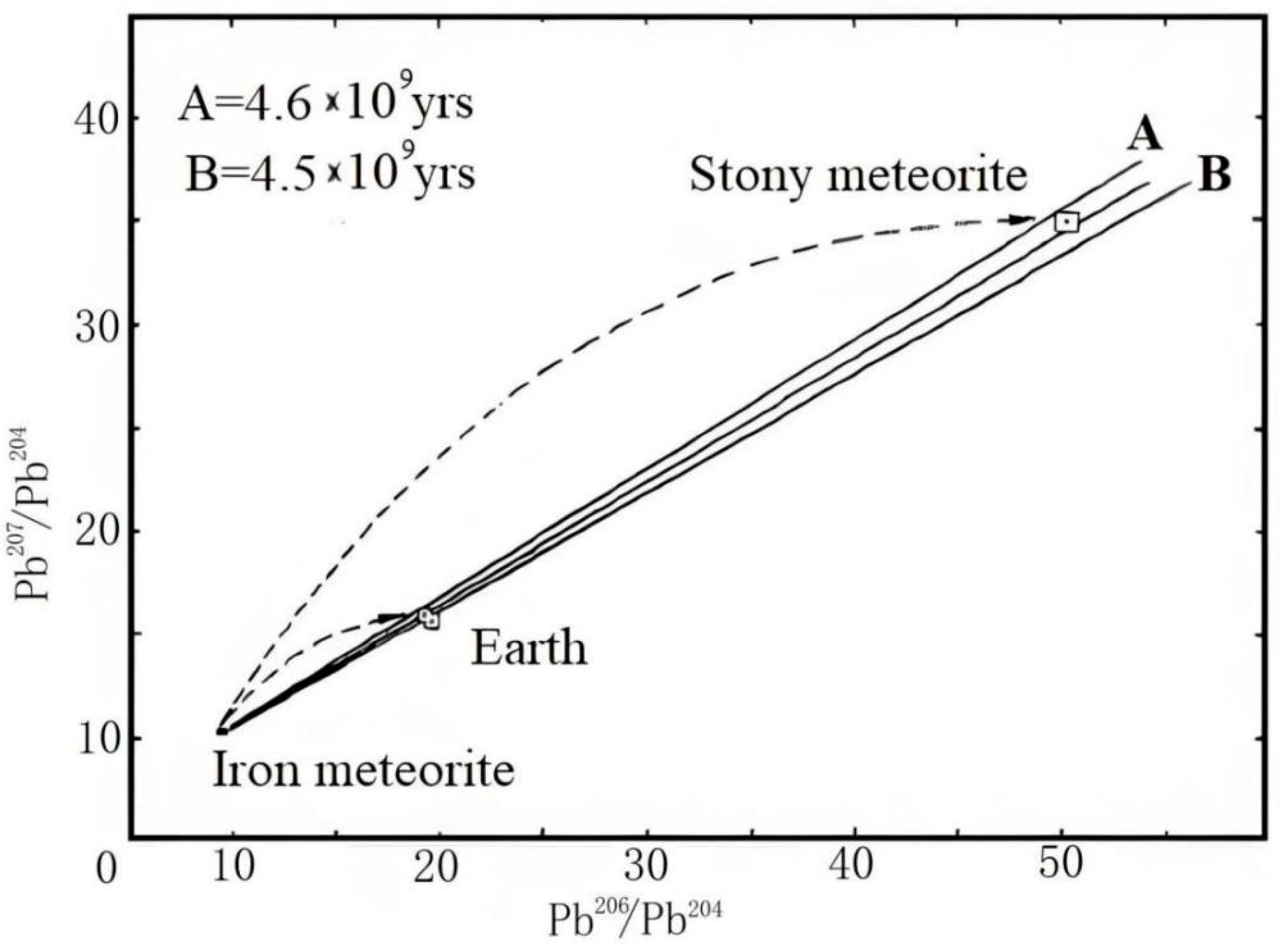
Figure 2.
Lead isotope compositions of oceanic basalts and mantle peridotites. This image is quoted from reference Zhang et al.[20].
Figure 2.
Lead isotope compositions of oceanic basalts and mantle peridotites. This image is quoted from reference Zhang et al.[20].
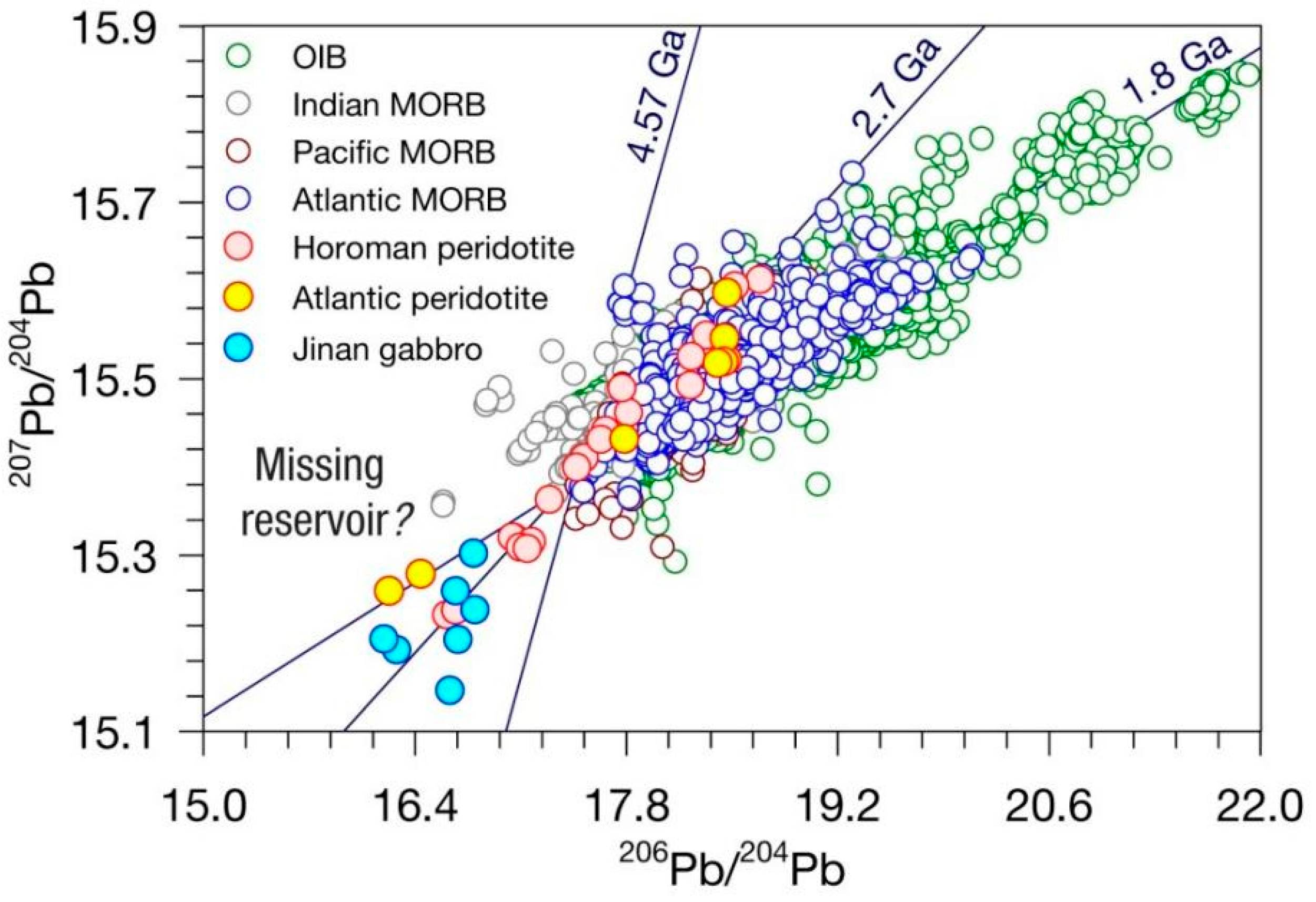
Figure 3.
Neutrino oscillations perturb radioactive nuclei to decay in an excited state. This image has been modified according to reference [35].
Figure 3.
Neutrino oscillations perturb radioactive nuclei to decay in an excited state. This image has been modified according to reference [35].
Disclaimer/Publisher’s Note: The statements, opinions and data contained in all publications are solely those of the individual author(s) and contributor(s) and not of MDPI and/or the editor(s). MDPI and/or the editor(s) disclaim responsibility for any injury to people or property resulting from any ideas, methods, instructions or products referred to in the content. |
© 2026 by the authors. Licensee MDPI, Basel, Switzerland. This article is an open access article distributed under the terms and conditions of the Creative Commons Attribution (CC BY) license (http://creativecommons.org/licenses/by/4.0/).
Copyright: This open access article is published under a Creative Commons CC BY 4.0 license, which permit the free download, distribution, and reuse, provided that the author and preprint are cited in any reuse.


