

Submitted:
11 March 2026
Posted:
12 March 2026
You are already at the latest version
Abstract
Certain integer transformations exhibit unexpected forms of stability that resemble attractors in dynamical systems. Two classical examples are the Kaprekar transformation leading to the constant 6174 and the arithmetic structure of perfect numbers. Although traditionally studied in separate areas of number theory, both phenomena reveal a common feature: the emergence of stable configurations under discrete informational constraints. In this work, we propose a unified framework based on Viscous Time Theory (VTT) and its informational geometry perspective, in which these two structures are interpreted as complementary forms of arithmetic stabilization. The Kaprekar transformation defines a discrete dynamical system whose iterations rapidly converge to a unique attractor (6174) for almost all four-digit inputs. Perfect numbers, on the other hand, arise as equilibrium points of the divisor-sum operator, where the informational deviation between a number and the sum of its proper divisors vanishes. We formalize both mechanisms using a common representation based on discrete informational tension functions defined over the integers. Within this framework, Kaprekar collapse appears as a dynamic attractor produced by iterative dissipation of digit-configuration tension, while perfect numbers correspond to static coherence wells generated by structural balance in the divisor field. Numerical exploration further suggests the presence of near-equilibrium zones—arithmetic configurations where informational gradients become locally minimal. These structures provide a natural bridge between iterative attractors and divisor-based equilibria, suggesting that stability phenomena in number theory may be understood through a broader lens of informational relaxation processes. The results do not claim new proofs regarding perfect numbers, but instead propose a conceptual and computational framework that unifies dynamic and structural stability in arithmetic systems. This perspective may provide new tools for exploring discrete attractors, divisor dynamics, and informational structures within number theory.
Keywords:
Kaprekar constant
; perfect numbers
; arithmetic dynamics
; discrete attractors
; divisor functions
; number theory
; integer transformations
; arithmetic
; stabilization
; discrete deviation fields
; Viscous Time Theory (VTT)
1. Introduction
Stability phenomena in mathematics often emerge in systems governed by iterative transformations or structural constraints. In continuous systems these phenomena appear as attractors, equilibria, or minima of energy functions. In the discrete world of integers, however, analogous mechanisms are less frequently interpreted through such a lens. Two classical objects illustrate this form of arithmetic stability.
The first is the Kaprekar transformation, a digit-rearrangement operation discovered by the mathematician D. R. Kaprekar in 1949 [1]. When applied repeatedly to four-digit numbers (excluding trivial repdigit cases), the transformation rapidly converges to the constant 6174. This number behaves as a global attractor for the system: almost every initial state reaches it within a small number of iterations. The Kaprekar process therefore defines a simple yet striking example of a discrete dynamical system over the integers [2].
The second object is the family of perfect numbers, known since antiquity and studied extensively since Euclid [3,4]. A positive integer is called perfect when it equals the sum of its proper divisors. Using the divisor-sum function , this condition can be written as
Historically these two phenomena have been treated independently. Kaprekar’s constant belongs to recreational number theory and digit dynamics, while perfect numbers arise in multiplicative number theory and divisor functions 3,4,5]. Yet both structures share an important conceptual property: they represent stable configurations produced by arithmetic transformations.
This observation motivates the central question of this work:
Can different forms of arithmetic stability—iterative attractors and divisor equilibria—be described within a unified conceptual framework?
To explore this possibility we introduce a simple representation based on informational deviation functions defined on the integers. In this perspective, integer transformations generate local tension fields that measure how far a configuration lies from structural balance. Stability emerges when this deviation either vanishes (equilibrium) or decreases under iteration (attractor).
Within this framework two complementary forms of stabilization appear:
- Dynamic attractors, produced by repeated application of a transformation that progressively reduces configuration tension.
- Static coherence wells, corresponding to integers where a structural balance condition is satisfied exactly.
The Kaprekar transformation illustrates the first category. Its digit-rearrangement process progressively collapses the informational variability of digit configurations until the system reaches the attractor 6174 [7].
Perfect numbers illustrate the second category. They arise when the divisor-sum operator achieves perfect balance between a number and the structure of its divisor set [6], producing a point of zero deviation within the divisor field. The goal of this paper is not to reinterpret these classical objects purely philosophically, but to construct a formal comparison between the two stabilization mechanisms.
By introducing explicit deviation measures and examining their numerical behavior, we show that both Kaprekar collapse and divisor equilibria can be viewed as manifestations of arithmetic relaxation processes. This interpretation is consistent with the informational relaxation mechanisms proposed in the Viscous Time Theory (VTT) framework, where stable configurations arise as minima of informational deviation fields.
This unified perspective leads naturally to the notion of near-equilibrium zones, regions of the integer line where deviation gradients become locally small. Such regions suggest intermediate forms of stability between strict attractors and exact equilibria.
The paper is organized as follows: Section 2 formalizes the Kaprekar transformation as a discrete dynamical operator and studies its convergence properties. Section 3 introduces the divisor-sum deviation field and examines the equilibrium structure of perfect numbers. Section 4 develops a unified framework describing both systems through informational tension functions defined over the integers. Section 5 presents numerical explorations illustrating attractor basins and near-equilibrium structures. Finally, Section 6 discusses the implications and limitations of this perspective for number-theoretic dynamics.
2. The Kaprekar Dynamical Operator
The Kaprekar transformation provides a simple yet remarkable example of a discrete dynamical system defined over the integers. Originally introduced by D. R. Kaprekar in the mid-twentieth century, the transformation acts on numbers by rearranging their digits and computing the difference between the largest and smallest possible permutations.
For a four-digit integer (excluding repdigit cases such as 1111, 2222, etc.), the transformation proceeds as follows:
- Arrange the digits of in descending order to form the integer .
- Arrange the digits of in ascending order to form the integer .
- Compute
The operator therefore defines a mapping
where denotes the set of four-digit integers with at least two distinct digits. Repeated application of this operator generates an integer sequence
which defines a discrete dynamical system on the finite state space of admissible digit configurations.
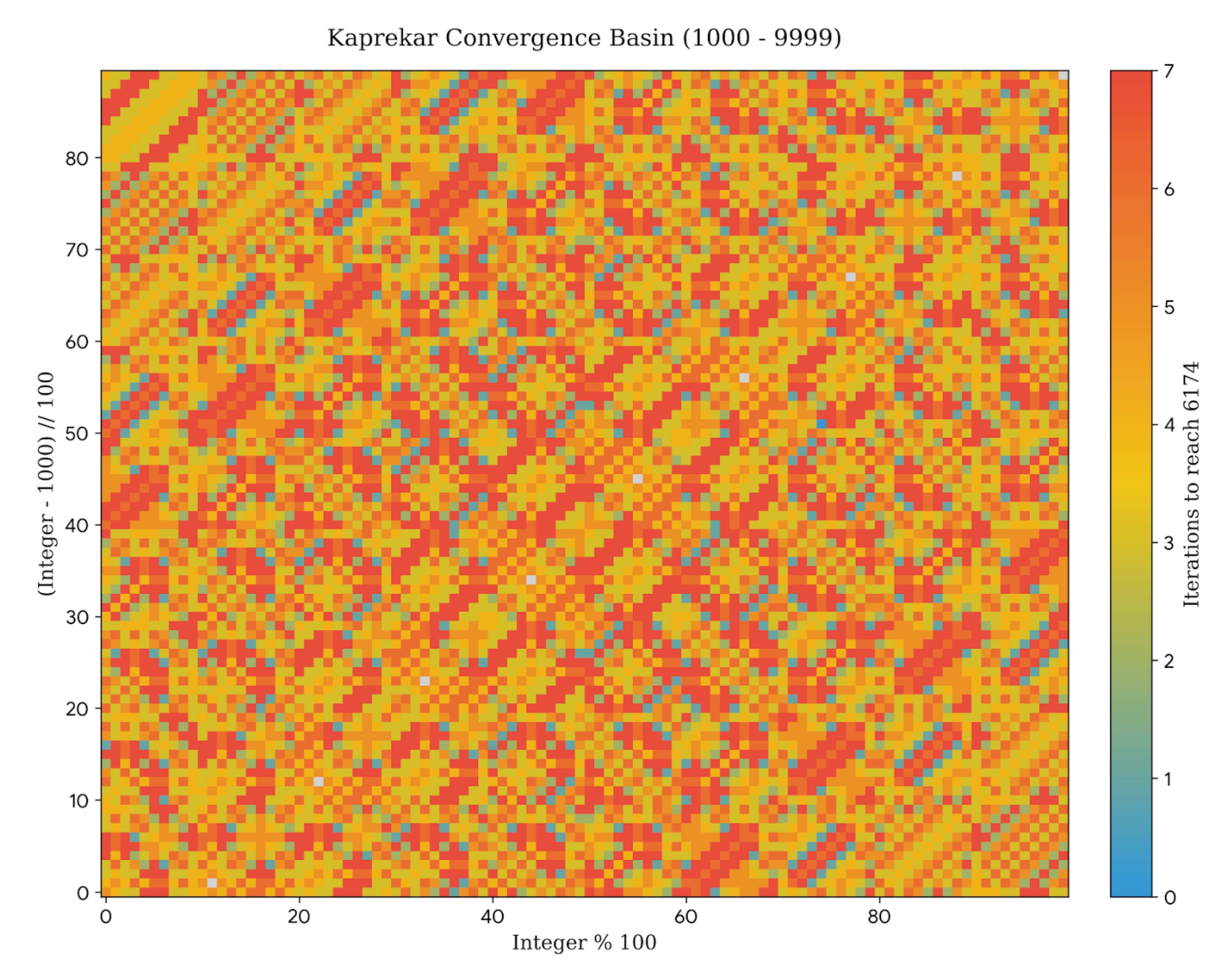
Figure 1.
Convergence basin of the Kaprekar operator for four-digit integers.
Each point represents a four-digit integer. Colors indicate the number of iterations required to reach the Kaprekar attractor 6174. The visualization reveals the structured basin of attraction associated with the Kaprekar transformation.
2.2. Convergence to the Kaprekar Attractor
A classical result is that, for almost every four-digit starting number, the iteration converges to the constant which satisfies the fixed-point condition
Indeed,
Empirical exploration shows that convergence occurs rapidly. For four-digit numbers the attractor is reached in at most seven iterations, and typically in significantly fewer steps.
Thus the Kaprekar system exhibits the defining property of a global attractor in a discrete dynamical system: almost all trajectories in the state space collapse to a single stable configuration.
2.3. State Space Representation
The Kaprekar operator acts on a finite set of digit configurations. Because permutations of the same digits produce identical transformation results, the effective state space can be represented in terms of digit multisets rather than individual integers.
This observation reduces the apparent complexity of the system and reveals that the transformation defines a directed graph whose nodes correspond to digit configurations and whose edges correspond to applications of the Kaprekar operator.
In this graph:
- nodes represent integer configurations,
- edges represent the transformation ,
- the attractor 6174 appears as a self-loop node.
Such a representation makes it possible to visualize the basin of attraction of the system and to study convergence properties in a graph-theoretic framework.
2.4. Informational Tension in Digit Configurations
To connect the Kaprekar process with the broader framework of arithmetic stabilization proposed in this work, it is useful to introduce the notion of digit-configuration tension. Digit arrangements that are highly symmetric (such as repdigits) contain minimal internal variability, whereas heterogeneous digit distributions contain larger informational diversity.
The Kaprekar transformation acts by maximizing the contrast between digit permutations and subtracting them, effectively redistributing this variability across iterations. From this viewpoint, each application of the operator reduces the informational irregularities of the digit configuration until the system reaches a configuration that is invariant under the transformation.
The fixed point 6174 therefore behaves as a stable informational configuration for the four-digit Kaprekar dynamics. A formal treatment of these informational measures and their relation to discrete deviation functions is provided in the mathematical expansion presented in Appendix A.
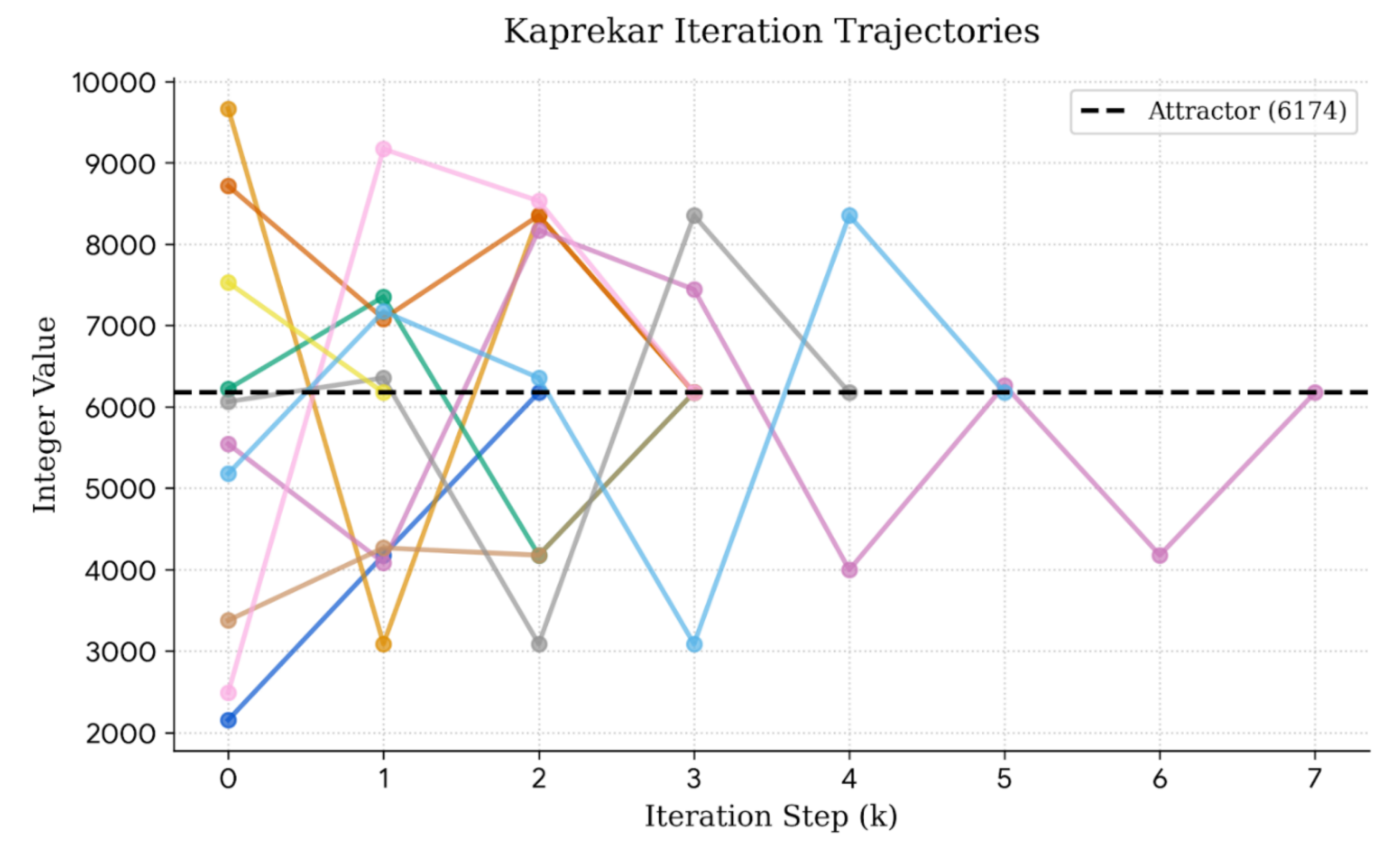
Figure 2.
Example trajectories of the Kaprekar iterative process.
Several initial four-digit integers are iteratively transformed by the Kaprekar operator. All trajectories converge toward the fixed-point attractor 6174, illustrating the strong stability of the Kaprekar dynamical system.
2.5. Computational Exploration
The finite size of the state space makes the Kaprekar system particularly suitable for computational exploration. Simple numerical experiments allow the mapping of the entire basin of attraction and the measurement of convergence times for all admissible starting states.
The algorithms used to perform these explorations are straightforward and can be implemented in a few lines of Python code. For reproducibility and accessibility, a complete implementation used in this study is provided in Appendix B, allowing readers to verify the convergence structure of the system and reproduce the numerical experiments described in this paper.
These computational experiments reveal two key empirical features:
- The basin of attraction of 6174 covers almost the entire admissible state space.
- The convergence depth remains remarkably shallow, rarely exceeding seven iterations.
These properties make the Kaprekar transformation a particularly clear example of a discrete arithmetic system exhibiting rapid convergence toward a stable attractor.
3. The Divisor Field and Perfect Numbers as Coherence Wells
While the Kaprekar transformation represents a dynamical stabilization process driven by iterative digit operations, perfect numbers emerge from a fundamentally different arithmetic structure: the organization of divisors within the integer lattice.
Perfect numbers have been studied since antiquity. A positive integer is called perfect when it equals the sum of its proper divisors. Using the classical divisor-sum function , this condition can be written as (Eq.(1)). Equivalently, defining the proper-divisor operator perfect numbers satisfy (Eq.(3)).
The first few perfect numbers are and are known to be generated by the Euclid–Euler theorem when is prime.
Although perfect numbers are traditionally studied within multiplicative number theory, in Viscous time Theory (VTT) framework, the divisor operator naturally defines a scalar field over the integers that can be interpreted as a structural balance measure.
3.1. The Divisor Deviation Field
To analyze the stability properties of this system, we introduce the divisor deviation function
This quantity measures the difference between the sum of proper divisors and the integer itself.
Under this representation:
- Perfect numbers satisfy
- Abundant numbers satisfy
- Deficient numbers satisfy
The function therefore defines a scalar deviation field on the integer line. Perfect numbers appear as exact equilibrium points where the structural contribution of divisors balances the magnitude of the integer.
This interpretation allows the divisor system to be viewed geometrically as a field containing isolated equilibrium wells embedded within a broader landscape of positive and negative deviations.
3.2. Equilibrium Structure of Perfect Numbers
Within the deviation field , perfect numbers occupy a special position: they correspond to points where the deviation vanishes exactly.
In analogy with equilibrium points in continuous systems, these integers can be interpreted as coherence wells—locations where the arithmetic structure of divisors reaches a state of internal balance.
Unlike the Kaprekar attractor, which arises from an iterative collapse process, perfect numbers do not emerge from repeated application of a transformation. Instead, they represent intrinsic equilibrium points determined by the multiplicative structure of the integers.
Nevertheless, both phenomena share an essential characteristic: they correspond to stable configurations produced by arithmetic constraints.
3.3. Local Structure of the Divisor Field
Although exact equilibrium points are extremely rare, the divisor deviation field exhibits a richer structure in the neighborhood of these points.
In particular, it is possible to identify integers for which the deviation function becomes locally small or changes slowly across nearby integers. These regions can be interpreted as near-equilibrium zones, where the structural imbalance measured by approaches zero. To study the local geometry of this field, we consider discrete differences of the deviation function, such as
and
These quantities play a role analogous to first and second derivatives in a continuous field and allow the identification of regions where the deviation landscape becomes locally flat. Such regions correspond to integers where structural tension varies only weakly across neighboring values, suggesting intermediate forms of arithmetic stability between exact equilibria and strongly imbalanced configurations.
A detailed mathematical treatment of these discrete operators is provided in Appendix A.
3.4. Structural Stability in the Divisor Field
The interpretation of perfect numbers as equilibrium wells suggests a natural analogy with stability phenomena observed in other mathematical systems.
In this framework:
- the integer axis acts as the domain of a scalar deviation field,
- the divisor operator defines the structural interaction between integers and their divisor sets,
- perfect numbers correspond to points where the deviation energy vanishes.
This interpretation does not alter the classical definition of perfect numbers but provides an alternative geometric perspective in which arithmetic structures appear as stable configurations of an underlying deviation landscape.
Such a perspective becomes particularly useful when comparing the divisor system with other forms of arithmetic stabilization, including the digit-dynamical processes studied in the Kaprekar transformation.
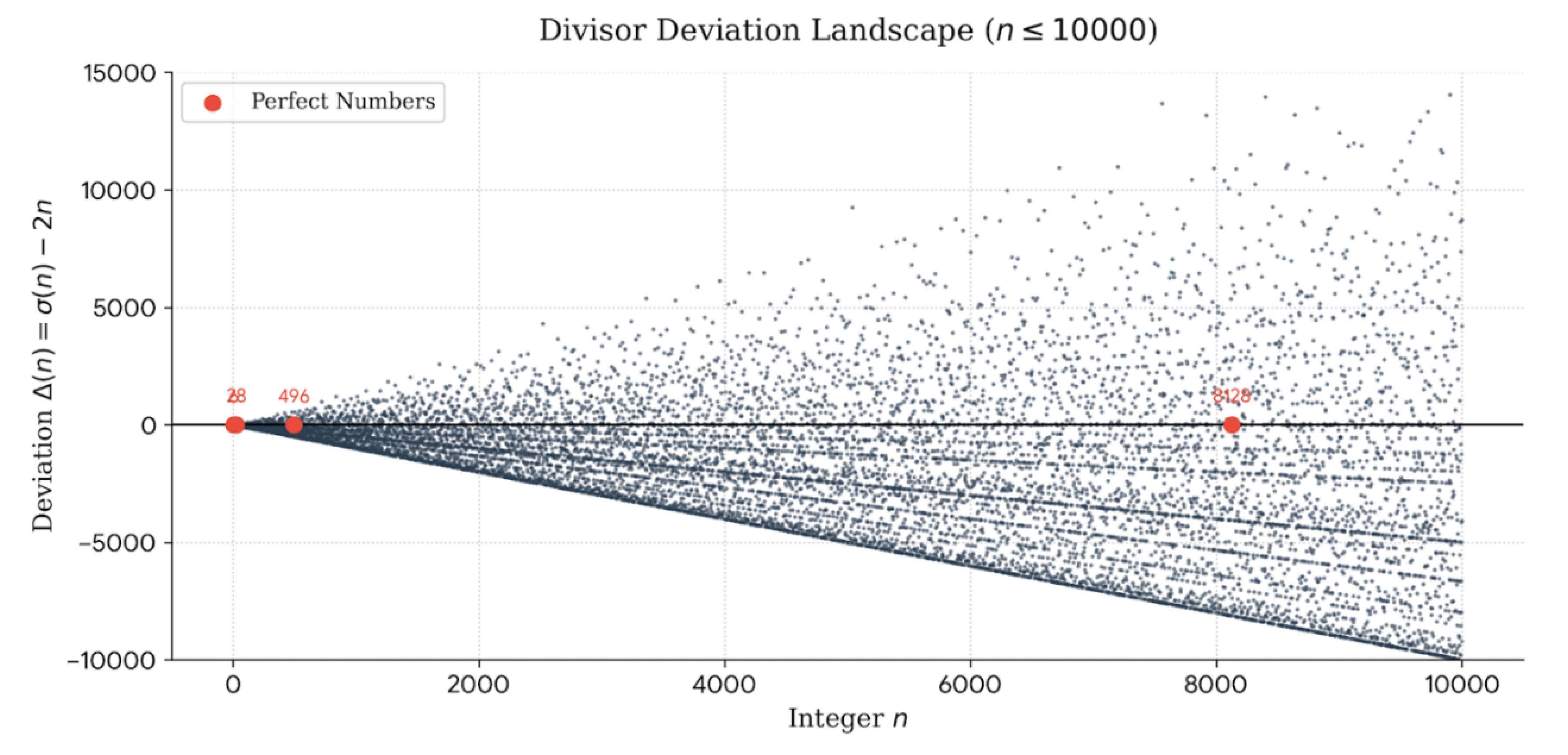
Figure 3.
Divisor deviation field for integers up to 10,000.
The function Δ(n) = σ(n) − 2n measures the balance between an integer and the sum of its divisors. Perfect numbers correspond to the equilibrium condition Δ(n) = 0 and appear as intersection points with the zero line.
3.5. Toward a Unified Interpretation
The Kaprekar system described in Section 2 and the divisor deviation field introduced here represent two different mechanisms through which stability can emerge in arithmetic structures.
In the Kaprekar transformation, stability arises through iterative relaxation, where repeated application of a digit operator collapses a wide range of initial states toward a single attractor. In the divisor system, stability appears as structural equilibrium, where the divisor architecture of an integer produces an exact balance condition.
Despite these differences, both systems exhibit a common feature: the presence of integer configurations that behave as informationally stable states within their respective transformation frameworks.
The next section develops a unified representation that allows these two stabilization mechanisms to be studied within a single conceptual framework.
4. A Unified Framework for Arithmetic Stabilization
The two systems examined in the previous sections—the Kaprekar transformation and the divisor deviation field—arise from distinct arithmetic constructions. One is defined through digit rearrangements and iterative subtraction, while the other emerges from the multiplicative structure of integer divisors. Despite these differences, both systems exhibit a strikingly similar phenomenon: the emergence of stable configurations within a discrete arithmetic landscape.
In this section we introduce a simple framework that allows these two stabilization mechanisms to be analyzed in parallel.
4.1. Arithmetic Operators on the Integer Domain
Let denote the set of positive integers. We consider arithmetic operators of the form
which act on integers either iteratively or structurally.
Two examples studied in this work are:
- 1.
- The Kaprekar operator
- 2.
- The divisor operator
which returns the sum of the proper divisors of .
Although these operators arise from different arithmetic constructions, both define transformations that associate each integer with a new value determined by internal structural properties.
4.2. Deviation Functions and Stability
To study stabilization phenomena generated by these operators, we introduce a deviation function
that measures how far an integer configuration lies from a stable state under a given operator . For the divisor system introduced in Section 3, the natural deviation function is
Perfect numbers correspond precisely to For the Kaprekar transformation, the system evolves through iteration
and stability is reached when
Thus the Kaprekar attractor satisfies
In this representation both systems admit a common description: stability occurs when the deviation function associated with an operator vanishes.
4.3. Dynamic Attractors vs. Structural Equilibria
Despite the formal similarity of their deviation conditions, the two systems exhibit different stabilization mechanisms.
Dynamic Attractors
In the Kaprekar system, the deviation function evolves through iteration:
and trajectories move through the state space until reaching a fixed point satisfying
The attractor 6174 therefore represents a dynamic equilibrium, reached through successive transformations of digit configurations.
Structural Equilibria
In the divisor system, stability does not arise through iteration but through intrinsic structural balance, . Perfect numbers therefore represent structural equilibria, where the internal divisor structure of the integer satisfies an exact balance condition.
The two stabilization mechanisms can be categorized by their respective systems: while the Kaprekar transformation relies on a dynamic attractor, the divisor field achieves stability through structural equilibrium
4.4. Arithmetic Relaxation Processes
Although the mechanisms differ, both systems may be interpreted as forms of arithmetic relaxation. In the Kaprekar dynamics, digit permutations generate large configuration differences that are progressively reduced through subtraction and iteration until the system collapses to a stable configuration.
In the divisor field, the integer interacts with its divisor set through the operator . When the divisor contribution equals the integer itself, the deviation vanishes and the system reaches structural balance. In both cases, stability corresponds to the disappearance of a deviation measure. This observation suggests that certain number-theoretic phenomena may be interpreted through the broader concept of relaxation toward arithmetic balance states.
4.5. Near-Equilibrium Configurations
Beyond exact equilibria, the deviation functions introduced above also allow the identification of integers where deviation values become locally small.
Such configurations do not satisfy the strict equilibrium condition but lie in regions where deviation gradients are weak. These regions may be interpreted as near-equilibrium zones within the arithmetic landscape.
In the divisor field these zones appear when
becomes small compared with neighboring values.
Similarly, in the Kaprekar system, certain digit configurations require only a small number of iterations to reach the attractor, indicating proximity to the basin center.
The study of these intermediate structures provides a bridge between exact equilibria and general integer configurations.
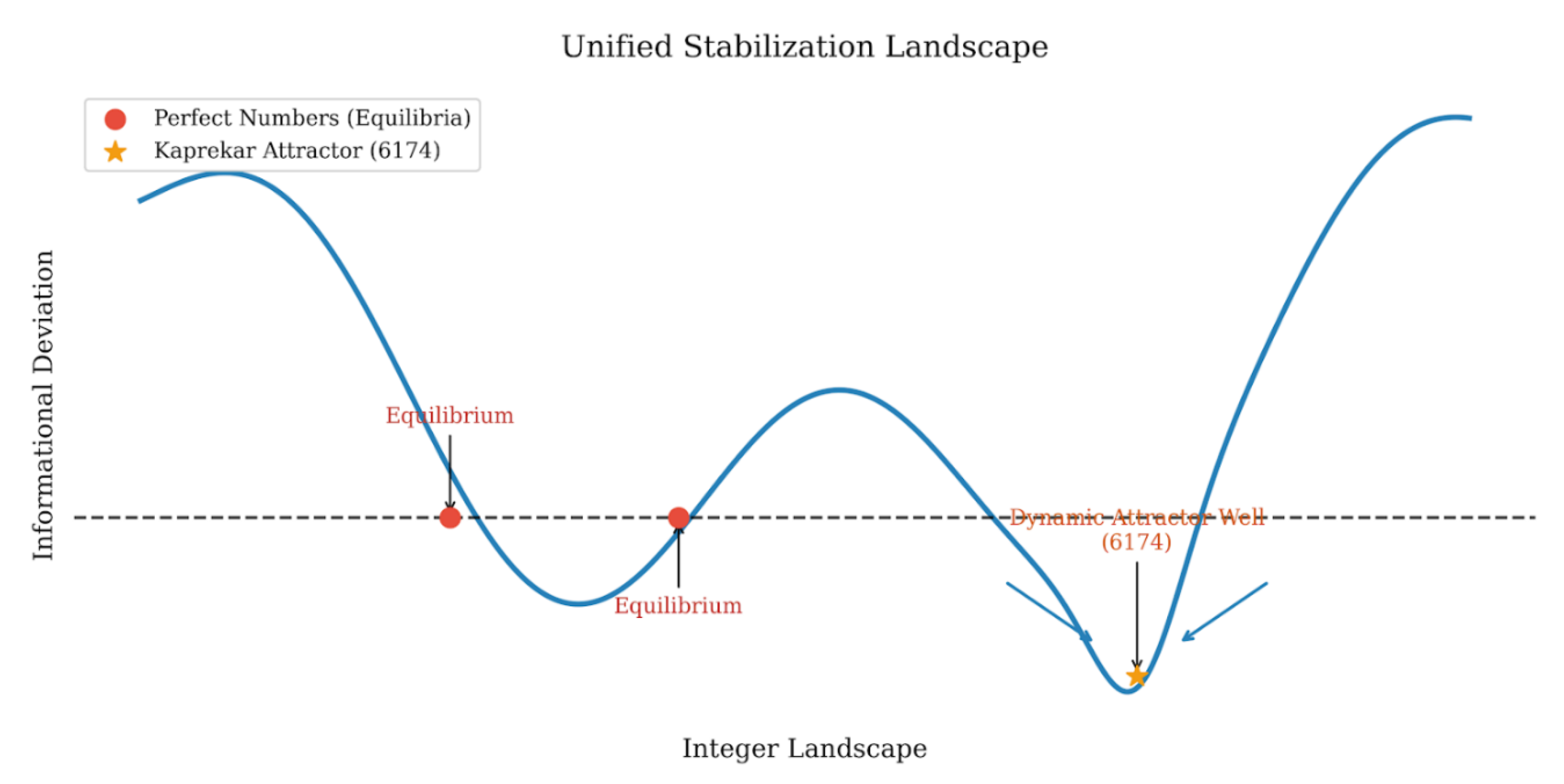
Figure 4.
Conceptual stabilization landscape for arithmetic systems.
The deviation framework introduced in this work allows arithmetic phenomena to be interpreted as stabilization structures within a deviation landscape. Dynamical attractors (such as the Kaprekar constant 6174) and structural equilibria (perfect numbers) appear as distinct forms of arithmetic stability.
4.6. Conceptual Implications
The comparison developed in this section reveals that two classical objects of number theory—Kaprekar’s constant and perfect numbers—can be interpreted within a common conceptual framework based on deviation functions and stabilization processes.
Within this view:
- the Kaprekar constant emerges as a global attractor of a digit-based dynamical system,
- perfect numbers appear as equilibrium points of the divisor deviation field.
Both phenomena therefore represent special configurations where an arithmetic operator reaches internal balance.
While this framework does not alter the classical properties of these objects, it provides a unified perspective that connects iterative integer dynamics with divisor-based structural equilibria.
5. Numerical Exploration and Computational Experiments
The stabilization mechanisms discussed in the previous sections can be investigated through direct computational exploration. Because both the Kaprekar transformation and the divisor deviation field are defined over discrete integer domains, numerical experiments allow the entire behavior of the systems to be mapped with modest computational resources.
In this section we present exploratory analyses that illustrate the structure of the Kaprekar attractor basin and the geometry of the divisor deviation field.
All computational procedures used in this study are implemented in a simple Python environment and are provided in Appendix B to ensure full reproducibility.
5.1. Basin Structure of the Kaprekar System
The Kaprekar operator defines a dynamical process on the finite set of four-digit integers with at least two distinct digits. Each starting number generates a trajectory under repeated application of the transformation
To explore the global structure of this system, one can compute the number of iterations required for each admissible starting number to reach the attractor 6174.
The resulting basin of attraction reveals several notable properties:
- 1.
- Global convergence
Nearly all admissible four-digit integers converge to 6174.
- 2.
- Bounded convergence depth
The maximum number of iterations required to reach the attractor is small (empirically bounded by seven steps).
- 3.
- Structured basin layers
Numbers can be grouped according to their convergence depth, producing a layered structure in the attractor basin. This layered structure reflects how far a given digit configuration lies from the attractor in the Kaprekar dynamical landscape. Visualization of this basin can be achieved by plotting integers against their convergence depth, producing a discrete attractor map that clearly highlights the global stability of 6174.
5.2. Distribution of Convergence Times
A second useful quantity is the distribution of iteration counts required for convergence.
For each admissible starting number , we compute the minimal integer such that
The resulting histogram of convergence depths typically exhibits a sharply peaked distribution concentrated in a small number of iterations. This empirical result confirms that the Kaprekar attractor is not only global but also rapidly absorbing, indicating strong stabilization dynamics within the digit transformation process.
5.3. Mapping the Divisor Deviation Field
The divisor deviation function introduced in Section 3, (Eq.(9)), can be evaluated for any range of integers. By computing this quantity across a large interval one obtains a scalar field defined on the integer line.Plotting the deviation values reveals a landscape characterized by:
- large negative regions corresponding to deficient numbers,
- positive spikes corresponding to abundant numbers,
- isolated zero crossings corresponding to perfect numbers.
These zero crossings represent the equilibrium wells described in Section 3.
Although perfect numbers are extremely rare, the surrounding structure of the deviation field provides insight into how divisor contributions evolve across neighboring integers.
5.4. Near-Equilibrium Zones
Beyond exact equilibrium points, the deviation field exhibits regions where the magnitude of the deviation becomes relatively small compared to nearby values.
Such regions can be identified by examining both the deviation magnitude and local variation measures such as
Integers satisfying
and
may be interpreted as near-equilibrium configurations, where the divisor structure approaches balance without satisfying the perfect-number condition exactly. These configurations provide an intermediate regime between strict equilibrium and general integer behavior.
5.5. Computational Accessibility
One advantage of the systems studied in this work is their computational simplicity. Both the Kaprekar transformation and the divisor deviation function can be evaluated efficiently with straightforward algorithms, making them suitable for direct exploration even in basic programming environments.
To facilitate verification of the concepts presented here, the full set of numerical procedures used in this study is provided in Appendix B, including:
- implementation of the Kaprekar transformation,
- convergence-depth computation,
- generation of attractor basin plots,
- computation of the divisor deviation field,
- identification of near-equilibrium zones.
These implementations allow readers to reproduce the numerical results and extend the exploration to larger integer ranges.
6. Discussion
The analysis presented in this work explores two classical arithmetic phenomena—Kaprekar’s constant and perfect numbers—through a common conceptual lens based on stabilization processes in discrete systems. Although these objects arise from distinct number-theoretic constructions, they exhibit analogous structural features when examined through the framework of deviation functions and arithmetic operators.
In the Kaprekar system, stability appears in the form of a global dynamical attractor. Repeated application of the digit-rearrangement operator collapses a wide variety of initial configurations toward the fixed point 6174. The stabilization mechanism is therefore iterative and dynamical: the system evolves through successive transformations until the deviation from the attractor vanishes.
In contrast, perfect numbers represent structural equilibrium states of the divisor field. They do not arise through iteration but instead correspond to integers whose divisor architecture satisfies an exact balance condition.
Despite these differences, both systems share a common property: they identify special integers that behave as stable configurations under arithmetic transformations. This observation motivates the unified framework developed in Section 4, where stabilization is interpreted through the vanishing of operator-based deviation functions.
6.1. Interpretation of Arithmetic Stability
From this perspective, stability phenomena in integer systems can be classified into two broad categories:
Dynamic attractors: Configurations reached through iterative transformations that progressively reduce deviation.
Structural equilibria: Configurations that satisfy balance conditions inherent to the arithmetic structure itself.
The Kaprekar attractor belongs to the first category, while perfect numbers belong to the second. Although these mechanisms operate differently, both can be described through deviation functions that measure distance from stability under a given operator.
This representation provides a useful conceptual bridge between digit-based dynamical systems and divisor-based arithmetic structures.
6.2. Limits of the Present Framework
The framework proposed here should be interpreted primarily as a conceptual and exploratory tool, rather than as a new structural theorem about perfect numbers or Kaprekar dynamics.
In particular, this work does not attempt to:
- derive new properties of perfect numbers beyond their classical definitions,
- prove new convergence results for the Kaprekar transformation,
- establish formal equivalences between digit dynamics and divisor theory.
Instead, the goal is to highlight an underlying similarity between two forms of arithmetic stabilization that are usually studied independently. The interpretation developed in this paper therefore complements existing number-theoretic approaches rather than replacing them.
6.3. Numerical Exploration as a Discovery Tool
One of the motivations for this work is the accessibility of the underlying systems to direct numerical exploration. Because both the Kaprekar transformation and the divisor deviation field are computationally simple, large portions of their behavior can be mapped explicitly.
Such exploration can reveal patterns that may later motivate deeper theoretical investigations. In this sense, the numerical experiments presented in Section 5 serve primarily as heuristic tools for visualizing the structure of arithmetic stabilization landscapes.
6.4. Connections with Discrete Dynamical Systems
The Kaprekar transformation can naturally be interpreted as a discrete dynamical system defined on a finite state space of digit configurations. From this viewpoint, the convergence toward 6174 resembles the behavior of attractors in classical dynamical systems, although the underlying domain is combinatorial rather than continuous. Similarly, the divisor deviation field introduced in Section 3 can be viewed as a scalar landscape defined on the integers.
Perfect numbers correspond to equilibrium points of this landscape, while neighboring integers define a gradient structure that can be explored through discrete difference operators. These observations suggest that several concepts from dynamical systems theory—such as attractors, basins, and local stability—may provide useful metaphors or analytical tools for studying arithmetic structures.
6.5. Future Directions
The unified perspective proposed here opens several possible directions for further investigation. One natural extension would be to explore other arithmetic operators that generate stabilization phenomena, such as digit-based transformations in different bases or divisor-related functions beyond the classical sum-of-divisors operator. Another direction would be the systematic study of near-equilibrium zones in deviation fields, which may reveal intermediate structures between strict equilibria and general integer behavior.
Finally, further work could investigate whether the stabilization mechanisms described here can be formalized within broader frameworks of discrete dynamical systems defined on arithmetic structures. Such investigations may help clarify how stability phenomena arise across different regions of number theory.
7. Conclusions
This work examined two classical objects of number theory—Kaprekar’s constant (6174) and perfect numbers—through the common perspective of stabilization phenomena in discrete arithmetic systems. The Kaprekar transformation provides a simple yet striking example of a digit-based dynamical system in which a wide range of initial states converge rapidly toward a single fixed point. Perfect numbers, in contrast, arise from the intrinsic balance of the divisor-sum structure of integers and represent equilibrium configurations of the divisor deviation field. By introducing deviation functions associated with arithmetic operators, we proposed a unified representation in which both systems can be interpreted as instances of arithmetic stabilization. Within this framework, the Kaprekar constant appears as a dynamic attractor, while perfect numbers correspond to structural equilibrium states.
Numerical exploration further illustrates how these systems generate distinct but comparable stabilization landscapes over the integers. In the Kaprekar system, convergence toward the attractor organizes the state space into layered basins of attraction. In the divisor system, the deviation field reveals isolated equilibrium points together with broader regions of near-equilibrium behavior.
From a broader perspective, these results suggest that certain stability phenomena in number theory may be interpreted within the informational dynamics framework developed in Viscous Time Theory (VTT). While the present work focuses on specific arithmetic examples, the approach indicates that discrete integer systems may also exhibit attractor structures and coherence wells analogous to those observed in dynamical systems and informational geometry.
The goal of this work is not to introduce new theorems about perfect numbers or Kaprekar dynamics, but rather to highlight a conceptual connection between two forms of arithmetic stability that are typically studied in separate contexts. Viewing these phenomena through a common deviation-based framework may help clarify how stabilization mechanisms arise in discrete arithmetic systems. Future work may explore whether similar stabilization structures appear in other integer transformations or divisor-based operators, and whether the concept of deviation landscapes can provide a useful exploratory tool in the study of arithmetic dynamics.
Funding
This research received no external funding.
Data Availability Statement
The datasets generated and analyzed during the current study are available from the corresponding author upon reasonable request.
Acknowledgments
The author gratefully acknowledges helpful discussions and technical feedback from colleagues and collaborators related to the development of the conceptual framework and numerical exploration presented in this work. Their insights and suggestions helped improve the clarity and presentation of the manuscript.
Conflicts of Interest
The author declare no conflict of interest.
Appendix A
Mathematical Expansion of the Arithmetic Stabilization Framework
This appendix provides a formal mathematical expansion of the stabilization framework introduced in the main text. The goal is to clarify how deviation functions associated with arithmetic operators can be used to characterize stable configurations in discrete integer systems.
A.1. Arithmetic Operators
Let denote the set of positive integers.
We consider arithmetic transformations of the form
which assign to each integer a new integer determined by an internal structural rule.
Two operators studied in this work are:
Kaprekar Operator
where and denote the descending and ascending digit permutations of .
Divisor Operator
where denotes the sum-of-divisors function.
These operators represent two distinct forms of arithmetic interaction: one based on digit configurations, the other based on divisor structure.
A.2. Deviation Functions
To measure stability under an arithmetic operator , we introduce a deviation function
This function measures how far an integer configuration lies from an equilibrium state under the transformation.
A configuration is stable if
This condition corresponds to the fixed-point equation
Examples include:
Kaprekar System
The attractor 6174 satisfies
Divisor System
Perfect numbers satisfy
Thus both systems admit a common representation in terms of vanishing deviation.
A.3. Iterative Relaxation
For operators that define dynamical processes, integer sequences are generated by iteration
A fixed point satisfies
If repeated application of the operator drives a wide range of initial states toward , the point acts as a discrete attractor.
The Kaprekar system provides a concrete example of this mechanism.
For four-digit integers with at least two distinct digits,
for almost all initial states.
The attractor therefore represents the endpoint of an iterative relaxation process in which digit configurations converge toward a stable arrangement.
A.4. Structural Equilibria
Not all arithmetic operators generate stability through iteration. Some operators instead describe intrinsic structural relations.
The divisor operator
defines a scalar field over the integers that measures the total contribution of proper divisors.
Perfect numbers satisfy the equilibrium condition In terms of the deviation function,
Thus perfect numbers appear as structural equilibrium points of the divisor deviation field. Unlike the Kaprekar attractor, these equilibria do not arise through dynamical iteration but instead reflect balance within the arithmetic structure itself.
A.5. Discrete Gradient Measures
To study the local geometry of deviation fields, it is useful to introduce discrete difference operators analogous to derivatives.
The first difference operator is defined as
This quantity measures the local change in deviation across neighboring integers.
The second difference operator is
This expression acts as a discrete analogue of curvature.
Regions where both and are small correspond to locally flat regions of the deviation landscape.
Such regions may be interpreted as near-equilibrium zones, where arithmetic configurations approach structural balance without satisfying the exact equilibrium condition.
A.6. Stabilization Landscapes
The deviation functions introduced above allow arithmetic systems to be represented as landscapes defined over the integers.
Within this representation:
- integers correspond to points in the landscape,
- deviation values determine local height,
- equilibria correspond to zero-level points.
Two types of stabilization structures emerge:
Dynamic attractors: Generated by iterative operators such as the Kaprekar transformation.
Structural equilibria: Generated by balance conditions such as those defining perfect numbers.
Although these structures arise through different mechanisms, both can be described using deviation functions associated with arithmetic operators.
A.7. Interpretation
The framework developed in this appendix does not alter the classical definitions of the Kaprekar constant or perfect numbers. Instead, it provides a simple mathematical language that allows both phenomena to be described within a common representation based on deviation functions and stabilization conditions.
This representation clarifies how distinct number-theoretic constructions can produce analogous forms of arithmetic stability.
Appendix B
Python Implementation for Computational Exploration
This appendix provides a simple Python implementation used to explore the numerical properties of the arithmetic systems discussed in this work. The scripts included here allow readers to reproduce the computational experiments described in Section 5.
The implementation focuses on three tasks:
- computation of Kaprekar convergence dynamics
- analysis of convergence depths
- exploration of the divisor deviation field
All algorithms are intentionally kept simple in order to remain accessible to readers with basic programming experience.
B.1. Kaprekar Transformation
The Kaprekar operator rearranges the digits of a number and subtracts the smallest permutation from the largest.
The following function implements the Kaprekar step for four-digit integers.
def kaprekar_step(n):
digits = list(str(n).zfill(4))
asc = int("".join(sorted(digits)))
desc = int("".join(sorted(digits, reverse=True)))
return desc - asc
B.2. Iterative Convergence
The next function computes the number of iterations required for a number to reach the Kaprekar attractor 6174.
def kaprekar_iterations(n, limit=20):
steps = 0
while n != 6174 and steps < limit:
n = kaprekar_step(n)
steps += 1
return steps
Example usage:
print(kaprekar_iterations(3524))
This returns the number of steps required for the initial value to converge to the attractor.
B.3. Basin Mapping
To explore the global basin of attraction, we compute convergence times for all admissible four-digit integers.
results = {}
for n in range(1000,10000):
if len(set(str(n))) > 1:
results[n] = kaprekar_iterations(n)
The resulting dictionary associates each integer with its convergence depth.
These values can be used to construct histograms or visual maps of the attractor basin.
B.4. Histogram of Convergence Depths
The following code produces a simple histogram of iteration counts.
import matplotlib.pyplot as plt
steps = list(results.values())
plt.hist(steps, bins=range(1,10), edgecolor=‘black’)
plt.xlabel(“Iterations to reach 6174”)
plt.ylabel(“Frequency”)
plt.title(“Kaprekar Convergence Distribution”)
plt.show()
This visualization illustrates the rapid convergence of most trajectories toward the attractor.
B.5. Divisor Deviation Function
To explore the divisor deviation field introduced in Section 3, we compute the proper-divisor sum for each integer.
def divisor_sum(n):
def divisor_sum(n):
s = 1
for i in range(2, int(n**0.5)+1):
if n % i == 0:
s += i
if i != n//i:
s += n//i
return s
The deviation function is then defined as
def deviation(n):
return divisor_sum(n) - n
B.6. Mapping the Deviation Field
The deviation field can be evaluated across a chosen integer range.
N = 10000
values = [deviation(n) for n in range(1,N)]
Plotting these values produces a deviation landscape illustrating the distribution of deficient and abundant numbers.
plt.plot(range(1,N), values)
plt.xlabel(“n”)
plt.ylabel(“Δ(n)”)
plt.title(“Divisor Deviation Field”)
plt.show()
Perfect numbers appear as the points where the curve crosses zero.
B.7. Near-Equilibrium Detection
Near-equilibrium configurations may be detected by identifying integers for which the deviation magnitude becomes small.
threshold = 10
near_equilibria = []
for n in range(2,N):
if abs(deviation(n)) < threshold:
near_equilibria.append(n)
print(near_equilibria[:20])
These integers correspond to regions where the divisor deviation approaches structural balance.
B.8. Reproducibility
All experiments described in this work can be reproduced using the code provided above. The scripts require only standard Python libraries such as matplotlib and run efficiently on standard hardware.
Readers are encouraged to modify the integer ranges and parameters to explore additional stabilization patterns in the arithmetic systems studied in this paper.
References
- Kaprekar, D.R. An interesting property of the number 6174. Scripta Mathematica 1949, 15, 244–245. [Google Scholar]
- Guy, R.K. Unsolved Problems in Number Theory, 3rd ed.; Springer: New York, NY, USA, 2004. [Google Scholar]
- Hardy, G.H.; Wright, E.M. An Introduction to the Theory of Numbers, 6th ed.; Oxford University Press: Oxford, UK, 2008. [Google Scholar]
- Narkiewicz, W. The Development of Prime Number Theory; Springer: Berlin, Germany, 2004. [Google Scholar]
- Dickson, L.E. History of the Theory of Numbers; Vol. I: Divisibility and Primality; (reprint of the 1919 original); Dover Publications: Mineola, NY, USA, 2005. [Google Scholar]
- Weisstein, E.W. Perfect Number. MathWorld—A Wolfram Web Resource. Available online: https://mathworld.wolfram.com/PerfectNumber.html (accessed on 1 March 2026).
- Weisstein, E.W. Kaprekar Constant. MathWorld—A Wolfram Web Resource. Available online: https://mathworld.wolfram.com/KaprekarConstant.html (accessed on 1 March 2026).
- OEIS Foundation Inc. The On-Line Encyclopedia of Integer Sequences. Available online: https://oeis.org (accessed on 1 March 2026).
Disclaimer/Publisher’s Note: The statements, opinions and data contained in all publications are solely those of the individual author(s) and contributor(s) and not of MDPI and/or the editor(s). MDPI and/or the editor(s) disclaim responsibility for any injury to people or property resulting from any ideas, methods, instructions or products referred to in the content. |
© 2026 by the author. Licensee MDPI, Basel, Switzerland. This article is an open access article distributed under the terms and conditions of the Creative Commons Attribution (CC BY) license.
Copyright: This open access article is published under a Creative Commons CC BY 4.0 license, which permit the free download, distribution, and reuse, provided that the author and preprint are cited in any reuse.


