Preprint
Article

This version is not peer-reviewed.

Effects of IncobotulinumtoxinA in an Animal Model of Trigeminal Pain

Submitted:

11 March 2026

Posted:

12 March 2026

You are already at the latest version

Abstract

Background/Objectives: Trigeminal neuralgia (TN) is a debilitating neurological condition characterized by recurrent, severe pain linked to peripheral and central sensitization within trigeminal pathways. Although current pharmacologic treatments are limited by inadequate efficacy or dose-limiting side effects, botulinum neurotoxin type A (BoNT/A) has emerged as a viable option. However, its potential use in the management of TN is hampered by methodological limitations in existing studies and a lack of pivotal clinical trials. This study investigated the efficacy, optimal treatment site, preventive utility, and duration of effect of incobotulinumtoxinA (Inco/A), a BoNT/A, in a model of TN. Methods: An infraorbital nerve chronic constriction injury model was used to induce mechanical allodynia in male Sprague–Dawley rats, reproducing the trigeminal sensitization seen in TN. The effects of subcutaneous Inco/A (1, 2, and 4U) were measured using the mechanical sensitivity (von Frey) test to evaluate the dose response, effect of injection location, potential preventive nature of treatment, and duration of benefit. Results: Inco/A produced a robust, dose-dependent reduction in mechanical allodynia, predominantly via a local mechanism of action. Both preventive and therapeutic administration of Inco/A was efficacious, with significant reduction of allodynia even when administered up to 28 days before nerve injury. The anti-allodynic effect persisted up to 56 days post-injection. Conclusions: Inco/A is highly effective in alleviating mechanical allodynia in a validated rat model of TN. The findings highlight Inco/A as a promising candidate for clinical translation in TN and related neuropathic pain syndromes and support systematic investigation in well-controlled human trials.

Keywords: 
;  ;  ;  ;  ;  ;  ;  ;  ;  

1. Introduction

Trigeminal neuralgia (TN) is a neuropathic facial pain syndrome characterized by sudden, severe, electric shock-like or stabbing unilateral pain that occurs in the distribution of one or more branches of the trigeminal nerve [1]. Individual attacks usually last from a fraction of a second to 2 minutes but often recur in rapid succession and can occur up to hundreds of times per day [2]. There are three main types of TN: classical TN is the most common and results from neurovascular compression of the trigeminal nerve root; secondary TN is associated with underlying pathology, such as multiple sclerosis (MS) or intracranial tumors; and idiopathic TN has no identifiable cause [3]. The lifetime prevalence of TN in the general population is relatively low (0.16–0.3% in Western countries), but it is markedly more prevalent in patients with MS (9.7%), and TN presentation precedes a diagnosis of MS in 15% of cases [4,5].
TN is a highly debilitating disorder, with a multifaceted impact on basic daily functions such as speaking, eating, drinking, facial hygiene, and social interaction, and it frequently triggers comorbid psychiatric disorders, particularly depression and anxiety [6]. TN can therefore result in high disability rates and a substantially diminished quality of life (QoL) [2,7]. First-line pharmacological treatment consists of carbamazepine or oxcarbazepine, with second-line options including gabapentin, lamotrigine, and baclofen [8]. Intravenous fosphenytoin or lidocaine provide acute rescue therapy for severe exacerbations. However, despite these treatment options, many patients with TN develop refractory pain. In addition, intolerable medication-related side effects that include dizziness, cognitive impairment, nausea, electrolyte abnormalities, and severe dermatological reactions may necessitate drug dose reductions or discontinuations, potentially limiting long-term therapeutic efficacy [2,9,10]. When combined with the disabling nature of TN, this therapeutic gap represents a significant unmet medical need.
TN shares many clinical and pathophysiological features with migraine, with both conditions involving activation and sensitization within the trigeminal nociceptors (peripheral sensitization), as well as dysregulation of central pain processing pathways (central sensitization) [11,12]. Moreover, the risk of developing TN is higher in those affected by migraine [13]. Therefore, therapies targeting migraine may offer therapeutic benefit for both conditions. Botulinum neurotoxin type A (BoNT/A) is particularly promising in this context because of its established efficacy in chronic migraine (PREEMPT 1 [NCT00156910] and 2 [NCT00168428]) and its direct actions on trigeminal nociceptive pathways [14,15]. Further clinical trials are currently under way to evaluate the safety and efficacy of BoNT/A in both chronic and episodic migraine (MINT-C [NCT07018713] and MINT-E [NCT07018700]).
Systematic reviews of clinical trials and case reports indicate that off-label use of BoNT/A for the treatment of medically refractory TN is both safe and efficacious [16,17]. However, most existing studies have methodological limitations and therefore do not meet the requirements for regulatory approval. Additionally, important gaps remain regarding optimal dosing regimens, long-term safety and efficacy profiles, mechanism of action, and performance compared with standard TN therapies [18].
The infraorbital nerve chronic constriction injury (IoN-CCI) is a well-established rat model of trigeminal pain that produces mechanical hyperalgesia and tactile allodynia in the vibrissal pad territory innervated by the injured nerve [19,20] as well as peripheral trigeminal sensitization [21]. BoNT/A has previously been shown to partially reverse facial mechanical allodynia and hyperalgesia in the IoN-CCI rat model, without affecting motor coordination [22,23,24]. BoNT/A also normalized the expression of ion channels related to neuronal excitability and decreased neuronal responses in the trigeminal nociceptive pathway [22,23,24].
IncobotulinumtoxinA (Inco/A; Xeomin® [Merz Therapeutics, Frankfurt am Main, Germany, research code NT 201]) is a highly purified BoNT/A formulation. Unlike conventional BoNT/A products, it has a minimized protein load and the highest specificity among existing BoNT/A products, a feature that may decrease immunogenicity and the risk of neutralizing antibody formation [25]. Inco/A is approved for clinical use as Xeomin® across multiple indications [26].
Published data relating to the anti-allodynic effect of BoNT/A treatment in TN are currently weak or entirely absent, including several aspects of Inco/A’s anti-allodynic mode of action. These include the site of action, the potential preventive nature of treatment and the duration of action, which were investigated in the IoN-CCI rat model of TN in the series of studies presented. The optimal therapeutic dose of Inco/A in this rat model was also investigated.

2. Materials and Methods

All studies were performed at HD Bioscience (HDB), Shanghai, China (now WuXi Biology, WuXi AppTec, Shanghai, China). This facility has full Association for Assessment and Accreditation of Laboratory Animal Care international accreditation. Study protocols were reviewed and approved by the HDB Institutional Animal Care and Use Committee before study initiation. This study adhered to the ARRIVE 2.0 guidelines (Essential 10 and Recommended Set) for reporting animal research [27].

Animals

Male Sprague–Dawley rats (weighing 200–230 g) were obtained from Beijing Vital River Laboratory Animal Technology Co. Ltd. (Charles River Laboratoires, Beijing, China). On arrival, animals were acclimatized to the facility for 1 week before study initiation. Rats were housed in groups of four to five per cage (42 × 31 × 18 cm) with sterile bedding, ad libitum access to purified water, and standard certified laboratory rodent chow (Beijing Keao Xieli Feed Co., Ltd, Beijing, China) throughout the study.
Treatments and assessments were carried out sequentially by group, with each animal participating in only one study. Animals and cages were kept in the same locations throughout the study. Animals were acclimatized to the testing room for at least 10 minutes before each session.
Animal health and welfare were monitored daily by a qualified veterinarian. Body weight and health status were monitored biweekly throughout the study as a humane endpoint. All studies were designed and conducted in accordance with the 3R principles, aiming to replace the use of animals where possible, reduce the number used, and refine procedures to minimize animal suffering, in line with ethical standards.
All procedures were conducted with systematic efforts to minimize suffering and distress. There were no adverse events throughout the study, and no animals or data points were excludedduring data analysis. At the end of the study, animals were euthanized by carbon dioxide inhalation in accordance with the American Veterinary Medical Association guidelines for the euthanasia of animals (2020 edition).

Induction of Neuropathic Trigeminal Pain

All studies involved generation of neuropathic trigeminal pain via IoN-CCI. This was surgically induced in rats under general anesthesia using intramuscular xylazine, tiletamine, and zolazepam. Using a sterile technique, a 1 cm intraoral incision was made along the gingivobuccal margin proximal to the first molar, allowing the facial hair and vibrissae to remain anatomically intact. Approximately 0.5 cm of the infraorbital nerve was isolated from surrounding tissue, and two loose ligatures of 4-0 chromic gut were placed circumferentially around the nerve without completely occluding the lumen. The incision was closed using three interrupted 4-0 silk sutures. For some animals, the surgical procedure was identical with the exception that the nerve was not ligated (sham-operated group). In all studies, the day of surgery was designated as day 0.

Study Treatments

Rats that had undergone IoN-CCI received no further treatment or were injected once with Inco/A or vehicle (normal saline [0.9% sodium chloride]). All injections were delivered subcutaneously and were 5 µL in volume, with Inco/A being reconstituted and made up to this volume using vehicle. The amount of Inco/A injected, the timing of injections relative to surgery, and the injection site varied by study (See Study designs). The majority of the injections were administered into one vibrissal pad. For these injection sites, the terms ‘ipsilateral’ and ‘contralateral’ refer to the injection site’s relationship to the site of the IoN-CCI procedure (e.g., an ipsilateral vibrissal pad injection was performed on the same side of the face as the injured nerve).

Assessment of Facial Mechanical Allodynia

Facial vibrissal pads were gently stimulated with a plastic stick at 30-second intervals for 10 minutes to habituate animals to the procedure and proximity of the apparatus. Formal behavioral testing was initiated when rats were in a quiescent state. This was defined as their limbs being in contact with the ground, with no spontaneous locomotion, tremor, grooming, or active sniffing behavior.
Mechanical sensory testing was performed using 20 von Frey monofilaments (North Coast Medical Inc, Morgan Hill, CA, USA), with a range of standardized bending forces: 0.008 g (filament 1.65), 0.02 g (2.36), 0.04 g (2.44), 0.07 g (2.83), 0.16 g (3.22), 0.4 g (3.61), 0.6 g (3.84), 1.0 g (4.08), 1.4 g (4.17), 2.0 g (4.31), 4.0 g (4.56), 6.0 g (4.74), 8.0 g (4.93), 10.0 g (5.07), 15.0 g (5.18), 26.0 g (5.46), 60.0 g (5.88), 100 g (6.10), 200 g (6.45), and 300 g (6.65).
Von Frey filaments were applied to the whisker pad region ipsilateral to the induced IoN-CCI. Responses were considered positive if any of the following behaviors occurred: rapid head withdrawal accompanied by face washing of the stimulated facial area; escape, postural curling, head hiding, or biting/grasping of the stimulus; or asymmetric face grooming, comprising an uninterrupted series of three or more face-wash strokes directed exclusively to the stimulated facial area.
Testing commenced with the 2.0 g filament (number 10). If a positive response was observed, the next weakest filament was applied. If the response to the 2.0 g filament was negative, the next strongest filament was applied. Testing continued until five filaments had been applied. The final mechanical withdrawal threshold (MWT, measured in grams-force) was determined by adding 0.5 to the final filament number if there had been no response to this final filament or subtracting 0.5 from the final filament number if there had been a positive response. The MWT was calculated using the following formula:
MWT (grams-force) = 10 ( x * F + B ) , where x is 0.182, F is the filament number, and B is −1.47 [28].
The individuals performing the behavioral assessments were blinded to group allocation (IoN-CCI or sham) and treatment (Inco/A or vehicle).

Study Designs

The four sub-studies reported herein (Figure 1) were designed to determine optimal therapeutic dose (study 1), effect of local versus systemic treatment (study 2), preventive versus therapeutic treatment (study 3), and duration of anti-allodynic effect (study 4). In each study, rats were randomly assigned to experimental groups at baseline and stratified by body weight to ensure balanced distribution across treatment conditions. All sub-studies included an additional two groups to control for the effect of surgery (sham-operated group) and treatment (vehicle-treated or no treatment group, depending on the study). In addition to the post-surgical MWT assessment sessions specified below, sensory responses were tested at baseline (before model induction) in all animals.

Study 1: Inco/A Administration and Evaluation of Dose–Response

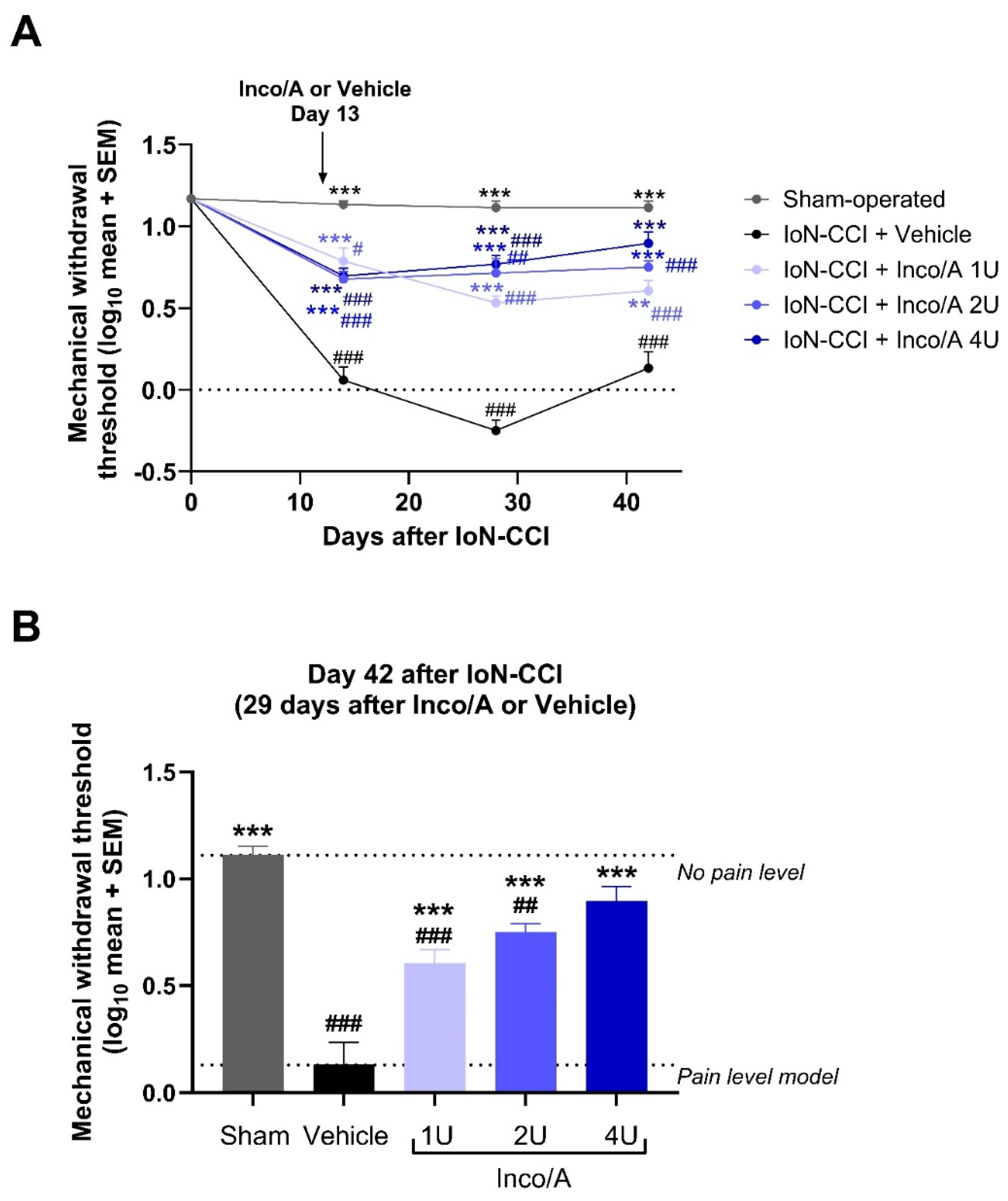
Inco/A (1, 2, or 4 U) was injected into the ipsilateral vibrissal pad of rats on day 13. The timing of the injection was based on pilot studies performed at HDB that demonstrated that allodynia in the IoN-CCI model was fully developed from day 13 (data not shown). The study also included sham-operated and IoN-CCI vehicle-treated animals. Facial mechanical allodynia was assessed in all five groups (N=10 per group) on days 14, 28, and 42 (1, 15, and 29 days post-treatment).

Study 2: Effects of Local Versus Systemic Inco/A Administration

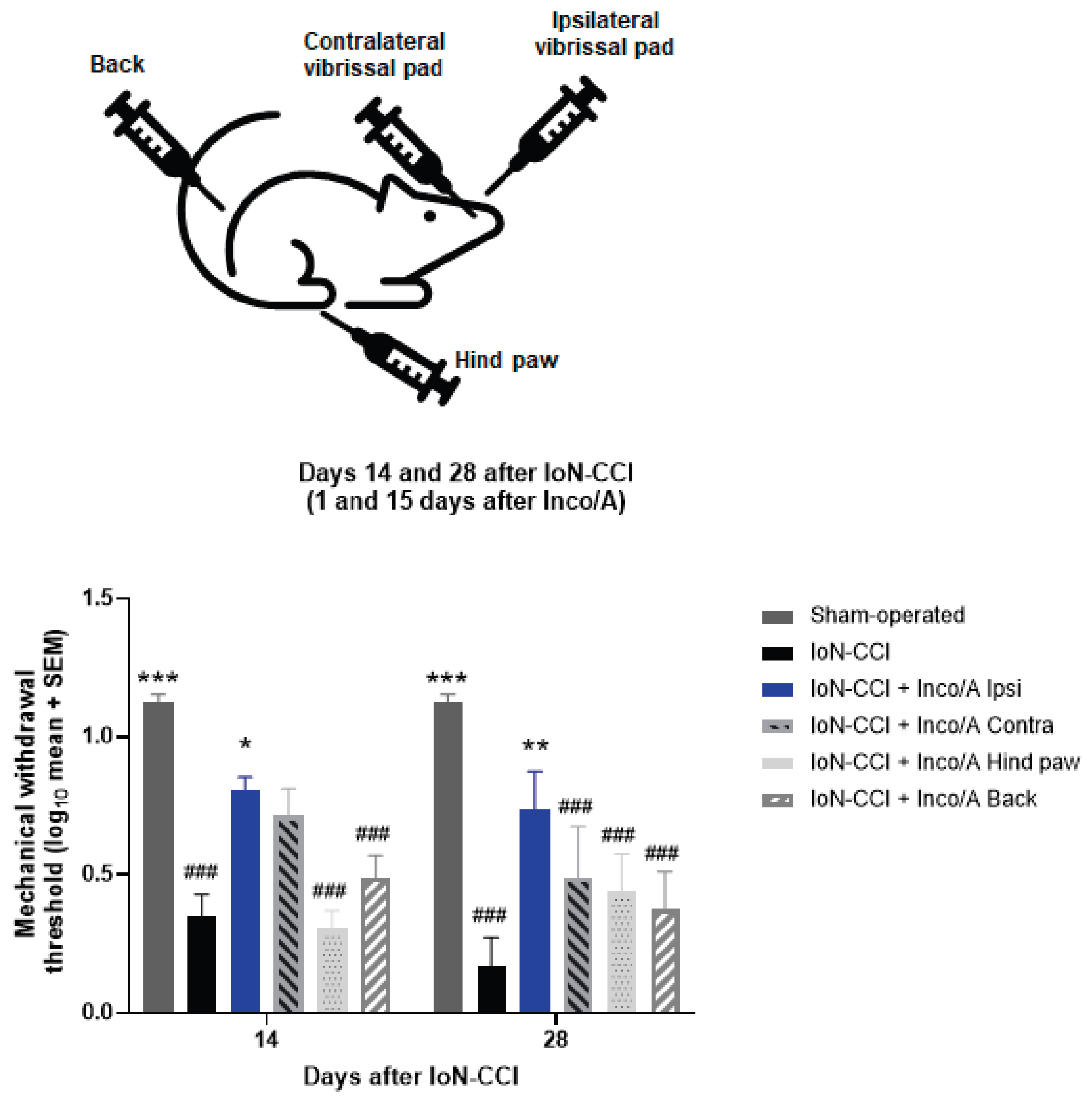
Inco/A (2 U) was injected into the ipsilateral vibrissal pad, the contralateral vibrissal pad, the hind paw, or the back of rats on day 13. The study also included sham-operated and IoN-CCI animals without treatment. Facial mechanical allodynia was assessed in all six groups (N=8 per group) on days 14 and 28 (1 and 15 days post-treatment).

Study 3: Effects of Preventive Versus Therapeutic Inco/A Administration

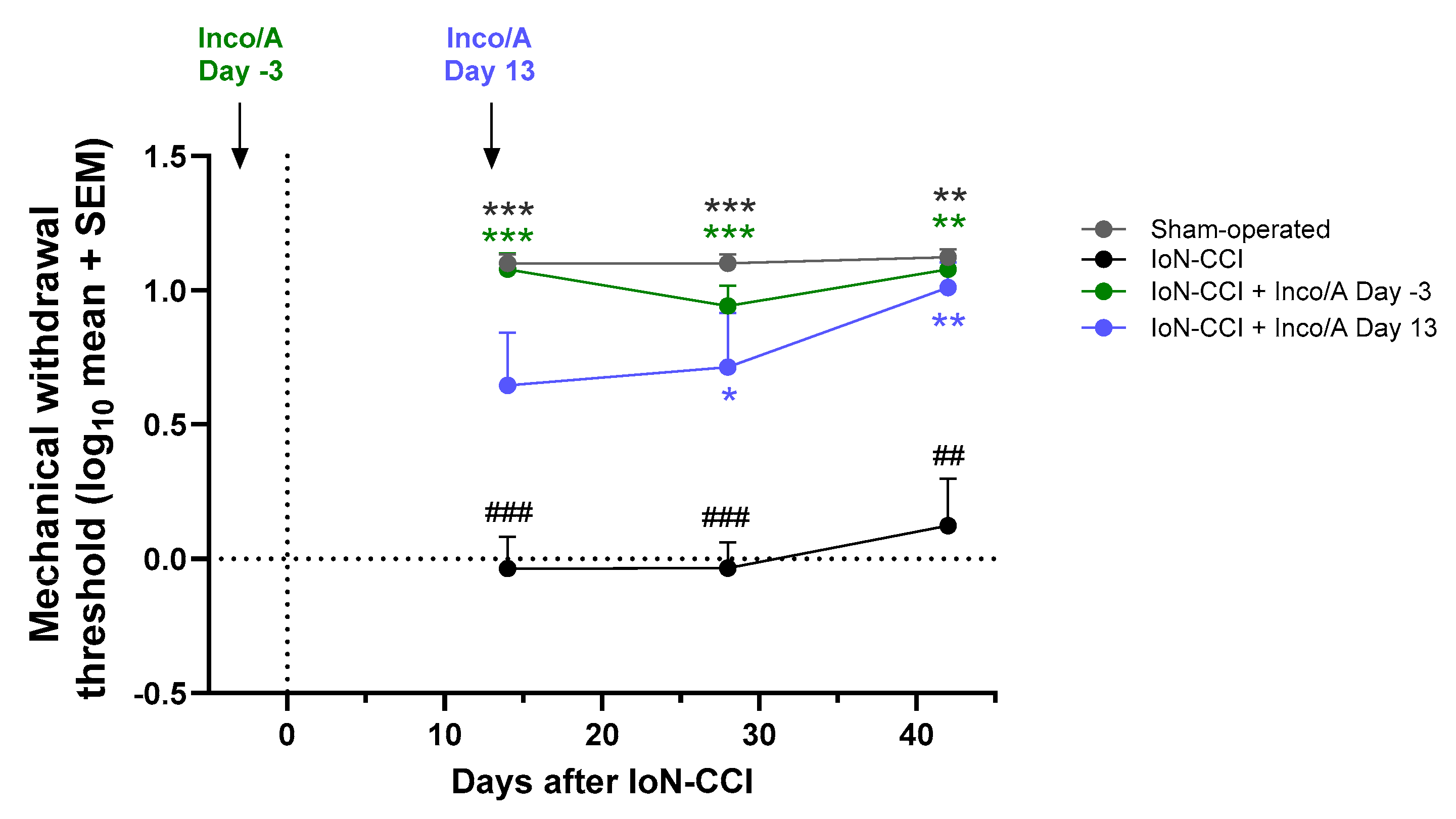
Inco/A (2 U) was injected into the ipsilateral vibrissal pad of rats on day -3 or day 13. The study also included sham-operated and IoN-CCI animals without treatment. Facial mechanical allodynia was assessed in all four groups (N=8 per group) on days 14, 28, and 42 (1, 15, and 29 days post-treatment).

Study 4: Duration of Inco/A Treatment Effect

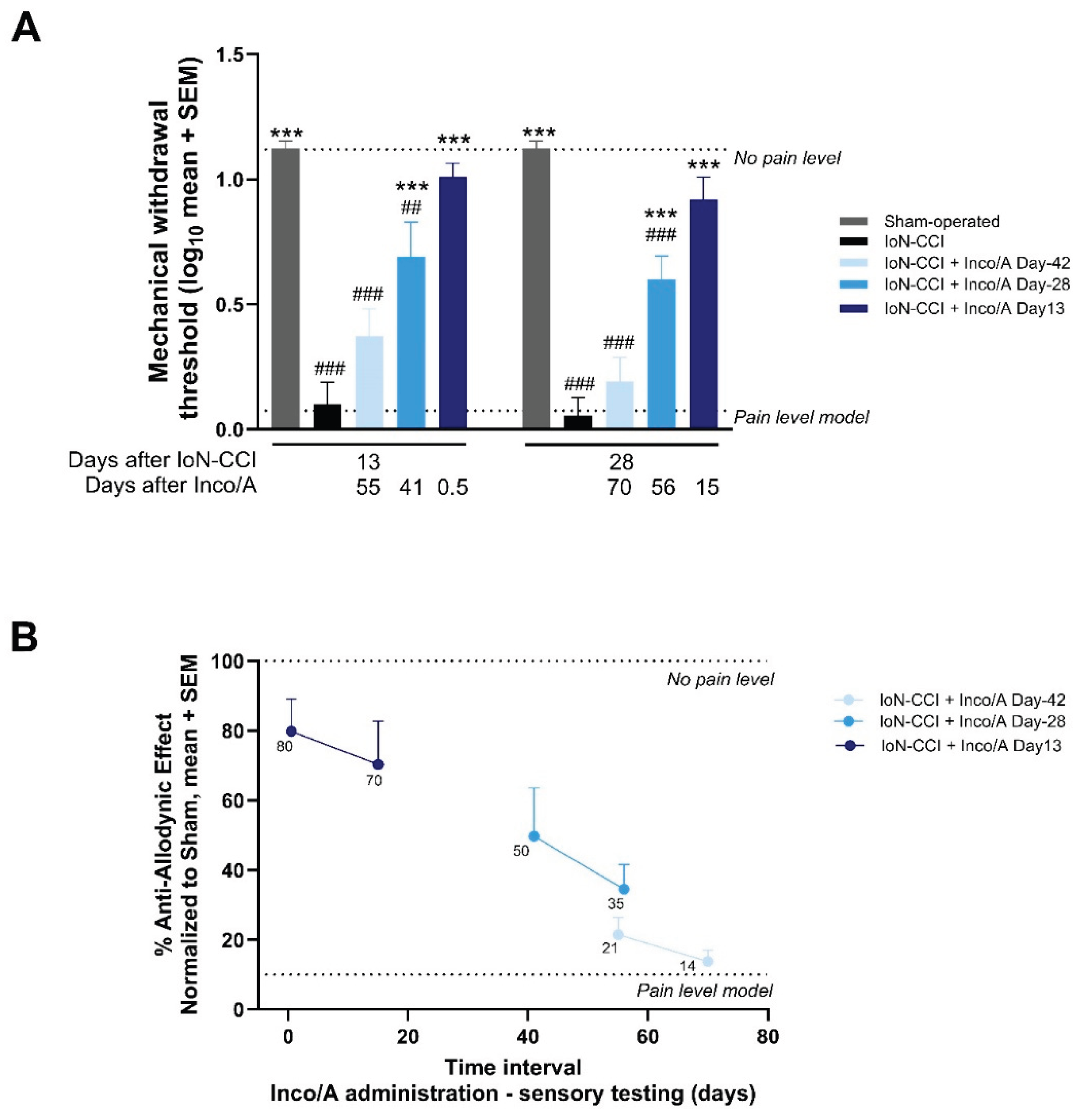
Inco/A (2 U) was injected into the ipsilateral vibrissal pad of rats on days -42, -28, or 13. The study also included sham-operated and IoN-CCI animals without treatment. Facial mechanical allodynia was assessed in all five groups (N=8 per group) on days 13 or 28 (i.e., up to 70 days post-treatment).

Statistical Methods

An a priori power analysis performed by HDB based on their historical data and published data from the established IoN-CCI model [19,20,23,24] indicated that a minimum sample size of 10 rats per group would be required to demonstrate a statistically significant between-group difference in MWT with a statistical power of 0.8 at an alpha level of 0.05.
Tactile stimuli follow Weber’s law and are sensed on a log scale [29]. MWT values were therefore log10-transformed before the statistical analysis using GraphPad Prism (version 10, GraphPad Software LLC, USA). Treatment groups were compared using one-way analysis of variance (ANOVA) followed by Tukey’s multiple comparisons test or repeated measures two-way ANOVA with Geisser–Greenhouse correction (if applicable), followed by Tukey’s multiple comparisons test. Results are expressed as mean ± standard error of the mean (SEM). Each animal was considered an experimental unit. No animals or data points were excluded from the analysis.
In study 4, an additional analysis of the relationship between the timing of Inco/A administration and sensory testing was evaluated by analyzing normalized MWTs, with sham-operated values designated as 100% (indicative of no pain; lower percentages reflect greater allodynia).

3. Results

3.1. Study 1: Dose–Response Relationship and Anti-allodynic Effects of Inco/A

IoN-CCI induced robust allodynia-like behavior, as evidenced by markedly lower MWTs in all animals compared with those in the sham-operated group at all post-surgical timepoints (Figure 2A). On day 42, vehicle-treated animals that had undergone IoN-CCI had the lowest MWT of all the groups, with a log10 mean ± SEM MWT of 0.13 ± 0.10. At the same timepoint, the sham-operated group’s MWT was 1.11 ± 0.04 (p<0.001 vs vehicle-treated group; Figure 2B).
Treatment with all doses of Inco/A significantly increased the pain threshold of the IoN-CCI model as early as 1 day post-administration, with the effect remaining significant until study end (day 42 = 29 days post-treatment) (two-way ANOVA: F treatment (4, 45) = 111.2, p<0.001; F time (2420, 108.9) = 132.9, p<0.001; F time × treatment (9681, 108.9) = 19.4, p<0.001) (Figure 2A). When administered at doses of 2 U and 4 U, the analgesic effect of Inco/A had a general tendency to increase over time.
The animals that had received 4 U Inco/A demonstrated a pain threshold statistically similar to those in the sham-operated group on day 42, with log10 mean ± SEM MWTs of 0.90 ± 0.07 and 1.11 ± 0.04, respectively (p=0.09) (Figure 2B). Furthermore, on day 42, a dose-dependent effect was observed, with all Inco/A-treated groups demonstrating significantly higher pain thresholds than the vehicle-treated group (p<0.001 for all; one-way ANOVA with Tukey’s multiple comparison’s test, F (4, 45) = 31.03, p<0.001).

3.2. Study 2: Local, Regional, and Systemic Anti-allodynic Effects of Inco/A

A significantly higher MWT was observed on day 14 (1 day after treatment) in the animals that had received 2 U Inco/A into the ipsilateral vibrissal pad compared with the IoN-CCI animals without treatment (log10 mean ± SEM 0.81 ± 0.05 and 0.35 ± 0.08, respectively; p<0.05) (Figure 3). Although a trend towards a higher pain threshold was noted in the rats that had received contralateral vibrissal pad injection (log10 mean ± SEM 0.71 ± 0.10 on day 14), this effect did not reach statistical significance versus the IoN-CCI animals without treatment (p=0.15). These findings persisted to day 28 (15 days after treatment), with the ipsilateral effect remaining robust (Inco/A: log10 mean ± SEM 0.74 ± 0.14; IoN-CCI animals without treatment: 0.17 ± 0.10; p<0.01 [two-way ANOVA, F treatment (5, 42) = 14.39, p<0.001]). No analgesic effect was detected in the groups injected with Inco/A in the hind paw or back at any time point.
The pain thresholds demonstrated by the groups that had received Inco/A in the ipsilateral vibrissal pad were not significantly different from those observed in the sham-operated group on day 14 (log10 mean ± SEM 0.81 ± 0.05 and 1.12 ± 0.03, respectively; p=0.27) or day 28 (log10 mean ± SEM 0.74 ± 0.14 and 1.12 ± 0.03, respectively; p=0.11). In the group that had received Inco/A into the contralateral vibrissal pad, the pain threshold did not differ from that of the sham-operated group on day 14 (p=0.07). However, it was significantly lower on day 28 (p<0.001).

3.3. Study 3: Preventive and Therapeutic Anti-allodynic Effects of Inco/A

A significantly higher sensory threshold was observed on day 14 (1 day after treatment) in the groups treated with Inco/A on day -3 (i.e., preventive treatment) compared with the IoN-CCI animals without treatment (Inco/A: log10 mean ± SEM 1.08 ± 0.06; no treatment: -0.04 ± 0.12; p<0.001) (Figure 4). The mean value observed in the Inco/A preventive treatment group was comparable to that achieved in the sham-operated group (log10 mean ± SEM 1.11 ± 0.03). In contrast, the group that received Inco/A on day 13 (therapeutic treatment) showed only a non-significant trend towards improvement versus the IoN-CCI animals without treatment on day 14 (log10 mean ± SEM, 0.65 ± 0.20; p=0.05). The MWT values of the preventive and therapeutic Inco/A-treated groups became more similar over time, with the values of both groups approaching those of the sham-operated group by day 42 (Inco/A preventive: log10 mean ± SEM 1.08 ± 0.05; Inco/A therapeutic 1.01 ± 0.09; sham-operated group 1.12 ± 0.03). There was a significant effect of Inco/A treatment and of time and subject (treatment, p<0.001; time, p<0.05; subject, p<0.001), however, the interaction time x treatment was not significant.
The sensory thresholds achieved by the animals treated with Inco/A were not significantly different from those in the sham-operated group at any timepoint (days 14, 28, and 42), regardless of the timing of Inco/A administration (day -3 or 13). For the sham-operated group, the log10 mean ± SEM MWT was 1.10 ± 0.03 on day 14, 1.10 ± 0.03 on day 28, and 1.12 ± 0.03 on day 42. For the group that received preventive Inco/A (treatment on day -3), log10 mean ± SEM MWTs on days 14, 28, and 42 were, respectively, 1.08 ± 0.06, p=0.98 versus sham-operated group; 0.94 ± 0.08, p=0.27; and 1.08 ± 0.05, p=0.85. For the group that received therapeutic Inco/A (treatment on day 13), log10 mean ± SEM MWTs on days 14, 28, and 42 were, respectively, 0.65 ± 0.20, p=0.19 versus sham-operated group; 0.72 ± 0.20, p=0.30; and 1.01 ± 0.10, p=0.67.

3.4. Study 4: Duration of Anti-allodynic Effects of Inco/A

Administration of Inco/A 42 days before surgery was not associated with a significant anti-allodynic effect at either of the two post-surgical timepoints tested (day 13: Inco/A: log10 mean ± SEM 0.37 ± 0.11; IoN-CCI and no treatment: 0.10 ± 0.09, p=0.18; day 28: Inco/A: 0.19 ± 0.10; IoN-CCI and no treatment: 0.06 ± 0.07, p=0.80) (Figure 5A). However, administration of Inco/A 28 days before surgery resulted in a significant improvement in MWT at both timepoints (day 13: Inco/A: log10 mean ± SEM, 0.69 ± 0.14; IoN-CCI and no treatment: 0.10 ± 0.09, p<0.001; day 28: Inco/A: 0.60 ± 0.09; IoN-CCI and no treatment: 0.06 ± 0.07, p<0.001). Interestingly, administration of Inco/A on post-surgical day 13 resulted in a strong improvement in mechanical allodynia as early as 4 hours post-treatment (day 13: Inco/A: log10 mean ± SEM, 1.01 ± 0.05; IoN-CCI and no treatment: 0.10 ± 0.09, p<0.001), as well as on day 28 (Inco/A: 0.92 ± 0.09; IoN-CCI and no treatment: 0.06 ± 0.07, p<0.001). However, in contrast to these preventive treatments, only day 13 Inco/A administration (i.e., therapeutic treatment) resulted in sensory threshold levels similar to those seen in the sham-operated group (day 13: Inco/A: log10 mean ± SEM, 1.01 ± 0.05; sham-operated: 1.12 ± 0.03, p=0.88; day 28: Inco/A: 0.92 ± 0.09; sham-operated: 1.12 ± 0.03, p=0.45). The effect of treatment across all timepoints was significant (two-way ANOVA, F treatment (4, 35) = 47.84, p<0.001).
The use of normalized MWTs (sham-operated group values designated as 100%) to determine the relationship between timing of Inco/A administration and analgesic effect revealed that maximum efficacy was reached when Inco/A was administered therapeutically (i.e., post-injury). The data indicated that an 80% reduction in pain was achieved on the day of injection and a 70% reduction 15 days later (Figure 5B). However, the preventive regimen demonstrated persistent efficacy, with observable benefits for up to 56 days after treatment (treatment on day -28, testing on day 28).

4. Discussion

In this study, the IoN-CCI model of trigeminal pain in rats was employed to evaluate the anti-allodynic efficacy of Inco/A as a potential treatment for TN. We have shown that a 2 U dose of Inco/A elicited a robust anti-allodynic effect in the IoN-CCI rat model and that these effects resulted predominantly from local administration. Both preventive and therapeutic regimens produced sustained anti-allodynic benefits in our assessments, and a significant anti-allodynic efficacy was observed even when the administration occurred up to 28 days before surgery.
Surgical induction of IoN-CCI produced mechanical allodynia in the ipsilateral vibrissal pad of rats. This effect persisted from post-surgical day 13 until the end of each study (day 28 or day 42). All Inco/A doses administered (1, 2, and 4 U) elicited clear anti-allodynic responses, significantly reducing mechanical allodynia by 1 day post-injection and with a minimum duration of effect of 29 days. These findings align with previous reports of BoNT/A’s antinociceptive properties in animal models of neuropathic pain [30,31,32,33], including the IoN-CCI model [22,23,24,34,35,36], and establish a reliable foundation for assessing the effects of Inco/A on trigeminal pain. Previous studies using the IoN-CCI model and similar doses of BoNT/A in rats (3–10 U/kg [1–3 U per animal]) reduced facial tactile allodynia and cold-evoked facial grooming within a few days, with the effects lasting for more than 2 weeks [23,24,34,35]. When BoNT/A was given before carrageenan, capsaicin, or formalin, it attenuated mechanical and thermal hypersensitivity and reduced late (plasticity-related) pain phases [34,37,38].
In the present study, injection of Inco/A into the ipsilateral vibrissal pad (the side subjected to IoN-CCI) significantly alleviated tactile allodynia on post-surgical days 14 and 28 (1 and 15 days post-treatment, respectively). There was a trend towards short-term alleviation of allodynia when Inco/A was injected into the contralateral vibrissal pad. Given the anatomical proximity of the ipsilateral and contralateral vibrissal pads, this could be explained by local diffusion of the toxin [39]. In contrast, injections into remote sites such as the hind paw or back had no discernible effect on mechanical allodynia. This indicates that local/regional mechanisms are responsible for efficacy and that systemic exposure – for example via the bloodstream – is unlikely to be responsible.
The issue of systemic exposure has been previously discussed. Using both the IoN-CCI model and a cisplatin-induced chemotherapy model in rats, Waskitho et al. [36] reported a decrease of tactile allodynia after injection of BoNT into the contralateral vibrissal pad. They also performed a mouse bioassay and concluded that approximately 18% of the BoNT injected into the vibrissal pad was found in the circulation. However, it is important to note that Waskitho et al. [36] administered BoNT at substantially higher doses than in our study. In the allodynia study, Waskitho et al. [36] injected 10 times the minimal lethal dose of BoNT/A intradermally into rats’ vibrissal pads. In the mouse bioassay study, they injected 5000 times the minimal lethal dose intradermally into a rat’s vibrissal pad, collected serum from the rat 5 hours post-injection, and inoculated serial dilutions of the serum intraperitoneally into mice [36]. In the current study, 2 U of Inco/A was injected in a volume of 5 µL. Assuming complete systemic distribution, the theoretical blood concentration would be roughly 0.36 U per 15 mL (the average blood volume of a rat; 18% of Inco/A in the circulation), or 0.00012 U per 5 µL. This represents an approximate 17,000-fold dilution relative to the injected concentration. Naturally, local dilution also occurs at the injection site but to a much lesser extent.
Peripheral BoNT/A injections can lead to limited systemic and trans-synaptic transport (as evidenced by the presence of BoNT/A in blood, or labeling in contralateral ganglia or muscles), but exposure is low and not typically associated with muscle weakness, supporting the view that analgesia is largely mediated by local neuronal uptake and transport within the trigeminal system [40].
Taken together, these findings suggest that systemic distribution of Inco/A, if present, plays only a minor role in its analgesic action, whereas local and possibly intra-neuronal transport are the dominant mechanisms. This is supported by the lack of motor deficits after subcutaneous injection.
Our results demonstrate that Inco/A confers benefits in trigeminal neuropathic pain models when administered both preventively and therapeutically, with effects that are not only robust but also long-lasting. Comparable anti-allodynic efficacy was observed whether Inco/A was administered 3 days before or 13 days after IoN-CCI induction, supporting its utility in both preventive and therapeutic treatment paradigms. Notably, anti-allodynic effects were still observed 56 days after Inco/A administration (when given 28 days before injury and assessed 28 days after), indicating a substantial duration of action. To our knowledge, this is the first study evaluating the effect of BoNT/A treatment in an IoN-CCI model for an extended period. Our observations are in line with the findings reported by Li et al. [41] regarding a post-operative pain model in rats. Intraplantar or intrathecal BoNT/A administered 1 day or 2 days before pain induction, respectively, decreased mechanical hypersensitivity, reduced synaptosomal-associated protein 25 in the ipsilateral dorsal root ganglia and dorsal horn of the spinal cord, and attenuated neurokinin-1 receptor internalization in the dorsal horn of the spinal cord. The long-lasting effect observed in our study is translationally relevant; clinical trials on TN generally report onset of the analgesic action within 1–2 weeks and duration of effects of approximately 3–6 months, with considerable improvements in QoL [42,43,44,45,46,47,48,49].
Most clinical studies to date have investigated onabotulinumtoxinA. However, available clinical data suggest that Inco/A may offer comparable efficacy and distinct advantages [50]. The two products contain the same active 150 kDa neurotoxin molecule, with onabotulinumtoxinA containing additional neurotoxin complexing proteins that have no effect on the neurotoxin’s mode of action [51,52]. The absence of these proteins in Inco/A reduces the overall foreign protein load, potentially lowering immunogenicity and the likelihood of neutralizing antibody development. Considering the recurrent and severe nature of pain attacks in TN, the findings presented here support the potential of Inco/A as both a preventive and a therapeutic treatment option. However, it is important to note that the duration of BoNT/A’s effects in rodents differs from that in humans. This likely reflects species-specific neuronal biology and toxin handling, including differences in intracellular persistence of BoNT/A light chain and regeneration dynamics, with rodents exhibiting faster and more robust peripheral nerve recovery than humans and shorter persistence of BoNT/A activity [53,54,55,56].
The mechanism of action of BoNT/A in pain modulation, though incompletely elucidated, has been documented in several comprehensive reviews [42,43,57,58]. BoNT/A modulates pain by primarily binding to synaptic vesicle glycoprotein 2 receptors at peripheral nerve terminals, where it is internalized through endocytosis. After translocation into the cytosol, the light chain of BoNT/A cleaves the soluble N-ethylmaleimide-sensitive factor attachment protein receptor protein synaptosomal-associated protein 25, impairing synaptic vesicle fusion and thus blocking the release of key neurotransmitters involved in nociceptive transmission, such as substance P, calcitonin gene-related peptide, and glutamate. BoNT/A also decreases the expression of pronociceptive genes, including those encoding ion channels and cytokines in damaged neurons, thereby limiting neurogenic inflammation [43].
Importantly, the effects of BoNT/A are not restricted to peripheral nerve endings but extend along the entire primary sensory neuron. There is accumulating evidence for retrograde axonal transport of BoNT/A within sensory neurons, enabling the toxin to reach the presynaptic terminals in the dorsal horn of the spinal cord, passing through the somas of the neurons in the dorsal root ganglia or trigeminal ganglia [42,57]. Additionally, BoNT/A disrupts synaptic vesicle transport, which impairs trafficking and surface expression of pain receptors and ion channels, such as transient receptor potential channels, calcium channels, sodium channels, purinergic receptors, neurokinin-1 receptors, and glutamate receptors. This reduces the overall excitability of sensory neurons and leads to attenuation of pain transmission. As a result, both peripheral and, indirectly, central sensitization are effectively attenuated or prevented [42,59].
In the context of TN, pain generation in both classical and secondary TN is fundamentally driven by demyelination and subsequent axonal changes, which lower neuronal excitability thresholds and promote ectopic firing and ephaptic crosstalk between demyelinated fibers. These processes are further characterized by abnormal expression and function of sodium channels (NaV1.7, NaV1.3, NaV1.8) and voltage-gated potassium channels, disrupting the stability of resting membrane potentials and predisposing affected neurons to spontaneous and evoked hyperexcitability [58]. BoNT/A exerts therapeutic effects in this setting by inhibiting soluble N-ethylmaleimide-sensitive factor attachment protein receptor-dependent neurotransmitter release at presynaptic terminals and may counteract the abnormal sodium and potassium channel-driven excitability, directly targeting the heightened synaptic activity and neurogenic inflammation that maintain neuropathic pain in demyelinated trigeminal pathways [58].
This study has several limitations. Although the IoN-CCI animal model is validated for the neuropathic pain associated with trigeminal nerve damage, it is not an optimal model for secondary or idiopathic TN. In addition, the study assessed mechanical pain thresholds evoked using von Frey hairs, which do not capture the full impact of pain on the QoL of human patients. Alternative approaches, including longitudinal and non-evoked pain readouts, may provide more comprehensive insights into the therapeutic impact of BoNT/A on patient wellbeing. Lastly, only male rats were studied. Given that TN affects more women than men, there is an unmet need for preclinical studies using female animal models.

5. Conclusions

Inco/A (Xeomin®) is highly effective in reducing mechanical allodynia in the IoN-CCI model of trigeminal pain in rats. The analgesic effects are predominantly local, with a negligible role for systemic contribution. This suggests that the analgesia is effected via local neuronal uptake and intra-neuronal distribution, rather than systemic or remote effects, and is therefore consistent with a favorable safety profile. Both preventive and therapeutic regimens are beneficial, with marked long-lasting efficacy. Remarkably, benefits were observed even when Inco/A was administered up to 28 days before injury, indicating a substantial preventive window. Given the reliability, magnitude, and duration of the anti-allodynic effects of Inco/A in this validated preclinical model, these findings strongly support further investigation and clinical translation for both prevention and management of TN and potentially other related neuropathic pain syndromes.

Author Contributions

WD planned the studies, designed the methodological details, analyzed and interpreted the results, and produced the first draft version of the manuscript. PNB was a major contributor to the final manuscript version including data analysis and figures. WD, AG, JN and KF contributed equally to improving the manuscript, including expanding the introduction, discussion and conclusions. JN and KF provided input related to pain and BoNT mechanism of action, respectively.

Funding

All studies were funded by Merz Therapeutics.

Institutional Review Board Statement

The animal study protocol was approved by the Institutional Review Board of HD Bioscience (HDB), now WuXi Biology, WuXi AppTec, Shanghai, China (protocol code AUF#108, approved on August 10, 2020).

Data Availability Statement

The research questions, study designs and analysis plans were prepared before study execution. No registrations in public repositories were made. All raw data are available in the results database Quattro at Merz Therapeutics.

Acknowledgments

We would like to thank the In Vivo Pharmacology Unit, WuXi Biology, WuXi AppTec, Shanghai for their excellent execution of the studies and valuable support with data analysis. The authors would also like to thank Dr. Oscar Sánchez-Carranza for reviewing this manuscript. Medical Writing and editorial support during the preparation of the manuscript was provided by Sarah Amir and Janet Douglas (Rx Communications, Mold, UK), and was funded by Merz Therapeutics GmbH.

Conflicts of Interest

AG, JN, KF, PNB and WD are employees of Merz Therapeutics.

Abbreviations

The following abbreviations are used in this manuscript:
TN trigeminal neuralgia
BoNT/A botulinum neurotoxin type A
Inco/A incobotulinumtoxinA
MS multiple sclerosis
QoL Quality of life
IoN-CCI infraorbital nerve chronic constriction injury
HDB HD Bioscience
MWT mechanical withdrawal threshold
ANOVA analysis of variance
SEM standard error of the mean

References

  1. No authors listed. Headache Classification Committee of the International Headache Society (IHS) The International Classification of Headache Disorders, 3rd edition. Cephalalgia. 2018, 38, 1–211. [CrossRef]
  2. Lambru, G.; Zakrzewska, J.; Matharu, M. Trigeminal neuralgia: a practical guide. Pract. Neurol. 2021, 21, 392–402. [Google Scholar] [CrossRef] [PubMed]
  3. Chong, M.S.; Bahra, A.; Zakrzewska, J.M. Guidelines for the management of trigeminal neuralgia. Cleve. Clin. J. Med. 2023, 90, 355–362. [Google Scholar] [CrossRef] [PubMed]
  4. Fallata, A.; Salter, A.; Tyry, T.; Cutter, GR.; Marrie, RA. Trigeminal neuralgia commonly precedes the diagnosis of multiple sclerosis. Int. J. MS. Care. 2017, 19, 240–246. [Google Scholar] [CrossRef] [PubMed]
  5. Mueller, D.; Obermann, M.; Yoon, M.S.; Poitz, F.; Hansen, N.; Slomke, M.A.; et al. Prevalence of trigeminal neuralgia and persistent idiopathic facial pain: a population-based study. Cephalalgia 2011, 31, 1542–1548. [Google Scholar] [CrossRef]
  6. Zakrzewska, J.M.; Wu, J.; Mon-Williams, M.; Phillips, N.; Pavitt, S.H. Evaluating the impact of trigeminal neuralgia. Pain 2017, 158, 1166–1174. [Google Scholar] [CrossRef]
  7. Martinelli, R.; Vannuccini, S.; Burattini, B.; D'Alessandris, Q.G.; D'Ercole, M.; Izzo, A.; et al. Psychological assessment in patients affected by trigeminal neuralgia. A systematic review. Neurosurg. Rev. 2025, 48, 414. [Google Scholar] [CrossRef]
  8. Xu, R.; Xie, M.E.; Jackson, C.M. Trigeminal neuralgia: current approaches and emerging interventions. J. Pain Res. 2021, 14, 3437–3463. [Google Scholar] [CrossRef]
  9. Pergolizzi, Jr. J.V.; LeQuang, J.A.; El-Tallawy, S.N.; Wagner, M.; Ahmed, R.S.; Varrassi, G. An update on pharmacotherapy for trigeminal neuralgia. Exp. Rev. Neurother. 2024, 24, 773–7786. [Google Scholar] [CrossRef]
  10. Ahmad, R.M.; Sher, K.; Devi, L.; Abrar, A.; Nisha; Muhammad, FG. Comparison of Oxcarbazepine Versus Carbamazepine in the Management of Trigeminal Neuralgia in Patients Presenting in the Outpatient Department of Neurology, Jinnah Postgraduate Medical Centre. Biol. Clin. Sci. Res. J. 2025, 6, 13–16. [Google Scholar] [CrossRef]
  11. Tohyama, S.; Datko, M.; Brusaferri, L.; Kinder, L.D.; Schnieders, J.H.; Hyman, M.; et al. Trigeminal nerve microstructure is linked with neuroinflammation and brainstem activity in migraine. Brain 2025, 148, 2551–2562. [Google Scholar] [CrossRef] [PubMed]
  12. Iyengar, S.; Johnson, K.W.; Ossipov, M.H.; Aurora, S.K. CGRP and the trigeminal system in migraine. Headache 2019, 59, 659–681. [Google Scholar] [CrossRef]
  13. Lin, K.-H.; Chen, Y.-T.; Fuh, J.-L.; Wang, S.-J. Increased risk of trigeminal neuralgia in patients with migraine: A nationwide population-based study. Cephalalgia 2016, 36, 1218–1227. [Google Scholar] [CrossRef]
  14. Aurora, S.K.; Dodick, D.W.; Diener, H.C.; DeGryse, R.E.; Turkel, C.C.; Lipton, R.B.; et al. OnabotulinumtoxinA for chronic migraine: efficacy, safety, and tolerability in patients who received all five treatment cycles in the PREEMPT clinical program. Acta Neurol. Scand. 2014, 129, 61–70. [Google Scholar] [CrossRef]
  15. Domitrz, I.; Slawek, J.; Slowik, A.; Boczarska-Jedynak, M.; Stepien, A.; Rejdak, K.; et al. Onabotulinumtoxin A (ONA-BoNT/A) in the treatment of chronic migraine. Neurol. Neurochir. Pol. 2022, 56, 39–47. [Google Scholar] [CrossRef]
  16. Argyriou, A.A.; Mitsikostas, D.D.; Mantovani, E.; Vikelis, M.; Tamburin, S. Beyond chronic migraine: a systematic review and expert opinion on the off-label use of botulinum neurotoxin type-A in other primary headache disorders. Exp. Rev. Neurother. 2021, 21, 923–944. [Google Scholar] [CrossRef] [PubMed]
  17. Hu, X.; Xia, Y.; Li, J.; Wang, X.; Liu, H.; Hu, J.; et al. Efficacy and safety of botulinum toxin type A in the treatment of trigeminal neuralgia: an update on systematic review with meta-analyses. Clin. J. Pain 2024, 40, 383–392. [Google Scholar] [CrossRef]
  18. Hosseindoost, S.; Askari Rad, M.; Inanloo, S.H.; Rahimi, M.; Dehghan, S.; Orandi, A.; et al. The analgesic effects of botulinum neurotoxin by modulating pain-related receptors; a literature review. Mol. Pain 2024, 20, 17448069241275099. [Google Scholar] [CrossRef]
  19. Vos, B.P.; Strassman, A.M.; Maciewicz, R.J. Behavioral evidence of trigeminal neuropathic pain following chronic constriction injury to the rat's infraorbital nerve. J. Neurosci. 1994, 14, 2708–2723. [Google Scholar] [CrossRef]
  20. Deseure, K.; Hans, G.H. Chronic constriction injury of the rat's infraorbital nerve (IoN-CCI) to study trigeminal neuropathic pain. J. Vis. Exp. 2015, 53167. [Google Scholar] [CrossRef]
  21. Harriott, A.M.; Strother, L.C.; Vila-Pueyo, M.; Holland, P.R. Animal models of migraine and experimental techniques used to examine trigeminal sensory processing. J. Headache. Pain 2019, 20, 91. [Google Scholar] [CrossRef] [PubMed]
  22. Noma, N.; Watanabe, K.; Sato, Y.; Imamura, Y.; Yamamoto, Y.; Ito, R.; et al. Botulinum neurotoxin type A alleviates mechanical hypersensitivity associated with infraorbital nerve constriction injury in rats. Neurosci. Lett. 2017, 637, 96–101. [Google Scholar] [CrossRef]
  23. Wu, C.; Xie, N.; Lian, Y.; Xu, H.; Chen, C.; Zheng, Y.; et al. Central antinociceptive activity of peripherally applied botulinum toxin type A in lab rat model of trigeminal neuralgia. Springerplus 2016, 5, 431. [Google Scholar] [CrossRef]
  24. Zhang, Y.; Su, Q.; Lian, Y.; Chen, Y. Botulinum toxin type A reduces the expression of transient receptor potential melastatin 3 and transient receptor potential vanilloid type 4 in the trigeminal subnucleus caudalis of a rat model of trigeminal neuralgia. Neuroreport 2019, 30, 735–740. [Google Scholar] [CrossRef]
  25. Grein, S.; Mander, G.; Fink, K. Stability of botulinum neurotoxin type A, devoid of complexing proteins. Botulinum J. 2011, 2, 49–58. [Google Scholar] [CrossRef]
  26. US Food and Drug Administration. Highlights of Prescribing Information: XEOMIN (incobotulinumtoxinA) for injection, for intramuscular or intraglandular use. Available online: https://www.accessdata.fda.gov/drugsatfda_docs/label/2023/125360s097lbl.pdf (accessed on 27 February 2026).
  27. Percie du Sert, N.; Hurst, V.; Ahluwalia, A.; Alam, S.; Avey, M.T.; Baker, M.; et al. The ARRIVE guidelines 2.0: updated guidelines for reporting animal research. BMJ Open Sci. 2020, 4, e100115. [Google Scholar] [CrossRef] [PubMed]
  28. Bonin, R.P.; Bories, C.; De Koninck, Y. A simplified up-down method (SUDO) for measuring mechanical nociception in rodents using von Frey filaments. Mol. Pain 2014, 10, 26. [Google Scholar] [CrossRef] [PubMed]
  29. Mills, C.; Leblond, D.; Joshi, S.; Zhu, C.; Hsieh, G.; Jacobson, P.; et al. Estimating efficacy and drug ED50's using von Frey thresholds: impact of weber's law and log transformation. J. Pain 2012, 13, 519–523. [Google Scholar] [CrossRef]
  30. Marinelli, S.; Luvisetto, S.; Cobianchi, S.; Makuch, W.; Obara, I.; Mezzaroma, E.; et al. Botulinum neurotoxin type A counteracts neuropathic pain and facilitates functional recovery after peripheral nerve injury in animal models. Neurosci. 2010, 171, 316–328. [Google Scholar] [CrossRef]
  31. Shi, Y.; Gong, C.; Nan, W.; Zhou, W.; Lei, Z.; Zhou, K.; et al. Intrathecal administration of botulinum toxin type a antagonizes neuropathic pain by countering increased vesicular nucleotide transporter expression in the spinal cord of chronic constriction injury of the sciatic nerve rats. Neuropeptides 2023, 100, 102346. [Google Scholar] [CrossRef]
  32. Xiao, L.; Cheng, J.; Dai, J.; Zhang, D. Botulinum toxin decreases hyperalgesia and inhibits P2X3 receptor over-expression in sensory neurons induced by ventral root transection in rats. Pain Med. 2011, 12, 1385–1394. [Google Scholar] [CrossRef]
  33. Yang, K.Y.; Kim, M.J.; Ju, J.S.; Park, S.K.; Lee, C.G.; Kim, S.T.; et al. Antinociceptive effects of botulinum toxin type A on trigeminal neuropathic pain. J. Dent. Res. 2016, 95, 1183–1190. [Google Scholar] [CrossRef]
  34. Filipovic, B.; Matak, I.; Bach-Rojecky, L.; Lackovic, Z. Central action of peripherally applied botulinum toxin type A on pain and dural protein extravasation in rat model of trigeminal neuropathy. PLoS One 2012, 7, e29803. [Google Scholar] [CrossRef]
  35. Piovesan, E.J.; Oshinsky, M.; Silberstein, S.; Kowacs, P.A.; Novak, E.M.; Werneck, L.C. Botulinum neurotoxin type-A when utilized in animals with trigeminal sensitization induced a antinociceptive effect. Arq. Neuropsiquiatr. 2016, 74, 462–469. [Google Scholar] [CrossRef]
  36. Waskitho, A.; Yamamoto, Y.; Raman, S.; Kano, F.; Yan, H.; Raju, R.; et al. Peripherally administered botulinum toxin type A localizes bilaterally in trigeminal ganglia of animal model. Toxins (Basel) 2021, 13, 704. [Google Scholar] [CrossRef] [PubMed]
  37. Cui, M.; Khanijou, S.; Rubino, J.; Aoki, KR. Subcutaneous administration of botulinum toxin a reduces formalin-induced pain. Pain 2004, 107, 125–133. [Google Scholar] [CrossRef]
  38. Bach-Rojecky, L.; Lackovic, Z. Antinociceptive effect of botulinum toxin type a in rat model of carrageenan and capsaicin induced pain. Croat. Med. J. 2005, 46, 201–208. [Google Scholar]
  39. Towal, R.B.; Quist, B.W.; Gopal, V.; Solomon, J.H.; Hartmann, M.J.Z. The morphology of the rat vibrissal array: a model for quantifying spatiotemporal patterns of whisker-object contact. PLoS Comput. Biol. 2011, 7, e1001120. [Google Scholar] [CrossRef]
  40. Omoto, K.; Maruhama, K.; Terayama, R.; Yamamoto, Y.; Matsushita, O.; Sugimoto, T.; et al. Cross-excitation in peripheral sensory ganglia associated with pain transmission. Toxins (Basel) 2015, 7, 2906–2917. [Google Scholar] [CrossRef] [PubMed]
  41. Li, X.; Guo, R.; Sun, Y.; Li, H.; Ma, D.; Zhang, C.; et al. Botulinum toxin type A and gabapentin attenuate postoperative pain and NK1 receptor internalization in rats. Neurochem. Int. 2018, 116, 52–62. [Google Scholar] [CrossRef] [PubMed]
  42. Oh, H.M.; Chung, M.E. Botulinum toxin for neuropathic pain: a review of the literature. Toxins (Basel) 2015, 7, 3127–3154. [Google Scholar] [CrossRef]
  43. Bagues, A.; Hu, J.; Alshanqiti, I.; Chung, M.K. Neurobiological mechanisms of botulinum neurotoxin-induced analgesia for neuropathic pain. Pharmacol. Ther. 2024, 259, 108668. [Google Scholar] [CrossRef]
  44. Santos, R.F.; Machado, M.; Ferro, M.; Camões-Barbosa, A. Botulinum toxin type A in trigeminal neuralgia treatment: a case series and literature review. Cureus 2024, 16, e73389. [Google Scholar] [CrossRef]
  45. Yoshida, K. Effects of botulinum toxin type A on pain among trigeminal neuralgia, myofascial temporomandibular disorders, and oromandibular dystonia. Toxins (Basel) 2021, 13, 605. [Google Scholar] [CrossRef]
  46. Wu, C.J.; Lian, Y.J.; Zheng, Y.K.; Zhang, H.F.; Chen, Y.; Xie, N.C.; et al. Botulinum toxin type A for the treatment of trigeminal neuralgia: results from a randomized, double-blind, placebo-controlled trial. Cephalalgia 2012, 32, 443–450. [Google Scholar] [CrossRef]
  47. Bohluli, B.; Motamedi, M.H.K.; Bagheri, S.C.; Bayat, M.; Lassemi, E.; Navi, F.; et al. Use of botulinum toxin A for drug-refractory trigeminal neuralgia: preliminary report. Oral Surg Oral Med Oral Pathol Oral Radiol Endod 2011, 111, 47–50. [Google Scholar] [CrossRef]
  48. Shehata, H.S.; El-Tamawy, M.S.; Shalaby, N.M.; Ramzy, G. Botulinum toxin-type A: could it be an effective treatment option in intractable trigeminal neuralgia? J. Headache Pain 2013, 14, 92. [Google Scholar] [CrossRef] [PubMed]
  49. Türk Börü, Ü.; Duman, A.; Bölük, C.; Coşkun Duman, S.; Taşdemir, M. Botulinum toxin in the treatment of trigeminal neuralgia: 6-Month follow-up. Medicine (Baltimore) 2017, 96, e8133. [Google Scholar] [CrossRef] [PubMed]
  50. Duran-Hernandez, S.; Herrera-Gonzalez, N.E.; Duran-Hernandez, N.; Carnalla, M.; Castillejos-Lopez, M.J.; Salinas-Lara, C. Single-dose incobotulinumtoxinA in the treatment of early-stage knee osteoarthritis: results from a preliminary single-arm clinical trial. Toxins (Basel) 2025, 17, 216. [Google Scholar] [CrossRef]
  51. Eisele, K.H.; Fink, K.; Vey, M.; Taylor, H.V. Studies on the dissociation of botulinum neurotoxin type A complexes. Toxicon 2011, 57, 555–565. [Google Scholar] [CrossRef]
  52. Frevert, J.; Dressler, D. Complexing proteins in botulinum toxin type A drugs: a help or a hindrance? Biologics 2010, 4, 325–332. [Google Scholar] [CrossRef]
  53. Bolívar, S.; Sanz, E.; Ovelleiro, D.; Zochodne, D.W.; Udina, E. Neuron-specific RNA-sequencing reveals different responses in peripheral neurons after nerve injury. eLife 2024, 12, RP91316. [Google Scholar] [CrossRef] [PubMed]
  54. Ryu, H.J.; Kwak, S.; Park, M.; Yun, H.Y. Model-based interspecies interpretation of botulinum neurotoxin type A on muscle-contraction inhibition. Biopharm. Drug Dispos. 2024, 45, 190–200. [Google Scholar] [CrossRef]
  55. Wilcox, M.B.; Jessen, K.R.; Quick, T.J.; Phillips, J.B. The molecular profile of nerve repair: humans mirror rodents. Neural. Regen. Res. 2021, 16, 1440–1441. [Google Scholar] [CrossRef]
  56. Pellett, S.; Bradshaw, M.; Tepp, W.H.; Pier, C.L.; Whitemarsh, R.C.M.; Chen, C.; et al. The light chain defines the duration of action of botulinum toxin serotype A subtypes. mBio 2018, 9, e00089-18. [Google Scholar] [CrossRef]
  57. Matak, I.; Bolcskei, K.; Bach-Rojecky, L.; Helyes, Z. Mechanisms of botulinum toxin type A action on pain. Toxins (Basel) 2019, 11, 459. [Google Scholar] [CrossRef]
  58. Tereshko, Y.; Dal Bello, S.; Lettieri, C.; Belgrado, E.; Gigli, G.L.; Merlino, G.; et al. Botulinum toxin type A for trigeminal neuralgia: a comprehensive literature review. Toxins (Basel) 2024, 16, 500. [Google Scholar] [CrossRef] [PubMed]
  59. Matak, I.; Tekus, V.; Bolcskei, K.; Lackovic, Z.; Helyes, Z. Involvement of substance P in the antinociceptive effect of botulinum toxin type A: Evidence from knockout mice. Neuroscience 2017, 358, 137–145. [Google Scholar] [CrossRef]
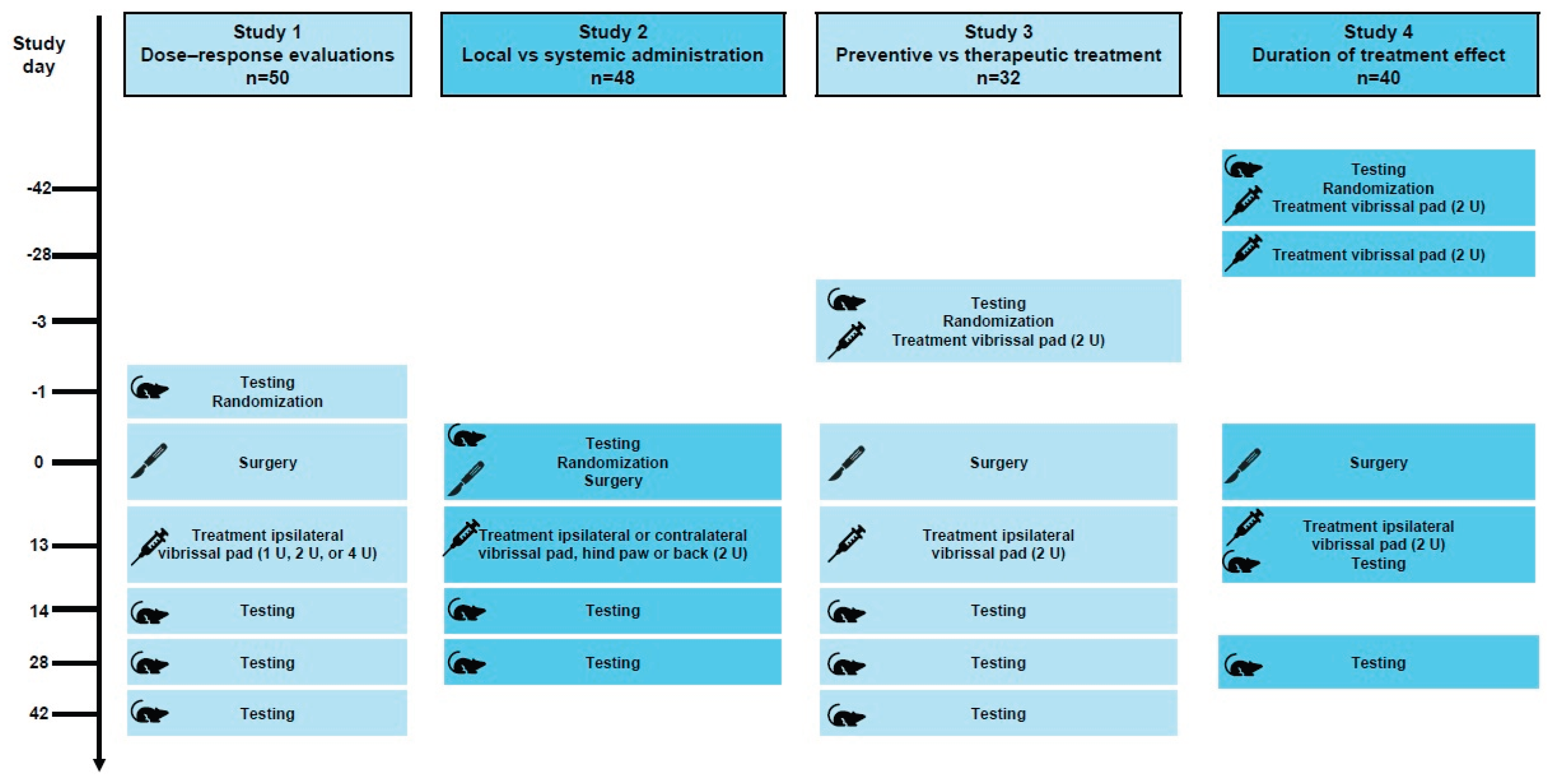
Figure 1. Study design. Study 1: IncobotulinumtoxinA (Inco/A) was injected into the ipsilateral vibrissal pad* on day 13, and mechanical withdrawal threshold (MWT) was assessed on days 14, 28, and 42. Study 2: Inco/A was injected into the ipsilateral vibrissal pad*, contralateral vibrissal pad*, hind paw, or back on day 13, and MWT was assessed on days 14 and 28; Study 3: Inco/A was injected into the ipsilateral vibrissal pad on day -3 or day 13, and MWT was assessed on days 14, 28, and 42; Study 4: Inco/A was injected into the ipsilateral vibrissal pad on days -42, -28, or 13, and MWT was assessed on days 13 and 28. The studies included the following control groups: sham-operated group (all studies), and infraorbital nerve chronic constriction injury (IoN-CCI) vehicle-treated animals (study 1) or IoN-CCI animals without treatment (studies 2–4). *Contralateral vibrissal pad: vibrissal pad contralateral to the injured nerve/site of sham surgery; Ipsilateral vibrissal pad: vibrissal pad ipsilateral to the injured nerve/site of sham surgery.
Preprints 202545 g001
Figure 2. Effect of different doses of incobotulinumtoxinA (Inco/A) in the infraorbital nerve chronic constriction injury (IoN-CCI) model of trigeminal pain in rats (study 1). (a) Time course of mechanical withdrawal thresholds for each treatment group. Statistical analysis: repeated measures two-way-analysis of variance (ANOVA) with Geisser–Greenhouse correction, followed by Tukey’s multiple comparisons test. (b) Dose–response effect on day 42 after surgery (29 days post-treatment). The upper dotted line indicates the mean mechanical withdrawal threshold (MWT) value for sham-operated animals (no pain level), and the lower dotted line indicates the mean MWT value for IoN-CCI vehicle-treated animals (pain level model). Statistical analysis: one-way ANOVA test followed by Tukey’s multiple comparisons test; n=10 per group; *Comparison with vehicle-treated; #Comparison with sham-operated; */#p<0.05; **/##p<0.01; ***/###p<0.001. SEM, standard error of the mean.
Preprints 202545 g002
Figure 3. Effect of incobotulinumtoxinA (Inco/A) administration into different body sites in the infraorbital nerve chronic constriction injury (IoN-CCI) model of trigeminal pain in rats (study 2). On day 13 after IoN-CCI induction, 2 U Inco/A was administered subcutaneously to rats in one of four locations: ipsilateral vibrissal pad; contralateral vibrissal pad; hind paw; back. Mechanical withdrawal thresholds (MWTs) were assessed on days 14 and 28 (1 and 15 days post-treatment). Statistical analysis: repeated measures two-way-analysis of variance (ANOVA) with Tukey’s test for multiple comparisons. n=8 per group; *Comparison with IoN-CCI without treatment; #Comparison with sham-operated; */#p<0.05; **/##p<0.01; ***/###p<0.001. contra, contralateral; ipsi, ipsilateral; SEM, standard error of the mean.
Preprints 202545 g003
Figure 4. Preventive and therapeutic treatment effects of incobotulinumtoxinA (Inco/A) in the infraorbital nerve chronic constriction injury (IoN-CCI) model of trigeminal pain in rats (study 3). Inco/A (2 U) was administered subcutaneously into the ipsilateral vibrissal pad either 3 days before (day -3; preventive group, green line) or 13 days after (day 13; therapeutic group, blue line) IoN-CCI surgery. Mechanical withdrawal thresholds (MWTs) were assessed on study days 14, 28, and 42 (1, 15, and 29 days post-treatment). Statistical analysis: repeated measures two-way-analysis of variance (ANOVA) with Geisser–Greenhouse correction and Tukey’s post hoc test. n=8 per group; *Comparison with IoN-CCI without treatment; #Comparison with sham-operated; */#p<0.05; **/##p<0.01; ***/###p<0.001. SEM, standard error of the mean.
Preprints 202545 g004
Figure 5. Duration of anti-allodynic effects of incobotulinumtoxinA (Inco/A) in the infraorbital nerve chronic constriction injury (IoN-CCI) model of trigeminal pain in rats (study 4). (a) Inco/A (2 U) was administered subcutaneously at three time points (42 or 28 days before, or 13 days after IoN-CCI surgery). Mechanical withdrawal thresholds (MWTs) were measured on post-surgical days 13 and 28, corresponding to up to 70 days post-treatment. (b) Anti-allodynic effect of Inco/A calculated using MWTs normalized to those of the sham-operated group (sham-operated group values designated as 100%). The upper dotted line indicates the mean MWT value for sham-operated animals (no pain level), and the lower dotted line indicates the mean MWT value for IoN-CCI vehicle-treated animals (pain level model). Statistical analysis: repeated measures two-way-analysis of variance (ANOVA) with Tukey’s post hoc test. n=8 per group; *Comparison with IoN-CCI without treatment; #Comparison with sham-operated; */#p<0.05; **/##p<0.01; ***/###p<0.001. SEM, standard error of the mean.
Preprints 202545 g005
Disclaimer/Publisher’s Note: The statements, opinions and data contained in all publications are solely those of the individual author(s) and contributor(s) and not of MDPI and/or the editor(s). MDPI and/or the editor(s) disclaim responsibility for any injury to people or property resulting from any ideas, methods, instructions or products referred to in the content.
Copyright: This open access article is published under a Creative Commons CC BY 4.0 license, which permit the free download, distribution, and reuse, provided that the author and preprint are cited in any reuse.
Prerpints.org logo

Preprints.org is a free preprint server supported by MDPI in Basel, Switzerland.

Subscribe

Disclaimer

Terms of Use

Privacy Policy

Privacy Settings

© 2026 MDPI (Basel, Switzerland) unless otherwise stated