

Submitted:
15 June 2026
Posted:
17 June 2026
You are already at the latest version
Abstract
Background: Accelerating sustainable food system transitions requires spatially explicit integration of local production conditions and nutritional priorities, yet such assessments remain scarce, particularly for low- and middle-income countries (LMIC). Despite methodological advances, most Life Cycle Assessments (LCA) remain focused on high-income, industrialized production systems, depend on proprietary data and software, and frame impact assessments solely around resource efficiency without reference to safe operating spaces. Methods: We developed a spatially explicit nutritional LCA (nLCA) framework and model: Local Environmental and Nutritional Scoring (LENS). Integrating geospatial environmental data with a comprehensive nutritional score to capture both local agroecological conditions and dietary requirements, LENS normalizes and aggregates environmental impacts against spatially resolved sustainability thresholds. We applied LENS across six environmental impact categories at sub-national scale in Kenya and Rwanda. Findings: Results reveal strong context dependency. Wild-caught seafood and vegetables from low-input systems consistently achieve the highest enviro-nutritional efficiencies across both countries, while starchy staples and poultry tend to rank lowest. In Kenya specifically, many terrestrial animal products score comparably to plant-source foods – a pattern less pronounced in Rwanda. Water use, greenhouse gas emissions, and potential biodiversity loss contribute most to overall scores, with substantial variation within food groups, between co-products, and across geographic landscapes. Interpretation: LENS provides a scalable, open-source template for enviro-nutritional analysis in data-scarce environments. As our case studies show, results are most meaningful at the landscape level rather than as independent benchmarks, making locally grounded assessment essential for informing food system governance and production decisions in LMICs.
Keywords:
life cycle analysis
; environmental impact assessment
; spatial analysis
; greenhouse gas emissions
; water use
; water pollution
; air pollution
; biodiversity
; agrifood systems
; food supply chains
; nutrition-sensitive agriculture
; nutrient profiling
; smallholders
; low- and middle-income countries (LMIC)
; Africa South of Sahara
; Kenya
; Rwanda
; open-source software
1. Introduction
Life Cycle Assessment (LCA) serves as a standardized methodology for assessing potential environmental impacts along food supply chains, from primary inputs to waste disposal. Yet, established frameworks remain inadequately adapted to the ecological complexity of agrifood systems, particularly in low- and middle-income countries (LMIC) [1,2] that bear the greatest burden of both environmental degradation and malnutrition [3]. A growing body of scholarship has begun to address these limitations. Spatially explicit approaches methodologically advance LCAs by focusing on single supply chains or aggregated economic activities within defined sub-national territories [4,5,6]. Nutritional LCAs (nLCAs) expand the analytical scope of conventional LCA by shifting from mass- or energy-based functional units to nutritional metrics (single nutrients (e.g., protein [7]) or compound nutritional scores [8,9,10]), revealing synergies and trade-offs between environmental integrity and human health [11,12,13]. Separately, approaches for converting environmental flows into impact scores (characterization factors), have advanced in capturing sub-national variation in ecosystem sensitivity [14], while discussions surrounding integration of ecological carrying capacities and natural resource constraints into impact evaluation continue [15,16].
Despite this progress, important limitations remain. LCA applications typically rely on data from industrialized agrifood systems in high-income countries [5,6,17,18,19] and extensively depend on proprietary data or software, further restricting their reproducibility and accessibility [20,21]. Advances in characterization factors have not been matched by corresponding improvements in inventory data, which mostly remain aggregated at administrative rather than biophysical levels, preventing the spatial precision that improved impact methods can in principle offer (e.g., countries vs. river basins [22]). Additionally, impact assessments are traditionally framed around resource efficiency alone, without reference to resource constraints and ecological thresholds (e.g., total vs. sustainable water use [23]).
Here we introduce Local Environmental and Nutritional Scoring (LENS), an LCA framework operationalized as an open-source model designed to address these limitations through four key advancements. First, LENS provides default inventory data (base year 2020) to represent local production conditions, enabling scalable sub-national impact assessment. Second, this scalability is achieved through seamless integration of global, high-resolution geospatial datasets on climate, soil, water, and land use – capturing agroecological heterogeneity and leveraging recent advances in environmental data availability and spatial precision. Third, the model employs a comprehensive nutritional score as standardized reference basis, tailored to regional dietary patterns and malnutrition profiles. This enhances applicability to the food environments and traditional smallholder and transitional agricultural systems [24] of LMICs. Fourth, LENS implements a threshold-based normalization approach to compare foods’ enviro-nutritional efficiency, grounding impact comparisons in physical resource limits and sustainability targets. To demonstrate its capabilities, we apply LENS to Kenya and Rwanda – two East African countries with contrasting food system profiles but shared environmental and dietary challenges.
| RESEARCH IN CONTEXT |
| Evidence Before This Study |
| Life Cycle Assessments (LCAs) have traditionally relied on inventory data aggregated at national or regional scales, reflecting data availability rather than the diversity of agroecological contexts. Spatially explicit approaches have begun to address this, enabling sub-national precision, though their application across sectors including agriculture remains limited. In parallel, nutritional LCAs have expanded the analytical focus from the impacts of producing a given quantity of food to those associated with meeting defined dietary or nutrient-specific objectives. Despite these advances, most LCA applications have largely remained centered on high-income, industrialized production systems represented by national aggregates, depend on proprietary data and software, and frame impact assessments solely around resource efficiency without reference to ecological thresholds or safe operating spaces. |
| Added Value of This Study |
| LENS is an open-source, globally scalable LCA framework operationalized as a reproducible model with a particular focus on sub-national implementation. It derives inventory data from publicly available sources – including high-resolution data on climate, soil, water, and land use to improve spatial accuracy and representativeness, captures agroecological heterogeneity by dynamically calculating spatially explicit environmental impacts, and provides adjustable characterization and normalization modules. LENS’ use of a regionally calibrated comprehensive nutritional score as a reference basis enhances applicability to the food environments and traditional smallholder and transitional agricultural systems of LMICs. Critically, the model normalizes impacts against spatially resolved sustainability thresholds rather than total resource use, eliminating the need for post-hoc weighting assumptions. Applied to Kenya and Rwanda, it demonstrates that contextually appropriate enviro-nutritional assessment is feasible in data-scarce environments. |
| Implications of all the Available Evidence |
| Integrating spatial precision, nutritional complexity of local food products, open-source accessibility, and threshold-based normalization in a single LCA framework represents a meaningful step toward analyses that are fit for purpose to inform food system transitions at local and regional scales. LENS offers a replicable template for extending this approach to other LMIC regions; our Kenya and Rwanda case studies demonstrate the value of locally grounded guidance for decision-making across governance levels. |
2. Methods
2.1. The LENS Framework and Model
LENS is a methodological framework for integrated environmental and nutritional LCA of food supply chains at sub-national scale. It establishes an approach for deriving all required inventory data from publicly available sources, integrates a comprehensive nutritional functional unit, has the capacity to dynamically calculate spatially explicit environmental impact data, and offers adjustable impact characterization and normalization modules. LENS is operationalized as an open-source, globally scalable model with default inventory data (base year 2020), designed for reproducible implementation, especially in data-scarce settings.
2.2. Case Study Context
We apply LENS in Kenya and Rwanda, two East African countries that share persistent food and nutrition security challenges. Despite progress, over 25% of the population in both countries still consume diets lacking sufficient quantities of nutrient-rich foods (e.g., meat, dairy, vegetables) [25]. Dietary diversity is constrained by starchy staple crop overdependence (maize, beans, and potatoes in Kenya; cassava, bananas, and sweet potatoes in Rwanda), limiting dietary supply of high-quality protein and essential nutrients [26]. Yet the two countries offer contrasting food system contexts. Kenya is characterized by a large diversity of agroecological zones – from pastoral systems across arid and semi-arid lands [27] to large-scale Rift Valley cereal production [28] and export-oriented sectors including tea, coffee, and horticulture [29]. Rwanda, by contrast, has nearly six times Kenya’s population density, making it one of Africa’s most densely populated countries, with limited pastoral production [30] and an even greater reliance on smallholders, of whom 90% farm on hillsides [31].
2.3. Goal and Scope
The study has two interrelated goals: (1) to present and validate LENS as a scalable framework and model for integrated enviro-nutritional LCA of food supply chains; and (2) to apply it as a case study to assess the current sub-national impacts of commonly consumed foods across Kenya and Rwanda. The case study application follows the ISO 14040/44 standards for LCA [32,33], with full methodological detail provided in Supplementary Appendices 1 and 2.
LENS employs the Nutritional Value Score (NVS) as a standardized reference basis (functional unit), marking one of the first applications of this metric in an LCA model. The NVS integrates multiple health-relevant nutritional indicators, accounting for both density of nutrients commonly lacking in diets globally and dietary factors linked to noncommunicable disease risk [34]. On a 1–100 scale, NVS reflects a food’s relative nutritional value, with 100 representing the highest score achievable among a given set of foods. We use an NVS of 100 as the functional unit, applying regional NVS values for Sub-Saharan Africa to derive the quantity of food (in grams) required to achieve this score (see Supplementary Appendix 1 for detailed information). System boundaries follow a cradle-to-grave approach, including downstream consumer and waste stages (see Figure S1). LENS also integrates international imports relevant to national food consumption (see Supplementary Appendix 1 for details). Besides enviro-nutritional efficiency, our study also qualitatively characterizes ecosystem functions beyond food provision for each food. Classified according to CICES 2025 [35] across all functional groups relevant to ecosystem regulation and maintenance, we contextualize environmental trade-offs within the broader ecological and cultural role of food-producing species in their landscapes.
2.4. Life Cycle Inventory
Food items were selected based on each country’s Diet Quality Questionnaire (DQQ) [36], covering commonly consumed unprocessed, minimally processed, and processed foods, including indigenous crops and traditional foods rarely represented in global food composition and life cycle inventory databases (e.g., dried lake sardine, jute mallow, camel milk). Environmental inventory data were compiled from high-resolution (5arc min) geospatial datasets on land use and fertilizer inputs, as well as soil, climate, and hydrological datasets, supplemented by data derived from agricultural statistics at national level, systemized literature reviews, and expert consultation. Default geospatial data sources were selected based on global coverage and sub-national resolution; users can substitute alternative datasets where available. The model also allows for distinguishing production systems: high-input (H) (i.e., irrigation, farm machinery use) and low-input (L) production. Full data sources and processing steps are documented in Supplementary Tables S1–S2. Co-product handling follows mass-based allocation; sensitivity to allocation choice is discussed in Supplementary Appendix 1.
2.5. Life Cycle Impact Assessment
LENS assesses six mid-point indicators: greenhouse gas (GHG) emissions, water use, water pollution (i.e., marine and freshwater eutrophication potential, ocean acidification potential), biodiversity loss (i.e., potential species loss), and non-GHG air pollution (i.e., particulate matter (PM) emissions) (see Table 1). Characterization methods were selected to maximize spatial precision and relevance to Sub-Saharan African agroecological conditions. Unlike traditional LCA normalization, which expresses impacts as dimensionless fractions of total resource use or monetary values [37,38], LENS employs spatially resolved climate policy goals and safe operating spaces as normalization references for each indicator. Normalization thresholds are applied at scales matching each impact’s spatial dynamics, e.g., provincial water availability and national emission targets (for more information see Supplementary Appendix 1 and Table S3). Results are expressed as dimensionless fractions of these thresholds, scaled by 10⁶ and reported per kilogram of food [ppm per kg] and at an NVS of 100 (e-100NVS [ppm per 100 NVS]) – analogous to % (parts per hundred) but reflecting the small fractions of ecological or policy thresholds that an individual functional unit equivalent of food represents. Smaller values indicate greater enviro-nutritional efficiency, i.e., less environmental impact per unit nutritional value. Normalization at different geographic scales allows for a direct comparison of foods within the study region based on their relative environmental pressures. When these impacts are aggregated, they carry an implicit equal weight. However, our approach does not support absolute sustainability assessments.
3. Interpretation and Sensitivity Analysis
Enviro-nutritional efficiency scores and their medians (Mdn) enable comparisons across foods, food groups, and space. Sample sizes vary by food group, reflecting the number of commonly consumed foods per category. This variation reflects the production patterns in each country’s current food system rather than a statistical sampling choice. Sensitivity analyses examined the effect of yield variation and functional unit choice on results. Yield-based uncertainty is reported as one standard deviation (SD) within each spatial unit (production-weighted averages by province and nationally). Derived from spatially interpolated crop production data [39] based on documented agricultural statistics, values reflect a combination of real production variability and spatial modeling uncertainty.
Individual, non-normalized impacts compared by functional unit are reported in Supplementary Appendix 1 (Figures S15-S19) and our accompanying Zenodo repository. Cross-model validation against existing LCA databases is not pursued for two reasons: the limited coverage of East African foods in current databases (e.g., WFLDB, Agri-footprint), and the proprietary inventory data (sampling criteria, integration) underlying these databases, which preclude meaningful attribution of differences or similarities.
4. Results
We analyzed 163 domestically produced foods in Kenya and 74 in Rwanda, organizing them in eleven categories (Figure 1). Figure 1A presents the relationship between nutritional value [100 NVS] and combined environmental impacts by food group [ppm per kg]. Kenyan data include both high-input and low-input production systems, while Rwandan data represent exclusively smallholder, low-input production. Figure 1B presents results at e-100NVS [ppm]. Rwanda’s overall efficiencies are considerably higher than Kenya’s (Mdn: 1.34×10⁻² ppm vs. 7.23×10⁻1 ppm), driven primarily by the country’s far greater physical water availability rather than differences in modeled farming practices. Despite this variation, several common patterns emerge across both countries: wild-caught fish and seafood (Mdn: 1.61×10⁻³–1.23×10⁻² ppm) and vegetables, including green leafy vegetables (Mdn: 1.13×10⁻²–1.10×10⁻1 ppm), from low-input systems show highest enviro-nutritional efficiencies. In Kenya, pulses (Mdn: 7.32×10⁻² ppm) follow the same pattern. By contrast, starchy staples (starchy roots and tubers, Kenyan cereals) (Mdn: 3.06×10⁻²–1.27 ppm), poultry (Mdn: 3.28×10⁻1–3.52 ppm), and nuts and seeds (Mdn: 2.77×10⁻²–4.95 ppm) tend to show relatively low efficiencies (see our Zenodo repository for complete national datasets).
Uncertainties are on average higher for terrestrial animal products than plant-source foods, stemming from local yield variations (mean SD: 4.18x10⁻²–5.30 x10⁻¹ ppm vs. 2.68x10⁻³–4.46 x10⁻¹ ppm). Though scores vary across individual foods and food groups, they cluster closely together overall. In Kenya specifically, no clear pattern distinguishes most plant from terrestrial animal products. Some ruminant and other foregut-fermenting herbivore products, rank higher in enviro-nutritional efficiency than monogastric animal products and plant-source foods – for example, beef (across both systems) scores higher than chicken meat or peanuts. A much weaker pattern appears in Rwanda, where goat/sheep milk for example ranks above pork or cassava. Additionally, allocation of resources and emissions between co-products – such as milk and meat from the same animals, or roots and tubers and their leaves from the same plant – can lead to considerable individual score differences. For Kenya, the inclusion of high-input production systems adds additional heterogeneity: foods from high-input systems often rank lower overall (Mdn: 6.53 (H) vs. 4.24x10⁻¹ (L) ppm), driven primarily by irrigation water requirements. Notably, ruminant products from extensive (low-input) and intensive (high-input) livestock systems rank similarly (Mdn: 3.96x10⁻¹ (L) vs. 3.89x10⁻¹ (H) ppm). Although intensive systems achieve higher feed-to-output efficiency per animal, this advantage is offset by the environmental impacts of domestic feed production. Extensive systems, by contrast, draw primarily on grass, crop residues, and food waste, with minimal reliance on inorganic fertilizer [40], resulting in higher enteric emissions but lower input-related impacts.
Figure 2 presents sub-national median e-100NVS for locally produced food products. Regional median scores range from 8.19×10⁻² to 4.06×10² ppm in Kenya (Figure 2A, aggregated to former provinces) and from 5.97×10⁻³ to 1.90×10⁻² ppm in Rwanda (Figure 2B, province-level aggregation). In Rwanda, where all provinces include the same number of foods (n = 74), this variation reflects differences in production conditions across space. In Kenya, regional variation is driven by both crop mix and agroecological context (n = 131-163), as provinces with greater crop diversity – notably more cereals, legumes, and starchy roots and tubers – coincide with higher-yielding zones. Sub-national analysis reveals systemic environmental hotspots that are region- and impact-specific, varying across both food types and production systems. For box plots of enviro-nutritional efficiencies by food group and province, see Supplementary Figures S2-S14; for complete sub-national datasets by country, see our Zenodo repository. While impact category contributions show similar patterns across both countries, inter-provincial variation is considerable. Kenya’s national median e-100NVS is similar to scores in the Eastern province, while central and western regions – covering most national cropland area [41] – show higher enviro-nutritional efficiencies. Foods produced in the North-Eastern province rank significantly lower mainly due to limited regional water availability. Water use and climate change dominate most provincial scores. The risk of species loss increases toward the western provinces, driven by both land use change and terrestrial acidification. Rwanda’s provincial median e-100NVS are less variable than Kenya’s, with the Western provinces ranking marginally lower than elsewhere in the country. As in Kenya, water use and GHG emissions strongly drive overall scores in Rwanda, but here also air pollution from PM emissions plays an important role due to a combination of lower total e-100NVS and its smaller geographic area, the latter resulting in higher PM impacts per unit area when normalized against World Health Organization air pollution thresholds [42].
Average relative contributions of individual impact categories by supply chain stage reveal that potential biodiversity loss and eutrophication are limited to primary crop production and processing in both countries (Figure 2C,D). Primarily land use change drives potential species loss. In Kenya, most water use (61%) occurs during primary stages, whereas in Rwanda, the secondary stages account for highest share (67%). For certain pulses, including capillary rise in total crop water requirements results in considerable score differentiation within this food group, despite low absolute water use. GHG emissions show a more heterogeneous pattern. In Kenya, emissions from waste disposal dominate (92%), reflecting sector-specific emissions targets that limit waste more strictly than agriculture. In Rwanda, by contrast, primary supply chain stages dominate GHG emissions (79%), driven mainly by soil emissions and land use change against relatively low emissions targets. Particulate matter emissions occur predominantly during food preparation due to widespread use of charcoal and gas stoves in both countries [43]. Eutrophication and ocean acidification potentials contribute minimally to overall scores.
Figure 3 and Figure 4 present selected foods for Kenya and Rwanda, respectively, displaying e-100NVS values alongside traditional culinary uses and ecosystem functions beyond food provision. Heatmaps depict each food’s relative deviation from its food-group median, revealing several patterns. First, co-products from the same source can show divergent enviro-nutritional efficiencies, yet are produced together in practice. Second, foods with contrasting scores are often combined in traditional dishes: for example, Kenyan Nyama Choma (roasted meat, e-100NVS (goat) = 0.422 (H) – 0.437 (L) ppm) served with maize ugali (0.558 (L) – 1.818 (H) ppm) and Sukuma wiki (sautéed collard greens, e-100NVS = 0.09 (L) – 6.356 (H) ppm), or Rwandan Brochette (meat skewers, e-100NVS (beef) = 0.127 ppm) paired with Igitoki (green banana, e-100NVS = 0.033 ppm) and Kachumbari (fresh salad, e-100NVS (tomato) = 0.007 ppm). Third, several foods with lower overall enviro-nutritional efficiency scores fulfill multiple ecosystem regulation functions, including nitrogen fixation (legumes) and carbon sequestration and soil erosion control (tree crops). Fourth, impact-specific deviations can contradict overall rankings, for example, Kenyan mango [L] ranks below passion fruit [H] in four out of six impact categories (Figure 3).
5. Discussion
LENS advances current (n)LCA approaches for comprehensive food system analysis by better capturing spatial agroecological heterogeneity, production contexts, and local nutritional priorities. Our application in Kenya and Rwanda uncovers distinct enviro-nutritional synergies and trade-offs in smallholder-dominated systems with low external inputs and integrated crop-livestock production. These patterns differ from conventional LCA findings for industrialized agrifood systems [17,18,23], reflecting both the specific production contexts modelled as well as LENS’ normalization against physical environmental thresholds. Treating each threshold as an equally binding, scientifically-defined limit thereby avoids any post-hoc impact weighting by the authors. In addition, LENS avoids treating land occupation as an environmental burden per se, instead attributing impacts to active land cultivation and conversion. We find that wild-caught aquatic animal products, vegetables, and pulses from low-input systems tend to score higher. By contrast, starchy staples and poultry predominantly show lower efficiencies. Notably, ruminant products from extensive systems mostly match those from more intensive systems – contrasting with findings from previous meta-analyses [17,18,44].
The substantial heterogeneity within food groups, between co-products, and across space underscores that enviro-nutritional efficiency metrics are context-dependent and therefore cannot guide interventions in isolation. Model results should be interpreted as indicative of broader patterns rather than exact quantifications at individual food level. Each food’s e-100NVS reflects the output of complex, interdependent agrifood systems. Altering production (and processing) scales, spatial distribution, or practices can therefore affect other products’ efficiency – for example, by adjusting fertilizer application rates, feed availability, or required energy inputs, as shown in our low-input vs. high-input system comparison. Solely relying on scaling production based on such values – expanding more efficient foods, reducing less efficient ones – risks rebound and spillover effects, where efficiency gains trigger increased production or land use that can ultimately drive further deforestation or heightened vulnerability to natural hazards [45,46]. System-level design choices, including production system type or landscape integration (e.g., land use patterns, wildlife corridors) should precede and inform agronomic decisions, such as crop variety or livestock breed selection. The e-100NVS can thus serve primarily as diagnostic indicator to guide mitigation and adaptation strategies, while accounting for other ecological dimensions essential to ecosystem functioning and climate adaptation [47], as well as cultural values, including local culinary traditions and economic considerations shaping livelihoods [48].
LENS is adaptable to other word regions and production systems and includes the assessment of major international food imports, e.g., wheat from Turkey and temperate fruit from South Africa (results available in our Zenodo repository). We encourage users to review and verify available data sources and modeling approaches for specific study contexts. The number of environmental impact categories, inventory datasets, and assessment approaches are adjustable and expandable as needed. When analytical objectives vary, both functional unit and normalization approach can be modified accordingly. This flexibility comes with methodological implications: normalization choices in particular strongly influence individual impact contributions to final single scores [49]. We set sustainability thresholds at different geographic scales: for example, water use budgets reflect provincial availability, while GHG emissions rely on national targets aligned with Paris Agreement goals. This illustrates how spatial boundary decisions affect results. Additionally, water use budgets rely on physical availability rather than management constraints or infrastructure limitations. Either can restrict effective access even when total resources appear adequate – a particular concern in Rwanda given its dense population and rapid surface runoff from hillside farmland [50]. Thresholds represent the latest available sustainability targets to ensure policy relevance (see Supplementary Appendix 1 and Table S3). For each indicator, we apply a single threshold at its respective geographic scale since only one national policy target, natural resource budget, or planetary boundary estimate exists at each scale.
Yield-based uncertainty ranges derived from spatially modeled production data [39] represent the dominant source of variance in results for terrestrial food products, consistent with findings from other LCA databases (e.g., Agri-footprint [51]). Since all impacts for these foods are modeled per hectare, yield variability propagates across all impact categories, unlike variance arising from individual data sources such as soil or hydrological model outputs (for a full list of data sources see Supplementary Appendix 2, Tables S2-S3). Existing assessments show low uncertainty in crop production model outputs for our case studies [39,52]. Wild-caught aquatic animal products preclude meaningful uncertainty analysis as catch data and processing inventory are reported per kilogram rather than per area. Additional uncertainty arises from food loss and waste rate estimates [40,53], for which we were unable to identify multiple data sources, and uncertainty is rarely reported. In extensive pastoral systems such as those prevalent in Kenya, GHG emissions from ruminants and camels at least partially substitute for natural wildlife emission baselines; a dynamic not captured in this study (see Supplementary Appendix 1). Both extensive and intensive systems in Kenya and Rwanda largely operate within national carrying capacities, primarily drawing on locally available feed resources with minimal reliance on inorganic fertilizer, meaning associated environmental impacts are largely contained within the landscape where production occurs. While ruminant products show greatest absolute GHG emissions among assessed foods regardless of functional unit choice (see Figures S15-S23), their overall e-100NVS scores do not rank at the high end of the distribution, reflecting LENS’s equal weighting of all impact categories against sustainability thresholds. For context, both countries’ direct livestock emissions (enteric fermentation, manure) represent less than 0.1% of global GHG totals [40,54], highlighting the marginal contribution of national livestock populations to global climate change.
The patterns revealed for Kenya and Rwanda – where low-input systems can outperform high-input ones, co-products show contrasting efficiencies, and culturally important dishes can span the full spectrum of enviro-nutritional profiles – demonstrate why context-specific assessment is essential for evidence-based interventions addressing both malnutrition and environmental degradation. We make our model openly available to encourage broader application across LMICs (and beyond), continued methodological refinement, and straightforward updates as more precise data and modeling approaches become available. LENS may thereby support food system transitions oriented towards resilience and food sovereignty, where efficiency is evaluated only insofar as it respects both ecological carrying capacities and the complexity of diverse nutritional, socio-economic, cultural, and geopolitical contexts.
Author Contributions
KD, FO, TB, and JC conceptualized the study. KD, FO, TB, CGF, and GM developed the methodology: KD, FO, TB, CGF, GM. KD and TB designed study graphs. JC was responsible for project administration. KD wrote the original draft. All authors were responsible for writing, reviewing, and editing the manuscript. All authors had access to all data in the study. The corresponding author had final responsibility for the decision to submit for publication.
Data sharing
We developed LENS with a particular focus on applicability in data-scarce environments, though analyses can be run and updated for any part of the world. The entire model code (v1.1) implemented in R, all accompanying datasets, and case study outputs (incl. functional unit comparisons) can be accessed under the Creative Commons license CC-BY 4.0 International, archived in Zenodo (https://doi.org/10.5281/zenodo.20596037). A summary folder with all final model outputs by country and province can be retrieved from our Zenodo repository (see link above). Supplementary Figure S24 (see Supplementary Appendix 2) provides an overview of the folder structure, distinguishing which datasets are already included as input data and underwent transformation, and which have to be manually retrieved by users from public repositories. Regional NVS datasets are publicly available via Dataverse (https://doi.org/10.7910/DVN/HJJR2V).
Acknowledgments
We thank Abhishek Chaudhary for assistance in identifying, interpreting, and adapting the latest land-use-specific global characterization factors for terrestrial biodiversity footprints, and Jessica Gephart for guidance in identifying global data sources for assessing biotic resource depletion of freshwater and marine fish and seafood. In preparing this work, the authors used generative AI to improve conciseness and readability. All original content including model code was written by the authors, who subsequently reviewed and edited all AI-assisted text/scripts and are fully responsible for the published content.
Conflicts of Interest
The authors declare no competing interests.
References
- Bahmutsky, S.; Bamber, N.; Arulnathan, V.; Pelletier, N. Addressing spatiotemporal variability in life cycle assessment: review focused on applications relevant to agriculture. J. Env. Manag. 2025, 394, 127451. [Google Scholar] [CrossRef] [PubMed]
- Minetto Gellert Paris, J.; Nöthlings, U.; Ankomah Asante, F.; Qaim, M. The sustainability of diets in sub-Saharan Africa: Synergies and tradeoffs between human health and the environment. Sustain. Prod. Consum. 2026, 65, 215–227. [Google Scholar] [CrossRef]
- Mumah, E.; Hong, Y.; Chen, Y. Exploring the reality of global food insecurity and policy gaps. Humanit Soc. Sci. Commun. 2025, 12, 1241. [Google Scholar] [CrossRef]
- Shi, S.; Yan, X. A critical review on spatially explicit life cycle assessment methodologies and applications. Sustain Prod. Consum 2024, 52, 566–79. [Google Scholar] [CrossRef]
- Maier, M.; Mueller, M.; Yan, X. Introducing a localised spatio-temporal LCI method with wheat production as exploratory case study. J. Clean. Prod. 2017, 140, 492–501. [Google Scholar] [CrossRef]
- Lulovicova, A.; Bouissou, S. Life cycle assessment as a prospective tool for sustainable agriculture and food planning at a local level. Geogr. Sustain 2024, 5, 251–64. [Google Scholar] [CrossRef]
- McAuliffe, G.A.; Takahashi, T.; Beal, T.; Huppertz, T.; Leroy, F.; Buttriss, J.; et al. Protein quality as a complementary functional unit in life cycle assessment (LCA). Int. J. Life Cycle Assess. 2023, 28, 146–55. [Google Scholar] [CrossRef] [PubMed]
- Lukas, M.; Rohn, H.; Lettenmeier, M.; Liedtke, C.; Wiesen, K. The nutritional footprint – integrated methodology using environmental and health indicators to indicate potential for absolute reduction of natural resource use in the field of food and nutrition. J. Clean. Prod. 2016, 132, 161–70. [Google Scholar] [CrossRef]
- Kyttä, V.; Kårlund, A.; Pellinen, T.; Pietiläinen, O.; Tuomisto, H.L.; Kolehmainen, M.; et al. Product-group-specific nutrient index as a nutritional functional unit for the Life Cycle Assessment of protein-rich foods. Int. J. Life Cycle Assess. 2023, 28, 1672–88. [Google Scholar] [CrossRef]
- Majumdar, S.; McLaren, S.J.; van der Pols, J.C.; Lister, C.E. An nLCA approach to support consumer meal decisions: a New Zealand case study of toppings on toast. Front Sustain Food Syst. 2024, 8, 1363565. [Google Scholar] [CrossRef]
- Heller, M.C.; Keoleian, G.A.; Willett, W.C. Toward a life cycle-based, diet-level framework for food environmental impact and nutritional quality assessment: a critical review. Env. Sci. Technol. 2013, 47, 12632–47. [Google Scholar] [CrossRef] [PubMed]
- McLaren, S.; Berardy, A.; Henderson, A.; Holden, N.; Huppertz, T.; Jolliet, O.; et al. Integration of Environment and Nutrition in Life Cycle Assessment of Food Items: Opportunities and Challenges; Food and Agriculture Organization of the United Nations: Rome, 2021; Available online: www.fao.org.
- Grasso, A.C.; Tyszler, M.; Blonk, H.; Groen, J.; Broekema, R.; Huppertz, T.; et al. Sustainability nutrition balance: a proof-of-concept metric integrating nutrition and environmental sustainability of foods in the context of whole diets. Clean. Food Syst. 2026, 3, 100013. [Google Scholar] [CrossRef]
- Bulle, C.; Margni, M.; Patouillard, L.; Boulay, A.M.; Bourgault, G.; De Bruille, V.; et al. IMPACT World+: a globally regionalized life cycle impact assessment method. Int. J. Life Cycle Assess. 2019, 24, 1653–74. [Google Scholar] [CrossRef]
- Bjørn, A.; Hauschild, M.Z. Introducing carrying capacity-based normalisation in LCA: framework and development of references at midpoint level. Int. J. Life Cycle Assess. 2015, 20, 1005–18. [Google Scholar] [CrossRef]
- Matuštík, J.; Paulu, A.; Kočí, V. Is normalization in Life Cycle Assessment sustainable? Alternative approach based on natural constraints. J. Clean. Prod. 2024, 444, 141234. [Google Scholar] [CrossRef]
- Poore, J.; Nemecek, T. Reducing food’s environmental impacts through producers and consumers. Science 2018, 360, 987–92. [Google Scholar] [CrossRef] [PubMed]
- Clark, M.; Tilman, D. Comparative analysis of environmental impacts of agricultural production systems, agricultural input efficiency, and food choice. Env. Res. Lett. 2017, 12, 064016. [Google Scholar] [CrossRef]
- Atkare, A.A.; Allen, J.C.; Yang, M. Integrating nutritional and environmental impacts of animal-source foods via nutrition-based life-cycle assessment (nLCA). Sustain Prod. Consum 2026, 62, 28–37. [Google Scholar] [CrossRef]
- Wu, S.R.; Wang, L. Higher transparency: a desideratum in environmental life cycle assessment research. J. Clean. Prod. 2022, 374, 134074. [Google Scholar] [CrossRef]
- Nautiyal, M.; Cleveland, D.; Hunting, A.; Smith, A. Legacy datasets and their impacts: analysing Ecoinvent’s influence on wool and polyester LCA outcomes. Sustainability 2025, 17, 6513. [Google Scholar] [CrossRef]
- Morelli, B.; Hawkins, T.R.; Niblick, B.; Henderson, A.D.; Golden, H.E.; Compton, J.E.; et al. Critical review of eutrophication models for life cycle assessment. Env. Sci. Technol. 2018, 52, 9562–78. [Google Scholar] [CrossRef] [PubMed]
- Röös, E.; Jacobsen, M.; Karlsson, L.; Wanecek, W.; Spångberg, J.; Mazac, R.; et al. Introducing a comprehensive and configurable tool for calculating environmental and social footprints for use in dietary assessments. J. Clean. Prod. 2025, 519, 146002. [Google Scholar] [CrossRef]
- Arslan, A.; Cattaneo, A.; Benitez Humanes, M.; McMenomy, T.; Ranuzzi, E. A Typology for Agrifood Systems; Food and Agriculture Organization of the United Nations: Rome, 2024. [Google Scholar] [CrossRef] [PubMed]
- AGRA. Food Security Monitor; AGRA: Nairobi, March 2025. [Google Scholar]
- Passarelli, S.; Free, C.M.; Allen, L.H.; Batis, C.; Beal, T.; Biltoft-Jensen, A.P.; et al. Estimating national and subnational nutrient intake distributions of global diets. Am. J. Clin. Nutr. 2022, 116, 551–60. [Google Scholar] [CrossRef] [PubMed]
- Cecchi, G.; Wint, W.; Shaw, A.; Marletta, A.; Mattioli, R.; Robinson, T. Geographic distribution and environmental characterization of livestock production systems in Eastern Africa. Agric. Ecosyst. Env. 2010, 135, 98–110. [Google Scholar] [CrossRef]
- Masambaya, F.N.; Oludhe, C.; Lukoritom, C.B.; Onwonga, R. Vulnerability of maize production to climate change in maize producing counties of Rift Valley Kenya: the indicator approach. Int. J. Sci. Res. Publ. 2018, 8. [Google Scholar] [CrossRef]
- Kenya National Bureau of Statistics. National Agriculture Production Report 2024. KNBS: Nairobi, 2025; Available online: https://www.knbs.or.ke/wp-content/uploads/2025/01/National-Agriculture-Production-Report-2024.pdf.
- FAO. Livestock Climate Action in Rwanda; Food and Agriculture Organization of the United Nations: Rome, 2025. [Google Scholar] [CrossRef]
- African Development Bank Group. Rwanda Country Food and Agriculture Delivery Compact; African Development Bank Group: Abidjan, 2023; Available online: https://www.afdb.org/en/documents/rwanda-country-food-and-agriculture-delivery-compact.
- ISO. ISO 14040:2006; Environmental Management — Life Cycle Assessment — Principles and Framework. International Organization for Standardization: Geneva, 2006.
- ISO. ISO 14044:2006; Environmental Management — Life Cycle Assessment — Requirements and Guidelines. International Organization for Standardization: Geneva, 2006.
- Beal, T.; Ortenzi, F. Nutritional Value Score rates foods based on nutrient density and noncommunicable disease prevention. J. Nutr. 2026. [Google Scholar] [CrossRef] [PubMed]
- Haines-Young, R. Common International Classification of Ecosystem Services (CICES) V5.2: Guidance on the Application of the Revised Structure. 2023. Available online: www.cices.eu.
- Global Diet Quality Project. Diet Quality Questionnaire (DQQ) for Kenya and Rwanda. 2026. [Google Scholar]
- Crenna, E.; Secchi, M.; Benini, L.; Sala, S. Global environmental impacts: data sources and methodological choices for calculating normalization factors for LCA. Int. J. Life Cycle Assess. 2019, 24, 1851–77. [Google Scholar] [CrossRef]
- FAO. The State of Food and Agriculture 2024 – Value-driven Transformation of Agrifood Systems; Food and Agriculture Organization of the United Nations: Rome, 2024. [Google Scholar] [CrossRef]
- International Food Policy Research Institute. Global Spatially-Disaggregated Crop Production Statistics Data for 2020, Version 1.0; IFPRI: Washington DC, 2024. [Google Scholar] [CrossRef]
- FAO. FAOSTAT Statistical Database; Food and Agriculture Organization of the United Nations: Rome, 2025; Available online: www.fao.org/faostat.
- Potapov, P.; Turubanova, S.; Hansen, M.C.; Tyukavina, A.; Zalles, V.; Khan, A.; et al. Global maps of cropland extent and change show accelerated cropland expansion in the twenty-first century. Nat. Food 2022, 3, 19–28. [Google Scholar] [CrossRef]
- WHO. WHO Global Air Quality Guidelines: Particulate Matter (PM2.5 and PM10), Ozone, Nitrogen Dioxide, Sulfur Dioxide and Carbon Monoxide; World Health Organization: Geneva, 2021; Available online: https://iris.who.int/handle/10665/345329.
- Nabukwangwa, W.; Rutayisire, R.; Kalkman-Boudewijns, E.A.; Lorenzetti, F.; Nix, E.; Mutariyani, B.; et al. Air pollution and health in Rwandan and Kenyan schools cooking with polluting fuels: a cross-sectional impact study. Env. Res. 2025, 285, 122619. [Google Scholar] [CrossRef] [PubMed]
- de Vries, M.; de Boer, I.J.M. Comparing environmental impacts for livestock products: a review of life cycle assessments. Livest. Sci. 2010, 128, 1–11. [Google Scholar] [CrossRef]
- Gatto, A.; Kuiper, M.; van Meijl, H. Economic, social and environmental spillovers decrease the benefits of a global dietary shift. Nat. Food 2023, 4, 496–507. [Google Scholar] [CrossRef] [PubMed]
- Lambin, E.F.; Meyfroidt, P. Global land use change, economic globalization, and the looming land scarcity. Proc. Natl. Acad. Sci. USA 2011, 108, 3465–72. [Google Scholar] [CrossRef] [PubMed]
- Brondízio, E.S.; Settele, J.; Díaz, S.; Ngo, H.T. (Eds.) Global Assessment Report on Biodiversity and Ecosystem Services of the Intergovernmental Science-Policy Platform on Biodiversity and Ecosystem Services; IPBES Secretariat: Bonn, 2019. [Google Scholar] [CrossRef]
- FAO. Principles for Responsible Investment in Agriculture and Food Systems; Food and Agriculture Organization of the United Nations: Rome, 2014; Available online: www.fao.org/cfs.
- Pizzol, M.; Laurent, A.; Sala, S.; Weidema, B.; Verones, F.; Koffler, C. Normalisation and weighting in life cycle assessment: quo vadis? Int. J. Life Cycle Assess. 2017, 22, 853–66. [Google Scholar] [CrossRef]
- World Bank Group. Rwanda Climate Risk Country Profile; World Bank Group: Washington DC, 2021; Available online: www.worldbank.org.
- Blonk, H.; de Kraker, W.; van Paassen, M.; Smits, D.; Corigliano, J. Agri-footprint 7: Methodology Report, Parts 1 & 2; Mérieux NutriSciences | Blonk: Gouda, 2025; Available online: www.blonksustainability.nl.
- Yu, Q.; You, L.; Wood-Sichra, U.; Ru, Y.; Joglekar, A.K.B.; Fritz, S.; et al. A cultivated planet in 2010 — Part 2: the global gridded agricultural-production maps. Earth Syst. Sci. Data 2020, 12, 3545–72. [Google Scholar] [CrossRef]
- Chen, C.; Chaudhary, A.; Mathys, A. Nutritional and environmental losses embedded in global food waste. Resour. Conserv Recycl 2020, 160, 104912. [Google Scholar] [CrossRef]
- United Nations Environment Programme. Emissions Gap Report 2024: No More Hot Air …Please! With a Massive Gap Between Rhetoric and Reality, Countries Draft New Climate Commitments; UNEP: Nairobi, 2024. [Google Scholar] [CrossRef]
Figure 1.
Complex synergies and tradeoffs between nutritional and environmental dimensions by food group and country. (A) Large variation in both environmental impacts [ppm/kg] and nutritional value of foods within and across countries (Kenya: n = 163 / Rwanda: n = 74). Error bars show ±1 SD based on per-hectare yield. (B) National e-100NVS [ppm] by food group reveal a common pattern: wild-caught aquatic animal products, pulses, and vegetables from low-input systems tend to show greatest enviro-nutritional efficiencies, while poultry and starchy staples tend to rank lower. Rwanda shows higher efficiencies overall (Mdn: 1.34×10⁻², Range: 4.44×10⁻5 - 7.01×10⁻¹ ppm) than Kenya (Mdn: 7.23×10⁻1, Range: 9.62×10⁻4 - 7.58×101 ppm). Food groups are ordered by median from highest enviro-nutritional efficiency (top) to lowest (bottom), showing interquartile ranges; points indicate outliers; the vertical line denotes the total national median. Within each food group, the specific foods labeled represent the minimum and maximum e-100NVS values.
Figure 1.
Complex synergies and tradeoffs between nutritional and environmental dimensions by food group and country. (A) Large variation in both environmental impacts [ppm/kg] and nutritional value of foods within and across countries (Kenya: n = 163 / Rwanda: n = 74). Error bars show ±1 SD based on per-hectare yield. (B) National e-100NVS [ppm] by food group reveal a common pattern: wild-caught aquatic animal products, pulses, and vegetables from low-input systems tend to show greatest enviro-nutritional efficiencies, while poultry and starchy staples tend to rank lower. Rwanda shows higher efficiencies overall (Mdn: 1.34×10⁻², Range: 4.44×10⁻5 - 7.01×10⁻¹ ppm) than Kenya (Mdn: 7.23×10⁻1, Range: 9.62×10⁻4 - 7.58×101 ppm). Food groups are ordered by median from highest enviro-nutritional efficiency (top) to lowest (bottom), showing interquartile ranges; points indicate outliers; the vertical line denotes the total national median. Within each food group, the specific foods labeled represent the minimum and maximum e-100NVS values.
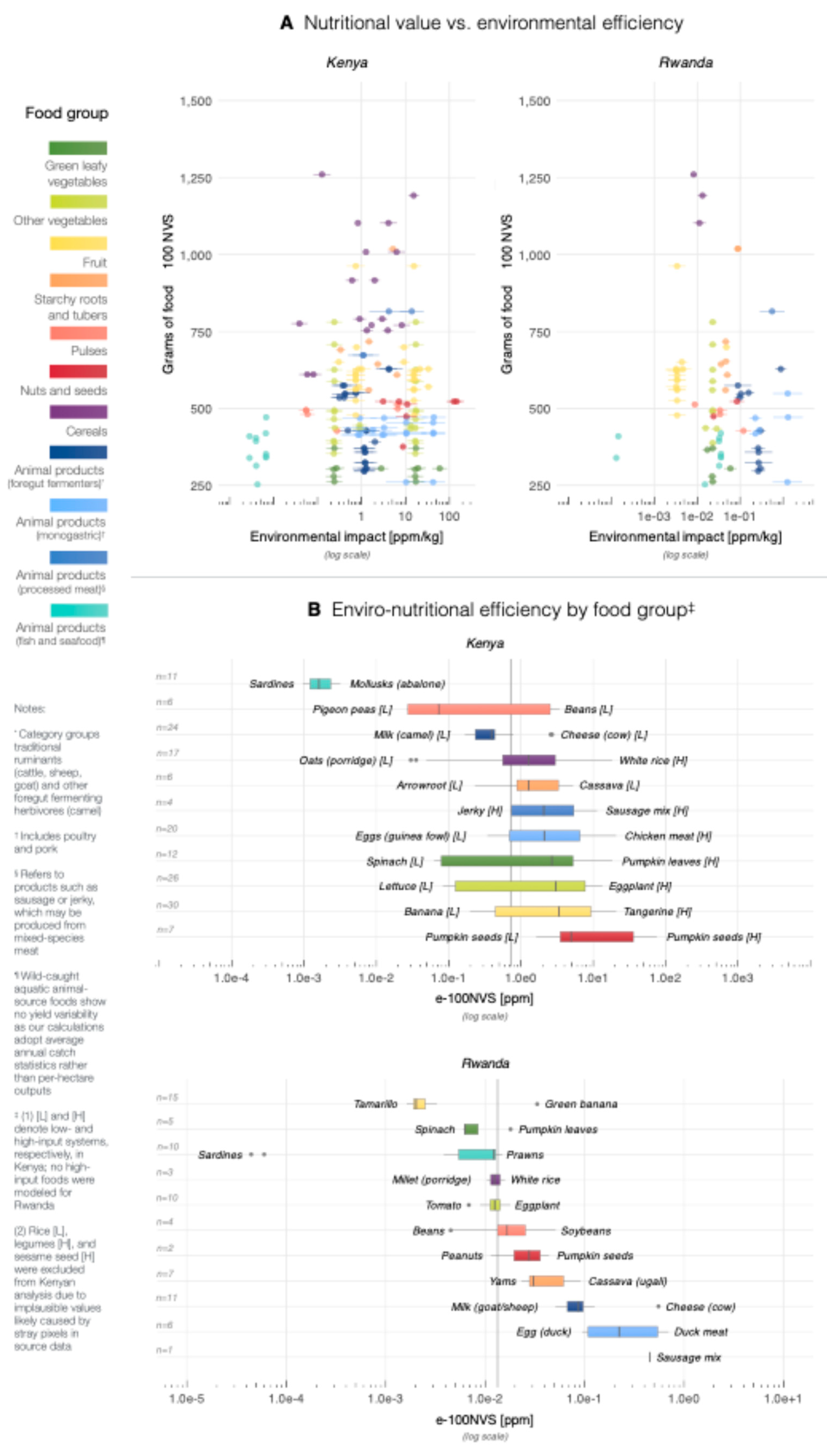
Figure 2.
Inter-provincial variations in locally produced foods are considerable despite similar patterns in how environmental impact categories contribute relatively to national scores. (A) Kenya’s 47 counties were aggregated to eight former provincial boundaries to improve model accuracy, as uncertainties in underlying data could generate less reliable results at the county scale. The country’s western regions achieve the highest enviro-nutritional efficiencies. Water use and GHG emissions dominate overall impacts in most provinces, though species loss risk increases westward. (B) Rwanda’s provincial median e-100NVSs are less variable than Kenya’s and reflect generally greater efficiencies, with the Western province ranking marginally lower; species loss risk increases towards the north. Particulate matter plays a more prominent role than in Kenya. (C,D) Potential species loss, water use, and water pollution occur mainly during primary production and processing in both countries, while climate change, ocean acidification potential, and particulate matter show more heterogeneous patterns across supply chain stages.
Figure 2.
Inter-provincial variations in locally produced foods are considerable despite similar patterns in how environmental impact categories contribute relatively to national scores. (A) Kenya’s 47 counties were aggregated to eight former provincial boundaries to improve model accuracy, as uncertainties in underlying data could generate less reliable results at the county scale. The country’s western regions achieve the highest enviro-nutritional efficiencies. Water use and GHG emissions dominate overall impacts in most provinces, though species loss risk increases westward. (B) Rwanda’s provincial median e-100NVSs are less variable than Kenya’s and reflect generally greater efficiencies, with the Western province ranking marginally lower; species loss risk increases towards the north. Particulate matter plays a more prominent role than in Kenya. (C,D) Potential species loss, water use, and water pollution occur mainly during primary production and processing in both countries, while climate change, ocean acidification potential, and particulate matter show more heterogeneous patterns across supply chain stages.
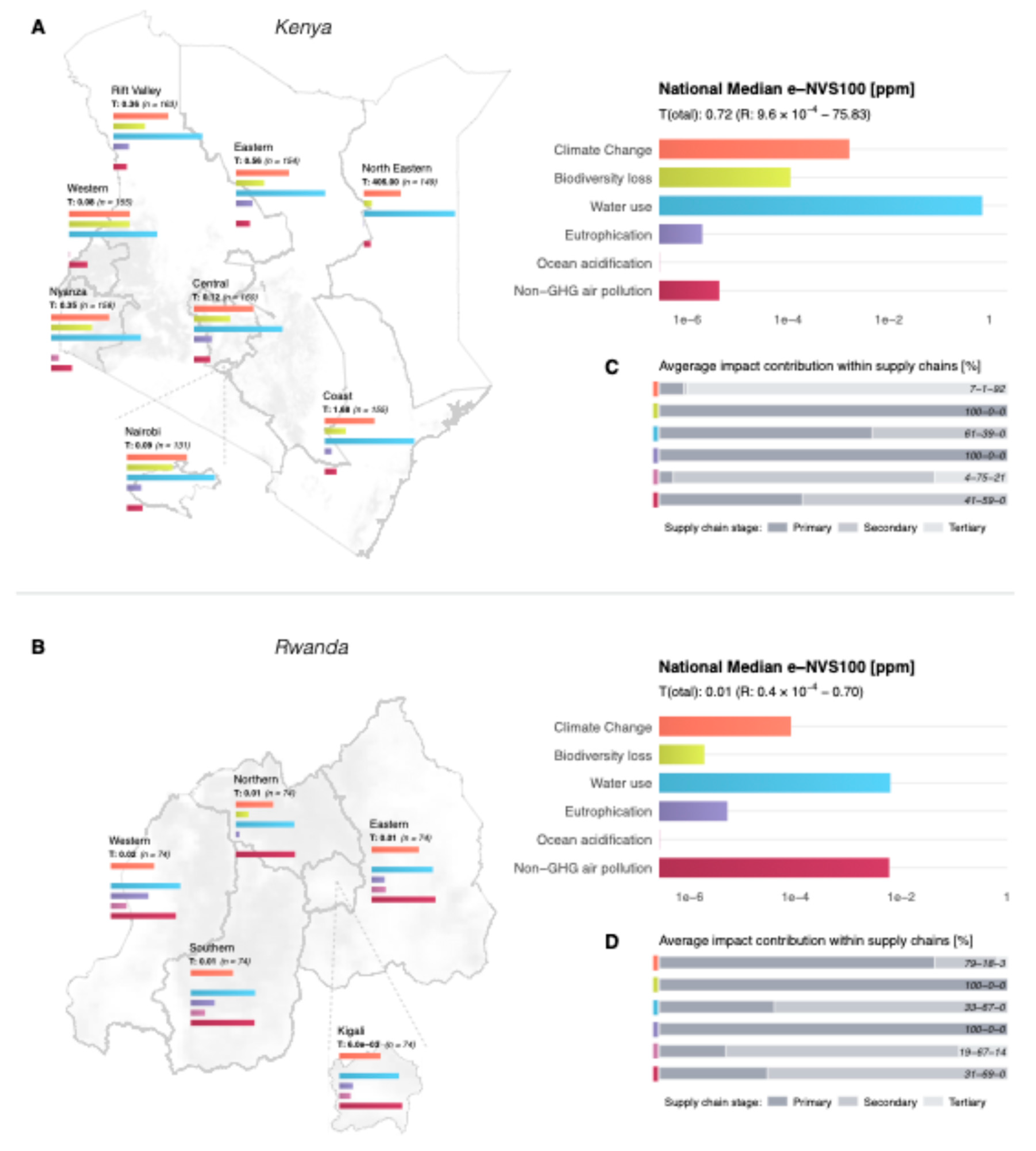
Figure 3.
Selected foods for Kenya, showing their e-100NVS, key ecosystem functions, and traditional culinary uses. Asterisks (*) refer to co-products from a common plant or animal. Key ecological functions include: (1) trees sequestering and storing carbon; (2) intercropped maize or maize with undersown cover crops, and vegetables, preventing soil erosion via root systems; (3) goats consuming dry vegetation, reducing wild fire risk; (4) trees regulating local water cycles by moderating soil moisture and water flow; (5) camels supporting seed dispersal; (6) legumes – when grown in rotation with other crops – disrupting pest life cycles; and (7) pumpkins as cover crops reducing erosion and suppressing weeds. A heatmap shows how each food deviates from the median e-100NVS of its respective food group by impact category.
Figure 3.
Selected foods for Kenya, showing their e-100NVS, key ecosystem functions, and traditional culinary uses. Asterisks (*) refer to co-products from a common plant or animal. Key ecological functions include: (1) trees sequestering and storing carbon; (2) intercropped maize or maize with undersown cover crops, and vegetables, preventing soil erosion via root systems; (3) goats consuming dry vegetation, reducing wild fire risk; (4) trees regulating local water cycles by moderating soil moisture and water flow; (5) camels supporting seed dispersal; (6) legumes – when grown in rotation with other crops – disrupting pest life cycles; and (7) pumpkins as cover crops reducing erosion and suppressing weeds. A heatmap shows how each food deviates from the median e-100NVS of its respective food group by impact category.
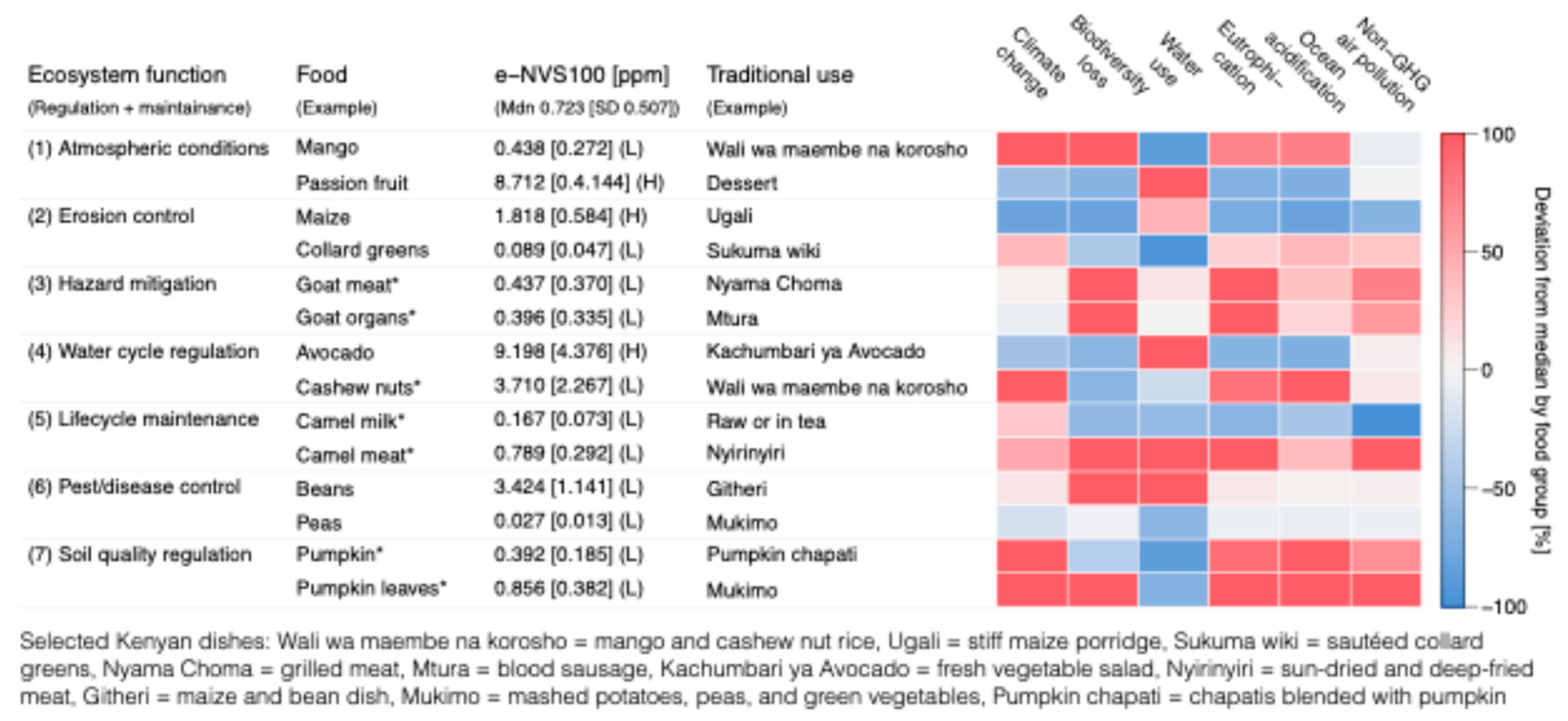
Figure 4.
Selected foods for Rwanda, showing their e-100NVS, key ecosystem functions, and traditional culinary uses. Asterisks (*) refer to co-products from a common plant or animal. Key ecological functions include: (1) legumes reducing soil nitrogen (N) emissions through N fixation; (2) trees and shrubs preventing soil erosion via root systems; (3) drought-resistant starchy roots and tubers providing resilience against weather hazards; (4) trees regulating local water cycles by moderating soil moisture and water flow; (5) flowering vegetables supporting pollinators; (6) poultry controlling weeds and pests (insects); and (7) livestock manure enhancing soil fertility. A heatmap shows how each food deviates from the median e-100NVS of its food group by impact category.
Figure 4.
Selected foods for Rwanda, showing their e-100NVS, key ecosystem functions, and traditional culinary uses. Asterisks (*) refer to co-products from a common plant or animal. Key ecological functions include: (1) legumes reducing soil nitrogen (N) emissions through N fixation; (2) trees and shrubs preventing soil erosion via root systems; (3) drought-resistant starchy roots and tubers providing resilience against weather hazards; (4) trees regulating local water cycles by moderating soil moisture and water flow; (5) flowering vegetables supporting pollinators; (6) poultry controlling weeds and pests (insects); and (7) livestock manure enhancing soil fertility. A heatmap shows how each food deviates from the median e-100NVS of its food group by impact category.
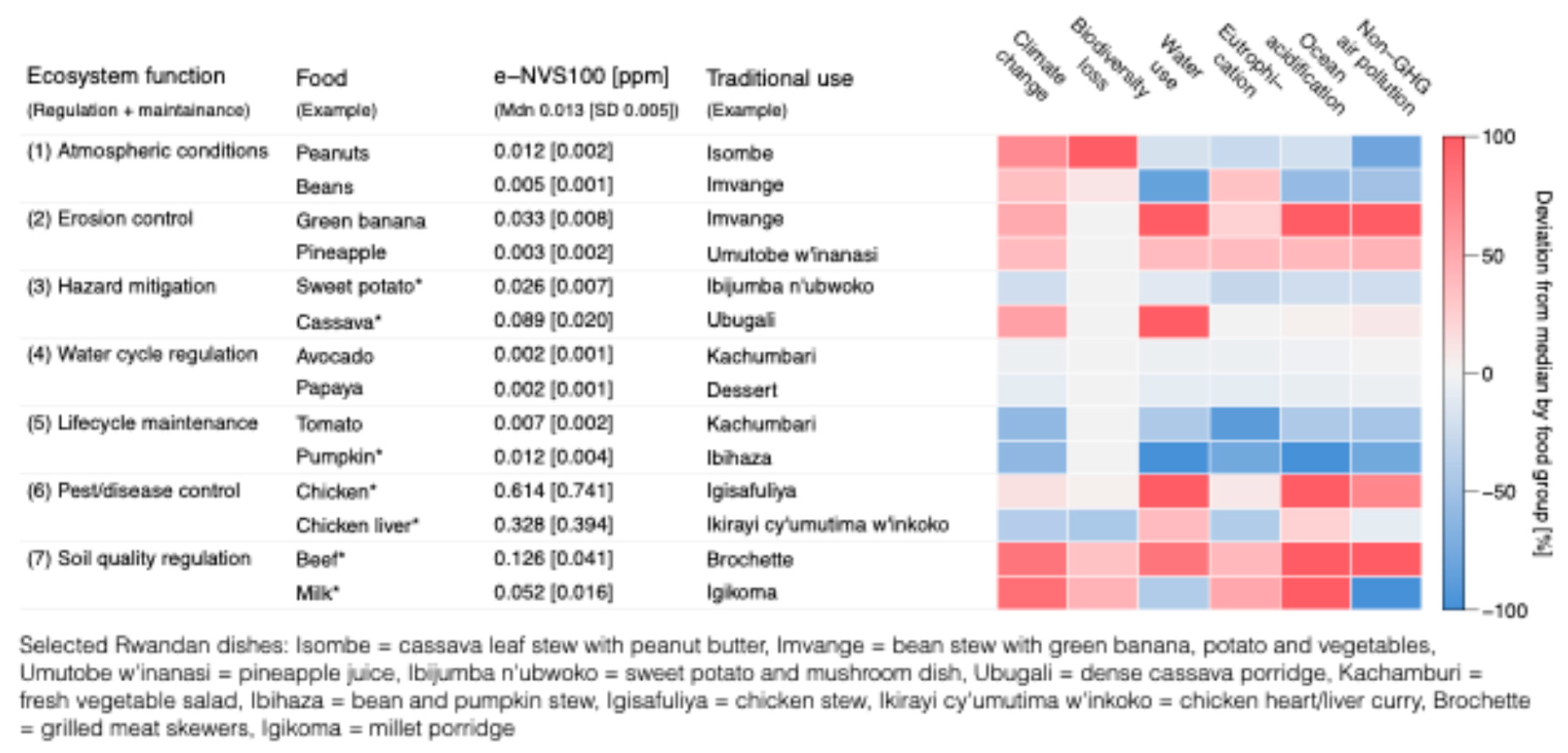

Table 1.
Environmental impact categories assessed with LENS, with characterization and normalization approach. Full references for characterization methods and normalization thresholds are provided in Supplementary Appendix 1.
Table 1.
Environmental impact categories assessed with LENS, with characterization and normalization approach. Full references for characterization methods and normalization thresholds are provided in Supplementary Appendix 1.
| Impact Category | Indicator | Characterization Method | Normalization Reference |
|---|---|---|---|
| Climate change | CO₂-equivalent emissions [kg CO₂ eq] | IPCC AR6 GWP100 (IPCC 2019) | National Nationally Determined Contribution (NDC) targets by sector1 (Govt. of Kenya 2023, Govt. of Rwanda 2025) |
| Water use2 | Freshwater consumption (irrigation, capillary rise, processing) [m³] | Volumetric accounting | Renewable freshwater availability adjusted for river basin-level water stress (WaterGAP 2.2e, Aqueduct 4.0) |
| Eutrophication potential | N and P emissions to water as phosphate equivalent [kg PO₄ eq] | River basin-based fate factors (Payen et al. 2021, Cosme et al. 2017) | Provincial N (terrestrial) boundary (Schulte-Uebbing et al. 2023); regional N budget (marine) and P boundary (UNEP 2008, Richardson et al. 2023) |
| Ocean acidification potential | Proton release potential [mol H⁺ eq] | Gas-specific conversion factors (Bach et al. 2016) | Planetary boundary (Findlay et al. 2025) |
| Biodiversity loss3 | Potential species loss as potentially disappeared fraction [PDF] | Ecoregion/region-/biome-specific characterization (Chaudhary and Brooks 2018, Hélias et al. 2023; Azevedo et al. 2013) | Planetary boundary for species extinction rate (Richardson et al. 2023) |
| Non-GHG air pollution | Particulate matter emissions: PM2.5 and PM10 emissions [g] | Country-specific emission factors by energy source (EEA/EMEP 2023, IEA 2025) | WHO (2021) air quality guidelines, converted to national annual load via land area and planetary boundary height |
1 GHG emissions were corrected for baseline biogenic methane levels (1990) to improve accuracy when benchmarked against global warming targets as defined in the Paris Agreement. 2 Blue water (irrigation, capillary rise, processing) and green water (precipitation) use are calculated separately; only blue water is included in the normalization, as no agreed sustainability boundary exists for green water yet. 3 Species loss integrates potential disappeared fractions (PDF) from land use change (2000-2020), terrestrial acidification, and biotic resource depletion from fisheries.
Disclaimer/Publisher’s Note: The statements, opinions and data contained in all publications are solely those of the individual author(s) and contributor(s) and not of MDPI and/or the editor(s). MDPI and/or the editor(s) disclaim responsibility for any injury to people or property resulting from any ideas, methods, instructions or products referred to in the content. |
© 2026 by the authors. Licensee MDPI, Basel, Switzerland. This article is an open access article distributed under the terms and conditions of the Creative Commons Attribution (CC BY) license.
Copyright: This open access article is published under a Creative Commons CC BY 4.0 license, which permit the free download, distribution, and reuse, provided that the author and preprint are cited in any reuse.