
Preprint
Technical Note

This version is not peer-reviewed.

AI4EVER: A Graphical Deep Learning Platform for GWAS-Informed Genomic Prediction

Submitted:

11 March 2026

Posted:

12 March 2026

Read the latest preprint version here

Abstract

Summary: The potential of deep learning (DL) in genomic selection (GS) is constrained by the significant technical expertise required to design and implement neural networks. While DL has revolutionized fields like language processing and structural biology, its application in GS has not yet consistently outperformed traditional models like mixed linear models. The key to unlocking DL's power in GS lies in the exploration of network architectures tailored to genomic data, a process that demands intensive programming and poses a barrier for many researchers. To overcome this challenge, we developed Artificial Intelligence for Efficient and Versatile Evaluation and Representation (AI4EVER), a freely available graphical software platform that enables users to explore and apply machine learning (ML) models without any coding. AI4EVER integrates a graphical user interface (GUI) with a Python-based ML backend. The platform currently supports five models: Ridge Regression, Random Forest, Gradient Boosted Decision Trees, Multi-Layer Perceptron, and a customizable Keras-based neural network that can simultaneously predict multiple traits in a single model. A key feature of AI4EVER is optional incorporation of genome-wide association study (GWAS) results (p-values) as feature weights during model training, enabling biologically informed DL workflows. The platform further provides real-time visualization of model performance metrics and automated feature-importance outputs to enhance interpretability. AI4EVER also separates model training and prediction workflows, allowing trained models to be reused for independent prediction datasets. Using a representative maize dataset, we demonstrate that AI4EVER enables access to advanced AI, empowers genomic researchers to accelerate data-driven decision-making in breeding programs, ultimately lowering the barrier to artificial intelligence-enabled genetic improvement in crops and animals and human health management.

Keywords: 
;  ;  ;  ;  ;  ;  ;  

1. Introduction

Predicting genetic merit of individuals is fundamental in plant and animal breeding as well as human health management. When genome-wide genetic markers became available, the mixed linear model was adapted in 1994 to obtain the genomic best linear unbiased prediction (gBLUP) using all markers to derive the relationships among individuals in maize (Bernardo 1994). In 2001, the effects of genetic markers were summed under a Bayesian framework to perform genomic selection (GS) in simulated data (Meuwissen, Hayes and Goddard 2001). In 2011, neural networks (now widely referred to as deep learning, DL) were first applied to predict both additive and non-additive genetic effects in cattle and wheat (Gianola et al. 2011), one year earlier than the introduction of AlexNet, which used convolutional neural networks for image classification and triggered the explosive growth of artificial intelligence (Krizhevsky et al. 2012).
The remarkable success of neural networks has been demonstrated across many domains, including AlphaGo defeating the world Go champion (Silver et al. 2016), Nobel Prize-winning AlphaFold achieving atomic-level accuracy in 3D protein structure prediction (Jumper et al. 2021), and large language models (LLMs) such as ChatGPT (Achiam et al. 2023), DeepSeek (Liu et al. 2024), and Gemini (Gemini Team et al. 2023) becoming part of daily life. A critical factor underlying these breakthroughs is that their hidden layers are informed by rich domain-specific knowledge and structural relationships—for example, convolutional operations that establish relationships among layers in AlexNet, hundreds of features provided for each amino acid sequence in AlphaFold, and thousands of features provided for each token in LLMs. In contrast, applications of neural networks to genomic prediction have so far shown only modest or no consistent improvements over conventional statistical methods (Bellot et al. 2018). The underlying causes and potential solutions were comprehensively reviewed by Montesinos-López et al. (2021).
Besides challenges related to data scale and neural network modeling, the review concluded that accessible computing platforms are critical to enable a vast number of researchers to explore the potential of DL in GS. DL-based GS workflows often require substantial programming expertise, manual hyperparameter tuning, and custom scripting, creating a significant barrier for breeders and applied researchers. In addition, most current DL implementations rely on code that users must develop and maintain themselves, which limits reproducibility and hinders routine application. Consequently, there is a clear need for accessible graphical software that integrates classical ML and DL approaches into GS workflows while preserving methodological rigor and interpretability.
To address these challenges, we (1) enlarged the effective data scale by jointly modeling multiple traits in a single neural network, with the first hidden layer containing trait-indicator nodes, (2) informed the second layer of the network using GWAS results and prior literature in a manner similar to AlphaFold and LLMs, and (3) developed Artificial Intelligence for Efficient and Versatile Evaluation and Representation (AI4EVER), a graphical software platform for GS. AI4EVER delivers a complete end-to-end GS workflow through an intuitive graphical user interface, enabling users to explore, train, evaluate, and apply ML and DL models without writing code. A distinctive feature is its optional integration of GWAS p-values as feature weights during training, which allows biologically informed neural network architecture. By lowering technical barriers and incorporating interpretability and model customization, AI4EVER aims to accelerate the broader adoption of DL in GS.

2. GWAS-Informed Neural Networks

In neural networks for genomic prediction, the first layer consists of genetic markers as input and the last layer consists of phenotypes as output. To simultaneously handle multiple traits, trait-indicator nodes are included in the first layer, thereby enlarging the effective data scale. To reduce the burden of training to resolve all parameters related to the hidden layers, we propose to use GWAS results and literature knowledge to inform the second layer. We designate this layer as representing the genes underlying phenotypes. The biases of nodes in the second layer are related to pleiotropy across multiple traits. The weights are related to the total association signals across traits. Additional phantom gene nodes are allowed as placeholders for genes that are not identified by the GWAS results or existing literature. The initial weights and biases related to GWAS results and literature are subject to update during training (the arrow from D to F in Figure 1G).

3. Software Design

AI4EVER uses a modular architecture that separates the graphical user interface from the computational backend. The frontend is developed using Swift and SwiftUI, providing a native macOS application with a responsive layout and intuitive controls. The graphical interface manages data input, model configuration, workflow execution, and visualization (Figure 1A). The backend is implemented in Python and integrates widely used ML and DL libraries, including scikit-learn and TensorFlow/Keras. This architecture allows AI4EVER to maintain a lightweight user-facing interface while delegating computational tasks to a robust and extensible backend. Communication between the frontend and backend enables real-time progress updates, visualization of training metrics, and logging of results.
AI4EVER separates model training and prediction. During training, genotype data (Figure 1D) and phenotype data are used to train models and evaluate model performance through cross-validation (Figure 1C). Trained models can be saved and reused for prediction on independent datasets.

4. Modeling and Training

AI4EVER supports a range of classical ML and DL models commonly used in GS, allowing users to compare approaches within a unified framework. Linear models such as RR-BLUP and related ridge regression approaches (RIDGE) are provided as baselines due to their widespread use and interpretability in GS. Tree-based methods, including random forest (RF) and gradient boosted decision trees (GBDT), are included to capture nonlinear relationships and marker interactions (Figure 1B). For DL, AI4EVER integrates multilayer perceptron (MLP) models and a customizable Keras-based neural network (KERAS) that jointly models multiple traits by incorporating trait-indicator nodes in the first layer. Users can define network architectures and training parameters through the graphical interface, enabling exploration of DL models without writing code (Figure 1F).

5. Prediction, Visualization, and Interpretation

AI4EVER provides built-in visualization tools for monitoring model performance and interpreting results (Figure 1G). Real-time plots display prediction accuracy metrics, during training and evaluation, including correlation and root mean square error (RMSE). Feature importance outputs are generated automatically for supported models, allowing users to examine the contribution of individual markers in the form of Manhattan plots (the arrow from F to D in Figure 1).

6. Case Study

We demonstrate an application of AI4EVER using a maize dataset of 282 inbred lines. Genotypes of 3093 SNPs and phenotypes of three traits (flowering time, ear diameter, and ear height) were used to train classical ML models and DL models. Cross-validation was conducted to assess predictive performance. Across models, DL approaches achieved prediction accuracies comparable to those of classical linear models, particularly when GWAS-informed feature weighting was incorporated. Tree-based models benefited from GWAS-based marker prioritization, while neural networks showed improved convergence and stability when prior biological information was incorporated

7. Limitations and Conclusions

By combining graphical usability, DL capability, GWAS-informed modeling, and built-in interpretability, AI4EVER addresses key barriers to applying DL in GS, including data scale, modeling, and software. Although the case study did not demonstrate the superiority of GWAS informed DL over the classical approaches, AI4EVER provides a powerful platform that enables researchers to explore the potential of DL on larger data scales or even develop new neural network architecture that could trigger the “AlexNet moment” in genomic prediction.

Funding

This work was partly supported by the Endowment of Washington Grain Commission and National Science Foundation (2520271).

References

  1. Achiam, J; Adler, S; Agarwal, S; et al. Gpt-4 technical report. arXiv 2023, arXiv:2303.08774. [Google Scholar] [CrossRef]
  2. Bellot, P; de Los Campos, G; Pérez-Enciso, M. Can deep learning improve genomic prediction of complex human traits? Genetics 2018, 210, 809–19. [Google Scholar] [CrossRef] [PubMed]
  3. Bernardo, R. Prediction of maize single-cross performance using RFLPs and information from related hybrids. Crop Sci 1994, 34, 20–5. [Google Scholar] [CrossRef]
  4. Anil, R; Borgeaud, S; Alayrac, JB; Yu, J; Soricut, R; Schalkwyk, J; Dai, AM; Hauth, A; Millican, K; Silver, D.; Team G. Gemini: a family of highly capable multimodal models. arXiv 2023, arXiv:2312.11805. [Google Scholar] [CrossRef]
  5. Gianola, D; Okut, H; Weigel, KA; et al. Predicting complex quantitative traits with Bayesian neural networks: a case study with Jersey cows and wheat. BMC Genet 2011, 12, 87. [Google Scholar] [CrossRef] [PubMed]
  6. Jumper, J; Evans, R; Pritzel, A; et al. Highly accurate protein structure prediction with AlphaFold. Nature 2021, 596, 583–9. [Google Scholar] [CrossRef] [PubMed]
  7. Krizhevsky, A; Sutskever, I; Hinton, GE. Imagenet classification with deep convolutional neural networks. Adv Neural Inf Process Syst 2012, 25. [Google Scholar] [CrossRef]
  8. Liu, A; Feng, B; Xue, B; et al. Deepseek-v3 technical report. arXiv 2024. arXiv:241219437.
  9. Meuwissen, TH; Hayes, BJ; Goddard, ME. Prediction of total genetic value using genome-wide dense marker maps. Genetics 2001, 157, 1819–29. [Google Scholar] [CrossRef] [PubMed]
  10. Montesinos-López, OA; Montesinos-López, A; Pérez-Rodr\’\iguez, P; et al. A review of deep learning applications for genomic selection. BMC Genomics 2021, 22, 19. [Google Scholar] [CrossRef] [PubMed]
  11. Silver, D; Huang, A; Maddison, CJ; et al. Mastering the game of Go with deep neural networks and tree search. Nature 2016, 529, 484–9. [Google Scholar] [CrossRef] [PubMed]
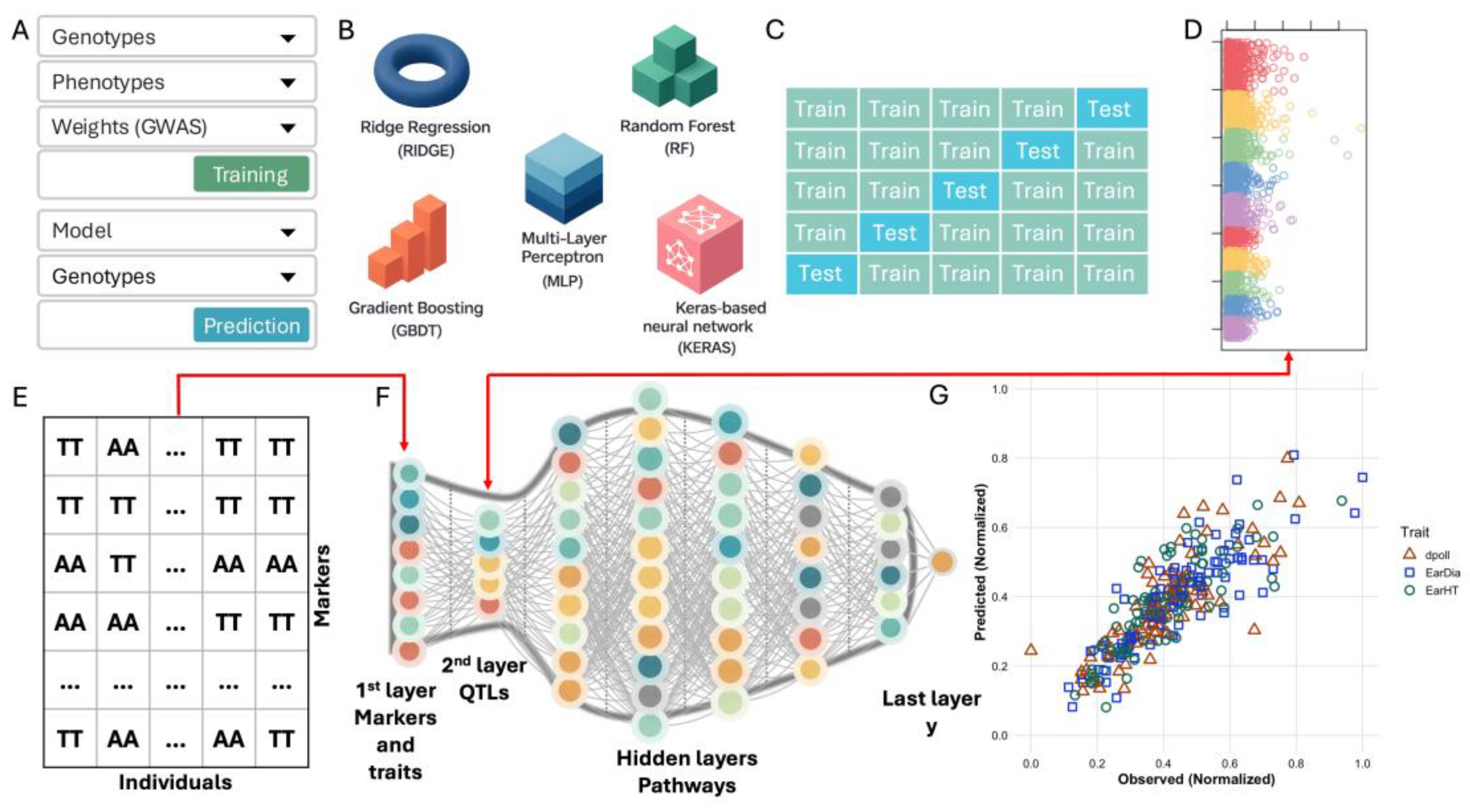
Figure 1. Workflow of the AI4EVER platform. (A) Graphical user interface enabling data import, model selection, training, and prediction. It is optional to incorporate GWAS-derived feature weights. (B) Five models are currently implemented for user selection. (C) Model validation is conducted using k-fold (default is 5) cross-validation. (D) Conceptual illustration of GWAS-informed model training, where prior association signals are used to weight genomic features during training. (E) Genotype matrix where the markers serve as the first layer in neural networks. (F) Illustrative neural networks where the number of hidden layers and number of nodes in each layer may vary. (G) Integrated output visualization showing alignment of observed and predicted phenotypes.
Preprints 202502 g001
Disclaimer/Publisher’s Note: The statements, opinions and data contained in all publications are solely those of the individual author(s) and contributor(s) and not of MDPI and/or the editor(s). MDPI and/or the editor(s) disclaim responsibility for any injury to people or property resulting from any ideas, methods, instructions or products referred to in the content.
Copyright: This open access article is published under a Creative Commons CC BY 4.0 license, which permit the free download, distribution, and reuse, provided that the author and preprint are cited in any reuse.