

Submitted:
10 March 2026
Posted:
11 March 2026
You are already at the latest version
Abstract
Against the backdrop of accelerating low-carbon transformation in the global energy system and decarbonization in the transportation sector, the widespread adoption of electric vehicles has intensified grid load imbalances and highlighted challenges in integrating intermittent renewable energy generation. Vehicle-to-Grid (V2G) technology has emerged as a key solution to these challenges. This paper systematically traces the global evolution of V2G technology from conceptualization to large-scale deployment, focusing on localized practices in China's scaled V2G applications. It dissects the logic behind policy evolution, identifies three distinct Chinese V2G models-centralized, distributed and battery-swapping, and validates the practical outcomes of representative pilot projects. Research reveals three core constraints hindering China's large-scale V2G adoption: the absence of battery capacity degradation management mechanisms, fragmented standardization systems, and rigid market mechanisms. Based on this, the paper proposes recommendations for scaling V2G in China across three dimensions: power battery second-life utilization, standardization system construction, and market mechanism optimization. Furthermore, aligning with the global demand for large-scale V2G implementation, this paper proactively proposes innovative market models. These include establishing a coordinated trading mechanism between green power and V2G, developing a digitally driven distributed trust and transaction system, and exploring financialization and risk hedging models for battery assets. These concepts provide theoretical foundations and decision-making references for achieving high-quality, large-scale V2G applications worldwide.
Keywords:
electric vehicles
; V2G technology
; research progress
; Chinese practice
1. Introduction
Since the Industrial Revolution, fossil fuel-dominated energy consumption has driven the continuous rise in global carbon emissions.As a carbon-intensive sector heavily reliant on oil and notoriously difficult to abate, transportation has emerged as a focal point in global climate governance [1].The latest data released by the International Energy Agency (IEA) in 2024 indicated that carbon emissions from fossil fuel consumption account for over 80% of global carbon emissions, while transportation sector emissions exceed 20% of the global total [2], primarily from fuel-powered vehicles. Against this backdrop, accelerating energy substitution and decoupling transportation from fossil fuel dependence has become a global strategic imperative. Electric vehicles (EVs), whose carbon footprint is intrinsically linked to the electricity generation mix, offer a pathway toward deep decarbonization. As the share of clean energy sources like wind and solar power continues to grow within the electricity system, EVs can achieve near-zero carbon emissions over their entire life-cycle, making them the optimal solution for deep decarbonization in the transportation sector [3,4]. Over the past decade, the EV industry has undergone leapfrog development.According to data from the International Energy Agency (IEA), the global electric vehicle fleet reached 58 million units in 2024, with annual sales exceeding 17 million units—a year-on-year increase of approximately 25%. Market share surpassed 20% for the first time, and the global electric vehicle fleet is projected to exceed 85 million units in 2025 [2]. Within this global trajectory, China has consistently spearheaded the market. In 2024, China’s electric vehicle sales exceeded 11 million units, equivalent to the total global electric vehicle sales in 2022. By the end of June 2025, China’s new energy vehicle stock reached 36.89 million units, accounting for 10.3% of the country’s total vehicle fleet. Among these, pure electric vehicles numbered 25.539 million, representing 69.2% of the total new energy vehicle stock. all figures setting new historical records [5]. Figure 1 illustrates the evolution of global annual electric vehicle sales from 2014 to 2024.
However, the surging penetration of EVs poses a formidable challenge to the hosting capacity and regulatory stability of existing power systems. Currently, the large-scale deployment of EVs has introduced a sustained demand for high-power charging, leading to an increasingly acute contradiction between the stochastic spatial-temporal distribution of charging loads and the rigid constraints of regional grid infrastructure [6]. Uncoordinated charging behavior not only widens the peak-to-valley load gap—thereby exacerbating the operational strain on distribution transformers and elevating the risk of overloads, but also compromises grid security and inflates operation and maintenance costs, Consequently, utilities are compelled to increase investments in emergency reserves and peak-shaving resources, resulting in significant capital redundancy. Furthermore, as intermittent renewable sources such as photovoltaic and wind energy integrate into the mix, because of governed by stochastic natural conditions, their output exhibits pronounced volatility [7]. To mitigate the weather-dependent nature of renewables, the deployment of energy storage systems (ESS) has become imperative. By leveraging their compensatory and regulatory functions to smooth generation-side fluctuations, ESS can substantially enhance the operational stability and dispatch flexibility of the integrated power system [8].
Vehicle-to-Grid (V2G) technology has emerged as a pivotal solution to these systemic challenges. Driven by advancements in battery energy density, conversion efficiency, and grid-vehicle communication protocols, electric vehicles are transcending their conventional role as mere transportation assets. They are increasingly being redefined as mobile distributed energy storage units capable of providing flexible regulation and fostering deep integration within modern power systems [9,10]. By deploying bidirectional smart charging infrastructure, V2G technology unlocks the latent storage potential of EV batteries during idle periods. This is primarily operationalized by absorbing surplus electricity during off-peak hours and injecting power back into the grid during peak demand or periods of supply scarcity [11].This bidirectional paradigm, characterized by “peak shaving and valley filling,” not only mitigates the load strain induced by large-scale charging but also provides a vital buffer for intermittent renewables. By facilitating the integration of wind and solar power and mitigating curtailment, V2G enhances the utilization of clean energy and reduces fossil fuel dependency [12], thereby accelerating the transition toward a low-carbon energy architecture. Simultaneously, V2G creates market-based revenue streams for EV owners. While prioritizing mobility requirements, owners can leverage a price-arbitrage model—charging at lower off-peak rates and discharging when prices peak [13]. To secure economic returns. Such market incentives provide a sustainable mechanism for the widespread adoption of V2G technology. Figure 2 illustrates the fundamental operating principle of V2G technology.
The large-scale integration of V2G technology has emerged as a focal point in energy and power system research [14]. Current grid-side studies emphasize coordinated dispatch within microgrids and virtual power plant (VPP) frameworks [15,16,17]. These efforts leverage machine learning to enhance load forecasting granularity [18], and employ multi-objective optimization to balance operational efficiency with user-centric demands [19]while simultaneously exploring pathways for power quality improvement and distribution network economics. On the user side, research focuses on demand response models, both price-based and incentive-based, to harmonize grid stability with consumer benefits. Regarding storage systems, extensive literature delves into the degradation mechanisms of batteries under frequent cyclings [20,21], proposing mitigation strategies such as State-of-Charge and Depth-of-Discharge control, alongside advanced thermal management systems [22]. considerable attention is being paid to the second-life application value of retired batteries to maximize their life-cycle utility across diverse energy scenarios [23,24].Despite this progress, the large-scale deployment of V2G faces multi-dimensional impediments. First, fragmented technical standards and divergent regional protocols restrict device interoperability and system compatibility. Second, concerns regarding accelerated battery aging remain a significant barrier for users, exacerbated by a lack of mature warranty frameworks and risk-mitigation instruments. Third, sub-optimal revenue-sharing models and the high capital expenditure of bidirectional charging hardware create persistent economic bottlenecks. Fourth, V2G communication and data privacy require robust, high-efficiency security solutions that minimize computational overhead. Finally, the precision of current load forecasting remains insufficient for capturing the stochastic complexities of user behavior in real-world scenarios [25,26] .
Against this backdrop, an in-depth exploration of pathways for large-scale V2G deployment offers far-reaching benefits. Beyond providing flexible ancillary services and diversified revenue streams for grid operators, it fosters innovative business models for emerging market intermediaries, such as load aggregators, through battery second-life services and power trading brokerage. Furthermore, robust mechanisms for peak-valley arbitrage and ancillary service revenue sharing can generate tangible economic returns for users, thereby alleviating adoption barriers and incentivizing participation. This transition is poised to catalyze a synergistic technological upgrade across the entire industrial value chain, encompassing intelligent bidirectional charging/swapping infrastructure, advanced battery management systems, and standardized communication protocols, while simultaneously revitalizing the power ancillary services market. Consequently, research in this domain carries profound theoretical and practical significance for accelerating the global transportation revolution and the broader transition toward sustainable energy systems [27] .
This study establishes a progressive analytical framework, transitioning from global trajectory analysis to the deconstruction of local practices, followed by bottleneck identification and pathway exploration. First, by conducting a longitudinal analysis of global V2G evolution—spanning its theoretical inception in 1997 to the large-scale deployment phase post-2021—this research delineates distinct patterns of technological maturation and policy orientation. Subsequently, focusing on China’s domestic landscape, a penetrative assessment of policy evolution since 2015 distills three primary interaction paradigms: centralized, distributed, and battery-swapping-based V2G. For each paradigm, representative pilot projects were selected to empirically evaluate their energy interaction performance and techno-economic viability. Guided by these empirical findings, the study posits that the current large-scale promotion of V2G is undergoing a paradigm shift from technical validation toward systemic integration. First, The non-linear coupling between electrochemical battery degradation mechanisms and energy dispatch models defines the underlying cost boundaries of various interaction modes. Second, the lack of a unified technical architecture constitutes an external constraint that hinders wide-area resource aggregation and value unlocking. Third, The static nature of current electricity market mechanisms significantly constrains the realization of EV value as flexible demand-side resources, with existing incentive models falling short of supporting deep integration into higher-tier ancillary service markets.
The remainder of this paper is structured as follows. Section 1 systematically reviews the four evolutionary stages of global V2G technology from initial proof-of-concept to full commercialization, while identifying the critical technical bottlenecks and policy shifts across distinct historical periods. Section 2 focuses on the development of V2G in China, first dissecting the phased evolution of the national policy framework, followed by an in-depth analysis of three interaction paradigms uniquely tailored to the Chinese context. By scrutinizing operational data from representative pilot projects, this section identifies the structural challenges impeding large-scale implementation. Section 3 synthesizes the core findings and proposes a suite of strategic policy recommendations. These focus on three pivotal dimensions: battery life-cycle management, the restructuring of standardization systems, and the optimization of power market regulations, all aimed at fostering high-quality V2G integration. Finally, Section 4 adopts a macro perspective, exploring future evolutionary paradigms within the context of the Energy Internet and digital transformation, including green power collaborative trading, distributed trust mechanisms, and the financialization of battery assets.
2. Development History of V2G Technology Scaling
2.1. Conceptualization and Prototyping Phase (1997–2009)
The conceptual origin of V2G dates back to 1995, when it was first proposed by Amory Lovins, Chief Scientist at the Rocky Mountain Institute. The concept was subsequently formalized and refined through systematic research by Professor William Kempton’s team at the University of Delaware [28]. In 1997, a quantitative analysis of US. EVs usage data revealed that the average daily driving time accounted for only 4% of a vehicle’s life-cycle. Based on this stochastic availability, the team estimated that one million EVs could provide 50 GW of peak-shaving capacity—equivalent to 5% of the total U.S. peak load at the time. This seminal study first quantified the immense potential of idle EV batteries to provide ancillary grid services [29]. The transition from theoretical conceptualization to engineering implementation was marked by AC Propulsion’s development of the TZERO in 2001, the world’s first EV featuring bidirectional charging. Equipped with a lead-acid battery pack and a custom bidirectional inverter. The TZERO achieved 10 kW of power flow with an energy conversion efficiency of 75%–80% [30]. By 2005, Kempton’s team had further expanded the theoretical boundaries of V2G by delineating three viable vehicle categories: battery electric vehicles(BEVs), fuel cell vehicles(FCVs), and plug-in hybrid electric vehicles(PHEVs). They established the foundational mathematical framework for system power calculations [31]and demonstrated V2G’s dual role in stabilizing grid frequency and buffering intermittent renewable generation [32]. In 2007, the team successfully conducted the world’s first grid-connected V2G pilot. By integrating ten modified EVs into the grid dispatch architecture, they validated the technical viability of utilizing vehicle fleets to supply stable power during peak periods without compromising battery safety or vehicle performance [33]. Parallel research in 2009 by Dirk Uwe Sauer et al. in Germany highlighted V2G as a form of mobile energy storage (MES). This paradigm suggested that integrated EV control systems could partially substitute for stationary storage facilities, offering superior flexibility [34]. During this period, industry leaders like Toyota and Siemens also initiated laboratory simulations focused on coordinated control mechanisms within distribution networks. Their work, primarily utilizing CAN bus-based bidirectional regulation, optimized voltage fluctuation algorithms and real-time battery monitoring, laying the groundwork for modern battery management and safety protocols [35].
The theoretical foundations and technical validations established during this phase delineated the initial application boundaries of V2G, catalyzing its emergence as a research hotspot.However, these early endeavors also exposed fundamental impediments deeply rooted in the industrial constraints of the era. These challenges primarily manifested across three dimensions: First, early EVs relied on lead-acid or first-generation lithium-ion chemistries, characterized by low energy density and inferior cyclic stability. Empirical studies from this period suggested that frequent bidirectional cycling could increase capacity fading by 10%-15% [36], thereby imposing a significant economic penalty on V2G participation. Second, he capital expenditure for bidirectional hardware was substantial; for instance, the inverters utilized in the University of Delaware’s 2007 pilot cost three to five times more than contemporaneous unidirectional chargers. This price disparity was driven by a heavy reliance on specialized imported components and a lack of economies of scale, which disincentivized sustained R&D investment from equipment manufacturers [37] .Third, The absence of unified global communication protocols and grid-interconnection standards during this period led to a heterogeneous technological landscape [38]. Research teams often deployed proprietary interfaces and ad-hoc communication schemes, resulting in poor interoperability across different vehicle brands and regional power systems, ultimately hindering the wide-area aggregation of V2G resources.
2.2. Policy Guidance and Pilot Implementation Phase (2010–2015)
Between 2010 and 2015, V2G technology gained global strategic recognition as governments began integrating it into broader energy transition and grid modernization agendas. This period was characterized by the deployment of targeted policy incentives and diversified pilot projects to catalyze commercial growth. In 2010, California became a pioneer by enacting legislation that mandated the California Public Utilities Commission to establish energy storage standards. This framework formally codified V2G as a viable storage technology, setting ambitious two-phase installation targets for 2015 and 2020 [39]. To further incentivize adoption, California introduced a robust time-of-use pricing mechanism in 2011, widening the peak-to-valley price differential to over $0.3/kWh to facilitate price-arbitrage through V2G services [39,40].Simultaneously, European nations accelerated their R&D investments. Denmark introduced a subsidy program in 2012 offering up to 40% funding for core V2G technologies [41], while the Netherlands’ 2013 Smart Grid Action Plan designated V2G as a strategic priority, establishing ten dedicated pilot zones [42]. A landmark institutional breakthrough occurred in 2014 with the release of the ISO-15118 series, which defined the communication protocols and architectural requirements for V2G, providing the necessary foundation for global interoperability [43]. Underpinned by these policies, several high-impact pilot projects validated V2G’s multi-scenario utility. In 2012, the University of Delaware and PJM Interconnection launched the EV2G project, the world’s first commercial pilot demonstrating V2G participation in frequency regulation markets. This initiative empirically confirmed V2G’s superiority in response time and operational cost-effectiveness [44]. Japan launched the “Leaf to Home” pilot project in 2012, leveraging emergency power supply needs following the 2011 Fukushima nuclear accident. Utilizing 250 Nissan Leaf electric vehicles, the project provided emergency power to affected households in Fukushima Prefecture, significantly enhancing public acceptance and recognition of V2G technology’s value in emergency scenarios [45] .In 2013, Denmark launched the Parker Project pilot, delivering frequency regulation services across multiple regional power markets for over three years. This successfully validated V2G technology’s integration into existing electricity market mechanisms [46]. In 2015, the Netherlands conducted a residential community V2G pilot in Amsterdam, focusing on exploring commercial operation models on the consumer side. This provided a practical reference for V2G technology projects targeting residential adoption and promotion [47].
V2G research in China initiated relatively late, with early government support primarily focused on strategic alignment with the national energy structure, grid topology, and environmental mandates. During this period, large-scale pilot deployments were notably absent; instead, domestic research institutions prioritized theoretical frameworks and adaptability assessments, conducting extensive systematic explorations into the technology’s local feasibility [48]. While policy incentives and international pilots accelerated the field’s momentum, the fundamental barriers identified in the nascent phase, such as accelerated battery aging, high capital costs, and fragmented standardization, remained largely unresolved. Simultaneously, the structural incompatibility of existing grid infrastructure with V2G operations became increasingly evident. Most national distribution networks are designed with unidirectional power flow in mind, centered on traditional transmission requirements with minimal provision for the stochastic fluctuations and dispatch complexities inherent in V2G. Furthermore, a widespread deficit in centralized control and coordinated dispatch capabilities for distributed V2G assets persists. From a consumer perspective, persistent anxieties regarding battery health and the volatility of economic returns have dampened the willingness of EVs owners to participate in interaction programs. This psychological and economic barrier has made it challenging for pilot initiatives to achieve the requisite scale for meaningful market penetration [49].
2.3. Market Exploration and Commercial Emergence Phase (2016–2020)
After 2016, propelled by the global surge in EV adoption and the rising penetration of renewables, V2G technology transitioned from experimental validation to a critical commercialization phase. Within this period, “peak-valley arbitrage” emerged as the primary commercial pathway, underpinned by intensified policy frameworks worldwide. Governments progressively refined time-of-use pricing to widen the spread between peak and off-peak rates, thereby enhancing the economic viability of V2G participation [50] .In 2018, the European Union released the “Clean Energy for all Europeans” package, which formally integrated V2G technology into its renewable energy support framework and mandated that member states finalize deployment roadmaps by 2020 [51]. Similarly, in 2019, California updated its AB 2514 regulations to extend energy storage subsidies to V2G projects for the first time, offering subsidies of up to $5,000 per bidirectional charging station [52]. During the same year, China accelerated its efforts by issuing the “Notice on Further Improving the Fiscal Subsidy Policy for Promoting New Energy Vehicles,” which explicitly advocated for the R&D and pilot implementation of vehicle-to-grid interaction to steer industrial growth [53]. Against this backdrop, diverse V2G technology business model pilot projects gradually unfolded worldwide. In 2016, Denmark scaled the 2013 Parker Project, expanding its fleet from 10 to 50 electric buses across three Copenhagen transit hubs. By optimizing charging schedules under time-of-use pricing, each vehicle achieved an average daily energy throughput of 200 kWh, yielding annual revenues of approximately €29,000 per unit [46]. Similarly, in 2018, the UK launched the Powerloop project, a consortium involving Nissan, Octopus Energy, and the National Grid. This initiative deployed 500 Nissan Leaf EVs paired with 500 units of 22 kW bidirectional charging infrastructure. Operational analytics revealed that each vehicle absorbed 2.4 MWh of renewable energy annually, resulting in 1.8 tons of carbon mitigation and generating average annual arbitrage profits of approximately £800 for individual users [54]. Furthermore, in 2020, the UK inaugurated the world’s largest electric bus V2G project at London’s Northumberland Park depot. This flagship initiative integrated 100 zero-emission electric buses with a high-capacity 150 kW bidirectional charging network. This large-scale deployment demonstrated the potential for significant revenue streams, achieving an average daily return of £120 per vehicle. These empirical results underscore that when V2G is applied to commercial fleets with high utilization rates and predictable duty cycles, it transcends experimental validation to become a financially viable grid-resource asset [55].
The full demonstration of V2G’s commercial potential during this stage is primarily attributable to breakthrough advancements in core technological domains. Continuous iterative improvements in battery chemistry have pushed energy densities to the 150-200 Wh/kg range, with cycle lives now exceeding 1,500. Notably, through optimized Depth of Discharge control, the marginal battery degradation attributed to V2G interactions can be mitigated to below 3.0%, a level that renders its impact on State-of-Health virtually negligible compared to conventional usage patterns [56]. Concurrently, the global EV market’s exponential growth has catalyzed the maturation of the upstream and downstream supply chains, fostering significant economies of scale. The shift toward mass production of bidirectional power electronics has substantially reduced capital expenditures. A landmark institutional achievement occurred in 2019 when the ISO/IEC Joint Working Group released the ISO-15118-20 standard. This update not only resolved the legacy interoperability conflicts between competing interfaces like CHADEMO and CCS but also established a unified global communication architecture for bidirectional power flow [57]. Despite these technological strides, the widespread commercialization of V2G remains hindered by systemic challenges. These primarily manifest as stakeholder incongruence, where conflicting interests among national utilities, energy service aggregators, and regulatory bodies complicate revenue-sharing and cost-allocation frameworks. Furthermore, global consumer awareness remains suboptimal. The lack of user-centric management tools and the presence of cumbersome participation protocols continue to create friction, ultimately dampening the enthusiasm of EV owners to integrate their assets into the grid ecosystem.
2.4. Scalable Deployment and Commercialization Phase (2021–Present)
Since 2021, the global energy transition has entered an accelerated trajectory. Within the context of decarbonized power systems, V2G applications have expanded significantly, evolving into a critical pillar for the stability and resilience of modern grids. Consequently, the technology has transitioned into a phase of large-scale commercial deployment and comprehensive rollout [58]. In 2021, the European Union adopted the “Fit for 55” initiative, formally designating V2G as a pivotal decarbonization solution. The directive mandates that member states achieve a 50% penetration rate for bidirectional functionality in all new charging installations by 2030, rising to 100% by 2035[54].Following this lead, the UK released its Smart Charging and Vehicle-Grid Interaction Strategy in 2022, outlining a roadmap to deploy 5 million V2G-compatible vehicles and 1 million bidirectional stations by 2030, supported by a national unified dispatch platform. This strategy was complemented by the expansion of the Powerloop project to 1,000 vehicles, which now facilitates the annual absorption of 1.2 GWh of renewable energy and mitigates 800 tons of carbon emissions [59]. In 2023, California further incentivized participation by widening its time-of-use rate differential to $0.80/kWh and launching the “Electric School Bus V2G Program.” This initiative provides targeted subsidies to school bus operators, leveraging the predictable idle periods of these fleets to provide grid services. Concurrently, China has demonstrated robust development momentum, underpinned by its massive EV market and comprehensive industrial infrastructure. Driven by top-level strategic design and localized policy frameworks, a synergistic ecosystem for industry development, infrastructure expansion, and user engagement has matured. Key performance metrics of Chinese V2G technology have reached internationally competitive levels, with bidirectional power electronics achieving full domesticated production [60,61].
During this mature phase, V2G technology has achieved multidimensional breakthroughs, with commercial paradigms evolving toward large-scale deployment and global standardization. The market architecture for V2G has undergone significant refinement; most jurisdictions have now formally integrated V2G assets into their electricity market frameworks, establishing transparent market-access protocols and standardized transaction procedures. A robust incentive-compatible mechanism has been established among stakeholders, effectively aligning the interests of utilities, aggregators, and consumers. Leading Original Equipment Manufacturers and energy service providers have launched sophisticated V2G management platforms that leverage digital orchestration to simplify the user experience. Through intuitive mobile applications, users can engage in autonomous scheduling, real-time revenue tracking, and continuous battery health monitoring. To further catalyze adoption, governments have optimized incentive structures by augmenting traditional pricing signals with targeted participation subsidies. These measures have collectively lowered the barriers to entry, fostering the critical mass required for a large-scale user base. In summary, V2G technology has successfully transitioned from an experimental proof-of-concept to a cornerstone of global sustainable energy systems. However, as market penetration deepens, the next frontier of development will encounter complex challenges regarding advanced standardization, next-generation technological bottlenecks, and the dynamic evolution of policy-market linkages. Figure 3 illustrates the longitudinal evolution of V2G technology toward large-scale deployment.
3. China’s Practice in Scaling V2G Technology
The transition from the “old three pillars” to the “new three pillars” serves as compelling evidence of the upward mobility of China’s manufacturing sector within the global industrial value chain [62]. As the flagship of these “new three pillars,” new energy vehicles (NEVs) have undergone a transformative evolutionary journey, progressing from initial technological breakthroughs and industrialization subsidies to market-driven expansion and the large-scale deployment of vehicle-grid integration. China’s NEV industry is fundamentally centered on electric vehicles. As the pivotal enabler for synchronizing electric vehicles with the power grid, V2G technology represents not only a strategic imperative for China to achieve a “leapfrog” advancement in the global automotive revolution but also a critical lever for realizing energy structure transformation and the national “dual carbon” goals. Figure 4 illustrates the evolution of China’s electric vehicle ownership and market penetration from 2019 to 2024.
3.1. Policy Evolution Related to V2G
Compared to Europe and the United States, China’s engagement with Vehicle-to-Grid technology began at a later stage, with initial efforts predominantly centered on theoretical frameworks and preliminary compatibility assessments. Systematic policy support began to coalesce in 2015. In October of that year, the General Office of the State Council issued the “Guiding Opinions on Accelerating the Construction of Electric Vehicle Charging Infrastructure,” which advocated for bidirectional energy and information exchange between electric vehicles and smart grids. This document effectively institutionalized smart charging services as a cornerstone of the national infrastructure development agenda [63]. A landmark shift occurred in November 2020 with the publication of the “New Energy Vehicle Industry Development Plan (2021–2035).” This was the first official document to explicitly define V2G technology within a national strategic context. It elevated the synergy between new energy vehicles and the power grid to a strategic priority, mandating intensified research into high-cycle-life battery chemistries and encouraging local authorities to initiate demonstration pilots. Furthermore, it established a comprehensive regulatory framework that utilized peak-valley pricing and charging incentives to optimize the efficiency of interaction [64]. The release of this policy document signifies V2G technology’s transition from conceptual models to practical exploration.
In January 2022, the National Development and Reform Commission (NDRC), in collaboration with other departments, issued the “Implementation Opinions on Further Enhancing the Service Guarantee Capability of Electric Vehicle Charging Infrastructure.” This directive catalyzed the transition toward operationalizing V2G by mandating accelerated testing, pilot demonstrations, and the development of a unified standardization system. Critically, it proposed for the first time the integration of new energy vehicles into electricity spot markets, marking a significant shift toward market-based interaction [65]. In May 2023, the NDRC and the National Energy Administration jointly released a subsequent directive focused on rural revitalization. This document mandates the integration of smart orderly charging into product specifications and encourages exploring the synergy between V2G and photovoltaic-storage-charging integrated facilities in rural environments. By promoting the extension of V2G pilots to lower-tier markets, the policy aims to broaden the geographical reach of vehicle-grid synergy [66]. Simultaneously, in June 2023, the General Office of the State Council issued the “Guiding Opinions on Further Building a High-Quality Charging Infrastructure System.” This policy requires enhanced regulatory oversight of both charging and discharging behaviors to ensure grid stability. Concurrently, the National Standardization Administration was tasked with accelerating the revision of interaction standards, with a primary focus on harmonizing interface specifications and communication protocols within orderly charging scenarios to resolve legacy technical inconsistencies [67].
In December 2023, the National Development and Reform Commission (NDRC), in coordination with several departments, released the “Implementation Opinions on Strengthening the Integration and Interaction Between New Energy Vehicles and the Power Grid.” This landmark document established the guiding principle of “government guidance, market participation, and multi-party coordination.” It outlined a phased strategic roadmap: initially establishing a technical standard system by 2025, fully implementing peak-valley pricing for charging, and achieving large-scale application with tens of millions of kilowatts of bidirectional flexibility regulation capacity by 2030. Spanning six critical dimensions, including technological breakthroughs, market pricing, and grid support. this represents China’s first comprehensive top-level design for vehicle-grid synergy, marking the transition from fragmented policy guidance to systematic, large-scale advancement [68]. In September 2024, the NDRC issued a specific directive to catalyze large-scale pilot programs, further clarifying operational objectives and key tasks. It mandates that pilot regions fully implement peak-valley time-of-use pricing and encourages the exploration of innovative business models to ensure the sustainability of the interaction mechanism [69]. Subsequently, in April 2025, the NDRC announced the “First Batch of Pilot Programs for Large-Scale Application of Vehicle-Grid Interaction,” officially designating nine pilot cities and thirty demonstration projects. This announcement provided the necessary institutional support and regulatory framework to propel V2G technology into a formalized phase of standardization and large-scale deployment [70]. Table 1 outlines the policy evolution process for V2G technology development in China.
3.2. China’s Vehicle-Grid Interaction Model and Pilot Program Research
In China, V2G pilot projects have primarily been spearheaded by the State Grid Corporation of China and China Southern Power Grid, in strategic collaboration with a diverse spectrum of stakeholders. These include original equipment manufacturers, charging infrastructure providers, and specialized operators. These initiatives have prioritized the implementation of smart orderly charging, the integration of electric vehicles into demand response frameworks, and the synchronization of generation-grid-load-storage interaction, alongside the development of virtual power plants.Through these extensive efforts, three distinct vehicle-grid interaction paradigms tailored to the Chinese context have emerged: centralized, distributed, and battery-swapping-based interaction. To date, comprehensive technical validation and demonstration applications have been successfully executed across a wide range of operational scenarios, establishing a robust empirical foundation for the subsequent scaling of V2G technology.
3.2.1. Centralized V2G Model
The centralized V2G model aggregates electric vehicle resources within a localized region to facilitate the unified dispatch of vehicle energy assets. This architectural approach is specifically designed to meet grid dispatch requirements [71] and safeguard the operational stability of the power system. This paradigm is most effective for coordinating the simultaneous charging and discharging demands of large-scale vehicle fleets. It enables extensive bidirectional energy exchange through the deployment of high-capacity bidirectional charging infrastructure, which is managed via sophisticated energy management systems and grid dispatch platforms [72]. The practical implementation of the centralized model is predominantly found in urban public charging hubs, highway service areas, and logistics parks. The economic viability of this model is primarily derived from two revenue streams: peak-valley arbitrage and grid ancillary services. In the arbitrage model, the system incentivizes users to store electricity during off-peak periods at lower tariffs and inject power back into the grid during peak demand at higher rates, thereby capturing the value of time-of-use price differentials. Simultaneously, the grid ancillary services model leverages the rapid response characteristics of centralized V2G assets to provide frequency regulation, reserve capacity, and other stability-enhancing services, generating revenue through market transactions and performance-based subsidies.
Representative pilot projects under the centralized V2G model include the GAC Group V2G Demonstration Center and the Wuxi Xinwu District Public Transport V2G Project. The GAC Group initiative, situated at the GAC Aion Campus in Guangzhou, stands as China’s largest V2G-enabled microgrid. It notably achieved a technological milestone as the nation’s first centralized system to implement 10 kV medium-voltage grid connection. Following its inclusion in the inaugural national vehicle-grid interaction list, the project officially commenced operations in September 2025 [73]. Operational data as of December 2025 underscores the project’s substantial scale, serving 1.95 million users through a network of 21,066 charging piles. Each station achieves an average daily discharge volume exceeding 11,000 kWh, with cumulative discharge surpassing 1 million kWh. Driven by Guangzhou’s robust peak-to-valley price differentials and targeted fiscal subsidies, participating vehicle owners have secured significant economic returns. While average monthly earnings for typical users exceed 2,000 yuan, high-frequency participants have recorded monthly incomes approaching 20,000 yuan, particularly during the high-demand summer periods where daily earnings can reach 500 yuan [74]. The Wuxi Xinwu District Public Transport V2G Project represents a pioneering application within the public transit sector. Jointly developed by State Grid Jiangsu Electric Power and Wuxi Public Transport Group, it has been operational since May 2024. Featuring four bidirectional charging stations, the project has achieved seamless integration between bus battery management systems, bidirectional fast-charging hardware, and grid dispatch protocols. Technically, the project’s frequency regulation response time outperforms the national requirement of 1 second, demonstrating superior agility in grid stabilization. During peak demand, the system coordinates a maximum discharge power of 2,100 kW across 59 vehicles, providing a peak-shaving capacity of 3,150 kWh [75] and with cumulative discharge projected to exceed 300,000 kWh by 2026 [76]. This project not only fills a technical gap in centralized V2G applications within China’s public transportation sector but also establishes a development model deeply integrating transportation and energy sectors. It provides valuable, replicable, and scalable experience for the electrification of urban public transportation and flexible grid interaction.
3.2.2. Distributed V2G Model
The distributed V2G model leverages Virtual Power Plant (VPP) technology to aggregate geographically dispersed charging resources from households and residential communities into a single, dispatchable grid regulation entity [77]. The primary advantage of this paradigm is the circumvention of high capital expenditures associated with constructing large-scale centralized infrastructure. By facilitating coordinated dispatch between the VPP and the power grid, individual vehicle battery capacities are transformed into mobile energy storage units characterized by low capital intensity and low market entry barriers.The economic viability of the distributed model is fundamentally anchored in peak-valley arbitrage and grid ancillary services. Unlike centralized systems, distributed models deal with smaller per-unit user capacities; consequently, total revenue scales are intrinsically linked to the level of fleet participation. The system can only develop the requisite regulatory capacity to meet grid dispatch demands by aggregating a sufficient volume of vehicle resources, thereby securing stable ancillary service returns.Furthermore, recognizing the significant regional variations in peak-to-valley price differentials, pilot areas have introduced adaptive localized pricing strategies. These mechanisms include phased revenue subsidies, time-based participation incentives, and points-based reward systems. Such diversified instruments are designed to mitigate revenue volatility and enhance the long-term willingness of individual EV owners to engage in the distributed V2G ecosystem.
Representative pilot projects under the distributed V2G model include the Beijing Zhongzai Center Demonstration Station and the Sichuan Tianfu New Area “Orderly Charging + V2G” Residential Community Project. The Beijing project, located at the headquarters of the China Reinsurance Group, stands as China’s first commercially operational V2G initiative. Operational since July 2020, the facility is equipped with nine 15 kW DC bidirectional charging stations. By leveraging the State Grid Smart Vehicle Internet Platform, the system facilitates off-peak charging and peak-hour reverse power supply to the campus, effectively mitigating peak load during office hours. Furthermore, the project participates in Beijing’s power ancillary service market, maintaining an annual discharge volume exceeding the national pilot threshold of 100,000 kWh.The economic model of the Beijing pilot provides a clear benchmark for distributed V2G profitability. With a discharge rate of 0.7 yuan/kWh and a residential charging rate of 0.4733 yuan/kWh, a vehicle with a 52 kWh battery capacity can generate an annual net income of approximately 1,700 yuan. This calculation assumes a 30 kWh discharge per session across 250 working days, demonstrating a sustainable revenue stream for individual participants in an urban office environment [78]. In April 2025, the first “Orderly Charging + V2G” residential Virtual Power Plant (VPP) in Sichuan commenced operations in Chengdu’s Tianfu New Area. Coordinated by the State Grid Tianfu New Area Power Supply Company, the project encompasses over 7,000 households, with an initial integration of more than 100 residential charging stations, achieving a controllable grid capacity exceeding 1 megawatt. This project innovatively integrates orderly charging with V2G capabilities through a centralized VPP platform. The system dynamically monitors transformer load rates within the community in real-time. When the load falls below 50%, the platform automatically initiates smart orderly charging protocols. Conversely, during peak demand periods, the platform dispatches V2G-capable vehicles to inject power back into the residential commercial transformer. This intelligent dispatch mechanism effectively resolves the systemic challenges of insufficient charging capacity and transformer overloading in high-density residential areas [79].
3.2.3. Battery Swap-Based V2G Model
The battery-swapping V2G model is characterized by the decoupling of vehicle batteries from the vehicle chassis, enabling bidirectional energy exchange directly between the power battery and the grid. The core advantage of this paradigm lies in the treatment of batteries as independent energy storage assets. Managed by specialized operators, these assets can be optimized to maximize their entire life-cycle value [80]. Beyond the conventional revenue streams of peak-valley arbitrage and grid ancillary services, the battery-swapping V2G model secures consistent cash flow through battery leasing fees. Simultaneously, this model facilitates centralized battery management and cascading utilization (second-life applications), which significantly extends the operational lifespan of the battery cells and reduces unit costs. Furthermore, the “vehicle-battery separation” commercial model eliminates the need for consumers to purchase the power battery outright. By transitioning to a rental-based system, the initial capital barrier to vehicle ownership is substantially lowered, fostering faster market penetration for electric vehicles.
Representative pilot projects under the battery-swapping V2G paradigm include the Shanghai NIO Urban Networking Project and the Fujian CATL Heavy Truck Project. The Shanghai initiative, a collaboration between NIO and State Grid Shanghai Electric Power, represents China’s first urban-scale V2G network for passenger vehicles. Strategically deployed across core districts, this network has integrated over 3,000 passenger vehicles, establishing the nation’s largest collaborative battery-swapping system. Utilizing third-generation technology, these stations achieve standardized swaps in just 3 minutes with a 99.8% success rate. Beyond meeting high-frequency energy demands, the centralized management of these battery assets facilitates stable grid interaction, with average daily discharge volumes per station reaching 600-700 kWh [81]. The technological agility of this model has been empirically validated through cross-regional trials. During centralized discharge testing in Jiangsu Province, a single NIO station achieved a peak power output of 1,539.85 kW, demonstrating the immense potential of battery-swapping infrastructure for large-scale grid regulation [82].In the commercial sector, the Fujian CATL Heavy Truck V2G Project targets high-intensity port logistics. Situated in the Ningde Dongqiao Zero-Carbon Industrial Park, this project is specifically engineered to handle the massive payloads and concentrated energy demands characteristic of port heavy trucks. By deploying intelligent bidirectional stations equipped with the QIJI battery-swapping system, the project integrates solar generation and energy storage into a unified “generation-grid-load-storage” ecosystem. The economic advantages of this model for heavy-duty logistics are substantial. Operating under a “vehicle-battery separation” framework, heavy trucks utilizing the QIJI chassis-swap technology can save 0.62 yuan per kilometer compared to diesel models—translating to over 60,000 yuan in annual savings for high-mileage operators [83]. Furthermore, the deep integration with V2G technology allows idle truck batteries to feed power back into the grid during peak demand, generating supplemental revenue through peak-valley arbitrage and grid reserve services. This model not only reduces the time cost of energy replenishment but also lowers overall battery management expenses through centralized maintenance, providing a scalable blueprint for the electrification of global port logistics. Table 2 summarizes these representative commercial V2G projects in China.
3.3. Challenges and Constraints in Scaling V2G Development
3.3.1. Battery Capacity Degradation Issues
Existing research indicates that within V2G application scenarios, electric vehicles must perform high-frequency charging and discharging cycles to respond to grid dispatch requirements. This intensity not only accelerates battery capacity fade and curtails operational lifespans but also increases the implicit costs for participants, thereby dampening the collective willingness to engage [84] .Specifically, the challenge is twofold. On one hand, current domestic V2G dispatch strategies primarily prioritize the maximization of grid peak-shaving and frequency-regulation benefits. These algorithms often lack the integration of battery longevity preservation as a fundamental dispatch constraint. Frequent cycles trigger complex multi-scale electrochemical-mechanical coupling effects, such as the continuous reconstruction of the solid electrolyte interphase (SEI) layer on the anode, phase transitions in cathode materials, and the formation of lithium dendrites—all of which precipitously accelerate capacity degradation [85]. On the other hand, the absence of standardized quantification and compensation frameworks for V2G-induced battery degradation further exacerbates the issue. Coupled with an insufficient understanding of risk perception across diverse user demographics, these factors have fueled significant anxieties regarding charging efficiency, vehicle residual value, and remaining driving range. This multifaceted uncertainty has markedly hindered user participation rates and limited the overall market penetration of V2G technology [86].
3.3.2. Standardization System Development Issues
China’s V2G technical landscape exhibits significant deficiencies in communication protocols, lacking a standardized framework to facilitate seamless vehicle-grid coordination. There is a critical shortage of universal technical standards governing hardware control logic and communication protocols between electric vehicles and bidirectional charging infrastructure [87]. Furthermore, the absence of unified specifications for interactive control terminals creates substantial barriers to system integration. Inconsistencies in communication interfaces across different equipment brands and aggregation platforms make it increasingly difficult to meet the rigorous management and control demands required for large-scale grid integration. Specifically, technical requirements for reverse power discharge and grid-synchronization communication are largely absent, failing to support the sophisticated data exchange necessary for large-scale electric vehicle fleets to provide resilient backup services to the grid [88].The lack of standardized testing and evaluation criteria further undermines system reliability. Unified metrics for assessing communication functionality, response latency, and data transmission integrity across charging facilities, interactive terminals, and aggregation platforms are currently non-existent. Without these assessment criteria, it is impossible to effectively verify protocol compatibility and stability prior to equipment commissioning. This systemic gap significantly compromises the overall communication quality and operational security of the vehicle-grid interaction ecosystem.
3.3.3. Insufficiently Flexible and Robust Market Mechanisms
Currently, most V2G pilot projects in China rely on a rudimentary profit model based on peak-to-valley price arbitrage, resulting in a fragile revenue structure. Furthermore, pricing on the discharge side remains inflexible, failing to dynamically adapt to the real-time supply-and-demand fluctuations within the power market [89]. This lack of pricing agility creates a dual-sided incentive deficit. For participating users, the marginal gains from fixed price differentials are often insufficient to offset the implicit time costs and anxieties regarding battery degradation. This inadequate compensation leads to intermittent participation—occurring only when price spreads are exceptionally wide—rather than the sustained, regular engagement required for grid stability [90]. For the power market, fixed tariffs impede the role of electric vehicles as high-value flexibility resources. Rigid pricing fails to signal where grid regulation is most urgently needed, thereby preventing EV assets from deeper integration into ancillary service markets, such as frequency regulation and reserve power. Consequently, the vast regulatory potential of these distributed resources remains structurally underutilized.Furthermore, the physical integration of V2G assets faces localized constraints. In many pilot scenarios, the power discharged from vehicles is restricted to local consumption within the supply radius of a single distribution transformer. Due to the absence of standardized grid-connection protocols, these resources fail to integrate into the unified grid dispatch system, limiting their ability to provide wider systemic benefits [91].
4. Research Findings and Development Recommendations
V2G technology serves as a critical solution to alleviate grid load pressures arising from the large-scale adoption of electric vehicles while mitigating the inherent intermittency of renewable energy generation. By facilitating a bidirectional interaction model based on peak-to-valley price differentials, the technology effectively enables grid peak shaving and valley filling, thereby enhancing renewable energy absorption rates. Simultaneously, it establishes a robust value-sharing ecosystem between the power system and end users. Based on the preceding analysis, this paper presents the following three core conclusions: First, the mechanism of battery life degradation remains the primary technical bottleneck constraining the large-scale deployment of V2G technology. Research indicates that current energy dispatch models have not yet deeply integrated the electrochemical degradation mechanisms of power batteries. The implicit costs associated with degradation during high-frequency interactions significantly suppress user participation willingness. Achieving a dynamic equilibrium between battery depreciation and interaction benefits is the fundamental technical prerequisite for transitioning from experimental demonstrations to ubiquity.Second, the fragmented state of standardization systems constitutes a structural barrier to cross-domain resource aggregation. Although China has established a preliminary technical framework, significant brand-specific barriers and regional variations persist in standards for bidirectional charging/discharging architectures, communication protocols, and grid integration safety. This lack of standardization not only increases redundant costs in vehicle-to-charger and charger-to-grid interactions but also severely limits the grid’s capacity to aggregate distributed resources across wide geographic areas. Third, the static nature of electricity market incentive mechanisms limits the value realization of vehicle-grid interaction resources. Current applications in China rely excessively on time-of-use pricing arbitrage, lacking a dynamic pricing system that reflects grid frequency fluctuations and locational marginal value in real time. As a flexible regulation resource capable of millisecond-level response, electric vehicles face incomplete market-access mechanisms and assessment systems in ancillary service markets, such as frequency regulation and reserve power. This prevents their immense regulatory potential from being fully converted into tangible economic benefits. Based on the above analysis, this paper proposes the following three development recommendations:
4.1. Battery Life Extension
For in-service power batteries, it is imperative to develop a balanced loss-benefit model that accurately characterizes the trade-off between V2G-induced degradation and dispatch revenue. This analytical framework should effectively convert physical battery degradation rates into quantified implicit costs for participating users. Building on this foundation, automakers should be encouraged to extend specialized warranty coverage, augmenting existing battery guarantee systems specifically for vehicles engaged in V2G operations. Concurrently, a robust policy-based subsidy mechanism should be established to systematically lower participation barriers and enhance the collective enthusiasm for V2G adoption among individual vehicle owners. On the other hand, for retired power batteries, in-depth research into the total life-cycle cost structure during their secondary utilization is essential. This involves establishing dynamic cost-accounting models and developing specialized energy management strategies for large-scale clusters of retired batteries. Such efforts will lay a solid technical foundation for their participation in renewable energy consumption and grid stabilization. Simultaneously, clear regulatory criteria for retired batteries entering the energy storage sector must be defined. This requires establishing tiered standards and decision-making mechanisms based on multidimensional metrics, including performance, safety, and economic feasibility. Through the quantitative analysis of economic and environmental benefits across diverse application scenarios, the industry can achieve precise identification of the economic and technical thresholds required for the successful secondary utilization of retired battery assets.
4.2. Standardization System Development
First, priority must be given to establishing unified technical standards for bidirectional charging and discharging equipment alongside vehicle-grid interaction response terminals. It is essential to define standardized hardware control logic and communication protocol specifications to bridge the current gap between vehicles and charging infrastructure [92] .Second, the technical approach for interactive control terminals connecting charging facilities with higher-level aggregation platforms and dispatch systems must be unified. This will resolve existing compatibility challenges arising from heterogeneous solutions—such as diverse energy controllers and orderly charging modules—thereby laying a foundational framework for the large-scale integration of charging assets. Third, technical requirements regarding the safety, adaptability, and stability of reverse power discharge grid integration must be supplemented. A comprehensive technical architecture standard should be established to cover diverse application scenarios, clearly articulating the responsibilities and collaborative mechanisms among all participating entities. Fourth, communication use cases, protocols, and information models among charging facilities, aggregation systems, demand-response platforms, and grid dispatchers should be standardized. Regulating the transmission rules for critical data—including device parameters, operational status, and authorization information—is vital to establishing seamless information exchange channels across the “human-vehicle-station-platform-grid” ecosystem. Fifth, robust testing and evaluation standards for both equipment and systems must be implemented. This involves defining precise testing methodologies for critical performance metrics, such as control functionality, response latency, and power quality. Guidelines for assessing vehicle-grid interaction potential and effectiveness should also be formalized. Sixth, these standardization efforts should align with advancements in power battery technology and the evolution of electricity market mechanisms. By proactively planning pilot verification initiatives, the industry can continuously refine technical indicators, comprehensively enhancing the integrity, coordination, and reliability of the V2G standardization system [28].
4.3. Improving Market-Based Mechanisms
Regarding V2G business models, comprehensive consideration must be given to the divergent interests of multiple stakeholders, including power grid utilities, aggregators, and electric vehicle users. It is essential to design and implement more flexible charging and discharging pricing mechanisms. Dynamic pricing should be integrated into energy dispatch systems to effectively resolve the challenges of multi-party collaborative control and interest coordination. Simultaneously, planning schemes for rapid charging and discharging facilities must be scientifically formulated to meet user demands across diverse scenarios. Such strategic placement is vital to maximizing the utilization rates of public charging infrastructure. In the realm of electricity market trading, the development of transaction rules that enable aggregated resources to participate in demand response, ancillary services, and smart orderly charging must be accelerated. This involves clearly defining the scope of responsibility, participation formats, entry thresholds, and compensation standards for aggregators. In the peak-shaving ancillary services market, the compensation price ceiling for aggregators or virtual power plants should be gradually raised. Establishing a competitive bidding mechanism equivalent to that for conventional power generation entities is crucial. Furthermore, restrictive barriers for participating entities should be removed, permitting electric vehicles to enter the frequency regulation ancillary services market as consolidated aggregators. Concurrently, frequency regulation performance evaluation metrics should be optimized to enhance the market competitiveness and dispatch priority of electric vehicle aggregators. By refining these performance-based indicators, the system can significantly increase the willingness of individual users to participate in the V2G ecosystem, ensuring that their assets are utilized to their full regulatory potential.
5. Future Outlook
5.1. Establishing a Collaborative Trading Model for Green Power and V2G Technology
The synergistic trading model for green power and V2G technology represents a pivotal pathway for the decarbonization of global energy structures and the quantification of renewable energy’s environmental and economic value. The essence of this model lies in the deep integration of V2G’s grid-flexibility functions with the inherent environmental attributes of green power. This approach transcends the traditional single-value framework reliant on peak-to-valley price arbitrage, establishing instead a diversified and multi-dimensional development system. From a macro energy system perspective, this model integrates V2G technology into a coordinated “generation-grid-load-storage” dispatch system. By leveraging the adjustable load characteristics of electric vehicles, it provides critical flexibility to accommodate the intermittency of renewable energy sources, such as wind and solar power. This synchronization enhances the operational efficiency of green power consumption frameworks and propels the transition of the energy system toward greater cleanliness and flexibility. Guided by the “dual carbon” goals and the requirements for large-scale renewable energy integration, this model utilizes green power consumption certification as a strategic lever. It incentivizes electric vehicles to prioritize the absorption of surplus wind and solar energy during off-peak hours or periods of peak renewable generation. This mechanism enables targeted consumption and ensures the high-efficiency utilization of green electricity resources. Upon verification by an officially recognized third-party certification platform, the charging and discharging activities of electric vehicles are converted into green power certificates or carbon credits based on their consumption volume. Green power certificates can be traded on national markets to monetize their environmental premiums, while carbon credits can be exchanged on national carbon markets. This dual-market integration further unlocks the latent value-added potential of green power, providing a sustainable economic incentive for the widespread adoption of V2G technology.
5.2. Establishing a Digital-Driven Distributed Trust and Trading Mechanism
The digitally driven distributed trust and transaction mechanism represents a market innovation model tailored to the distributed characteristics of modern power systems. By employing advanced digital technologies—including blockchain, smart contracts, and edge computing, this model systematically reconstructs the V2G transaction architecture, stakeholder collaboration frameworks, and operational control systems.At the strategic level, this model addresses the inherent limitations of traditional centralized dispatch when scaling distributed electric vehicle energy storage integration. These challenges include operational inefficiencies, high trust-related transaction costs among participants, and prolonged settlement cycles. Consequently, the framework accelerates the evolution of vehicle-grid interactions from centralized unified dispatch toward distributed autonomous trading.Amid the convergence of digital energy and power systems, this model establishes a multi-party consortium blockchain network that balances decentralization with regulatory oversight. It integrates diverse stakeholders, including grid operators, aggregators, and individual users—by defining clear boundaries for rights, responsibilities, and collaborative workflows. Leveraging the immutability and traceability of blockchain technology, the system achieves on-chain evidence storage, encrypted data transmission, and full traceability for all charging and discharging activities.Simultaneously, by leveraging the programmability and automated execution of smart contracts, the model enables fully autonomous operations. This includes seamless transaction matching, dynamic pricing, and real-time settlement without the need for manual intervention. Such automation significantly enhances the market allocation efficiency of distributed energy storage resources, providing essential technical and institutional support for the high-quality advancement of V2G technology within the framework of the new power system.
5.3. Establishing Financialization and Risk Hedging Models for Battery Assets
The integration of financial instruments into the V2G ecosystem addresses two critical barriers: capital intensity and risk uncertainty. On one hand, the issuance of standardized asset-backed securities (ABS)—using projected revenues from charging, discharging, and tiered secondary utilization as underlying assets, effectively mobilizes existing battery inventories. This strategic financialization leverages diverse capital market funds to support high-investment phases, such as the construction of V2G infrastructure and the deployment of large-scale battery systems.This approach mitigates the systemic challenges of heavy upfront capital requirements and prolonged payback periods. By lowering investment thresholds, it facilitates broader market participation and enhances the liquidity of battery assets throughout their operational life cycle. On the other hand, proactive collaboration with specialized insurance institutions is essential to develop tailored V2G insurance products. These financial instruments are designed to provide comprehensive coverage across multiple risk dimensions, including accelerated wear and tear from frequent cycling, accidental hardware failures, and the volatility of market residual values. Furthermore, the introduction of professional residual value protection services establishes clear standards and safeguards for post-retirement battery recovery. By providing a predictable financial floor for retired assets, these insurance products precisely address the core apprehensions of grid utilities, aggregators, and individual users. This systematic transfer of risk to specialized underwriters effectively reduces participation barriers, fostering a more resilient and attractive environment for all market entities involved in the V2G sector.
Author Contributions
Conceptualization, F.W.; writing—review and editing, F.W.; supervision, F.W.; project administration, F.W.; funding acquisition, F.W.; software, H.C.; investigation, H.C.; data curation, H.C.; writing—original draft preparation, H.C.; validation, F.W. and H.C.; formal analysis, F.W. and H.C; All authors have read and agreed to the published version of the manuscript.
Funding
The authors acknowledge financial support from the General Project of National Philosophy and Social Sciences Foundation in 2022: Driving effects, potential impacts and coordinating pathways of the forcing mechanism from China’s “dual carbon” targets on its high-quality economic development [grant number: 22BJY127].
Data Availability Statement
No new data were created or analyzed in this study.
Conflicts of Interest
The authors declare no conflicts of interest.
Abbreviations
The following abbreviations are used in this manuscript:
| V2G | Vehicle-to-Grid |
| EVs | Electric vehicles |
| BEVs | Battery electric vehicles |
| FCVs | Fuel cell vehicles |
| PHEVs | Plug-in hybrid electric vehicles |
References
- Hatziargyriou, N. The Interaction of Electric Vehicles with the Power Grid-Challenges and Solutions. iEnergy 2023, 2, 254–255. [Google Scholar] [CrossRef]
- IEA – International Energy Agency. Available online: https://www.iea.org (accessed on 6 March 2026).
- Zhu, Z.; Zhang, D.; Zhang, X.; Zhang, X. Integrated Modeling for the Transition Pathway of China’s Power System. Energy Environ. Sci. 2025, 18, 3699–3717. [Google Scholar] [CrossRef]
- Wang, W.; Yuan, B.; Sun, Q.; Wennersten, R. Application of Energy Storage in Integrated Energy Systems — A Solution to Fluctuation and Uncertainty of Renewable Energy. Journal of Energy Storage 2022, 52, 104812. [Google Scholar] [CrossRef]
- Wang, Y. China’s Motor Vehicle Fleet Reaches 460 Million, with 550 Million Licensed Drivers in the First Half of 2025. Available online: https://www.gov.cn/lianbo/bumen/202507/content_7031802.htm (accessed on 6 March 2026).
- Kapustin, N.O.; Grushevenko, D.A. Long-Term Electric Vehicles Outlook and Their Potential Impact on Electric Grid. Energy Policy 2020, 137, 111103. [Google Scholar] [CrossRef]
- Mozafar, M.R.; Moradi, M.H.; Amini, M.H. A Simultaneous Approach for Optimal Allocation of Renewable Energy Sources and Electric Vehicle Charging Stations in Smart Grids Based on Improved GA-PSO Algorithm. Sustainable Cities and Society 2017, 32, 627–637. [Google Scholar] [CrossRef]
- Mangipinto, A.; Lombardi, F.; Sanvito, F.D.; Pavičević, M.; Quoilin, S.; Colombo, E. Impact of Mass-Scale Deployment of Electric Vehicles and Benefits of Smart Charging across All European Countries. Applied Energy 2022, 312, 118676. [Google Scholar] [CrossRef]
- Yin, W.-J.; Ming, Z.-F. Electric Vehicle Charging and Discharging Scheduling Strategy Based on Local Search and Competitive Learning Particle Swarm Optimization Algorithm. Journal of Energy Storage 2021, 42, 102966. [Google Scholar] [CrossRef]
- Cui, D.; Wang, Z.; Liu, P.; Wang, S.; Zhang, Z.; Dorrell, D.G.; Li, X. Battery Electric Vehicle Usage Pattern Analysis Driven by Massive Real-World Data. Energy 2022, 250, 123837. [Google Scholar] [CrossRef]
- Pearre, N.S.; Ribberink, H. Review of Research on V2X Technologies, Strategies, and Operations. Renewable and Sustainable Energy Reviews 2019, 105, 61–70. [Google Scholar] [CrossRef]
- Das, H.S.; Rahman, M.M.; Li, S.; Tan, C.W. Electric Vehicles Standards, Charging Infrastructure, and Impact on Grid Integration: A Technological Review. Renewable and Sustainable Energy Reviews 2020, 120, 109618. [Google Scholar] [CrossRef]
- Feng, S.; Magee, C.L. Technological Development of Key Domains in Electric Vehicles: Improvement Rates, Technology Trajectories and Key Assignees. Applied Energy 2020, 260, 114264. [Google Scholar] [CrossRef]
- Liu, D.; Ji, Y.; Hu, Y. A Review of Research and Practice on Vehicle-to-Grid (V2G) Technology for the Integration of Transportation and Energy. J. Shanghai Jiao Tong Univ 2025, 59, 1–15. [Google Scholar] [CrossRef]
- Revankar, S.R.; Kalkhambkar, V.N. Grid Integration of Battery Swapping Station: A Review. Journal of Energy Storage 2021, 41, 102937. [Google Scholar] [CrossRef]
- Du, P.; Liu, T.; Chen, T.; Jiang, M.; Zhu, H.; Shang, Y.; Goh, H.H.; Zhao, H.; Huang, C.; Kong, F.; et al. Enhancing Green Mobility through Vehicle-to-Grid Technology: Potential, Technological Barriers, and Policy Implications. Energy Environ. Sci. 2025, 18, 4496–4520. [Google Scholar] [CrossRef]
- Kilic, A. TLS-Handshake for Plug and Charge in Vehicular Communications. Computer Networks 2024, 243, 110281. [Google Scholar] [CrossRef]
- Cai, L.; Ge, P.; Dai, N.; Xu, Q.; Wang, K.; Zhang, Y.; He, C. A Review of Research Progress on Electric Vehicle Grid-Connected Load Forecasting and Its Interaction with the Power Grid. Smart Power 2022, 50, 96–103. [Google Scholar]
- Zhang, T.; Huang, Y.; Liao, H.; Liang, Y. A Hybrid Electric Vehicle Load Classification and Forecasting Approach Based on GBDT Algorithm and Temporal Convolutional Network. Applied Energy 2023, 351, 121768. [Google Scholar] [CrossRef]
- Zhao, J. Research Progress on Key Technologies of Vehicle-to-Grid (V2G). Electrotechnics Electric 2025, 1–7, 51. [Google Scholar]
- Wei, L.; Chen, Y.; Wen, Y.; Cai, Y. A Review of Analysis on Bidirectional On-Board Chargers for Electric Vehicles. Electric Switch 2024, 62, 17–23. [Google Scholar]
- Xu, X.; Han, X.; Lu, L.; Wang, F.; Yang, M.; Liu, X.; Wu, Y.; Tang, S.; Hou, Y.; Hou, J.; et al. Challenges and Opportunities toward Long-Life Lithium-Ion Batteries. Journal of Power Sources 2024, 603, 234445. [Google Scholar] [CrossRef]
- Wu, J.; Xue, Y.; Xie, D.; Yue, D.; Wen, F.; Zhao, J. Capacity Assessment and Simulation Analysis of Electric Vehicles Participating in Operating Reserve. Autom. Electr. Power Syst 2018, 42, 101–107, 168. [Google Scholar]
- Hu, Z.; Song, Y.; Xu, Z.; Luo, Z.; Zhan, K.; Jia, L. Impacts and Utilization of Electric Vehicles Integration into Power Systems. Proc. CSEE 2012, 32, 1–10, 25. [Google Scholar] [CrossRef]
- Zhao, J.; Tian, X.; Shi, R. Analysis of the Development Status and Trends of Interaction Technology between Electric Vehicles and Power Grids. Electr. Power 2024, 134–149. [Google Scholar]
- Zhao, X.; Zhang, Y.; Li, B.; Diao, X.; Li, T.; Jiang, L.; Zhang, J. Analysis of the Effectiveness of Domestic and International Vehicle-to-Grid (V2G) Pilot Projects and Development Recommendations. Electr. Power Autom. Equip 2022, 42, 280–292. [Google Scholar] [CrossRef]
- Yang, Z.; Yang, J. SWOT Analysis of the Electric Vehicle Market under V2G Technology. China Storage & Transport 2025, 52–53. [Google Scholar] [CrossRef]
- Wang, F.; Zhang, Q. The Development of China’s New Energy Vehicle Charging and Swapping Industry: Review and Prospects. Energies 2025, 18, 4548. [Google Scholar] [CrossRef]
- Kempton, W.; Letendre, S.E. Electric Vehicles as a New Power Source for Electric Utilities. Transportation Research Part D: Transport and Environment 1997, 2, 157–175. [Google Scholar] [CrossRef]
- Brooks, A.N.; Gage, T.B.; Propulsion, A. The Tzero Electric Sports Car – How Electric Vehicles Can Achieve Both High Performance and High Efficiency. Available online: https://heritageproject.caltech.edu/documents/21135/Brooks_Gage_tzero_paper.pdf (accessed on 6 March 2026).
- Kempton, W.; Tomić, J. Vehicle-to-Grid Power Fundamentals: Calculating Capacity and Net Revenue. Journal of Power Sources 2005, 144, 268–279. [Google Scholar] [CrossRef]
- Kempton, W.; Tomić, J. Vehicle-to-Grid Power Implementation: From Stabilizing the Grid to Supporting Large-Scale Renewable Energy. Journal of Power Sources 2005, 144, 280–294. [Google Scholar] [CrossRef]
- Tomić, J.; Kempton, W. Using Fleets of Electric-Drive Vehicles for Grid Support. Journal of Power Sources 2007, 168, 459–468. [Google Scholar] [CrossRef]
- Sauer, D.U.; Kleimaier, M.; Glaunsinger, W. Relevance of Energy Storage in Future Distribution Networks with High Penetration of Renewable Energy Sources. In Proceedings of the CIRED 2009 - 20th International Conference and Exhibition on Electricity Distribution - Part 1, June 2009; pp. 1–4. [Google Scholar]
- Szumanowski, A.; Chang, Y. Battery Management System Based on Battery Nonlinear Dynamics Modeling. IEEE Transactions on Vehicular Technology 2008, 57, 1425–1432. [Google Scholar] [CrossRef]
- Wang, D.; Coignard, J.; Zeng, T.; Zhang, C.; Saxena, S. Quantifying Electric Vehicle Battery Degradation from Driving vs. Vehicle-to-Grid Services. Journal of Power Sources 2016, 332, 193–203. [Google Scholar] [CrossRef]
- Mojumder, M.R.H.; Ahmed Antara, F.; Hasanuzzaman, M.; Alamri, B.; Alsharef, M. Electric Vehicle-to-Grid (V2G) Technologies: Impact on the Power Grid and Battery. Sustainability 2022, 14, 13856. [Google Scholar] [CrossRef]
- Fulari, S.C.; van de Kaa, G. Overcoming Bottlenecks for Realizing a Vehicle-to-Grid Infrastructure in Europe through Standardization. Electronics 2021, 10, 582. [Google Scholar] [CrossRef]
- Huang, S.; Hodge, B.-M.S.; Taheripour, F.; Pekny, J.F.; Reklaitis, G.V.; Tyner, W.E. The Effects of Electricity Pricing on PHEV Competitiveness. Energy Policy 2011, 39, 1552–1561. [Google Scholar] [CrossRef]
- Timothy Lipman, P.A.J.Y. Electric Vehicle Charge Management Strategies to Benefit the California Electricity Grid. 2025. [Google Scholar] [CrossRef]
- Kester, J.; Noel, L.; Zarazua de Rubens, G.; Sovacool, B.K. Promoting Vehicle to Grid (V2G) in the Nordic Region: Expert Advice on Policy Mechanisms for Accelerated Diffusion. Energy Policy 2018, 116, 422–432. [Google Scholar] [CrossRef]
- Cheng, J.; Feng, J.; Sun, J.; Huang, Y.; Zhou, J.; Cen, K. Enhancing the Lipid Content of the Diatom Nitzschia Sp. by 60Co-γ Irradiation Mutation and High-Salinity Domestication. Energy 2014, 78, 9–15. [Google Scholar] [CrossRef]
- Negari, S.; Xu, D. A New Solid-State HVDC Circuit Breaker Topology for Offshore Wind Farms. In Proceedings of the 2014 IEEE 5th International Symposium on Power Electronics for Distributed Generation Systems (PEDG), June 2014; pp. 1–5. [Google Scholar]
- Yang, M.; Wang, B.; Shao, X.; Jia, J.; Ye, Y. A Review of Vehicle-to-Grid Business Models and Policy Recommendations for China. IET Conf. Proc. 2025, 2024, 264–271. [Google Scholar] [CrossRef]
- Nissan and Nichicon to Launch the “LEAF to Home” Power Supply System With ’EV Power Station’. Available online: https://global.nissannews.com/en/releases/120530-01-e (accessed on 6 March 2026).
- DTU Electrical Engineering. Parker Project Final Report; Project No. 12410 1 2016. Available online: https://eudp.dk/files/media/document/final_report_Parker_2019-04.pdf (accessed on 6 March 2026).
- Amsterdam Vehicle2grid | Towards the Energy Transition, the Smart Electric Energy Boat Project. Available online: https://www.amsterdamvehicle2grid.nl/ (accessed on 6 March 2026).
- Zhou, Z.; Yan, R.; Qin, W.; Yang, J. Market Prospect Analysis of the Integration of Electric Vehicles and Power Grids Based on V2G Technology. Automobile and New Power 2024, 7, 127–130. [Google Scholar] [CrossRef]
- Sagaria, S.; Van Der Kam, M.; Boström, T. Vehicle-to-Grid Impact on Battery Degradation and Estimation of V2G Economic Compensation. Applied Energy 2025, 377, 124546. [Google Scholar] [CrossRef]
- Thompson, A.W.; Perez, Y. Vehicle-to-Everything (V2X) Energy Services, Value Streams, and Regulatory Policy Implications. Energy Policy 2020, 137, 111136. [Google Scholar] [CrossRef]
- Renewable Energy | EUR-Lex. Available online: https://eur-lex.europa.eu/EN/legal-content/summary/renewable-energy.html (accessed on 6 March 2026).
- Wang, M.; Craig, M.T. The Value of Vehicle-to-Grid in a Decarbonizing California Grid. Journal of Power Sources 2021, 513, 230472. [Google Scholar] [CrossRef]
- Ministry of Finance; Ministry of Industry and Information Technology; Ministry of Science and Technology; National Development and Reform Commission. Notice on Further Improving the Financial Subsidy Policy for the Promotion and Application of New Energy Vehicles. Available online: https://www.gov.cn/zhengce/zhengceku/2020-12/31/content_5575906.htm (accessed on 6 March 2026).
- Powerloop | V2G | Octopus Electric Vehicles. Available online: https://octopusev.com/powerloop (accessed on 6 March 2026).
- International Energy Network Energy Information Center. The Era of Bidirectional Charging: Electric Buses in London Garages Can Generate Power When Not in Use. Available online: https://m.in-en.com/article/html/energy-2295137.shtml (accessed on 6 March 2026).
- Yazdanipour, S.; Varaprasad Oruganti, V.S.R.; Son, J.; Arani, M.F.M.; Williamson, S.S. State-of-the-Art in Cyber-Physical Security for Dynamic Wireless Charging of Electric Vehicles. In Proceedings of the IECON 2024 - 50th Annual Conference of the IEEE Industrial Electronics Society, November 3 2024; IEEE: Chicago, IL, USA; pp. 1–6. [Google Scholar]
- Ustun, T.S.; Hussain, S.M.S. Implementation of IEC 61850 Based Integrated EV Charging Management in Smart Grids. In Proceedings of the 2019 IEEE Vehicle Power and Propulsion Conference (VPPC), Hanoi, Vietnam, October 2019; IEEE; pp. 1–5. [Google Scholar]
- Bogdanov, D.; Breyer, C. Role of Smart Charging of Electric Vehicles and Vehicle-to-Grid in Integrated Renewables-Based Energy Systems on Country Level. Energy 2024, 301, 131635. [Google Scholar] [CrossRef]
- Electric vehicle smart charging action plan. Available online: https://www.gov.uk/government/publications/electric-vehicle-smart-charging-action-plan (accessed on 6 March 2026).
- Li, J. Challenges and Countermeasures for the High-Quality Development of New Energy During the “15th Five-Year Plan” Period. New Horizon 2025. [Google Scholar]
- Zhong, D.; Zhou, X.; Li, L. Interpretation of Vehicle-Grid Interaction Policy: Achieving Large-Scale Application by 2030. Energy 2024, 29–33. [Google Scholar]
- Feng, Wang; Haohao, Li; Jianxiong, Wu. Policy evolution, evaluation methods and realization paths of economic green development in China. Journal of Green Mine 2024, 2(2), 136–149. [Google Scholar] [CrossRef]
- General Office of the State Council. Guiding Opinions of the General Office of the State Council on Accelerating the Construction of Electric Vehicle Charging Infrastructure. Available online: https://www.gov.cn/zhengce/content/2015-10/09/content_10214.htm (accessed on 6 March 2026).
- General Office of the State Council. Notice of the General Office of the State Council on Issuing the Development Plan for the New Energy Automobile Industry (2021–2035). Available online: https://www.gov.cn/zhengce/content/2020-11/02/content_5556716.htm (accessed on 6 March 2026).
- et al.; National Development and Reform Commission Implementation Opinions of the National Development and Reform Commission and Other Departments on Further Enhancing the Service Guarantee Capability of Electric Vehicle Charging Infrastructure. Available online: https://www.gov.cn/zhengce/zhengceku/2022-01/21/content_5669780.htm (accessed on 6 March 2026).
- National Development and Reform Commission; National Energy Administration. Implementation Opinions of the National Development and Reform Commission and the National Energy Administration on Accelerating the Construction of Charging Infrastructure to Better Support the Extension of New Energy Vehicles to Rural Areas and Rural Revitalization. Available online: https://www.gov.cn/zhengce/zhengceku/202305/content_6874368.htm (accessed on 6 March 2026).
- General Office of the State Council. Guiding Opinions of the General Office of the State Council on Further Building a High-Quality Charging Infrastructure System. Available online: https://www.gov.cn/zhengce/content/202306/content_6887167.htm (accessed on 6 March 2026).
- National Development and Reform Commission; National Energy Administration; Ministry of Industry and Information Technology; State Administration for Market Regulation. Implementation Opinions of the National Development and Reform Commission and Other Departments on Strengthening the Integration and Interaction between New Energy Vehicles and the Power Grid. Available online: https://www.gov.cn/zhengce/zhengceku/202401/content_6924347.htm (accessed on 6 March 2026).
- National Development and Reform Commission. Notice on Promoting the Pilot Work of Large-Scale Application of Vehicle-Grid Interaction (NDRC Office Energy [2024] No. 718). Available online: https://www.ndrc.gov.cn/xxgk/zcfb/tz/202409/t20240910_1392926.html (accessed on 6 March 2026).
- National Development and Reform Commission. Notice on Announcing the First Batch of Large-Scale Application Pilots for Vehicle-Grid Interaction (NDRC Office Energy [2025] No. 241). Available online: https://www.ndrc.gov.cn/xxgk/zcfb/tz/202504/t20250402_1396958.html (accessed on 6 March 2026).
- Zhao, C.; Liu, L.; Sun, F.; Zhao, F.; Zuo, F. Impact of Electric Vehicle Discharging on the Power Quality of Distribution Networks. Northeast Electric Power Technology 2016, 37, 41–44. [Google Scholar]
- Yang, X.; Zhang, Y.; Weng, G.; Zhao, B.; Gao, X. Research on Optimal Charging and Discharging Scheduling of Electric Vehicles and Its Implementation Mechanism Based on Virtual Electricity Price. Transactions of China Electrotechnical Society 2016, 31, 52–62. [Google Scholar] [CrossRef]
- Guangzhou Municipal Industry and Information Technology Bureau. Guangzhou Builds the Country’s Largest V2G Microgrid. Available online: https://gxj.gz.gov.cn/yw/zwyw/content/mpost_10467963.html (accessed on 6 March 2026).
- Yiche. GAC V2G Demonstration Center’s Discharge Exceeds 400,000 kWh, Single Station Daily Average Discharge Exceeds 11,000 kWh. Available online: https://news.yiche.com/zonghexinwen/20251104/19104894416.html (accessed on 6 March 2026).
- The People’s Government of Jiangsu Province. Wuxi Vehicle-Grid Interaction Demonstration Zone Officially Enters Commercial Operation: New Energy Vehicles Transform into Mobile “Power Banks”. Available online: https://www.jiangsu.gov.cn/art/2024/8/10/art_33718_11320977.html (accessed on 6 March 2026).
- Exploring Low-Carbon Public Transport and Lighting Up the Green Journey with Electricity: Wuxi Public Transport V2G Project Achieves Another Phased Breakthrough. Available online: https://m.sohu.com/a/981966341_121117455/m.sohu.com/a/981966341_121117455 (accessed on 6 March 2026).
- Tian, L.; Cheng, L.; Guo, J.; Wang, X.; Yun, Q.; Gao, W. Review on the Management and Interaction Mechanisms of Virtual Power Plants with Distributed Energy Resources. Power Syst. Technol 2020, 44, 2097–2108. [Google Scholar] [CrossRef]
- How to Build a Flexible Power Grid? New Energy Vehicles Contribute (Energy Transition in China ②). Available online: https://paper.people.com.cn/rmrbhwb/html/2024-09/26/content_26082908.htm (accessed on 6 March 2026).
- Sichuan’s First “Coordinated Charging + V2G” Residential Community Virtual Power Plant Officially Put into Operation. Available online: http://sc.people.com.cn/BIG5/n2/2025/0414/c379469-41196139.html (accessed on 6 March 2026).
- Liu, X.; Zhang, Q.; Cui, S. Overview of Electric Vehicle V2G Technology. Transactions of China Electrotechnical Society 2012, 27, 121–127. [Google Scholar] [CrossRef]
- China City Network. “Vehicle-to-Grid” Battery Swapping Station Put into Operation at a Shanghai Energy Station. Available online: https://www.zgcsb.com/news/pinDao/2026-01/09/a_644857.html (accessed on 6 March 2026).
- Carbon Storage Network. GCL Joins Hands with NIO to Powerfully Promote the “Breakthrough of 10,000” Moment for V2G in Jiangsu. Available online: https://mcn.solarbe.com/news/20260128/50017653.html (accessed on 6 March 2026).
- CATL Launches the 75# Standardized Battery Swapping Block and Plans to Construct the “Eight Horizontal and Ten Vertical” Green Battery Swapping Network. Available online: https://www.catl.com/news/8518.html (accessed on 6 March 2026).
- Xu, X.; Han, X.; Lu, L.; Wang, F.; Yang, M.; Liu, X.; Wu, Y.; Tang, S.; Hou, Y.; Hou, J.; et al. Challenges and Opportunities toward Long-Life Lithium-Ion Batteries. Journal of Power Sources 2024, 603, 234445. [Google Scholar] [CrossRef]
- Huang, Q.; Zhang, X.; Wu, F.; Chen, R.; Li, L. Degradation of Ni-Rich Cathode Materials: A Multiple Fields Coupling with Negative Feedback Process. Energy Storage Materials 2023, 63, 103050. [Google Scholar] [CrossRef]
- Yaw, C.T.; Rajamony, R.K.; Bhutto, Y.A.; Bakthavatchalam, B.; Kottala, R.K.; Chopra, K.; Paw, J.K.S.; Doroody, C.; Allasi, H.L.; Soudagar, M.E.M. Two Phase Heat Transfer Approaches for Battery Thermal Management: Current Status, Challenges and Future Outlook. Results in Engineering 2025, 27, 105749. [Google Scholar] [CrossRef]
- Mamidala, S.; Prajapati, A.K. Grid-Integrated EV Charging Infrastructure. In Recent Advances in Power Electronics and Drives; Lecture Notes in Electrical Engineering; Murari, K., Singh, B., Sood, V.K., Eds.; Springer Nature Singapore: Singapore, 2024; Vol. 1139, pp. 297–323. ISBN 978-981-99-9438-0. [Google Scholar]
- Wang, F.; Chen, Z. Comparison of County-Level Rooftop Photovoltaic Development Models in China’s Electricity Spot Market. Energy Economics 2025, 148, 108623. [Google Scholar] [CrossRef]
- Xiang, D.; Song, Y.; Hu, Z.; Xu, Z. Research on the Optimal Time-of-Use Price for Electric Vehicles Participating in V2G. Proc. CSEE 2013, 33, 15–25, 2. [Google Scholar] [CrossRef]
- Drude, L.; Pereira Junior, L.C.; Rüther, R. Photovoltaics (PV) and Electric Vehicle-to-Grid (V2G) Strategies for Peak Demand Reduction in Urban Regions in Brazil in a Smart Grid Environment. Renewable Energy 2014, 68, 443–451. [Google Scholar] [CrossRef]
- Qi, X.; Khattak, B.N.; Alam, A.; Liu, W.; Saeedi, S. RETRACTED: Optimal Energy Modeling and Planning in the Power System via a Hybrid Firefly and Cuckoo Algorithm in the Presence of Renewable Energy Sources and Electric Vehicles. Alexandria Engineering Journal 2023, 76, 333–348. [Google Scholar] [CrossRef]
- Song, N.-O.; Kwak, B.-J. International Standard Trend of Vehicle to Grid (V2G) Communication Interface for Wireless Communication and RPT. In Proceedings of the 2019 IEEE Transportation Electrification Conference and Expo, Asia-Pacific (ITEC Asia-Pacific), May 2019; pp. 1–5. [Google Scholar]
Figure 1.
Annual Global Electric Vehicle Sales from 2014 to 2024.
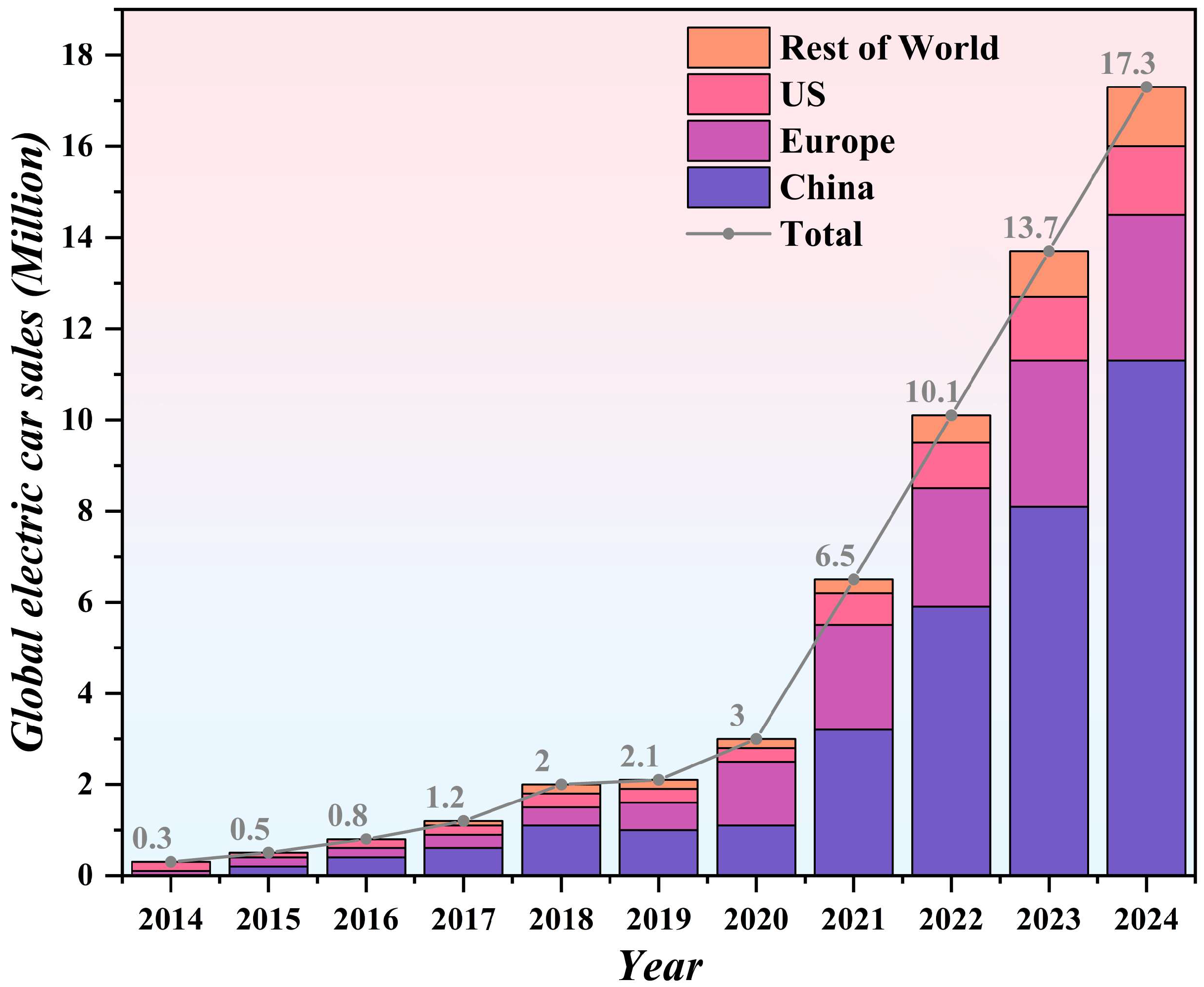
Figure 2.
Schematic diagram of the V2G technology model for electric vehicles.
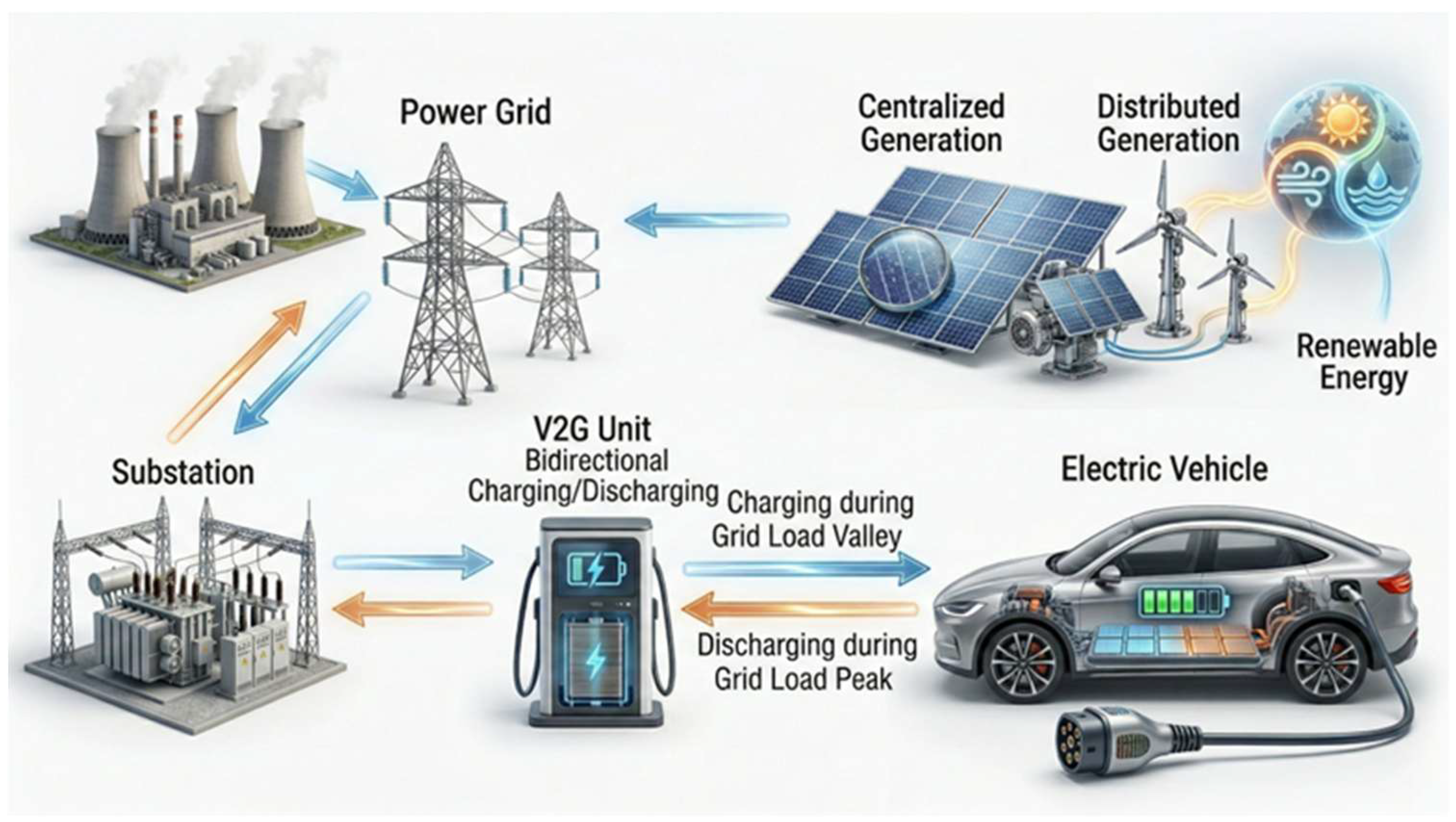
Figure 3.
Global Evolution of V2G Technology Scaling.
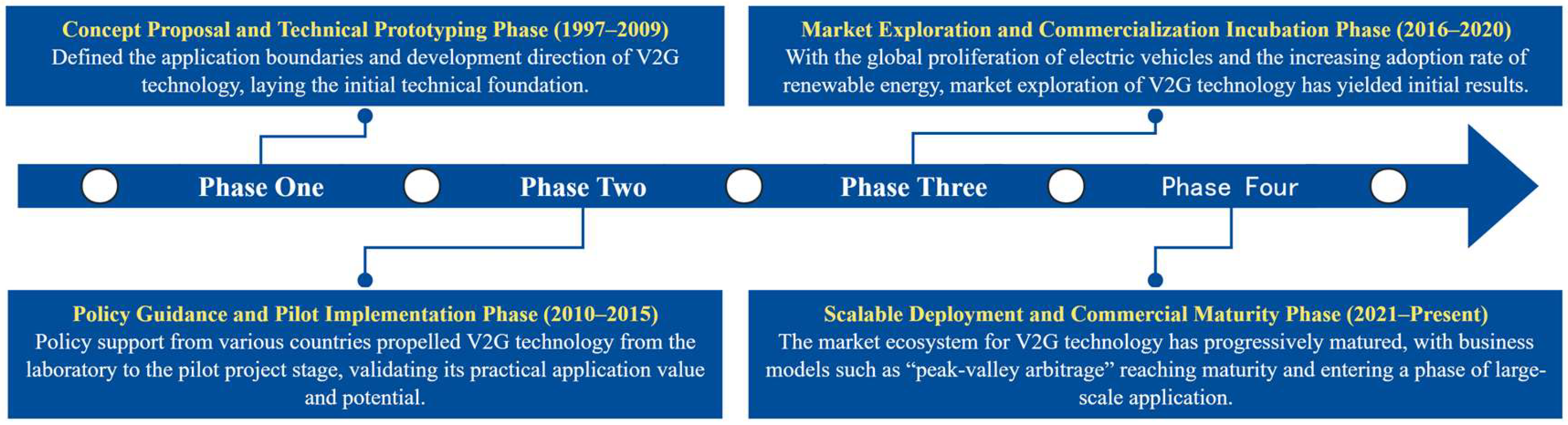
Figure 4.
China’s Electric Vehicle Ownership and Market Penetration Rate from 2019-2024.
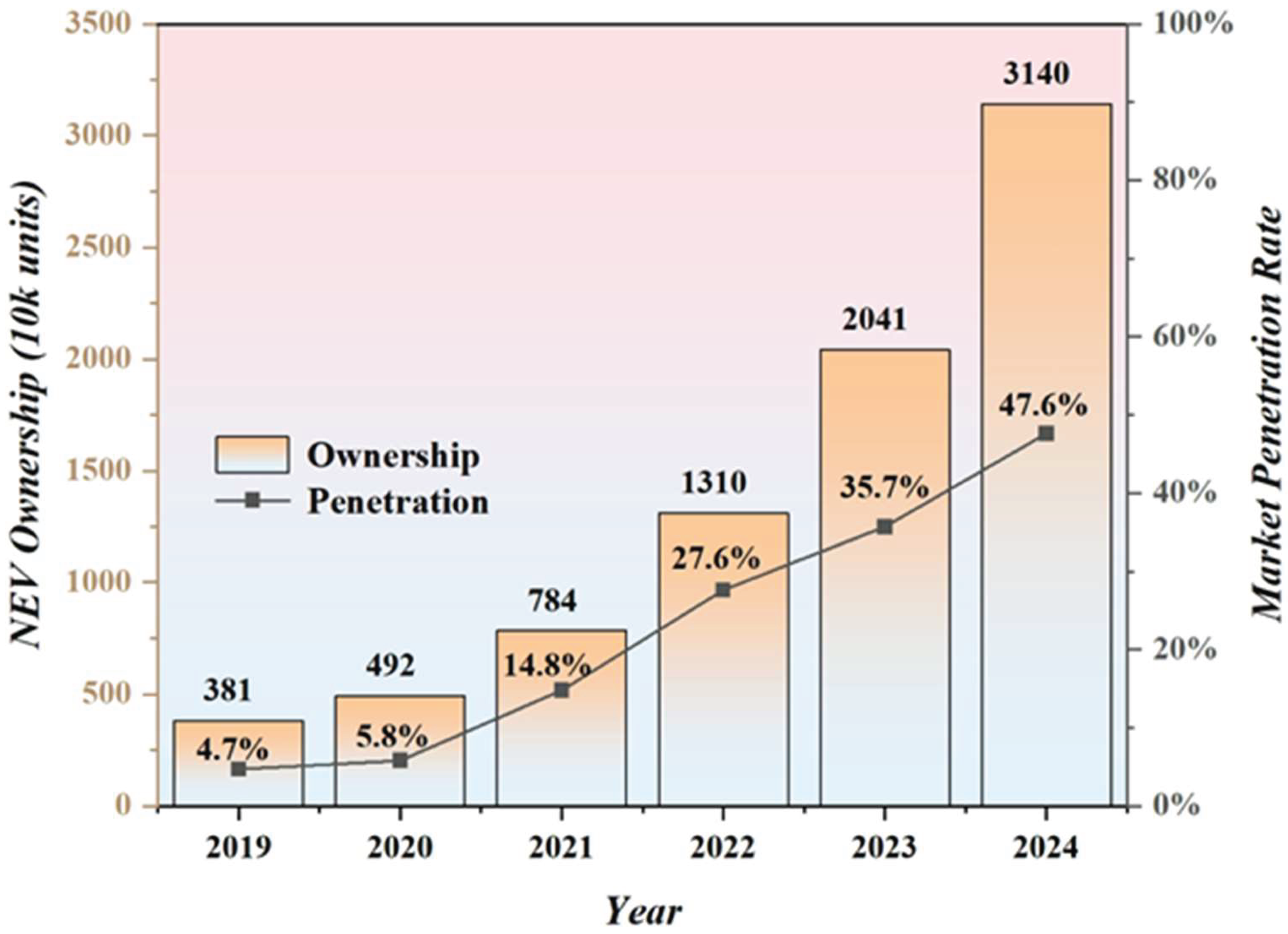

Table 1.
Evolution of China’s V2G Technology Policy Development.
| Time | Policy Name | Issuing Authority |
|---|---|---|
| October 2015 | Guiding Opinions on Accelerating the Construction of Electric Vehicle Charging Infrastructure | General Office of the State Council |
| November 2020 | New Energy Vehicle Industry Development Plan (2021–2035) | The General Office of the State Council |
| January 2022 | Implementation Opinions on Further Enhancing the Service Support Capabilities of Electric Vehicle Charging Infrastructure | National Development and Reform Commission |
| May 2023 | Implementation Opinions on Accelerating the Construction of Charging Infrastructure to Better Support the Promotion of New Energy Vehicles in Rural Areas and Rural Revitalization | The National Development and Reform Commission and The National Energy Administration jointly |
| June 2023 | Guiding Opinions on Further Building a High-Quality Charging Infrastructure System | General Office of the State Council |
| December 2023 | Implementation Opinions on Strengthening the Integration and Interaction Between New Energy Vehicles and the Power Grid | National Development and Reform Commission |
| September 2024 | Notice on Promoting Pilot Programs for the Large-Scale Application of Vehicle-Grid Interaction | The National Development and Reform Commission |
| April 2025 | Notice on Announcing the First Batch of Pilot Programs for Large-Scale Application of Vehicle-Grid Interaction | The National Development and Reform Commission |
Table 2.
Representative Commercial Projects of V2G Technology in China.
| Project Title | Type | Features |
|---|---|---|
| GAC Group V2G Demonstration Center Project | Centralized | The Nation’s Largest V2G Microgrid Project |
| Wuxi Xinwu District Public Transport Branch V2G Project | Centralized | The First V2G Demonstration Project for Public Transportation |
| Beijing China Re Center V2G Demonstration Station Project | Distributed | The First Project to Achieve Commercial Operation of V2G |
| Sichuan Tianfu New Area “Orderly Charging + V2G” Residential Community Virtual Power Plant Project | Distributed | The First Residential Virtual Power Plant with “Orderly Charging + V2G” |
| Shanghai NIO V2G Urban Network Project for Battery Swapping Stations | Swapped | The First Pilot Project for Battery-Swap V2G Urban Networking Focused on Passenger Vehicle Scenarios |
| Fujian CATL Heavy-Duty Truck Battery Swapping V2G Project | Swapped | Focusing on High-frequency Commercial Applications for Heavy-duty Trucks in Port Environments |
Disclaimer/Publisher’s Note: The statements, opinions and data contained in all publications are solely those of the individual author(s) and contributor(s) and not of MDPI and/or the editor(s). MDPI and/or the editor(s) disclaim responsibility for any injury to people or property resulting from any ideas, methods, instructions or products referred to in the content. |
© 2026 by the authors. Licensee MDPI, Basel, Switzerland. This article is an open access article distributed under the terms and conditions of the Creative Commons Attribution (CC BY) license (http://creativecommons.org/licenses/by/4.0/).
Copyright: This open access article is published under a Creative Commons CC BY 4.0 license, which permit the free download, distribution, and reuse, provided that the author and preprint are cited in any reuse.


