
Submitted:
09 March 2026
Posted:
11 March 2026
You are already at the latest version
Abstract
Recent studies have demonstrated that microRNAs hold potential as diagnostic biomarkers and therapeutic targets for ophthalmic diseases. However, there is a lack of bibliometric research focused on the role of microRNAs in ophthalmology. In this study, we conducted a bibliometric analysis to examine the trends and research hotspots in the field of microRNAs in eye-related diseases, providing a visual map of both established and emerging trends. We retrieved publications from the Web of Science database covering the period from 1999 to 2025. Visual representations were created using VOSviewer, CiteSpace, Venn diagrams, UpSet RStudio, and Microsoft Excel to perform co-occurrence and co-citation analyses, highlighting trends, hotspots, and contributions from authors, institutions, journals, and countries/regions. China and the United States emerged as the leading contributors, while Investigative Ophthalmology and Experimental Eye Research were the most prolific journals in this field. Over the past 26 years, the number of publications and citations has grown exponentially across various countries, organizations, and authors. Notably, we found that the dysregulation of let-7, miR-184, miR-181, miR-155, miR-146, miR-21, and miR-9 occurred most frequently in various ocular-related diseases. This study outlines the current trends, hotspots, and emerging frontiers in the field, offering new insights into the identification of diagnostic biomarkers and the design of future clinical trials for microRNAs in ophthalmic diseases. Additionally, international collaborations are essential for expanding and advancing research on microRNAs in eye-related diseases.
Keywords:
microRNAs
; eye-related diseases
; bibliometric analysis
; VOSviewer
; CiteSpace
1. Introduction
MicroRNAs (miRNAs) are short, non-coding RNA molecules that play a crucial role in post-transcriptional gene regulation, influencing key biological processes such as development, tumorigenesis, and disease progression. Their evolutionary significance is evident in the highly conserved sequences and regulatory functions across species. By binding to target messenger RNAs (mRNAs), particularly in the 3′ untranslated region (UTR), miRNAs regulate gene expression through translational repression or mRNA degradation, thereby exerting widespread effects on cellular functions [1]. miRNAs were first discovered in 1993 in Caenorhabditis elegans through classical forward genetics, analyzing the key C. elegans mutants lin-4 [2] and lin-14 [3].
Numerous studies have identified miRNAs as both diagnostic and prognostic biomarkers for various diseases, including cardiovascular diseases, neurodegenerative disorders, retinal diseases, and cancers [4,5,6]. miRNAs, which are endogenous non-coding RNAs, consist of small single-stranded nucleotides (~22 bp in length) [7] and recognize and bind to specific target mRNA sequences to induce their degradation [8] or suppress their translation [9], thereby modulating gene expression through post-transcriptional regulation [10].
Bibliometrics focuses on analyzing literature systems and characteristics, statistically and mathematically examining publications such as books and periodicals [11]. This method is a reliable approach for analyzing scientific literature and characterizing research trends over time. Bibliometrics has been applied to research in cardiovascular diseases [12], gastrointestinal diseases [13], and diabetes [14]. The aim of the present study is to systematically evaluate the international publication productivity of microRNA research using the Web of Science (WoS) from 1999 to 2025, analyze the most productive countries, institutions, and journals, and measure the geographic and temporal distribution of literature related to miRNAs.
2. Materials and Methods
2.1. Patient and Public Involvement
In this retrospective study, no patient or public involvement was available.
2.2. Sources of Data and the Search Strategy
We searched literature in the online version of Science Citation Index-Expanded (SCIE), Web of Science Core Collection (WoSCC), and Essential Science Indicator (ESI) databases on December 23, 2025. We downloaded the data from a public database as secondary data, which did not involve ethical considerations. Thus, ethical approval was not applicable in this situation.
We used the following search terms to identify publications primarily concerning miRNAs: TS = (“microRNA*” OR “miRNA*” OR “miR”) AND TS= (“eye-related diseases”) (For details see in Supplementary Table S1). We limited the search period to between 1 January 1999 and 23 December 2025. Then, the document type was limited to original and review articles. The exclusion criteria are as follows. The types of publications are meeting abstract, editorial material, correction, and letter. The identified publications that met the inclusion criteria were exported as plain text files in the format of “Full Record and Cited References”.
2.3. Mapping Analysis
In this research, a visualized bibliometric analysis was generated using the VOSviewer software (www.vosviewer.com) version 1.6.17 [15]. This software facilitates the creation of visual bibliometric maps and node-link diagrams, encompassing research trend data, including countries, publications, and researchers, as well as network information from co-cited reference and co-authorship analyses. Keywords articulate the theme of scientific literature, and the clustering of analogous keywords resulted in co-occurrence keyword clusters, which can be utilized to investigate the knowledge structure and hotspots within this research domain.
Full records and cited references of all publications in TXT format were obtained and assembled from WoSCC, subsequently imported into CiteSpace 6.3.3., 64 bits basic (Drexel University, Philadelphia, PA, USA), VOSviewer 1.6.20 (Leiden University, The Netherlands), Microsoft Excel 2019, and one online platform (https://bibliometric.com), according to the software demanded for visual analysis and data analysis.
This study examined country scientific production, three field plots (co-cited references, authors, keywords), author production over time, author impact (H-index), and thematic evolution utilizing the R language-based Bibliometrix Package (version 5.1.0), which can display the publications of the ten most prolific authors over the past 26 years and delineate the evolution of research topics.
In addition to the software referred to above, bibliometric analysis software (https://bibliometric.com/) was applied to study collaboration relationships among countries. We use Venn diagram and UpSet Rstudio to analyse all the intersection of microRNAs in different eye-related diseases as well as in each ocular segment diseases.Figure 1 summarizes the entire process of bibliometric analysis.
3. Results
3.1. General Data
We initially retrieved a total of 3,476 publications from the Web of Science Core Collection (WoSCC) database, covering the period from 1 January 1999 to 23 December 2025 (Table 1). Next, the publication types were limited to original and review articles. Finally, 3,476 publications were included in this analysis. The analysis process and items are shown in Figure 1. A total of 1,589 articles were published in the previous five years, which accounted for approximately 45.71% of the included publications. There were 3,036 (87.34%) original articles and 440 (12.65%) review articles included in our analysis. The overall number of citations was 108,708, with an average of 38,882.43 citations per paper. Moreover, the following bibliometric parameters were determined: 79 countries or regions, 3,237 organizations, 870 journals, 8,170 co-cited journals, 16,413 authors, 73,799 co-cited authors, 11,273 keywords, and 119,681 references. The countries that published the most articles included China, the United States, and Italy (Figure 2A).
3.2. Global Research Contributions and Collaborative Networks
Since 1999, researchers from 79 countries have contributed to miRNA studies (Figure 2B). China leads in both publication volume (1,896 publications) and total citations (40,916), followed by the USA (696 publications, 41,142 citations) and Italy (170 publications, 11,111 citations). While China dominates research output, the USA exhibits a higher citation impact per publication (59.11 citations/ document vs. China’s 21.58), highlighting the influence of US-based studies (Table 2A). Collaboration network analysis reveals strong domestic partnerships within China (total link strength (TLS = 252), whereas the USA leads in international co-authorship strength (TLS = 433) (Table 2A). Key contributing institutions include Nanjing Medical University (China), which has the highest publication count (107 articles) and records the highest citation impact (3,797 citations; 35.48 citations per publication) (Table 2B, Figure 2C). Although China dominates in research output, fostering stronger international collaborations could enhance the field’s global impact (Figure 2D, Figure 2E). At the author level, Yan Biao leads with 27 publications and 2,084 citations, followed by Li Yan with 22 publications and 346 citations. Yan Biao also ranks highest in bibliographic coupling (TLS=138), reinforcing his foundational role in the field. Additionally, Bartel DP, known for his work on miRNA biogenesis, has the highest total citations (672) and remains a key figure in understanding miRNA function in pathology (Table 3A).
3.3. Influential Journals and Citation Impact
Table 3B presents the most influential journals in miRNA research. Investigative Ophthalmology & Visual Science leads in publication volume (150 articles), and it holds the highest citation impact (5,432 citations) and centrality in co-citation networks (total link strength = 541,486). The prominence of Q1-ranked journals among the top-cited sources highlights the strong scientific recognition of miRNA research, particularly in translational applications (Table 3B).
3.4. Active Authors
In this study, we analyzed the top 10 prolific authors and co-cited authors, as shown in Table 3A. Sorted by the number of publications, Yan Biao, Li Yan, and Jiang Qin had published 27, 22, 19 articles in this field, respectively. However, Yan Biao’s citations and average citations were the highest among the top 10 prolific authors. In terms of co-citations, Bartel DP, Wang Y and Zhang Y formed the top three (Table 3A). Among the 55 authors who had published more than ten articles, 29 authors had collaborated with others. Initially, we visually analyzed the cooperative relationships between these 29 authors according to cluster (Figure 3A). There were five clusters in total. Yan Biao frequently co-operated with other authors and had the biggest total link strength. Based on the average publication years, we created an overlay map (Figure 3B). Li Xiu-Miao, Liu Chang, Shan Kun and Zhao Chen authored the earliest publications, whereas Li Na, Liu Yan, Xie Ping and Shao Yi authored the most recent publications.
3.5. Key Studies and Citation Dynamics
Among the top 10 most-cited references in the field, an analysis of the most-cited references identifies Bartel DP et al. (399 citations) (Bartel DP et al., 2004) and Livak KJ et al. (284 citations) (Livak KJ et al., 2001) as leading contributions to the field (Table 4). These studies highlight genomics, biogenesis, mechanism, and function of microRNAs, and analysis of relative gene expression data (Bartel DP et al., 2004; Livak KJ et al., 2001). Notably, 20% of the top 10 cited references are authored by Bartel DP, highlighting his significant contributions to genomics, biogenesis, mechanism, target recognition and regulatory function of microRNAs research (Bartel DP et al., 2004; Bartel DP et al., 2009). Several key studies emphasize miRNAs as therapeutic targets, providing evidence for their role in diabetic retinopathy (Kovacs B et al., 2011; Mcarthur K et al., 2011). Besides, the 100 most co-cited references in microRNA analysis from 1999 to 2025 in the eye-related diseases were extracted (Supplementary Table 2).
The prevalence of open-access journals among the most-cited references suggests that accessibility may be a key driver of citation impact in this field. Using Citespace analysis, we identified the top 25 co-cited references with the strongest citation bursts spanning 1999 to 2025 (Figure 3C). The initial burst (2007–2011) corresponds to early investigations into expression of miRNAs in mammalian ocular tissues, while the latest burst (2023–present) signals a growing focus on prediction of miRNA functions by integrative analysis of target prediction and Gene Ontology data. Among the burst-detected studies, Bartel DP et al. (burst strength = 25.02) (Bartel DP et al., 2009,) and Kovacs B et al. (23.04) (Kovacs B et al., 2011) were prominently highlighted, study target recognition, regulatory functions of MicroRNAs, and identify miRNAs involved in early diabetic retinopathy (DR) and to characterize their roles in the pathogenesis of DR.
3.6. Thematic Evolution and Emerging Research Frontiers
Next, we obtained the research hotpots and trends by analyzing the co-occurrence of keywords. This bibliometric information was analyzed by VOSviewer as follows: there were 11,273 keywords in total, of which 122 appeared a minimum of 40 times, with a total of five clusters (Figure 4A). Next, we initially analyzed the frequently used keywords and found they mainly included “expression” (n = 1,104), “microRNAs” (n = 548), “microRNA” (n = 539), “o apoptosis” (n = 473), “proliferation” (n = 429), “cancer” (n = 377), “diabetic retinopathy” (n = 374), “cells” (n = 322), “retinoblastoma” (n = 289), and “miRNA” (n = 282).
The keywords above also reflected the major themes associated with the investigators. In our overlay visualization map (Figure 4B), the light shade represents the most recent phase, and the dark shade represents the early phase. The following keywords reflected the recent attention of scholars in this field: “diabetic retinopathy”, “glaucoma”, “extracellular vesicles”, “microglia”, “circular RNA” and “lncRNA” (Figure 4B). In addition, Citespace was also used to identify the major topics by detecting burst keywords during a particular period (Figure 4C). Figure 4D exhibits the top 25 keywords alongside the strongest citation bursts, of which “in vivo” was the keyword with the longest burst duration, and the burst strength of “gene expression” was the highest. Also, the top 50 co-occurrence keywords related to microRNA analysis in eye-related diseases were extracted (Supplementary Table 3).
3.7. Hotspot Analysis of microRNAs in Eye-Related Diseases
Table 5A shows that several microRNAs are dysregulated in various corneal diseases, including let-7, miR-21, miR-29, miR-124, miR-142, miR-146, miR-181, miR-182, miR-183, miR-184, miR-199, miR-204, miR-205, miR-222, and miR-223. Notably, miR-184 is simultaneously dysregulated in CSCC, CNV, HEK, FK, and KTC. Additionally, several microRNAs exhibit regulatory abnormalities in various conjunctival diseases, such as let-7, miR-16, miR-20, miR-21, miR-30, miR-34, miR-130, miR-142, miR-145, miR-146, miR-147, miR-150, miR-155, miR-181, miR-184, miR-200, miR-203, miR-222, miR-223, miR-302, and miR-4427. Among these, miR-184 is simultaneously dysregulated in PTG, CL, CM, and TRC, while miR-155 is dysregulated in AC, CL, TRC, and SS. Furthermore, miR-30 is simultaneously present in CL, CM, TRC, and SS, and miR-146 is dysregulated in AC, CM, DED, and SS (Table 5A, Figure 5A).
We also identified the intersection of miRNAs across different retinal diseases, such as let-7, miR-9, miR-20, miR-21, miR-22, miR-25, miR-27, miR-30, miR-34, miR-98, miR-126, miR-138, miR-140, miR-146, miR-155, miR-181, miR-195, miR-200, miR-223, miR-320, miR-330, miR-335, miR-363, miR-374, miR-502, and miR-708. Among these, miR-146 is dysregulated in AMD, DR, AU, and RP, while miR-9 and miR-181 are dysregulated in AMD, RB, RP, and PCV (Table 5A, Figure 5B). Additionally, several microRNAs are dysregulated in various optic nerve diseases (LHON/PEX/GLC/NMODS), such as miR-548, miR-200, miR-126, miR-122, miR-30, let-7, miR-4667, miR-637, miR-4490, miR-1253, miR-3190, miR-3173, miR-608, miR-4725, miR-4448, miR-323, miR-4538, miR-3913, miR-3159, miR-4663, miR-4767, miR-4724, miR-1306, miR-181, miR-433, and miR-6777, as shown in Table 5A and Figure 5C. Table 5B illustrates the intersection of miRNAs in various ocular segment diseases. Among these, let-7 and miR-21 show regulatory abnormalities in CND, CJD, RD, ON, OD, RE, and HED, while miR-146 shows regulatory abnormalities in CND, CJD, LD, RD, OD, RE, and HED (Figure 5D andFigure 6).
Notably, the co-occurrence analysis of microRNAs, conducted using VOSviewer, revealed that miR-146 had the highest frequency (co-occurrence = 76), followed by miR-126 (53), miR-155 (52), miR-34 (45), miR-21 (43), miR-204 (41), miR-29 (39), miR-184 (24), miR-200 (23), miR-124 (31), let-7 (28), miR-223 (15), miR-182 (13), miR-214 (12), miR-9 (12), miR-181 (11), miR-96 (9), miR-183 (8), miR-142 (7), miR-145 (7), miR-150 (7), miR-192 (7), miR-30 (7), miR-132 (6), and miR-23 (5), as shown in Table 6. These findings support the intersection analysis of microRNAs in Table 5, highlighting the significance and emerging trends of these microRNAs in ophthalmology research.
4. Discussion
4.1. Evolving Role of miRNAs in Eye-Related Diseases: Insights and Emerging Themes
The number of annual publications can reflect the development of a particular field. Our analysis included 3,476 articles, which had been published between 1999 and 2025, from a total of 79 countries/regions, 3,237 institutions, 870 journals, 8,170 co-cited journals, 16,413 authors, 73,799 co-cited authors, 11,274 keywords, and 119,681 references. These numbers indicate that this research field has received significant global attention. Indeed, the top three countries with the highest numbers of publications were China (n = 1,896), the United States (n = 696), and Italy (n = 170). In particular, China published a large number of articles after 2020. Of the top 10 prolific institutions, all ten were located in China. Nanjing Medical University was the most prominent contributor and had the highest number of publications and total citations, while Shanghai Jiao Tong University ranked second. Investigative Ophthalmology and Visual Science (n = 150; 5,432 citations), Experimental Eye Research (n = 119; 2,308 citations), and International Journal of Molecular Sciences (n = 86, 1,459 citations) were the top three journals with the most publications in this field.
The role of miRNAs in eye-related diseases is rapidly evolving, with growing evidence supporting their involvement in key regulatory processes such as inflammation[16], neovascularization[17], retinal ganglion cell survival [18], and neurodegeneration[19]. This bibliometric analysis provides a comprehensive evaluation of research trends, thematic hotspots, and future directions in miRNA of eye-related diseases research. The dramatic rise in related publications over the past two decades reflects the increasing recognition of miRNAs not only as diagnostic and prognostic biomarkers but also as potential therapeutic agents in eye care [20,21,22].
4.2. MicroRNAs in Neurodegenerative Diseases (NDs)
MicroRNAs (miRNAs) regulate gene expression at the post-transcriptional level. Disruption of gene regulation has been implicated in numerous neurodegenerative diseases (NDs) and their animal models [23,24,25]. NDs are characterized by the progressive degeneration of neuronal structures and functions, ultimately leading to neuronal loss, which underlies most neurological impairments [26]. Presently, NDs represent a major global health issue, primarily due to the aging population. Unfortunately, despite extensive research, NDs remain incurable and irreversible. Disorders such as Alzheimer’s disease, Parkinson’s disease, glaucoma, age-related macular degeneration, amyotrophic lateral sclerosis, and Huntington’s disease share common cellular mechanisms and histopathological features, beyond mere neuronal dysfunction or death [27]. While the underlying causes of individual NDs vary, common pathobiological characteristics and mechanisms are consistently observed across these diseases. Recent studies have shown that miRNA expression is significantly altered during the pathogenesis of NDs and contributes to the dysfunction of neurons [24,28]. However, systematic overviews of miRNA expression changes and their regulatory roles across different NDs are limited [29,30]. Identifying common miRNA dysregulation patterns across NDs may help elucidate conserved molecular pathways affected in these diseases and reveal novel therapeutic targets. Camille A et al. [31] identified commonly dysregulated miRNAs across multiple NDs. Specifically, miR-9-5p, miR-21-5p, the miR-29 family, miR-124-3p, miR-132-3p, miR-146a-5p, miR-155-5p, and miR-223-3p were found to be predominantly dysregulated in 12 ND classes and their representative animal models. Among these, miR-146a-5p, miR-155-5p, and miR-223-3p were predominantly upregulated. They also summarized the pathways targeted by these dysregulated miRNAs, such as Aβ generation, autophagy, homeostasis, apoptosis, and NF-κB signaling. Furthermore, they highlighted the functional overlap of these miRNAs and suggested that they may act synergistically to directly or indirectly influence their targets.
4.3. MicroRNAs in Ophthalmic Diseases (ODs)
4.3.1. Corneal Disorders
Corneal squamous cell carcinoma
Corneal squamous cell carcinoma (CSCC) is a malignant tumor originating from the corneal epithelium. It may arise de novo from normal corneal epithelial cells or develop from corneal intraepithelial neoplasia (carcinoma in situ) following disruption of the epithelial basement membrane and subsequent invasion into the underlying stroma. The phosphatidylinositol 3-kinase (PI3K)/Akt signaling pathway promotes cell proliferation and inhibits apoptosis, thereby playing a critical role in tumor initiation and progression. Src homology 2 domain–containing inositol polyphosphate 5′-phosphatase 2 (SHIP2) negatively regulates the Akt pathway and suppresses tumor cell proliferation [31].
Yu et al. [32] used TargetScan bioinformatic prediction and luciferase reporter assays to demonstrate that SHIP2 is a direct target of miR-205 and that miR-205 promotes squamous cell carcinoma progression by inhibiting SHIP2 expression. Corneal epithelium–specific miR-184 competitively inhibits the binding of miR-205 to its target genes, thereby attenuating the suppressive effect of miR-205 on SHIP2, maintaining SHIP2 expression levels, and exerting a tumor-suppressive effect. In situ hybridization analysis revealed that miR-184 was expressed in the corneal epithelium but not in the limbal epithelium, whereas miR-205 was expressed in both tissues. Immunohistochemical analysis further demonstrated that SHIP2 staining was markedly weaker in the limbal epithelium than in the corneal epithelium, supporting the notion that miR-184 preserves SHIP2 expression by antagonizing miR-205. Notably, this study was the first to report that one miRNA can maintain the expression level of a target protein by negatively regulating another miRNA. These findings suggest that synthetic miR-205 antagonists or overexpression of miR-184 to inhibit miR-205 activity may represent potential therapeutic strategies for advanced squamous cell carcinoma.
Corneal neovascularization
The normal cornea is avascular, a feature essential for maintaining corneal transparency. Under pathological conditions, such as infection, trauma, or immune responses, capillaries originating from the limbal vasculature invade the cornea, leading to corneal neovascularization (CNV). Although neovascularization may facilitate infection clearance, wound healing, and prevention of corneal melting, it disrupts the corneal microenvironment and compromises the immune-privileged status of the anterior segment. Consequently, CNV represents a major risk factor for immune rejection following corneal transplantation. Newly formed vessels are fragile and susceptible to leakage and inflammatory cell infiltration, often resulting in hemorrhage, exudation, and secondary fibrosis, which can ultimately cause visual impairment or blindness. CNV remains one of the leading causes of vision loss worldwide.
In recent years, studies investigating miRNAs associated with CNV have been limited. Previous findings indicate that miR-184 is highly and specifically expressed in the cornea and limbus [33] but is significantly downregulated in ischemia-induced retinal neovascularization. Zong et al. [34] established a rat corneal suture model to induce neovascularization and evaluated changes in miR-184 expression. In vivo overexpression of miR-184 significantly attenuated suture-induced CNV. In vitro experiments involving the upregulation or downregulation of miR-184 in human corneal epithelial cells and human umbilical vein endothelial cells (HUVECs) demonstrated that the intrinsically high expression of miR-184 in the cornea may contribute to its avascular and transparent properties. Mechanistically, miR-184 appears to inhibit endothelial cell biological functions through modulation of the Wnt signaling pathway. Xiaoping Zhang et al. [35] investigated the interaction between dexamethasone (Dex) and miR-204 in a mouse alkali burn–induced CNV model and found that the therapeutic effect of Dex in attenuating CNV was partially mediated by miR-204. These findings suggest that miR-204 may serve as a potential therapeutic target in alkali burn–induced CNV.
Jingjing Qian et al. [36] reported that functional knockdown of miR-335 suppressed the migration and angiogenesis of basic fibroblast growth factor (b-FGF)–treated HUVECs, whereas miR-335 overexpression produced the opposite effect. Mechanistically, miR-335 directly interacted with epidermal growth factor receptor (EGFR) and negatively regulated its expression. Rescue assays further confirmed that miR-335 modulates the migration and angiogenic capacity of b-FGF–treated HUVECs via EGFR signaling. In addition, miR-204 expression is reduced in vascularized corneas and inhibits CNV progression by targeting vascular endothelial growth factor (VEGF) and VEGF receptor 2 (VEGFR2) [35]. Elevated expression of miR-1275 and miR-1246 has also been shown to suppress HUVEC angiogenesis, highlighting their potential as promising biomarkers and therapeutic targets for CNV [37].
Endothelial dystrophy
Fuchs endothelial corneal dystrophy (FECD) is a rare, bilateral, progressive disorder characterized by corneal opacity and visual impairment [38]. It results from the loss of endothelial cell function, leading to stromal edema and corneal scarring [39]. Several microRNAs (miRNAs) have been implicated in the pathogenesis of FECD. Pan et al. [40] reported that miR-199b is significantly hypermethylated in the endothelium of FECD patients. This hypermethylation leads to the downregulation of miR-199b, which directly targets and downregulates two zinc-finger transcription factors, Snai1 and ZEB1. These transcription factors are involved in the deposition of extracellular matrix (ECM) components in FECD. The downregulation of miR-199b causes an upregulation of Snai1 and ZEB1, resulting in aberrant ECM deposition. Consequently, miR-199b may serve as a potential therapeutic target for FECD.
In a related study, Matthaei et al. [41] identified 87 miRNAs that are downregulated in the endothelium of FECD patients compared to healthy controls. Their research focused on three members of the miR-29 family: miR-29a-3p, miR-29b-2–5p, and miR-29c-5p. The miR-29 family is known to play a crucial role in ECM homeostasis and has been reported to exert an antifibrotic effect in ocular tissues. In a subsequent experiment by Toyono et al. [42], transfection of immortalized endothelial cells from FECD patients with miR-29b led to a significant reduction in the expression of abnormal ECM components, including collagen type I alpha 1, collagen type IV alpha 1, and laminin gamma 1. These findings suggest that miR-29b could represent a promising therapeutic approach for FECD.
Herpes Epithelial Keratitis (HEK)
Herpes epithelial keratitis (HEK) is caused by a herpes simplex virus (HSV) infection of the corneal epithelium, leading to the formation of dendritic lesions and geographic ulcers [43]. This condition can result in a loss of corneal sensation, photophobia, and visual impairment due to corneal scarring [44]. A recent study analyzed the tear miRNA profile of patients with HEK and found significant upregulation of 23 miRNAs in the tears of HEK patients compared to controls. These miRNAs include miR-15b-5p, miR-16-5p, miR-20b-5p, miR-21-5p, miR-23b-3p, miR-25-3p, miR-29a-3p, miR-30a-3p, miR-30d-5p, miR-92a-3p, miR-124-3p, miR-127-3p, miR-132-3p, miR-142-3p, miR-145-5p, miR-146a-5p, miR-146b-5p, miR-155-5p, miR-182-5p, miR-183-5p, miR-221-3p, miR-223-3p, and miR-338-5p. The elevated expression of these miRNAs suggests they may play critical roles in herpes infection and host immunity [45].
In mouse models, significant upregulation of mmu-miR-184-3p and mmu-let-7d-5p has been observed, while mmu-miR-329-3p is downregulated. It has been suggested that miR-329 functions as a pro-viral miRNA by disrupting TLR9 signaling, thereby facilitating HSV-1 replication. Inhibition of miR-329 enhances TLR9-mediated antiviral responses, highlighting the potential for targeting host miRNAs as a therapeutic strategy for managing viral keratitis. However, miR-184-3p mimic and let-7d-5p mimic did not exhibit any biological impact on HSV-1 entry [46]. Additionally, a study by Cui et al. showed that miR-181b-5p, miR-338-3p, miR-635, and miR-222-3p were upregulated in primary human corneal epithelial cells infected with HSV-1. These findings provide insights into differentially expressed circRNAs and miRNAs during HSV-1 infection, shedding light on the potential role of circRNA-miRNA interactions in herpes simplex keratitis pathogenesis [47]. Monitoring these miRNAs may offer valuable insights into the development of HEK and highlight the importance of proper patient classification in describing disease-stage miRNA fluctuations.
Herpes Stromal Keratitis (HSK)
Herpes stromal keratitis (HSK) is a leading cause of vision loss or blindness following herpes simplex virus (HSV)-1 infection. The vision impairment associated with HSK is primarily due to corneal scarring and neovascularization resulting from inflammation. Upon HSV infection of the cornea, the virus triggers innate and adaptive immune responses in host cells, leading to the release of inflammatory cytokines, chemokines, microRNAs, and other regulatory factors that modulate tissue responses.
HSV-1 infection in the cornea induces the production of inflammatory cells and substance P (SP) and upregulates miR-155, which promotes overexpression of inflammatory cytokines and chemokines. This, in turn, enhances Th1 and Th17 immune responses, contributing to more severe corneal opacity and angiogenesis [48]. MiR-155, expressed in activated CD4+ T cells, suppresses the levels of phosphatidylinositol-3,4,5-trisphosphate 5-phosphatase 1 (SHIP1) and IFN-γ receptor α-chain (IFN-γRα), but viral replication is not associated with the induction of increased miR-155 expression [48]. Increased expression of miR-132 is also detected following HSV-1 infection, and miR-132 has been shown to promote corneal neovascularization (CNV) [49]. Interestingly, VEGF upregulates the expression of miR-132 in the corneas of HSV-1-infected mice. In vivo silencing of miR-132 in HSV-infected mice results in reduced corneal neovascularization and diminished stromal keratitis (SK) lesions [49].
Fungal Keratitis (FK)
Fungal keratitis (FK) is commonly caused by filamentous fungi, such as Fusarium, Aspergillus, Phaeohyphomycetes, and Scedosporium apiospermum, as well as yeast-like fungi such as Candida albicans and other Candida species. FK is characterized by rapid progression, corneal ulceration, and a stromal inflammatory infiltrate [50,51]. Despite the use of polyene antifungals, such as natamycin and amphotericin B, as the primary treatment for FK, 15–27% of patients require surgical intervention, which often has a relatively poor prognosis [51,52].
Recent studies suggest that microRNAs (miRNAs) play a role in the pathogenesis of fungal keratitis. Deep RNA sequencing of corneas from five FK patients with a positive culture for Aspergillus flavus and three normal controls revealed that 75 miRNAs were differentially expressed between the infected and healthy corneas. Functional annotation of these dysregulated miRNAs, including miR-511-5p, miR-142-3p, miR-155-5p, and miR-451a, indicated their involvement in regulating inflammation and wound healing processes [51]. Notably, increased expression of miR-451a in FK correlated with a decrease in the expression of its target gene, macrophage migration inhibitory factor (MIF), suggesting a potential regulatory role. Further studies are needed to confirm whether miR-451a targets MIF in specific cell types and how this regulation affects the pathogenesis of FK. This may provide insights into the role of miR-451a as a potential therapeutic target for fungal keratitis.
Several studies have also demonstrated significant upregulation of miR-223-3p [53] and miR-665-3p [54] in FK. Notably, miR-665-3p may be involved in Fusarium solani keratitis in mice by regulating autophagic pathways and inflammation. Likewise, miR-223-3p may regulate autophagy by targeting ATG16L1 in experimental F. solani keratitis, contributing to the inflammatory response. Both miR-223-3p and miR-665-3p may serve as potential therapeutic targets for FK.
Bacterial Keratitis
Bacterial keratitis (BK) is most commonly associated with complications arising from extended contact lens use in industrialized countries. Pseudomonas aeruginosa (PA), a Gram-negative bacterium and a significant human pathogen, remains the leading cause of contact lens-related keratitis in developed countries. It is also one of the most rapidly progressing and destructive causes of corneal blindness [55].
Pioneering studies have identified that miR-155 [56] is upregulated, while let-7b [57,58] is downregulated in human corneal epithelial cells (HCECs) treated with both tear fluid and PA, compared to those treated with PA alone [59]. This suggests that miR-155 and let-7b may play important roles in modulating tear-induced gene expression changes during PA infection. Recent studies have also demonstrated that the conserved miRNA cluster miR-183/96/182 modulates the corneal response to PA infection at multiple levels. Prophylactic knockdown of miR-183C has been shown to protect against PA keratitis by regulating innate immunity, corneal innervation, and neuroimmune interactions [60].
4.3.2. Conjunctival Disorders
Pterygium
Pterygium is a common ocular surface disease characterized by the abnormal growth of wing-shaped fibrovascular tissue from the limbus and conjunctiva onto the adjacent cornea [61]. This condition affects a significant portion of the global population [62]. As it progresses, pterygium can lead to significant visual impairment and a reduced quality of life; however, the exact pathogenic mechanisms underlying its formation and progression remain largely unclear [63].
The downregulation of the miR-200 family, which is known to regulate epithelial-mesenchymal transition (EMT), suggests that EMT may play a role in the pathogenesis of pterygium [64]. Wu et al. [65] further reinforced the role of miR-200a in EMT and pterygium pathogenesis. β-catenin, a multifunctional protein involved in cell development, has been implicated in pterygium pathogenesis in conjunction with EMT [66]. İçme G et al. [67,68] explored the hypothesis that the expression levels of miR-182-5p, miR-183-5p, and miR-184 are increased, while β-catenin, miR-221, and its downstream target, p27Kip1, are correlated with the pathogenesis of pterygium. In ocular surface pterygium fibroblasts, miR-215 has been shown to inhibit fibroblast proliferation, while in human pterygium epithelial cells, miR-218-5p inhibits cell migration and proliferation [69,70]. Investigating the role of apoptosis in pterygium pathogenesis, miR-122 has been reported to inversely regulate the expression of Bcl-w, an anti-apoptotic protein, leading to abnormal cell apoptosis and contributing to the development of pterygium [71].
MiR-21, a cancer-promoting miRNA, is upregulated in pterygium and its expression increases with the severity of the condition. MiR-21 promotes pterygium cell differentiation through the PTEN/AKT pathway, and its inhibition suppresses fibroblast proliferation and induces apoptosis [72]. Additionally, miR-3175 has been shown to promote proliferation, migration, invasion, and EMT in human conjunctiva and pterygium by directly inhibiting Smad7 [73]. Furthermore, TGF-β1-induced subconjunctival fibrosis is mediated by microRNAs 143/145, primarily through SMAD-independent pathways. Inhibition of TGF-β1-induced expression of miR-143/145 in human Tenon’s fibroblasts (HTFs) may represent a novel strategy to prevent subconjunctival fibrosis [74,75].
Allergic Conjunctivitis (AC)
Allergic conjunctivitis (AC) is an inflammation of the conjunctiva in response to an allergen. It is one of the most common ocular conditions encountered in clinical practice. Although type 1 hypersensitivity, immunoglobulin E (IgE)-mediated, and non-IgE-mediated mechanisms are believed to contribute to its development, the pathophysiology of ocular allergy is complex and multifactorial, involving various mediators, chemokines, cytokines, receptors, and regulatory pathways.
Sun et al. [76] developed an in vivo pollen-induced mouse model of AC and an in vitro lipopolysaccharide-stimulated inflammatory model using human corneal limbal epithelial cells. In these models, it was observed that eosinophils and total inflammatory cells were highly expressed, and the expression of miR-146a was significantly reduced, while the levels of thymic stromal lymphopoietic protein (TSLP) and its downstream molecules were enhanced [76]. A similar study conducted two years later in a murine model demonstrated that miR-146a also contributes to the development of AC by regulating the inhibitory effect of regulatory T cells on conventional T cells and modulating the nuclear factor-κB (NF-κB) signaling pathway [77].
Additionally, a study in a murine AC model showed reduced levels of miR-19b, while the levels of TSLP and phosphorylated signal transducer and activator of transcription 3 (STAT3) were increased. This suggests that miR-19b reduces conjunctival inflammation by modulating STAT3 signaling via TSLP downregulation [78]. Moreover, a recent study elucidated the role of miR-155 in AC. MiR-155 was upregulated in AC models, and its inhibition reduced AC-induced injury by inhibiting the phosphorylation of P65 [79]. Furthermore, Zhang et al. [80] found that the downregulation of miR-223 plays an important role in the pathology of allergic conjunctivitis.
Conjunctival Lymphoma
Conjunctival lymphoma (CL) is a malignant ocular surface tumor originating from B-cell lymphocytes, accounting for approximately 25% of ocular adnexal lymphomas (OALs), which include the orbit, eyelids, conjunctiva, lacrimal glands, and lacrimal sac [81].
MicroRNA (miRNA) profiling of mucosa-associated lymphoid tissue (MALT) lymphoma, the most common subtype of OALs, and adjacent normal tissues by Cai et al. [82] revealed dysregulation of several miRNAs. Specifically, miR-150 and miR-155 were upregulated, while miR-184, miR-200a, b, c, and miR-205 were downregulated. The study further demonstrated that dysregulation of the miR-200 family could be linked to the pathogenesis of conjunctival MALT lymphoma [82]. Additionally, a study by Hother C et al. [83] found that miRNAs such as let-7g, miR-16, miR-27a, miR-27b, miR-29a, miR-29b, miR-29c, miR-30e, miR-199a, miR-222, and miR-1248 were downregulated in OALs. These findings suggest that miRNA expression differs between extranodal marginal zone lymphoma (EMZL) and aggressive diffuse large B-cell lymphoma (DLBCL), primarily due to differences in MYC and NF-κB regulatory pathways [83].
Conjunctival Melanoma
Conjunctival melanoma (CM) presents as a raised pigmented or non-pigmented lesion on the ocular surface [84]. Genetic studies have revealed mutations in somatic genes such as BRAF, NRAS, NFI, KIT, and TERT, suggesting that CMs share more similarities with skin and mucosal melanomas than other ocular melanomas[85,86].
A 2016 study employing microarray analysis compared CMs with normal conjunctival samples and revealed 24 upregulated and one downregulated miRNA in the conjunctival samples [87]. Several miRNAs were associated with tumor thickness and specific stages of CM (T1 and T2). Additionally, miR-3687 and miR-3916 were found to correlate with an increased risk of regional recurrence. The study highlighted the similarities between CM, mucosal melanoma, and cutaneous melanoma [87]. Another recent study investigated the miRNA profile in primary tumors from non-metastasizing and metastasizing CMs. Differential expression of miRNAs in these two forms suggested their potential role in predicting metastatic progression. Notably, miR-184 was downregulated in the progressive stages of CM, implicating its role in driving tumor cells toward more severe metastatic forms [88].
Vernal Keratoconjunctivitis
Vernal keratoconjunctivitis (VKC) is a chronic, inflammatory condition of the conjunctiva with an unclear pathogenesis [88]. While the disease is self-limited, it can lead to corneal scarring and significant visual impairment [89]. In a recent study, 51 tear miRNAs were found to be differentially expressed in VKC patients. Specifically, the expressions of miR-1229-5p, miR-6821-5p, miR-6800-5p, miR-4466, miR-3665, miR-4530, miR-7110-5p, miR-1207-5p, miR-6875-5p, miR-762, miR-4741, miR-6740-5p, and miR-4298 were significantly upregulated, while miR-7975, miR-7977, and miR-1260a were significantly downregulated in VKC patients compared to healthy controls. These findings suggest that these differentially expressed miRNAs could play a role in VKC pathogenesis [90]. However, the small sample size (n = 4 per group) may limit the reproducibility of these results.
MiR-4530 has been associated with the suppression of cell proliferation and regulation of inflammatory processes [91,92]. The upregulation of this miRNA in VKC patient tears may reflect a response to pro-inflammatory species and stressors present during the disease. MiR-762, which was overexpressed in human corneal stromal cell exosomes in keratoconus patients, was also detected in the tears of VKC patients [59]. This upregulation may indicate miR-762’s involvement in corneal surface integrity. Additionally, a study by Ueta M et al. [93] found that miR-628-3p was upregulated in atopic dermatitis (AD) patients with atopic keratoconjunctivitis (AKC), suggesting that plasma miR-628-3p levels may serve as a marker to predict the presence of severe AKC in AD patients.
Trachoma
Trachoma is a contagious bacterial infection caused by Chlamydia trachomatis that primarily affects the eyes and is a leading cause of preventable blindness worldwide [94]. The initial symptoms include mild itching and irritation, which gradually progress to swelling and pus discharge. Persistent forms of trachoma are believed to drive the continuous scarring process even in the absence of active C. trachomatis infection [95].
Recent reports suggest that host microRNAs (miRNAs) play a role in the pathogenesis and progression of trachoma [96,97]. miRNA expression profiling in conjunctival swabs from patients with follicular trachoma, an early stage of the disease, revealed differential expression of at least nine miRNAs (miR-155, -150, -142, -181a/b, -342, -132, -4728, and miR-184) between trachomatous follicular inflammation (TF) (with or without detectable C. trachomatis) and normal controls [96,98]. Among these, miR-155 and miR-184 showed a direct relationship with the degree of clinical inflammation: miR-155 was upregulated, while miR-184 and miR-4728 were downregulated as the severity of inflammation increased [96,98]. These findings may reflect the host immune response to C. trachomatis infection and the wound healing process during the early stages of trachoma.
Furthermore, a study by Derrick T et al. identified the upregulation of miR-10a, miR-30c, miR-32, miR-147b, miR-203, miR-1285, and miR-1305 in trachomatous scarring. Notably, the expression of miR-147b and miR-1285 was significantly increased in inflammatory trachomatous scarring, highlighting major pathways under the control of these miRNAs in the conjunctival epithelium. The study suggests that dysregulation of these miRNAs could lead to the activation of the TGF-β signaling pathway in trachomatous disease [97,98].
4.3.3. Lens Diseases and Refractive Error
Cataract
Cataract is the leading cause of vision impairment worldwide. It results from changes in the composition of the aqueous humor, altered permeability of the lens capsule, and metabolic disturbances, which cause denaturation of lens proteins and subsequent opacity of the normally transparent lens. Previous research has proposed that the lens is an ideal biological model for investigating fibrotic processes due to its unique biological properties [99]. Lens fibrotic disorders, such as anterior subcapsular cataract (ASC) and posterior capsule opacification (PCO), are common causes of visual impairment globally. Therefore, using the lens as a model for fibrosis not only provides direct insights into lens fibrotic disorders but also serves as a valuable experimental tool for understanding fibrosis more broadly.
Wei et al. [100] and Liang et al. [101] reported that miR-26a can inhibit cardiac fibrosis and idiopathic pulmonary fibrosis by targeting collagen I, CTGF, and HMGA2, respectively. Recent studies have also shown that miR-26b is significantly decreased in PCO tissues from patients [102], and overexpression of miR-26b can inhibit lens epithelial cell (LEC) epithelial-mesenchymal transition (EMT) by targeting Smad4 and COX-2 [103]. However, the role of miR-26a in lens fibrosis remains unknown. Xiaoyun Chen et al. focused on miR-26a and miR-26b to further explore their functions in fibrosis using the lens as a model. They employed gain- and loss-of-function assays in various models to demonstrate that miR-26a and miR-26b act as EMT suppressors in lens fibrosis. Importantly, they revealed a novel mechanism in which miR-26a and miR-26b inhibit EMT by directly targeting Jagged-1 and suppressing Jagged-1/Notch signaling. Furthermore, the use of Jagged-1 siRNA and the Notch pathway-specific inhibitor DAPT was shown to reverse LEC-EMT and ASC development, suggesting that the miR-26 family and pharmacological targeting of the Notch pathway could be therapeutic in preventing ASC, PCO, and other organ fibroses [104].
Tian et al. further confirmed by luciferase assay that Bin3 is the target gene of miR-184. The expression of miR-184, the transcriptional level of Bin3, and cataract formation are closely correlated [105]. Previous studies have shown that miR-184 is specifically and highly expressed in the germinal region of epithelial cells in the lens cortex and may play a critical role in the development of posterior capsular opacification (PCO). After cataract extraction, excessive proliferation and migration of stromal epithelial cells in the peripheral and equatorial regions of the anterior capsule (the germinative area of the lens epithelium), as well as epithelial-mesenchymal transdifferentiation and collagen secretion, form the biological basis for PCO development [106,107]. Furthermore, Hoffmann et al. [108] used a mouse cataract model and found that miR-184 was upregulated in vivo. Addition of miR-184 inhibitors to an in vitro model delayed the development of secondary cataract, inhibiting stromal epithelial expansion, migration, and reducing epithelial-mesenchymal cell transformation (such as a-SMA expression). These findings suggest that the complex competitive network involving miR-184 and other miRNAs plays a crucial role in regulating cataract occurrence and progression.
Myopia
Myopia, also known as short- or near-sightedness, occurs when the eye axis elongates excessively, causing light from distant objects to focus in front of the retina, resulting in blurred vision. It is a prevalent ocular condition worldwide. High myopia (defined as a refractive error greater than −6.00 D) significantly increases the risk of sight-threatening complications, including open-angle glaucoma, retinal detachment, chorioretinal atrophy, and choroidal neovascularization, which can lead to irreversible vision loss and severely impact the quality of life, particularly during an individual’s most productive years [109,110].
The spatially distinct expression levels of miRNAs at various stages of myopia suggest that miRNAs play diverse regulatory roles in the development of the condition. Single nucleotide polymorphisms (SNPs) in miR-29a have been linked to high myopia [111]. Zhu et al. examined miR-29a expression levels in the aqueous humor (AH) and peripheral plasma of 21 high myopia patients and eight control patients with cataracts using quantitative polymerase chain reaction (qPCR). While no significant difference was observed in peripheral blood, the miR-29a expression level in the AH of the high myopia group was significantly higher than in the cataract control group [112]. Additionally, Zhu et al. found that 249 mature miRNAs and 17 novel miRNAs were differentially expressed in myopic eyes. The expression levels of let-7i-5p, miR-127-3p, and miR-98-5p were significantly higher in the myopic group compared to controls [113].
In recent years, several studies have used bioinformatics analysis to identify differentially expressed miRNAs in myopia. Liu et al. (2022) indicated that mmu-miR-1936, mmu-miR-338-5p, and mmu-miR-673-3p were upregulated in eyes with form-deprivation myopia (FDM), suggesting their involvement in myopia development through post-transcriptional gene regulation[114]. Additionally, Metlapally et al. found increased expression of let-7a and miR-16-2 in the eyes of C57BL/6J mice with FDM, with scleral miRNAs showing differential expression linked to myopia, supporting the role of miRNAs in eye growth regulation [115]. In an induced myopia study, Tkatchenko et al. explored 53 differentially expressed miRNAs in the retina (37 upregulated and 16 downregulated) and found no differences in miRNA expression in the sclera of C57BL/6J mice after 10 days of visual form deprivation [116]. In a study by Mei F and colleagues, 8 miRNAs were found to be upregulated, which may influence the progression of myopia by disrupting related pathways or biological processes. Notably, miR-466h-5p and miR-466j were significantly enriched in synaptic transmission-related biological processes [117].
4.3.4. Retinopathy
Diabetic retinopathy
Diabetic retinopathy (DR) is a common complication of diabetes that can lead to retinal vascular and nerve degeneration, ultimately resulting in blindness in many patients. Neurodegeneration and vascular degeneration of the retina are associated with hyperglycemia, involving mechanisms such as apoptosis, oxidative stress, inflammation, and endothelial dysfunction, although the exact pathways remain unclear. Therefore, it is crucial to explore the mechanisms linking retinal neurodegeneration and vascular degeneration in hyperglycemic states, to identify significant therapeutic targets and develop strategies to halt the progression of DR in its early stages [118].
Furthermore, fluctuations in microRNA expression due to changes in the hyperglycemic environment are implicated in oxidative stress and apoptosis in the retina. Overexpression of Methyl-CpG binding domain protein 2 (Mbd2) via miR-345-5p plays a pro-apoptotic role in high-glucose-induced retinal cell death [119]. Studies have suggested that miRNAs such as has-miR-421, has-let-7g-5p, has-miR-30e-5p, has-let-7c-5p, has-let-7a-5p, has-miR-363-3p, has-miR-30c-5p, has-miR-98-5p, has-miR-224-5p, and has-miR-155-5p regulate three important inflammation-related genes: Caspase-3, Toll-like receptor 4, and Guanylate Binding Protein 2 [120]. Downregulation of miR-590-3p promotes cellular focal death through the NOX4/ROS/TXNIP/NLRP3 pathway [121]. Increased expression of miR-138-5p in retinal pigment epithelial (RPE) cells in high-glucose environments leads to reduced activity of Silent Message Regulator 1/Nuclear Factor E2-related Factor 2 (SMR1/NRF2), decreased expression of antioxidant response-related molecules, and increased ferroptosis, thereby promoting cell death [122]. Circ_0000615 affects high-glucose-induced apoptosis, inflammation, and oxidative stress in human RPE cells via the miR-646/YAP1 axis [123]. Upregulation of miR-200a-M inhibits Keap1/NRF2 signaling, which may attenuate hyperglycemia-induced inflammation and endothelial dysfunction [124]. These findings suggest that microRNAs influence retinal cell apoptosis and oxidative stress through a complex network of cytokines.
The critical role of NF-kB signaling in metabolic disorders is well established. NF-kB is an important regulator of inflammatory chemokines and cytokines in various metabolic tissues [125]. The NF-kB signaling pathway plays a pivotal role in inflammation, and many microRNAs are involved in modulating this pathway. Increased expression of miR-146a downregulates the NF-kB downstream gene Intercellular Adhesion Molecule-1 (ICAM-1), reducing the production of pro-inflammatory factors and preventing retinal microvessel leakage. miR-146a’s negative feedback regulation of NF-kB activation may play a role in Tr-iBRB endothelial cells [126]. Downregulation of miR-377 inhibits the NF-kB pathway and suppresses the release of pro-inflammatory cytokines by upregulating Silent Information Regulator 1 (SIRT1) [127]. miR-518d negatively regulates the expression of Peroxisome Proliferator-Activated Receptors (PPARs), leading to the nuclear translocation of NF-kB and phosphorylation of pathway-associated proteins, triggering inflammatory responses [128]. Thus, the NF-kB inflammatory pathway is a crucial component in how many miRNAs affect retinal neuropathy and angiopathy.
MicroRNAs modulate diabetic retinopathy by regulating vascular endothelial factors. Vascular endothelial growth factor (VEGF) is a key angiogenic growth factor that increases vascular permeability and promotes the proliferation of vascular endothelial cells. Overexpression of miR-351 significantly reduces VEGF and Angiotensin II expression levels [129]. Inhibition of miR-93-5p or overexpression of Sirt1 in the retina of rats with type 2 diabetes (T2DM) reduced VEGF levels and pro-inflammatory cytokines while enhancing antioxidant activity [130]. miR-148a-3p increases cell viability and reduces apoptosis by targeting Transforming Growth Factor Beta 2 (TGFB2) and Fibroblast Growth Factor 2 (FGF2), protecting the blood-retinal barrier and inhibiting angiogenesis [131]. Overexpression of miR-21 promotes angiogenesis in retinal vascular endothelial cells (RVECs) of DR rats by activating the PI3K/Akt/VEGF signaling pathway. miR-21 also influences the expression of superoxide dismutase 2, affecting the antioxidant response system [132]. Downregulation of miR-126-3p in diabetic rat retina attenuates experimental diabetic retinopathy by targeting Polo-like Kinase 4 (PLK4), inhibiting endothelial cell proliferation and migration [133]. miR-126-5p promotes endothelial proliferation by inhibiting Delta-like 1 (Dlk1), ultimately preventing atherosclerosis [134]. miR-126 is reduced in diabetes [135], and delivery of functional miR-126-3p promotes vascular endothelial repair [136]. Downregulation of miR-222 by metformin maintains endothelial integrity and provides cardioprotective effects. miR-15a/16 maintains the retinal endothelial cell barrier by reducing TGFβ3/VEGF signaling and increasing tight junction protein levels [137]. Low expression of miR-15b promotes the proliferation of retinal capillary endothelial cells and pericytes by upregulating VEGFA in diabetic rats [138].
Studies have shown that miR-184 regulates ischemia-induced retinal neovascularization by modulating the expression of the classical Wnt receptor, Frizzled7. Takabashi et al. studied mice with oxygen-induced retinopathy models and found that miR-184 expression was very low, while Wnt signaling was activated. However, overexpression of miR-184 blocked Wnt signaling by targeting Frizzled7, inhibiting ischemia-induced retinal neovascularization [139]. Additionally, upregulation of miR-150, miR-155-5p, miR-20a-5p, miR-20b-5p, and miR-451a was observed in DR patients [140,141,142], while downregulation of hsa-miR-195-5p, hsa-miR-27b-3p [142], and miR-320a [143] was found. The correlation between specific circulating miRNAs and intraretinal hyper-reflective spots was demonstrated, confirming these miRNAs as prognostic biomarkers and potential pharmacological targets, warranting further clinical evaluation for the development of novel therapies for diabetic retinopathy [142].
Macular degeneration
Both age-related macular degeneration (AMD) and diabetic retinopathy (DR) are commonly associated with oxidative stress, and the use of antioxidant agents may serve as co-adjuvant therapies for these diseases. MicroRNAs (miRNAs) are involved in the regulation of angiogenesis, oxidative stress, immune responses, and inflammation in both AMD and DR [144]. miR-205-5p is modulated by oxidative stress and regulates vascular endothelial growth factor A (VEGFA)-mediated angiogenesis [145]. Therefore, miR-205-5p is proposed as a potential candidate for targeting eye-related proliferative diseases [145].
The retinal pigment epithelium (RPE) is regularly exposed to high levels of pro-oxidative stimuli. Inhibition of miR-144 enhances Nrf2-dependent antioxidant signaling in the RPE, preventing oxidative stress-induced AMD [146]. VEGFA enhancement and neovascular overgrowth are hallmark features of AMD [147,148]. VEGFA is produced by retinal cells, including the RPE [149]. Activation of the Nrf2 signaling pathway protects RPE cells from oxidative damage, and miR-125b targets the Nrf2/hypoxia-inducible factor-1α (HIF-1α) pathway to protect RPE from oxidative damage [150].
Moreover, miR-9 is associated with the nuclear factor-kappa B (NF-κB) signaling pathway and the pathogenic mechanism of complement factor H (CFH) deficiency, which leads to inflammatory neurodegeneration [151]. Upregulation of miR-9-3p may play a crucial role in the inflammatory and oxidative mechanisms of typical AMD. Studies suggest that miR-20a levels in serum increase angiogenesis in patients with typical AMD. miR-20a, which is upregulated under hypoxic conditions, targets VEGF [152,153]. In contrast, a previous study reported that the downregulation of miR-335 in blood plasma was inconsistent with the finding that hsa-miR-335-5p was upregulated in typical AMD groups [154]. These differences suggest that inferring the expression of ocular cell-specific miRNAs from those found in blood plasma may be challenging. Activation of miR-335 plays an important role in inducing p53-dependent cell cycle arrest after DNA damage [152]. p53 is known to induce RPE apoptosis in age-related RPE disorders, such as typical AMD. Taken together, these observations imply that miR-335 and miR-20a may play critical roles in the apoptosis mechanisms of typical AMD.
In the study by Yeong A. Choi et al. [155], hsa-miR-22-5p was found to be the most abundant miRNA in the typical AMD group. The study also showed that hsa-miR-708-5p was overexpressed in the typical AMD group. miR-708-5p regulates rhodopsin in the retina and alleviates protein folding stress by reducing the flow of rhodopsin into the stressed endoplasmic reticulum (ER) [156]. These results suggest that the upregulation of miR-708-5p may be related to the oxidative stress pathway in typical AMD.
Furthermore, several miRNAs were dysregulated both in AMD animal models and AMD patients, such as let-7, miR-146, miR-155, miR-17-5p, miR-20a-5p, miR-24-3p, miR-106a-5p, and miR-223-3p, which were upregulated [151,157,158,159], while miR-126, miR-106b, miR-152, miR-21-3p, miR-21-5p, miR-25-3p, miR-140-3p, miR-146b-5p, miR-192-5p, miR-335-5p, miR-342-3p, miR-374a-5p, miR-410, miR-574-3p, and miR-660-5p were downregulated [158,159,160,161]. These findings suggest that these miRNAs represent potential biomarkers and new pharmacological targets for AMD.
Polypoidal Choroidal Vasculopathy
Polypoidal choroidal vasculopathy (PCV) is an exudative maculopathy characterized by abnormal aneurysmal dilatations and a branching vascular network in the choroid [162]. In Yeong A. Choi et al.’s study [155], the top four miRNAs related to angiogenesis (hsa-miR-374a-5p, hsa-miR-9-3p, hsa-miR-374b-5p, and hsa-miR-20a-5p) were selected for the PCV group. The study found that hsa-miR-9-3p, hsa-miR-20a-5p, hsa-miR-335-3p, and hsa-miR-22-5p were commonly overexpressed in PCV, suggesting that these overexpressed miRNAs may be involved in the common pathophysiology of PCV. Additionally, hsa-miR-374a-5p was the most highly overexpressed miRNA in the PCV group and was one of the most abundant angiogenesis-related miRNAs. Tasharrofi et al. [163] demonstrated that miR-374a inhibits Fas-induced apoptosis in human primary RPE cells by targeting Fas under oxidative conditions. This suggests that oxidative conditions induce upregulation of miR-374a, leading to inhibition of Fas-induced apoptosis and protection of RPE cells against oxidative stress in PCV. hsa-miR-374b-5p is also overexpressed in patients with PCV. Gutiérrez et al. [164] showed that upregulation of miR-374b promotes angiogenesis. Therefore, miR-374b may contribute to angiogenic processes in PCV. Further in vivo and in vitro investigations are needed to confirm which miRNAs in the miR-374 family are associated with PCV. Taken together, these results suggest that the pathogenesis of PCV may be linked to angiogenesis, oxidative stress, and inflammatory processes involving these miRNAs.
4.3.5. Optic Neuropathy
Glaucoma
Glaucoma is a neurodegenerative disorder that affects the visual system and ultimately leads to global and irreversible vision loss [165]. Currently, glaucoma affects millions of people worldwide and is projected to affect 111.8 million people by 2040 [166]. A characteristic feature of glaucoma is the slow loss of retinal ganglion cells (RGCs) and their axons [167]. Glaucoma is classified into open-angle glaucoma (OAG) and closed-angle glaucoma (CAG). OAG is the most common type, accounting for approximately 90% of all glaucoma cases [168], with primary open-angle glaucoma (POAG) and exfoliation glaucoma, a secondary form, being the most prevalent subtypes [169]. Among the various types, POAG is the most common, particularly in individuals of European and African descent. It is typically bilateral, although its severity is often asymmetric [166]. CAG is less common, affecting fewer than 20% of patients in the Americas. Primary angle closure glaucoma (PACG) represents the most severe form of closed-angle disorders [170].
Numerous miRNAs are dysregulated in glaucoma and may play a critical role in the underlying pathogenesis of POAG [168]. Additionally, miRNAs may serve as diagnostic and prognostic biomarkers for glaucoma. For example, several miRNAs have been identified in patient-derived samples from POAG cases [171], and they also play a role in the trabecular meshwork (TM) [172], retina [173], and aqueous humor (AH) [174]. Certain miRNAs are involved in the delicate balance of extracellular matrix synthesis and deposition, which is regulated by chronic oxidative stress in POAG-associated tissues [175]. Many miRNAs are abundantly expressed in ocular tissues. The expression of miRNAs in the normal human ciliary body, cornea, and trabecular meshwork has been studied to better understand their function and role in disease [176].
Various miRNAs could serve as biomarkers for the early diagnosis of POAG. Intraocular pressure (IOP) is the primary risk factor for blindness in glaucoma patients. The expression of miR-143 and miR-145 is enriched in the smooth muscle and trabecular meshwork of the eye. Targeted deletion of miR-143/145 in mice results in a significant reduction in IOP [177]. Aqueous humor (AH) is a dynamic intraocular fluid that supports the vitality of tissues regulating IOP. The eye continuously produces a small amount of AH, which flows out through the trabecular meshwork of the drainage angle. An imbalance in AH production and drainage can lead to elevated IOP. Exosomes are a major component of AH [178]. The expression profiles of miRNAs in the AH of glaucoma patients were compared with those of controls [174]. A total of 334 and 291 discrete miRNAs were detected in AH samples from patients with exfoliation glaucoma (PEX) and normal tension glaucoma (NTG), respectively. In PEX glaucoma patients, two significantly upregulated miRNAs (hsa-miR-30d-5p and hsa-miR-320a) and ten significantly downregulated miRNAs (hsa-miR-3156-5p, hsa-miR-4458, hsa-miR-6717-5p, hsa-miR-6728-5p, hsa-miR-6834-5p, hsa-miR-6864-5p, hsa-miR-6879-5p, hsa-miR-877-3p, hsa-miR-548e-3p, and hsa-miR-6777-5p) were identified. In NTG patients, ten miRNAs were significantly upregulated (hsa-let-7a-5p, hsa-let-7c-5p, hsa-let-7f-5p, hsa-miR-192-5p, hsa-miR-10a-5p, hsa-miR-10b-5p, hsa-miR-375, hsa-miR-4510, hsa-let-7b-3p, hsa-miR-222-3p) and two were downregulated (hsa-miR-4639-5p, hsa-miR-6777-5p). Notably, only hsa-miR-6777-5p was commonly downregulated in both PEX and NTG glaucoma patients [179].
Oxidative stress-induced damage to trabecular meshwork cells leads to the release of extracellular miRNAs, including miR-21, miR-450, miR-149, and miR-107, as established in vitro and in glaucoma AH samples [180]. Overexpression of miR-144-3p promotes proliferation and invasion of human trabecular meshwork cells by inhibiting fibronectin 1 expression under oxidative stress conditions, making miR-144-3p a potential therapeutic target for glaucoma treatment [181]. Silencing miR-29b-3p can protect human trabecular meshwork cells against oxidative injury by upregulating RNF138, activating the extracellular signal-regulated kinase (ERK) pathway [182]. Furthermore, numerous other miRNAs were dysregulated in glaucoma, including miR-21, miR-24, miR-26a, miR-27a, miR-124, miR-125b, miR-126, miR-141-3p, miR-155, miR-182, miR-4295, miR-92b-3p, miR-99a-5p, miR-486, miR-1260a, miR-451a, miR-3196, miR-4667-5p, miR-99b-3p, miR-637, miR-4490, miR-1253, miR-3190-3p, miR-3173-3p, miR-608, miR-4725-3p, miR-4448, miR-323b-5p, miR-4538, miR-3913-3p, miR-3159, miR-4663, miR-4767, miR-4724-5p, miR-1306-5p, miR-181b-3p, and miR-433-3p, which were upregulated [183,184,185,186,187,188,189,190,191,192,193,194,195,196], while miR-7, miR-93, miR-100, miR-187, and miR-144-3p were downregulated [197,198,199,200,201]. Additionally, miR-138-3p, miR-323b-5p, miR-146a, the miR-200 family, hsa-miR-210-3p, miR-125b-5p, miR-302d-3p, and miR-451a were also differentially expressed in glaucoma [202,203,204,205,206]. These differentially expressed miRNAs in glaucoma samples highlight the potential role of miRNAs in the pathogenesis of glaucoma and suggest that pathogenic mechanisms may differ across different types of glaucoma, as summarized in Supplementary Table 4.
Pseudoexfoliation Syndrome
Pseudoexfoliation syndrome (PEX) is a significant systemic disorder of the extracellular matrix, commonly associated with advancing age. What distinguishes PEX as a systemic disease is the presence of granular amyloid-like protein fibers that aggregate in various tissues and organs, including the anterior segment of the eye, meninges, blood vessels, connective tissue, skin, heart muscle, liver, gallbladder, bladder, kidneys, and lungs [207].
In 2018, Drewry et al. conducted a differential analysis of microRNA (miR) expression in the aqueous humor of patients with primary open-angle glaucoma (POAG) and pseudoexfoliation glaucoma (PEXG) [206]. The control group consisted of cataract patients. The researchers identified 298 miRs, focusing on those with significantly different expression between the groups. They found decreased expression of miR-125b-5p in POAG compared to the control group and increased expression of miR-302d-3p and miR-451a. In the PEXG group, five miRs exhibited significantly altered expression compared to the control group. Notably, miR-122-5p, miR-3144-3p, miR-320e, and miR-630 showed significantly higher levels, while miR-320a was significantly lower. Interestingly, the expression of miR-302d-3p was significantly lower in PEXG compared to POAG [206].
In 2020, it was found that miR-122-5p was significantly upregulated as PEX advanced to later stages, including PEXG. Among the miRs identified as differentially expressed in PEX, the authors highlighted those involved in regulating TGF-β1, protein binding, and extracellular matrix-related processes. Specifically, miR-124-3p, miR-424-5p, and miR-122-5p were upregulated in PEXG, targeting these pathways. The material was isolated from blood, and miR profiling was performed using PCR arrays [208]. In 2022, a study utilizing next-generation sequencing identified four miRs with statistically significant differential expression. These miRs—miR-671-3p, miR-374a-5p, miR-1307-5p, and miR-708-5p—were collected from anterior lens capsules during cataract extraction and may play a significant role in the etiopathogenesis of PEX [209]. Polymorphisms rs3742330 in the DICER1 gene and rs10719 in the DROSHA gene were analyzed in blood samples, with a significant genetic association found between the rs3742330 variant in DICER1 and PEXG [210].
Another study [179] analyzed miR profiles in aqueous humor samples from Korean patients with PEXG and normal-tension glaucoma (NTG), compared to healthy controls. Ten downregulated miRs (miR-3156-5p, miR-4458, miR-6717-5p, miR-6728-5p, miR-6834-5p, miR-6864-5p, miR-6879-5p, miR-877-3p, miR-548e-3p, and miR-6777-5p) and two upregulated miRs (miR-30d-5p and miR-320a) were found in PEXG patients compared to controls. RNA sequencing was performed on 26 aqueous humor samples. Additionally, numerous other miRNAs associated with PEX, including let-7b, miR-29a, miR-34a, miR-126, miR-181a-5p, miR-3161, miR-1304, miR-1268a, miR-4667-5p, miR-99b-3p, miR-637, miR-4490, miR-1253, miR-3190-3p, miR-3173-3p, miR-608, miR-4725-3p, miR-4448, miR-323b-5p, miR-4538, miR-3913-3p, miR-3159, miR-4663, miR-4767, miR-4724-5p, miR-1306-5p, miR-181b-3p, and miR-433-3p [195,196,211], were identified. These miRNAs may be involved in pathways previously implicated in PEX or PEXG, suggesting their potential as biomarkers for disease pathogenesis, as outlined in Supplementary Table 4.
Neuromyelitis Optica Spectrum Disorder (NMOSD)
Neuromyelitis optica spectrum disorder (NMOSD) and multiple sclerosis (MS) are inflammatory demyelinating diseases of the central nervous system (CNS) with distinct pathogeneses. The immunoglobulin G antibody against aquaporin-4 (AQP4-IgG) is a highly specific biomarker for NMOSD, present in over 80% of patients [212]. AQP4-IgG targets aquaporin-4, inducing astrocytic damage through antibody-dependent cellular cytotoxicity mechanisms [213], and also induces damage to non-AQP4-expressing cells via bystander killing mechanisms [214].
Chen et al. [215] demonstrated that the level of exosomal hsa-miR-122-3p was significantly elevated in the serum of acute NMOSD patients compared to remitting patients and healthy controls. Exosomal hsa-miR-122-3p expression correlated with the Expanded Disability Status Scale (EDSS) score, suggesting that serum exosomal hsa-miR-122-3p could serve as a marker for NMOSD relapse. Furthermore, a study showed that hsa-miR-200a expression was significantly reduced in rituximab-treated NMO patients, with a fold change of 0.21 relative to untreated patients [216]. However, no differences in the expression of hsa-miR-122-3p and hsa-miR-200a-5p were found between NMOSD patients and healthy controls in serum and whole blood [217].
MiR-324-3p, known to target NRG1 in various diseases such as diabetic nephropathy, Alzheimer’s disease, and chronic renal conditions, has not been thoroughly investigated for its role in regulating NRG1 in MS or as a potential differential marker between NMOSD and MS. To explore this, the relative copy number (RCN) of miR-324-3p was measured across MS, NMO, relapsing-remitting MS (RRMS), secondary progressive MS (SPMS), and healthy control groups [218]. Chen et al. [215] also found that hsa-miR-200a-5p expression was significantly higher in acute NMOSD patients compared to those in remission. Previous studies have reported dysregulation of miR-23a, miR-155, miR-572, miR-22b-5p, miR-30b-5p, and miR-126-5p in NMOSD patients, suggesting that exosomal miRNAs could be used as potential biomarkers for differential diagnosis of NMOSD [219,220,221].
4.3.6. Autoimmune Diseases
Graves’ Ophthalmopathy
Graves’ Ophthalmopathy (GO) is a debilitating autoimmune inflammatory disorder affecting the orbit, occurring in approximately 40% of patients with Graves’ disease (GD). The prevalence of GD is 3% among women and 0.5% among men [222], though these figures can vary across different racial and ethnic groups. Given the variable specificity and sensitivity of existing biomarkers, there is a critical need for novel biomarkers that can improve early diagnosis, predict treatment responses, and guide personalized therapies [223,224].
Circulating microRNAs (miRNAs) have emerged as promising biomarkers in autoimmune and inflammatory diseases, including GO [224]. miRNAs are key regulators in immune modulation, adipogenesis, and tissue remodeling, all of which play critical roles in the pathophysiology of GO [225]. Notable miRNAs such as miR-146a and miR-155 are involved in the regulation of immune responses in GO. miR-146a, known for its anti-inflammatory properties, dampens immune activation by targeting genes in the NF-κB signaling pathway, a central driver of cytokine production and immune cell activation [225,226]. Studies have consistently shown that miR-146a is downregulated in GO, particularly in patients with active disease, suggesting its potential as a biomarker for disease activity [227,228]. In contrast, miR-155 is upregulated in GO, enhancing pro-inflammatory signaling via the toll-like receptor (TLR) pathway and contributing to the chronic inflammation characteristic of the disease [4,229].
A comparison between GO patients and healthy individuals revealed that miR-96 and miR-183 were upregulated in GO patients [230], while miR-146a was downregulated [231]. In comparisons between GO and GD patients, both miR-199 and miR-146a were downregulated [232,233]. When investigating glucocorticoid responses in GO patients, 90 miRNAs did not show significant changes, but two (miR-4474–3p and miR-615–3p) were downregulated, and one (miR-885–3p) was upregulated [233,234]. In glucocorticoid-resistant GO patients, miR-224 was found to be downregulated [235].
Further studies comparing active and inactive GO patients found significantly lower levels of miR-146a in both groups compared to healthy controls, with active GO patients having even lower levels than those with inactive disease [236]. miR-21-5p was significantly elevated in patients with GO, compared to both healthy individuals and patients with elevated TSHR-Abs without GO [237]. A study analyzing 3431 miRNAs across various autoimmune thyroid diseases found that in GO patients, miR-96–5p and miR-301a-3p were upregulated, while miR-Let7d was downregulated [235]. Among 3025 miRNAs analyzed between healthy individuals, GD, and GO patients, two miRNAs (Novel:19_15038 and Novel: hsa-miR-27a-3p) were significantly upregulated in GO, while miR-22–3p was significantly downregulated in both GD and GO [230]. These proteomic and miRNA analyses, combined with bioinformatics, have identified circulating biomarkers that can diagnose GD, predict GO disease status, and optimize patient management.
Autoimmune Uveitis
Uveitis, a form of intraocular inflammation primarily involving the retina and uvea, is a major cause of blindness due to retinal photoreceptor degeneration from mitochondrial oxidative stress [238,239]. This oxidative damage primarily affects the retinal photoreceptors [240,241]. Experimental Autoimmune Uveitis (EAU) is a well-established animal model used to study uveitis and evaluate the efficacy of novel anti-inflammatory therapeutics [242]. The development of EAU requires activation of the innate immune response, leading to T cell-mediated autoimmune processes directed at the retina.
Recent target prediction analyses suggest that a significant number of innate immune response genes are directly regulated by microRNAs [243,244]. Sindhu Saraswathy et al. investigated miRNA expression profiles in the retinas of EAU mice treated with αA crystallin. Their findings revealed upregulation of certain miRNAs in the treated retina, with significant downregulation in untreated EAU retinas, suggesting that αA crystallin might upregulate specific miRNAs. However, additional studies are needed to confirm this potential role [245]. Bioinformatics analyses of upregulated miRNAs, in combination with validated targets, identified miR-146a and miR-155 as significant in modulating immune-reactive genes, contributing to the alleviation of inflammation in uveitis [246,247,248]. miR-146a was also shown to reduce intraocular inflammation in Experimental Autoimmune Anterior Uveitis (EAAU) in rats by inhibiting NFκB [249].
Transgenic mice with altered miRNA expression have been successfully used to study miRNA function. These mice are designed to target miRNA expression during specific developmental stages and in a tissue- or cell-type-specific manner [250,251]. Sindhu Saraswathy’s study demonstrated the protective function of miR-146a in EAU using miR-146a knockout (KO) mice. Their results revealed that miR-146a KO mice experienced severe inflammation compared to wild-type (WT) mice, supporting the role of miR-146a in suppressing uveitis. The absence of this miRNA led to heightened intraocular inflammation and retinal damage [245]. Previous studies have identified upregulation of miR-379-5p [252] and downregulation of miR-223-3p [253], miR-30b-5p [254,255], miR-182-5p [256] in EAU, highlighting the role of autophagy in uveitis pathogenesis. These miRNAs regulate autophagy and inflammation, indicating that targeting miRNAs could offer a promising therapeutic strategy for treating uveitis.
Dry Eye Disease
Dry Eye Disease (DED) is a multifactorial condition affecting both the tear film and ocular surface, leading to tear film instability and potential ocular surface damage [257]. Diagnosing DED can be time-consuming and delayed due to variations in disease severity, the need for detailed examinations, and evaluation of patient history [258]. As DED directly impacts the tear film, understanding how it alters its composition could reveal novel targets for both diagnosis and treatment.
Literature on profiling tear miRNAs in DED patients is limited, with only two studies reported. One study identified nine tear miRNAs (miR-127-5p, miR-1273h-3p, miR-1288-5p, miR-130b-5p, miR-139-3p, miR-1910-5p, miR-203b-5p, miR-22-5p, and miR-4632-3p) linked to inflammation, which were upregulated in the tears of DED patients [259]. Another study found that four miRNAs (miR-450b-5p, miR-1283, miR-5700, and miR-3671) were significantly upregulated in tears from dry eye patients compared to healthy controls, while 28 miRNAs (including miR-4673, miR-890, miR-576-5p, and others) were significantly downregulated [258]. Notably, there was no overlap between the altered miRNAs identified in these two studies. This discrepancy may be due to differences in research methods, such as the use of microarray hybridization vs. RNA-Seq, different collection techniques (saline wash vs. capillary tubes), and variations in sample sizes (n = 5 per group in Pucker et al.’s study vs. n = 138 per group in Wang et al.’s study). These factors contribute to the variability across studies and examining the impact of each may provide insights into improving reproducibility in future research. Additionally, due to high interpersonal variability in tear miRNA levels, studies with larger sample sizes are necessary to generate more reliable findings.
Historically, tear miRNAs have been under-studied because obtaining enough tear samples for comprehensive analysis is challenging. However, Kim et al. recently demonstrated differential expression of miRNAs in the tears of Sjögren’s Syndrome (SS) patients, although there was no overlap with the miRNAs identified in the current DED study [260]. Approximately 90% of free-floating extracellular miRNAs are protected from degradation by proteins like high-density lipoprotein (HDL), while about 10% are protected by extracellular vesicles [261]. This theory is supported by previous findings that HDL components have been detected in tears [262]. However, future studies are needed to further clarify the nature of miRNAs in the tear supernatant.
Many miRNAs associated with DED (miR-1288-5p, miR-130b-5p, miR-139-3p, miR-22-5p, miR-203b-5p, and miR-450b-5p) have been primarily studied in the context of cancer [263,264,265,266,267,268]. One study also found elevated expression of miR-1910-5p in human retinal pigment epithelium (APRE-19) cells under hydrogen peroxide-induced oxidative stress [269]. Environmental factors such as exposure to ultraviolet radiation and pollutants are known to increase oxidative stress and ocular surface inflammation in DED [270]. miR-127, which was elevated in tears from DED patients, has also been shown to promote pro-inflammatory M1 macrophage development in murine models of lung inflammation [271]. Furthermore, higher expression of miR-203 in monkey tears compared to sera suggests a potential involvement of miR-203 in ocular homeostasis [272]. Additionally, studies have identified the dysregulation of miR-328, miR-223-3p, miR-125b, let-7b, miR-6873, and miR-214-3p in DED, indicating that their dysregulated expression may play a role in DED pathogenesis and could serve as new therapeutic targets [273,274,275,276,277].
Sjögren’s Syndrome
Sjögren’s syndrome (SS) is a chronic autoimmune disorder characterized by lymphocytic infiltration of exocrine glands, particularly the salivary and lacrimal glands [278]. Diagnosis typically relies on a combination of patient-reported symptoms (e.g., dry mouth/eyes), ocular and oral dryness measurements, and antinuclear antibody blood tests. These symptoms often overlap with other inflammatory diseases, which can delay diagnosis and treatment. Identifying reliable tear biomarkers for SS can accelerate diagnosis and prevent mismanagement.
A recent study found that four miRNAs (miR-16-5p, miR-34a-5p, miR-142-3p, and miR-223-3p) were significantly upregulated, while ten miRNAs (miR-30b-5p, miR-30c-5p, miR-30d-5p, miR-92a-3p, miR-134-5p, miR-137, miR-302d-5p, miR-365b-3p, miR-374c-5p, and miR-487b-3p) were significantly downregulated in patients with SS compared to healthy controls [260]. However, since this study measured the expression of only 43 pre-selected miRNAs using a custom PCR array, it may not capture all the miRNAs significantly altered in SS. Many of these miRNAs play roles in regulating inflammatory pathways. miR-16 and miR-223 have been found elevated in minor salivary gland tissue and peripheral blood mononuclear cells of SS patients [279]. miR-16 has also been linked to decreased salivary flow rates [280]. miR-16, miR-142, and miR-223 families are essential for hematopoietic lineage differentiation and play roles in immune cell development [260,281]. Upregulation of miR-223-3p has been associated with increased detection of pro-inflammatory cytokines TNF-α and IL-1β in the corneas of mouse models of fungal keratitis [53].
Cortes-Troncoso et al. found that miR-142-3p, expressed in the salivary glands of SS patients but not healthy controls, is transferred from activated T-cells into glandular cells. Here, it restricts cAMP production and alters intracellular Ca2+ signaling [282]. These processes are critical for fluid and enzyme secretion from exocrine glands. Attenuating elevated miR-223, miR-16, and miR-142 levels could alleviate the heightened immune response in SS patients and relieve symptoms. However, further studies are necessary to clarify their precise regulatory roles. miR-34a is associated with T-cell activation regulatory networks [283]. Inducing miR-34a expression in T-cell receptors has been shown to decrease the killing capacity of primary CD4+ and CD8+ T cells, ultimately downregulating NF-κB signaling through a proposed feedback loop [284]. Elevated activity of CD4+ and CD8+ T cells is common in SS patients, and dysfunction in this miRNA pathway may contribute to the damage of glandular epithelial cells by cytotoxic CD8+ T cells, leading to the increased miR-34a expression detected in the tears of SS patients [285,286].
Furthermore, downregulation of miR-92 is linked to the overexpression of innate defense genes in human corneal epithelial cells under excessive inflammation [59]. miR-92a expression in minor salivary gland tissue samples from SS patients correlates inversely with SS severity [287]. However, murine models with elevated miR-17-92 cluster expression in lymphocytes developed lymphoproliferative disease and autoimmunity, with enhanced proliferation of both T and B cells [288]. The miR-30 family, known for negatively regulating B-cell activating factor (BAFF) [289], was downregulated in the tears of SS patients. BAFF is crucial for B-cell maturation, proliferation, and survival. Murine studies have shown that excessive BAFF expression can lead to autoimmune-like manifestations [290]. Elevated BAFF expression has also been observed in B lymphocytes infiltrating the salivary glands of primary SS patients [289]. Other miRNAs dysregulated in SS include miR-31-5p, miR-130a, miR-708, miR-23b-3p, miR-155, miR-203-3p, miR-181b-5p, and miR-146a-5p, suggesting that differences in miRNA expression profiles may improve the understanding of immune regulatory mechanisms and contribute to diagnosing SS (see Supplementary Table 4).
4.3.7. Hereditary Diseases
Keratoconus
Keratoconus (KC) is a degenerative corneal disease characterized by progressive corneal ectasia. Despite extensive research, the etiology of KC remains poorly understood. Recent studies have focused on characterizing the microRNA (miRNA) profile in patients with KC, particularly at the level of the ocular surface. Several miRNAs have been suggested to potentially play a role in the disease’s etiology.
In 2022, Zhang and colleagues conducted a study analyzing miRNA patterns in the aqueous humor of keratoconic eyes. They found four miRNAs (hsa-miR-7–5p, hsa-miR-193b-5p, hsa-miR-195–3p, and hsa-miR-199a-5p) to be upregulated, while ten miRNAs (hsa-miR-28–3p, hsa-miR-222–3p, hsa-miR-363–3p, hsa-miR-95–3p, hsa-miR-181a-5p, hsa-miR-novel-chrX_13407, hsa-miR-320a-3p, hsa-miR-22–3p, hsa-miR-423–5p, and hsa-miR-185–5p) were downregulated. This resulted in a total of 14 miRNAs with differential expression between KC eyes and normal eyes. Pathways potentially involved in the disease include antigen response, endocytosis, and mismatch repair [291].
miR-195 has been linked to oxidative stress pathways [292], which could contribute to corneal stromal degradation. miR-199 appears to regulate vascular endothelial growth factor (VEGF) expression [293], though its role in KC is still unclear. miR-193 has been shown to regulate collagen production in other tissues [294]. miR-181’s altered expression in keratoconic corneas was associated with TGF-beta-induced gene expression and collagen type IV degradation pathways [295]. In previous studies, Wang and colleagues also reported altered expression of miR-181, miR-28, and miR-195 in corneal epithelial samples, both harvested after surgery and collected through impression cytology, alongside seven other miRNAs (hsa-miR-151a-3p, hsa-miR-138–5p, hsa-miR-146b-5p, hsa-miR-194–5p, and others) [296].
One well-studied miRNA in KC is miR-184, which is highly expressed in the human cornea. Mutations in miR-184 have been linked to ectatic corneal diseases [176]. Specifically, mutations in a single base of miR-184 are associated with keratoconus, often alongside other ocular abnormalities [297]. miR-184 is involved in the Wnt signaling pathway, which plays an important role in immune cell maintenance, renewal, and cell homeostasis. The increased expression of miR-184 in the healthy human cornea, coupled with its association with KC, suggests its involvement in corneal disease progression [298]. A study by Anne E. Hughes and colleagues found upregulation of both miR-205 and miR-184 in familial severe keratoconus, highlighting the potential of miRNAs in identifying susceptibility genes and new therapeutic targets for both rare and common ocular diseases [299]. A summary of upregulated and downregulated miRNAs in KC is provided in Supplementary Table 4.
EDICT Syndrome
EDICT syndrome (Endothelial dystrophy, iris hypoplasia, congenital cataract, and stromal thinning) was first identified in a Swedish family in 1951 [300]. It is an autosomal dominant genetic disorder characterized by abnormal anterior segment development, including corneal endothelial dystrophy, iris dysplasia, congenital cataracts, and corneal stromal thinning. Iliff et al. [301] analyzed venous blood from family members with a history of genetic diseases and controls, extracting DNA to detect candidate genes and pre-miRNAs. Their comparative studies revealed that members with a family history of genetic diseases had a mutation from C to T in the seed regions of miRNA-184. This mutation (+57 C>T) was speculated to alter the stability of pre-miRNA-184 and its interaction with RNA polymerase, contributing to the pathogenesis of EDICT syndrome. However, the exact mechanism behind the pathogenesis of EDICT syndrome due to this mutation requires further experimental validation.
Yelena Bykhovskaya et al. [302] reported that the clinical symptoms of congenital cataracts combined with bilateral keratoconus in a family from Northern Ireland closely resembled those of an affected family with EDICT syndrome [303]. Further genetic testing revealed the presence of the c.57 C>U mutation in miR-184 in all maternally related affected family members, suggesting that this mutation could be responsible for the observed corneal and lens abnormalities. This supports genetic testing for the MIR184 c.57 C>U mutation in patients with familial corneal and lens defects [304].
Aniridia
Aniridia is a rare congenital panocular disease characterized by varying degrees of iris hypoplasia or complete absence of iris tissue [305,306]. The condition is typically caused by mutations or deletions in the PAX6 gene, which leads to haploinsufficiency of this gene [307,308]. The incidence of congenital aniridia ranges from 1 in 64,000 to 1 in 100,000, and it can occur either as an isolated condition or in association with other syndromes [309,310].
A study by Latta et al. found evidence of altered miRNA expression patterns in conjunctival cells of patients with aniridia compared to healthy controls, using miRNA microarrays [311]. This study identified 21 significantly deregulated miRNAs (including miR-204-5p) in the conjunctival cells of 20 subjects with congenital aniridia. These alterations were associated with neovascularization in the corneas of patients with severe aniridia-associated keratopathy (AAK). Additional studies have highlighted the significant role of miRNAs in corneal angiogenesis [312], corneal wound healing [313], corneal neovascularization [314], and corneal differentiation [315].
Through microarray profiling, Mahsa Nastaranpour et al. identified a novel miRNA, miR-138-5p, which was upregulated in aniridia samples. The expression of its target genes, FOXC1, CASP3, and CCND1, was reduced. Key signaling pathways related to miR-138-5p included PI3K-Akt, Hippo, Wnt, focal adhesion, cAMP, p53, IL-17, Jak-STAT, and MAPK [316]. Kevin Yongblah and colleagues found that miR-7 and miR-375 were upregulated in pancreatic islets from mice with aniridia, suggesting that RNA-based therapies targeting miRNAs may offer potential treatments for the progressive defects associated with aniridia [317].
Retinoblastoma
Retinoblastoma (RB) is a retinal tumor that affects approximately 1 in 16,000 live births and is typically diagnosed during the early years of a child’s life. About 60% of RB cases involve both alleles of the RB1 gene being altered locally within the affected retina. In certain cases (40%), a germline predisposition involving the RB1 gene, followed by somatic inactivation of the second allele, leads to hereditary RB [318].
In RB cells and tissues, the expression of miR-140-5p is significantly downregulated, which is associated with poor patient survival and adverse clinicopathological features. miR-140-5p plays a role in inhibiting cell proliferation following cell cycle arrest and induction of apoptosis. These suppressive effects are achieved through inhibition of the c-Met/AKT/mTOR signaling pathway [319]. Another important miRNA in RB is miR-598, whose expression is reduced. Increasing miR-598 expression suppresses RB cell metastasis and survival. miR-598 directly targets the transcription factor E2F1 and exerts repressive effects on cell survival. Furthermore, miR-598 inactivates the AKT signaling pathway, promoting cell apoptosis. As a result, miR-598 suppresses metastasis and survival of RB cells by inactivating AKT signaling and inhibiting E2F1 expression [320]. In contrast, RB cells exhibit higher expression of miR-320a compared to healthy retinal cells. miR-320a directly targets and negatively regulates the tumor suppressor candidate 3 (TUSC3). Overexpression of TUSC3 is associated with decreased RB cell viability and induction of apoptosis. Inhibition of miR-320a, along with targeting TUSC3, suppresses cell proliferation and induces apoptosis in RB cells [321].
The Wnt/β-catenin signaling pathway, which depends on Wnt3A, plays a critical role in the growth, differentiation, and metastasis of cancer cells. miR-485 has been shown to suppress Wnt/β-catenin signaling and Wnt3A activity in RB cells. Downregulation of miR-485 in RB cell lines and tissue samples leads to increased cell invasion, migration, proliferation, and resistance to chemotherapy, as well as epithelial-to-mesenchymal transition (EMT). Increased expression of miR-485 results in the reversal of these effects, highlighting its potential role in controlling RB cell behavior [322,323].
Furthermore, RB cell lines overexpress Disheveled-Axin domain-containing protein 1 (DIXDC1), a protein associated with increased cell invasion and proliferation. Silencing of DIXDC1 inhibits these processes and Wnt signaling. miR-186 targets DIXDC1 and can reverse its effects by increasing its expression. In this context, DIXDC1 acts as an oncogene, and inhibition of DIXDC1 by miR-186 suppresses the proliferation and invasion of RB cells [324]. MiR-9 dysregulation has been observed in various cancers, including RB. In RB, miR-9 expression is reduced in both tissue and blood samples. Increased levels of miR-9 suppress cell migration, viability, and tumor formation. miR-9 exerts its tumor-suppressive effects by targeting PTEN, which is reduced by miR-9 mimic transfection. Therefore, miR-9 inhibits RB progression and proliferation through PTEN targeting, suggesting its potential as a therapeutic target for RB treatment [325,326].
Retinitis pigmentosa
Retinitis pigmentosa (RP) is a genetically diverse group of retinal disorders that lead to progressive vision loss due to the degeneration of photoreceptors (PRs), ultimately resulting in blindness. Although rod PRs are predominantly affected in RP, their degeneration triggers secondary processes that lead to the death of cone PRs [327]. Additionally, the progressive alterations in the RP retina extend beyond the PRs, affecting other retinal cell types, such as the retinal pigment epithelium (RPE) [327,328]. The RPE plays a critical role in retinal function by transporting nutrients and maintaining the outer segments of PRs [329,330]. RP pathology can impair RPE function, thereby exacerbating disease progression.
Recent studies have revealed that miR-181a/b is highly expressed in the human retina [331], and it has been implicated in the reprogramming of cancer metabolism [332,333]. Specifically, downregulation of miR-181b-5p suppressed glycolysis in gallbladder cancer by upregulating PDHX, which decreased cancer cell viability [333]. Furthermore, overexpression of miR-181a promotes colon cancer cell proliferation by activating the PTEN/AKT pathway, which enhances glycolysis in tumor cells [334]. Early investigations into the therapeutic potential of miR-181a/b downregulation for inherited retinal diseases (IRDs) have demonstrated improvements in disease phenotypes, including enhanced mitochondrial morphology and function. These improvements were associated with increased mitochondrial biogenesis and turnover, as well as reduced mitochondrial fragmentation [335,336]. However, the role of miR-181a/b in regulating retinal cell metabolism remains underexplored. Bruna Lopes da Costa et al. shed light on this aspect, showing that downregulation of miR-181a/b in RPE cells improved their morphology and reduced glycolytic activity. This reduction in aerobic glycolysis is particularly significant for treating IRDs, as it suggests increased glucose availability for PRs, which is beneficial for their function [337,338].
In a study by Donato et al. [339], the expression of miRNAs was compared between two groups of RPE cells: one untreated and the other exposed to oxidized low-density lipoprotein (oxLDL). In the treated samples, 23 miRNAs exhibited altered expression, targeting genes involved in various biochemical pathways, many of which are associated with RP. Additionally, five RP causative genes (KLHL7, RDH11, CERKL, AIPL1, and USH1G) were identified as confirmed targets of five altered miRNAs (hsa-miR-1307, hsa-miR-3064, hsa-miR-4709, hsa-miR-3615, and hsa-miR-637), suggesting a connection between oxidative stress and RP development and progression. These findings may uncover novel mechanisms underlying RP pathogenesis. Downregulation of miR-181a/b has also shown therapeutic promise in neurodegenerative disorders, including RP caused by mutations in the Rhodopsin (Rho) and Phosphodiesterase 6β (Pde6β) genes. The use of an adeno-associated viral vector (AAV) carrying a miR-181a/b complementary sequence, known as a “sponge,” improved mitochondrial morphology and function in PR cells. Notably, using a ubiquitous promoter for transduction of both PRs and RPE cells resulted in a more significant rescue effect compared to cell-type-specific expression of the miR-181a/b “sponge” in rods or RPE cells alone. This suggests that simultaneous downregulation of miR-181a/b in multiple retinal cell types is essential for achieving optimal therapeutic outcomes [335,336].
In a healthy human retina, miR-204 is expressed in the ganglion cell layer (GCL), inner nuclear layer (INL), outer nuclear layer (ONL), retinal pigment epithelium (RPE), and ARPE-19 cell lines [340]. A pathogenic variant in miR-204 was first identified in a case of retinal degeneration associated with ocular coloboma, characterized by keyhole-shaped defects in the iris, sometimes accompanied by congenital cataract [341]. The n.37C>T variant in the seed region of miR-204 was found in six members of a five-generation family of white British descent, with the associated disease termed ‘retinal dystrophy and iris coloboma with or without congenital cataract’ (MIM #616722) [341]. Clinical instances of RP caused by miRNA gene variations are rare, and the co-occurrence of RP and macular abnormalities (MAC) is even less common. This report describes a Chinese family with RP and iris coloboma linked to the miR-204 gene variation (n.37C>T), inherited in an autosomal dominant pattern [342]. In 2023, this pathogenic variant was also observed in a Czech family, where it was associated with congenital glaucoma, as well as RP and iris coloboma [343]. In a study by Zhang Lei, whole-exome sequencing (WES) identified the miR-204 n.37C>T variant. Both the proband and his mother exhibited iris coloboma and cataracts, with the variant inherited from his mother, who had congenital iris coloboma in both eyes. The variant was also present in the proband’s son, who displayed iris coloboma. Pedigree analysis of the miR-204 (n.37C>T) variant suggests a dominant inheritance pattern [344]. Furthermore, several studies have highlighted the dysregulation of miR-6937-5p, miR-6240-p3_2, miR-9-5p, and miR-214-3p in RP. These studies suggest that miRNA expression analysis in oxidative stress-induced RPE cells may uncover novel regulatory functions, potentially leading to new strategies for regulating the pathogenesis of RP [345,346,347,348].
Leber Hereditary Optic Neuropathy
Leber hereditary optic neuropathy (LHON) was the first disease to be attributed to maternal inheritance, named after Dr. Theodore Leber, who first described it in 15 patients from four families [349]. As one of the most common inherited optic neuropathies, LHON has a prevalence ranging from 1 in 50,000 to 1 in 25,000 in Europe, predominantly affecting males (80%-90% of cases) [350]. LHON is caused by point mutations in complex I of the mitochondrial electron transport chain, leading to the selective degeneration and death of retinal ganglion cells (RGCs), which are responsible for transmitting visual signals from the eyes to the brain, ultimately resulting in vision loss [351].
Yi-Ping Yang et al. demonstrated that miRNAs have a negative relationship with circRNA_0087207 in LHON-derived RGCs, with circRNA_0087207 acting as a sponge for miR-548c-3p. The study also found that miR-665 may have a high affinity for circRNA_0087207. In their validation experiments using transfected cells, the authors identified PLSCR1 and TGFB2 as potential downstream targets of miR-548c-3p. Notably, these mRNAs were upregulated in circRNA_0087207-overexpressing RGCs and downregulated in circRNA_0087207-knockdown RGCs. Overexpression of circRNA_0087207 sponges miR-548c-3p, thereby releasing elevated levels of PLSCR1 and TGFB2. This pathway, in conjunction with the ND4 mutation, increases apoptosis levels in LHON-derived RGCs, leading to the death of a critical number of RGCs and resulting in vision loss. Furthermore, the authors were the first to demonstrate that the circRNA_0087207/miR-548c-3p/PLSCR1-TGFB2 axis may cooperate with the ND4 mutation to regulate apoptosis levels in LHON-derived RGCs, revealing a novel mechanism of this disease [352].
4.4. The Promise and Challenges of miRNA Biomarkers
MicroRNAs show great potential as biomarkers for eye diseases due to their ability to be detected in non-invasive body fluids (e.g., blood, tears, aqueous humor), enabling early diagnosis and monitoring of conditions like glaucoma, AMD, and diabetic retinopathy. miRNAs can also track disease progression and response to therapy and could be used for targeted therapies by regulating specific genes involved in eye diseases. However, there are methodological challenges: inter-patient variability, inconsistent sampling times, normalization techniques, and influences from comorbidities or environmental exposures. These include the lack of standardized detection methods, the complexity of miRNA regulation, and difficulty in establishing causality in disease. Validation through large-scale, long-term studies is needed, as well as overcoming regulatory and ethical concerns. Additionally, efficient delivery of miRNA-based therapies to specific eye tissues remains a major obstacle. The field must prioritize reproducibility, consistent analytical pipelines, and integration with clinical workflows to unlock their full potential.
3.7. Limitations and Future Directions
We used bibliometric and visualized analyses to formulate the research actuality in the field of miRNAs in glaucoma research, which enabled this research to be comparatively exhaustive and objective. Nevertheless, this research still contains some inevitable limitations. First, a significant constraint of this study is the predominance of English-language publications, which represents a limitation in capturing the full scope of pupillometry research. Many valuable contributions may be published in journals written in other languages, which were not fully represented in this analysis. Second, it is essential to recognize the inherent differences between bibliometric data and real-world research findings. For instance, older articles typically accumulate a greater number of citations, while newer, high-quality articles may not receive the same attention due to their relatively lower citation frequency. Third, while the SCI Expanded database is adequate for conducting bibliometric analyses, the document retrieval counts are only marginally different between SCI Expanded and WoSCC. Since different databases have distinct properties, such as variations in citation frequency counts, document classification, and export formats, combining multiple databases may not always yield optimal results [353]. Finally, some bibliometric experts recommend using the “front page” filter to refine the analysis and exclude unrelated documents, thus improving the relevance and quality of the bibliometric assessment [354].
The dynamic and fast-paced nature of scientific discovery means that new research, technological advances, and clinical applications may emerge rapidly. Periodic re-evaluation and longitudinal bibliometric tracking will be essential to maintain an up-to-date understanding of the field’s progression. Despite these limitations, our study provides a strong foundation for identifying key research hotspots, influential contributors, and emerging directions in miRNA-stroke research. By addressing the outlined limitations, future studies can further refine and expand the landscape, ultimately supporting the translation of bibliometric insights into clinical and scientific advancements.
5. Conclusions
In conclusion, the number of annual publications on microRNAs in eye-related disease research has steadily increased over the past two decades. China is a leading country in this field, making significant contributions to miRNA research in glaucoma. Institutional and individual collaboration is crucial for advancing research on miRNAs in glaucoma and will serve as the foundation for future studies. This research provides a basis for new frontiers in miRNA studies in ophthalmology by summarizing publication trends, research hotspots, collaborative relationships, and emerging topics, thereby enabling readers to quickly access valuable information. Notably, we found that the dysregulation of let-7, miR-184, miR-181, miR-155, miR-146, miR-21 and miR-9 occurred most frequently in various ocular related diseases. These findings will help the research community explore novel topics and mechanisms, offering guidance for future clinical trials involving miRNAs in eye-related diseases.
Supplementary Materials
The following supporting information can be downloaded at website of this paper posted on Preprints.org.
Author Contributions
Phanna Han had the idea for the study. Phanna Han selected studies for inclusion and abstracted data. Phanna Han and Marady Hun did the statistical analyses. Phanna Han and Fulgencio Nsue Eyene Nfumu interpreted the data. Phanna Han wrote the first draft. Bing Jiang critically revised the paper for important intellectual content. All authors have read and approved the content of the manuscript.
Funding
This work was supported by the Natural Science Foundation of China (NSFC 82070967 and 81770930 to Bing Jiang), China Hunan Provincial Science and Technology Department (No. 2020SK2086), and the Natural Science Foundation of Hunan Province (2020jj4788 to Bing Jiang).
Institutional Review Board Statement
All data for this study were obtained from existing publications and Ethical approval was not required for this research.
Informed Consent Statement
Not required.
Data Availability Statement
All data generated or analyzed during this study are included in this published article and its supplementary information files.
Conflicts of Interest
All authors have declared no conflicts of interest. The funders had no role in the design and conduct of the study; collection, management, analysis, and interpretation of the data; preparation, review, or approval of the manuscript; and decision to submit the manuscript for publication.
References
- Cai, Y.; Yu, X.; Hu, S.; Yu, J. A brief review on the mechanisms of miRNA regulation. Genomics Proteomics Bioinformatics 2009, 7, 147–154. [Google Scholar] [CrossRef] [PubMed]
- Horvitz, H.R.; Sulston, J.E. Isolation and genetic characterization of cell-lineage mutants of the nematode Caenorhabditis elegans. Genetics 1980, 96, 435–454. [Google Scholar] [CrossRef]
- Ferguson, E.L.; Sternberg, P.W.; Horvitz, H.R. A genetic pathway for the specification of the vulval cell lineages of Caenorhabditis elegans. Nature 1987, 326, 259–267. [Google Scholar] [CrossRef]
- Backes, C.; Meese, E.; Keller, A. Specific miRNA Disease Biomarkers in Blood, Serum and Plasma: Challenges and Prospects. Mol Diagn Ther 2016, 20, 509–518. [Google Scholar] [CrossRef] [PubMed]
- Vishnoi, A.; Rani, S. miRNA Biogenesis and Regulation of Diseases: An Updated Overview. Methods Mol Biol 2023, 2595, 1–12. [Google Scholar] [CrossRef]
- Wojciechowska, A.; Braniewska, A.; Kozar-Kamińska, K. MicroRNA in cardiovascular biology and disease. Adv Clin Exp Med 2017, 26, 865–874. [Google Scholar] [CrossRef]
- Wang, Y.; Niu, L.; Zhao, J.; Wang, M.; Li, K.; Zheng, Y. An update: mechanisms of microRNA in primary open-angle glaucoma. Brief Funct Genomics 2021, 20, 19–27. [Google Scholar] [CrossRef]
- Bagga, S.; Bracht, J.; Hunter, S.; Massirer, K.; Holtz, J.; Eachus, R.; Pasquinelli, A.E. Regulation by let-7 and lin-4 miRNAs results in target mRNA degradation. Cell 2005, 122, 553–563. [Google Scholar] [CrossRef]
- Meister, G. miRNAs get an early start on translational silencing. Cell 2007, 131, 25–28. [Google Scholar] [CrossRef]
- Fioravanti, A.; Pirtoli, L.; Giordano, A.; Dotta, F. Crosstalk between MicroRNA and Oxidative Stress in Physiology and Pathology. Int J Mol Sci 2020, 21. [Google Scholar] [CrossRef] [PubMed]
- Miao, Y.; Xu, S.Y.; Chen, L.S.; Liang, G.Y.; Pu, Y.P.; Yin, L.H. Trends of long noncoding RNA research from 2007 to 2016: a bibliometric analysis. Oncotarget 2017, 8, 83114–83127. [Google Scholar] [CrossRef]
- Shuaib, W.; Khan, M.S.; Shahid, H.; Valdes, E.A.; Alweis, R. Bibliometric analysis of the top 100 cited cardiovascular articles. Am J Cardiol 2015, 115, 972–981. [Google Scholar] [CrossRef] [PubMed]
- Narotsky, D.; Green, P.H.; Lebwohl, B. Temporal and geographic trends in celiac disease publications: a bibliometric analysis. Eur J Gastroenterol Hepatol 2012, 24, 1071–1077. [Google Scholar] [CrossRef]
- Geaney, F.; Scutaru, C.; Kelly, C.; Glynn, R.W.; Perry, I.J. Type 2 Diabetes Research Yield, 1951-2012: Bibliometrics Analysis and Density-Equalizing Mapping. PLoS One 2015, 10, e0133009. [Google Scholar] [CrossRef]
- van Eck, N.J.; Waltman, L. Software survey: VOSviewer, a computer program for bibliometric mapping. Scientometrics 2010, 84, 523–538. [Google Scholar] [CrossRef] [PubMed]
- Qi, X.; Wang, R.; Jin, L.; Tian, Y.; Jin, H.; Han, Y.; Sun, C.; Ding, M.; Guo, H. MiR-223-3p Aggravates Ocular Inflammation in Sjögren's Syndrome. Endocr Metab Immune Disord Drug Targets 2023, 23, 1087–1095. [Google Scholar] [CrossRef]
- Plastino, F.; Pesce, N.A.; André, H. MicroRNAs and the HIF/VEGF axis in ocular neovascular diseases. Acta Ophthalmol 2021, 99, e1255–e1262. [Google Scholar] [CrossRef]
- Mead, B.; Cullather, E.; Nakaya, N.; Niu, Y.; Kole, C.; Ahmed, Z.; Tomarev, S. Viral delivery of multiple miRNAs promotes retinal ganglion cell survival and functional preservation after optic nerve crush injury. Exp Eye Res 2020, 197, 108071. [Google Scholar] [CrossRef]
- Piona, C.; Costantini, S.; Zusi, C.; Cozzini, T.; Pedrotti, E.; Marigliano, M.; Fornari, E.; Maguolo, A.; Morandi, A.; Maffeis, C. Early marker of ocular neurodegeneration in children and adolescents with type 1 diabetes: the contributing role of polymorphisms in mir146a and mir128a genes. Acta Diabetol 2022, 59, 1551–1561. [Google Scholar] [CrossRef] [PubMed]
- Li, T.; Wang, Y.; Chen, J.; Gao, X.; Pan, S.; Su, Y.; Zhou, X. Co-delivery of brinzolamide and miRNA-124 by biodegradable nanoparticles as a strategy for glaucoma therapy. Drug Deliv 2020, 27, 410–421. [Google Scholar] [CrossRef]
- Smit-McBride, Z.; Morse, L.S. MicroRNA and diabetic retinopathy-biomarkers and novel therapeutics. Ann Transl Med 2021, 9, 1280. [Google Scholar] [CrossRef]
- Kakan, S.S.; Edman, M.C.; Yao, A.; Okamoto, C.T.; Nguyen, A.; Hjelm, B.E.; Hamm-Alvarez, S.F. Tear miRNAs Identified in a Murine Model of Sjögren's Syndrome as Potential Diagnostic Biomarkers and Indicators of Disease Mechanism. Front Immunol 2022, 13, 833254. [Google Scholar] [CrossRef]
- Shalgi, R.; Lieber, D.; Oren, M.; Pilpel, Y. Global and local architecture of the mammalian microRNA-transcription factor regulatory network. PLoS Comput Biol 2007, 3, e131. [Google Scholar] [CrossRef]
- Nelson, P.T.; Wang, W.X.; Rajeev, B.W. MicroRNAs (miRNAs) in neurodegenerative diseases. Brain Pathol 2008, 18, 130–138. [Google Scholar] [CrossRef]
- Juźwik, C.A.; Drake, S.; Lécuyer, M.A.; Johnson, R.M.; Morquette, B.; Zhang, Y.; Charabati, M.; Sagan, S.M.; Bar-Or, A.; Prat, A.; et al. Neuronal microRNA regulation in Experimental Autoimmune Encephalomyelitis. Sci Rep 2018, 8, 13437. [Google Scholar] [CrossRef]
- Bredesen, D.E.; Rao, R.V.; Mehlen, P. Cell death in the nervous system. Nature 2006, 443, 796–802. [Google Scholar] [CrossRef]
- Glass, C.K.; Saijo, K.; Winner, B.; Marchetto, M.C.; Gage, F.H. Mechanisms underlying inflammation in neurodegeneration. Cell 2010, 140, 918–934. [Google Scholar] [CrossRef] [PubMed]
- Maciotta, S.; Meregalli, M.; Torrente, Y. The involvement of microRNAs in neurodegenerative diseases. Front Cell Neurosci 2013, 7, 265. [Google Scholar] [CrossRef] [PubMed]
- Swarbrick, S.; Wragg, N.; Ghosh, S.; Stolzing, A. Systematic Review of miRNA as Biomarkers in Alzheimer's Disease. Mol Neurobiol 2019, 56, 6156–6167. [Google Scholar] [CrossRef] [PubMed]
- Dolati, S.; Marofi, F.; Babaloo, Z.; Aghebati-Maleki, L.; Roshangar, L.; Ahmadi, M.; Rikhtegar, R.; Yousefi, M. Dysregulated Network of miRNAs Involved in the Pathogenesis of Multiple Sclerosis. Biomed Pharmacother 2018, 104, 280–290. [Google Scholar] [CrossRef]
- Juźwik, C.A.; S.D., S; Zhang, Y.; Paradis-Isler, N.; Sylvester, A.; Amar-Zifkin, A.; Douglas, C.; Morquette, B.; Moore, C.S.; Fournier, A.E. microRNA dysregulation in neurodegenerative diseases: A systematic review. Prog Neurobiol 2019, 182, 101664. [Google Scholar] [CrossRef] [PubMed]
- Yu, J.; Ryan, D.G.; Getsios, S.; Oliveira-Fernandes, M.; Fatima, A.; Lavker, R.M. MicroRNA-184 antagonizes microRNA-205 to maintain SHIP2 levels in epithelia. Proc Natl Acad Sci U S A 2008, 105, 19300–19305. [Google Scholar] [CrossRef] [PubMed]
- Karali, M.; Peluso, I.; Gennarino, V.A.; Bilio, M.; Verde, R.; Lago, G.; Dollé, P.; Banfi, S. miRNeye: a microRNA expression atlas of the mouse eye. BMC Genomics 2010, 11, 715. [Google Scholar] [CrossRef]
- Zong, R.; Zhou, T.; Lin, Z.; Bao, X.; Xiu, Y.; Chen, Y.; Chen, L.; Ma, J.X.; Liu, Z.; Zhou, Y. Down-Regulation of MicroRNA-184 Is Associated With Corneal Neovascularization. Invest Ophthalmol Vis Sci 2016, 57, 1398–1407. [Google Scholar] [CrossRef]
- Zhang, X.; Di, G.; Dong, M.; Qu, M.; Zhao, X.; Duan, H.; Hu, X.; Liu, T.; Zhou, Q.; Shi, W. Epithelium-derived miR-204 inhibits corneal neovascularization. Exp Eye Res 2018, 167, 122–127. [Google Scholar] [CrossRef]
- Qian, J.; Yu, J.; Zhu, X.; Liang, S. MiR-335 promotes corneal neovascularization by Targeting EGFR. BMC Ophthalmol 2022, 22, 267. [Google Scholar] [CrossRef]
- Bai, Y.; Wang, W.; Sun, G.; Zhang, M.; Dong, J. Curcumin inhibits angiogenesis by up-regulation of microRNA-1275 and microRNA-1246: a promising therapy for treatment of corneal neovascularization. Cell Prolif 2016, 49, 751–762. [Google Scholar] [CrossRef]
- Adamis, A.P.; Filatov, V.; Tripathi, B.J.; Tripathi, R.C. Fuchs' endothelial dystrophy of the cornea. Surv Ophthalmol 1993, 38, 149–168. [Google Scholar] [CrossRef]
- Mimura, T.; Yamagami, S.; Amano, S. Corneal endothelial regeneration and tissue engineering. Prog Retin Eye Res 2013, 35, 1–17. [Google Scholar] [CrossRef]
- Pan, P.; Weisenberger, D.J.; Zheng, S.; Wolf, M.; Hwang, D.G.; Rose-Nussbaumer, J.R.; Jurkunas, U.V.; Chan, M.F. Aberrant DNA methylation of miRNAs in Fuchs endothelial corneal dystrophy. Sci Rep 2019, 9, 16385. [Google Scholar] [CrossRef] [PubMed]
- Matthaei, M.; Hu, J.; Kallay, L.; Eberhart, C.G.; Cursiefen, C.; Qian, J.; Lackner, E.M.; Jun, A.S. Endothelial cell microRNA expression in human late-onset Fuchs' dystrophy. Invest Ophthalmol Vis Sci 2014, 55, 216–225. [Google Scholar] [CrossRef]
- Toyono, T.; Usui, T.; Villarreal, G., Jr.; Kallay, L.; Matthaei, M.; Vianna, L.M.; Zhu, A.Y.; Kuroda, M.; Amano, S.; Jun, A.S. MicroRNA-29b Overexpression Decreases Extracellular Matrix mRNA and Protein Production in Human Corneal Endothelial Cells. Cornea 2016, 35, 1466–1470. [Google Scholar] [CrossRef] [PubMed]
- Kaye, S.; Choudhary, A. Herpes simplex keratitis. Prog Retin Eye Res 2006, 25, 355–380. [Google Scholar] [CrossRef]
- Azher, T.N.; Yin, X.T.; Tajfirouz, D.; Huang, A.J.; Stuart, P.M. Herpes simplex keratitis: challenges in diagnosis and clinical management. Clin Ophthalmol 2017, 11, 185–191. [Google Scholar] [CrossRef]
- Kim, Y.J.; Yeon, Y.; Lee, W.J.; Shin, Y.U.; Cho, H.; Lim, H.W.; Kang, M.H. Analysis of MicroRNA Expression in Tears of Patients with Herpes Epithelial Keratitis: A Preliminary Study. Invest Ophthalmol Vis Sci 2022, 63, 21. [Google Scholar] [CrossRef]
- Sharma, P.; Naqvi, R.A.; Borase, H.; Kapoor, D.; Valverde, A.; Capistrano, K.; Yadavalli, T.; Naqvi, A.R.; Shukla, D. Global MicroRNA Profiling of HSV-1 Infected Cornea Identifies miR-329 as a Novel Regulator of Virus Infection. Invest Ophthalmol Vis Sci 2025, 66, 61. [Google Scholar] [CrossRef]
- Cui, Y.H.; Liu, C.Q.; Song, X.L.; Yi, W.Z.; Liu, Q.; Liu, J.M.; Wu, Y.N.; Chen, J.Y.; Yang, L.J.; He, H.Y.; et al. Integrative Analysis of miRNA and circRNA Expression Profiles and Interaction Network in HSV-1-Infected Primary Corneal Epithelial Cells. Curr Eye Res 2024, 49, 368–379. [Google Scholar] [CrossRef] [PubMed]
- Bhela, S.; Mulik, S.; Gimenez, F.; Reddy, P.B.; Richardson, R.L.; Varanasi, S.K.; Jaggi, U.; Xu, J.; Lu, P.Y.; Rouse, B.T. Role of miR-155 in the pathogenesis of herpetic stromal keratitis. Am J Pathol 2015, 185, 1073–1084. [Google Scholar] [CrossRef] [PubMed]
- Mulik, S.; Xu, J.; Reddy, P.B.; Rajasagi, N.K.; Gimenez, F.; Sharma, S.; Lu, P.Y.; Rouse, B.T. Role of miR-132 in angiogenesis after ocular infection with herpes simplex virus. Am J Pathol 2012, 181, 525–534. [Google Scholar] [CrossRef]
- Thomas, P.A. Fungal infections of the cornea. Eye (Lond) 2003, 17, 852–862. [Google Scholar] [CrossRef]
- Boomiraj, H.; Mohankumar, V.; Lalitha, P.; Devarajan, B. Human Corneal MicroRNA Expression Profile in Fungal Keratitis. Invest Ophthalmol Vis Sci 2015, 56, 7939–7946. [Google Scholar] [CrossRef]
- Vemuganti, G.K.; Garg, P.; Gopinathan, U.; Naduvilath, T.J.; John, R.K.; Buddi, R.; Rao, G.N. Evaluation of agent and host factors in progression of mycotic keratitis: A histologic and microbiologic study of 167 corneal buttons. Ophthalmology 2002, 109, 1538–1546. [Google Scholar] [CrossRef] [PubMed]
- Tang, H.; Lin, Y.; Huang, L.; Hu, J. MiR-223-3p Regulates Autophagy and Inflammation by Targeting ATG16L1 in Fusarium solani-Induced Keratitis. Invest Ophthalmol Vis Sci 2022, 63, 41. [Google Scholar] [CrossRef] [PubMed]
- Guo, Q.; Lin, Y.; Hu, J. Inhibition of miR-665-3p Enhances Autophagy and Alleviates Inflammation in Fusarium solani-Induced Keratitis. Invest Ophthalmol Vis Sci 2021, 62, 24. [Google Scholar] [CrossRef] [PubMed]
- Hazlett, L.D. Corneal response to Pseudomonas aeruginosa infection. Prog Retin Eye Res 2004, 23, 1–30. [Google Scholar] [CrossRef]
- Wang, W.; Zhou, R.; Wu, Y.; Liu, Y.; Su, W.; Xiong, W.; Zeng, Z. PVT1 Promotes Cancer Progression via MicroRNAs. Front Oncol 2019, 9, 609. [Google Scholar] [CrossRef] [PubMed]
- Wu, Y.; Zhong, J.L.; Hou, N.; Sun, Y.; Ma, B.; Nisar, M.F.; Teng, Y.; Tan, Z.; Chen, K.; Wang, Y.; et al. MicroRNA Let-7b inhibits keratinocyte migration in cutaneous wound healing by targeting IGF2BP2. Exp Dermatol 2017, 26, 116–123. [Google Scholar] [CrossRef]
- Li, X.; Sun, M.; Long, Y. Cyanidin-3-O-Glucoside Attenuates Lipopolysaccharide-Induced Inflammation in Human Corneal Epithelial Cells by Inducing Let-7b-5p-Mediated HMGA2/PI3K/Akt Pathway. Inflammation 2020, 43, 1088–1096. [Google Scholar] [CrossRef]
- Mun, J.; Tam, C.; Chan, G.; Kim, J.H.; Evans, D.; Fleiszig, S. MicroRNA-762 is upregulated in human corneal epithelial cells in response to tear fluid and Pseudomonas aeruginosa antigens and negatively regulates the expression of host defense genes encoding RNase7 and ST2. PLoS One 2013, 8, e57850. [Google Scholar] [CrossRef]
- McClellan, S.; Pitchaikannu, A.; Wright, R.; Bessert, D.; Iulianelli, M.; Hazlett, L.D.; Xu, S. Prophylactic Knockdown of the miR-183/96/182 Cluster Ameliorates Pseudomonas aeruginosa-Induced Keratitis. Invest Ophthalmol Vis Sci 2021, 62, 14. [Google Scholar] [CrossRef]
- Shahraki, T.; Arabi, A.; Feizi, S. Pterygium: an update on pathophysiology, clinical features, and management. Ther Adv Ophthalmol 2021, 13, 25158414211020152. [Google Scholar] [CrossRef]
- Rezvan, F.; Khabazkhoob, M.; Hooshmand, E.; Yekta, A.; Saatchi, M.; Hashemi, H. Prevalence and risk factors of pterygium: a systematic review and meta-analysis. Surv Ophthalmol 2018, 63, 719–735. [Google Scholar] [CrossRef]
- Neale, R.E.; Lucas, R.M.; Byrne, S.N.; Hollestein, L.; Rhodes, L.E.; Yazar, S.; Young, A.R.; Berwick, M.; Ireland, R.A.; Olsen, C.M. The effects of exposure to solar radiation on human health. Photochem Photobiol Sci 2023, 22, 1011–1047. [Google Scholar] [CrossRef]
- Engelsvold, D.H.; Utheim, T.P.; Olstad, O.K.; Gonzalez, P.; Eidet, J.R.; Lyberg, T.; Trøseid, A.M.; Dartt, D.A.; Raeder, S. miRNA and mRNA expression profiling identifies members of the miR-200 family as potential regulators of epithelial-mesenchymal transition in pterygium. Exp Eye Res 2013, 115, 189–198. [Google Scholar] [CrossRef]
- Wu, C.W.; Peng, M.L.; Yeh, K.T.; Tsai, Y.Y.; Chiang, C.C.; Cheng, Y.W. Inactivation of p53 in pterygium influence miR-200a expression resulting in ZEB1/ZEB2 up-regulation and EMT processing. Exp Eye Res 2016, 146, 206–211. [Google Scholar] [CrossRef] [PubMed]
- Kato, N.; Shimmura, S.; Kawakita, T.; Miyashita, H.; Ogawa, Y.; Yoshida, S.; Higa, K.; Okano, H.; Tsubota, K. Beta-catenin activation and epithelial-mesenchymal transition in the pathogenesis of pterygium. Invest Ophthalmol Vis Sci 2007, 48, 1511–1517. [Google Scholar] [CrossRef]
- Wu, C.W.; Cheng, Y.W.; Hsu, N.Y.; Yeh, K.T.; Tsai, Y.Y.; Chiang, C.C.; Wang, W.R.; Tung, J.N. MiRNA-221 negatively regulated downstream p27Kip1 gene expression involvement in pterygium pathogenesis. Mol Vis 2014, 20, 1048–1056. [Google Scholar] [PubMed]
- İçme, G.; Yilmaz, A.; Dinç, E.; Görür, A.; Fidanci Ş, B.; Tamer, L. Assessment of miR-182, miR-183, miR-184, and miR-221 Expressions in Primary Pterygium and Comparison With the Normal Conjunctiva. Eye Contact Lens 2019, 45, 208–211. [Google Scholar] [CrossRef] [PubMed]
- Lan, W.; Chen, S.; Tong, L. MicroRNA-215 Regulates Fibroblast Function: Insights from a Human Fibrotic Disease. Cell Cycle 2015, 14, 1973–1984. [Google Scholar] [CrossRef]
- Han, S.; Chen, Y.; Gao, Y.; Sun, B.; Kong, Y. MicroRNA-218-5p inhibit the migration and proliferation of pterygium epithelial cells by targeting EGFR via PI3K/Akt/mTOR signaling pathway. Exp Eye Res 2019, 178, 37–45. [Google Scholar] [CrossRef]
- Cui, Y.H.; Li, H.Y.; Gao, Z.X.; Liang, N.; Ma, S.S.; Meng, F.J.; Li, Z.J.; Pan, H.W. Regulation of Apoptosis by miR-122 in Pterygium via Targeting Bcl-w. Invest Ophthalmol Vis Sci 2016, 57, 3723–3730. [Google Scholar] [CrossRef] [PubMed]
- Li, X.; Dai, Y.; Xu, J. MiR-21 promotes pterygium cell proliferation through the PTEN/AKT pathway. Mol Vis 2018, 24, 485–494. [Google Scholar] [PubMed]
- Zhong, X.; Tang, J.; Li, H.; Shi, X.; Wu, Y.; Xia, D.; Zhang, H.; Ye, J.; Wu, H. MiR-3175 promotes epithelial-mesenchymal transition by targeting Smad7 in human conjunctiva and pterygium. FEBS Lett 2020, 594, 1207–1217. [Google Scholar] [CrossRef]
- Chien, K.H.; Chen, S.J.; Liu, J.H.; Woung, L.C.; Chen, J.T.; Liang, C.M.; Chiou, S.H.; Tsai, C.Y.; Cheng, C.K.; Hu, C.C.; et al. Correlation of microRNA-145 levels and clinical severity of pterygia. Ocul Surf 2013, 11, 133–138. [Google Scholar] [CrossRef]
- Hwang, Y.H.; Jung, S.A.; Lyu, J.; Kim, Y.Y.; Lee, J.H. Transforming Growth Factor-β1-induced Human Subconjunctival Fibrosis is Mediated by MicroRNA 143/145 Expression. Invest Ophthalmol Vis Sci 2019, 60, 2064–2071. [Google Scholar] [CrossRef]
- Sun, W.; Sheng, Y.; Chen, J.; Xu, D.; Gu, Y. Down-Regulation of miR-146a Expression Induces Allergic Conjunctivitis in Mice by Increasing TSLP Level. Med Sci Monit 2015, 21, 2000–2007. [Google Scholar] [CrossRef]
- Yang, Y.; Yin, X.; Yi, J.; Peng, X. MiR-146a overexpression effectively improves experimental allergic conjunctivitis through regulating CD4(+)CD25(-)T cells. Biomed Pharmacother 2017, 94, 937–943. [Google Scholar] [CrossRef]
- Guo, C.; Liu, J.; Hao, P.; Wang, Y.; Sui, S.; Li, L.; Ying, M.; Han, R.; Wang, L.; Li, X. The Potential Inhibitory Effects of miR-19b on Ocular Inflammation are Mediated Upstream of the JAK/STAT Pathway in a Murine Model of Allergic Conjunctivitis. Invest Ophthalmol Vis Sci 2020, 61, 8. [Google Scholar] [CrossRef]
- Bai, M.; Li, Y.; Li, Y.; Hu, Z. Influence of miR155 on allergic conjunctivitis in mice via regulation of NF-κB signal pathway. Tropical Journal of Pharmaceutical Research 2019, 18. [Google Scholar]
- Zhang, S.; Sun, W. Clinical implications of miR-223 in allergic conjunctivitis and related factors affecting disease recurrence. Clin Immunol 2022, 237, 108966. [Google Scholar] [CrossRef] [PubMed]
- Dalvin, L.A.; Salomão, D.R.; Patel, S.V. Population-based incidence of conjunctival tumours in Olmsted County, Minnesota. Br J Ophthalmol 2018, 102, 1728–1734. [Google Scholar] [CrossRef]
- Cai, J.; Liu, X.; Cheng, J.; Li, Y.; Huang, X.; Li, Y.; Ma, X.; Yu, H.; Liu, H.; Wei, R. MicroRNA-200 is commonly repressed in conjunctival MALT lymphoma, and targets cyclin E2. Graefes Arch Clin Exp Ophthalmol 2012, 250, 523–531. [Google Scholar] [CrossRef]
- Hother, C.; Rasmussen, P.K.; Joshi, T.; Reker, D.; Ralfkiær, U.; Workman, C.T.; Heegaard, S.; Ralfkiær, E.; Grønbæk, K. MicroRNA profiling in ocular adnexal lymphoma: a role for MYC and NFKB1 mediated dysregulation of microRNA expression in aggressive disease. Invest Ophthalmol Vis Sci 2013, 54, 5169–5175. [Google Scholar] [CrossRef] [PubMed]
- Wong, J.R.; Nanji, A.A.; Galor, A.; Karp, C.L. Management of conjunctival malignant melanoma: a review and update. Expert Rev Ophthalmol 2014, 9, 185–204. [Google Scholar] [CrossRef] [PubMed]
- Mikkelsen, L.H.; Larsen, A.C.; von Buchwald, C.; Drzewiecki, K.T.; Prause, J.U.; Heegaard, S. Mucosal malignant melanoma - a clinical, oncological, pathological and genetic survey. Apmis 2016, 124, 475–486. [Google Scholar] [CrossRef] [PubMed]
- Larsen, A.C.; Dahl, C.; Dahmcke, C.M.; Lade-Keller, J.; Siersma, V.D.; Toft, P.B.; Coupland, S.E.; Prause, J.U.; Guldberg, P.; Heegaard, S. BRAF mutations in conjunctival melanoma: investigation of incidence, clinicopathological features, prognosis and paired premalignant lesions. Acta Ophthalmol 2016, 94, 463–470. [Google Scholar] [CrossRef]
- Larsen, A.C.; Mikkelsen, L.H.; Borup, R.; Kiss, K.; Toft, P.B.; von Buchwald, C.; Coupland, S.E.; Prause, J.U.; Heegaard, S. MicroRNA Expression Profile in Conjunctival Melanoma. Invest Ophthalmol Vis Sci 2016, 57, 4205–4212. [Google Scholar] [CrossRef]
- Mikkelsen, L.H.; Andersen, M.K.; Andreasen, S.; Larsen, A.C.; Tan, Q.; Toft, P.B.; Wadt, K.; Heegaard, S. Global microRNA profiling of metastatic conjunctival melanoma. Melanoma Res 2019, 29, 465–473. [Google Scholar] [CrossRef]
- Arif, A.S.; Aaqil, B.; Siddiqui, A.; Nazneen, Z.; Farooq, U. Corneal Complications And Visual Impairment In Vernal Keratoconjunctivitis Patients. J Ayub Med Coll Abbottabad 2017, 29, 58–60. [Google Scholar]
- Syed, N.H.; Shahidan, W.N.S.; Shatriah, I.; Zunaina, E. MicroRNA Profiling of the Tears of Children With Vernal Keratoconjunctivitis. Front Genet 2022, 13, 847168. [Google Scholar] [CrossRef]
- Jing, L.; Li, H.; Zhang, T.; Lu, J.; Zhong, L. MicroRNA-4530 suppresses cell proliferation and induces apoptosis by targeting RASA1 in human umbilical vein endothelial cells. Mol Med Rep 2019, 19, 3393–3402. [Google Scholar] [CrossRef]
- Pagliari, M.; Munari, F.; Toffoletto, M.; Lonardi, S.; Chemello, F.; Codolo, G.; Millino, C.; Della Bella, C.; Pacchioni, B.; Vermi, W.; et al. Helicobacter pylori Affects the Antigen Presentation Activity of Macrophages Modulating the Expression of the Immune Receptor CD300E through miR-4270. Front Immunol 2017, 8, 1288. [Google Scholar] [CrossRef]
- Ueta, M.; Nishigaki, H.; Komai, S.; Sotozono, C.; Kinoshita, S. Difference in the plasma level of miR-628-3p in atopic dermatitis patients with/without atopic keratoconjunctivitis. Immun Inflamm Dis 2021, 9, 1815–1819. [Google Scholar] [CrossRef]
- Mariotti, S.P.; Pascolini, D.; Rose-Nussbaumer, J. Trachoma: global magnitude of a preventable cause of blindness. Br J Ophthalmol 2009, 93, 563–568. [Google Scholar] [CrossRef]
- Burton, M.J.; Rajak, S.N.; Bauer, J.; Weiss, H.A.; Tolbert, S.B.; Shoo, A.; Habtamu, E.; Manjurano, A.; Emerson, P.M.; Mabey, D.C.; et al. Conjunctival transcriptome in scarring trachoma. Infect Immun 2011, 79, 499–511. [Google Scholar] [CrossRef] [PubMed]
- Derrick, T.; Last, A.R.; Burr, S.E.; Roberts, C.H.; Nabicassa, M.; Cassama, E.; Bailey, R.L.; Mabey, D.C.; Burton, M.J.; Holland, M.J. Inverse relationship between microRNA-155 and -184 expression with increasing conjunctival inflammation during ocular Chlamydia trachomatis infection. BMC Infect Dis 2016, 16, 60. [Google Scholar] [CrossRef] [PubMed]
- Derrick, T.; Roberts, C.; Rajasekhar, M.; Burr, S.E.; Joof, H.; Makalo, P.; Bailey, R.L.; Mabey, D.C.; Burton, M.J.; Holland, M.J. Conjunctival MicroRNA expression in inflammatory trachomatous scarring. PLoS Negl Trop Dis 2013, 7, e2117. [Google Scholar] [CrossRef] [PubMed]
- Derrick, T.; Ramadhani, A.M.; Mtengai, K.; Massae, P.; Burton, M.J.; Holland, M.J. miRNAs that associate with conjunctival inflammation and ocular Chlamydia trachomatis infection do not predict progressive disease. Pathog Dis 2017, 75. [Google Scholar] [CrossRef]
- Eldred, J.A.; Dawes, L.J.; Wormstone, I.M. The lens as a model for fibrotic disease. Philos Trans R Soc Lond B Biol Sci 2011, 366, 1301–1319. [Google Scholar] [CrossRef]
- Wei, C.; Kim, I.K.; Kumar, S.; Jayasinghe, S.; Hong, N.; Castoldi, G.; Catalucci, D.; Jones, W.K.; Gupta, S. NF-κB mediated miR-26a regulation in cardiac fibrosis. J Cell Physiol 2013, 228, 1433–1442. [Google Scholar] [CrossRef] [PubMed]
- Liang, H.; Gu, Y.; Li, T.; Zhang, Y.; Huangfu, L.; Hu, M.; Zhao, D.; Chen, Y.; Liu, S.; Dong, Y.; et al. Integrated analyses identify the involvement of microRNA-26a in epithelial-mesenchymal transition during idiopathic pulmonary fibrosis. Cell Death Dis 2014, 5, e1238. [Google Scholar] [CrossRef] [PubMed]
- Wang, Y.; Li, W.; Zang, X.; Chen, N.; Liu, T.; Tsonis, P.A.; Huang, Y. MicroRNA-204-5p regulates epithelial-to-mesenchymal transition during human posterior capsule opacification by targeting SMAD4. Invest Ophthalmol Vis Sci 2013, 54, 323–332. [Google Scholar] [CrossRef]
- Dong, N.; Xu, B.; Benya, S.R.; Tang, X. MiRNA-26b inhibits the proliferation, migration, and epithelial-mesenchymal transition of lens epithelial cells. Mol Cell Biochem 2014, 396, 229–238. [Google Scholar] [CrossRef] [PubMed]
- Chen, X.; Xiao, W.; Chen, W.; Liu, X.; Wu, M.; Bo, Q.; Luo, Y.; Ye, S.; Cao, Y.; Liu, Y. MicroRNA-26a and -26b inhibit lens fibrosis and cataract by negatively regulating Jagged-1/Notch signaling pathway. Cell Death Differ 2017, 24, 1431–1442. [Google Scholar] [CrossRef]
- Tian, L.; Huang, K.; DuHadaway, J.B.; Prendergast, G.C.; Stambolian, D. Genomic profiling of miRNAs in two human lens cell lines. Curr Eye Res 2010, 35, 812–818. [Google Scholar] [CrossRef]
- Wormstone, I.M. Posterior capsule opacification: a cell biological perspective. Exp Eye Res 2002, 74, 337–347. [Google Scholar] [CrossRef]
- Wormstone, I.M.; Wang, L.; Liu, C.S. Posterior capsule opacification. Exp Eye Res 2009, 88, 257–269. [Google Scholar] [CrossRef]
- Hoffmann, A.; Huang, Y.; Suetsugu-Maki, R.; Ringelberg, C.S.; Tomlinson, C.R.; Del Rio-Tsonis, K.; Tsonis, P.A. Implication of the miR-184 and miR-204 competitive RNA network in control of mouse secondary cataract. Mol Med 2012, 18, 528–538. [Google Scholar] [CrossRef]
- Hong, N.; Huang, B.S.; Tong, J.P. Primary silicone oil tamponade and internal limiting membrane peeling for retinal detachment due to macular hole in highly myopic eyes with chorioretinal atrophy. BMC Ophthalmol 2015, 15, 165. [Google Scholar] [CrossRef] [PubMed]
- Ohno-Matsui, K.; Lai, T.Y.; Lai, C.C.; Cheung, C.M. Updates of pathologic myopia. Prog Retin Eye Res 2016, 52, 156–187. [Google Scholar] [CrossRef]
- Xie, M.; Li, Y.; Wu, J.; Wu, J. Genetic variants in MiR-29a associated with high myopia. Ophthalmic Genet 2016, 37, 456–458. [Google Scholar] [CrossRef]
- Zhu, Y.; Zhang, Y.; Jiang, R.; Zhao, K.; Zhou, J. MicroRNA-29a May Influence Myopia Development by Regulating Collagen I. Curr Eye Res 2022, 47, 468–476. [Google Scholar] [CrossRef] [PubMed]
- Zhu, Y.; Li, W.; Zhu, D.; Zhou, J. microRNA profiling in the aqueous humor of highly myopic eyes using next generation sequencing. Exp Eye Res 2020, 195, 108034. [Google Scholar] [CrossRef]
- Liu, S.; Chen, H.; Ma, W.; Zhong, Y.; Liang, Y.; Gu, L.; Lu, X.; Li, J. Non-coding RNAs and related molecules associated with form-deprivation myopia in mice. J Cell Mol Med 2022, 26, 186–194. [Google Scholar] [CrossRef] [PubMed]
- Metlapally, R.; Park, H.N.; Chakraborty, R.; Wang, K.K.; Tan, C.C.; Light, J.G.; Pardue, M.T.; Wildsoet, C.F. Genome-Wide Scleral Micro- and Messenger-RNA Regulation During Myopia Development in the Mouse. Invest Ophthalmol Vis Sci 2016, 57, 6089–6097. [Google Scholar] [CrossRef] [PubMed]
- Tkatchenko, A.V.; Luo, X.; Tkatchenko, T.V.; Vaz, C.; Tanavde, V.M.; Maurer-Stroh, S.; Zauscher, S.; Gonzalez, P.; Young, T.L. Large-Scale microRNA Expression Profiling Identifies Putative Retinal miRNA-mRNA Signaling Pathways Underlying Form-Deprivation Myopia in Mice. PLoS One 2016, 11, e0162541. [Google Scholar] [CrossRef]
- Mei, F.; Wang, J.; Chen, Z.; Yuan, Z. Potentially Important MicroRNAs in Form-Deprivation Myopia Revealed by Bioinformatics Analysis of MicroRNA Profiling. Ophthalmic Res 2017, 57, 186–193. [Google Scholar] [CrossRef] [PubMed]
- Lin, K.Y.; Hsih, W.H.; Lin, Y.B.; Wen, C.Y.; Chang, T.J. Update in the epidemiology, risk factors, screening, and treatment of diabetic retinopathy. J Diabetes Investig 2021, 12, 1322–1325. [Google Scholar] [CrossRef] [PubMed]
- Ge, Y.; Zhang, R.; Feng, Y.; Lu, J.; Li, H. Mbd2 deficiency alleviates retinal cell apoptosisvia the miR-345-5p/Atf1 axis in high glucoseinjury and streptozotocin-induced diabetic mice. Mol Ther Nucleic Acids 2021, 26, 1201–1214. [Google Scholar] [CrossRef] [PubMed]
- Wang, N.; Ding, L.; Liu, D.; Zhang, Q.; Zheng, G.; Xia, X.; Xiong, S. Molecular investigation of candidate genes for pyroptosis-induced inflammation in diabetic retinopathy. Front Endocrinol (Lausanne) 2022, 13, 918605. [Google Scholar] [CrossRef]
- Gu, C.; Draga, D.; Zhou, C.; Su, T.; Zou, C.; Gu, Q.; Lahm, T.; Zheng, Z.; Qiu, Q. miR-590-3p Inhibits Pyroptosis in Diabetic Retinopathy by Targeting NLRP1 and Inactivating the NOX4 Signaling Pathway. Invest Ophthalmol Vis Sci 2019, 60, 4215–4223. [Google Scholar] [CrossRef] [PubMed]
- Tang, X.; Li, X.; Zhang, D.; Han, W. Astragaloside-IV alleviates high glucose-induced ferroptosis in retinal pigment epithelial cells by disrupting the expression of miR-138-5p/Sirt1/Nrf2. Bioengineered 2022, 13, 8240–8254. [Google Scholar] [CrossRef]
- Zeng, Q.; Luo, Y.; Fang, J.; Xu, S.; Hu, Y.H.; Yin, M. Circ_0000615 promotes high glucose-induced human retinal pigment epithelium cell apoptosis, inflammation and oxidative stress via miR-646/YAP1 axis in diabetic retinopathy. Eur J Ophthalmol 2022, 32, 1584–1595. [Google Scholar] [CrossRef]
- Jiang, Z.; Wu, J.; Ma, F.; Jiang, J.; Xu, L.; Du, L.; Huang, W.; Wang, Z.; Jia, Y.; Lu, L.; et al. MicroRNA-200a improves diabetic endothelial dysfunction by targeting KEAP1/NRF2. J Endocrinol 2020, 245, 129–140. [Google Scholar] [CrossRef]
- Hoorzad, P.; Mousavinasab, F.; Tofigh, P.; Kalahroud, E.M.; Aghaei-Zarch, S.M.; Salehi, A.; Fattahi, M.; Le, B.N. Understanding the lncRNA/miRNA-NFκB regulatory network in diabetes mellitus: From function to clinical translation. Diabetes Res Clin Pract 2023, 202, 110804. [Google Scholar] [CrossRef]
- Zhuang, P.; Muraleedharan, C.K.; Xu, S. Intraocular Delivery of miR-146 Inhibits Diabetes-Induced Retinal Functional Defects in Diabetic Rat Model. Invest Ophthalmol Vis Sci 2017, 58, 1646–1655. [Google Scholar] [CrossRef]
- Cui, C.; Li, Y.; Liu, Y. Down-regulation of miR-377 suppresses high glucose and hypoxia-induced angiogenesis and inflammation in human retinal endothelial cells by direct up-regulation of target gene SIRT1. Hum Cell 2019, 32, 260–274. [Google Scholar] [CrossRef] [PubMed]
- Qiu, H.; Liu, X.; Yao, S.; Zhou, J.; Zhang, X.; Du, J. Regulation and Mechanism of miR-518d through the PPARα-Mediated NF-κB Pathway in the Development of Gestational Diabetes Mellitus. J Diabetes Res 2020, 2020, 7019597. [Google Scholar] [CrossRef]
- Zhao, R.; Qian, L.; Jiang, L. miRNA-dependent cross-talk between VEGF and Ang-2 in hypoxia-induced microvascular dysfunction. Biochem Biophys Res Commun 2014, 452, 428–435. [Google Scholar] [CrossRef] [PubMed]
- Wang, H.; Su, X.; Zhang, Q.Q.; Zhang, Y.Y.; Chu, Z.Y.; Zhang, J.L.; Ren, Q. MicroRNA-93-5p participates in type 2 diabetic retinopathy through targeting Sirt1. Int Ophthalmol 2021, 41, 3837–3848. [Google Scholar] [CrossRef] [PubMed]
- Wang, J.; Yao, Y.; Wang, K.; Li, J.; Chu, T.; Shen, H. MicroRNA-148a-3p alleviates high glucose-induced diabetic retinopathy by targeting TGFB2 and FGF2. Acta Diabetol 2020, 57, 1435–1443. [Google Scholar] [CrossRef]
- Lu, J.M.; Zhang, Z.Z.; Ma, X.; Fang, S.F.; Qin, X.H. Repression of microRNA-21 inhibits retinal vascular endothelial cell growth and angiogenesis via PTEN dependent-PI3K/Akt/VEGF signaling pathway in diabetic retinopathy. Exp Eye Res 2020, 190, 107886. [Google Scholar] [CrossRef]
- Zheng, Y.; Liu, Y.; Wang, L.; Xu, H.; Lu, Z.; Xuan, Y.; Meng, W.; Ye, L.; Fang, D.; Zhou, Y.; et al. MicroRNA-126 suppresses the proliferation and migration of endothelial cells in experimental diabetic retinopathy by targeting polo-like kinase 4. Int J Mol Med 2021, 47, 151–160. [Google Scholar] [CrossRef] [PubMed]
- Schober, A.; Nazari-Jahantigh, M.; Wei, Y.; Bidzhekov, K.; Gremse, F.; Grommes, J.; Megens, R.T.; Heyll, K.; Noels, H.; Hristov, M.; et al. MicroRNA-126-5p promotes endothelial proliferation and limits atherosclerosis by suppressing Dlk1. Nat Med 2014, 20, 368–376. [Google Scholar] [CrossRef] [PubMed]
- Zampetaki, A.; Kiechl, S.; Drozdov, I.; Willeit, P.; Mayr, U.; Prokopi, M.; Mayr, A.; Weger, S.; Oberhollenzer, F.; Bonora, E.; et al. Plasma microRNA profiling reveals loss of endothelial miR-126 and other microRNAs in type 2 diabetes. Circ Res 2010, 107, 810–817. [Google Scholar] [CrossRef]
- Jansen, F.; Yang, X.; Hoelscher, M.; Cattelan, A.; Schmitz, T.; Proebsting, S.; Wenzel, D.; Vosen, S.; Franklin, B.S.; Fleischmann, B.K.; et al. Endothelial microparticle-mediated transfer of MicroRNA-126 promotes vascular endothelial cell repair via SPRED1 and is abrogated in glucose-damaged endothelial microparticles. Circulation 2013, 128, 2026–2038. [Google Scholar] [CrossRef]
- Ye, E.A.; Liu, L.; Steinle, J.J. miR-15a/16 inhibits TGF-beta3/VEGF signaling and increases retinal endothelial cell barrier proteins. Vision Res 2017, 139, 23–29. [Google Scholar] [CrossRef] [PubMed]
- Xu, Y.; Xie, S.C.; Ma, Y.C. Low expression of microRNA-15b promotes the proliferation of retinal capillary endothelial cells and pericytes by up-regulating VEGFA in diabetic rats. Eur Rev Med Pharmacol Sci 2019, 23, 6018–6025. [Google Scholar] [CrossRef] [PubMed]
- Takahashi, Y.; Chen, Q.; Rajala, R.V.S.; Ma, J.X. MicroRNA-184 modulates canonical Wnt signaling through the regulation of frizzled-7 expression in the retina with ischemia-induced neovascularization. FEBS Lett 2015, 589, 1143–1149. [Google Scholar] [CrossRef] [PubMed]
- Lin, J.B.; Moolani, H.V.; Sene, A.; Sidhu, R.; Kell, P.; Lin, J.B.; Dong, Z.; Ban, N.; Ory, D.S.; Apte, R.S. Macrophage microRNA-150 promotes pathological angiogenesis as seen in age-related macular degeneration. JCI Insight 2018, 3. [Google Scholar] [CrossRef] [PubMed]
- Dou, W.; Fu, C.; Jin, L.; Li, T.; Li, M. MiR-155-5p promotes endothelial-mesenchymal transition and oxidative stress in diabetic retinopathy. J Diabetes Investig 2026, 10.1111/jdi.70209. [Google Scholar] [CrossRef]
- Trotta, M.C.; Gesualdo, C.; Platania, C.B.M.; De Robertis, D.; Giordano, M.; Simonelli, F.; D'Amico, M.; Drago, F.; Bucolo, C.; Rossi, S. Circulating miRNAs in diabetic retinopathy patients: Prognostic markers or pharmacological targets? Biochem Pharmacol 2021, 186, 114473. [Google Scholar] [CrossRef] [PubMed]
- Prado, M.S.G.; de Jesus, M.L.; de Goes, T.C.; Mendonça, L.S.O.; Kaneto, C.M. Downregulation of circulating miR-320a and target gene prediction in patients with diabetic retinopathy. BMC Res Notes 2020, 13, 155. [Google Scholar] [CrossRef]
- Gemayel, M.C.; Bhatwadekar, A.D.; Ciulla, T. RNA therapeutics for retinal diseases. Expert Opin Biol Ther 2021, 21, 603–613. [Google Scholar] [CrossRef] [PubMed]
- Oltra, M.; Vidal-Gil, L.; Maisto, R.; Sancho-Pelluz, J.; Barcia, J.M. Oxidative stress-induced angiogenesis is mediated by miR-205-5p. J Cell Mol Med 2020, 24, 1428–1436. [Google Scholar] [CrossRef]
- Jadeja, R.N.; Jones, M.A.; Abdelrahman, A.A.; Powell, F.L.; Thounaojam, M.C.; Gutsaeva, D.; Bartoli, M.; Martin, P.M. Inhibiting microRNA-144 potentiates Nrf2-dependent antioxidant signaling in RPE and protects against oxidative stress-induced outer retinal degeneration. Redox Biol 2020, 28, 101336. [Google Scholar] [CrossRef] [PubMed]
- Marneros, A.G. VEGF-A and the NLRP3 Inflammasome in Age-Related Macular Degeneration. Adv Exp Med Biol 2016, 854, 79–85. [Google Scholar] [CrossRef] [PubMed]
- Penn, J.S.; Madan, A.; Caldwell, R.B.; Bartoli, M.; Caldwell, R.W.; Hartnett, M.E. Vascular endothelial growth factor in eye disease. Prog Retin Eye Res 2008, 27, 331–371. [Google Scholar] [CrossRef] [PubMed]
- Deissler, H.L.; Stutzer, J.N.; Lang, G.K.; Grisanti, S.; Lang, G.E.; Ranjbar, M. VEGF receptor 2 inhibitor nintedanib completely reverts VEGF-A(165)-induced disturbances of barriers formed by retinal endothelial cells or long-term cultivated ARPE-19 cells. Exp Eye Res 2020, 194, 108004. [Google Scholar] [CrossRef] [PubMed]
- Liu, J.X.; Ma, D.Y.; Zhi, X.Y.; Wang, M.W.; Zhao, J.Y.; Qin, Y. MiR-125b attenuates retinal pigment epithelium oxidative damage via targeting Nrf2/HIF-1α signal pathway. Exp Cell Res 2022, 410, 112955. [Google Scholar] [CrossRef] [PubMed]
- Lukiw, W.J.; Surjyadipta, B.; Dua, P.; Alexandrov, P.N. Common micro RNAs (miRNAs) target complement factor H (CFH) regulation in Alzheimer's disease (AD) and in age-related macular degeneration (AMD). Int J Biochem Mol Biol 2012, 3, 105–116. [Google Scholar]
- Sticht, C.; De La Torre, C.; Parveen, A.; Gretz, N. miRWalk: An online resource for prediction of microRNA binding sites. PLoS One 2018, 13, e0206239. [Google Scholar] [CrossRef]
- Yang, L.; Liang, H.; Meng, X.; Shen, L.; Guan, Z.; Hei, B.; Yu, H.; Qi, S.; Wen, X. mmu_circ_0000790 Is Involved in Pulmonary Vascular Remodeling in Mice with HPH via MicroRNA-374c-Mediated FOXC1. Mol Ther Nucleic Acids 2020, 20, 292–307. [Google Scholar] [CrossRef]
- Wu, J.; Chen, J.; Hu, J.; Yao, M.; Zhang, M.; Wan, X.; Jia, H.; Wang, F.; Sun, X. CircRNA Uxs1/miR-335-5p/PGF axis regulates choroidal neovascularization via the mTOR/p70 S6k pathway. Transl Res 2023, 256, 41–55. [Google Scholar] [CrossRef]
- Choi, Y.A.; Jeong, A.; Woo, C.H.; Cha, S.C.; Park, D.Y.; Sagong, M. Aqueous microRNA profiling in age-related macular degeneration and polypoidal choroidal vasculopathy by next-generation sequencing. Sci Rep 2023, 13, 1274. [Google Scholar] [CrossRef]
- Behrman, S.; Acosta-Alvear, D.; Walter, P. A CHOP-regulated microRNA controls rhodopsin expression. J Cell Biol 2011, 192, 919–927. [Google Scholar] [CrossRef] [PubMed]
- Zhou, Q.; Frost, R.J.A.; Anderson, C.; Zhao, F.; Ma, J.; Yu, B.; Wang, S. let-7 Contributes to Diabetic Retinopathy but Represses Pathological Ocular Angiogenesis. Mol Cell Biol 2017, 37. [Google Scholar] [CrossRef] [PubMed]
- Ménard, C.; Rezende, F.A.; Miloudi, K.; Wilson, A.; Tétreault, N.; Hardy, P.; SanGiovanni, J.P.; De Guire, V.; Sapieha, P. MicroRNA signatures in vitreous humour and plasma of patients with exudative AMD. Oncotarget 2016, 7, 19171–19184. [Google Scholar] [CrossRef] [PubMed]
- Ertekin, S.; Yıldırım, O.; Dinç, E.; Ayaz, L.; Fidancı, S.B.; Tamer, L. Evaluation of circulating miRNAs in wet age-related macular degeneration. Mol Vis 2014, 20, 1057–1066. [Google Scholar] [PubMed]
- Liu, J.; Ma, Z.; Ran, Z. MiR-21-3p modulates lipopolysaccharide-induced inflammation and apoptosis via targeting TGS4 in retinal pigment epithelial cells. Clin Exp Pharmacol Physiol 2019, 46, 883–889. [Google Scholar] [CrossRef]
- Wang, L.; Lee, A.Y.; Wigg, J.P.; Peshavariya, H.; Liu, P.; Zhang, H. miR-126 Regulation of Angiogenesis in Age-Related Macular Degeneration in CNV Mouse Model. Int J Mol Sci 2016, 17. [Google Scholar] [CrossRef] [PubMed]
- Chaikitmongkol, V.; Cheung, C.M.G.; Koizumi, H.; Govindahar, V.; Lai, T.Y.Y. Latest Developments in Polypoidal Choroidal Vasculopathy: Epidemiology, Etiology, Diagnosis, and Treatment. Asia-Pacific Journal of Ophthalmology 2020, 9. [Google Scholar] [CrossRef]
- Tasharrofi, N.; Kouhkan, F.; Soleimani, M.; Soheili, Z.S.; Kabiri, M.; Mahmoudi Saber, M.; Dorkoosh, F.A. Survival Improvement in Human Retinal Pigment Epithelial Cells via Fas Receptor Targeting by miR-374a. J Cell Biochem 2017, 118, 4854–4861. [Google Scholar] [CrossRef] [PubMed]
- Gutiérrez, J.; Droppelmann, C.A.; Salsoso, R.; Westermeier, F.; Toledo, F.; Salomon, C.; Sanhueza, C.; Pardo, F.; Leiva, A.; Sobrevia, L. A Hypothesis for the Role of RECK in Angiogenesis. Curr Vasc Pharmacol 2016, 14, 106–115. [Google Scholar] [CrossRef]
- Weinreb, R.N.; Aung, T.; Medeiros, F.A. The pathophysiology and treatment of glaucoma: a review. Jama 2014, 311, 1901–1911. [Google Scholar] [CrossRef] [PubMed]
- Tham, Y.C.; Li, X.; Wong, T.Y.; Quigley, H.A.; Aung, T.; Cheng, C.Y. Global prevalence of glaucoma and projections of glaucoma burden through 2040: a systematic review and meta-analysis. Ophthalmology 2014, 121, 2081–2090. [Google Scholar] [CrossRef] [PubMed]
- Sharoukhov, D.; Bucinca-Cupallari, F.; Lim, H. Microtubule Imaging Reveals Cytoskeletal Deficit Predisposing the Retinal Ganglion Cell Axons to Atrophy in DBA/2J. Invest Ophthalmol Vis Sci 2018, 59, 5292–5300. [Google Scholar] [CrossRef] [PubMed]
- Martinez, B.; Peplow, P.V. MicroRNAs as biomarkers in glaucoma and potential therapeutic targets. Neural Regen Res 2022, 17, 2368–2375. [Google Scholar] [CrossRef] [PubMed]
- Weinreb, R.N.; Khaw, P.T. Primary open-angle glaucoma. Lancet 2004, 363, 1711–1720. [Google Scholar] [CrossRef]
- Xu, B.Y.; Liang, S.; Pardeshi, A.A.; Lifton, J.; Moghimi, S.; Lewinger, J.P.; Varma, R. Differences in Ocular Biometric Measurements among Subtypes of Primary Angle Closure Disease: The Chinese American Eye Study. Ophthalmol Glaucoma 2021, 4, 224–231. [Google Scholar] [CrossRef] [PubMed]
- Lobo, J.; Gillis, A.J.M.; van den Berg, A.; Dorssers, L.C.J.; Belge, G.; Dieckmann, K.P.; Roest, H.P.; van der Laan, L.J.W.; Gietema, J.; Hamilton, R.J.; et al. Identification and Validation Model for Informative Liquid Biopsy-Based microRNA Biomarkers: Insights from Germ Cell Tumor In Vitro, In Vivo and Patient-Derived Data. Cells 2019, 8. [Google Scholar] [CrossRef]
- Callaghan, B.; Lester, K.; Lane, B.; Fan, X.; Goljanek-Whysall, K.; Simpson, D.A.; Sheridan, C.; Willoughby, C.E. Genome-wide transcriptome profiling of human trabecular meshwork cells treated with TGF-β2. Sci Rep 2022, 12, 9564. [Google Scholar] [CrossRef] [PubMed]
- Seong, H.; Cho, H.K.; Kee, C.; Song, D.H.; Cho, M.C.; Kang, S.S. Profiles of microRNA in aqueous humor of normal tension glaucoma patients using RNA sequencing. Sci Rep 2021, 11, 19024. [Google Scholar] [CrossRef] [PubMed]
- Tanaka, Y.; Tsuda, S.; Kunikata, H.; Sato, J.; Kokubun, T.; Yasuda, M.; Nishiguchi, K.M.; Inada, T.; Nakazawa, T. Profiles of extracellular miRNAs in the aqueous humor of glaucoma patients assessed with a microarray system. Sci Rep 2014, 4, 5089. [Google Scholar] [CrossRef]
- Tabak, S.; Schreiber-Avissar, S.; Beit-Yannai, E. Crosstalk between MicroRNA and Oxidative Stress in Primary Open-Angle Glaucoma. Int J Mol Sci 2021, 22. [Google Scholar] [CrossRef]
- Drewry, M.; Helwa, I.; Allingham, R.R.; Hauser, M.A.; Liu, Y. miRNA Profile in Three Different Normal Human Ocular Tissues by miRNA-Seq. Invest Ophthalmol Vis Sci 2016, 57, 3731–3739. [Google Scholar] [CrossRef]
- Li, X.; Zhao, F.; Xin, M.; Li, G.; Luna, C.; Li, G.; Zhou, Q.; He, Y.; Yu, B.; Olson, E.; et al. Regulation of intraocular pressure by microRNA cluster miR-143/145. Sci Rep 2017, 7, 915. [Google Scholar] [CrossRef]
- Perkumas, K.M.; Hoffman, E.A.; McKay, B.S.; Allingham, R.R.; Stamer, W.D. Myocilin-associated exosomes in human ocular samples. Exp Eye Res 2007, 84, 209–212. [Google Scholar] [CrossRef]
- Cho, H.K.; Seong, H.; Kee, C.; Song, D.H.; Kim, S.J.; Seo, S.W.; Kang, S.S. MicroRNA profiles in aqueous humor between pseudoexfoliation glaucoma and normal tension glaucoma patients in a Korean population. Sci Rep 2022, 12, 6217. [Google Scholar] [CrossRef]
- Izzotti, A.; Ceccaroli, C.; Longobardi, M.G.; Micale, R.T.; Pulliero, A.; La Maestra, S.; Saccà, S.C. Molecular Damage in Glaucoma: from Anterior to Posterior Eye Segment. The MicroRNA Role. Microrna 2015, 4, 3–17. [Google Scholar] [CrossRef] [PubMed]
- Yin, R.; Chen, X. Regulatory effect of miR-144-3p on the function of human trabecular meshwork cells and fibronectin-1. Exp Ther Med 2019, 18, 647–653. [Google Scholar] [CrossRef]
- Liu, H.; Xiu, Y.; Zhang, Q.; Xu, Y.; Wan, Q.; Tao, L. Silencing microRNA-29b-3p expression protects human trabecular meshwork cells against oxidative injury via upregulation of RNF138 to activate the ERK pathway. Int J Mol Med 2021, 47. [Google Scholar] [CrossRef]
- Tan, C.; Song, M.; Stamer, W.D.; Qiao, Y.; Chen, X.; Sun, X.; Lei, Y.; Chen, J. miR-21-5p: A viable therapeutic strategy for regulating intraocular pressure. Exp Eye Res 2020, 200, 108197. [Google Scholar] [CrossRef]
- Luna, C.; Li, G.; Qiu, J.; Epstein, D.L.; Gonzalez, P. MicroRNA-24 regulates the processing of latent TGFβ1 during cyclic mechanical stress in human trabecular meshwork cells through direct targeting of FURIN. J Cell Physiol 2011, 226, 1407–1414. [Google Scholar] [CrossRef]
- Kang, Y.; Jia, P.; Zhao, H.; Hu, C.; Yang, X. MicroRNA-26a overexpression protects RGC-5 cells against H2O2-induced apoptosis. Biochem Biophys Res Commun 2015, 460, 164–169. [Google Scholar] [CrossRef]
- Zhao, J.; Du, X.; Wang, M.; Yang, P.; Zhang, J. Salidroside mitigates hydrogen peroxide-induced injury by enhancement of microRNA-27a in human trabecular meshwork cells. Artif Cells Nanomed Biotechnol 2019, 47, 1758–1765. [Google Scholar] [CrossRef]
- Guo, J.; Liu, H.; Fu, L. MicroRNA-124 ameliorates autophagic dysregulation in glaucoma via regulation of P2X7-mediated Akt/mTOR signaling. Cutan Ocul Toxicol 2022, 41, 43–48. [Google Scholar] [CrossRef]
- Tomczyk-Socha, M.; Baczyńska, D.; Przeździecka-Dołyk, J.; Turno-Kręcicka, A. MicroRNA-125b overexpression in pseudoexfoliation syndrome. Adv Clin Exp Med 2020, 29, 1399–1405. [Google Scholar] [CrossRef]
- Wang, L.J.; Wang, X.Z.; Li, Z.M.; Kou, D.; Zhang, D.; Xu, Z.Z. MiR-126 facilitates apoptosis of retinal ganglion cells in glaucoma rats via VEGF-Notch signaling pathway. Eur Rev Med Pharmacol Sci 2020, 24, 8635–8641. [Google Scholar] [CrossRef]
- Zhang, L.Q.; Cui, H.; Yu, Y.B.; Shi, H.Q.; Zhou, Y.; Liu, M.J. MicroRNA-141-3p inhibits retinal neovascularization and retinal ganglion cell apoptosis in glaucoma mice through the inactivation of Docking protein 5-dependent mitogen-activated protein kinase signaling pathway. J Cell Physiol 2019, 234, 8873–8887. [Google Scholar] [CrossRef]
- Xi, X.; Ma, J.; Chen, Q.; Wang, X.; Xia, Y.; Wen, X.; Yuan, J.; Li, Y. Acteoside attenuates hydrogen peroxide-induced injury of retinal ganglion cells via the CASC2/miR-155/mTOR axis. Ann Transl Med 2022, 10, 5. [Google Scholar] [CrossRef]
- Liu, Y.; Bailey, J.C.; Helwa, I.; Dismuke, W.M.; Cai, J.; Drewry, M.; Brilliant, M.H.; Budenz, D.L.; Christen, W.G.; Chasman, D.I.; et al. A Common Variant in MIR182 Is Associated With Primary Open-Angle Glaucoma in the NEIGHBORHOOD Consortium. Invest Ophthalmol Vis Sci 2016, 57, 4528–4535. [Google Scholar] [CrossRef]
- Liu, Y.; Zhang, Y. RETRACTED: Lycium barbarum polysaccharides alleviate hydrogen peroxide-induced injury by up-regulation of miR-4295 in human trabecular meshwork cells. Exp Mol Pathol 2019, 106, 109–115. [Google Scholar] [CrossRef]
- Zou, Y.; Kim, J.; Kim, T.; Sung, S.E.; Han, J.C.; Cha, S.C.; Park, D.Y. A Pilot Study Profiling Aqueous Humor-Derived Exosomal MicroRNA in Primary Open-Angle and Exfoliation Glaucoma. Ophthalmol Sci 2026, 6, 100996. [Google Scholar] [CrossRef]
- Chatzikyriakidou, A.; Founti, P.; Melidou, A.; Minti, F.; Bouras, E.; Anastasopoulos, E.; Pappas, T.; Haidich, A.B.; Lambropoulos, A.; Topouzis, F. MicroRNA-related polymorphisms in pseudoexfoliation syndrome, pseudoexfoliative glaucoma, and primary open-angle glaucoma. Ophthalmic Genet 2018, 39, 603–609. [Google Scholar] [CrossRef]
- Hindle, A.G.; Thoonen, R.; Jasien, J.V.; Grange, R.M.H.; Amin, K.; Wise, J.; Ozaki, M.; Ritch, R.; Malhotra, R.; Buys, E.S. Identification of Candidate miRNA Biomarkers for Glaucoma. Invest Ophthalmol Vis Sci 2019, 60, 134–146. [Google Scholar] [CrossRef]
- Zhao, J.; Sun, H.; Zhang, J.M.; Wang, M.; Du, X.J.; Zhang, J.L. Long non-coding RNA ANRIL down-regulates microRNA-7 to protect human trabecular meshwork cells in an experimental model for glaucoma. Eur Rev Med Pharmacol Sci 2019, 23, 3173–3182. [Google Scholar] [CrossRef]
- Wang, Y.; Chen, S.; Wang, J.; Liu, Y.; Chen, Y.; Wen, T.; Fang, X.; Vidal-Sanz, M.; Jonas, J.B.; Zhang, X. MicroRNA-93/STAT3 signalling pathway mediates retinal microglial activation and protects retinal ganglion cells in an acute ocular hypertension model. Cell Death Dis 2021, 12, 41. [Google Scholar] [CrossRef]
- Kong, N.; Lu, X.; Li, B. Downregulation of microRNA-100 protects apoptosis and promotes neuronal growth in retinal ganglion cells. BMC Mol Biol 2014, 15, 25. [Google Scholar] [CrossRef]
- Zhang, Q.L.; Wang, W.; Li, J.; Tian, S.Y.; Zhang, T.Z. Decreased miR-187 induces retinal ganglion cell apoptosis through upregulating SMAD7 in glaucoma. Biomed Pharmacother 2015, 75, 19–25. [Google Scholar] [CrossRef]
- Zhang, Q.L.; Wang, W.; Alatantuya; Dongmei; Lu, Z.J.; Li, L.L.; Zhang, T.Z. Down-regulated miR-187 promotes oxidative stress-induced retinal cell apoptosis through P2X7 receptor. Int J Biol Macromol 2018, 120, 801–810. [Google Scholar] [CrossRef]
- Ghanbari, M.; Iglesias, A.I.; Springelkamp, H.; van Duijn, C.M.; Ikram, M.A.; Dehghan, A.; Erkeland, S.J.; Klaver, C.C.W.; Meester-Smoor, M.A. A Genome-Wide Scan for MicroRNA-Related Genetic Variants Associated With Primary Open-Angle Glaucoma. Invest Ophthalmol Vis Sci 2017, 58, 5368–5377. [Google Scholar] [CrossRef]
- Han, R.; Zhong, H.; Zhang, Y.; Yu, H.; Zhang, Y.; Huang, S.; Yang, Z.; Zhong, Y. MiR-146a reduces fibrosis after glaucoma filtration surgery in rats. J Transl Med 2024, 22, 440. [Google Scholar] [CrossRef]
- Sugali, C.K.; Gajula, N.N.; Chava, S.; Reddy, A.B.M. TGF-β2/OPTN/FOXC1/miR-200 axis regulates actin dynamics in human trabecular meshwork cells. BBA Adv 2026, 9, 100177. [Google Scholar] [CrossRef]
- Liu, Y.; Wang, Y.; Chen, Y.; Fang, X.; Wen, T.; Xiao, M.; Chen, S.; Zhang, X. Discovery and Validation of Circulating Hsa-miR-210-3p as a Potential Biomarker for Primary Open-Angle Glaucoma. Invest Ophthalmol Vis Sci 2019, 60, 2925–2934. [Google Scholar] [CrossRef]
- Drewry, M.D.; Challa, P.; Kuchtey, J.G.; Navarro, I.; Helwa, I.; Hu, Y.; Mu, H.; Stamer, W.D.; Kuchtey, R.W.; Liu, Y. Differentially expressed microRNAs in the aqueous humor of patients with exfoliation glaucoma or primary open-angle glaucoma. Hum Mol Genet 2018, 27, 1263–1275. [Google Scholar] [CrossRef]
- Schlötzer-Schrehardt, U.; Naumann, G.O. Ocular and systemic pseudoexfoliation syndrome. Am J Ophthalmol 2006, 141, 921–937. [Google Scholar] [CrossRef]
- Rao, A.; Chakraborty, M.; Roy, A.; Sahay, P.; Pradhan, A.; Raj, N. Differential miRNA Expression: Signature for Glaucoma in Pseudoexfoliation. Clin Ophthalmol 2020, 14, 3025–3038. [Google Scholar] [CrossRef]
- Tomczyk-Socha, M.; Kręcicka, J.; Misiuk-Hojło, M.; Turno-Kręcicka, A. MicroRNA Expression in Pseudoexfoliation Syndrome with the Use of Next-Generation Sequencing. Genes (Basel) 2022, 13. [Google Scholar] [CrossRef]
- Kondkar, A.A.; Azad, T.A.; Sultan, T.; Radhakrishnan, R.; Osman, E.A.; Almobarak, F.A.; Lobo, G.P.; Al-Obeidan, S.A. Polymorphism rs3742330 in microRNA Biogenesis Gene DICER1 Is Associated with Pseudoexfoliation Glaucoma in Saudi Cohort. Genes (Basel) 2022, 13. [Google Scholar] [CrossRef]
- Banasaz, B.; Zamzam, R.; Aghadoost, D.; Golabchi, K.; Morshedi, M.; Bayat, M.; Sadri Nahand, J.; Sheida, A.; Eshraghi, R.; Rahimzadeh, Z.; et al. Evaluation of expression pattern of cellular miRNAs (let-7b, miR-29a, miR-126, miR-34a, miR-181a-5p) and IL-6, TNF-α, and TGF-β in patients with pseudoexfoliation syndrome. Pathol Res Pract 2023, 249, 154721. [Google Scholar] [CrossRef]
- Fujihara, K. Neuromyelitis optica and astrocytic damage in its pathogenesis. J Neurol Sci 2011, 306, 183–187. [Google Scholar] [CrossRef]
- Ratelade, J.; Asavapanumas, N.; Ritchie, A.M.; Wemlinger, S.; Bennett, J.L.; Verkman, A.S. Involvement of antibody-dependent cell-mediated cytotoxicity in inflammatory demyelination in a mouse model of neuromyelitis optica. Acta Neuropathol 2013, 126, 699–709. [Google Scholar] [CrossRef]
- Duan, T.; Smith, A.J.; Verkman, A.S. Complement-independent bystander injury in AQP4-IgG seropositive neuromyelitis optica produced by antibody-dependent cellular cytotoxicity. Acta Neuropathol Commun 2019, 7, 112. [Google Scholar] [CrossRef]
- Chen, C.; Wu, Y.; Li, M.; Cui, C.; Zhao, Y.; Sun, X.; Wang, Y.; Liu, C.; Wu, H.; Zhong, X.; et al. Different Exosomal microRNA Profile in Aquaporin-4 Antibody Positive Neuromyelitis Optica Spectrum Disorders. Front Immunol 2020, 11, 1064. [Google Scholar] [CrossRef]
- Vaknin-Dembinsky, A.; Charbit, H.; Brill, L.; Abramsky, O.; Gur-Wahnon, D.; Ben-Dov, I.Z.; Lavon, I. Circulating microRNAs as biomarkers for rituximab therapy, in neuromyelitis optica (NMO). J Neuroinflammation 2016, 13, 179. [Google Scholar] [CrossRef]
- Keller, A.; Leidinger, P.; Meese, E.; Haas, J.; Backes, C.; Rasche, L.; Behrens, J.R.; Pfuhl, C.; Wakonig, K.; Gieß, R.M.; et al. Next-generation sequencing identifies altered whole blood microRNAs in neuromyelitis optica spectrum disorder which may permit discrimination from multiple sclerosis. J Neuroinflammation 2015, 12, 196. [Google Scholar] [CrossRef]
- Mangoud, N.; Hegazy, M.I.; Estfanous, S.; Ali, S.A. The lncRNA 74.1/miR-324-3p/NRG1 axis as a differential diagnostic and prognostic biomarker in neuromyelitis optica and multiple sclerosis. Biochim Biophys Acta Mol Basis Dis 2025, 1871, 167922. [Google Scholar] [CrossRef]
- Sharaf-Eldin, W.; Kishk, N.; Sakr, B.; El-Hariri, H.; Refeat, M.; ElBagoury, N.; Essawi, M. Potential Value of miR-23a for Discriminating Neuromyelitis Optica Spectrum Disorder from Multiple Sclerosis. Arch Iran Med 2020, 23, 678–687. [Google Scholar] [CrossRef]
- Chen, J.; Zhu, J.; Wang, Z.; Yao, X.; Wu, X.; Liu, F.; Zheng, W.; Li, Z.; Lin, A. MicroRNAs Correlate with Multiple Sclerosis and Neuromyelitis Optica Spectrum Disorder in a Chinese Population. Med Sci Monit 2017, 23, 2565–2583. [Google Scholar] [CrossRef]
- Teekaput, C.; Thiankhaw, K.; Tanprawate, S.; Apaijai, N.; Suparan, K.; Kumfu, S.; Chattipakorn, N.; Chattipakorn, S.C. Alterations in the Expression of Let-7i, miR-21-5p, and miR-30b-5p in Plasma-Derived Extracellular Vesicles as the Possible Prognostic Markers in Central Demyelinating Diseases. Mol Neurobiol 2025, 63, 267. [Google Scholar] [CrossRef]
- Vanderpump, M.P. The epidemiology of thyroid disease. Br Med Bull 2011, 99, 39–51. [Google Scholar] [CrossRef]
- Bartel, D.P. MicroRNAs: genomics, biogenesis, mechanism, and function. Cell 2004, 116, 281–297. [Google Scholar] [CrossRef]
- Ueland, H.O.; Ueland, G.; Løvås, K.; Breivk, L.E.; Thrane, A.S.; Meling Stokland, A.E.; Rødahl, E.; Husebye, E.S. Novel inflammatory biomarkers in thyroid eye disease. Eur J Endocrinol 2022, 187, 293–300. [Google Scholar] [CrossRef]
- Woeller, C.F.; Roztocil, E.; Hammond, C.; Feldon, S.E. TSHR Signaling Stimulates Proliferation Through PI3K/Akt and Induction of miR-146a and miR-155 in Thyroid Eye Disease Orbital Fibroblasts. Invest Ophthalmol Vis Sci 2019, 60, 4336–4345. [Google Scholar] [CrossRef]
- Wei, H.; Guan, M.; Qin, Y.; Xie, C.; Fu, X.; Gao, F.; Xue, Y. Circulating levels of miR-146a and IL-17 are significantly correlated with the clinical activity of Graves' ophthalmopathy. Endocr J 2014, 61, 1087–1092. [Google Scholar] [CrossRef]
- Maitra, U.; Davis, S.; Reilly, C.M.; Li, L. Differential regulation of Foxp3 and IL-17 expression in CD4 T helper cells by IRAK-1. J Immunol 2009, 182, 5763–5769. [Google Scholar] [CrossRef]
- Martínez-Hernández, R.; Sampedro-Núñez, M.; Serrano-Somavilla, A.; Ramos-Leví, A.M.; de la Fuente, H.; Triviño, J.C.; Sanz-García, A.; Sánchez-Madrid, F.; Marazuela, M. A MicroRNA Signature for Evaluation of Risk and Severity of Autoimmune Thyroid Diseases. J Clin Endocrinol Metab 2018, 103, 1139–1150. [Google Scholar] [CrossRef] [PubMed]
- Yoon, J.S.; Lee, H.J.; Choi, S.H.; Chang, E.J.; Lee, S.Y.; Lee, E.J. Quercetin inhibits IL-1β-induced inflammation, hyaluronan production and adipogenesis in orbital fibroblasts from Graves' orbitopathy. PLoS One 2011, 6, e26261. [Google Scholar] [CrossRef]
- Zhang, L.; Masetti, G.; Colucci, G.; Salvi, M.; Covelli, D.; Eckstein, A.; Kaiser, U.; Draman, M.S.; Muller, I.; Ludgate, M.; et al. Combining micro-RNA and protein sequencing to detect robust biomarkers for Graves' disease and orbitopathy. Sci Rep 2018, 8, 8386. [Google Scholar] [CrossRef]
- Yang, W.J.; Ma, P.F.; Li, S.P.; Su, H.; Liu, Y.J. MicroRNA-146a contributes to CD4(+) T lymphocyte differentiation in patients with thyroid ophthalmopathy. Am J Transl Res 2017, 9, 1801–1809. [Google Scholar]
- Hu, Z.J.; He, J.F.; Li, K.J.; Chen, J.; Xie, X.R. Decreased microRNA-146a in CD4+T cells promote ocular inflammation in thyroid-associated ophthalmopathy by targeting NUMB. Eur Rev Med Pharmacol Sci 2017, 21, 1803–1809. [Google Scholar] [PubMed]
- Liberati, A.; Altman, D.G.; Tetzlaff, J.; Mulrow, C.; Gøtzsche, P.C.; Ioannidis, J.P.; Clarke, M.; Devereaux, P.J.; Kleijnen, J.; Moher, D. The PRISMA statement for reporting systematic reviews and meta-analyses of studies that evaluate healthcare interventions: explanation and elaboration. Bmj 2009, 339, b2700. [Google Scholar] [CrossRef]
- Sun, J.; Wei, J.; Zhang, Y.; Li, J.; Li, J.; Yan, J.; Guo, M.; Han, J.; Qiao, H. Plasma Exosomes Transfer miR-885-3p Targeting the AKT/NFκB Signaling Pathway to Improve the Sensitivity of Intravenous Glucocorticoid Therapy Against Graves Ophthalmopathy. Front Immunol 2022, 13, 819680. [Google Scholar] [CrossRef]
- Craps, J.; Joris, V.; Baldeschi, L.; Daumerie, C.; Camboni, A.; Buemi, A.; Lengelé, B.; Behets, C.; Boschi, A.; Mourad, M.; et al. miR-199a Downregulation as a Driver of the NOX4/HIF-1α/VEGF-A Pathway in Thyroid and Orbital Adipose Tissues from Graves' Patients. Int J Mol Sci 2021, 23. [Google Scholar] [CrossRef]
- Ma, X.; Becker Buscaglia, L.E.; Barker, J.R.; Li, Y. MicroRNAs in NF-kappaB signaling. J Mol Cell Biol 2011, 3, 159–166. [Google Scholar] [CrossRef]
- Nahid, M.A.; Pauley, K.M.; Satoh, M.; Chan, E.K. miR-146a is critical for endotoxin-induced tolerance: IMPLICATION IN INNATE IMMUNITY. J Biol Chem 2009, 284, 34590–34599. [Google Scholar] [CrossRef]
- de Smet, M.D.; Taylor, S.R.; Bodaghi, B.; Miserocchi, E.; Murray, P.I.; Pleyer, U.; Zierhut, M.; Barisani-Asenbauer, T.; LeHoang, P.; Lightman, S. Understanding uveitis: the impact of research on visual outcomes. Prog Retin Eye Res 2011, 30, 452–470. [Google Scholar] [CrossRef] [PubMed]
- Rao, N.A.; Wu, G.S. Free radical mediated photoreceptor damage in uveitis. Prog Retin Eye Res 2000, 19, 41–68. [Google Scholar] [CrossRef] [PubMed]
- Zhang, J.; Wu, L.Y.; Wu, G.S.; Rao, N.A. Differential expression of nitric oxide synthase in experimental uveoretinitis. Invest Ophthalmol Vis Sci 1999, 40, 1899–1905. [Google Scholar]
- Wu, G.S.; Lee, T.D.; Moore, R.E.; Rao, N.A. Photoreceptor mitochondrial tyrosine nitration in experimental uveitis. Invest Ophthalmol Vis Sci 2005, 46, 2271–2281. [Google Scholar] [CrossRef]
- Bowers, C.E.; Calder, V.L.; Greenwood, J.; Eskandarpour, M. Experimental Autoimmune Uveitis: An Intraocular Inflammatory Mouse Model. J Vis Exp 2022, 10.3791/61832. [Google Scholar] [CrossRef]
- Tsitsiou, E.; Lindsay, M.A. microRNAs and the immune response. Curr Opin Pharmacol 2009, 9, 514–520. [Google Scholar] [CrossRef]
- Seto, A.G. The road toward microRNA therapeutics. Int J Biochem Cell Biol 2010, 42, 1298–1305. [Google Scholar] [CrossRef]
- Saraswathy, S.; Rao, N.A. microRNA 146a ameliorates retinal damage in experimental autoimmune uveitis. Front Ophthalmol (Lausanne) 2023, 3, 1130202. [Google Scholar] [CrossRef]
- Carissimi, C.; Fulci, V.; Macino, G. MicroRNAs: novel regulators of immunity. Autoimmun Rev 2009, 8, 520–524. [Google Scholar] [CrossRef] [PubMed]
- Lu, L.F.; Boldin, M.P.; Chaudhry, A.; Lin, L.L.; Taganov, K.D.; Hanada, T.; Yoshimura, A.; Baltimore, D.; Rudensky, A.Y. Function of miR-146a in controlling Treg cell-mediated regulation of Th1 responses. Cell 2010, 142, 914–929. [Google Scholar] [CrossRef] [PubMed]
- Louafi, F.; Martinez-Nunez, R.T.; Sanchez-Elsner, T. MicroRNA-155 targets SMAD2 and modulates the response of macrophages to transforming growth factor-{beta}. J Biol Chem 2010, 285, 41328–41336. [Google Scholar] [CrossRef]
- Hsu, Y.R.; Chang, S.W.; Lin, Y.C.; Yang, C.H. MicroRNA-146a Alleviates Experimental Autoimmune Anterior Uveitis in the Eyes of Lewis Rats. Mediators Inflamm 2017, 2017, 9601349. [Google Scholar] [CrossRef] [PubMed]
- Rovira, C.; Güida, M.C.; Cayota, A. MicroRNAs and other small silencing RNAs in cancer. IUBMB Life 2010, 62, 859–868. [Google Scholar] [CrossRef]
- Nicolas, F.E.; Pais, H.; Schwach, F.; Lindow, M.; Kauppinen, S.; Moulton, V.; Dalmay, T. Experimental identification of microRNA-140 targets by silencing and overexpressing miR-140. Rna 2008, 14, 2513–2520. [Google Scholar] [CrossRef] [PubMed]
- Li, M.; Gao, X.; Liu, K.; Bao, N.; Jiang, Z. MiR-379-5p aggravates experimental autoimmune uveitis in mice via the regulation of SEMA3A. Autoimmunity 2021, 54, 275–283. [Google Scholar] [CrossRef]
- Qu, R.; Peng, Y.; Zhou, M.; Xu, S.; Yin, X.; Qiu, Y.; Liu, B.; Gao, Y.; Bi, H.; Guo, D. MiR-223-3p attenuates M1 macrophage polarization via suppressing the Notch signaling pathway and NLRP3-mediated pyroptosis in experimental autoimmune uveitis. Eur J Pharmacol 2023, 960, 176139. [Google Scholar] [CrossRef]
- Liu, B.; Yin, X.; Wei, H.; Zhang, X.; Peng, Y.; Bi, H.; Guo, D. MiR-30b-5p ameliorates experimental autoimmune uveitis by inhibiting the Atg5/Atg12/Becn1 Axis. Int Immunopharmacol 2025, 151, 114370. [Google Scholar] [CrossRef]
- Yin, X.; Wei, H.; Guo, L.; Liu, B.; Peng, Y.; Zhou, M.; Qiu, Y.; Qu, R.; Gao, Y.; Wu, Q.; et al. Therapeutic effect of miR-30b-5p-loaded lentivirus on experimental autoimmune uveitis via inhibiting Notch signaling activation. J Transl Med 2025, 23, 426. [Google Scholar] [CrossRef]
- Zhang, L.; Sun, P.; Zhang, Y.; Xu, Y.; Sun, Y. miR-182-5p inhibits the pathogenic Th17 response in experimental autoimmune uveitis mice via suppressing TAF15. Biochem Biophys Res Commun 2020, 529, 784–792. [Google Scholar] [CrossRef] [PubMed]
- Craig, J.P.; Nichols, K.K.; Akpek, E.K.; Caffery, B.; Dua, H.S.; Joo, C.K.; Liu, Z.; Nelson, J.D.; Nichols, J.J.; Tsubota, K.; et al. TFOS DEWS II Definition and Classification Report. Ocul Surf 2017, 15, 276–283. [Google Scholar] [CrossRef]
- Wolffsohn, J.S.; Arita, R.; Chalmers, R.; Djalilian, A.; Dogru, M.; Dumbleton, K.; Gupta, P.K.; Karpecki, P.; Lazreg, S.; Pult, H.; et al. TFOS DEWS II Diagnostic Methodology report. Ocul Surf 2017, 15, 539–574. [Google Scholar] [CrossRef]
- Pucker, A.D.; Ngo, W.; Postnikoff, C.K.; Fortinberry, H.; Nichols, J.J. Tear Film miRNAs and Their Association With Human Dry Eye Disease. Curr Eye Res 2022, 47, 1479–1487. [Google Scholar] [CrossRef]
- Kim, Y.J.; Yeon, Y.; Lee, W.J.; Shin, Y.U.; Cho, H.; Sung, Y.K.; Kim, D.R.; Lim, H.W.; Kang, M.H. Comparison of MicroRNA Expression in Tears of Normal Subjects and Sjögren Syndrome Patients. Invest Ophthalmol Vis Sci 2019, 60, 4889–4895. [Google Scholar] [CrossRef] [PubMed]
- Zhu, H.; Fan, G.C. Extracellular/circulating microRNAs and their potential role in cardiovascular disease. Am J Cardiovasc Dis 2011, 1, 138–149. [Google Scholar] [PubMed]
- Jung, J.H.; Ji, Y.W.; Hwang, H.S.; Oh, J.W.; Kim, H.C.; Lee, H.K.; Kim, K.P. Proteomic analysis of human lacrimal and tear fluid in dry eye disease. Sci Rep 2017, 7, 13363. [Google Scholar] [CrossRef] [PubMed]
- Gopalan, V.; Pillai, S.; Ebrahimi, F.; Salajegheh, A.; Lam, T.C.; Le, T.K.; Langsford, N.; Ho, Y.H.; Smith, R.A.; Lam, A.K. Regulation of microRNA-1288 in colorectal cancer: altered expression and its clinicopathological significance. Mol Carcinog 2014, 53 Suppl 1, E36-44. [Google Scholar] [CrossRef]
- Zhao, G.; Zhang, J.G.; Shi, Y.; Qin, Q.; Liu, Y.; Wang, B.; Tian, K.; Deng, S.C.; Li, X.; Zhu, S.; et al. MiR-130b is a prognostic marker and inhibits cell proliferation and invasion in pancreatic cancer through targeting STAT3. PLoS One 2013, 8, e73803. [Google Scholar] [CrossRef]
- Krishnan, K.; Steptoe, A.L.; Martin, H.C.; Pattabiraman, D.R.; Nones, K.; Waddell, N.; Mariasegaram, M.; Simpson, P.T.; Lakhani, S.R.; Vlassov, A.; et al. miR-139-5p is a regulator of metastatic pathways in breast cancer. Rna 2013, 19, 1767–1780. [Google Scholar] [CrossRef]
- Xu, D.; Takeshita, F.; Hino, Y.; Fukunaga, S.; Kudo, Y.; Tamaki, A.; Matsunaga, J.; Takahashi, R.U.; Takata, T.; Shimamoto, A.; et al. miR-22 represses cancer progression by inducing cellular senescence. J Cell Biol 2011, 193, 409–424. [Google Scholar] [CrossRef]
- Wang, C.; Wang, X.; Liang, H.; Wang, T.; Yan, X.; Cao, M.; Wang, N.; Zhang, S.; Zen, K.; Zhang, C.; et al. miR-203 inhibits cell proliferation and migration of lung cancer cells by targeting PKCα. PLoS One 2013, 8, e73985. [Google Scholar] [CrossRef]
- Jin, Y.; Jiang, Z.; Guan, X.; Chen, Y.; Tang, Q.; Wang, G.; Wang, X. miR-450b-5p Suppresses Stemness and the Development of Chemoresistance by Targeting SOX2 in Colorectal Cancer. DNA Cell Biol 2016, 35, 249–256. [Google Scholar] [CrossRef]
- Ayaz, L.; Dinç, E. Evaluation of microRNA responses in ARPE-19 cells against the oxidative stress. Cutan Ocul Toxicol 2018, 37, 121–126. [Google Scholar] [CrossRef]
- Seen, S.; Tong, L. Dry eye disease and oxidative stress. Acta Ophthalmol 2018, 96, e412–e420. [Google Scholar] [CrossRef]
- Ying, H.; Kang, Y.; Zhang, H.; Zhao, D.; Xia, J.; Lu, Z.; Wang, H.; Xu, F.; Shi, L. MiR-127 modulates macrophage polarization and promotes lung inflammation and injury by activating the JNK pathway. J Immunol 2015, 194, 1239–1251. [Google Scholar] [CrossRef]
- Nakagawa, A.; Nakajima, T.; Azuma, M. Tear miRNA expression analysis reveals miR-203 as a potential regulator of corneal epithelial cells. BMC Ophthalmol 2021, 21, 377. [Google Scholar] [CrossRef]
- Liao, C.H.; Tseng, C.L.; Lin, S.L.; Liang, C.L.; Juo, S.H. MicroRNA Therapy for Dry Eye Disease. J Ocul Pharmacol Ther 2022, 38, 125–132. [Google Scholar] [CrossRef]
- Han, R.; Gao, J.; Wang, L.; Hao, P.; Chen, X.; Wang, Y.; Jiang, Z.; Jiang, L.; Wang, T.; Zhu, L.; et al. MicroRNA-146a negatively regulates inflammation via the IRAK1/TRAF6/NF-κB signaling pathway in dry eye. Sci Rep 2023, 13, 11192. [Google Scholar] [CrossRef] [PubMed]
- Wang, G.; Zhu, Y.; Liu, Y.; Yang, M.; Zeng, L. Mesenchymal Stem Cells-Derived Exosomal miR-223-3p Alleviates Ocular Surface Damage and Inflammation by Downregulating Fbxw7 in Dry Eye Models. Invest Ophthalmol Vis Sci 2024, 65, 1. [Google Scholar] [CrossRef] [PubMed]
- Wang, L.; Wang, X.; Chen, Q.; Wei, Z.; Xu, X.; Han, D.; Zhang, Y.; Chen, Z.; Liang, Q. MicroRNAs of extracellular vesicles derived from mesenchymal stromal cells alleviate inflammation in dry eye disease by targeting the IRAK1/TAB2/NF-κB pathway. Ocul Surf 2023, 28, 131–140. [Google Scholar] [CrossRef] [PubMed]
- Zhao, D.; Ji, H.; Zhang, W.; He, A.; Guo, C.; Ma, L.; Liu, Y. miR-214-3p inhibits LPS-induced macrophage inflammation and attenuates the progression of dry eye syndrome by regulating ferroptosis in cells. Genes Genomics 2025, 47, 183–195. [Google Scholar] [CrossRef]
- Patel, R.; Shahane, A. The epidemiology of Sjögren's syndrome. Clin Epidemiol 2014, 6, 247–255. [Google Scholar] [CrossRef]
- Cha, S.; Mona, M.; Lee, K.E.; Kim, D.H.; Han, K. MicroRNAs in Autoimmune Sjögren's Syndrome. Genomics Inform 2018, 16, e19. [Google Scholar] [CrossRef]
- Alevizos, I.; Alexander, S.; Turner, R.J.; Illei, G.G. MicroRNA expression profiles as biomarkers of minor salivary gland inflammation and dysfunction in Sjögren's syndrome. Arthritis Rheum 2011, 63, 535–544. [Google Scholar] [CrossRef]
- Chen, C.Z.; Li, L.; Lodish, H.F.; Bartel, D.P. MicroRNAs modulate hematopoietic lineage differentiation. Science 2004, 303, 83–86. [Google Scholar] [CrossRef] [PubMed]
- Cortes-Troncoso, J.; Jang, S.I.; Perez, P.; Hidalgo, J.; Ikeuchi, T.; Greenwell-Wild, T.; Warner, B.M.; Moutsopoulos, N.M.; Alevizos, I. T cell exosome-derived miR-142-3p impairs glandular cell function in Sjögren's syndrome. JCI Insight 2020, 5. [Google Scholar] [CrossRef] [PubMed]
- Taheri, F.; Ebrahimi, S.O.; Shareef, S.; Reiisi, S. Regulatory and immunomodulatory role of miR-34a in T cell immunity. Life Sci 2020, 262, 118209. [Google Scholar] [CrossRef] [PubMed]
- Hart, M.; Walch-Rückheim, B.; Friedmann, K.S.; Rheinheimer, S.; Tänzer, T.; Glombitza, B.; Sester, M.; Lenhof, H.P.; Hoth, M.; Schwarz, E.C.; et al. miR-34a: a new player in the regulation of T cell function by modulation of NF-κB signaling. Cell Death Dis 2019, 10, 46. [Google Scholar] [CrossRef] [PubMed]
- Youinou, P.; Pennec, Y.L.; Blaschek, M.A.; Gentric, A.; Jouquan, J.; Lamour, A.; Angelidis, P. Activation of peripheral blood lymphocytes in patients with primary Sjögren's syndrome. Rheumatol Int 1988, 8, 125–130. [Google Scholar] [CrossRef]
- Zhou, H.; Yang, J.; Tian, J.; Wang, S. CD8(+) T Lymphocytes: Crucial Players in Sjögren's Syndrome. Front Immunol 2020, 11, 602823. [Google Scholar] [CrossRef]
- Yan, T.; Shen, J.; Chen, J.; Zhao, M.; Guo, H.; Wang, Y. Differential expression of miR-17-92 cluster among varying histological stages of minor salivary gland in patients with primary Sjögren's syndrome. Clin Exp Rheumatol 2019, 37 Suppl 118, 49–54. [Google Scholar]
- Xiao, C.; Srinivasan, L.; Calado, D.P.; Patterson, H.C.; Zhang, B.; Wang, J.; Henderson, J.M.; Kutok, J.L.; Rajewsky, K. Lymphoproliferative disease and autoimmunity in mice with increased miR-17-92 expression in lymphocytes. Nat Immunol 2008, 9, 405–414. [Google Scholar] [CrossRef]
- Wang-Renault, S.F.; Boudaoud, S.; Nocturne, G.; Roche, E.; Sigrist, N.; Daviaud, C.; Bugge Tinggaard, A.; Renault, V.; Deleuze, J.F.; Mariette, X.; et al. Deregulation of microRNA expression in purified T and B lymphocytes from patients with primary Sjögren's syndrome. Ann Rheum Dis 2018, 77, 133–140. [Google Scholar] [CrossRef]
- Mackay, F.; Woodcock, S.A.; Lawton, P.; Ambrose, C.; Baetscher, M.; Schneider, P.; Tschopp, J.; Browning, J.L. Mice transgenic for BAFF develop lymphocytic disorders along with autoimmune manifestations. J Exp Med 1999, 190, 1697–1710. [Google Scholar] [CrossRef]
- Zhang, Y.; Che, D.; Cao, Y.; Yue, Y.; He, T.; Zhu, Y.; Zhou, J. MicroRNA Profiling in the Aqueous Humor of Keratoconus Eyes. Transl Vis Sci Technol 2022, 11, 5. [Google Scholar] [CrossRef]
- Zhang, R.; Garrett, Q.; Zhou, H.; Wu, X.; Mao, Y.; Cui, X.; Xie, B.; Liu, Z.; Cui, D.; Jiang, L.; et al. Upregulation of miR-195 accelerates oxidative stress-induced retinal endothelial cell injury by targeting mitofusin 2 in diabetic rats. Mol Cell Endocrinol 2017, 452, 33–43. [Google Scholar] [CrossRef]
- Liu, X.; Gong, Q.; Yang, L.; Liu, M.; Niu, L.; Wang, L. microRNA-199a-5p regulates epithelial-to-mesenchymal transition in diabetic cataract by targeting SP1 gene. Mol Med 2020, 26, 122. [Google Scholar] [CrossRef] [PubMed]
- Ju, B.; Nie, Y.; Yang, X.; Wang, X.; Li, F.; Wang, M.; Wang, C.; Zhang, H. miR-193a/b-3p relieves hepatic fibrosis and restrains proliferation and activation of hepatic stellate cells. J Cell Mol Med 2019, 23, 3824–3832. [Google Scholar] [CrossRef] [PubMed]
- Tian, R.; Wang, L.; Zou, H.; Song, M.; Liu, L.; Zhang, H. Role of the XIST-miR-181a-COL4A1 axis in the development and progression of keratoconus. Mol Vis 2020, 26, 1–13. [Google Scholar]
- Wang, Y.M.; Ng, T.K.; Choy, K.W.; Wong, H.K.; Chu, W.K.; Pang, C.P.; Jhanji, V. Histological and microRNA Signatures of Corneal Epithelium in Keratoconus. J Refract Surg 2018, 34, 201–211. [Google Scholar] [CrossRef]
- Stunf Pukl, S. Are miRNAs Dynamic Biomarkers in Keratoconus? A Review of the Literature. Genes (Basel) 2022, 13. [Google Scholar] [CrossRef]
- Abu-Amero, K.K.; Helwa, I.; Al-Muammar, A.; Strickland, S.; Hauser, M.A.; Allingham, R.R.; Liu, Y. Screening of the Seed Region of MIR184 in Keratoconus Patients from Saudi Arabia. Biomed Res Int 2015, 2015, 604508. [Google Scholar] [CrossRef]
- Hughes, A.E.; Bradley, D.T.; Campbell, M.; Lechner, J.; Dash, D.P.; Simpson, D.A.; Willoughby, C.E. Mutation altering the miR-184 seed region causes familial keratoconus with cataract. Am J Hum Genet 2011, 89, 628–633. [Google Scholar] [CrossRef]
- Dohlman, C. FAMILIAL CONGENITAL CORNEA GUTTATA IN ASSOCIATION WITH ANTERIOR POLAR CATARACT. Acta Ophthalmologica 1951, 29, 445–473. [Google Scholar] [CrossRef]
- Iliff, B.W.; Riazuddin, S.A.; Gottsch, J.D. A single-base substitution in the seed region of miR-184 causes EDICT syndrome. Invest Ophthalmol Vis Sci 2012, 53, 348–353. [Google Scholar] [CrossRef]
- Bykhovskaya, Y.; Caiado Canedo, A.L.; Wright, K.W.; Rabinowitz, Y.S. C. Ophthalmic Genet 2015, 36, 244–247. [CrossRef] [PubMed]
- Hughes, A.E.; Dash, D.P.; Jackson, A.J.; Frazer, D.G.; Silvestri, G. Familial keratoconus with cataract: linkage to the long arm of chromosome 15 and exclusion of candidate genes. Invest Ophthalmol Vis Sci 2003, 44, 5063–5066. [Google Scholar] [CrossRef]
- Akpek, E.K.; Jun, A.S.; Goodman, D.F.; Green, W.R.; Gottsch, J.D. Clinical and ultrastructural features of a novel hereditary anterior segment dysgenesis. Ophthalmology 2002, 109, 513–519. [Google Scholar] [CrossRef] [PubMed]
- Nelson, L.B.; Spaeth, G.L.; Nowinski, T.S.; Margo, C.E.; Jackson, L. Aniridia. A review. Surv Ophthalmol 1984, 28, 621–642. [Google Scholar] [CrossRef]
- Nishida, K.; Kinoshita, S.; Ohashi, Y.; Kuwayama, Y.; Yamamoto, S. Ocular surface abnormalities in aniridia. Am J Ophthalmol 1995, 120, 368–375. [Google Scholar] [CrossRef] [PubMed]
- Neuhaus, C.; Betz, C.; Bergmann, C.; Bolz, H.J. [Genetics of congenital aniridia]. Ophthalmologe 2014, 111, 1157–1163. [Google Scholar] [CrossRef]
- Ton, C.C.; Hirvonen, H.; Miwa, H.; Weil, M.M.; Monaghan, P.; Jordan, T.; van Heyningen, V.; Hastie, N.D.; Meijers-Heijboer, H.; Drechsler, M.; et al. Positional cloning and characterization of a paired box- and homeobox-containing gene from the aniridia region. Cell 1991, 67, 1059–1074. [Google Scholar] [CrossRef]
- Lee, H.; Khan, R.; O'Keefe, M. Aniridia: current pathology and management. Acta Ophthalmol 2008, 86, 708–715. [Google Scholar] [CrossRef]
- Landsend, E.C.S.; Lagali, N.; Utheim, T.P. Congenital aniridia - A comprehensive review of clinical features and therapeutic approaches. Surv Ophthalmol 2021, 66, 1031–1050. [Google Scholar] [CrossRef]
- Latta, L.; Ludwig, N.; Krammes, L.; Stachon, T.; Fries, F.N.; Mukwaya, A.; Szentmáry, N.; Seitz, B.; Wowra, B.; Kahraman, M.; et al. Abnormal neovascular and proliferative conjunctival phenotype in limbal stem cell deficiency is associated with altered microRNA and gene expression modulated by PAX6 mutational status in congenital aniridia. Ocul Surf 2021, 19, 115–127. [Google Scholar] [CrossRef] [PubMed]
- Yang, W.; Yang, Y.; Wan, S.; Xu, Y.; Li, J.; Zhang, L.; Guo, W.; Zheng, Y.; Xiang, Y.; Xing, Y. Exploring the Mechanism of the miRNA-145/Paxillin Axis in Cell Metabolism During VEGF-A-Induced Corneal Angiogenesis. Invest Ophthalmol Vis Sci 2021, 62, 25. [Google Scholar] [CrossRef]
- Cao, Q.; Xu, W.; Chen, W.; Peng, D.; Liu, Q.; Dong, J.; Reinach, P.S.; Yan, D. MicroRNA-184 negatively regulates corneal epithelial wound healing via targeting CDC25A, CARM1, and LASP1. Eye Vis (Lond) 2020, 7, 35. [Google Scholar] [CrossRef]
- Zhang, X.; Wang, G.; Wang, Q.; Jiang, R.B. Dexamethasone and MicroRNA-204 Inhibit Corneal Neovascularization. Mil Med 2024, 189, 374–378. [Google Scholar] [CrossRef]
- Lee, S.K.; Teng, Y.; Wong, H.K.; Ng, T.K.; Huang, L.; Lei, P.; Choy, K.W.; Liu, Y.; Zhang, M.; Lam, D.S.; et al. MicroRNA-145 regulates human corneal epithelial differentiation. PLoS One 2011, 6, e21249. [Google Scholar] [CrossRef]
- Nastaranpour, M.; Suiwal, S.; Stachon, T.; Fries, F.N.; Amini, M.; Seitz, B.; Meese, E.; Ludwig, N.; Szentmáry, N. miRNA Expression Profile in Primary Limbal Epithelial Cells of Aniridia Patients. Invest Ophthalmol Vis Sci 2025, 66, 20. [Google Scholar] [CrossRef] [PubMed]
- Yongblah, K.; Alford, S.C.; Ryan, B.C.; Chow, R.L.; Howard, P.L. Protecting Pax6 3' UTR from MicroRNA-7 Partially Restores PAX6 in Islets from an Aniridia Mouse Model. Mol Ther Nucleic Acids 2018, 13, 144–153. [Google Scholar] [CrossRef]
- Rojanaporn, D.; Boontawon, T.; Chareonsirisuthigul, T.; Thanapanpanich, O.; Attaseth, T.; Saengwimol, D.; Anurathapan, U.; Sujirakul, T.; Kaewkhaw, R.; Hongeng, S. Spectrum of germline RB1 mutations and clinical manifestations in retinoblastoma patients from Thailand. Mol Vis 2018, 24, 778–788. [Google Scholar]
- Liao, Y.; Yin, X.; Deng, Y.; Peng, X. MiR-140-5p suppresses retinoblastoma cell growth via inhibiting c-Met/AKT/mTOR pathway. Biosci Rep 2018, 38. [Google Scholar] [CrossRef]
- Liu, F.; Zhang, Q.; Liang, Y. MicroRNA-598 acts as an inhibitor in retinoblastoma through targeting E2F1 and regulating AKT pathway. J Cell Biochem 2020, 121, 2294–2302. [Google Scholar] [CrossRef] [PubMed]
- Kong, L.; Sun, Y.; Chen, M.; Dai, Y.; Liu, Z. Downregulation of microRNA-320a inhibits proliferation and induces apoptosis of retinoblastoma cells via targeting TUSC3. Exp Ther Med 2020, 20, 9. [Google Scholar] [CrossRef] [PubMed]
- Ahangar Davoodi, N.; Najafi, S.; Naderi Ghale-Noie, Z.; Piranviseh, A.; Mollazadeh, S.; Ahmadi Asouri, S.; Asemi, Z.; Morshedi, M.; Tamehri Zadeh, S.S.; Hamblin, M.R.; et al. Role of non-coding RNAs and exosomal non-coding RNAs in retinoblastoma progression. Front Cell Dev Biol 2022, 10, 1065837. [Google Scholar] [CrossRef]
- Fernandez-Diaz, D.; Rodriguez-Vidal, C.; Silva-Rodríguez, P.; Paniagua, L.; Blanco-Teijeiro, M.J.; Pardo, M.; Piñeiro, A.; Bande, M. Applications of Non-Coding RNAs in Patients With Retinoblastoma. Front Genet 2022, 13, 842509. [Google Scholar] [CrossRef] [PubMed]
- Che, X.; Qian, Y.; Li, D. Suppression of Disheveled-Axin Domain Containing 1 (DIXDC1) by MicroRNA-186 Inhibits the Proliferation and Invasion of Retinoblastoma Cells. J Mol Neurosci 2018, 64, 252–261. [Google Scholar] [CrossRef]
- Khosravi, A.; Alizadeh, S.; Jalili, A.; Shirzad, R.; Saki, N. The impact of Mir-9 regulation in normal and malignant hematopoiesis. Oncol Rev 2018, 12, 348. [Google Scholar] [CrossRef]
- Gao, M.; Cui, Z.; Zhao, D.; Zhang, S.; Cai, Q. MicroRNA-9 inhibits proliferation and progression in retinoblastoma cells by targeting PTEN. Genes & Genomics 2021. [Google Scholar]
- Narayan, D.S.; Wood, J.P.; Chidlow, G.; Casson, R.J. A review of the mechanisms of cone degeneration in retinitis pigmentosa. Acta Ophthalmol 2016, 94, 748–754. [Google Scholar] [CrossRef]
- Napoli, D.; Biagioni, M.; Billeri, F.; Di Marco, B.; Orsini, N.; Novelli, E.; Strettoi, E. Retinal Pigment Epithelium Remodeling in Mouse Models of Retinitis Pigmentosa. Int J Mol Sci 2021, 22. [Google Scholar] [CrossRef]
- Kanow, M.A.; Giarmarco, M.M.; Jankowski, C.S.; Tsantilas, K.; Engel, A.L.; Du, J.; Linton, J.D.; Farnsworth, C.C.; Sloat, S.R.; Rountree, A.; et al. Biochemical adaptations of the retina and retinal pigment epithelium support a metabolic ecosystem in the vertebrate eye. Elife 2017, 6. [Google Scholar] [CrossRef]
- Boulton, M.; Dayhaw-Barker, P. The role of the retinal pigment epithelium: topographical variation and ageing changes. Eye (Lond) 2001, 15, 384–389. [Google Scholar] [CrossRef]
- Karali, M.; Persico, M.; Mutarelli, M.; Carissimo, A.; Pizzo, M.; Singh Marwah, V.; Ambrosio, C.; Pinelli, M.; Carrella, D.; Ferrari, S.; et al. High-resolution analysis of the human retina miRNome reveals isomiR variations and novel microRNAs. Nucleic Acids Res 2016, 44, 1525–1540. [Google Scholar] [CrossRef]
- Yin, J.; Shi, Z.; Wei, W.; Lu, C.; Wei, Y.; Yan, W.; Li, R.; Zhang, J.; You, Y.; Wang, X. MiR-181b suppress glioblastoma multiforme growth through inhibition of SP1-mediated glucose metabolism. Cancer Cell Int 2020, 20, 69. [Google Scholar] [CrossRef] [PubMed]
- Qin, Y.; Zheng, Y.; Huang, C.; Li, Y.; Gu, M.; Wu, Q. Downregulation of miR-181b-5p Inhibits the Viability, Migration, and Glycolysis of Gallbladder Cancer by Upregulating PDHX Under Hypoxia. Front Oncol 2021, 11, 683725. [Google Scholar] [CrossRef] [PubMed]
- Wei, Z.; Cui, L.; Mei, Z.; Liu, M.; Zhang, D. miR-181a mediates metabolic shift in colon cancer cells via the PTEN/AKT pathway. FEBS Lett 2014, 588, 1773–1779. [Google Scholar] [CrossRef]
- Carrella, S.; Di Guida, M.; Brillante, S.; Piccolo, D.; Ciampi, L.; Guadagnino, I.; Garcia Piqueras, J.; Pizzo, M.; Marrocco, E.; Molinari, M.; et al. miR-181a/b downregulation: a mutation-independent therapeutic approach for inherited retinal diseases. EMBO Mol Med 2022, 14, e15941. [Google Scholar] [CrossRef]
- Indrieri, A.; Carrella, S.; Romano, A.; Spaziano, A.; Marrocco, E.; Fernandez-Vizarra, E.; Barbato, S.; Pizzo, M.; Ezhova, Y.; Golia, F.M.; et al. miR-181a/b downregulation exerts a protective action on mitochondrial disease models. EMBO Mol Med 2019, 11. [Google Scholar] [CrossRef] [PubMed]
- Punzo, C.; Kornacker, K.; Cepko, C.L. Stimulation of the insulin/mTOR pathway delays cone death in a mouse model of retinitis pigmentosa. Nat Neurosci 2009, 12, 44–52. [Google Scholar] [CrossRef]
- Venkatesh, A.; Ma, S.; Le, Y.Z.; Hall, M.N.; Rüegg, M.A.; Punzo, C. Activated mTORC1 promotes long-term cone survival in retinitis pigmentosa mice. J Clin Invest 2015, 125, 1446–1458. [Google Scholar] [CrossRef]
- Donato, L.; Bramanti, P.; Scimone, C.; Rinaldi, C.; Giorgianni, F.; Beranova-Giorgianni, S.; Koirala, D.; D'Angelo, R.; Sidoti, A. miRNAexpression profile of retinal pigment epithelial cells under oxidative stress conditions. FEBS Open Bio 2018, 8, 219–233. [Google Scholar] [CrossRef]
- Shiels, A. TRPM3_miR-204: a complex locus for eye development and disease. Hum Genomics 2020, 14, 7. [Google Scholar] [CrossRef]
- Conte, I.; Hadfield, K.D.; Barbato, S.; Carrella, S.; Pizzo, M.; Bhat, R.S.; Carissimo, A.; Karali, M.; Porter, L.F.; Urquhart, J.; et al. MiR-204 is responsible for inherited retinal dystrophy associated with ocular coloboma. Proc Natl Acad Sci U S A 2015, 112, E3236-3245. [Google Scholar] [CrossRef]
- Zuzic, M.; Rojo Arias, J.E.; Wohl, S.G.; Busskamp, V. Retinal miRNA Functions in Health and Disease. Genes (Basel) 2019, 10. [Google Scholar] [CrossRef] [PubMed]
- Jedlickova, J.; Vajter, M.; Barta, T.; Black, G.C.M.; Perveen, R.; Mares, J.; Fichtl, M.; Kousal, B.; Dudakova, L.; Liskova, P. MIR204. Clin Genet 2023, 104, 418–426. [Google Scholar] [CrossRef] [PubMed]
- Lei, Z.; He-Lin, Z.; Hai-Yan, W.; Wei, J.; Ru, W.; Zhi-Li, C.; Qian-Feng, W. Retinitis pigmentosa with iris coloboma due to miR-204 gene variant in a Chinese family. Mol Genet Genomic Med 2024, 12, e2481. [Google Scholar] [CrossRef]
- Anasagasti, A.; Lara-López, A.; Milla-Navarro, S.; Escudero-Arrarás, L.; Rodríguez-Hidalgo, M.; Zabaleta, N.; González Aseguinolaza, G.; de la Villa, P.; Ruiz-Ederra, J. Inhibition of MicroRNA 6937 Delays Photoreceptor and Vision Loss in a Mouse Model of Retinitis Pigmentosa. Pharmaceutics 2020, 12. [Google Scholar] [CrossRef]
- Xu, X.; Lu, F.; Yu, D.; Wang, Y.; Chen, P.; Hu, W.; Wo, J.; Jia, S.; Liu, S. Cortex Dictamni induces retinitis pigmentosa in zebrafish by inhibiting pde6a post-transcriptional activity via mmu-mir-6240-p3_2. J Ethnopharmacol 2025, 340, 119282. [Google Scholar] [CrossRef]
- Su, H.; Liang, Z.; Weng, S.; Sun, C.; Huang, J.; Zhang, T.; Wang, X.; Wu, S.; Zhang, Z.; Zhang, Y.; et al. miR-9-5p regulates immunometabolic and epigenetic pathways in β-glucan-trained immunity via IDH3α. JCI Insight 2021, 6. [Google Scholar] [CrossRef] [PubMed]
- Wang, J.; Smith, S.B. A Novel Mechanism of Sigma 1 Receptor Neuroprotection: Modulation of miR-214-3p. Adv Exp Med Biol 2019, 1185, 463–467. [Google Scholar] [CrossRef]
- Wallace, D.C. A new manifestation of Leber's disease and a new explanation for the agency responsible for its unusual pattern of inheritance. Brain 1970, 93, 121–132. [Google Scholar] [CrossRef]
- Bi, R.; Logan, I.; Yao, Y.G. Leber Hereditary Optic Neuropathy: A Mitochondrial Disease Unique in Many Ways. Handb Exp Pharmacol 2017, 240, 309–336. [Google Scholar] [CrossRef]
- Majander, A.; Robson, A.G.; João, C.; Holder, G.E.; Chinnery, P.F.; Moore, A.T.; Votruba, M.; Stockman, A.; Yu-Wai-Man, P. The pattern of retinal ganglion cell dysfunction in Leber hereditary optic neuropathy. Mitochondrion 2017, 36, 138–149. [Google Scholar] [CrossRef] [PubMed]
- Yang, Y.P.; Chang, Y.L.; Chiou, G.Y.; Lee, M.S.; Wu, Y.R.; Chen, P.W.; Lin, Y.Y.; Lai, W.Y.; Liu, Y.H.; Hwang, D.K.; et al. Dysregulation of the circRNA_0087207/miR-548c-3p/PLSR1-TGFB2 axis in Leber hereditary optic neuropathy in vitro. J Chin Med Assoc 2024, 87, 261–266. [Google Scholar] [CrossRef] [PubMed]
- Zhang, Y.; Lim, D.; Yao, Y.; Dong, C.; Feng, Z. Global Research Trends in Radiotherapy for Gliomas: A Systematic Bibliometric Analysis. World Neurosurg 2022, 161, e355–e362. [Google Scholar] [CrossRef]
- Fu, H.Z.; Wang, M.H.; Ho, Y.S. The most frequently cited adsorption research articles in the Science Citation Index (Expanded). J Colloid Interface Sci 2012, 379, 148–156. [Google Scholar] [CrossRef] [PubMed]
Figure 1.
A flowchart representing retrieval strategies for microRNA articles from the WOS SCI-Expanded database and the inclusion criteria for the study.
Figure 1.
A flowchart representing retrieval strategies for microRNA articles from the WOS SCI-Expanded database and the inclusion criteria for the study.
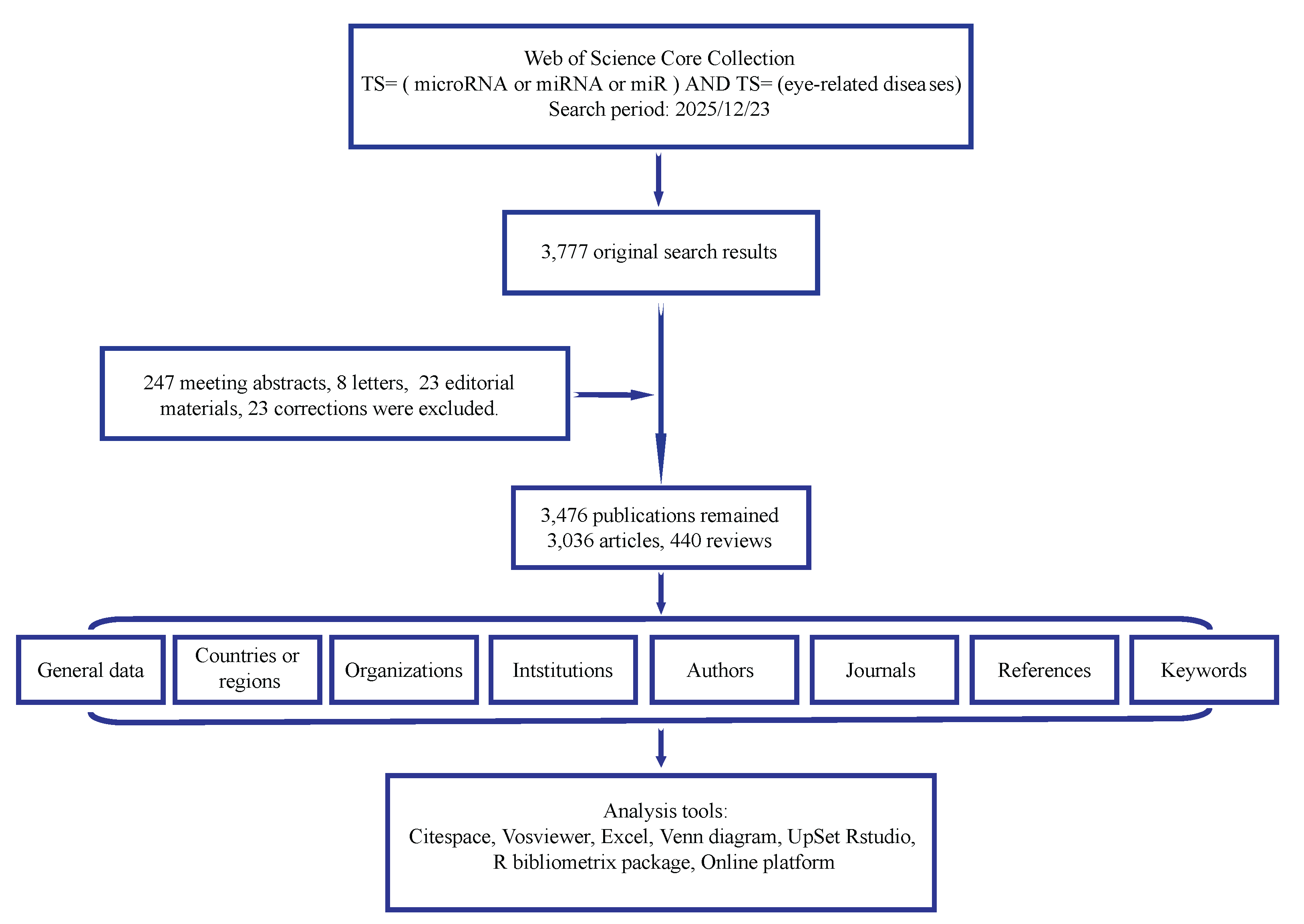
Figure 2.
Countries, trends in the growth of publications, and the number of cited articles related to microRNA research published worldwide from 1999 to 2025. (A) Distribution of main countries from 1999 to 2025 in the pupillometry field. The minimum number of a country’s number was set as 10. A total of 29 countries met the threshold of 69 countries. (B) Network map of the country distribution for pupillometry. (C) The annual publication and citation. (D) The annual publication in the top 10 countries. (E) The distribution world map of pupillometry. The minimum number of documents of an organization was set as 10. A total of 48 organizations of the 2,236 organizations met the threshold.
Figure 2.
Countries, trends in the growth of publications, and the number of cited articles related to microRNA research published worldwide from 1999 to 2025. (A) Distribution of main countries from 1999 to 2025 in the pupillometry field. The minimum number of a country’s number was set as 10. A total of 29 countries met the threshold of 69 countries. (B) Network map of the country distribution for pupillometry. (C) The annual publication and citation. (D) The annual publication in the top 10 countries. (E) The distribution world map of pupillometry. The minimum number of documents of an organization was set as 10. A total of 48 organizations of the 2,236 organizations met the threshold.
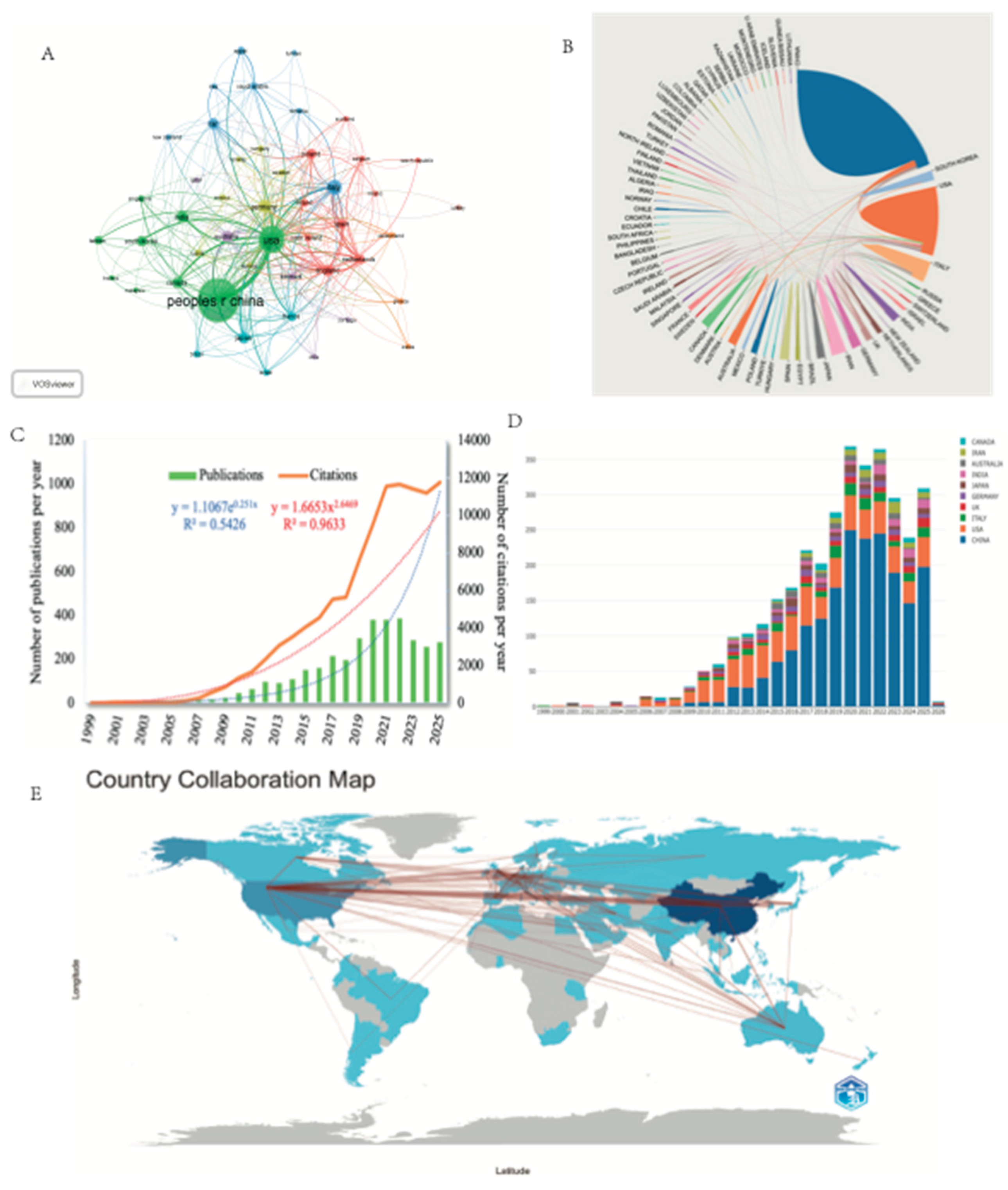
Figure 3.
Analysis of authors and references involved in this field. (A) The co-authorship network visualization map of authors related to this field. (B) The overlay visualization map between authors. (C) Top 25 references with the strongest citation bursts involved in the pupillometry field.
Figure 3.
Analysis of authors and references involved in this field. (A) The co-authorship network visualization map of authors related to this field. (B) The overlay visualization map between authors. (C) Top 25 references with the strongest citation bursts involved in the pupillometry field.
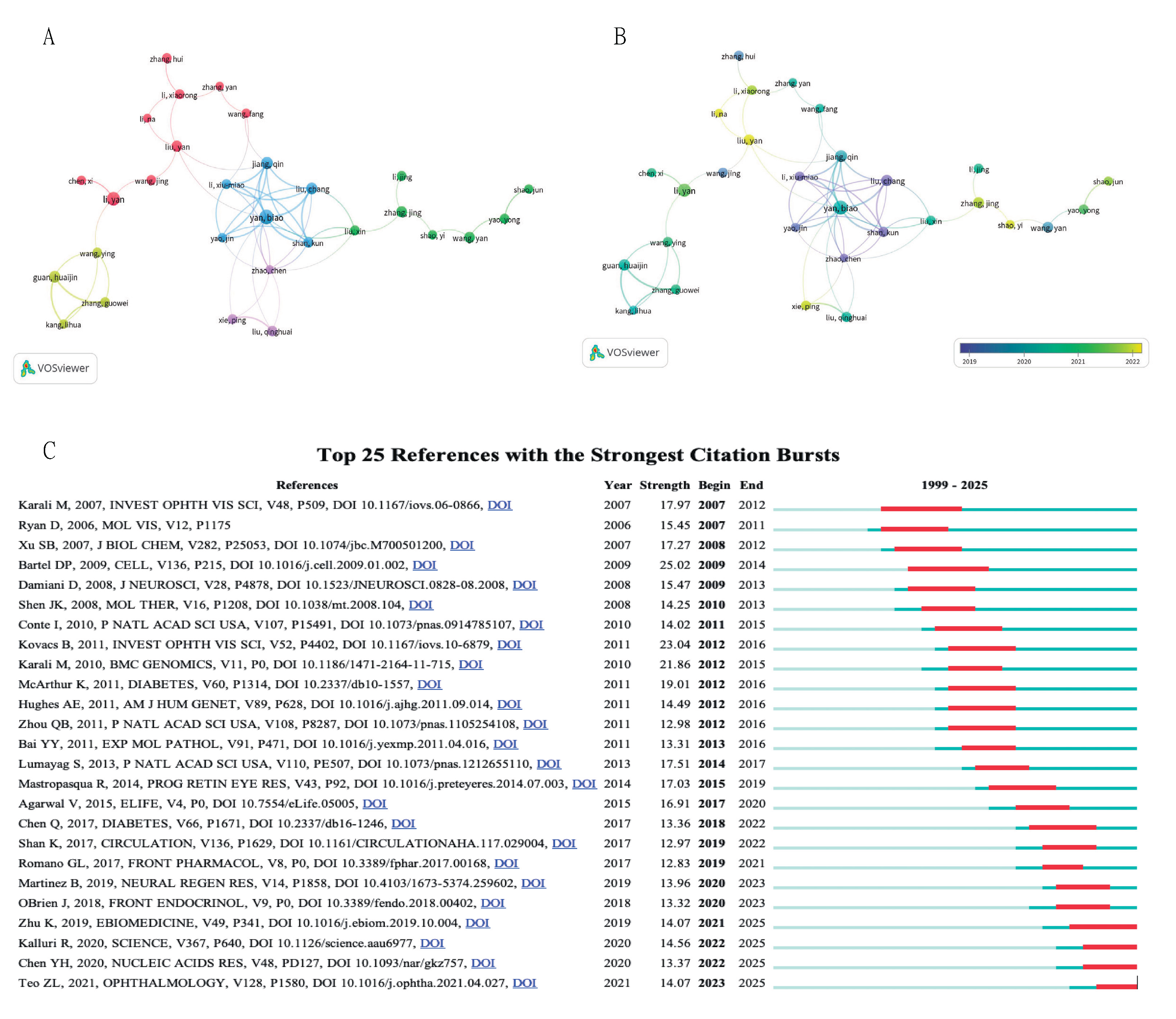
Figure 4.
Keyword-related mapping, strongest citation burst, and evolution in studies of the microRNAs. (A) Network visualization map of keyword co-occurrence analysis using VOS viewer. (B) The overlay map of keywords. (C) Top 25 references with the strongest citation bursts involved in the pupillometry field. (D) Evolutionary pathway in the study of pupillometry: The position of each node represents when it first appeared, and the lines between nodes represent relationships between keywords. The node colors represent different years, from cold to warm means the period from 1999 to 2025. Bluish purple indicates the previous keyword, and red indicates the latest keyword. Longer colored segments indicate a larger reference time span. The flow of knowledge between clusters from cool to warm colors can also be observed over time.
Figure 4.
Keyword-related mapping, strongest citation burst, and evolution in studies of the microRNAs. (A) Network visualization map of keyword co-occurrence analysis using VOS viewer. (B) The overlay map of keywords. (C) Top 25 references with the strongest citation bursts involved in the pupillometry field. (D) Evolutionary pathway in the study of pupillometry: The position of each node represents when it first appeared, and the lines between nodes represent relationships between keywords. The node colors represent different years, from cold to warm means the period from 1999 to 2025. Bluish purple indicates the previous keyword, and red indicates the latest keyword. Longer colored segments indicate a larger reference time span. The flow of knowledge between clusters from cool to warm colors can also be observed over time.
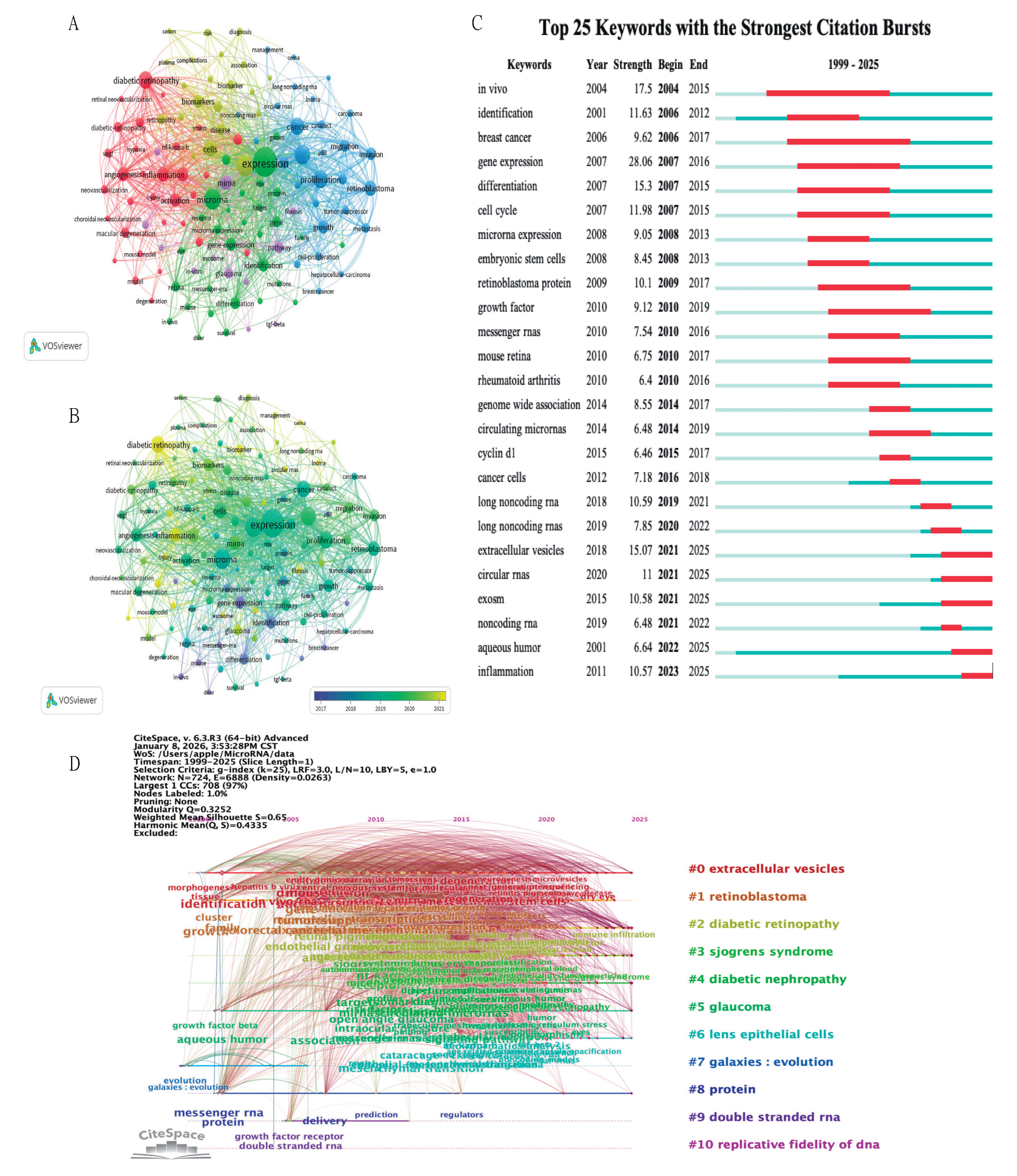
Figure 5.
The analysis of microRNAs in ophthalmic diseases. (A) The intersection of microRNAs in different corneal diseases. (B) The intersection of microRNAs in various conjunctival diseases. (C) The intersection of microRNAs in different retinal diseases. (D) The intersection of microRNAs in various optic nerve diseases. (E) The intersection of miRNAs in various ocular segment diseases.
Figure 5.
The analysis of microRNAs in ophthalmic diseases. (A) The intersection of microRNAs in different corneal diseases. (B) The intersection of microRNAs in various conjunctival diseases. (C) The intersection of microRNAs in different retinal diseases. (D) The intersection of microRNAs in various optic nerve diseases. (E) The intersection of miRNAs in various ocular segment diseases.
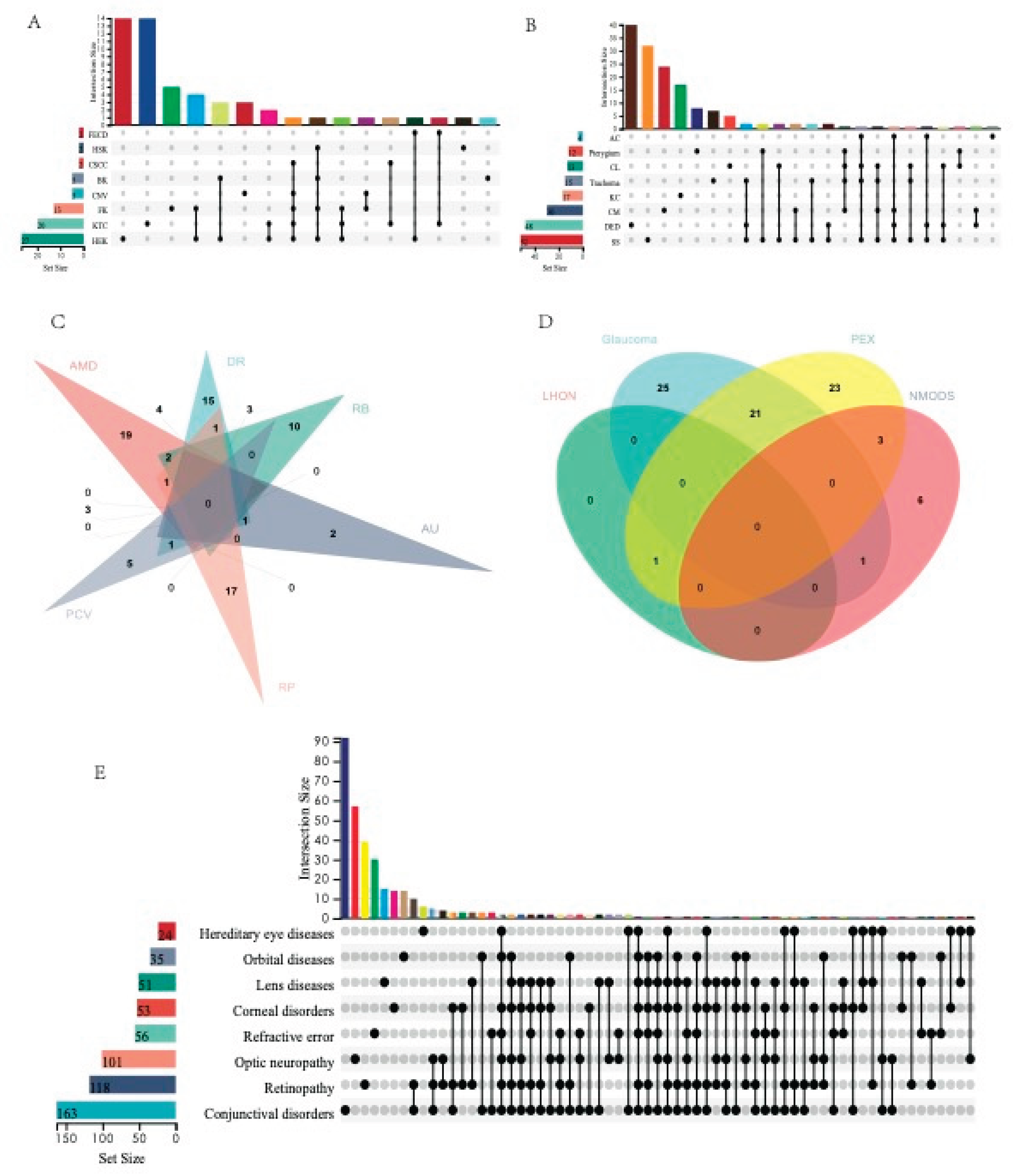
Figure 6.
Dysregulation of microRNAs in various ocular segment disorders (Each microRNA at least associated with three or more ocular segments: cornea, conjunctiva, lens, retina, optic nerve).
Figure 6.
Dysregulation of microRNAs in various ocular segment disorders (Each microRNA at least associated with three or more ocular segments: cornea, conjunctiva, lens, retina, optic nerve).
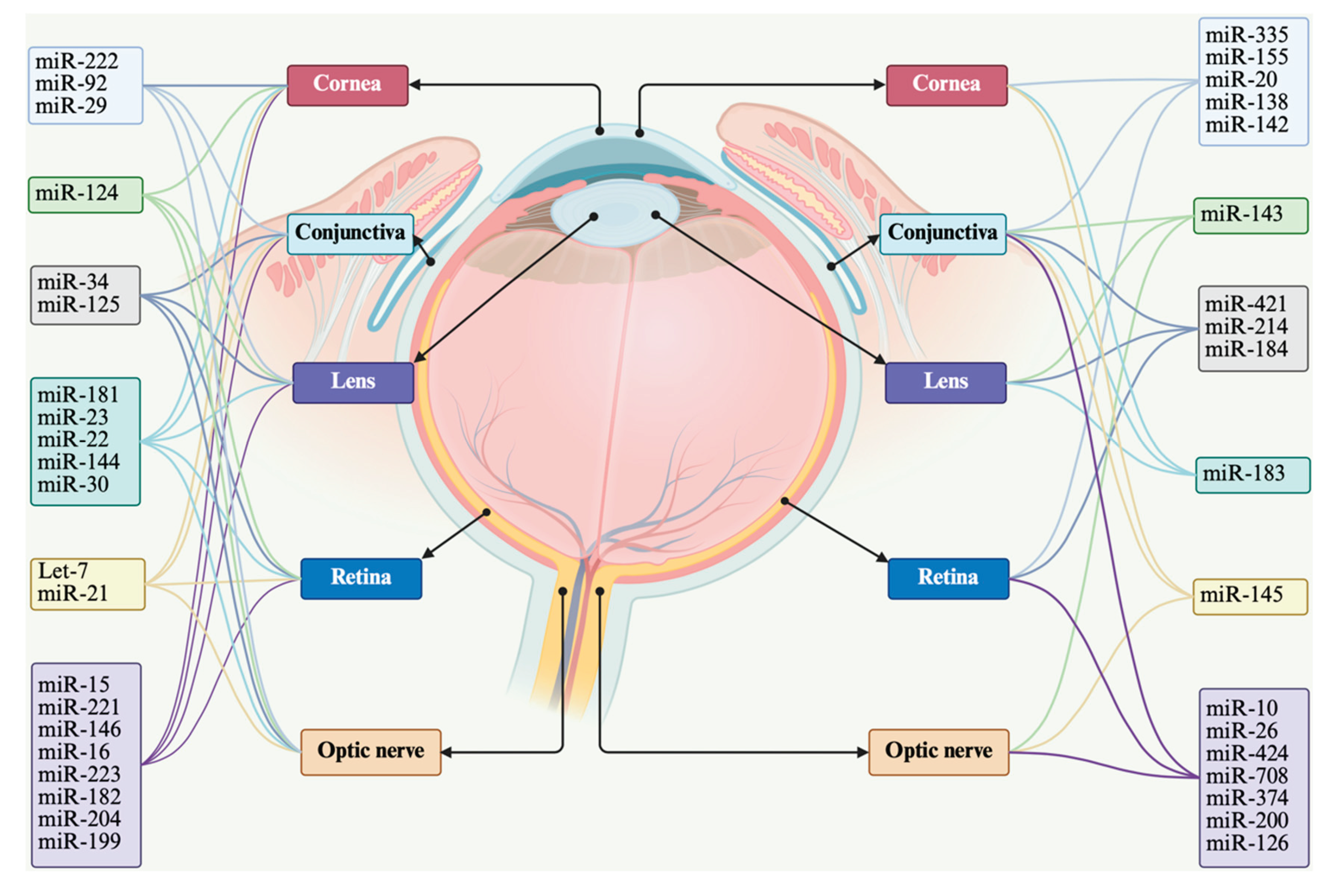

Table 1.
The quantity of microRNA analysis from 1999 to 2025 in the eye-related diseases in terms of year.
Table 1.
The quantity of microRNA analysis from 1999 to 2025 in the eye-related diseases in terms of year.
| Year | Publications | Citations |
| 1999 | 2 | 16 |
| 2000 | 1 | 23 |
| 2001 | 5 | 28 |
| 2002 | 1 | 35 |
| 2003 | 1 | 34 |
| 2004 | 5 | 43 |
| 2005 | 1 | 49 |
| 2006 | 12 | 99 |
| 2007 | 12 | 269 |
| 2008 | 15 | 555 |
| 2009 | 24 | 867 |
| 2010 | 46 | 1,334 |
| 2011 | 63 | 1,662 |
| 2012 | 96 | 2,327 |
| 2013 | 91 | 3,055 |
| 2014 | 108 | 3,532 |
| 2015 | 150 | 4,068 |
| 2016 | 159 | 4,533 |
| 2017 | 215 | 5,532 |
| 2018 | 196 | 5,651 |
| 2019 | 297 | 7,610 |
| 2020 | 382 | 9,559 |
| 2021 | 382 | 11,538 |
| 2022 | 386 | 11,640 |
| 2023 | 286 | 11,401 |
| 2024 | 258 | 11,181 |
| 2025 | 277 | 11,745 |
| Total | 3,476 | 108,708 |
Table 2.
A. The top 10 countries contributed to publications of microRNA analysis from 1999 to 2025 in the eye-related diseases. B. The top ten productive organizations from 1999 to 2025 in the microRNA analysis.
Table 2.
A. The top 10 countries contributed to publications of microRNA analysis from 1999 to 2025 in the eye-related diseases. B. The top ten productive organizations from 1999 to 2025 in the microRNA analysis.
| A | ||||||||||
| Rank | Country | Documents | Citations | Citation/ Document (%) | Centrality | Total link strength | ||||
| 1 | China | 1,896 | 40,916 | 21.58 | 0.18 | 252 | ||||
| 2 | USA | 696 | 41,142 | 59.11 | 0.37 | 433 | ||||
| 3 | Italy | 170 | 11,111 | 65.35 | 0.21 | 135 | ||||
| 4 | Germany | 102 | 4,882 | 47.86 | 0.09 | 127 | ||||
| 5 | Japan | 99 | 3,701 | 37.38 | 0.02 | 68 | ||||
| 6 | England | 94 | 4,058 | 43.17 | 0.27 | 143 | ||||
| 7 | India | 94 | 2,422 | 25.76 | 0.10 | 50 | ||||
| 8 | Australia | 85 | 3,035 | 35.70 | 0.06 | 90 | ||||
| 9 | Iran | 82 | 1,599 | 19.50 | 0.10 | 46 | ||||
| 10 | Canada | 77 | 4,873 | 63.28 | 0.04 | 74 | ||||
| B | ||||||||||
| Rank | Organization | Documents | Citations | Citation/ Document (%) (%) | Centrality | |||||
| 1 | Nanjing Medical University | 107 | 3,797 | 35.48 | 0.07 | |||||
| 2 | Shanghai Jiao Tong University | 106 | 2,627 | 24.78 | 0.20 | |||||
| 3 | Fudan University | 96 | 3,089 | 32.17 | 0.07 | |||||
| 4 | Sun Yat Sen University | 87 | 2,297 | 26.40 | 0.12 | |||||
| 5 | Central South University | 60 | 932 | 15.53 | 0.02 | |||||
| 6 | Wen Zhou Medical University | 60 | 1,192 | 19.86 | 0.03 | |||||
| 7 | Zheng Zhou University | 60 | 961 | 16.01 | 0.01 | |||||
| 8 | Tian Jin Medical University | 55 | 1,296 | 23.56 | 0.05 | |||||
| 9 | Ji Lin University | 51 | 1,334 | 26.15 | 0.02 | |||||
| 10 | Capital Medical University | 50 | 766 | 15.32 | 0.06 | |||||
Table 3.
A. The top ten productive authors and co-cited authors from 1999 to 2025 in the microRNA analysis. B. The top 10 journals and research areas in the study of microRNA from 1999 to 2025 in the eye-related diseases.
Table 3.
A. The top ten productive authors and co-cited authors from 1999 to 2025 in the microRNA analysis. B. The top 10 journals and research areas in the study of microRNA from 1999 to 2025 in the eye-related diseases.
| A | |||||||||||
| Rank | Author | Documents | Citations | Total link strength | Co-cited author | Citations | Total link strength | ||||
| 1 | Yan Biao | 27 | 2,084 | 138 | Bartel DP | 672 | 13,333 | ||||
| 2 | Li Yan | 22 | 346 | 80 | Wang Y | 378 | 7,474 | ||||
| 3 | Jiang Qin | 19 | 1,508 | 86 | Zhang Y | 369 | 7,537 | ||||
| 4 | Zhang Hong | 19 | 350 | 23 | Karali M | 301 | 9,305 | ||||
| 5 | Guan Huai Jin | 18 | 251 | 112 | Livak KJ | 285 | 3,568 | ||||
| 6 | Banfi Sandro | 18 | 978 | 82 | Li Y | 248 | 5,428 | ||||
| 7 | Liu Chang | 17 | 2,003 | 96 | Liu Y | 237 | 5,057 | ||||
| 8 | Zhang Jing | 16 | 207 | 35 | Xu SB | 236 | 6,464 | ||||
| 9 | Gonzalez Pedro | 15 | 1,073 | 45 | Zhang L | 224 | 4,430 | ||||
| 10 | Wang Yan | 15 | 417 | 29 | Ambros V | 224 | 4,339 | ||||
| B | |||||||||||
| Rank | Journal | Country | Documents (%)2024. | Citations | Total link strength | IF (2024) | Co-cited journal | Citations | Total link strength | IF (2024) | |
| 1 | IOVS | USA | 150 (4.31) | 5,432 | 1976 | 4.7 | IOVS | 7,324 | 541,486 | 4.7 | |
| 2 | Experimental Eye Research | USA | 119 (3.42) | 2,308 | 1115 | 2.7 | Plos One | 4,301 | 333,398 | 2.6 | |
| 3 | International Journal of Molecular Sciences | USA | 86 (2.47) | 1,459 | 798 | 4.9 | PNAS | 4,043 | 322,014 | 9.1 | |
| 4 | Plos One | USA | 79 (2.27) | 3,036 | 670 | 2.6 | CELL | 3,610 | 274,554 | 42.5 | |
| 5 | Scientific Reports | England | 69 (1.98) | 1,342 | 623 | 3.9 | NATURE | 3,397 | 276,337 | 48.5 | |
| 6 | Current Eye Research | Netherlands | 61 (1.75) | 595 | 539 | 2.0 | Experimental Eye Research | 2,852 | 220,606 | 2.7 | |
| 7 | Molecular Medicine Reports | Greece | 52 (1.49) | 750 | 332 | 3.5 | Journal of Biological Chemistry | 2,447 | 209,467 | 3.9 | |
| 8 | Molecular Vision | USA | 43 (1.23) | 1,757 | 604 | 1.4 | Nucleic Acids Research | 2,365 | 158,511 | 13.1 | |
| 9 | International Journal of Ophthalmology | China | 33 (0.94) | 380 | 253 | 1.8 | Scientific Reports | 2,234 | 171,979 | 3.9 | |
| 10 | Frontiers in Immunology | Switzerland | 31 (0.89) | 1,120 | 259 | 5.9 | International Journal of Molecular Sciences | 2,122 | 165,181 | 4.9 | |
IOVS, Investigative Ophthalmology & Visual Science; PNAS, Proceedings of the National Academy of Sciences of the United States of America.
Table 4.
Top ten co-cited references in microRNA analysis from 1999 to 2025 in the eye-related diseases.
Table 4.
Top ten co-cited references in microRNA analysis from 1999 to 2025 in the eye-related diseases.
| Rank | Cited reference | Title | Journal | Citations | Total link strength |
|---|---|---|---|---|---|
| 1 | bartel dp, 2004, cell, v116, p281, doi 10.1016/s0092-8674(04)00045-5 | MicroRNAs: genomics, biogenesis, mechanism, and function | CELL | 399 | 4,628 |
| 2 | livak kj, 2001, methods, v25, p402, doi 10.1006/meth.2001.1262 | Analysis of relative gene expression data using real-time quantitative PCR and the 2(-Delta Delta C(T)) Method | Methods | 284 | 2,001 |
| 3 | bartel dp, 2009, cell, v136, p215, doi 10.1016/j.cell.2009.01.002 | MicroRNAs: target recognition and regulatory functions | CELL | 209 | 2,669 |
| 4 | ambros v, 2004, nature, v431, p350, doi 10.1038/nature02871 | The functions of animal microRNAs | NATURE | 155 | 1,754 |
| 5 | lewis bp, 2005, cell, v120, p15, doi 10.1016/j.cell.2004.12.035 | Conserved seed pairing, often flanked by adenosines, indicates that thousands of human genes are microRNA targets | CELL | 149 | 2,111 |
| 6 | kovacs b, 2011, invest ophth vis sci, v52, p4402, doi 10.1167/iovs.10-6879 | MicroRNAs in early diabetic retinopathy in streptozotocin-induced diabetic rats | IOVS | 141 | 2,817 |
| 7 | xu sb, 2007, j biol chem, v282, p25053, doi 10.1074/jbc.m700501200 | MicroRNA (miRNA) transcriptome of mouse retina and identification of a sensory organ-specific miRNA cluster | Journal of Biological Chemistry | 136 | 3,068 |
| 8 | shen jk, 2008, mol ther, v16, p1208, doi 10.1038/mt.2008.104 | MicroRNAs regulate ocular neovascularization | Molecular Therapy | 126 | 2,606 |
| 9 | lee rc, 1993, cell, v75, p843, doi 10.1016/0092-8674(93)90529-y | The C. elegans heterochronic gene lin-4 encodes small RNAs with antisense complementarity to lin-14 | CELL | 122 | 2,819 |
| 10 | mcarthur k, 2011, diabetes, v60, p1314, doi 10.2337/db10-1557 | MicroRNA-200b regulates vascular endothelial growth factor-mediated alterations in diabetic retinopathy |
Diabetes | 113 | 2,437 |
Table 5.
MicroRNAs in ophthalmology. A| The intersection of MicroRNAs in different eye-related diseases. B The intersection of MicroRNAs in each ocular segment disease.
Table 5.
MicroRNAs in ophthalmology. A| The intersection of MicroRNAs in different eye-related diseases. B The intersection of MicroRNAs in each ocular segment disease.
| A | |||||||||||||
| Disease | microRNA | Disease | microRNA | Disease | microRNA | Disease | microRNA | ||||||
| AMD|DR | let-7, miR-21, miR-200, miR-138 | AMD|PCV | miR-374, miR-22, miR-502 | TRC|DED|SS | miR-142, miR-203 | HEK|BK | let-7, miR-182, miR-183 | ||||||
| AMD|RB | miR-708, miR-330 | AMD|RP|PCV | miR-335 | CL|TRC|SS | miR-150 | HEK|KTC | miR-181, miR-222 | ||||||
| AMD|RP | miR-25 | AMD|RB|PCV | miR-140 | AC|DED|SS | miR-223 | CNV|FK | miR-204 | ||||||
| DR|RB | miR-363, miR-320, miR-98 | AMD|RB|RP|PCV | miR-9, miR-181 | CL|DED|SS | let-7 | CSCC|KTC | miR-205 | ||||||
| DR|AU | miR-30 | AMD|DR|PCV | miR-20 | PTG|CL|CM|TRC | miR-184 | KTC|FECD | miR-199 | ||||||
| DR|RP | miR-126 | PTG|SS | miR-21, miR-145 | AC|CL|TRC|SS | miR-155 | LHON|PEX | miR-548 | ||||||
| AMD|DR|AU | miR-155 | CL|SS | miR-16, miR-222 | CL|CM|TRC|SS | miR-30 | GLC|NMODS | miR-200 | ||||||
| AMD|DR|RP | miR-27 | CM|SS | miR-34, miR-302 | AC|CM|DED|SS | miR-146 | PEX|NMODS | miR-126, miR-122, miR-30 | ||||||
| AMD|RB|RP | miR-34 | TRC|SS | miR-181, miR-147 | CSCC|CNV|HEK|FK|KTC | miR-184 | GLC|PEX | let-7, miR-4667, miR-637, miR-4490, miR-1253, miR-3190, miR-3173, miR-608, miR-4725, miR-4448, miR-323, miR-4538, miR-3913, miR-3159, miR-4663, miR-4767, miR-4724, miR-1306, miR-181, miR-433, miR-6777 | ||||||
| AMD|AU|RP | miR-223 | DED|SS | miR-130, miR-20 | HEK|FK|KTC | miR-146 | ||||||||
| AMD|DR|AU|RP | miR-146 | PTG|CL | miR-200 | HEK|FECD | miR-29 | ||||||||
| DR|PCV | miR-195 | CM|DED | miR-4427 | HEK|FK | miR-21, miR-124, miR-142, miR-223 | ||||||||
| B | |||||||||||||
| Disease | MicroRNA | Disease | MicroRNA | Disease | MicroRNA | ||||||||
| CJD|RD | miR-218, miR-150, miR-342, miR-485, miR-153, miR-365, miR-503, miR-106, miR-186, miR-191 | ON|HED | miR-375 | CND|CJD|LD|OD | miR-183 | ||||||||
| RD|ON | miR-1307, miR-637, miR-382, miR-1253 | CJD|RD|ON | miR-10, miR-26, miR-424, miR-708, miR-374 | CND|RD|ON|OD | miR-320 | ||||||||
| CND|RD | miR-195, miR-363, miR-25 | CND|CJD|RD | miR-335, miR-155, miR-20 | CJD|LD|RD|RE | miR-214 | ||||||||
| LD|RD | miR-377, miR-148, miR-24 | CJD|RD|OD | miR-27, miR-502 | CND|CJD|ON|RE | miR-145 | ||||||||
| LD|ON | miR-210, miR-630 | CJD|ON|RE | miR-122, miR-302 | CJD|LD|ON|RE | miR-143 | ||||||||
| CJD|OD | miR-130, miR-484 | CJD|LD|RD | miR-421 | CND|CJD|RD|HED | miR-138 | ||||||||
| CJD|RE | miR-500, miR-539, miR-18 | CND|RD|ON | miR-451 | CJD|LD|RD|HED | miR-184 | ||||||||
| CND|CJD | miR-1246, miR-132 | RD|ON|OD | miR-192 | CND|CJD|LD|RD|ON | miR-181, miR-23 | ||||||||
| CJD|LD | miR-19, miR-4728 | CND|CJD|RE | miR-127 | CND|CJD|LD|RD|RE | miR-16, miR-223 | ||||||||
| ON|RE | miR-1306, miR-671 | CND|LD|RE | miR-338 | CND|CJD|LD|RD|OD | miR-182 | ||||||||
| CJD|HED | miR-7977, miR-31 | CND|CJD|HED | miR-205 | CJD|LD|RD|ON|RE | miR-125 | ||||||||
| CJD|ON | miR-548 | CND|LD|HED | miR-193 | CND|CJD|RD|OD|RE | miR-142 | ||||||||
| CND|OD | miR-96 | LD|RD|HED | miR-224 | CND|CJD|LD|RD|HED | miR-204 | ||||||||
| RD|OD | miR-129 | CJD|ON|HED | miR-1260 | CND|CJD|LD|RD|ON|OD | miR-22, miR-144 | ||||||||
| LD|RE | miR-216 | CND|CJD|LD|RD | miR-15, miR-221 | CND|CJD|LD|RD|OD|RE | miR-199 | ||||||||
| RD|RE | miR-98 | CND|CJD|LD|ON | miR-222, miR-92 | CND|CJD|LD|ON|OD|RE | miR-29 | ||||||||
| OD|RE | miR-101 | CJD|RD|ON|RE | miR-200, miR-126 | CND|CJD|LD|RD|ON|HED | miR-30 | ||||||||
| CND|HED | miR-7 | CND|LD|RD|ON | miR-124 | CND|CJD|RD|ON|OD|RE|HED | let-7, miR-21 | ||||||||
| LD|HED | miR-211 | CJD|LD|RD|ON | miR-34 | CND|CJD|LD|RD|OD|RE|HED | miR-146 | ||||||||
Corneal squamous cell carcinoma (CSCC), Corneal neovascularization (CNV), Fuchs endothelial corneal dystrophy (FECD), Herpes epithelial keratitis (HEK), Herpes stromal keratitis (HSK), Fungal keratitis (FK), Bacterial Keratitis, Pterygium (PTG), Allergic conjunctivitis (AC), Conjunctival lymphoma (CL), Conjunctival melanoma (CM), Keratoconjunctivitis (KC), Trachoma (TRC), Diabetic RD (DR), Age-related macular degeneration (AMD), Polypoidal choroidal vasculopathy (PCV), Glaucoma (GLC), Pseudoexfoliation syndrome (PEX), Neuromyelitis optica spectrum disorder (NMOSD), Autoimmune uveitis (AU), Dry Eye Disease (DED), Sjögren's syndrome (SS), Keratoconus (KTC), Retinoblastoma (RB), Retinitis pigmentosa (RP). Corneal Disorders (CND), Conjunctival Disorders (CJD), Lens diseases (LD, Cataract), Retinal disorders (RD), Optic neuropathy (ON), Refractive error (RE, Myopia), Orbital diseases (OD, Graves' ophthalmopathy), Hereditary eye diseases (HED, EDICT syndrome, Aniridia).
Table 6.
The top 25 co-occurrence analysis of keywords in the microRNAs.
| MircoRNA | MircoRNA | MircoRNA |
|---|---|---|
| miR-146 (76) | let-7 (28) | miR-150 (7) |
| miR-126 (53) | miR-223 (15) | miR-192 (7) |
| miR-155 (52) | miR-182 (13) | miR-30 (7) |
| miR-34 (45) | miR-214 (12) | miR-132 (6) |
| miR-21 (43) | miR-9 (12) | miR-23 (5) |
| miR-204 (41) | miR-181 (11) | |
| miR-29 (39) | miR-96 (9) | |
| miR-184 (24) | miR-183 (8) | |
| miR-200 (23) | miR-142 (7) | |
| miR-124 (31) | miR-145 (7) |
The numbers in brackets represent the frequency of keywords according to the co-occurrence.
Disclaimer/Publisher’s Note: The statements, opinions and data contained in all publications are solely those of the individual author(s) and contributor(s) and not of MDPI and/or the editor(s). MDPI and/or the editor(s) disclaim responsibility for any injury to people or property resulting from any ideas, methods, instructions or products referred to in the content. |
© 2026 by the authors. Licensee MDPI, Basel, Switzerland. This article is an open access article distributed under the terms and conditions of the Creative Commons Attribution (CC BY) license (http://creativecommons.org/licenses/by/4.0/).
Copyright: This open access article is published under a Creative Commons CC BY 4.0 license, which permit the free download, distribution, and reuse, provided that the author and preprint are cited in any reuse.


