

Submitted:
10 March 2026
Posted:
11 March 2026
You are already at the latest version
Preprints on COVID-19 and SARS-CoV-2
Abstract
Background: During the Covid-19 event, Ontario hospitals implemented healthcare worker vaccination policies under Directive #6, a provincial framework that formally permitted multiple compliance pathways, including mandatory vaccination. Despite this formal flexibility, institutional responses converged. This study examines how vaccination mandates were implemented and justified across institutional, legal, and media domains, with particular attention to the operation of discretion within a decentralized governance framework. Methods: An environmental scan was conducted using document analysis of publicly available materials from a purposive sample of Ontario hospitals. Sources included hospital policy documents, institutional communications, court decisions, and media coverage. Materials were analyzed to identify patterns of mandate implementation, justification, and representation across domains. The term “Covid-19 event” is used as a neutral temporal descriptor that does not presuppose epidemiological classification. The study emphasizes descriptive mapping of institutional responses rather than causal inference. Results: Across the documentary corpus, vaccination was consistently framed as a baseline condition of healthcare employment, while alternatives permitted under provincial policy were rarely presented as durable or equivalent options. Hospitals adopted highly similar implementation models despite formal discretion. Legal decisions generally treated mandates as matters of institutional or employer authority, emphasizing jurisdictional and procedural considerations while limiting substantive review of scientific and proportionality claims central to the litigation. Media coverage largely mirrored institutional and legal framings, presenting vaccination as a settled professional expectation and employment exclusion as a routine administrative consequence. Taken together, these domains exhibited parallel patterns of normalization and policy alignment. Conclusions:This environmental scan documents convergence toward restrictive vaccination mandate implementation across institutional, legal, and media domains despite a formally flexible policy framework. By tracing how discretion was exercised and legitimated, the study provides an empirical account of how vaccination mandates stabilized as routine institutional practice. These findings establish a foundation for subsequent interpretive analysis of authority, dissent, and policy problem representation within governance frameworks during declared public health emergencies.
Keywords:
Covid-19
; vaccination mandates
; healthcare workers
; hospitals
; policy implementation
; environmental scan
; Ontario
; Canada
Introduction
At the outset of the Covid event, healthcare workers were elevated to near-mythic status in public discourse, both in Canada and globally. Media outlets, hospital campaigns, and government communications portrayed them as “frontline heroes”—essential, self-sacrificing figures bearing the emotional and physical burdens of an unprecedented health crisis. In an article titled The Heroes Behind the Masks, the President and CEO of the Mental Health Commission of Canada, herself a former hospital administrator and nurse, was quoted as saying that “health-care workers have always been heroes in my eyes”; in support of this assertion, she noted that workers were already overextended under ordinary conditions and even more so during what she described as a “once-in-a-generation crisis like [Covid-19]” (St. Louis, 2020). Around the same time, the British Broadcasting Corporation (BBC) published a piece commemorating 100 National Health Service workers in the United Kingdom who had “died with coronavirus”; the article included personal biographies emphasizing sacrifice, service, and moral fortitude (BBC, 2020). The scientific literature echoed this framing: an early 2020 editorial in the Journal of the American Medical Association cast healthcare workers as moral exemplars, emphasizing their extraordinary commitment to patients, communities, and public health (Bauchner & Easley, 2020).
As vaccine mandates were introduced in healthcare settings—for example, in Ontario under Directive #6—the public and institutional framing of healthcare workers began to shift across scholarly, policy, legal, and media domains. Workers who questioned, delayed, or declined vaccination—notably from within the same collective publicly valorized throughout 2020, prior to vaccine availability—were increasingly characterized not as overburdened professionals navigating complex circumstances, but as risks to patient safety and institutional integrity. Scholarly discourse reflected this shift, positioning such workers less as moral agents confronting difficult decisions and more as potential threats to the populations they served. For example, Talbot et al. (2021) argued that unvaccinated healthcare workers posed unacceptable risks to patients (Talbot, 2021). Gandhi et al. (2024) framed vaccination as a professional obligation, particularly in long-term care settings, implying that non-compliance reflected a failure of professional responsibility (Gandhi et al., 2024). Ramzy et al. (2023) associated healthcare worker vaccine refusal with systemic vulnerability, further construing such workers as risks to public health (Ramzy et al., 2023).
The “hero to threat” shift has at times been articulated so starkly that professional dissent—across both scholarly and policy domains—has been reframed not merely as disagreement but as epistemic and ethical deviance. For example, Sule et al. (2023), in an analysis of U.S. physicians’ social media posts, classified physician statements diverging from official Covid-19 guidance—particularly regarding vaccination—as “misinformation” or “conspiracy theories,” using alignment with CDC recommendations as the primary epistemic benchmark (Sule et al., 2023). In a similar vein, Backhaus et al. (2023) associated reservations toward Covid-19 vaccination with “right-wing” political beliefs, framing dissent from official policy as ideological deviance and contributing to a discursive environment in which dissenters may be positioned as politically suspect (Backhaus et al., 2023). More broadly, positions short of full endorsement of Covid-19 vaccination have been—and continue to be—constructed as policy “problems,” such as “vaccine hesitancy,” requiring correction. Within this framing, reluctance or reservations are frequently attributed to cognitive deficits, emotional vulnerability, or moral failure rather than examined as potentially reasoned responses to contested evidence, scientific uncertainty, or policy trade-offs (see for example (Larson et al., 2022; The Lancet Child & Adolescent Health, 2019; WHO, 2019).
This article presents the first phase of a two-part study examining how Covid-19 vaccine mandates were implemented across healthcare institutions in Ontario. The broader project analyzes both the content and institutional justifications of mandate policies (Phase 1) and the discursive transformation through which dissenting healthcare workers came to be reframed from celebrated professionals to perceived public health threats (Phase 2).
Phase 1 consists of an environmental scan that compiles and analyzes institutional, legal, and media documents to reconstruct how Ontario hospitals implemented vaccine mandates. The analysis examines how healthcare institutions interpreted and operationalized provincial directives, the rationales they provided, the timelines they followed, and the types of evidence they cited. The objective is to map how hospital vaccination policies framed the stakes of vaccination, redefined professional responsibilities, and constructed risk representations to support institutional action. In doing so, the scan provides a descriptive account of the policy rollout while offering a document-based empirical window into how institutional authority was exercised, justified, and normalized—an essential step toward understanding the broader rhetorical and ideological transformation of the healthcare workforce under Covid-19 governance.
Methods
To examine how vaccine mandates were implemented, justified, and managed by healthcare institutions across Ontario, we conducted an environmental scan using document analysis of publicly accessible materials spanning 2020 to 2025. Environmental scanning, originally developed in organizational research and increasingly used in health services research, is well suited to the systematic identification, organization, and interpretation of information across complex policy environments (Charlton et al., 2021; Choo, 2001). Following Bowen (2009), documents were treated as social artifacts that convey meaning, institutional priorities, and justificatory logics (Bowen, 2009). Thematic analysis was used to identify recurring patterns in framing and justification (Braun & Clarke, 2006).
The objective was to capture how provincial policy directives—specifically Directive #6—were interpreted and operationalized by hospital administrators, and how mandate implementation was framed across institutional, legal, and media domains. Accordingly, the analysis mapped the rollout of hospital vaccine mandates as documented in hospital records (e.g., internal communications and press releases), legal rulings, and media coverage. Consistent with established approaches to environmental scanning, this design enabled triangulation across document types to capture both institutional decision-making and its public representation within a shared policy context (Carter et al., 2014).
Hospital Selection
Hospitals were selected from the Canadian Broadcasting Corporation (CBC)’s Rate My Hospital database (CBC News, 2013), which includes 240 hospitals across Canada—153 in Ontario—classified along two dimensions: (1) institutional type (Teaching, Large Community, Medium Community, Small Community) and (2) performance grade (A+, A, B, C, or Unrated), based on a weighted composite of outcome and quality indicators (CBC News, 2013). Selection followed a purposive sampling strategy aimed at identifying information-rich cases relevant to the implementation of Covid-19 vaccination mandates, our object of inquiry (Palinkas et al., 2015). Within this purposive framework, hospitals were selected from the CBC database using a maximum variation sampling logic. Commonly employed in qualitative research, this approach supports the identification of shared patterns across diverse organizational contexts while attending to variation associated with institutional characteristics (Palinkas et al., 2015; Patton, 2015).
Specifically, we created a 20-cell matrix that cross-tabulated hospital type by grade and selected one hospital from each populated grade-by-type cell using criteria grounded in maximum variation logic. The first hospital was selected based on high visibility—or alphabetical order when no highly visible institution was available—the second was selected alphabetically, and a backup institution was designated for each category in case either of the first two did not yield sufficient data after a 30 to 60–minute search. Where only one hospital was available in a category, that institution was included by default.
In categories with more than two hospitals, up to two were selected to avoid overrepresentation while maximizing internal diversity. For Teaching and Large Community hospitals, preference was given to institutions with documented public visibility—for example, those featured in academic publication analyses or media coverage, such as Toronto General (Thayaparan, 2025). This inclusion aligned with the study’s objective of capturing prominent institutional voices in healthcare independent of standard performance datasets. Finally, where public visibility was not decisive, selection favoured institutions listed first in the CBC database—a pragmatic and reproducible criterion. For all other hospital types, alphabetical order or visual prominence guided selection. This strategy balanced reproducibility with interpretive richness, consistent with qualitative research priorities (Table 1).
The approach yielded a sample of 25 Ontario hospitals: 7 Teaching, 7 Large Community, 8 Medium Community, and 3 Small Community (Table 2).
Document Collection and Data Extraction
To document the implementation of vaccination mandates, we prioritized collection of hospital-originated policy documents, including internal communications, public statements, and press releases where available. Document identification followed a structured multi-stage search strategy tailored to the institutional nature of the material sought.
Hospital-originated documents were identified through systematic review of each hospital’s official website to locate publicly available policy documents, institutional communications, press releases, and archived notices pertaining to Covid-19 vaccination requirements.
Legal materials were identified through searches of the Canadian Legal Information Institute (CanLII) database using hospital names and relevant mandate-related terms. This approach ensured coverage of publicly available judicial and arbitral decisions directly referencing the institutions in the sample. The legal corpus was limited to original judicial and arbitral decisions addressing vaccination mandates in healthcare or closely related institutional settings (e.g., nursing homes). Where multiple decisions arose from the same underlying dispute, including appellate review, all related decisions were treated as part of a single legal trajectory and included to document how institutional authority was affirmed across levels of adjudication. Law-firm memoranda and professional legal commentary were consulted to contextualize how such decisions were interpreted and disseminated to institutional actors, but they were not treated as primary legal documents and were therefore not included in the legal document sample analyzed.
Media materials were identified through targeted web searches using the hospital name in combination with key terms (e.g., “vaccination mandate”, “policy”, “staff”, “termination”) through the Google search engine. The media corpus consisted of news articles and reports referencing hospital vaccination policies, related legal proceedings, and broader institutional responses, and was used to document how mandate implementation and contestation were publicly represented and interpreted.
All searches were conducted between June and September 2025—extended only exceptionally to clarify mandate status of selected medical institutions.
Implementation was reconstructed directly through hospital-originated documents and, where necessary, indirectly through legal rulings and media reporting that referenced hospital policies or their enforcement. Legal and media materials were collected for all hospitals in the sample, including those for which hospital-originated documents were available, to provide contextual information and to examine how mandate implementation was publicly articulated and interpreted.
Across all document types, data extraction was restricted to information pertaining to mandate implementation and the rationales provided for policy choices. For each hospital, we extracted:
- Start and end dates of mandate enforcement (if available)
- Nature and scope of vaccination policies
- Degree of alignment with Directive #6
- Stated justifications for policy design and enforcement
- References to scientific or evidentiary rationales (or absence thereof)
- Enforcement mechanisms (e.g., termination)
- Related legal commentary and media coverage
Analytic Tools and Typology Development
The analytic framework drew on Max Weber’s concept of the “ideal type”, understood as a heuristic device for organizing and comparing social phenomena through accentuated patterns rather than comprehensive description (Swedberg, 2018). Directive #6, the provincial policy framework guiding institutional behaviour in Ontario, served as the benchmark against which hospital policies—as articulated and implemented through institutional, legal, and media documents —were evaluated.
Using this framework, we categorized the corpus of hospital, legal, and media materials according to analytically constructed ideal types designed to capture how discourses across diverse sources framed alignment with the range of options permitted under Directive #6, the rationales advanced for policy choices, and associated notions of risk and responsibility. Specifically, Directive #6 required that all covered institutions implement a vaccination policy offering, at minimum, one of the following three options:
- a)
- Proof of full vaccination, defined as: “having received the full series of a COVID-19 vaccine or combination of COVID-19 vaccines approved by [the World Health Organization] (e.g., two doses of a two-dose vaccine series or one dose of a single-dose vaccine series); and having received the final dose of the COVID-19 vaccine at least 14 days ago.”
- b)
- A valid medical exemption, provided by a physician or nurse practitioner, specifying that the individual could not be vaccinated and indicating whether the exemption was time-limited or permanent.
- c)
-
Proof of having completed an educational session, which at minimum addressed:
- how Covid-19 vaccines work
- vaccine safety related to Covid-19
- benefits of vaccination
- risks of non-vaccination
- potential side effects of COVID-19 vaccines
Of note, Directive # 6 authorized institutions to implement testing requirements for individuals who did not provide proof of vaccination. It also gave hospitals a fair amount of institutional discretion, stating that “despite paragraph 1, a Covered Organization may decide to remove the option set out in paragraph 1(c) and require all employees, staff, contractors, volunteers and students to either provide the proof required in paragraph 1(a) or (b)”. (Chief Medical Officer of Health, Ontario, 2021).
Using these three policy options as the analytic baseline, we developed a classification schema consisting of three ideal types—Light, Moderate, and Strict—to categorize documents describing institutional behaviour and vaccination mandate implementation across hospitals. These ideal types were analytically constructed to capture how institutional policies and related discourses aligned with the range of options permitted under Directive #6, including the degree of coercion involved and the rationales provided for policy choices. Throughout the manuscript, the terms Light, Moderate, and Strict are capitalized to denote their use as formal analytic categories rather than descriptive modifiers (Table 3).
In hospital-originated documents, the typology was applied to classify policy choices as articulated by institutions themselves. In legal and media materials, it was applied to capture how those same institutional choices were represented, interpreted, and supported across external sources. Classification involved close reading of each document to identify explicit policy provisions, stated alternatives, enforcement mechanisms, and justificatory language, which were then assessed against the operational criteria defining each ideal type. Where documents contained elements spanning more than one category, classification was based on the dominant policy orientation and enforcement posture described.
To enhance analytic consistency, two investigators independently reviewed each document and assigned a provisional ideal-type classification based on the operational criteria. Discrepancies were infrequent and were resolved through discussion and re-examination of the documentary evidence until consensus was reached. No instances required adjudication by a third reviewer. This collaborative process allowed interpretive judgements to be refined through comparison while maintaining sensitivity to contextual nuances across document types.
By triangulating hospital-originated documents with legal and media materials, we aimed to produce a robust descriptive account of mandate implementation while situating these findings within the broader institutional and public context to be examined during Phase 2.
Statement on Reflexivity
The research team consisted of four investigators with diverse disciplinary backgrounds spanning clinical medicine, molecular biology, medical sociology, health services research, anthropology, and policy analysis, and with extensive combined experience in qualitative health research. Consistent with established guidance on reflexivity in medical qualitative inquiry (Malterud, 2001), these disclosures are offered not for personal or ideological positioning, but to enhance transparency and to situate the knowledge claims advanced in this study.
In addition to their academic and professional expertise, members of the research team have lived experience of the Covid-19 policy response within Canadian public institutions, including healthcare and post-secondary education. This experience informed the choice of research questions and heightened sensitivity to issues of governance, institutional discretion, and the effects of policy implementation on workers, without predetermining analytic conclusions. Reflexivity was maintained throughout the research process through explicit attention to the distinction between prior concerns and interpretations emerging from systematic analysis of the documentary material.
The study builds on a substantial body of prior individual and collaborative research by the investigative team examining Covid-19 policy responses in Canadian public institutions, including higher education and healthcare settings (Chaufan, 2023; Chaufan et al., 2023, 2024, 2025). This prior work informed the design of the present study, which was developed and published as a protocol in advance of data collection, and guided the team’s commitment to epistemic integrity, transparency of methods, and careful separation of empirical description from normative evaluation (Chaufan, 2025).
Ethical Statement
The study drew from publicly available documents and was therefore waived IRB approval.
Findings
1. Document Collection Overview
The environmental scan yielded a total of 87 documents relevant to the implementation of Covid-19 vaccine mandates across Ontario hospitals. They included:
- 23 hospital-originated documents, including policy statements, internal memos, and press releases (Table 4)
- 10 legal rulings and briefings interpreting hospital actions in relation to employment standards and human rights codes (Table 5)
- 54 media articles covering vaccine mandate developments and responses at hospital and community levels (Table 6)
Taken together, these documents provide complementary perspectives on how Covid-19 vaccine mandates were implemented, justified, and communicated across Ontario hospitals. The hospital-originated corpus, including policy documents, internal communications, and public-facing documents such as press releases, formed the core empirical basis for examining mandate design and enforcement, while legal rulings and media coverage were used to contextualize these policies within broader public narratives. In the following sections we present our findings organized according to document type.
2. Hospital Documents
Between August and December of 2021, all hospitals in the sample had implemented a Covid-19 vaccination policy. As noted earlier, Directive #6 permitted multiple compliance pathways, including medical or human rights–based exemptions, antigen testing, and vaccine education. However, close examination of the hospital policy documents revealed a clear and consistent pattern: across the corpus, vaccination functioned in practice as a condition of employment, with policies converging around highly restrictive mandate models. Institutional documents drew on a narrow set of justificatory frames—most commonly patient protection, regulatory alignment, and occupational necessity—while offering limited insight into whether, or how, alternative pathways permitted under Directive #6 were substantively evaluated. In the sections that follow, hospital vaccination policies are classified applying to the totality of the documentary record the Weberian ideal-type schema described in the Methods section; dominant themes are then identified within hospital-authored documents to capture how these policies were explained and justified institutionally.
2.1. Weberian Typology
Nearly all hospitals in the sample (24/25; 96%) fell into the Strict category, with only one (4%) classified as Light; none were categorized as Moderate. This distribution was consistent across institutional types. Teaching hospitals, large community hospitals, medium community hospitals, and small community hospitals were all overwhelmingly concentrated in the most restrictive mandate category, with minimal variation by hospital type or grade, and no discernible pattern toward less restrictive approaches (Table 7).
Community hospitals exhibited a high degree of uniformity. All large community hospitals implemented Strict mandates, with no representation in either the Light or Moderate categories. Medium community hospitals followed the same pattern, with all institutions adopting Strict mandates and none classified as Light or Moderate. Small community hospitals were similarly concentrated, with all policies classified as Strict and no instances of Moderate or Light mandates. By contrast, teaching hospitals displayed the greatest—albeit still limited—internal variation. Within this group, one institution adopted a Light mandate model, while the rest implemented Strict mandates; none fell into the Moderate category. Thus, even where some flexibility was observed, the dominant approach among teaching hospitals remained highly restrictive (Chart 1).
In contrast to the near uniformity of vaccination mandates, the extent to which hospitals documented or implemented alternatives permitted under Directive #6 showed some variation, although within narrow and clearly circumscribed limits. Among large community hospitals, all implemented vaccination requirements (7/7; 100%) and referenced medical exemptions (7/7; 100%), while fewer documented antigen testing (6/7; 86%) or educational sessions (5/7; 71%). Medium community hospitals displayed a similar pattern: although all implemented vaccination mandates (8/8; 100%), only three fourths (6/8; 75%) offered exemptions, all but one (7/8; 88%) antigen testing, and slightly over half (5/8; 63%) educational sessions. Small community hospitals required vaccination in all cases (3/3; 100%), but mentioned exemptions, antigen testing, and educational sessions in only two thirds of policies (2/3; 67% for each) (Chart 2).
Teaching hospitals followed a somewhat distinct pattern. Most teaching hospitals implemented vaccination mandates (6/7; 86%), with Sunnybrook Health Sciences Centre representing the sole exception. Rather than requiring vaccination as a condition of employment, Sunnybrook permitted unvaccinated staff to undergo regular antigen testing without suspension or termination, while nevertheless reporting vaccination uptake exceeding 95% among its workforce (CBC, 2021). Notably, teaching hospitals were more consistent than other hospital types in documenting the full range of alternatives authorized under Directive #6, with all referencing exemptions (7/7; 100%), antigen testing (7/7; 100%), and educational sessions (7/7; 100%). This suggests that teaching hospitals were more likely to formally acknowledge alternative pathways, even if their policies overwhelmingly aligned with Strict mandate models.
Taken together, these findings indicate that—at least within the hospital sample examined—vaccination as a condition of continuing employment was enforced across institutional types, while the documentation of alternative compliance pathways varied only modestly and did not substantially alter the overall orientation of policy choices. In several cases, the policy was explicitly maintained beyond the period in which provincial mandates were formally in effect (Collingwood General and Marine Hospital, 2021; Jones, 2022)
2.2. Qualitative Thematic Analysis
Beyond classifying hospital vaccination policies by mandate stringency, the hospital corpus revealed a consistent set of justificatory frames through which institutions explained and defended their policy choices under Directive #6. Across documents, vaccination was routinely presented as scientifically self-evident, morally warranted, and pragmatically necessary, justified through appeals to the protection of patients, staff, and the community, asserted alignment with provincial and public health authorities, and its treatment as a standard condition of professional practice rather than an exceptional intervention. Documents devoted little attention to alternatives, reflecting the exercise of institutional discretion within a formally flexible policy framework. Evidence was invoked primarily through deference to public health authority and expertise, alongside appeals to collective obligation, rendering underlying evidentiary judgments implicit rather than explicitly examined. As a result, compliance pathways—though permitted under provincial policy—remained outside the scope of institutional deliberation. The analysis that follows examines three dominant themes through which hospitals articulated these rationales and constructed the legitimacy of mandate implementation.
2.2.1. Evidence-Based Protection of Patients, Staff, and Community
The most pervasive theme across the hospital documents was the prioritization of safeguarding the health of patients, staff, and the broader community. Vaccination mandates were consistently framed as essential to the prevention of viral infection and transmission and perceived as essential to protect safety, positioning hospitals as responsible stewards of public health. For example, William Osler described its policy as a way of taking “steps that further support the safety and wellbeing of those who receive care, visit or work in our facilities”, Niagara Health similarly emphasized its obligation to “do everything to keep our patients, staff and physicians safe,” identifying Covid-19 vaccination as “the best defense against COVID-19”, and Unity Health Toronto advanced that “vaccination is one of the most effective ways to control transmission” (Mohammad, 2021; Niagara Health, 2022; Unity Health Toronto, 2021).
This framing was echoed across institutions. Thunder Bay Regional Health Sciences Centre articulated a closely aligned rationale, stating that: “Given our commitment to quality and our duty to protect those that are most vulnerable, we are proud to support a region-wide move to mandatory COVID-19 vaccination policies across all hospital and health care sites at our respective organizations” (Thunder Bay Regional Health Sciences Centre, 2021). Other hospitals similarly grounded their mandates in safety-oriented narratives: St. Joseph’s Health Care London described its actions as “creating a healthier community, championing a culture of quality and safety, and supporting the health and well-being of our staff and affiliates,” while Scarborough Health Network affirmed its commitment to guaranteeing the “safest possible environment” for patients, families, and healthcare workers (Scarborough Health Network, 2021; St. Joseph’s Health Care London, 2021).
Across these accounts, appeals to protection and safety were closely intertwined with claims of institutional responsibility and deference to broader governance structures, with hospitals framing mandated vaccination as an obligation imposed with no space for discretionary policy choices. This framing underpinned a second, closely related theme concerning alignment with provincial and public health direction.
2.2.2. Alignment with Provincial and Public Health Directives
Across hospital documents, alignment with provincial and public health direction—most often through explicit reference to Directive #6—functioned as a key legitimating frame for the adoption of mandatory Covid-19 vaccination, recasting mandates as compliance-driven and limiting discussion of internal deliberation or alternative pathways.
Several hospitals emphasized this alignment through formal regulatory or authoritative language. For example, London Health Sciences Centre stated that its vaccination program met the “requirements of the Public Hospitals Act, 1990, R.S.O., Regulation 965” (London Health Sciences Centre, 2021). Similarly, St. Thomas Elgin General Hospital justified its mandate as “consistent with reports from experts” and noted that it “supports the province’s decision [Directive #6] to mandate vaccination in high-risk settings including hospitals” (St. Thomas Elgin General Hospital, 2021). Alexandra Marine and General Hospital likewise grounded its policy in provincial direction, stating that the Ontario government had issued “Directive #6 which mandates hospitals and home and community care service providers to have a mandatory COVID-19 vaccination policy” for staff and affiliates (Alexandra Marine & General Hospital, 2021).
Notably, none of the reviewed hospital documents explicitly evaluated the provincial framework or explained how specific implementation choices were selected relative to the range of alternatives permitted under Directive #6. References to public health authority and regulatory alignment generally functioned as sufficient justification for institutional action, even in cases where hospitals exercised discretion to exceed provincial minimum requirements. In this way, alignment operated less as a constraint on decision-making than as a legitimating frame through which discretionary—and often highly restrictive—policies were publicly justified.
Nevertheless, the presence of discretionary policy space was evident in certain documents. For example, a public communication issued by Collingwood General & Marine dated November 4, 2021, noted that “The province recently announced that it is not willing to support a provincially mandated vaccination policy. The decision now lies with each hospital which can continue to implement and/or uphold COVID-19 vaccination policies that were established in recent weeks/months.” The hospital then immediately reaffirmed that it “stands strong on its mandatory COVID-19 vaccination policy for hospital employees and credentialed staff.” (Collingwood General and Marine Hospital, 2021).
Throughout the corpus, however, vaccination mandates were presented not as contingent policy choices but as taken-for-granted institutional requirements governing employment and access to healthcare spaces, a pattern that forms the basis of the third thematic finding.
2.2.3. Vaccination as a Condition of Access and Employment
A third theme concerned the normalization of Covid-19 vaccination as a taken-for-granted prerequisite for participation in healthcare environments. Across the hospital documents, vaccination was presented not as an exceptional or temporary intervention but as an extension of standard occupational health and safety requirements governing employment—a baseline condition for access to, participation in, and work within hospital spaces, rather than as a policy choice. Within this framework, noncompliant staff were presented as posing a risk to health and safety.
For example, St. Thomas Elgin General Hospital applied its policy broadly to “all new staff and physicians, employees, students, and contractors,” with alternatives that were limited and tightly circumscribed (St. Thomas Elgin General Hospital, 2021). Alexandra Marine & General Hospital similarly defined Covid-19 immunization as an organizational expectation, stating that its goal was “to have 100% of staff, physicians and midwives vaccinated no later than October 31, 2021,” with non-compliance potentially leading to “unpaid leave and/or revocation of privileges,” on the grounds that “unvaccinated healthcare workers in higher risk settings, such as hospitals, pose risks to patients, other healthcare workers, and themselves” (Alexandra Marine & General Hospital, 2021). Brockville General Hospital likewise presented vaccination as a routine condition of employment, extending the requirement to employees, professional staff, contractors, volunteers, and students working on-site (Brockville General Hospital, 2021).
Several hospitals extended this logic beyond workers to visitors and designated care partners, incorporating vaccination status directly into access control practices. William Osler, for example, justified its visitor and care partner requirements as necessary to “support the safety and well-being of those who receive care, visit, or work” within its facilities (William Osler Health System, 2021). Alexandra Marine & General Hospital similarly required proof of full vaccination as a condition of entry for designated care partners, thereby embedding vaccination status into routine determinations of physical access to hospital spaces (MICs Group of Health Services, 2021).
Finally, across these documents, alternatives permitted under Directive #6—such as antigen testing or educational sessions—were mentioned infrequently and were rarely framed as equivalent or enduring substitutes for vaccination. As presented in hospital documents, vaccination functioned as an unquestioned occupational norm, embedded within the routine governance of safety, access, and workforce participation.
2. Legal Documents
The environmental scan identified ten documents related to nine legal decisions arising from challenges to Covid-19 vaccination policies in Ontario hospitals. These cases involved hospital employees or physicians who faced unpaid leave, termination, or loss of privileges following non-compliance with vaccination requirements. The documents include labour arbitration rulings, tribunal decisions, and court judgments, spanning multiple legal fora and reflecting the different institutional pathways through which hospital mandates were contested.
Across all cases, decisions consistently treated vaccination requirements as matters of hospital or employer authority, evaluated primarily through jurisdictional, procedural, and employment-law frameworks. As a result, hospital mandates were upheld through deference to institutional decision-making and reliance on public health authority, rather than through direct evaluation of evidence or proportionality. In no case did adjudicators engage with the scientific merits of Covid-19 vaccination, questions of proportionality, or the availability of alternative compliance pathways permitted under provincial policy.
The sections that follow first classify legal documents using the aforementioned Weberian ideal-type schema and then identify recurring themes in how vaccination mandates were legally framed and justified.
2.1. Weberian Typology
When the Weberian typology was applied to the legal corpus, all documents were classified within the Strict category. No ruling met the criteria for Light or Moderate classification, as defined in the methods section. Across the corpus, vaccination was upheld as a condition of continued employment or hospital access, with non-compliance resulting in unpaid leave, termination, or removal of professional privileges. In none of the cases were alternatives—such as regular testing, masking, or continued employment with conditions—recognized or preserved as ongoing options.
For example, in some decisions—such as OPSEU vs. Hawkesbury (2024)—adjudicators upheld the use of periods of unpaid leave prior to termination (Ontario Public Service Employees Union, Local 461 v Hawkesbury and District General Hospital (Grievance of Valérie Bougie), 2024), a feature that might initially appear consistent with a Moderate classification (Ontario Public Service Employees Union, Local 461 v Hawkesbury and District General Hospital (Grievance of Valérie Bougie), 2024). However, in this case, unpaid leave was framed not as a substantive alternative to vaccination but as a permissible enforcement mechanism preceding termination. Continued employment was explicitly contingent on eventual compliance, and adjudicators emphasized that ongoing non-compliance would ultimately render employment untenable. As such, unpaid leave functioned as a transitional step within a strict enforcement trajectory, rather than as a less restrictive implementation model.
Other rulings—such as William Osler Health System v. CUPE—reaffirmed workers’ entitlement to statutory termination and severance pay under the Employment Standards Act (William Osler Health System v Canadian Union of Public Employee’s and its Local 145, 2024), a feature that could initially suggest a Moderate classification. However, the ruling accepted termination as a settled outcome and confined its analysis to post-exclusion remedies, without reopening the conditions of employment or preserving any pathway for continued work absent vaccination. As such, while the decision mitigated certain financial consequences of termination, it did not alter the underlying enforcement logic, thereby supporting the classification of the document as Strict.
Beyond their uniform classification as Strict, the legal rulings displayed consistent patterns in how scientific evidence relating to hospital vaccination policies was treated. Across the decisions, adjudicators stated that they would not assess or second-guess whether the policies were empirically warranted, characterizing such questions as outside the scope of legal review. In one decision, for example, the respondent explicitly submitted that “this appeal hearing is not a data war on the safety and efficacy of COVID-19 vaccines” (Dr. Ian Depass v Chatham-Kent Health Alliance, 2024). Similarly, other rulings emphasized that they did not address “the question of the merits…of the vaccine policy” (Blake v. University Health Network, 2021), treating scientific evaluation as settled and legally irrelevant to the matters before them.
This orientation persisted even where employees or physicians raised individualized circumstances, including prior Covid-19 infection (Johana Andrea Munoz Rojas v Unifor Local 27, 2025), pregnancy or breastfeeding (Ontario Public Service Employees Union, Local 461 v Hawkesbury and District General Hospital (Grievance of Valérie Bougie), 2024), adverse reactions following an initial dose (Trillium Health Partners v Canadian Union of Public Employees, 2024), anxiety or other health concerns (Tonigussi v. Niagara Health, 2025), or religious objections (Dr. Ian Depass v Chatham-Kent Health Alliance, 2024). While claims raising empirical questions related to transmission, effectiveness, or risk were acknowledged in the record, they were not substantively examined. Instead, decision-makers relied on the existence of public health guidance as a sufficient point of reference. In this way, evidence functioned as a background assumption rather than as an object of scrutiny, and questions of uncertainty, proportionality, or alternative measures were set aside.
A similar evidentiary posture was reflected in professional legal commentaries summarizing and disseminating these rulings. Law-firm commentaries referenced adjudicators’ deference to public health guidance and institutional discretion as confirming the “reasonableness” of hospital vaccination policies. For example, one such commentary, discussing NOWU v. Sinai Health System and related injunction decisions, highlighted the courts’ refusal to engage with disputes over the “international scientific consensus on the safety and efficacy of [Covid-19] vaccines’, framing the rulings as affirmations of employers’ authority to implement mandates in healthcare settings (Vaughan, 2021). Another commentary, addressing rulings against two physicians--DePass v Chatham-Kent Health Alliance and Rogelstad v Middlesex Hospital Alliance (not in the selected hospital sample)—asserted that the decisions “confirm the reasonableness of hospitals’ mandatory COVID-19 vaccination policies during the pandemic” (Reid et al., 2025), without engaging the underlying evidence or contested claims raised by the plaintiffs.
2.2. Qualitative Thematic Analysis
Beyond the Weberian classification, three dominant themes were identified in how legal decision-makers framed and justified hospital vaccination mandates.
2.2.1. Protection and Institutional Responsibility
A central theme across the legal decisions was the framing of vaccination mandates as expressions of hospitals’ responsibility to protect patients, staff, and the healthcare environment. Adjudicators consistently emphasized the vulnerability of hospital populations and treated this context as sufficient to justify strict vaccination requirements. Rather than questioning whether vaccination was necessary—including in circumstances such as remote work or roles with no patient contact—the rulings assumed that hospitals were entitled to adopt the most protective measures available, invariably taken to be vaccination. This framing positioned vaccination as a natural extension of hospitals’ core mission.
As a result, challenges to mandates were not approached as disputes over policy choices, but as conflicts between individual employment interests and institutional safety obligations, with the latter consistently prioritized. This logic was particularly evident in Lakeridge Health v. CUPE (2023) and National Organized Workers Union (NOWU) v. Sinai Health System (2022) (National Organized Workers Union v. Sinai Health System, 2022). In Lakeridge, the arbitrator emphasized the hospital’s statutory duty under the Occupational Health and Safety Act to “take every precaution reasonable in the circumstances for the protection of a worker,” treating this obligation as sufficient to warrant strict vaccination requirements (Lakeridge Health v CUPE, 2023). Similarly, in Sinai, mandatory vaccination was characterized not merely as “another tool … but as a critical tool” in fulfilling the hospital’s protective mandate (Amalgamated Transit Union, 2021). In both cases, vaccination was treated not as a contingent policy choice open to proportionality analysis, but as a self-evident extension of institutional responsibility to protect workers, patients, and the healthcare environment.
2.2.2. Deference to Institutional Decision-Making
A second recurring theme across the legal corpus was deference to hospital decision-making. Adjudicators consistently did not scrutinize how hospitals interpreted provincial guidance or why they selected a given implementation pathway. Although provincial policy permitted multiple approaches, decision-makers did not require hospitals to justify the selection of the most restrictive option. Instead, hospitals were treated as possessing broad discretion to define workplace requirements, particularly in the context of what was accepted to be a public health emergency. Legal review focused on whether policies were applied within existing labour, employment, or regulatory frameworks, rather than on evaluating their substantive merits. This deference was evident not only at first instance but also on appeal.
For instance, in National Organized Workers Union v. Sinai Health System (2022), the Ontario Court of Appeal upheld the Superior Court’s refusal to grant injunctive relief against a hospital vaccination mandate, emphasizing that disputes concerning the reasonableness of the policy properly belonged within the labour arbitration process (National Organized Workers Union v. Sinai Health System, 2022). The Court treated the consequences of non-compliance—such as unpaid leave or termination—as employment-related harms remediable through arbitration, and affirmed that it was not required, at the injunction stage, to engage with disputes over the scientific merits of vaccination or the necessity of the policy. In doing so, the Court reinforced deference both to hospital decision-making and to institutional mechanisms for resolving employment disputes.
A similar posture was adopted by the Human Rights Tribunal of Ontario in Tonigussi v. Niagara Health (2025). In that case, the applicant challenged her termination as a nurse following refusal to comply with a mandatory vaccination policy, raising claims based on creed, disability, and reprisal. The Tribunal declined to examine the empirical justification for the vaccination requirement or to assess the policy’s proportionality, on grounds that “[it did] not have jurisdiction over general allegations of unfairness’, instead confining its analysis to whether the applicant had established discrimination within the meaning of the Human Rights Code (Tonigussi v. Niagara Health, 2025). The Tribunal characterized broader objections to the vaccination policy—including claims relating to safety, efficacy, and medical autonomy—as outside its jurisdiction, treating them as general challenges to institutional policy rather than as Code-protected conduct.
2.2.3. Vaccination as a Condition of Employment and Access
A third theme involved framing Covid-19 vaccination as a condition of employment or, in the case of physicians, a condition of hospital access, with non-compliance characterized as a failure to meet essential requirements for participation in healthcare settings. Within this framing, vaccination functioned as a threshold condition for continued work or institutional access rather than as a contingent policy choice. This positioning enabled adjudicators to uphold significant consequences—such as unpaid leave, termination, or loss of privileges—without engaging broader scientific considerations concerning transmission, effectiveness, or risk.
This logic was particularly evident in Trillium Health Partners (Credit Valley Hospital), where the arbitrator upheld progressive discipline imposed on an employee who sought a temporary deferral of a second vaccine dose after receiving a first dose, subsequently contracting Covid-19, and being hospitalized for an exacerbation of a cardiac condition (Trillium Health Partners v Canadian Union of Public Employees, 2024). Following hospitalization, medical specialists recommended a three-month delay before administration of the second dose. Although the employee did not refuse vaccination outright and sought a deferral supported by medical documentation, the hospital maintained that compliance required vaccination within its prescribed timeframe of 14 days following the first dose, and conditioned continued employment on meeting that requirement. In accepting this approach, the arbitrator emphasized adherence to institutional and national standards, stating that “the Hospital implemented the [National Advisory Committee on Immunization] minimum time frame of 21–28 days between the first and second dose,” and applied Ministry of Health guidelines governing medical exemptions, notwithstanding the specialist recommendation for delay (Trillium Health Partners v Canadian Union of Public Employees, 2024).
More broadly, across the legal corpus, alternatives to vaccination were not treated as meaningful substitutes. Once a mandate was in place, continued employment or access without vaccination was not preserved as a viable outcome in any of the cases reviewed. This dynamic was clearly illustrated in Munoz Rojas v. Unifor, Local 27 (London Health Sciences Centre), where a healthcare worker challenged her union’s refusal to pursue arbitration following her termination for non-compliance with the hospital’s vaccination policy (Johana Andrea Munoz Rojas v Unifor Local 27, 2025). Although the applicant raised multiple grounds—including prior infection, natural immunity, pregnancy-related concerns, and evolving scientific evidence—the Labour Relations Board treated vaccination as a settled condition of employment and confined its analysis to the union’s procedural obligations. As the Board observed, “the applicant’s complaint really is that the responding party refused to carry the grievance that it filed on her behalf to arbitration,” accepting the union’s assessment “that the grievance was unlikely to succeed” given prevailing jurisprudence (Johana Andrea Munoz Rojas v Unifor Local 27, 2025).
Taken together, this legal corpus documents a consistent pattern in how hospital Covid-19 vaccination mandates were treated across legal fora. Through overlapping mechanisms—expansive interpretations of hospitals’ protective responsibilities, deference to institutional decision-making, and the framing of vaccination as a condition of employment or access—hospital policies were upheld without substantive legal challenge. Adjudicators confined review to jurisdictional and procedural considerations, while legal commentaries reinforced these boundaries, normalizing the treatment of vaccination mandates as legitimate exercises of institutional authority outside the scope of scientific scrutiny.
The following section examines media coverage referencing hospital vaccination mandates and related legal proceedings, documenting how these policies and disputes were publicly represented and contextualized.
3. Media Documents
Across the media component of the environmental scan, vaccination was presented as a standard, non-negotiable condition of healthcare employment. While some variation in tone and emphasis was identifiable—particularly in how mandate implementation and enforcement were publicly narrated—unpaid leave or termination were routinely described as the expected administrative outcomes of non-compliance, with little or no attention paid to alternative measures permitted under Directive #6. A subset of articles appeared neutral or purely factual; however, on closer inspection, these reports similarly normalized strict enforcement by treating exclusion from work as unremarkable and predictable.
Only a small number of articles adopted a more sympathetic tone toward affected healthcare workers, acknowledging personal hardship or ethical distress, and occasionally suggesting persuasion or testing as preferable to termination. However, these accounts did not challenge the legitimacy of mandates themselves, nor did they question vaccination as a condition of continued employment. Finally, claims regarding vaccine necessity or effectiveness were typically asserted through reference to institutional or public health authority, rather than examined as empirical questions. Taken together, the media coverage reflected a public discourse in which hospital vaccine mandates and their exclusionary consequences were broadly normalized, providing the basis for the Weberian classification that follows.
3.1. Weberian Typology
Most articles in the corpus were categorized as Strict (50/54; 93%), aligning with the most restrictive implementation pathway permitted under Directive #6. A small subset was categorized as Moderate (4/54; 7%), and none were classified as Light.
Articles classified as Strict consistently presented vaccination as a non-negotiable condition of healthcare employment and treated unpaid leave, suspension, or termination as ordinary, expected, and even deserved consequences of non-compliance (Bogdan, 2021; CBC News, 2021; Coxson, 2024; Free Press Staff, 2021; Gowdy, 2021; Hristova, 2022; Lowrie, 2021; Redmond, 2022). Within this dominant framing, mandates were justified through recurrent appeals to patient safety, institutional responsibility, and high vaccination rates—assumed to indicate broad consent to the policy on the part of all but a fringe minority of healthcare workers—while alternative compliance pathways explicitly permitted under provincial policy, such as regular testing or educational completion, were rarely examined or substantively engaged.
Notably, a subset of articles categorized as Strict (9/50; 18%) appeared to report “just the facts,” focusing on enforcement timelines, hospital announcements, or the staffing impacts of mandated vaccination (99.9 myFM News staff, 2021; Allen, 2021; Boyce, 2022; Finucane, 2021; Kula, 2021; The Canadian Press, 2022; Varley, 2021). However, like articles that explicitly adopted an evaluative stance toward non-compliant workers, these ostensibly neutral reports normalized strict enforcement by presenting unpaid leave or termination as routine administrative outcomes rather than as discretionary or politically contestable policy choices. Within the Weberian framework, such neutrality functioned not as balance but as tacit endorsement of the most restrictive implementation pathway, reinforcing their classification as Strict.
Articles classified as Moderate, by contrast, adopted a more sympathetic tone toward affected healthcare workers, foregrounding themes such as moral distress, uneven accommodation practices, or the personal costs of exclusion. Some suggested that education, testing, or temporary accommodation might have been preferable to termination, at least until workers could be persuaded to accept vaccination once shown “trustworthy information” (CBC, 2021) or upon receiving “online education modules” to “dispel vaccine myths” (Taylor, 2021). Others highlighted perceived inconsistencies in how mandates were selectively enforced on healthcare workers when “visitors can enter who are not vaccinated and are given a rapid test” (Jeffrey, 2021).
Other articles classified as Moderate on the basis of their sympathetic tone toward healthcare workers reported rulings that found that even when terminations were “technically lawful” and “reasonable”, employees were still entitled to severance pay because their non-compliance was not due to “malicious intent” (Hodgson, 2024). However, none of these articles challenged vaccination as a condition of continued employment, opposed termination as an outcome, or advanced a broader critique of mandate policy. Sympathy, where present, remained bounded by acceptance of the mandate’s underlying legitimacy.
Finally, across both Strict and Moderate categories, support for mandatory vaccination was rarely accompanied by engagement with empirical evidence. Assertions regarding vaccine safety, effectiveness, and necessity, or the risks posed by non-compliant healthcare workers, were typically grounded in references to hospital leadership statements, provincial directives, or generalized public health claims (Allen, 2021; Bieman, 2021; Bogdan, Sawyer, 2021; Engel, 2021; The Canadian Press, 2021, 2022), often displaying pride in implementing measures that went beyond provincial requirements (Boyce, 2022), rather than in citation or discussion of specific studies, data, or evaluations of alternative measures permitted under Directive #6. As a result, “evidence” functioned primarily as a legitimizing backdrop aligned with institutional authority, rather than as a site of scrutiny or debate.
3.2. Qualitative Thematic Analysis
Beyond assessing alignment with specific implementation pathways, a qualitative thematic analysis was conducted to examine how mandates, compliance, and dissent were framed across the media corpus. This analysis identified recurring three themes in how articles conveyed messages about healthcare work, vaccination, and the legitimacy of exclusion.
3.2.1. Vaccination as Settled Professional Expectation
Across the media corpus, vaccination was consistently presented as a normative expectation tied to professional responsibility, patient safety, and institutional duty. Articles routinely positioned vaccination as integral to what it means to work in a healthcare setting. The distinction between Strict and Moderate categories did not rest on whether vaccination was framed as a non-negotiable condition of employment or as an indicator of professionalism—this assumption was shared across both categories—but rather on how immediate, severe, or explicitly attributed to healthcare workers themselves the consequences of non-compliance were portrayed to be.
Articles classified as Strict openly endorsed punitive responses to non-compliance, including unpaid leave or termination, framing such outcomes as warranted and necessary—presented as the justifiable outcome of a “multistep vaccination education program and disciplinary warning process” (Campaigne, 2022). By contrast, Moderate articles emphasized education, dialogue, or persuasion initiatives—for instance, “initial huddles, usually over Zoom”, training “vaccine champions who were available for anything from one-on-one talks to large team meetings”, and affording staff multiple options such as “talking in person and then offering a confidential email” —presenting these as preferable to disciplinary enforcement (CBC, 2021; Taylor, 2021). In both cases, however, alternative compliance pathways permitted under provincial policy—such as regular testing or educational completion—were typically discussed as transitional measures intended to facilitate eventual vaccination, rather than as legitimate long-term alternatives to it.
Finally, high vaccination rates were frequently invoked across both categories as confirmation of mandate legitimacy (Bogdan, 2021; Campaigne, 2021; Gowdy, 2021; Hristova, 2022; Redmond, 2022). For instance, a “higher than a 99% vaccination rate” was framed as “great news” and loss of staff as “very manageable”, reinforcing the idea that widespread compliance reflected professional consensus rather than institutional pressure, and that whatever the negative impact of mandates on patient care and staff wellbeing, it was well worth the benefit (Gowdy, 2021). In this way, mandatory vaccination functioned throughout the corpus as a settled professional expectation, with deviation as the policy choice requiring explanation.
3.2.2. Vaccine Hesitancy as Personal Deficiency
A second recurring theme concerned how reservations toward vaccination were characterized. Across the corpus, the term “vaccine hesitancy” functioned as a classificatory label applied to healthcare workers expressing reservations, framing such reservations primarily as a “problem” to be solved. Media narratives described reluctance along a spectrum of personal attributes, ranging from uncertainty and confusion to misinformation, mistrust, or irrationality (Campaigne, 2021; Coxson, 2024; Fox, 2021; Hristova, 2022; Redmond, 2022).
Moderate articles often portrayed healthcare workers described as “vaccine hesitant” as requiring reassurance, education, or dialogue, emphasizing psychological comfort, trust-building, and peer influence (CBC, 2021; Taylor, 2021). Within these accounts, the label itself denoted a presumed state of incompleteness or deficiency, treated as temporary and amenable to correction through exposure to ostensibly accurate information and supportive engagement. By contrast, more entrenched refusal was associated with irresponsibility, unsuitability for healthcare work, or impaired moral judgment, with disciplining measures the predictable and justifiable result of “misguided conduct” (Hodgson, 2024).
Across both framings, the possibility that healthcare workers might hold evidence-based or ethically grounded objections to vaccination mandates was largely absent. Disagreement was constructed not as dissent but as deviance, pathologized and at times moralized, and framed as a deficit or character flaw to be remedied. That dissent could be the result of a reasoned position grounded in ethical judgment, evidence appraisal, or professional autonomy was not considered.
3.2.3. Individual Harm as Legitimate If It Protects the Public Good
A third recurring theme concerned how harm was represented and weighed across the media corpus—specifically, how potential harm to healthcare workers was juxtaposed against presumed harm to patients and the public, particularly those described as vulnerable. Media accounts frequently presented mandate enforcement as involving an implicit trade-off: harm to individual healthcare workers was framed as acceptable, and at times necessary, to avert greater harm to patients and the healthcare system during a public health crisis.
Within this framing, personal and professional harm to healthcare workers—including distress, unpaid leave, suspension, or termination—was occasionally acknowledged yet consistently treated as “essential to prevent new infections, hospitalization and death” (99.9 myFM News staff, 2021). This logic rested on the construction of a “high-risk” category that positioned healthcare workers—with or without patient contact—as a threat to patients and system safety. As noted in one article, these workers “may pose an increased risk to others. If they become infected, either at work or in the community, they could spread the coronavirus to their fellow employees or vulnerable patients” (Taylor, 2021).
As a result, punitive outcomes were consistently framed as consequences of individual choice. Crisis language—references to pandemic waves, system strain, or the protection of vulnerable populations—was repeatedly invoked to justify exceptional measures and to subordinate individual harm to an assumed collective good. As noted by the CEO of a teaching hospital, “if an employee decides that they cannot be vaccinated, they will be placed in an unpaid leave of absence [because] these changes are about the safety and well-being of patients and the members of [our institution]” (Demarco, 2021). Within this framing, harm was not denied or ignored but rather rendered morally tolerable—even justified—through appeals to public safety and to the professional responsibilities that non-compliant workers were framed as having failed to meet.
Taken together, the thematic analysis revealed a media discourse that reinforced the legitimacy of hospital Covid-19 vaccination mandates by presenting vaccination as a professional norm, dissent as a personal deficiency, and harm to non-compliant workers as an acceptable cost of protecting the public good, rather than as the result of discretionary institutional decision-making These messages were conveyed across supportive, condemnatory, and ostensibly neutral reporting styles, contributing to a narrow range of permissible interpretations regarding mandate enforcement and its consequences.
Discussion
This environmental scan identified a consistent pattern in how Covid-19 vaccination mandates were implemented and justified in a purposive sample of Ontario hospitals. Across the documentary corpus, vaccination was presented as a baseline condition of healthcare employment and institutional access, while alternatives explicitly permitted under the provincial directive were rarely presented as durable or equivalent options. Hospital documents routinely justified strict mandate models through alignment with provincial and public health direction, including in cases where communications acknowledged that centralized provincial enforcement had been withdrawn. Legal decisions addressing challenges to hospital policies largely treated mandates as matters of employer or institutional authority within employment, labour, and regulatory frameworks, without sustained engagement with scientific questions or with whether less restrictive options permitted under provincial policy should have remained available. Media coverage, in turn, generally normalized these arrangements by presenting vaccination as a settled professional expectation and exclusion from work as a predictable administrative outcome, with empirical claims about necessity and effectiveness most often conveyed through reliance on institutional or public health authority rather than examined as empirical questions.
One of the central findings concerns the operation of delegated enforcement under Directive #6. Although the Directive formally permitted multiple compliance pathways and explicitly allowed institutions to retain or eliminate less restrictive options (Moore, 2021), the empirical record shows a marked convergence toward the most restrictive implementation model across hospitals. This convergence does not appear attributable to the absence of institutional discretion; rather, it is consistent with how discretion was exercised within a policy framework that simultaneously authorized flexibility yet normalized its most restrictive use. As Sabatier and Mazmanian have noted in their analysis of policy implementation, the design of a statutory or regulatory directive often structures the range of outcomes that implementing institutions ultimately produce, even when those institutions formally retain discretion in how policies are carried out (Sabatier & Mazmanian, 1980). The findings here indicate that delegated enforcement, as structured under Directive #6, was associated with limited policy variation and convergence around strict mandates, even as institutions continued to present these outcomes as compliance-driven rather than discretionary. This pattern is also consistent with forms of metaregulation in which regulatory authorities establish broad compliance expectations, while delegating implementation to institutional actors, who then produce internally governed enforcement structures (Morgan, 2004).
Convergence was sustained, in part, through the framing of vaccination mandates as legitimate and self-evident—a natural extension of hospitals’ core responsibilities to protect patients, staff, and the healthcare environment, and a taken-for-granted professional norm—rather than as a contingent policy choice requiring justification. Appeals to institutional duty, alignment with public health authorities, and high vaccination uptake jointly operated to render mandates cognitively and morally legitimate while discouraging scrutiny of alternative approaches. As Suchman observed in his analysis of organizational legitimacy, policies become particularly stable when they achieve cognitive legitimacy—when they are treated as natural or inevitable rather than as choices requiring justification (Suchman, 1995). The findings here suggest a similar process in which policy choices were stabilized not through argument or evidence-based comparison but through routinized appeals to necessity, responsibility, and authority that limited the scope of deliberation.
The policy literature has long discussed the concept of policy convergence, typically defined as the tendency of policies adopted in formally distinct jurisdictions or institutions to grow increasingly similar over time. Convergence research has examined this phenomenon across a wide range of policy domains, noting that similar policy outcomes can emerge even where decision-making authority remains decentralized and where actors formally retain discretion in how policies are implemented (Drezner, 2001; Heichel et al., 2005; Seeliger, 1996). Research has also observed that outcomes may converge even in the absence of formal coordination when organizations operate within similar regulatory environments and draw on shared policy models (Bennett, 1991). Importantly, this literature does not assume a single explanation for convergence and distinguishes between the empirical observation of similarity and the mechanisms that might produce it. The present study is concerned only with the former. Its contribution lies in documenting a consistent pattern of institutional similarity across Ontario hospitals despite the discretionary framework established by Directive #6.
The same pattern became visible when examining how courts addressed legal challenges to hospital vaccination policies. Legal decisions addressing challenges to hospital mandates contributed to policy alignment and normalization by limiting the scope of adjudicative scrutiny. Across labour, human rights, and court decisions, adjudicators consistently treated vaccination mandates as matters falling within institutional or employer authority, to be assessed primarily through jurisdictional, procedural, or employment-law frameworks. Scientific questions concerning vaccine effectiveness, transmission, proportionality, or the necessity of eliminating alternatives explicitly permitted under provincial policy were acknowledged but not substantively examined. In effect, the very issues that motivated many of the legal challenges—whether vaccination was necessary in all circumstances and whether less restrictive measures could or should have been preserved— appeared to fall outside the scope of legal review.
Legal reasoning thus operated through deference to institutional and public health authority, which had the effect of insulating mandate implementation from challenge without directly adjudicating the evidentiary claims on which those mandates rested. A dynamic of this kind has been long discussed in administrative law under the principle of judicial deference. When decision-making authority has been delegated to specialized actors, courts frequently limit the scope of review, particularly in areas framed as involving institutional expertise or regulatory judgment. Under these conditions, judicial review typically focuses on questions of jurisdiction, procedural fairness, or the reasonableness of a decision-making process rather than revisiting the substantive policy judgments or empirical claims underlying the decision itself (Daly, 2012; Dyzenhaus & Taggart, 1997).
The decisions examined in this study reflect this pattern. By treating vaccination mandates primarily as matters of employer or institutional authority within employment and regulatory frameworks, courts tended to narrow the scope of adjudication and left unresolved the substantive disputes about necessity, proportionality, and the availability of less restrictive alternatives that motivated many of the legal challenges. In this way, judicial review appeared to function less as a forum for evaluating the evidentiary foundations of vaccination policy than as a mechanism that reinforced the administrative authority through which those policies had been implemented.
The stabilization of mandate implementation was also reflected in how the issue was represented in the media, with coverage largely mirroring and reinforcing institutional and legal framings. Across supportive, neutral, and even sympathetic reporting, vaccination was presented as a settled professional expectation and exclusion from work as a predictable consequence of non-compliance. Claims regarding vaccine necessity or risk were typically conveyed through reference to institutional or public health authority rather than examined as empirical propositions. In this way, media narratives appeared to function less as an independent site of scrutiny and more as a mechanism through which mandate legitimacy and enforcement outcomes were normalized and dissent was contained, further narrowing the range of interpretations of institutional choice and responsibility.
Across media studies and political economy, similar dynamics have long been noted in analyses of how news production relies on institutional authority. Herman’s “propaganda model,” for example, emphasizes that mainstream media routinely depend on government agencies, large organizations, and recognized experts as primary sources of information. This dependence, the model proposes, is not typically the result of coordinated control but arises from structural features of news production itself, including the efficiency of relying on established sources, professional routines, and the credibility attached to official actors. Under these conditions, news coverage tends to reproduce the interpretive frameworks advanced by those institutions while marginalizing perspectives that fall outside established authority structures (Herman 1996). In the context examined here, media reliance on public health authorities, hospital leadership, and governmental communications operated in a comparable manner: empirical claims about vaccination policy were reproduced and amplified through those institutional actors rather than serving as independent checks, thus contributing to a media environment in which mandate implementation appeared both administratively routine and substantively settled.
Taken together, the convergence of institutional policy documents, judicial decisions, and media representations suggests that mandate implementation was embedded in a broader governance environment in which multiple institutional arenas reproduced similar interpretive assumptions regarding vaccination necessity and the administrative legitimacy of employment exclusion. The present analysis does not attempt to establish causal relationships among these domains; rather, it documents the observed alignment of governance responses across them.
Limitations
Several limitations of this study warrant consideration. First, as an environmental scan, this analysis examined institutional documents, legal rulings, and media coverage rather than the motivations, beliefs, or intentions of individual decision-makers or healthcare workers. It therefore cannot determine whether particular policy choices were driven by scientific conviction, moral reasoning, political pressure, or pragmatic considerations. These limits were intentional and reflect the study’s focus on governance practices and policy implementation rather than scientific, political, or ethical evaluation of those policies.
Second, the hospital policies analyzed represent a subset of Ontario healthcare institutions rather than an exhaustive census. The purpose of this environmental scan, however, was not statistical generalization but analytic pattern identification. Hospitals were selected to capture variation in institutional type, size, and performance category within the Ontario hospital system. The near-uniform convergence toward Strict mandate models across this diverse sample therefore represents a substantive finding in itself. This convergence is reinforced by parallel patterns observed in legal rulings and media coverage, strengthening analytic inference through triangulation rather than numerical representativeness.
A further limitation concerns the interpretation of dissent. By examining how reservations, non-compliance, and exclusion were framed and managed, the study may be read as privileging the perspectives of non-compliant healthcare workers or as questioning the legitimacy of public health authority. This study does not adopt that position. Instead, it treats dissent as an empirical object of governance—one that institutions, courts, and media variously classified, managed, and constrained within a specific policy regime. Examining dissent in this way is necessary to understand how institutional legitimacy was constructed and maintained within a policy environment explicitly framed by authorities as an emergency public health response.
Finally, the study is limited by its deliberate analytic restraint. It does not assess whether Covid-19 vaccination mandates were necessary, proportionate, or ethically justified, nor does it evaluate whether alternative policy choices would have produced better outcomes. This restraint leaves normative questions unresolved, but it is also what allows the analysis to establish a rigorous empirical foundation on which the interpretive work in Phase 2 can build.
Closing Remarks
Taken together, this environmental scan documents how a formally flexible policy framework was associated with convergence toward the most restrictive implementation option across institutional, legal, and media domains. By tracing how discretion was exercised, legitimated, and rendered largely invisible, the study provides an empirical account of how Covid-19 vaccination mandates became stabilized as a routine governance practice in Ontario hospitals. While this analysis does not adjudicate the scientific or ethical merits of these policies, it establishes a useful foundation for examining how authority, dissent, and problem representation were subsequently managed within this policy regime.
Funding
The work was partially supported by a Social Sciences and Humanities Research Council Grant (435-2022-0959) and a New Frontiers in Research Fund Grant (2022-00305). The funders played no role in the design, data collection and analysis, manuscript preparation, or decision to publish.
Acknowledgments
The authors thank the professional and lay organizations, students, trainees, and friends and family members for their support and for having afforded spaces of reflection and debate over the past years. A special thanks to Scarlett Martyn, for sharing with CC her wisdom, experience, and passion for patient care.
Conflicts of Interest
The authors have no conflicts of interest to declare.
Contributions (CRediT taxonomy)
Conceptualization: Claudia Chaufan; Methodology: Claudia Chaufan; Investigation: Claudia Chaufan, Maryanne Dias, Natalie Hemsing and Olga Collins; Formal Analysis: Claudia Chaufan and Maryanne Dias; Writing – Original Draft: Claudia Chaufan; Writing – Review & Editing: Claudia Chaufan, Maryanne Dias, Natalie Hemsing and Olga Collins.
References
- 99.9 myFM News staff. (2021, September 2). Mandatory vaccine policy implemented at Brockville General Hospital. GananoqueNow.Ca. https://www.gananoquenow.ca/2021/09/02/mandatory-vaccine-policy-implemented-at-brockville-general-hospital/.
- Alexandra Marine & General Hospital. (2021, September 8). Alexandra Marine & General Hospital announces mandatory COVID-19 vaccination policy [Press release]. Huron Health System. https://www.ihlp.ca/newsroom?newsid=498.
- Allen, J. (2021, August 26). Brampton hospital instituting mandatory vaccination policy insauga. Insauga Ontario Local News Network. https://www.insauga.com/breaking-brampton-hospital-instituting-mandatory-vaccination-policy/.
- Amalgamated Transit Union (20 November 2021). https://canlii.ca/t/jklr9.
- Backhaus, I., Hoven, H., & Kawachi, I. (2023). Far-right political ideology and COVID-19 vaccine hesitancy: Multilevel analysis of 21 European countries. Social Science & Medicine, 335, 116227. [CrossRef]
- Bauchner, H., & Easley, T. J. (2020). Health Care Heroes of the COVID-19 Pandemic. JAMA, 323(20), 2021. [CrossRef]
- BBC. (2020, April 11). Coronavirus: Remembering 100 NHS and healthcare workers who have died. https://www.bbc.com/news/health-52242856.
- Bennett, C. J. (1991). What Is Policy Convergence and What Causes It? British Journal of Political Science, 21(2), 215–233. https://www.jstor.org/stable/193876.
- Bieman, J. (2021, September 1). Two London hospitals, two very different COVID vaccine policies London Free Press. The London Free Press. https://lfpress.com/news/local-news/london-hospital-to-its-15000-staff-get-covid-vaccine-or-risk-being-fired.
- Blake v. University Health Network (29 October 2021). https://canlii.ca/t/jk25x.
- Bogdan, S. (2021, December 1). COVID-19: St. Joseph’s health care says 99% of staff are vaccinated as deadline passes—London Globalnews.ca. https://globalnews.ca/news/8417827/covid-19-st-josephs-health-care-staff-vaccinated-deadline/.
- Bogdan, Sawyer. (2021, November 4). LHSC and St. Joseph’s Health Care London standing by vaccine mandates—London Globalnews.ca. Global News. https://globalnews.ca/news/8350303/lhsc-and-josephs-health-care-london-vaccine-mandates/.
- Bowen, G. A. (2009). Document Analysis as a Qualitative Research Method. Qualitative Research Journal, 9(2), 27–40. [CrossRef]
- Boyce, J. (2022, August 11). Vaccine mandate remains in place for BWH employees. Sarnia News Today. https://sarnianewstoday.ca/sarnia/News/2022/08/11/vaccine-mandate-remains-place-bwh-employees.
- Braun, V., & Clarke, V. (2006). Using thematic analysis in psychology. Qualitative Research in Psychology, 3(2), 77–101. [CrossRef]
- Brockville General Hospital. (2021, September 1). Protecting patients and healthcare workers by implementing a mandatory COVID-19 vaccine policy at BGH. page no longer available following site redesign.
- Campaigne, S. by. (2021, October 8). Employees fired over vax policy ‘made a bad choice’ says hospital top boss. BayToday.Ca. https://www.baytoday.ca/local-news/employees-fired-over-vax-policy-made-a-bad-choice-says-hospital-top-boss-4498874.
- Campaigne, S. (2022, January 12). NBRHC places 18 on unpaid leave due to vaccination policy. BayToday.Ca. https://www.baytoday.ca/local-news/nbrhc-places-18-on-unpaid-leave-due-to-vaccination-policy-4944214.
- Carter, N., Bryant-Lukosius, D., DiCenso, A., Blythe, J., & Neville, A. J. (2014). The use of triangulation in qualitative research. Oncology Nursing Forum, 41(5), 545–547. [CrossRef]
- CBC. (2021, November 27). Hospital’s friendly huddles persuade more staff to get COVID-19 vaccinations. CBC Radio. https://www.cbc.ca/radio/whitecoat/hospital-s-friendly-huddles-persuade-more-staff-to-get-covid-19-vaccinations-1.6260936.
- CBC News. (2013, April). Canadian hospitals rated by CBC. http://www.cbc.ca/news2/health/features/ratemyhospital/hospitalratings.html.
- CBC News. (2021, November 1). 45 staff impacted following mandatory vaccine deadline at Sarnia, Chatham-Kent hospitals. CBC News. https://www.cbc.ca/news/canada/windsor/windsor-bluewater-chatham-kent-health-alliance-1.6232918.
- Charlton, P., Kean, T., Liu, R. H., Nagel, D. A., Azar, R., Doucet, S., Luke, A., Montelpare, W., Mears, K., & Boulos, L. (2021). Use of environmental scans in health services delivery research: A scoping review. BMJ Open, 11(11), e050284. [CrossRef]
- Chaufan, C. (2023). Is Covid-19 “vaccine uptake” in postsecondary education a “problem”? A critical policy inquiry. Health, 13634593231204169. [CrossRef]
- Chaufan, C. (2025). How did Ontario healthcare institutions implement and legitimize Covid-19 vaccine mandates? A qualitative multi-method study protocol. PLOS ONE, 20(10), e0332589. [CrossRef]
- Chaufan, C., Hemsing, N., & Moncrieffe, R. (2024). COVID-19 vaccination decisions and impacts of vaccine mandates: A cross sectional survey of healthcare workers in Ontario, Canada. Journal of Public Health and Emergency, 0(0), Article 0. [CrossRef]
- Chaufan, C., Hemsing, N., & Moncrieffe, R. (2025). COVID-19 vaccination decisions and the impact of vaccination mandates: An exploratory cross-sectional survey of healthcare workers in British Columbia, Canada. Global Health Economics and Sustainability, 0(0), Article 0. [CrossRef]
- Chaufan, C., Hemsing, Natalie, Heredia, C., & McDonald, J. (2023). What do experts mean by “misinformation” in the COVID-19 era? A critical scoping review protocol. International Journal of Scholarly Research in Multidisciplinary Studies, 3(2). https://srrjournals.com/ijsrms/content/what-do-experts-mean-%E2%80%9Cmisinformation%E2%80%9D-covid-19-era-critical-scoping-review-protocol.
- Chief Medical Officer of Health, Ontario. (2021, August 17). Directive #6 for Public Hospitals within the meaning of the Public Hospitals Act, Service Providers in accordance with the Home Care and Community Services Act, 1994, Local Health Integration Networks within the meaning of the Local Health System Integration Act, 2006, and Ambulance Services within the meaning of the Ambulance Act, R.S.O. 1990, c. A.19. https://www.ontariomidwives.ca/sites/default/files/2021%2008%2017%20CMOH%20Directive%206.pdf.
- Choo, C. W. (2001). Environmental scanning as information seeking and organizational learning. Information Research, 7(1). https://informationr.net/ir/7-1/paper112.html.
- Collingwood General and Marine Hospital. (2021, November 4). CGMH continues to implement internal mandatory COVID-19 vaccination policy. https://cgmh.on.ca/news-article/-cgmh-continues-to-implement-internal-mandatory-covid-19-vaccination-policy.
- Coxson, D. (2024, December 23). Hospital workers who refused COVID vaccine lose court battle. GuelphToday.Com. https://www.guelphtoday.com/local-news/hospital-workers-who-refused-covid-vaccine-lose-court-battle-9995515.
- Daly, P. (2012). A Theory of Deference in Administrative Law: Basis, Application and Scope. Cambridge University Press. [CrossRef]
- Demarco. (2021, August 20). COVID-19 vaccines will be mandatory for all UHN, SickKids staff News. Daily Hive. https://dailyhive.com/toronto/mandatory-covid-19-vaccines-uhn-sickkids.
- Dr. Ian Depass v Chatham-Kent Health Alliance (15 April 2024). https://canlii.ca/t/k97bv.
- Drezner, D. W. (2001). Globalization and Policy Convergence. International Studies Review, 3(1), 53–78. https://www.jstor.org/stable/3186512.
- Dyzenhaus, D., & Taggart, M. (1997). The Politics of Deference: Judicial Review and Democracy. In The Province of Administrative Law (Vol. 279).
- Engel, E. (2021, November 4). Collingwood hospital reports 97% of staff comply with vaccine disclosure policy. Collingwood Today. https://www.collingwoodtoday.ca/local-news/collingwood-hospital-reports-97-of-staff-comply-with-vaccine-disclosure-policy-4726106.
- Finucane, D. (2021, August 27). Mississauga hospitals mandate COVID-19 vaccinations for all staff INsauga. Insauga Ontario Local News Network. https://www.insauga.com/mississauga-hospitals-mandate-covid-19-vaccinations-for-all-staff/.
- Fox, C. (2021, September 3). Ontario Hospital Association says anti-vaccine protests outside hospitals went too far. CTV News. https://www.ctvnews.ca/toronto/article/ontario-hospital-association-says-anti-vaccine-protests-outside-hospitals-went-too-far/.
- Free Press Staff. (2021, December 1). St. Joseph’s Health Care fires 40 workers who didn’t get COVID shots. The London Free Press. https://lfpress.com/news/local-news/st-josephs-fires-40-workers-who-didnt-get-covid-shots.
- Gandhi, A., Larkin, I., McGarry, B., Wen, K., Yu, H., Berry, S., Mor, V., Syme, M., & White, E. (2024). The Health and Employment Effects of Employer Vaccination Mandates (Working Paper No. 33072). National Bureau of Economic Research. [CrossRef]
- Gowdy, C. (2021, November 1). Vaccine mandate leads to 18 terminations at Bluewater Health. Sarnia News Today. https://sarnianewstoday.ca/sarnia/news/2021/11/1/vaccine-mandate-leads-18-terminations-bluewater-health?
- Health, T. L. C. & A. (2019). Vaccine hesitancy: A generation at risk. The Lancet Child & Adolescent Health, 3(5), 281. [CrossRef]
- Heichel, S., Pape, J., & Sommerer, T. (2005). Is there convergence in convergence research? An overview of empirical studies on policy convergence. Journal of European Public Policy, 12(5), 817–840. [CrossRef]
- Hodgson, J. (2024, August 20). Arbitrator awards compensation to Toronto healthcare workers dismissed for refusing COVID jab. Western Standard. https://www.westernstandard.news/news/arbitrator-awards-compensation-to-toronto-healthcare-workers-dismissed-for-refusing-covid-jab/56587.
- Hristova, B. (2022, January 27). Hamilton Health Sciences fires 138 workers for refusing to be fully vaccinated. CBC News. https://www.cbc.ca/news/canada/hamilton/hamilton-hospital-vaccines-fire-staff-1.6330007.
- Jeffrey, T. (2021, November 17). Unemployed nurse explains why she refused to get shot. The Sarnia Journal. https://www.thesarniajournal.ca/top-story/unemployed-nurse-explains-why-she-refused-to-get-shot-7971828.
- Johana Andrea Munoz Rojas v Unifor Local 27 (16 October 2025). https://canlii.ca/t/kg8vq.
- Jones, A. (2022, February 17). Ontario hospitals to keep mandatory COVID vaccination for staff, some for visitors Globalnews.ca. Global News. https://globalnews.ca/news/8627106/ontario-hospitals-keeping-covid-vaccine-mandatory/.
- Kula, T. (2021, September 3). Bluewater Health announces stricter vaccination policy The Sarnia Observer. The Observer. https://www.theobserver.ca/news/local-news/bluewater-health-announces-stricter-vaccination-policy.
- Lakeridge Health v CUPE (02 2023). https://canlii.ca/t/jwvzn.
- Larson, H. J., Gakidou, E., & Murray, C. J. L. (2022). The Vaccine-Hesitant Moment. New England Journal of Medicine, 387(1), 58–65. [CrossRef]
- London Health Sciences Centre. (2021, July 5). COVID-19 vaccination program (Corporate policy; approved August 27, 2021; effective July 5, 2021; revised September 3, 2021). Internal Policy Document.
- Lowrie, W. (2021, October 29). BGH to suspend 10-15 anti-vax employees Brockville Recorder & Times. Recorder & Times. https://www.recorder.ca/news/bgh-to-suspend-10-15-anti-vax-employees.
- Malterud, K. (2001). Qualitative research: Standards, challenges, and guidelines. The Lancet, 358(9280), 483–488. [CrossRef]
- MICs Group of Health Services. (2021, July 19). Designated care partner visitation information. https://www.micsgroup.com/wp-content/uploads/2021/07/2021-07-19-Designated-Care-Partner-Visitation-Information.pdf.
- Mohammad, N. (2021, August 26). Memorandum: Osler Moving to Mandatory COVID-19 Vaccination for Health Care Workers. William Osler Health System. https://pgme.mcmaster.ca/wp-content/uploads/2021/09/All-Staff-Memo-Physicians-Mandatory-Vaccination-Policy-FINAL.pdf.
- Moore, K. (2021). Directive #6. Chief Medical Officer of Health.
- Morgan, B. (2004). The Economisation of Politics: Metaregulation as a Form of Nonjudicial Legality (SSRN Scholarly Paper No. 542882). Social Science Research Network. https://papers.ssrn.com/abstract=542882.
- National Organized Workers Union v. Sinai Health System (22 November 2022). https://canlii.ca/t/jt3x0.
- Niagara Health. (2022, April 7). Statement from Niagara Health regarding our mandatory vaccination program taking effect. https://www.niagarahealth.on.ca/site/news/2022/04/07/statement-from-niagara-health-regarding-our-mandatory-vaccination-program-taking-effect.
- OPSEU vs. Hawkesbury (Labour Arbitration (Ontario) 10 June 2024).
- Palinkas, L. A., Horwitz, S. M., Green, C. A., Wisdom, J. P., Duan, N., & Hoagwood, K. (2015). Purposeful sampling for qualitative data collection and analysis in mixed method implementation research. Administration and Policy in Mental Health, 42(5), 533–544. [CrossRef]
- Patton, M. (2015). Qualitative Research & Evaluation Methods: Integrating Theory and Practice. Sage Publications.
- Ramzy, A., Reed, A. C., Murmann, M., Heer, C., May, K., Scott, M. M., Welch, V., Wilson, K., Little, J., Presseau, J., Brouwers, M., Kodsi, D. E., & Hsu, A. T. (2023). Understanding COVID-19 Vaccine Education for Long-Term Care Workers: An Environmental Scan. Canadian Nurse Practitioner Journal, 3(2), 1–13. [CrossRef]
- Redmond, D. (2022, April 8). Niagara Health fires 61 employees for refusing COVID-19 vaccinations—INniagararegion Local Online News. INniagararegion Niagara Region’s Latest Breaking News. https://niagara.insauga.com/niagara-health-fires-61-employees-for-refusing-covid-19-vaccinations/.
- Reid, A., Kingdom, H., Smith, E., & worndl, M. (2025). Recent decisions confirm reasonableness of hospital mandatory COVID-19 vaccination policies. Osler, Hoskin & Harcourt LLP. https://www.osler.com/en/insights/updates/recent-decisions-confirm-reasonableness-hospital-mandatory-covid-19-vaccination-policies/.
- Sabatier, P., & Mazmanian, D. (1980). The Implementation of Public Policy: A Framework of Analysis. Policy Studies Journal, 8(4), 538–560. [CrossRef]
- Scarborough Health Network. (2021, October 4). Message to our community: Staff vaccinations at SHN. https://www.shn.ca/message-to-our-community-staff-vaccinations-at-shn/.
- Seeliger, R. (1996). Conceptualizing and Researching Policy Convergence1. Policy Studies Journal, 24(2), 287–306. [CrossRef]
- St. Joseph’s Health Care London. (2021). COVID-19 Vaccination.
- St. Louis, A. (2020, July). The heroes behind the masks. Mental Health Commission of Canada. https://mentalhealthcommission.ca/catalyst/frontline/the-heroes-behind-the-masks/.
- St. Thomas Elgin General Hospital. (2021, August 26). St. Thomas Elgin General Hospital implements mandatory COVID-19 vaccination policy. https://www.stegh.on.ca/news/st-thomas-elgin-general-hospital-implements-mandatory-covid-19-vaccination-policy/.
- Suchman, M. C. (1995). Managing Legitimacy: Strategic and Institutional Approaches. The Academy of Management Review, 20(3), 571–610. [CrossRef]
- Sule, S., DaCosta, M. C., DeCou, E., Gilson, C., Wallace, K., & Goff, S. L. (2023). Communication of COVID-19 Misinformation on Social Media by Physicians in the US. JAMA Network Open, 6(8), e2328928. [CrossRef]
- Swedberg, R. (2018). How to use Max Weber’s ideal type in sociological analysis. Journal of Classical Sociology, 18(3), 181–196. [CrossRef]
- Talbot, T. R. (2021). COVID-19 Vaccination of Health Care Personnel as a Condition of Employment: A Logical Addition to Institutional Safety Programs. JAMA, 326(1), 23. [CrossRef]
- Taylor, P. (2021, April 15). Patient Navigator: Hospital program aims to boost vaccination rate among health-care workers. Healthy Debate. https://healthydebate.ca/2021/04/topic/vaccination-health-care-workers/.
- Thayaparan, A. (2025, October 8). Toronto hospital performs groundbreaking transplant with heart that stopped beating. CBC News. https://www.cbc.ca/news/canada/toronto/uhn-dcc-heart-transplant-9.6932059.
- The Canadian Press. (2021, September 1). Group of 14 hospitals jointly enacts mandatory vaccine policy; extends to new hires. CityNews Toronto. https://toronto.citynews.ca/2021/09/01/ontario-hospitals-covid-19-vaccine-policy/.
- The Lancet Child & Adolescent Health. (2019). Vaccine hesitancy: A generation at risk. The Lancet Child & Adolescent Health, 3(5), 281. [CrossRef]
- The Canadian Press, T. C. (2022, February 17). Ontario hospitals keeping mandatory vaccination for staff, some for visitors. CTV News. https://www.ctvnews.ca/toronto/article/ontario-hospitals-keeping-mandatory-vaccination-for-staff-some-for-visitors/.
- Thunder Bay Regional Health Sciences Centre. (2021, December 8). Mandatory vaccine policy agreement: North West region hospitals. Thunder Bay Regional Health Sciences Centre. https://tbrhsc.net/mandatory-vaccine-policy-agreement-north-west-region-hospitals/.
- Tonigussi v. Niagara Health (27 June 2025). https://canlii.ca/t/kcz8g.
- Trillium Health Partners v Canadian Union of Public Employees (25 November 2024). https://canlii.ca/t/k836p.
- Unity Health Toronto. (2021, September 7). COVID-19 vaccination (Policy No. UHT0001584). Corporate Health, Safety and Wellness Program. Internal Policy Document. Internal Policy Document.
- Varley, K. (2021, November 1). 18 staff let go over COVID vaccination policy at Bluewater Health in Sarnia, Ont. CTV News. https://www.ctvnews.ca/london/article/18-staff-let-go-over-covid-vaccination-policy-at-bluewater-health-in-sarnia-ont/.
- Vaughan, E. (2021, November 20). Court Denies Injunction Motions and Allows Mandatory Vaccination Policies to be Implemented. https://hicksmorley.com/2021/11/20/court-denies-injunction-motions-and-allows-mandatory-vaccination-policies-to-be-implemented/.
- WHO. (2019). Ten health issues WHO will tackle this year. https://www.who.int/news-room/spotlight/ten-threats-to-global-health-in-2019.
- William Osler Health System. (2021, September 29). Osler introduces mandatory COVID-19 vaccination for visitors and essential care partners. https://www.williamoslerhs.ca/en/news/osler-introduces-mandatory-covid-19-vaccination-for-visitors-and-essential-care-partners.aspx.
- William Osler Health System v Canadian Union of Public Employee’s and Its Local 145 (12 August 2024). https://canlii.ca/t/k6b34.
Chart 1.
Mandate severity by hospital type.
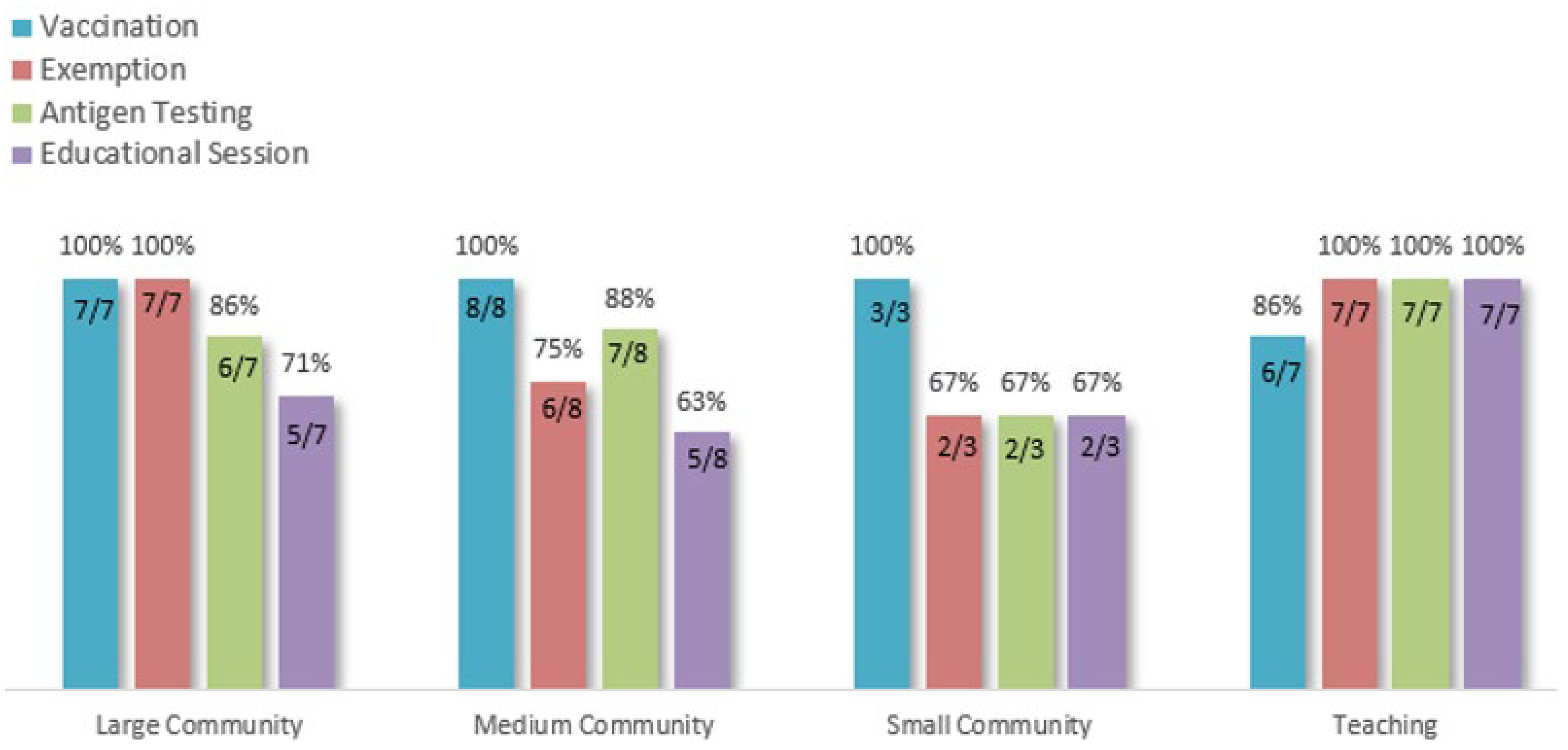
Chart 2.
Directive #6 Alternatives by Hospital Type.
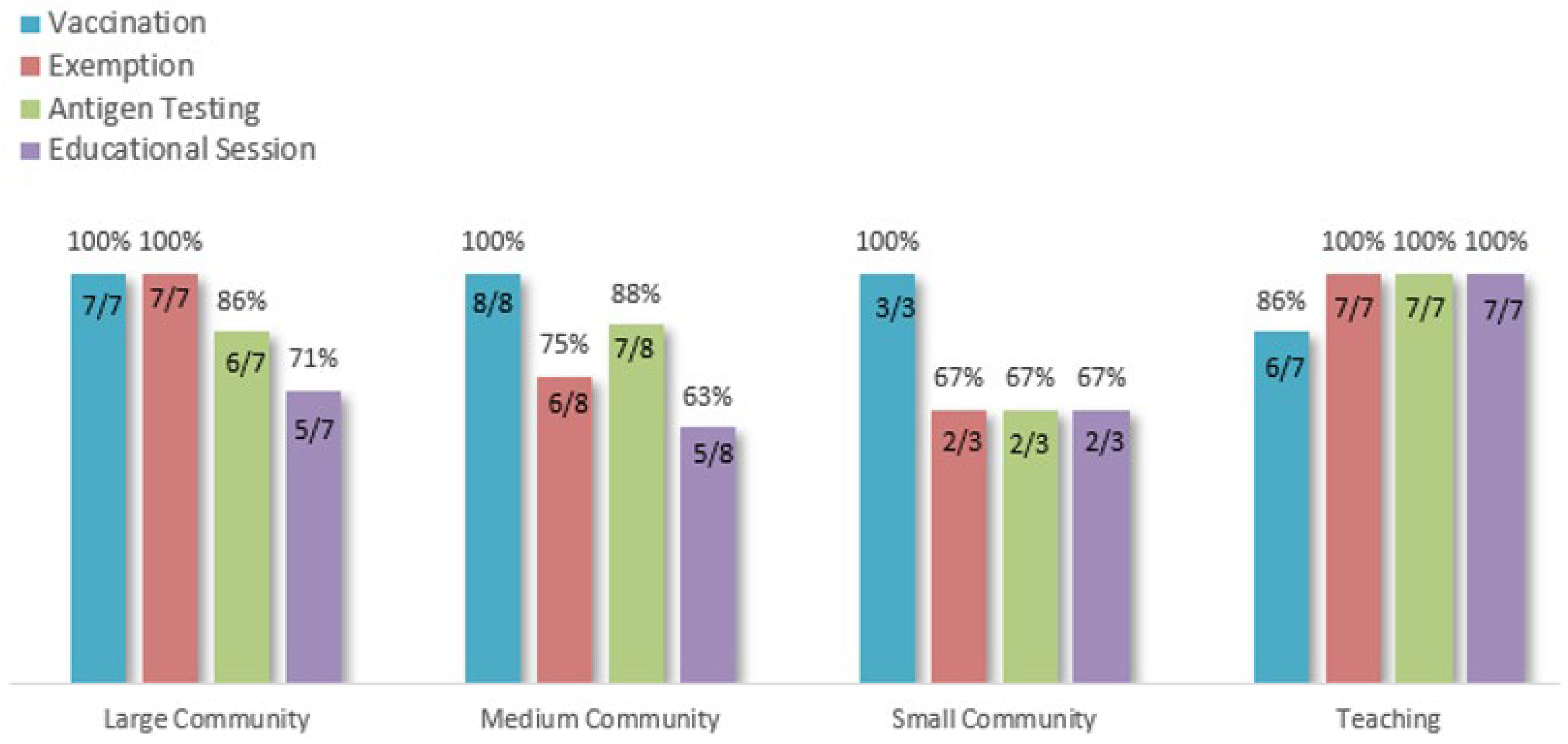

Table 1.
Criteria for Within-Category Hospital Selection.
| Selection Criterion | Description |
|---|---|
| Public Visibility | Hospitals featured in research forums or mass media |
| Alphabetical Prominence | Hospitals as listed by CBC reflecting alphabetical / editorial order. |
| Pragmatic Accessibility | Institutions with readily available documentation concerning vaccination policy |
Table 2.
Selected hospitals – Type and grade (CBC Ranking).
| ID | Hospital | Hospital Type | CBC Grade |
|---|---|---|---|
| 1 | Alexandra Marine and General Hospital | Small Community | B |
| 2 | Anson General Hospital | Small Community | B |
| 3 | Atikokan General Hospital | Small Community | Unrated |
| 4 | Bluewater Health | Large Community | B |
| 5 | Brampton Civic (William Osler Health System) | Large Community | B |
| 6 | Brockville General Hospital | Medium Community | B |
| 7 | Chatham Kent Health Alliance | Medium Community | Unrated |
| 8 | Collingwood General and Marine Hospital | Medium Community | B |
| 9 | Hawkesbury & District General Hospital | Medium Community | A |
| 10 | Headwaters Health Care Centre | Medium Community | Unrated |
| 11 | Lakeridge Health-Ajax & Pickering (Rouge Valley Ajax and Pickering) |
Large Community | A |
| 12 | Mount Sinai Hospital | Teaching | B |
| 13 | Niagara on the Lake -Niagara Health System | Large Community | C |
| 14 | North Bay Regional Centre – North Bay Site | Large Community | C |
| 15 | Perth & Smith Falls District Hospital | Medium Community | A+ |
| 16 | St. Joseph's Health Care London | Teaching | A+ |
| 17 | St. Joseph's Health Care Hamilton | Teaching | B |
| 18 | St. Michael's Hospital (Unity Health) | Teaching | B |
| 19 | St. Thomas Elgin General Hospital | Medium Community | C |
| 20 | Sunnybrook Health Sciences Centre | Teaching | C |
| 21 | The Credit Valley Hospital | Large Community | A |
| 22 | The Scarborough Hospital (Scarborough Health Network) |
Large Community | B |
| 23 | Toronto General (University Health Network) | Teaching | C |
| 24 | University Hospital (London Health Sciences Centre) | Teaching | C |
| 25 | West Lincoln Memorial Hospital | Medium Community | C |
Table 3.
Typology of Hospital Covid019 Vaccination Mandate Implementation.
| Type | Definition |
|---|---|
| Light | Vaccination encouraged; sustainable alternatives (e.g., educational module, remote work) available without penalty |
| Moderate | Vaccination required, but some alternatives (e.g., unpaid leave with right of return) permitted |
| Strict | Vaccination required; no alternatives permitted; noncompliance leads to employment termination (if salaried) or removal of privileges (in the case of medical doctors) |
Disclaimer/Publisher’s Note: The statements, opinions and data contained in all publications are solely those of the individual author(s) and contributor(s) and not of MDPI and/or the editor(s). MDPI and/or the editor(s) disclaim responsibility for any injury to people or property resulting from any ideas, methods, instructions or products referred to in the content. |
© 2026 by the authors. Licensee MDPI, Basel, Switzerland. This article is an open access article distributed under the terms and conditions of the Creative Commons Attribution (CC BY) license (http://creativecommons.org/licenses/by/4.0/).
Copyright: This open access article is published under a Creative Commons CC BY 4.0 license, which permit the free download, distribution, and reuse, provided that the author and preprint are cited in any reuse.