

Submitted:
09 March 2026
Posted:
10 March 2026
You are already at the latest version
Abstract
Background: Tuberculosis (TB), caused by Mycobacterium tuberculosis, remains a major global health challenge and a leading infectious cause of death, with 10.6 million cases and 450,000 rifampicin-resistant cases reported in 2021. The rise of multi-drug-resistant (MDR) and extensively drug-resistant TB (XDR-TB), driven by mutations in genes such as rpoB, katG, inhA, gyrA, and rrs, threatens the practical control of TB. In the Eastern Cape, South Africa, limited data exist on the patterns of resistance-conferring mutations. This study investigated the molecular profiles of genetic mutations associated with first-line and second-line anti-tuberculosis drug resistance, including fluoroquinolones and injectable agents, among Mycobacterium tuberculosis isolates to inform region-specific diagnostics and treatment strategies. Methods: A retrospective cross-sectional laboratory-based design was used to analyze 112 phenotypically confirmed drug-resistant isolates. Molecular DST for first- and second-line anti-tuberculosis drugs was performed at the National Health Laboratory Service (NHLS) TB reference laboratory. Drug-resistance profiles were classified according to World Health Organization (WHO) definitions. Results: rpoB (D435V 40.2%; S450L 36.6%) and katG (S315T 80.4%) mutations predominated, forming the MDR backbone, while 15% harbored inhA promoter mutations linked to low-level cross-resistance. Nearly 48.2% showed dual resistance to fluoroquinolones and second-line injectables. A significant association between rpoB S450L and dual second-line resistance (p=0.0019) suggests genomic progression toward XDR-TB. The predominance of stable high-fitness resistance mutations and the substantial burden of dual second-line resistance suggest sustained community transmission of established multidrug-resistant strains. These findings underscore the importance of integrating molecular surveillance with community-engaged prevention strategies and strengthened clinical governance to interrupt transmission and limit progression toward advanced resistance in high-burden rural settings. They further reinforce the value of genotype-based diagnostics and expanded genomic surveillance within routine TB programs. Incorporating predictive analytics into programmatic practice will enhance early detection, optimize treatment selection, and support sustained progress toward TB control and eventual elimination.
Keywords:
tuberculosis
; drug resistant
; multidrug-resistant
; extensively drug-resistant
; second-line drug resistance
; mutations
; community engagement
; clinical governance
1. Introduction
Tuberculosis (TB) is a preventable and curable disease caused by Mycobacterium tuberculosis, but with significant contribution to morbidity and mortality on a global scale, thus a threat to public health [1,2,3]. It ranks second worldwide in mortality from single infectious agents, after coronavirus disease (COVID-19), and thirteenth overall [4]. In 2024, an estimated 10.7 million people developed TB, and approximately 1.23 million deaths occurred among HIV-negative individuals, including mortality among people living with HIV [5]. South Africa continues to rank among the high TB burden countries, with persistent transmission and a substantial burden of drug-resistant tuberculosis (DR-TB) [6]. The emergence and spread of drug resistance threatens progress in TB control [7]. Globally, an estimated 410,000 new cases of rifampicin-resistant TB (RR-TB) occurred in 2023, the majority of which met criteria for multidrug-resistant TB (MDR-TB), defined as resistance to at least rifampicin and isoniazid [6]. Resistance to first-line drugs such as isoniazid (INH) and rifampicin (RIF) is primarily associated with mutations in genes including katG, inhA promoter, and rpoB, which alter drug targets or metabolic pathways [8,9,10]. Molecular assays have enabled the rapid detection of these mutations, allowing earlier initiation of appropriate therapy.
There are three forms of clinically remarkable drug-resistant TB (DR-TB), namely RR-TB, MDR-TB, and extensively drug-resistant tuberculosis (XDR-TB). The strains of MDR-TB are resistant to the two most important TB medicines, INH and RIF. Moreover, XDR-TB is even more brutal and more fatal, with fewer effective treatment choices. In addition to being resistant to INH and RIF, it can also be resistant to fluoroquinolones (FQL), usually due to mutations in the gyrA or gyrB genes, and to at least one second-line injectable drug (SLID) [11,12]. Second-line resistance has become an increasing concern. Fluoroquinolones, which are core components of MDR-TB regimens, are compromised by mutations in the quinolone resistance-determining region of gyrA and gyrB [13]. Resistance to second-line injectable agents such as amikacin and kanamycin has been linked to mutations in the rrs gene and the eis promoter region [14,15]. SLIDs have been a backbone of effective MDR-TB therapy but are associated with severe side effects [16,17]. The WHO guidelines issued in 2018 replaced the use of kanamycin (KAN) and capreomycin (CAP) with bedaquiline (BDQ), a potent drug with fewer side effects, in an extended MDR-TB treatment regimen [18]. However, SLIDS are still being used in short MDR-TB regimens, particularly due to the limited availability of BDQ in several countries, coupled with the intolerance of BDQ in some patients [14]. The emergence of resistance to FQLs and injectables further limits treatment options and is associated with poorer outcomes [19].
The rising prevalence of DR-TB, especially MDR and XDR strains, continues to pose a serious threat to public health despite domestic and international efforts to control the disease. These forms of TB are a growing threat around the world because they are harder, longer, and more dangerous to treat [20]. TB bacteria can acquire resistance through various mutations in genes such as rpoB, katG, inhA, pncA, embB, rpsL, gyrA, ethA, and rrs [21,22]. Sometimes, these mutations stack up, making the bacteria even more stubborn against treatment [20]. The high mortality rate associated with untreated or poorly treated MDR-TB, which can skyrocket to 80% makes MDR-TB and XDR-TB serious public health challenges that demand urgent attention and stronger control measures [23]. The associated higher fatality has attendant effects on both the individual and society [24]. The higher toxicity, prolonged treatment time, and limited availability and effectiveness of second-line anti-TB medications have led to unfavorable treatment outcomes for DR-TB [25].
Beyond its clinical and microbiological significance, DR-TB presents a complex governance and community-level challenge in high-burden rural settings. Molecular resistance patterns do not merely inform drug selection; they reflect transmission dynamics, health system responsiveness, and community-level vulnerabilities. In regions such as the rural Eastern Cape, where socio-economic constraints, delayed health-seeking behavior, and treatment interruptions intersect, resistance surveillance must be integrated with community engagement (CE) and clinical governance (CG) strategies. Embedding molecular intelligence within community-informed TB education, early testing initiatives, contact tracing, and adherence support structures strengthens both accountability and responsiveness within TB programmes. Understanding local resistance mutation patterns, therefore, provides not only diagnostic insight but also an evidence base for community-engaged prevention and precision public health interventions aimed at curbing transmission and preventing progression toward advanced resistance phenotypes.
There is limited information on the precise patterns and profiles of resistance-conferring mutations within circulating Mycobacterium tuberculosis strains. Understanding the local genetic mutation patterns is essential for several reasons. First, it supports accurate interpretation of molecular diagnostic assays. Second, it informs treatment decision-making, particularly where standardized regimens are used. Third, it contributes to surveillance by identifying shifts in resistance patterns over time.
This study, therefore, aimed to characterize the genetic mutation patterns associated with first- and second-line anti-tuberculosis drug resistance, including fluoroquinolones and injectable agents, among Mycobacterium tuberculosis isolates in the Eastern Cape, South Africa. By providing province-specific molecular data, the study seeks to strengthen drug-resistance surveillance and inform clinical and programmatic TB management.
2. Materials and Methods
2.1. Study Design and Setting
This study employed a retrospective, cross-sectional, laboratory-based design that integrated molecular characterization and ML approaches to identify genetic mutations in Mycobacterium tuberculosis isolated from TB patients. Laboratory results of isolates obtained from patients attending public health facilities in the O.R. Tambo local Municipality, a region with a documented high burden of DR-TB, were used.
2.2. Sample Collection and Characterization
A secondary data set of 112 culture-confirmed drug-resistant Mycobacterium tuberculosis isolates was included in the primary analysis. These isolates underwent routine phenotypic drug DST to first- and second-line anti-tuberculosis drugs at the National Health Laboratory Service (NHLS) TB reference laboratory. Drug-resistance profiles were classified according to World Health Organization (WHO) definitions. To identify predictors of mixed-strain infection, RF models were applied using demographic, clinical, and genotypic variables. Feature-importance measures were used in place of conventional multivariable logistic regression owing to the limited sample size and collinearity among predictor variables.
2.3. Mutation Profiling and Phenotypic Classification
For all isolates, mutation data were extracted from the rpoB gene, which confers resistance to RIF; the katG gene, associated with INH resistance; and the inhA promoter region, linked to low-level INH and ethionamide resistance. Resistance to second-line drugs was further categorized into three groups: FQL-resistant, referring to isolates resistant only to FQLs; injectable-resistant, denoting resistance only to aminoglycosides; and FQLs + injectable-resistant, representing isolates exhibiting dual resistance patterns indicative of pre-XDR or XDR-TB phenotypes.
2.4. Machine Learning Analysis
To approximate the multivariable associations between genetic and phenotypic predictors of mixed-strain infection, an RF classifier was implemented using scikit-learn (version 1.3.0). The model incorporated several predictor variables, including variant counts per drug class (RIF_varcount, INH_varcount, and ethionamide_varcount), heteroresistance measures (hetero_variant_count and multi_drug_hetero), lineage assignments (lineages 1–4 and mixed), and the drug resistance classification (MDR, pre-MDR, XDR, and pre-XDR).
The model was configured with 500 decision trees, using the Gini impurity as the splitting criterion and no maximum tree depth restriction (max_depth = None), with random_state = 42 to ensure reproducibility. Model performance was evaluated using the Area Under the Receiver Operating Characteristic Curve (AUC) and the Area Under the Precision–Recall Curve (AUPRC). Feature importance scores were computed to quantify the relative contribution of each predictor variable to the model’s discriminative performance.
2.5. Statistical Analysis
Descriptive analyses were conducted using Python (pandas, scipy) and SPSS version 27. Categorical variables were summarized using frequencies and percentages. Chi-square (χ²) goodness-of-fit tests were applied to evaluate whether the distribution of mutations within the rpoB and katG genes deviated significantly from a uniform distribution. In contrast, Chi-square tests of association were used to assess relationships between specific mutation types and second-line drug resistance. Statistical significance was determined at a threshold of p < 0.05. Visualization outputs, including bar charts and heatmaps, were generated using seaborn and matplotlib to depict the distribution of mutations and patterns of co-resistance.
3. Results
Among 112 drug-resistant isolates, rpoB and katG mutations were highly prevalent, particularly S450L (36.6%) and S315T (80.4%), defining the backbone of MDR-TB in this cohort. Approximately 15% harbored inhA promoter variants (C−15T, T−8A), conferring potential cross-resistance to ethionamide. Nearly half (48.2%) exhibited concurrent resistance to both FQLs and SLIDs, indicative of pre-XDR/XDR phenotypes. The co-occurrence of rpoB and katG mutations across all second-line categories underscores the widespread dissemination of high-level resistance genotypes within the community.
3.1. Overview of Mutation Frequencies
Among 112 drug-resistant Mycobacterium tuberculosis isolates, mutations conferring resistance to first-line drugs were highly prevalent. The most frequent rpoB variants were D435V (40.2%) and S450L (36.6%) (Table 1), together accounting for nearly three-quarters of all rifampicin-resistant cases. In katG, the S315T mutation was observed in 80.4% of isolates (Table 2), representing the predominant mechanism of INH resistance. Approximately 15 % of isolates carried mutations in the inhA promoter (C−15T or T−8A) (Table 3), which are known to mediate low-level INH and ethionamide cross-resistance. These findings confirm that first-line resistance in the Eastern Cape cohort is dominated by classical high-impact mutations previously reported in global datasets.
3.2. Second-Line Drug Resistance Spectrum
Second-line drug-resistance profiling revealed that nearly half (48.2 %) of the isolates exhibited combined FQLs and injectable resistance (Table 4), consistent with pre-XDR/XDR phenotypes.
3.2.1. rpoB–katG Overlap
Most isolates harboring rpoB S450L or D435V mutations also carry the katG S315T mutation, indicating that the MDR (RIF and INH) combination is the predominant genotype. Furthermore, rpoB S450L mutations frequently co-occur with resistance to both FQLs and SLIDs, linking this variant to pre-XDR/XDR-TB phenotypes. In contrast, rpoB D435V mutations are distributed across all second-line resistance categories, suggesting the presence of diverse and heterogeneous secondary resistance pathways.
3.2.2. rpoB and katG Mutation Patterns
Statistical analysis demonstrated significant non-uniformity in the distribution of rpoB mutations (χ², p < 0.0001). The D435V and S450L variants jointly defined the molecular backbone of RIF resistance. In contrast, katG mutations were uniformly dominated by S315T, showing no significant association with second-line resistance categories (χ² p = 0.578).
The dominant rpoB mutations identified were D435V (40.2%) and S450L (36.6%), which together comprised approximately 77% of all isolates. Statistical analysis demonstrated a highly significant goodness-of-fit χ² statistic (p < 0.0001), with mutation frequencies differing strongly, confirming a non-uniform distribution. Moreover, a substantial association with second-line drug resistance (χ² p = 0.0019) was observed, suggesting that specific rpoB mutations, particularly S450L, are strongly linked to concurrent FQLs and SLID resistance.
The dominant mutation identified was S315T, present in over 80% of isolates, confirming its role as the key determinant of INH resistance. Statistical analysis revealed a highly significant goodness-of-fit χ² (p < 0.0001), indicating a strongly skewed distribution that overwhelmingly favored the S315T variant. However, the association with second-line resistance (χ² p = 0.578) was not significant, suggesting that katG mutations occur independently of second-line resistance patterns. Overall, while katG mutations clearly dominate INH resistance, their lack of association with second-line drug categories implies that the progression of resistance toward FQLs and injectable agents is primarily driven by rpoB and other genetic loci rather than katG.
A statistically significant association was observed between rpoB S450L and dual second-line resistance (χ² p = 0.0019), suggesting that specific rpoB variants may serve as early genomic indicators of transition to XDR-TB (Figure 3). These outcomes highlight heteroresistance and within-host genetic diversity as critical factors influencing treatment complexity and transmission potential in the study cohort.
3.3. Machine Learning Model Findings
The RF model demonstrated excellent classification performance (ROC-AUC = 1.00; AUPRC = 1.00), identifying key predictors of mixed-strain infection among drug-resistant Mycobacterium tuberculosis isolates. Feature importance analysis revealed that heteroresistance intensity and multidrug variant burden were the strongest predictors, with additional contributions from RIF and INH variant loads, lineage membership, and resistance class indicators (Figure 4).
4. Discussion
4.1. Overview of Mutation Distribution Patterns
The molecular analysis of 112 drug-resistant Mycobacterium tuberculosis isolates revealed a highly skewed distribution of first-line drug-resistance mutations. The rpoB gene exhibited two dominant mutation clusters: D435V (40.2%) and S450L (36.6%), which together accounted for three-quarters of all isolates. Unlike previous studies, where S450L has typically been the overwhelmingly dominant mutation, the present findings show a more balanced pattern, with D435V slightly exceeding S450L in frequency. For instance, a study reported that S450L accounted for 62.5% of RIF-resistant isolates in Cape Town, while D435V accounted for only 7.1%, highlighting the global predominance of S450L [26]. Similarly, another study in Angola found that S450L (56.3%) and D435V (17.2%) were the most frequent mutations, jointly representing about 73.5% of all rpoB alterations [27]. In contrast, the present data show a more even distribution between these two key mutations, suggesting lineage-specific adaptation or local selective pressures within the Eastern Cape may be shaping a distinct resistance profile. This pattern was statistically significant (χ² p < 0.0001), confirming that rpoB mutations are non-randomly distributed and predominantly clustered in codons critical for RIF binding to the β-subunit of RNA polymerase.
Likewise, the katG gene was mainly characterized by the S315T substitution (80.4%), the canonical determinant of high-level INH resistance (χ² p < 0.0001). In comparison, the inhA promoter exhibited the C−15T variant in 12.5% of isolates. Comparable studies have reported similar patterns, identifying C−15T in 14.4% of INH-resistant isolates [28] and observing higher katG S315T (64%) and lower inhA C−15T (19%) frequencies relative to global averages [29]. These findings suggest additional mechanisms contributing to low-level INH and ethionamide cross-resistance.
4.2. RpoB Mutations and Association with Second-Line Drug Resistance
The observed co-occurrence of rpoB S450L with FQLs and injectable resistance (χ² p = 0.0019) indicates that specific rpoB mutations may facilitate the accumulation of secondary resistance under continued drug pressure. Isolates carrying S450L frequently exhibit dual FQL + SLID resistance, suggesting progression toward pre-XDR/XDR-TB phenotypes. Although S450L is not a mechanistic driver of FQ/SLID resistance, it is a marker of rifampicin resistance in successful MDR lineages that are more likely to persist, transmit, and accumulate additional resistance under continued drug pressure. S450L is the most common rifampicin-resistance mutation and is repeatedly reported to have a lower fitness cost than many other rpoB mutations, which can support the persistence and transmission of RR/MDR strains [30]. Another study reported that rifampicin-resistant isolates with rpoB S450L had a substantially higher risk of FQL resistance than isolates with rpoB mutations at other codons [11]. This aligns with the significant association between S450L and FQ resistance observed in this study.
Comparable findings from India and Australia show that rpoB S450L often co-occurs with gyrA/gyrB or rrs mutations, marking an evolutionary transition toward XDR phenotypes [31,32]. One study reported that the rpoB S450L variant was the most common among MDR-TB isolates in the Mumbai Metropolitan Region, particularly among lineage 2 (Beijing) strains [31]. Evidence suggests the S450L advantage is indirect: its relatively low fitness cost and frequent association with compensatory mutations in rpoA/rpoC can increase strain fitness, providing more opportunities for additional resistance mutations to arise and spread [33]. Hence, S450L is associated with a higher likelihood of further resistance, likely due to selection, prior treatment exposure, and transmission of successful MDR clones [11,30].
In contrast, while S450L is common in many successful MDR/XDR clones, it is not essential for strains to become highly transmitted or to evolve broader resistance; other rpoB RRDR mutations can also underpin successful MDR/XDR lineages [33]. The dual FQLs + SLIDs are programmatically important because the updated WHO definition describes pre-XDR TB as MDR/RR-TB with FQL resistance, and XDR TB as MDR/RR-TB with FQL resistance plus additional Group A resistance [34].
4.3. katG Mutations and Independence from Second-Line Resistance
Unlike rpoB, the katG S315T mutation showed no significant association with second-line drug resistance (χ² p = 0.578). Its uniform dominance across all second-line categories indicates that while it drives INH resistance, it does not directly influence FQLs or SLIDs resistance pathways. This independence supports the hypothesis that first-line resistance mechanisms emerge early during therapy, preceding exposure to second-line agents. katG S315T is a canonical marker of high-level INH resistance, and it is repeatedly reported as one of the most common INH-resistance mechanisms worldwide. Published studies have emphasized that katG codon 315 variants are strongly associated with INH resistance and serve as reliable markers for this purpose [35,36]. FQLs' resistance is primarily governed by gyrA/gyrB mutations, with katG contributing little beyond initial INH resistance [29,37]. In contrast, FQLs' resistance and second-line injectable drug (SLID) resistance are typically driven by mutations in different loci, especially gyrA/gyrB for FQLs and rrs/eis for SLIDs. Studies of MDR-TB populations evaluating second-line resistance consistently focus on these genes rather than katG, supporting the study’s findings that katG S315T is not in the causal pathway for FQLs or SLID resistance [38,39].
In many MDR/XDR settings, katG S315T is standard across multiple resistance strata because it is a frequent INH-resistance mutation and may persist due to a relatively low fitness cost compared with other INH-resistance mechanisms. This can lead to a high prevalence of katG S315T in the overall resistant population, without implying that it drives second-line resistance [35]. Genomic and molecular epidemiology studies also show that katG S315T often co-occurs with other resistance mutations in MDR strains. Such co-occurrence reflects accumulation of resistance mutations over time or transmission of already-resistant clones, rather than a direct mechanistic role of katG in second-line resistance [33,40]. Some studies report that MDR/RR-TB is associated with a higher risk of FQL resistance than non-MDR-TB. However, this is typically interpreted as reflecting programmatic/clinical selection and prior treatment exposure patterns, rather than an effect of katG itself. In other words, MDR status (and its treatment history) may correlate with FQ resistance, whereas katG S315T does explicitly not [11]. High katG S315T prevalence across second-line categories is therefore a background dominance of an INH-resistance mutation within resistant lineages, not a driver of second-line resistance.
4.4. Implications for Clinical Governance and Public Health
From a clinical-governance perspective, the predominance of rpoB S450L and katG S315T provides actionable intelligence that reinforces the continued use of rapid molecular diagnostics such as LPAs and GeneXpert targeting these loci [9]. Prior evidence demonstrates that rpoB mutations, including L430P (8%, n=34), S450L (80%, n=355), and I491F (8%, n=35), and katG S315T (99%, n=502), account for the majority of RIF and INH resistance, respectively [9]. These mutations alter the function of RNA polymerase and catalase-peroxidase, reducing drug binding and compromising therapeutic efficacy. Their predominance underscores the need for strict adherence to rapid molecular testing protocols and the immediate initiation of appropriate regimens. Where rpoB S450L is detected, clinicians should anticipate a higher likelihood of additional resistance and ensure timely confirmatory testing for FQLs and SLIDs. Standardized treatment pathways, multidisciplinary case review, and close monitoring of treatment response are essential to prevent further amplification of resistance. Routine audits of diagnostic turnaround times and resistance reporting systems are equally critical to ensure that laboratory findings translate into timely clinical action. From a public health standpoint, the high proportion of dual FQL and SLID resistance signals sustained transmission of advanced resistance phenotypes within the community [43,44,45]. This pattern supports viewing DR-TB not just because of individual treatment failure but as part of a transmission-driven epidemic [46]. Patients with rpoB S450L and second-line resistance, usually categorized as pre-XDR/XDR-TB, should be prioritized for increased adherence support, rapid regimen adjustments, enhanced contact tracing, and strengthened infection prevention and control. Including comprehensive second-line drug screening in routine diagnostic protocols is essential. Surveillance systems should incorporate molecular resistance profiles into district-level monitoring dashboards to identify emerging trends early and inform targeted intervention strategies.
At the community level, the mutation distribution mirrors polyclonal transmission dynamics observed in genomic epidemiology studies. These findings highlight the importance of embedding molecular intelligence within community-engaged education strategies. Messaging should emphasize early symptom recognition, prompt testing, household contact screening, ventilation practices, prevention of reinfection, and collective responsibility for treatment completion [47]. Integrating resistance surveillance outputs into provincial dashboards can facilitate identification of transmission hotspots and improve allocation of outreach, diagnostic, and adherence-support resources [41,42,47]. Transparent communication of these findings to communities supports co-produced prevention efforts and strengthens trust between health systems and affected populations [48].
The machine learning findings, which identified heteroresistance and multidrug variant burden as key predictors of complexity, further suggest that within-host diversity and potential reinfection contribute to treatment challenges. In high-burden rural settings, repeated exposure within households and congregate settings may facilitate superinfection, underscoring the need for community-driven dialogue to address structural barriers to adherence, including transport costs, stigma, and economic vulnerability. Co-designed interventions such as peer support networks and enhanced community health worker tracing can mitigate these drivers.
Finally, the substantial prevalence of second-line resistance necessitates strengthened antibiotic stewardship at both clinical and community levels [49]. Educational initiatives must clearly communicate that incomplete treatment and inappropriate antibiotic use accelerate the evolution of resistance and jeopardize future therapeutic options. Protecting drug efficacy should therefore be framed as a shared societal responsibility, requiring coordinated action across laboratory, clinical, public health, and community governance domains.
5. Conclusions
This study delineated the molecular architecture of drug-resistant Mycobacterium tuberculosis in the Eastern Cape, demonstrating that rpoB S450L, rpoB D435V, and katG S315T constitute the dominant resistance backbone. The substantial burden of dual FQL and second-line injectable resistance (48.2%), together with the significant association between rpoB S450L and advanced resistance phenotypes, signals a concerning trajectory toward increasingly complex and difficult-to-treat DR-TB forms.
Notably, the predominance of stable, high-fitness resistance mutations suggests sustained community transmission of established multidrug-resistant strains rather than isolated emergence during individual treatment episodes. These findings therefore reframe DR-TB in this setting as a transmission-driven public health challenge requiring coordinated action beyond the laboratory and clinic.
From a CE perspective, the data underscore the need to translate molecular surveillance into accessible education that reduces stigma, promotes early testing, strengthens household infection prevention practices, and reinforces collective responsibility for treatment completion. Integrating mutation-informed surveillance outputs into district-level dashboards, community dialogues, and outreach programming can support co-created prevention strategies grounded in local realities.
Within a clinical governance framework, early molecular detection, timely second-line drug susceptibility testing, strengthened contact tracing, and antibiotic stewardship must be embedded within community-informed systems of care. Such integration advances a precision public health approach in which laboratory intelligence, patient-centred management, and community partnership operate synergistically.
Overall, aligning molecular resistance surveillance with community-engaged prevention and governance structures offers a pragmatic pathway to curb transmission, prevent further resistance amplification, and advance progress toward TB elimination in high-burden rural settings.
Author Contributions
Conceptualization, M.M. and M.C.H.; methodology, M.C.H. and L.M.F.; software, M.C.H. and L.M.F.; validation, M.C.H., L.M.F., N.D., and T.A.; formal analysis, M.C.H. and L.M.F.; investigation, M.M.; resources, M.C.H.; data curation, M.C.H.; L.M.F.; and N.D.; writing—original draft preparation, M.M. and M.C.H.; writing—review and editing, M.C.H., L.M.F., N.D.; and T.A.; visualization, M.C.H.; L.M.F. and N.D.; supervision, M.C.H. and T.A.; project administration, T.A. All authors have read and agreed to the published version of the manuscript.”.
Funding
This research received no external funding, and Walter Sisulu University funded the APC.
Institutional Review Board Statement
The study was conducted in accordance with the Declaration of Helsinki and was approved by the Walter Sisulu University Health Research Ethics Committee (protocol code WSU HREC 115/2025, with approval date 2 July 2025).
Informed Consent Statement
Informed consent was not obtained because the research involved a retrospective review of patients’ medical records and did not involve any patient contact.
Data Availability Statement
Data can be requested from the corresponding author.
Acknowledgments
The authors are grateful to the facility managers who facilitated data collection.
Conflicts of Interest
The authors declare no conflicts of interest.
Abbreviations
The following abbreviations are used in this manuscript:
| DR-TB | Drug-resistant tuberculosis |
| DST | Drug susceptibility test |
| FQLs | Fluoroquinolones |
| INH | Isoniazid |
| MDR-TB | Multidrug-resistant tuberculosis |
| ML | Machine learning |
| NHLS | National Health Laboratory Service |
| RF | Random forest |
| RIF | Rifampicin |
| SLID | Second-line injectable drugs |
| TB | Tuberculosis |
| XDR-TB | Extensively drug-resistant tuberculosis |
References
- Singh, N.; Singh, P.K.; Singh, U.; Garg, R.; Jain, A. Fluroquinolone drug resistance among MDR-TB patients increases the risk of unfavourable interim microbiological treatment outcome: An observational study. J. Glob. Antimicrob. Resist. 2021, 24, 40–44. [CrossRef]
- Ledesma, J.R.; Ma, J.; Zhang, M.; Basting, A.V.; Chu, H.T.; Vongpradith, A.; Novotney, A.; LeGrand, K.E.; et al. Global, regional, and national age-specific progress towards the 2020 milestones of the WHO End TB Strategy: a systematic analysis for the Global Burden of Disease Study 2021. Lancet Infect. Dis. 2024, 24, 698–725. [CrossRef]
- Goletti, D.; Meintjes, G.; Andrade, B.B.; Zumla, A.; Lee, S.S. Insights from the 2024 WHO global tuberculosis report–more comprehensive action, innovation, and investments required for achieving WHO end TB goals. Int. J. Infect. Dis. 2025, 150, 107325. [CrossRef]
- Yenew, B.; Kebede, A.; Alemu, A.; Diriba, G.; Mehammed, Z.; Amare, M.; Dagne, B.; Sinshaw, W.; et al. Genotypic and phenotypic drug resistance patterns of Mycobacterium tuberculosis isolated from presumptive pulmonary tuberculosis patients in Ethiopia: A multicenter study. PLoS ONE 2024, 19, e0303460. [CrossRef]
- World Health Organization (WHO). Global Tuberculosis Report 2025; World Health Organization: Geneva, Switzerland, 2025. Available online: https://iris.who.int/server/api/core/bitstreams/e97dd6f4-b567-4396-8680-717bac6869a9/content (accessed on 23 February 2026).
- World Health Organization (WHO). Global Tuberculosis Report 2024; World Health Organization: Geneva, Switzerland, 2024. Available online: https://iris.who.int/server/api/core/bitstreams/7292c91e-ffb0-4cef-ac39-0200f06961ea/content (accessed on 23 February 2026).
- Roshdi Maleki, M. Genetic Analysis of Molecular Mechanisms of Drug Resistance in Mycobacterium tuberculosis Against Four Major First-Line Anti-Tuberculosis Drugs (Isoniazid, Rifampin, Ethambutol, and Pyrazinamide). Infect. Drug Resist. 2025, 4901–4915. [CrossRef]
- Ranjan, K.P.; Ranjan, N.; Kumar, N. Molecular characterization of katG and inhA mutations by genotype MTBDRplus line probe assay to guide isoniazid and ethionamide use for drug-resistant tuberculosis. Cureus 2023, 15, e37136. [CrossRef]
- Traoré, A.N.; Rikhotso, M.C.; Mphaphuli, M.A.; Patel, S.M.; Mahamud, H.A.; Kachienga, L.O.; Kabue, J.P.; Potgieter, N. Isoniazid and rifampicin resistance-conferring mutations in Mycobacterium tuberculosis isolates from South Africa. Pathogens 2023, 12, 1015. [CrossRef]
- Ulger, M.; Biltekin, N.; Ulger, S.T.; Aslan, G. Investigation of Gene Regions Responsible for Drug Resistance in Clinical Isolates of Mycobacterium tuberculosis Complex Resistant to at Least Two First-Line Anti-Tuberculosis Drugs. Pathogens 2026, 15, 222. [CrossRef]
- Nehru, V.J.; Jose Vandakunnel, M.; Brammacharry, U.; Ramachandra, V.; Pradhabane, G.; Mani, B.R.; Vn, A.D.; Muthaiah, M. Risk assessment and transmission of fluoroquinolone resistance in drug-resistant pulmonary tuberculosis: a retrospective genomic epidemiology study. Sci. Rep. 2024, 14, 19719. [CrossRef]
- Oduoye, M.O.; Zafar, H.; Wamiq, U.; Afzoon, S.; Shuja, H.; Wumi, A.O.; Opeyemi, A.I. Comparative genomic analysis of drug-resistant and drug-sensitive tuberculosis strains and their impact on cough severity. Mycobacteria 2025, 1, 1–14. [CrossRef]
- Kabir, S.; Tahir, Z.; Mukhtar, N.; Sohail, M.; Saqalein, M.; Rehman, A. Fluoroquinolone resistance and mutational profile of gyrA in pulmonary MDR tuberculosis patients. BMC Pulm. Med. 2020, 20, 138. [CrossRef]
- Ramakrishna, V.; Singh, P.K.; Prakash, S.; Jain, A. Second-line injectable drug resistance and associated genetic mutations in newly diagnosed cases of multidrug-resistant tuberculosis. Microb. Drug Resist. 2020, 26, 971–975. [CrossRef]
- Conkle-Gutierrez, D.; Kim, C.; Ramirez-Busby, S.M.; Modlin, S.J.; Mansjö, M.; Werngren, J.; Rigouts, L.; Hoffner, S.E.; et al. Distribution of common and rare genetic markers of second-line-injectable-drug resistance in Mycobacterium tuberculosis revealed by a genome-wide association study. Antimicrob. Agents Chemother. 2022, 66, e02075-21. [CrossRef]
- Shibeshi, W.; Sheth, A.N.; Admasu, A.; Berha, A.B.; Negash, Z.; Yimer, G. Nephrotoxicity and ototoxic symptoms of injectable second-line anti-tubercular drugs among patients treated for MDR-TB in Ethiopia: a retrospective cohort study. BMC Pharmacol. Toxicol. 2019, 20, 31. [CrossRef]
- Zhao, Y.; Fox, T.; Manning, K.; Stewart, A.; Tiffin, N.; Khomo, N.; Leslie, J.; Boulle, A.; et al. Improved treatment outcomes with bedaquiline when substituted for second-line injectable agents in multidrug-resistant tuberculosis: a retrospective cohort study. Clin. Infect. Dis. 2019, 68, 1522–1529. [CrossRef]
- World Health Organization (WHO). Rapid Communication: Key Changes to Treatment of Multidrug- and Rifampicin-Resistant Tuberculosis (MDR/RR-TB); World Health Organization: Geneva, Switzerland, 2018.
- Lee, E.H.; Yong, S.H.; Leem, A.Y.; Lee, S.H.; Kim, S.Y.; Chung, K.S.; Jung, J.Y.; Park, M.S.; et al. Improved fluoroquinolone-resistant and extensively drug-resistant tuberculosis treatment outcomes. Open Forum Infect. Dis. 2019, 6, ofz118. [CrossRef]
- Faye, L.M.; Hosu, M.C.; Oostvogels, S.; Dippenaar, A.; Warren, R.M.; Sineke, N.; Vasaikar, S.; Apalata, T. The detection of mutations and genotyping of drug-resistant Mycobacterium tuberculosis strains isolated from patients in the Rural Eastern Cape Province. Infect. Dis. Rep. 2023, 15, 403–416. [CrossRef]
- Wan, L.; Liu, H.; Li, M.; Jiang, Y.; Zhao, X.; Liu, Z.; Wan, K.; Li, G.; et al. Genomic analysis identifies mutations concerning drug-resistance and Beijing genotype in multidrug-resistant Mycobacterium tuberculosis isolated from China. Front. Microbiol. 2020, 11, 1444. [CrossRef]
- Libiseller-Egger, J.; Phelan, J.; Campino, S.; Mohareb, F.; Clark, T.G. Robust detection of point mutations involved in multidrug-resistant Mycobacterium tuberculosis in the presence of co-occurrent resistance markers. PLoS Comput. Biol. 2020, 16, e1008518. [CrossRef]
- Omoteso, O.A.; Fadaka, A.O.; Walker, R.B.; Khamanga, S.M. Innovative strategies for combating multidrug-resistant tuberculosis: advances in drug delivery systems and treatment. Microorganisms 2025, 13, 722. [CrossRef]
- Reta, M.A.; Maningi, N.E.; Fourie, P.B. Patterns and profiles of drug resistance-conferring mutations in Mycobacterium tuberculosis genotypes isolated from tuberculosis-suspected attendees of spiritual holy water sites in Northwest Ethiopia. Front. Public Health 2024, 12, 1356826. [CrossRef]
- Walker, T.M.; Miotto, P.; Köser, C.U.; Fowler, P.W.; Knaggs, J.; Iqbal, Z.; et al. The 2021 WHO catalogue of Mycobacterium tuberculosis complex mutations associated with drug resistance: a genotypic analysis. Lancet Microbe 2022, 3, e265–e273. [CrossRef]
- Goig, G.A.; Menardo, F.; Salaam-Dreyer, Z.; Dippenaar, A.; Streicher, E.M.; Daniels, J.; Reuter, A.; Borrell, S.; et al. Effect of compensatory evolution in the emergence and transmission of rifampicin-resistant Mycobacterium tuberculosis in Cape Town, South Africa: a genomic epidemiology study. Lancet Microbe 2023, 4, e506–e515. [CrossRef]
- Rando-Segura, A.; Aznar, M.L.; Moreno, M.M.; Espasa Soley, M.; Sulleiro Igual, E.; Bocanegra Garcia, C.; Gil Olivas, E.; Nindia Eugénio, A.; et al. Molecular characterization of rpoB gene mutations in isolates from tuberculosis patients in Cubal, Republic of Angola. BMC Infect. Dis. 2021, 21, 1056. [CrossRef]
- Nono, V.N.; Nantia, E.A.; Mutshembele, A.; Teagho, S.N.; Simo, Y.W.K.; Takong, B.S.; Djieugoue, Y.J.; Assolo, Y.P.; et al. Prevalence of katG and inhA mutations associated with isoniazid resistance in Mycobacterium tuberculosis clinical isolates in Cameroon. BMC Microbiol. 2025, 25, 127. [CrossRef]
- Welekidan, L.N.; Skjerve, E.; Dejene, T.A.; Gebremichael, M.W.; Brynildsrud, O.; Tønjum, T.; Yimer, S.A. Frequency and patterns of first-and second-line drug resistance-conferring mutations in Mycobacterium tuberculosis isolated from pulmonary tuberculosis patients in a cross-sectional study in Tigray Region, Ethiopia. J. Glob. Antimicrob. Resist. 2021, 24, 6–13. [CrossRef]
- Ma, P.; Luo, T.; Ge, L.; Chen, Z.; Wang, X.; Zhao, R.; Liao, W.; Bao, L. Compensatory effects of M. tuberculosis rpoB mutations outside the rifampicin resistance-determining region. Emerg. Microbes Infect. 2021, 10, 743–752. [CrossRef]
- Dreyer, V.; Mandal, A.; Dev, P.; Merker, M.; Barilar, I.; Utpatel, C.; Nilgiriwala, K.; Rodrigues, C.; et al. High fluoroquinolone resistance proportions among multidrug-resistant tuberculosis driven by dominant L2 Mycobacterium tuberculosis clones in the Mumbai Metropolitan Region. Genome Med. 2022, 14, 95. [CrossRef]
- Dorji, T.; Horan, K.; Sherry, N.L.; Tay, E.L.; Globan, M.; Viberg, L.; Bond, K.; Denholm, J.T.; et al. Whole genome sequencing of drug-resistant Mycobacterium tuberculosis isolates in Victoria, Australia. Int. J. Infect. Dis. 2024, 138, 46–53. [CrossRef]
- Emane, A.K.A.; Guo, X.; Takiff, H.E.; Liu, S. Highly transmitted M. tuberculosis strains are more likely to evolve MDR/XDR and cause outbreaks, but what makes them highly transmitted? Tuberculosis 2021, 129, 102092. [CrossRef]
- World Health Organization (WHO). WHO announces updated definitions of extensively drug-resistant tuberculosis. Available online: https://www.who.int/news/item/27-01-2021-who-announces-updated-definitions-of-extensively-drug-resistant-tuberculosis (accessed on 27 February 2026).
- Dookie, N.; Rambaran, S.; Padayatchi, N.; Mahomed, S.; Naidoo, K. Evolution of drug resistance in Mycobacterium tuberculosis: a review on the molecular determinants of resistance and implications for personalized care. J. Antimicrob. Chemother. 2018, 73, 1138–1151. [CrossRef]
- Rivière, E.; Whitfield, M.G.; Nelen, J.; Heupink, T.H.; Van Rie, A. Identifying isoniazid resistance markers to guide inclusion of high-dose isoniazid in tuberculosis treatment regimens. Clin. Microbiol. Infect. 2020, 26, 1332–1337. [CrossRef]
- Click, E.S.; Kurbatova, E.V.; Alexander, H.; Dalton, T.L.; Chen, M.P.; Posey, J.E.; Ershova, J.; Cegielski, J.P. Isoniazid and rifampin-resistance mutations associated with resistance to second-line drugs and with sputum culture conversion. J. Infect. Dis. 2020, 221, 2072–2082. [CrossRef]
- Matsui, T.; Pinhata, J.M.W.; Rabello, M.C.D.S.; Brandão, A.P.; Ferrazoli, L.; Leão, S.C.; Viana-Niero, C.; Oliveira, R.S.D. Frequency of first and second-line drug resistance-associated mutations among resistant Mycobacterium tuberculosis clinical isolates from São Paulo, Brazil. Mem. Inst. Oswaldo Cruz 2020, 115, e200055. [CrossRef]
- Al-Mutairi, N.M.; Ahmad, S.; Mokaddas, E. Increasing prevalence of resistance to second-line drugs among multidrug-resistant Mycobacterium tuberculosis isolates in Kuwait. Sci. Rep. 2020, 11, 7765. [CrossRef]
- Hang, N.T.L.; Hijikata, M.; Maeda, S.; Thuong, P.H.; Ohashi, J.; Van Huan, H.; Hoang, N.P.; Miyabayashi, A.; et al. Whole genome sequencing, analyses of drug resistance-conferring mutations, and correlation with transmission of Mycobacterium tuberculosis carrying katG-S315T in Hanoi, Vietnam. Sci. Rep. 2019, 9, 15354. [CrossRef]
- Scott, L.E.; Shapiro, A.N.; Da Silva, M.P.; Tsoka, J.; Jacobson, K.R.; Emch, M.; Moultrie, H.; Jenkins, H.E.; et al. Integrating molecular diagnostics and GIS mapping: A multidisciplinary approach to understanding tuberculosis disease dynamics in South Africa using Xpert MTB/RIF. Diagnostics 2023, 13, 3163. [CrossRef]
- Teibo, T.K.A.; Andrade, R.L.D.P.; Rosa, R.J.; Tavares, R.B.V.; Berra, T.Z.; Arcêncio, R.A. Geo-spatial high-risk clusters of Tuberculosis in the global general population: a systematic review. BMC Public Health 2023, 23, 1586. [CrossRef]
- Dalhoff, A. Resistance surveillance studies: a multifaceted problem—the fluoroquinolone example. Infection 2012, 40, 239–262. [CrossRef]
- Oliveira, R.S.; Brandão, A.P.; Ferreira, FM.; Costa, S.M.; Silva, V.L.; Ferrazoli, L.; Chimara, E.; Pinhata, J.M. Fluoroquinolone and Second-Line Injectable Resistance Among Rifampicin- and Isoniazid-Resistant Mycobacterium tuberculosis Clinical Isolates: A Molecular Study from a High-Burden Setting. Microorganisms 2025, 13, 2470. [CrossRef]
- Falzon, D.; Gandhi, N.; Migliori, G.B.; Sotgiu, G.; Cox, H.S.; Holtz, T.H.; Hollm-Delgado, M.G.; Keshavjee, S.; et al. Resistance to fluoroquinolones and second-line injectable drugs: impact on multidrug-resistant TB outcomes. Eur. Respir. J. 2013, 42, 156–168. [CrossRef]
- Zwerling, A.; Shrestha, S.; Dowdy, D.W. Mathematical modelling and tuberculosis: advances in diagnostics and novel therapies. Adv. Med. 2015, 2015, 907267. [CrossRef]
- Faye, L.M.; Dlatu, N.; Chitha, W.W.; Apalata, P. Community-Engaged Clinical Governance and Machine Learning for Optimizing Tuberculosis Management in Rural Eastern Cape. Front. Public Health 2025, 13, 1713401. [CrossRef]
- Albert, A.; Islam, S.; Haklay, M.; McEachan, R.R. Nothing about us without us: A co-production strategy for communities, researchers and stakeholders to identify ways of improving health and reducing inequalities. Health Expect. 2023, 26, 836–846. [CrossRef]
- Fu, Q.; Zhang, Y.; Shu, Y.; Ding, M.; Yao, L.; Wang, C. From data to action: Charting a data-driven path to combat antimicrobial resistance. arXiv 2025, arXiv:2502.00061. [CrossRef]
Figure 3.
Heatmap of rpoB mutation vs second-line resistance categories.
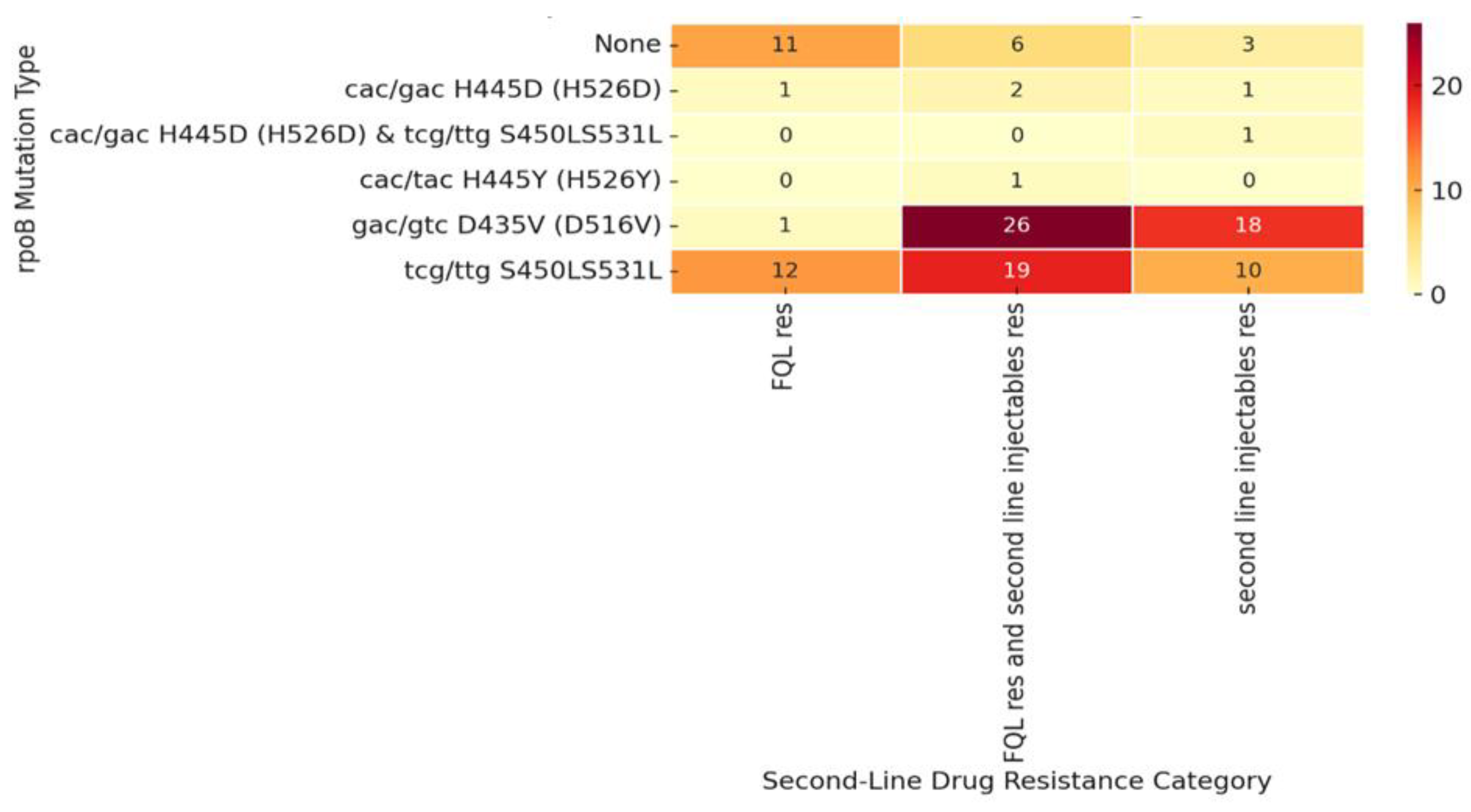
Figure 4.
Feature importance plot from the random forest model.
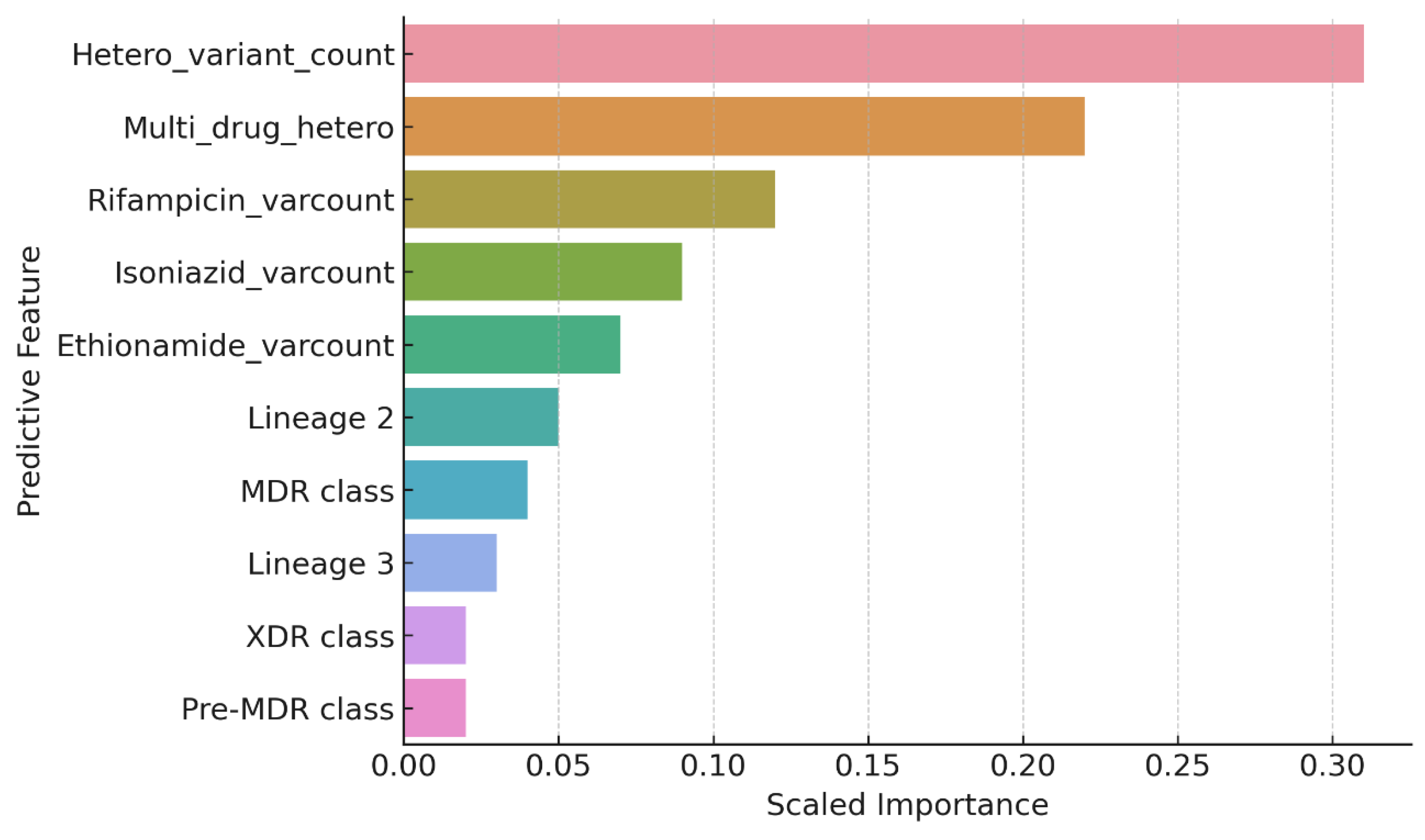

Table 1.
Distribution of rpoB mutations among drug-resistant isolates.
| Gene mutation | Frequency (n) | % (of 112 Isolates) | Interpretation | |
|---|---|---|---|---|
| rpoB | D435V (D516V) | 45 | 40.2 | Common RIF-resistance mutation linked to MDR-TB |
| S450L (S531L) | 41 | 36.6 | Another high-prevalence rifampicin-resistance determinant | |
| H445D (H526D) | 4 | 3.6 | Less frequent but clinically relevant mutation | |
| H445D + S450L | 1 | 0.9 | Dual mutation suggesting complex resistance | |
| H445Y (H526Y) | 1 | 0.9 | Rare rpoB variant | |
| None detected | 20 | 17.9 | phenotypically resistant but genotypically wild-type or missing data |
Table 2.
Distribution of katG mutations among drug-resistant isolates.
| Gene mutation | frequency (n) | % | Interpretation | |
|---|---|---|---|---|
| katG | S315T (b variant) | 90 | 80.4 | Major INH resistance determinant |
| S315T (a variant) | 2 | 1.8 | Alternate codon change | |
| None | 20 | 17.9 | Likely resistant via the inhA promoter mutation |
Table 3.
Distribution of inhA mutations among drug-resistant isolates.
| Gene mutation | Frequency (n) | % | Interpretation | |
|---|---|---|---|---|
| InhA promoter | C−15T | 14 | 12.5 | Common promoter mutation linked to low-level INH and ETH resistance |
| T−8A | 3 | 2.7 | Less frequent variant | |
| None | 95 | 84.4 | Absent or not tested |
Table 4.
Distribution of second-line drug-resistance patterns.
| Category | Frequency (n) | % | Interpretation |
|---|---|---|---|
| FQL + Injectable resistant | 54 | 48.2 | Indicates pre-XDR or XDR-TB patterns |
| Injectable-only resistant | 33 | 29.5 | Aminoglycoside resistance likely |
| FQL-only resistant | 25 | 22.3 | FQLs resistance detected |
Disclaimer/Publisher’s Note: The statements, opinions and data contained in all publications are solely those of the individual author(s) and contributor(s) and not of MDPI and/or the editor(s). MDPI and/or the editor(s) disclaim responsibility for any injury to people or property resulting from any ideas, methods, instructions or products referred to in the content. |
© 2026 by the authors. Licensee MDPI, Basel, Switzerland. This article is an open access article distributed under the terms and conditions of the Creative Commons Attribution (CC BY) license (http://creativecommons.org/licenses/by/4.0/).
Copyright: This open access article is published under a Creative Commons CC BY 4.0 license, which permit the free download, distribution, and reuse, provided that the author and preprint are cited in any reuse.