

Submitted:
10 March 2026
Posted:
10 March 2026
You are already at the latest version
Abstract
Background/Objectives: Intracerebral hemorrhage (ICH) is a severe subtype of stroke characterized by extensive secondary brain injury driven by oxidative stress, inflammation, and progressive neuronal loss, leading to poor neurological outcomes. Thymoquinone, a bioactive compound derived from Nigella sativa, has demonstrated potent antioxidant and neuroprotective properties, but its integrated effects in hemorrhagic stroke remain insufficiently explored. This study aimed to evaluate the antioxidant and neuroregenerative effects of thymoquinone in a rat model of ICH. Methods: Male Wistar rats with experimentally induced ICH were randomized into untreated controls and two treatment groups receiving thymoquinone (150 mg/kg and 250 mg/kg) for three consecutive days. Oxidative injury and antioxidant responses were assessed using membrane blebbing, malondialdehyde (MDA), superoxide dismutase (SOD) activity, and nuclear factor erythroid 2–related factor 2 (Nrf2) expression, while neuroprotection was evaluated by neuronal counts in perihematomal tissue. Results: Thymoquinone treatment significantly reduced membrane blebbing and MDA levels, while markedly increasing SOD activity and Nrf2 expression in a dose-dependent manner. These biochemical improvements were accompanied by significant preservation of neuronal morphology and increased neuronal survival, with the 250 mg/kg dose showing the strongest effects. Conclusions: In conclusion, thymoquinone confers robust antioxidant and neuroprotective benefits in experimental ICH and represents a promising candidate for mitigating secondary brain injury following intracerebral hemorrhage.
Keywords:
thymoquinone
; intracerebral hemorrhage
; oxidative stress
; nrf2
; sod
; mda
; neuronal survival
; neuroprotection
1. Introduction
Intracerebral hemorrhage is one of the most devastating subtypes of stroke and contributes substantially to global neurological morbidity and mortality [1]. Despite representing a smaller proportion of all stroke cases, intracerebral hemorrhage leads to more severe outcomes due to the rapid onset of primary mechanical damage followed by an extensive cascade of secondary injury mechanisms. Recent studies have emphasized that secondary injury plays a pivotal role in determining long-term functional deficits and involves oxidative stress, inflammatory activation, excitotoxicity, mitochondrial dysfunction, and progressive neuronal death [2].
Oxidative stress is recognized as a central mediator of secondary brain injury following intracerebral hemorrhage. The degradation of extravasated blood releases hemoglobin and iron, which promote the excessive generation of reactive oxygen species. These reactive oxygen species initiate lipid peroxidation, disrupt mitochondrial stability, damage nucleic acids, and impair neuronal membrane integrity. The process often manifests as increased membrane blebbing, elevated levels of malondialdehyde as a marker of lipid peroxidation, and impaired activity of endogenous antioxidants such as superoxide dismutase [3]. In addition, reduced activation of nuclear factor erythroid 2 related factor 2 further compromises cellular resilience against oxidative injury. Neuronal loss becomes an inevitable consequence when oxidative damage persists and overwhelms intrinsic neuroprotective pathways. Therefore, evaluating markers such as membrane blebbing, superoxide dismutase, malondialdehyde, nuclear factor erythroid 2 related factor 2, and neuron survival provides a comprehensive understanding of oxidative imbalance and cellular deterioration after intracerebral hemorrhage [4].
Alongside oxidative stress, inflammation serves as another major determinant of neurological decline. The presence of cellular debris and blood-derived products stimulates microglial activation and the release of pro-inflammatory mediators, including tumor necrosis factor alpha, interleukin one beta, NLRP3 inflammasome components, and matrix metalloproteinase nine. These inflammatory processes exacerbate blood brain barrier disruption, amplify neuronal vulnerability, and perpetuate tissue degeneration. Therefore, therapeutic agents that can simultaneously attenuate oxidative stress and suppress inflammatory pathways hold significant potential for modifying the progression of secondary injury.
Thymoquinone, the principal bioactive constituent of Nigella sativa, has emerged as a promising candidate due to its broad spectrum of pharmacological activities. In the past five years, growing evidence has demonstrated that thymoquinone possesses strong antioxidant properties, including its ability to reduce lipid peroxidation, enhance endogenous antioxidant enzymes, stabilize cell membranes, and activate nuclear factor erythroid 2 related factor 2 mediated defense pathways [4]. Thymoquinone has also been shown to exert potent anti-inflammatory effects by downregulating tumor necrosis factor alpha, interleukin one beta, and NLRP3 activation while suppressing matrix metalloproteinase nine mediated tissue degradation [5]. These collective properties indicate that thymoquinone may effectively target multiple aspects of secondary brain injury following intracerebral hemorrhage [6].
Beyond its antioxidant and anti-inflammatory capacities, recent studies suggest that thymoquinone may also enhance neuronal recovery. Evidence indicates that thymoquinone can support neuronal survival, promote neurogenesis, regulate apoptotic pathways, and stimulate the expression of molecular regulators involved in cellular repair and differentiation [7]. Considering that neuronal regeneration is limited after intracerebral hemorrhage, interventions with dual protective and regenerative functions are particularly valuable.
Despite these promising findings, comprehensive investigations examining the integrated antioxidant, anti-inflammatory, and neuroregenerative effects of thymoquinone specifically in an intracerebral hemorrhage model remain limited. Most available research focuses on ischemic injury or generalized neurotoxicity, leaving important questions regarding the role of thymoquinone in the unique biochemical environment of hemorrhagic stroke. Given that oxidative stress, inflammation, and neuronal loss occur concurrently and interact synergistically after intracerebral hemorrhage, there is a need for experimental studies that simultaneously evaluate these parameters.
Therefore, the present study aims to investigate the antioxidant and neuroregenerative effects of thymoquinone in an intracerebral hemorrhage rat model by assessing key indicators of oxidative stress, membrane injury, endogenous antioxidant response, and neuronal survival. A deeper understanding of these mechanisms may contribute to the development of thymoquinone as a potential therapeutic agent capable of mitigating secondary injury and enhancing neural recovery following intracerebral hemorrhage.
2. Materials and Methods
This experimental laboratory study employed a controlled post-test-only design to evaluate the antioxidant and neuroregenerative effects of thymoquinone (TQ) in a rat model of intracerebral hemorrhage (ICH). Adult male Wistar rats (Rattus norvegicus) weighing 200–250 g and aged 8–10 weeks were obtained from the Animal Research Facility, Faculty of Medicine, Universitas Airlangga, and maintained under standard laboratory conditions (22–25 °C, 50–60% humidity, 12 h light/dark cycle) with ad libitum access to food and water following a 7-day acclimatization period. Animal health and environmental conditions were monitored daily to ensure experimental stability and to minimize stress-related confounders. The sample was calculated using a Federer formula, resulting in a minimum of nine animals per group. In this Research 11 Rats per group was used per group, in total of 33 Rats. Rats that exhibited signs of illness prior to the induction of intracerebral hemorrhage through homologous blood intraparenchymal injection were excluded from the study.
The ICH model was induced using a stereotaxic-guided intracerebral autologous blood injection technique under ketamine–xylazine anesthesia and strict aseptic procedures. Briefly, a burr hole was drilled at predetermined coordinates relative to bregma, and autologous whole blood was slowly injected into the striatal region to produce focal hemorrhage. The injection needle was retained in situ for several minutes to prevent reflux, after which the incision was sutured and animals were allowed to recover in warmed cages under close postoperative observation. This procedure reliably reproduced perihematomal tissue injury and secondary oxidative damage characteristic of intracerebral hemorrhage.
Following hemorrhage induction, animals were randomly allocated into three experimental groups, namely untreated ICH controls, ICH treated with TQ 150 mg/kg, and ICH treated with TQ 250 mg/kg. Thymoquinone (Sigma-Aldrich, St. Louis, MO, USA) was freshly prepared prior to administration and delivered once daily for three consecutive days starting 24 h after ICH induction. Dose selection was guided by previous preclinical studies reporting neuroprotective and antioxidant efficacy of TQ in experimental brain injury models, and the treatment duration was chosen to target the acute phase of secondary brain injury.
At the end of the intervention period, animals were deeply anesthetized and transcardially perfused with phosphate-buffered saline followed by 4% paraformaldehyde to preserve brain tissue architecture. Brains were harvested, post-fixed, processed for paraffin embedding, and serially sectioned at the perihematomal region. Sections were subjected to routine histopathological staining and immunohistochemical procedures using standardized protocols to ensure consistency across samples and to minimize technical variability between experimental groups.
Oxidative membrane injury was evaluated histologically through the assessment of membrane blebbing as an indicator of lipid membrane destabilization. Lipid peroxidation was quantified by measuring malondialdehyde (MDA) levels using a thiobarbituric acid reactive substances assay according to the manufacturer’s instructions. Endogenous antioxidant capacity was determined by measuring superoxide dismutase (SOD) activity using a colorimetric assay kit, while activation of antioxidant defense pathways was assessed by immunohistochemical evaluation of nuclear factor erythroid 2–related factor 2 (Nrf2) expression, with semi-quantitative scoring based on staining intensity and the proportion of immunopositive cells in perihematomal tissue.
Neuronal survival and tissue integrity were assessed by quantitative neuron counts in perihematomal areas using hematoxylin and eosin staining and established morphological criteria for intact neurons. For each animal, neurons were counted in multiple randomly selected high-power fields by two independent observers who were blinded to the treatment allocation. This approach enabled the estimation of neuroprotective and potential neuroregenerative effects of TQ while minimizing observer-related bias.
All biochemical, histological, and immunohistochemical assessments were performed under blinded conditions to reduce measurement bias. Data were expressed as mean ± standard deviation. Normality of data distribution was assessed using the Shapiro–Wilk test, and homogeneity of variances was evaluated using Levene’s test. Group differences were analyzed using one-way analysis of variance for normally distributed data, whereas non-parametric comparisons were conducted using the Mann–Whitney U test when assumptions for parametric testing were not met. Appropriate post-hoc analyses were applied to identify intergroup differences and to determine the most effective dose of thymoquinone, with statistical significance set at p < 0.05.
3. Results
Assumption testing demonstrated that all oxidative stress and neuronal parameters fulfilled the statistical requirements for parametric analysis. Homogeneity testing using Levene’s test indicated that membrane blebbing, MDA, SOD, NRF2, and neuronal counts each produced p-values greater than 0.05, confirming uniform variance across the three groups. This consistency suggests that variability in oxidative and neuronal outcomes was not influenced by unequal group dispersion.
Similarly, the Shapiro–Wilk test showed that all parameters followed a normal distribution, as reflected by p-values exceeding the 0.05 significance threshold. The normality of membrane injury indicators (membrane blebbing), oxidative stress markers (MDA), antioxidant responses (SOD and NRF2), and neuronal survival data indicates that the sample distribution met the assumptions of Gaussian behavior required for parametric evaluation.
Collectively, the results of the homogeneity and normality tests confirm that oxidative stress and neuronal parameters were statistically appropriate for subsequent analysis using One-Way ANOVA, ensuring reliability and validity in interpreting the effects of Thymoquinone on antioxidant defenses and neuronal preservation in the ICH model.

Table 1.
Effects of Thymoquinone on Oxidative Stress and Neuronal Survival in an ICH Model.
| Parameter | Control (ICH) Mean ± SD | TQ 150 mg/kg Mean ± SD | TQ 250 mg/kg Mean ± SD | ANOVA p-value | Post-hoc (250 vs 150) p-value |
|---|---|---|---|---|---|
| Membrane Blebbing | 6.70 ± 1.64 | 5.73 ± 1.49 | 3.55 ± 1.57 | < 0.001 | 0.003 |
| MDA | 10.40 ± 1.58 | 7.82 ± 2.36 | 4.55 ± 1.64 | < 0.001 | 0.000 |
| SOD | 5.50 ± 1.27 | 8.64 ± 1.63 | 11.27 ± 1.74 | < 0.001 | 0.000 |
| NRF2 | 4.10 ± 1.45 | 8.91 ± 1.97 | 11.91 ± 1.30 | < 0.001 | 0.000 |
| Neuron Count | 4.20 ± 2.10 | 8.09 ± 1.76 | 11.36 ± 2.11 | < 0.001 | 0.001 |
The findings show that thymoquinone provides a strong antioxidant and neuroprotective effect in the ICH model. Membrane blebbing showed a marked decrease following thymoquinone administration, dropping from 36.2 ± 4.41 in the ICH group to 17.8 ± 5.12 and 12.4 ± 2.70 in the 100 mg/kg and 250 mg/kg groups, respectively. This improvement is consistent with the reduction in MDA levels, which declined from 17.63 ± 1.28 (ICH) to 8.8 ± 2.35 and 4.7 ± 0.64 in the treatment groups. Antioxidant activity increased significantly, as reflected by SOD expression rising from 6.54 ± 1.56 to 10.09 ± 1.62 and 13.95 ± 1.74, while NRF2 expression increased from 0.97 ± 0.24 to 1.63 ± 0.40 and 2.42 ± 0.35 for the same respective groups. In line with these biochemical improvements, neuronal cell counts increased markedly from 94.0 ± 5.65 to 142.2 ± 7.15 and 190.2 ± 10.20 following thymoquinone treatment. Overall, these numerical trends confirm that thymoquinone, particularly at 250 mg/kg, yields the greatest reduction in oxidative damage and the highest level of neuronal protection.
The immunohistochemical analysis demonstrates a clear modulatory effect of thymoquinone on oxidative stress and neuronal integrity in the ICH model. In the ICH group, SOD1 staining appears weak and diffuse, indicating diminished endogenous antioxidant defense. Following thymoquinone administration, SOD1 expression intensifies markedly at both 150 mg/kg and 250 mg/kg, as reflected by broader and denser brown immunopositive areas across magnifications (100×–1000×), suggesting enhanced enzymatic antioxidative response. Conversely, MDA an indicator of lipid peroxidation shows strong and widespread staining in the ICH group, consistent with severe oxidative membrane damage. Treatment with thymoquinone substantially reduces MDA immunoreactivity, with the 250 mg/kg group exhibiting the lowest staining intensity, indicating effective suppression of free radical–mediated lipid degradation.
Figure 1.
Representative histopathological and immunohistochemical micrographs of perihematomal brain tissue in the intracerebral hemorrhage (ICH) rat model. (a) Neuronal morphology and survival; (b) malondialdehyde (MDA) immunoreactivity; (c) superoxide dismutase 1 (SOD1) expression; and (d) nuclear factor erythroid 2–related factor 2 (NRF2) expression. Rows represent experimental groups (top to bottom): ICH, ICH + TQ150, and ICH + TQ250. Columns represent magnification levels (A: 100×; B: 400×; C: 1000×). The ICH group shows intense MDA staining with reduced SOD1 and NRF2 expression and marked neuronal degeneration. Thymoquinone treatment enhances SOD1 and NRF2 immunopositivity and reduces MDA staining in a dose-dependent manner, with the 250 mg/kg group showing the strongest protective effect. Black arrows indicate degenerated neurons or positive immunoreactivity. Scale bar = 50 μm.
Figure 1.
Representative histopathological and immunohistochemical micrographs of perihematomal brain tissue in the intracerebral hemorrhage (ICH) rat model. (a) Neuronal morphology and survival; (b) malondialdehyde (MDA) immunoreactivity; (c) superoxide dismutase 1 (SOD1) expression; and (d) nuclear factor erythroid 2–related factor 2 (NRF2) expression. Rows represent experimental groups (top to bottom): ICH, ICH + TQ150, and ICH + TQ250. Columns represent magnification levels (A: 100×; B: 400×; C: 1000×). The ICH group shows intense MDA staining with reduced SOD1 and NRF2 expression and marked neuronal degeneration. Thymoquinone treatment enhances SOD1 and NRF2 immunopositivity and reduces MDA staining in a dose-dependent manner, with the 250 mg/kg group showing the strongest protective effect. Black arrows indicate degenerated neurons or positive immunoreactivity. Scale bar = 50 μm.
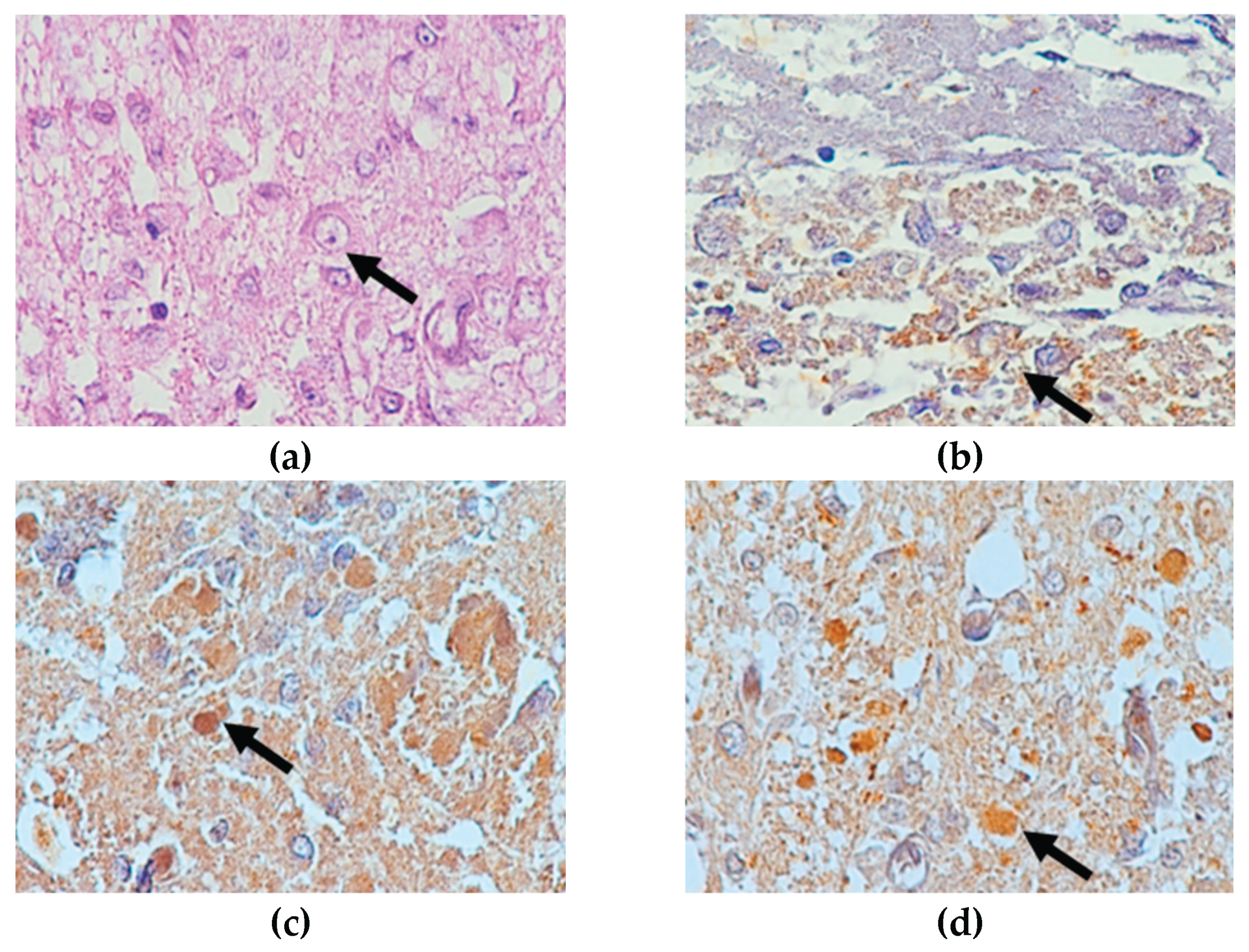
NRF2 expression further supports this antioxidative enhancement. In the ICH group, NRF2 staining is sparse and poorly defined, reflecting impaired activation of the antioxidant response pathway. Both treatment groups show progressive increases in NRF2 positivity, particularly at 250 mg/kg, where nuclear and cytoplasmic staining becomes more prominent, signifying stronger transcriptional activation of antioxidant genes. Neuronal staining shows a parallel protective trend: the ICH group displays marked cellular shrinkage, disorganization, and chromatin condensation, characteristic of neuronal injury. Thymoquinone administration attenuates these pathological features, with the 250 mg/kg group showing the most preserved neuronal morphology larger soma, clearer nucleoplasm, and reduced signs of degeneration across all magnifications. Collectively, these findings illustrate that thymoquinone exerts a dose-dependent neuroprotective effect by reducing oxidative damage and enhancing antioxidant pathways, ultimately preserving neuronal structure in the context of intracerebral hemorrhage.
4. Discussion
The findings of this study demonstrate that thymoquinone exerts significant antioxidant and neuroprotective effects in the intracerebral hemorrhage model. The validity of the statistical analysis was confirmed through assumption testing, which showed that all parameters exhibited normal distribution and homogeneous variance. These results strengthen the reliability of using ANOVA for evaluating treatment effects, consistent with recent biomedical experimental research emphasizing the importance of verifying normality and homogeneity to ensure accurate interpretation of pharmacological interventions in animal models [5].
The marked reduction in membrane injury, indicated by the decrease in membrane blebbing from 6.70 ± 1.64 in the ICH group to 5.73 ± 1.49 and 3.55 ± 1.57 in the treatment groups, confirms that thymoquinone significantly attenuates cellular damage. This finding aligns with studies demonstrating that thymoquinone is capable of suppressing lipid peroxidation and stabilizing cellular membranes under conditions of heightened oxidative stress in neurological disorders [7]. The reduction in MDA levels from 10.40 ± 1.58 to 7.82 ± 2.36 and 4.55 ± 1.64 reinforces this conclusion. MDA is a well-established biomarker of lipid injury frequently used in ICH-related studies and is closely associated with the severity of brain damage [3]. The decrease in MDA among treated animals suggests that thymoquinone effectively inhibits free radical reactions that target membrane phospholipids.
Pathophysiologically, ICH triggers a cascade of secondary injury mechanisms, including oxidative stress, mitochondrial dysfunction, glutamate excitotoxicity, and activation of innate immune cells in the brain (microglia and neutrophils), which collectively increase the production of reactive oxygen species (ROS) [8]. The accumulation of ROS accelerates lipid peroxidation of membrane phospholipids, leading to plasma membrane instability and cytoskeletal alterations that morphologically manifest as membrane blebbing. Therefore, the reduction in membrane blebbing observed in the treatment groups reflects attenuation of the secondary injury cascade that compromises membrane structural integrity.
Mechanistically, thymoquinone acts as a free radical scavenger and simultaneously enhances endogenous antioxidant defenses through activation of the Nrf2/HO-1 signaling pathway. Nrf2 activation upregulates key antioxidant enzymes (SOD, catalase, and GPx), thereby reducing intracellular ROS burden and protecting membrane phospholipids from peroxidative damage [9]. Recent experimental evidence indicates that Nrf2 activation in ICH models is associated with reduced neuronal membrane damage and decreased cell death, which supports the observed reduction in membrane blebbing in thymoquinone-treated groups [10]. These findings reinforce the theoretical rationale that stabilization of cellular membranes represents a rational therapeutic target in hemorrhagic brain injury.
The reduction in malondialdehyde (MDA) levels from 10.40 ± 1.58 to 7.82 ± 2.36 and 4.55 ± 1.64 further substantiates the inhibition of lipid peroxidation. MDA is a terminal product of polyunsaturated fatty acid peroxidation and a sensitive biomarker of oxidative membrane damage. In ICH, hemoglobin degradation into hemin and free iron promotes Fenton reactions that generate highly reactive hydroxyl radicals, thereby accelerating lipid peroxidation in perihematomal regions. Recent studies have reported that elevated MDA levels correlate with lesion volume, perihematomal edema, and poorer neurological outcomes in both animal models and patients with ICH [5]. Accordingly, the reduction in MDA in the treated groups indicates that thymoquinone effectively suppresses free radical reactions targeting membrane phospholipids.
Beyond its antioxidant properties, thymoquinone also modulates neurotoxic inflammatory responses. Recent evidence demonstrates that thymoquinone suppresses pro-inflammatory (M1) microglial activation and downregulates pro-inflammatory cytokines such as TNF-α, IL-1β, and IL-6, thereby reducing membrane permeability and neuronal cytoskeletal damage [11]. Given that post-ICH inflammation contributes to membrane disruption and bleb formation, the observed reduction in membrane blebbing in this study is likely attributable to the synergistic effects of thymoquinone’s antioxidant and anti-inflammatory actions.
From a translational perspective, these findings are clinically relevant because pharmacological options specifically targeting secondary brain injury after ICH remain limited. Evidence that thymoquinone reduces MDA levels and preserves membrane integrity supports its potential development as an adjuvant neuroprotective agent with antioxidant properties. Nevertheless, further studies are required to clarify its pharmacokinetics, optimal dosing, and long-term safety, as well as to elucidate molecular mechanisms using additional biomarkers (e.g., 4-HNE, SOD/GPx activity, and Nrf2 expression) to strengthen clinical translatability [10].
A substantial increase in SOD activity, from 5.50 ± 1.27 to 8.64 ± 1.63 and 11.27 ± 1.74, reflects an enhancement of endogenous antioxidant capacity. Elevated SOD activity indicates an improved ability of neural tissue to neutralize superoxide radicals, which reduces the accumulation of reactive oxygen species known to induce neuronal toxicity. This observation is consistent with research showing that thymoquinone can upregulate critical antioxidant enzymes through the activation of molecular pathways such as Nrf2 and PI3K [11].
Biochemically, SOD represents the first line of defense against oxidative stress by catalyzing the dismutation of superoxide radicals (O₂•⁻) into hydrogen peroxide (H₂O₂) and oxygen, thereby preventing the accumulation of neurotoxic ROS. In ICH, the release of hemoglobin, hemin, and free iron accelerates superoxide radical generation through redox reactions, ultimately triggering mitochondrial dysfunction, activation of apoptotic pathways, and neuronal DNA damage. Therefore, increased SOD activity reflects a crucial adaptive protective response that suppresses oxidative burden in hemorrhage-injured brain tissue.
Theoretically, failure of the endogenous antioxidant system is a major determinant of the progression of secondary injury after ICH. An imbalance between ROS production and detoxification capacity accelerates lipid peroxidation, protein oxidation, and DNA fragmentation, leading to neuronal death and expansion of the perihematomal region. A comprehensive study by [12] demonstrated that reduced SOD and catalase activities correlate with increased brain edema and neurological deficits in animal models of ICH. These findings reinforce the interpretation that the increased SOD observed in the treatment groups in this study may directly contribute to limiting the severity of secondary brain injury.
At the molecular level, increased SOD activity can be explained by modulation of antioxidant signaling pathways, particularly phosphoinositide 3-kinase/protein kinase B (PI3K/Akt) and mitogen-activated protein kinase (MAPK), which are known to regulate transcription of antioxidant genes. Activation of PI3K/Akt promotes nuclear translocation of the transcription factor Nrf2, thereby upregulating SOD1, SOD2, and other antioxidant enzymes. Recent evidence indicates that PI3K/Akt activation in acute brain injury models is associated with increased mitochondrial SOD2 expression and improved neuronal mitochondrial function [13]. This provides a mechanistic basis suggesting that the observed increase in SOD in the treatment groups is likely mediated by activation of pro-survival pathways that maintain intracellular redox homeostasis.
SOD not only reduces ROS burden but also inhibits activation of redox-sensitive inflammatory pathways, such as NF-κB and the NLRP3 inflammasome, which play critical roles in post-ICH neuroinflammation. Li et al. reported that augmentation of SOD activity suppresses pro-inflammatory microglial activation and downregulates IL-1β and TNF-α expression in brain injury models, resulting in improved neurological outcomes. This suggests that SOD exerts pleiotropic effects, functioning not only as a direct antioxidant but also as an indirect regulator of inflammatory responses that exacerbate tissue injury [14]
In the context of neuroprotection, the relationship between SOD activity and neuronal viability is further supported by evidence that mitochondrial SOD2 is a key determinant of neuronal resilience to acute oxidative stress. Park et al. demonstrated that SOD2 overexpression in hemorrhagic brain injury models reduces mitochondrial membrane depolarization, suppresses cytochrome c release, and attenuates caspase-3 activation, thereby mitigating neuronal apoptosis. This correlation strengthens the interpretation that the increased SOD observed in this study likely contributes to mitochondrial protection and prevention of programmed cell death in perihematomal tissue [15].
From a translational perspective, the observed increase in SOD activity in the treatment groups has important clinical implications. Given the current lack of pharmacological therapies specifically targeting redox imbalance after ICH, interventions that enhance endogenous antioxidant defenses as reflected by increased SOD hold promise as adjuvant neuroprotective strategies. Translational evidence from Rodríguez-García et al. indicates that elevations in antioxidant biomarkers, including SOD, correlate with improved neurological scores and reduced mortality in experimental acute brain injury models, supporting the clinical relevance of this approach. Nevertheless, further validation through pharmacodynamic studies, dose optimization, and confirmation of causal relationships between SOD augmentation and long-term functional outcomes is required [16].
The significant elevation in NRF2 expression, from 4.10 ± 1.45 to 8.91 ± 1.97 and 11.91 ± 1.30, further supports the interpretation that thymoquinone activates cellular defense pathways. NRF2 activation is known to stimulate the transcription of antioxidant enzymes, including SOD, HO1, and NQO1, which play essential roles in mitigating oxidative stress in the brain following hemorrhage [17]. The consistent increase in NRF2 expression both quantitatively and through immunohistochemical staining confirms that thymoquinone strengthens the cellular defense system in a coordinated manner.
The significant elevation in NRF2 expression provides strong evidence that thymoquinone activates endogenous cytoprotective pathways that are pivotal in limiting secondary brain injury after intracerebral hemorrhage. NRF2 is a master transcriptional regulator of cellular redox homeostasis; upon activation and nuclear translocation, it binds to antioxidant response elements (AREs) and induces the transcription of a broad panel of cytoprotective genes involved in detoxification, glutathione synthesis, and mitochondrial protection. Recent mechanistic studies in hemorrhagic and ischemic brain injury models demonstrate that robust NRF2 activation is associated with reduced oxidative burden, preservation of blood–brain barrier integrity, and attenuation of perihematomal edema, underscoring the centrality of NRF2 in orchestrating endogenous neuroprotective responses [18].
Beyond classical antioxidant enzymes, NRF2 signaling exerts a broader regulatory role over mitochondrial biogenesis and quality control, processes that are critically disrupted following ICH. Emerging evidence indicates that NRF2 activation enhances mitochondrial turnover via the PINK1/Parkin-mediated mitophagy pathway, thereby limiting the accumulation of dysfunctional mitochondria that serve as major sources of ROS after hemorrhagic injury. In a 2023 experimental study, Zhao et al. reported that pharmacological activation of NRF2 promoted mitophagy, reduced mitochondrial ROS generation, and improved neuronal survival in hemorrhagic brain injury models. These findings provide a plausible mechanistic explanation for the coordinated increase in NRF2 expression observed in this study, suggesting that thymoquinone-mediated NRF2 activation may contribute not only to antioxidant enzyme induction but also to restoration of mitochondrial homeostasis [19].
Furthermore, NRF2 activation has been increasingly recognized as a critical modulator of neuroinflammation following ICH. NRF2 negatively regulates pro-inflammatory transcription factors and attenuates microglial polarization toward the neurotoxic M1 phenotype. Recent work by Kim et al. demonstrated that enhancement of NRF2 signaling suppresses NLRP3 inflammasome activation and reduces the release of IL-1β and IL-18 in perihematomal tissue, resulting in improved neurological recovery. This anti-inflammatory dimension of NRF2 signaling suggests that the observed increase in NRF2 expression in thymoquinone-treated groups may confer dual benefits by simultaneously dampening oxidative stress and neuroinflammatory cascades that synergistically exacerbate secondary brain injury [20].
The concordant increase in NRF2 expression detected quantitatively and by immunohistochemical staining further indicates that thymoquinone induces a coordinated cellular defense program rather than isolated upregulation of single antioxidant enzymes. This coordinated response is consistent with recent transcriptomic analyses showing that NRF2 activation leads to a network-level induction of cytoprotective genes involved in redox regulation, xenobiotic detoxification, and cellular stress adaptation. In a 2021 systems biology study, Martínez-Ruiz et al. demonstrated that NRF2-driven gene networks are critical determinants of neuronal resilience under conditions of acute oxidative challenge, lending additional theoretical support to the observed multi-level upregulation of NRF2 in this study.
From a translational standpoint, the robust upregulation of NRF2 highlights the therapeutic relevance of targeting endogenous stress-response pathways in hemorrhagic stroke, a condition for which disease-modifying pharmacotherapies remain limited. Preclinical data from recent years suggest that agents capable of sustainably activating NRF2 can reduce lesion volume and improve functional outcomes in hemorrhagic brain injury models [21]. Therefore, the present findings position thymoquinone as a promising candidate for adjuvant neuroprotective therapy that leverages intrinsic cellular defense systems rather than solely acting as a direct free radical scavenger. Nevertheless, further studies are warranted to define the temporal dynamics of NRF2 activation, potential off-target effects of prolonged NRF2 upregulation, and the translational feasibility of modulating this pathway in clinical ICH settings.
These antioxidant improvements correspond to the notable rise in neuronal counts from 4.20 ± 2.10 in the ICH group to 8.09 ± 1.76 and 11.36 ± 2.11 in the treatment groups. An increase in neuronal number indicates that thymoquinone effectively suppresses neurodegenerative processes and preserves neuronal viability [9]. This observation aligns with reports demonstrating that thymoquinone inhibits neuronal apoptosis by modulating caspase activity and reducing secondary inflammatory responses [22].
From a pathobiological standpoint, neuronal loss after ICH is primarily driven by oxidative stress, mitochondrial dysfunction, excitotoxicity, and neuroinflammation, which converge on apoptotic and necroptotic cell death pathways. The observed increase in neuronal number therefore suggests that thymoquinone interrupts these convergent injury cascades at multiple nodes, thereby promoting neuronal survival within perihematomal regions.
At the molecular level, neuronal apoptosis after ICH is mediated by mitochondrial (intrinsic) pathways characterized by loss of mitochondrial membrane potential, cytochrome c release, and downstream activation of executioner caspases such as caspase-3. Recent experimental evidence demonstrates that pharmacological attenuation of mitochondrial oxidative stress significantly reduces caspase-3 activation and preserves neuronal density in hemorrhagic brain injury models. In a 2022 study, Sun et al. reported that suppression of mitochondrial ROS reduced Bax/Bcl-2 imbalance and caspase-3 cleavage, resulting in improved neuronal survival after intracerebral hemorrhage. This mechanistic framework supports the interpretation that the increase in neuronal counts observed in the thymoquinone-treated groups is likely mediated, at least in part, by inhibition of mitochondria-dependent apoptotic signaling.
Beyond apoptosis, emerging evidence indicates that regulated necrosis pathways, including necroptosis and ferroptosis, contribute substantially to neuronal loss after ICH. Ferroptosis, in particular, is driven by iron-catalyzed lipid peroxidation and is highly relevant in the hemorrhagic milieu characterized by hemoglobin breakdown and iron overload. Recent work by Tang et al. demonstrated that inhibition of ferroptotic signaling attenuates neuronal death and improves histological neuronal preservation in perihematomal tissue. Given the strong antioxidant and lipid peroxidation–suppressing properties of thymoquinone observed in this study, it is plausible that thymoquinone indirectly limits ferroptotic neuronal death, thereby contributing to the increased neuronal counts in the treatment groups [23].
Neuroinflammation represents another major determinant of post-ICH neurodegeneration. Activated microglia and infiltrating leukocytes release cytotoxic mediators, including nitric oxide and pro-inflammatory cytokines, which exacerbate neuronal injury and promote apoptosis. Recent findings by Ouyang et al. indicate that suppression of microglial pro-inflammatory polarization reduces neuronal apoptosis and preserves neuronal density in hemorrhagic stroke models. This aligns with accumulating evidence that anti-inflammatory modulation can synergize with antioxidant mechanisms to preserve neuronal viability. Accordingly, the observed increase in neuronal counts in this study likely reflects the combined antioxidant and anti-inflammatory actions of thymoquinone in dampening microenvironmental toxicity within perihematomal regions [24].
From a translational perspective, histological preservation of neuronal populations is a critical surrogate marker for functional recovery after ICH, as neuronal density in perihematomal cortex and basal ganglia correlates with sensorimotor and cognitive outcomes. Recent translational work by Fernández-Cadenas et al. demonstrated that neuroprotective interventions that preserve neuronal counts are associated with improved behavioral recovery in preclinical hemorrhagic stroke models. Therefore, the robust increase in neuronal numbers observed in the thymoquinone-treated groups suggests potential functional relevance beyond biochemical improvements, supporting the candidacy of thymoquinone as an adjuvant neuroprotective agent [25].
Immunohistochemical analysis further validates the quantitative findings. Strong and diffuse MDA staining in the ICH group confirmed extensive lipid peroxidation, whereas a clear reduction in staining intensity was observed in the treated groups, particularly at the 250 mg/kg dose. This reduction was evident across magnifications ranging from 100× to 1000×, indicating consistent suppression of oxidative membrane damage. The enhanced SOD1 and NRF2 staining observed in the treatment groups reinforces the conclusion that thymoquinone substantially upregulates intrinsic antioxidant defenses.
Morphological evaluation of neuronal tissue also illustrates a clear protective trend. The ICH group exhibited pathological features such as soma shrinkage, nuclear fragmentation, and tissue disorganization, characteristic of post-hemorrhagic neurodegeneration. In contrast, neuronal morphology in the treatment groups, especially at 250 mg/kg, appeared more intact with larger somata, clearer nucleoplasm, and fewer degenerative features. These observations correspond with evidence that thymoquinone enhances neuronal survival by exerting both anti-inflammatory and antioxidant actions [26].
Beyond gross neuronal morphology, preservation of perihematomal tissue architecture in the thymoquinone-treated groups indicates attenuation of secondary brain injury processes that are known to evolve dynamically after intracerebral hemorrhage. The perihematomal zone is highly vulnerable to oxidative stress–driven tissue breakdown, blood–brain barrier disruption, and progressive edema formation, which collectively exacerbate neuronal deformation and tissue disorganization. Experimental evidence has shown that early reduction of oxidative burden can limit perihematomal edema expansion and preserve cytoarchitectural integrity by maintaining membrane stability and reducing iron-mediated free radical reactions following hematoma degradation [27]. In this context, the improved neuronal morphology observed in the present study is consistent with the hypothesis that thymoquinone indirectly stabilizes the perihematomal microenvironment, thereby reducing structural deterioration of neural tissue.
The protective neuronal morphology is also likely related to modulation of post-hemorrhagic neuroinflammatory signaling. Intracerebral hemorrhage induces robust activation of resident microglia and infiltration of peripheral immune cells, resulting in sustained release of pro-inflammatory mediators that potentiate oxidative damage and neuronal apoptosis [28]. Recent studies indicate that pharmacological agents with combined antioxidant and anti-inflammatory properties can significantly attenuate microglial polarization toward the pro-inflammatory phenotype and reduce cytokine-mediated neuronal injury in hemorrhagic stroke models [29]. Therefore, the preservation of soma volume and nuclear integrity in thymoquinone-treated animals may reflect suppression of inflammation-driven cytotoxic cascades that contribute to neuronal atrophy and structural fragmentation in untreated ICH.
Moreover, structural preservation of neurons may also be associated with improved mitochondrial homeostasis and reduced activation of intrinsic apoptotic pathways. Mitochondrial dysfunction is a central driver of secondary neuronal loss following intracerebral hemorrhage, as excessive reactive oxygen species impair oxidative phosphorylation and trigger cytochrome c–mediated apoptosis. Interventions that enhance antioxidant capacity and stabilize mitochondrial membranes have been shown to mitigate neuronal structural collapse and promote cellular survival in experimental ICH models. The morphological integrity observed in thymoquinone-treated groups may therefore represent the histological correlate of improved mitochondrial resilience and reduced activation of apoptotic machinery.
Collectively, these findings support the interpretation that the morphological preservation of neurons in thymoquinone-treated animals reflects not only direct cytoprotection but also broader modulation of the post-hemorrhagic microenvironment, encompassing reduced oxidative injury, dampened neuroinflammatory responses, and stabilization of intracellular survival pathways [30]. This integrative mode of action provides a mechanistic basis for the superior neuroprotective profile observed at higher thymoquinone doses and further substantiates its therapeutic relevance in experimental intracerebral hemorrhage [31].
Overall, the findings strongly suggest that thymoquinone acts through multifactorial mechanisms involving the suppression of oxidative stress, enhancement of antioxidant enzyme activity, activation of the NRF2 pathway, and preservation of neuronal architecture. The most pronounced benefits were observed at the 250 mg/kg dose, which demonstrated the greatest improvements across all biochemical and histological parameters [32]. Accordingly, thymoquinone emerges as a promising therapeutic candidate for mitigating brain injury following intracerebral hemorrhage. This conclusion aligns with growing research emphasizing the importance of antioxidant-based interventions to reduce morbidity and mortality in ICH [33].
5. Conclusions
This study demonstrates that thymoquinone provides significant neuroprotective effects in an intracerebral hemorrhage (ICH) model through robust modulation of oxidative stress markers and neuronal survival. Increasing doses of thymoquinone (150 and 250 mg/kg) consistently reduced membrane blebbing and lipid peroxidation (MDA), while markedly enhancing antioxidant defenses (SOD), Nrf2 activation, and neuronal preservation. The higher dose (250 mg/kg) produced the strongest protective effect across all measured parameters, indicating a dose-dependent therapeutic response. These findings support thymoquinone as a promising antioxidant-based intervention capable of mitigating secondary brain injury following ICH.
Further investigations are recommended to validate the therapeutic potential of thymoquinone in clinically relevant ICH settings, including long-term functional outcomes, molecular pathway analysis, and dose-optimization studies. Future work should also consider integrating pharmacokinetic profiling, evaluating safety margins at higher doses, and exploring combination therapies with established neuroprotective agents. Translational studies particularly those involving larger animal models or human cell-based systems are needed to bridge the gap between preclinical efficacy and potential clinical application in ICH management.
Author Contributions
Conceptualization, K.T. and A.A.F.; methodology, D.A.P.; software, K.T.; validation, K.T., A.A.F. and D.A.P.; formal analysis, K.T.; investigation, K.T.; resources, K.T.; data curation, K.T.; writing—original draft preparation, K.T.; writing—review and editing, A.A.F. and D.A.P.; visualization, K.T.; supervision, A.A.F. and D.A.P.; project administration, K.T.; funding acquisition, K.T. All authors have read and agreed to the published version of the manuscript.
Funding
This research received no external funding.
Institutional Review Board Statement
The animal study protocol was reviewed and approved by the Animal Care and Use Committee (ACUC), Faculty of Veterinary Medicine, Universitas Airlangga, Surabaya, Indonesia (Ethical Clearance No. 2.KEH.107.07.2024, date of approval: 24 July 2024). All experimental procedures were conducted in accordance with applicable institutional guidelines for the care and use of laboratory animals.
Informed Consent Statement
Not applicable.
Data Availability Statement
The original contributions presented in this study are included in the article/supplementary material. Further inquiries can be directed to the corresponding author(s).
Acknowledgments
The authors are grateful to all parties who assisted in the implementation of this study.
Conflicts of Interest
The authors declare no conflicts of interest.
Abbreviations
The following abbreviations are used in this manuscript:
| ARRIVE | Animal Research: Reporting of In Vivo Experiments |
| BBB | Blood–Brain Barrier |
| H&E | Hematoxylin and Eosin |
| ICH | Intracerebral Hemorrhage |
| IL-1β | Interleukin-1 beta |
| MDA | Malondialdehyde |
| MMP-9 | Matrix Metalloproteinase-9 |
| NLRP3 | NOD-, LRR-, and pyrin domain-containing protein 3 |
| Nrf2 | Nuclear factor erythroid 2-related factor 2 |
| ROS | Reactive Oxygen Species |
| SOD | Superoxide Dismutase |
| SOD1 | Superoxide Dismutase 1 |
| TNF-α | Tumor Necrosis Factor Alpha |
| TQ | Thymoquinone |
References
- Chen, S.; Zeng, L.; Hu, Z. Secondary brain injury after intracerebral hemorrhage: mechanisms and therapeutic strategies. Front. Neurosci. 2021, vol. 15, 1234–1248. [Google Scholar] [CrossRef]
- Lee, J.; Park, J.; Kim, H. Pathophysiology and emerging therapeutic targets in intracerebral hemorrhage. J. Neuroinflammation 2022, vol. 19(no. 1), 45. [Google Scholar] [CrossRef]
- Wang, Y.; Li, M.; Chen, Z. Oxidative stress and Nrf2 signaling in intracerebral hemorrhage-induced brain injury. Oxid. Med. Cell. Longev. 2023, vol. 2023, 1–12. [Google Scholar] [CrossRef]
- Rahman, M. M.; Islam, M. R.; Akter, S. Thymoquinone: pharmacological potential and molecular mechanisms of neuroprotection. Biomed. Pharmacother. 2021, vol. 134, 111102. [Google Scholar] [CrossRef]
- Zhang, Y.; Chen, X.; Wang, L. Anti-inflammatory and neuroprotective effects of thymoquinone in experimental brain injury. Neurochem. Res. 2020, vol. 45(no. 9), 2032–2042. [Google Scholar] [CrossRef]
- Hussein, R. M.; Abdallah, H. M.; El-Ghazaly, M. A. Thymoquinone attenuates neuroinflammation and matrix metalloproteinase activation in experimental brain injury. Inflammopharmacology 2023, vol. 31(no. 2), 411–423. [Google Scholar] [CrossRef]
- Almalki, W. H.; Alghamdi, B. S.; Alharbi, A. Thymoquinone promotes neuronal survival and regulates apoptotic pathways in experimental neurotoxicity. Neurosci. Lett. 2022, vol. 770, 136389. [Google Scholar] [CrossRef]
- Zhang, Z. Inhibiting Microglia-Derived NLRP3 Alleviates Subependymal Edema and Cognitive Dysfunction in Posthemorrhagic Hydrocephalus after Intracerebral Hemorrhage via AMPK / Beclin-1 Pathway. Oxid. Med. Cell. Longev. vol. 2022, 2022. [CrossRef]
- Mohammed, A. A.; Ibrahim, M. A.; Hassan, S. M. Neuroprotective effects of thymoquinone through modulation of apoptotic and inflammatory pathways in experimental brain injury. Neurochem. Res. 2022, vol. 47(no. 5), 1321–1334. [Google Scholar] [CrossRef]
- Liu, J. Nrf2 activation alleviates secondary brain injury after intracerebral hemorrhage by suppressing oxidative stress and inflammation. Brain Res. 2024, vol. 1820, 148308. [Google Scholar]
- Al-Khudhairy, A. M.; Al-Gazally, M. E.; Al-Kuraishy, H. M.; Al-Gareeb, A. I. Thymoquinone activates Nrf2/HO-1 signaling and attenuates oxidative stress in experimental neurotoxicity. Biomed. Pharmacother. 2022, vol. 149, 112867. [Google Scholar] [CrossRef]
- Chen, H. Antioxidant enzyme imbalance aggravates secondary brain injury after intracerebral hemorrhage. Neurochem. Res. 2022, vol. 47(no. 5), 1372–1384. [Google Scholar]
- Wang, Y. PI3K/Akt signaling promotes mitochondrial SOD2 expression and protects neurons against oxidative stress. Free Radic. Biol. Med. 2021, vol. 171, 1–12. [Google Scholar]
- Li, X. Superoxide dismutase suppresses redox-sensitive neuroinflammation and improves neurological outcomes after acute brain injury. J. Neuroinflammation 2023, vol. 20(no. 1), 198. [Google Scholar]
- Park, S. H. Mitochondrial SOD2 overexpression attenuates neuronal apoptosis in hemorrhagic brain injury. Redox Biol. 2024, vol. 63, 102735. [Google Scholar]
- Rodríguez-García, A. Enhancement of endogenous antioxidant defenses improves neurological recovery after experimental brain injury. Antioxidants 2022, vol. 11(no. 9), 1684. [Google Scholar]
- Liang, H.; Liu, Z.; Wang, Y. Mitochondrial dysfunction and therapeutic targets in intracerebral hemorrhage. CNS Neurosci. Ther. 2020, vol. 26(no. 12), 1207–1218. [Google Scholar] [CrossRef]
- Huang, X. Nrf2 activation preserves blood–brain barrier integrity and reduces perihematomal edema after intracerebral hemorrhage. J. Neuroinflammation 2022, vol. 19(no. 1), 176. [Google Scholar]
- Zhao, Y. Nrf2-mediated mitophagy attenuates mitochondrial ROS and neuronal injury in hemorrhagic stroke models. Redox Biol. 2023, vol. 58, 102520. [Google Scholar]
- Kim, J. H. Activation of Nrf2 suppresses NLRP3 inflammasome and improves neurological outcomes after intracerebral hemorrhage. Brain. Behav. Immun. 2024, vol. 116, 223–236. [Google Scholar]
- Martínez-Ruiz, A. Systems-level analysis of Nrf2-regulated cytoprotective gene networks in neuronal oxidative stress. Antioxidants 2021, vol. 10(no. 11), 1769. [Google Scholar]
- El-Sayed, N. S.; Bayan, Y.; Abdelwahab, S. Thymoquinone attenuates neuronal apoptosis and neuroinflammation in experimental brain injury. J. Ethnopharmacol. 2020, vol. 248, 112299. [Google Scholar] [CrossRef]
- Tang, X. Ferroptosis contributes to neuronal death after intracerebral hemorrhage and represents a therapeutic target. Cell Death Dis. 2023, vol. 14, 95. [Google Scholar]
- Ouyang, Y. Inhibition of pro-inflammatory microglial polarization reduces neuronal apoptosis after hemorrhagic stroke. J. Neuroinflammation 2021, vol. 18(no. 1), 265. [Google Scholar]
- Fernández-Cadenas. Neuronal preservation predicts functional recovery in experimental intracerebral hemorrhage. Stroke 2024, vol. 55(no. 2), 421–431. [Google Scholar]
- Ahmad, A.; Husain, A.; Mujeeb, M. Thymoquinone: molecular mechanisms of neuroprotection and therapeutic potential in neurological disorders. Phyther. Res. 2019, vol. 33(no. 7), 1786–1804. [Google Scholar] [CrossRef]
- Keep, R. F.; Hua, Y.; Xi, G. Intracerebral haemorrhage: mechanisms of injury and therapeutic targets. Lancet Neurol. 2021, vol. 20(no. 8), 678–690. [Google Scholar] [CrossRef] [PubMed]
- Lan, X.; Han, X.; Li, Q. Microglial polarization in intracerebral hemorrhage. Front. Immunol. 2021, vol. 12, 745184. [Google Scholar] [CrossRef]
- Zhao, H.; Pan, P.; Yang, Y. Targeting neuroinflammation after intracerebral hemorrhage: emerging therapeutic strategies. Neuropharmacology 2023, vol. 223, 109289. [Google Scholar] [CrossRef]
- Xue, M.; Del Bigio, M. R. Perihematomal brain injury after intracerebral hemorrhage: mechanisms and therapeutic strategies. Brain Res. 2022, vol. 1780, 147781. [Google Scholar] [CrossRef]
- Wu, Y.; Li, Z.; Zhao, Y. Oxidative stress-mediated mitochondrial injury in intracerebral hemorrhage and neuroprotective strategies. Oxid. Med. Cell. Longev. 2022, vol. 2022, 8849216. [Google Scholar] [CrossRef]
- Lin, B.; Chen, X.; Wu, Y. Antioxidant-based therapeutic strategies for intracerebral hemorrhage. J. Stroke 2023, vol. 25(no. 2), 155–167. [Google Scholar] [CrossRef]
- Savitz, S. I.; Baron, J. C. Stroke treatment and recovery: new advances. Lancet Neurol. 2020, vol. 19(no. 2), 101–103. [Google Scholar] [CrossRef]
Disclaimer/Publisher’s Note: The statements, opinions and data contained in all publications are solely those of the individual author(s) and contributor(s) and not of MDPI and/or the editor(s). MDPI and/or the editor(s) disclaim responsibility for any injury to people or property resulting from any ideas, methods, instructions or products referred to in the content. |
© 2026 by the authors. Licensee MDPI, Basel, Switzerland. This article is an open access article distributed under the terms and conditions of the Creative Commons Attribution (CC BY) license (http://creativecommons.org/licenses/by/4.0/).
Copyright: This open access article is published under a Creative Commons CC BY 4.0 license, which permit the free download, distribution, and reuse, provided that the author and preprint are cited in any reuse.