
Submitted:
08 March 2026
Posted:
10 March 2026
You are already at the latest version
Abstract
Background Treatment adherence and outcomes for drug-resistant tuberculosis (DR-TB) continue to be sub-par in rural South Africa, where structural health system limitations, comorbid conditions, and diverse resistance patterns make clinical management more challenging. This study aimed to assess how demographic, clinical, and programmatic factors, including a Community Engagement–Clinical Governance (CE–CG) implementation period, affect DR-TB treatment outcomes using explanatory predictive modelling. Methods A retrospective cohort study was conducted using routine programme data from 694 DR-TB patients. Complete-case analysis was performed for multivariable modelling (n = 282). Logistic regression and decision tree models were used to examine the relationships between treatment success and selected predictors, including age, sex, treatment regimen, resistance phenotype, comorbidities, and the CE–CG implementation period. Model discrimination and performance were evaluated using receiver operating characteristic (ROC) curves, pseudo-R² statistics, likelihood ratio tests, and multicollinearity diagnostics. Results The cohort had a mean age of 40.7 years, and 58.8% of patients were male. Overall treatment success was 59.9%. Severe resistance phenotypes were rare (1.7%) but clinically significant. Comparative analysis showed no notable demographic or outcome differences between included and excluded patients, indicating minimal selection bias. In adjusted models, treatment initiation during the CE–CG implementation period was significantly linked to lower odds of treatment success (adjusted odds ratio [aOR] = 0.443; 95% CI: 0.240–0.818; p = 0.009). Severe resistance phenotypes were strongly negatively associated with treatment success (aOR = 0.303; p = 0.056). Logistic regression models had limited discriminatory ability (AUC: 0.523–0.548), while the decision tree model showed modest improvement (AUC: 0.626). Overall, the model’s explanatory power was limited (pseudo-R² = 0.029), although no evidence of multicollinearity was found. Conclusions Programmatic implementation durations and resistance severity were key factors influencing treatment outcomes in this rural DR-TB cohort. Although the predictive accuracy was modest, the modelling approach revealed structural and programmatic vulnerabilities that impacted treatment success. Enhancing clinical governance, improving program documentation, and expanding community-engaged adherence strategies may improve DR-TB results. Future predictive models should incorporate programmatic indicators alongside longitudinal adherence data and social determinants of health to boost explanatory power and guide targeted interventions.
Keywords:
tuberculosis
; drug-resistant TB
; treatment outcomes
; community engagement
; clinical governance
; predictive modelling
; logistic regression
; decision tree analysis
; programmatic factors
; resistance phenotype
; pre-XDR/XDR-TB
; rural health systems
; South Africa
1. Introduction
Drug-resistant tuberculosis (DR-TB) remains a major global public health challenge, disproportionately affecting low- and middle-income countries [1,2,3]. In high HIV-prevalence settings, especially in rural regions of sub-Saharan Africa, treatment outcomes are shaped by a complex interaction of biological resistance, patient vulnerabilities, and health system capacity. Despite advances in molecular diagnostics and improved treatment regimens, unfavourable outcomes, including treatment failure, loss to follow-up, and death, remain common among patients with DR-TB [4,5,6,7]. While pathogen-related factors, such as resistance phenotype, strongly influence prognosis, structural and programmatic elements also significantly affect treatment trajectories [8,9,10,11]. In resource-limited rural settings, support for adherence, care continuity, patient tracing, and integration of TB–HIV services are often inconsistent. These contextual challenges underscore the importance of clinical governance and community engagement as key structural determinants of treatment success [12]. Clinical governance frameworks emphasize accountability, monitoring, quality improvement, and systematic oversight of healthcare delivery, whereas community engagement focuses on building trust, encouraging adherence, and enabling locally responsive services. Increasingly, health systems are adopting integrated community engagement–clinical governance (CE–CG) approaches to enhance tuberculosis program performance [13,14,15,16]. These often include community health worker-led tracing, structured adherence counselling, community-based follow-up, routine program monitoring via dashboards, and coordinated TB–HIV care pathways. However, assessing the impact of governance and community engagement interventions remains challenging. These mechanisms operate through complex, multidimensional processes that are not easily captured by traditional causal models, especially when using routine program data [17,18,19,20]. Predictive modeling offers an opportunity to explore how demographic, clinical, and programmatic factors interact to influence treatment outcomes. Still, most existing predictive studies focus mainly on individual-level prognostic tools rather than explanatory models that account for structural and programmatic factors. In settings undergoing governance reform, modelling approaches can serve as both predictive tools and system-oriented analytical frameworks that help interpret program performance and structural coherence within evolving health systems [21,22,23,24]. Consequently, this study aimed to model and predict DR-TB treatment outcomes within a context of improved community engagement and clinical governance, evaluating their potential impact on adherence and treatment success through explanatory predictive models. Specifically, multivariable logistic regression and tree-based models were used to examine the associations between demographic, clinical, and programmatic factors and treatment success. By combining epidemiological modelling with clinical governance perspectives, this research seeks to deepen understanding of how structural programme environments influence DR-TB outcomes in rural, high-burden settings.
2. Methods
2.1. Study Design and Setting
This study employed a retrospective cohort design using routinely collected programme data from a drug-resistant tuberculosis (DR-TB) treatment programme in a rural South African setting. The analysis aimed to model treatment outcomes within the context of evolving programme structures, particularly the implementation of community engagement and clinical governance (CE–CG) strategies intended to strengthen adherence support and programme oversight.
2.2. Study Population and Data Source
The dataset comprised 694 patient records extracted from the tuberculosis programme database. Variables included demographic characteristics (age and gender), clinical factors (drug-resistance phenotype, treatment regimen at initiation, and comorbidity status), treatment initiation date, and final treatment outcome.
Treatment outcomes were categorised as favourable (cured or treatment completed) or unfavourable (lost to follow-up, treatment failure, death, transfer, or still on treatment at the time of analysis). For modelling purposes, drug-resistance phenotype was further classified into severe resistance (pre-extensively drug-resistant tuberculosis [pre-XDR] or extensively drug-resistant tuberculosis [XDR]) versus other resistance patterns.
2.3. Operationalisation of Community Engagement and Clinical Governance (CE–CG)
Community engagement and clinical governance were operationalised as a programme-level contextual indicator. Patients initiating treatment from 2024 onwards were classified as receiving care during the CE–CG implementation period.
This period corresponded with the documented introduction of structured governance and community-oriented support mechanisms, including community health worker–led patient tracing, structured adherence counselling, community-based follow-up, integrated TB–HIV coordination, and routine programme oversight supported by monitoring dashboards. The CE–CG indicator was conceptualised as a contextual explanatory variable representing programme environment rather than a direct causal exposure at the individual patient level.
2.4. Data Cleaning and Complete-Case Analysis
Continuous variables were assessed for plausibility and converted to numeric format where necessary. Age was centred prior to regression modelling to improve interpretability and reduce potential multicollinearity.
Complete-case analysis was applied for multivariable modelling. Records with missing values for any modelling variable (age, gender, regimen, treatment outcome, CE–CG indicator, resistance phenotype, or comorbidity status) were excluded. Comparisons between included and excluded patients were conducted to assess potential selection bias.
2.5. Descriptive Analysis
Descriptive statistics were computed for the full dataset before applying complete-case exclusion criteria. Continuous variables were summarised using means and standard deviations (SD), while categorical variables were reported as frequencies and percentages.
To evaluate potential selection bias arising from complete-case exclusion, comparisons between included and excluded patients were conducted using independent samples t-tests for continuous variables (age) and chi-square tests for categorical variables (gender and treatment success). In addition to statistical significance testing, effect sizes were calculated to assess practical significance, using Cohen’s d for continuous variables and Cramér’s V for categorical variables.
2.6. Multivariable Logistic Regression
A multivariable logistic regression model was fitted using complete-case data to examine associations between demographic, clinical, and programmatic variables and treatment success. The model included centred age, gender, CE–CG period indicator, regimen at treatment initiation, severe resistance phenotype, and comorbidity status as predictors.
Adjusted odds ratios (aOR) with corresponding 95% confidence intervals (CI) were estimated to quantify independent associations. Statistical significance was determined using two-sided p-values with a significance threshold of 0.05.
2.7. Comparative Predictive Modelling
To explore whether non-parametric modelling approaches improved discriminative performance, a decision tree classifier was fitted using the same predictor variables as the logistic regression model.
Both models were evaluated using a 70/30 train–test split to assess internal model performance. Discriminative ability was quantified using receiver operating characteristic (ROC) curve analysis and the corresponding area under the curve (AUC). Consistent with the study’s explanatory predictive framework, model performance was interpreted descriptively to evaluate internal coherence and structural insight rather than to develop a deployable prognostic prediction tool.
2.8. Model Diagnostics and Goodness-of-Fit
Logistic regression model diagnostics included assessing McFadden’s pseudo-R², likelihood-ratio (LR) testing comparing the full model with the intercept-only model, and evaluating multicollinearity using the Variance Inflation Factor (VIF).
McFadden’s pseudo-R² was interpreted within the context of routinely collected clinical programme data, where modest explanatory power is commonly observed. VIF values below 5 were considered indicative of acceptable levels of multicollinearity among predictors.
2.9. Statistical Software
All statistical analyses were conducted in Python version 3.11 within a Jupyter Notebook environment to ensure reproducibility. Data management and preprocessing were performed using pandas version 2.1 and NumPy version 1.26. Inferential statistical analyses were conducted using SciPy version 1.11 and statsmodels version 0.14, while predictive modelling procedures, including decision tree analysis, were implemented using scikit-learn. Figures, including ROC curves and diagnostic plots, were generated using matplotlib version 3.8. Statistical significance was defined a priori as a two-sided p-value < 0.05.
3. Results
3.1. Study Population and Data Completeness
A total of 694 patient records were identified in the tuberculosis programme dataset. After applying complete-case criteria for all modelling variables (age, gender, regimen at initiation, treatment outcome, CE–CG period indicator, resistance phenotype, and comorbidity status), 282 patients (40.6%) were retained for multivariable analysis. In comparison, 412 patients (59.4%) were excluded due to missing data in one or more variables. Missingness was primarily driven by incomplete documentation of resistance phenotype and comorbidity status, whereas core demographic variables such as age and gender were largely complete. The complete-case dataset was subsequently used for all multivariable modelling analyses.
3.2. Baseline Characteristics
The mean age of the overall cohort (N = 694) was 40.69 years (SD = 17.38). The study population was predominantly male (58.8%), while females comprised 38.9% of the cohort.
Overall treatment success, defined as cure or treatment completion, was observed in 59.9% of patients. Most patients (88.8%) were initiated on a short treatment regimen, whereas 6.8% received a long regimen. Severe resistance phenotypes, defined as pre-extensively drug-resistant (pre-XDR) or extensively drug-resistant tuberculosis (XDR-TB), were relatively uncommon (1.7%) but clinically significant. A detailed summary of baseline characteristics is presented in Table 1.
3.3. Comparison of Included and Excluded Patients
To assess potential selection bias introduced by the complete-case analysis, patients included in the modelling dataset (n = 282) were compared with those excluded due to missing data (n = 412). No statistically significant differences were observed between the two groups in terms of mean age (t = −1.04, p = 0.299), gender distribution (χ² = 1.962, p = 0.161), or treatment success proportions (χ² = 3.269, p = 0.071). Effect size estimates indicated negligible differences between groups. Cohen’s d for age was −0.081, while Cramér’s V values were 0.054 for gender and 0.069 for treatment success, suggesting minimal practical imbalance between included and excluded patients. Although 59.4% of records were excluded due to incomplete modelling variables, these findings indicate that the analytic sample remained broadly comparable to the full cohort across key demographic characteristics and treatment outcomes. The observed missingness appeared primarily related to incomplete documentation of specific clinical variables rather than systematic differences in core demographic or outcome measures. However, the possibility of residual bias due to unmeasured clinical or programmatic factors cannot be entirely ruled out.
3.4. Multivariable Explanatory Predictive Modelling
A multivariable logistic regression analysis was conducted using a complete-case dataset (n = 282) to explore the associations between demographic, clinical, and programmatic factors and treatment success. The predictor variables included centred age, gender, the treatment regimen at initiation, severe resistance phenotype (pre-XDR/XDR), comorbidity status, and an indicator for the community engagement-clinical governance (CE-CG) implementation period.
After adjusting for covariates, the analysis found that treatment initiation during the CE-CG implementation period (≥2024) was significantly associated with lower odds of treatment success (aOR = 0.443, 95% CI: 0.240–0.818, p = 0.009). The presence of severe resistance phenotypes (pre-XDR/XDR) was also strongly negatively associated with treatment success, approaching statistical significance (aOR = 0.303, 95% CI: 0.089–1.029, p = 0.056). However, other covariates—such as age, gender, treatment regimen at initiation, and comorbidity status—were not significantly associated with treatment outcomes in the adjusted model.

Table 2.
Adjusted multivariable logistic regression model for treatment success.
| Predictor | Adjusted OR | 95% CI | p-value |
| Constant | 1.293 | 0.395–4.236 | 0.671 |
| Age (centred) | 0.999 | 0.983–1.015 | 0.871 |
| Gender | 1.334 | 0.777–2.291 | 0.296 |
| CE–CG period | 0.443 | 0.240–0.818 | 0.009 |
| Regimen at initiation | 1.220 | 0.515–2.890 | 0.652 |
| Severe resistance (Pre-XDR/XDR) | 0.303 | 0.089–1.029 | 0.056 |
| Any comorbidity | 0.935 | 0.542–1.612 | 0.808 |
The constant represents the model's baseline reference level. Age was centred (age_c) by subtracting the sample mean to improve interpretability and reduce potential multicollinearity.
3.5. Comparative Model Performance
To evaluate whether non-parametric modelling approaches improved predictive discrimination, a decision tree classifier was developed alongside the logistic regression model using the same set of predictor variables. Both models were evaluated using a 70/30 train–test split to assess internal predictive performance.
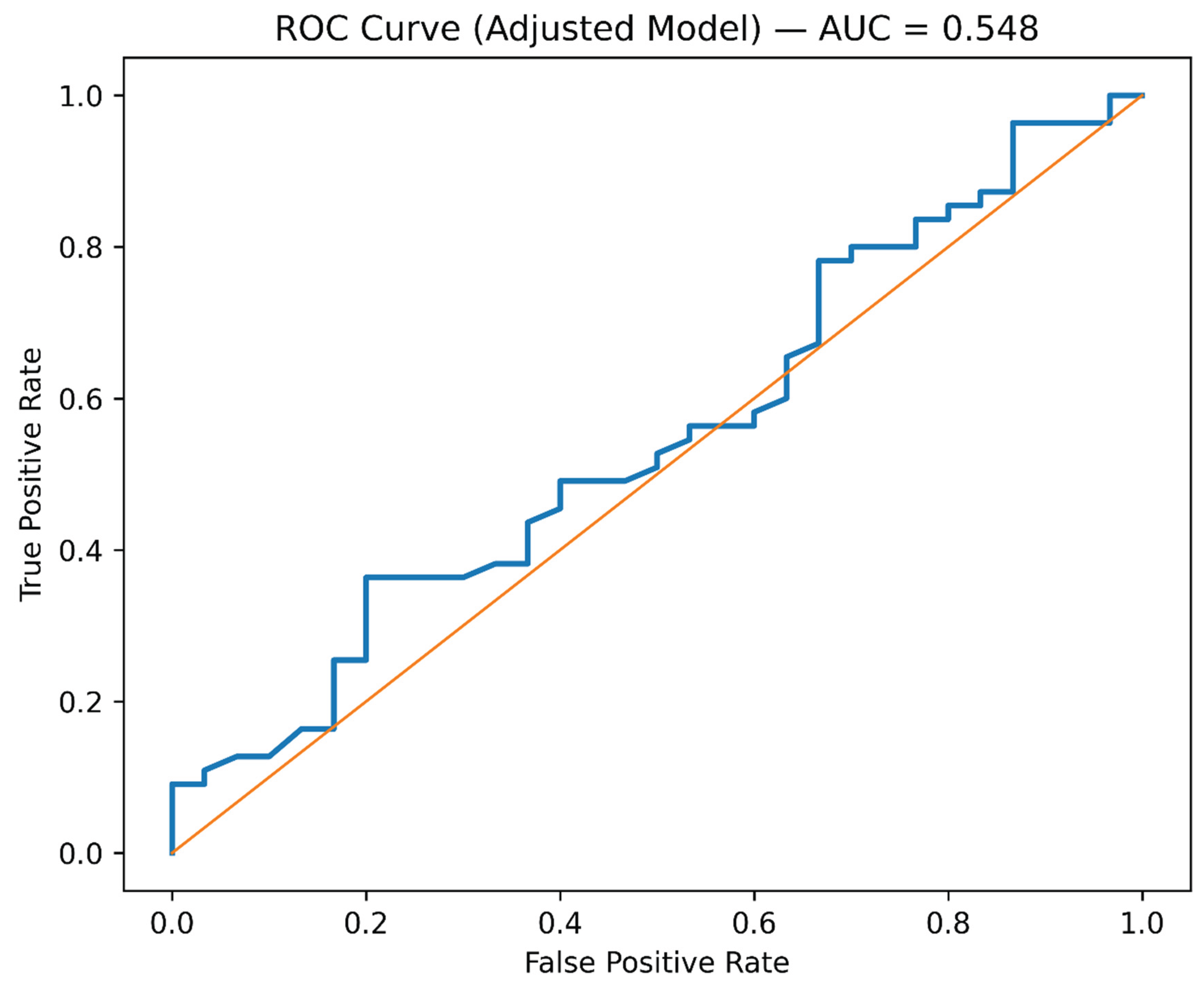
The logistic regression model demonstrated limited discriminative ability, with an area under the receiver operating characteristic curve (AUC) ranging from 0.523 to 0.548, indicating performance only marginally better than chance. In contrast, the decision tree classifier showed modestly improved discrimination (AUC = 0.626), suggesting greater capacity to capture nonlinear relationships and hierarchical interactions among predictors. Despite this relative improvement, overall predictive performance remained modest across both modelling approaches, indicating that the available variables have limited explanatory capacity for predicting treatment success in the current dataset (Figure 1).
3.6. Comparative Model Performance: Logistic Regression vs Tree-Based Models
To evaluate whether non-parametric modelling improved discriminative performance, a decision tree classifier was fitted alongside the multivariable logistic regression model using identical predictor variables. Both models were assessed using a 70/30 train–test split and receiver operating characteristic (ROC) curve analysis. The logistic regression model demonstrated limited discrimination (AUC = 0.523–0.548), indicating modest ability to distinguish between favorable and unfavorable treatment outcomes. The decision tree model showed improved discrimination (AUC = 0.626), suggesting that hierarchical partitioning may better capture nonlinear relationships and interaction structures within the dataset. Nevertheless, overall performance remained moderate across both approaches.
These findings reflect the complementary strengths of the modelling strategies. Logistic regression provides interpretable effect estimates (adjusted odds ratios with confidence intervals), supporting inferential clarity and governance-relevant interpretation. In contrast, tree-based models identify structural decision pathways and potential threshold effects without imposing linear assumptions. However, neither approach achieved sufficient discrimination to support individual-level prognostic application. The modest AUC values likely reflect limitations of the available predictor set, including the absence of longitudinal adherence markers, socioeconomic instability measures, and quantified governance-process indicators. Consistent with the study’s explanatory predictive framework, model performance is interpreted descriptively to assess internal coherence and structural insight rather than to develop externally generalisable prediction tools.
Figure 2.
Receiver Operating Characteristic Curve for the Adjusted Explanatory Predictive Model of Treatment Success.
Figure 2.
Receiver Operating Characteristic Curve for the Adjusted Explanatory Predictive Model of Treatment Success.
3.7. Model Diagnostics and Goodness-of-Fit
The multivariable logistic regression model, fitted on the complete-case dataset (n = 282), included centred age, gender, CE–CG implementation period, regimen at treatment initiation, severe resistance phenotype, and comorbidity status as predictors of treatment success. Model diagnostics showed modest explanatory power with acceptable internal consistency. McFadden’s pseudo-R² was 0.029, indicating a limited explanatory contribution of the predictors compared to the intercept-only model, which is common when analysing routinely collected clinical program data. Likelihood-ratio testing comparing the full model with the intercept-only model gave χ²(6) = 10.70, p = 0.098, showing a small, non-significant improvement in model fit. Assessment of multicollinearity revealed Variance Inflation Factor (VIF) values near 1.0 for all predictors, suggesting no problematic collinearity among the independent variables. Overall, these diagnostics support the model's structural validity while confirming its limited explanatory power. In line with the study’s explanatory modelling framework, the regression model is primarily used as a descriptive tool for examining programmatic and structural factors affecting treatment outcomes rather than as a predictor for individual clinical decisions. A summary of model diagnostics is shown in Table 3.
4. Discussion
This study used an explanatory predictive modelling approach to explore how community engagement and clinical governance (CE–CG), implemented through a program-level indicator during the implementation period, operate within the broader clinical and epidemiological context of drug-resistant tuberculosis (DR-TB) management. Instead of creating a patient-level prognostic tool, the modelling strategy was purposely designed as a governance-sensitive analytical framework to investigate structural consistency and generate insights into program performance. Explanatory modelling approaches are increasingly used to examine how interactions between health system processes, governance reforms, and clinical pathways influence programme outcomes, especially in resource-limited settings [22,24]. By adopting this systems-focused perspective, modelling can reveal not only statistical relationships but also how governance structures interact with demographic and clinical factors to influence treatment trajectories, aligning with emerging trends in health systems strengthening and implementation research [21,23]. Three main findings emerged from this analysis. First, despite excluding a large portion of records due to missing variables, the remaining sample was demographically like the full cohort, suggesting minimal selection bias. Second, severe resistance phenotypes showed a strong negative relationship with treatment success, highlighting the significant biological role of pathogen-level factors in DR-TB outcomes. Similar links between advanced resistance profiles and poor treatment results have been reported in other DR-TB cohorts, including studies in South Africa and India [25,26]. Third, the CE–CG implementation period indicator remained independently associated with treatment outcomes after adjusting for demographic and clinical factors. However, interpreting this connection requires careful consideration of the context, given the complexity of concurrent programmatic changes and possible confounding factors. Variations in treatment outcomes during periods of health system reform, care decentralization, and evolving patient management strategies have been documented in prior studies assessing TB program performance [27,28].
The observed association between the CE–CG implementation period and lower treatment success should therefore not be interpreted as evidence of a negative governance effect. In this study, CE–CG was operationalised as a contextual programme indicator rather than a direct causal exposure. The implementation period likely coincided with broader operational shifts, including increased clinical complexity, evolving case-mix patterns, and a greater prevalence of advanced resistance phenotypes. Similar dynamics have been observed during periods of programme transformation in DR-TB care, where governance strengthening occurs alongside expanding access to treatment for more complex or previously underserved patient populations [10,11,12,13]. Evidence from health systems research suggests that improvements in governance and accountability often occur simultaneously with expanded service coverage, during which outcome indicators may temporarily appear less favourable as programmes begin identifying and managing more complex cases [29,30]. Within TB programmes specifically, intensified surveillance, decentralised treatment expansion, and integrated TB–HIV care can increase detection of high-risk cases and improve classification of unfavourable outcomes, potentially creating the appearance of reduced treatment success despite underlying improvements in programme responsiveness and care quality [31,32]. The modest discriminatory performance of both logistic regression and tree-based models provides an additional theoretical insight relevant to CE–clinical governance frameworks. Governance interventions typically operate through complex, relational, and process-driven mechanisms that are difficult to capture using routinely collected administrative data. Activities such as community tracing, adherence counselling, integrated TB–HIV service coordination, and dashboard-driven programme oversight function as organisational and relational processes that influence care pathways but are rarely measured directly at the individual patient level [33,34,35,36]. In high-burden TB settings, governance mechanisms often influence outcomes by improving accountability, coordination of care, and patient–provider relationships dimensions that are difficult to quantify using conventional programme indicators [33,34,37]. Consequently, predictive discrimination may appear modest not because governance interventions lack importance, but because their relational and organisational mechanisms remain poorly represented within routine health information systems [35,36]. Within this explanatory modelling framework, the results thus emphasize the structural relationships within the treatment pathway rather than acting solely as predictive tools. The analysis confirms the primary impact of biological resistance on treatment outcomes and highlights the limitations of routine program datasets in capturing governance quality and process-level care mechanisms within TB systems [38,39,40,41]. Improving routine data systems by adding measurable governance indicators such as adherence counselling frequency, clinician review intervals, contact tracing activities, decentralized follow-up coverage, and TB–HIV service integration metrics could significantly enhance the depth of explanation and predictive ability of future programme evaluations [38,41].
Strengths and Limitations
This study has several strengths. First, it employs an explanatory predictive modelling framework to examine treatment outcomes within the broader context of community engagement and clinical governance (CE–CG). By integrating epidemiological modelling with governance-sensitive analysis, the study goes beyond traditional patient-level prognostic modelling and contributes to the growing body of research exploring how health system structures impact clinical outcomes. Second, the analysis uses routine program data from a real-world DR-TB treatment setting, enhancing the practical relevance of the findings for program evaluation and implementation research in rural, high-burden environments. Third, the study applied multiple modelling approaches, including both logistic regression and decision tree analysis, allowing for comparison between parametric and non-parametric methods and providing insights into the structural relationships between predictors and treatment outcomes. However, several limitations need to be acknowledged. The use of complete-case analysis resulted in significant data exclusion, mainly due to incomplete documentation of resistance phenotype and comorbidity variables. Although statistical comparisons indicated minimal demographic imbalance between included and excluded patients, residual bias related to unmeasured clinical complexity or program characteristics cannot be completely ruled out. Additionally, the CE–CG variable was operationalized as a programme-level implementation period indicator, which captures contextual change but does not directly measure the intensity or fidelity of governance and community engagement activities. Consequently, important relational and process-level mechanisms such as adherence counselling frequency, community tracing efforts, and clinical oversight procedures were not directly represented in the dataset. Finally, the study relied on routine administrative programme data, which may lack the detail needed to capture social determinants, patient adherence behaviours, and other contextual factors that influence treatment outcomes. These limitations likely contributed to the models' modest predictive and discriminative performance.
Policy and Programmatic Implications
The findings highlight important considerations for strengthening DR-TB programmes in rural, high-burden settings. First, the strong link between severe resistance phenotypes and treatment outcomes emphasizes the ongoing need for early detection, accurate resistance profiling, and suitable regimen selection within DR-TB programs. Enhancing laboratory capacity and increasing access to rapid molecular diagnostics are essential to identify high-risk patients and initiate effective treatments. Secondly, the results underscore the importance of bolstering clinical governance mechanisms within TB programmes, especially in areas experiencing programmatic transition. Governance structures that support routine monitoring, structured clinical reviews, and accountability measures may improve care coordination and programme responsiveness. Using governance tools such as routine dashboard monitoring, structured clinical audits, and multidisciplinary case reviews can help detect treatment barriers earlier and enable timely corrective actions. Third, the modest predictive performance observed in this study underscores the need for more robust routine health information systems that capture governance and community engagement activities. Including measurable indicators such as adherence counselling, community health worker follow-ups, frequency of clinical visits, and integration of TB–HIV services would allow for more accurate assessment of programme performance and enhance predictive models for programme improvement. Lastly, the findings support the value of community-engaged TB care models, especially in rural health systems where access difficulties, social vulnerabilities, and challenges in maintaining continuity of care are still significant. Strengthening community-based support mechanisms, including the involvement of community health workers, patient tracking systems, and integrated TB–HIV services, may improve adherence and lead to better treatment outcomes in high-burden settings.
Conclusions
Explanatory predictive modelling offers a governance-sensitive analytical approach for analysing programmatic context within tuberculosis care systems. Although the models developed in this study are not intended for individual-level prognosis, they provide insights into how biological risk factors, structural conditions, and governance environments interact within rural DR-TB treatment programs. Future research should incorporate more detailed longitudinal adherence data, social determinants, and measurable CE–CG process indicators to assess programme effectiveness better and improve predictive modelling of treatment outcomes in high-burden settings.
Author Contributions
Conceptualization, N.D. and L.M.F.; methodology, N.D. and L.M.F.; software, N.D. and L.M.F.; validation, N.D. and L.M.F.; formal analysis, N.D. and L.M.F.; investigation, N.D. and L.M.F.; data curation, N.D. and L.M.F.; writing—original draft preparation, N.D. and L.M.F.; writing—review and editing, N.D. and L.M.F.; visualization, L.M.F.; supervision, L.M.F. All authors have read and agreed to the published version of the manuscript.
Funding
No funding was received for the conduct of this study.
Institutional Review Board Statement
This study was conducted in accordance with the Declaration of Helsinki. Approval granted by the Research Ethics and Biosafety Committee of the Faculty of Health Sciences of Walter Sisulu University (Ref. No.140/202502; date July 2025) and Eastern Cape Department of Health (Reference Number EC_202507_022; date 11 July 2025).
Informed Consent Statement
Patient consent was waived because the study was retrospective and used anonymized routine data from the tuberculosis treatment program. No personal identifiable information was accessed, and all analyses were performed on de-identified data in line with ethical research standards.
Data Availability Statement
The data from this study are available upon request from the corresponding author.
Acknowledgement: We sincerely thank the TB Group supervisors and mentors for their invaluable guidance and support in preparing this manuscript. We also appreciate Luzuko and the Honors TB Group students at Walter Sisulu University for their contributions and collaboration, which significantly contributed to the successful completion of this manuscript.
Conflicts of Interest
The authors declare no conflict of interest.
Abbreviation
| DR-TB | Drug-Resistant Tuberculosis |
| MDR-TB | Multidrug-Resistant Tuberculosis |
| RR-TB | Rifampicin-Resistant Tuberculosis |
| XDR-TB | Extensively Drug-Resistant Tuberculosis |
| Pre-XDR | Pre-Extensively Drug-Resistant Tuberculosis |
| CE–CG | Community Engagement–Clinical Governance |
| TB | Tuberculosis |
| HIV | Human Immunodeficiency Virus |
| CHW | Community Health Worker |
| aOR | Adjusted Odds Ratio |
| CI | Confidence Interval |
| ROC | Receiver Operating Characteristic |
| AUC | Area Under the Curve |
| VIF | Variance Inflation Factor |
| SD | Standard Deviation |
| LR | Likelihood Ratio |
| CE | Community Engagement |
| CG | Clinical Governance |
| WHO | World Health Organization |
References
- Wang, X.; et al. Global, regional, and national disease burden of multidrug-resistant tuberculosis: Trends and disparities. J. Infect. Dis. 2025. Available online: https://www.sciencedirect.com/science/article/pii/S1368764625000664.
- World Health Organization. Tuberculosis. 2025. Available online: https://www.who.int/health-topics/tuberculosis.
- Akalu, T.Y. Economic burden of multidrug-resistant tuberculosis on vulnerable populations in low- and middle-income countries. Front. Public Health 2023. Available online: https://pmc.ncbi.nlm.nih.gov/articles/PMC10724290/.
- Farhat, M.; Cox, H.; Ghanem, M.; Denkinger, C.M.; Rodrigues, C.; Abd El Aziz, M.S.; Enkh-Amgalan, H.; Vambe, D.; Ugarte-Gil, C.; Furin, J.; Pai, M. Drug-resistant tuberculosis: A persistent global health concern. Nat. Rev. Microbiol. 2024, 22, 617–635. [CrossRef]
- Morgan, H.; Loveday, M.; Cox, H.; Ndjeka, N.; Brust, J.C.M.; Padayatchi, N.; et al. Treatment of multidrug-resistant or rifampicin-resistant tuberculosis with bedaquiline-containing regimens under programmatic conditions in South Africa: A cohort study. Clin. Infect. Dis. 2024, 78, 1698–1708. [CrossRef]
- Rukasha, I.; Atif, M.; Ahmad, N.; Ahmad, I.; Wahid, A.; Khan, A.; et al. Treatment outcomes for drug-resistant tuberculosis patients receiving bedaquiline-containing regimens in rural South Africa. BMC Infect. Dis. 2025, 25, 950.
- Spies, R.; du Plessis, N.; Franco-Paredes, C.; Conradie, F.; Mendelson, M.; van der Plas, H. Rifampicin resistance and mortality among hospitalized TB patients in a high HIV-burden setting. S. Afr. J. HIV Med. 2022, 23, a1396. [CrossRef]
- Naidoo, K.; Perumal, R.; Cox, H.; Mathema, B.; Loveday, M.; Ismail, N.; et al. Epidemiology, transmission, diagnosis, and management of drug-resistant TB: Lessons from the South African experience. Lancet Infect. Dis. 2024, 24, e559–e575. [CrossRef]
- Dookie, N.; Ngema, S.L.; Perumal, R.; Naicker, N.; Padayatchi, N.; Naidoo, K. The changing paradigm of drug-resistant TB treatment: Successes, pitfalls, and future perspectives. Clin. Microbiol. Rev. 2022, 35, e00180-19. [CrossRef]
- Loveday, M.; Wallengren, K.; Reddy, T.; Besada, D.; Brust, J.C.M.; Voce, A.; et al. Cost-effectiveness of five models of MDR-TB care in KwaZulu-Natal, South Africa. PLoS ONE 2018, 13, e0196003. [CrossRef]
- Hosu, M.C.; Faye, L.M.; Apalata, T. Optimizing DR-TB outcomes in a high HIV-burden setting: Sputum conversion and regimen efficacy. Pathogens 2025, 14, 441. [CrossRef]
- Zulu, M.L.T.; Carpanen, R.P.; Tiako, R. Correction: AI optimization technique applications in hybrid microgrids. Energies 2024, 17, 3887. [CrossRef]
- Hosu, M.C.; Tsuro, U.; Dlatu, N.; Faye, L.M.; Apalata, T. Strengthening clinical governance to improve drug-resistant TB outcomes in rural South Africa. Healthcare 2025, 13, 2093. [CrossRef]
- Kumah, A. Building community networks for effective TB case management. Front. Public Health 2025, 13, 1576875. [CrossRef]
- World Health Organization. Case Studies on Engagement of Communities and Civil Society to End Tuberculosis; WHO Press: Geneva, Switzerland, 2024.
- TB Accountability Consortium. Community engagement remains key in reaching people at risk of TB in South Africa. 2025.
- Malaka, D.; Lowane, M.P. Community health worker perspectives on tracing HIV and TB patients in rural South Africa. Open AIDS J. 2026, 20, e18746136444692. [CrossRef]
- Sinha, P.; Shenoi, S.V.; Friedland, G.H. Contributions of community health workers to TB elimination efforts. Glob. Public Health 2020, 15, 474–484. [CrossRef]
- Ngcobo, S.; Olorunju, S.; Nkwenika, T.; Rossouw, T. Impact of outreach teams on retention and viral suppression. S. Afr. J. HIV Med. 2022, 23, a1446. [CrossRef]
- Kalonji, D.; Mahomed, O.H. Challenges to HIV–TB integration in Durban clinics. Afr. J. Prim. Health Care Fam. Med. 2019, 11, a1831.
- Piquer-Martinez, C.; Urionagüena, A.; Benrimoj, S.I.; et al. Theories, models, and frameworks for health systems integration: A scoping review. Soc. Sci. Med. 2024. [CrossRef]
- Belloni, G.; Dumont, F. Health systems governance, shocks, and resilience. BMJ Glob. Health 2025, 10, e017358. [CrossRef]
- Pyone, T.; et al. Frameworks to assess health systems governance: A systematic review. BMC Health Serv. Res. 2017, 17, 617. [CrossRef]
- Astbury, B.; Leeuw, F. Systems thinking and complexity in public health modelling. Int. J. Health Policy Manag. 2023.
- Vadakunnel, M.J.; et al. Factors associated with unfavourable MDR/RR-TB outcomes in India. Sci. Rep. 2025, 15, 13227.
- Seloma, N.M. Evaluation of DR-TB outcomes in Limpopo Province. S. Afr. Fam. Pract. 2023.
- Faye, L.M.; Hosu, M.C.; Iruedo, J.; et al. TB treatment outcomes in rural Eastern Cape. Trop. Med. Infect. Dis. 2023, 8, 315.
- Panford, V.; et al. MDR-TB outcomes in Ashanti Region, Ghana. BMJ Open 2022, 12, e062857. [CrossRef]
- Kruk, M.E.; et al. High-quality health systems for the Sustainable Development Goals era. Lancet Glob. Health 2018, 6, e1196–e1252. [CrossRef]
- Debie, A.; Khatri, R.B.; Assefa, Y. Governance and universal health coverage: A narrative review. Health Res. Policy Syst. 2022, 20, 50. [CrossRef]
- Hassab, T.M.; et al. TB/HIV co-infection treatment outcomes in Zambia. Antibiotics 2025, 14, 664. [CrossRef]
- Perumal, R.; Padayatchi, N.; Naidoo, K.; Knight, S. TB–HIV co-infection profile in Durban. ISRN AIDS 2014, 260329.
- Murdoch, J.; Curran, R.; van Rensburg, A.J.; Meyer, E.; Bachmann, M.; Zwarenstein, M.; Cornick, R.; Fairall, L.; Picken, S. Identifying contextual determinants of problems in tuberculosis care provision in South Africa: A theory-generating case study. Infect. Dis. Poverty 2021, 10, 67. [CrossRef]
- Gengiah, S.; Naidoo, K.; Mlobeli, R.; Mansoor, L.E.; Voce, A.; Abdool Karim, Q. A quality improvement intervention to inform scale-up of integrated HIV-TB services: Lessons learned from KwaZulu-Natal, South Africa. Glob. Health Sci. Pract. 2021, 9, 444–458. [CrossRef]
- Naidoo, K.; Gengiah, S.; Yende-Zuma, N.; Perumal, R.; Beggero, N.P.; Naidoo, K.; Abdool Karim, S.S. Mortality in HIV and tuberculosis patients following implementation of integrated HIV-TB treatment. eClinicalMedicine 2022, 44, 101298. [CrossRef]
- Nidoi, J.; Muttamba, W.; Walusimbi, S.; Imoko, J.F.; Kabaalu, A.; Ayakaka, I.; Sekandi, J.N.; Joloba, M.L.; Buregyeya, E. Impact of socio-economic factors on tuberculosis treatment outcomes in north-eastern Uganda: A mixed-methods study. BMC Public Health 2021, 21, 2167. [CrossRef]
- Scally, G.; Donaldson, L.J. Clinical governance and the drive for quality improvement in the new NHS. BMJ 1998, 317, 61–65. [CrossRef]
- Hosu, M.C.; Faye, L.M.; Apalata, T. Predicting treatment outcomes in patients with drug-resistant tuberculosis and HIV coinfection using supervised machine learning algorithms. Pathogens 2024, 13, 923. [CrossRef]
- Kazemian, S.V.; Shakeri, M.; Nazar, E.; et al. Prevalence, treatment outcomes, and determinants of TB/HIV coinfection. Heliyon 2024, 10, e26615. [CrossRef]
- Migliori, G.B.; Ong, C.W.; Petrone, L.; et al. The definition of tuberculosis infection is based on the spectrum of tuberculosis disease. Breathe 2021, 17, 210079. [CrossRef]
- Zhang, S.X.; Wang, J.C.; Yang, J.; et al. Epidemiological features and temporal trends of TB–HIV coinfection from the Global Burden of Disease Study. Infect. Dis. Poverty 2024, 13, 30. [CrossRef]
Figure 1.
Comparative Model Performance: Logistic Regression vs Tree-Based Models.
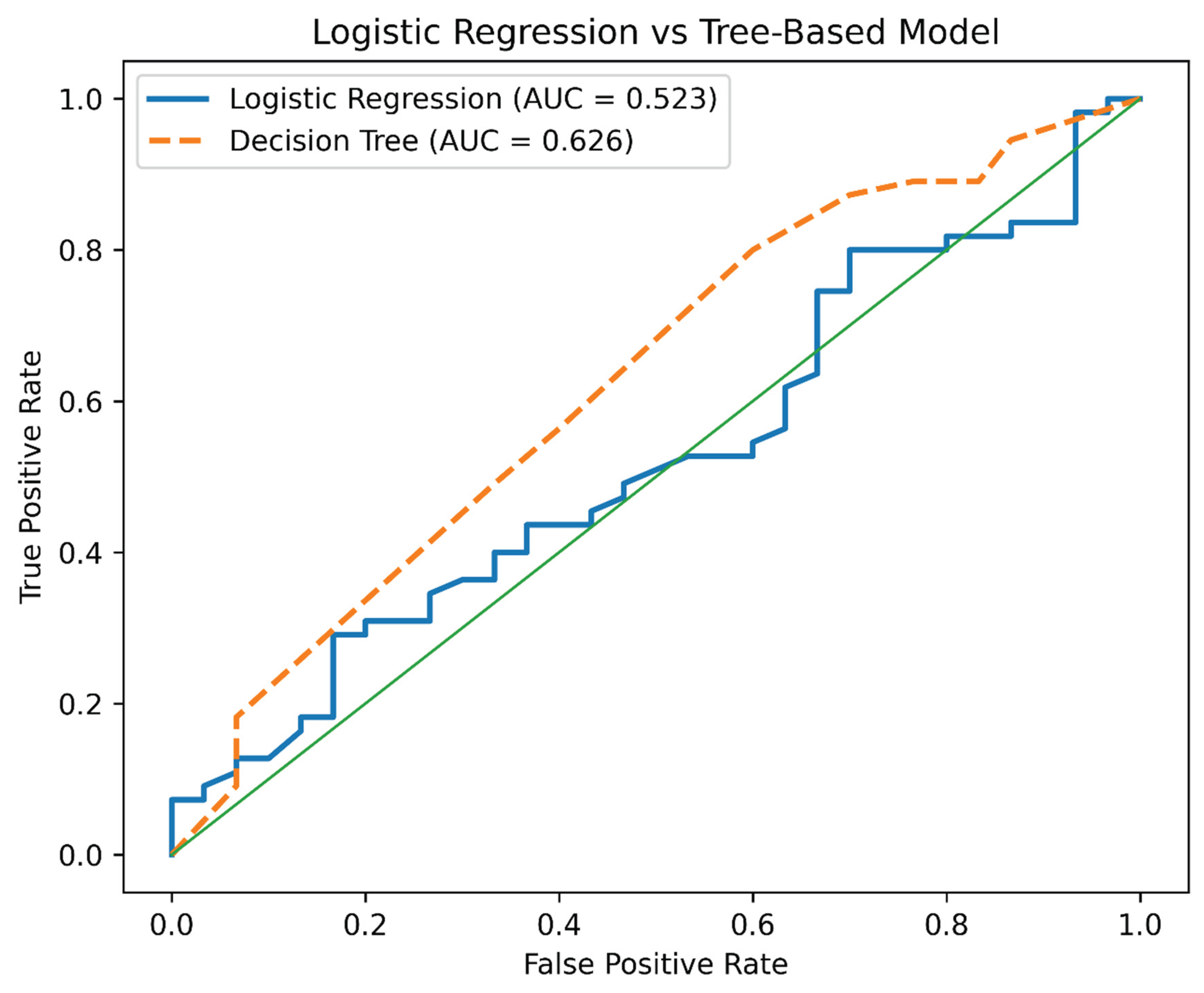
Table 1.
Baseline characteristics.
| Characteristic | Value |
|---|---|
| Age (mean ± SD) | 40.69 ± 17.38 |
| Male, n (%) | (408). (58.8%) |
| Female, n (%) | 270 (38.9%) |
| Treatment success, n (%) | 416 (59.9%) |
| Short regimen, n (%) | 616 (88.8%) |
| Long regimen, n (%) | 47 (6.8%) |
| Severe resistance (Pre-XDR/XDR), n (%) | 12 (1.7%) |
Table 3.
Model Diagnostics and Goodness-of-Fit.
| Metric | Result | Interpretation |
|---|---|---|
| Pseudo-R² | 0.029 | Modest explanatory strength |
| LR χ² | 10.70 (p=0.098) | Borderline overall model improvement |
| VIF | ~1.0 | No multicollinearity |
| AUC (previous) | 0.52–0.55 | Weak discrimination |
Disclaimer/Publisher’s Note: The statements, opinions and data contained in all publications are solely those of the individual author(s) and contributor(s) and not of MDPI and/or the editor(s). MDPI and/or the editor(s) disclaim responsibility for any injury to people or property resulting from any ideas, methods, instructions or products referred to in the content. |
© 2026 by the authors. Licensee MDPI, Basel, Switzerland. This article is an open access article distributed under the terms and conditions of the Creative Commons Attribution (CC BY) license (http://creativecommons.org/licenses/by/4.0/).
Copyright: This open access article is published under a Creative Commons CC BY 4.0 license, which permit the free download, distribution, and reuse, provided that the author and preprint are cited in any reuse.


