

Submitted:
05 May 2026
Posted:
06 May 2026
You are already at the latest version
Abstract
The rectangular (square) waveform universally used in neurostimulation and electrotherapy was adopted for reasons of technological convenience, not biological validation. We demonstrate that it constitutes a fundamental error of physical, mathematical, and neurophysiological nature, and propose a physiologically optimal alternative. Fourier spectral analysis shows that a 600 µs rectangular pulse at 50 Hz generates harmonics extending to 81,650 Hz with a calculated peak power of 7.75 × 10⁸ W— a factor of 1,273 above the sinusoidal equivalent. The Hodgkin-Huxley model (Nobel Prize, 1963) establishes that voltage-gated ion channels respond to dV/dt, not to absolute voltage: the rectangular wavefront is neurophysiologically incoherent. We propose an optimal biomimetic signal described by a parametric Bézier curve calibrated on the conformational time constants of sodium and potassium channels, scalable within the physiologically bounded range 200 µs ≲ τ ≲ 1,000 µs. Combined with a capacitive electrode (CNT/aPDMS or TiN), this waveform incurs only +61% in initial energy relative to the faradaic-rectangular reference — an overhead that remains stable over time, unlike the progressive energy escalation imposed by rectangular-induced peri-electrode fibrosis. Independent experimental evidence (Lembcke et al., 2026) corroborates the proposed mechanistic framework. The hypothesis has direct clinical implications for millions of patients carrying deep brain stimulators, cardiac pacemakers, and cochlear implants, in whom peri-electrode fibrosis and impedance drift are downstream consequences of waveform-electrode mismatch. The corrected system is firmware-implementable without hardware redesign.
Keywords:
neurostimulation
; rectangular waveform
; Bézier curve
; ion channels
; capacitive electrode
; peri-electrode fibrosis
1. Opening: The Quadrature of the Circle
1.1. A Mathematical Problem Two Thousand Years Old
The quadrature of the circle is one of the founding problems of ancient geometry: to construct, using only a ruler and compass, a square of equal area to a given circle. For two millennia, mathematicians and philosophers attempted to solve it. In 1882, Ferdinand von Lindemann demonstrated its impossibility once and for all: is a transcendental number, the root of no polynomial with rational coefficients [23]. No finite algebraic construction can bridge the circle from the square.
1.2. Vitruvian Man: The Square and the Circle as Geometries of Life
Vitruvius, in his De architectura (1st century BCE), describes man as the measure of all things, inscribable both in a square and in a circle [30]. Leonardo da Vinci illustrated this duality around 1490 in what remains the most celebrated image in the history of human anatomy. Two superimposed silhouettes: one inscribed in the circle and the other in the square. The circle is not an approximation of an improved square, it is its primary form, the form of movement, rotation, and life.
1.3. The Missed Quadrature of Electrotherapy
Electrotherapy has for 150 years pursued its own quadrature of the circle: substituting a rectangular signal for the curved, continuous, periodic form of the neuronal action potential.
Lindemann’s result applies here by analogy: substitution is impossible without loss. One cannot replace the circle with the square without leaving something behind. That “something” is what we shall now quantify.
2. What the Founders Already Knew
2.1. Du Bois-Reymond and the Wave of Negativity (1843)
Emil Heinrich Du Bois-Reymond (1818–1896), working in Berlin under Johannes Müller, demonstrated in 1843 that a stimulus applied to the surface of a nerve produces a local decrease in electrical potential — which he named the wave of relative negativity (negative Schwankung) — propagating along the fiber [10]. This discovery founded the field of scientific electrophysiology.
What is decisive for our argument: Du Bois-Reymond stimulated using mechanical interruption circuits and induction coils. The signals produced had mechanically constrained rise times, rounded, damped, quasi-sinusoidal. Involuntarily, instruments of the era produced physiological signals close to the target. And stimulation worked, at modest voltages.
2.2. Helmholtz and the Measurement of Conduction Velocity (1850)
Hermann von Helmholtz (1821–1894) measured in 1850 the propagation velocity of the nerve impulse in frog nerve-muscle preparations, obtaining values between 25 and 43 m/s [18]. His apparatus used induction coils (Ruhmkorff spirals) for stimulation. Again, the stimulation signal was a quasi-sinusoidal impulse envelope — the natural product of an inductance discharge.
Helmholtz did not choose the sinusoid through physiological reasoning. He was constrained to it by the available technology. That constraint was a stroke of luck.
2.3. The Historical Rupture
The discoveries of Du Bois-Reymond and his contemporaries could have provided a rigorous physiological foundation for electrotherapeutic practice from the mid-nineteenth century onwards. They were “coldly received by electrotherapists, who criticised them severely for several decades” [21]. The dissociation between fundamental electrophysiology and clinical practice is ancient. It is not the product of a lack of data. It is a refusal.
3. The Technological Stratigraphy of the Error
The fundamental error of electrotherapy was not born from a single bad decision. It was built up in successive layers, each technological advance perfecting the wrong target.
3.1. Level 1: The Manual Switch and the Induction Coil (19th Century)
The first stimulators produced signals with mechanically constrained rise times, rounded, and damped. These instruments had stimulated effectively at modest energies. The error did not yet exist: technology was involuntarily correct.
3.2. Level 2: Vacuum Tube Electronics (1920–1960)
The first electronic generators allowed for the first time the choice of waveform. The square wave became possible, and immediately desirable, because it appeared to be precise, reproducible, and parameterizable. Its duration could be read directly from an oscilloscope screen.
This is the bifurcation point. The rectangular signal was not adopted following a physiological demonstration. It was adopted because it was convenient for the human operator. The quality criterion became visual legibility, not biological adequacy.
3.3. Level 3: The Operational Amplifier (1960–1980)
The advent of A741 and its successors provided slew rates of several V/s. Rise times could now be quasi-vertical. The plateaus were perfectly flat. Technology reached the perfection of the ideal square wave.
The ideal square wave is, as we shall demonstrate, the worst possible neurophysiological signal.
3.4. Level 4: The Fast MOSFET and the Microprocessor (1980–2000)
The generators of the era of foundational publications (Dumoulin & de Bisschop, 1987; Crépon, 1994) produced wavefronts in a few hundred nanoseconds. The engineering was remarkable. The target was still the square wave.
3.5. Level 5: High-Voltage Digital Stimulation (2000 – Present)
Deep brain stimulation (DBS), cochlear implants, and spinal neurostimulators operate with pulses whose fronts reach a few tens of nanoseconds, at voltages that can exceed 100 V. Jamali et al. [20] proposed in 2019 a stimulation method at 1 MHz with sub-microsecond pulses, reporting a reduction in charge per pulse from 60 nC to 0.3 nC. At these frequencies, energy is predominantly dissipated as heat. The device resembles a low-power electrosurgical unit more than a neurostimulator.
The law of this stratigraphy: at each technological generation, the quality criterion was fidelity to the rectangle — steeper rise, flatter plateau, sharper descent. Nobody asked whether the rectangle was the right target. This is the error of perfection: to optimise brilliantly in the wrong direction.
4. Codification of the Error in the Foundational Literature
4.1. Two Assertions, One Generation of Error
4.1.0.1. Assertion 1 — Dumoulin & de Bisschop (1987)
In Électrothérapie [12], p. 33: direct current is presented as the ideal waveform because “it is easy to establish and break a circuit.”
This claim confuses the electrical properties of a resistive load with the physiology of an excitable membrane. In terms of pure resistance, the establishment of a direct current does indeed produce sustained depolarisation. On a neurological membrane, the same manoeuvre produces a single initial depolarisation, followed by accommodation and then electrical silence – as Hodgkin and Huxley had demonstrated 35 years earlier [19]. The neuron responds to the variation of the potential (), not to its absolute value.
4.1.0.2. Assertion 2 — Crépon (1994)
In Électrophysiothérapie [8], p. 23: the advantage of the rectangular signal is that “it is possible to rise to the plateau value in zero time.”
A zero-time rise is a Heaviside discontinuity. Its Fourier series expansion is an infinite sum of sinusoids whose amplitudes never tend to zero. In real devices, a 100 ns front corresponds to a cutoff frequency of approximately 3.5 MHz — several orders of magnitude above the physiologically relevant bandwidth of the neuron.
4.2. Persistence of the Error in 2024: An Audit of the Contemporary Reference Textbook
The codification of the rectangular-waveform doctrine is not confined to the foundational French manuals of the 1980s and 1990s. It persists, in identical conceptual form, in the most widely adopted English-language clinical electrotherapy textbook of the present decade. Cameron Ocelnik [5] dedicates Chapter 10 to diathermy and Chapter 11 to electrotherapy. Within four pages of a single chapter, the reader encounters six statements which, taken together, reveal the conceptual incoherence that this manuscript seeks to correct.
| # | Location | Statement |
| A | Ch. 10, p. 210 | Diathermy of any sort is contraindicated for patients with cardiac pacemakers or implanted neural stimulators, on grounds of electromagnetic interference and Joule heating of leads. |
| B | Ch. 11, pp. 225–230 | Stimulation waveforms are classified geometrically (square, rectangular, triangular, sinusoidal); “frequency” is reduced to pulse-repetition rate. |
| C | Ch. 11, p. 233 | Transcutaneous electrical stimulation is contraindicated for patients with pacemakers — the same mechanism (interference with device function) is invoked, without the qualifier electromagnetic. |
| D | Ch. 11, p. 233 | “Balanced biphasic waveforms leave no charge in the tissue and thus have no ionic effects.” |
| E | Ch. 11, p. 236 | Electrochemical effects under DC electrodes are reported as “caustic”; no mechanism is provided beyond current density. |
| F | Ch. 11, refs. 22 & 32 | Two clinical reports are cited: TENS interference with permanent ventricular stimulation [6], and third-degree burns from interferential current therapy [27]. |
The textbook thus formalises three claims (A, C, D) and reports two clinical events (F) that are mutually inconsistent within the conceptual frame the textbook itself provides. We focus on the sharpest of these, statement D ([5] p. 233): “Balanced biphasic waveforms leave no charge in the tissue and thus have no ionic effects.”
The implicit theorem behind this assertion — charge in equals charge out, therefore no net biological effect — rests on four physical assumptions that no biological tissue satisfies: linearity of the load, instantaneous response, spatial homogeneity, and absence of memory. The Fourier analysis developed in Section 5 suffices, on its own, to refute the conclusion. A balanced biphasic rectangular pulse of phase duration s carries significant spectral energy up to several MHz on its rising and falling edges. This radiofrequency content interacts with tissue at frequencies several orders of magnitude above the window of voltage-gated ion channels. Whether or not the time-integrated charge is zero is irrelevant: the spectral footprint of each transition activates differential tissue responses that no integral over a phase pair can cancel.
The textbook itself supplies the empirical refutation. Statement F records two events in its own bibliography: a 2009 case in which TENS interfered with permanent ventricular stimulation [6], described in the original title as a new clinical problem, and a 2008 report of third-degree burns from interferential current therapy [27]. The first event would have been predictable from a spectral analysis of the TENS waveform; the second contradicts statement D directly — balanced biphasic interferential currents producing a documented thermal-electrochemical lesion. The interpretive framework that would link the statement A (electromagnetic contraindication) to the statement C (the same mechanism, unnamed) and that would derive event F from waveform B is precisely the framework that statement D forecloses. The reader has every empirical element required for a coherent interpretation, but is not given the spectral vocabulary that would permit one.
This is not a question of editorial oversight. It is a structural omission. The terms required to bridge Chapter 10 and Chapter 11 — spectral content, harmonic distribution, rise time, biological bandwidth — are absent from the chapter glossary, the chapter references, and the index. The chapter bibliography (37 entries, predominantly clinical) does not include any of the foundational references in the literature on neural-engineering electrochemistry [24]. The two communities – clinical electrotherapy education and biomedical signal processing – have not converged in the four decades that separate the textbook from the work of Hodgkin Huxley [19], although the conceptual elements required for that convergence have been available throughout.
We leave it to the reader to appreciate why a textbook that contraindicates a radiofrequency signal in Chapter 10 prescribes, in Chapter 11, the transcutaneous delivery of a signal whose Fourier transform occupies the same band, without communicating that spectral identity to the clinician.
4.3. A Matter of Training, Not Negligence
Guy de Bisschop held positions in clinical neurophysiology at the hospitals of Marseille and Martigues, and lectured at Paris V. Francis Crépon authored major pedagogical references, still in print in 2014. These authors were not lacking in rigour — they lacked specific conceptual tools: Fourier spectral analysis applied to non-sinusoidal signals, the concept of biological bandwidth, and the molecular biophysics of ion channels. These tools are taught in undergraduate physics and biomedical engineering. They were not and are still not systematically included in medical and paramedical curricula.
4.4. The Responsibility of Manufacturers
Neurostimulation device manufacturers employ engineers in electronics and signal processing. These engineers know the spectral content of their signals. They measure load impedance. They calculate peak power delivered.
The technical manuals of neurostimulation devices do not to this day specify the spectral content of the delivered signal, the cutoff frequency dB, the calculated maximum power, nor the physiological limits beyond which injected energy ceases to be neurophysiologically relevant.
This information was available. We will leave it to the reader to appreciate why it did not find its way into user manuals.
5. Physical and Mathematical Demonstration
5.1. Spectral Analysis of the Rectangular Signal
A rectangular signal of period T, amplitude A, and duty cycle decomposes into a Fourier series:
For a pulse of duration at repetition frequency Hz (where is the pulse repetition rate and Hz is the fundamental harmonic of the Fourier series):
- Fundamental harmonic: Hz
- Significant harmonics extending to Hz (for )
- Wavefront duration ns (modern device): MHz
The physiologically relevant bandwidth of a neuron is determined by the duration of the action potential: 1–2 ms, corresponding to a cutoff frequency of approximately 500–1000 Hz. The vast majority of the spectral energy of the rectangular signal is deposited at frequencies to which the membrane is blind — it cannot respond to them through selective ionic mechanisms. This energy is dissipated as heat.
5.2. Comparative Peak Power Calculation
Two key observations:
(1) The peak power of the rectangular signal is approximately 1273 times greater than that of the sinusoidal signal for comparable clinical parameters. The commercial claim that the rectangular signal “uses less energy” is doubly incorrect: the mean rectangular amplitude is 13% higher than the sinusoidal amplitude, and the peak power exceeds it by more than three orders of magnitude.
(2) The impedance varies by a factor of 64: the actual charge delivered to the membrane varies proportionally between frequencies. The rectangular signal is intrinsically unstable against a biological load, unlike the sinusoidal signal, whose impedance is constant.

Table 1.
Comparative energy parameters — rectangular vs. sinusoidal signal.
| Parameter | Rectangular | Sinusoidal |
|---|---|---|
| Minimum impedance | ||
| Maximum impedance | ||
| Impedance variation | constant | |
| Peak power () | W | W |
| Mean amplitude | 3.92 mA | 3.46 mA |
| Ratio | ||
5.3. The Sinusoid: Omnipresent and Unrecognised
There is a profound irony in the situation described. The sinusoidal signal is as follows:
- The form of every oscillatory motion (pendulum, spring, tide)
- The projection of uniform circular motion — Vitruvian Man’s circle
- The form of sound waves, light, and electromagnetic radiation.
- The form of the alternating current that powers the stimulation devices themselves
- The approximate form of the action potential
Yet, inside the neurostimulation device itself, the mains sinusoid is rectified, chopped, and deformed — to produce a rectangular signal before it reaches the patient. The physiological signal is deliberately destroyed at the input of the device.
One of the authors verified experimentally, during a 50 Hz mains electrification incident (1985), that the pure mains sinusoid produces effective and reproducible muscular tetanisation at modest voltage, exactly what Du Bois-Reymond observed with his induction coils.
We optimised for the human observer. We forgot to optimise for the neuron.
6. Membrane Neurophysiology: What the Neuron Requires
6.1. The Hodgkin-Huxley Model (1952)
The Hodgkin-Huxley model [19], Nobel Prize 1963, describes the dynamics of the action potential:
The conductances and are governed by activation and inactivation variables (m, h, n) obeying first-order differential equations with voltage-dependent time constants , , — the conformational time constants of the channel proteins.
6.2. What the Square Wave Imposes on the Membrane
Rise front (): theoretically infinite . Voltage-gated sodium channels are transmembrane proteins — mechanical objects with finite conformational time constants. Their opening cannot be instantaneous. The imposed electrical constraint has no relation to any physiological stimulation.
Plateau (): the potential is kept constant. However, it is precisely that is the relevant signal for sodium channels. A constant potential produces accommodation: channels progressively inactivate. Stimulation becomes ineffective.
Falling front: a second discontinuity of opposite sign. A second mechanical constraint on the membrane proteins.
In chronic stimulation (DBS, prolonged TENS), these repeated mechanical constraints on channel proteins may induce conformational fatigue, local neuroinflammation, and peri-electrode fibrotic reaction.
6.3. Membrane Accommodation: A Neglected Phenomenon
Membrane accommodation, the progressive decrease of excitability under constant current, has been described in the electrophysiological literature since the 19th century. Pflüger’s law (1859) [26] states that it is the variation of the current, not its intensity, that determines the contractile response. This law underpins the concepts of chronaxie and rheobase — both of which, it should be noted, are measured using rectangular signals, introducing a systematic measurement bias that the literature has never corrected.
7. Documented Clinical Consequences
7.1. Peri-Electrode Fibrosis in DBS
Deep brain stimulation uses chronically implanted electrodes that deliver rectangular high-frequency pulses. The literature documents a progressive impedance drift after implantation [3,17,28]:
- Initial impedance: 500–1500
- Impedance at 6 months: 800–3000
- Stabilisation: after 3–12 months, at a level 1.5–3× above initial baseline
The official explanation – the foreign body inflammatory reaction – does not account for why inflammation is systematically localised at the active electrode-tissue interface, nor why it is more pronounced under active stimulation [2]. The mechanism proposed in this article – chronic membrane aggression by an inadequate signal → inflammation → fibrosis → impedance increase → compensatory energy increase → aggravation — provides a mechanistic explanation absent from the current literature.
7.2. Cardiac Pacemakers: The Weightiest Argument
Chronic cardiac pacing constitutes the most widespread application of the rectangular waveform in medicine. More than five million new devices are implanted annually worldwide [25]. The formation of a fibrous capsule around the electrode tip after implantation is universally known to cardiologists [13]. It manifests itself as an increase in stimulation impedance in the weeks following implantation, followed by stabilisation at a level above the initial baseline.
Pacemaker manufacturers justify the use of ultra-short rectangular pulses (typically 400–500 s) by battery longevity optimisation: a short pulse consumes less energy than a long one. This argument is valid in terms of the charge per pulse.
However, if a significant fraction of each pulse’s energy is dissipated as heat in biologically out-of-band harmonics, the useful energetic efficiency — energy actually converted into myocardial depolarisation — is lower than the charge calculation suggests. Furthermore, the peri-electrode fibrosis induced by spectral mismatch forces progressive energy increases over time, gradually negating the benefit of the short pulse.
In terms of public health, the question of the optimal waveform in chronic cardiac pacing exceeds by several orders of magnitude that of TENS or even DBS. This is the weightiest argument in this article and, to our knowledge, one that has never been formulated in the literature.
7.3. Cochlear Implants and Consumer TENS
The same reasoning applies to cochlear implants, whose electrodes deliver rectangular biphasic pulses to the auditory nerve fibres. The progressive loss of efficacy and peri-electrode histological changes observed after cochlear implantation [29] deserve to be re-examined through the lens of spectral mismatch.
Tens of millions of TENS devices are sold annually worldwide, all using rectangular signals. The clinical evaluation of their efficacy in chronic pain remains controversial [7]. To date, no rigorous comparative study has compared rectangular and biomimetic signals with identical physiological parameters.
8. The Optimal Biomimetic Signal: Complete Description
8.1. Design Principles
The optimal stimulation signal must satisfy the following neurophysiological constraints:
- Rise time with respect to conformational time constants of Na+ channels ( – ms)
- Repolarization phase with respect to the kinetics of K+ (–5 ms)
- Zero net charge: (physiological design constraint preventing electrolytic accumulation at the electrode-tissue interface; satisfied numerically by calibrating the return-to-baseline segment of the Bézier curve via Brent’s root-finding algorithm)
- No discontinuity: and continuous everywhere
- Bounded spectrum: energy concentrated in the biological bandwidth (DC – 1 kHz)
8.2. The Bézier Curve as a Modeling Tool
A parametric cubic Bézier curve is defined by four control points in the plane:
(a) Each control point corresponds to an identifiable ionic event: Na+ channel opening (), depolarisation peak (), Na+ inactivation, and K+ activation (). The coordinates are therefore biologically interpretable and measurable by electrophysiology.
(b) The curve is -smooth everywhere: no discontinuity of V or .
(c) The zero net charge condition is satisfied by an appropriate choice of (or by calibration by root-finding on ).
8.3. Parametric Description of the Optimal Signal
8.3.0.3. Segment 1 — Depolarization (Duration –1 ms)
This segment reproduces the apparent exponential activation of sodium channels, which is rapid but not discontinuous.
8.3.0.4. Segment 2 — Rapid repolarization (duration –2 ms).
This segment corresponds to Na+ inactivation and K+ activation, reproducing the fast repolarisation of the action potential.
8.3.0.5. Segment 3 — Return to rest (duration –8 ms).
8.3.0.6. Zero net charge condition.
The zero mean condition is written:
Numerical calibration using a root-finding algorithm (e.g., Brent’s method) on the y-coordinate of yields exact satisfaction of equation (7).
8.4. Comparative Visualization
Figure 1.
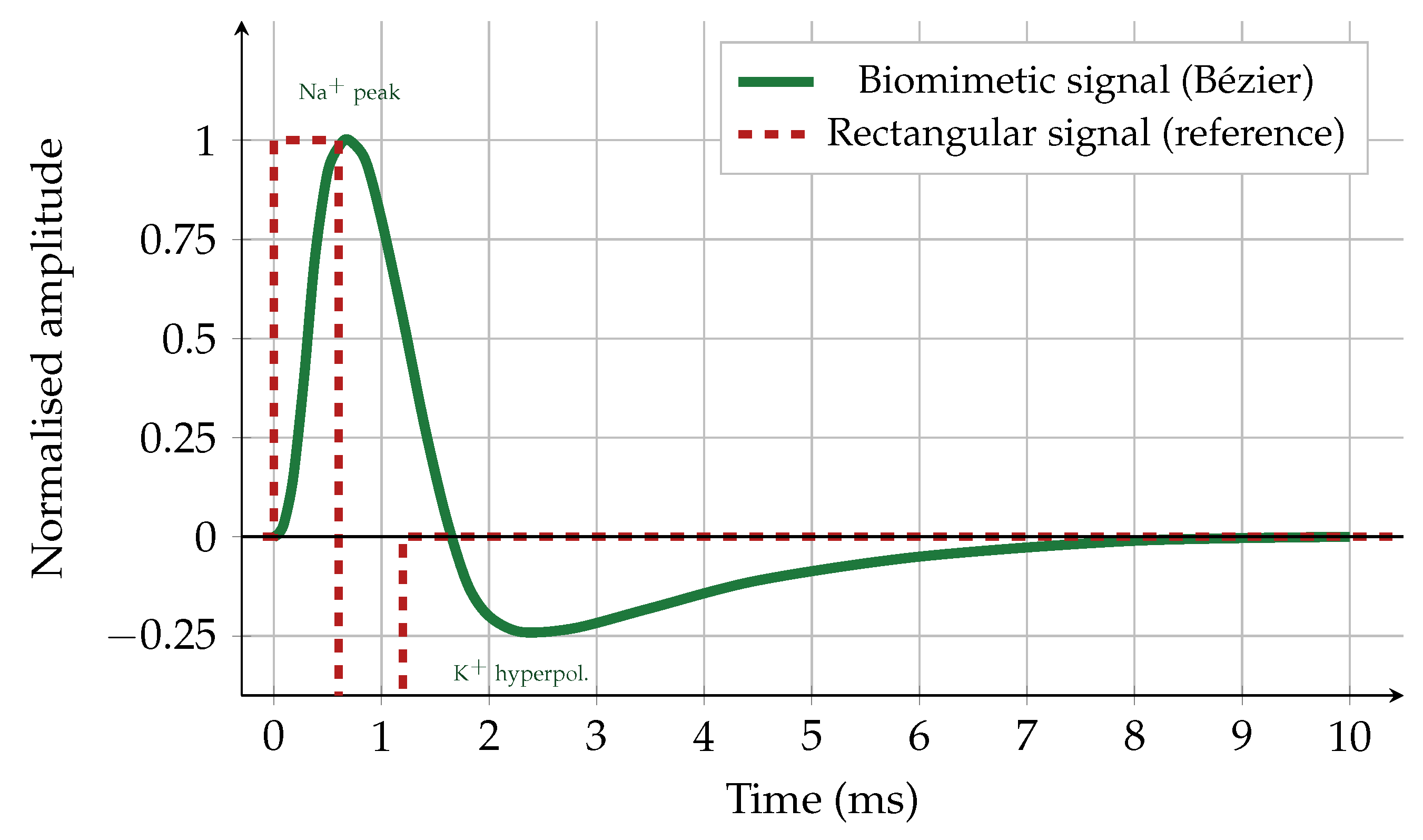
Comparison of the proposed biomimetic signal (green) and the standard rectangular signal (red, dashed). The biomimetic signal reproduces the phases of the action potential: progressive depolarization respecting Na+ kinetics, peak, K+ repolarization, post-potential hyperpolarisation, and return to rest. Zero net charge is guaranteed. The rectangular signal presents non-physiological discontinuities at the rising and falling fronts.
Figure 1.
Comparison of the proposed biomimetic signal (green) and the standard rectangular signal (red, dashed). The biomimetic signal reproduces the phases of the action potential: progressive depolarization respecting Na+ kinetics, peak, K+ repolarization, post-potential hyperpolarisation, and return to rest. Zero net charge is guaranteed. The rectangular signal presents non-physiological discontinuities at the rising and falling fronts.
8.5. Advantages of the Biomimetic Signal
- 1.
- Concentrated spectrum: absence of discontinuities ⇒ energy naturally limited to the biological bandwidth
- 2.
- Respect for ionic kinetics: the signal invites channels to open according to their own natural dynamics, rather than forcing them through a discontinuity
- 3.
- Stable impedance: absence of high-frequency components ⇒ predictable and constant load
- 4.
- Reduced thermal energy: minimisation of energy deposited outside the biological band
- 5.
- Biologically interpretable parameters: each control point corresponds to a measurable and adjustable membrane time constant, tuneable to the properties of the target tissue
8.6. Waveform Parameterisation and Clinical Adaptability
The Bézier-optimal waveform should not be understood as a fixed pulse of predetermined duration, but rather as a family of physiologically constrained waveforms sharing a common geometric architecture. The control points of the Bézier curve define ratios, not absolute time values. Therefore, the total duration of the impulse remains a free parameter, adjustable without compromising the neurophysiological rationale of the waveform.
Any scaled version over with preserves:
- the shape of the profile relative to the channel time constants,
- the zero net charge condition ,
- the harmonic content structure, scaled proportionally in frequency.
8.6.0.7. Physiological bounds on .
The free parameter is not unbounded. For sodium channels controlled by voltage (Nav), the activation time constant is in the range of 50–100 s at physiological temperature [19]. A waveform compressed below s would present a profile too brief for channel activation to follow, effectively decoupling the stimulus from the gating mechanism it is designed to engage, entering a regime of electrochemical shock rather than physiological recruitment.
The physiologically valid range for is therefore bounded:
where the upper bound reflects the onset of membrane accommodation – the progressive inactivation of Nav channels under sustained depolarisation, quantified by the time constant [19].
Within this window, remains a genuine clinical variable. Shorter durations favour the recruitment of large myelinated fibres (A, A); longer durations extend the recruitment to smaller fibres (A, C), following the strength-duration relationship described by Lapicque [22]. The Bézier waveform family thus subsumes the classical strength-duration framework within a physiologically coherent signal architecture.
For implantable device manufacturers, the waveform family can be encoded as a lookup table parameterised by , which does not require continuous computation. The transition from rectangular to physiologically shaped stimulation is therefore not a hardware redesign — it is, in most cases, a firmware decision.
9. The Electrode-Tissue Interface: Faradaic vs. Capacitive Regimes
9.1. Two Charge Injection Mechanisms
Every stimulation electrode operates at the boundary between the electronic domain (electron flow in metal) and the ionic domain (ion flow in tissue). Charge transfer occurs through two distinct mechanisms:
Capacitive injection — redistribution of charge at the electric double layer, without transfer of matter. No electrochemical reaction occurs. The process is perfectly reversible.
Faradaic injection — electron transfer across the interface, driving reduction-oxidation reactions: water electrolysis, metal oxidation, generation of reactive oxygen species (H2O2, OH•), local pH variations.
The equivalent circuit of the electrode-tissue interface (Randles model) places these two mechanisms in parallel: a double-layer capacitance and a charge transfer resistance in series with a Warburg diffusion impedance .
9.2. Why the Rectangular Waveform Drives Faradaic Reactions
The steep rising front of the rectangular waveform instantaneously imposes the maximum current density at the electrode surface. This transient peak drives the interfacial potential beyond the Flade potential – the threshold above which faradaic reactions become thermodynamically favourable – at every single pulse.
The smooth rising front of the Bézier waveform, by contrast, allows the double-layer capacitance to charge progressively. The interfacial potential increases slowly and remains within the capacitive window for a larger fraction of the pulse duration.
9.3. Clinical Consequences: The Faradaic Spiral
The products of faradaic reactions, oxidative radicals, pH changes, and dissolved metal ions, are direct pro-inflammatory agents. In chronically implanted devices, this produces a self-reinforcing cascade: faradaic oxidative stress triggers local neuroinflammation, progressing to peri-electrode fibrosis, raising interfacial impedance Z, forcing compensatory increases in stimulation voltage , which in turn intensifies the faradaic reaction at the next pulse.
This vicious cycle – already qualitatively described in the literature as the peri-electrode impedance drift of unknown cause [14] – finds here a mechanistic explanation rooted in the waveform-interface mismatch.
9.4. Comparative Energetic Analysis: Three Configurations
To quantify the cost and benefit of electrode-waveform combinations, we performed a simplified analytical calculation using a lumped RC membrane model (node of Ranvier, ms, depolarisation threshold mV, pulse duration s, tissue resistivity cm).
Table 2.
Comparative energetic analysis — three electrode/waveform configurations.
| Configuration | (V) | E (J) | ||
|---|---|---|---|---|
| Faradaic Pt + Square (ref.) | 2.2 | 12.35 | 1.00 | 1.00 |
| Capacitive Pt + Square | 7.4 | 137.2 | 3.33 | 11.1 |
| Capacitive TiN + Bézier | 4.9 | 19.85 | 2.20 | 1.61 |
(1) A capacitive electrode combined with a rectangular waveform is energetically catastrophic (×11 in energy): the mismatch between a waveform optimised for DC charge transfer and an interface designed for AC coupling is total.
(2) A capacitive high-performance electrode (TiN, CNT/aPDMS) combined with the Bézier waveform incurs only in initial energy relative to the faradaic reference, an overhead that, crucially, does not compound over time. As the peri-electrode impedance remains stable (no fibrosis), this modest initial cost is never escalated by the compensatory voltage increases that progressively burden rectangular-faradaic systems in chronic use.
9.5. CNT/aPDMS Electrodes: The Natural Substrate for the Biomimetic Waveform
Among emerging capacitive electrode materials, carbon nanotube / adhesive polydimethylsiloxane (CNT/aPDMS) composites represent a particularly compelling match for the Bézier waveform:
- Purely capacitive by construction: the insulating PDMS matrix prevents faradaic reactions structurally
- Exceptional charge injection capacity: functionalised CNT electrodes reach 1.0–1.6 mC/cm2 without faradaic reactions [15], compared to ∼0.05 mC/cm2 for bare platinum
- Mechanical compliance: Young’s modulus approaching that of neural tissue, reducing the mechanical component of the inflammatory response
- Progressive tissue integration: stimulation thresholds decrease over time [4] — the inverse of the fibrotic spiral
- Validated durability: Mechanical stability has been demonstrated over biphasic stimulation pulses and 10,000 stretch cycles at 20% strain [16]
The CNT/aPDMS electrode is not just a material improvement. It is the physical substrate that the smooth waveform demands. Applied to such a purely capacitive interface, the rectangular waveform would be doubly aberrant: electrochemically incoherent and neurophysiologically wasteful. The Bézier waveform finds here its natural receiver.
10. Discussion
10.1. The Irony of the Unrecognised Sinusoid
The sinusoidal signal is the most universal mathematical form in nature. It is present in the mains sinusoid that powers the stimulation device itself. And at the final step of the chain, it is deliberately destroyed to produce a rectangle.
The sinusoid is paradoxically foreign to us — not because it is rare, but because its “useful” duration cannot be read directly from an oscilloscope screen. We preferred the signal whose duration can be measured with a ruler on the display. The square wave has a visual advantage: the pulse duration is immediately apparent. The sinusoid does not offer this legibility.
We optimised for the human observer. We forgot to optimise for the neuron.
10.2. Toward Spectral Normalisation of Neurostimulation Signals
This article argues for the introduction, in medical device safety standards for neurostimulation, of a minimum spectral specification:
- Mandatory declaration of the spectral content of the delivered signal ( dB cutoff frequency; energy fraction in the band kHz)
- Declaration of the calculated peak power
- Justification of spectral adequacy with respect to the biological bandwidth of the target tissue
These requirements are technically trivial for any manufacturer equipped with a spectrum analyser. Their absence from current standards is the regulatory gap that has allowed the error to persist.
10.3. Limitations and Future Directions
The biomimetic signal proposed in this article is described on theoretical grounds and from available literature on ion channel time constants. Experimental validation requires:
- 1.
- In vitro electrophysiological studies comparing the efficiency of action potential triggering across waveforms (rectangular vs. Bézier biomimetic)
- 2.
- In vivo animal studies measuring stimulation threshold, fibre selectivity, and peri-electrode inflammatory response
- 3.
- Clinical studies comparing the analgesic efficacy and tolerability of biomimetic versus rectangular TENS
- 4.
- Systematic characterisation of DBS peri-electrode fibrosis as a function of waveform
These studies are feasible with current technology. Arbitrary waveform generators can reproduce the described signal exactly. Digital signal processing enables real-time Bézier implementation at frequencies well above those required.
10.4. Experimental Corroboration of the Faradaic Spiral
Although the biomimetic waveform described in this article has not yet been directly compared to the rectangular waveform in a controlled electrophysiological study, recent experimental evidence provides independent support for the mechanistic framework proposed in Section 9.
Lembcke et al. [1] demonstrated in human adipose-derived stem cells that low-frequency sinusoidal AC stimulation (20 Hz) at moderate amplitude (1–2 Vrms) maintains stable electrode impedance, preserved cellular metabolic activity, and stable reference gene expression. In contrast, stimulation at 3 Vrms triggered a progressive increase in electrode impedance of approximately , the formation of dendritic sodium chloride deposits on the electrode surface – consistent with faradaic electrochemical reactions – and significant destabilisation of metabolic reference genes, indicating the onset of cellular stress responses.
This voltage-dependent transition from electrochemically stable to dynamically altered interfacial conditions corresponds precisely to the faradaic spiral described in Section 9: faradaic oxidative stress → local inflammation → impedance drift → compensatory voltage escalation → aggravated faradaic reaction. The fact that these authors employed a sinusoidal waveform – a smooth, continuous signal without discontinuities – and obtained biologically compatible results at low amplitude further corroborates the neurophysiological argument of this article: the progressive, low- signal characteristic avoids the instantaneous interfacial potential peak that drives the rectangular waveform into the faradaic regime at every pulse.
This independent experimental evidence, obtained in a peer-reviewed study published after the preprint deposit of the present article (March 2026), supports the mechanistic predictions of the theoretical framework presented here and strengthens the case for its experimental validation in excitable neural tissue.
11. Perspectives
The convergence of evidence presented in this article points toward a coherent and actionable therapeutic horizon. The argument is no longer purely critical: the physical, neurophysiological, electrochemical, and material foundations of an optimised neurostimulation system are now simultaneously available.
The Bézier-optimal waveform and the CNT/aPDMS electrode represent a complementary pair: the capacitive electrode demands a smooth waveform; the smooth waveform finds its natural receiver in the capacitive electrode. The initial energy overhead does not compound over time, unlike the progressive energy escalation of rectangular-faradaic systems implanted chronically.
For patients: millions of patients carrying implanted devices face progressive therapeutic degradation and surgical revision as a direct downstream effect of waveform-electrode mismatch. The corrected system offers longer battery life, more stable therapeutic effect, and fewer surgical revisions.
For clinicians: waveform shape is a neurophysiological variable, not a fixed technical parameter. The bounded range preserves full clinical adaptability. For external stimulation, a firmware update suffices.
For manufacturers: the capacitive-Bézier system offers lower chronic energy consumption, extended battery life, reduced peri-electrode tissue reaction, and a stronger medico-legal position. The materials exist. The waveform is freely published. What remains is the decision to align the engineering target with the biology it was always meant to serve.
The quadrature of the circle was proven impossible in 1882. The stimulation of living neural tissue with a rectangular pulse was never proven optimal — it was simply never seriously questioned. This article is an invitation to begin that question and to follow it wherever physics leads.
12. Conclusion
Neurostimulation has attempted for 150 years to achieve the quadrature of the circle: substituting a rectangular signal for the curved form of the neuronal action potential. Lindemann’s 1882 proof of the mathematical impossibility of the quadrature finds its biophysical analogue here: one cannot replace the curved signal of the neuron with a rectangular signal without energetic loss, membrane aggression, and clinical consequences.
This error is the product of a convergence: the visual convenience of the rectangular signal on an oscilloscope; technological drift toward ever-steeper wavefronts; insufficient signal theory training; the absence of spectral requirements in medical device standards; and the systematic choice of faradaic metal electrodes that amplify rather than attenuate the mismatch.
The proposed biomimetic signal, a Bézier curve whose control points correspond to the time constants of voltage-gated ion channels, scalable within a physiologically bounded duration range, is now implementable in real time with the available technology. The electrode materials to receive it correctly already exist. Both are published freely.
The circle is not an approximation of an improved square. It is the form the neuron has been waiting for all along.
Author Contributions
B.D.: Conceptualisation, methodology, original draft, investigation. H.T.: Conceptualisation, validation, review and editing. Both authors have read and agreed to the published version of the manuscript.
Funding
No funding was received for this work.
Data Availability Statement
All signal parameters are fully described in the article. The Python code used for the comparative energetic calculation is available from the corresponding author upon request. A preprint (v2) of an earlier version of this manuscript is publicly available at https://doi.org/10.20944/preprints202603.0747.v2. The present submission is a substantially revised and extended version, incorporating a new section on the electrode-tissue electrochemical interface, a comparative energetic analysis of three electrode-waveform configurations, characterisation of CNT/aPDMS electrodes as the natural substrate for the biomimetic waveform, a waveform parameterisation section with physiological bounds, experimental corroboration from an independent peer-reviewed study (Lembcke et al., 2026), and a Perspectives section addressing clinical and industrial implications.
Acknowledgments
The authors thank the researchers in fundamental neurophysiology whose work forms the foundation of this article, and in particular the authors of the DBS peri-electrode fibrosis studies whose rigorous clinical data illuminate the practical consequences of the problem described herein.
References
- Lembcke, L.; Bathel, H.; Zimmermann, J.; Engel, V.; Bader, R.; Frerich, B.; van Rienen, U.; Springer, A.; Engel, N.; Kämmerer, P. W. A validated in vitro approach for low-frequency alternating-current stimulation of stem cells: From electrode characterization to biological responses. In Protoplasma; 2026. [Google Scholar] [CrossRef]
- Bai, D.; Odin, P.; Bhatt, D. L. Stimulation-induced fibrous tissue formation around cardiac pacing leads: histological and electrophysiological correlates. Pacing Clin. Electrophysiol. 2000, 23(4), 568–573. [Google Scholar]
- Badstübner, K.; Kluger, A.; Gruber, R.; et al. Impedance and power consumption of DBS electrodes: long-term follow-up. Biomed. Tech. 2013, 58 (Suppl. 1). [Google Scholar]
- Bareket, L.; Barriga-Rivera, A.; Zapf, M. P.; Lovell, N. H.; Suaning, G. J. Progress in artificial vision through suprachoroidal retinal implants. J. Neural Eng. 2014, 14(4), 045002. [Google Scholar] [CrossRef] [PubMed]
- Cameron, M. H.; Ocelnik, M. Physical Agents in Rehabilitation: From Research to Practice, 6th ed.; Elsevier: St. Louis, MO, 2024. [Google Scholar]
- Carlson, T.; Andréll, P.; Ekre, O.; Edvardsson, N.; Holmgren, C.; Jacobsson, F.; Mannheimer, C. Interference of transcutaneous electrical nerve stimulation with permanent ventricular stimulation: a new clinical problem? Europace 2009, 11(3), 364–369. [Google Scholar] [CrossRef] [PubMed]
- Cochrane Collaboration. Transcutaneous electrical nerve stimulation (TENS) for chronic pain — an overview of Cochrane reviews. In Cochrane Database of Systematic Reviews; 2019. [Google Scholar]
- Crépon, F. Électrophysiothérapie; Masson: Paris, 1994. [Google Scholar]
- Delalande, B. Signal carré ou signal sinusoïdal en électrothérapie: analyse comparative. Ann. De Kinésithérapie 2001, 28(3), 99–108. [Google Scholar]
- Du Bois-Reymond, E. H. Untersuchungen über thierische Elektrizität; G. Reimer: Berlin, 1848–1884; 2 vols. [Google Scholar]
- Dumoulin, J.; de Bisschop, G. Électromyographie et électrodiagnostics; Maloine: Paris, 1984. [Google Scholar]
- Dumoulin, J.; de Bisschop, G. Électrothérapie; Maloine: Paris, 1987. [Google Scholar]
- Ellenbogen, K. A.; Kay, G. N.; Lau, C.-P.; Wilkoff, B. L. Clinical Cardiac Pacing, Defibrillation and Resynchronization Therapy, 4th ed.; Saunders/Elsevier: Philadelphia, 2011. [Google Scholar]
- Frontiers in Human Neuroscience. Impedance drift in chronic deep brain stimulation. In Frontiers in Human Neuroscience; 2020. [Google Scholar]
- Gabay, T.; Ben-David, M.; Kalifa, I.; Sorkin, R.; Abrams, Z. R.; Ben-Jacob, E.; Hanein, Y. Electro-chemical and biological properties of carbon nanotube based multi-electrode arrays. Nanotechnology 2007, 18(3), 035201. [Google Scholar] [CrossRef] [PubMed]
- Goding, J.; Gilmour, A.; Martens, P.; Poole-Warren, L.; Green, R. Interpenetrating conducting hydrogel materials for neural interfacing electrodes. Adv. Healthc. Mater. 2019, 8(18), e1900177. [Google Scholar] [CrossRef] [PubMed]
- Guridi, J.; Rodriguez-Oroz, M. C.; Clavero, P.; Manrique, M.; Obeso, J. A. The problem of electrode impedance in deep brain stimulation. Park. Relat. Disord. 2012, 18(6), 765–769. [Google Scholar] [CrossRef] [PubMed]
- von Helmholtz, H. Messungen über den zeitlichen Verlauf der Zuckung animalischer Muskeln und die Fortpflanzungsgeschwindigkeit der Reizung in den Nerven. Arch. Für Anat. Physiol. Und Wiss. Med. 1850, 276–364. [Google Scholar]
- Hodgkin, A. L.; Huxley, A. F. A quantitative description of membrane current and its application to conduction and excitation in nerve. J. Physiol. 1952, 117(4), 500–544. [Google Scholar] [CrossRef] [PubMed]
- Jamali, Y.; Jamali, M.; Golshani, M. A new method of brain stimulation at ultra-high frequency. In bioRxiv; 2019. [Google Scholar] [CrossRef]
- Karger Publishers. The origins of neuromuscular electrodiagnosis, 1800–1950. Eur. Neurol. 2025, 88(1), 32–45. [Google Scholar] [CrossRef] [PubMed]
- Lapicque, L. Recherches quantitatives sur l’excitation électrique des nerfs traitée comme une polarisation. J. De Physiol. Et. De Pathol. Générale 1907, 9, 620–635. [Google Scholar]
- Lindemann, F. Über die Zahl π. Math. Ann. 1882, 20(2), 213–225. [Google Scholar] [CrossRef]
- Merrill, D. R.; Bikson, M.; Jefferys, J. G. R. Electrical stimulation of excitable tissue: design of efficacious and safe protocols. J. Neurosci. Methods 2005, 141(2), 171–198. [Google Scholar] [CrossRef] [PubMed]
- Mond, H. G.; Proclemer, A. The 11th world survey of cardiac pacing and implantable cardioverter-defibrillators. Pacing Clin. Electrophysiol. 2011, 34(8), 1013–1027. [Google Scholar] [CrossRef] [PubMed]
- Pflüger, E. F. W. Untersuchungen über die Physiologie des Electrotonus; A. Hirschwald: Berlin, 1859. [Google Scholar]
- Satter, E. K. Third-degree burns incurred as a result of interferential current therapy. Am. J. Dermatopathol. 2008, 30(3), 281–283. [Google Scholar] [CrossRef] [PubMed]
- Satzer, D.; Lanctin, D.; Eberly, L. E.; Abosch, A. Variation in deep brain stimulation electrode impedance over years following electrode implantation. Stereotact. Funct. Neurosurg. 2014, 92(2), 94–102. [Google Scholar] [CrossRef] [PubMed]
- Shepherd, R. K.; Coco, A.; Epp, S. B.; Xu, J. Chronic depolarization enhances the trophic effects of brain-derived neurotrophic factor in rescuing auditory neurons following a sensorineural hearing loss. J. Comp. Neurol. 2006, 486(2), 145–158. [Google Scholar] [CrossRef] [PubMed]
- Vitruvius. De Archit.>, Book III.
Disclaimer/Publisher’s Note: The statements, opinions and data contained in all publications are solely those of the individual author(s) and contributor(s) and not of MDPI and/or the editor(s). MDPI and/or the editor(s) disclaim responsibility for any injury to people or property resulting from any ideas, methods, instructions or products referred to in the content. |
© 2026 by the authors. Licensee MDPI, Basel, Switzerland. This article is an open access article distributed under the terms and conditions of the Creative Commons Attribution (CC BY) license (http://creativecommons.org/licenses/by/4.0/).
Copyright: This open access article is published under a Creative Commons CC BY 4.0 license, which permit the free download, distribution, and reuse, provided that the author and preprint are cited in any reuse.


