

Submitted:
08 March 2026
Posted:
10 March 2026
You are already at the latest version
Abstract
This paper studies graph-based higher-order structures related to metagraphs and edgelabeled hierarchical networks. After reviewing MetaGraphs and Iterated MetaGraphs, we introduce the notion of an Edge-MetaGraph, in which each edge is labeled by a two-ported internal graph, allowing edge-substitution expansion through port gluing. We then define Iterated EdgeMetaGraphs recursively, so that edges may carry nested Edge-MetaGraph structures. Concrete examples from biomedical systems, software pipelines, and logistics are presented to illustrate the expressive power of the proposed framework.
Keywords:
Edge-MetaGraph
; MetaGraph
; Iterated MetaGraph
1. Preliminaries
This section establishes notation and summarizes the set-theoretic and combinatorial notions needed in the sequel. Throughout, all sets that serve as vertex domains are assumed to be finite, and we write .
1.1. MetaGraph (Graph of Graphs)
Graph theory investigates mathematical structures consisting of vertices and edges to model relationships and connectivity [1,2]. A MetaGraph is a graph whose vertices are themselves graphs, with edges representing specified relations between those graphs (cf.[3,4,5,6]).
Definition 1.1.
(Metagraph (graph of graphs)). [7] Fix a nonempty universe of finite graphs (undirected, loopless by default) and a nonempty family of binary relations
A metagraph over is a directed, labelled multigraph
with
satisfying the incidence constraint
Elements of V are meta-vertices (each is a graph ). For with , we write and call e a meta-edge. If is a singleton, labels may be omitted. If every is symmetric, M can be viewed as an undirected labelled multigraph.
Remark 1.1.
We fix a common base universe of finite, loopless graphs that encode biochemical modules. Each comes with a vertex-labeling (e.g. metabolite/protein/gene names) and, when needed, an edge-labeling (e.g. reaction/interaction types). We use the following chemically meaningful binary relations on :
Set .
1.2. Iterated MetaGraph (Graph of Graphs of ... of Graphs)
An Iterated MetaGraph is a graph whose vertices are metagraphs, recursively extending graph-of-graphs structure to multiple hierarchical levels [7,8,9]. Related concepts, such as MetaStructures [10,11], are also known.
Definition 1.2
Definition 1.3
(Relation lifting). Given on , define its lift on finite metagraphs over by
Set .
Definition 1.4
(Iterated object and relation universes). Define recursively for :
Definition 1.5
(Iterated MetaGraph of depth t). For , an iterated metagraph of depth t is a metagraph
over , i.e., , and
Remark 1.2
We use the relation lifting of the preliminaries: for and metagraphs over ,
Example 1.1
(A concrete iterated metagraph (depth ) with a biomedical interpretation). We give an explicit example of an iterated metagraph of depth (i.e., a graph whose vertices are metagraphs of base graphs).
Base level ().Let contain three pathway graphs
Let , where
Assume (shared metabolite: pyruvate) and (shared metabolite: acetyl-CoA).
Metagraphs of graphs (objects in ).Define two metagraphs over :
By construction, .
Lifted relation and depth-1 iterated metagraph.Since with and , the lifted relation satisfies
Hence the depth-1 iterated metagraph
can be defined by
Figure 1.1 depicts this construction.
2. Results
The results of this paper are presented in this section.
2.1. Edge-MetaGraph (Graph-Labeled Edges)
Edge-MetaGraph is a graph whose edges carry two-ported internal graphs, enabling edge-substitution expansion by gluing ports to endpoints.
Definition 2.1
(Two-ported graphs). Fix a nonempty universe of finite (undirected, loopless by default) graphs. Atwo-ported graphis a triple
where and are distinguished vertices called thetail-portandhead-port, respectively. We write and , and denote by
the class of all two-ported graphs over .
Definition 2.2
(Edge-MetaGraph). Let be as in Definition 2.1. AnEdge-MetaGraph over is a directed multigraph equipped with a two-ported-graph label on each edge, i.e., a tuple
where is a directed multigraph (loops and parallel edges allowed) and
is a labeling map. For , writing , the intended meaning is: the edge e from to carries the internal graph , whose ports will be attached to the endpoints , respectively.
Definition 2.3
(Expansion / edge-substitution). Let be an Edge-MetaGraph and write . Define a graph (the expansion of ) by gluing each labeled graph along its ports to the endpoints of e as follows.
Take the disjoint union of vertex sets
and let ∼ be the smallest equivalence relation on W such that for every ,
Set . For edges, take the disjoint union
and for define its endpoints in to be
Then is the (multi)graph with vertex set and edge multiset induced from F.
(If is a universe of directed graphs, replace by ordered pairs throughout.)
Example 2.1
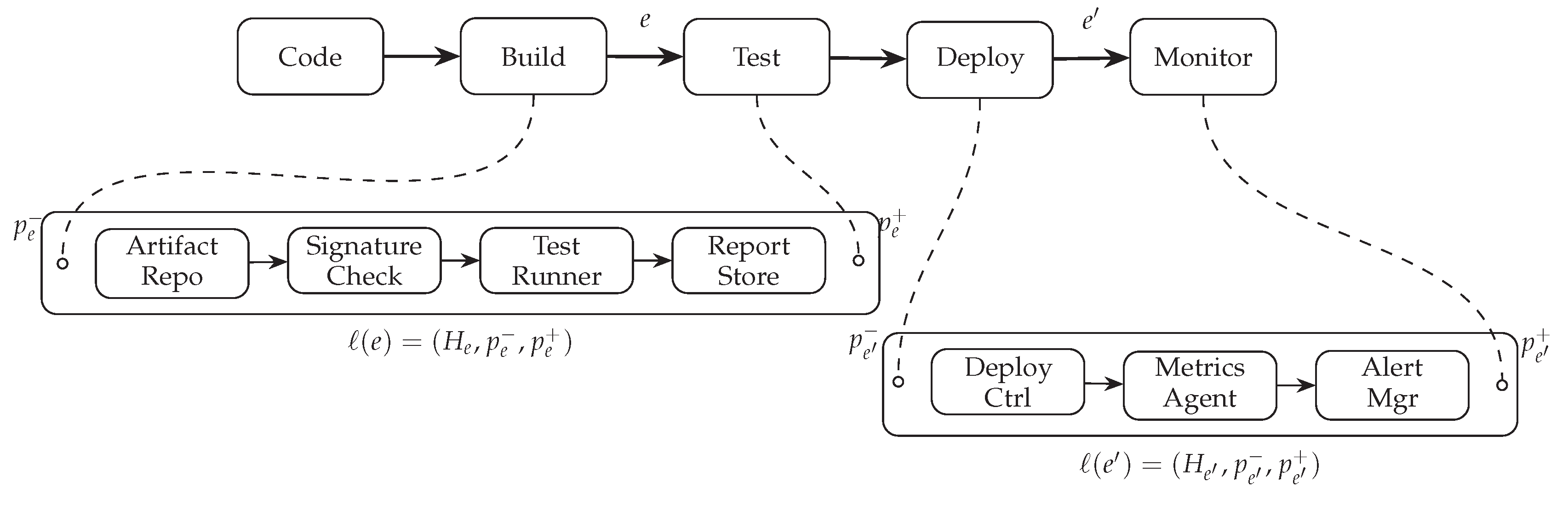
(Real-world example: software deployment pipeline with edge-level internal dependencies). Consider a company operating a microservice platform. At a coarse operational level, we describe the deployment pipeline as a directed multigraph
whose vertices are macro-stages:
A directed edge represents the handoff “send build artifacts to the test stage”. However, this handoff is not atomic: it involves multiple tools and checks (artifact registry, signature verification, test orchestration, reporting).
To model such hidden internal structure, define an Edge–MetaGraph
where each edge is labeled by a two-ported internal graph
For example, for the edge , take to be the graph whose vertices are
and whose edges represent required interactions (e.g. artifact fetch, signature verification, executing tests, storing reports). Choose ports
so that is the entry interface to the internal process (receiving artifacts) and is the exit interface (publishing test reports).
Similarly, for the edge , the internal graph may encode
with ports identifying the start/end of the deployment-to-observability integration.
Figure 2.1 visualizes the Edge–MetaGraph viewpoint: the outer pipeline is shown together with two illustrative internal graphs attached to edges. By Definition 2.3, the expanded graph is obtained by gluing each port to and each port to .
2.2. Iterated Edge-MetaGraphs
Iterated Edge-MetaGraphs recursively label each edge by a two-ported Edge-MetaGraph, creating multi-level edge-substitution and expansion hierarchy.
Definition 2.4
(Two-ported iterated Edge-MetaGraphs). Let and let be a class of finite objects each equipped with a finite vertex set . A two-ported iterated Edge-MetaGraph of depth t is a triple
where and are distinguished vertices called the tail-port and head-port. We write and , and set
Definition 2.5
(Iterated Edge-MetaGraph universes). Fix a nonempty universe of finite graphs (as in the preliminaries). Define recursively a hierarchy by
and for each ,
Thus, an object of is an Edge-MetaGraph whose edge labels are two-ported objects from the previous level .
Definition 2.6
(Iterated Edge-MetaGraph of depth t). Let . An iterated Edge-MetaGraph of depth t is an element of from Definition 2.5.
Equivalently, for it is a tuple
such that is a finite directed multigraph and
In particular, depth 1 coincides with the (non-iterated) Edge-MetaGraph concept where edges are labeled by two-ported base graphs.
Remark 2.1
(Recursive expansion (optional notation)). Using the expansion operator Expand already defined for Edge-MetaGraphs, one may define a depth-t flattening recursively by
where . This yields an ordinary graph obtained by expanding all nested edge labels down to depth 0.
Example 2.2
(Real-world example: multi-layer logistics & service dependencies). Consider an international e-commerce company that ships products from a factory to a customer. At the top level (depth 2), we model the end-to-end process as a directed multigraph
whose vertices are major stages:
An edge represents a contractual handoff such as or .
Each such handoff is not atomic in practice: it is implemented by a nested workflow involving multiple carriers, checkpoints, and IT services. Hence we label every top-level edge e by a two-ported object
where is a depth-1 Edge–MetaGraph describing the internal sub-process realizing the handoff, and the ports indicate the entry/exit interface of that sub-process.
For instance, the edge may be labeled by a depth-1 Edge–MetaGraph whose vertices represent operational checkpoints
and whose edges correspond to concrete tasks (document verification, container scanning, flight booking, etc.). Crucially, each task edge is again labeled by a two-ported base graph
where is a small graph encoding the micro-structure of the task, e.g. a dependency graph between IT services:
Thus, the overall system forms an iterated Edge–MetaGraph of depth 2: top-level shipment handoffs are edges labeled by depth-1 Edge–MetaGraphs, and inside those, task edges are labeled by two-ported base graphs capturing service-level dependencies. Expanding the structure (recursively) yields a single flattened dependency graph for the entire factory-to-customer delivery pipeline.
Funding
This study did not receive any financial or external support from organizations or individuals.
Data Availability Statement
This research is purely theoretical, involving no data collection or analysis. We
encourage future researchers to pursue empirical investigations to further develop and validate the concepts
introduced here.
Use of Artificial Intelligence
LLM-based software was used for language polishing (e.g., grammar and clarity
checks), formatting verification, and assistance in diagnosing potential LATEX compilation errors. It was not used
to produce results or in any manner that would compromise research integrity.
Acknowledgments
We extend our sincere gratitude to everyone who provided insights, inspiration, and
assistance throughout this research. We particularly thank our readers for their interest and acknowledge the
authors of the cited works for laying the foundation that made our study possible. We also appreciate the support
from individuals and institutions that provided the resources and infrastructure needed to produce and share this paper. Finally, we are grateful to all those who supported us in various ways during this project.
Conflicts of Interest
The author confirms that there is no conflict of interest related to the research or its
publication.
Ethical Approval
As this research is entirely theoretical in nature and does not involve human participants or
animal subjects, no ethical approval is required. I have not engaged in any unethical conduct.
Disclaimer
This work presents theoretical concepts that have not yet undergone practical testing or validation.
Future researchers are encouraged to apply and assess these ideas in empirical contexts. While every effort has
been made to ensure accuracy and appropriate referencing, unintentional errors or omissions may still exist.
Readers are advised to verify referenced materials on their own. The views and conclusions expressed here are
the authors’ own and do not necessarily reflect those of their affiliated organizations.
References
- Diestel,, R. Graph theory; Springer (print edition); Reinhard Diestel (eBooks), 2024.
- Gross, J.L.; Yellen, J.; Anderson, M. Graph theory and its applications; Chapman and Hall/CRC, 2018 .
- Lima Filho, R.B.; Sabino-Silva, R.; Carneiro, M.G. High-level classification based on meta-graph of visibility graphs for Autism detection. In Proceedings of the 2025 International Joint Conference on Neural Networks (IJCNN). IEEE, 2025, pp. 1–8.
- Azevedo, R.; Lohaus, R.; Paixao, T. Networking networks. Evol Dev 2008, 10, 882.
- Velazquez-Garcia, E.; Lopez-Arevalo, I.; Sosa-Sosa, V.J. Representing document semantics by means of graphs. In Proceedings of the 2011 8th International Conference on Electrical Engineering, Computing Science and Automatic Control. IEEE, 2011, pp. 1–6.
- Donnat, C.; Holmes, S. Tracking network dynamics: A survey using graph distances. The Annals of Applied Statistics 2018, 12, 971–1012. [CrossRef]
- Fujita, T. Metahypergraphs, metasuperhypergraphs, and iterated metagraphs: Modeling graphs of graphs, hypergraphs of hypergraphs, superhypergraphs of superhypergraphs, and beyond. Current Research in Interdisciplinary Studies 2025, 4, 1–23. [CrossRef]
- Fujita, T.; Smarandache, F. Representing Higher-Order Networks: A Survey of Graph-Based Frameworks; Neutrosophic Science International Association (NSIA) Publishing House, 2026.
- Fujita, T.; Smarandache, F. HyperGraph and SuperHyperGraph Theory with Applications; Neutrosophic Science International Association (NSIA) Publishing House, 2026.
- Fujita, T. Metastructure, meta-hyperstructure, and meta-superhyper structure. Journal of Computers and Applications 2025, 1, 1–22.
- Fujita, T. Molecular MetaGraph and Molecular Iterated MetaGraph in Chemistryand BioChemistry. Journal of Applied Mathematics and Symbolic Science 2025, 1, 43–57.
Figure 1.1.
A depth-1 iterated metagraph: vertices are metagraphs , and the outer edge is labeled by the lifted relation .
Figure 1.1.
A depth-1 iterated metagraph: vertices are metagraphs , and the outer edge is labeled by the lifted relation .
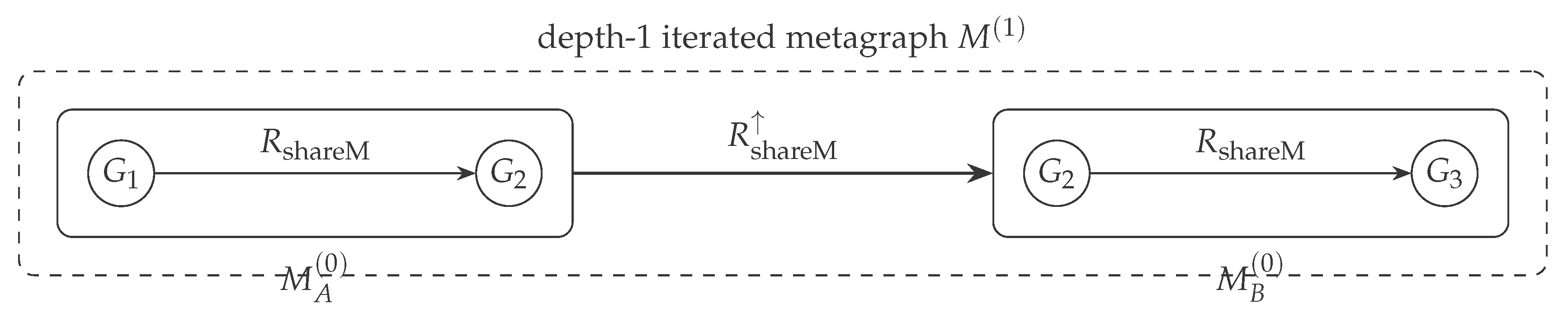
Figure 2.1.
An Edge–MetaGraph for a CI/CD pipeline. The outer directed multigraph encodes macro-stages. Edges e and are labeled by two-ported internal graphs; dashed curves indicate the port-gluing used in .
Figure 2.1.
An Edge–MetaGraph for a CI/CD pipeline. The outer directed multigraph encodes macro-stages. Edges e and are labeled by two-ported internal graphs; dashed curves indicate the port-gluing used in .
Disclaimer/Publisher’s Note: The statements, opinions and data contained in all publications are solely those of the individual author(s) and contributor(s) and not of MDPI and/or the editor(s). MDPI and/or the editor(s) disclaim responsibility for any injury to people or property resulting from any ideas, methods, instructions or products referred to in the content. |
© 2026 by the authors. Licensee MDPI, Basel, Switzerland. This article is an open access article distributed under the terms and conditions of the Creative Commons Attribution (CC BY) license (http://creativecommons.org/licenses/by/4.0/).
Copyright: This open access article is published under a Creative Commons CC BY 4.0 license, which permit the free download, distribution, and reuse, provided that the author and preprint are cited in any reuse.


