

Submitted:
09 March 2026
Posted:
10 March 2026
You are already at the latest version
Abstract
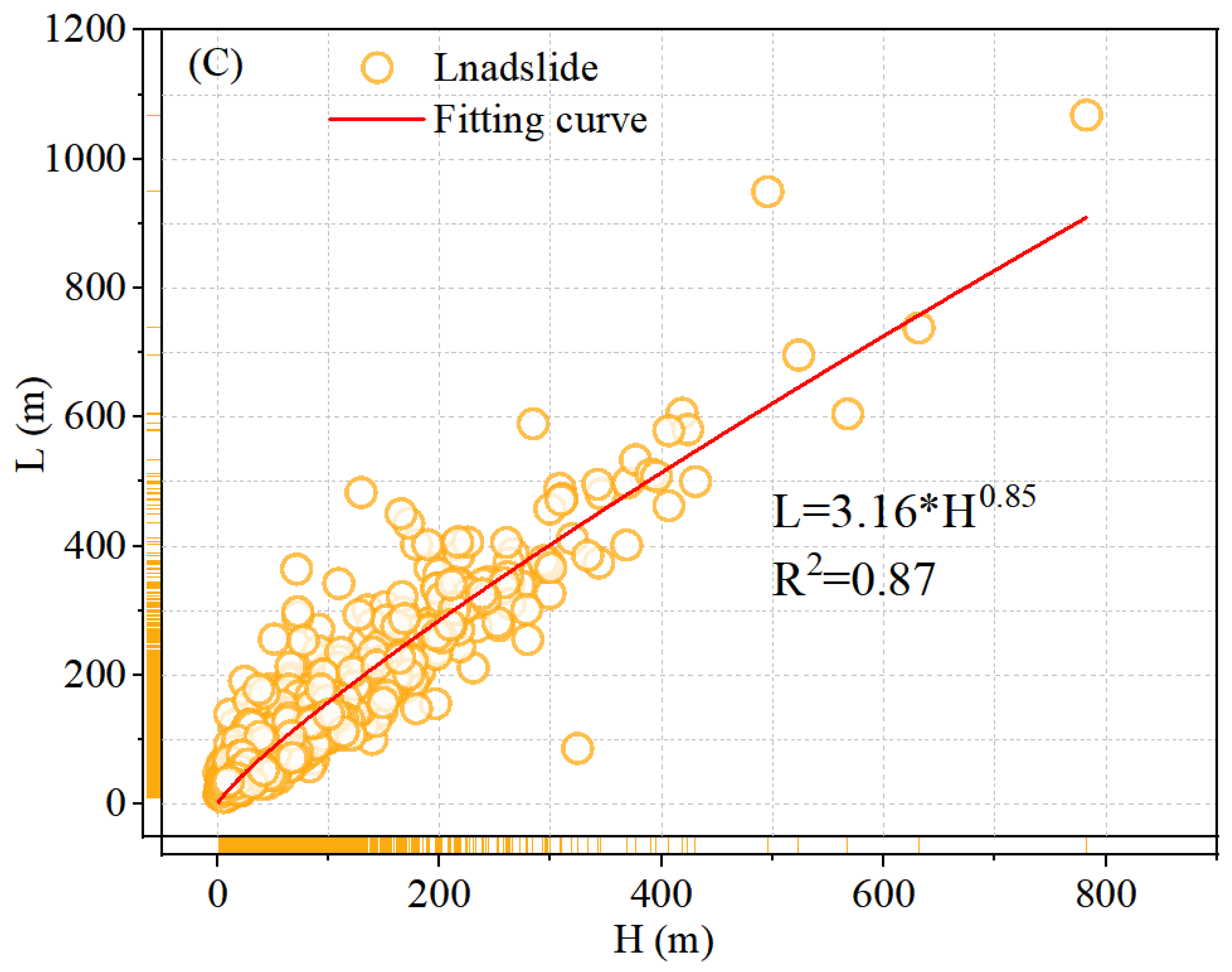
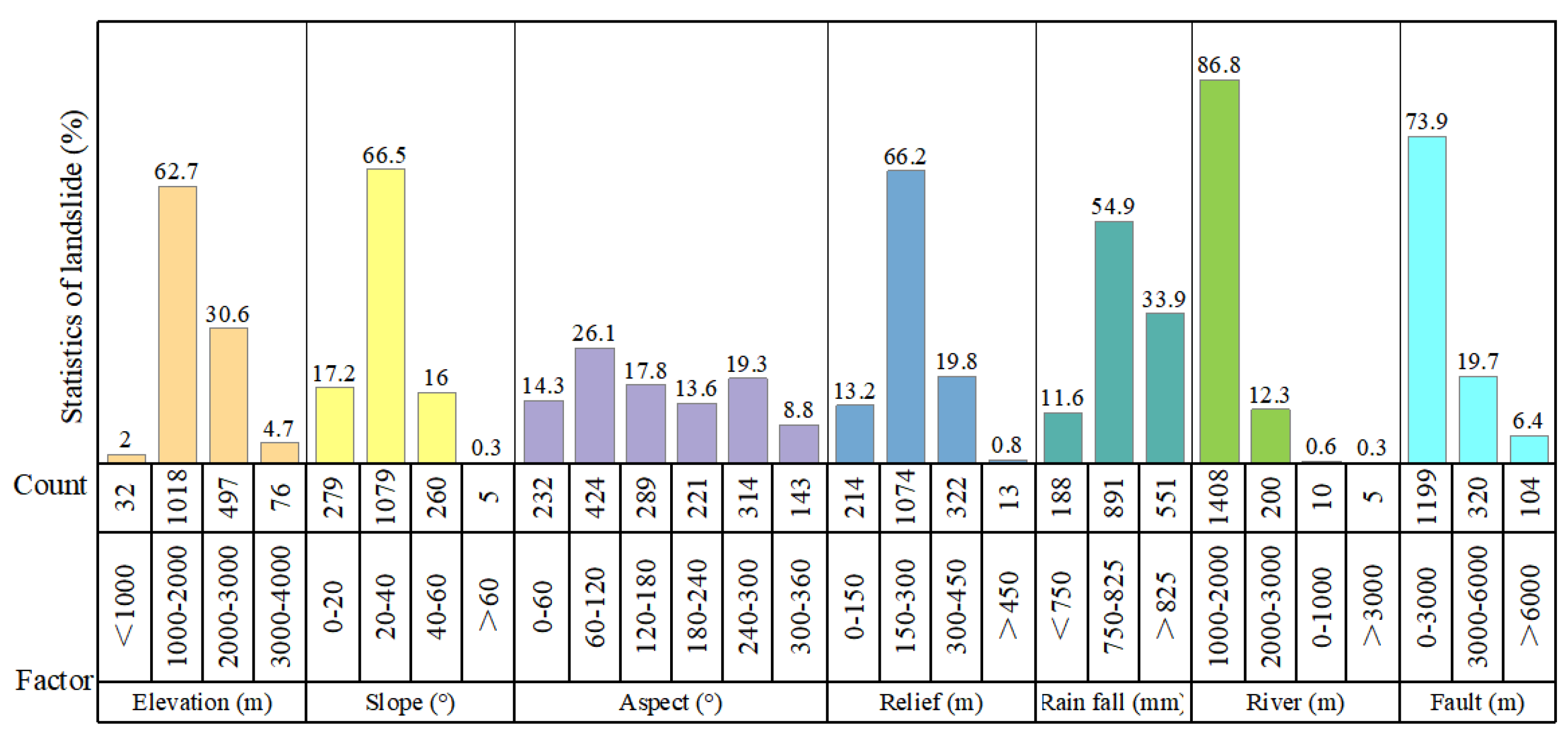
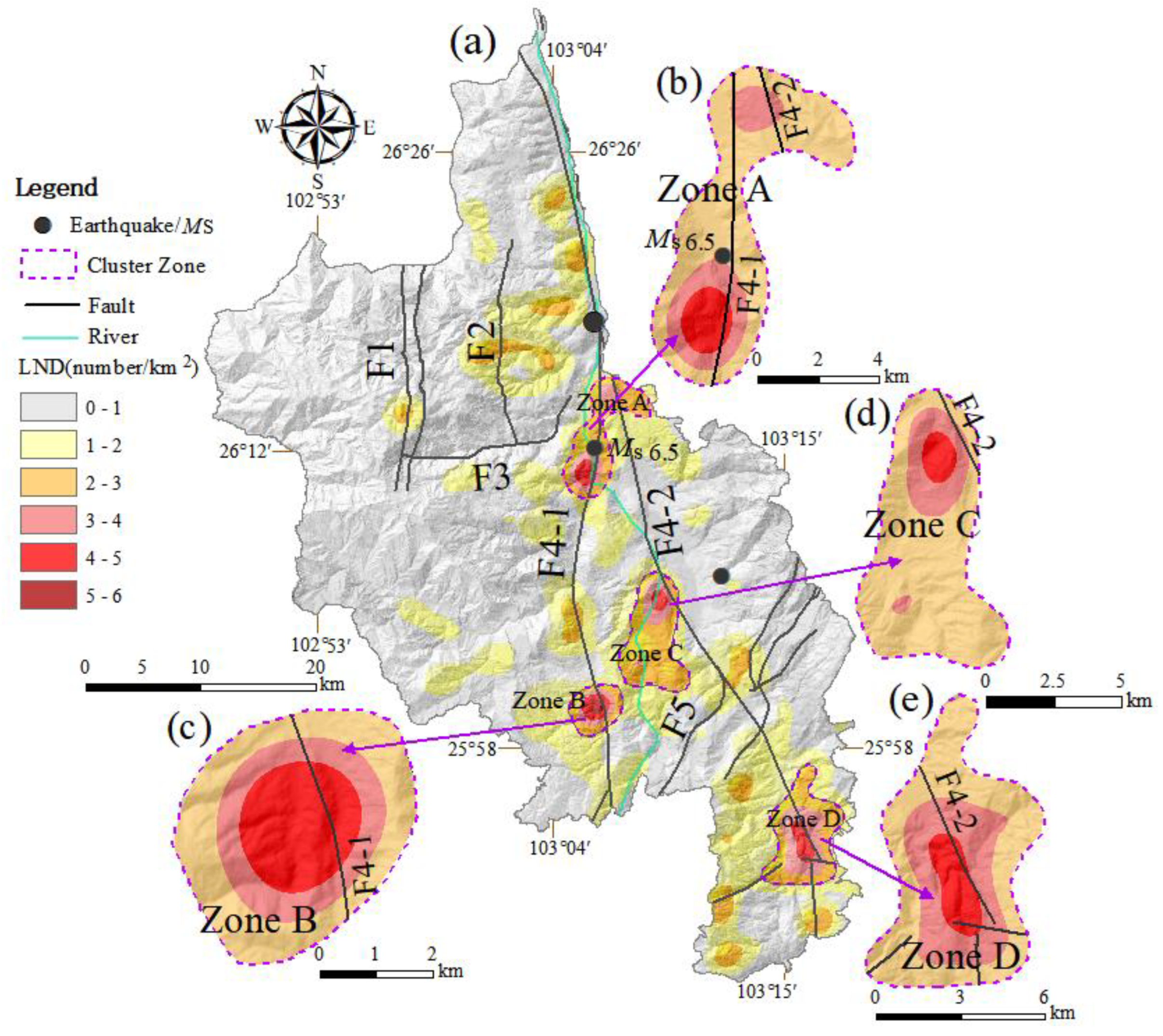
The Dongchuan District of Kunming City lies in the transition zone between the Yunnan-Guizhou Plateau and the Sichuan Basin, hosting numerous landslides that pose a serious threat to local lives and property. Therefore, compiling a comprehensive landslide inventory and analyzing the relationships between landslide spatial distribution and influencing factors are of significant importance for geological hazard prevention. This study focuses on the Dongchuan District. High-resolution remote sensing imagery was interpreted to establish a landslide inventory, and the spatial distribution and geometric characteristics of landslides were systematically analyzed. The results show that a total of 1,623 landslides were identified, covering an area of 10.36 km². Landslides predominantly occur at elevations of 1,000-2,000 m, on slopes of 20°-45°, with aspects of 255°-285°, relief between 150-400 m, annual rainfall below 825 mm, and within a distances of 1,000 m from rivers and 3,000 m from faults. Four landslide clusters were delineated along the Xiao River Fault, highlight the significant influence of the fault on the spatial distribution of landslides. Most landslides are longitudinal in planform, with travel distances (L) of 50-450 m and heights (H) from 25 to 350 m, exhibiting allometric relationships between these parameters and volume. The mean H/L ratio is 0.56 (corresponding to a mean reach angle of 29°), significantly higher than that observed in Baoshan City (mean reach angle of 21°). The results would be helpful for further understanding landslide initiation mechanisms and spatial distribution patterns on the northern margin of the Yunnan-Guizhou Plateau and providing valuable data support for subsequent landslide hazard risk assessment in this region.
Keywords:
1. Introduction
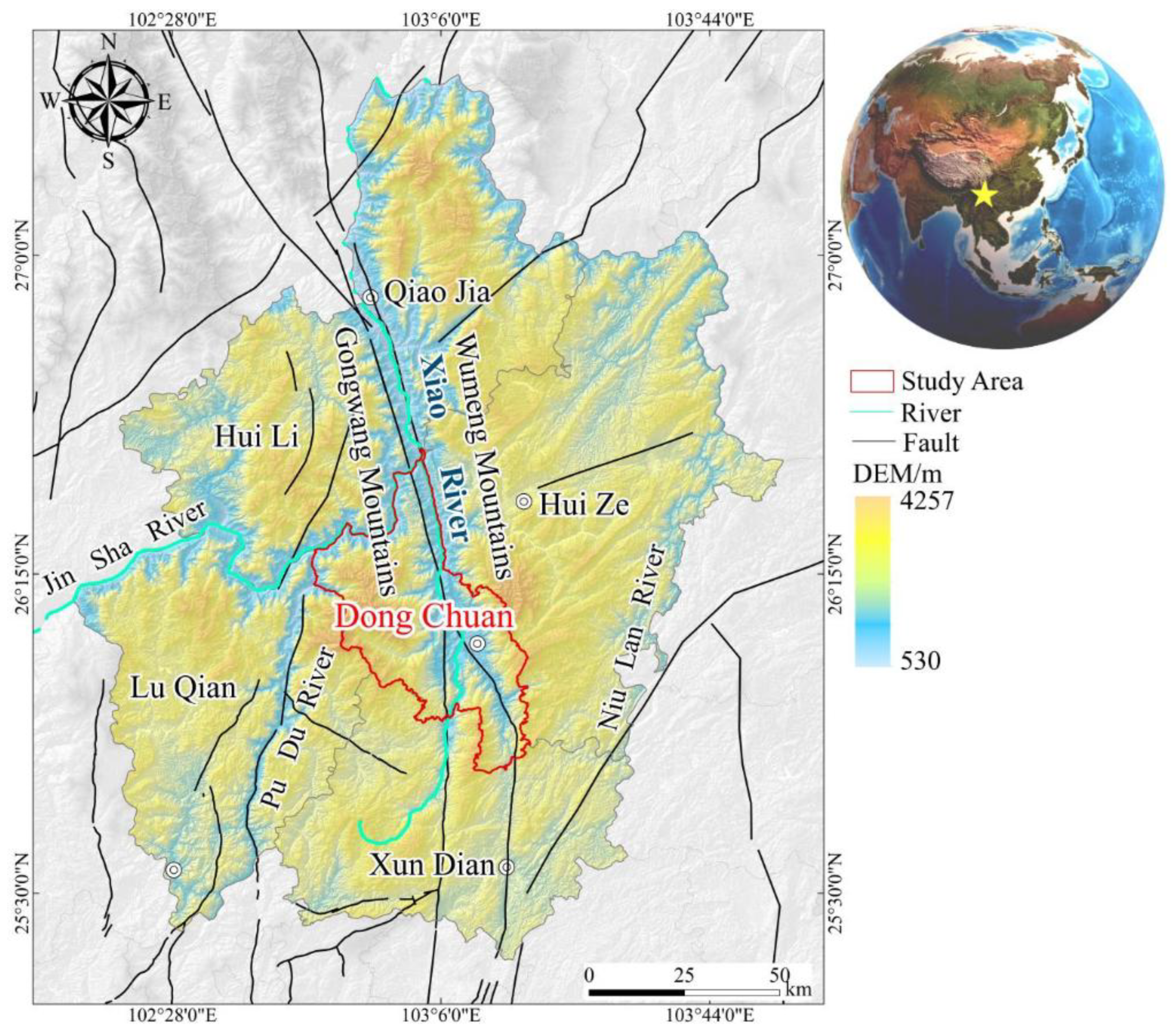
2. Study Area
3. Methods and Data
3.1. Landslide Mapping
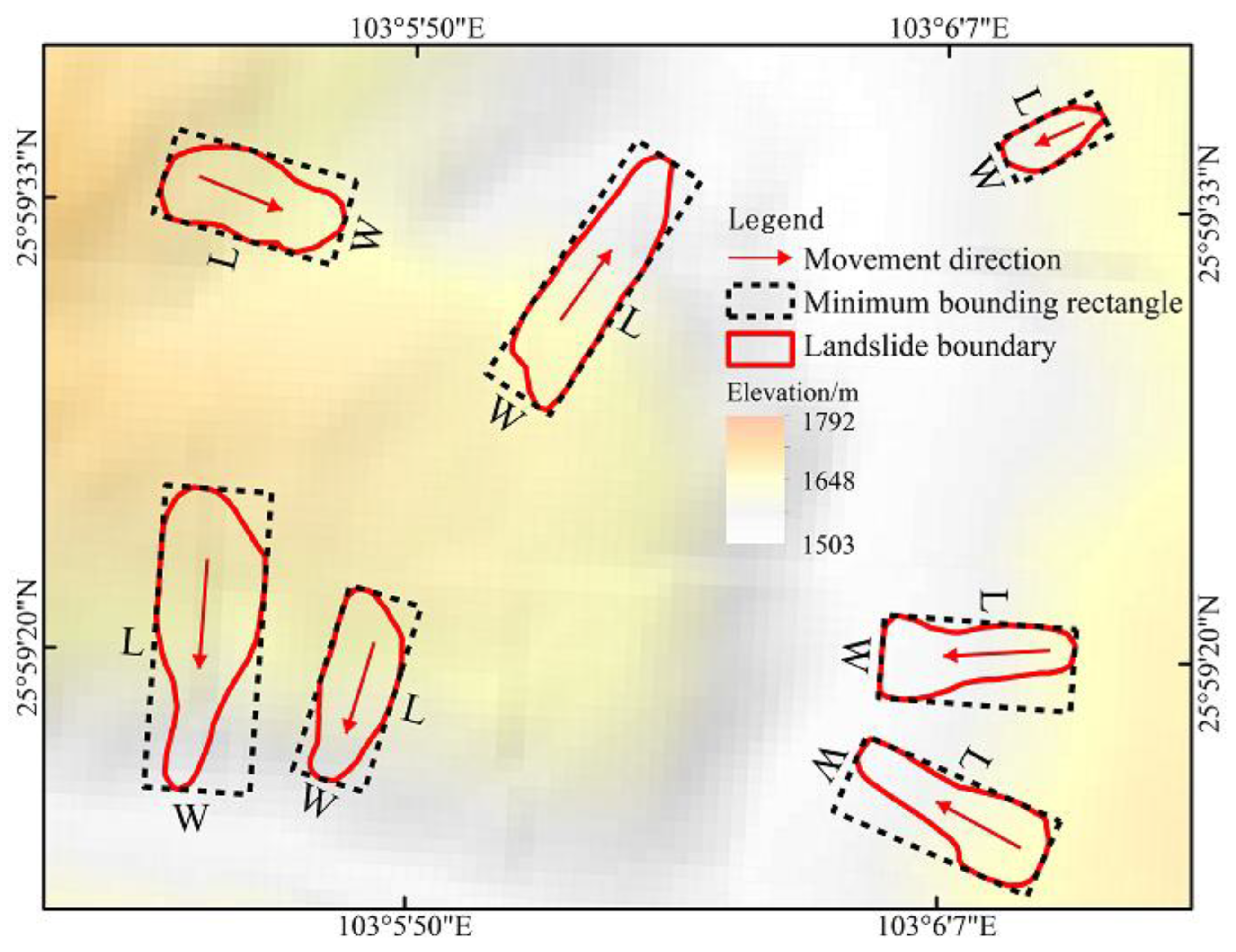
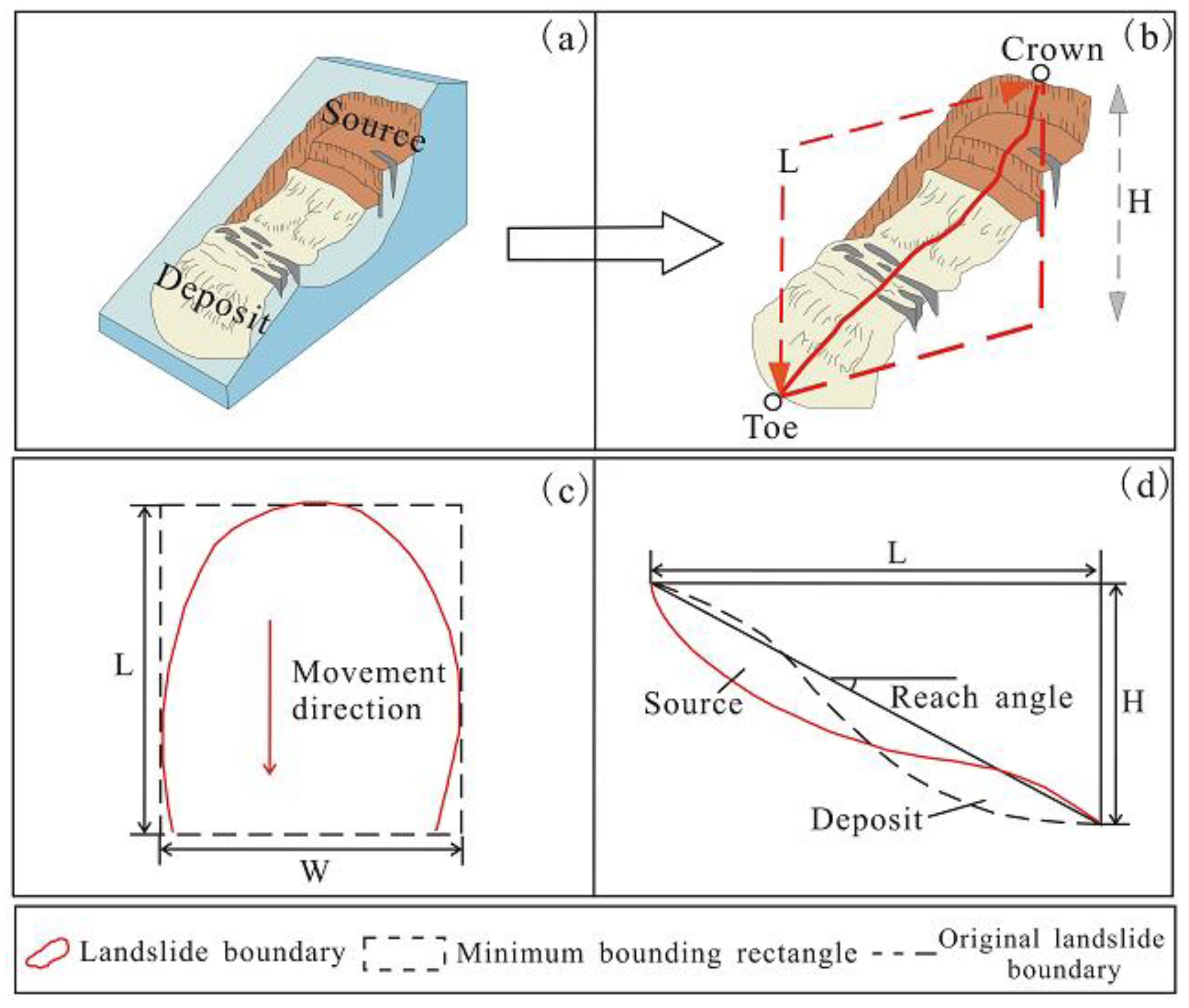
3.2. Geometric Parameters of Landslides
3.3. Data Source
4. Result
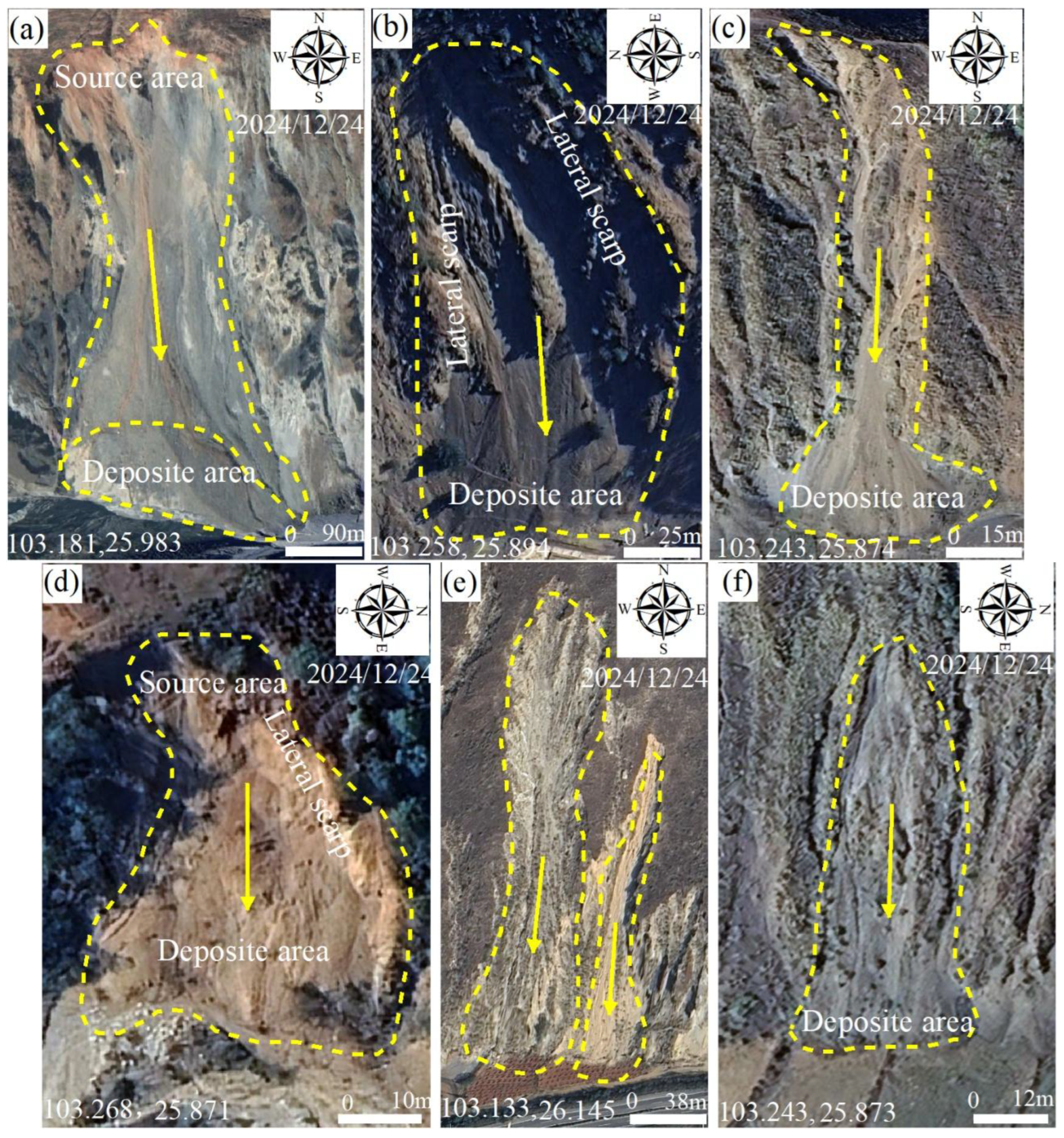
4.1. Landslide Inventory Map
4.2. Spatial Distribution Characteristic of Landslides
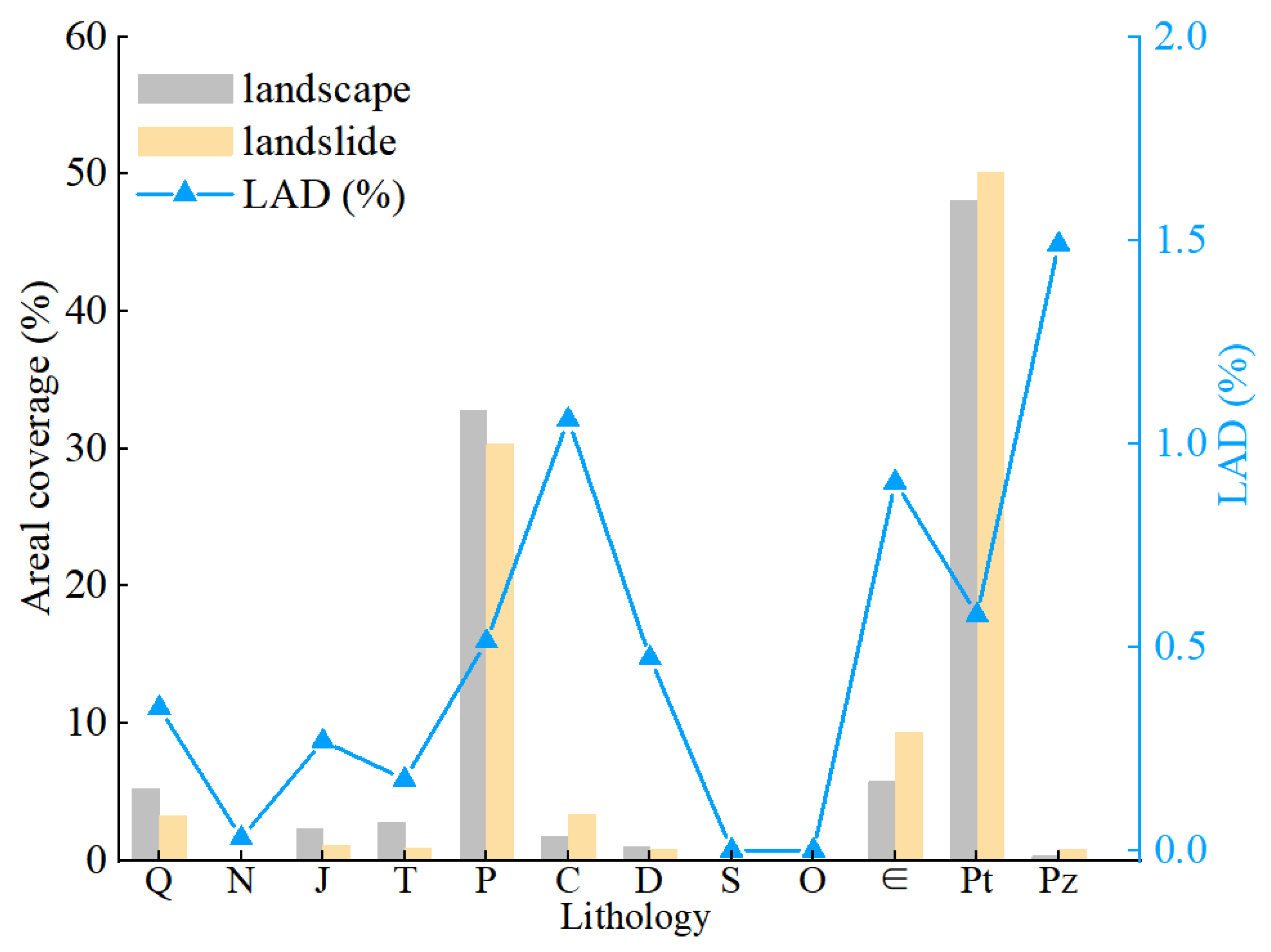
4.3. Relationship Between Landslide and Various Influencing Factors
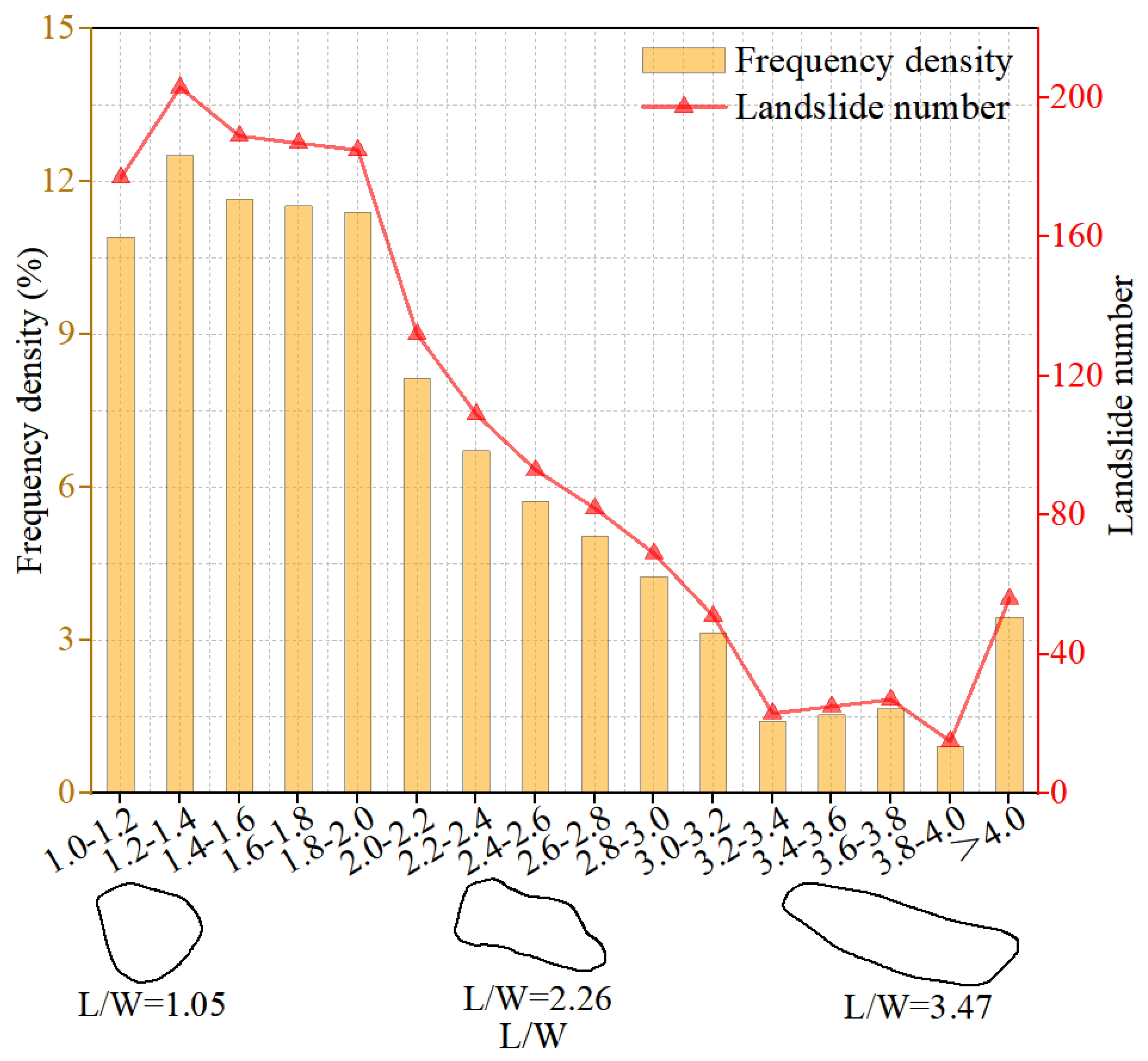
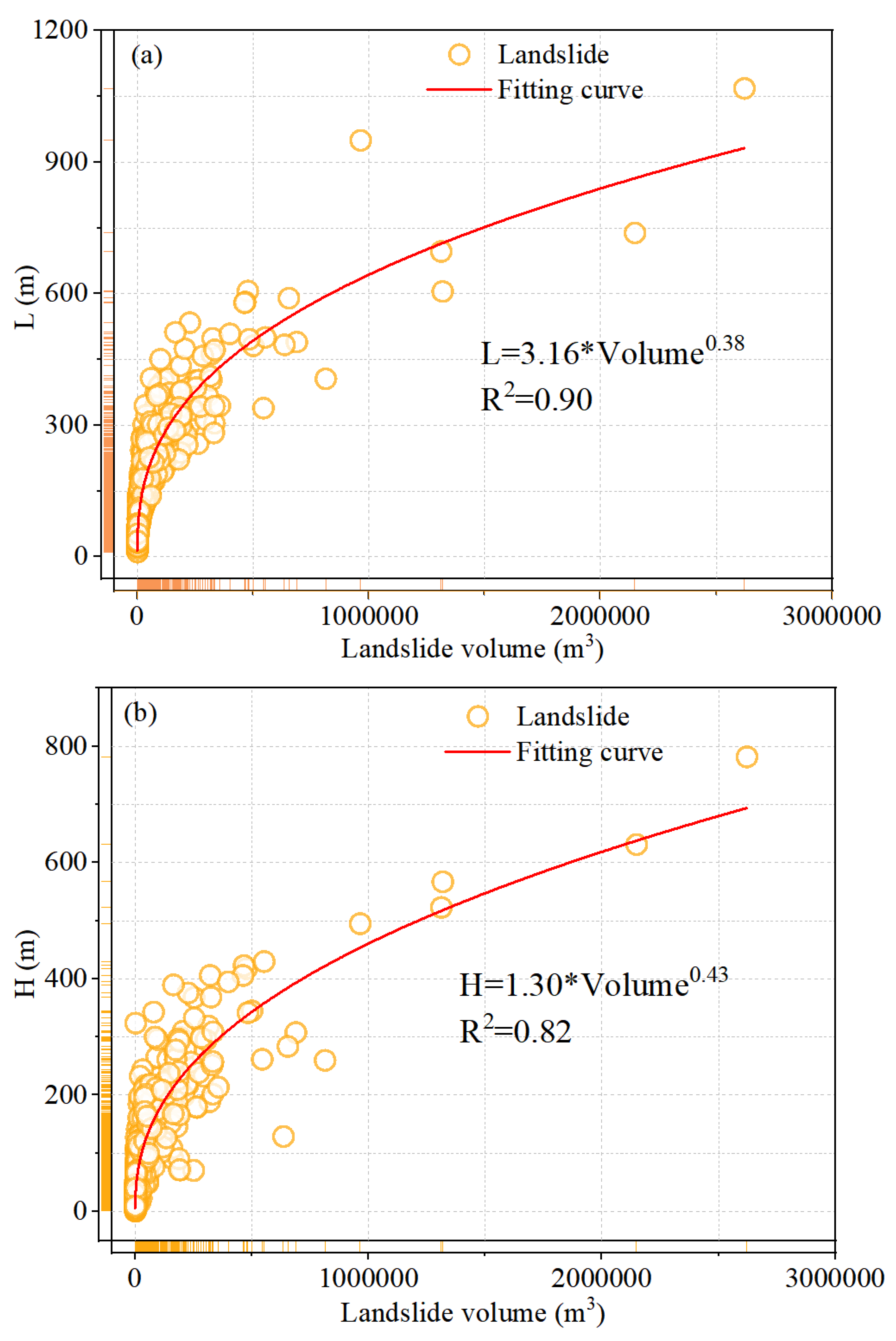
4.4. Geometric Characteristics of Landslides
5. Discussion
5.1. Controlling Factors Affecting the Distribution of Landslides
5.2. Spatial Distribution Characteristic of Landslides
5.3. Comparative Analysis with Other Regions
6. Conclusions
Author Contributions
Acknowledgments
References
- Burbank, D. W.; Rates of erosion and their implications for exhumation. Mineralogical Magazine. 2002, 66, 25-52. [CrossRef]
- Roering, J. J., Perron, J. T., Kirchner, J. W. Functional relationships between denudation and hillslope form and relief. Earth and Planetary Science Letters. 2007, 264, 245-258. [CrossRef]
- Gorüm, T. Tectonic, topographic and rock-type influences on large landslides at the northern margin of the Anatolian Plateau. Landslides. 2018, 16, 333-346. [CrossRef]
- Jacobs, L.; Dewite, O.; Poesen, I.; Maes, J.; Mertens, K.; Sekajugo, J.; Kervyn, M. Landslide characteristics and spatial distribution in the Rwenzori Mountains, Uganda. Journal of African Earth Sciences. 2017, 134, 917-930. [CrossRef]
- Tanyas, H.; Rossi, M.; Alvioli, M.; van, Westen, C. J.; Marchesini, I.; A global slope unit-based method for the near real-time prediction of earthquake-induced landslides. Geomorphology. 2019, 327, 126-146. [CrossRef]
- Santangelo, M.; Gioia, D.; Cardinali, M.; Guzzetti, F.; Schiattarella, M.; Landslide inventory map of the upper Sinni River valley, Southern Italy. Journal of Maps. 2014, 11:444-453. [CrossRef]
- Shao, X.; Ma, S.; Xu, C.; Shen, L.; Lu, Y. Inventory, Distribution and Geometric characteristics of landslides in Baoshan City, Yunnan Province, China. Sustainability. 2020, 12, 24-33. [CrossRef]
- Cui, P.; He, M.; Tapponnier, P.; Zhang, L.; Li, Z.; Gong, W.; Zhou, G.; Guo, J.; Preface for Geohazards and mitigation along the Sichuan-Tibet Railway. Engineering Geology. 2023, 317, 107095. [CrossRef]
- Tian, Y.; Xu, C.; Xu, X.; Wu, S. E.; Chen, J. Spatial distribution analysis of coseismic and pre-earthquake landslides triggered by the 2014 Ludian MS 6.5 earthquake. Seismology and Geology. 2015, 37, 291-306.
- He, X.; Xu, C.; Qi, W.; Huang, Y.; Cheng, J.; Xu, X.; Yao, Q.; Lu, Y.; Dai, B.; Landslides Triggered by the 2020 Qiaojia Mw 5.1 Earthquake, Yunnan, China: Distribution, Influence Factors and Tectonic Significance. Journal of Earth Science. 2021, 32, 1056-1068.
- Jin, J. L.; Cui, Y. L.; Xu, C.; Zheng, J.; Miao, H. B. Application of logistic regression model for hazard assessment of landslides caused by the 2012 Yiliang Ms 5.7 earthquake in Yunnan Province, China. Journal of Mountain Science. 2023, 20, 657-669. [CrossRef]
- Tian, S.; Zhang, Z. Housing loss estimation study of urban debris flow disaster based on SPOT-5 data-A case study on Dongchuan District, Kunming, Yunnan Province. In 2009 Joint Urban Remote Sensing Event. IEEE. 2009, 1-5.
- Cui, P.; Zou, Q.; Xiang, L.; Zeng, C. Risk assessment of simultaneous debris flows in mountain townships. Progress in physical geography. 2013, 37, 516-542. [CrossRef]
- Xu, J.; Cheng, X.; Huang, Q.; Chen, Y.; Qi, W.; Yuan, J.; Yang, J. Susceptibility evaluation of debris flow based on experience weight method combined with“3S”technology: a case study from Dongchuan in Yunnan Province, China. IOP Conference Series: Earth and Environmental Science. IOP Publishing. 2017, 95, 022051.
- Li, K.; Zhao, J. S.; Lin, Y. L.; Chen, K., Bi, R. Assessment of debris flow susceptibility in Dongchuan based on RF and SVM models. Journal of Yunnan University: Natural Sciences Edition. 2021, 44, 107-115.
- Sun, B.; Zhu C. B.; Kang, X. B.; Ye, L.; Liu,Y. Susceptibility assessment of debris flows based on information model in Dongchuan, Yunnan Province. The Chinese Journal of Geological Hazard and Control. 2022, 33, 119-127.
- Wei, F.; Hu, K.; Cui, P.; Guan, Q. A decision support system for debris-flow hazard mitigation in towns based on numerical simulation: a case study at Dongchuan, Yunnan Province. International Journal of Risk Assessment and Management. 2008, 8, 373-383. [CrossRef]
- Cao, C.; Song, S.; Chen, J.; Zheng, L., Kong, Y. An approach to predict debris flow average velocity. Water. 2017, 9, 205. [CrossRef]
- Liu, D.; Li, Y.; You, Y.; Liu, J., Wang, B.; Yu, B. Velocity of debris flow determined by grain composition. Journal of Hydraulic Engineering. 2020, 146, 06020010. [CrossRef]
- Zhang, X.; Gan, S.; Yuan, X.; Zong, H.; Wu, X. Slope deformation monitoring and early identification of disasters in debris flow source area of Baini River, Dongchuan District, China. Frontiers in Earth Science. 2022, 10, 1000736. [CrossRef]
- Shen, J.; Wang, Y. P.; Song, F. M. Characteristics of the active Xiaojiang fault zone in Yunnan, China: a slip boundary for the southeastward escaping Sichuan-Yunnan Block of the Tibetan Plateau. Journal of Asian Earth Sciences. 2003, 21, 1085-1096.
- Li, C.; Zhang, J.; Gao, L.; Chen, X.; Ma, S.; Yuan, R. Spatial Clustering and distribution characteristics of large landslides in the Yalong River Basin, China. Geomorphology. 2025, 109667. [CrossRef]
- Bian, M.; Qiu, H.; Chen, X. The Distribution Characteristics of Large Landslides Along the Daduhe River in the Eastern Tibetan Plateau and Their Effects on Landscape Evolution. Remote Sensing. 2025, 17, 1133. [CrossRef]
- Ma, S. Y.; Shao, X. Y.; Xu, C. Landslide inventory and distribution patterns in Lhasa area, Tibet Plateau. Natural Hazards. 2025, 121, 5849-5871. [CrossRef]
- Guzzetti, F.; Mondini, AC.; Cardinali, M.; Fiorucci, F.; Santangelo, M.; Chang, K-T. Landslide inventory maps: New tools for an old problem. Earth-Science Reviews. 2012, 112, 42-66. [CrossRef]
- Xu, C. Preparation of earthquake-triggered landslide inventory maps using remote sensing and GlS technologies: Principles and case studies. Geoscience Frontiers. 2015, 6, 825-836. [CrossRef]
- Taylor, F, E.; Malamud, B, D.; Witt, A.; Guzzetti F. Landslide shape, ellipticity and length-to-width ratios. Earth Surface Processes and Landforms. 2018, 43, 3164-3189. [CrossRef]
- Tian, Y.; Xu, C.; Chen, J.; Zhou, Q.; Shen, L. Geometrical characteristics of earthquake-induced landslides and correlations with control factors: a case study of the 2013 Minxian, Gansu, China, Mw 5.9 event. Landslides. 2017, 14, 1915-1927. [CrossRef]
- lAEG. Commission on Landslides. Suggested nomenclature for landslides. Bulletin of the International Association of Engineering Geology-Bulletin de I'Association Internationale de Géologie de I'Ingénieur. 1990, 41, 13-16.
- Larsen, I, J.; Montgomery, D, R.; Korup, O. Landslide erosion controlled by hillslope material. Nature Geoscience. 2010, 3, 247-251.
- Xu, C.; Xu, X.; Shen, L.; Yao, Q.; Tan, X.; Kang, W.; Ma, S.; Wu, X.; Cai, J.; Gao, M. Optimized volume models of earthquake-triggered landslides. Scientific Reports. 2016, 6, 29797. [CrossRef]
- Fan, X.; Scaringi, G.; Xu, Q.; Zhan, W.; Dai, L.; Li, Y.; Pei, X.; Yang, Q.; Huang, R. Coseismic landslides triggered by the 8 th August 2017 Ms 7.0 Jiuzhaigou earthquake (Sichuan, China): Factors controlling their spatial distribution and implications for the seismogenic blind fault identification. Landslides. 2018, 15, 967-983. [CrossRef]
- Roback, K.; Clark, M. K.; West, A . J.; Zekkos, D.; Li, G.; Gallen, S. F.; Chamlagain, D.; Godt, J.W. The size, distribution, and mobility of landslides caused by the 2015 Mw7. 8 Gorkha earthquake, Nepal. Geomorphology. 2018, 301, 121-138. [CrossRef]
- Zou, Y.; Oi, S.; Guo, S.; Zheng, B.; Zhan, Z.; He, N.; Huang, X.; Hou, X.; Liu, H. Factors controlling the spatial distribution of coseismic landslides triggered by the Mw 6.1 Ludian earthguake in China. Engineering Geology. 2022, 296, 106477. [CrossRef]
- Huang, Y.; Xu, C.; He, X.; Cheng, J.; Huang, Y.; Wu, L.; Xu, X. Distribution characteristics and cumulative effects of landslides triggered by multiple moderate-magnitude earthquakes: a case study of the comprehensive seismic impact area in Yibin, Sichuan, China. Landslides. 2024, 21, 2927-2943. [CrossRef]
- Pourghasemi, H, R.; Moradi, H, R.; Aghda, S, M, F.; Sezer, E, A.; Jirandeh, A, G.; Pradhan, B. Assessment of fractal dimension and geometrical characteristics of the landslides identified in North of Tehran, Iran. Environmental Earth Sciences. 2013, 71, 3617-3626.
- Hunter, G.; Fell, R.Travel distance angle for rapid landslides in constructed and natural soil slopes. Canadian Geotechnical Joural. 2003, 40, 1123-1141. [CrossRef]
- Xu, C. A preliminary spatial distribution analysis of landslides triggered by the 2010 Haiti earthquake. In Landslide Science for a Safer Geoenvironment: Volume 3: Targeted Landslides. Cham: Springer International Publishing. 2014, 183-190.
- Tian, Y.; Xu, C.; Xu, X.; Chen, j. Detailed inventory mapping and spatial analyses to landslides induced by the 2013 Ms 6.6 Minxian earthquake of China. Journal of Earth Science. 2016, 27, 1016-1026. [CrossRef]
- Tanyas, H.; Westen, c.; Allstadt, K.; jibson, R. Factors controlling landslide frequency-area distributions. Earth Surface Processes and Landforms. 2018, 44, 900-917. [CrossRef]
- Wang, W.; Ma, S.; Yan, W.; Yuan, R. The Spatial Distribution Characteristics and Possible Influencing Factors of Landslide Disasters in the Zhaotong Area, Yunnan Province of China. Applied Sciences. 2024, 14, 5093. [CrossRef]
- Bucci, F.; Santangelo, M.; Cardinali, M.; Fiorucci, F.; Guzzetti, F. Landslide distribution and size in response to Quaternary fault activity: the Peloritani Range, NE Sicily, Italy. Earth Surface Processes and Landforms. 2016, 41, 711-720. [CrossRef]
- Marc, O.; Hovius, N. Amalgamation in landslide maps: Effects and automatic detection. Natural Hazards and Earth System Science. 2015, 15, 723-733. [CrossRef]
- McColl, S.T.; Cook, S.J. A universal size classification system for landslides. Landslides. 2024, 21, 111-120. [CrossRef]
- Hungr, O.; Leroueil, S.; Picarelli, L. The Varnes classification of landslide types, an update. Landslides. 2014, 11, 167-194. [CrossRef]
- Malamud, B, D.; Turcotte, D, L.; Guzzetti F.; Reichenbach P. Landslide inventories and their statistical properties. Earth Surface Processes and Landforms. 2004, 29, 687-711. [CrossRef]
- Katz, O.; Morgan, J.K.; Aharonov, E.; Dugan, B. Controls on the size and geometry of landslides: Insights from discrete element numerical simulations. Geomorphology. 2014, 220, 104-113. [CrossRef]
- Barth, S.; Geertsema, M.; Bevington, A.R.; Bird, A.L.; Clague, J.J.; Millard, T.; Bobrowsky, P.T.; Hasler, A.; Liu, H. Landslide response to the 27 October 2012 earthquake (Mw 7.8), southern Haida Gwaii, British Columbia, Canada. Landslides. 2020, 17, 517-526. [CrossRef]
- Wang, T.; Liu, J.; Huang, C. Research on Ore-controlling factors and Metallogenic Prognosis of Dongchuan Copper Mining Area, Yunnan, China. In IOP Conference Series: Earth and Environmental Science. IOP Publishing. 2017, 59, 01203.
- Scheidegger, A, E. On the prediction of the reach and velocity of catastrophic landslides. Rock Mechanics and Rock Engineering. 1973, 5, 231-236. [CrossRef]

Disclaimer/Publisher’s Note: The statements, opinions and data contained in all publications are solely those of the individual author(s) and contributor(s) and not of MDPI and/or the editor(s). MDPI and/or the editor(s) disclaim responsibility for any injury to people or property resulting from any ideas, methods, instructions or products referred to in the content. |
© 2026 by the authors. Licensee MDPI, Basel, Switzerland. This article is an open access article distributed under the terms and conditions of the Creative Commons Attribution (CC BY) license.


