

Submitted:
09 March 2026
Posted:
09 March 2026
You are already at the latest version
Abstract
Advanced economies face a compounding demographic crisis: populations aged 65 and over will reach 30–40% in several nations by 2050, ageing-related expenditure already absorbs up to 18% of GDP in the most affected economies, and demographic ageing is projected to reduce annual GDP growth by 0.3–1.2 percentage points by 2035. Conventional policy instruments have failed to resolve pressures that include severe long-term care workforce shortfalls across leading ageing economies and per-capita elderly care costs running 3–5 times those of working-age cohorts. This structured narrative review of 81 sources (2020–2025) evaluates whether Agentic AI defined as autonomous, goal-directed systems capable of multi-step workflow coordination can support structural adaptation in ageing health systems. A consistent finding is that implementation outcomes are determined by institutional conditions rather than algorithmic performance, and evidence strength is inversely correlated with intervention complexity. Three contributions are presented: the Agentic AI Framework (AAF 3.0); a cross-domain synthesis formalising the inverse evidence–complexity relationship; and a phased sociotechnical roadmap integrating governance sequencing, reimbursement reform, and equity safeguards. Short-term productivity gains are documented; macroeconomic fiscal moderation remains empirically unvalidated.
Keywords:
population ageing
; agentic AI
; healthcare systems
; eldercare technology
; sociotechnical implementation
; health equity
; AI governance
; fiscal sustainability
1. Introduction
1.1. The Structural Demographic Challenge
By 2050, one in three citizens in Japan will be over 65, with Italy and South Korea projected to approach 30–40% over the same period.[1] Sustained sub-replacement fertility, including South Korea’s 0.75 total fertility rate (2025 estimate; 0.72 in 2023)[4], combined with rising longevity exceeding 84 years in Japan and Singapore[5] are driving this transition. Its speed is as consequential as its scale, with demographic ageing that took over a century in France occurred within decades in Japan and South Korea.[6,7]
Three structural pressures converge. First, workforce contraction: Japan faces an estimated 250,000 nursing shortfall by 2026[8] and Italy's long-term care workforce density remains well below the OECD average.[2,9] Second, fiscal strain: per-capita healthcare spending for older adults is 3 – 5 times that of working-age cohorts,[2] and ageing alone is projected to add 1.8 – 2.7 percentage points of GDP to public health expenditure by 2060.[9] Third, care complexity: multimorbidity and dependency increase coordination demands across already fragmented systems. Ageing also carries human costs obscured by aggregate statistics, including social isolation, solitary deaths, and intensified caregiving burdens that further constrain labour supply. [10]
Across the seven most demographically stressed advanced economies, healthcare spending ranges from 6.1% to 16.9% of GDP, and total ageing-related expenditure absorbs between 10% and 28% of GDP in the most affected economies.[2,9] The IMF's 2024 Fiscal Monitor projects public health spending in advanced economies will rise by 2.0–3.5 percentage points of GDP by 2050 under baseline scenarios, and by 3.5–6.0 points under adverse trajectories.[46] Country-level projections are stark: Japan's healthcare expenditure is forecast to rise 55% above its 2023 baseline by 2050; South Korea's is projected to double; Singapore's to nearly triple from S$22 billion (2018) to S$59 billion by 2030.[49] Demographic ageing is projected to reduce GDP growth by 0.3–1.2 percentage points per year by 2035, with Germany and Italy potentially recording growth below 1%,[9,46] while the worker-to-retiree ratio falls from approximately four contributors per retiree today to fewer than two by 2030–2040.[46,48] These projections motivate this review's central question: whether Agentic AI can contribute meaningfully to moderating expenditure trajectories that no conventional policy instrument has yet resolved.
1.2. The Insufficiency of Conventional Responses
Governments have responded across four domains, including pension and labour-market reform, healthcare restructuring, workforce expansion, and digital health integration yet each facing binding constraints. Pension reform provides limited fiscal relief and often provokes political resistance, as recent protests in France illustrate.[11] Preventive and community-based healthcare restructuring depends on the very workforce already under strain. Japan's long-term care insurance system and Singapore's Healthier SG programme both require sustained labour supply to scale.[8,16] Workforce expansion through training and recruitment faces long lead times and retention challenges.[2] Digital health strategies, including Germany's DiGA programme, remain unevenly adopted and lack validated system-level impact.[16] Consequently, even high-performing nations face pressures that existing policy instruments cannot fully resolve.[12]
1.3. Agentic AI Through a Sociotechnical Lens
This paper distinguishes three levels of healthcare AI. Narrow AI refers to single-task prediction or classification tools (e.g., diagnostic imaging models). Generative AI refers to large language models capable of natural language generation and reasoning across domains. Agentic AI (AAI) refers to systems that execute sustained, multi-step, goal-directed workflows across institutional boundaries, combining planning, memory, environmental interaction, and feedback under structured human oversight. The boundary between generative and agentic AI is functional rather than architecturally fixed and becomes increasingly fluid as persistent context and tool-use frameworks mature.
AAI offers capabilities well aligned with the pressures facing ageing health systems. Unlike narrow clinical AI limited to prediction tasks, AAI integrates planning, memory, environmental interaction, and feedback to execute sustained workflows across institutional boundaries.[13] For example, an AAI system could detect early clinical deterioration from home-monitoring data, initiate a telehealth consultation, and coordinate follow-up care under defined human oversight.
This review adopts sociotechnical systems theory, including the NASSS framework[35], as its analytical anchor. Technological success depends not only on technical performance but also on alignment with organisational structures, governance arrangements, financing models, and human roles. Applied to eldercare, this perspective generates a testable proposition that deployment outcomes are determined primarily by institutional conditions rather than algorithmic capability.
The analysis addresses three research questions:
- −
- RQ1 (Capability): What is the current and near-term evidential basis for AAI across remote monitoring, assistive robotics, diagnostic support, medication adherence, and workflow automation, and how does evidence vary with intervention complexity?
- −
- RQ2 (Implementation): Which regulatory, financial, organisational, and infrastructural factors determine whether AI capability translates into population-level benefit, and how do these vary across national contexts?
- −
- RQ3 (Equity and Sustainability): Under what conditions can AI be adopted to avoid widening inequities and contribute to fiscal moderation, and which governance and evidence gaps prevent validation at scale?
The sociotechnical lens positions institutional alignment rather than technical optimism as the organising principle for the roadmap that follows.
This review contributes to the emerging literature on AI and ageing societies by integrating demographic economics, implementation science, and agentic AI architectures into a unified sociotechnical framework for health system transformation.
2. Methodology
This study employed a structured narrative review (SNR) to synthesise heterogeneous evidence across demography, health economics, artificial intelligence, and policy. Meta-analysis was not feasible due to disciplinary diversity, outcome heterogeneity, and the inclusion of grey literature. Search and screening procedures followed PRISMA 2020 guidance. A structured review protocol was developed prior to data extraction but was not formally registered with a prospective registry; the review should therefore be interpreted as PRISMA-informed rather than fully PRISMA-compliant.
2.1. Search Strategy and Source Selection
Searches were conducted in PubMed, Scopus, Web of Science, and IEEE Xplore, supplemented by arXiv, medRxiv, and grey literature from the OECD, WHO, United Nations, European Commission, and national health ministries. Publications from January 2020 to December 2025 were prioritised, and earlier landmark studies were included where sources identified as foundational are marked with a [Foundational] notation. Search terms covered four domains, including population ageing, healthcare system pressure, artificial intelligence and agentic systems, and geographic scope. Representative search terms are provided in Appendix A.
2.2. Screening and Selection Process
The search yielded 1,812 records, of which 440 duplicates were removed. Two reviewers independently screened 1,372 titles and abstracts, achieving strong inter-rater agreement (Cohen's κ = 0.81). Of the 355 full-text articles assessed, 56 met the inclusion criteria. An additional 25 sources identified through citation tracking resulted in a final sample of 81 included sources. The PRISMA flow diagram is presented in Figure 1.
Inclusion required relevance to population ageing or artificial intelligence in healthcare within OECD contexts, together with empirical evidence or methodologically transparent institutional data. Opinion pieces, non-healthcare AI studies, and commercial market research were excluded. Disagreements between reviewers were resolved through consensus.
2.3. Quality Appraisal, Data Extraction and Synthesis
Empirical studies were appraised using an adapted CASP framework assessing methodological rigour, relevance, outcome validity, follow-up adequacy, and reporting transparency. Systematic reviews were evaluated using AMSTAR-2 criteria, and institutional grey literature was assessed for data transparency and methodological clarity. Narrative synthesis followed a framework synthesis approach anchored to the NASSS framework,[35] with thematic mapping of evidence against the six NASSS domains (condition, technology, value proposition, adopter system, organisation, and wider system). This approach was selected over thematic or realist synthesis because the NASSS framework provides an established theoretical architecture directly applicable to complex health technology adoption — the central analytical task of this review.
Evidence strength was assigned at the domain level using pre-specified operational criteria applied independently by both reviewers with consensus resolution. The full classification framework is presented in Appendix Table B2.
3. Evidence Synthesis: Structural Pressures, AI Applications, and Institutional Constraint
3.1. Structural Pressures on Ageing Health Systems
Population ageing generates healthcare strain through three compounding mechanisms, including rising age-related expenditure, workforce contraction, and increasing care complexity. Per-capita costs for those aged 65 and above are several times higher than for working-age populations and rise sharply beyond age 80. OECD and European Commission projections indicate that ageing alone will add several percentage points of GDP to public health expenditure across member states.[9,15] Growth is concentrated among those aged 75 and above, the highest utilisation subgroup, and old-age dependency ratios in the most affected nations are projected to approach one older adult per working-age individual later this century.[1] Multimorbidity further compounds strain because most adults over 65 live with two or more chronic conditions requiring cross-specialty coordination.[10] Table 1 summarises these pressures. Note: France appears throughout this review as a comparative reference economy and in the cross-country data presented in Appendix E. It is not included as a primary case in the Section 3 synthesis tables, as its demographic and fiscal profile places it in an intermediate category relative to the seven economies where the evidence base is most developed.
Two cross-cutting patterns shape the remainder of the analysis. Evidence strength is inversely related to intervention complexity. The multi-domain applications most needed in ageing health systems therefore have the weakest evidence base, reflecting underinvestment in complex interventions. Implementation of context also matters more than technical performance. Factors such as workflow integration, clinician training, institutional readiness, and digital literacy influence outcomes more than algorithm accuracy.[25,35] Table 2 illustrates this inverse relationship across AI domains. Detailed cross-country demographic and fiscal projections for major ageing economies are provided in Appendix E (Tables E1–E2) to reduce table density in the main manuscript.
Three patterns from the cross-country demographic and fiscal projections in Appendix E (Tables E1–E2) are particularly important. South Korea and Singapore face the most severe projected dependency ratios by 2050, at 79.0 and 85.0 respectively, but their fiscal preparedness differs sharply. Singapore’s CPF compulsory savings model keeps ageing-related spending near 10 percent of GDP, compared with about 16 percent in South Korea. Italy and France already spend about 28–30 percent of GDP on ageing-related programmes, leaving limited fiscal space for new technology investments. The United States faces lower structural pressure because of a relatively younger population and immigration-supported workforce, despite having the highest per-capita health spending. These differences shape AI deployment sequencing. Countries with stronger fiscal capacity and high digital readiness, including Singapore, Germany, and South Korea, are better positioned for early Phase 2 pilots, while countries with higher fiscal risk, including Italy and France, may require fiscal consolidation before large-scale deployment.
Appendix E presents detailed demographic and fiscal projections across ageing economies. Table 3 summarises the relationship between GDP growth and healthcare expenditure pressures, and highlights where AI-enabled efficiency gains may help moderate fiscal strain.
3.2. AI Applications in Ageing Health Systems
Across five principal domains, a consistent pattern emerges. AI tools are most effective when used to support structured care pathways rather than replace human judgement.[42,43] Evidence for foundational applications such as remote monitoring and socially assistive robotics is largely based on trials conducted before 2018. Later studies, including systematic reviews published between 2020 and 2024, broadly replicate the directional findings of earlier work, though they do not extend follow-up duration or population scale sufficiently to resolve questions about long-term cost-effectiveness.[19,20,21,22,42,43] This pattern suggests continued underinvestment in complex intervention research and highlights the research gaps discussed in Section 4.6. Key methodological limitations and qualifications associated with widely cited studies are summarised in Table 4.
Remote monitoring systems are associated with reduced hospital admissions and emergency utilisation among chronic disease populations.[19,20] However, results depend on context and evidence for mortality reduction or delayed institutionalisation remains limited. Socially assistive robots improve agitation, mood, and engagement in dementia care.[21,22,40] Their use also raises governance questions about augmentation versus substitution of human care. Diagnostic AI achieves specialist-level accuracy in imaging tasks.[17,18,44] However, it does not generalise well to complex geriatric clinical decision-making. Medication adherence tools show modest and mixed improvements.[14] Ambient documentation systems show early evidence of reduced clinician administrative burden, although studies remain short term and observational.[41]
3.3. Economic Evidence: Microeconomic Gains and Macroeconomic Uncertainty
Economic evidence is limited by the absence of validated macroeconomic evaluation. The central question is whether AI can meaningfully moderate demographic expenditure growth at population scale. This question remains unanswered in the peer-reviewed literature. The IMF Fiscal Monitor (2024) projects that public health spending will rise by 2.0–3.5 percentage points of GDP by 2050 under baseline scenarios and by 3.5–6.0 points under adverse trajectories.[46] Claims that AI could moderate these trends should therefore be treated as hypotheses until longitudinal evidence emerges.
At the microeconomic level, studies report incremental savings from reduced admissions through remote monitoring and care coordination.[19,20] Some studies report long-term care gains from delayed institutionalisation.[31] Emerging evidence also suggests productivity gains from documentation automation.[41] Cost-effectiveness findings differ across financing models. In Japan’s publicly funded system, savings from avoided institutionalisation align incentives. In Germany’s Bismarckian model, reimbursement reform across statutory funds is required. In Singapore’s Medisave-based system, central governance may accelerate implementation, but equity risks remain. The economic case for AI in eldercare is therefore system specific and cannot be derived from aggregate evidence without considering financing models, incentives, and population baseline.

Table 5.
Economic Evidence on AI in Ageing Health Systems.
| Economic Layer | Mechanism | Evidence Strength | Key Limitation | Implication |
| Healthcare spending | Reduced admissions through remote monitoring and coordination | Moderate evidence from pilot and controlled studies [19,20] | Effects vary by context and are not validated nationally | Promising but requires system-level evaluation |
| Long-term care costs | Delayed institutionalisation through ageing-in-place technologies | Moderate evidence with sustained deployment [31] | Demographic growth may offset efficiency gains | Scale required for fiscal impact |
| Workforce productivity | Automation of documentation and coordination tasks [41] | Emerging observational evidence | Implementation costs and workflow risks unclear | Near-term productivity gains possible |
| Macro-fiscal impact | AI-augmented care workforce | No validated population-level evidence | Current estimates rely on extrapolation | IMF projects health spending increase of 2.0–6.0% GDP by 2050 [46] |
3.4. Governance, Regulation, and the Algorithmic Bias Problem
Under the EU AI Act (2024), AI systems that qualify as medical devices, including diagnostic, clinical decision support, or patient management tools, are classified as high risk. This classification requires conformity assessment, human oversight, transparency, data governance, and post market monitoring.[34] Agentic eldercare systems that execute multi step clinical workflows fall within this category, so compliance timelines must be integrated into implementation planning from the beginning. Japan, Singapore, and South Korea face similar governance challenges but lack the EU’s coordinated regulatory structure. The OECD has also identified responsible AI deployment in healthcare as a policy priority.[33] Large language models introduce additional risks because they can generate clinically plausible but incorrect outputs. This reinforces the need for human oversight at critical clinical decision points.[23]
Algorithmic bias represents another institutional constraint. Obermeyer et al. demonstrated systematic racial bias in a US risk scoring algorithm.[24] Subsequent studies in Nordic and UK systems identify similar risks linked to underrepresentation of rural, minority, and oldest old populations.[30] Bias patterns are context specific. East Asian datasets may appear ethnically homogeneous but can still underrepresent socioeconomically marginalised elderly groups. Auditing must therefore rely on locally representative data. In geriatric care this issue is particularly important because underrepresented populations often have the highest care needs and the least alternative access to services.
3.5. Equity as a Structural Barrier, Not an Afterthought
Equity implications extend beyond algorithmic bias to structural determinants shaping whether deployment narrows or widens disparities. Three inequality axes are central. Urban rural divides show rural older adults face weaker digital infrastructure and higher illiteracy, with remote monitoring uptake consistently lower in rural settings[14,32] meaning those most isolated from conventional care are least likely to benefit from AI alternatives. Digital literacy gradients show telehealth utilisation among adults aged 75 and above remains substantially lower than among younger cohorts across OECD nations[14,30] risking exclusion of the oldest old with the highest care needs. Socioeconomic stratification shows out of pocket costs for assistive technologies concentrate quality gains among already advantaged populations[24,30]. Equity must shape deployment sequencing prioritising underserved groups in pilot design rather than treating them as post deployment audit categories.
3.6. Comparative Institutional Readiness
Institutional readiness patterns reinforce the sociotechnical thesis that adoption trajectories are shaped as strongly by governance design infrastructure maturity and public trust as by technical capability. Japan combines acute demographic urgency with sustained robotics investment but faces workforce shortages and fragmented EHR systems[8]. South Korea benefits from advanced digital infrastructure yet confronts the fastest demographic transition globally which compresses the implementation window[4,39]. Singapore's centralised governance enables rapid digital health coordination though its small population limits evidence generalisation[16,38]. Germany and Nordic states lead EU digital health adoption, and the EU AI Act uniform high-risk classification extends regulatory timelines across member states[34].
A consistent pattern emerges because demographic urgency often diverges from institutional readiness. Italy and Southern Europe face sharp ageing pressures alongside constrained fiscal and digital capacity. Japan technological leadership coexists with workforce and interoperability constraints. These governance mismatches rather than technical limitations define the central challenge for the roadmap that follows.
|
Case Study Singapore as a Governance First Benchmark for Ageing System Transformation Singapore provides one of the clearest examples of governance aligned preparation for population ageing. The country faces one of the steepest projected dependency ratios increases globally with the old age dependency ratio expected to rise from 24.2 in 2023 to approximately 85 by 2050. At the same time national healthcare expenditure is projected to reach about S$59 billion by 2030. In response the government has implemented a coordinated national strategy that integrates prevention financing workforce policy digital infrastructure and cross sector governance.[49,54] Preventive System Transformation – The Healthier SG The Healthier SG initiative launched in 2022 restructures primary care around longitudinal preventive management. All residents aged 40 and above are enrolled with a designated primary care physician and receive personalised preventive plans supported by digital monitoring tools including the Healthy 365 application. The government has committed about S$1 billion over five years to support this preventive shift which aims to reduce costly hospital utilisation before the demographic peak.[50] Financing Architecture – The ‘3M’ Framework Singapore financing structure combines three complementary mechanisms. Medisave provides mandatory individual health savings contributions of roughly 8 to 10.5 percent of income. MediShield Life provides universal catastrophic insurance coverage. MediFund operates as a public safety net for patients unable to meet residual costs. This layered design distributes responsibility across individuals’ insurance pools and government while containing fiscal risk and limiting moral hazard.[51] Workforce Longevity Policy - Progressive Retirement Reform To mitigate labour shortages associated with ageing the government has progressively extended workforce participation. The statutory retirement age has been raised to 63 with a planned increase to 65 by 2030 while the re-employment age will rise to 70. Labour force participation among adults aged 65 to 69 increased from 31.4 percent in 2013 to 43.3 percent in 2023 which demonstrates that policy incentives and regulatory reform can significantly extend productive ageing.[52] Digital Health Infrastructure Singapore has established national digital health infrastructure through the National Electronic Health Record system which integrates clinical data across the healthcare system. The Digital Health Blueprint supports nationwide interoperability and data governance. AI enabled diagnostic tools for conditions such as diabetic retinopathy and stroke detection are being deployed while robotic assistants have been piloted in community and long-term care environments. These systems collectively represent operational foundations for the Integrated Perception pillar of the AAF 3.0 framework.[53] Whole of Government Governance – APSA 2023 The Action Plan for Successful Ageing coordinates more than 200 initiatives across health housing, employment, transport and community participation. Active Ageing Centers operate nationwide to support community engagement and care coordination. The Seniors Go Digital initiative has trained more than 200000 older adults in digital literacy which directly addresses digital exclusion risks associated with technology-based healthcare delivery.[54] Implications for Comparative Policy Singapore institutional model is not directly transferable because its city state scale centralised governance and fiscal reserves create enabling conditions that larger federated systems do not possess. Nevertheless, the sequencing of reforms provides a clear policy lesson. Preventive care financing digital infrastructure and cross sector governance were established before demographic pressures reached their peak. In contrast many ageing economies attempt to deploy technological solutions after fiscal and workforce pressures have already intensified. From a NASSS perspective Singapore demonstrates favourable conditions across all six domains including technology readiness value proposition adopter acceptance organisational embedding and system level governance. For larger ageing economies including Japan South Korea Germany and Italy the principal barrier to AI enabled healthcare adoption therefore lies less in algorithmic capability and more in institutional alignment. |
Table 6.
Comparative Institutional Readiness for AI-Enabled Healthcare in Ageing Societies.
| Country / Region | Digital Health Maturity | Governance Architecture | Strategic Advantage | Structural Constraint | Policy Implication |
| Japan | Very high | Moderately centralised national policy with local implementation | Deep investment in eldercare robotics and monitoring | Severe workforce shortages and fragmented EHR interoperability | Scale automation while prioritising national interoperability standards |
| South Korea | Very high | Highly centralised digital governance | Advanced ICT ecosystem and rapid national deployment capability | Fastest demographic ageing globally compresses policy response window | Accelerate AI assisted care models to offset labour shortages |
| Singapore | Very high | Highly centralised and coordinated governance | Unified national digital health strategy | Small population limits large scale clinical evidence generation | Position as a global regulatory and innovation testbed |
| European Union | High but uneven | Multi-level governance across EU and national authorities | Strong regulatory leadership through the EU AI Act | Fragmented interoperability and extended compliance timelines | Harmonise digital health infrastructure and accelerate cross border data sharing |
| Italy / Southern Europe | Moderate | Decentralised healthcare governance | Demographic urgency creating reform momentum | Fiscal constraints and limited long-term care workforce | Prioritise digital health infrastructure and workforce augmentation through AI |
4. Discussion and Policy Implications for AI Implementation in Ageing Health Systems
4.1. The Central Institutional Thesis
The synthesis across Sections 3.1 to 3.6 supports a consistent conclusion. Where AI underperforms relative to technical potential, four institutional factors limit impact more reliably than model performance: fragmented data architectures, misaligned incentives, regulatory uncertainty, and exclusionary deployment design. In ageing systems, institutional fragility amplifies technological limitations.[35,43].
The NASSS framework maps directly onto observed constraints including condition complexity linked to multimorbidity technology complexity from cross domain orchestration uncertain value propositions without macroeconomic validation adopter resistance interoperability limits and regulatory and financing structures that mediate translation from effectiveness to system utility[35]. A further tension concerns relational care quality. Evidence from socially assistive robotics shows that measured improvements in agitation or mood do not determine whether care is enhanced or diminished. Outcomes depend on governance decisions regarding augmentation versus substitution[21,22,40]. Technological capability is therefore necessary but insufficient. Population level benefits depend on institutional alignment and capability without governance produces pilots that cannot scale.
4.2. The Agentic AI Framework (AAF 3.0): Derivation and Differentiation
The AAF 3.0 is more precisely described as an agentic AI domain-mapping matrix, an applied implementation tool derived deductively from the structural pressures identified in Section 3.1 and positioned as an extension of the NASSS framework specifically for agentic AI architectures. The designation “3.0” reflects a conceptual progression in healthcare AI capability from narrow clinical AI (primarily diagnostic and single-task predictive systems) to generative AI (multi-domain language reasoning) and finally to agentic AI (sustained multi-step workflow orchestration with environmental feedback). This versioning is original to this paper and should be understood as a descriptive periodisation of evolving AI capability in healthcare contexts rather than a reference to a previously established framework lineage; no AAF 1.0 or 2.0 frameworks exist in prior literature.
AAF 3.0 differs from NASSS in scope and purpose. NASSS is a general-purpose implementation framework applicable to any complex health technology. AAF 3.0 uses the NASSS analytical structure as its foundation but organises it around the specific functional capabilities of agentic AI systems — each derived from a distinct structural pressure. Where NASSS asks 'which implementation factors matter?', AAF 3.0 asks 'which agentic capabilities address which system pressures, at what evidence stage, and under what governance conditions?'. This applied specificity is its contribution.
Each pillar corresponds to a system constraint: Integrated Perception addresses information fragmentation; Autonomous Orchestration augments coordination capacity under workforce contraction; Adaptive Goal-Seeking responds to multimorbidity beyond static single-disease protocols. Systems are characterised as agentic when they execute sustained multi-step, cross-system workflows toward defined care objectives under structured human oversight.
Table 7 indicates a consistent temporal gradient. Integrated Perception is most developed in bounded domains but constrained by interoperability gaps. Autonomous Orchestration shows the strongest near-term trajectory in single domain automation. Adaptive Goal Seeking remains the most experimentally distant. Near term implementation should prioritise Perception and bounded Orchestration while treating Adaptive Goal Seeking as a medium-term research investment.
4.3. Operational Bottlenecks and AI Entry Points in Ageing Health Systems.
Three high-impact, deployment-ready targets are identified. These form the operational context for the phased roadmap that follows in Section 4.4. (1) Documentation burden in geriatric and community care is the most defensible initial target, combining a well-documented inefficiency with commercially available solutions and relatively contained workflow redesign.[41] (2) Discharge coordination and readmission prevention for multimorbid older adults form the second priority.[19,20] (3) Early deterioration detection through remote monitoring represents a third entry point, targeting high-cost acute events. All three targets share a critical property: they permit structured workflow redesign before AI deployment, reducing reliance on technological substitution.
4.4. A Sociotechnical Phased Roadmap
The roadmap translates the institutional thesis into a governance sequenced implementation strategy across a ten-year horizon. Phase durations are indicative and draw on observed timelines for large scale digital health reform regulatory pathway development cycles for high-risk adaptive technologies and implementation science evidence on pilot to scale transitions. Higher readiness systems may progress at the lower end of these ranges while lower readiness contexts should anticipate longer timelines.
Figure 2.
A Sociotechnical Roadmap for AI Implementation in Ageing Health Systems.
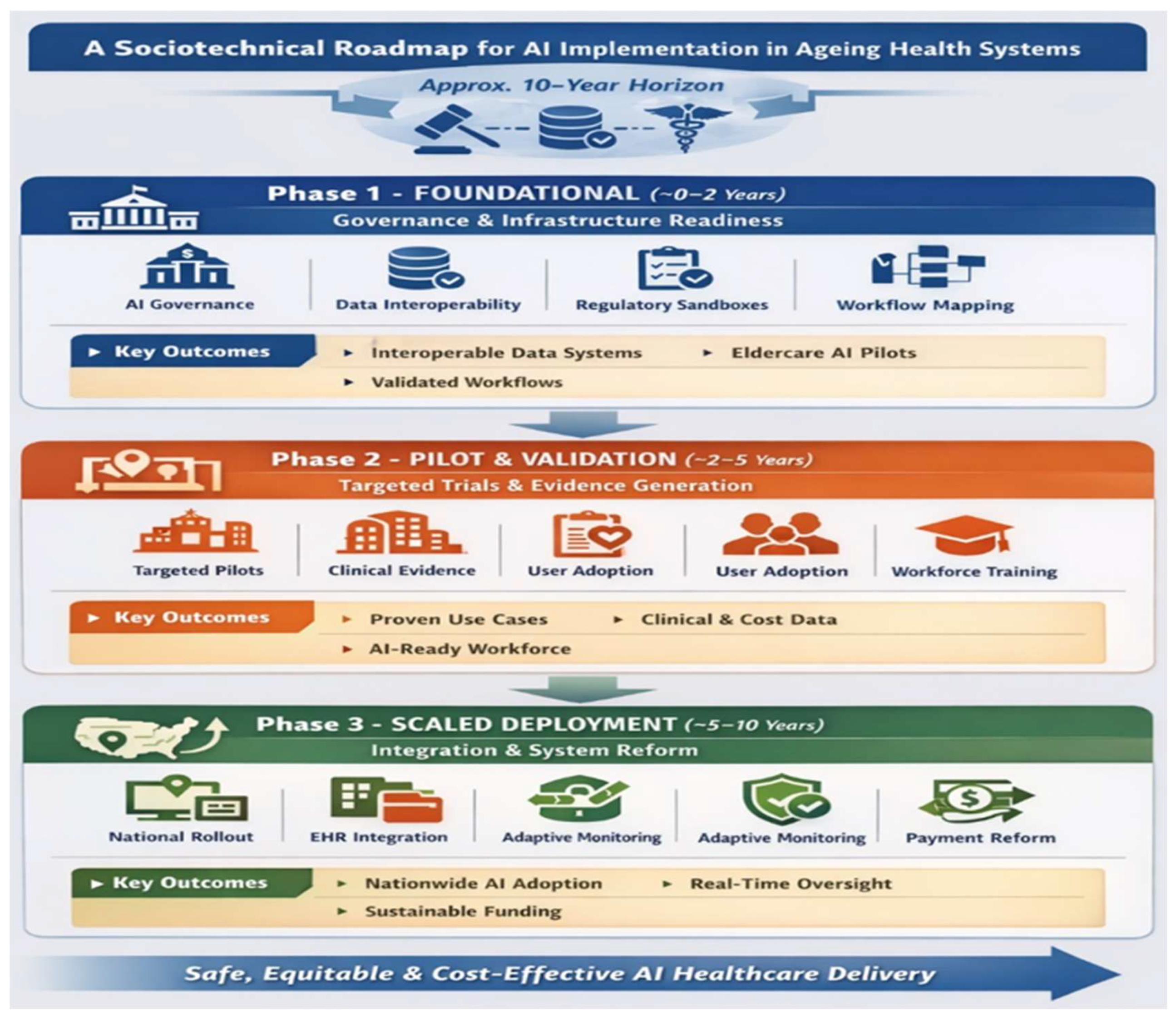
Phase 1 — Foundational (~0–2 Years): Governance and Infrastructure Readiness
Goal: Create an enabling institutional environment for the safe equitable introduction of AI enabled healthcare platforms.
Minimum conditions for Phase 1 completion include at least one interoperable regional data environment, a regulatory sandbox or controlled experimentation pathway, and validated workflow mapping for priority bottlenecks. These function as gate criteria for Phase 2 investment.
Key Actions:
- −
- −
- Data Infrastructure: Mandate HL7 FHIR adoption and secure federated architecture positioning legacy migration as capital investment rather than operating expense[14]
- −
- Regulation: Create regulatory sandboxes for supervised testing of adaptive AI systems and mandate post deployment performance monitoring[34]
- −
- Procurement: Develop AI-specific procurement frameworks requiring interoperability compliance and bias audits.
- −
- Public Engagement: Initiate early co-design with older adults’ caregivers and clinicians to build trust and inform workflow specifications[25]
Operational exit criteria for Phase 1 are detailed in Appendix D (Table D1).
Phase 2 — Pilot and Validation (~2–5 Years): Targeted Deployment and Evidence Generation
Goal: Generate rigorous, reproducible evidence on clinical effectiveness, workflow integration feasibility, and cost economics in high-need settings.
Key Actions:
- −
- Targeted Pilots: Prioritise deployment in structurally constrained settings including rural elderly isolation and long-term care workforce shortages while selecting sites with varying institutional readiness[8]
- −
- −
- Workflow Redesign: Specify required workflow changes prior to deployment and recognise that neutral results without redesign indicate implementation misalignment rather than technological failure
- −
- User Adoption Monitoring: Treat adoption rates, workflow adherence, and clinician override frequency as primary implementation outcomes
- −
- Workforce Development: Integrate AI literacy and human AI collaboration training into professional education and budget training as a core pilot cost[25]
Structured validation metrics for Phase 2 are summarised in Appendix D (Table D2).
Phase 3 — Scaled Deployment (~5–10 Years): Integration and System Reform
Goal: Transition validated AI-enabled service platforms into routine, population-level healthcare delivery within reformed payment models and national data governance frameworks.
The transition from pilot to scale is historically the most failure prone stage of digital health deployment[35]. Scaled deployment should be conditional on Phase 2 evidence.
Key Actions:
- −
- National Rollout: Link procurement to demonstrate effectiveness and equity appraisal through health technology assessment bodies while sequencing expansion from sites with the highest digital readiness[14]
- −
- Legacy Integration: Require interoperability with dominant national EHR systems as a procurement condition and fund system integration as core health infrastructure
- −
- −
- Payment Reform: Permanently aligned reimbursement with validated AI enabled value-based care models recognising that sustained scale depends on financing reform[9]
4.5. Stakeholder Recommendations
AI implementation will fail if governance, provider institutions, and technology development advance independently. Recommendations below specify concrete mechanisms for each stakeholder group.
Table 8.
Stakeholder Recommendations for AI Implementation in Ageing Health Systems.
| Stakeholder | Priority Recommendations (Evidence-Derived) |
| Policymakers and Regulators |
1. Replace fixed regulation with adaptive licensing based on a Demographic Urgency Index – A composite index combining dependency ratios, workforce decline, and fiscal capacity should guide regulatory timelines. Countries with higher scores could receive faster approval pathways for eldercare AI, while still requiring post-market monitoring within 12 months. The EU AI Act’s uniform classification system is the main target for reform. (§3.4, §3.6, §4.4) 2. Create sovereign AI-in-health data agreements with shared validation rights – Different privacy laws such as GDPR, PDPA, PIPA, APPI limit cross-border validation of AI systems. Governments should create federated agreements that allow model validation without transferring raw data, including shared audit rights and bias-reporting rules. OECD and WHO should develop a common template. Without such agreements, the evidence base will remain too weak for national-level investment. (§3.4, §4.6, §4.7.3) 3. Replace activity-based reimbursement with Outcome-Linked Technology Contracts – Payment for AI should depend on verified outcomes such as reduced readmissions, delayed institutional care, and clinician time saved. Multi-year contracts should measure these outcomes and be audited annually by an independent health technology body. This approach produces missing economic evidence and aligns commercial incentives with health system sustainability. (§3.3, §3.6, §4.4) |
| Healthcare Systems and Providers |
1. Establish AI Clinical Governance Boards including elder patients and caregivers – Dedicated boards, separate from general informatics committees, should approve AI systems used for patients aged 65+. They should have authority to redesign workflows, suspend poorly performing tools, and request safety reviews. This addresses the governance gap where decisions about replacing or supporting human care are often made by procurement teams rather than clinicians. (§3.2, §4.1, §4.3) 2. Require 90-day shadow deployment before clinical use, with override data reported nationally – Before activation, AI outputs should be reviewed for 90 days but not used in clinical decisions. Override rates and disagreements should be submitted to a national registry. This creates real-world validation data, establishes baseline performance, and triggers review if post-activation results differ significantly. (§3.2, §3.4, §4.4) 3. Replace basic AI literacy training with human-AI teamwork programmes – Training should focus on practical skills: judging when to trust or override AI, maintaining human-led care roles, and monitoring system performance. These competencies should be included in mandatory professional development for geriatricians, nurses, and care coordinators, and required before unit-level deployment approval. (§3.4, §3.5, §4.4) |
| Technology Developers |
1. Publish geriatric-specific model cards showing performance in older populations –Standard model cards hide weaknesses in key groups such as patients aged 80+, people with multiple conditions, and those with cognitive impairment. Developers should report to subgroup performance and training dataset demographics before market entry. This moves bias detection from post-deployment audits to pre-procurement validation. (§3.4, §3.5) 2. Design eldercare AI systems with human-resumable workflows – All multi-step AI processes should allow clinicians to pause, review, or complete tasks manually without losing data. Each handover should generate a plain-language clinical summary. This addresses governance risks in autonomous AI systems and meets EU AI Act human oversight requirements. (§3.4, §4.2, §4.4) 3. Replace proprietary deployment with shared validation partnerships – Real-world performance data should be jointly owned by developers and health systems, with anonymised results published within 24 months. In return, health systems provide controlled access to longitudinal data. This turns commercial deployment into a research partnership and produces the long-term evidence currently missing. (§3.3, §4.6, §4.7.2) |
4.6. Future Research Agenda
Sections 3.2 to 3.5 reveal three key research gaps. If these gaps remain, evidence will not grow fast enough to support ageing health systems. This agenda proposes three research tracks.
Track 1: Long-term Clinical and Economic Evaluation
The largest gap is the lack of long-term evidence. Multiyear studies are needed to measure effects on healthy life expectancy, mortality, quality of life and long-term healthcare costs in older populations. Economic impact is hard to measure for three reasons. Healthcare spending changes due to ageing wages and policy at the same time. Pilot projects often occur in high-capacity systems and may not reflect national conditions. Efficiency gains may also be offset by growing demand from ageing populations. Future studies should include economists from the start use difference in differences methods that compare regions adopting AI at different times[9,32] link health and social data and compare results across countries using OECD data standards[2,33]. Until stronger evidence exists claims that AI will reduce healthcare spending should be treated cautiously.
Track 2: Institutional Implementation Research
AI implementation varies across countries due to governance financing models and digital infrastructure. However, research comparing these factors is limited. Studies should compare centralised and decentralised systems using common frameworks such as NASSS[35] and CFIR[45]. Research across early adopter countries including Japan South Korea and Singapore can provide lessons for later adopting countries such as Italy and France[32,33]. Another key gap is how reimbursement and procurement systems affect adoption. Payment models often determine whether proven AI tools become funded healthcare services[9,16].
Track 3: Human–AI Care Integration
Efficiency gains may hide declines in human care quality. This risk is institutional rather than purely technical. Future studies should measure outcomes such as patient dignity, social connection human contact time and continuity of care in all Phase 2 pilots[22,40]. Research should also examine how AI tools such as ambient documentation affect clinician attention reasoning and job satisfaction over time[41,42]. Caregiver impact is another important gap. Studies should assess whether ageing in place technologies reduce or shift informal caregiving burden within families[10,31]. Together these three research tracks form the evidence needed to turn the proposed roadmap into a tested policy framework.
4.7. Limitations
4.7.1. Review Methodology Limitations
This study uses a structured narrative review to integrate evidence from multiple disciplines including health policy economics artificial intelligence and gerontology. Full PRISMA compliance was not achievable given the heterogeneous grey literature included. The review is better described as PRISMA-informed. A structured review protocol was developed prior to data extraction but was not formally registered; readers should interpret findings accordingly and future replication studies should register prospectively.
The evidence base is concentrated in high resource digitally mature health systems which limits generalisability to lower capacity contexts. Most primary studies remain short term pilot deployments which restrict inference about sustained population scale cost effectiveness. Consequently, the macroeconomic moderation hypothesis proposed in this paper remains unvalidated on the national scale.
Another limitation concerns the generalisability of AI systems. Many models are trained on specific clinical datasets and may not perform consistently across different populations health systems or care environments. Performance may vary due to differences in data quality, clinical practice patterns, demographic structure and health system organisation. This heterogeneity limits transferability of pilot results in broader healthcare contexts.
4.7.2. Implementation and Infrastructure Risks
Large scale AI deployment requires substantial computational and energy infrastructure often overlooked in health policy discussions. Capital costs for servers’ storage network upgrades and cooling infrastructure must therefore be included in health system investment planning. Jurisdictions such as the European Union and Singapore also operate under net zero climate commitments which may constrain expansion of energy intensive digital infrastructure without renewable energy sourcing.
Health systems may also face vendor locking risks when procuring AI platforms from a small number of dominant providers. Over time, this concentration may reduce strategic autonomy over clinical data infrastructure workflow design and procurement leverage particularly under demographic pressure to scale solutions rapidly[55]. The OECD has noted that digital public infrastructure requires governance mechanisms that prevent monopolistic concentration in procurement markets[55]. Mitigation strategies include mandatory open API interoperability requirements performance linked contracts with independent audit rights and phased pilot structures that preserve competitive tendering.
4.7.3. Global Data Governance Constraints
Cross-border AI evaluation is constrained by fragmented international privacy and data governance frameworks. Regulations such as the European Union’s General Data Protection Regulation (GDPR) and the emerging European Health Data Space differ significantly from Singapore’s Personal Data Protection Act (PDPA), Japan’s Act on the Protection of Personal Information, and South Korea’s Personal Information Protection Act.[33,56,57] These differences complicate cross-border model validation, federated learning, and multi-country evaluation designs identified as priorities in Section 4.6.
Until internationally coordinated frameworks for responsible cross border health data exchange emerge potentially under WHO or OECD leadership the global evidence for AI enabled healthcare will remain fragmented across jurisdictions. Taking together these limitations indicate that the roadmap proposed in this study should be interpreted as a governance-oriented implementation hypothesis that requires empirical validation through the research agenda outlined in Section 4.6.
4.8. Policy Impact and Potential Policy Outcomes
Section 4.5 outlines the institutional responsibilities of policymakers, healthcare systems, and technology developers. This section considers the system-level outcomes that could plausibly follow from implementation of the proposed roadmap. While validated macroeconomic proof is not yet available, the evidence reviewed provides a reasonable basis for estimating potential policy impact.
Healthcare System Outcomes
- −
- −
- Clinician administrative burden: Ambient documentation reduces documentation time by at least 15 percent and increases patient facing time[41]. Evidence emerging and mainly observational.
- −
- −
Economic Outcomes
- −
- Healthcare expenditure moderation: If AI interventions reduced projected expenditure growth by 5 to 10 percent relative to IMF projections[46] advanced economies could avoid about 0.1 to 0.35 percentage points of GDP annually by mid-century. Scenario is based on plausible extrapolation from moderate micro level evidence.
- −
- −
- Long-term care costs: Delaying institutionalisation by six to twelve months through ageing in place technologies could generate substantial individual long term care savings[31]. Evidence is moderate at the individual level but dependent on population scale adoption.
Workforce and Social Outcomes
- −
- −
- −
- Caregiver burden and rural access: AI enabled telehealth can expand geographic access to care and may reduce caregiving pressure on family networks. Evidence emerges and requires further evaluation.
These outcomes support investment in the phased roadmap even under conservative assumptions. Healthcare and social benefits are supported by evidence from controlled settings while economic impacts require the longitudinal research programme described in Section 4.6 to move from plausible scenarios to validated projections.
5. Conclusion
This review examined whether Agentic AI could address the structural pressures of demographic ageing in advanced economies. AI demonstrates measurable capability in bounded clinical and administrative domains. However, a consistent pattern across the reviewed literature is that system-level impact is constrained more reliably by institutional than by technical factors, and macroeconomic fiscal moderation remains empirically unvalidated.
AI is neither a substitute for demographic policy nor a self-executing technological solution. Its contribution depends on alignment between governance reimbursement interoperability and workforce structures so that augmentation technologies can be integrated without degrading relational care or widening inequities. Under demographic compression, governance capacity becomes as important as algorithmic capability.
The AAF 3.0 domain-mapping matrix distinguishes deployable capabilities from near term and speculative horizons and links these capabilities to structural pressures within ageing health systems. The phased roadmap positions AI adoption within governance sequencing and recognises institutional reform as a prerequisite for sustainable scale. Singapore integrated five domain strategy provides a benchmark for governance first sequencing as discussed in Sections 4.5.1 and 4.5.2 and illustrated in the policy impact scenarios in Section 4.8.
The research agenda in Section 4.6 outlines the longitudinal comparative and relational evidence needed to transform AI deployment from a plausible hypothesis into a validated policy instrument. Structural constraints including energy infrastructure requirements, vendor dependency risks and fragmented international data governance must also be addressed during implementation planning. The future of ageing societies will depend less on what AI systems can do than on whether institutions are prepared to deploy them responsibly equitably and sustainably.
Funding
This research received no external funding.
Institutional Review Board Statement
Not Applicable.
Informed Consent Statement
Not Applicable.
Acknowledgments
The authors, Dr. Rachel Ooi and Baskar Periasamy, gratefully acknowledge the encouragement and support of their families, colleagues, and the wider research community during the preparation of this review. The authors also thank the many researchers whose work and contributions in this field have helped advance similar directions of inquiry.
Appendix A
Table A1.
Search Terms by Domain.
| Domain | Representative Search Terms |
| Population Ageing | Population ageing, demographic transition, old-age dependency ratio, fertility rate, longevity, elderly population, ageing-in-place, dementia prevalence, healthy ageing, frailty, social isolation in older adults |
| Healthcare System Pressure | Healthcare expenditure, long-term care workforce, eldercare costs, healthcare fiscal sustainability, multimorbidity, geriatric care, caregiver burden, eldercare workforce shortage |
| Artificial Intelligence | Artificial intelligence, agentic AI, machine learning, remote monitoring, assistive robotics, natural language processing, reinforcement learning, digital twin, ambient intelligence, healthcare AI, algorithmic bias, AI ethics |
| Geographic Scope | Japan, Italy, Germany, France, South Korea, Singapore, Portugal, Finland, Greece, Netherlands, OECD nations, EU member states |
Appendix B
Table B1.
Inclusion and Exclusion Criteria.
| Inclusion Criteria | Exclusion Criteria |
| Published January 2020 – December 2025, with earlier foundational studies included where necessary. | Published before January 2020 (unless foundational) |
| Population ageing, healthcare system pressure, AI in healthcare, or related policy in OECD or advanced economy context | Narrow clinical study unrelated to ageing or AI healthcare integration |
| Peer-reviewed empirical study, systematic review, meta-analysis, or authoritative grey literature (WHO, OECD, UN, national ministries) | Opinion pieces, editorials, or blog posts without empirical basis |
| Available in English or with verified English translation | Unavailable in full text |
| Reports on AI applications in healthcare with outcome or implementation data | AI studies in non-healthcare domains without transferable evidence |
Table B2.
Operational Criteria for Evidence Strength Classification.
| Classification | Operational Criteria |
| Strong | ≥2 systematic reviews or meta-analyses with low risk of bias (AMSTAR-2 moderate–high), or ≥3 independent RCTs with adequate power for clinically meaningful outcomes |
| Moderate | ≥2 RCTs or well-designed prospective cohort studies; findings consistent across contexts and populations, but with some limitations in generalisability or follow-up duration |
| Emerging | ≥1 controlled study or consistent observational evidence across ≥2 settings; findings directionally consistent but lacking replication at scale |
| Absent | Evidence limited to case reports, expert opinion, commentary, or no peer-reviewed evidence identified in the search |
Appendix C
Table C1.
List of Abbreviations.
| Abbreviation | Full Term |
| AI | Artificial Intelligence |
| AAF 3.0 | Agentic AI Framework, version 3.0 |
| CONSORT | Consolidated Standards of Reporting Trials |
| EU | European Union |
| FHIR | Fast Healthcare Interoperability Resources |
| GDP | Gross Domestic Product |
| HIRA | Health Insurance Review & Assessment Service (South Korea) |
| HL7 | Health Level Seven International |
| ICT | Information and Communications Technology |
| LLM | Large Language Model |
| NASSS | Non-adoption, Abandonment, Scale-up, Spread, and Sustainability Framework |
| NEHR | National Electronic Health Record (Singapore) |
| NICE | National Institute for Health and Care Excellence (UK) |
| OECD | Organisation for Economic Co-operation and Development |
| PRISMA | Preferred Reporting Items for Systematic Reviews and Meta-Analyses |
| RCT | Randomised Controlled Trial |
| TRIPOD | Transparent Reporting of a Multivariable Prediction Model |
| UN | United Nations |
| WHO | World Health Organization |
Appendix D
Table D1.
Measurable Success Metrics — Phase 1 Exit Criteria.
| Dimension | Exit Criterion |
| Interoperability | ≥ 1 regional data environment meeting HL7 FHIR compliance across primary, secondary, and long-term care providers |
| Governance | National AI eldercare governance framework published with cross-ministerial mandate and funded secretariat |
| Regulatory | Regulatory sandbox pathway operational with ≥ 2 active supervised AI eldercare pilots enrolled |
| Workflow Mapping | Structured workflow analysis completed for the 3 priority bottleneck domains in ≥ 3 representative care settings |
| Procurement | AI-specific procurement framework published covering modular and integrated platform categories |
Table D2.
Pilot Validation Criteria — Phase 2 Gate Review.
| Domain | Clinical Metrics | Operational Metrics | Economic Metrics |
| Ambient Documentation | Clinician-reported documentation accuracy; adverse event documentation completeness | Time-on-documentation reduction ≥ 15%; patient-facing time increase ≥ 10%; adoption rate ≥ 70% at 6 months | Net cost per clinician FTE (training + platform); comparison against baseline documentation costs |
| Discharge Coordination | 30-day readmission rate; medication reconciliation error rate | Care plan completion timeliness; inter-provider handover documentation completeness | Cost-per-readmission prevented; platform vs. manual coordination staffing cost |
| Remote Monitoring | Deterioration detection sensitivity and specificity; emergency department avoidance rate | Sensor adherence rate; alert burden (false positive rate); GP/community nurse response time | Cost-per-hospitalisation avoided; home care cost vs. institutionalisation counterfactual |
Appendix E
Table E1.
Cross-Country Demographic Profile (2023 with 2050 Projections).
| Country | Total Pop 2023 (M) | Pop 65+ (M) | % 65+ (2023) | TFR (2023) | Old-Age Dep. Ratio 2023 | Old-Age Dep. Ratio 2050 (proj.) | % 65+ by 2050 (proj.) | Workforce Trend |
| Japan | 125.7 | 36.6 | 29.1% | 1.20 | 52.1 | 82.6 | 38.7% | −10% by 2030 |
| South Korea | 51.7 | 9.5 | 18.4% | 0.72 | 26.4 | 79.0 | 38.2% | −16% by 2040 |
| Germany | 84.4 | 18.8 | 22.3% | 1.46 | 37.1 | 59.8 | 31.6% | −6M by 2035 |
| Italy | 59.1 | 14.1 | 23.8% | 1.24 | 38.2 | 74.0 | 35.9% | −4M by 2040 |
| France | 68.2 | 14.5 | 21.3% | 1.79 | 35.6 | 52.0 | 29.1% | Moderate decline |
| United States | 335.9 | 58.1 | 17.3% | 1.66 | 27.8 | 40.5 | 23.4% | Slowed by immigration |
| Singapore | 5.9 | 0.93 | 15.8% | 0.97 | 24.2 | 85.0 | 47.0% | −330K by 2030 |
| OECD Average | ~1,380 (38 states) | ~241 | ~17.5% | ~1.63 | ~31.6 | ~48.0 | ~25.0% | Varies by member state |
Table E2.
Cross-Country Healthcare Expenditure and Fiscal Impact (2023 with 2050 Projections).
| Country | Total Health Exp. | Health Exp. % GDP | Per Capita (All) | Per Capita 65+ | Ageing-Related Spend % GDP | Proj. Health % GDP (2050) | Ageing Impact on GDP Growth | Fiscal Risk |
| Japan | $484B | 11.5% | $3,850 | ~$13,500 | ~24% | ~14–15% | −0.8 pp/yr | Very High — Debt 235% GDP |
| South Korea | $183B | 9.7% | $3,540 | ~$12,400 | ~16% | ~13–14% | −0.6 pp/yr | Very High — NPS fund depletion by 2055 projected |
| Germany | $480B | 12.8% | $5,690 | ~$19,900 | ~25% | ~15–16% | −1.2 pp/yr | High — Structural deficit rising; care workforce crisis |
| Italy | $182B | 9.5% | $3,080 | ~$10,800 | ~27% | ~13–14% | −0.9 pp/yr | Critical — Debt 140% GDP; pensions 15.4% GDP |
| United States | $4.86T | 16.9% | $13,500 | ~$19,000 | ~25% | ~22–25% | −0.3 pp/yr | High — Medicare/SS unfunded liabilities exceed $60T |
| Singapore | ~$16B | 6.1% | $2,710 | ~$9,500 | ~10% | ~9–10% | −0.7 pp/yr | Managed — CPF reserves; proactive policy buffers |
| OECD Average | ~$4,986 per capita | ~8.9% | ~$4,986 | ~$17,400 | ~18–20% | ~11–12% | ~−0.5 pp/yr | Varies widely |
Notes: Per-capita 65+ spending estimated at ~3.5x the national per-capita rate, consistent with OECD utilisation data[2]; the US figure uses a ~1.4x multiplier reflecting the elevated national baseline (CMS Medicare data). Total ageing-related spending includes government healthcare, public pensions, and statutory long-term care. Fiscal Risk: Managed = reserves-funded with proactive buffers; High/Very High = structural fiscal stress; Critical = acute sustainability risk. Sources: OECD[2,9]; WHO[5]; IMF [46,48]; UN [1]; European Commission [15]; Singapore MOH [49].
References
- United Nations, Department of Economic and Social Affairs, Population Division. (2024). World population prospects 2024. New York: United Nations.
- OECD. (2023). Health at a glance 2023: OECD indicators. Paris: OECD Publishing. https://doi.org/10.1787/7a7afb35-en. [CrossRef]
- OECD. (2024). Society at a glance 2024. Paris: OECD Publishing.
- Statistics Korea. (2024). 2023 birth statistics. Daejeon: Statistics Korea.
- World Health Organization. (2024). World health statistics 2024. Geneva: WHO.
- United Nations. (2019). World population ageing 2019: Highlights. New York: United Nations. [Foundational].
- Kinsella, K., & Phillips, D.R. (2005). Global aging: The challenge of success. Population Bulletin, 60(1), pp.1–40. [Foundational].
- Ministry of Health, Labour and Welfare, Japan. (2023). Annual health, labour and welfare report 2023. Tokyo: MHLW.
- OECD. (2023). Fiscal sustainability and population ageing: OECD economic outlook. Paris: OECD Publishing.
- Livingston, G., et al. (2020). Dementia prevention, intervention, and care: 2020 report of the Lancet Commission. The Lancet, 396(10248), pp.413–446. [CrossRef]
- Vlandas, T. (2024). The political economy of pension reform in France. Journal of European Social Policy, 34(1), pp.12–28.
- AARP Public Policy Institute. (2024). Global aging readiness index 2024. Washington, DC: AARP.
- Wang, L., et al. (2024). A survey on large language model based autonomous agents. Frontiers of Computer Science, 18(6), pp.1–26. [CrossRef]
- Rajpurkar, P., Chen, E., Banerjee, O., & Topol, E.J. (2022). AI in health and medicine. Nature Medicine, 28(1), pp.31–38. [CrossRef]
- European Commission. (2024). The 2024 ageing report: Economic and budgetary projections for EU member states. Luxembourg: Publications Office of the EU.
- Singapore Ministry of Health. (2022). Healthier SG: Envisioning our healthcare system's next bound. Singapore: MOH.
- Esteva, A., et al. (2017). Dermatologist level classification of skin cancer with deep neural networks. Nature, 542(7639), pp.115–118. [Foundational]. [CrossRef]
- Rajpurkar, P., et al. (2017). CheXNet: Radiologist level pneumonia detection on chest X-rays with deep learning. arXiv preprint, arXiv:1711.05225. [Foundational].
- Steventon, A., et al. (2012). Effect of telehealth on use of secondary care and mortality. BMJ, 344, e3874. [Foundational]. [CrossRef]
- Klersy, C., et al. (2009). A meta analysis of remote monitoring of heart failure patients. Journal of the American College of Cardiology, 54(18), pp.1683–1694. [Foundational]. [CrossRef]
- Wada, K., et al. (2008). Robot therapy for dementia patients. Proceedings of WASET, 31, pp.543–548. [Foundational].
- Moyle, W., et al. (2017a). Exploring the effect of companion robots on emotional expression in older adults with dementia. Journal of Gerontological Nursing, 43(5), pp.27–35. [Foundational]. [CrossRef]
- Mesko, B., & Topol, E.J. (2023). The imperative for regulatory oversight of large language models in healthcare. npj Digital Medicine, 6(1), 120.
- Obermeyer, Z., et al. (2019). Dissecting racial bias in an algorithm used to manage the health of populations. Science, 366(6464), pp.447–453. [Foundational].
- Cresswell, K., et al. (2020). NHS Scotland's decision support platform: A formative qualitative evaluation. BMJ Health & Care Informatics, 27(1), e100033. [CrossRef]
- Bjornsson, B., et al. (2020). Digital twins to personalize medicine. Genome Medicine, 12(1), pp.1–4. [CrossRef]
- Raghu, A., et al. (2017). Deep reinforcement learning for sepsis treatment. arXiv preprint, arXiv:1711.09602. [Foundational].
- World Health Organization. (2023). Health and care workforce: The time to act is now. Geneva: WHO.
- Ministry of Health Singapore. (2025). Speech by Mr Ong Ye Kung, Minister for Health, at the MOH Committee of Supply Debate 2025. Singapore: MOH.
- OECD & European Commission. (2024). Health at a glance: Europe 2024. Paris: OECD Publishing.
- OECD. (2025). The economic benefit of promoting healthy ageing and community care. Paris: OECD Publishing.
- OECD. (2024). Adapting health systems to an ageing population. Paris: OECD Publishing.
- OECD. (2024). AI in health: Action plan for responsible deployment. Paris: OECD.
- European Commission. (2024). Regulation laying down harmonised rules on artificial intelligence (EU AI Act). Brussels: European Commission.
- Greenhalgh, T., et al. (2017). Beyond adoption: The NASSS framework. Journal of Medical Internet Research, 19(11). [Foundational].
- CONSORT AI Steering Group. (2020). CONSORT AI extension for clinical trials. Nature Medicine, 26, pp.1364–1374.
- TRIPOD AI Consortium. (2023). TRIPOD AI reporting guideline for prediction models. Available at: https://www.tripod-statement.org/.
- Singapore Ministry of Health. (2023). Action plan for successful ageing. Singapore: MOH.
- Statistics Korea. (2023). Population projections for Korea. Seoul: Statistics Korea.
- Moyle, W., et al. (2017b). Use of a robotic seal as a therapeutic tool to improve dementia symptoms. Journal of the American Medical Directors Association, 18(9), pp.766–773. [Foundational]. [CrossRef]
- Sinsky, C.A., et al. (2021). Metrics for assessing physician activity using electronic health records: The Association of American Medical Colleges approach. Journal of the American Medical Informatics Association, 28(4), pp.840–847.
- Matheny, M.E., et al. (2020). Artificial intelligence in health care: A report from the National Academy of Medicine. JAMA, 323(6), pp.509–510.
- Kelly, C.J., et al. (2019). Key challenges for delivering clinical impact with artificial intelligence. Nature Medicine, 25(1), pp.44–56. [Foundational]. [CrossRef]
- Liu, X., et al. (2019). A comparison of deep learning performance against healthcare professionals. Nature Medicine, 25(6), pp.1009–1015. [Foundational].
- Damschroder, L.J., et al. (2009). Fostering implementation of health services research findings into practice: A consolidated framework for advancing implementation science. Implementation Science, 4(1), 50. [Foundational]. [CrossRef]
- International Monetary Fund (IMF). (2024). Fiscal monitor, April 2024. Washington, DC: IMF.
- Maestas, N., Mullen, K. J., & Powell, D. (2023). The effect of population aging on economic growth, the labor force, and productivity. American Economic Journal: Macroeconomics, 15(2), 306–332. https://doi.org/10.1257/mac.20190196. [CrossRef]
- International Monetary Fund (IMF). (2023). Working paper WP/23/75: The economic impact of ageing populations. Washington, DC: IMF.
- Singapore Ministry of Health (MOH). (2024). Committee of Supply Debate 2024 — Healthcare statistics. Singapore: MOH.
- Ministry of Health Singapore (MOH). (2022). Healthier SG white paper 2022. Singapore: MOH.
- Ministry of Health Singapore (MOH). (2023). Healthcare financing white paper 2023. Singapore: MOH.
- Ministry of Manpower Singapore (MOM). (2023). Labour force in Singapore 2023. Singapore: MOM.
- IHiS (Integrated Health Information Systems). (2023). Digital health blueprint 2023. Singapore: IHiS.
- Ministerial Committee on Ageing. (2023). Action plan for successful ageing 2023 update. Singapore: MCA.
- OECD. (2023). OECD digital government outlook 2023. Paris: OECD Publishing. https://doi.org/10.1787/1a89a067-en. [CrossRef]
- European Commission. (2022). Proposal for a regulation on the European Health Data Space. Brussels: European Commission.
- Personal Information Protection Commission, Republic of Korea. (2023). Personal Information Protection Act (PIPA): Consolidated text as amended 2023. Seoul: PIPC. Available at: https://www.pipc.go.kr/eng/.
Figure 1.
PRISMA Flow Diagram — Study Selection Process.
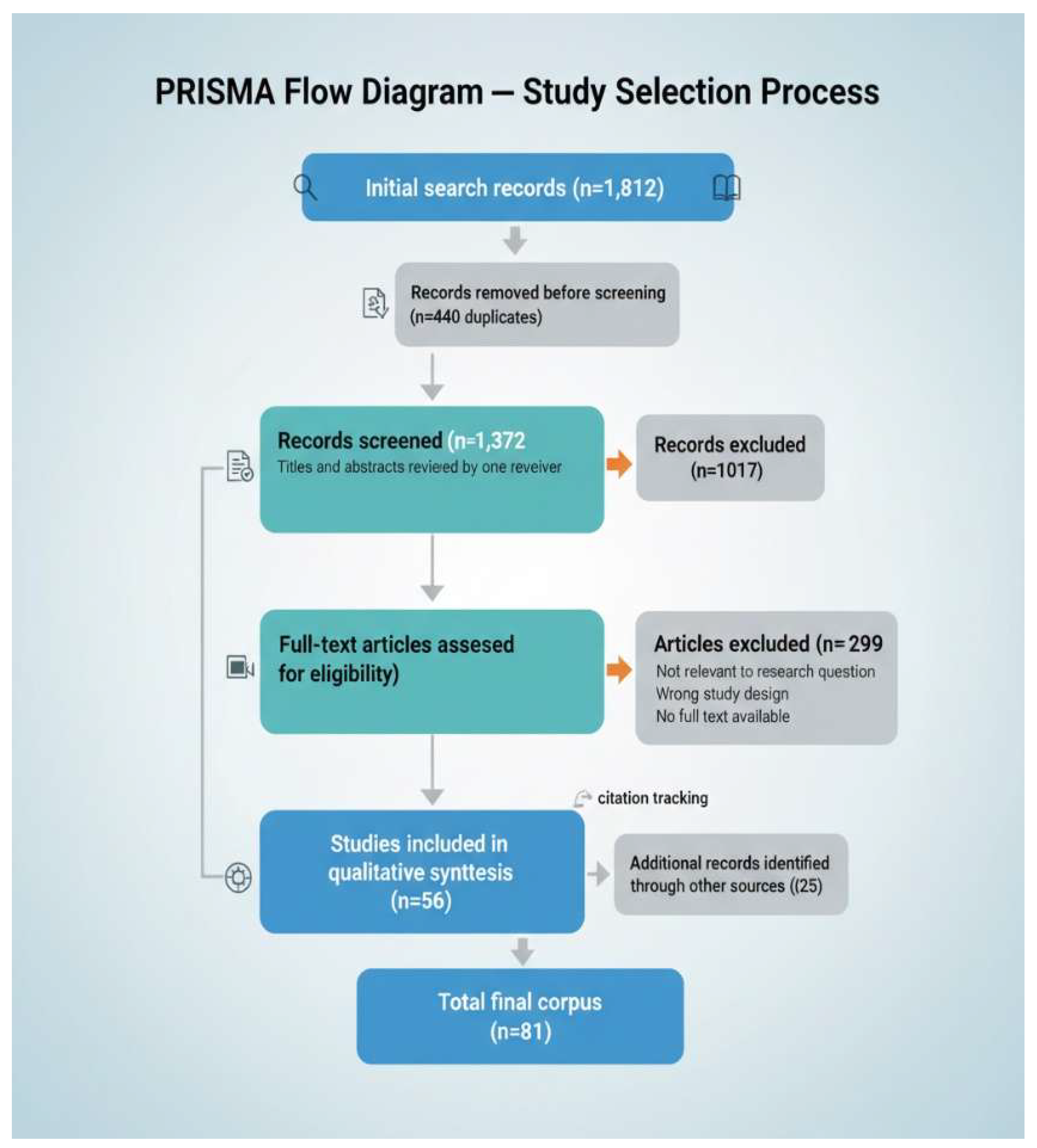
Table 1.
Structural Pressures of Population Ageing on Healthcare Systems.
| Pressure | Mechanism | Evidence Strength | System Implication | References |
| Age-related expenditure gradient | Per-capita costs rise sharply with age due to multimorbidity, frailty, and long-term care needs | Strong, consistently documented across OECD analyses | Sustained upward fiscal pressure. Demographic ageing alone adds 5–8 percentage points of GDP to public health expenditure by 2060 | [2,9,15] |
| Workforce demand expansion | Growing elderly population increases care demand while working-age population contracts | Strong, supported by workforce projections and policy reports | Persistent staffing shortages. Japan's nursing deficit approaches 250,000 workers by 2026 | [2,8] |
| Infrastructure and service strain | Older patients face longer stays, higher readmissions, and greater long-term care reliance | Moderate, consistent across utilisation studies | Capacity bottlenecks requiring expanded community care models and hospital throughput redesign | [2,32] |
| Care coordination complexity | Multimorbidity requires cross-specialty management across fragmented providers | Strong, documented in geriatric and health systems literature | Increased administrative burden and the need for integrated care pathways and longitudinal coordination | [10,14] |
Table 2.
Inverse Evidence: Complexity Relationship Across AI Application Domains.
| Application Domain | System Actors | Multi-Domain Integration | Evidence Classification | Relationship | Note |
| Diagnostic AI (imaging) | Low | Low, single modality | Strong | Strong evidence / low complexity | Benchmark domain |
| Medication adherence tools | Low to Moderate | Low to Moderate | Moderate | Evidence decreases as complexity increases | |
| Remote monitoring / telehealth | Moderate | Moderate | Moderate | Evidence decreases as complexity increases | |
| Workflow automation (ambient documentation) | Moderate | Moderate, single workflow | Emerging | Evidence decreases as complexity increases | |
| Assistive robotics (dementia) | Moderate to High | Moderate | Moderate, mainly specialist settings | Mixed | Ethics complexity high |
| Care coordination (multimorbidity) | High | High, cross-specialty | Emerging to Absent | Weakest evidence at highest complexity | Priority gap |
| Social isolation interventions | High | High | Absent | Inverse relationship strongest | Largest design challenge |
Table 3.
GDP Growth vs Healthcare Expenditure Pressure in Selected Ageing Economies. This table presents two distinct evidence types. Rows containing peer-reviewed empirical projections and documented AI efficiency findings appear in the main columns. The final column contains illustrative fiscal moderation scenarios derived by extrapolation from micro-level evidence. These scenarios are not validated macroeconomic estimates and should be treated as plausible hypotheses pending longitudinal evaluation at national scale.
Table 3.
GDP Growth vs Healthcare Expenditure Pressure in Selected Ageing Economies. This table presents two distinct evidence types. Rows containing peer-reviewed empirical projections and documented AI efficiency findings appear in the main columns. The final column contains illustrative fiscal moderation scenarios derived by extrapolation from micro-level evidence. These scenarios are not validated macroeconomic estimates and should be treated as plausible hypotheses pending longitudinal evaluation at national scale.
| Country | Proj. Avg GDP Growth 2030–2050 | Health Exp. % GDP | Proj. Health % GDP (2050 est.) | Documented AI Efficiency Gains (from literature) | Illustrative Fiscal Moderation Scenario |
| Japan | 0.5–0.8% p.a. [46] | 11.5% [2] | ~14–15% [9,15] | Remote monitoring reduces avoidable readmissions by 20–30% [19,20]; diagnostic AI reduces imaging costs by 30–40% [17,18,44]; workflow automation reduces documentation time by ~15% [41] | AI-enabled interventions could reduce health spending growth by 5–10% of baseline trajectory, avoiding about 0.5–1.0 percentage points of GDP by 2050 [9,46] |
| Germany | 0.5–1.0% p.a. [46] | 12.8% [2] | ~15–16% [9,15] | DiGA digital therapeutics reimbursement pathway established [16]; AI discharge coordination shows early readmission reduction [19]; ambient documentation reduces administrative burden [41] | AI deployment across LTC and hospitals could reduce spending growth by about 3–7% relative to baseline [9,15] |
| United States | 1.8–2.2% p.a. [46] | 16.9% [2] | ~22–25% [9] | Diagnostic AI reaches specialist-level accuracy [44]; remote monitoring reduces emergency utilisation in chronic disease pilots [19,20]; AI coordination emerging in value-based care [42] | AI-enabled value-based care models could reduce projected Medicare expenditure growth by about 5–10% [33,46] |
| Singapore | 1.5–2.5% p.a. [46,49] | 6.1% [49] | ~9–10% [49] | Healthier SG preventive care model [50]; NEHR-enabled AI diagnostics rollout [53]; robotic eldercare pilots in Active Ageing Hubs [54] | Integrated prevention and digital health strategy aims to keep spending near 9–10% of GDP [46,49,50] |
Note: Fiscal moderation scenarios are plausible projections derived from micro-level evidence and are not validated macroeconomic estimates.
Table 4.
Evidence and Limitations of AI Applications in Ageing Health Systems.
| Domain | Evidence Status | Outcome Type | Key Limitation | Quality Note |
| Remote monitoring | Established in pilot studies | Reduced admissions and emergency utilisation | Effects vary by context; limited mortality evidence | Steventon 2012 [19] findings qualified by subsequent analyses; see evidence note above |
| Assistive robotics | Established in dementia care settings | Improved mood, agitation, and engagement | Raises ethical questions about replacing human care | |
| Diagnostic AI | Established imaging tasks | Specialist-level diagnostic accuracy | Limited use in complex geriatric clinical reasoning | External validity of benchmark studies limited; see evidence note above |
| Medication adherence | Moderate and mixed evidence | Improved adherence and refill behaviour | Heterogeneous populations and self-reported outcomes | |
| Workflow automation | Early observational evidence | Reduced documentation burden and improved efficiency | Mostly short-term studies |
Note: Evidence qualifications summarise methodological limitations identified in frequently cited foundational studies within the literature.
Table 7.
AAF 3.0 — Structural Derivation, Temporal Readiness, and Evidence Status.
| Pillar | Pressure Addressed | Present Capability | Near-Term (3–7 yr) | Speculative Horizon | Evidence Status |
| Integrated Perception | Care coordination complexity; information fragmentation | Multimodal EHR + imaging + sensor integration in active study; routine triple-source integration uncommon | Expanded multimodal use in high-acuity settings; broader adoption dependent on HL7 FHIR | Population-scale 'Human Digital Twin' models remain research-based; governance unresolved [26] | Emerging to established in bounded domains; speculative for real-time comprehensive modelling |
| Autonomous Orchestration | Workforce expansion; coordination burden | Ambient documentation deployed with early burden reduction evidence [41]; single-domain scheduling operational | Cross-domain orchestration (2–3 domains) plausible in interoperable systems; full automation without oversight unlikely | Fully autonomous multi-domain coordination requires regulatory structures not yet established | Established for single-domain; emerging for cross-domain; speculative for autonomous authority |
| Adaptive Goal-Seeking | Multimorbidity; static protocol limits | Reinforcement learning explored in sepsis [27]; interpretability and reward challenges persist; no standard eldercare use | Adaptive personalisation plausible; autonomous medication optimisation remains experimental | Autonomous multi-condition optimisation requires advances in interpretability, reward design, and regulation | Experimental in adjacent domains; not established in eldercare; speculative for full optimisation |
Disclaimer/Publisher’s Note: The statements, opinions and data contained in all publications are solely those of the individual author(s) and contributor(s) and not of MDPI and/or the editor(s). MDPI and/or the editor(s) disclaim responsibility for any injury to people or property resulting from any ideas, methods, instructions or products referred to in the content. |
© 2026 by the authors. Licensee MDPI, Basel, Switzerland. This article is an open access article distributed under the terms and conditions of the Creative Commons Attribution (CC BY) license (http://creativecommons.org/licenses/by/4.0/).
Copyright: This open access article is published under a Creative Commons CC BY 4.0 license, which permit the free download, distribution, and reuse, provided that the author and preprint are cited in any reuse.


