

Submitted:
09 March 2026
Posted:
09 March 2026
You are already at the latest version
Abstract
Background: Drug-resistant tuberculosis (DR-TB) remains a major public health challenge in South Africa, particularly in rural settings with high HIV co-infection rates. Under-standing predictors of treatment response among people living with HIV is essential for improving clinical management and programmatic outcomes. This study aimed to iden-tify socio-demographic and clinical predictors of treatment outcomes among HIV-positive individuals diagnosed with multidrug-resistant (MDR) and extensively drug-resistant tuberculosis (XDR-TB) in the rural Eastern Cape Province, South Africa. Methods: A ret-rospective cohort study was conducted using routinely collected clinical records of DR-TB patients initiated on treatment between January 2020 and December 2024 at two public healthcare facilities. A total of 239 patients with complete treatment outcome data were included. Treatment outcomes were classified as favorable (cured or treatment completed) or unfavorable (death, treatment failure, or loss to follow-up). Descriptive statistics were used to summaries patient characteristics, while univariate and multivariable logistic re-gression analyses were performed to identify factors associated with treatment outcomes. Results: Most participants were aged ≤39 years (58%), male (60%), unemployed (90%), and without income (80%). MDR-TB accounted for 40% of cases, rifampicin-resistant TB (RR-TB) for 53%, and XDR-TB for 7.1%. Multivariable analysis showed that XDR-TB was the strongest independent predictor of unfavorable treatment outcome (AOR = 0.18; 95% CI: 0.06–0.58; p = 0.004). Income status was also significantly associated with outcome, with participants reporting some income having lower odds of favorable outcomes (AOR = 0.46; 95% CI: 0.23–0.92; p = 0.036). The model demonstrated modest predictive perfor-mance (AUC = 0.67). Conclusion: These findings highlight the dominant influence of re-sistance phenotype particularly XDR-TB on treatment prognosis among HIV-positive DR-TB patients in rural Eastern Cape. Integrating early resistance profiling, intensified clinical management of XDR-TB, and socioeconomic support mechanisms may improve treatment outcomes in high-burden rural settings.
Keywords:
drug-resistant tuberculosis
; XDR-TB
; MDR-TB
; HIV co-infection
; treatment outcomes
; predictors
; rural health
; Eastern Cape
; logistic regression
; public health
1. Introduction
Drug-resistant tuberculosis (DR-TB), including rifampicin-resistant (RR-TB), multidrug-resistant (MDR-TB), and extensively drug-resistant tuberculosis (XDR-TB), remains a major threat to global tuberculosis control [1,2]. South Africa is among the countries with the highest burden of both tuberculosis and HIV co-infection, with rural provinces such as the Eastern Cape experiencing disproportionate morbidity and mortality [3,4]. Among people living with HIV (PLHIV), treatment outcomes for DR-TB are frequently compromised by immune suppression, treatment toxicity, drug–drug interactions, and delayed diagnosis [5,6].
A growing body of evidence has identified several predictors influencing treatment outcomes in TB–HIV co-infected populations [3,7]. Clinical factors such as advanced immunosuppression, delayed initiation of antiretroviral therapy (ART), high bacillary burden, and extensive drug resistance are consistently associated with poorer outcomes [8,9]. In particular, XDR-TB significantly reduces treatment success due to resistance to key second-line agents, prolonged treatment duration, and limited therapeutic options [1,10]. Immunological status, often reflected by CD4 cell counts and viral load suppression, further influences treatment response, as severe immune compromise may impair the host’s ability to control Mycobacterium tuberculosis infection during therapy [11].
In addition to biological determinants, socio-demographic and structural factors also shape treatment outcomes. Variables such as age, gender, income status, education level, and employment can influence treatment adherence and access to healthcare [12,13]. Structural challenges including poverty, food insecurity, unstable employment, and limited health literacy may disrupt treatment continuity and contribute to delayed healthcare seeking [14,15]. Clinical history, including previous TB treatment, relapse status, and the extent of drug resistance, further complicates treatment trajectories and has been associated with unfavourable outcomes [16,17].
Despite growing global evidence, context-specific data from rural high-burden settings remain limited. Rural health systems often face additional constraints, including limited diagnostic capacity, delayed access to specialized DR-TB care, and broader socioeconomic vulnerability [18,19]. Identifying predictors of treatment outcomes among HIV-positive individuals with DR-TB in such settings is therefore essential for improving risk stratification, guiding targeted clinical management, and strengthening TB–HIV programme responses. This study aimed to identify sociodemographic and clinical predictors of treatment outcomes among HIV-positive individuals diagnosed with MDR- and XDR-pulmonary tuberculosis in rural Eastern Cape, South Africa.
2. Materials and Methods
2.1. Study Design and Setting
A retrospective cohort study was conducted using routinely collected clinical records of patients diagnosed with drug-resistant tuberculosis (DR-TB) who were initiated on treatment at two purposively selected public health clinics in the Eastern Cape Province, South Africa, between January 2020 and December 2024. The study sites were selected to represent both rural and peri-urban healthcare settings within the province.
A total of 385 patients with complete sociodemographic, clinical, and treatment outcome data were included in the analysis. Patients with missing treatment outcome information or incomplete records were excluded. Eligible participants comprised individuals with microbiologically confirmed rifampicin-resistant tuberculosis (RR-TB), multidrug-resistant tuberculosis (MDR-TB), pre-extensively drug-resistant tuberculosis (Pre-XDR-TB), or extensively drug-resistant tuberculosis (XDR-TB). These categories were included to reflect the full clinical spectrum of DR-TB as currently defined by the World Health Organization, thereby enhancing the comparability of findings with global evidence.
The use of retrospective routine programme data enabled the inclusion of a larger sample size and allowed for the assessment of treatment outcomes under real-world clinical and programmatic conditions.
2.2. Study Variables
The primary outcome was treatment outcome, classified as favorable (cured or treatment completed) or unfavourable (death, treatment failure, or loss to follow-up). Independent variables included sociodemographic factors (age, sex, education level, income, occupation), clinical characteristics (comorbidities, previous TB treatment history, patient category, type of resistance, and type of DR-TB), and social history variables.
2.3. Statistical Analysis
Descriptive statistics were used to summarize patient characteristics. Categorical variables were presented as frequencies and percentages, while continuous variables were summarized using means and standard deviations or medians and interquartile ranges, depending on the distribution.
Univariate logistic regression was performed to assess the association between each independent variable and treatment group membership. Variables with a p-value <0.20 in univariate analysis were considered for inclusion in the multivariate logistic regression model.
Multivariate logistic regression was then conducted to identify independent factors associated with treatment group membership. Adjusted odds ratios (AORs) with 95% confidence intervals (CIs) were reported. Multicollinearity was assessed using the variance inflation factor (VIF). Model fit was evaluated using Hosmer-Lemeshow goodness-of-fit test and residual deviance. The discriminative ability of the model was assessed using the area under the receiver operating characteristic curve (AUC).
All analyses were performed in R version 4.5.2 (2025-10-31 ucrt), and statistical significance was set at p < 0.05.
3. Results
3.1. Participant Characteristics
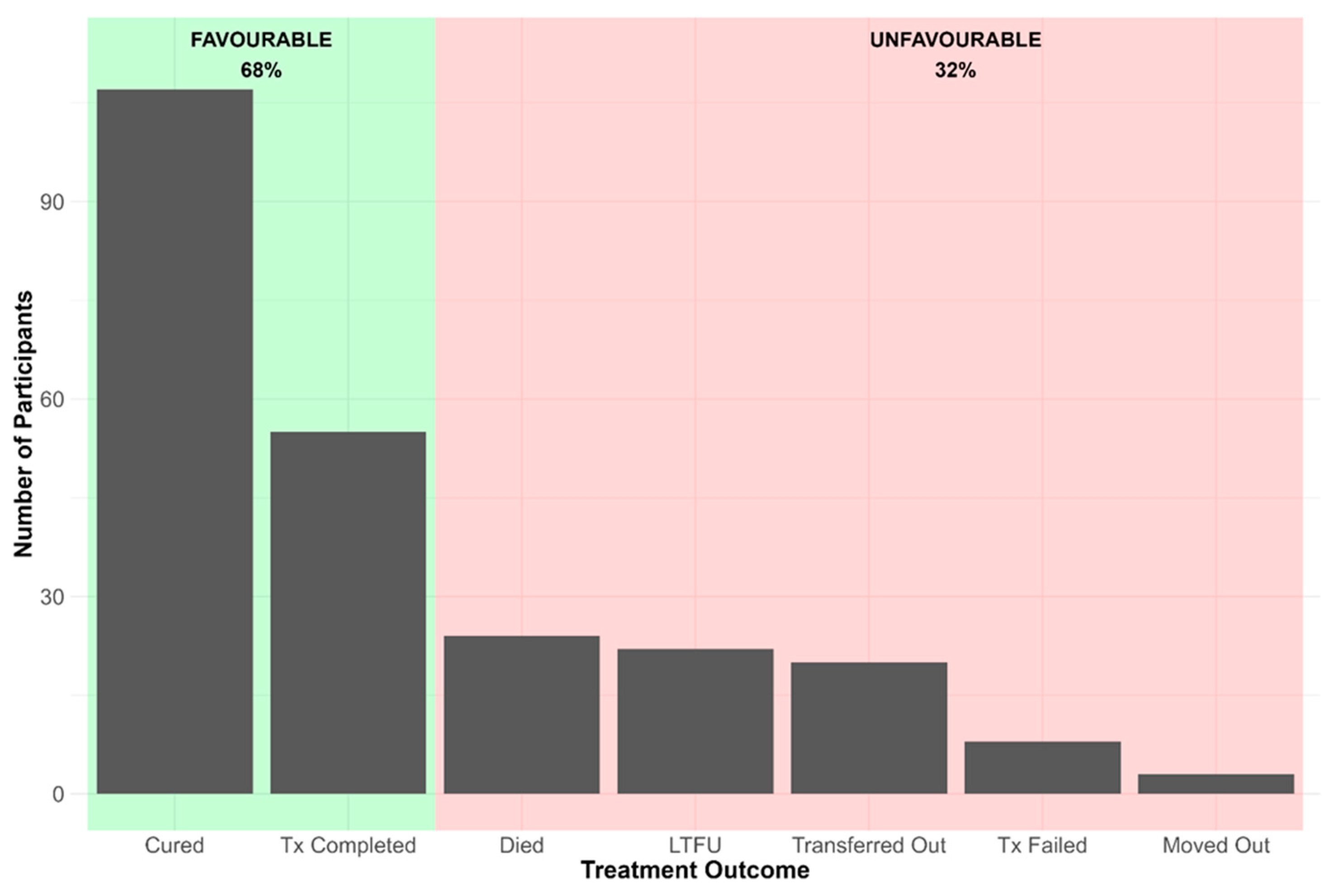
A total of 239 participants with complete clinical and treatment outcome data were included in the analysis. Treatment outcomes were classified as favorable (cured or treatment completed) or unfavourable (death, treatment failure, or loss to follow-up).
Figure 1.
Plot of number of participants by treatment outcome.
3.1.2. Socio-Demographic Characteristics
Table 1 presents the distribution of socio-demographic characteristics stratified by treatment outcome (favorable vs unfavourable). Most participants were aged ≤39 years (58%), male (60%), unemployed (90%), and had no income (80%). The majority had poly-drug resistance (61%) and RR-TB (53%), while 7.1% were diagnosed with XDR-TB
3.1.3. Age Distribution
The majority of participants were aged ≤39 years (58%). Among those with favorable outcomes, 61% were ≤39 years compared to 52% in the unfavourable group. Conversely, participants aged ≥50 years constituted a larger proportion of the unfavourable group (22%) compared to the favorable group (15%). This pattern suggests a potential trend toward poorer treatment outcomes among older individuals, although formal statistical testing is required to confirm significance. Participants aged 40–49 years were similarly distributed across favorable (24%) and unfavourable (26%) outcomes, indicating no marked difference in this age category.
3.1.4. Gender
Overall, 60% of participants were male and 40% were female. Males represented a higher proportion of the favorable outcome group (63%) compared to the unfavourable group (53%). In contrast, females constituted a greater proportion of the unfavourable group (47%) compared to the favorable group (37%). This distribution suggests a possible gender-related difference in treatment response; however, the magnitude of difference appears modest.
3.1.5. Education Level
Educational attainment was similar across outcome categories. The majority of participants had medium-level education (70%), followed by low (19%) and high (10%) education. The proportions were nearly identical between favourable and unfavourable groups, indicating no observable association between education level and treatment outcome at the descriptive level.
3.1.6. Income Status
Most participants reported having no income (80%). However, individuals with no income were more frequently represented in the favourable outcome group (84%) compared to the unfavourable group (73%). Conversely, those with some income comprised a larger proportion of the unfavourable group (27%) compared to the favourable group (16%). This pattern suggests a counterintuitive trend whereby participants with some income appeared more likely to experience unfavourable outcomes. This finding warrants further analytical exploration to understand underlying socioeconomic dynamics.
3.1.7. Occupation
The majority of participants were unemployed (90%). Unemployment was slightly more common in the unfavourable group (92%) compared to the favourable group (88%). Employment was more frequent among those with favourable outcomes (12%) compared to those with unfavourable outcomes (7.8%). However, the overall number of employed individuals was small, limiting strong descriptive inference.
3.1.8. Social History
Most participants reported no substance use history (61%). A slightly higher proportion of individuals with no substance use were observed in the unfavourable group (65%) compared to the favourable group (59%). Single substance use was somewhat more common among those with favourable outcomes (28%) compared to unfavourable outcomes (23%), while multiple substance use was similarly distributed across groups (14% vs 12%).
3.1.9. Clinical Characteristics
Table 2 summarizes the clinical characteristics of participants stratified by treatment outcome (favourable vs unfavourable).
3.1.10. Previous Drug History
The majority of participants (59%) had a history of previous TB treatment, while 41% were newly treated cases. The distribution was similar between outcome groups: 59% of those with favourable outcomes and 61% of those with unfavourable outcomes had prior treatment history. This suggests that previous TB treatment exposure was common in this cohort but did not demonstrate a marked descriptive difference between outcome groups.
3.1.11. Patient Category
When categorized by patient classification at presentation, new cases constituted 42% of the overall cohort, with a slightly higher proportion observed among those with favourable outcomes (44%) compared to those with unfavourable outcomes (39%). Relapse cases accounted for 40% overall and were marginally more represented in the unfavourable group (42%) than in the favourable group (39%). Treatment failure cases comprised 18% of the cohort, with comparable proportions between favourable (17%) and unfavourable (19%) outcomes. Overall, the distribution of patient categories was relatively balanced across outcome groups, suggesting no strong descriptive association between patient classification and treatment outcome. However, relapse and treatment failure cases were modestly more frequent among individuals with unfavourable outcomes, indicating a possible trend that warrants further analytical assessment.
3.1.12. Type of Resistance (Mono vs Poly Drug Resistance)
Poly-drug resistance was more common (61%) than mono-resistance (39%) in the overall cohort. Among participants with unfavourable outcomes, 64% had poly-resistance compared to 60% in the favourable group. Conversely, mono-resistance was slightly more common in the favourable group (40%) compared to the unfavourable group (36%). Although the difference is modest, this trend suggests that broader resistance profiles may be associated with poorer outcomes.
3.1.13. Type of DR-TB
The distribution of DR-TB type demonstrated clear differences across treatment outcome groups. Overall, MDR-TB accounted for 40% of cases, with a slightly higher proportion observed among participants with favourable outcomes (42%) compared to those with unfavourable outcomes (35%). Similarly, RR-TB constituted 53% of the cohort and was more common in the favourable group (55%) than in the unfavourable group (49%). In contrast, XDR-TB represented only 7.1% of the total cohort but showed a pronounced imbalance between outcome categories, comprising 3.1% of favourable cases and 16% of unfavourable cases. This substantial overrepresentation of XDR-TB among participants with unfavourable outcomes suggests a strong descriptive association between XDR-TB and poorer treatment response.
3.1.14. Comorbidity
Most participants (96%) had a single comorbidity, while only 4.2% had multiple comorbidities. Multiple comorbidities were slightly more frequent in the favourable group (4.9%) than in the unfavourable group (2.6%).
3.2. Univariate Analysis
Univariate logistic regression identified several variables meeting the threshold (p < 0.20) for multivariable modelling (Table 3). Patients with XDR-TB had significantly lower odds of favourable treatment outcomes compared to those with MDR-TB (OR = 0.17; 95% CI: 0.06–0.50; p = 0.002). Participants reporting some income also had reduced odds of favourable outcomes compared to those with no income (OR = 0.51; 95% CI: 0.27–0.95; p = 0.043). Age ≥50 years (OR = 0.57; p = 0.127) and male gender (OR = 1.49; p = 0.153) demonstrated non-significant trends toward association with treatment outcome.
3.3. Multivariable Logistic Regression
Variables with p < 0.20 in univariate analysis (age group, gender, type of DR-TB, income, and comorbidity type) were included in the multivariable model (Table 4).
3.3.1. Type of DR-TB
XDR-TB remained independently associated with significantly reduced odds of favourable treatment outcome compared to MDR-TB (AOR = 0.18; 95% CI: 0.06–0.58; p = 0.004). RR-TB did not significantly differ from MDR-TB (p = 0.749).
3.3.2. Income
Participants reporting some income had significantly lower odds of favourable outcomes compared to those without income (AOR = 0.46; 95% CI: 0.23–0.92; p = 0.036).
3.3.3. Age and Gender
Age ≥50 years showed a borderline association with reduced favourable outcomes (AOR = 0.51; 95% CI: 0.24–1.09; p = 0.089). Male gender was not significantly associated with outcome (AOR = 1.55; p = 0.146).
3.3.4. Comorbidity Type
Comorbidity type was not independently associated with treatment outcome (p = 0.143).
3.4. Model Performance
No evidence of multicollinearity was observed (GVIF values ≈1 for all predictors) table 5.

Table 5.
Testing for multicollinearity.
| Variable | GVIF^(1/(2*Df)) | Interpretation |
| Age group | 1.01 | Very low; no multicollinearity |
| Gender | 1.02 | Very low; no multicollinearity |
| Type of DR-TB | 1.01 | Very low; no multicollinearity |
| Income | 1.04 | Very low; no multicollinearity |
| Comorbidity type | 1.05 | Very low; no multicollinearity |
GVIF = Generalized Variance Inflation Factor; Df = degrees of freedom. GVIF^(1/(2Df)) values <5 indicate absence of problematic multicollinearity.*.
Figure 2 illustrates the receiver operating characteristic (ROC) curve for the multivariable logistic regression model predicting treatment outcomes among HIV-positive individuals with drug-resistant tuberculosis in rural Eastern Cape, South Africa. The model showed modest discriminative ability (AUC = 0.67) in distinguishing favourable from unfavourable outcomes and demonstrated adequate calibration based on the Hosmer–Lemeshow goodness-of-fit test (χ² = 12.74, df = 8, p = 0.121). No multicollinearity was detected among predictors (VIF < 5).
4. Discussion
In this retrospective cohort study of HIV-positive individuals with DR-TB in rural Eastern Cape, we examined socio-demographic and clinical predictors of treatment outcome using both descriptive and multivariable analyses. The discussion is structured to reflect the progression of findings presented in the Results section.
4.1. Descriptive Patterns in Socio-Demographic Characteristics
At the descriptive level, younger participants (≤39 years) were more frequently represented among favorable outcomes, whereas older individuals (≥50 years) were proportionally more common in the unfavorable group. Although differences were modest, this pattern suggests a potential age-related vulnerability that may reflect immunosenescence, comorbidity burden, or reduced physiological resilience among older HIV-positive patients. These findings are consistent with several studies in Africa and globally suggesting physiological decline associated with aging [20,21,22,23,24]. On the contrary, a study by Hosu et al., suggested that older age improves outcomes, whereas others link earlier or middle age to better outcomes owing to differences in study populations [25].
Gender differences were observed descriptively, with males more represented in the favourable outcome group and females proportionally higher in the unfavourable group. However, the magnitude of difference was small, suggesting that sex alone may not be a dominant determinant of treatment response in this cohort. In contrast, several studies associated males as predictors of poorer treatment outcomes which then suggests differences may be due to variability across regions and cohorts [22,26,27]. This discrepancy in findings encourages the consideration of exploring other predictors including socioeconomic status, ART adherence, health seeking behavior and substance use rather than treating gender solely.
Income distribution revealed an unexpected pattern: participants reporting some income were more frequently represented in the unfavourable group compared to those without income. Conversely, low income has been associated with reduced treatment success driven by barriers such as treatment access, food insecurity and treatment adherence [28]. This counterintuitive observation may reflect informal or unstable employment patterns common in rural settings, potentially contributing to treatment interruptions or reduced healthcare engagement.
Educational attainment and occupational status demonstrated minimal variation across outcome categories, suggesting limited descriptive association with treatment outcome. However, a previous cohort study indicated that lower educational level has been associated with increased treatment default, poor treatment adherence and delayed healthcare seeking behaviors resulting to poorer treatment success [29]. This then emphasizes the need for structural and patient-centered health literacy interventions.
4.2. Descriptive Patterns in Clinical Characteristics
Previous TB treatment exposure was common in the cohort but showed no meaningful imbalance between favourable and unfavourable groups. Similarly, patient classification (new, relapse, treatment failure) demonstrated relatively balanced distribution across outcomes, although relapse and treatment failure cases were slightly more represented among unfavourable outcomes. Comparably, a recent DR-TB database analysis in Cameroon reported that a history of previous DR-TB was significantly associated with poor treatment outcomes, including increased risk of death or treatment refusal. This suggests that retreatment cases (i.e., treatment exposure) are more vulnerable to unsuccessful outcomes [30].
Poly-drug resistance was marginally more common in the unfavourable group compared to mono-resistance; however, the difference was modest. In contrast, the distribution of DR-TB subtype revealed a pronounced imbalance. XDR-TB represented a small proportion of the overall cohort but was substantially overrepresented among participants with unfavourable outcomes. These findings were similar to those reported by Safaev et al., and the 2020 Global TB reports by the WHO [31,32]. This descriptive signal strongly suggested a clinically meaningful association between XDR-TB and poorer treatment response.
4.3. Univariate Associations
Univariate analysis confirmed the descriptive trends. XDR-TB was significantly associated with reduced odds of favorable outcome compared to MDR-TB. Income status was also significantly associated with outcome, with participants reporting some income demonstrating lower odds of favorable response. Age ≥50 years and male gender showed trends toward association but did not reach statistical significance. Other variables, including education level, social history, patient category, and resistance type (mono vs poly), were not significantly associated with outcome in univariate models. These findings refined the descriptive observations and identified variables warranting inclusion in multivariable modelling.
4.4. Independent Predictors of Treatment Outcome
In multivariable analysis, XDR-TB remained the strongest independent predictor of unfavourable outcome. Patients with XDR-TB had markedly reduced odds of achieving favourable treatment outcomes compared to those with MDR-TB. Correspondingly, a review article emphasized the need for health initiatives aimed at improving outcomes for XDR-TB patients by prioritizing XDR-TB prevention activities [33]. This finding is consistent with global evidence demonstrating poorer survival and increased treatment failure among XDR-TB patients due to limited therapeutic options, delayed culture conversion, and higher regimen toxicity [34,35].
Income status also remained independently associated with treatment outcome. Participants with some income had lower odds of favourable outcomes compared to those with no income. In rural Eastern Cape, income may reflect informal employment, seasonal work, or labour migration, potentially disrupting treatment continuity. Conversely, individuals without income may qualify for disability grants or structured social support, which may facilitate adherence. These findings were consistent with studies in Uganda, Kenya, Ethiopia and South Africa suggesting the need for targeted adherence support, risk stratification and social protection measures [3,24,26,37].
Age ≥50 years demonstrated borderline association in the multivariable model, maintaining the same directional trend observed descriptively. While not statistically significant, the magnitude of effect suggests potential clinical relevance. Moreover, Given that age is a non-modifiable disease risk factor, sensitizing vulnerable age groups to prevent TB-HIV co-infection may help attenuate its negative consequences [38]. Gender and comorbidity type were not independently associated with outcome after adjustment, indicating that their descriptive differences were likely confounded by other variables.
4.5. Model Performance and Implications
The multivariable model demonstrated adequate calibration, as indicated by the non-significant Hosmer–Lemeshow goodness-of-fit test, suggesting that the predicted probabilities were reasonably consistent with the observed outcomes. Additionally, no evidence of problematic multicollinearity was detected among the predictors, indicating that the independent variables included in the model were sufficiently distinct and did not distort the regression estimates. These findings support the internal validity of the model and suggest that the identified predictors were appropriately specified within the analytical framework.
Despite adequate calibration, the model’s discriminative ability was modest, with an area under the receiver operating characteristic curve (AUC) of 0.67. An AUC in this range indicates that the model performs better than chance in distinguishing between favourable and unfavourable treatment outcomes, but its predictive accuracy remains limited. This level of performance is not uncommon in studies using routine programmatic data, where clinical records may lack detailed biological, behavioural, and adherence-related variables that could enhance predictive precision [39]. The modest AUC therefore reflects the complexity of DR-TB treatment outcomes, which are influenced by a multifactorial interplay of biological, clinical, and socioeconomic determinants.
The findings suggest that while key variables such as DR-TB subtype particularly XDR-TB and income status contribute meaningfully to predicting treatment outcomes, additional predictors are likely necessary to strengthen model performance. Variables that were not available in this dataset, such as CD4 cell count, viral load suppression, antiretroviral therapy adherence, treatment regimen composition, time to culture conversion, nutritional status, and adherence support mechanisms, may substantially improve predictive accuracy. These factors are known to influence treatment response among HIV-positive individuals with drug-resistant tuberculosis and may capture aspects of disease severity and treatment engagement not reflected in routine demographic or clinical variables.
From a programmatic perspective, the model nonetheless provides valuable insights for clinical risk stratification. Identifying XDR-TB as a dominant predictor of unfavourable outcome reinforces the need for early molecular resistance profiling and intensified clinical monitoring of patients with highly resistant disease. Similarly, the observed association with income status highlights the importance of addressing structural determinants of health through social protection, adherence support, and patient-centred care interventions. Future predictive modelling efforts in high-burden rural settings should aim to integrate clinical, immunological, behavioral, and health system variables, potentially using larger datasets and advanced modelling approaches such as machine learning to improve predictive performance and support precision public health strategies for DR-TB management.
5. Strengths and Limitations
This study utilized real-world programmatic data from rural public health facilities, enhancing external validity. Inclusion of the full WHO spectrum of DR-TB categories strengthens comparability with global evidence. However, limitations include retrospective design, potential residual confounding, absence of immunological markers (e.g., CD4 count), and limited granularity of socioeconomic variables.
6. Conclusions
In this cohort of HIV-positive individuals with drug-resistant tuberculosis in rural Eastern Cape, resistance phenotype particularly XDR-TB emerged as the strongest independent predictor of unfavorable treatment outcome, underscoring its dominant clinical influence on prognosis. Socioeconomic context, notably income status, also independently affected outcomes, reflecting the interaction between biological resistance mechanisms and structural determinants of health. These findings emphasize the importance of early molecular resistance profiling, intensified and targeted management of XDR-TB cases, and integration of socioeconomic support within DR-TB treatment programmes. Future predictive models should incorporate immunological markers and adherence-related variables to strengthen risk stratification and support precision public health approaches in high-burden rural settings.
Author Contributions
Conceptualization, T.Z.; and M.F.; methodology, T.Z.; and L.M.F.; software, U.T.; validation, T.Z., L.M.F., and M.F.; formal analysis, U.T.; L.M.F., and N.S.; investigation, T.Z., L.M.F.; data curation, T.Z., U.T., and L.M.F.; writing original draft preparation, T.Z.; U.T.; L.M.F.; writing review and editing, T.Z., N.S., and L.M.F.; visualization, U.T.; Supervision, M.F. All authors have read and agreed to the published version of the manuscript.
Funding
Walter Sisulu University, Faculty of medicine and health sciences, School of Health funds were used conduct of this study and the Department of public health took responsibility of paying journal APC fess.
Institutional Review Board Statement
This study was conducted by the Declaration of Helsinki. Approval granted Research Ethics and Biosafety Committee of the Faculty of Health Sciences of Walter Sisulu University (Ref. No. 171/2025, 09 July 2025).
Informed Consent Statement
No informed consent was required for the study as it involved review of clinical records in the clinics retrospectively following all ethical guidelines.
Data Availability Statement
Data can be requested from the corresponding author.
Acknowledgments
Authors would like to acknowledge Walter Sisulu University TB Research Group – 2025 Honours students for assisting in data collection and Health care professionals in clinics for the guidance in patient clinical records review and data extraction.
Conflicts of Interest
The authors declare no conflicts of interest.
Abbreviations
The following abbreviations are used in this manuscript:
| TB | Tuberculosis |
| DR-TB | Drug resistant tuberculosis |
| RR-TB | Rifampicin resistant tuberculosis |
| MDR-TB | Multi drug resistant tuberculosis |
| Pre-XDR-TB | Pre-extensively drug-resistant |
| XDR-TB | Extensively drug-resistant |
| WHO | World Health Organization |
| HIV | Human immunodeficiency virus |
References
- Tiberi, S; Utjesanovic, N; Galvin, J; Centis, R; D'Ambrosio, L; van den Boom, M; Zumla, A; Migliori, GB. Drug resistant TB–latest developments in epidemiology, diagnostics and management. International Journal of Infectious Diseases 2022, 124, S20–5. [Google Scholar] [CrossRef] [PubMed]
- Chowdhury, K; Ahmad, R; Sinha, S; Dutta, S; Haque, M. Multidrug-resistant TB (MDR-TB) and extensively drug-resistant TB (XDR-TB) among children: where we stand now. Cureus 2023, 15(2), e35154. [Google Scholar] [CrossRef] [PubMed]
- Dlatu, N; Faye, LM; Apalata, T. Outcomes of Treating Tuberculosis Patients with Drug-Resistant Tuberculosis, Human Immunodeficiency Virus, and Nutritional Status: The Combined Impact of Triple Challenges in Rural Eastern Cape. International Journal of Environmental Research and Public Health 2025, 22(3), 319. [Google Scholar] [CrossRef]
- Hosu, MC; Faye, LM; Apalata, T. Comorbidities and treatment outcomes in patients diagnosed with drug-resistant tuberculosis in rural Eastern Cape Province, South Africa. Diseases 2024, 12(11), 296. [Google Scholar] [CrossRef]
- Singh, A; Prasad, R; Balasubramanian, V; Gupta, N. Drug-resistant tuberculosis and HIV infection: current perspectives. HIV/AIDS-Research and Palliative Care 2020, 9–31. [Google Scholar] [CrossRef] [PubMed]
- Teferi, MY; El-Khatib, Z; Boltena, MT; Andualem, AT; Asamoah, BO; Biru, M; Adane, HT. Tuberculosis treatment outcome and predictors in Africa: a systematic review and meta-analysis. International journal of environmental research and public health 2021, 18(20), 10678. [Google Scholar] [CrossRef]
- Dlatu, N; Faye, LM; Sineke, N; Apalata, T. Predictors of drug-resistant TB outcomes: Body mass index, HIV, and comorbidities. African Journal of Primary Health Care & Family Medicine 2025, 17(1), 4953. [Google Scholar] [CrossRef]
- SeyedAlinaghi, S; Afsahi, AM; Moradi, A; Parmoon, Z; Habibi, P; Mirzapour, P; Dashti, M; Ghasemzadeh, A; Karimi, E; Sanaati, F; Hamedi, Z. Current ART, determinants for virologic failure and implications for HIV drug resistance: an umbrella review. AIDS research and therapy 2023, 20(1), 74. [Google Scholar] [CrossRef]
- Alara, JA; Alara, OR. An overview of the global alarming increase of multiple drug resistant: a major challenge in clinical diagnosis. Infectious Disorders-Drug TargetsDisorders 2024, 24(3), 26–42. [Google Scholar] [CrossRef]
- Borah, P; Deb, PK; Venugopala, KN; Al-Shar'i, NA; Singh, V; Deka, S; Srivastava, A; Tiwari, V; Mailavaram, RP. Tuberculosis: an update on pathophysiology, molecular mechanisms of drug resistance, newer anti-TB drugs, treatment regimens and host-directed therapies. Current Topics in Medicinal Chemistry 2021, 21(6), 547–70. [Google Scholar] [CrossRef]
- Odoom, A; Osman, AH; Dzuvor, CK. Recent advances in immunotherapeutic and vaccine-based approaches for the treatment of drug-resistant bacterial infections. ACS Infectious Diseases 2025, 11(6), 1366–402. [Google Scholar] [CrossRef]
- Faye, LM; Hosu, MC; Dlatu, N; Iruedo, J; Apalata, T. Predicting treatment adherence in patients with drug-resistant tuberculosis: insights from socioeconomic, demographic, and clinical factors of patients in the rural Eastern Cape. Frontiers in Tuberculosis 2025, 3, 1659333. [Google Scholar] [CrossRef]
- Kimani, E; Muhula, S; Kiptai, T; Orwa, J; Odero, T; Gachuno, O. Factors influencing TB treatment interruption and treatment outcomes among patients in Kiambu County, 2016-2019. PloS one 2021, 16(4), e0248820. [Google Scholar] [CrossRef]
- Reddy, SC; Mohan, KG; Jain, K. Impact of socioeconomic factors on the treatment of tuberculosis. In InEmerging Paradigms in Delivery Systems for Antitubercular Therapy; Academic Press, 1 Jan 2025; pp. 353–369. [Google Scholar]
- Gilmour, B; Alene, KA. Ending tuberculosis: Challenges and opportunities. Frontiers in Tuberculosis 2024, 2, 1487518. [Google Scholar] [CrossRef]
- Dookie, N; Ngema, SL; Perumal, R; Naicker, N; Padayatchi, N; Naidoo, K. The changing paradigm of drug-resistant tuberculosis treatment: successes, pitfalls, and future perspectives. Clinical Microbiology Reviews 2022, 35(4), e00180-19. [Google Scholar] [CrossRef] [PubMed]
- Soedarsono, S; Mertaniasih, NM; Kusmiati, T; Permatasari, A; Ilahi, WK; Anggraeni, AT. Characteristics of previous tuberculosis treatment history in patients with treatment failure and the impact on acquired drug-resistant tuberculosis. Antibiotics 2023, 12(3), 598. [Google Scholar] [CrossRef] [PubMed]
- Shah, HD; Nazli Khatib, M; Syed, ZQ; Gaidhane, AM; Yasobant, S; Narkhede, K; Bhavsar, P; Patel, J; Sinha, A; Puwar, T; Saha, S. Gaps and interventions across the diagnostic care cascade of TB patients at the level of patient, community and health system: a qualitative review of the literature. Tropical Medicine and Infectious Disease 2022, 7(7), 136. [Google Scholar] [CrossRef] [PubMed]
- Al-Worafi, YM. Tuberculosis management in developing countries. In InHandbook of Medical and Health Sciences in Developing Countries: Education, Practice, and Research; Springer International Publishing: Cham, 30 Nov 2023; pp. 1–40. [Google Scholar]
- Matambo, R.; Nyandoro, G.; Sandy, C.; Nkomo, T.; Mutero-Munyati, S.; Mharakurwa, S.; Chikaka, E.; Ngwenya, M.; Ndongwe, G.; Pepukai, V.M. Predictors of mortality and treatment success of multi-drug resistant and Rifampicin resistant tuberculosis in Zimbabwe: a retrospective cohort analysis of patients initiated on treatment during 2010 to 2015. The Pan African Medical Journal 2021, 39, 128. [Google Scholar] [CrossRef]
- Nangombe, V.N.T. Predictors of treatment success among patients with drug resistant Tuberculosis in Namibia. Doctoral dissertation, University of Namibia, 2022. [Google Scholar]
- Johnson, J.M.; Mohapatra, A.K.; Velladath, S.U.; Shettigar, K.S. Predictors of treatment outcomes in drug resistant tuberculosis-observational retrospective study. The International Journal of Mycobacteriology 2022, 11(1), 38–46. [Google Scholar] [CrossRef]
- Leketa, M.M.; Zondi, S.; Cele, L.; Mathibe, M.; Ngwepe, P. Factors associated with unfavourable treatment outcomes among tuberculosis patients at health facilities of Maseru, Lesotho. South African Family Practice 2024, 66(1), 6004. [Google Scholar] [CrossRef]
- Nxumalo, E. L.; Sineke, N.; Dlatu, N.; Apalata, T.; Faye, L. M. Treatment Outcomes of Tuberculosis in the Eastern Cape: Clinical and Socio-Demographic Predictors from Two Rural Clinics. International Journal of Environmental Research and Public Health 2025, 22(12), 1804. [Google Scholar] [CrossRef]
- Hosu, M. C.; Faye, L. M.; Apalata, T. Optimizing Drug-Resistant Tuberculosis Treatment Outcomes in a High HIV-Burden Setting: A Study of Sputum Conversion and Regimen Efficacy in Rural South Africa. Pathogens 2025, 14(5), 441. [Google Scholar] [CrossRef]
- Fekadu, G.; Turi, E.; Kasu, T.; Bekele, F.; Chelkeba, L.; Tolossa, T.; Labata, B. G.; Dugassa, D.; Fetensa, G.; Diriba, D. C. Impact of HIV status and predictors of successful treatment outcomes among tuberculosis patients: A six-year retrospective cohort study. Annals of medicine and surgery (2012) 2020, 60, 531–541. [Google Scholar] [CrossRef]
- Baluku, J.B.; Mukasa, D.; Bongomin, F.; et al. Gender differences among patients with drug resistant tuberculosis and HIV co-infection in Uganda: a countrywide retrospective cohort study. BMC Infect Dis 2021, 21, 1093. [Google Scholar] [CrossRef] [PubMed]
- Barteka, G.; Bwayo, D.; Matovu, J.K.; Wanume, B.; Alunyo, J.P.; Sseguya, R.; Masaba, J.P.; Obbo, J.S. Treatment outcomes and predictors of success for multidrug resistant tuberculosis MDR TB in Ugandan regional referral hospitals. Scientific Reports 2025, 15(1), 14144. [Google Scholar] [CrossRef]
- Tian, M.; Ding, H.; Lu, P.; et al. Determinants of treatment success and cost implications in MDR/RR-TB patients: a prospective cohort study in China. Sci Rep 2025, 15, 34370. [Google Scholar] [CrossRef]
- Mbuh, T.P.; Mendjime, P.; Goupeyou-Wandji, I.A.; Donkeng-Donfack, V.F.; Kahou, J.; Endale Mangamba, L.M.; Mefoug, S.; Bisso Ngono, P.A.; Esso, L.; Etoundi Mballa, G.A. Trends of drug-resistant tuberculosis and risk factors to poor treatment-outcome: a database analysis in Littoral region-Cameroon, 2013–2022. BMC Public Health 2024, 24(1), 3195. [Google Scholar] [CrossRef]
- World Health Organization. Global tuberculosis report 2020: executive summary.
- Safaev, K.; Parpieva, N.; Liverko, I.; Yuldashev, S.; Dumchev, K.; Gadoev, J.; Korotych, O.; Harries, A. D. Trends, Characteristics and Treatment Outcomes of Patients with Drug-Resistant Tuberculosis in Uzbekistan: 2013–2018. International Journal of Environmental Research and Public Health 2021, 18(9), 4663. [Google Scholar] [CrossRef] [PubMed]
- Varshney, K.; Anaele, B.; Molaei, M.; Frasso, R.; Maio, V. Risk Factors for Poor Outcomes Among Patients with Extensively Drug-Resistant Tuberculosis (XDR-TB): A Scoping Review. Infection and Drug Resistance 2021, 14, 5429–5448. [Google Scholar] [CrossRef] [PubMed]
- Saukkonen, JJ; Duarte, R; Munsiff, SS; Winston, CA; Mammen, MJ; Abubakar, I; Acuña-Villaorduña, C; Barry, PM; Bastos, ML; Carr, W; Chami, H. Updates on the treatment of drug-susceptible and drug-resistant tuberculosis: an official ATS/CDC/ERS/IDSA clinical practice guideline. American Journal of Respiratory and Critical Care Medicine 2025, 211(1), 15–33. [Google Scholar] [CrossRef]
- Pedersen, O.S.; Butova, T.; Kapustnyk, V.; Miasoiedov, V.; Kuzhko, M.; Hryshchuk, L.; Kornaha, S.; Borovok, N.; Raznatovska, O.; Fedorec, A.; Bogomolov, A. Treatment outcomes and risk factors for an unsuccessful outcome among patients with highly drug-resistant tuberculosis in Ukraine. Clinical Microbiology and Infection 2024, 30(3), 360–367. [Google Scholar] [CrossRef] [PubMed]
- Nidoi, J.; Muttamba, W.; Walusimbi, S.; Imoko, J.F.; Lochoro, P.; Ictho, J.; Mugenyi, L.; Sekibira, R.; Turyahabwe, S.; Byaruhanga, R.; Putoto, G. Impact of socio-economic factors on Tuberculosis treatment outcomes in north-eastern Uganda: a mixed methods study. BMC Public Health 2021, 21(1), 2167. [Google Scholar] [CrossRef] [PubMed]
- Ngari, M.M.; Rashid, M.A.; Sanga, D.; Mathenge, H.; Agoro, O.; Mberia, J.K.; Katana, G.G.; Vaillant, M.; Abdullahi, O.A. Burden of HIV and treatment outcomes among TB patients in rural Kenya: a 9-year longitudinal study. BMC infectious diseases 2023, 23(1), 362. [Google Scholar] [CrossRef] [PubMed]
- Ngala, S. M.; Tantoh, D. M.; Nfor, O. N.; Francis, G. D.; Fitame, A.; Chu, Y. W. Age-specific relationship between HIV and TB treatment outcomes in the West Region of Cameroon: a cross-sectional study. BMC infectious diseases 2025, 25(1), 475. [Google Scholar] [CrossRef] [PubMed]
- Faye, LM; Dlatu, N; Hosu, MC; Chitha, WW; Apalata, T. Community-engaged clinical governance and machine learning for optimizing tuberculosis management in rural Eastern Cape. Frontiers in Public Health 2026, 13, 1713401. [Google Scholar] [CrossRef]
Figure 2.
ROC Curve for Multivariable Model Predicting DR-TB Treatment Outcomes.
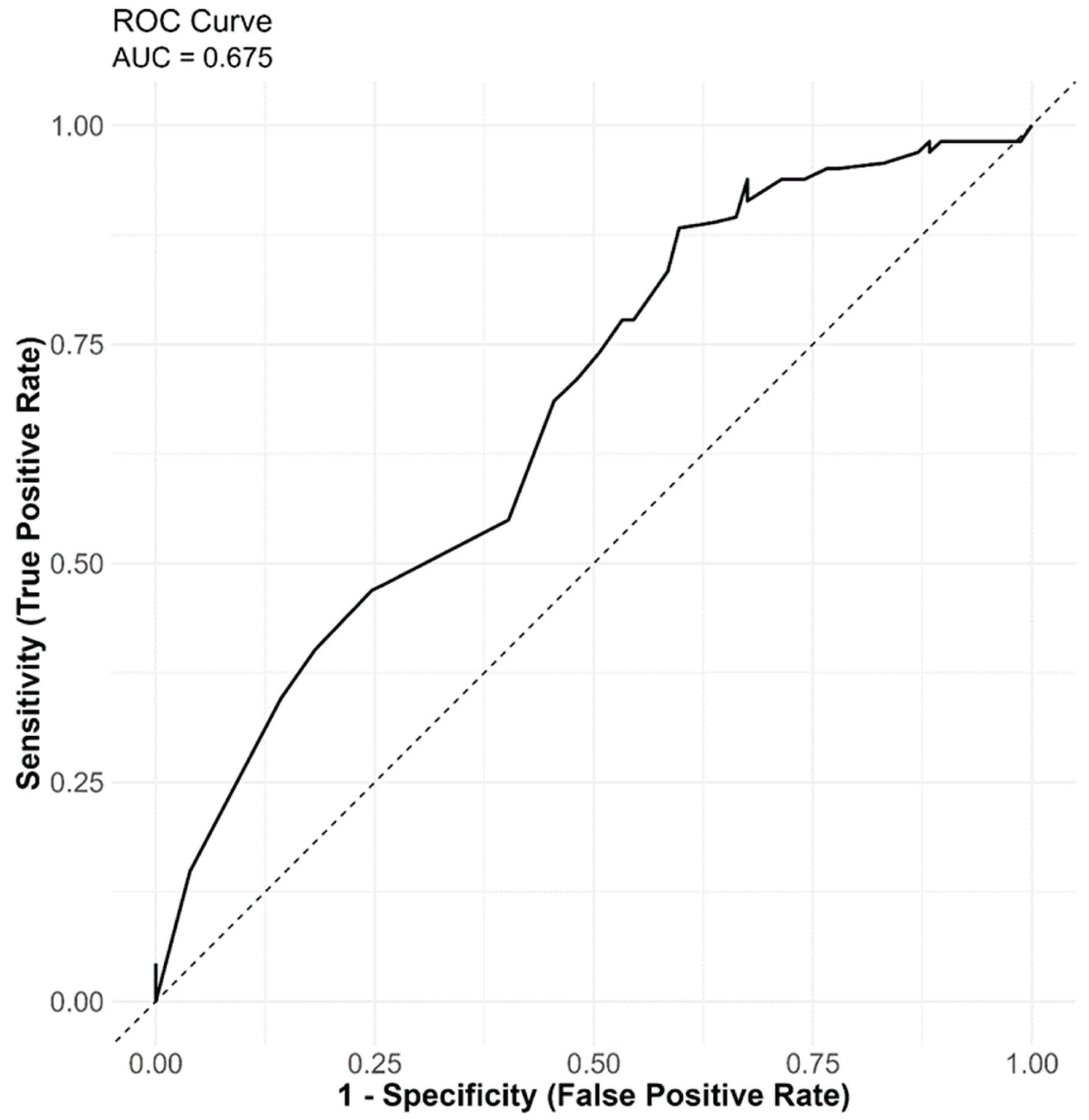
Table 1.
Socio-demographic characteristics of study participants.
| Characteristic | Category |
Overall N = 2391 |
Favourable N = 1621 |
Unfavourable N = 771 |
| Age group | ≤39 | 139 (58%) | 99 (61%) | 40 (52%) |
| 40–49 | 59 (25%) | 39 (24%) | 20 (26%) | |
| ≥50 | 41 (17%) | 24 (15%) | 17 (22%) | |
| Gender | Female | 96 (40%) | 60 (37%) | 36 (47%) |
| Male | 143 (60%) | 102 (63%) | 41 (53%) | |
| Education | Low | 46 (19%) | 31 (19%) | 15 (19%) |
| Medium | 168 (70%) | 114 (70%) | 54 (70%) | |
| High | 25 (10%) | 17 (10%) | 8 (10%) | |
| Income | No income | 192 (80%) | 136 (84%) | 56 (73%) |
| Some income | 47 (20%) | 26 (16%) | 21 (27%) | |
| Occupation | Employed | 25 (10%) | 19 (12%) | 6 (7.8%) |
| Unemployed | 214 (90%) | 143 (88%) | 71 (92%) | |
| Social history | None | 145 (61%) | 95 (59%) | 50 (65%) |
| Single substance | 63 (26%) | 45 (28%) | 18 (23%) | |
| Multiple substances | 31 (13%) | 22 (14%) | 9 (12%) |
1n (%).
Table 2.
Clinical characteristics of study participants.
| Characteristic | Category |
Overall N = 2391 |
Favourable N = 1621 |
Unfavourable N = 771 |
| Previous drug history | New | 97 (41%) | 67 (41%) | 30 (39%) |
| Previous treatment | 142 (59%) | 95 (59%) | 47 (61%) | |
| Patient category | New | 101 (42%) | 71 (44%) | 30 (39%) |
| Relapse | 95 (40%) | 63 (39%) | 32 (42%) | |
| Treatment failure | 43 (18%) | 28 (17%) | 15 (19%) | |
| Type of resistance | MONO | 93 (39%) | 65 (40%) | 28 (36%) |
| POLY | 146 (61%) | 97 (60%) | 49 (64%) | |
| Type of DR-TB | MDR | 95 (40%) | 68 (42%) | 27 (35%) |
| RR | 127 (53%) | 89 (55%) | 38 (49%) | |
| XDR | 17 (7.1%) | 5 (3.1%) | 12 (16%) | |
| Comorbidity | Multiple | 10 (4.2%) | 8 (4.9%) | 2 (2.6%) |
| Single | 229 (96%) | 154 (95%) | 75 (97%) |
1n (%).
Table 3.
Univariate Logistic Regression Analysis of Factors Associated with Treatment Outcome.
| Variable | Category vs Reference | OR (95% CI) | p-value |
| Age group | 40–49 vs <40 | 0.79 (0.44–1.41) | 0.474 |
| ≥50 vs <40 | 0.57 (0.29–1.12) | 0.127 | |
| Gender | Male vs Female | 1.49 (0.85–2.61) | 0.153 |
| Occupation | Unemployed vs Employed | 0.64 (0.27–1.52) | 0.356 |
| Type of DR-TB | RR vs MDR | 0.93 (0.53–1.63) | 0.808 |
| XDR vs MDR | 0.17 (0.06–0.50) | 0.002 | |
| Income | Some income vs No income | 0.51 (0.27–0.95) | 0.043 |
| Comorbidity type | Single vs Multiple | 0.51 (0.24–1.10) | 0.079 |
| Type of resistance | POLY vs Mono | 0.85 (0.43–1.67) | 0.578 |
| Education | Medium vs Low | 1.02 (0.54–1.93) | 0.952 |
| High vs Low | 1.03 (0.41–2.57) | 0.958 | |
| Previous drug history | Previous treatment vs None | 0.91 (0.49–1.69) | 0.724 |
| Social history | Single substance vs None | 1.32 (0.60–2.90) | 0.404 |
| Multiple substances vs None | 1.29 (0.49–3.39) | 0.560 | |
| Patient category | Relapse vs New | 0.83 (0.44–1.56) | 0.549 |
| Treatment failure vs New | 0.79 (0.37–1.69) | 0.540 |
Table 4.
Multivariable Logistic Regression Analysis of Factors Associated with Treatment Outcome (N = 239).
Table 4.
Multivariable Logistic Regression Analysis of Factors Associated with Treatment Outcome (N = 239).
| Variable | Category vs Reference | Adjusted OR (95% CI) | p-value |
| Age group | 40–49 vs <40 | 0.87 (0.44–1.71) | 0.706 |
| ≥50 vs <40 | 0.51 (0.24–1.09) | 0.089 | |
| Gender | Male vs Female | 1.55 (0.87–2.77) | 0.146 |
| Type of DR-TB | RR vs MDR | 0.91 (0.50–1.66) | 0.749 |
| XDR vs MDR | 0.18 (0.06–0.58) | 0.004 | |
| Income | Some income vs No income | 0.46 (0.23–0.92) | 0.036 |
| Comorbidity type | Single vs Multiple | 0.29 (0.06–1.38) | 0.143 |
Disclaimer/Publisher’s Note: The statements, opinions and data contained in all publications are solely those of the individual author(s) and contributor(s) and not of MDPI and/or the editor(s). MDPI and/or the editor(s) disclaim responsibility for any injury to people or property resulting from any ideas, methods, instructions or products referred to in the content. |
© 2026 by the authors. Licensee MDPI, Basel, Switzerland. This article is an open access article distributed under the terms and conditions of the Creative Commons Attribution (CC BY) license (http://creativecommons.org/licenses/by/4.0/).
Copyright: This open access article is published under a Creative Commons CC BY 4.0 license, which permit the free download, distribution, and reuse, provided that the author and preprint are cited in any reuse.


