

Submitted:
09 March 2026
Posted:
09 March 2026
You are already at the latest version
Abstract
The block-and-lock strategy aims to achieve a functional cure for human immunodeficiency virus type 1 (HIV-1) infection by enforcing durable, drug-independent silencing of proviral transcription. Several latency-promoting agents have been described that effectively limit viral reactivation in vitro or in animal models. However, most approaches induce only partial or reversible transcriptional repression and have not yet been translated into safe and effective clinical interventions. This review summarizes the molecular mechanisms underlying block-and-lock strategies and critically evaluates the limitations of current candidate compounds. We highlight recent advances in understanding HIV-1 integration site selection, focusing on the roles of lens epithelium-derived growth factor p75 (LEDGF/p75) and cleavage and polyadenylation specificity factor subunit 6 (CPSF6) in directing proviral integration toward gene-dense, transcriptionally active chromatin. Pharmacological disruption of the LEDGF/p75–integrase interaction by LEDGF/p75 inhibitors (LEDGINs) redirects proviral integration toward less transcriptionally active genomic regions that are more resistant to reactivation. Recent tandem knockout studies, however, demonstrate that CPSF6 plays a dominant role in guiding HIV-1 integration toward gene-dense, transcriptionally active chromatin. LEDGIN treatment has been linked to the preferential targeting of proviruses to heterochromatin-rich regions within the nuclear interior. By contrast, CPSF6 knockout redirects integration toward peripheral heterochromatin, especially lamina-associated domains (LADs), genomic regions typically exhibiting stronger and more stable transcriptional repression than interior heterochromatin. These findings suggest that therapeutic modulation of CPSF6 may exert a more profound and durable effect on proviral silencing within a block-and-lock framework. Nevertheless, complete CPSF6 ablation is associated with severe cellular toxicity. The challenges associated with CPSF6-related adverse effects and potential strategies to overcome these limitations are discussed.
Keywords:
HIV-1
; Block-and-lock
; CPSF6
; LEDGF/p75
; proviral integration
; LADs
; functional cure
1. Introduction
Combination antiretroviral therapy (cART) has profoundly improved the management of human immunodeficiency virus type 1 (HIV-1) infection, transforming it from a fatal disease into a chronic condition. Nevertheless, HIV-1 infection is associated with marked immune dysfunction, including progressive CD4+ T-cell depletion, chronic immune activation, dendritic cell dysregulation, immune cell exhaustion, and alterations in B-cell compartments, as well as perturbations of key signaling pathways such as the signal transducer and activator of transcription (STAT) system [1,2,3]. Some of these immune dysfunctions can persist despite cART or complete restoration of CD4+ T-cells. Although cART effectively suppresses viral replication to undetectable levels, it does not eliminate the pool of integrated HIV-1 DNA (provirus) that persists in long-lived immune cells, which remains a major barrier to achieving a definitive cure [4,5].
Early cure strategies primarily focused on the “shock-and-kill” approach, which aims to reactivate the latent virus and then eliminate infected cells [6,7,8,9,10]. However, limited clinical success has shifted attention toward alternative therapeutic paradigms. In this context, “block-and-lock” strategies seek to achieve a functional cure by enforcing durable viral latency through stable epigenetic silencing of the integrated provirus, thereby preventing viral reactivation even after cART interruption [11,12,13,14,15].
The “block-and-lock” approach relies on agents that inhibit viral transcription (“block”) and promote durable latency (“lock”) through distinct but complementary mechanisms, including: (i) direct inhibition of viral transcription; (ii) post-transcriptional inhibition of HIV-1 gene expression; (iii) inhibition of host transcription factors that activate the HIV-1 LTR; (iv) blockade of cellular kinases and signaling pathways required for HIV-1 transcription; and (v) epigenetic silencing of the provirus and promotion of its integration into repressive chromatin domains (Table 1).
HIV-1 transcription inhibitors, such as didehydro-cortistatin A (dCA), and host transcription factor modulators, such as bromodomain-containing protein 4 (BRD4) modulators, have been extensively studied [16,17,18,19]. Transcriptional kinase inhibitors (CDK8/19 inhibitors) have shown promise in promoting HIV-1 latency and suppressing reactivation in cell models [20,21]. Lens epithelium-derived growth factor (LEDGF/p75) inhibitors (LEDGINs) retarget HIV-1 integration toward less transcriptionally active chromatin, thereby expanding the reservoir to a more deeply latent state. Multiple studies have demonstrated their ability to reduce reactivation potential and promote durable silencing [22,23,24,25].
Although each of these molecular approaches has generated compelling preclinical evidence, none has yet met the safety, tolerability, or formulation criteria required to advance into human clinical trials. Challenges include compound toxicity, off-target chromatin effects, and the absence of delivery systems suitable for long-term administration. As a result, the clinical translation of “block-and-lock” agents remains limited, and there is growing interest in identifying alternative mechanisms that can achieve durable proviral silencing using established therapeutic platforms. Notably, for compounds with demonstrated block-and-lock activity in vivo in animal models, the time to viral rebound after treatment cessation remains relatively short, ranging from approximately 2 to 4 weeks.
In this context, it is conceivable that compounds capable of redirecting proviral integration toward transcriptionally silent regions of the genome—such as condensed and transcriptionally silent heterochromatin, where viral reactivation may be severely restricted—could, over time, promote the selective enrichment of latently infected cells in a deeply silenced state, ultimately achieving a stable block-and-lock condition. Such an effect may be attainable through the use of LEDGINs. However, recent evidence indicates that modulation of cleavage and polyadenylation specificity factor subunit 6 (CPSF6) expression—either through genetic knockout or knockdown approaches, or by means of compounds that disrupt CPSF6–capsid interactions—can redirect proviral integration toward highly transcriptionally repressive chromatin regions, specifically lamina-associated domains (LADs), which are typically associated with stable and long-term gene silencing. [26,27,28,29].
Notably, two LEDGINs have advanced to Phase I and II clinical trials, whereas the capsid inhibitor lenacapavir is already approved for the treatment of HIV-1 infection [30,31,32,33,34,35]. This contrasts with most other agents investigated within the block-and-lock framework, for which the absence of comprehensive pharmacokinetic, metabolic, and long-term toxicity data remains a major obstacle to clinical translation.
In this review, we summarize the current progress achieved with the most relevant compounds evaluated for block-and-lock strategies, with particular emphasis on integration-targeting approaches. The final section provides an in-depth discussion of the therapeutic potential and challenges associated with pharmacological modulation of proviral integration via CPSF6 targeting.
2. Direct Suppression of HIV-1 Transcriptional Activity
2.1. Tat-Mediated Control of HIV-1 Transcription as a Therapeutic Target for Block-and-Lock Strategies
The trans-activator of transcription (Tat) protein inhibitors represents a promising approach within the HIV-1 “block-and-lock” therapeutic paradigm, which aims to achieve durable transcriptional silencing and prevent viral reactivation from latent reservoirs. The Tat protein in HIV-1 is essential for efficient viral gene expression. Its primary function is to dramatically enhance transcriptional elongation from the HIV-1 LTR promoter [36,37].
The HIV-1 genome is transcribed by RNA polymerase II (RNAPII) using the 5′ LTR as a promoter. Several cellular transcription factors, including NF-κB, NFATc, Sp1, and TATA-binding protein (TBP), bind to the 5′ LTR and recruit the preinitiation complex (PIC), positioning RNAPII at the transcription start site.
RNAPII synthesizes a 59-nucleotide, non-coding, RNA stem-loop structure called the transactivation response element (TAR) located at the 5' end of nascent viral transcript. TAR provides the structural platform for Tat and elongation factor recruitment [38]. The hairpin motif of the HIV-1 TAR RNA is organised into two helices interconnected by a characteristic three-nucleotide bulge and terminated by an apical loop of approximately six nucleotides (Figure 1A). Tat primarily associates with the TAR bulge through its arginine-rich motif (Figure 1B). As discussed in more detail below, to perform its functions, Tat must interact with the positive transcription elongation factor b (P-TEFb) complex, composed of cyclin-dependent kinase 9 (CDK9) and cyclin T1, which is essential for the initiation of transcriptional elongation of the viral genome. The cyclin T1 subunit of P-TEFb forms specific and stabilizing interactions with the TAR loop (Figure 1C).
TAR is located at the +1 position of the 5’ LTR (Figure 2). The LTR is embedded into two nucleosomes, Nuc-0 and Nuc-1 (Figure 2). The Nuc-0 nucleosome is positioned upstream of the transcription start site, in the modulatory region of the HIV-1 LTR, and specifically spans the modulatory region defined by nucleotides -455 to -105. This region is critical for the epigenetic regulation of HIV-1 latency and transcriptional silencing, as it is subject to histone modifications and chromatin remodeling that influence viral gene expression. Nuc-0, as Nuc-1, consists of an octamer of histone proteins (two copies each of H2A, H2B, H3, and H4). The Nuc-1 nucleosome is located in the leader region of the LTR between +1 and +179 nucleotides, immediately downstream of the transcription start site. It is a key regulatory element for transcriptional activation and latency, as its remodeling is required for efficient transcription initiation and elongation (Figure 2).
Following TAR synthesis, RNAPII pauses near the Nuc-1 nucleosome. This pause is mediated by two promoter-proximal pausing factors: the negative elongation factor (NELF), a multisubunit protein complex found in metazoans that regulates gene transcription, and the DRB sensitivity–inducing factor (DSIF), a conserved transcription elongation factor essential for recruiting NELF to the transcription complex (Figure 2) [39,40].
Productive elongation of the viral genome requires the recruitment of P-TEFb [41]. In the absence of Tat, HIV-1 transcriptional elongation is inhibited by the 7SK small nuclear ribonucleoprotein (snRNP)/HEXIM1 complex, which sequesters and inactivates P-TEFb (Figure 3, step 1). This complex is a nuclear ribonucleoprotein assembly that regulates RNA polymerase II–dependent transcriptional elongation and is composed of the noncoding 7SK snRNA and hexamethylene bis-acetamide inducible protein 1 (HEXIM1), which binds both 7SK snRNA and P-TEFb. HEXIM1 is essential for the inhibitory function of the 7SK snRNP, as it directly interacts with the cyclin T1 subunit and the catalytic domain of CDK9, thereby suppressing CDK9 kinase activity. As a result, the 7SK snRNP/HEXIM1 complex acts as a global regulator of P-TEFb activity, modulating transcriptional elongation of both cellular and viral genes.
During HIV-1 infection, Tat competes with the 7SK snRNP/HEXIM1 complex for binding to cyclin T1 of P-TEFb, displacing the inhibitory complex and releasing transcriptionally active P-TEFb [42,43,44,45]. The resulting Tat–P-TEFb complex is subsequently recruited to the TAR RNA element, forming the Tat–P-TEFb–TAR assembly (Figure 3, step 2). The Tat protein primarily associates with the TAR bulge via its arginine-rich motif (ARM) (Figure 1B). However, this interaction appears to contribute less to the overall binding affinity than the contacts established between cyclin T1 and the TAR loop. In particular, the Tat–TAR recognition motif (TRM) within cyclin T1 forms specific, stabilizing interactions with the TAR loop (Figure 1C). Tat, in turn, acts as a molecular scaffold that supports and reinforces these contacts, not only through its zinc-coordinating loop but also via electrostatic interactions mediated by the ARM. CDK9 of P-TEFb provides the kinase activity required for phosphorylation of the C-terminal domain (CTD) of RNAPII, DSIF, and NELF. In addition, acetylation of Tat at lysine 28 (K28) by the p300/CBP-associated factor (PCAF) enhances its capacity to recruit P-TEFb. (Figure 3, step 3).
The phosphorylation events mediated by CDK9 convert DSIF into a positive elongation factor and promote the dissociation of NELF, thereby allowing RNAPII to transition from a paused to a productive elongation state (Figure 3, step 4). The newly synthesized Tat protein further amplifies this process by enhancing the recruitment of additional P-TEFb molecules and the Super Elongation Complex (SEC)—a multiprotein assembly composed of P-TEFb, the elongation factors ELL1/ELL2, AF4 family scaffold proteins (AFF1 or AFF4), and either ENL or AF9—to the TAR element, thereby ensuring robust viral RNA synthesis and protein production [38,39,40,41,42,43,44].
Given Tat's key role in promoting HIV-1 transcription, several classes of Tat inhibitors are currently under active investigation as components of “block-and-lock” strategies aimed at achieving a functional cure for HIV-1 infection.
2.2. Didehydro-Cortistatin A: Mechanism and Preclinical Efficacy
Among Tat-targeting compounds, didehydro-cortistatin A (dCA) is the most extensively characterized and remains the leading candidate in this class. dCA binds directly to the unstructured basic region of Tat and inhibits the ability of the Tat–P-TEFb complex to recognize and bind the TAR element of viral RNA (Figure 4A). By doing so, it blocks viral transcription, disrupts the transcriptional feedback loop, and promotes epigenetic silencing of the HIV-1 LTR promoter [16,45,46,47,48,49].
In vitro studies have demonstrated that dCA potently suppresses HIV-1 reactivation from latency by inhibiting Tat-mediated transcription. In models of latently infected cells, prolonged treatment with dCA maintained the proviral promoter in a transcriptionally silenced state, and removal of the compound did not result in detectable viral rebound over the observation period, indicating durable repression of viral gene expression [49]. Translating these findings in vivo, Kessing et al. showed that in BLT humanized mice, dCA in combination with cART significantly delayed viral rebound after therapy interruption [16]. Whereas mice receiving cART alone exhibited detectable viremia as early as 3 days post-cART cessation, with all animals rebounding by day 10, in ten mice treated with dCA plus cART, only one had detectable plasma viremia by day 7, three by day 10, and six by day 19 post-therapy interruption (Table 2).
These results illustrate that while dCA can establish persistent transcriptional silencing in vitro, in vivo latency is more complex, and rebound can still occur after cART cessation, albeit significantly delayed. Together, these studies provide strong proof-of-concept that Tat inhibition via dCA contributes to block-and-lock strategies, potentially extending the period of proviral silencing and reducing the frequency of viral reactivation events.
Although dCA is an interesting agent for a block-and-lock approach, resistance may develop [46,51,52]. The resistance is not necessarily due to mutations in the target itself, but rather through heightened basal HIV-1 transcription. In other words, the virus adapts by increasing its basal transcription level, making it less reliant on the Tat protein, which is inhibited by dCA [52]. Of note, dCA-resistant variants can display reduced fitness. Using humanized mice, researchers found that resistant mutants (MUT1/MUT2) showed delayed establishment of infection, lower plasma viral loads, and lower proviral DNA levels compared to wild-type (WT) HIV-1 [51].
2.3. dCA Pharmacokinetics, Bioavailability, and Safety
Pharmacokinetic data on dCA remain limited but provide initial insights into its potential for clinical translation. In animal models, dCA has been administered intraperitoneally or subcutaneously, achieving broad systemic distribution and penetration into HIV-1-relevant tissues, including lymph nodes and spleen [17].
dCA exerts potent antiviral activity at nanomolar concentrations; however, data on half-life, metabolism, and oral absorption are lacking, and no formal pharmacokinetic studies reporting plasma concentration–time profiles have been published. Consequently, oral bioavailability remains uncharacterized, and most studies have relied on injectable formulations.
To date, no major toxicity signals have been reported in animal models, although human safety data are unavailable. dCA has not been evaluated in registered clinical trials, nor has it received regulatory approval. Despite its favorable preclinical efficacy and tissue distribution, progress toward clinical application has been limited by incomplete pharmacokinetic characterization, safety concerns, and formulation challenges.
The lack of optimized, stable, and safe formulations—together with potential immunogenicity and insufficient toxicological data—has impeded transition to human trials. Furthermore, certain analogs have shown immune-related adverse effects or other toxicities, underscoring the need for comprehensive safety evaluations. Overall, the absence of detailed pharmacokinetic, metabolic, and long-term toxicity data remains a major barrier to clinical translation [46,47].
Future research should prioritize the development of optimized formulations with improved bioavailability, alongside thorough toxicity, biodistribution, and metabolism studies—including assessments of alternative delivery routes—before advancing to human trials.
2.4. Novel Tat Inhibitors and Future Perspectives
Beyond dCA, several new classes of small molecules have been identified as Tat inhibitors within the “block-and-lock” framework. These compounds interfere with Tat-mediated transcription by disrupting critical interactions between Tat and its cofactors—most notably the Tat–TAR RNA and Tat–cyclin T1 complexes—thereby suppressing viral transcription and altering the epigenetic state of the HIV-1 LTR promoter [53,54,55].
Shin et al. developed a homogeneous, mix-and-read time-resolved fluorescence resonance energy transfer (TR-FRET) assay to identify compounds that disrupt the interaction between the HIV-1 Tat protein and the TAR RNA element. By screening a library of 39,360 small molecules, the authors identified two 1,3,4-oxadiazole derivatives, 460-G06 and 463-H08, as the most potent inhibitors of the Tat–TAR interaction. These compounds inhibit Tat-dependent transcription by directly binding to the TAR RNA, thereby preventing the formation of the Tat–TAR complex, which is essential for viral gene expression [53].
Mechanistically, these inhibitors act by targeting the bulge region of TAR RNA, thereby interfering with Tat recognition (Figure 4 B). The bulge region plays a pivotal role in mediating the Tat–TAR interaction and constitutes a preferred binding site for small molecules aimed at blocking Tat-mediated HIV-1 transcription [56,57,58].
In parallel, other small molecules have been developed to target the Tat–TAR RNA interface via rational design, virtual screening, and structure-based docking. Among the most promising candidates, the benzoxazole compound T0516-4834 has been shown to selectively disrupt the Tat–TAR interaction, thereby inhibiting Tat-induced transcription and viral RNA and p24 protein production in HIV-1–infected T cells and PBMCs, without exerting significant effects on cellular transcription [54].
In addition, T0516-4834 disrupted the Tat–CDK9/cyclin T1 interaction. Other molecules, such as compound T5628834, showed a stronger effect in disrupting this interaction (Figure 4 C) [54]. Likewise, cyclic peptides and foldamers such as TB-CP-6.9a and ADH-19 exhibit strong affinity for the TAR bulge, effectively reducing viral infectivity in cultured cells without inducing significant cytotoxic effects [59,60]. The cyclic peptides described by Chavali et al. selectively engage the major groove of HIV-1 TAR RNA, specifically recognizing guanine bases and the phosphate backbone through their arginine-fork motif. This interaction is primarily localized to the region encompassing the three-nucleotide bulge and the upper helix, the very site where Tat normally binds to mediate transcriptional activation [59].
Recently, Khatkar et al. demonstrated that small molecules targeting the HIV-1 TAR RNA can induce a conformational shift of the TAR loop toward cyclin T1 within the P-TEFb complex, which is essential for efficient HIV-1 transcription [61]. Both the small molecules described by Khatkar et al. and the cyclic peptides reported by Davidson et al. [62] can directly interact with the bulge and loop regions of TAR (Figure 4 D). This dual interaction is particularly relevant, as the TAR loop serves as the binding site for cyclin T1 within the P-TEFb complex, a critical component of productive viral transcription. Both studies emphasize that simultaneous targeting of the bulge and loop is a key requirement to achieve complete inhibition of HIV-1 transcription, since interaction with the bulge alone is insufficient to prevent P-TEFb recruitment and Tat function.
Despite these promising results, none of these inhibitors have been evaluated in vivo in animal models, and no clinical data are currently available. Furthermore, no experimental data have been reported regarding viral rebound following removal of the compounds from the culture medium (Table 2). Their assessment, therefore, remains confined to biochemical and cellular models, underscoring the need for further preclinical development and rigorous in vivo validation.
Collectively, these findings highlight the TAR bulge as a highly druggable RNA structural motif and a promising target for the development of novel antiviral agents that can disrupt Tat-dependent HIV-1 transcription. However, for newly identified molecules targeting the Tat-TAR interaction to be truly effective within a "block-and-lock" strategy, they must not only achieve potent inhibition of viral transcription ("block") but also ensure durable suppression of viral reactivation upon treatment interruption ("lock"). Achieving this latter effect remains particularly challenging for Tat-TAR binding inhibitors, as viral rebound may still occur—albeit with a delay—once drug administration is discontinued, resulting in only a partial, reversible "lock”.
2.5. Triptolide-Mediated Tat Degradation as a Block-and-Lock Strategy for HIV-1
Triptolide is a diterpenoid epoxide isolated from Tripterygium wilfordii Hook F, a medicinal plant traditionally used for its immunosuppressive and anti-inflammatory properties. In the context of HIV-1 research, triptolide has been shown to potently inhibit viral replication in vitro by promoting proteasome-mediated degradation of the viral transactivator Tat [63] (Figure 4E).
Beyond Tat degradation, triptolide exerts broader transcriptional effects. At the molecular level, it inhibits XPB, a critical helicase subunit of the transcription factor IIH (TFIIH) complex, thereby interfering with global transcriptional processes. In addition, triptolide modulates key cellular signaling pathways involved in HIV-1 transcriptional activation, including NF-κB signaling. Although these pleiotropic activities may further contribute to viral transcriptional repression, they are also associated with significant cytotoxicity. This toxicity represents a major obstacle to therapeutic development and reflects the compound's narrow therapeutic window [64].
Despite its promising in vitro antiviral activity, there is currently no clinical evidence supporting the efficacy or safety of triptolide as a block-and-lock agent in humans. Moreover, in vivo studies have yielded limited and largely disappointing results. The most relevant data derive from studies using (5R)-5-hydroxytriptolide (LLDT-8), a structural analog with reduced cytotoxicity, in simian immunodeficiency virus (SIV)-infected rhesus macaques, a well-established model of HIV-1 infection.
In SIV-infected macaques receiving cART, LLDT-8 administration was associated with a significant reduction in immune activation markers, including HLA-DR and CD38 co-expression on CD8+ T cells, as well as downregulation of proliferation-related gene pathways in peripheral blood mononuclear cells. However, these immunomodulatory effects did not translate into virological benefit. LLDT-8 failed to reduce viral reservoir size, did not prevent viral rebound after cART discontinuation (Table 2), and did not consistently decrease plasma inflammatory markers or T cell activation levels across studies [65,66].
Overall, while triptolide remains a valuable experimental tool for dissecting mechanisms of HIV-1 transcriptional regulation and latency maintenance, its unfavorable toxicity profile and the absence of convincing in vivo efficacy currently preclude its advancement as a clinical candidate for block-and-lock–based functional cure strategies.
2.6. Camptothecin Analogs
Topoisomerase I (Top I) inhibitors, such as the camptothecin analog topotecan, primarily suppress HIV-1 replication by interfering with host Top1 activity, which is essential for relieving torsional stress during transcription elongation. By stabilizing the DNA–Top1 cleavage complex, these compounds impede efficient transcription of the integrated provirus, reducing viral RNA production and downstream protein synthesis. In addition, because HIV-1 RNA splicing is co-transcriptional, the slowed elongation caused by Top1 inhibition can indirectly alter splice-site usage, leading to changes in the ratio of fully spliced, partially spliced, and unspliced viral transcripts. This disruption further limits the production of essential viral proteins and decreases susceptibility to reactivation [67] (Figure 4F).
There are no in vivo studies investigating the effects of camptothecin analogs in the context of HIV-1 infection in the medical literature. All available data on topotecan and other camptothecin analogs in HIV-1 infection are derived from in vitro studies using cell lines and primary cells, where these compounds have demonstrated inhibition of HIV-1 replication, promotion of HIV-1 latency, and interference with viral transcription and RNA splicing.
In vitro studies with topotecan have provided preliminary data on the duration of HIV-1 gene expression suppression after treatment cessation. In an experimental in vitro model of HIV-1 latency using the JLat 6.3 reporter cell line, treatment with topotecan for 24 hours suppressed HIV-1 expression, with suppression lasting at least 3 days (72 hours) after the compound was removed from culture (Table 2). During this follow-up period, cells pretreated with topotecan showed reduced induction of HIV-1 expression compared with controls when stimulated with latency-reversing agents [67]. Due to toxicity, topotecan is unlikely to be used clinically for HIV-1, and there is a call for the development and testing of less toxic analogs, but no animal or human studies have been reported.
2.7. CRISPR–Cas Technologies as Block-and-Lock Strategies for HIV-1
CRISPR–Cas systems, most notably CRISPR–Cas9, provide a complementary strategy by enabling sequence-specific editing of HIV-1 proviral DNA integrated into the host genome. By inducing double-strand breaks at predefined loci within the provirus, CRISPR–Cas9 can disrupt essential viral genes or excise large proviral fragments, leading to irreversible inactivation and permanent transcriptional silencing. Xu et al. investigated the use of CRISPR/Cas9 genome editing to permanently inactivate latent HIV-1 proviral DNA, providing experimental support for its potential application within a block-and-lock strategy. Using the J-Lat 10.6 latency model, the authors designed multiple single-guide RNAs (sgRNAs) targeting conserved regions of the HIV-1 genome and tested different sgRNA combinations in association with Cas9. Several dual-sgRNA strategies efficiently induced insertions and deletions within proviral DNA, resulting in functional inactivation of the virus. High editing efficiencies were observed, with selected sgRNA pairs achieving proviral disruption rates exceeding 70%, consistent with a stable silencing of HIV-1 transcriptional competence. [68].
There are in vivo studies employing CRISPR–Cas technologies in the context of HIV-1 infection, including models aimed at removing or suppressing integrated proviral DNA, which conceptually aligns with block-and-lock strategies (i.e., durable inactivation of viral genomes). Most of these studies, however, focus on proviral excision or disruption rather than transcriptional silencing alone.
A key study demonstrated that an AAV-delivered multiplex CRISPR/Cas9 system (SaCas9 with multiple guide RNAs) could excise integrated HIV-1 proviral DNA in vivo in HIV-1 transgenic mice (Tg26), EcoHIV-1-infected mice, and HIV-1-infected humanized BLT mice. Following a single intravenous injection of AAV carrying the CRISPR components, proviral excision was detectable in multiple organs, including the spleen, lungs, and brain, and viral RNA expression was significantly reduced both in tissues and systemically. This study provided one of the first demonstrations that CRISPR-mediated proviral genome editing can occur in vivo and reduce viral burden [69].
More recent studies suggest that CRISPR gene editing combined with cART in humanized mice can decrease HIV-1 DNA and RNA levels, and in some animals, persistent absence of viral signal was observed in multiple tissues over time [70]. In a preclinical non-human primate study, Burdo et al. demonstrated the safety, biodistribution, and in vivo proviral DNA editing using a CRISPR-Cas9 gene editing approach in ART-treated, virally controlled rhesus macaques infected with simian immunodeficiency virus (SIV) [71].
In another study, treatment of HIV-1-infected humanized mice with cART followed by dual CRISPR-Cas9 targeting of CCR5 and HIV-1 proviral DNA led to sequential viral suppression, restoration of absolute human CD4+ T-cell numbers, and elimination of replication-competent virus in 58% of infected animals [72].
In an early clinical context, participants receiving the CRISPR-based therapy EBT-101 who discontinued cART generally experienced HIV-1 rebound within a few weeks (~2–4 weeks), although one individual maintained suppression for approximately 16 weeks [73].
Collectively, these findings highlight the potential of CRISPR-based approaches as a block-and-lock strategy for HIV-1, while underscoring the need for improved editing efficiency and comprehensive reservoir targeting to achieve long-term viral remission.
3. Post-Transcriptional and Gene-Silencing Approaches
3.1. Splicing Inhibitors
Control of HIV-1 RNA splicing is essential for viral replication, as it enables the regulated production of distinct mRNA species and proteins at specific stages of the viral life cycle. Splicing inhibitors target host cell components of the spliceosome, the molecular machinery responsible for processing RNA transcripts. One key target is splicing factor 3B subunit 1 (SF3B1), a protein that plays a central role in HIV-1 RNA splicing and is required for efficient viral gene expression. Both pharmacological inhibition and genetic depletion of SF3B1 impair Tat-dependent HIV-1 transcription and prevent RNA polymerase II recruitment to the HIV-1 promoter. As a result, HIV-1 reactivation from latency is blocked regardless of the latency-reversing agent used. Importantly, SF3B1 inhibitors— such as sudemycin D6—have shown selective activity against HIV-1-infected cells with limited toxicity in preclinical models, supporting their potential use as block-and-lock agents [74]. There are no in vivo studies investigating the effects of splicing inhibitors targeting SF3B1 within the block-and-lock approach for HIV-1 infection in the medical literature. All available data on SF3B1 inhibitors are limited to in vitro models, where these compounds have demonstrated modulation of alternative splicing, inhibition of HIV-1 transcription, and reactivation from latency (Table 2).
3.2. RNA Interference Technologies as Block-and-Lock Strategies for HIV-1
RNA interference (RNAi) technologies are actively investigated as block-and-lock approaches to achieve durable suppression of HIV-1 proviral transcription and prevent viral reactivation. RNAi relies on small interfering RNAs (siRNAs) or short hairpin RNAs (shRNAs) to induce sequence-specific degradation of HIV-1 RNA transcripts, thereby reducing viral gene expression and replication. RNAi-based strategies can be engineered to simultaneously target multiple viral transcripts or host dependency factors essential for HIV-1 entry and replication, such as CCR5, and have demonstrated potent antiviral activity in preclinical models. However, their long-term efficacy is challenged by the high genetic variability of HIV-1, which facilitates viral escape, as well as by difficulties in achieving efficient, sustained delivery to reservoir tissues and in maintaining long-term expression of RNAi effectors. Combinatorial RNAi approaches targeting multiple conserved viral regions have been proposed to reduce escape and enhance antiviral durability [75,76,77]. To overcome delivery-related limitations, advanced delivery platforms, including viral vectors and non-viral systems such as lipid- and polymer-based nanoparticles, are under development to improve tissue targeting, cellular uptake, and stability of RNAi molecules, thereby enhancing their translational potential [78].
There are in vivo RNAi studies in HIV models demonstrating transcriptional silencing and durable suppression of HIV-1 gene expression, including promoter-targeted shRNAs that can cause epigenetic repression of the HIV-1 LTR. However, these studies do not conclusively demonstrate robust induction of an HIV-1 latent state with proven rebound resistance — i.e., they do not meet the strict definition of inducing deep latency in an animal model, analogous to block-and-lock cures as currently conceptualized [79,80].
Several experiments have used RNAi (siRNA/shRNA) or RNAi-delivery systems to suppress HIV-1 replication in vivo, usually in humanized mouse models of infection. However, these studies do not convincingly demonstrate a durable “deep latency” block-and-lock effect in vivo. shPromA and related promoter-targeting shRNAs delivered via lentiviral vectors can suppress HIV-1 transcription and replication. This approach has been shown in vivo to knock down HIV-1 expression in animal models (e.g., humanized mice or lentivector-modified human cells engrafted into mice) [79].
A promoter-targeted siRNA, LTR-362, designed to induce transcriptional gene silencing (TGS), was tested in vivo using gp120-aptamer-delivery systems in humanized mice. These conjugates repressed viral RNA levels in serum compared with controls, but the effect did not clearly demonstrate stable, deep latentization via epigenetic silencing of the reservoir and was interpreted mainly as reduced transcription/post-transcriptional silencing at that time point [81]. These studies do show that RNAi constructs can reduce viral transcription or replication in vivo, but they do not show a durable epigenetic lock on the provirus that would constitute deep latentization in a functional cure sense.
Combinatorial strategies integrating CRISPR–Cas and RNAi have been explored to simultaneously target HIV-1 at both the DNA and RNA levels, yielding additive or synergistic antiviral effects. However, overlapping or closely spaced target sites may accelerate the emergence of viral escape mutants through error-prone DNA repair mechanisms and promote cross-resistance, highlighting the need for careful target selection and design [82,83,84,85].
Despite their strong conceptual appeal, key challenges remain for both RNAi- and CRISPR–Cas–based block-and-lock strategies, including precise and efficient delivery to latent viral reservoirs, minimizing off-target effects, controlling immune responses, and preventing viral escape. To date, neither approach has progressed to the establishment of standardized clinical dosing regimens, as both remain largely confined to preclinical and early translational stages. Ongoing research efforts are focused on improving specificity, delivery technologies, and the long-term durability of HIV-1 transcriptional silencing [13].
4. Cellular Transcription Factor Modulators as Block-and-Lock Agents
HIV-1 transcription is tightly controlled by host transcription factors that, together with the viral transactivator Tat, regulate LTR promoter activity. Within this framework, pharmacological modulation of key cellular transcriptional regulators represents a promising block-and-lock strategy to achieve stable, durable suppression of HIV-1 gene expression. Rather than eliminating the integrated provirus, this approach seeks to enforce a deeply silenced state that prevents viral rebound.
Among the critical factors involved, BRD4 and NF-κB play central roles. BRD4, a chromatin-associated member of the BET protein family, supports basal transcription from the integrated provirus. NF-κB functions as a major inducible activator of the HIV-1 promoter. By integrating pro-inflammatory and cellular activation signals, NF-κB can destabilize latency and promote proviral reactivation.
Targeting BRD4 and NF-κB, therefore, allows interference with critical transcriptional nodes governing HIV-1 expression, promoting a deeper and more durable state of viral latency. Fine-tuning host transcriptional regulatory networks may thus represent a cornerstone for the success of block-and-lock strategies.
4.1. BDR4 Functions Under Physiologic Conditions and in HIV-1 Infection
BRD4 is a member of the BET (bromodomain and extra-terminal domain) protein family and contains two bromodomains (BD1 and BD2) that recognize acetylated lysine residues on histone tails. Its primary function is to act as an epigenetic and transcriptional regulator by binding acetylated chromatin and interacting with RNAPII, thereby facilitating transcriptional activation. Histone acetylation involves the addition of an acetyl group (CH₃CO–) to lysine residues within histone tails, a reaction catalyzed by histone acetyltransferases (HATs) and reversed by histone deacetylases (HDACs). This post-translational modification neutralizes the positive charge of lysine residues, thereby weakening histone–DNA interactions and promoting a more open and accessible chromatin conformation, which is generally associated with transcriptional activation. In addition, histone acetylation functions as a molecular signal for the recruitment of regulatory proteins, including the bromodomain-containing protein BRD4, which acts as a scaffold by binding acetylated histones via its bromodomains, thereby promoting chromatin opening and facilitating the recruitment of transcription factors and coactivators to gene promoters [86,87,88,89,90]. However, BRD4 displays functional versatility and exerts context-dependent effects on HIV-1 transcription, largely shaped by its specific interactions with histones and partner proteins.
Under physiological conditions, BRD4 primarily functions as a transcriptional activator by promoting the release of P-TEFb from the inhibitory 7SK snRNP/HEXIM1 complex. This activity depends on a P-TEFb–interacting domain (PID) located in the C-terminal region of BRD4, which directly binds P-TEFb and facilitates its dissociation from the inhibitory complex. Once released, P-TEFb becomes transcriptionally active and can be recruited to chromatin, thereby supporting productive RNAPII–mediated transcription [91,92,93,94].
When associated with BRD4, P-TEFb is positioned in close proximity to RNAPII, enabling efficient phosphorylation of the RNAPII C-terminal domain (CTD), as well as of the negative elongation factor (NELF) and DRB sensitivity–inducing factor (DSIF). This phosphorylation cascade promotes NELF dissociation and converts DSIF into a positive elongation factor, ultimately facilitating productive transcript elongation (Figure 5A).
During HIV-1 infection, BRD4 retains its ability to extract P-TEFb from the inactive 7SK snRNP complex and recruit it near RNAPII. The BRD4-associated P-TEFb complex phosphorylates the RNAPII, thereby supporting basal transcription from the integrated provirus. However, in infected cells, this process remains relatively inefficient in the absence of Tat [95,96,97,98] (Figure 5B).
In the presence of Tat, this viral transactivator directly competes with BRD4 for binding to P-TEFb. Tat exhibits a higher affinity for the cyclin T1 subunit of P-TEFb than BRD4 and efficiently displaces BRD4, promoting the release of P-TEFb from the HEXIM1-containing 7SK snRNP complex. This displacement facilitates assembly of the Tat–P-TEFb complex and its recruitment to the TAR RNA element, driving robust viral transcription [97,98]. The ability of Tat to extract P-TEFb from 7SK snRNP is further enhanced by cofactors such as AFF1, which stabilize Tat–P-TEFb interactions and promote formation of the SEC [97]. Although phosphorylation of specific CDK9 residues, including Ser175, can modulate the relative affinity of BRD4 and Tat for P-TEFb, Tat remains the dominant competitor for P-TEFb in HIV-1–infected cells [99] (Figure 5C).
Following dissociation from the inactive 7SK snRNP/HEXIM1 complex, a transient pool of free P-TEFb is generated. This pool is not immediately bound by Tat or BRD4 and can be rapidly captured by either factor or by additional transcriptional regulators [100]. Tat and BRD4 therefore primarily compete for this free P-TEFb fraction; however, Tat prevails because of its greater binding affinity [95,98].
The proportion of P-TEFb associated with BRD4 during HIV-1 infection has not been precisely quantified. Nonetheless, seminal studies indicate that under physiological conditions, approximately half of the cellular P-TEFb pool is bound to BRD4, whereas the remaining fraction is sequestered within the inactive 7SK/HEXIM1 complex [91,94]. In the presence of Tat, this equilibrium is disrupted: Tat preferentially recruits P-TEFb to sustain viral transcription, thereby reducing its availability for BRD4, although a residual fraction remains BRD4-associated. During HIV-1 latency, BRD4 can retain a substantial proportion of P-TEFb, contributing to the maintenance of transcriptional silencing of the integrated provirus [95,101,102].
4.2. Pharmacological Modulation of BRD4
Among the molecules that can interfere with BRD4, two have been extensively studied: JQ1 and ZL0580 [102]. Although the precise mechanisms of action of these compounds remain under investigation and are not yet fully elucidated, studies have shown that they exert opposite effects on HIV-1 infection. The pan-BET inhibitor JQ1 broadly enhances HIV-1 transcription, whereas ZL0580 promotes epigenetic repression of HIV-1 transcription, favoring proviral silencing consistent with a ‘block-and-lock’ approach [19].
JQ1 is a small-molecule inhibitor of the BET protein family, particularly BRD4, developed in 2010. Its discovery marked a turning point in cancer research and epigenetic biology, enabling the pharmacological modulation of BRD4 [103].
The mechanism of action of JQ1 involves competitive binding to the BRD4 bromodomains BD1 and BD2, thereby preventing the interaction between BRD4 and acetylated histone tails. This blockade disrupts the recruitment of the P-TEFb complex by BRD4, which is required for RNAPII phosphorylation and subsequent transcriptional elongation. As a result, JQ1 represses the transcription of oncogenic genes such as MYC and other targets associated with cellular proliferation and survival [103].
In contrast, during HIV-1 infection, JQ1 activates transcription of the integrated provirus [104,105]. This effect reflects the distinctive regulation of viral transcription: BRD4 competes with Tat for P-TEFb, and JQ1 disrupts this interaction, favoring Tat-mediated transactivation. Under latency conditions, BRD4 can retain a substantial fraction of P-TEFb, contributing to transcriptional silencing of the integrated provirus. Inhibition of BRD4 by JQ1 facilitates P-TEFb recruitment by Tat, and consequently enhances proviral transcriptional elongation [81,82]. Moreover, JQ1 promotes the transient release of P-TEFb from its inactive form (the 7SK snRNP complex), increasing the pool of free P-TEFb available for transcription, including HIV-1 proviral transcription [80]. Therefore, whereas BRD4 is essential for transcriptional elongation of host genes, its inhibition in the context of HIV-1 favors viral transcription due to Tat-mediated activation.
It was more recently shown that JQ1 induces dissociation of BRD4 from the repressive chromatin remodeling proteins (SWI/SNF) at the HIV-1 LTR, thereby reversing BRD4-mediated HIV-1 transcriptional suppression [101]. This is considered independent of Tat-mediated transcription elongation but dependent on the regulatory chromatin structure at the HIV-1 LTR. JQ1 has been explored as a potential agent within a ‘kick-and-kill’ strategy for HIV-1 cure interventions. However, JQ1 is not currently approved for clinical use in humans, and its toxicity profile remains a major obstacle to its translation into routine therapeutic applications, including cancer treatment.
Different from JQ1, ZL0580 selectively represses genes involved in transcriptional activation and chromatin accessibility [106]. This selective targeting of the BRD4 BD1 domain reduces off-target effects and toxicity compared with pan-BET inhibitors that affect all BET family members and both BD1 and BD2 domains.
ZL0580 suppresses HIV-1 transcription through multiple mechanisms. It binds the BD1 domain of BRD4 at Glu-151, inducing a conformational change that promotes repressive chromatin at the HIV-1 LTR, reduces chromatin accessibility, and prevents recruitment of transcriptional activators such as P-TEFb [18,107]. Additionally, ZL0580 disrupts Tat–CDK9 interactions and inhibits P-TEFb recruitment, further blocking transactivation and transcriptional elongation [18,107]. Beyond the viral promoter, it reprograms host chromatin architecture, increasing nucleosome density and reducing accessibility at other genomic loci, contributing to durable silencing. Finally, ZL0580 promotes durable epigenetic silencing by facilitating the recruitment of additional repressive chromatin remodeling complexes, such as the BAF (SWI/SNF) complex, to the HIV-1 LTR, thereby enhancing transcriptional repression [18,107]. ZL0580 is also effective in suppressing HIV-1 in myeloid reservoirs, including microglia and macrophages, which are critical for CNS persistence [108].
The in vivo HIV-1-suppressive activity of ZL0580 was assessed in a humanized mouse model of HIV-1 infection characterized by robust human immune cell reconstitution. Following systemic infection, animals were treated with ZL0580 either as monotherapy or in combination with standard cART, and plasma viral replication was longitudinally monitored. ZL0580 administration led to a rapid and sustained reduction of plasma viremia, comparable to cART, with monotherapy achieving near-undetectable viral loads in vivo. Upon treatment interruption, viral rebound occurred earlier in cART-treated mice, whereas ZL0580-treated animals displayed delayed rebound and lower post-treatment viremia. Specifically, after analytical treatment interruption at week 7, rapid viral rebound occurred in the cART-only group by week 9 (2 weeks post-interruption), whereas the ZL0580 monotherapy group maintained undetectable plasma viral loads at this time point. By week 11 (4 weeks post-interruption), viremia became detectable in both the ZL0580-only and ZL0580 plus cART groups, but at lower levels than in the cART-only group (Table 2). These findings indicate that ZL0580 provided a measurable delay in viral rebound and partial viremia suppression in vivo, supporting its potential as a block-and-lock agent in HIV-1 cure strategies. All treatment regimens were well tolerated, with no detectable adverse effects [83].
Combination strategies, such as ZL0580 with LEDGINs, have demonstrated additive effects in blocking HIV-1 reactivation in both cell lines and primary cells, supporting the rationale for multi-target “block-and-lock” approaches (the potential mechanisms underlying this additive effect are discussed in the section 6) [18].
No clinical safety data in humans have been published to date for ZL0580, and its translational potential will depend on future phase I studies to confirm the absence of significant off-target or systemic toxicities.
4.3. NF-κB Inhibitors as Block-and-Lock Agents in HIV-1 Infection
Inhibitors of nuclear factor kappa B (NF-κB) have been identified as potential agents for block-and-lock strategies in HIV -1infection. These compounds primarily act by inhibiting the IκB kinase (IKK) signaling pathway, thereby preventing NF-κB activation and subsequent transcription of the HIV-1 provirus. Among the compounds investigated, ACHP is a selective inhibitor of IKKα and IKKβ that has been shown to suppress latent virus reactivation in cellular models by reducing TNF-α–induced HIV-1 gene expression, without significant cytotoxicity at active concentrations [109].
Natural compounds have also been identified, including globospiramine, a spirobisindole alkaloid, which inhibits the NF-κB activation cascade and effectively blocks viral reactivation in vitro [110]. Additional agents, such as antioxidants (N-acetylcysteine, α-lipoic acid) and salicylates (acetylsalicylic acid), have been investigated for their ability to inhibit IκB phosphorylation and degradation, thereby reducing NF-κB activity [111].
Recently, Peters et al. found that treating HIV-1-infected monocyte-derived macrophages with NF-κB inhibitors (caffeic acid or resveratrol) reduced NF-κB activation and modestly accelerated the establishment of a latent state. Unexpectedly, however, proviruses in these cells became irreversibly refractory to reactivation by multiple latency reversal agents (LRAs), including LPS and SAHA, even after the inhibitors were removed and NF-κB activity was restored.
Collectively, these NF-κB inhibitors are considered promising candidates for block-and-lock strategies; however, there are no well-established reports yet of NF-κB inhibitors tested in animal models specifically to enforce HIV-1 latency, and their long-term safety and efficacy in the context of HIV-1 infection remain to be fully characterized.
5. Kinase Inhibitors in the Block-and-Lock Strategy
The kinase inhibitors investigated within the block-and-lock strategy for HIV-1 infection mainly include inhibitors of phosphoinositide 3-kinase–AKT–mammalian target of rapamycin (PI3K–AKT–mTOR) pathway, inhibitors of Aurora kinase and PAK1/2, inhibitors of protein kinase C (PKC), inhibitors of cyclin-dependent kinases involved in the regulation of viral transcription, and SR Kinase Inhibitors.
5.1. PI3K–AKT–mTOR Pathway Modulators as Latency-Promoting Agents in HIV-1 Block-and-Lock Strategies
Modulators of the phosphoinositide 3-kinase–AKT–mammalian target of rapamycin (PI3K–AKT–mTOR) pathway are emerging as latency-promoting agents within the block-and-lock strategy for HIV-1. These compounds act by suppressing viral gene transcription and stabilizing a state of deep, long-term latency. The PI3K–AKT–mTOR pathway is a central cellular signaling network that controls chromatin structure, gene activation, and cell survival. HIV-1 exploits this pathway to promote transcriptional activation and reactivation from latency.
Small-molecule modulators such as ponatinib and ripretinib inhibit the PI3K–AKT–mTOR pathway, thereby preventing the activation of key transcription factors and coactivators at the HIV-1 long terminal repeat (LTR) promoter. This inhibition limits chromatin opening and reduces RNA polymerase II recruitment, thereby silencing proviral transcription. These effects have been observed in both established latency cell models and in primary CD4+ T cells isolated from individuals with suppressed viraemia on ART.
Importantly, these agents do not trigger global T-cell activation or functional exhaustion and have shown minimal cytotoxicity in preclinical studies [112,113].
At the molecular level, inhibition of the PI3K–AKT–mTOR pathway disrupts phosphorylation events that are required for efficient transcriptional elongation and Tat-mediated activation of HIV-1 gene expression. As a result, the integrated provirus remains transcriptionally inactive.
At present, in vivo validation of PI3K–AKT–mTOR pathway inhibitors as latency-promoting agents within block-and-lock strategies is still lacking, and no clinical guidelines currently recommend their dosing or therapeutic use for HIV-1 functional cure approaches; their application therefore remains investigational. Nevertheless, their ability to suppress HIV-1 transcription and to limit viral rebound following antiretroviral therapy interruption highlights their potential relevance for the development of future block-and-lock–based functional cure strategies.
5.2. Aurora Kinase and PAK1/2 Inhibitors
Aurora kinases (AURKA and AURKB) are serine/threonine kinases that regulate cell cycle progression, particularly during mitosis. Beyond their canonical mitotic functions, they also modulate transcriptional regulation and chromatin dynamics by phosphorylating key proteins involved in transcriptional elongation and chromatin remodeling. In the context of HIV-1 infection, AURKs have been shown to influence epigenetic regulation during the early stages of infection [114]. Pharmacological inhibition of AURKs reduces the activity of transcriptional activators and affects signaling pathways such as NF-κB and P-TEFb, both of which are required for efficient HIV-1 transcriptional elongation. AURK inhibition has been reported to decrease phosphorylation of CDK9 and histone H3, thereby reducing RNA polymerase II processivity at the LTR. Furthermore, inhibition of AURKs promotes the accumulation of the repressive histone mark H3K27me3 and stabilizes Polycomb-mediated silencing, reinforcing a transcriptionally inactive state. Collectively, these effects contribute to a “block-and-lock” mechanism in which the viral promoter becomes epigenetically silenced [115].
Danusertib, a pan-AURK inhibitor, has been evaluated as a latency-promoting agent in HIV-1 block-and-lock strategies using in vitro models. Specifically, danusertib was identified in a high-throughput screen of kinase inhibitors for its ability to potently block the reversal of HIV-1 latency in cell line models and in CD4+ T cells isolated from HIV-1–infected donors. Danusertib inhibited reactivation of the latent HIV-1 provirus induced by multiple latency-reversing agents with distinct mechanisms, suggesting its potential utility in enforcing proviral silencing within a block-and-lock approach [116]. However, danusertib has not been evaluated in animal models of HIV/SIV latency, and no data currently demonstrate that it suppresses viral rebound after cART interruption in vivo; thus, its application remains limited to in vitro studies.
p21-activated kinases (PAKs) are serine/threonine kinases that regulate cytoskeletal dynamics, cell survival, and transcriptional signaling. In HIV-1 infection, PAK1 and especially PAK2 have been implicated in multiple stages of the viral life cycle and in modulation of host cellular responses [117]. The viral protein Nef interacts with PAK2, forming an active complex that contributes to viral pathogenicity and promotes efficient replication in T lymphocytes [118]. In addition, PAK1 regulates NF-κB and other transcription factors that bind to the HIV-1 LTR promoter, thereby promoting viral transcription.
PF-3758309 functions as a potent inhibitor of HIV-1 latency reversal by targeting PAK1 and PAK2, suppressing reactivation of latent HIV-1 provirus in both cell line models and primary CD4+ T-cells from HIV-1–infected individuals [119]. Although PF-3758309 inhibits viral production through multiple mechanisms related to PAK inhibition, the principal mechanism appears to involve downregulation of the NF-κB signaling pathway, which is essential for transcriptional activation of the HIV-1 LTR during latency reversal. PF-3758309 blocks the activity of multiple mechanistically distinct latency-reversing agents, indicating broad efficacy in maintaining proviral silencing and supporting its potential use as a latency-promoting agent within block-and-lock strategies. The compound demonstrates nanomolar potency and high selectivity in inhibiting HIV-1 reactivation in vitro. To date, no controlled animal model studies or clinical trials have evaluated PF-3758309 for in vivo enforcement of HIV-1 latency or for delaying or preventing viral rebound following cART interruption [119].
5.3. Protein Kinase C (PKC) Inhibitors
Protein kinase C (PKC) inhibitors, such as sotrastaurin, GF109203X, and Go 6983 (less studied in HIV-1 models), act by blocking intracellular signaling pathways, including the PKC-dependent activation of NF-κB, which is essential for HIV-1 reactivation. By inhibiting PKC and its downstream kinases, these compounds prevent latency reversal induced by potent PKC agonists such as prostratin and bryostatin and have been shown to suppress HIV-1 reactivation in primary CD4+ T-cells in vitro [120]. To date, there are no well-established in vivo studies evaluating PKC inhibitors or PKC modulation as a block-and-lock strategy for HIV-1 latency.
5.4. CDK9 Inhibitors
CDK9 is essential for transcriptional elongation mediated by P-TEFb. LDC000067 is a selective CDK9 inhibitor that suppresses HIV-1 proviral expression without significant cellular toxicity. However, the induced latency is not stable: viral reactivation occurs rapidly after drug withdrawal, limiting its potential as a block-and-lock agent (Table 2) [121]. Moreover, there are currently no well-established in vivo studies demonstrating the use of CDK9 inhibitors as latency-promoting agents in HIV-1 block-and-lock strategies.
5.5. CDK8/19 Inhibitors
Cyclin-dependent kinases 8 and 19 (CDK8/19) are part of the kinase module of the Mediator complex, which regulates multiple steps of transcription, including recruitment of RNA polymerase II, phosphorylation of transcriptional co-factors, and modulation of transcriptional elongation. In the context of HIV-1, inhibition of CDK8/19 has been shown to reinforce latency by suppressing viral transcription. Small molecules such as Senexin A and BRD6989 act as CDK8/19 inhibitors and induce a deeper and more durable latency compared with CDK9 inhibitors (Table 2); in vitro, transcriptional suppression persists for several days after drug removal, highlighting their potential as candidates for block-and-lock strategies [121]. Currently, no published in vivo studies demonstrate that CDK8/19 inhibitors can be used to enforce HIV-1 latency or suppress viral rebound after cART interruption.
5.6. CDK7 Inhibitors
Cyclin-dependent kinase 7 (CDK7) is a component of the TFIIH complex and plays a key role in transcription initiation by phosphorylating RNA polymerase II and regulating transcriptional elongation. The selective CDK7 inhibitor YKL-5-124 effectively suppresses HIV-1 proviral expression in vitro, but also induces cell cycle arrest, limiting its suitability as a continuous treatment agent [121]. To date, no published in vivo studies have evaluated CDK7 inhibitors, such as YKL-5-124, as block-and-lock agents to enforce HIV-1 latency or prevent viral rebound after cART interruption.
5.7. SR Kinase Inhibitors (CLK1/2, SRPK1)
Pyrazolo[1,5-b]pyridazine derivatives are small-molecule inhibitors of the serine/arginine-rich (SR) protein kinases CLK1 and CLK2. In the context of HIV-1, their primary effect is to suppress viral gene expression and replication, thereby promoting and stabilizing latency. These compounds selectively inhibit CLK1 and CLK2, which are critical for the phosphorylation of SR proteins involved in alternative splicing and post-initiation steps of HIV-1 RNA processing. Inhibition of these kinases reduces viral RNA and protein accumulation while exhibiting minimal cytotoxicity at effective concentrations.
In block-and-lock strategies, these derivatives act as latency-promoting agents by enforcing transcriptional silencing of the provirus, thereby reducing reactivation even when cells are exposed to latency-reversing stimuli. This effect is mediated through modulation of the host cell splicing machinery and transcriptional regulation, rather than through direct effects on the viral genome. The compounds have demonstrated nanomolar potency in cell models, indicating their potential utility in functional cure strategies aimed at durable HIV-1 silencing without global T cell activation or significant off-target toxicity.
To date, there are no published in vivo studies evaluating pyrazolo[1,5-b]pyridazine derivatives targeting CLK1/CLK2 as block-and-lock agents to enforce HIV-1 latency or prevent viral rebound after cART interruption. Nevertheless, their mechanism of action and efficacy in suppressing HIV-1 gene expression position them as promising candidates for further development as latency-promoting agents in block-and-lock approaches [122].
6. Epigenetic and Chromatin-Based Silencing Approaches Within the Block-and-Lock Strategy
Although the agents descripted in this chapter act through diverse molecular mechanisms, they all converge on shaping the epigenetic and chromatin landscape of the HIV-1 provirus, thereby modulating transcriptional activity and stabilizing viral latency. They include compounds targeting histone-modifying enzymes, chromatin-associated factors that regulate transcriptional elongation, and host determinants of proviral integration site selection. For clarity, they are collectively discussed under the framework of Epigenetic and Chromatin-based silencing approaches. The chapter is organized into three sections: Direct Epigenetic Enzyme Inhibitors (targeting histone-modifying enzymes), Chromatin-Associated Transcriptional Modulators (altering chromatin architecture and elongation dynamics, exemplified by CBL0100 and Q308), and Integration Site Modulators (LEDGINs/ALLINIs, which redirect integration toward chromatin regions less permissive to transcription).
6.1. Direct Epigenetic Enzyme Inhibitors
The positioning of Nuc-0 and Nuc-1 nucleosomes at the HIV-1 LTR critically regulates proviral latency by controlling chromatin accessibility and recruitment of transcriptional machinery. Nuc-1, immediately downstream of the transcription start site, acts as a major barrier to transcription initiation and elongation. In latent cells, Nuc-1 is stably positioned and enriched with repressive histone modifications, including H3K9me3 and H3K27me3, which compact chromatin and prevent RNA polymerase II access, thereby silencing transcription. Nuc-0, upstream of the transcription start site, further contributes to latency by maintaining a repressive chromatin environment, restricting transcription factor binding, and stabilizing silencing. The combined presence of Nuc-0 and Nuc-1 establishes a nucleosomal barrier that enforces proviral latency. Upon cellular activation or exposure to latency-reversing agents, both nucleosomes undergo remodeling, with increased histone acetylation, nucleosome displacement, and enhanced transcriptional activity from the LTR [123,124,125,126,127,128,129,130].
Many direct inhibitors of epigenetic enzymes investigated to date, including H3K27 demethylase inhibitors such as GSK-J4 and histone acetyltransferase (HAT)–targeting agents, have been shown to suppress viral reactivation or induce transient transcriptional repression (Table 2). However, these compounds have not consistently met the stringent requirement for durable, stable silencing that defines a functional “lock” within the block-and-lock strategy. Nevertheless, modulation of histone marks remains a mechanistically compelling and biologically relevant approach in the context of block-and-lock strategies. Given the ongoing development of compounds targeting histone-regulating enzymes, we have elected to include this topic in the present review, despite the limited evidence currently supporting the establishment of a robust and long-lasting functional “lock” with the agents studied so far.
GSK-J4 is a potent dual inhibitor of the H3K27me3/me2 demethylases JMJD3 (KDM6B) and UTX (KDM6A), two epigenetic regulators that remove repressive H3K27 methylation marks from chromatin. Under physiological conditions, JMJD3 and UTX counteract Polycomb-mediated silencing by demethylating H3K27me3 and H3K27me2, thereby promoting transcriptional activation.
In vitro, pharmacological inhibition of these demethylases by GSK-J4 enhanced the repressive chromatin environment, suppressed reactivation of latent HIV-1, and induced DNA methylation at specific CpG sites within the 5′ LTR. However, to date, no histone lysine methyltransferase (HKMT) modulator has achieved durable and permanent HIV-1 silencing within a validated block-and-lock strategy (Table 2) [131].
HATs, including p300/CBP and GCN5, regulate chromatin accessibility by acetylating lysines on histone tails and non-histone proteins, including viral Tat and viral integrase. Acetylation of integrase by p300/GCN5 enhances its DNA-binding, catalytic efficiency, and stability, while HAT-mediated histone acetylation near integration sites creates a permissive chromatin environment, facilitating both integration and transcription. Tat further recruits p300/GCN5 to the LTR, establishing a positive feedback loop that amplifies proviral transcription and viral production.
Several natural compounds, such as curcumin and isogarcinol, inhibit p300/GCN5 activity, though their limited specificity and cytotoxicity restrict their use. Chemical derivatives, including LTK14 (from isogarcinol/garcinol) and coumarin derivatives such as BPRHIV001, exhibit improved selectivity and effectively suppress Tat-mediated transcription in vitro [132,133,134]. These findings underscore HATs as promising targets for HIV-1 block-and-lock strategies, although their ability to prevent latent virus reactivation in vivo remains to be determined, highlighting the need for further mechanistic and translational research.
6.2. Chromatin-Associated Transcriptional Modulators
The FACT (Facilitates Chromatin Transcription) complex regulates nucleosome disassembly and reassembly during transcriptional elongation by facilitating RNA polymerase II progression through chromatin. In HIV-1 infection, FACT paradoxically functions as a negative regulator of viral transcription at the LTR, contributing to the establishment and maintenance of proviral latency. This effect is mediated by FACT-dependent preservation of a relatively repressive chromatin environment that interferes with the efficient recruitment and function of cyclin T1 and the viral transactivator Tat, resulting in impaired RNA polymerase II processivity and inhibition of HIV-1 transcription [135,136,137].
Small-molecule FACT-targeting compounds, including the curaxin CBL0100 and Q308, have been shown to paradoxically promote HIV-1 latency by blocking viral transcription and preventing reactivation [138,139]. Notably, these effects are not mediated by simple FACT inhibition or depletion, which instead favors viral reactivation, but by functional modulation of FACT and suppression of Tat-dependent transcription.
Q308 was found to inhibit Tat-mediated transcription and selectively downregulate components of the facilitated chromatin transcription (FACT) complex, which is involved in chromatin remodeling and efficient transcriptional elongation of the HIV-1 genome. In multiple in vitro models of HIV-1 latency, Q308 effectively suppressed reactivation of latent virus without significant cytotoxicity. Notably, treatment with Q308 also induced preferential apoptosis in latently infected cells, suggesting a potential to reduce the size of the viral reservoir and thereby further prevent viral rebound. These findings indicate that Q308 operates through a dual mechanism—transcriptional repression and reservoir reduction—supporting its potential as a novel and relatively safe latency-promoting agent (LPA) within block-and-lock strategies aimed at achieving a functional cure for HIV-1 infection [139].
CBL0100 induces chromatin trapping of FACT, reducing its occupancy and that of RNA polymerase II at the HIV-1 LTR and reinforcing viral latency [138,140], whereas genetic FACT depletion leads to chromatin relaxation and spontaneous HIV-1 reactivation [136,141]. Similarly, Q308 suppresses Tat-mediated transcription and downregulates FACT expression, stabilizing latency and increasing the susceptibility of latently infected cells to apoptosis [139].
Overall, these findings indicate that the block-and-lock activity of FACT-targeting agents arises from functional modulation of FACT rather than from FACT depletion, and from inhibition of Tat-dependent transcription rather than from FACT depletion. Although CBL0100 and Q308 represent promising latency-promoting candidates, their translational potential remains unproven, as there are currently no published in vivo studies (in animal models or humans).
6.3. Integration Site Modulators
LEDGF/p75–integrase interaction inhibitors, known as LEDGINs, are small molecules that disrupt the interaction between the cellular protein LEDGF/p75 (lens epithelium-derived growth factor) and HIV-1 integrase. They are referred to as allosteric integrase inhibitors (ALLINIs) and can retarget proviral integration toward genomic regions that are less transcriptionally active and less permissive to reactivation [22,24,142,143]. Physiologically, LEDGF/p75 is a nuclear protein that functions as both a transcriptional coactivator and an epigenetic reader. Through its PWWP domain (a protein motif of approximately 100–150 amino acids, characterized by the conserved Pro-Trp-Trp-Pro sequence) LEDGF/p75 recognizes specific histone methylation marks and recruit protein complexes involved in gene regulation, DNA repair, and cellular stress responses promoting cell growth and survival, exerting an anti-apoptotic effect on various cell types, including lens epithelial cells, fibroblasts, and keratinocytes [144]. In HIV-1-infected cells, LEDGF/p75 is a key cellular cofactor of the viral integrase. LEDGF/p75 preferentially directs HIV-1 integration toward chromatin regions enriched in the H3K36me2/3 histone marks, which are associated with active transcription [25,145,146] (Figure 6A). Using multiple complementary approaches, it has been demonstrated that LEDGINs not only reduce overall HIV-1 integration efficiency but also markedly alter integration site selection.
Mechanistically, these compounds act as allosteric integrase inhibitors by binding to the LEDGF/p75 interaction site on integrase (commonly referred to as the “LEDGF/p75 binding pocket” or “dimer interface”), thereby disrupting the protein–protein interaction between integrase and the integrase-binding domain (IBD) of LEDGF/p75, which mediates tethering of the pre-integration complex (PIC) to transcriptionally active chromatin.
In the presence of LEDGINs, HIV-1 proviral integration is consequently redirected toward less transcriptionally active genomic regions, including intergenic and heterochromatic domains, as well as loci distal to actively transcribed genes and regions enriched in H3K36me2/3 [23,24,25] (Figure 6B). This redistribution results from disruption of LEDGF/p75-mediated chromatin targeting via its PWWP domain, which normally recognizes H3K36me2/3 marks [147].
Under these conditions, integrase may rely on residual low-affinity chromatin interactions, such as binding to condensed or AT-rich DNA regions. This shift away from gene-dense and highly transcribed regions favors the establishment of a more repressive epigenetic environment, thereby limiting proviral transcription and reducing reactivation potential. Consequently, a larger fraction of proviruses becomes locked in a state of deep latency, characterized by persistently low viral RNA expression and reduced inducibility [23,24,25].
Although LEDGINs redirect viral integration away from H3K36me2/3-marked chromatin, a small subset of cells with high levels of viral RNA expression can still persist. Vansant et al. showed that these high-viral-RNA-expressing cells were integrated in proximity to enhancer elements, regulatory genomic regions characterized by histone marks such as H3K27 acetylation (H3K27ac) and H3K4 monomethylation (H3K4me1). Integration near enhancers occurs largely stochastically and is independent of LEDGF/p75. As a consequence, the frequency of enhancer-proximal integration is not significantly altered by LEDGIN treatment. Enhancer-driven transcription is critically dependent on BRD4, which recognizes acetylated histones and facilitates the recruitment of transcriptional elongation machinery. When HIV-1 integrates near enhancer regions, BRD4 can sustain viral transcription despite LEDGF/p75 inhibition (Figure 7). This mechanism provides a plausible explanation for the residual HIV-1 transcription observed following LEDGIN treatment and represents an alternative pathway for viral gene transcription.
Recent evidence indicates that simultaneous modulation of these complementary pathways results in additive transcriptional silencing [18]. Specifically, the combination of LEDGINs, which redirect integration away from active gene bodies, with BRD4 modulators, which suppress enhancer-driven transcription, more effectively restricts HIV-1 gene expression than either strategy alone. This dual approach limits both LEDGF/p75-dependent and enhancer-associated transcriptional activation routes, thereby reinforcing transcriptional repression of the provirus.
Molecules belonging to the class of LEDGINs include CX14442, BI-1001, GS-9822, STP0404, BDM-2, DW-D-5, Ebselen, CX04328, CHIBA-3053, CHI-104, and the 3-hydroxypicolinamide class [24,148,149,150,151,152,153,154,155,156,157,158]. Some of these compounds, such as STP0404 and BDM-2, have been evaluated in preclinical studies and have advanced to clinical trial phases.
The research compound CX14442, a potent LEDGIN targeting the LEDGF/p75–integrase interaction, has been shown in vitro to retarget residual HIV-1 integration away from active genes into repressive chromatin and to increase both immediate latency and resistance to reactivation of residual proviruses, consistent with a block-and-lock–like phenotype in cell culture models. Although it hasn’t been developed clinically and hasn’t yet proven functional cure in vivo, CX14442 provides preclinical evidence that disrupting the LEDGF/p75–integrase interaction can contribute to a latent reservoir that is more refractory to reactivation [152].
Although BDM-2 and STP0404 have primarily been developed as antiviral agents, both compounds belong to the class of LEDGINs targeting the integrase–LEDGF/p75 interaction. Given the established role of LEDGF/p75 in directing HIV-1 integration toward transcriptionally active chromatin, it can be hypothesized that these compounds may also influence proviral integration site selection and contribute to a block-and-lock–like phenotype. However, direct experimental evidence supporting such an effect is currently lacking.
STP0404 has advanced to human clinical trials, with available data indicating a favorable safety and tolerability profile in early-phase studies. In preclinical and initial human investigations, STP0404 demonstrated potent antiviral activity at picomolar concentrations and a high therapeutic index, with no significant toxicity observed in extensive in vivo pharmacological and toxicity assessments. The compound targets the LEDGF/p75 binding site of HIV-1 integrase, and resistance mutations have been identified at Y99H and A128T. No dose-limiting toxicities or major adverse events have been reported in the available literature, supporting its continued clinical development [153].
BDM-2 has completed a single-ascending-dose phase I clinical trial (NCT03634085), with results showing that the compound is well-tolerated in healthy volunteers. No antagonism was observed between BDM-2 and a panel of 16 clinical antiretrovirals, and the compound retained high antiviral activity against HIV-1 variants resistant to integrase strand transfer inhibitors and other antiretroviral classes. The virologic profile and safety data from the phase I trial support further clinical investigation of BDM-2 in combination regimens. No serious adverse events or dose-limiting toxicities have been reported in the available clinical trial data [154].
Although preliminary efficacy of STP0404 and BDM-2 in humans is supported by their potent antiviral activity in vitro and favorable safety profiles, further studies are needed to determine whether these two agents, in combination with standard cART, can delay HIV-1 viral load rebound after treatment interruption.
GS-9822 is a potent LEDGIN that retargets HIV-1 proviral integration toward less transcriptionally active chromatin regions and promotes viral latency. GS-9822 has demonstrated superior efficacy compared with CX14442, but STP0404 exhibits superior potency and retargeting activity at picomolar concentrations, with a therapeutic index exceeding 24,000 [23].
Detailed human pharmacokinetic parameters—including absorption, distribution, metabolism, and excretion—as well as bioavailability data, are not available in the current medical literature because GS-9822 remains a preclinical candidate and has not progressed to human clinical trials [23]. The safety profile of GS-9822 is characterized by species-specific urothelial toxicity observed in cynomolgus monkeys, but not in rats [159].
7. Redirecting HIV-1 Integration into LADs: CPSF6 Knockdown and Capsid Inhibitors as Block-and-Lock Strategies
Multiple lines of evidence show that Cleavage and Polyadenylation Specificity Factor subunit 6 (CPSF6) is a critical host factor for HIV-1 integration, guiding the PIC to nuclear speckles and gene-dense transcriptionally active regions. When CPSF6 is depleted or its interaction with the HIV-1 capsid is disrupted, integration is redirected away from these active regions and toward heterochromatic LADs at the nuclear periphery, which are known to be transcriptionally repressive. Specifically, Li et al. mapped millions of integration sites and found that CPSF6 knockout in human cells resulted in a marked increase in integration events within LADs, with a corresponding decrease in integration within speckle-associated domains (SPADs), which are euchromatic and transcriptionally active [160]. Engelman further corroborates that the absence of CPSF6-capsid interaction leads to mis-targeting of integration to LADs [31]. Other studies, in addition to those by Li et al. and Engelman et al., demonstrated that CPSF6 knockout or knockdown redirects proviral integration toward less transcriptionally active genomic regions and LADs. Achuthan et al. showed that loss of CPSF6-capsid interaction results in HIV-1 PIC accumulating at the nuclear periphery and integrating into transcriptionally repressed lamina-associated heterochromatin, rather than gene-dense regions in the nuclear interior [27]. Sowd et al. further demonstrated that CPSF6 knockout or knockdown decreases integration into transcriptionally active genes and regions enriched for activating histone marks, with a corresponding shift toward less active chromatin [26]. Chaudhuri et al. confirmed that disruption of CPSF6-capsid binding redirects integration away from gene-dense, transcriptionally active regions into regions of low transcriptional activity [161].
7.1. Role of CPSF6 in Host Gene Regulation and HIV-1 Replication
CPSF6 is a host cellular protein involved in mRNA maturation, a fundamental process required for proper gene expression. In particular, CPSF6 contributes to the formation of the poly(A) tail, a structure that influences mRNA stability and functionality [162,163].
During HIV-1 infection, the virus exploits CPSF6 by directly binding to it via the viral capsid. This interaction is critical for viral replication, as it enables proper intracellular trafficking of the viral PIC and its transport into the nucleus. Through CPSF6, the viral genome is preferentially integrated into transcriptionally active, gene-rich regions of host chromatin, thereby promoting efficient viral replication [164,165,166].
Beyond its role in viral trafficking and genome integration, CPSF6 also modulates host gene expression. Upon recruitment by the viral capsid, CPSF6 is redistributed to nuclear speckles, specialized compartments enriched in factors involved in mRNA processing. In this context, CPSF6 regulates the selection of polyadenylation sites, altering the processing of host mRNAs [167]. This regulation determines the length of the 3′ untranslated regions (3′ UTRs) of cellular mRNAs, which contain key regulatory elements. By modulating 3′ UTR length, CPSF6 influences mRNA stability, localization, and post-transcriptional regulation, thereby reshaping host gene expression programs.
HIV-1 infection perturbs these processes. Through its interaction with CPSF6, the virus recapitulates aspects of alternative polyadenylation, which governs approximately 70% of host gene expression, resulting in a phenotype similar to that observed in CPSF6 knockout cells. This phenotype is characterized by altered mRNA stability, post-transcriptional regulation, and host gene expression, creating a cellular environment more permissive to HIV-1 replication [167].
In addition, the C-terminal short amino acid nuclear localization signal (NLS) in CPSF6 facilitates steps of HIV-1 infection following nuclear import by influencing the localization of the viral genome within the nucleus [168]. As previously reported, in the absence of CPSF6, the PIC fails to traffic to nuclear speckles and instead accumulates at the nuclear periphery, where integration events become enriched within LADs, which are transcriptionally repressive.
7.2. LADs Structure and Functions
LADs are large genomic regions, typically spanning megabases, that are in close contact with the nuclear lamina, a fibrous network lining the inner face of the nuclear envelope. LADs are composed predominantly of heterochromatic chromatin, enriched in repressive histone modifications, primarily H3K9me2 and H3K9me3, with H3K27me3 marking specific LAD subtypes. These features contribute to low chromatin accessibility and transcriptional repression (Figure 8, Table 3) [169,170].
The primary functions of LADs include regulating nuclear architecture, repressing gene expression, and controlling chromatin accessibility. Lamina association contributes to spatial genome compartmentalization, restricting gene expression within LADs and supporting overall chromosome organization during interphase. LADs largely correspond to the B compartment of the genome, characterized by compact chromatin and low transcriptional activity. However, not all B compartment regions are LADs, indicating that lamina association provides an additional layer of three-dimensional genome regulation. High-resolution mapping and integrative analyses have shown that while most LADs reside within the B compartment, some B compartment regions do not associate with the lamina, including polycomb-enriched domains marked by H3K27me3, which can occupy internal nuclear positions and remain transcriptionally repressed independently of stable lamina tethering [170,171,172]. LADs are dynamic structures whose position and composition change during the cell cycle, during differentiation, or in response to environmental cues. At the same time, lamina association can act as a mechanism of long-term epigenetic silencing, contributing to stable gene expression programs and cellular epigenetic memory [29,173]. LAD boundaries (the transition zone where lamina-associated, repressive chromatin switches to more internal, transcriptionally active chromatin) are often enriched in architectural and regulatory factors, such as CTCF and, in some contexts, YY1, which help define domain limits and maintain the separation between transcriptionally active regions and repressive peripheral chromatin domains [174].
7.3. LADs and HIV-1 Integration
Although LADs are generally less accessible due to condensed chromatin, HIV-1 integrase retains the ability to catalyze strand transfer into these regions. This process is likely facilitated by local DNA flexibility and nucleosome dynamics, which allow HIV-1 integrase to access and integrate viral DNA even within transcriptionally repressive chromatin environments including LADs [175]. The absence of CPSF6 does not alter integrase enzymatic activity but alters the spatial distribution of the PIC, increasing the relative enrichment of integration events within LAD-enriched, lamina-proximal genomic regions [27,151,168]. Recently, we proposed a possible explanation for why HIV-1 capsids unbound to CPSF6 could contribute to increased interactions between CPSF6-unbound HIV-1 capsids and lamina-proximal chromatin, thereby favoring integration within LAD-enriched regions [4], referencing the work of Emerson et al. on the Gmr1-like family of Gypsy/Ty3-like retrotransposons in the ancestor of amniotes [176]. We suggested that the SCAN domain, found in many C2H2-type zinc finger proteins and derived from the C-terminal portion of the gag capsid protein, may mediate protein–protein interactions with retroviral capsids [4]. These zinc finger proteins are more prevalent in LADs, potentially facilitating proviral integration into these regions when the capsid is not bound to CPSF6, drawing on the evolutionary relationship described by Emerson et al. The idea that SCAN domain-containing zinc finger proteins, which are enriched in LADs, could interact with unbound HIV-1 capsids and facilitate integration into these regions remains speculative and is identified as an area for further research in host–virus interactions [4].
HIV-1 proviruses integrated into LADs are less likely to be transcribed due to the repressive chromatin environment, which impedes access of transcriptional machinery and limits RNAPII activity (Table 3). This chromatin context is associated with a higher propensity to establish and maintain HIV-1 latency, as these proviruses are less responsive to activation signals and latency-reversing agents.
Zheng et al. demonstrated that CPSF6 deficiency not only redirects HIV-1 integration but also impairs transcriptional reactivation by dysregulating CDK9 and RNAPII phosphorylation in primary CD4+ T cells [177]. Specifically, CPSF6 knockout leads to abnormal stabilization of the protein phosphatase 2A (PP2A). This stabilization increases PP2A activity, which in turn dephosphorylates CDK9. Reduced CDK9 phosphorylation impairs its ability to phosphorylate the CTD of RNA polymerase II, a critical step for transcriptional elongation and HIV-1 latency reversal. As a result, latent HIV-1 proviruses in CPSF6-deficient cells show markedly reduced transcriptional reactivation in response to latency-reversing agents such as PMA. The study further demonstrates that pharmacological inhibition of PP2A with LB100 restores CDK9 and RNA polymerase II phosphorylation and rescues HIV-1 transcription in CPSF6 knockout cells, confirming the mechanistic link. This regulatory pathway is independent of CPSF6’s role in integration site selection and mRNA cleavage/polyadenylation.
In light of these observations, a critical question arises: is a block-and-lock therapeutic strategy based on pharmacological inhibition of CPSF6 safe? Disruption of CPSF6 is known to exert pleiotropic effects on host cell gene regulation and immune function, including widespread alterations in alternative polyadenylation [164,165,167]. Collectively, these findings raise significant concerns about the feasibility and safety of directly targeting CPSF6 within a block-and-lock therapeutic approach.
An alternative strategy may involve preventing the interaction between CPSF6 and the viral capsid rather than depleting CPSF6 itself. Such an approach could impair PIC nuclear transport and favor integration into LADs, while preserving the cellular CPSF6 pool and its physiological functions. In this context, Bester et al. showed that the HIV-1 capsid inhibitor GS-6207 (lenacapavir) binds at the interface between two adjacent capsid subunits and enhances both intra- and inter-hexamer interactions, thereby stabilizing the curved capsid lattice. This stabilization interferes with the binding of host cofactors such as Nup153 and CPSF6, which are required for efficient nuclear import and for directing viral integration toward gene-rich chromatin regions [28].
As a result, GS-6207 substantially reduced integration in gene-dense regions and conversely, enhanced integration in LADs. These observations mirror the outcomes seen after CPSF6 knockout or knockdown, in which disruption of CPSF6–capsid interactions likewise shifts HIV-1 integration away from transcriptionally active euchromatin and toward LADs (Figure 9). However, the changes induced by the inhibitor were less pronounced than those observed following CPSF6 knockout, indicating that GS-6207 may not completely displace this host cofactor [28]. Other scientific studies support the findings of Bester et al., demonstrating that lenacapavir binds to a conserved hydrophobic pocket in the HIV-1 capsid hexamer that overlaps with the binding site used by host factors such as CPSF6 and Nup153, thereby competing with — but not necessarily fully abolishing — their interaction with the capsid that normally directs the PIC to transcriptionally active, gene-rich regions. [31,178,179,180].
Importantly, lenacapavir has already been approved for clinical use in the treatment of HIV-1 infection. Under the brand name Sunlenca, the U.S. Food and Drug Administration (FDA) granted approval for lenacapavir in combination with other antiretrovirals as a twice-yearly treatment option for heavily treatment-experienced adults with multidrug-resistant HIV-1 infection, and marketing authorizations have been granted in multiple regions. In addition, lenacapavir has received regulatory endorsements for HIV-1 prevention as a long-acting injectable administered biannually. These approvals reflect a substantial body of clinical evidence supporting the safety and efficacy of lenacapavir in the management of HIV-1 infection, underscoring its potential as a clinically viable component of novel therapeutic strategies that leverage capsid inhibition to suppress viral replication [30,32,33,34,35].
7.4. Could Capsid–CPSF6 Interaction Inhibitors Enable a More Stable Block-and-Lock Strategy than LEDGINs?
HIV-1 integration site selection is increasingly recognized as a critical determinant of long-term proviral transcriptional fate and, consequently, as a potential leverage point for block-and-lock strategies. Although multiple host cofactors contribute to integration targeting, their relative importance in establishing durable proviral silencing remains incompletely defined. In this context, the distinct and non-redundant roles of CPSF6 and LEDGF/p75 raise important considerations for therapeutic intervention.
Accumulating evidence, including the work of Sowd et al. [26], indicates that CPSF6 plays a central role in directing HIV-1 integration toward gene-dense, transcriptionally active chromatin. In contrast, LEDGF/p75 appears to predominantly influence integration positioning within gene bodies, rather than governing higher-order chromatin compartment selection. Pharmacological disruption of the LEDGF/p75–integrase interaction through LEDGINs shifts integration away from active euchromatin toward gene-poor, transcriptionally repressed regions (Table 3). Notably, LEDGIN treatment has been associated with proviruses localizing deeper within the nuclear interior, in heterochromatin-enriched environments (Figure 9).
By comparison, CPSF6 knockout—or disruption of the capsid–CPSF6 interaction, for example by lenacapavir—impairs proper nuclear trafficking of the PIC. This alteration results in a redistribution of integration events toward the nuclear periphery, particularly within LADs (Figure 9, Table 3) [26,27]. Thus, although both LEDGIN treatment and CPSF6 depletion reduce integration within transcriptionally active chromatin, the resulting chromatin landscapes are not equivalent (Figure 9).
Importantly, LADs are generally regarded as more stably and deeply repressive than the internal heterochromatin favored under LEDGIN treatment. The heterochromatic regions targeted in the presence of LEDGINs are enriched in repressive histone modifications, such as H3K9me3, yet are not necessarily anchored to the nuclear lamina. While these regions are less transcriptionally permissive and are associated with reduced basal proviral expression, they often retain a degree of chromatin plasticity and may remain susceptible to reactivation.
In contrast, loss of CPSF6 function redirects integration toward chromatin domains that are stably associated with the nuclear lamina (Figure 9). These LADs are characterized by high levels of H3K9me2/3, low gene density, enrichment within the nuclear B compartment, and a compact, structurally constrained chromatin environment (Table 3). Collectively, these features define some of the most transcriptionally repressive regions of the nuclear genome. From a transcriptional perspective, integration within LADs following CPSF6 knockdown or knockout is therefore generally considered more repressive than integration within the internal heterochromatin promoted by LEDGINs.
From a block-and-lock standpoint, these observations raise the possibility that targeting CPSF6-dependent integration pathways through capsid inhibitors could more effectively bias proviral integration toward highly silenced chromatin compartments, such as LADs, compared with strategies that act exclusively on LEDGF/p75 (Figure 10). However, it is important to emphasize that this hypothesis remains largely theoretical. Direct experimental evidence demonstrating that capsid inhibition leads to durable proviral silencing through altered integration targeting is currently lacking. Nevertheless, the hierarchical role of CPSF6 in regulating integration site selection provides a compelling rationale to further investigate the capsid–CPSF6 axis as a potential, albeit indirect, strategy for block-and-lock interventions. Future studies will be required to determine whether modulation of this pathway can meaningfully contribute to the establishment of a deeply latent, stable, and non-reactivable HIV-1 reservoir.
HIV-1 preferentially integrates into actively transcribed genes, but in patients on long-term cART, intact, latent proviruses are commonly found within Krüppel-associated box zinc finger (KRAB-ZNF) genes. These regions are characterized by heterochromatin, leading to silenced, non-productive infection and the survival of infected T-cell clones, contributing significantly to the viral reservoir [181,182,183]. Conversely, cells with proviruses in transcriptionally active regions are prone to viral expression and elimination. This natural selection results in an enrichment of cells harboring proviruses in repressive regions after years of cART. Importantly, despite being silenced, proviruses integrated in KRAB-ZNF genes can undergo clonal expansion and produce virus upon appropriate stimulation, demonstrating that reactivation is still possible [181,182,183].
LADs share key features with heterochromatin and KRAB-ZNF genes, including enrichment in repressive histone marks (H3K9 di- and trimethylation) and in repetitive DNA elements that serve as platforms for zinc finger proteins, all of which contribute to strong transcriptional repression [183]. There is currently no direct and definitive experimental evidence that HIV-1 proviruses integrated into LADs are no longer reactivatable. However, some observations suggest that proviruses integrated into LADs could indeed be stably silenced. Battivelli et al. observed that latent proviruses that are not readily reactivatable in a shock-and-kill strategy are more extensively integrated into LADs [184]. In addition, elite controllers, a rare subset of people living with HIV-1 who can naturally control the virus without cART, show significant enrichment of intact proviruses in LADs, particularly when clonally expanded proviruses are counted as independent integration events, suggesting that integration into these regions may strongly suppress viral transcription [185].
From a conceptual standpoint, distinct chromatin environments contribute different layers of transcriptional repression that influence the stability of integrated viral genomes. KRAB–ZNF gene clusters and LADs represent two such repressive genomic contexts, yet they operate through partially distinct mechanisms.
KRAB–ZNF clusters primarily repress transcription through a molecular silencing pathway mediated by the KRAB/KAP1 (TRIM28) complex. The KRAB domain recruits KAP1, which in turn engages SETDB1 and other chromatin-modifying enzymes, leading to the deposition of H3K9me3 and the establishment of HP1-enriched heterochromatin. This mechanism generates a robust epigenetic barrier to transcription and is particularly effective in silencing transposable elements and exogenous DNA sequences. Thus, integration within KRAB–ZNF regions predominantly subjects the proviral genome to strong molecular repression driven by heterochromatin formation [186].
In contrast, LADS provide a dual layer of repression. Similar to KRAB–ZNF clusters, LADs are enriched in repressive histone marks such as H3K9me2/3 and are generally transcriptionally inactive. However, LADs additionally confer spatial sequestration through physical association with the nuclear lamina. This peripheral positioning limits access to transcriptional machinery, reduces enhancer–promoter contacts, and reinforces chromatin compaction within a structurally constrained nuclear compartment. Consequently, LAD-associated integration couples epigenetic silencing with three-dimensional genome organization, potentially creating a more stringent barrier to reactivation [29,187]
Finally, viral genomes different from HIV-1 can associate with repressive nuclear compartments and adopt a transcriptionally silent state. During latency, the Epstein–Barr virus (EBV) genome persists as a chromatinized episome within the nucleus of infected cells and can localize to regions near the nuclear periphery. Evidence indicates that EBV episomes may interact with components of the nuclear lamina, including lamin B1 and lamin A/C, and that this spatial positioning correlates with the enrichment of repressive histone modifications such as H3K9me2 and H3K9me3, which contribute to silencing of the majority of viral genes during latency [188,189,190]. During latency, only a restricted subset of viral genes required for persistence remains expressed, whereas most of the viral genome is epigenetically silenced [190,191,192]. Perturbation of this repressive chromatin landscape can facilitate viral reactivation and entry into the lytic cycle.
Other herpesviruses, such as Kaposi’s sarcoma–associated herpesvirus (KSHV), also persist as chromatinized episomes that acquire repressive histone marks during latency [193,194,195]. In KSHV, the latency-associated nuclear antigen (LANA) tethers the viral episome to host chromosomes and contributes to the maintenance of latent infection. Although KSHV genomes can associate with repressive chromatin environments, stable or obligate localization within LADs has not been definitively established.
Based on these observations, we proposed a theoretical model in which prolonged treatment with capsid inhibitors that favor HIV-1 integration into LADs gradually selects for CD4+ T cells harboring proviruses in these repressive domains, where transcriptional silencing is maintained, and the risk of viral reactivation is minimized (Figure 10) [4]. In this context, capsid inhibitors would not only block new rounds of viral replication but also, through integration site–driven selection, indirectly promote long-term proviral silencing, potentially reducing viral rebound following therapy interruption. It is important to emphasize that this model remains entirely hypothetical. Its validation would require long-term clinical studies with extended treatment with capsid inhibitors. Nevertheless, this framework provides a valuable conceptual advance for block-and-lock strategies, highlighting that both the epigenetic environment and the genomic context of proviral integration, combined with clonal selection over time, may be critical for achieving durable HIV-1 latency.
7.5. CFIm, Alternative Polyadenylation Remodeling by HIV-1, and Implications for Capsid Inhibitors in Block-and-Lock Strategies
The mammalian cleavage factor I (CFIm) complex is a key regulator of alternative polyadenylation, a process that determines the length of the 3′ untranslated region (3′UTR) in most human mRNAs. CFIm promotes the use of distal polyadenylation sites, thereby generating transcripts with longer 3 ′ UTRs [196]. Although the 3′UTR does not encode proteins, it contains regulatory elements that control mRNA stability, translation, export, and localization. Therefore, longer 3 ′ UTRs enable more precise post-transcriptional regulation of gene expression.
When CFIm components such as CPSF5 or CPSF6 are depleted, polyadenylation shifts toward proximal sites, leading to widespread 3′UTR shortening and reduced regulatory control, with significant effects on cellular gene expression [196].
HIV-1 interferes with this pathway through a capsid-dependent mechanism. During early infection, the viral capsid binds CPSF6 and relocalizes it to nuclear speckles, disrupting CFIm function and inducing global alternative polyadenylation remodeling. In infected CD4+ T-cells and permissive cell lines, wild-type HIV-1 promotes proximal polyadenylation and the accumulation of transcripts with shortened 3′UTRs. In contrast, capsid mutants unable to bind CPSF6 fail to induce these changes, demonstrating a direct link between capsid–CPSF6 interaction and host transcriptome remodeling [164,196,197].
Capsid inhibitors such as lenacapavir disrupt the interaction between the viral capsid and CPSF6 and could, at least in principle, preserve CFIm localization and function, potentially preventing HIV-1–induced dysregulation of alternative polyadenylation. However, this remains a theoretical model. To date, no direct experimental studies have demonstrated that lenacapavir effectively prevents the alternative polyadenylation remodeling induced by HIV-1 infection. Although biologically plausible and consistent with current knowledge of capsid–CPSF6 interactions, this effect remains to be experimentally validated. If confirmed, this mechanism could have important implications for block-and-lock strategies. Beyond inhibiting viral replication, capsid inhibitors might help maintain a more transcriptionally stable and less permissive cellular environment by limiting HIV-1–driven transcriptomic reprogramming and cellular dysregulation, processes that may contribute to viral persistence and reactivation. Thus, while requiring experimental confirmation, this additional layer of action could provide a unique advantage for capsid inhibitors over other antiretroviral drug classes, potentially supporting strategies aimed at a long-term functional cure.
7.6. Capsid-Centered Modulation of HIV-1 Integration: Current Limits and Future Directions Toward LAD Targeting
Although lenacapavir provides the first proof-of-concept that pharmacological manipulation of the capsid can alter integration site selection, its effects overlap only partially with those of CPSF6 depletion. Recent structural studies show that lenacapavir can bind to unoccupied hydrophobic pockets in capsid hexamers without fully displacing CPSF6, which binds through its low-complexity regions to create multivalent interactions with the capsid lattice [28,198]. This likely permits residual CPSF6-mediated influences on trafficking toward gene-rich chromatin. Second, lenacapavir stabilizes the capsid lattice allosterically rather than directly removing CPSF6. In contrast, CPSF6 knockout eliminates all CPSF6-dependent guidance, resulting in a more pronounced redistribution of viral complexes away from SPADs and an increased probability of integration within LAD-enriched regions [26,27,28].
Based on the currently available literature, no experimental compound has yet been reported to redirect HIV-1 integration more effectively toward LAD-enriched regions than lenacapavir. Nevertheless, several promising research avenues are emerging [199,200]. New capsid-targeting agents (e.g., KFA-027 and additional GS-6207 analogues) are being developed primarily to overcome resistance, but their altered binding modalities or enhanced perturbation of capsid conformation could, in theory, more strongly disrupt CPSF6–capsid interactions. Although no published data currently confirm this, the structural diversity of these molecules may provide unforeseen opportunities to strengthen LAD-biased integration. In addition, small molecules or gene-modifying approaches that modulate CPSF6 function might more closely approximate selected aspects of the CPSF6 knockout phenotype. Despite their conceptual appeal, such strategies face significant toxicity and specificity challenges and therefore remain primarily theoretical.
Perhaps the most realistic near-term approach involves combining capsid inhibitors with agents that reinforce transcriptional repression, such as BRD4 modulators or chromatin-targeting compounds.
The clinical availability of lenacapavir presents a unique and unprecedented opportunity. Its demonstrated ability to bias HIV-1 integration away from gene-dense chromatin and toward LAD regions raises the captivating possibility that years of continuous administration might gradually enrich for a deeply repressed reservoir, steering the virus toward a functionally silent state.
Although entirely speculative at this stage, this model merits rigorous investigation. If validated, capsid-based manipulation of integration site selection could potentially become an important component of future block-and-lock cure strategies.
8. Conclusions
Despite significant advances in understanding HIV-1 latency, clinically effective block-and-lock strategies remain elusive. Approaches based on Tat inhibitors, BRD4 modulators, CRISPR–Cas technologies, splicing inhibitors, and cyclin-dependent kinase inhibitors have demonstrated efficacy in experimental systems but have not yet reached clinical application due to limited potency, off-target effects, toxicity, or formulations unsuitable for long-term administration.
Integration site modulators may represent a particularly attractive class of compounds for block-and-lock strategies. To date, this class includes LEDGINs; however, experimental evidence indicates that capsid inhibitors such as lenacapavir—shown to redirect viral integration toward LADs—may also functionally belong to this category.
Importantly, both LEDGINs and capsid inhibitors include molecules that have entered Phase I and II clinical trials or, in the case of lenacapavir, are already in clinical use. Beyond their established role as antiretroviral agents, these compounds may progressively influence the composition of the viral reservoir. Cells harboring proviruses integrated into transcriptionally permissive regions are more likely to undergo viral cytopathic effects or immune-mediated clearance, whereas cells containing proviruses embedded within transcriptionally silent heterochromatin domains may preferentially persist.
Prolonged antiretroviral therapy combined with integration site modulation could therefore, over time, enrich the reservoir for proviruses stably integrated into repressive chromatin environments. In this scenario, a potential treatment interruption might not lead to viral rebound, as deeply silenced proviruses may remain transcriptionally inactive. Although the duration of therapy required to achieve such a state remains unknown, this model provides a compelling conceptual framework for durable HIV-1 latency.
Nevertheless, whether modulation of integration site selection effectively translates into long-term proviral silencing and sustained protection from viral rebound remains to be demonstrated. Notably, CPSF6 appears to play a dominant role in integration site targeting compared with LEDGF/p75, and its modulation promotes integration into LADs, genomic regions that are generally less permissive to transcriptional reactivation.
The ability of lenacapavir to mimic the effects of CPSF6 knockout by limiting the interaction between the viral capsid and CPSF6, thereby redirecting integration toward LADs, together with its clinical availability, offers a unique opportunity to investigate block-and-lock strategies in a translational setting. Moreover, the development of highly competitive capsid inhibitors capable of directly disrupting capsid–CPSF6 interactions, and thus more faithfully recapitulating the effects of CPSF6 knockout, may further enhance preferential integration into LADs and potentially strengthen the efficacy of block-and-lock approaches. Future studies integrating virological, genomic, and clinical data will be essential to determine whether capsid inhibitors can contribute not only to durable viral suppression but also to long-term stabilization of HIV-1 latency, potentially redefining the role of antiretroviral therapy within functional cure strategies.
Author Contributions
M.T. designed the structure of the review, performed the literature search, and wrote the first draft of the manuscript. A.C. contributed to the literature search, critically revised the manuscript, and supervised the project. All authors have read and agreed to the published version of the manuscript.Funding.
Funding
This research received no external funding.
Conflicts of Interest
The authors declare no conflicts of interest.
References
- Tolomeo, M.; Cascio, A. The complex dysregulations of CD4 T cell subtypes in HIV infection. Int. J. Mol. Sci. 2024, 25, 7512. [Google Scholar] [CrossRef] [PubMed]
- Tolomeo, M.; Cascio, A. The STAT signaling pathway in HIV-1 infection: roles and dysregulation. Int J Mol Sci. 2025, 26, 9123. [Google Scholar] [CrossRef] [PubMed]
- Tolomeo, M.; Cavalli, A.; Cascio, A. Stat1 and its crucial role in the control of viral infections. Int. J. Mol. Sci. 2022, 23, 4095. [Google Scholar] [CrossRef] [PubMed]
- Tolomeo, M.; Tolomeo, F.; Cascio, A. The complex interactions between HIV-1 and human host cell genome: From molecular mechanisms to clinical practice. Int. J. Mol. Sci. 2025, 26, 3184. [Google Scholar] [CrossRef]
- Gunst, J.D.; Gohil, J.; Li, J.Z.; Bosch, R.J.; White, C.; Seamon, A.; Chun, T.W.; Mothe, B.; Gittens, K.; Praiss, L.; De Scheerder, M.A. Time to HIV viral rebound and frequency of post-treatment control after analytical interruption of antiretroviral therapy: an individual data-based meta-analysis of 24 prospective studies. Nat. Commun. 2025, 16, 906. [Google Scholar] [CrossRef]
- Kula-Pacurar, A.; Rodari, A.; Darcis, G.; Van Lint, C. Shocking HIV-1 with immunomodulatory latency reversing agents. Semin. Immunol. 2021, 51, 101478. [Google Scholar] [CrossRef]
- Sadowski, I.; Hashemi, F.B. Strategies to eradicate HIV from infected patients: elimination of latent provirus reservoirs. Cell Mol Life Sci. 2019, 76, 3583–3600. [Google Scholar] [CrossRef]
- Abner, E.; Jordan, A. HIV 'shock and kill' therapy: in need of revision. Antiviral Res. 2019, 166, 19–34. [Google Scholar] [CrossRef]
- Fidler, S.; Stöhr, W.; Pace, M.; Dorrell, L.; Lever, A.; Pett, S.; Kinloch-de Loes, S.; Fox, J.; Clarke, A.; Nelson, M.; et al. Antiretroviral therapy alone versus antiretroviral therapy with a kick and kill approach, on measures of the HIV reservoir in participants with recent HIV infection (The RIVER Trial): a phase 2, randomised trial. Lancet 2020, 395, 888–898. [Google Scholar] [CrossRef]
- Liu, G.; Liu, S.; Zhang, C.; Li, W.; Li, H. Modeling the effects of a shock-and-kill treatment for HIV: latency-reversing agents and natural killer cells. Bull. Math. Biol. 2025, 87, 116. [Google Scholar] [CrossRef]
- Ahlenstiel, C.L.; Symonds, G.; Kent, S.J.; Kelleher, A.D. Block and lock HIV cure strategies to control the latent reservoir. Front. Cell. Infect. Microbiol. 2020, 11 10, 424. [Google Scholar] [CrossRef] [PubMed]
- Vansant, G.; Bruggemans, A.; Janssens, J.; Debyser, Z. Block-and-lock strategies to cure HIV infection. Viruses 2020, 12, 84. [Google Scholar] [CrossRef] [PubMed]
- Moranguinho, I.; Valente, S.T. Block-and-lock: New horizons for a cure for HIV-1. Viruses 2020, 12, 1443. [Google Scholar] [CrossRef] [PubMed]
- Mediouni, S.; Lyu, S.; Schader, S.M.; Valente, S.T. Forging a functional cure for HIV: Transcription regulators and inhibitors. Viruses 2022, 14 14, 1980. [Google Scholar] [CrossRef]
- Li, C.; Mori, L.; Valente, S.T. The block-and-lock strategy for human immunodeficiency virus cure: Lessons learned from didehydro-cortistatin A. J. Infect. Dis. 2021, 223 (Suppl. 2), S46–S53. [Google Scholar] [CrossRef]
- Kessing, C.F.; Nixon, C.C.; Li, C.; Tsai, P.; Takata, H.; Mousseau, G.; Ho, P.T.; Honeycutt, J.B.; Fallahi, M.; Trautmann, L.; et al. In vivo suppression of HIV rebound by didehydro-cortistatin A, a "block-and-lock" strategy for HIV-1 treatment. Cell Rep. 2017, 21, 600–611. [Google Scholar] [CrossRef]
- Mediouni, S.; Kessing, C.F.; Jablonski, J.A.; Thenin-Houssier, S.; Clementz, M.; Kovach, M.D.; Mousseau, G.; de Vera, I.M.S.; Li, C.; Kojetin, D.J.; et al. The Tat inhibitor didehydro-cortistatin A suppresses SIV replication and reactivation. FASEB J. 2019, 33, 8280–8293. [Google Scholar] [CrossRef]
- Pellaers, E.; Janssens, J.; Wils, L.; Denis, A.; Bhat, A.; Van Belle, S.; Feng, D.; Christ, F.; Zhan, P.; Debyser, Z. BRD4 modulator ZL0580 and LEDGINs additively block and lock HIV-1 transcription. Nat. Commun. 2025, 16, 4226. [Google Scholar] [CrossRef]
- Niu, Q.; Liu, Z.; Alamer, E.; Fan, X; Chen, H.; Endsley, J.; Gelman, B.B.; Tian, B.; Kim, J.H.; Michael, N.L.; et al. Structure-guided drug design identifies a BRD4-selective small molecule that suppresses HIV. J. Clin. Investig. 2019, 129, 3361–3373. [Google Scholar] [CrossRef]
- Horvath, R.M.; Brumme, Z.L.; Sadowski, I. CDK8 inhibitors antagonize HIV-1 reactivation and promote provirus latency in T cells. J. Virol. 2023, 97, e0092323. [Google Scholar] [CrossRef]
- Janssens, J.; De Spiegelaere, W.; Trypsteen, W.; Van Nieuwerburgh, F.; De Paepe, A.; Vandekerckhove, L. Mechanisms and efficacy of small molecule latency-promoting agents to inhibit HIV reactivation ex vivo. JCI Insight 2024, 9, e183084. [Google Scholar] [CrossRef]
- Debyser, Z.; Vansant, G.; Bruggemans, A.; Janssens, J.; Christ, F. Insight in HIV integration site selection provides a block-and-lock strategy for a functional cure of HIV infection. Viruses 2018, 11, 12. [Google Scholar] [CrossRef] [PubMed]
- Bruggemans, A.; Vansant, G.; Balakrishnan, M.; Mitchell, M.L.; Cai, R.; Christ, F.; Debyser, Z. GS-9822, a preclinical LEDGIN candidate, displays a block-and-lock phenotype in cell culture. Antimicrob. Agents Chemother. 2023, 65, e02328-20. [Google Scholar] [CrossRef] [PubMed]
- Janssens, J.; De Wit, F.; Parveen, N.; Debyser, Z. Single-cell imaging shows that the transcriptional state of the HIV-1 provirus and its reactivation potential depend on the integration site. mBio 2022, 13, e0000722. [Google Scholar] [CrossRef] [PubMed]
- Vansant, G.; Chen, H.C.; Zorita, E.; Trejbalová, K.; Miklík, D.; Filion, G.; Debyser, Z. The chromatin landscape at the HIV-1 provirus integration site determines viral expression. Nucleic Acids Res. 2020, 48, 7801–7817. [Google Scholar] [CrossRef]
- Sowd, G.A.; Serrao, E.; Wang, H.; Wang, W.; Fadel, H.J.; Poeschla, E.M.; Engelman, A.N. A critical role for alternative polyadenylation factor CPSF6 in targeting HIV-1 integration to transcriptionally active chromatin. Proc. Natl. Acad. Sci. USA 2016, 26 113, E1054–E1063. [Google Scholar] [CrossRef]
- Achuthan, V.; Perreira, J.M.; Sowd, G.A.; Puray-Chavez, M.; McDougall, W.M.; Paulucci-Holthauzen, A.; Wu, X.; Fadel, H.J.; Poeschla, E.M.; Multani, A.S.; et al. Capsid-CPSF6 interaction licenses nuclear HIV-1 trafficking to sites of viral DNA integration. Cell Host Microbe 2018, 24, 392–404. [Google Scholar] [CrossRef]
- Bester, S.M.; Wei, G.; Zhao, H.; Adu-Ampratwum, D.; Iqbal, N.; Courouble, V.V.; Francis, A.C.; Annamalai, A.S.; Singh, P.K.; Shkriabai, N.; et al. Structural and mechanistic bases for a potent HIV-1 capsid inhibitor. Science 2020, 28 6514, 360–364. [Google Scholar] [CrossRef]
- Briand, N.; Collas, P. Lamina-associated domains: Peripheral matters and internal affairs. Genome Biol. 2020, 21, 85. [Google Scholar] [CrossRef]
- Hitchcock, A.M.; Kufel, W.D.; Dwyer, K.A.M.; Sidman, E.F. Lenacapavir: A novel injectable HIV-1 capsid inhibitor. Int. J. Antimicrob. Agents 2024, 63, 107009. [Google Scholar] [CrossRef]
- Engelman, A.N. HIV capsid and integration targeting. Viruses 2021, 13, 125. [Google Scholar] [CrossRef] [PubMed]
- Gupta, S.K.; Berhe, M.; Crofoot, G.; Benson, P.; Ramgopal, M.; Sims, J.; McDonald, C.; Ruane, P.; Sanchez, W.E.; Scribner, A.; et al. Lenacapavir administered every 26 weeks or daily in combination with oral ART for initial HIV treatment: A randomized, open-label, phase 2 trial. Lancet HIV 2023, 10, e15–e23. [Google Scholar] [CrossRef] [PubMed]
- Mounzer, K.; Slim, J.; Ramgopal, M.; Hedgcock, M.; Bloch, M.; Santana, J.; Mendes, I.; Guo, Y.; Arora, P.; Montezuma-Rusca, J.M.; et al. Phase 2 study of switch to daily BIC + LEN in individuals on a complex HIV treatment regimen. In Proceedings of the CROI Conference, Denver, CO, USA, 3–6 March 2024. [Google Scholar]
- Mounzer, K.; Slim, J.; Ramgopal, M.; Hedgcock, M.; Bloch, M.; Santana, J.; Mendes, I.; Guo, Y.; Arora, P.; Montezuma-Rusca, J.M.; et al. Efficacy and safety of switching to daily Bictegravir plus Lenacapavir from a complex HIV treatment regimen: A randomized, open-label, multicenter phase 2 Study (ARTISTRY-1). Clin. Infect. Dis. 2025, 80, 881–888. [Google Scholar] [CrossRef] [PubMed]
- Doan, J.; Brunzo-Hager, S.; Satterly, B.; Cory, T.J. Expanding therapeutic options: Lenacapavir + bictegravir as a potential treatment for HIV. Expert Opin. Pharmacother. 2023, 18, 1949–1956. [Google Scholar] [CrossRef]
- Romani, B.; Engelbrecht, S.; Glashoff, R.H. Functions of Tat: the versatile protein of human immunodeficiency virus type 1. J. Gen. Virol. 2010, 91, 1–12. [Google Scholar] [CrossRef]
- Schulze-Gahmen, U.; Hurley, J.H. Structural mechanism for HIV-1 TAR loop recognition by Tat and the super elongation complex. Proc. Natl. Acad. Sci. USA 2018, 115, 12973–12978. [Google Scholar] [CrossRef]
- Chavali, S.; Bonn-Breach, R.; Wedekind, J. Face-time with TAR: portraits of an HIV-1 RNA with diverse modes of effector recognition relevant for drug discovery. J. Biol. Chem. 2019, 294, 9326–9341. [Google Scholar] [CrossRef]
- Cao, Y.; Qin, Y.; Zhang, W.; Tian, W.; Ren, Y.; Ren, J.; Wang, J.; Wang, M.; Jiang, J.; Wang, Z. Structural basis of the human negative elongation factor NELF-B/C/E ternary complex. Biochem. Biophys. Res. Commun. 2023, 677, 155–161. [Google Scholar] [CrossRef]
- Su, B.G.; Vos, S.M. Distinct negative elongation factor conformations regulate RNA polymerase II promoter-proximal pausing. Mol. Cell 2024, 84, 1243–1256.e5. [Google Scholar] [CrossRef]
- Fujinaga, K.; Huang, F.; Peterlin, B.M. P-TEFb: the master regulator of transcription elongation. Mol. Cell 2023, 83, 393–403. [Google Scholar] [CrossRef]
- Pham, V.V.; Salguero, C.; Khan, S.N.; Meagher, J.L.; Brown, W.C.; Humbert, N.; de Rocquigny, H.; Smith, J.L.; D’Souza, V.M. HIV-1 Tat interactions with cellular 7SK and viral TAR RNAs identify dual structural mimicry. Nat. Commun. 2018, 9, 4266. [Google Scholar] [CrossRef]
- Barboric, M.; Yik, J.H.; Czudnochowski, N.; Yang, Z.; Chen, R.; Contreras, X.; Geyer, M.; Peterlin, B.M.; Zhou, Q. Tat competes with HEXIM1 to increase the active pool of P-TEFb for HIV-1 transcription. Nucleic Acids Res. 2007, 35, 2003–2012. [Google Scholar] [CrossRef] [PubMed]
- Schulte, A.; Czudnochowski, N.; Barboric, M.; Schönichen, A.; Blazek, D.; Peterlin, B.M.; Geyer, M. Identification of a cyclin T-binding domain in HEXIM1 and biochemical analysis of its binding competition with HIV-1 Tat. J. Biol. Chem. 2005, 280, 24968–24977. [Google Scholar] [CrossRef]
- Mousseau, G.; Valente, S. Strategies to block HIV transcription: focus on small molecule Tat inhibitors. Biology 2012, 1, 668–697. [Google Scholar] [CrossRef] [PubMed]
- Yu, K.; Liu, H.; Pan, T. HIV-1 Tat: molecular switch in viral persistence and emerging technologies for functional cure. Int. J. Mol. Sci. 2025, 26, 6311. [Google Scholar] [CrossRef] [PubMed]
- Jin, H.; Li, D.; Lin, M.H.; Li, L.; Harrich, D. Tat-based therapies as an adjuvant for an HIV-1 functional cure. Viruses 2020, 12, 415. [Google Scholar] [CrossRef]
- Mediouni, S.; Chinthalapudi, K.; Ekka, M.K.; Usui, I.; Jablonski, J.A.; Clementz, M.A.; Mousseau, G.; Nowak, J.; Macherla, V.R.; Beverage, J.N. Didehydro-cortistatin A inhibits HIV-1 by specifically binding to the unstructured basic region of Tat. mBio 2019, 10, e02662-18. [Google Scholar] [CrossRef]
- Mousseau, G.; Kessing, C.F.; Fromentin, R.; Trautmann, L.; Chomont, N.; Valente, S.T. The Tat inhibitor didehydro-cortistatin A prevents HIV-1 reactivation from latency. mBio 2015, 6, e00465. [Google Scholar] [CrossRef]
- Pitman, M.C.; Lau, J.S.Y.; McMahon, J.H.; Lewin, S.R. Barriers and strategies to achieve a cure for HIV. Lancet HIV 2018, 5, e317–e328. [Google Scholar] [CrossRef]
- Ling, L.; Leda, A.R.; Begum, N.; Spagnuolo, R.A.; Wahl, A.; Garcia, J.V.; Valente, S.T. Loss of in vivo replication fitness of HIV-1 variants resistant to the Tat inhibitor dCA. Viruses 2023, 15, 950. [Google Scholar] [CrossRef]
- Mousseau, G.; Aneja, R.; Clementz, M.A.; Mediouni, S.; Lima, N.S.; Haregot, A.; Kessing, C.F.; Jablonski, J.A.; Thenin-Houssier, S.; Nagarsheth, N.; et al. Resistance to the Tat inhibitor didehydro-cortistatin A is mediated by heightened basal HIV-1 transcription. mBio 2019, 10, e01750-18. [Google Scholar] [CrossRef] [PubMed]
- Shin, Y.H.; Kim, D.E.; Yu, K.L.; Park, C.M.; Kim, H.G.; Kim, K.C.; Bae, S.; Yoon, C.H. Novel time-resolved fluorescence resonance energy transfer assay for the discovery of small-molecule inhibitors of HIV-1 Tat-regulated transcription. Int. J. Mol. Sci. 2023, 24, 9139. [Google Scholar] [CrossRef] [PubMed]
- Alanazi, A.; Ivanov, A.; Kumari, N.; Lin, X.; Wang, S.; Kovalskyy, D.; Nekhai, S. Targeting Tat–TAR RNA interaction for HIV-1 inhibition. Viruses 2021, 13, 2004. [Google Scholar] [CrossRef] [PubMed]
- Ronsard, L.; Rai, T.; Rai, D.; Ramachandran, V.G.; Banerjea, A.C. In silico analyses of subtype-specific HIV-1 Tat–TAR RNA interaction reveal the structural determinants for viral activity. Front. Microbiol. 2017, 8, 1467. [Google Scholar] [CrossRef]
- Aboul-Ela, F.; Karn, J.; Varani, G. Structure of HIV-1 TAR RNA in the absence of ligands reveals a novel conformation of the trinucleotide bulge. Nucleic Acids Res. 1996, 24, 3974–3981. [Google Scholar] [CrossRef]
- Liu, Y.; Wang, Z.; Rana, T.M. Visualizing a specific contact in the HIV-1 Tat protein fragment and trans-activation responsive region RNA complex by photocross-linking. J. Biol. Chem. 1996, 271, 10391–10396. [Google Scholar] [CrossRef]
- Sheline, C.T.; Milocco, L.H.; Jones, K.A. Two distinct nuclear transcription factors recognize loop and bulge residues of the HIV-1 TAR RNA hairpin. Genes Dev. 1991, 5, 2508–2520. [Google Scholar] [CrossRef]
- Chavali, S.S.; Mali, S.M.; Bonn, R.; Saseendran Anitha, A.; Bennett, R.P.; Smith, H.C.; Fasan, R.; Wedekind, J.E. Cyclic peptides with a distinct arginine-fork motif recognize the HIV trans-activation response RNA in vitro and in cells. J. Biol. Chem. 2021, 297, 101390. [Google Scholar] [CrossRef]
- Maity, D.; Kumar, S.; Curreli, F.; Debnath, A.K.; Hamilton, A.D. α-Helix-mimetic foldamers for targeting HIV-1 TAR RNA. Chem. Eur. J. 2019, 25, 7265–7269. [Google Scholar] [CrossRef]
- Khatkar, P.; Mensah, G.; Ning, S.; Cowen, M.; Kim, Y.; Williams, A.; Abulwerdi, F.A.; Zhao, Y.; Zeng, C.; Le Grice; et al. HIV-1 transcription inhibition using small RNA-binding molecules. Pharmaceuticals 2023, 17, 33. [Google Scholar] [CrossRef]
- Davidson, A.; Leeper, T.C.; Athanassiou, Z.; Patora-Komisarska, K.; Karn, J.; Robinson, J.A.; Varani, G. Simultaneous recognition of HIV-1 TAR RNA bulge and loop sequences by cyclic peptide mimics of Tat protein. Proc. Natl. Acad. Sci. USA 2009, 106, 11931–11936. [Google Scholar] [CrossRef] [PubMed]
- Wan, Z.; Chen, X. Triptolide inhibits human immunodeficiency virus type 1 replication by promoting proteasomal degradation of Tat protein. Retrovirology 2014, 11, 88. [Google Scholar] [CrossRef] [PubMed]
- Gorrie, D.; Bravo, M.; Fan, L. The Yin and Yang of the natural product triptolide and its interactions with XPB, an essential protein for gene expression and DNA repair. Genes 2024, 15, 1287. [Google Scholar] [CrossRef] [PubMed]
- Lv, T.; Cao, W.; Xue, J.; Wei, Q.; Qiu, Z.; Han, Y.; Li, T. Therapeutic effect of (5R)-5-hydroxytriptolide (LLDT-8) in SIV infected rhesus monkeys. Int. Immunopharmacol. 2022, 110, 108932. [Google Scholar] [CrossRef]
- Liu, X.; Lv, T.; Li, X.; Xue, J.; Lin, L.; Lu, L.; Li, X.; Yang, Y.; Wu, Y.; Wei, Q.; et al. Comprehensive transcriptomic analyses identify the immunosuppressive effects of LLDT-8 in ART-treated SIV-infected rhesus macaques. Int. Immunopharmacol. 2024, 126, 111173. [Google Scholar] [CrossRef]
- Mukim, A.; Smith, D.M.; Deshmukh, S.; Qazi, A.A.; Beliakova-Bethell, N. A camptothecin analog, topotecan, promotes HIV latency via interference with HIV transcription and RNA splicing. J. Virol. 2023, 97, e01630-22. [Google Scholar] [CrossRef]
- Xu, Y.; Peng, X.; Zheng, Y.; Jin, C.; Lu, X.; Han, D.; Fu, H.; Chen, C.; Wu, N. Inactivation of latent HIV-1 proviral DNA using clustered regularly interspaced short palindromic repeats/Cas9 treatment and the assessment of off-target effects. Front. Microbiol. 2021, 12, 629153. [Google Scholar] [CrossRef]
- Yin, C.; Zhang, T.; Qu, X.; Zhang, Y.; Putatunda, R.; Xiao, X.; Li, F.; Xiao, W.; Zhao, H.; Dai, S.; et al. In vivo excision of HIV-1 provirus by saCas9 and multiplex single-guide RNAs in animal models. Mol. Ther. 2017, 25, 1168–1186. [Google Scholar] [CrossRef]
- Bhowmik, R.; Chaubey, B. CRISPR/Cas9: A tool to eradicate HIV-1. AIDS Res. Ther. 2022, 19, 58. [Google Scholar] [CrossRef]
- Burdo, T.H.; Chen, C.; Kaminski, R.; Sariyer, I.K.; Mancuso, P.; Donadoni, M.; Smith, M.D.; Sariyer, R.; Caocci, M.; Liao, S.; et al. Preclinical safety and biodistribution of CRISPR targeting SIV in non-human primates. Gene Ther. 2024, 31, 434–435. [Google Scholar] [CrossRef]
- Dash, P.K.; Chen, C.; Kaminski, R.; Su, H.; Mancuso, P.; Sillman, B.; Zhang, C.; Liao, S.; Sravanam, S.; Liu, H.; et al. CRISPR editing of CCR5 and HIV-1 facilitates viral elimination in antiretroviral drug-suppressed virus-infected humanized mice. Proc. Natl. Acad. Sci. U.S.A. 2023, 120, e2217887120. [Google Scholar] [CrossRef] [PubMed]
- Presti, R.; Kennedy, W.; Craddick, T.J.; Gordon, J. First-in-human study of EBT-101 in aviremic HIV-1 infected adults on stable ART. In Proceedings of the 27th Annual Meeting of the American Society of Gene & Cell Therapy, Baltimore, MD, USA, 7–11 May 2024. [Google Scholar]
- Kyei, G.B.; Meng, S.; Ramani, R.; Niu, A.; Lagisetti, C.; Webb, T.R.; Ratner, L. Splicing factor 3B subunit 1 interacts with HIV Tat and plays a role in viral transcription and reactivation from latency. mBio 2018, 9, e01423-18. [Google Scholar] [CrossRef] [PubMed]
- Swamy, M.N.; Wu, H.; Shankar, P. Recent advances in RNAi-based strategies for therapy and prevention of HIV-1/AIDS. Adv. Drug Deliv. Rev. 2016, 103, 174–186. [Google Scholar] [CrossRef] [PubMed]
- Herrera-Carrillo, E.; Berkhout, B. Attacking HIV-1 RNA versus DNA by sequence-specific approaches: RNAi versus CRISPR-Cas. Biochem. Soc. Trans. 2016, 44, 1355–1365. [Google Scholar] [CrossRef]
- Bobbin, M.L.; Burnett, J.C.; Rossi, J.J. RNA interference approaches for treatment of HIV-1 infection. Genome Med. 2015, 7, 50. [Google Scholar] [CrossRef]
- Cisneros, E.; Sherwani, N.; Lanier, O.L.; Peppas, N.A. Targeted delivery methods for RNA interference are necessary to obtain a potential functional cure for HIV/AIDS. Adv. Drug Deliv. Rev. 2023, 199, 114970. [Google Scholar] [CrossRef]
- Suzuki, K.; Hattori, S.; Marks, K.; Ahlenstiel, C.; Maeda, Y.; Ishida, T.; Millington, M.; Boyd, M.; Symonds, G.; Cooper, D.A.; et al. Promoter targeting shRNA suppresses HIV-1 infection in vivo through transcriptional gene silencing. Mol. Ther. Nucleic Acids 2013, 2, e137. [Google Scholar] [CrossRef]
- Alpuche-Lazcano, S.P.; Scarborough, R.J.; Gatignol, A. MicroRNAs and long non-coding RNAs during transcriptional regulation and latency of HIV and HTLV. Retrovirology 2024, 21, 5. [Google Scholar] [CrossRef]
- Zhou, J.; Lazar, D.; Li, H.; Xia, X.; Satheesan, S.; Charlins, P.; O’Mealy, D.; Akkina, R.; Saayman, S.; Weinberg, M.S.; et al. Receptor-targeted aptamer-siRNA conjugate-directed transcriptional regulation of HIV-1. Theranostics 2018, 8, 1575–1590. [Google Scholar] [CrossRef]
- Zhao, N.; Wang, G.; Das, A.T.; Berkhout, B. Combinatorial CRISPR-Cas9 and RNA interference attack on HIV-1 DNA and RNA can lead to cross-resistance. Antimicrob. Agents Chemother. 2017, 61, e01486-17. [Google Scholar] [CrossRef]
- Herrera-Carrillo, E.; Gao, Z.; Berkhout, B. CRISPR therapy towards an HIV cure. Brief Funct. Genomics 2020, 19, 201–208. [Google Scholar]
- Hussein, M.; Molina, M.A.; Berkhout, B.; Herrera-Carrillo, E. A CRISPR-Cas cure for HIV/AIDS. Int. J. Mol. Sci. 2023, 24, 1563. [Google Scholar] [CrossRef] [PubMed]
- Maslennikova, A.; Mazurov, D. Application of CRISPR/Cas genomic editing tools for HIV therapy: Toward precise modifications and multilevel protection. Front. Cell Infect. Microbiol. 2022, 12, 880030. [Google Scholar] [CrossRef] [PubMed]
- Liang, Y.; Tian, J.; Wu, T. BRD4 in physiology and pathology: “BET” on its partners. BioEssays 2021, 43, e2100180. [Google Scholar] [CrossRef]
- Devaiah, B.N.; Case-Borden, C.; Gegonne, A.; Hsu, C.H.; Chen, Q.; Meerzaman, D.; Dey, A.; Ozato, K.; Singer, D.S. BRD4 is a histone acetyltransferase that evicts nucleosomes from chromatin. Nat. Struct. Mol. Biol. 2016, 23, 540–548. [Google Scholar] [CrossRef]
- Weissman, J.D.; Singh, A.K.; Devaiah, B.N.; Schuck, P.; LaRue, R.C.; Singer, D.S. The intrinsic kinase activity of BRD4 spans its BD2–B–BID domains. J. Biol. Chem. 2021, 297, 101326. [Google Scholar] [CrossRef]
- Devaiah, B.N.; Gegonne, A.; Singer, D.S. Bromodomain 4: a cellular Swiss Army knife. J. Leukoc. Biol. 2016, 100, 679–686. [Google Scholar] [CrossRef]
- Schröder, S.; Cho, S.; Zeng, L.; Zhang, Q.; Kaehlcke, K.; Mak, L.; Lau, J.; Bisgrove, D.; Schnölzer, M.; Verdin, E.; et al. Two-pronged binding with bromodomain-containing protein 4 liberates positive transcription elongation factor b from inactive ribonucleoprotein complexes. J. Biol. Chem. 2012, 287, 1090–1099. [Google Scholar] [CrossRef]
- Yang, Z.; Yik, J.H.N.; Chen, R.; He, N.; Jang, M.K.; Ozato, K.; Zhou, Q. Recruitment of P-TEFb for stimulation of transcriptional elongation by the bromodomain protein Brd4. Mol. Cell 2005, 19, 535–545. [Google Scholar] [CrossRef]
- Chen, R.; Yik, J.H.N.; Lew, Q.J.; Chao, S.H. Brd4 and HEXIM1: multiple roles in P-TEFb regulation and cancer. BioMed Res. Int. 2014, 2014, 232870. [Google Scholar] [CrossRef]
- Zhou, K.; Zhuang, S.; Liu, F.; Chen, Y.; Li, Y.; Wang, S.; Li, Y.; Wen, H.; Lin, X.; Wang, J.; et al. Disrupting the Cdk9/Cyclin T1 heterodimer of 7SK snRNP for the Brd4 and AFF1/4 guided reconstitution of active P-TEFb. Nucleic Acids Res. 2022, 50, 750–762. [Google Scholar] [CrossRef]
- Jang, M.K.; Mochizuki, K.; Zhou, M.; Jeong, H.S.; Brady, J.N.; Ozato, K. The bromodomain protein Brd4 is a positive regulatory component of P-TEFb and stimulates RNA polymerase II-dependent transcription. Mol. Cell 2005, 19, 523–534. [Google Scholar] [CrossRef] [PubMed]
- Bisgrove, D.A.; Mahmoudi, T.; Henklein, P.; Verdin, E. Conserved P-TEFb-interacting domain of BRD4 inhibits HIV transcription. Proc. Natl. Acad. Sci. USA 2007, 104, 13690–13695. [Google Scholar] [CrossRef] [PubMed]
- Muniz, L.; Egloff, S.; Ughy, B.; Jády, B.E.; Kiss, T. Controlling cellular P-TEFb activity by the HIV-1 transcriptional transactivator Tat. PLoS Pathog. 2010, 6, e1001152. [Google Scholar] [CrossRef] [PubMed]
- Lu, H.; Li, Z.; Xue, Y.; Schulze-Gahmen, U.; Johnson, J.R.; Krogan, N.J.; Alber, T.; Zhou, Q. AFF1 is a ubiquitous P-TEFb partner to enable Tat extraction of P-TEFb from 7SK snRNP and formation of SECs for HIV transactivation. Proc. Natl. Acad. Sci. USA 2014, 111, E15–E24. [Google Scholar] [CrossRef]
- Itzen, F.; Greifenberg, A.K.; Bösken, C.A.; Geyer, M. Brd4 activates P-TEFb for RNA polymerase II CTD phosphorylation. Nucleic Acids Res. 2014, 42, 7577–7590. [Google Scholar] [CrossRef]
- Mbonye, U.; Wang, B.; Gokulrangan, G.; Shi, W.; Yang, S.; Karn, J. Cyclin-dependent kinase 7 (CDK7)-mediated phosphorylation of the CDK9 activation loop promotes P-TEFb assembly with Tat and proviral HIV reactivation. J. Biol. Chem. 2018, 293, 10009–10025. [Google Scholar] [CrossRef]
- Krueger, B.J.; Varzavand, K.; Cooper, J.J.; Price, D.H. The mechanism of release of P-TEFb and HEXIM1 from the 7SK snRNP by viral and cellular activators includes a conformational change in 7SK. PLoS ONE 2010, 5, e12335. [Google Scholar] [CrossRef]
- Conrad, R.J.; Fozouni, P.; Thomas, S.; Sy, H.; Zhang, Q.; Zhou, M.M.; Ott, M. The short isoform of BRD4 promotes HIV-1 latency by engaging repressive SWI/SNF chromatin-remodeling complexes. Mol. Cell 2017, 67, 1001–1012.e6. [Google Scholar] [CrossRef]
- Huang, W.; Zheng, X.; Yang, Y.; Wang, X.; Shen, Z. An overview on small molecule inhibitors of BRD4. Mini Rev. Med. Chem. 2016, 16, 1403–1414. [Google Scholar] [CrossRef]
- Jiang, G.; Deng, W.; Liu, Y.; Wang, C. General mechanism of JQ1 in inhibiting various types of cancer. Mol. Med. Rep. 2020, 21, 1021–1034. [Google Scholar] [CrossRef]
- Li, Z.; Guo, J.; Wu, Y.; Zhou, Q. The BET bromodomain inhibitor JQ1 activates HIV latency through antagonizing Brd4 inhibition of Tat transactivation. Nucleic Acids Res. 2013, 41, 277–287. [Google Scholar] [CrossRef] [PubMed]
- Zhu, J.; Gaiha, G.D.; John, S.P.; Pertel, T.; Chin, C.R.; Gao, G.; Qu, H.; Walker, B.D.; Elledge, S.J.; Brass, A.L.; et al. Reactivation of latent HIV-1 by inhibition of BRD4. Cell Rep. 2012, 2, 807–816. [Google Scholar] [CrossRef] [PubMed]
- Bartholomeeusen, K.; Xiang, Y.; Fujinaga, K.; Peterlin, B.M. Bromodomain and extra-terminal (BET) bromodomain inhibition activates transcription via transient release of positive transcription elongation factor B (P-TEFb) from 7SK small nuclear ribonucleoprotein. J. Biol. Chem. 2012, 287, 36609–36616. [Google Scholar] [CrossRef]
- Kumar, N.; Ma, Z.; Long, F.; Bonam, S.R.; Lai, H.-T.; Wu, S.-Y.; Chen, H.; Hazell, N.C.; Bei, J.; Liu, X.; et al. Mechanistic insights and in vivo HIV suppression by the BRD4-targeting small molecule ZL0580. bioRxiv 2025, 2025.08.14.670267. [Google Scholar] [CrossRef] [PubMed]
- Alamer, E.; Zhong, C.; Liu, Z.; Niu, Q.; Long, F.; Guo, L.; Gelman, B.B.; Soong, L.; Zhou, J.; Hu, H. Epigenetic suppression of HIV in myeloid cells by the BRD4-selective small molecule modulator ZL0580. J. Virol. 2020, 94, e01880-19. [Google Scholar] [CrossRef]
- Victoriano, A.F.; Asamitsu, K.; Hibi, Y.; Imai, K.; Barzaga, N.G.; Okamoto, T. Inhibition of human immunodeficiency virus type 1 replication in latently infected cells by a novel IkappaB kinase inhibitor. Antimicrob. Agents Chemother. 2006, 50, 547–555. [Google Scholar] [CrossRef]
- de Jesus, M.S.M.; Macabeo, A.P.G.; Ramos, J.D.A.; de Leon, V.N.O.; Asamitsu, K.; Okamoto, T. Voacanga globosa spirobisindole alkaloids exert antiviral activity in HIV latently infected cell lines by targeting the NF-kB cascade: In vitro and in silico investigations. Molecules 2022, 27, 1078. [Google Scholar] [CrossRef]
- Pande, V.; Ramos, M.J. Nuclear factor kappa B: A potential target for anti-HIV chemotherapy. Curr. Med. Chem. 2003, 10, 1603–1615. [Google Scholar] [CrossRef]
- Huang, T.; Cai, J.; Wang, P.; Zhou, J.; Zhang, H.; Wu, Z.; Zhao, J.; Huang, Z.; Deng, K. Ponatinib represses latent HIV-1 by inhibiting AKT-mTOR. Antimicrob. Agents Chemother. 2023, 67, e0006723. [Google Scholar] [CrossRef]
- Cai, J.F.; Zhou, J.S.; Meng, Z.Y.; Wu, Z.Q.; Zhao, J.C.; Peng, H.X.; Liang, X.Y.; Chen, J.J.; Wang, P.P.; Deng, K. Ripretinib inhibits HIV-1 transcription through modulation of PI3K-AKT-mTOR. Acta Pharmacol. Sin. 2024, 45, 1632–1643. [Google Scholar] [CrossRef]
- Nunes, J.M.; Furtado, M.N.; de Morais Nunes, E.R.; Sucupira, M.C.A.; Diaz, R.S.; Janini, L.M.R. Modulation of epigenetic factors during the early stages of HIV-1 infection in CD4⁺ T cells in vitro. Virology 2018, 523, 41–51. [Google Scholar] [CrossRef] [PubMed]
- Vargas, B; Giacobbi, NS; Sanyal, A; et al. Inhibitors of Signaling Pathways That Block Reversal of HIV-1 Latency. Antimicrobial Agents and Chemotherapy 2019, 63(2), e01744-18. [Google Scholar] [CrossRef] [PubMed]
- Vargas, B.; Giacobbi, N.S.; Sanyal, A.; Venkatachari, N.J.; Han, F.; Gupta, P.; Sluis-Cremer, N. Inhibitors of signaling pathways that block reversal of HIV-1 latency. Antimicrob. Agents Chemother. 2019, 63, e01744-18. [Google Scholar] [CrossRef] [PubMed]
- Renkema, G.H.; Manninen, A.; Mann, D.A.; Harris, M.; Saksela, K. Identification of the Nef-associated kinase as p21-activated kinase 2. Curr. Biol. 1999, 9, 1407–1410. [Google Scholar] [CrossRef]
- Saksela, K. HIV-1 Nef and host cell protein kinases. Front. Biosci. 2011, 16, 176–191. [Google Scholar] [CrossRef]
- Vargas, B.; Boslett, J.; Yates, N.; Sluis-Cremer, N. Mechanism by which PF-3758309, a pan isoform inhibitor of p21-activated kinases, blocks reactivation of HIV-1 latency. Biomolecules 2023, 13, 100. [Google Scholar] [CrossRef]
- Pisell, T.L.; Ho, O.; Lee, G.; Butera, S.T. Spectrum of CDK9 inhibitor activity against HIV-1 replication among various models of chronic and latent infection. Antivir. Chem. Chemother. 2001, 12, 33–41. [Google Scholar]
- Horvath, R.M.; Brumme, Z.L.; Sadowski, I. Small molecule inhibitors of transcriptional cyclin-dependent kinases impose HIV-1 latency, presenting "block and lock" treatment strategies. Antimicrob. Agents Chemother. 2024, 68, e0107223. [Google Scholar] [CrossRef]
- Dahal, S.; Clayton, K.; Been, T.; Fernet-Brochu, R.; Ocando, A.V.; Balachandran, A.; Poirier, M.; Maldonado, R.K.; Shkreta, L.; Boligan, K.F.; et al. Opposing roles of CLK SR kinases in controlling HIV-1 gene expression and latency. Retrovirology 2022, 19, 18. [Google Scholar] [CrossRef]
- Quivy, V.; De Walque, S.; Van Lint, C. Chromatin-associated regulation of HIV-1 transcription: implications for the development of therapeutic strategies. Subcell. Biochem. 2007, 41, 371–396. [Google Scholar] [PubMed]
- Hokello, J.; Sharma, A.L.; Tyagi, M. Efficient non-epigenetic activation of HIV latency through the T-cell receptor signalosome. Viruses 2020, 12, 868. [Google Scholar] [CrossRef] [PubMed]
- Tripathy, M.K.; Abbas, W.; Herbein, G. Epigenetic regulation of HIV-1 transcription. Epigenomics 2011, 3, 487–502. [Google Scholar] [CrossRef] [PubMed]
- Imai, K.; Togami, H.; Okamoto, T. Involvement of histone H3 lysine 9 (H3K9) methyltransferase G9a in the maintenance of HIV-1 latency and its reactivation by BIX01294. J. Biol. Chem. 2010, 285, 16538–16545. [Google Scholar] [CrossRef]
- Matsuda, Y.; Kobayashi-Ishihara, M.; Fujikawa, D.; Ishida, T.; Watanabe, T.; Yamagishi, M. Epigenetic heterogeneity in HIV-1 latency establishment. Sci. Rep. 2015, 5, 7701. [Google Scholar] [CrossRef]
- Machida, S.; Depierre, D.; Chen, H.C.; Thenin-Houssier, S.; Petitjean, G.; Doyen, C.M.; Takaku, M.; Cuvier, O.; Benkirane, M. Exploring histone loading on HIV DNA reveals a dynamic nucleosome positioning between unintegrated and integrated viral genome. Proc. Natl. Acad. Sci. USA 2020, 117, 6822–6830. [Google Scholar] [CrossRef]
- Lusic, M.; Giacca, M. Regulation of HIV-1 latency by chromatin structure and nuclear architecture. J.Mol. Biol. 2015, 427, 688–694. [Google Scholar] [CrossRef]
- Widłak, P.; Garrard, W.T. Nucleosomes and regulation of gene expression: Structure of the HIV-1 5′ LTR. Acta Biochim. Pol. 1998, 45, 209–219. [Google Scholar] [CrossRef]
- Nguyen, K.; Dobrowolski, C.; Shukla, M.; Cho, W.-K.; Luttge, B.; Karn, J. Inhibition of the H3K27 demethylase UTX enhances the epigenetic silencing of HIV proviruses and induces HIV-1 DNA hypermethylation but fails to permanently block HIV reactivation. PLoS Pathog. 2021, 17, e1010014. [Google Scholar] [CrossRef]
- Balasubramanyam, K.; Altaf, M.; Varier, R.A.; Swaminathan, V.; Siddappa, N.B.; Ranga, U.; Kundu, T.K. Polyisoprenylated benzophenone, garcinol, a natural histone acetyltransferase inhibitor, represses chromatin transcription and alters global gene expression. J. Biol. Chem. 2004, 279, 33716–33726. [Google Scholar] [CrossRef]
- Mantelingu, K.; Reddy, B.A.A.; Swaminathan, V.; Meera, P.; Ramachandran, L.; Balasubramanyam, K.; Kundu, T.K. Specific inhibition of p300-HAT alters global gene expression and represses HIV replication. Chem. Biol. 2007, 14, 645–657. [Google Scholar] [CrossRef] [PubMed]
- Lin, P.-H.; Ke, Y.-Y.; Su, C.-T.; Shiao, H.-Y.; Hsieh, H.-P.; Chao, Y.-K.; Lee, C.-N.; Kao, C.-L.; Chao, Y.-S.; Chang, S.-Y. Inhibition of HIV-1 Tat-mediated transcription by a coumarin derivative, BPRHIV001, through the Akt pathway. J. Virol. 2011, 85, 9114–9126. [Google Scholar] [CrossRef] [PubMed]
- Matysiak, J.; Lesbats, P.; Mauro, E.; Lapaillerie, D.; Dupuy, J.W.; Lopez, A.P.; Benleulmi, M.S.; Calmels, C.; Andreola, M.L.; Ruff, M.; et al. Modulation of chromatin structure by the FACT histone chaperone complex regulates HIV-1 integration. Retrovirology 2017, 14, 39. [Google Scholar] [CrossRef] [PubMed]
- Gallastegui, E.; Millán-Zambrano, G.; Terme, J.M.; Chávez, S.; Jordan, A. Chromatin reassembly factors are involved in transcriptional interference promoting HIV latency. J. Virol. 2011, 85, 3187–3202. [Google Scholar] [CrossRef]
- Vanti, M.; Gallastegui, E.; Respaldiza, I.; Rodríguez-Gil, A.; Gómez-Herreros, F.; Jimeno-González, S.; Jordan, A.; Chávez, S. Yeast genetic analysis reveals the involvement of chromatin reassembly factors in repressing HIV-1 basal transcription. PLoS Genet. 2009, 5, e1000339. [Google Scholar] [CrossRef]
- Jean, M.J.; Hayashi, T.; Huang, H.; Brennan, J.; Simpson, S.; Purmal, A.; Gurova, K.; Keefer, M.C.; Kobie, J.J.; Santoso, N.G.; et al. Curaxin CBL0100 blocks HIV-1 replication and reactivation through inhibition of viral transcriptional elongation. Front. Microbiol. 2017, 8, 2007. [Google Scholar] [CrossRef]
- Zhou, C.L.; Huang, Y.F.; Li, Y.B.; Liang, T.Z.; Zheng, T.Y.; Chen, P.; Wu, Z.Y.; Lai, F.Y.; Liu, S.W.; Xi, B.M.; et al. A new small molecule compound, Q308, silences latent HIV-1 provirus by suppressing Tat- and FACT-mediated transcription. Antimicrob. Agents Chemother. 2021, 65, e00470-21. [Google Scholar] [CrossRef]
- Chang, H.W.; Valieva, M.E.; Safina, A.; Chereji, R.V.; Wang, J.; Kulaeva, O.I.; Morozov, A.V.; Kirpichnikov, M.P.; Feofanov, A.V.; Gurova, K.V.; et al. Mechanism of FACT removal from transcribed genes by anticancer drugs curaxins. Sci. Adv. 2018, 4, eaav2131. [Google Scholar] [CrossRef]
- Huang, H.; Santoso, N.; Power, D.; Simpson, S.; Dieringer, M.; Miao, H.; Gurova, K.; Giam, C.Z.; Elledge, S.J.; Zhu, J. FACT proteins, SUPT16H and SSRP1, are transcriptional suppressors of HIV-1 and HTLV-1 that facilitate viral latency. J. Biol. Chem. 2015, 290, 27297–27310. [Google Scholar] [CrossRef]
- Debyser, Z.; Bruggemans, A.; Van Belle, S.; Janssens, J.; Christ, F. LEDGINs, inhibitors of the interaction between HIV-1 integrase and LEDGF/p75, are potent antivirals with a potential to cure HIV infection. Adv. Exp. Med. Biol. 2021, 1322, 97–114. [Google Scholar]
- Singh, P.K.; Li, W.; Bedwell, G.J.; Fadel, H.J.; Poeschla, E.M.; Engelman, A.N. Allosteric integrase inhibitor influences on HIV-1 integration and roles of LEDGF/p75 and HDGFL2 host factors. Viruses 2022, 14, 1883. [Google Scholar] [CrossRef] [PubMed]
- Singh, D.P.; Ohguro, N.; Kikuchi, T.; Chylack, L.T., Jr.; Shinohara, T. Lens epithelium-derived growth factor: Effects on growth and survival of lens epithelial cells, keratinocytes, and fibroblasts. Biochem. Biophys. Res. Commun. 2000, 267, 373–381. [Google Scholar] [CrossRef] [PubMed]
- De Rijck, J.; Bartholomeeusen, K.; Ceulemans, H.; Debyser, Z.; Gijsbers, R. High-resolution profiling of the LEDGF/p75 chromatin interaction in the ENCODE region. Nucleic Acids Res. 2010, 38, 6135–6147. [Google Scholar] [CrossRef] [PubMed]
- Lapaillerie, D.; Lelandais, B.; Mauro, E.; Gozalo, A.; Gharbi, M.; Dufour, C.; Delelis, O.; Saïb, A.; Ruff, M.; Mély, Y.; et al. Modulation of the intrinsic chromatin binding property of HIV-1 integrase by LEDGF/p75. Nucleic Acids Res. 2021, 49, 11241–11256. [Google Scholar] [CrossRef]
- Eidahl, J.O.; Crowe, B.L.; North, J.A.; McKee, C.J.; Shkriabai, N.; Feng, L.; Plumb, M.; Graham, R.L.; Gorelick, R.J.; Hess, S.; et al. Structural basis for high-affinity binding of LEDGF PWWP to mononucleosomes. Nucleic Acids Res. 2013, 41, 3924–3936. [Google Scholar] [CrossRef]
- Maehigashi, T.; Ahn, S.; Kim, U.I.; Lindenberger, J.; Oo, A.; Koneru, P.C.; Mahboubi, B.; Engelman, A.N.; Kvaratskhelia, M.; Kim, K; et al. A highly potent and safe pyrrolopyridine-based allosteric HIV-1 integrase inhibitor targeting host LEDGF/p75 integrase interaction site. PLoS Pathog. 2021, 17, e1009671. [Google Scholar] [CrossRef]
- Christ, F.; Shaw, S.; Demeulemeester, J.; Desimmie, B.A.; Marchand, A.; Butler, S.; Smets, W.; Chaltin, P.; Westby, M.; Debyser, Z.; et al. Small-molecule inhibitors of the LEDGF/p75 binding site of integrase block HIV replication and modulate integrase multimerization. Antimicrob. Agents Chemother. 2012, 56, 4365–4374. [Google Scholar] [CrossRef]
- Xue, W.; Liu, H.; Yao, X. Molecular modeling study on the allosteric inhibition mechanism of HIV-1 integrase by LEDGF/p75 binding site inhibitors. PLoS ONE 2014, 9, e90799. [Google Scholar] [CrossRef]
- Bonnard, D.; Le Rouzic, E.; Singer, M.R.; Yu, Z.; Le Strat, F.; Batisse, C.; Batisse, J.; Amadori, C.; Chasset, S.; Pye, V.E.; et al. Biological and structural analyses of new potent allosteric inhibitors of HIV-1 integrase. Antimicrob. Agents Chemother. 2023, 67, e00462-23. [Google Scholar] [CrossRef]
- Vranckx, L.S.; Demeulemeester, J.; Saleh, S.; Boll, A.; Vansant, G.; Schrijvers, R.; Weydert, C.; Battivelli, E.; Verdin, E.; Cereseto, A.; Christ, F.; Gijsbers, R.; Debyser, Z. LEDGIN-mediated inhibition of integrase–LEDGF/p75 interaction reduces reactivation of residual latent HIV. EBioMedicine 2016, 8, 248–264. [Google Scholar] [CrossRef]
- Meng, X.; et al. Results from a proof-of-concept clinical trial of pirmitegravir, an investigational HIV-1 allosteric integrase inhibitor (ALLINI). Proceedings of IDWeek 2025, San Diego, CA, USA, 19–22 October 2025. [Google Scholar]
- HIVIH. A single ascending dose trial investigating the safety, tolerability and pharmacokinetics of orally administered BDM-2 in healthy male subjects. NCT03634085; ClinicalTrials.gov. 2020. [Google Scholar]
- Chhokar, N.; Kalra, S.; Chauhan, M.; Munshi, A.; Kumar, R. Quinoline-based protein-protein interaction inhibitors of LEDGF/p75 and HIV integrase: An in silico study. Curr. Top. Med. Chem. 2018, 18, 2800–2815. [Google Scholar] [CrossRef] [PubMed]
- Wang, Y.; Lin, H.Q.; Wang, P.; Hu, J.S.; Ip, T.M.; Yang, L.M.; Zheng, Y.T.; Wan, D.C.-C. Discovery of a novel HIV-1 integrase/p75 interacting inhibitor by docking screening, biochemical assay, and in vitro studies. J. Chem. Inf. Model. 2017, 57, 2336–2343. [Google Scholar] [CrossRef] [PubMed]
- Zhang, F.H.; Debnath, B.; Xu, Z.L.; Yang, L.M.; Song, L.R.; Zheng, Y.T.; Neamati, N.; Long, Y.Q. Discovery of novel 3-hydroxypicolinamides as selective inhibitors of HIV-1 integrase-LEDGF/p75 interaction. Eur. J. Med. Chem. 2017, 125, 1051–1063. [Google Scholar] [CrossRef] [PubMed]
- Zhang, D.W.; Yan, H.L.; Xu, X.S.; Xu, L.; Yin, Z.H.; Chang, S.; Luo, H. The selenium-containing drug ebselen potently disrupts LEDGF/p75 HIV-1 integrase interaction by targeting LEDGF/p75. J. Enzyme Inhib. Med. Chem. 2020, 35, 906–912. [Google Scholar] [CrossRef]
- Roberts, R.A.; Campbell, R.A.; Sikakana, P.; Sadler, C.; Osier, M.; Xu, Y.; Feng, J.Y.; Mitchell, M.; Sakowicz, R.; Chester, A.; et al. Species-specific urothelial toxicity with an anti-HIV noncatalytic site integrase inhibitor (NCINI) is related to unusual pH-dependent physicochemical changes. Toxicol. Sci. 2021, 183, 105–116. [Google Scholar] [CrossRef]
- Li, W.; Singh, P.K.; Sowd, G.A.; Fadel, H.J.; Cote, M.L.; Valente, S.T.; Engelman, A.N. CPSF6-dependent targeting of speckle-associated domains distinguishes primate from nonprimate lentiviral integration. mBio 2020, 11, e02254-20. [Google Scholar] [CrossRef]
- Chaudhuri, E.; Jang, S.; Chakraborty, R.; Li, W.; Singh, P.K.; Sowd, G.A.; Engelman, A.N. CPSF6 promotes HIV-1 preintegration complex function. J. Virol. 2025, 99, e00490-25. [Google Scholar] [CrossRef]
- Jang, S.; Cook, N.J.; Pye, V.E.; Regan, L.; Barford, D.; Yang, J.; Zhang, C.; Fischer, U.; Hennig, J. Differential role for phosphorylation in alternative polyadenylation function versus nuclear import of SR-like protein CPSF6. Nucleic Acids Res. 2019, 47, 4663–4683. [Google Scholar] [CrossRef]
- Liu, L.; Manley, J.L. Modulation of diverse biological processes by CPSF, the master regulator of mRNA 3' ends. RNA 2024, 30, 1122–1140. [Google Scholar] [CrossRef]
- Cornish, D.; Jackson-Jones, K.A.; Ling-Hu, T.; Simons, L.; Cisneros, W.; Kuffour, E.; Agnes, F.; Lee, Y.; Bieniasz, P.; Lorenzo-Redondo, R.; Hultquist, J. Alternative polyadenylation upon CPSF6 knock-out enhances HIV-1 infection in primary T cells. PLoS Pathog. 2025, 21, e1013745. [Google Scholar] [CrossRef]
- Bialas, K.; Diaz-Griffero, F. HIV-1-induced translocation of CPSF6 to biomolecular condensates. Trends Microbiol. 2024, 32, 781–790. [Google Scholar] [CrossRef] [PubMed]
- Luchsinger, C.; Lee, K.; Mardones, G.A.; KewalRamani, V.N.; Diaz-Griffero, F. Formation of nuclear CPSF6/CPSF5 biomolecular condensates upon HIV-1 entry into the nucleus is important for productive infection. Sci. Rep. 2023, 13, 10974. [Google Scholar] [CrossRef] [PubMed]
- Ge, Y.; Huang, J.; Chen, R.; Fu, Y.; Ling, T.; Ou, X.; Rong, X.; Cheng, Y.; Lin, Y.; Zhou, F.; Lu, C.; Yuan, S.; Xu, A. Downregulation of CPSF6 leads to global mRNA 3' UTR shortening and enhanced antiviral immune responses. PLoS Pathog. 2024, 20, e1012061. [Google Scholar] [CrossRef] [PubMed]
- Rohlfes, N.; Radhakrishnan, R.; Singh, P.K.; Li, W.; Sowd, G.A.; Engelman, A.N. The nuclear localization signal of CPSF6 governs post-nuclear import steps of HIV-1 infection. PLoS Pathog. 2025, 21, e1012354. [Google Scholar] [CrossRef]
- Martin, C.J.; Oser, E.A.; Nagarajan, P.; Popova, L.V.; Sunkel, B.D.; Stanton, B.Z.; Parthun, M.R. Distinct classes of lamina-associated domains are defined by differential patterns of repressive histone methylation. Genome Res. 2025, 35, 1959–1974. [Google Scholar] [CrossRef]
- Lochs, S.J.A.; Kefalopoulou, S.; Kind, J. Lamina associated domains and gene regulation in development and cancer. Cells 2019, 8, 271. [Google Scholar] [CrossRef]
- van Steensel, B.; Belmont, A.S. Lamina-associated domains: links with chromosome architecture, heterochromatin, and gene repression. Cell 2017, 169, 780–791. [Google Scholar] [CrossRef]
- Yáñez-Cuna, J.O.; van Steensel, B. Genome-nuclear lamina interactions: from cell populations to single cells. Curr. Opin. Genet. Dev. 2017, 43, 67–72. [Google Scholar] [CrossRef]
- van Schaik, T.; Vos, M.; Peric-Hupkes, D.; Hn Celie, P.; van Steensel, B. Cell cycle dynamics of lamina-associated DNA. EMBO Rep. 2020, 21, e50193. [Google Scholar] [CrossRef]
- Kaczmarczyk, L.S.; Levi, N.; Segal, T.; Salmon-Divon, M.; Gerlitz, G. CTCF supports preferentially short lamina-associated domains. Chromosome Res. 2022, 30, 123–136. [Google Scholar] [CrossRef]
- Wilson, M.D.; Renault, L.; Maskell, D.P.; Vora, M.; Lehmann, L.C.; Halic, M.; Balasubramanian, S.; Cugliandolo, F.M.; Engelman, A.N.; Skalka, A.M.; et al. Retroviral integration into nucleosomes through DNA looping and sliding along the histone octamer. Nat. Commun. 2019, 10, 4189. [Google Scholar] [CrossRef] [PubMed]
- Emerson, R.O.; Thomas, J.H. Gypsy and the birth of the SCAN domain. J. Virol. 2011, 85, 12043–12052. [Google Scholar] [CrossRef] [PubMed]
- Zheng, Y.; Schubert, H.L.; Singh, P.K.; He, S.; Kaur, S.; Chen, P.; Li, W.; Sowd, G.A.; Engelman, A.N. Cleavage and polyadenylation specificity factor 6 is required for efficient HIV-1 latency reversal. mBio 2021, 12, e01098-21. [Google Scholar] [CrossRef] [PubMed]
- Jang, S.; Engelman, A.N. Capsid-host interactions for HIV-1 ingress. Microbiol. Mol. Biol. Rev. 2023, 87, e00048-22. [Google Scholar] [CrossRef]
- Li, C.; Burdick, R.C.; Siddiqui, R.; Vora, M.; Renault, L.; Maskell, D.P.; Lehmann, L.C.; Halic, M.; Engelman, A.N.; Skalka, A.M.; et al. Lenacapavir disrupts HIV-1 core integrity while stabilizing the capsid lattice. Proc. Natl. Acad. Sci. USA 2025, 122, e2420497122. [Google Scholar] [CrossRef]
- Müller, T.G.; Klaus, S.; Zila, V.; Lucic, B.; Penzo, C.; Nopper, S.L.; Golani, G.; Anders-Össwein, M.; Sonntag-Buck, V.; Heuser, A.M.; et al. Lenacapavir-induced capsid damage uncovers HIV-1 genomes emanating from nuclear speckles. EMBO J. 2026, 45, 449–470. [Google Scholar] [CrossRef]
- Dragoni, F.; Kwaa, A.K.; Traut, C.C.; Veenhuis, R.T.; Woldemeskel, B.A.; Camilo-Contreras, A.; Raymond, H.E.; Dykema, A.G.; Scully, E.P.; Rosecrans, A.M.; et al. Proviral location affects cognate peptide-induced virus production and immune recognition of HIV-1-infected T cell clones. J. Clin. Invest. 2023, 133, e171097. [Google Scholar] [CrossRef]
- Halvas, E.K.; Joseph, K.W.; Brandt, L.D.; Guo, S.; Sobolewski, M.D.; Jacobs, J.L.; Tumiotto, C.; Bui, J.K.; Cyktor, J.C.; Keele, B.F.; et al. HIV-1 viremia not suppressible by antiretroviral therapy can originate from large T cell clones producing infectious virus. J. Clin. Invest. 2020, 130, 5847–5857. [Google Scholar] [CrossRef]
- Marini, B.; Kertesz-Farkas, A.; Ali, H.; Lucic, B.; Lisek, K.; Manganaro, L.; Pongor, S.; Luzzati, R.; Recchia, A.; Mavilio, F.; et al. Nuclear architecture dictates HIV-1 integration site selection. Nature 2015, 521, 227–231. [Google Scholar] [CrossRef]
- Battivelli, E.; Dahabieh, M.S.; Abdel-Mohsen, M.; Svensson, J.P.; Tojal Da Silva, I.; Cohn, L.B.; Gramatica, A.; Deeks, S.; Greene, W.C.; Pillai, S.K.; Verdin, E. Distinct chromatin functional states correlate with HIV latency reactivation in infected primary CD4+ T cells. eLife 2018, 7, e34655. [Google Scholar] [CrossRef]
- Jiang, C.; Lian, X.; Gao, C.; Sun, X.; Einkauf, K.B.; Chevalier, J.M.; Chen, S.M.Y.; Hua, S.; Rhee, B.; Chang, K.; et al. Distinct viral reservoirs in individuals with spontaneous control of HIV-1. Nature 2020, 585, 261–267. [Google Scholar] [CrossRef]
- Ecco, G.; Imbeault, M.; Trono, D. KRAB zinc finger proteins. Development 2017, 144, 2719–2729. [Google Scholar] [CrossRef] [PubMed]
- Manzo, S.G.; Mazouzi, A.; Leemans, C.; van Schaik, T.; Neyazi, N.; van Ruiten, M.S.; Rowland, B.D.; Brummelkamp, T.R.; van Steensel, B. Chromatin protein complexes involved in gene repression in lamina-associated domains. EMBO J. 2024, 43, 5260–5287. [Google Scholar] [CrossRef] [PubMed]
- Caruso, L.B.; Guo, R.; Keith, K.; Tempera, I.; Gewurz, B.E. The nuclear lamina binds the Epstein-Barr virus genome during latency and regulates viral gene expression. PLoS Pathog. 2022, 18, e1010400. [Google Scholar] [CrossRef] [PubMed]
- Kim, K.D.; Tanizawa, H.; De Leo, A.; Luo, Y.; Huang, L.; Kossenkov, A.V.; Li, H.; Ishii, K.J.; Lieberman, P.M. Epigenetic specifications of host chromosome docking sites for latent Epstein-Barr virus. Nat. Commun. 2020, 11, 877. [Google Scholar] [CrossRef]
- Ramasubramanyan, S.; Osborn, K.; Flower, K.; Sinclair, A.J. Dynamic chromatin environment of key lytic cycle regulatory regions of the Epstein-Barr virus genome. J. Virol. 2012, 86, 1809–1819. [Google Scholar] [CrossRef]
- Buschle, A.; Hammerschmidt, W. Epigenetic lifestyle of Epstein-Barr virus. Semin. Immunopathol. 2020, 42, 131–142. [Google Scholar] [CrossRef]
- Murata, T.; Sugimoto, A.; Inagaki, T.; Yanagi, Y.; Watanabe, T.; Sato, Y.; Kimura, H. Molecular basis of Epstein-Barr virus latency establishment and lytic reactivation. Viruses 2021, 13, 2344. [Google Scholar] [CrossRef]
- De Leo, A.; Calderon, A.; Lieberman, P.M. Control of viral latency by episome maintenance proteins. Trends Microbiol. 2020, 28, 150–162. [Google Scholar] [CrossRef]
- Cohen, J.I. Herpesvirus Latency. J. Clin. Investig. 2020, 130, 3361–3369. [Google Scholar] [CrossRef]
- Lieberman, P.M. Epigenetics and genetics of viral latency. Cell Host Microbe 2016, 19, 619–628. [Google Scholar] [CrossRef]
- Luchsinger, C.; Dai, A.Z.; Yalamanchili, H.; Lee, K.; Mardones, G.A.; KewalRamani, V.N.; Diaz-Griffero, F. HIV-1 infection regulates gene expression by altering alternative polyadenylation correlated with CPSF6 and CPSF5 redistribution. mBio 2025, 16, e02865-25. [Google Scholar] [CrossRef]
- Tomasini, C.; Cuche, C.; Ay, S.; Collard, M.; Cui, B.; Rashid, M.; Bhattacharjee, S.; Tello-Rubio, B.; Buchrieser, J.; Luchsinger, C.; et al. Decoding the biogenesis of HIV-induced CPSF6 puncta and their fusion with nuclear speckles. Elife 2026, 13, RP103725. [Google Scholar] [CrossRef]
- Wei, G.; Iqbal, N.; Courouble, V.V.; Francis, A.C.; Singh, P.K.; Hudait, A.; Annamalai, A.S.; Bester, S.; Huang, S.W.; Shkriabai, N.; et al. Prion-like low complexity regions enable avid virus-host interactions during HIV-1 infection. Nat. Commun. 2022, 13, 5879. [Google Scholar] [CrossRef]
- Ding, D.; Xu, S.; Zhang, X.; Jiang, X.; Cocklin, S.; Dick, A.; Zhan, P.; Liu, X. The discovery and design of novel HIV-1 capsid modulators and future perspectives. Expert Opin. Drug Discov. 2023, 18, 5–12. [Google Scholar] [CrossRef]
- McFadden, W.M.; Faerch, M.; Kirby, K.A.; Dick, R.A.; Torbett, B.E.; Sarafianos, S.G. Considerations for capsid-targeting antiretrovirals in pre-exposure prophylaxis. Trends Mol. Med. 2025, 31, 801–813. [Google Scholar] [CrossRef]
Figure 1.
Representative structures of TAR RNA alone (A) and in complex with Tat (B), and with the Tat–P-TEFb complex (C). HIV-1 TAR RNA is organized into two helices (H1 and H2) connected by a characteristic three-nucleotide bulge (U23, C24, and U25) and capped by an apical loop of approximately six nucleotides (typically residues 30–35) (A). The Tat protein primarily associates with the TAR bulge via its arginine-rich motif (B), whereas the cyclin T1 subunit of P-TEFb forms specific, stabilizing interactions with the TAR loop (C). The CDK9 protein does not bind directly to TAR but forms a complex with cyclin T1 and Tat (C), serving as the catalytic subunit of the P-TEFb complex and providing the kinase activity required for transcriptional elongation.
Figure 1.
Representative structures of TAR RNA alone (A) and in complex with Tat (B), and with the Tat–P-TEFb complex (C). HIV-1 TAR RNA is organized into two helices (H1 and H2) connected by a characteristic three-nucleotide bulge (U23, C24, and U25) and capped by an apical loop of approximately six nucleotides (typically residues 30–35) (A). The Tat protein primarily associates with the TAR bulge via its arginine-rich motif (B), whereas the cyclin T1 subunit of P-TEFb forms specific, stabilizing interactions with the TAR loop (C). The CDK9 protein does not bind directly to TAR but forms a complex with cyclin T1 and Tat (C), serving as the catalytic subunit of the P-TEFb complex and providing the kinase activity required for transcriptional elongation.
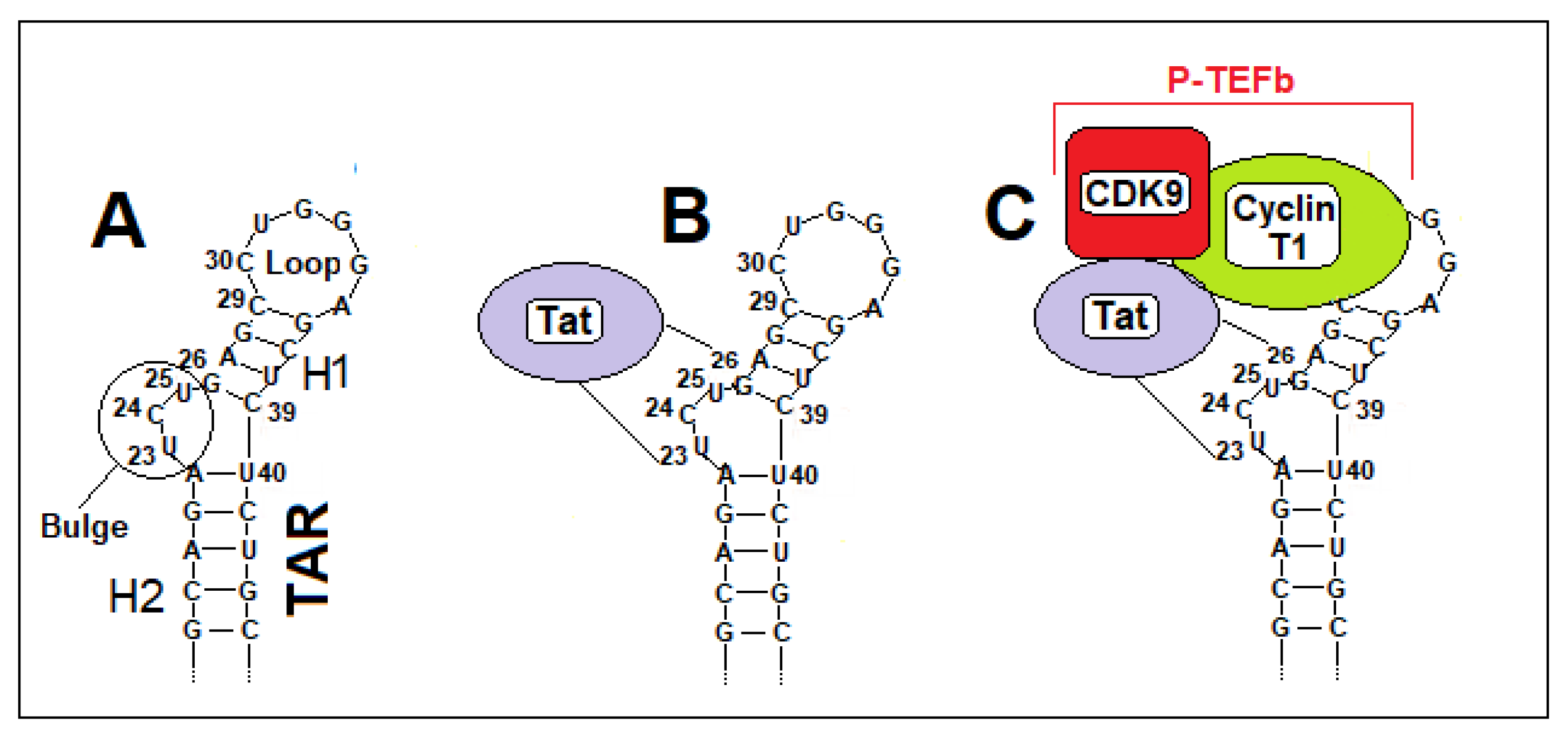
Figure 2.
Representative structure of HIV-1 5’ LTR structure and organization of nucleosomes and TAR-RNAPII-NELF-DSF positioning at the 5′ LTR. The 5′ LTR of HIV-1 is divided into four functional domains: the modulatory region, enhancer, core promoter, and leader region. The modulatory region contains binding sites for transcription factors that modulate basal and inducible transcription. The enhancer region typically includes multiple NF-κB binding sites, which are essential for activation in response to cellular signals. The core promoter contains the TATA box and Sp1 binding sites, which are necessary for transcription initiation. The leader region, also known as the 5′ untranslated region (5′-UTR), contains additional regulatory elements and is involved in post-transcriptional regulation and RNA processing. The transcription start site is located at the +1 position of the LTR. Nuc-0 and Nuc-1 nucleosomes regulate latency and transcriptional activity of the HIV-1 provirus by controlling chromatin accessibility and the recruitment of transcriptional machinery at the HIV-1 LTR promoter.
Figure 2.
Representative structure of HIV-1 5’ LTR structure and organization of nucleosomes and TAR-RNAPII-NELF-DSF positioning at the 5′ LTR. The 5′ LTR of HIV-1 is divided into four functional domains: the modulatory region, enhancer, core promoter, and leader region. The modulatory region contains binding sites for transcription factors that modulate basal and inducible transcription. The enhancer region typically includes multiple NF-κB binding sites, which are essential for activation in response to cellular signals. The core promoter contains the TATA box and Sp1 binding sites, which are necessary for transcription initiation. The leader region, also known as the 5′ untranslated region (5′-UTR), contains additional regulatory elements and is involved in post-transcriptional regulation and RNA processing. The transcription start site is located at the +1 position of the LTR. Nuc-0 and Nuc-1 nucleosomes regulate latency and transcriptional activity of the HIV-1 provirus by controlling chromatin accessibility and the recruitment of transcriptional machinery at the HIV-1 LTR promoter.
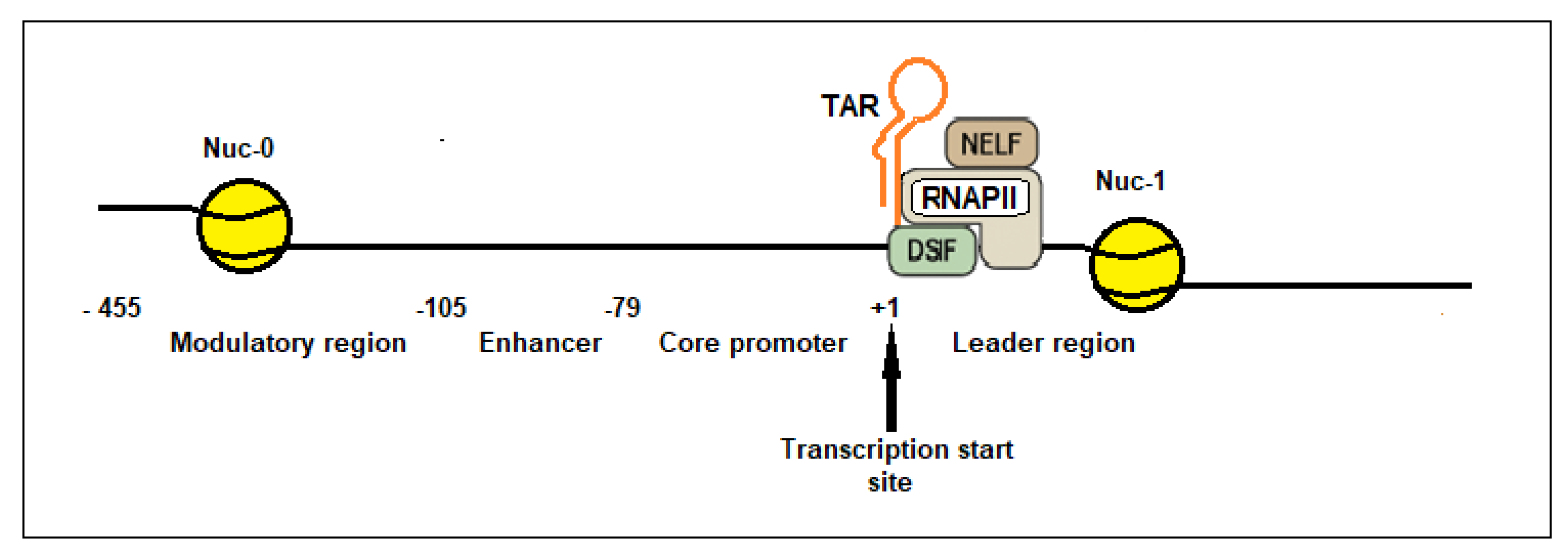
Figure 3.
Tat-mediated activation of HIV-1 transcription. Step 1: In HIV-1-infected cells and in the absence of Tat, several cellular transcription factors (TFs)—including NF-κB, NFATc, Sp1, and TBP—bind to the 5′ LTR and initiate RNA synthesis. However, RNAPII soon stalls after generating short transcripts due to the recruitment of the negative elongation factors NELF and DSIF. Step 2: Upon Tat accumulation in the nucleus, this viral protein binds to cyclin T1, a subunit of P-TEFb (a heterodimer composed of CDK9 and cyclin T1), thereby competing with and displacing HEXIM1. This interaction releases the active Tat–P-TEFb complex, which is specifically recruited to the trans-activation response (TAR) RNA element at the 5′ end of nascent HIV-1 transcripts. Step 3: Acetylation of Tat at lysine 28 (K28) by the p300/CBP-associated factor (PCAF) enhances its capacity to recruit P-TEFb. The kinase subunit of P-TEFb, CDK9, phosphorylates both the C-terminal domain (CTD) of RNAPII and the DSIF and NELF complexes. Step 4: These phosphorylation events convert DSIF into a positive elongation factor and promote the dissociation of NELF, allowing RNAPII to transition from a paused to a productive elongation state.
Figure 3.
Tat-mediated activation of HIV-1 transcription. Step 1: In HIV-1-infected cells and in the absence of Tat, several cellular transcription factors (TFs)—including NF-κB, NFATc, Sp1, and TBP—bind to the 5′ LTR and initiate RNA synthesis. However, RNAPII soon stalls after generating short transcripts due to the recruitment of the negative elongation factors NELF and DSIF. Step 2: Upon Tat accumulation in the nucleus, this viral protein binds to cyclin T1, a subunit of P-TEFb (a heterodimer composed of CDK9 and cyclin T1), thereby competing with and displacing HEXIM1. This interaction releases the active Tat–P-TEFb complex, which is specifically recruited to the trans-activation response (TAR) RNA element at the 5′ end of nascent HIV-1 transcripts. Step 3: Acetylation of Tat at lysine 28 (K28) by the p300/CBP-associated factor (PCAF) enhances its capacity to recruit P-TEFb. The kinase subunit of P-TEFb, CDK9, phosphorylates both the C-terminal domain (CTD) of RNAPII and the DSIF and NELF complexes. Step 4: These phosphorylation events convert DSIF into a positive elongation factor and promote the dissociation of NELF, allowing RNAPII to transition from a paused to a productive elongation state.
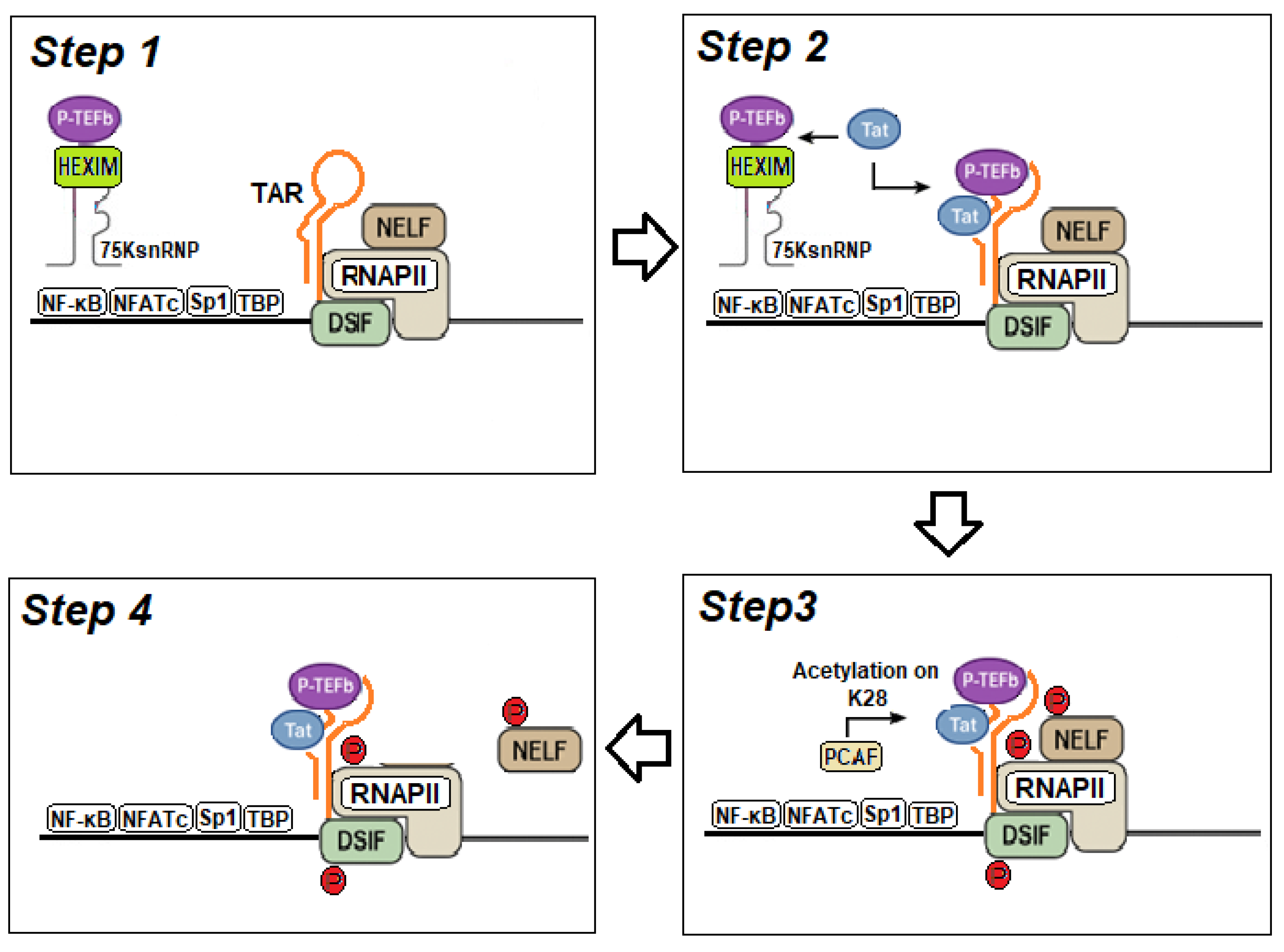
Figure 4.
Direct Suppressors of HIV-1 Transcriptional Activity: Molecular Targets and Mechanisms of Action. A) dCA binds directly to the unstructured basic region of Tat, preventing the Tat–P-TEFb complex from recognizing and binding the TAR element. B) Oxadiazole and benzoxazole derivatives inhibit Tat-dependent transcription by binding the TAR bulge, blocking formation of the Tat–TAR complex. C) Compounds T5628834 and T0516-4834 disrupt the Tat–CDK9/cyclin T1 interaction. D) Small molecules and cyclic peptides interact with both the bulge and loop regions of TAR, which is important because the loop is the cyclin T1 binding site within P-TEFb. E) Triptolide promotes proteasome-mediated degradation of Tat, inhibiting viral replication. F) Topotecan suppresses HIV-1 replication by interfering with host Top1 activity, which is required for transcription elongation and also alters mRNA splicing.
Figure 4.
Direct Suppressors of HIV-1 Transcriptional Activity: Molecular Targets and Mechanisms of Action. A) dCA binds directly to the unstructured basic region of Tat, preventing the Tat–P-TEFb complex from recognizing and binding the TAR element. B) Oxadiazole and benzoxazole derivatives inhibit Tat-dependent transcription by binding the TAR bulge, blocking formation of the Tat–TAR complex. C) Compounds T5628834 and T0516-4834 disrupt the Tat–CDK9/cyclin T1 interaction. D) Small molecules and cyclic peptides interact with both the bulge and loop regions of TAR, which is important because the loop is the cyclin T1 binding site within P-TEFb. E) Triptolide promotes proteasome-mediated degradation of Tat, inhibiting viral replication. F) Topotecan suppresses HIV-1 replication by interfering with host Top1 activity, which is required for transcription elongation and also alters mRNA splicing.
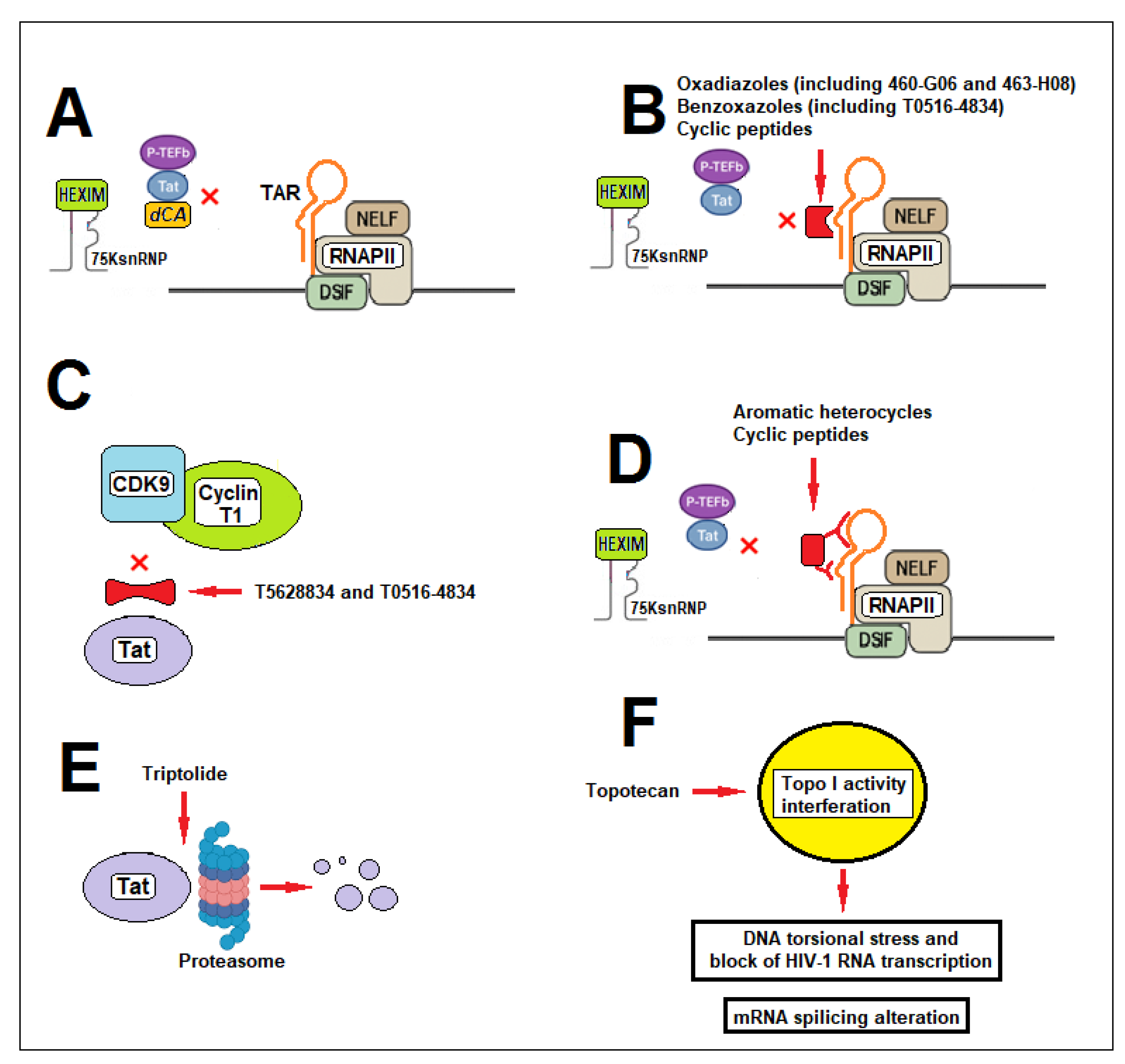
Figure 5.
Schematic Representation of BRD Functions Under Physiologic Conditions and in HIV-1 Infection. A) Under physiological conditions, BRD4 acts primarily as a transcriptional activator by promoting the release of P-TEFb from the inhibitory 7SK snRNP/HEXIM1 complex, enabling its recruitment to sites of transcription. BRD4 acts as a scaffold by binding acetylated histones via its bromodomains, promoting chromatin opening and the recruitment of transcription factors and coactivators to gene promoters. In addition, BRD4 facilitates transcriptional elongation primarily by recruiting P-TEFb to chromatin and paused RNA polymerase II complexes. P-TEFb, which contains the kinase CDK9, phosphorylates DSIF, NELF, and the C-terminal domain of RNA polymerase II, leading to the dissociation of NELF and conversion of DSIF into a positive elongation factor, thus enabling productive elongation. B) During HIV-1 infection, BRD4 retains the capacity to extract P-TEFb from the inactive 7SK snRNP complex and to recruit it in close proximity to RNAPII. The BRD4-associated P-TEFb complex phosphorylates the C-terminal domain of RNAPII, supporting basal transcription from the provirus. Histones H3 and H4 of nucleosomes Nuc-0 and Nuc-1 are the main binding substrates for BRD4, and their acetylation is the key determinant of the interaction with this protein. However, in infected cells, this process is relatively inefficient in the absence of Tat. C) In the presence of Tat, this viral transactivator competes with BRD4 for binding to P-TEFb. Tat displays a higher affinity for the cyclin T1 subunit of P-TEFb than BRD4 and efficiently displaces BRD4 to release P-TEFb from the HEXIM1-containing 7SK snRNP complex, facilitating assembly of the Tat/P-TEFb complex and its recruitment to TAR to drive robust viral transcription. D) ZL0580 binds the BD1 domain of BRD4, inducing a conformational change that promotes repressive chromatin at the HIV-1 LTR, reducing chromatin accessibility, and preventing recruitment of transcriptional activators such as P-TEFb. Additionally, ZL0580 disrupts Tat–CDK9 interactions and inhibits P-TEFb recruitment.
Figure 5.
Schematic Representation of BRD Functions Under Physiologic Conditions and in HIV-1 Infection. A) Under physiological conditions, BRD4 acts primarily as a transcriptional activator by promoting the release of P-TEFb from the inhibitory 7SK snRNP/HEXIM1 complex, enabling its recruitment to sites of transcription. BRD4 acts as a scaffold by binding acetylated histones via its bromodomains, promoting chromatin opening and the recruitment of transcription factors and coactivators to gene promoters. In addition, BRD4 facilitates transcriptional elongation primarily by recruiting P-TEFb to chromatin and paused RNA polymerase II complexes. P-TEFb, which contains the kinase CDK9, phosphorylates DSIF, NELF, and the C-terminal domain of RNA polymerase II, leading to the dissociation of NELF and conversion of DSIF into a positive elongation factor, thus enabling productive elongation. B) During HIV-1 infection, BRD4 retains the capacity to extract P-TEFb from the inactive 7SK snRNP complex and to recruit it in close proximity to RNAPII. The BRD4-associated P-TEFb complex phosphorylates the C-terminal domain of RNAPII, supporting basal transcription from the provirus. Histones H3 and H4 of nucleosomes Nuc-0 and Nuc-1 are the main binding substrates for BRD4, and their acetylation is the key determinant of the interaction with this protein. However, in infected cells, this process is relatively inefficient in the absence of Tat. C) In the presence of Tat, this viral transactivator competes with BRD4 for binding to P-TEFb. Tat displays a higher affinity for the cyclin T1 subunit of P-TEFb than BRD4 and efficiently displaces BRD4 to release P-TEFb from the HEXIM1-containing 7SK snRNP complex, facilitating assembly of the Tat/P-TEFb complex and its recruitment to TAR to drive robust viral transcription. D) ZL0580 binds the BD1 domain of BRD4, inducing a conformational change that promotes repressive chromatin at the HIV-1 LTR, reducing chromatin accessibility, and preventing recruitment of transcriptional activators such as P-TEFb. Additionally, ZL0580 disrupts Tat–CDK9 interactions and inhibits P-TEFb recruitment.
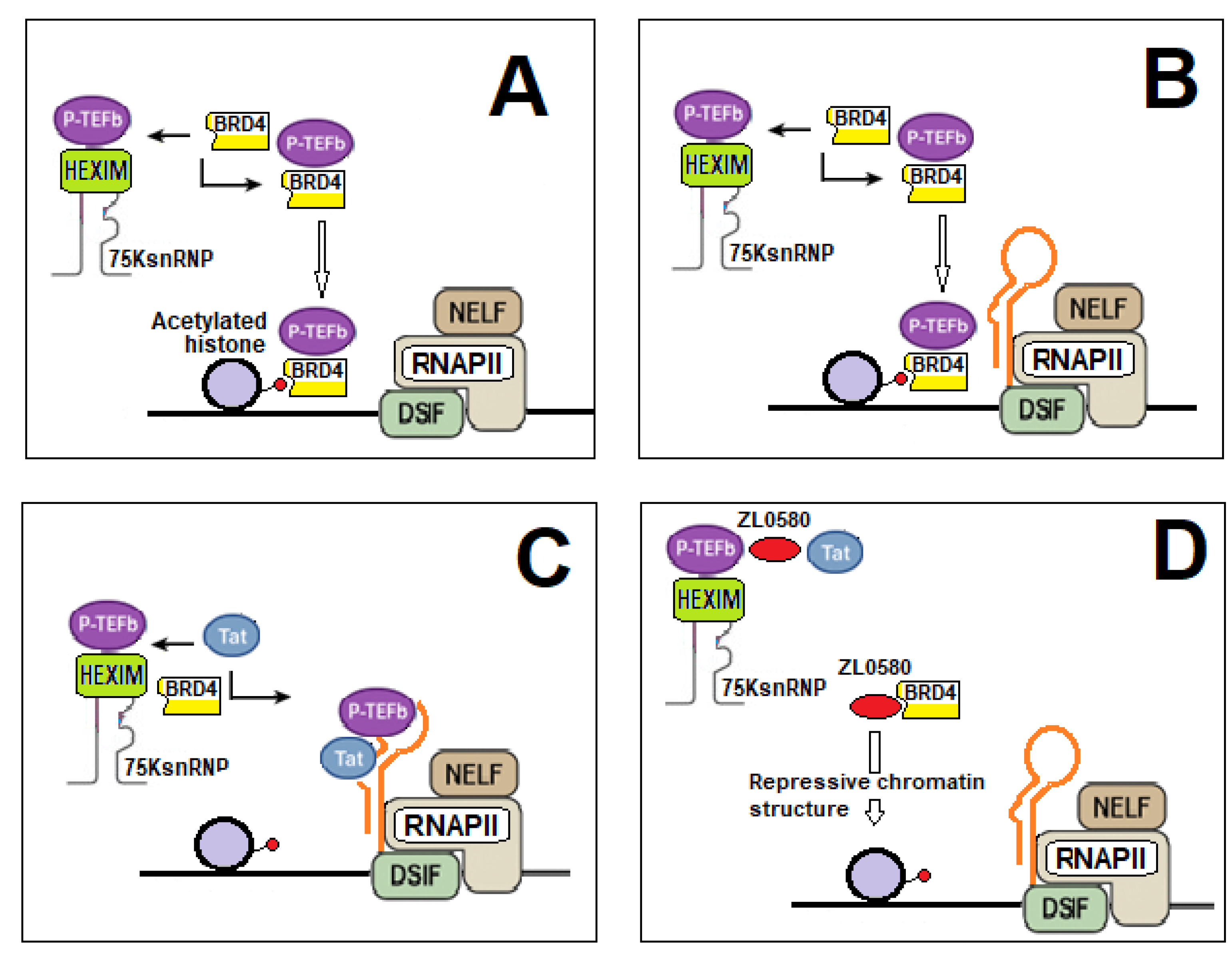
Figure 6.
Schematic Representation of LEDGF/p75 Function and Mechanism of Action of LEDGIN in HIV-1 Infection. A) During HIV-1 proviral integration, the PWWP domain of LEDGF/p75 mediates chromatin binding by recognizing H3K36me2/3-enriched nucleosomes, thereby tethering the PIC to transcriptionally active regions of the genome. The integrase-binding domain (IBD) of LEDGF/p75 directly interacts with HIV-1 integrase, forming a stable complex that positions the viral PIC at specific chromatin sites and is critical for efficient and site-selective integration. The AT-hook motifs further contribute to DNA binding, strengthening chromatin association and stabilizing tethering of the integration complex to host DNA. B) LEDGINs act as allosteric integrase inhibitors by binding to the LEDGF/p75 interaction site on integrase, thereby disrupting the integrase–LEDGF/p75 interaction and redirecting proviral integration toward less transcriptionally active genomic regions.
Figure 6.
Schematic Representation of LEDGF/p75 Function and Mechanism of Action of LEDGIN in HIV-1 Infection. A) During HIV-1 proviral integration, the PWWP domain of LEDGF/p75 mediates chromatin binding by recognizing H3K36me2/3-enriched nucleosomes, thereby tethering the PIC to transcriptionally active regions of the genome. The integrase-binding domain (IBD) of LEDGF/p75 directly interacts with HIV-1 integrase, forming a stable complex that positions the viral PIC at specific chromatin sites and is critical for efficient and site-selective integration. The AT-hook motifs further contribute to DNA binding, strengthening chromatin association and stabilizing tethering of the integration complex to host DNA. B) LEDGINs act as allosteric integrase inhibitors by binding to the LEDGF/p75 interaction site on integrase, thereby disrupting the integrase–LEDGF/p75 interaction and redirecting proviral integration toward less transcriptionally active genomic regions.
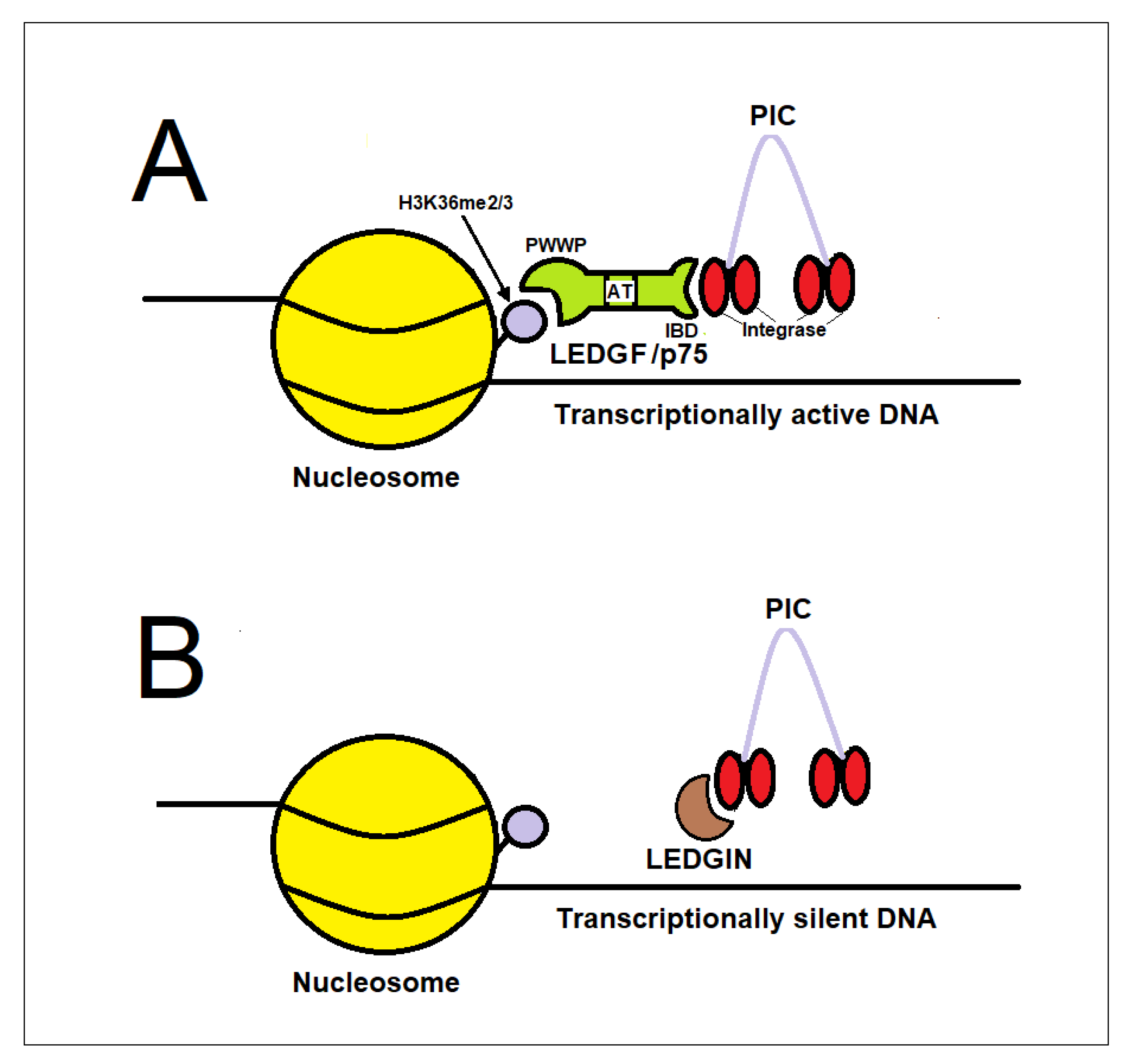
Figure 7.
Role of BRD4 in Enhancer-driven Activation of HIV-1 Transcription. The HIV-1 provirus can integrate near active enhancer elements that influence proviral transcription. BRD4 is recruited to enhancer-associated regions through its bromodomains, which recognize acetylated histones such as H3K27ac and H3K4me1. At these sites, BRD4 facilitates transcriptional activation by recruiting and activating positive transcription elongation factor b (P-TEFb), thereby promoting the release of RNA polymerase II from promoter-proximal pausing and enabling productive transcriptional elongation.
Figure 7.
Role of BRD4 in Enhancer-driven Activation of HIV-1 Transcription. The HIV-1 provirus can integrate near active enhancer elements that influence proviral transcription. BRD4 is recruited to enhancer-associated regions through its bromodomains, which recognize acetylated histones such as H3K27ac and H3K4me1. At these sites, BRD4 facilitates transcriptional activation by recruiting and activating positive transcription elongation factor b (P-TEFb), thereby promoting the release of RNA polymerase II from promoter-proximal pausing and enabling productive transcriptional elongation.
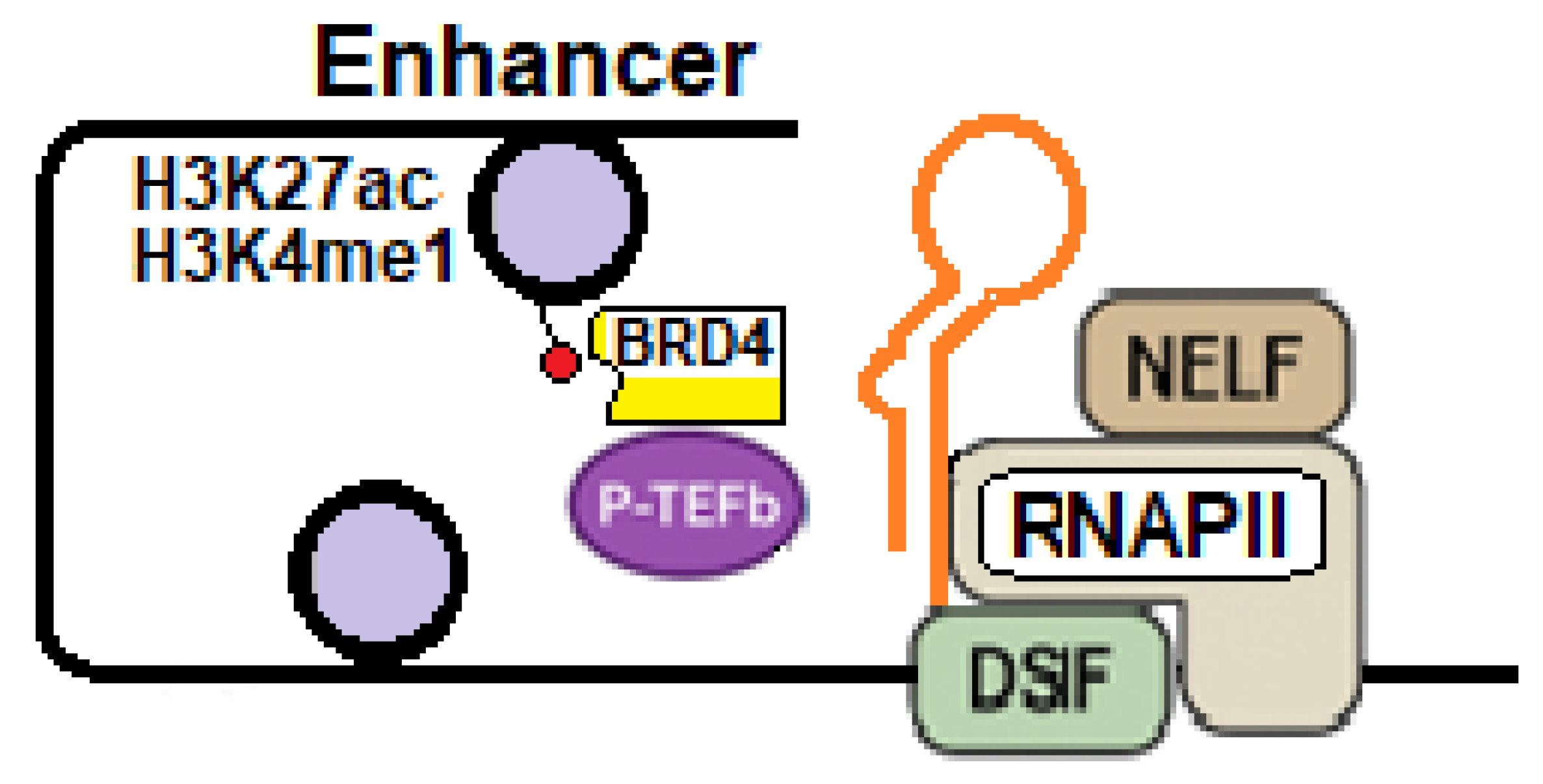
Figure 8.
LADs, intranuclear heterochromatin, and euchromatin organization. LADs are illustrated as chromatin regions positioned in close proximity to and physically interacting with the nuclear lamina. LADs correspond to highly compacted heterochromatin, typically enriched in repressive histone modifications and characterized by absent or markedly reduced transcriptional activity. In addition to LADs, the figure also depicts heterochromatin domains that are not directly bound to the nuclear lamina and are located more internally within the nucleoplasm. In contrast, euchromatin is less condensed chromatin that extends toward the nuclear interior and corresponds to transcriptionally permissive genomic regions.
Figure 8.
LADs, intranuclear heterochromatin, and euchromatin organization. LADs are illustrated as chromatin regions positioned in close proximity to and physically interacting with the nuclear lamina. LADs correspond to highly compacted heterochromatin, typically enriched in repressive histone modifications and characterized by absent or markedly reduced transcriptional activity. In addition to LADs, the figure also depicts heterochromatin domains that are not directly bound to the nuclear lamina and are located more internally within the nucleoplasm. In contrast, euchromatin is less condensed chromatin that extends toward the nuclear interior and corresponds to transcriptionally permissive genomic regions.
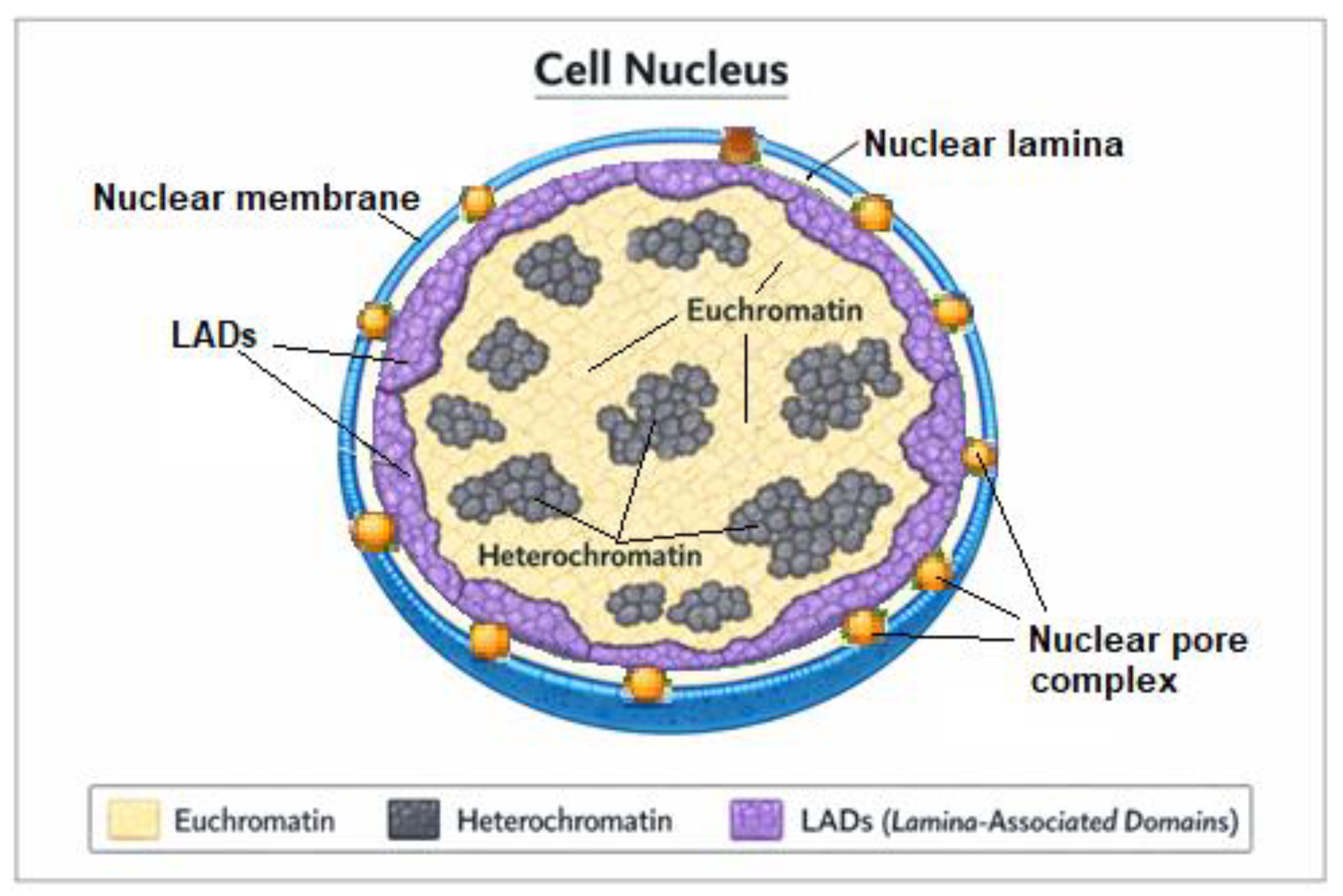
Figure 9.
Schematic representation of HIV-1 proviral integration in the absence of drugs (A), in the presence of LEDGINs (B), and following CPSF6 knockout or treatment with lenacapavir (C). Under basal conditions (A), HIV-1 integrates preferentially within gene-dense, transcriptionally active euchromatin, although a measurable fraction of events occurs in transcriptionally repressed heterochromatin. LEDGIN treatment (B) redirects integration away from active euchromatin toward gene-poor, transcriptionally repressed heterochromatin located within the nuclear interior. In contrast, CPSF6 knockout or disruption of the capsid–CPSF6 interaction by lenacapavir (C) alters nuclear trafficking and promotes integration at the nuclear periphery, particularly within LADs.
Figure 9.
Schematic representation of HIV-1 proviral integration in the absence of drugs (A), in the presence of LEDGINs (B), and following CPSF6 knockout or treatment with lenacapavir (C). Under basal conditions (A), HIV-1 integrates preferentially within gene-dense, transcriptionally active euchromatin, although a measurable fraction of events occurs in transcriptionally repressed heterochromatin. LEDGIN treatment (B) redirects integration away from active euchromatin toward gene-poor, transcriptionally repressed heterochromatin located within the nuclear interior. In contrast, CPSF6 knockout or disruption of the capsid–CPSF6 interaction by lenacapavir (C) alters nuclear trafficking and promotes integration at the nuclear periphery, particularly within LADs.
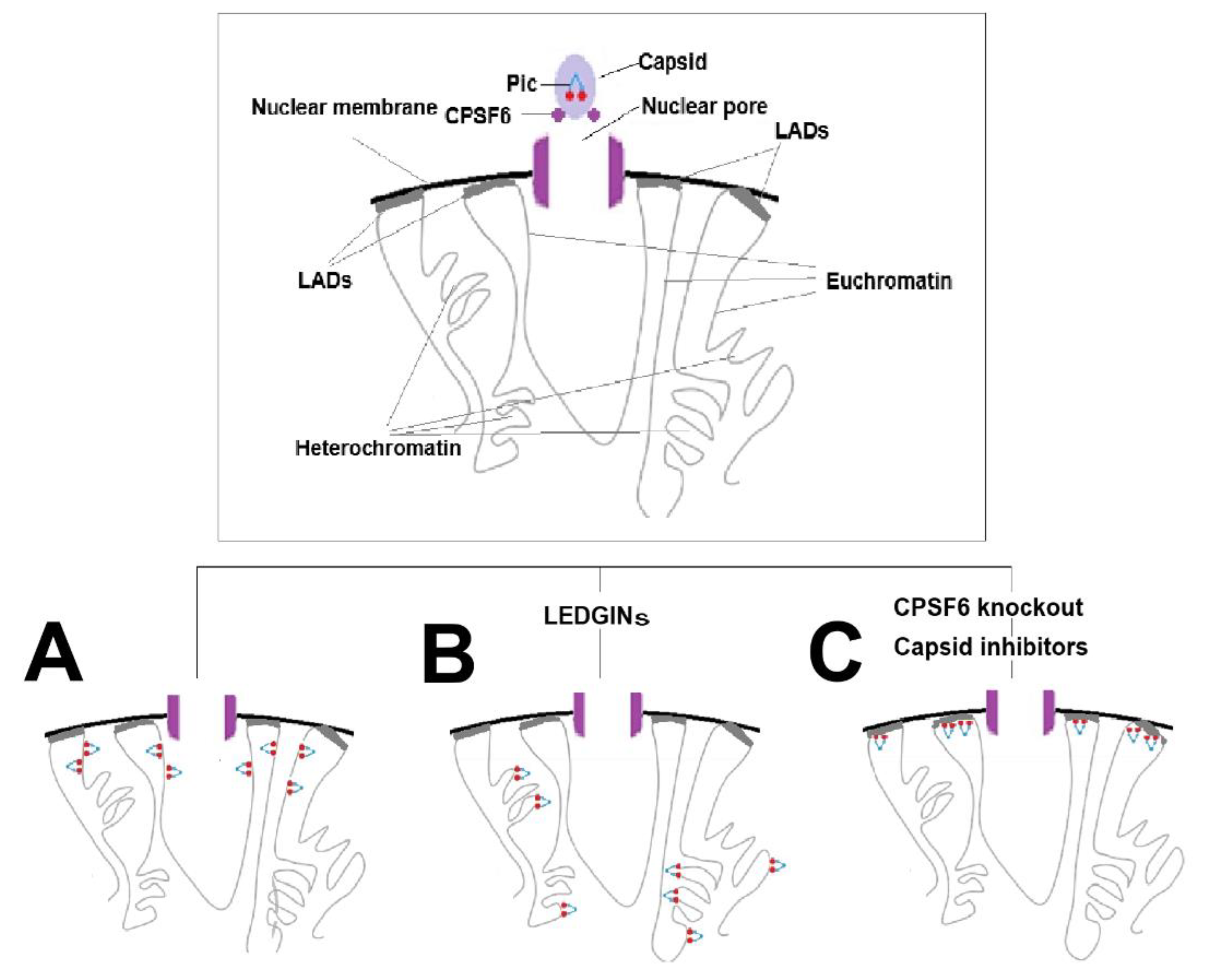
Figure 10.
Potential effects on clonal expansion of infected CD4+ T cells of patients treated with prolunged cART (including integrase inhibitors, nucleoside or non-nucleoside reverse transcriptase inhibitors, and protease inhibitors), LEDGINs, and capsid inhibitors.
Figure 10.
Potential effects on clonal expansion of infected CD4+ T cells of patients treated with prolunged cART (including integrase inhibitors, nucleoside or non-nucleoside reverse transcriptase inhibitors, and protease inhibitors), LEDGINs, and capsid inhibitors.
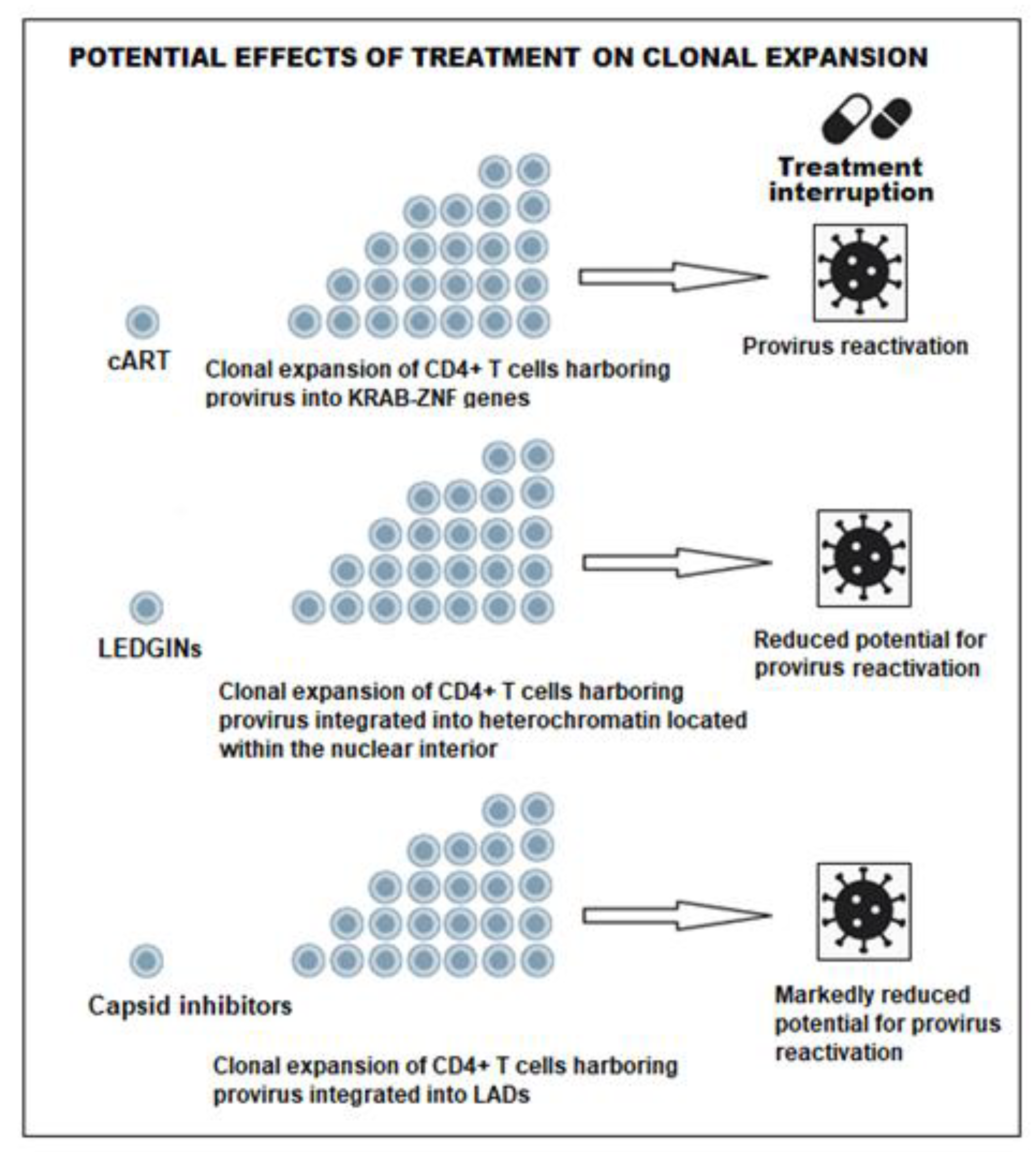

Table 1.
Classification of “block-and-lock” therapeutic strategies for HIV-1 infection according to their primary mechanism of action.
Table 1.
Classification of “block-and-lock” therapeutic strategies for HIV-1 infection according to their primary mechanism of action.
| Group | Block-and-lock agent's name or strategy name | Mechanism/Target | References |
|---|---|---|---|
| Direct suppressors of HIV-1 transcriptional activity | Tat inhibitors, Triptolide, Camptothecin analogs, CRISPR–Cas systems. | Direct inhibition of viral transcription, splicing, or RNA stability. | [16,45,46,47,48,49,50,51,52,53,54,55,56,57,58,59,60,61,62,63,64,65,66,67,68,69,70,71,72,73] |
| Post-transcriptional agents | Splicing inhibitors, RNA interference technologies. |
Sequence-specific silencing of HIV-1 gene expression through RNA degradation or targeted transcriptional repression, promoting durable viral latency. | [74,75,76,77,78,79,80,81,82,83,84,85] |
| Cellular transcription factor modulators. | BRD4 modulators, NF-κB inhibitors. | Inhibition of host transcription factors that activate HIV-1 LTR. | [86,87,88,89,90,91,92,93,94,95,96,97,98,99,100,101,102,103,104,105,106,107,108,109,110,111] |
| Cellular Kinase inhibitors. | PI3K–AKT–mTOR pathway modulators, Aurora kinase and PAK1/2 inhibitors, PKC inhibitors, CDK inhibitors, SR kinase inhibitors. | Block of cellular kinases/signaling required for HIV-1 transcription. | [112,113,114,115,116,117,118,119,120,121,122] |
| Epigenetic, chromatin, and integration site modulators. | H3K27 demethylase inhibitors, Histone acetyltransferase (HAT) inhibitors, FACT targeting compounds, LEDGF/p75–integrase inhibitors (LEDGINs) | Induction of repressive chromatin and epigenetic silencing of provirus. Integration in transcriptionally silent chromatin | [123,124,125,126,127,128,129,130,131,132,133,134,135,136,137,138,139,140,141,142,143,144,145,146,147,148,149,150,151,152,153,154,155,156,157,158,159] |
Table 2.
Time to viral rebound after treatment cessation in vivo or drug removal in vitro1.
| Intervention | Time to Viral Rebound | References |
|---|---|---|
| cART alone | 2–4 weeks (median time 16 days) in humans. 3–10 days in humanized mice of HIV-1 infection. |
[5,49] |
| dCA + cART | 10–19 days in humanized mice of HIV-1 infection. | [16,49] |
| Novel Tat inhibitors (1,3,4-oxadiazole derivatives, benzoxazole compounds, cyclic peptides, aromatic heterocycles) | No in vivo studies. No in vitro studies have calculated the time of transcriptional suppression after drug removal. | [53,54,55,56,57,58,59,60,61,62] |
| LLDT + cART | LLDT-8 + cART does not delay viral rebound in SIV-infected macaques after cART discontinuation. | [65,66] |
| Topotecan | No in vivo studies. In in vitro studies, suppression of HIV-1 reactivation persisted for ~72 hours after the drug was removed from the culture medium. | [67] |
| CRISPR–Cas (Targeted provirus editing) | Quantitative rebound kinetics are not yet well defined. | [68,69,70,71,72] |
| EBT-101 infusion (CRISPR excising HIV DNA) + cART in humans | In humans, ~2–4 weeks; one individual, ~16 weeks. | [73] |
| SF3B1 inhibitors | No in vivo studies. In in vitro studies, suppression of HIV-1 reactivation by sudemycin D6 persisted for ~72 hours after the drug was removed from the culture medium. | [74] |
| RNAi technologies | Quantitative rebound kinetics are not yet well defined. | [75,76,77,78,79,80,81,82,83,84,85] |
| ZL0580 | ~4 weeks in a humanized mouse model of HIV-1 infection. | [107] |
| NF-κB Inhibitors | No in vivo studies. Precise kinetics have not been systematically reported in standard in vitro latency models. | [109] |
| PI3K–AKT–mTOR Pathway Modulators | No in vivo studies. No in vitro studies have calculated the time of transcriptional suppression after drug removal. | [112,113] |
| Danusertib | No in vivo studies. No in vitro studies have calculated the time of transcriptional suppression after drug removal. | [116] |
| PF-3758309 | No in vivo studies. No in vitro studies have calculated the time of transcriptional suppression after drug removal. | [119] |
| Protein kinase C inhibitors | No in vivo studies. No in vitro studies have calculated the time of transcriptional suppression after drug removal. | [120] |
| CDK9 Inhibitors | No in vivo studies. In in vitro studies, the transcriptional suppression persists for at least 24 h after drug removal. | [121] |
| CDK8/19 Inhibitors | No in vivo studies. In in vitro studies, the transcriptional suppression persists for at least 7 days after drug removal. | [121] |
| CDK7 Inhibitors | No in vivo studies. No in vitro studies have calculated the time of transcriptional suppression after drug removal. | [121] |
| SR Kinase Inhibitors | No in vivo studies. No in vitro studies calculating the time of transcriptional suppression after drug removal. | [122] |
| H3K27 demethylase inhibitors, histone acetyltransferase (HAT) inhibitors | No in vivo studies. In in vitro studies, the transcriptional suppression lasts less than 72 hours after GSK-J4 removal. | [131,132,133,134] |
| CBL0100 | No in vivo studies. No in vitro studies have calculated the time of transcriptional suppression after drug removal. | [138] |
| Q308 | No in vivo studies. No in vitro studies have calculated the time of transcriptional suppression after drug removal. | [139] |
| LEDGINs | No in vivo or in vitro studies calculating the time of transcriptional suppression after drug removal. | [148,149,150,151,152,153,154,155,156,157,158,159] |
1 It should be emphasized that measuring viral rebound after drug withdrawal in vitro is not equivalent to assessing time to viral rebound in vivo, which requires reactivation, production, and systemic spread of replication-competent virus in an animal model or in patients following treatment interruption. Nevertheless, given the limited number of in vivo studies evaluating candidate block-and-lock compounds, we have also reported in vitro findings obtained after removal of the tested compounds, either alone or in combination with antiretroviral therapy, for all compounds that have not yet been tested in vivo.
Table 3.
Comparative epigenomic and structural features of major chromatin states.
| Chromatin type | H3K9me2/3 | Gene density | Enrichment in nuclear B compartment* |
Compact/ structurally constrained environment |
|---|---|---|---|---|
| Euchromatin | ↓ | ↑↑↑ | ↓ | ↓ |
| Intranuclear heterochromatin | ↑↑ | ↓↓ | ↑↑ | ↑↑ |
| LADs | ↑↑↑ | ↓↓↓ | ↑↑↑ | ↑↑↑ |
*The B compartment represents regions of the genome that are transcriptionally inactive, gene-poor, heterochromatic, and spatially segregated within the nucleus.
Disclaimer/Publisher’s Note: The statements, opinions and data contained in all publications are solely those of the individual author(s) and contributor(s) and not of MDPI and/or the editor(s). MDPI and/or the editor(s) disclaim responsibility for any injury to people or property resulting from any ideas, methods, instructions or products referred to in the content. |
© 2026 by the authors. Licensee MDPI, Basel, Switzerland. This article is an open access article distributed under the terms and conditions of the Creative Commons Attribution (CC BY) license (http://creativecommons.org/licenses/by/4.0/).
Copyright: This open access article is published under a Creative Commons CC BY 4.0 license, which permit the free download, distribution, and reuse, provided that the author and preprint are cited in any reuse.


