

Submitted:
06 March 2026
Posted:
09 March 2026
You are already at the latest version
Abstract
As artificial intelligence (AI) becomes increasingly embedded in organizational processes, questions about its impact on leadership have gained prominence. Yet the existing literature remains fragmented. Studies often focus separately on strategy, leadership skills, governance structures, or ethical concerns, without explaining how these dimensions connect to shape leadership effectiveness in AI-driven environments. This study conducts a PRISMA-guided systematic review of 63 peer-reviewed articles to examine how AI-embedded leadership is conceptualized across contexts. By synthesizing findings across strategic, human, and governance domains, the analysis identifies recurring patterns and structural relationships in the literature. The review shows that effective leadership in AI-intensive settings does not result simply from adopting advanced technologies or developing digital competencies. Instead, it depends on the alignment between how deeply AI is integrated into decision-making processes, how leaders interpret and oversee algorithmic outputs, and how governance mechanisms ensure transparency, accountability, and trust. On this basis, the study introduces the AI-Leadership Configurational Framework (ALCF), a multi-level model that explains leadership effectiveness as the outcome of systemic alignment. The framework integrates previously disconnected debates and offers a clear foundation for future empirical research on leadership in the algorithmic age.
Keywords:
artificial intelligence
; leadership
; organizational governance
; decision making
; sociotechnical systems
1. Introduction
Artificial intelligence (AI) has transitioned from a peripheral technological support tool to a structurally embedded force that reconfigures how organizations decide, coordinate, and govern. Early scholarship anticipated that AI would influence managerial judgment and leadership roles (Jones, 2018; Smith & Green, 2018). However, contemporary research demonstrates a far deeper transformation: AI is increasingly integrated into core decision architectures, resource allocation systems, and competitive positioning logics (Brock & von der Wangenheim, 2019; Huber & Alexy, 2024; Sadiku-Dushi, 2026). Rather than functioning as a neutral analytical instrument, AI actively shapes how information is produced, interpreted, and legitimized, thereby redistributing authority, expertise, and accountability within organizations (Van Quaquebeke & Gerpott, 2023).
This structural embedding unfolds across diverse sectors. In healthcare and professional services, AI influences diagnostic reasoning, risk assessment, and executive oversight (Burnside et al., 2025; Chen & Decary, 2020). In education, it challenges instructional leadership, governance design, and pedagogical autonomy (Fullan et al., 2024; Tyson & Sauers, 2021). In strategic management and digital transformation domains, AI reshapes decision-making architectures, capability development trajectories, and competitive dynamics (Abositta et al., 2024; Jaboob et al., 2025; Madanchian et al., 2024). Across contexts, a shared conclusion emerges: AI does not simply support leadership; it alters the structural conditions under which leadership is enacted.
Parallel to this structural transformation, a growing body of research has examined the leadership capabilities required in AI-intensive environments. Scholars emphasize data literacy, algorithmic interpretability, reflexive judgment, and ethical governance competence as central requirements (Bock & von der Oelsnitz, 2025; Di Prima et al., 2024; Myszak & Filina-Dawidowicz, 2025; Santana & Díaz-Fernández, 2023). From a dynamic managerial capabilities perspective, leadership is increasingly framed as the ability to sense technological opportunities, seize digital innovation potential, and reconfigure organizational resources under conditions of technological turbulence (Hossain et al., 2025).
Despite these advances, existing research remains theoretically fragmented. Strategic AI integration is frequently analyzed independently from leadership capability development. Ethical and governance risks—such as opacity, accountability diffusion, and bias amplification—are examined in isolation from structural transformation processes (Barari et al., 2024; Mahmoud et al., 2020; Papagiannidis et al., 2023; Rana et al., 2022). Simultaneously, performance-oriented studies highlight analytical precision and innovation gains associated with AI (Odugbesan et al., 2023; Plastino & Purdy, 2018; Wijayati et al., 2022), often without integrating governance contingencies.
A central tension therefore characterizes the field: AI is portrayed both as an enhancer of decision quality and as a source of systemic vulnerability. Moreover, emerging research conceptualizes leadership as operating within hybrid human–AI ecosystems where epistemic authority is partially distributed across sociotechnical constellations (Arar et al., 2024; Zárate-Torres et al., 2025). This shift unsettles traditional leadership constructs grounded in centralized authority and interpersonal influence, suggesting instead that leaders orchestrate networks of human and machine intelligence (Van Quaquebeke & Gerpott, 2023). Yet these contributions remain dispersed across disciplinary silos and rarely converge into a unified explanatory structure capable of capturing cross-level interdependencies.
What remains insufficiently theorized is how strategic AI embedding, leadership capability reconfiguration, hybrid human–AI collaboration, and governance–legitimacy safeguards interact to shape leadership effectiveness. The literature lacks a multi-level conceptual architecture that integrates structural transformation, human interpretive capacity, and institutional regulation within a single configurational logic. In the absence of such integration, AI-embedded leadership is alternately framed as a competence-upgrading challenge, a digital transformation initiative, or an ethical compliance problem—without explaining how these dimensions condition one another.
This theoretical gap carries significant implications. For general management theory, AI challenges assumptions about resource orchestration, competitive advantage, and strategic control. For leadership research, it destabilizes established constructs of authority, legitimacy, and influence. For digital transformation scholarship, it underscores the need to conceptualize leadership as a higher-order orchestration capability embedded within evolving sociotechnical infrastructures.
To address this fragmentation, the present study conducts a systematic PRISMA-guided review of 33 peer-reviewed studies at the intersection of artificial intelligence and leadership. Moving beyond descriptive aggregation, the analysis develops a theory-driven cross-thematic synthesis designed to identify structural patterns, interdependencies, and boundary conditions across sectors.
Specifically, the study pursues four interconnected objectives:
- To clarify the strategic domains in which AI restructures leadership practice and decision architectures;
- To identify the dynamic capabilities required to govern AI-embedded organizational systems;
- To explicate the ethical and governance tensions inherent in hybrid human–AI collaboration;
- To theorize the configurational boundary conditions under which AI enhances or destabilizes leadership effectiveness.
Conceptually anchored in the dynamic capabilities perspective (Hossain et al., 2025; Huber & Alexy, 2024; Santana & Díaz-Fernández, 2023), the study advances an integrative explanatory architecture: the AI-Leadership Configurational Framework (ALCF). Rather than treating AI as purely augmentative or substitutive, the ALCF conceptualizes leadership effectiveness as an emergent property of vertical alignment between strategic orchestration, capability reconfiguration, and governance–legitimacy safeguards within hybrid human–AI systems. By articulating this multi-level and system-moderated logic, the article seeks to transform a fragmented body of research into a theoretically coherent and empirically testable foundation for leadership scholarship in the algorithmic age.
2. Materials and Methods
2.1. Research Design
This study adopts a systematic literature review design structured in accordance with the PRISMA 2020 framework (Preferred Reporting Items for Systematic Reviews and Meta-Analyses). PRISMA 2020 provides updated guidance aimed at strengthening transparency, completeness, and methodological rigor in review-based research (Page et al., 2021a; Page et al., 2021b). Its revised structure responds to the growing complexity of contemporary evidence synthesis and emphasizes clear reporting of identification, screening, eligibility, and inclusion procedures (Page et al., 2021c).
The decision to employ PRISMA 2020 was not merely procedural but epistemological. Research on artificial intelligence (AI) and leadership is dispersed across multiple disciplines—including management, education, healthcare, information systems, and strategy—each with distinct terminologies and analytical traditions. In such fragmented knowledge domains, structured synthesis becomes essential to avoid selective interpretation and conceptual ambiguity. PRISMA’s updated guidance explicitly promotes transparency in decision-making processes and detailed documentation of inclusion and exclusion criteria, thereby enhancing reproducibility and reducing implicit selection bias (Sohrabi et al., 2021; Swartz, 2021).
Recent methodological commentaries underline that PRISMA 2020 moves beyond checklist compliance and encourages researchers to justify procedural decisions, report deviations when necessary, and clarify how evidence was evaluated and synthesized (Ramasamy, 2022; Yepes-Nuñez et al., 2021). In line with these recommendations, the present review was designed with predefined eligibility criteria, documented screening procedures, and a transparent audit trail of study selection.
Given the conceptual heterogeneity of the AI–leadership literature—ranging from empirical studies to theoretical reflections and structured reviews—the study follows a qualitative systematic synthesis approach. This design allows integration of diverse methodological traditions without imposing statistical aggregation, while still maintaining procedural rigor. The objective is not to quantify effect sizes but to map, organize, and critically interpret the evolving scholarly conversation at the intersection of artificial intelligence and organizational leadership.
By grounding the research design in PRISMA 2020 principles and explicitly aligning the review process with contemporary reporting standards, this study seeks to provide a replicable and analytically robust synthesis capable of withstanding methodological scrutiny in high-impact academic outlets.
2.2. Search Strategy
The search strategy was designed to ensure both breadth and conceptual precision in capturing the evolving literature at the intersection of artificial intelligence and organizational leadership. The search process was conducted between January and March 2026 across three multidisciplinary and high-impact academic databases: Web of Science Core Collection, Scopus, and ABI/INFORM (ProQuest). These databases were selected due to their extensive coverage of peer-reviewed journals in management, leadership studies, strategy, education, and information systems.
To balance sensitivity (capturing relevant studies) and specificity (excluding unrelated technical AI research), the search string was developed iteratively. Preliminary exploratory searches were conducted to identify dominant terminological patterns in the field. Based on this calibration process, the final Boolean string was defined as follows: (“artificial intelligence” OR “AI” OR “algorithmic decision-making” OR “generative AI”) AND (“leadership” OR “digital leadership” OR “strategic leadership” OR “executive decision-making”).
Search fields were restricted to title, abstract, and keywords to ensure thematic centrality rather than incidental mention. No initial time restriction was imposed in order to capture early conceptual contributions as well as recent empirical developments. Only peer-reviewed journal articles published in English were considered eligible at this stage.
After retrieval, all records were exported to a reference management system and duplicates were removed prior to screening. The resulting dataset constituted the initial pool for title and abstract evaluation under the predefined eligibility criteria described in Section 2.3.
This structured and replicable search configuration was intended to minimize omission bias while maintaining analytical focus on studies where artificial intelligence and leadership were substantively interconnected.
2.3. Eligibility Criteria
Eligibility criteria were defined prior to the screening phase in order to prevent retrospective adjustments and to minimize the risk of selection bias. Establishing these parameters ex ante was essential to preserve analytical consistency and to ensure that the review remained strictly focused on the intersection between artificial intelligence (AI) and leadership within organizational contexts.
Studies were considered eligible when artificial intelligence constituted a substantive analytical component of the research rather than a peripheral contextual reference. This included investigations examining AI systems, algorithmic decision-making, or generative AI within managerial, institutional, or organizational environments. Articles that merely referred to AI as a general technological trend, without developing its organizational or leadership implications, were not retained.
Leadership was required to function as a central theoretical or empirical construct. This condition was satisfied when leadership formed part of the study’s primary objective, research question, or conceptual framework; when leadership constructs—such as digital leadership, transformational leadership, strategic leadership, leadership competencies, or executive decision-making—were explicitly defined, developed, or measured; or when the study analyzed how AI influences leadership roles, behaviors, authority structures, competencies, or strategic decision processes. In contrast, studies in which leadership appeared only as a marginal reference—for example within brief managerial implications or future research suggestions—were excluded in order to avoid conceptual dilution of the review’s focus.
To maintain organizational relevance, eligible studies had to be situated within formal institutional settings, including corporate organizations, educational institutions, healthcare systems, entrepreneurial ventures, or public-sector entities. Purely technical, engineering-oriented, or laboratory-based research lacking organizational framing was not considered appropriate for inclusion.
Furthermore, only studies offering a clear scholarly contribution—whether theoretical, empirical, or structured review-based—were retained. Editorial notes, practitioner commentaries, opinion pieces, or conference abstracts without full papers were excluded due to insufficient methodological transparency. Accessibility was also a necessary condition; articles unavailable in full-text form were excluded because comprehensive eligibility assessment and data extraction could not be reliably conducted.
By operationalizing leadership as a theoretically framed or empirically examined core variable rather than as a contextual descriptor, this review safeguards conceptual rigor and prevents the over-inclusion of studies in which artificial intelligence is discussed independently of leadership dynamics. This deliberate boundary-setting strengthens the internal coherence of the final corpus and enhances the defensibility of the selection process under methodological scrutiny.
2.4. Screening and Selection Procedure
The study selection process followed the sequential logic established by the PRISMA 2020 framework. The initial database search yielded 521 records. All references were exported to Zotero for management and duplicate detection. A total of 32 duplicate records were removed prior to screening, resulting in 489 unique records eligible for title and abstract evaluation.
During the first screening phase, titles and abstracts were independently examined to assess their relevance to the intersection of artificial intelligence and organizational leadership. This process led to the exclusion of 426 records that did not explicitly address leadership as a central construct or that focused exclusively on technical or engineering aspects of artificial intelligence.
Sixty-three articles were retained for full-text retrieval. Of these, 17 reports could not be accessed in full text despite institutional database searches and cross-referencing efforts. Consequently, 46 full-text articles were assessed for eligibility. Although 17 reports could not be retrieved despite institutional access and cross-referencing efforts, their exclusion is unlikely to compromise the internal coherence of the review. Title and abstract screening indicated that these studies did not substantially diverge from the thematic distribution observed in the retained corpus. Therefore, the risk of systematic bias derived from non-retrieval is considered minimal.
Following detailed full-text evaluation against the predefined inclusion and exclusion criteria, 13 studies were excluded due to insufficient theoretical engagement with leadership, marginal treatment of artificial intelligence in organizational contexts, or lack of substantive conceptual contribution. Ultimately, 33 studies met all eligibility criteria and constitute the final corpus for qualitative synthesis.
The complete screening trajectory is illustrated in Figure 1, which presents the PRISMA 2020 flow diagram adapted to the present review.
2.5. Data Extraction
Once the final corpus of thirty-three studies was established, a structured data extraction process was conducted to ensure analytical consistency and comparability across heterogeneous research designs. Given the conceptual diversity of the AI–leadership literature, the objective of this phase was not merely descriptive compilation but systematic organization of theoretically and empirically relevant elements.
An extraction matrix was developed prior to in-depth analysis in order to standardize the information collected from each article. This matrix included bibliographic details, research design, methodological approach, sectoral or organizational context, conceptualization of artificial intelligence, operationalization or theoretical framing of leadership, principal findings, and explicit implications for leadership practice or theory. Recording these dimensions allowed for structured cross-study comparison and reduced the risk of interpretative selectivity during synthesis.
Particular attention was devoted to how leadership was defined and analytically positioned within each study. In empirical contributions, this involved identifying whether leadership constructs functioned as independent, dependent, mediating, or moderating variables. In conceptual and review-based works, the focus centered on how authors theorized shifts in leadership roles, competencies, authority configurations, and decision-making structures within AI-integrated environments. This distinction was essential to differentiate between technologically oriented discussions and research genuinely advancing leadership theory.
Each article was examined in full and coded iteratively rather than relying solely on abstracts. Extracted data were reviewed multiple times to confirm alignment with the predefined eligibility criteria and to verify internal consistency in thematic categorization. This recursive process strengthened classification reliability and reduced the likelihood of conceptual misinterpretation.
A comprehensive descriptive overview of the extracted studies, including bibliographic information, methodological design, organizational context, and analytical focus, is provided in Appendix 1. The integration of this structured documentation reinforces procedural transparency and supports the traceability of the subsequent thematic synthesis.
2.6. Data Analysis and Thematic Synthesis
The analytical phase was designed to move beyond descriptive aggregation and toward an interpretive integration of the evidence. Given the conceptual heterogeneity of the selected studies and the exploratory nature of the artificial intelligence–leadership nexus, a qualitative thematic synthesis was conducted. The objective was not merely to catalogue findings but to identify convergent patterns, underlying assumptions, and emerging tensions within the evolving body of literature.
The 33 studies constituting the final corpus were examined through an iterative coding process. In a first analytical cycle, each article was read in full to extract core arguments, theoretical positioning, methodological orientation, and principal findings. Open coding was then applied to segments of text referring to organizational implications of artificial intelligence for leadership processes, leader–follower dynamics, decision-making structures, ethical considerations, and risk configurations. Codes were generated inductively from the material rather than imposed a priori, allowing the analytical structure to emerge from the data itself.
During the second cycle, codes were compared across studies to identify thematic convergence and conceptual overlap. This constant comparative approach facilitated the clustering of codes into higher-order categories. Particular attention was paid to distinctions between normative claims and empirically substantiated findings, as well as to differences between technological optimism and critical or cautionary perspectives. This step was essential to avoid flattening the literature into simplistic dichotomies and to preserve the epistemic diversity of the field.
The synthesis ultimately coalesced into three analytically differentiated yet interrelated domains: opportunities, challenges, and emerging risks. The category of opportunities captures contributions highlighting efficiency gains, decision-support enhancement, augmentation of leader capabilities, and innovation potential. Challenges refer to structural, organizational, and competence-related constraints that may hinder effective integration of artificial intelligence into leadership practice. Emerging risks encompass ethical dilemmas, algorithmic opacity, erosion of relational trust, accountability diffusion, and potential dehumanization of managerial processes. These domains were not predefined but crystallized through repeated engagement with the corpus and systematic refinement of thematic boundaries.
To enhance analytical robustness, thematic assignments were revisited after the initial categorization to ensure internal coherence and external distinctiveness between domains. When ambiguities arose, studies were re-examined in light of their primary research questions and theoretical contributions. This recursive validation process reduced the likelihood of arbitrary classification and strengthened conceptual clarity.
Rather than privileging frequency counts, the synthesis prioritized conceptual salience and theoretical contribution. Studies offering integrative frameworks or introducing novel constructs were weighted analytically for their structuring influence on the field. In doing so, the review seeks to map not only what has been studied, but how artificial intelligence is progressively reframing leadership theory and organizational governance debates.
Through this layered interpretive procedure, the review provides a structured yet critical understanding of the current state of knowledge, while simultaneously identifying areas of conceptual fragmentation and research gaps that warrant further empirical and theoretical development.
3. Results
3.1. AI as Strategic Reconfiguration of Leadership
A recurrent pattern identified across the reviewed studies conceptualizes artificial intelligence not as an auxiliary technological instrument but as a structural force that redefines the strategic foundations of leadership practice. Rather than being confined to operational automation, AI progressively permeates decision-making architectures, reshapes authority configurations, and reorganizes the informational infrastructures through which strategic judgment is exercised (Bevilacqua et al., 2025; Brock & von der Wangenheim, 2019; Huber & Alexy, 2024; Sadiku-Dushi, 2026; Zaidi et al., 2025). In this respect, AI becomes embedded in the governing logic of organizations, influencing how strategic priorities are constructed, validated, and implemented.
Across management contexts, AI integration systematically alters the epistemic conditions under which executive decisions are formed. In healthcare environments, AI-supported diagnostic and risk assessment systems structure interpretive inputs prior to executive deliberation, thereby reframing oversight responsibilities (Burnside et al., 2025; Chen & Decary, 2020). Comparable dynamics are observed in broader organizational domains, where predictive analytics and data-driven forecasting recalibrate planning cycles and strategic routines (Jaboob et al., 2025; Madanchian et al., 2024). Divya et al. (2025) further illustrate that leadership functions as a mediating mechanism translating AI deployment into employee engagement outcomes, reinforcing the proposition that strategic AI integration is inseparable from leadership structuring processes.
In educational governance, AI adoption influences resource allocation logics and strategic prioritization mechanisms (Fullan et al., 2024; Renta-Davids et al., 2025; Tyson & Sauers, 2021). Wang (2021) highlights the potential constraint of interpretive autonomy when algorithmic outputs dominate deliberative processes. Similarly, Bollaert (2025) and Karakose and Tülübas (2024) argue that AI integration requires a redefinition of leadership roles rather than mere digital implementation. These sectoral insights converge toward a broader structural conclusion: AI modifies the architecture of leadership authority by embedding algorithmic reasoning within strategic governance processes.
Three interrelated mechanisms consistently emerge across the corpus. First, AI facilitates analytical augmentation by extending predictive capacity and enhancing strategic precision in complex environments (Plastino & Purdy, 2018; Wijayati et al., 2022). Second, it contributes to the redistribution of epistemic authority, as decision legitimacy becomes partially anchored in algorithmic outputs rather than exclusively in managerial expertise (Peifer et al., 2022; Van Quaquebeke & Gerpott, 2023). Third, AI intensifies the need for digital resource orchestration, requiring leaders to coordinate human capabilities and technological systems within increasingly data-intensive ecosystems (Hossain et al., 2025; Shatila, 2025; Vargas Portillo, 2026). Extending this perspective, Goralski and Tan (2020) link AI-enabled orchestration to long-term sustainability objectives, situating strategic AI deployment within broader value-creation trajectories.
However, this strategic reconfiguration is inherently tension-laden. While AI enhances analytical sophistication and scalability (Odugbesan et al., 2023), excessive dependence on algorithmic systems may erode reflexivity and blur accountability boundaries (Papagiannidis et al., 2023; Rana et al., 2022). Empirical analyses indicate that insufficient governance safeguards can generate performance distortions and legitimacy risks (Barari et al., 2024; Mahmoud et al., 2020), and implementation processes frequently expose structural vulnerabilities, particularly in highly regulated contexts (Petersson et al., 2022).
A structural paradox therefore becomes evident: AI simultaneously strengthens strategic capability and introduces governance fragilities. Leaders are not merely expected to leverage algorithmic intelligence but to critically interpret, contextualize, and, when necessary, override algorithmic outputs. Petrat (2021) underscores that leader attitudes toward AI significantly shape the depth and trajectory of integration, suggesting that strategic transformation remains contingent upon human agency rather than technological determinism.
Despite widespread recognition of AI as a driver of performance enhancement and digital transformation, much of the literature stops short of theorizing the higher-order strategic function responsible for coordinating AI deployment, legitimacy management, and sustainable value creation. The cross-thematic synthesis thus reveals a conceptual lacuna: AI is acknowledged as transformative, yet its role as a configurator of leadership architecture remains insufficiently articulated.
Taken together, the reviewed evidence indicates that AI reconfigures leadership at the strategic level through intertwined processes of analytical augmentation, epistemic redistribution, and digital orchestration, while simultaneously generating accountability and legitimacy tensions that condition effectiveness. This strategic layer constitutes the structural foundation upon which subsequent capability reconfiguration and governance dynamics unfold.
3.2. AI and Leadership Capabilities in Digitally Embedded Organizations
A second structural axis emerging from the cross-analysis concerns the reconfiguration of leadership capabilities within AI-embedded organizational systems. While Section 3.1 established that AI reshapes the strategic architecture of leadership, the present dimension focuses on the capabilities that enable leaders to operate within, interpret, and govern these algorithmically mediated environments. Across the corpus, AI-related leadership is not conceptualized as mere technological proficiency but as a multidimensional capability configuration integrating digital literacy, interpretive judgment, ethical reflexivity, and systemic orchestration (Baran, 2025; Bock & von der Oelsnitz, 2025; Myszak & Filina-Dawidowicz, 2025; Santana & Díaz-Fernández, 2023).
Several contributions propose updated leadership competency architectures aligned with AI integration. Bronkhorst and Becker (2024) empirically demonstrate that AI itself reshapes leadership development and selection processes, altering how leadership potential is assessed and cultivated. Fernandes et al. (2023) argue that global leadership competencies must be synergized with AI and expert systems to sustain long-term adaptability. Petrat (2021) further emphasizes that leader attitudes toward AI significantly influence integration depth, underscoring the psychological foundations of capability formation. Collectively, these studies indicate that AI does not simply demand new skills; it transforms the developmental infrastructure through which leadership capacity is constructed.
Beyond competency mapping, an emerging dynamic capabilities perspective reframes AI-related leadership as an adaptive managerial capacity. Hossain et al. (2025) conceptualize digital leadership in AI-driven contexts as a dynamic managerial capability enabling leaders to sense technological opportunities, seize innovation potential, and reconfigure organizational resources. Jaboob et al. (2025) and Madanchian et al. (2024) similarly highlight the necessity of continuously recalibrating strategic routines in response to predictive analytics and algorithmic feedback loops. Shatila (2025) extends this adaptive logic by linking AI-enabled digital leadership to organizational resilience through agility and innovation. Across these studies, leadership capability is positioned not as static expertise but as a reconfiguration mechanism responsive to technological turbulence.
Algorithmic literacy emerges as a foundational component within this capability architecture. Leaders are expected to understand, interrogate, and contextualize AI-generated outputs rather than accept them uncritically (Bock & von der Oelsnitz, 2025; Myszak & Filina-Dawidowicz, 2025). Peifer et al. (2022) demonstrate that AI modifies leaders’ cognitive workload and interpretive responsibilities, expanding analytical accountability. In educational contexts, Hejres (2022), Islam et al. (2022), and Karakose and Tülübas (2024) show that leaders must integrate algorithmic insights while preserving institutional autonomy and normative judgment. These findings converge in depicting interpretive competence as central to sustaining human agency within algorithmically structured environments.
A second recurrent capability cluster involves strategic digital orchestration. Leaders are required to align AI systems with human capital, organizational processes, and long-term objectives (Hossain et al., 2025; Vargas Portillo, 2026). Divya et al. (2025) illustrate that leadership mediates the relationship between AI adoption and employee engagement, indicating that orchestration extends beyond technological alignment to relational activation. Florea and Croitoru (2025) further demonstrate that AI reshapes communication dynamics and performance configurations, reinforcing the necessity of integrative coordination across technological and interpersonal domains. Orchestration thus emerges as a systemic coordination function rather than a discrete technical competence.
Adaptive learning facilitation and reskilling leadership represent a third consistent dimension. Morandini et al. (2023) and Sposato (2024) underscore the centrality of continuous upskilling in AI-transforming organizations, positioning leaders as catalysts of organizational learning processes. Renta-Davids et al. (2025) further indicate that leaders must balance innovation initiatives with institutional stability when navigating AI-induced uncertainty. In this regard, capability reconfiguration becomes inseparable from learning system design, extending leadership responsibility into the architecture of organizational adaptation.
Ethical and reflexive governance competence constitutes an additional layer within the capability structure. Crawford et al. (2023) emphasize that ethical leadership is indispensable for responsible AI deployment, particularly in generative AI contexts. Arcadi (2025) and Mumtaz et al. (2025) similarly argue that leaders must ensure transparency, accountability, and value alignment within AI-mediated decision systems. However, Papagiannidis et al. (2023) and Rana et al. (2022) caution that individual competencies cannot fully neutralize systemic opacity or structural governance fragilities embedded in AI infrastructures. Petersson et al. (2022) further reveal how healthcare leaders encounter regulatory and structural constraints that exceed individual skill boundaries. These findings delineate the limits of competency-centric approaches and signal the necessity of systemic alignment.
Importantly, the literature reveals fragmentation across analytical levels. Some contributions focus primarily on individual leader skills (Myszak & Filina-Dawidowicz, 2025), others on organizational learning mechanisms (Morandini et al., 2023), and still others on strategic digital capabilities (Hossain et al., 2025; Zaidi et al., 2025). Rarely are these levels integrated into a unified explanatory configuration. The cross-thematic synthesis therefore suggests that AI-driven leadership capability should not be conceptualized as an aggregation of discrete competencies. Rather, it constitutes a higher-order orchestration capacity linking individual cognition, relational coordination, organizational learning, and systemic adaptation.
In alignment with the structural reconfiguration identified in Section 3.1, capability transformation operates as the enabling mechanism through which strategic AI integration becomes actionable. Leadership in AI-embedded organizations thus emerges as an adaptive orchestration function that integrates algorithmic interpretive competence, strategic digital coordination, learning facilitation, and ethical reflexivity within dynamically evolving sociotechnical systems. At the same time, the evidence indicates that capability reconfiguration cannot compensate for unresolved governance misalignments, revealing the interdependence between individual capacity and structural conditions.
3.3. Human–AI Collaboration and Hybrid Governance
A third structural axis emerging from the cross-analysis situates leadership within hybrid human–AI systems, where epistemic agency is partially distributed between human actors and algorithmic infrastructures. While Section 3.1 and Section 3.2 established that AI reconfigures strategic architectures and leadership capabilities, this dimension clarifies the governance environment within which such transformation unfolds. AI integration is therefore not reducible to technological substitution; rather, it entails the construction of hybrid governance arrangements in which authority, judgment, and accountability are relationally negotiated (Arar et al., 2024; Van Quaquebeke & Gerpott, 2023; Zárate-Torres et al., 2025).
Within these sociotechnical constellations, leadership no longer operates exclusively through interpersonal influence but through the orchestration of distributed intelligence networks. Arar et al. (2024) demonstrate that AI-enabled systems embed algorithmic outputs into deliberative arenas, reshaping how authority is exercised in collaborative governance settings. Van Quaquebeke and Gerpott (2023) further argue that AI challenges foundational premises of leadership theory by relocating analytical assessment and recommendation functions to hybrid human–machine configurations. Zárate-Torres et al. (2025) reinforce this perspective by showing that algorithmic participation alters institutional coordination mechanisms rather than merely accelerating pre-existing routines. Collectively, these contributions suggest that leadership authority becomes co-constituted within hybrid interaction systems.
Empirical evidence across sectors substantiates this distributed governance logic. In educational leadership, Kafa (2025) and Marrone et al. (2025) document how AI reshapes decision hierarchies and supervisory authority, requiring leaders to mediate between data-driven recommendations and normative institutional commitments. Cowling et al. (2023) show that generative AI in research supervision generates shared cognitive spaces in which authority is co-constructed rather than hierarchically imposed. Abduljaber (2025) and Berkovich and Eyal (2025) similarly demonstrate that leader positioning toward AI significantly influences ethical climate, perceived legitimacy, and integration outcomes. These findings underscore that even within algorithmically mediated environments, leadership endorsement and interpretive framing remain central to governance stability.
In organizational and project management contexts, AI-mediated collaboration further recalibrates relational dynamics. Ali et al. (2025) reveal that AI interacts with leader–member exchange processes, influencing team-level performance through complex relational pathways rather than direct substitution. Florea and Croitoru (2025) show that AI reshapes communication patterns and performance expectations, thereby altering how coordination and influence are enacted. Krause and Balasescu (2022) emphasize that engagement-oriented leadership becomes particularly salient when navigating “wicked problems” in AI-integrated systems, as relational trust must coexist with algorithmic rationality. These sectoral analyses converge in demonstrating that hybrid governance reshapes the relational infrastructure of leadership.
Across this body of research, three governance dynamics consistently recur. First, decision authority becomes distributed across human and algorithmic actors, generating hybrid accountability configurations (Arar et al., 2024; Van Quaquebeke & Gerpott, 2023). Second, interpersonal influence processes are recalibrated as algorithmic inputs mediate deliberation and leader–follower exchanges (Ali et al., 2025; Cowling et al., 2023). Third, legitimacy becomes a negotiated construct, as leaders must justify AI-informed decisions under increasing expectations of transparency and ethical responsibility (Abduljaber, 2025; Marrone et al., 2025).
However, hybrid governance also introduces structural ambiguity. The redistribution of epistemic authority complicates responsibility boundaries and intensifies moral accountability dilemmas. Matli (2024) argues that reflexive leadership becomes indispensable in AI-enhanced contexts, as leaders must interrogate the normative assumptions embedded in algorithmic systems. Wang (2021) illustrates how algorithmic dominance may constrain interpretive autonomy in educational decision-making, thereby narrowing deliberative space. These findings indicate that hybrid systems are not self-regulating; they require continuous calibration between analytical efficiency and normative safeguards.
Crucially, the literature rarely integrates distributed governance dynamics with the strategic reconfiguration processes identified in Section 3.1 or the capability transformation mechanisms discussed in Section 3.2. As a result, hybrid human–AI collaboration is often treated as a contextual phenomenon rather than as a structural condition of leadership effectiveness. The cross-thematic synthesis suggests, however, that governance design constitutes a boundary condition for AI-augmented leadership. Strategic transformation (Section 3.1) and capability reconfiguration (Section 3.2) achieve effectiveness only when embedded within governance architectures capable of stabilizing distributed authority, clarifying accountability boundaries, and sustaining relational legitimacy.
This third axis therefore reframes hybrid human–AI collaboration as a configurational determinant rather than a peripheral dimension. AI-driven leadership unfolds within sociotechnical systems characterized by distributed epistemic authority, relational mediation, and negotiated legitimacy. Effective leadership in such environments depends not solely on strategic integration or individual capability, but on the deliberate design and continuous recalibration of hybrid governance architectures that align algorithmic intelligence with ethical accountability and institutional trust.
3.4. Ethical Tensions and the Dark Side of AI-Embedded Leadership
A fourth structural axis emerging from the cross-analysis foregrounds the ethical tensions, systemic vulnerabilities, and unintended consequences associated with AI-embedded leadership. While previous sections addressed strategic reconfiguration, capability transformation, and hybrid governance dynamics, this dimension introduces a critical configurational layer that conditions the stability and legitimacy of AI-augmented leadership systems. Rather than representing peripheral risks, these tensions operate as structural constraints embedded within algorithmic architectures and organizational adoption processes.
Across organizational contexts, research consistently identifies algorithmic opacity, accountability diffusion, and legitimacy fragility as recurrent structural risks (Barari et al., 2024; Mahmoud et al., 2020; Rana et al., 2022). Papagiannidis et al. (2023) demonstrate that machine-learning systems frequently rely on non-transparent modeling processes that limit leaders’ capacity to interpret, explain, or justify AI-generated recommendations. Such opacity destabilizes traditional assumptions of managerial oversight and informed judgment. In parallel, Barari et al. (2024) and Mahmoud et al. (2020) argue that AI-driven optimization logics may privilege efficiency metrics over relational and ethical considerations, thereby reshaping organizational value hierarchies and narrowing deliberative space.
Ethical tensions become particularly salient in high-stakes professional environments. Arcadi (2025) contends that AI integration in nursing leadership may erode relational trust when transparency mechanisms and ethical safeguards remain underdeveloped (Clipper et al., 2018; Ronquillo et al., 2021). Mumtaz et al. (2025) question whether emerging business leaders possess the normative preparedness required to govern increasingly autonomous AI tools responsibly. Gligor et al. (2021) extend these concerns to interorganizational settings, suggesting that digital technologies amplify latent trust asymmetries and relational vulnerabilities. Abduljaber (2025) further shows that leaders’ perceptions of AI shape both performance outcomes and ethical climate, reinforcing the interpretive dimension of technological legitimacy.
Three structural risk configurations recur across this body of literature. First, algorithmic opacity constrains explainability and weakens leaders’ ability to provide coherent justificatory narratives for AI-informed decisions (Papagiannidis et al., 2023; Rana et al., 2022). Second, accountability becomes distributed across designers, data scientists, organizational leaders, and automated systems, generating ambiguity in responsibility allocation (Barari et al., 2024; Mahmoud et al., 2020). Third, performance distortions and legitimacy erosion may emerge through biased data inputs, flawed modeling assumptions, or stakeholder distrust (Gligor et al., 2021; Rana et al., 2022). Crawford et al. (2023) reinforce this pattern in generative AI contexts, emphasizing that ethical leadership is indispensable to prevent uncritical algorithmic reliance.
Crucially, these vulnerabilities do not operate independently from the dynamics identified in Section 3.1, Section 3.2 and Section 3.3. Algorithmic augmentation may enhance analytical precision and predictive capability (Plastino & Purdy, 2018), yet insufficient governance safeguards can undermine legitimacy and destabilize stakeholder trust (Arcadi, 2025; Papagiannidis et al., 2023). Wang (2021) illustrates how data-driven systems may inadvertently narrow interpretive autonomy, revealing the tension between efficiency gains and deliberative integrity. Petersson et al. (2022) similarly document implementation barriers that expose structural constraints exceeding individual leader competence.
A key cross-cutting insight concerns the limits of competency-based mitigation. While Section 3.2 highlighted algorithmic literacy and reflexive governance capabilities, dark-side research indicates that individual skill development alone cannot neutralize systemic risks embedded within AI infrastructures (Papagiannidis et al., 2023; Rana et al., 2022). Ethical risk thus emerges not merely as a leadership deficit but as a configurational property of sociotechnical systems shaped by governance design, institutional culture, and regulatory frameworks.
The cross-analysis of this fourth axis therefore positions opacity, accountability diffusion, and legitimacy fragility as moderating conditions within AI-embedded leadership systems. These ethical tensions influence whether strategic AI integration (Section 3.1), capability orchestration (Section 3.2), and hybrid governance design (Section 3.3) translate into enhanced effectiveness or systemic destabilization. AI-augmented leadership does not operate in a normative vacuum; its performance consequences remain contingent upon alignment between technological integration, interpretive capacity, distributed governance architecture, and robust ethical safeguards.
3.5. Cross-Thematic Integration: Toward a Multi-Level Configuration of AI-Augmented Leadership
The cross-thematic synthesis of the four analytical axes indicates that AI-embedded leadership cannot be sufficiently explained through additive or isolated perspectives. Strategic integration, capability reconfiguration, hybrid governance dynamics, and ethical tensions do not operate as independent streams; rather, they form a configurational system of interdependent mechanisms that jointly shape leadership effectiveness in AI-intensive contexts. AI-augmented leadership therefore emerges as a multi-level sociotechnical configuration in which structural, cognitive, relational, and normative dimensions are reciprocally conditioned.
A first integrative mechanism concerns the reciprocal coupling between strategic AI orchestration and leadership capability reconfiguration. Research positioning AI as a driver of structural transformation and competitive renewal (Brock & von der Wangenheim, 2019; Huber & Alexy, 2024; Sadiku-Dushi, 2026) implicitly assumes leaders capable of supervising algorithmic infrastructures, interpreting predictive outputs, and recalibrating decision architectures. However, capability-centered research demonstrates that such orchestration presupposes advanced digital literacy, adaptive learning capacity, and reflexive governance competence (Bock & von der Oelsnitz, 2025; Hossain et al., 2025; Myszak & Filina-Dawidowicz, 2025). Strategic AI integration therefore generates endogenous capability demands, while leadership capabilities acquire functional meaning only within decision systems already transformed by algorithmic augmentation. This relationship is reciprocal and co-evolutionary rather than sequential.
A second configurational dynamic links leadership capability reconfiguration to hybrid human–AI governance architectures. Studies on distributed epistemic agency and relational recalibration (Arar et al., 2024; Van Quaquebeke & Gerpott, 2023; Zárate-Torres et al., 2025) highlight that AI integration redistributes analytical authority across human and algorithmic actors. Yet such redistribution becomes effective only when leaders possess interpretive judgment, algorithmic literacy, and ethical reflexivity (Di Prima et al., 2024; Santana & Díaz-Fernández, 2023). Simultaneously, hybrid governance structures reshape the situational activation of these competencies by redefining accountability boundaries, deliberative processes, and relational expectations. Leadership capabilities are thus not static traits but contextually enacted capacities embedded within evolving sociotechnical arrangements. Governance architectures both demand and redefine capability expression.
A third cross-level dynamic concerns the structural conditioning role of ethical tensions and dark-side dynamics. Algorithmic opacity, accountability diffusion, and legitimacy vulnerabilities (Barari et al., 2024; Papagiannidis et al., 2023; Rana et al., 2022) operate as boundary conditions moderating the impact of AI integration on leadership outcomes. While algorithmic augmentation may enhance analytical precision and decision quality (Plastino & Purdy, 2018), insufficient governance safeguards may undermine stakeholder trust and destabilize legitimacy (Arcadi, 2025; Mahmoud et al., 2020). Ethical governance therefore functions not as an external corrective mechanism but as a constitutive dimension embedded within the leadership configuration itself. The effectiveness of AI-augmented leadership is structurally contingent upon the alignment between technological integration and normative safeguards.
Across the four analytical axes, three higher-order configurational dimensions become theoretically salient. First, a strategic-orchestration dimension captures the embedding of AI into core decision architectures and resource allocation processes (Brock & von der Wangenheim, 2019; Huber & Alexy, 2024). Second, a capability-reconfiguration dimension reflects the development of digital literacy, adaptive learning capacity, and reflexive oversight competencies necessary for supervising algorithmic infrastructures (Bock & von der Oelsnitz, 2025; Myszak & Filina-Dawidowicz, 2025; Santana & Díaz-Fernández, 2023). Third, a governance–legitimacy dimension encompasses hybrid accountability arrangements, ethical safeguards, and stakeholder trust dynamics shaping the normative stability of AI integration (Arar et al., 2024; Arcadi, 2025; Papagiannidis et al., 2023). These dimensions do not operate hierarchically or independently; rather, they form a configurational triad whose internal alignment determines the sustainability of AI-embedded leadership systems.
Configurational misalignment produces distinct systemic vulnerabilities. Strategic orchestration without parallel capability reconfiguration results in superficial or technocratic AI adoption. Capability development without governance integrity increases the probability of efficiency-driven overreach and ethical blind spots. Governance mechanisms lacking strategic clarity may inhibit innovation and dilute competitive advantage. Leadership effectiveness in AI-intensive contexts therefore emerges from systemic coherence rather than from the isolated presence of any single dimension.
The literature further suggests recursive feedback mechanisms across levels. Strategic AI deployment reshapes competency requirements; enhanced capabilities enable more sophisticated governance design; governance outcomes subsequently influence future strategic integration trajectories. These feedback loops reinforce the view of AI-augmented leadership as a dynamic orchestration process embedded within continuously evolving sociotechnical infrastructures.
Taken together, the cross-thematic integration demonstrates that AI-augmented leadership effectiveness is contingent upon configurational alignment among technological integration, leadership capability reconfiguration, and governance–legitimacy safeguards. AI ceases to function as an exogenous technological variable and becomes structurally embedded within leadership processes, reshaping their cognitive, relational, and normative foundations. This configurational synthesis provides the theoretical foundation for a multi-level model of AI-augmented leadership in which effectiveness arises from the co-evolution and alignment of strategic, capability, and governance dimensions.
3.6. The ALCF Model: A Configurational Architecture of AI-Embedded Leadership
The cross-thematic synthesis developed in Section 3.1, Section 3.2, Section 3.3, Section 3.4 and Section 3.5 culminates in the formal articulation of the AI-Leadership Configurational Framework (ALCF). The accumulated evidence indicates that AI-embedded leadership effectiveness does not arise from the additive presence of strategic integration, capability development, and governance safeguards. Instead, it emerges from a vertically structured and system-moderated architecture in which these dimensions operate through ordered, interdependent mechanisms.
The ALCF conceptualizes AI-embedded leadership as a layered configuration composed of three analytically distinct but dynamically coupled dimensions: (1) strategic orchestration, (2) capability reconfiguration, and (3) governance–legitimacy regulation. These dimensions operate sequentially in activation logic but configurationally in outcome realization.
3.6.1. Strategic Orchestration as Foundational Structural Activation
The foundational layer of the ALCF is strategic orchestration, defined as the extent to which AI is embedded within core decision architectures, resource allocation systems, and organizational design (Brock & von der Wangenheim, 2019; Huber & Alexy, 2024; Plastino & Purdy, 2018; Sadiku-Dushi, 2026). The literature consistently demonstrates that AI integration restructures informational flows, redistributes analytical authority, and redefines decision hierarchies. Strategic orchestration therefore functions as the initiating structural mechanism that transforms the context within which leadership is enacted. However, AI integration simultaneously intensifies interpretive ambiguity and cognitive complexity. As decision architectures become algorithmically mediated, leaders confront expanded epistemic demands.
Proposition 1 (Structural Activation).
Higher levels of strategic AI orchestration increase the cognitive and interpretive complexity of leadership decision environments.
This structural activation generates endogenous pressures for leadership adaptation.
3.6.2. Capability Reconfiguration as Operational Mediation
In response to structural transformation, leaders must engage in capability reconfiguration, conceptualized as the development of algorithmic literacy, reflexive judgment, adaptive learning capacity, and ethical reasoning competencies (Bock & von der Oelsnitz, 2025; Di Prima et al., 2024; Hossain et al., 2025; Myszak & Filina-Dawidowicz, 2025; Santana & Díaz-Fernández, 2023). Capability reconfiguration constitutes the operational layer of the framework. It translates structural AI embedding into calibrated human–AI interaction, supervisory oversight, and informed interpretive mediation. Without such reconfiguration, strategic AI integration risks degenerating into technocratic reliance or superficial adoption.
Proposition 2 (Capability Mediation).
Leadership capability reconfiguration mediates the relationship between strategic AI orchestration and leadership decision quality.
Proposition 3 (Adaptive Alignment).
The positive effect of strategic AI orchestration on leadership effectiveness increases when leadership capability reconfiguration is high.
This establishes a first-order mediated relationship within the ALCF: structural activation requires operational adaptation.
3.6.3. Governance–Legitimacy as System-Level Regulation
The literature further indicates that even highly developed leadership capabilities cannot ensure positive outcomes in the absence of robust governance safeguards. Research on algorithmic opacity, accountability diffusion, and legitimacy vulnerabilities (Barari et al., 2024; Papagiannidis et al., 2023; Rana et al., 2022) demonstrates that AI systems embed structural risks that exceed individual competence. Consequently, the ALCF conceptualizes governance–legitimacy safeguards as a system-level regulatory layer encompassing explainability infrastructures, distributed accountability mechanisms, ethical oversight arrangements, and stakeholder trust calibration processes (Arcadi, 2025; Arar et al., 2024; Mahmoud et al., 2020). Governance–legitimacy does not function as a parallel dimension but as a regulatory filter conditioning outcome realization.
Proposition 4 (Governance Moderation).
Governance–legitimacy safeguards positively moderate the relationship between leadership capability reconfiguration and leadership effectiveness.
Proposition 5 (Risk Amplification).
In contexts characterized by algorithmic opacity and accountability diffusion, the relationship between AI integration and stakeholder legitimacy weakens, regardless of leadership capability levels.
Thus, identical levels of strategic orchestration and capability development may produce divergent outcomes depending on governance robustness.
3.6.4. Configurational Alignment and Systemic Coherence
The ALCF posits that AI-embedded leadership effectiveness arises from configurational alignment across the three layers rather than from isolated dimensional strength.
Strategic orchestration without capability adaptation produces technocratic fragility.
Capability development without governance integrity increases the likelihood of efficiency-driven overreach. Governance safeguards without strategic clarity may inhibit innovation and dilute competitive advantage.
Proposition 6 (Configurational Coherence).
AI-embedded leadership effectiveness is highest when strategic orchestration, capability reconfiguration, and governance–legitimacy safeguards are simultaneously aligned.
Proposition 7 (Configurational Misalignment).
Misalignment among the three ALCF dimensions increases the probability of legitimacy erosion, decision distortion, or innovation stagnation.
This proposition formalizes the central configurational claim emerging from sections 3.1–3.5.
3.6.5. Recursive Feedback Dynamics
Finally, the ALCF incorporates a recursive adaptation mechanism. Leadership outcomes feed back into strategic confidence and governance recalibration processes. Positive legitimacy outcomes reinforce AI integration trajectories, while trust breakdowns trigger governance redesign and strategic moderation.
Proposition 8 (Recursive Adaptation).
Leadership effectiveness outcomes dynamically influence subsequent levels of strategic AI integration and governance redesign.
The ALCF therefore advances a layered, mediated, moderated, and recursively adaptive architecture of AI-embedded leadership grounded in the configurational patterns identified across the reviewed literature. AI does not function as an exogenous technological variable. It becomes structurally embedded within leadership processes, reshaping their cognitive demands, relational dynamics, and normative foundations. Leadership effectiveness in AI-intensive contexts thus emerges from the coherent alignment of structural orchestration, adaptive capability development, and governance–legitimacy regulation within an evolving sociotechnical system.
The ALCF therefore advances a layered, mediated, moderated, and recursively adaptive architecture of AI-embedded leadership grounded in the configurational patterns identified across the reviewed literature. Figure 2 visually consolidates this architecture by illustrating the vertical activation logic, the mediating role of capability reconfiguration, the moderating function of governance–legitimacy safeguards, and the recursive feedback dynamics that collectively determine leadership effectiveness in AI-intensive environments.
4. Discussion
The purpose of this study was to respond to a central fragmentation identified in the introduction: the absence of an integrative, multi-level architecture capable of explaining how strategic AI embedding, leadership capability reconfiguration, hybrid human–AI governance, and ethical–legitimacy safeguards jointly shape leadership effectiveness. Moving beyond descriptive aggregation, this systematic review clarified how AI-embedded leadership has been conceptualized across a rapidly expanding yet theoretically dispersed body of literature.
The findings demonstrate that existing research frequently isolates strategic integration, leadership competencies, governance mechanisms, or ethical tensions without articulating their cross-level interdependencies. This fragmentation obscures a deeper structural logic. AI-augmented leadership does not emerge from incremental or isolated adjustments, nor from competence upgrading alone. Rather, it unfolds through the vertical alignment of interdependent layers embedded within a sociotechnical configuration.
The AI-Leadership Configurational Framework (ALCF) is advanced precisely to resolve this theoretical dispersion. By integrating structural transformation, capability mediation, and governance–legitimacy moderation into a coherent architecture, the framework translates the four objectives articulated in the introduction into a unified explanatory model. In doing so, it reframes AI-embedded leadership effectiveness as an emergent property of systemic alignment rather than as the outcome of isolated technological adoption or individual skill enhancement.
A first contribution of the review lies in reframing AI as a structural reconfigurator of leadership architecture rather than as a tool that merely modifies leadership style or skill sets. While recent scholarship has emphasized the redefinition of leadership competencies in the AI era (Baran, 2025; Fernandes et al., 2023), such approaches frequently imply that adaptation is primarily a matter of upgrading individual capacities. The cross-thematic synthesis challenges this assumption. Propositions P1 and P2 clarify that strategic orchestration of AI reshapes decision architectures, redistributes epistemic authority, and alters the informational conditions under which leadership judgment is exercised. In higher education and academic governance, for instance, debates regarding whether AI constitutes a strategic objective or an instrumental resource (Bollaert, 2025; Cox et al., 2019) reflect deeper architectural tensions. Similarly, instructional and school leadership studies (Hejres, 2022; Karakose & Tülübas, 2024) illustrate that AI integration modifies institutional decision logics rather than simply enhancing administrative efficiency. The ALCF captures this transformation by positioning strategic orchestration as the initiating layer of structural change, thereby shifting the analytical focus from leadership adaptation to leadership reconfiguration.
At the same time, structural embedding alone does not generate effectiveness. A second gap addressed by this study concerns the predominance of competence-centric interpretations that overlook how capabilities operate within transformed decision environments. Propositions P3 and P4 reposition capability reconfiguration as a mediating mechanism rather than a foundational driver. Digital literacy, reflexive judgment, and adaptive learning do not independently guarantee positive outcomes; they translate structural AI integration into calibrated oversight and contextualized decision-making. Sector-specific implementation research, such as AI adoption models in dental education (Islam et al., 2022) and qualitative evidence from healthcare leadership (Petersson et al., 2022), reveals that capability deficits often surface as implementation barriers. However, the ALCF demonstrates that such deficits are symptoms of misalignment across layers rather than isolated shortcomings. Leadership capability acquires meaning only within decision architectures already transformed by AI, reinforcing the view that competencies function as operational mediators embedded in structural conditions.
A further dimension emerging from the synthesis concerns governance–legitimacy safeguards. Prior work has extensively discussed accountability, transparency, and trust-related risks, particularly in high-stakes contexts (Petersson et al., 2022), yet these concerns are frequently treated as compliance issues external to leadership configuration. Propositions P5 and P6 reconceptualize governance as a structural moderator. Governance–legitimacy safeguards condition the translation of capability deployment into leadership effectiveness; they do not merely constrain technological use but regulate outcome realization. This insight also connects with sustainability-oriented discussions that frame AI as both enabler and risk factor for long-term development (Goralski & Tan, 2020). By embedding governance within the configurational core of the model, the ALCF clarifies why identical levels of AI integration and capability sophistication may yield divergent outcomes across organizations. Leadership effectiveness is contingent not only upon what leaders know or how deeply AI is embedded, but upon whether governance architectures provide transparency, accountability clarity, and legitimacy stabilization.
The eight propositions collectively converge toward a central configurational claim: AI-embedded leadership effectiveness emerges from vertical alignment across strategic orchestration, capability reconfiguration, and governance–legitimacy safeguards. This triadic structure resolves the persistent dichotomy in the literature between AI as augmentative infrastructure and AI as substitutive threat. Outcomes are not determined by the intrinsic nature of AI, but by the coherence of the sociotechnical configuration in which it is embedded. When strategic orchestration advances without corresponding capability reconfiguration, technocratic overreach becomes likely. When capabilities are developed without governance alignment, legitimacy erosion may follow. Conversely, governance rigidity without strategic clarity risks innovation paralysis. These instability patterns represent a theoretical contribution insofar as they specify predictable misalignment trajectories rather than merely describing abstract tensions.
An additional advancement concerns the recursive dynamic incorporated through Propositions P7 and P8. Much of the current literature treats AI adoption as a linear implementation process. The ALCF reframes it as an adaptive cycle in which governance outcomes and legitimacy perceptions feed back into future strategic integration decisions. Successful alignment reinforces strategic confidence and deepens integration, whereas legitimacy breakdowns trigger recalibration. This process-oriented perspective directly addresses the static treatment of AI integration identified in the introduction and situates leadership within an evolving sociotechnical system.
Taken together, the findings demonstrate that AI-augmented leadership cannot be reduced to technological sophistication, leadership style revision, or ethical compliance in isolation. It is a configurational phenomenon grounded in systemic coherence. By integrating structural transformation, mediating capabilities, moderating governance mechanisms, and recursive adaptation within a vertically structured architecture, the ALCF provides a theoretically grounded response to the fragmentation that currently characterizes the field. AI-embedded leadership is therefore neither purely technological nor purely human; it is a dynamic orchestration capacity operating within hybrid infrastructures whose effectiveness depends upon the alignment of strategic, cognitive, and normative layers.
Beyond the studies included in this review, emerging scholarship has begun to examine the psychosocial consequences of AI-mediated organizational environments. Recent analyses suggest that algorithmic acceleration may reshape emotional experience and intensify risks of digital burnout when efficiency imperatives dominate relational and recovery structures (Santiago-Torner et al., 2026; Santiago-Torner et al., 2025). These developments reinforce the argument that leadership effectiveness in AI-intensive systems is not solely a matter of strategic alignment and governance design, but also of sustaining human well-being within technologically embedded work architectures.
4.1. Theoretical Implications
The configurational patterns identified in Section 3.1, Section 3.2, Section 3.3, Section 3.4, Section 3.5 and Section 3.6 yield a set of theoretical implications that extend beyond descriptive synthesis and directly advance leadership theory in AI-intensive environments. These implications derive from the structural logic of the ALCF and from the eight propositions that formalize the relationships among strategic orchestration, capability reconfiguration, governance–legitimacy safeguards, and recursive adaptation.
A first implication concerns the ontological repositioning of leadership in algorithmically mediated contexts. The findings indicate that AI integration alters decision architectures, redistributes epistemic authority, and restructures informational flows at the organizational core. Propositions P1 and P2 therefore challenge individual-centered theories of leadership by demonstrating that leadership effectiveness cannot be theorized independently from the sociotechnical infrastructures within which it is enacted. The ALCF advances a structural-embeddedness thesis: leadership outcomes emerge from the alignment between AI-embedded decision architectures and governance integrity. This shifts the theoretical locus from leader traits or styles toward configurational alignment between human agency and algorithmic systems.
Second, the model problematizes competence-dominant narratives in digital leadership research. While Propositions P3 and P4 confirm that algorithmic literacy, reflexive judgment, and adaptive learning constitute necessary mediating mechanisms, the dark-side evidence synthesized in Section 3.4 demonstrates that capability accumulation alone cannot neutralize structural opacity, accountability diffusion, or legitimacy instability. By formalizing governance–legitimacy safeguards as a moderating layer (Propositions P5 and P6), the ALCF integrates boundary conditions into leadership theory rather than treating them as external ethical constraints. Governance is repositioned as a constitutive explanatory variable that shapes whether capability deployment stabilizes or destabilizes organizational outcomes.
Third, the configurational architecture advances leadership scholarship beyond additive or linear explanatory models. Much of the existing literature implicitly assumes monotonic relationships—for example, that greater AI integration improves decision quality or that enhanced digital competencies strengthen oversight. The synthesis conducted here indicates that such linear assumptions are theoretically insufficient. The interaction effects specified in the ALCF reveal a contingent and non-linear structure in which misalignment across layers produces predictable instability patterns. Leadership effectiveness in AI contexts is therefore an emergent property of vertical coherence rather than the cumulative presence of isolated strengths. This moves AI-related leadership theory toward a complexity-informed yet analytically specified framework.
Fourth, the recursive dynamic embedded in Propositions P7 and P8 introduces a process-based dimension to leadership theorizing under technological turbulence. Governance outcomes and legitimacy perceptions influence subsequent strategic integration depth, generating adaptive cycles rather than static equilibria. This reconceptualizes AI adoption as a dynamic recalibration process in which strategic ambition, capability development, and governance safeguards continuously co-evolve. Theoretically, this insight calls for longitudinal and multi-level research designs capable of capturing feedback effects across time.
Finally, the ALCF contributes to cross-sector theoretical integration. The corpus reviewed spans healthcare, education, interorganizational collaboration, and corporate strategy, yet prior theorization has largely remained domain-specific. By abstracting common structural regularities—strategic embedding, capability mediation, and governance moderation—the framework provides a transferable analytical architecture without erasing contextual nuance. This enhances cumulative theory-building in a field currently characterized by conceptual dispersion.
In sum, the theoretical contribution of this study lies in articulating a configurational, multi-layered, and dynamically moderated theory of AI-embedded leadership. Rather than proposing new competencies or normative prescriptions, the ALCF reframes leadership effectiveness as an emergent outcome of sociotechnical alignment under algorithmic conditions. In doing so, it advances leadership theory from adaptation-based narratives toward a structurally integrated and process-sensitive paradigm suited to the realities of the AI era.
4.2. Managerial Implications
The configurational architecture formalized in the ALCF implies that AI-augmented leadership cannot be operationalized through isolated interventions. Instead, managerial effectiveness depends on disciplined alignment across three structurally interdependent layers: strategic orchestration (P1–P2), capability reconfiguration (P3–P4), and governance–legitimacy safeguards (P5–P6), dynamically recalibrated through recursive feedback mechanisms (P7–P8).
A first implication concerns sequencing and depth of integration (P1–P2). Managers should diagnose whether AI is embedded in core decision architectures—resource allocation, performance evaluation, risk modeling, and strategic planning—before scaling adoption initiatives. AI deployed at the periphery (e.g., isolated analytics pilots) without redesigning decision rights and information hierarchies generates symbolic digitalization rather than structural transformation. The ALCF therefore suggests a “decision-system audit” as a preliminary managerial action: mapping where algorithmic outputs intervene in judgment processes, who retains override authority, and how epistemic weight is distributed between human and AI agents. Without this structural anchoring, subsequent capability investments risk misalignment.
Second, capability development must be interactional, not declarative (P3–P4). The evidence indicates that algorithmic literacy becomes operational only through repeated engagement with AI-generated outputs under conditions of uncertainty. Managers should therefore institutionalize interpretive simulation environments—structured decision labs in which leaders confront conflicting AI recommendations, ambiguous outputs, and explainability constraints. Training programs focused solely on technical awareness or ethical principles lack translational depth. Capability reconfiguration requires routinized exposure to sociotechnical friction points where human judgment and algorithmic prediction intersect.
Third, governance must be architected ex ante rather than appended ex post (P5–P6). The dark-side configurations identified in Section 3.4 show that opacity and accountability diffusion emerge predictably when AI integration outpaces governance design. Managers should establish explicit human–AI responsibility matrices, defining override thresholds, escalation procedures, and traceability standards for high-stakes decisions. Explainability protocols should be differentiated by decision criticality rather than uniformly applied. Treating governance as a compliance overlay introduces temporal lag; the ALCF instead recommends parallel co-design of integration and safeguard structures.
Fourth, legitimacy signals should be monitored as leading indicators of systemic misalignment (P7–P8). Stakeholder resistance, interpretive confusion, or declining trust are not peripheral communication issues; they reflect imbalance across the configurational layers. Managers should incorporate legitimacy diagnostics—trust surveys, stakeholder perception audits, and decision transparency evaluations—into strategic performance dashboards. When legitimacy erosion is detected, recalibration may involve moderating integration depth, intensifying capability recalibration, or reinforcing governance clarity. Delay in responding to legitimacy signals increases the probability of structural instability.
Fifth, the ALCF implies that ownership of AI transformation must be vertically integrated. Strategic orchestration (senior executives), capability development (HR and learning units), and governance oversight (legal/compliance/ethics functions) are often administratively separated. The model demonstrates that fragmentation across these domains produces predictable incoherence. Managers should therefore institutionalize cross-functional AI governance councils with decision authority rather than advisory status. Such councils enhance vertical coherence and reduce the risk of capability–integration or governance–strategy asymmetries.
Sixth, performance metrics must expand beyond efficiency indicators. Decision speed, predictive accuracy, or cost reduction are incomplete measures of AI-augmented leadership effectiveness. The configurational model indicates that sustainable performance requires parallel assessment of explainability quality, accountability clarity, and stakeholder trust stability. Managers should therefore adopt dual performance dashboards combining operational metrics with legitimacy and governance indicators. Efficiency gains achieved under legitimacy erosion represent unstable equilibria.
Finally, the managerial contribution of this study lies in reframing AI adoption from a technology implementation challenge to a systemic alignment discipline. Organizations that treat AI as a tool deployment initiative risk either technocratic overreach (high integration, weak governance) or symbolic adoption (training without structural embedding). In contrast, those that approach AI integration as a configurational transformation—balancing strategic embedding, interactive capability recalibration, and proactively designed governance safeguards—are more likely to sustain leadership effectiveness under algorithmic conditions.
In practical terms, the ALCF does not prescribe universal best practices. It provides a diagnostic logic: misalignment across layers generates predictable instability patterns, whereas vertical coherence fosters adaptive resilience. Effective AI-augmented leadership, therefore, is not the outcome of technological sophistication alone, but of disciplined sociotechnical orchestration.
4.3. Limitations and Future Research
Despite its integrative and configurational contribution, the present study remains subject to structural, methodological, and epistemological limitations that delimit the scope of its conclusions while simultaneously enabling a structured and theory-driven future research agenda. Although the AI-Leadership Configurational Framework (ALCF) emerges from a systematic PRISMA-guided synthesis of quality-assessed studies rather than exploratory thematic aggregation, the framework currently occupies a theory-building stage requiring empirical validation across multiple levels of analysis.
Because the ALCF is grounded in consolidated cross-sectoral evidence, its propositions (P1–P8) do not represent speculative conjectures but theoretically structured relationships derived from convergent patterns identified across the reviewed literature. However, the layered architecture articulated in P1–P6 and the recursive adaptive dynamic introduced in P7–P8 require empirical testing capable of capturing interdependencies rather than isolated linear effects. Future research should therefore operationalize the framework through multi-level designs that simultaneously measure: (a) the structural depth of strategic orchestration at the organizational level, (b) the maturity of capability reconfiguration at the leader or team level, and (c) the robustness of governance–legitimacy safeguards at the institutional or system level. Hierarchical Linear Modeling (HLM) and cross-level Structural Equation Modeling (SEM) would allow scholars to examine whether vertical alignment across these layers predicts leadership effectiveness more robustly than additive or competence-centric models.
The configurational logic embedded in the ALCF further implies non-linearity and equifinality. Propositions P1–P3 theorize mediation mechanisms through which capability reconfiguration translates structural AI embedding into leadership outcomes, whereas P4–P6 specify moderating effects in which governance robustness conditions the strength and direction of these relationships. Such interaction effects suggest that effectiveness emerges from specific combinations of integration depth, capability maturity, and governance alignment. Traditional regression-based approaches may only partially capture this complexity. Consequently, future research could apply fuzzy-set Qualitative Comparative Analysis (fsQCA) to test whether distinct configurational pathways lead to high leadership effectiveness and whether misalignment patterns generate instability configurations such as technocratic overreach or symbolic AI adoption. These methods would directly assess the equifinal structure hypothesized in Section 3.5.
A further limitation concerns temporality. The recursive feedback mechanism articulated in P7–P8 posits that governance outcomes and legitimacy perceptions influence subsequent strategic integration trajectories. However, much of the existing literature remains cross-sectional and perception-based, limiting empirical observation of adaptive recalibration cycles. Longitudinal panel studies, time-lagged SEM, process-tracing methodologies, and event-history analysis are therefore necessary to test whether legitimacy disruptions, governance redesign episodes, or trust fluctuations systematically alter the depth and direction of AI integration. Without temporal modeling, the adaptive architecture proposed by the ALCF remains theoretically coherent but empirically underdocumented.
Governance–legitimacy safeguards, positioned as a moderating layer within the framework, also remain operationally under-specified in much of the existing literature. Transparency, explainability, accountability, and trust are frequently invoked yet rarely measured through validated structural indicators. Future research should develop and validate governance robustness scales incorporating accountability clarity indices, explainability depth metrics, responsibility-mapping precision, and stakeholder trust resilience measures. Experimental and quasi-experimental designs could manipulate explainability conditions or responsibility allocations to determine whether variations causally influence perceived leadership effectiveness, legitimacy stability, and decision acceptance.
Contextual heterogeneity represents both a strength and a boundary condition of the framework. While the PRISMA-based synthesis abstracted common structural patterns across healthcare, education, interorganizational networks, and corporate environments, sectoral contingencies may moderate the relative weight of each layer. Governance safeguards, for example, may exert stronger moderating effects in high-stakes professional domains than in exploratory innovation ecosystems. Multi-group SEM and measurement invariance testing could determine whether the layered relationships proposed in P1–P6 remain structurally stable across contexts or require domain-specific calibration. Such empirical clarification would establish whether the ALCF constitutes a universal architecture or a context-contingent configurational template.
At the micro-level, the framework assumes that capability reconfiguration is relationally activated within sociotechnical systems, yet the cognitive and affective mechanisms through which leaders interpret algorithmic outputs under opacity or probabilistic ambiguity remain insufficiently theorized. Integrating cognitive leadership theory, behavioral decision-making research, and human–AI interaction studies could refine the explanatory depth of P3–P4. Controlled experimental simulations, decision-trace data, and response-latency analytics may illuminate how interpretive calibration occurs in real time and under what conditions over-reliance or under-reliance on AI emerges.
The sequencing assumption embedded in the ALCF—that strategic orchestration precedes and structures capability reconfiguration—also warrants empirical scrutiny. While the systematic synthesis suggests this layered order as predominant, digitally native or AI-born organizations may exhibit reversed or bidirectional dynamics. Longitudinal cross-lagged panel models and competing-path SEM specifications could test alternative causal orderings to determine whether the vertical architecture operates universally or conditionally.
Finally, the long-term sustainability implications of AI-embedded leadership remain theoretically posited but empirically underexplored. The framework conceptualizes governance–legitimacy safeguards as stabilizing mechanisms capable of preserving institutional trust and reputational durability over time. Future research should therefore integrate sustainability performance indicators, stakeholder trust resilience metrics, and longitudinal legitimacy measures into configurational leadership models. Multi-year panel datasets would allow scholars to examine whether organizations exhibiting stronger vertical alignment across the three layers demonstrate superior long-term institutional stability.
In sum, the limitations identified here clarify the epistemological status of the ALCF. It constitutes a configurational, multi-layered theoretical architecture derived from systematic PRISMA-based synthesis and grounded in convergent empirical patterns, yet awaiting rigorous multi-level, longitudinal, experimental, and set-theoretic validation. By transforming its propositions into empirically tested explanatory models, future scholarship can consolidate AI-embedded leadership as a structurally coherent and methodologically mature domain within contemporary leadership theory.
5. Conclusions
This study originated from a structural fragmentation identified in the introduction and revisited in the discussion: the absence of an integrative, multi-level architecture capable of explaining how strategic AI embedding, leadership capability reconfiguration, hybrid human–AI governance, and governance–legitimacy safeguards interact across organizational levels to shape leadership effectiveness. While prior research has generated valuable insights within each of these domains, it has largely treated them as analytically separable. Through a PRISMA-guided systematic synthesis of the available evidence, this review addressed that dispersion by identifying cross-thematic structural patterns and advancing a configurational explanation of AI-embedded leadership.
The analysis demonstrates that AI-augmented leadership cannot be reduced to technological sophistication, leadership style adaptation, or ethical compliance considered independently. Instead, effectiveness emerges from vertical coherence across three interdependent layers: strategic orchestration, capability reconfiguration, and governance–legitimacy safeguards operating within hybrid human–AI systems. By articulating this layered and moderated architecture, the AI-Leadership Configurational Framework (ALCF) repositions leadership effectiveness as an emergent property of sociotechnical alignment rather than as the outcome of isolated competencies or deterministic technological forces. The central explanatory principle introduced by the framework is not AI adoption per se, but configurational coherence under algorithmic conditions.
Importantly, the ALCF does not constitute a descriptive aggregation of themes, nor a context-bound typology. It represents a theory-building synthesis grounded in systematic evidence integration. Its eight propositions formalize mediating, moderating, and recursive dynamics that structure the relationship between AI integration and leadership outcomes. In doing so, the study advances leadership theory beyond additive or competence-dominant narratives and introduces a non-linear, multi-level logic consistent with complexity-informed organizational analysis. The configurational contribution lies precisely in demonstrating that misalignment across layers generates predictable instability patterns, whereas sustained effectiveness depends on synchronized structural embedding, human recalibration, and institutional regulation.
More broadly, the findings suggest that AI does not merely enhance leadership tasks; it restructures the cognitive, relational, and normative foundations of organizational authority. As AI becomes embedded in decision architectures, leadership shifts from discretionary individual action toward systemic calibration within sociotechnical infrastructures. Authority is increasingly co-constituted by human judgment and algorithmic mediation. In this context, leadership effectiveness depends not on how advanced the technology is, nor solely on how skilled the leader is, but on whether strategic integration depth, interpretive capability maturity, and governance robustness evolve in concert.
By consolidating fragmented debates into a vertically structured and empirically testable architecture, this PRISMA-based systematic review establishes a foundation for a new phase of scholarship on leadership in the algorithmic age. The ALCF offers a theoretically grounded platform for multi-level empirical validation and for the development of governance-sensitive models of AI adoption. The challenge ahead is not simply to refine AI systems or redefine leadership styles, but to understand and govern the configurational architectures within which human and algorithmic agency co-evolve. In that sense, this study contributes not only conceptual integration, but also a structural lens through which AI-embedded leadership can be examined with greater theoretical precision and methodological rigor.
Author Contributions
Conceptualization, C.S.-T., J.-A.C.-M. and E.T.-P.; methodology, C.S.-T., J.-A.C.-M. and E.T.-P.; validation, C.S.-T.; formal analysis, C.S.-T.; investigation, C.S.-T., J.-A.C.-M. and E.T.-P.; resources, C.S.-T., J.-A.C.-M. and E.T.-P.; data curation, C.S.-T.; writing—original draft preparation, C.S.-T.; writing—review and editing, C.S.-T., J.-A.C.-M. and E.T.-P.; supervision, J.-A.C.-M. and E.T.-P.; project administration, C.S.-T., J.-A.C.-M. and E.T.-P.; funding acquisition, J.-A.C.-M. and E.T.-P. All authors have read and agreed to the published version of the manuscript.
Funding
This research received no external funding.
Institutional Review Board Statement
Not applicable.
Informed Consent Statement
Not applicable.
Data Availability Statement
No new data were created or analyzed in this study. Data sharing is not applicable to this article.
Conflicts of Interest
The authors declare no conflicts of interest.
Abbreviations
The following abbreviations are used in this manuscript:
| AI | Artificial Intelligence |
| ALCF | AI-Leadership Configurational Framework |
| fsQCA | fuzzy-set Qualitative Comparative Analysis |
| HLM | Hierarchical Linear Modeling |
| HR | Human Resources |
| PRISMA | Preferred Reporting Items for Systematic reviews and Meta-Analyses |
| SEM | Structural Equation Modeling |
Appendix A. Descriptive Overview of the Final Nuclear Corpus (n = 33)
| Authors | Year | Article Title | Source | Design | Context | AI–Leadership Focus | Core Contribution |
| Smith & Green | 2018 | Artificial intelligence and the role of leadership | Journal of Leadership Studies | Conceptual | Cross-sector | AI redefining leadership role | Early conceptual framing of AI–leadership interface |
| Peifer et al. | 2022 | Artificial intelligence and its impact on leaders and leadership | Procedia Computer Science | Conceptual | Cross-sector | Leadership transformation | AI reshapes decision authority |
| Bronkhorst & Becker | 2024 | Use of artificial intelligence in leadership competency development and selection: An empirical study | Consulting Psychology Journal | Empirical (quant.) | Corporate | Competency development | AI enhances leadership assessment |
| Bock & von der Oelsnitz | 2025 | Leadership competences in the era of artificial intelligence – a structured review | Strategy & Leadership | Structured review | Corporate | Competency shift | Identifies future AI-driven leadership skills |
| Vargas Portillo | 2026 | The transformative role of artificial intelligence in leadership and management development | Development and Learning in Organizations | Conceptual | Management education | Leadership development | AI as catalyst of managerial evolution |
| Huber & Alexy | 2024 | The impact of artificial intelligence on strategic leadership | Edward Elgar Handbook | Conceptual | Strategic management | Strategic leadership | AI in high-level strategic decision-making |
| Crawford et al. | 2023 | Leadership is needed for ethical ChatGPT | JUTLP | Conceptual | Higher education | Ethical AI governance | Character-driven AI leadership |
| Florea & Croitoru | 2025 | The impact of artificial intelligence on communication dynamics and performance in organizational leadership | Administrative Sciences | Empirical | Organizational | Communication leadership | AI-mediated communication performance |
| Wijayati et al. | 2022 | Artificial intelligence on employee performance and work engagement: the moderating role of change leadership | Int. Journal of Manpower | Empirical | Corporate | Change leadership | Leadership moderates AI performance effects |
| Odugbesan et al. | 2023 | Green talent management... artificial intelligence and transformational leadership | Journal of Knowledge Management | Empirical | Corporate | Transformational leadership | AI-enabled innovation leadership |
| Wang | 2021 | When artificial intelligence meets educational leaders’ data-informed decision-making | Studies in Educational Evaluation | Conceptual | Education | Decision-making | AI caution in leader judgement |
| Quaquebeke & Gerpott | 2023 | The now, new, and next of digital leadership | JLOS | Conceptual | Cross-sector | AI takeover thesis | AI reshapes leadership ontology |
| Fullan et al. | 2024 | Artificial intelligence and school leadership | School Leadership & Management | Conceptual | Education | Leadership implications | Governance and opportunity framing |
| Petrat | 2021 | Attitude towards artificial intelligence in a leadership role | IEA Congress | Empirical | Experimental | AI as leader | Acceptance attitudes |
| Burnside et al. | 2025 | Artificial intelligence in radiology: a leadership survey | JACR | Empirical | Healthcare | Leadership adoption | Executive AI readiness |
| Madanchian et al. | 2024 | Transforming leadership practices through artificial intelligence | Procedia CS | Conceptual | Corporate | Practice transformation | AI-enabled leadership evolution |
| Myszak & Filina-Dawidowicz | 2025 | Leaders’ competencies and skills in the era of artificial intelligence | Applied Sciences | Scoping review | Cross-sector | Competencies | Skill mapping |
| Bevilacqua et al. | 2025 | Enhancing top managers’ leadership with artificial intelligence | Review of Managerial Science | Systematic review | Corporate | Top management | AI-augmented leadership |
| Zaidi et al. | 2025 | How will artificial intelligence evolve organizational leadership? | Global Business & Organizational Excellence | Empirical | Entrepreneurship | Leadership evolution | Technopreneur perspectives |
| Divya et al. | 2025 | The mediating effect of leadership in artificial intelligence success | Management Decision | Empirical | Corporate | Leadership mediation | AI success mechanisms |
| Zárate-Torres et al. | 2025 | Influence of Leadership on Human–Artificial Intelligence Collaboration | Behavioral Sciences | Empirical | Organizational | Human-AI collaboration | Leadership facilitation role |
| Hossain et al. | 2025 | Digital leadership: AI-driven leader capabilities | JLOS | Conceptual | Corporate | Dynamic capabilities | AI managerial capability model |
| Kafa | 2025 | Exploring integration aspects of school leadership in AI context | IJEM | Empirical | Education | Integration practices | AI adoption leadership |
| Tyson & Sauers | 2021 | School leaders’ adoption and implementation of artificial intelligence | JEA | Empirical | Education | Implementation | Adoption pathways |
| Matli | 2024 | Integration of AI and leadership reflexivity to enhance decision-making | Applied Artificial Intelligence | Conceptual | Strategic | Reflexive leadership | Cognitive augmentation |
| Marrone et al. | 2025 | Perceptions of school leaders on AI integration | School Leadership & Management | Empirical | Education | Perceptions | Institutional readiness |
| Arar et al. | 2024 | Human-Machine symbiosis in educational leadership | EMAL | Conceptual | Education | Symbiosis | Co-leadership model |
| Abduljaber | 2025 | Perceived influence of AI on educational leadership decision-making | Interactive Learning Environments | Qualitative | Education | Decision impact | Phenomenological insight |
| Renta-Davids et al. | 2025 | Navigating the challenges and opportunities of AI in educational leadership | Review of Education | Scoping review | Education | Challenges/opportunities | Integrated framework |
| Berkovich & Eyal | 2025 | Support for generative AI as predictor of leadership integration | EMAL | Empirical | Education | AI self-efficacy | Predictive leadership factors |
| Di Prima et al. | 2024 | The impact of artificial intelligence on organizations and managers | Springer | Conceptual | Corporate | Skills & leadership | Competency transformation |
| Jaboob et al. | 2025 | Harnessing AI for strategic decision-making: digital leadership catalyst | APJBA | Empirical | Corporate | Strategic leadership | Digital leadership mediation |
| Shatila | 2025 | Artificial intelligence and organizational resilience | Strategy & Leadership | Conceptual | Corporate | Digital leadership | AI–re |
References
- Abduljaber, M. Perceived influence of artificial intelligence on educational leadership decision making, teaching and learning outcomes: a transcendental phenomenological study. Interactive Learning Environments 2025, 1–15. [Google Scholar] [CrossRef]
- Abositta, A.; Adedokun, M. W.; Berberoğlu, A. Influence of Artificial Intelligence on Engineering Management Decision-Making with Mediating Role of Transformational Leadership. Systems 2024, 12, 570. [Google Scholar] [CrossRef]
- Ali, A.; Xue, X.; Wang, N.; Yin, X.; Tariq, H. The interplay of team-level leader-member exchange and artificial intelligence on information systems development team performance: a mediated moderation perspective. International Journal of Managing Projects in Business 2025, 18, 670–687. [Google Scholar] [CrossRef]
- Arar, K.; Tlili, A.; Salha, S. Human-Machine symbiosis in educational leadership in the era of artificial intelligence (AI): Where are we heading? Educational Management Administration & Leadership 2024, 0, 1–24. [Google Scholar] [CrossRef]
- Arcadi, P. Nursing leadership and artificial intelligence ethics: Safeguarding relationships and values. Nursing ethics 2025, 32, 2468–2476. [Google Scholar] [CrossRef]
- Baran, M. AI-augmented leadership: Redefining leaders’ style and competencies. In AI and Humanistic Management; Routledge, 2025; pp. 147–169. [Google Scholar]
- Barari, M.; Casper Ferm, L. E.; Quach, S.; Thaichon, P.; Ngo, L. The dark side of artificial intelligence in marketing: meta-analytics review. Marketing Intelligence & Planning 2024, 42, 1234–1256. [Google Scholar] [CrossRef]
- Berkovich, I.; Eyal, O. Support for generative artificial intelligence as a predictor of middle leaders’ generative artificial intelligence self-efficacy, valuing, and integration in school leadership work. Educational Management Administration & Leadership 2025, 0, 1–19. [Google Scholar] [CrossRef]
- Bevilacqua, S.; Masárová, J.; Perotti, F. A.; Ferraris, A. Enhancing top managers’ leadership with artificial intelligence: insights from a systematic literature review. Review of Managerial Science 2025, 19, 2899–2935. [Google Scholar] [CrossRef]
- Bock, T.; von der Oelsnitz, D. Leadership-competences in the era of artificial intelligence–a structured review. Strategy & Leadership 2025, 53, 235–255. [Google Scholar] [CrossRef]
- Bollaert, L. Artificial Intelligence: Objective or Tool in the 21st-Century Higher Education Strategy and Leadership? Education Sciences 2025, 15, 774. [Google Scholar] [CrossRef]
- Brock, J. K. U.; Von Wangenheim, F. Demystifying AI: What digital transformation leaders can teach you about realistic artificial intelligence. California management review 2019, 61, 110–134. [Google Scholar] [CrossRef]
- Bronkhorst, P. V.; Becker, J. Use of artificial intelligence in leadership competency development and selection: An empirical study. In Consulting Psychology Journal.; Advance online publication, 2024. [Google Scholar] [CrossRef]
- Burnside, E. S.; Grist, T. M.; Lasarev, M. R.; Garrett, J. W.; Morris, E. A. Artificial intelligence in radiology: a leadership survey. Journal of the American College of Radiology 2025, 22, 577–585. [Google Scholar] [CrossRef]
- Chen, M.; Decary, M. Artificial intelligence in healthcare: An essential guide for health leaders. In Healthcare management forum; Sage CA: Los Angeles, CA; Sage Publications, 2020; Vol. 33, No. 1, pp. 10–18. [Google Scholar] [CrossRef]
- Clipper, B.; Batcheller, J.; Thomaz, A. L.; Rozga, A. Artificial intelligence and robotics: a nurse leader’s primer. Nurse Leader 2018, 16, 379–384. [Google Scholar] [CrossRef]
- Cowling, M.; Crawford, J.; Allen, K. A.; Wehmeyer, M. Using leadership to leverage ChatGPT and artificial intelligence for undergraduate and postgraduate research supervision. Australasian Journal of Educational Technology 2023, 39, 89–103. [Google Scholar] [CrossRef]
- Cox, A. M.; Pinfield, S.; Rutter, S. The intelligent library: Thought leaders’ views on the likely impact of artificial intelligence on academic libraries. Library Hi Tech 2019, 37, 418–435. [Google Scholar] [CrossRef]
- Crawford, J.; Cowling, M.; Allen, K. A. Leadership is needed for ethical ChatGPT: Character, assessment, and learning using artificial intelligence (AI). Journal of University Teaching and Learning Practice 2023, 20, 1–19. [Google Scholar] [CrossRef]
- Di Prima, C.; Bevilacqua, S.; Bresciani, S.; Ferraris, A. The impact of artificial intelligence on organizations and managers: The skills needed for an effective leadership. In Artificial Intelligence and Business Transformation: Impact in HR Management, Innovation and Technology Challenges; Springer Nature Switzerland: Cham, 2024; pp. 163–176. [Google Scholar] [CrossRef]
- Divya, D.; Jain, R.; Chetty, P.; Siwach, V.; Mathur, A. The mediating effect of leadership in artificial intelligence success for employee-engagement. Management Decision 2025, 63, 3676–3699. [Google Scholar] [CrossRef]
- Fernandes, S.; Sheeja, M. S.; Parivara, S. Synergizing Global Leadership Competencies with Artificial Intelligence and Expert Systems: A Multidisciplinary Approach for the Future of Management. In International Conference on Science, Engineering Management and Information Technology; Springer Nature Switzerland: Cham, 2023; pp. 306–317. [Google Scholar] [CrossRef]
- Florea, N. V.; Croitoru, G. The impact of artificial intelligence on communication dynamics and performance in organizational leadership. Administrative Sciences 2025, 15, 33. [Google Scholar] [CrossRef]
- Fullan, M.; Azorín, C.; Harris, A.; Jones, M. Artificial intelligence and school leadership: challenges, opportunities and implications. School Leadership & Management 2024, 44, 339–346. [Google Scholar] [CrossRef]
- Gligor, D. M.; Pillai, K. G.; Golgeci, I. Theorizing the dark side of business-to-business relationships in the era of AI, big data, and blockchain. Journal of Business Research 2021, 133, 79–88. [Google Scholar] [CrossRef]
- Goralski, M. A.; Tan, T. K. Artificial intelligence and sustainable development. The International Journal of Management Education 2020, 18, 100330. [Google Scholar] [CrossRef]
- Hejres, S. The impact of artificial intelligence on instructional leadership. In Technologies, Artificial Intelligence and the future of learning Post-COVID-19: The crucial role of International Accreditation; Springer International Publishing: Cham, 2022; pp. 697–711. [Google Scholar] [CrossRef]
- Hossain, S.; Fernando, M.; Akter, S. Digital leadership: Towards a dynamic managerial capability perspective of artificial intelligence-driven leader capabilities. Journal of Leadership & Organizational Studies 2025, 32, 189–208. [Google Scholar] [CrossRef]
- Huber, D. M.; Alexy, O. The impact of artificial intelligence on strategic leadership. In Handbook of Research on Strategic Leadership in the Fourth Industrial Revolution; Edward Elgar Publishing, 2024; pp. 108–136. [Google Scholar] [CrossRef]
- Islam, N. M.; Laughter, L.; Sadid-Zadeh, R.; Smith, C.; Dolan, T. A.; Crain, G.; Squarize, C. H. Adopting artificial intelligence in dental education: a model for academic leadership and innovation. Journal of dental education 2022, 86, 1545–1551. [Google Scholar] [CrossRef] [PubMed]
- Jaboob, M; Al-Ansi, AM; Al-Okaily, M; Ferasso, M. Harnessing artificial intelligence for strategic decision-making: the catalyst impact of digital leadership. Asia-Pacific Journal of Business Administration 2025, Vol. ahead-of-print No. ahead-of-print. [Google Scholar] [CrossRef]
- Jones, W. A. Artificial intelligence and leadership: A few thoughts, a few questions. Journal of Leadership Studies 2018, 12, 60–62. [Google Scholar] [CrossRef]
- Kafa, A. Exploring integration aspects of school leadership in the context of digitalization and artificial intelligence. International Journal of Educational Management 2025, 39, 98–115. [Google Scholar] [CrossRef]
- Karakose, T.; Tülübas, T. School Leadership and Management in the Age of Artificial Intelligence (AI): Recent Developments and Future Prospects. Educational Process: International Journal 2024, 13, 7–14. [Google Scholar] [CrossRef]
- Krause, W.; Balasescu, A. Engagement as leadership-practice for today’s global wicked problems: leadership learning for artificial intelligence. In International Conference on Human-Computer Interaction; Springer International Publishing: Cham, 2022; pp. 578–587. [Google Scholar] [CrossRef]
- Madanchian, M.; Taherdoost, H.; Vincenti, M.; Mohamed, N. Transforming leadership practices through artificial intelligence. Procedia Computer Science 2024, 235, 2101–2111. [Google Scholar] [CrossRef]
- Mahmoud, A. B.; Tehseen, S.; Fuxman, L. The dark side of artificial intelligence in retail innovation. In Retail futures; Emerald Publishing Limited, 2020; pp. 165–180. [Google Scholar] [CrossRef]
- Marrone, R.; Fowler, S.; Bathakur, A.; Dawson, S.; Siemens, G.; Singh, C. Perceptions and perspectives of Australian school leaders on the integration of artificial intelligence in schools. School Leadership & Management 2025, 45, 30–52. [Google Scholar] [CrossRef]
- Matli, W. Integration of warrior artificial intelligence and leadership reflexivity to enhance decision-making. Applied Artificial Intelligence 2024, 38, 2411462. [Google Scholar] [CrossRef]
- Morandini, S.; Fraboni, F.; De Angelis, M.; Puzzo, G.; Giusino, D.; Pietrantoni, L. The impact of artificial intelligence on workers’ skills: Upskilling and reskilling in organisations. Informing Science 2023, 26, 39–68. [Google Scholar] [CrossRef] [PubMed]
- Mumtaz, S.; Carmichael, J.; Weiss, M.; Nimon-Peters, A. Ethical use of artificial intelligence based tools in higher education: are future business leaders ready? Education and Information Technologies 2025, 30, 7293–7319. [Google Scholar] [CrossRef]
- Myszak, J. M.; Filina-Dawidowicz, L. Leaders’ competencies and skills in the era of artificial intelligence: A scoping review. Applied Sciences 2025, 15, 10271. [Google Scholar] [CrossRef]
- Odugbesan, J. A.; Aghazadeh, S.; Al Qaralleh, R. E.; Sogeke, O. S. Green talent management and employees’ innovative work behavior: the roles of artificial intelligence and transformational leadership. Journal of knowledge management 2023, 27, 696–716. [Google Scholar] [CrossRef]
- Page, M. J.; McKenzie, J. E.; Bossuyt, P. M.; Boutron, I.; Hoffmann, T. C.; Mulrow, C. D.; Moher, D. The PRISMA 2020 statement: an updated guideline for reporting systematic reviews. bmj 2021a, 372. [Google Scholar] [CrossRef]
- Page, M. J.; McKenzie, J. E.; Bossuyt, P. M.; Boutron, I.; Hoffmann, T. C.; Mulrow, C. D.; Moher, D. Updating guidance for reporting systematic reviews: development of the PRISMA 2020 statement. Journal of clinical epidemiology 2021b, 134, 103–112. [Google Scholar] [CrossRef]
- Page, M. J.; Moher, D.; Bossuyt, P. M.; Boutron, I.; Hoffmann, T. C.; Mulrow, C. D.; McKenzie, J. E. PRISMA 2020 explanation and elaboration: updated guidance and exemplars for reporting systematic reviews. bmj 2021c, 372. [Google Scholar] [CrossRef]
- Papagiannidis, E.; Mikalef, P.; Conboy, K.; Van de Wetering, R. Uncovering the dark side of AI-based decision-making: A case study in a B2B context. Industrial Marketing Management 2023, 115, 253–265. [Google Scholar] [CrossRef]
- Peifer, Y.; Jeske, T.; Hille, S. Artificial intelligence and its impact on leaders and leadership. Procedia computer science 2022, 200, 1024–1030. [Google Scholar] [CrossRef]
- Petersson, L.; Larsson, I.; Nygren, J. M.; Nilsen, P.; Neher, M.; Reed, J. E.; Svedberg, P. Challenges to implementing artificial intelligence in healthcare: a qualitative interview study with healthcare leaders in Sweden. BMC health services research 2022, 22, 850. [Google Scholar] [CrossRef] [PubMed]
- Petrat, D. Attitude towards artificial intelligence in a leadership role. In Congress of the International Ergonomics Association; Springer International Publishing: Cham, 2021; pp. 811–819. [Google Scholar] [CrossRef]
- Plastino, E.; Purdy, M. Game changing value from Artificial Intelligence: eight strategies. Strategy & Leadership 2018, 46, 16–22. [Google Scholar] [CrossRef]
- Quaquebeke, N. V.; Gerpott, F. H. The now, new, and next of digital leadership: How Artificial Intelligence (AI) will take over and change leadership as we know it. Journal of Leadership & Organizational Studies 2023, 30, 265–275. [Google Scholar] [CrossRef]
- Ramasamy, A. Prisma 2020: key changes and implementation aspects. Journal of Oral and Maxillofacial Surgery 2022, 80, 795–797. [Google Scholar] [CrossRef] [PubMed]
- Rana, N. P.; Chatterjee, S.; Dwivedi, Y. K.; Akter, S. Understanding dark side of artificial intelligence (AI) integrated business analytics: assessing firm’s operational inefficiency and competitiveness. European Journal of Information Systems 2022, 31, 364–387. [Google Scholar] [CrossRef]
- Renta-Davids, A. I.; Camarero-Figuerola, M.; Camacho, M. Navigating the challenges and opportunities of artificial intelligence in educational leadership: A scoping review. Review of Education 2025, 13, e70101. [Google Scholar] [CrossRef]
- Ronquillo, C. E.; Peltonen, L. M.; Pruinelli, L.; Chu, C. H.; Bakken, S.; Beduschi, A.; Topaz, M. Artificial intelligence in nursing: Priorities and opportunities from an international invitational think-tank of the Nursing and Artificial Intelligence Leadership Collaborative. Journal of advanced nursing 2021, 77, 3707–3717. [Google Scholar] [CrossRef]
- Sadiku-Dushi, N. Artificial Intelligence in Strategic Management: Shaping the Future of Business Leadership. In Navigating AI in Business: Strategies and Insights Across Disciplines; Springer Nature Switzerland: Cham, 2026; pp. 45–63. [Google Scholar] [CrossRef]
- Santana, M.; Díaz-Fernández, M. Competencies for the artificial intelligence age: visualisation of the state of the art and future perspectives. Review of Managerial Science 2023, 17, 1971–2004. [Google Scholar] [CrossRef]
- Santiago-Torner, C.; Corral-Marfil, J.-A.; Tarrats-Pons, E. Artificial Intelligence and the Reconfiguration of Emotional Well-Being (2020–2025): A Critical Reflection. Societies 2026, 16, 6. [Google Scholar] [CrossRef]
- Santiago-Torner, C.; Corral-Marfil, J.-A.; Tarrats-Pons, E. Digital Burnout and the Future of Human Sustainability at Work: A Critical Reflection from Organizational Development (2015–2025). Organization Development Journal 2025, 43. [Google Scholar] [CrossRef]
- Shatila, K. “Artificial intelligence and organizational resilience: the mediating role of agility, innovation, and digital leadership”. Strategy & Leadership 2025, Vol. ahead-of-print No. ahead-of-print. [Google Scholar] [CrossRef]
- Smith, A. M.; Green, M. Artificial intelligence and the role of leadership. Journal of Leadership Studies 2018, 12, 85–87. [Google Scholar] [CrossRef]
- Sohrabi, C.; Franchi, T.; Mathew, G.; Kerwan, A.; Nicola, M.; Griffin, M.; Agha, R. PRISMA 2020 statement: What’s new and the importance of reporting guidelines. International Journal of Surgery 2021, 88, 105918. [Google Scholar] [CrossRef]
- Sposato, M. Leadership training and development in the age of artificial intelligence. Development and Learning in Organizations: An International Journal 2024, 38, 4–7. [Google Scholar] [CrossRef]
- Swartz, M. K. PRISMA 2020: an update. Journal of Pediatric Health Care 2021, 35, 351. [Google Scholar] [CrossRef]
- Tyson, M. M.; Sauers, N. J. School leaders’ adoption and implementation of artificial intelligence. Journal of Educational Administration 2021, 59, 271–285. [Google Scholar] [CrossRef]
- Vargas Portillo, P. The transformative role of artificial intelligence in leadership and management development: an academic insight. Development and Learning in Organizations: An International Journal 2026, 40, 1–4. [Google Scholar] [CrossRef]
- Wang, Y. When artificial intelligence meets educational leaders’ data-informed decision-making: A cautionary tale. Studies in Educational Evaluation 2021, 69, 100872. [Google Scholar] [CrossRef]
- Wijayati, D. T.; Rahman, Z.; Fahrullah, A. R.; Rahman, M. F. W.; Arifah, I. D. C.; Kautsar, A. A study of artificial intelligence on employee performance and work engagement: the moderating role of change leadership. International Journal of Manpower 2022, 43, 486–512. [Google Scholar] [CrossRef]
- Yepes-Nuñez, J. J.; Urrútia, G.; Romero-García, M.; Alonso-Fernández, S. Declaración PRISMA 2020: una guía actualizada para la publicación de revisiones sistemáticas. Revista española de cardiología 2021, 74, 790–799. [Google Scholar] [CrossRef]
- Zaidi, S. Y. A.; Aslam, M. F.; Mahmood, F.; Ahmad, B.; Raza, S. B. How will artificial intelligence (AI) evolve organizational leadership? Understanding the perspectives of technopreneurs. Global Business and Organizational Excellence 2025, 44, 66–83. [Google Scholar] [CrossRef]
- Zárate-Torres, R.; Rey-Sarmiento, C. F.; Acosta-Prado, J. C.; Gómez-Cruz, N. A.; Rodríguez Castro, D. Y.; Camargo, J. Influence of Leadership on Human–Artificial Intelligence Collaboration. Behavioral Sciences 2025, 15, 873. [Google Scholar] [CrossRef] [PubMed]
Figure 1.
Flow diagram.
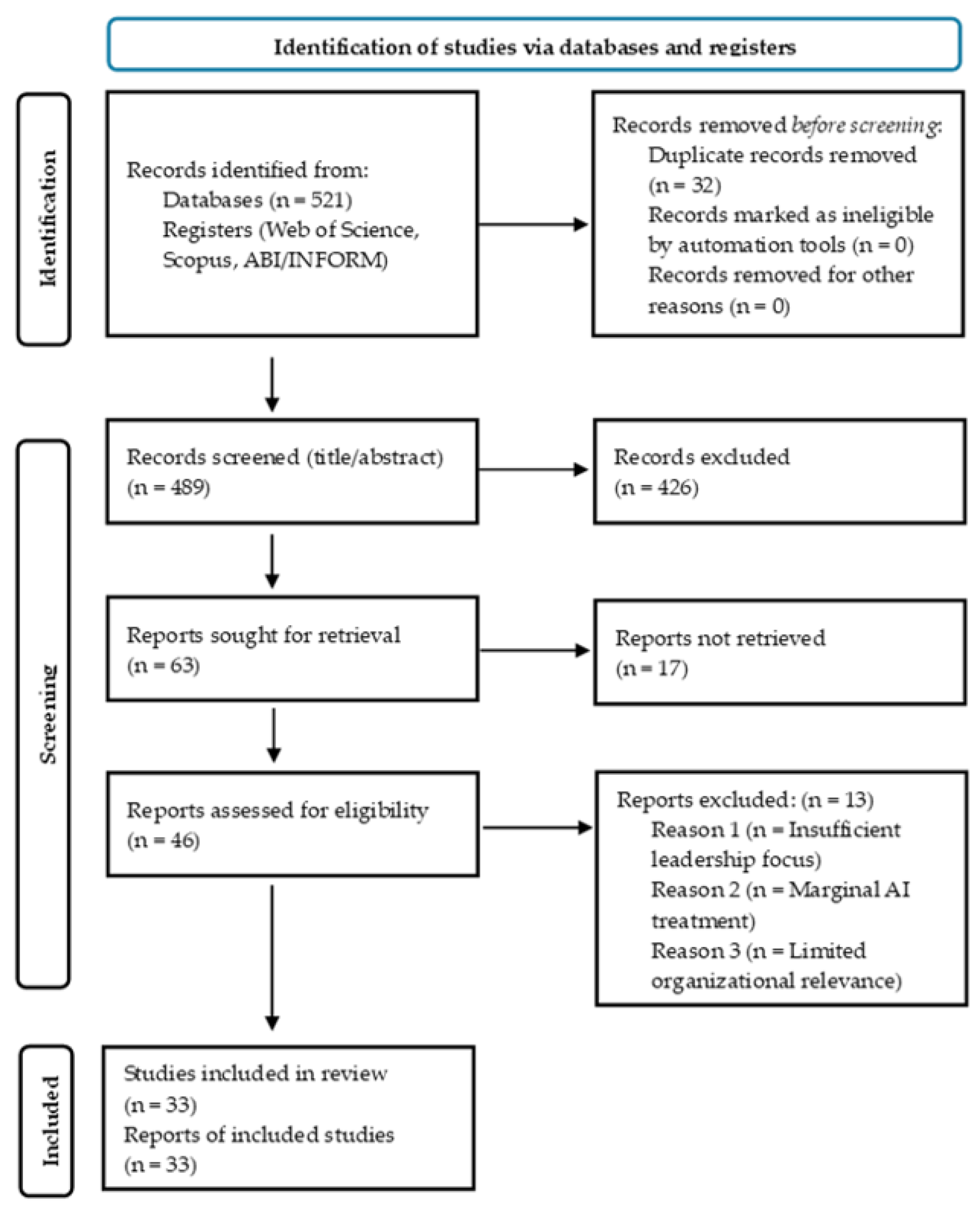
Figure 2.
The AI-Leadership Configurational Framework (ALCF). Note: The figure visually represents the core structural architecture of the ALCF, including the activation logic, mediating pathway, moderating governance layer, and recursive feedback mechanism. Propositions P3 and P5, which specify conditional amplification and contextual risk effects, are conceptually embedded within the depicted relationships but are not visually differentiated to preserve parsimony and structural clarity.
Figure 2.
The AI-Leadership Configurational Framework (ALCF). Note: The figure visually represents the core structural architecture of the ALCF, including the activation logic, mediating pathway, moderating governance layer, and recursive feedback mechanism. Propositions P3 and P5, which specify conditional amplification and contextual risk effects, are conceptually embedded within the depicted relationships but are not visually differentiated to preserve parsimony and structural clarity.
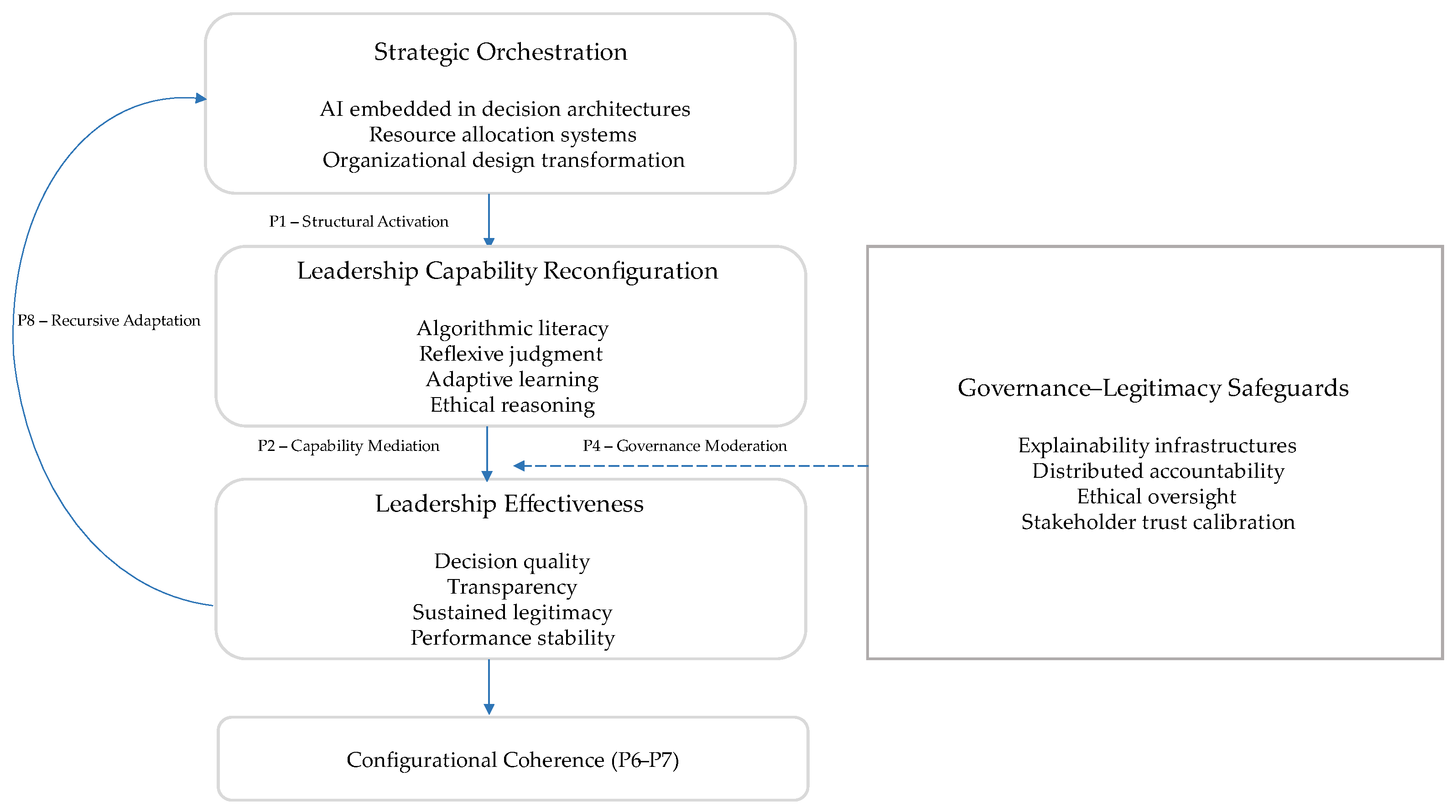
Disclaimer/Publisher’s Note: The statements, opinions and data contained in all publications are solely those of the individual author(s) and contributor(s) and not of MDPI and/or the editor(s). MDPI and/or the editor(s) disclaim responsibility for any injury to people or property resulting from any ideas, methods, instructions or products referred to in the content. |
© 2026 by the authors. Licensee MDPI, Basel, Switzerland. This article is an open access article distributed under the terms and conditions of the Creative Commons Attribution (CC BY) license (http://creativecommons.org/licenses/by/4.0/).
Copyright: This open access article is published under a Creative Commons CC BY 4.0 license, which permit the free download, distribution, and reuse, provided that the author and preprint are cited in any reuse.


