

Submitted:
04 March 2026
Posted:
05 March 2026
You are already at the latest version
Abstract
Background: Response to neoadjuvant therapy in locally advanced rectal cancer (LARC) is heterogeneous and early identification of non-responders may help optimize treatment strategies and reduce unnecessary toxicity. This study aimed to develop and internally validate a machine learning model based on radiomic features extracted from baseline magnetic resonance imaging (MRI) to predict treatment response assessed at restaging MRI. Methods: In this retrospective single-center study 86 patients with histologically confirmed LARC who underwent baseline and restaging MRI, neoadjuvant therapy, and surgery, were included. Primary tumors were manually segmented on oblique axial T2-weighted images. A total of 107 radiomic features were extracted using PyRadiomics, with and without N4 bias field correction. Feature selection was performed using LASSO, followed by elasticnet–regularized logistic regression. Model performance was assessed using repeated stratified 5-fold cross-validation. Response was defined according to MRI tumor regression grade (mrTRG) at restaging, dichotomized into responders (mrTRG ≤ 2) and non-responders (mrTRG ≥ 3). Results: The model achieved a mean area under the receiver operating characteristic curve (AUC-ROC) of 0.73, accuracy of 72.5%, sensitivity of 79.2%, and specificity of 50%. Conclusions: Baseline MRI-based radiomics demonstrated to potentially identify patients at higher risk of non-response to neoadjuvant therapy in LARC.
Keywords:
rectal cancer
; radiomics
; magnetic resonance imaging
; neoadjuvant therapy
; machine learning
; tumor regression grade
; predictive modeling
1. Introduction
Colorectal cancer (CRC) is one the most common malignancies worldwide and a major cause of cancer-related mortality [1,2]. Rectal cancer accounts for a substantial proportion of CRC cases and shows distinct anatomical and clinical features that influence staging, treatment planning, and outcomes [3]. Although screening programs and therapeutic advances have reduced CRC incidence in older populations, recent epidemiological data indicate a growing incidence of rectal cancer in younger adults (less than 50 years old), thus emphasizing the need of improved risk stratification and personalized management [1,2,4,5].
For locally advanced rectal cancer (LARC), neoadjuvant therapies as chemoradiotherapy (CTRT) and/or total neoadjuvant therapy (TNT) followed by total mesorectal excision (TME) represent the cornerstone of treatment, with the aim to improve local control and favorite curative resection [6,7,8,9,10]. However, response to neoadjuvant therapy is heterogeneous with a subset of patients showing limited or no response while still experiencing treatment-related toxicity and potential delays to definitive surgery [6,11,12,13,14]. Therefore, identifying non-responder patients before treatment could be clinically important to tailor treatment, improve prognosis stratification and reduce unnecessary exposure to ineffective therapies.
Magnetic resonance imaging (MRI) is the gold standard imaging modality for local staging of rectal cancer, providing high soft-tissue contrast and enabling assessment of key prognostic factors, including tumor extension, mesorectal fascia involvement, circumferential resection margin risk, and regional nodal involvement [15,16,17,18,19,20,21,22,23,24,25]. Moreover, MRI plays a key role also in tumor restaging after neoadjuvant therapy through the evaluation of tumor regression and residual disease [24,26,27,28,29,30]. However, conventional MRI interpretation is partly subjective and may be limited by inter-observer variability and by difficulties in distinguishing residual tumor from post-treatment changes such as fibrosis, edema, or mucinous degeneration [24,26,30,31]. In this scenario, radiomics offers a quantitative methodological approach to extract high-dimensional features from conventional radiological images, capturing patterns related to intensity, texture, shape, and intratumoral heterogeneity that are not visible by the human eye [32,33,34,35,36]. When combined with machine learning, radiomics can support predictive modeling and has shown promising results in rectal cancer for response prediction and risk stratification [32,37,38,39,40,41]. However, variability in imaging protocols, segmentation approaches, and validation strategies still limits reproducibility and generalizability, hindering clinical translation [32,33,34].
This retrospective study aimed to develop and internally validate a machine learning model based on radiomic features extracted from baseline MRI to predict response to neoadjuvant therapy in LARC patients. Response evaluation was based on MRI tumor regression grade (mrTRG) assessed at restaging MRI, adopted as the reference standard. It was hypothesized that baseline MRI based radiomic analysis could facilitate early identification of patients at higher risk of non-response, thereby contributing to personalized treatment planning.
2. Materials and Methods
2.1. Study Design and Population
This retrospective cross-sectional study included patients aged ≥18 years with histologically confirmed rectal adenocarcinoma treated at a single tertiary referral center between 2017 and 2022. Patients were selected according to the following criteria:
- inclusion criteria: availability of baseline staging MRI, completion of neoadjuvant therapy, availability of restaging MRI, surgical resection.
- exclusion criteria: poor image quality (e.g. motion artifacts), missing clinical data.
All patient related data was anonymized according to privacy regulations.
2.2. MRI Acquisition Protocol
All MRI examinations were performed using three scanners: 3T General Electric Discovery MR750 release software dv25 (GE Discovery MR750 3T), 1.5 T General Electric Signa HDxt TwinSpeed 1,5 T release software dv25 (GE Signa HDxt 1.5T), 1.5 T Siemens Magnetom SymphonyTim.
Acquisition protocol included: high-resolution T2-weighted (T2w) imaging (sagittal, 3D T2w, sagittal Fast Spin Echo (FSE) T2w, axial FSE T2w, oblique axial T2w), T1-weighted (T1w) imaging (axial FSE T1w), diffusion-weighted imaging (DWI, b value > 800) (Figure 1).
Optional sequences included focus sagittal DWI (b value>800), gradient echo (GRE) T1-weighted (T1w) in-phase (IN) and out-of-phase (OUT), oblique coronal (T2w, high resolution). Endorectal gel (60–100 mL) or intravenous antiperistaltic agents (20 mg i.v. hyoscine butyl-bromide) were administered when required.
All baseline staging MRI examinations were reviewed by a radiologist who assessed tumor location, distance of the tumor from the anal margin, TNM staging, and eventual presence of extramural vascular invasion (EMVI).
For the purposes of this study, the oblique axial T2-weighted sequence was analyzed. The sequence is acquired with an orientation perpendicular to the tumor’s major axis, thereby ensuring optimal evaluation and local staging of the primary tumor.
The acquisition parameters of this sequence for each scanner used in this study are reported in detail in Table 1.
2.3. MRI-Based Tumor Regression Grading System (mrTRG)
All restaging MRI examinations after neoadjuvant therapy were evaluated by a radiologist and classified according to the tumor regression grading (TRG) system, which assesses the degree of tumor regression after neoadjuvant therapy and therefore evaluates response to treatment.
TRG was primarily developed as a histopathological scoring system to evaluate tumor regression following neoadjuvant therapy, similarly to the Mandard score [31].
Subsequently, an MRI-based tumor regression grading system (mrTRG) was introduced to accurately reflect correlations between MRI imaging after neoadjuvant therapy and pathological findings.
Similarly to the Mandard system, mrTRG is a five grading score ranging from grade 1 (absence of residual tumor or complete response (CR)) to grade 5 (no tumor regression after neoadjuvant therapy) (Table 2) [42].
In this study, mrTRG was used as an indicator of tumor regression following neoadjuvant treatment. To properly classify patients as responders or non-responders based on mrTRG, a grouping strategy was applied. Specifically, patients with mrTRG 1 or mrTRG 2 were classified as responders, whereas patients with mrTRG 3, mrTRG 4, or mrTRG 5 were classified as non-responders.
2.4. Tumor Segmentation and Pre-Processing
Primary tumors were manually segmented by drawing region of interest (ROI) on baseline oblique axial MRI T2w images using an open-source software ITK-SNAP (version 3.6.0) by a junior radiologist and subsequently reviewed by a radiologist with more than ten years of experience in abdominal MRI (Figure 2). Segmentation was blinded to the study outcomes.
MRI is often affected by artifacts due to low spatial frequency intensity inhomogeneities which may compromise accuracy of automated image analysis algorithms, as they adversely affect the quality of automated MRI segmentation [45].
The N4 algorithm uses a parametric model, which does not rely on specific assumptions regarding the physical nature of the inhomogeneities, to estimate the impact of these artifacts on the image and to correct them [45].
To correct the images in this study, the N4BiasFieldCorrectionImageFilter function from the SimpleITK library was used.
2.5. Radiomic Feature Extraction
Radiomic features were extracted from tumor segmentation process of baseline oblique axial T2w MRI, either with and without N4 bias field correction, using open-source PyRadiomics library. All images were resampled to a uniform voxel dimension (0.46875 mm, 0.46875 mm, 3.30007672 mm). The voxel side dimensions were selected as the median values of the distribution of each voxel side among all images. For texture features calculation, images were discretized into 70 gray levels.
A total of 107 features were extracted and distributed as follows: 18 first-order features; 14 shape-based features; 24 features from the Gray Level Co-occurrence Matrix (GLCM); 16 from the Gray Level Run Length Matrix (GLRLM); 16 from the Gray Level Size Zone Matrix (GLSZM); 5 from the Neighbouring Gray Tone Difference Matrix (NGTDM); and 14 from the Gray Level Dependence Matrix (GLDM).
2.6. Model Development and Validation
Artificial intelligence models developed using supervised learning, i.e. where model parameters are updated to minimize discrepancy between predicted values and the true target variable, may be prone to overfitting. This phenomenon occurs when a model is sufficiently flexible (e.g. due to a large number of parameters relative to the number of observations) to closely reproduce the training data. However, strong performance on the training set is often associated with poor generalizability, meaning reduced predictive accuracy on previously unseen data, and thereby limiting the model’s applicability in real-world settings, including clinical practice.
Although there are strategies to reduce overfitting, it is crucial to evaluate the model performance on a dataset not used during training. For this reason, a repeated stratified 5-fold cross-validation approach was adopted: the dataset was partitioned into five subsets (“folds”), ensuring that each fold preserved the same proportion of positive labels (mrTRG ≥ 3) and negative labels (mrTRG ≤ 2). Each fold was iteratively used as a test set while the remaining four folds constituted the training set. This partitioning procedure was repeated 20 times. At the conclusion of the process the model’s generalization performance, defined as its ability to correctly predict unseen samples, was assessed by aggregating results across the 100 test folds.
The modeling pipeline consisted of three sequential steps, each performed exclusively on the training data without access to the test data. The first step involved normalization of each radiomic feature using z-score standardization (mean subtraction and division by the standard deviation). This procedure was necessary to eliminate scale-related effects that could bias the subsequent feature selection step, performed using the LASSO (Least Absolute Shrinkage and Selection Operator) method. The LASSO model was evaluated via 5-fold cross-validation and the radiomic features that maximized the mean AUC-ROC across the five folds were selected.
In the final step, the LASSO-selected features were used to train a logistic regression model with elasticnet regularization. The regularization strength and L1/L2 penalty ratio were optimized using grid search, maximizing the mean AUC-ROC within a 5-fold cross-validation framework.
All analyses were performed using Python libraries, including NumPy, SciPy, pandas, and scikit-learn.
2.7. Statistical Analysis
Model performance was evaluated using metrics derived from the confusion matrix, including sensitivity (true positive rate, TPR), specificity (true negative rate, TNR), positive predictive value (PPV), negative predictive value (NPV), overall accuracy, and F1-score. Discriminative ability was further assessed by calculating the area under the Receiver Operating Characteristic curve (AUC-ROC).
3. Results
The final cohort, derived from an eligible sample of 400 individuals, included 86 patients (65% male; mean age 63 ± 12 years). The population characteristics, along with the neoadjuvant treatments administered and the mrTRG distribution, are summarized in Table 3. As only patients who underwent restaging MRI were included, most of the study population presented with locally advanced tumors. The neoadjuvant treatments included chemotherapy regimens, chemoradiotherapy, short-course radiotherapy, and induction chemotherapy.
23.26% of patients were classified as responders (mrTRG ≤ 2) based on restaging MRI (Figure 3). Consequently, 76.74% of patients were classified as non-responders on restaging MRI (mrTRG ≥ 3).
The obtained results are presented as histograms in Figure 4.
For each model the Area Under the Curve (AUC-ROC), accuracy, sensitivity (true positive rate, TPR), and specificity (true negative rate, TNR) were evaluated. Subsequently, the mean values of all performance metrics were calculated, yielding the following results: AUC-ROC 73.2%, accuracy 72.5%, TPR 79.2%, and TNR 50%.
Our study workflow is summarized in Figure 5.
4. Discussion
The present study aimed to predict non-responder patients with locally advanced rectal cancer (LARC) treated with neoadjuvant therapy using a machine learning model based on baseline MRI-derived radiomic features. The proposed model achieved a TPR of 79.2% indicating a good sensitivity in identifying non-responders. However, the mean TNR was 50% thus reflecting a limited ability to correctly classify responders. This imbalance suggests that while the model may be useful for detecting high-risk patients unlikely to benefit from neoadjuvant therapy, its specificity remains suboptimal.
Neoadjuvant treatments which include either chemotherapy and radiotherapy, are associated with potential toxicities that may adversely affect patient quality of life and clinical status and are not always well tolerated [39]. Accurate early identification of non-responders is therefore clinically relevant, as treatment-related adverse effects may outweigh therapeutic benefits in this subgroup.
Several prior studies have explored predictive modeling for response assessment in rectal cancer. Although sharing similar objectives, these investigations differ substantially in methodology, imaging modalities, and feature extraction strategies, highlighting the complexity of this research field. In the present study, the radiomic features were extracted exclusively from MR imaging whereas other authors have incorporated multimodal imaging approaches, including CT and FDG PET/CT [40,46].
MRI represents the reference imaging modality for locoregional staging of rectal cancer, and most radiomics-based predictive models have been MRI-driven [47,48,49,50]. Nevertheless, considerable variability exists regarding the number and type of MRI sequences included. For example, a retrospective single-center study combining T2-w and T1-w images reported excellent predictive performance for pathological complete response (pCR), with an AUC of 94%, accuracy of 97%, sensitivity of 93%, and specificity of 88.9% [51].
However, integrating features from multiple imaging sources or sequences introduces methodological challenges. Beyond increased computational burden and model complexity, high-dimensional feature spaces relative to cohort size may increase the risk of overfitting [52]. To mitigate this risk, the present study employed a single MRI sequence (oblique axial T2-weighted), prioritizing model stability and interpretability.
Additional variability may arise from scanner-related factors. Static magnetic field strength has been suggested as a potential contributor to radiomic variability. In this study, imaging data were acquired using three MRI scanners (two 1.5T and one 3T), whereas several prior studies relied on a single scanner. A preliminary investigation using exclusively 3T scanners reported a higher AUC but lower sensitivity compared with the results observed in our cohort [47], suggesting that scanner homogeneity does not necessarily guarantee superior classification performance.
Another important methodological difference is related to the reference standard used to classify responders and non-responders. mrTRG assessment has emerged as a valuable tool within multidisciplinary oncologic management. While its non-invasive nature and repeatability offer clear advantages in repeatability and early assessment, mrTRG reproducibility may be limited with inter-reader variability, underscoring the importance of expert radiological evaluation. Furthermore, potential discrepancies between mrTRG and pathological TRG may affect response prediction accuracy, particularly when a long interval exists between MRI and surgery [44,48].
Although mrTRG enables early treatment response assessment and surgical planning, its limitations, including the frequent overestimation of residual tumor, must be acknowledged [48].
Several studies have instead used histopathological TRG (pTRG) as the reference standard. For example, a retrospective study applying the AJCC pTRG classification reported comparable discriminative performance (AUC 0.77) [39] using a dichotomization strategy similar to that employed in our analysis.
Other authors have focused on predicting pCR rather than TRG categories. A retrospective study with similar inclusion criteria achieved an AUC of 0.73, although tumor segmentation was restricted to the lesion border rather than the entire tumor volume [53]. Petkovska et al. reported similar findings (AUC 0.75) when distinguishing pCR from partial pathological response [54].
Response prediction strategies also vary with respect to imaging time points. The present study focused exclusively on baseline MRI, whereas other investigations have incorporated post-treatment MRI. Li et al. reported improved performance (AUC 0.87) by combining baseline and restaging MRI features [55]. More recently, novel delta-radiomics approaches, integrating longitudinal feature changes, have shown promising results [50,56]. Differences in validation strategies further complicate comparisons across studies. While repeated stratified 5-fold cross-validation (20 repetitions) was adopted in this work to enhance robustness, other studies have used fewer repetitions or alternative validation schemes [57].
This study has some limitations worth mentioning. The retrospective monocentric design resulted in a relatively small cohort size. Consequently, external validation was not performed, limiting model generalizability. Moreover, reproducibility analysis to evaluate feature stability (e.g., segmentation variability) was not conducted. These aspects should be addressed in future prospective multicenter studies.
5. Conclusions
Our proposed machine learning model based on baseline-MRI-derived radiomic features demonstrated good sensitivity in identifying non-responders to neoadjuvant therapy in patients with locally advanced rectal cancer. These findings suggest a potential role for baseline MRI radiomics in supporting early treatment stratification and more personalized therapeutic decision-making. However, the limited specificity and the retrospective single-center design warrant further methodological refinement and external validation before clinical application.
Author Contributions
Ilaria Ambrosini: Writing—original draft, review & editing, Methodology, Validation, Formal analysis, Data curation. Roberto Francischello Writing—original draft, Methodology, Validation, Formal analysis, Data curation Salvatore Claudio Fanni Writing—original draft, Methodology, Validation, Formal analysis, Data curation, Conceptualization. Lorenzo Faggioni Writing—review & editing, Supervision. Francesca Pia Caputo Visualization, Data curation. Karolina Cwiklinska Writing—original draft, Formal analysis. Gayane Aghakhanyan: Visualization, Data curation. Emanuele Neri Writing—review & editing; Visualization, Supervision, Funding acquistion. Riccardo Antonio Lencioni Writing—review & editing; Visualization, Supervision, Conceptualization, Funding acquisition. Dania Cioni Writing—review & editing; Visualization, Supervision, Conceptualization. All authors have read and agreed to the published version of the manuscript.
Funding
This research was supported by the European Union—NextGenerationEU, through the Italian Ministry of University and Research (MUR), under the National Recovery and Resilience Plan (PNRR), Mission 4, Component 2, Investment 1.3, Project PE_00000019 “HEAL ITALIA”, CUP I53C22001440006, at the University of Pisa (UNIPI). Emanuele Neri, Riccardo Antonio Lencioni, Salvatore Claudio Fanni, Gayane Aghakhanyan are recipients of this funding. The views and opinions expressed are those of the authors only and do not necessarily reflect those of the European Union or the European Commission. Neither the European Union nor the European Commission can be held responsible for them.
Institutional Review Board Statement
The study was conducted in accordance with the Declaration of Helsinki approved by the Tuscany regional ethical committee for clinical experimentation—AREA VASTA NORD OVEST section—Protocol No. 18253.
Informed Consent Statement
Patient consent was waived due to the retrospective nature of the study.
Data Availability Statement
The data presented in this study can be made available by the authors upon reasonable request.
Conflicts of Interest
The authors declare no conflicts of interest.
Abbreviations
The following abbreviations are used in this manuscript:
| ADC | Apparent Diffusion Coefficient |
| AUC-ROC | Area Under the Receiver Operating Characteristic Curve |
| CRC | Colorectal Cancer |
| CR | Complete Response |
| CT | Chemotherapy |
| CTRT | Chemoradiotherapy |
| CT IND>CTRT | Induction Chemotherapy followed by Chemoradiotherapy |
| DWI | Diffusion-Weighted Imaging |
| EMVI | Extramural Vascular Invasion |
| FOV | Field of View |
| FSE | Fast Spin Echo |
| FRFSE | Fast Recovery Fast Spin Echo |
| GLCM | Gray Level Co-occurrence Matrix |
| GLDM | Gray Level Dependence Matrix |
| GLRLM | Gray Level Run Length Matrix |
| GLSZM | Gray Level Size Zone Matrix |
| GRE | Gradient Echo |
| LARC | Locally Advanced Rectal Cancer |
| LASSO | Least Absolute Shrinkage and Selection Operator |
| MRI | Magnetic Resonance Imaging |
| mrTRG | Magnetic Resonance Imaging Tumor Regression Grade |
| NGTDM | Neighbouring Gray Tone Difference Matrix |
| NPV | Negative Predictive Value |
| pCR | Pathological Complete Response |
| PPV | Positive Predictive Value |
| ROI | Region of Interest |
| RT | Radiotherapy |
| RTSC | Short-Course Radiotherapy |
| TME | Total Mesorectal Excision |
| TNT | Total Neoadjuvant Therapy |
| TNM | Tumor–Node–Metastasis Staging System |
| T1w | T1-weighted |
| T2w | T2-weighted |
| TPR | True Positive Rate |
| TNR | True Negative Rate |
| TRG | Tumor Regression Grade |
References
- Siegel RL, Miller KD, Jemal A. Cancer statistics, 2018. CA Cancer J Clin 2018;68:7–30. [CrossRef]
- Fazeli MS, Keramati MR. Rectal cancer: a review. Med J Islam Repub Iran 2015;29:171.
- Calabria R. Linee guida Aiom NEOPLASIE DEL RETTO E ANO - Edizione 2017 n.d.
- Siegel R, DeSantis C, Jemal A. Colorectal cancer statistics, 2014. CA Cancer J Clin 2014;64:104–17. [CrossRef]
- Stefania G, Giuseppe A, Paolo A, Sergio B, Vanna Chiarion S, Alessandro C, et al. I numeri del cancro in Italia. 2017. http://www.registri-tumori.it/PDF/AIOM2014/I_numeri_del_cancro_2014.pdf.
- Garajová I, Di Girolamo S, De Rosa F, Corbelli J, Agostini V, Biasco G, et al. Neoadjuvant Treatment in Rectal Cancer: Actual Status. Chemother Res Pract 2011;2011:839742. [CrossRef]
- Jeong SY, Park JW, Nam BH, Kim S, Kang SB, Lim SB, et al. Open versus laparoscopic surgery for mid-rectal or low-rectal cancer after neoadjuvant chemoradiotherapy (COREAN trial): survival outcomes of an open-label, non-inferiority, randomised controlled trial. Lancet Oncol 2014;15:767–74. [CrossRef]
- Lindsetmo RO, Joh YG, Delaney CP. Surgical treatment for rectal cancer: an international perspective on what the medical gastroenterologist needs to know. World J Gastroenterol 2008;14:3281–9. [CrossRef]
- Benson AB, Venook AP, Al-Hawary MM, Azad N, Chen YJ, Ciombor KK, et al. Rectal Cancer, Version 2.2022, NCCN Clinical Practice Guidelines in Oncology. Journal of the National Comprehensive Cancer Network 2022;20:1139–67. [CrossRef]
- Kitz J, Fokas E, Beissbarth T, Ströbel P, Wittekind C, Hartmann A, et al. Association of Plane of Total Mesorectal Excision With Prognosis of Rectal Cancer: Secondary Analysis of the CAO/ARO/AIO-04 Phase 3 Randomized Clinical Trial. JAMA Surg 2018;153:e181607. [CrossRef]
- Peeters KCMJ, van de Velde CJH, Leer JWH, Martijn H, Junggeburt JMC, Kranenbarg EK, et al. Late Side Effects of Short-Course Preoperative Radiotherapy Combined With Total Mesorectal Excision for Rectal Cancer: Increased Bowel Dysfunction in Irradiated Patients—A Dutch Colorectal Cancer Group Study. Journal of Clinical Oncology 2005;23:6199–206. [CrossRef]
- Sauer R, Becker H, Hohenberger W, Rödel C, Wittekind C, Fietkau R, et al. Preoperative versus Postoperative Chemoradiotherapy for Rectal Cancer. New England Journal of Medicine 2004;351:1731–40. [CrossRef]
- Bujko K, Nowacki MP, Nasierowska-Guttmejer A, Michalski W, Bebenek M, Pudelko M, et al. Sphincter preservation following preoperative radiotherapy for rectal cancer: Report of a randomised trial comparing short-term radiotherapy vs. conventionally fractionated radiochemotherapy. Radiotherapy and Oncology 2004;72:15–24. [CrossRef]
- Glehen O, Chapet O, Adham M, Nemoz JC, Gerard JP. Long-term results of the Lyons R90-01 randomized trial of preoperative radiotherapy with delayed surgery and its effect on sphincter-saving surgery in rectal cancer. Br J Surg 2003;90:996–8. [CrossRef]
- Beets-Tan RGH, Lambregts DMJ, Maas M, Bipat S, Barbaro B, Curvo-Semedo L, et al. Magnetic resonance imaging for clinical management of rectal cancer: Updated recommendations from the 2016 European Society of Gastrointestinal and Abdominal Radiology (ESGAR) consensus meeting. Eur Radiol 2018;28:1465–75. [CrossRef]
- Beets-Tan RGH, Beets GL, Vliegen RFA, Kessels AGH, Van Boven H, De Bruine A, et al. Accuracy of magnetic resonance imaging in prediction of tumour-free resection margin in rectal cancer surgery. Lancet 2001;357:497–504. [CrossRef]
- Beets-Tan RGH, Lambregts DMJ, Maas M, Bipat S, Barbaro B, Caseiro-Alves F, et al. Magnetic resonance imaging for the clinical management of rectal cancer patients: recommendations from the 2012 European Society of Gastrointestinal and Abdominal Radiology (ESGAR) consensus meeting. Eur Radiol 2013;23:2522–31. [CrossRef]
- Brown G, Radcliffe AG, Newcombe RG, Dallimore NS, Bourne MW, Williams GT. Preoperative assessment of prognostic factors in rectal cancer using high-resolution magnetic resonance imaging. British Journal of Surgery 2003;90:355–64. [CrossRef]
- Fernandes MC, Gollub MJ, Brown G. The importance of MRI for rectal cancer evaluation. Surg Oncol 2022;43:101739. [CrossRef]
- Gollub MJ, Arya S, Beets-Tan RG, dePrisco G, Gonen M, Jhaveri K, et al. Use of magnetic resonance imaging in rectal cancer patients: Society of Abdominal Radiology (SAR) rectal cancer disease-focused panel (DFP) recommendations 2017. Abdominal Radiology 2018;43:2893–902. [CrossRef]
- Shihab OC, Moran BJ, Heald RJ, Quirke P, Brown G. MRI staging of low rectal cancer. Eur Radiol 2009;19:643–50. [CrossRef]
- Jhaveri KS, Hosseini-Nik H. MRI of rectal cancer: An overview and update on recent advances. American Journal of Roentgenology 2015;205:W42–55. [CrossRef]
- Taylor FGM, Swift RI, Blomqvist L, Brown G. A systematic approach to the interpretation of preoperative staging MRI for rectal cancer. American Journal of Roentgenology 2008;191:1827–35. [CrossRef]
- Horvat N, Rocha CCT, Oliveira BC, Petkovska I, Gollub MJ. MRI of rectal cancer: Tumor staging, imaging techniques, and management. Radiographics 2019;39:367–87. [CrossRef]
- Al-Sukhni E, Milot L, Fruitman M, Beyene J, Victor JC, Schmocker S, et al. Diagnostic accuracy of MRI for assessment of T category, lymph node metastases, and circumferential resection margin involvement in patients with rectal cancer: a systematic review and meta-analysis. Ann Surg Oncol 2012;19:2212–23. [CrossRef]
- Patel UB, Blomqvist LK, Taylor F, George C, Guthrie A, Bees N, et al. MRI after treatment of locally advanced rectal cancer: How to report tumor response - The MERCURY experience. American Journal of Roentgenology 2012;199. [CrossRef]
- Rullier A, Laurent C, Vendrely V, Le Bail B, Bioulac-Sage P, Rullier E. Impact of colloid response on survival after preoperative radiotherapy in locally advanced rectal carcinoma. Am J Surg Pathol 2005;29:602–6. [CrossRef]
- Compton CC. Key issues in reporting common cancer specimens: problems in pathologic staging of colon cancer. Arch Pathol Lab Med 2006;130:318–24. [CrossRef]
- Vecchio FM, Valentini V, Minsky BD, Padula GDA, Venkatraman ES, Balducci M, et al. The relationship of pathologic tumor regression grade (TRG) and outcomes after preoperative therapy in rectal cancer. Int J Radiat Oncol Biol Phys 2005;62:752–60. [CrossRef]
- Oberholzer K, Junginger T, Heintz A, Kreft A, Hansen T, Lollert A, et al. Rectal Cancer: MR imaging of the mesorectal fascia and effect of chemoradiation on assessment of tumor involvement. Journal of Magnetic Resonance Imaging 2012;36:658–63. [CrossRef]
- Thies S, Langer R. Tumor regression grading of gastrointestinal carcinomas after neoadjuvant treatment. Front Oncol 2013;3 OCT:64056. [CrossRef]
- Hou M, Sun JH. Emerging applications of radiomics in rectal cancer: State of the art and future perspectives. World J Gastroenterol 2021;27:3802–14. [CrossRef]
- Zhang S, Yu M, Chen D, Li P, Tang B, Li J. Role of MRI based radiomics in locally advanced rectal cancer (Review). Oncol Rep 2022;47. [CrossRef]
- Rizzo S, Botta F, Raimondi S, Origgi D, Fanciullo C, Morganti AG, et al. Radiomics: the facts and the challenges of image analysis. Eur Radiol Exp 2018;2:36. [CrossRef]
- Shur JD, Doran SJ, Kumar S, Ap Dafydd D, Downey K, O’connor JPB, et al. Radiomics in Oncology: A Practical Guide. Radiographics 2021;41:1717. [CrossRef]
- Miranda J, Horvat N, Araujo-Filho JAB, Albuquerque KS, Charbel C, Trindade BMC, et al. The Role of Radiomics in Rectal Cancer. J Gastrointest Cancer 2023;54:1158–80. [CrossRef]
- Ma X, Shen F, Jia Y, Xia Y, Li Q, Lu J. MRI-based radiomics of rectal cancer: preoperative assessment of the pathological features. BMC Med Imaging 2019;19. [CrossRef]
- Yu X, Song W, Guo D, Liu H, Zhang H, He X, et al. Preoperative Prediction of Extramural Venous Invasion in Rectal Cancer: Comparison of the Diagnostic Efficacy of Radiomics Models and Quantitative Dynamic Contrast-Enhanced Magnetic Resonance Imaging. Front Oncol 2020;10. [CrossRef]
- Zhou X, Yi Y, Liu Z, Cao W, Lai B, Sun K, et al. Radiomics-Based Pretherapeutic Prediction of Non-response to Neoadjuvant Therapy in Locally Advanced Rectal Cancer. Ann Surg Oncol 2019;26:1676–84. [CrossRef]
- Li ZY, Wang XD, Li M, Liu XJ, Ye Z, Song B, et al. Multi-modal radiomics model to predict treatment response to neoadjuvant chemotherapy for locally advanced rectal cancer. World J Gastroenterol 2020;26:2368–402. [CrossRef]
- Giannini V, Mazzetti S, Bertotto I, Chiarenza C, Cauda S, Delmastro E, et al. Predicting locally advanced rectal cancer response to neoadjuvant therapy with 18F-FDG PET and MRI radiomics features. Eur J Nucl Med Mol Imaging 2019;46:878–88. [CrossRef]
- Awiwi MO, Kaur H, Ernst R, Rauch GM, Morani AC, Stanietzky N, et al. Restaging MRI of Rectal Adenocarcinoma after Neoadjuvant Chemoradiotherapy: Imaging Findings and Potential Pitfalls. Radiographics 2023;43:e220135. [CrossRef]
- Sclafani F, Brown G, Cunningham D, Wotherspoon A, Mendes LST, Balyasnikova S, et al. Comparison between MRI and pathology in the assessment of tumour regression grade in rectal cancer. Br J Cancer 2017;117:1478–85. [CrossRef]
- Jankovic A, Kovac JD, Dakovic M, Mitrovic M, Saponjski D, Milicevic O, et al. MRI Tumor Regression Grade Combined with T2-Weighted Volumetry May Predict Histopathological Response in Locally Advanced Rectal Cancer following Neoadjuvant Chemoradiotherapy-A New Scoring System Proposal. Diagnostics (Basel) 2023;13. [CrossRef]
- Tustison NJ, Avants BB, Cook PA, Zheng Y, Egan A, Yushkevich PA, et al. N4ITK: improved N3 bias correction. IEEE Trans Med Imaging 2010;29:1310–20. [CrossRef]
- Bonomo P, Socarras Fernandez J, Thorwarth D, Casati M, Livi L, Zips D, et al. Simulation CT-based radiomics for prediction of response after neoadjuvant chemo-radiotherapy in patients with locally advanced rectal cancer. Radiat Oncol 2022;17:84. [CrossRef]
- Petresc B, Lebovici A, Caraiani C, Feier DS, Graur F, Buruian MM. Pre-Treatment T2-WI Based Radiomics Features for Prediction of Locally Advanced Rectal Cancer Non-Response to Neoadjuvant Chemoradiotherapy: A Preliminary Study. Cancers (Basel) 2020;12:1–18. [CrossRef]
- Voogt ELK, Nordkamp S, Van Zoggel DMGI, Daniëls-Gooszen AW, Nieuwenhuijzen GAP, Bloemen JG, et al. MRI tumour regression grade in locally recurrent rectal cancer. BJS Open 2022;6. [CrossRef]
- Li Y, Liu W, Pei Q, Zhao L, Güngör C, Zhu H, et al. Predicting pathological complete response by comparing MRI-based radiomics pre- and postneoadjuvant radiotherapy for locally advanced rectal cancer. Cancer Med 2019;8:7244–52. [CrossRef]
- Chen H, Shi L, Nguyen KNB, Monjazeb AM, Matsukuma KE, Loehfelm TW, et al. MRI Radiomics for Prediction of Tumor Response and Downstaging in Rectal Cancer Patients after Preoperative Chemoradiation. Adv Radiat Oncol 2020;5:1286. [CrossRef]
- Cui Y, Yang X, Shi Z, Yang Z, Du X, Zhao Z, et al. Radiomics analysis of multiparametric MRI for prediction of pathological complete response to neoadjuvant chemoradiotherapy in locally advanced rectal cancer. Eur Radiol 2019;29:1211–20. [CrossRef]
- Kocak B, Akinci D’Antonoli T, Mercaldo N, Alberich-Bayarri A, Baessler B, Ambrosini I, et al. METhodological RadiomICs Score (METRICS): a quality scoring tool for radiomics research endorsed by EuSoMII. Insights Imaging 2024;15:8. [CrossRef]
- Chiloiro G, Cusumano D, de Franco P, Lenkowicz J, Boldrini L, Carano D, et al. Does restaging MRI radiomics analysis improve pathological complete response prediction in rectal cancer patients? A prognostic model development. Radiol Med 2022;127:11–20. [CrossRef]
- Petkovska I, Tixier F, Ortiz EJ, Golia Pernicka JS, Paroder V, Bates DD, et al. Clinical utility of radiomics at baseline rectal MRI to predict complete response of rectal cancer after chemoradiation therapy. Abdom Radiol (NY) 2020;45:3608–17. [CrossRef]
- Li Y, Liu W, Pei Q, Zhao L, Güngör C, Zhu H, et al. Predicting pathological complete response by comparing MRI-based radiomics pre- and postneoadjuvant radiotherapy for locally advanced rectal cancer. Cancer Med 2019;8:7244–52. [CrossRef]
- Boldrini L, Cusumano D, Chiloiro G, Casà C, Masciocchi C, Lenkowicz J, et al. Delta radiomics for rectal cancer response prediction with hybrid 0.35 T magnetic resonance-guided radiotherapy (MRgRT): a hypothesis-generating study for an innovative personalized medicine approach. Radiol Med 2019;124:145–53. [CrossRef]
- Song M, Li S, Wang H, Hu K, Wang F, Teng H, et al. MRI radiomics independent of clinical baseline characteristics and neoadjuvant treatment modalities predicts response to neoadjuvant therapy in rectal cancer. Br J Cancer 2022;127:249. [CrossRef]
Figure 1.
Representative images of each MRI sequence acquired for staging. (A) Sagittal 3D T2w; (B) Axial fast recovery FSE (FRFSE) T2w; (C) Axial T1w; (D) Oblique axial T2w; (E) Axial DWI (b-value = 1000); (F) Apparent diffusion coefficient (ADC) map; (G) Oblique coronal T2w.
Figure 1.
Representative images of each MRI sequence acquired for staging. (A) Sagittal 3D T2w; (B) Axial fast recovery FSE (FRFSE) T2w; (C) Axial T1w; (D) Oblique axial T2w; (E) Axial DWI (b-value = 1000); (F) Apparent diffusion coefficient (ADC) map; (G) Oblique coronal T2w.
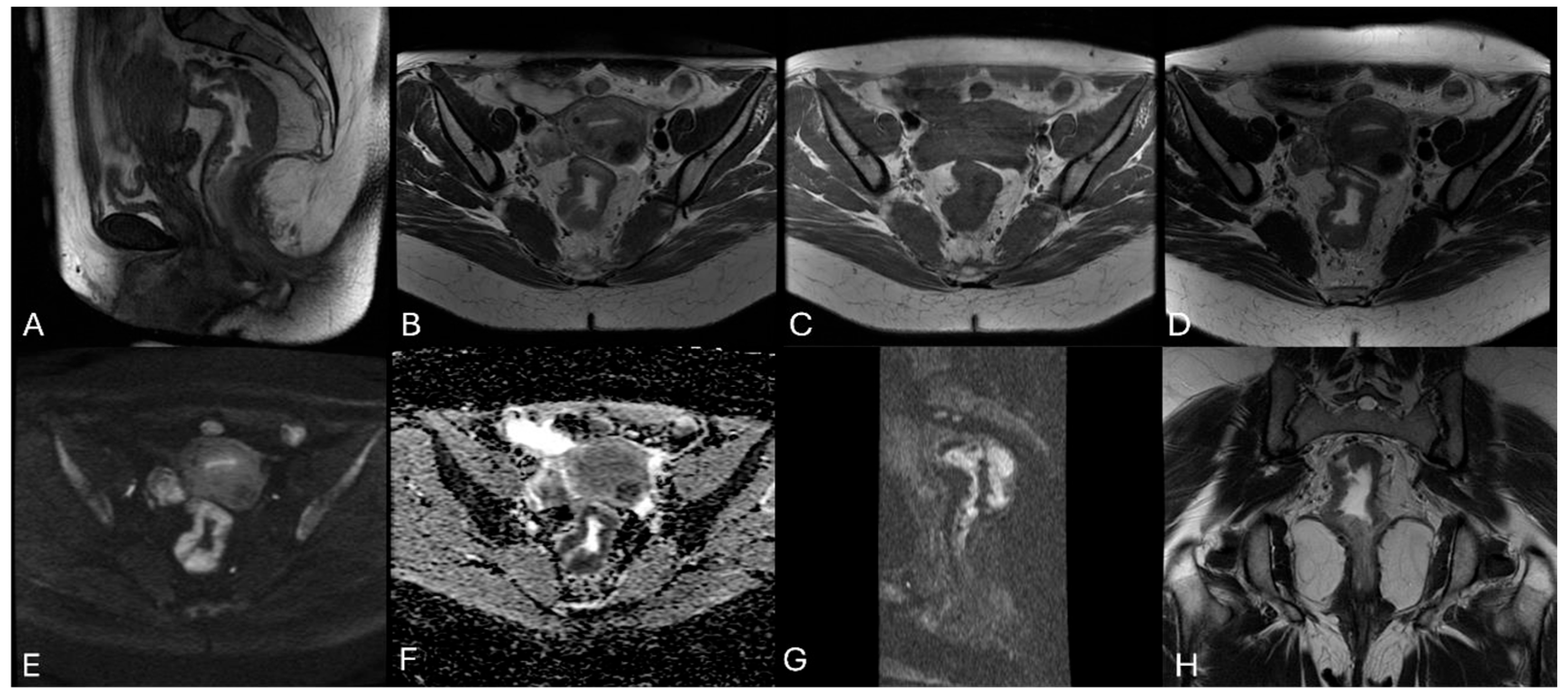
Figure 2.
Representative examples of tumor segmentation. Native oblique axial T2-weighted images are shown in the upper row (A, C, E, G), with the corresponding segmentation overlays presented in the lower row (B, D, F, H).
Figure 2.
Representative examples of tumor segmentation. Native oblique axial T2-weighted images are shown in the upper row (A, C, E, G), with the corresponding segmentation overlays presented in the lower row (B, D, F, H).
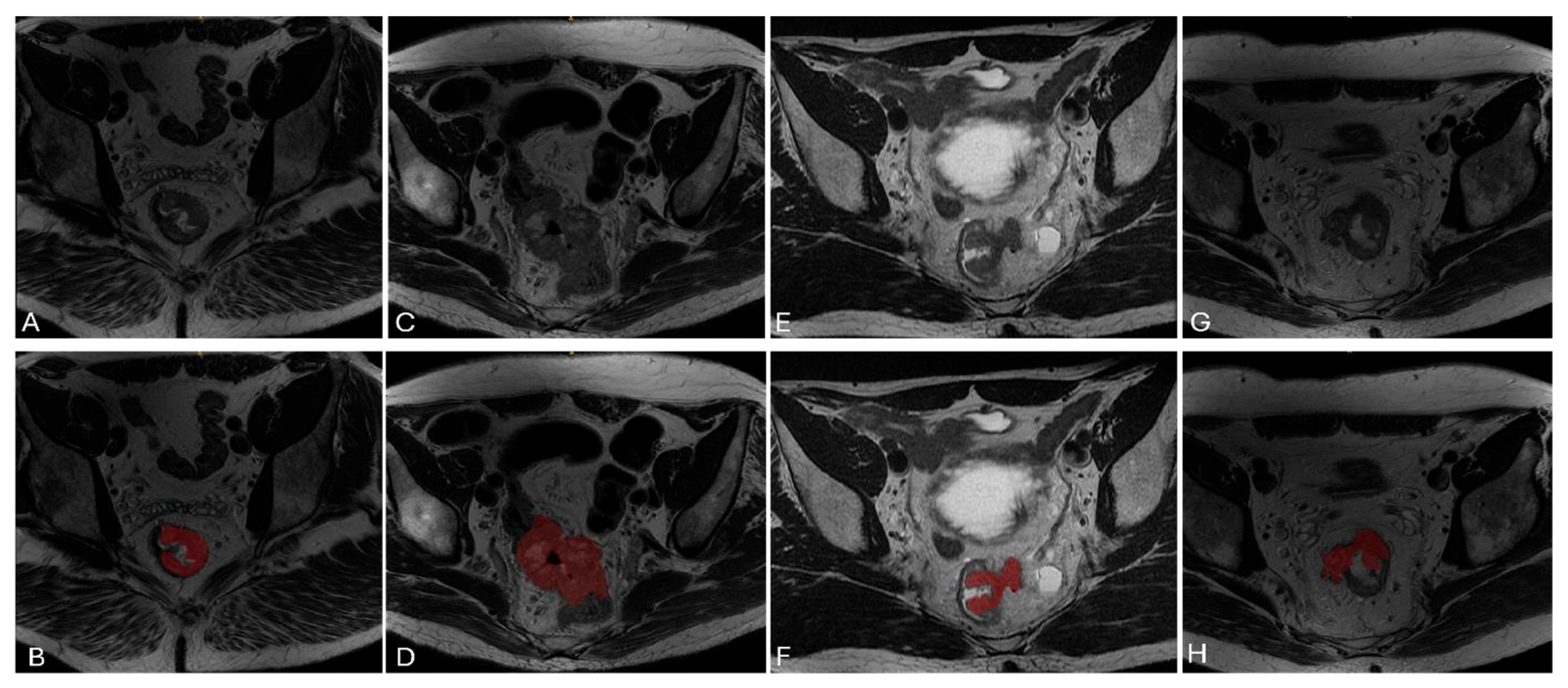
Figure 3.
A 75-year-old male patient with low-rectal cancer, stage IIIc treated with neoadjuvant chemoradiotherapy (CTRT) and classified as a responder (mrTRG = 1). (A)Oblique axial T2-w image and (B) DWI (b-value = 1000) from the baseline examination before (right) and after neoadjuvant therapy (left).
Figure 3.
A 75-year-old male patient with low-rectal cancer, stage IIIc treated with neoadjuvant chemoradiotherapy (CTRT) and classified as a responder (mrTRG = 1). (A)Oblique axial T2-w image and (B) DWI (b-value = 1000) from the baseline examination before (right) and after neoadjuvant therapy (left).
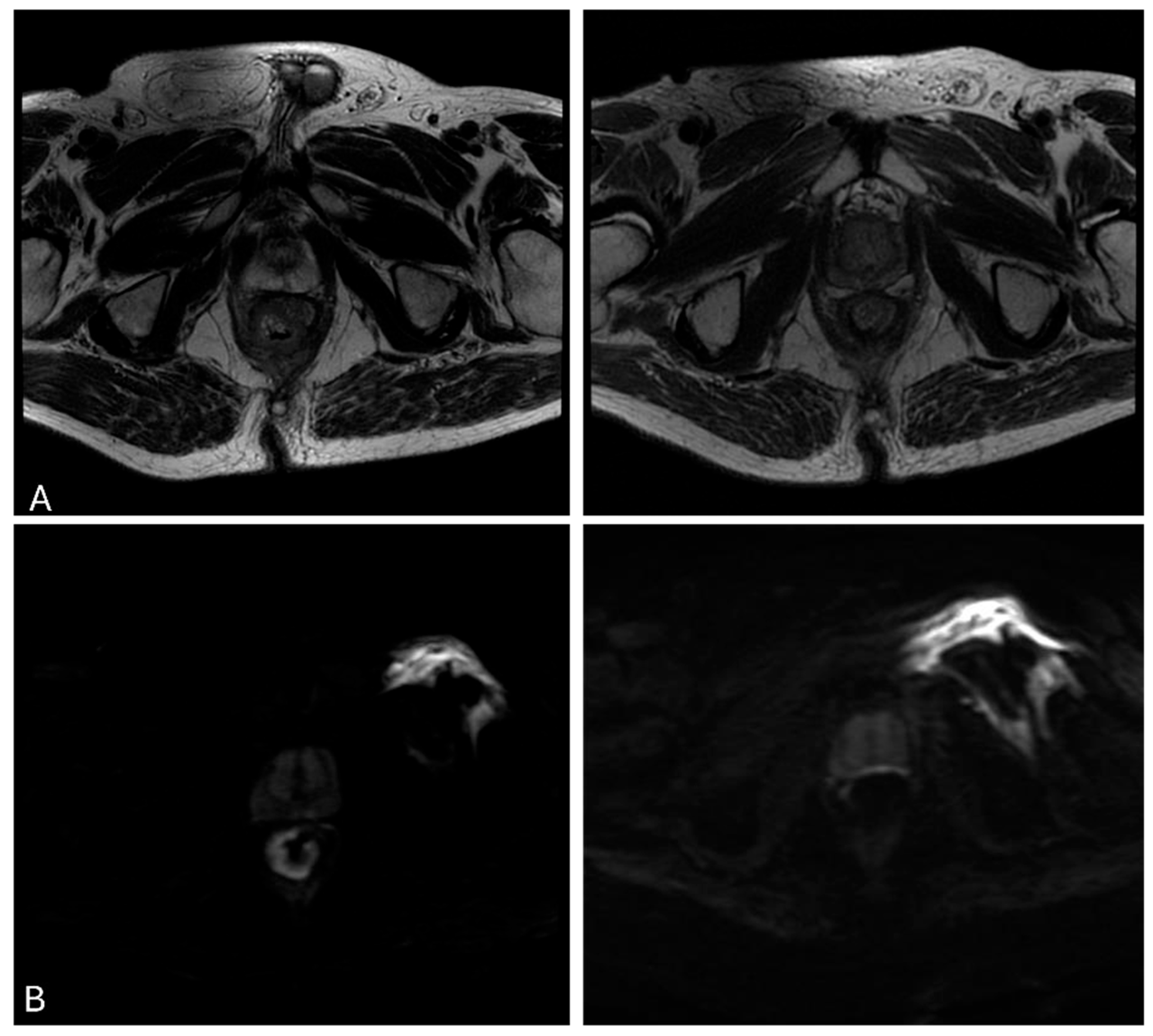
Figure 4.
Histograms illustrating model performance across the evaluated metrics.
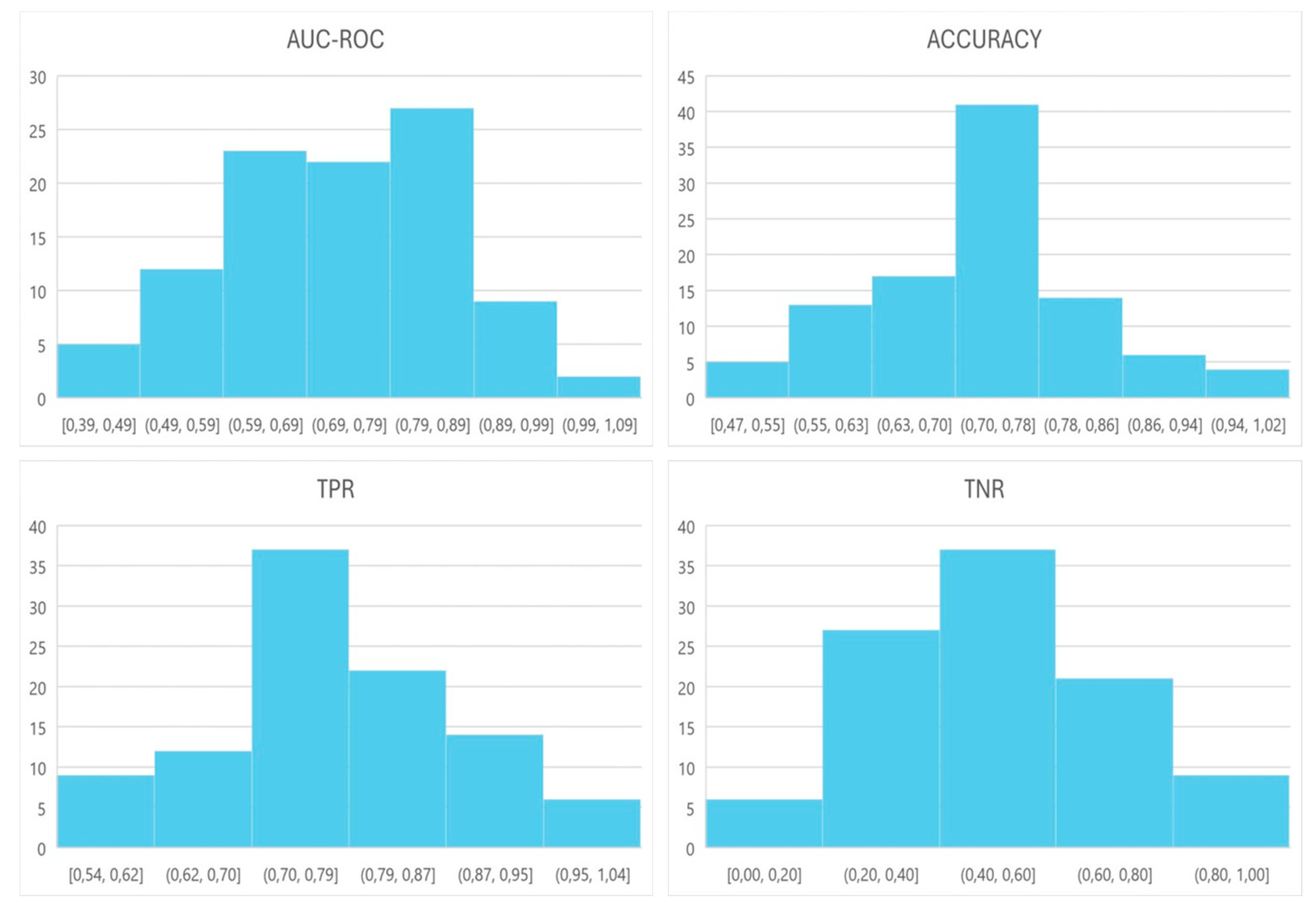
Figure 5.
MRI-based radiomics pipeline.


Table 1.
Acquisition parameters referred to the oblique axial T2-w sequence for each MRI scanner used in this study.
Table 1.
Acquisition parameters referred to the oblique axial T2-w sequence for each MRI scanner used in this study.
| MRI Scanner |
Echo time (ms) |
Repetition Time (ms) |
Slice Thickness (mm) |
FOV (mm) |
Acquisition Matrix |
Flip Angle |
|
DISCOVERY MR750 |
61,307 | 1400 | 2 | 100 | 0/224/224/0 | 90 |
| Signa HDxt | 65 | 1200 | 2 | 100 | 0/288/256 | 90 |
| Symphony Tim | 84 | 4200 | 4 | 100 | 320/0/0/256 | 150 |
Table 2.
mrTRG classification. This system is primarily based on comparison with baseline MRI and on the evaluation, particularly on T2w images, of the relative proportions of fibrotic and residual tumor signal intensity [43,44].
| Grade | Radiologic Response | Description |
| mrTRG 1 | Complete Response (CR) | Complete regression: no evidence of tumor signal or barely visible linear fibrotic scar (low signal intensity) in the mucosa/submucosal layer of previous tumor site |
| mrTRG 2 | Near complete Response (n-CR) | Good regression: predominant low signal intensity fibrotic scar with no obvious residual tumor signal |
| mrTRG 3 | Moderate Response | Moderate regression: >50% low signal intensity fibrosis/mucin areas, but there are obvious areas of intermediate signal intensity |
| mrTRG 4 | Mild Response | Slight regression: few areas of low signal intensity fibrosis or mucin but mostly tumor signal intensity on T2w images |
| mrTRG 5 | No Response | Intermediate signal intensity, same appearances as the original tumor on T2w images |
Table 3.
Study population characteristics. T: tumor; N: nodal involvement; M: metastasis; EMVI: Extramural Vascular Invasion; CT: Chemotherapy; CTRT: Chemoradiotherapy; RTSC: Short-Course Radiotherapy; CT IND>CTRT: Induction Chemotherapy followed by Chemoradiotherapy; RT: Radiotherapy; mrTRG: MRI Tumor Regression Grade.
Table 3.
Study population characteristics. T: tumor; N: nodal involvement; M: metastasis; EMVI: Extramural Vascular Invasion; CT: Chemotherapy; CTRT: Chemoradiotherapy; RTSC: Short-Course Radiotherapy; CT IND>CTRT: Induction Chemotherapy followed by Chemoradiotherapy; RT: Radiotherapy; mrTRG: MRI Tumor Regression Grade.
| Population Characteristics | N (%) |
| Age (mean ± standard deviation) | 63 ± 12 years |
| Male | 65 |
| Female | 35 |
| T | T2 8,14% |
| T3 9,3% | |
| T3a 10,47% | |
| T3b 37,21% | |
| T3c 15,12% | |
| T3d 3,49% | |
| T4 10,47% | |
| T4a 3,49% | |
| T4b 2,33% | |
| N | N0 3,49% |
| N1 31,4% | |
| N1b 2,33% | |
| N2 62,8% | |
| M | M0 86,05% |
| M1 13,95% | |
| EMVI | absent 63,95% |
| present 36,05% | |
| CT | 1,16% |
| CTRT | 61,63% |
| RTSC | 19,77% |
| CT IND>CTRT | 16,28% |
| RT | 1,16% |
| mrTRG | mrTRG1 1,15% |
| mrTRG2 19,54% | |
| mrTRG3 67,82% | |
| mrTRG4 4,60% | |
| mrTRG5 2,30% |
Disclaimer/Publisher’s Note: The statements, opinions and data contained in all publications are solely those of the individual author(s) and contributor(s) and not of MDPI and/or the editor(s). MDPI and/or the editor(s) disclaim responsibility for any injury to people or property resulting from any ideas, methods, instructions or products referred to in the content. |
© 2026 by the authors. Licensee MDPI, Basel, Switzerland. This article is an open access article distributed under the terms and conditions of the Creative Commons Attribution (CC BY) license (http://creativecommons.org/licenses/by/4.0/).
Copyright: This open access article is published under a Creative Commons CC BY 4.0 license, which permit the free download, distribution, and reuse, provided that the author and preprint are cited in any reuse.


