

Submitted:
04 March 2026
Posted:
05 March 2026
You are already at the latest version
Abstract
Background. Small and medium enterprises (SMEs) dominate East African commerce yet incur persistent time, cost, and liquidity frictions when settling cross-border transactions. Digital payment technologies promise to ease these constraints, but rigorous evidence connecting adoption to measurable trade-process efficiency is sparse. Purpose. This study evaluates whether, and under what institutional conditions, SME digital-payment adoption improves cross-border trade efficiency in Kenya, Uganda, Rwanda, and Tanzania. Methods. A harmonised dataset pools 2023–2025 World Bank Enterprise Surveys microdata with country-level indicators of payment-system interoperability and Trade Facilitation Agreement (TFA) progress. Adoption is captured through the shares of sales and purchases conducted electronically, while efficiency is proxied by customs-clearance days, compliance costs, and perceived predictability. Ordinary least squares models with survey-design inference estimate adoption–efficiency associations; interaction terms test moderation by interoperability and regulatory alignment. Results. Controlling for firm and country heterogeneity, electronic-payment adoption is associated with 1.5 fewer customs-clearance days (p = 0.019), a 2.1-percentage-point fall in compliance costs (p = 0.006), and a significant decline in perceived unpredictability (p = 0.009). Marginal-effects analysis shows that these gains intensify where remittance-corridor costs are low and TFA implementation exceeds 70 percent, underscoring the complementary roles of systemic interoperability and regulatory alignment. Conclusions. Digital-payment adoption yields tangible efficiency dividends for trading SMEs, but only when embedded in supportive payment and trade-governance ecosystems. Policymakers should therefore pair interoperability and regulatory reforms with targeted SME onboarding to translate Africa’s extensive mobile-money infrastructure into sustained trade competitiveness.
Keywords:
digital payment adoption
; small and medium enterprises
; cross-border trade efficiency
; East Africa
; mobile-money interoperability
; trade facilitation agreement
; pan-African payment and settlement system
1. Introduction
1.1. Background
Small and medium enterprises (SMEs) are widely recognised as central to economic activity, representing around 90% of businesses and more than half of global employment (World Bank, 2025a). In international business and trade, this scale implies that frictions faced by SMEs are not “micro” inconveniences but system-level constraints on market access, competition, and regional value-chain deepening. Recent OECD evidence on SME digitalisation further reinforces that competitiveness is increasingly shaped by firms’ ability to adopt and integrate digital tools, and that uneven adoption can translate into uneven resilience and participation in digitally mediated markets (Bianchini & Lasheras Sancho, 2025). For trading SMEs, payment frictions are particularly consequential because they often operate with thin liquidity buffers and limited access to affordable finance; therefore, payment delays and high cross-border settlement costs can quickly become binding working-capital constraints that reduce trade frequency, order size, and the capacity to scale cross-border relationships (OECD, 2021; IFC, n.d.; KBA, 2021).
Digital payments are frequently positioned as a remedy because they can reduce the physical, temporal, and informational burdens of transferring value across distance. Instruments such as mobile money, digital wallets, instant transfers, and platform-based merchant payments can lower cash-handling risk, shorten settlement cycles, and generate transaction records that strengthen accountability and improve access to finance (Suri & Jack, 2016). Their diffusion is now sufficiently large to warrant rigorous trade-focused evaluation: in 2024, mobile money processed over US$1.68 trillion in transaction value globally (GSMA, 2025). Sub-Saharan Africa remains the global centre of this infrastructure, hosting more than 1.1 billion registered mobile money accounts (GSMA, 2025). Related enterprise evidence outside the EAC similarly suggests that SMEs often use electronic payments more intensively domestically than cross-border, implying that cross-border ‘readiness’ constraints persist even in high-adoption environments (International Trade Centre & PCCACC, 2025). Demand-side indicators align with this supply-side expansion. Drawing on the Global Findex 2021 data as reported in the World Bank’s subsequent briefings, about 28% of adults in Sub-Saharan Africa held a mobile money account on average, and in several countries more adults report having only a mobile money account than an account at a regulated financial institution (World Bank, 2024). Tanzania illustrates the depth and trajectory of adoption: adult mobile money account ownership reached 45% by 2021, rising from 16% in 2014 (World Bank, 2024). These patterns make East Africa an analytically strong setting for testing whether widespread digital payment adoption translates into measurable improvements in cross-border trade efficiency.
However, adoption does not automatically yield efficiency gains. Payments function as socio-institutional infrastructure that embeds trust, identity, dispute resolution, and compliance into exchange relationships. Transaction cost economics clarifies why this matters: when settlement is slow, opaque, or costly, SMEs face higher coordination and monitoring costs, greater exposure to opportunism, and intensified liquidity pressures, raising the effective cost of participating in cross-border markets (Williamson, 1985). Technology adoption theory complements this by emphasising that uptake depends not only on availability but also on perceived usefulness, perceived ease of use, and facilitating conditions (Davis, 1989; Venkatesh et al., 2003). For cross-border traders, “usefulness” is tested under real constraints: the payment instrument must reduce cost, increase speed, and improve predictability while remaining workable across jurisdictions. Empirical studies support plausible firm-level benefits yet leave trade-process outcomes under-specified: mobile money use is associated with higher firm investment in East African enterprise data (Islam et al., 2018), and digital payment platform adoption is linked to greater participation in trade credit in Sub-Saharan Africa (Abdulai et al., 2024). Meanwhile, policy momentum has accelerated, with the EAC and TradeMark Africa advancing interoperability and regional payment integration initiatives (EAC, 2025; TradeMark Africa, 2024; 2025) and AfCFTA positioning PAPSS as a settlement instrument to facilitate cross-border payments in local currencies (AfCFTA, n.d.; PAPSS, 2021; Ruhamya, 2025). Collectively, these developments sharpen the need for evidence-based evaluation of whether, and under what conditions, digital payment adoption is associated with measurable improvements in SME cross-border trade efficiency.
1.2. Problem Statement
Despite the rapid expansion of digital payment ecosystems in Sub-Saharan Africa, including the scale-up of mobile money and related digital rails, cross-border trade by SMEs in East Africa remains constrained by procedural and financial frictions that reduce trade efficiency (GSMA, 2025; World Bank, 2024). While the Trade Facilitation Agreement demonstrates that “trade costs” can fall materially with reform, the World Trade Organization (WTO) indicates that full implementation could reduce trade costs by an average of 14.3%, underscoring the scale of efficiency gains that remain at stake (WTO, 2023). Yet trade costs are not limited to border procedures and logistics; they also include the practical costs of moving value across borders, including fees, delays, opacity, and compliance burdens embedded in payment and settlement arrangements (BIS, IMF, & World Bank, 2023; CPMI, 2023). Cross-border value transfer in Africa remains persistently expensive (AfricaNenda et al., 2022): the World Bank’s Remittance Prices Worldwide reports that Sub-Saharan Africa was the most costly remittance region in Q2 2024, averaging 8.78% for sending US$200, signalling an environment where cross-border transfer costs remain structurally high (World Bank, 2025). Although remittances are not identical to business-to-business settlement, they point to wider constraints, notably fragmented cross-border payment arrangements, weak interoperability, and regulatory misalignment that plausibly spill into SME trade settlement dynamics (BIS et al., 2023; CPMI, 2023). At the same time, regional and continental initiatives, including the EAC Cross-Border Payment System Masterplan and the operational roll-out of PAPSS under AfCFTA, are explicitly framed as solutions (EAC, 2025; PAPSS, 2021). However, the empirical evidence base remains thin on whether digital payment adoption is actually associated with measurable improvements in SME cross-border trade efficiency across East African countries. The resulting gap is specific and researchable: using comparable multi-country secondary data, we still lack robust evidence on the magnitude and conditions under which digital payment adoption reduces time, cost, and uncertainty in cross-border trade processes for SMEs.
1.3. Research Objectives
1.3.1. General Objective
The general objective of this study is to evaluate the relationship between digital payment adoption and cross-border trade efficiency among SMEs in East Africa using secondary data.
1.3.2. Specific Objectives
This study has three specific objectives: first, to construct a harmonised profile of SME digital payment adoption across selected East African economies for the most recent period with comparable secondary indicators, and to describe adoption variation by firm size, sector, and trade orientation; second, to estimate the association between SME digital payment adoption and cross-border trade efficiency outcomes, operationalised through secondary indicators that capture the time, cost, and predictability of cross-border transactions and procedures; and third, to assess whether interoperability and regulatory alignment conditions moderate the relationship between digital payment adoption and cross-border trade efficiency, using secondary proxies for payment system integration and institutional coordination linked to EAC and AfCFTA initiatives.
1.4. Research Questions
RQ1:
What is the pattern and intensity of digital payment adoption among SMEs engaged in cross-border trade in East Africa, and how does it vary across countries and firm characteristics? RQ2: To what extent is digital payment adoption associated with higher cross-border trade efficiency among East African SMEs when efficiency is measured through observable cost, time, and predictability indicators? RQ3: Do interoperability and regulatory harmonisation conditions strengthen or weaken the relationship between digital payment adoption and cross-border trade efficiency in East Africa?
1.5. Expected Contribution
This study makes a three-level contribution to international business scholarship and practice by treating digital payments not merely as “fintech” but as trade infrastructure whose value must be demonstrated in measurable efficiency outcomes. Academically, it integrates technology adoption theory (Davis, 1989; Venkatesh et al., 2003) with transaction cost logic to sharpen two critical distinctions: first, between the availability of digital payment rails and their meaningful adoption by SMEs; and second, between adoption and cross-border trade efficiency operationalised as observable reductions in time, cost, and uncertainty. This framing strengthens falsifiability and mechanism clarity by specifying how adoption can lower coordination, monitoring, and enforcement costs in cross-border exchange while also recognising offsetting vulnerabilities such as fee opacity, cross-jurisdictional dispute complexity, and compliance frictions that may neutralise gains (Williamson, 1985). Managerially, the study provides evidence to guide SME owner-managers and trade intermediaries in making disciplined payment-channel choices under trade-offs among speed, fees, reliability, and regulatory burdens, and it identifies where provider-side interventions such as merchant onboarding, interoperability, and user capability-building are most likely to translate adoption into commercial benefits. Policy-wise, the findings directly inform regional integration agendas by empirically testing whether initiatives aimed at payment interoperability and integrated settlement, including EAC efforts and PAPSS under AfCFTA, are associated with improved SME trade efficiency under varying regulatory and infrastructural conditions, thereby supporting targeted reforms that reduce the often hidden costs of cross-border settlement (EAC, 2025; AfCFTA, n.d.; PAPSS, 2021).
2. Literature Review
2.1. Introduction to the Literature Review
Digital payment systems increasingly function as trade infrastructure because they influence the cost, speed, and certainty with which firms settle cross-border transactions. For SMEs in East Africa, settlement frictions shape working-capital cycles, contract performance, and the feasibility of sustained cross-border exchange. Yet scholarship often splits the problem: digital payments are analysed through financial inclusion, while trade efficiency is proxied by border procedures and logistics rather than settlement. This chapter follows PRISMA 2020 and thematic synthesis logic to prioritise recent peer-reviewed evidence (Page et al., 2021; Snyder, 2019). The review is organised by the study’s research questions: (RQ1) determinants and patterns of SME digital payment adoption in Kenya, Uganda, Rwanda and Tanzania; (RQ2) associations between adoption and cross-border trade efficiency outcomes; and (RQ3) interoperability and regulatory alignment as boundary conditions.
2.2. Conceptual Definitions and Scope
“Digital payment adoption” denotes firm-level acceptance and use of electronic payment instruments for commercial transactions. It is treated on both the extensive margin (whether an SME uses/accepts digital payments) and intensive margin (frequency and transaction share) because efficiency gains depend on sustained use (Annan et al., 2024). “SMEs” are enterprises below the large-firm threshold; since national definitions differ, cross-country comparability is typically achieved through harmonised survey size bands (World Bank, n.d.). The scope includes SMEs that currently trade cross-border and those with credible potential or intent to do so, acknowledging fixed costs and selection into exporting (Melitz, 2003).
“Cross-border trade efficiency” refers to executing cross-border exchange with lower time and monetary costs and higher predictability across the trade process. Trade costs extend beyond tariffs, and time delays operate like an implicit tax that is especially burdensome for smaller firms (Anderson & van Wincoop, 2004; Hummels & Schaur, 2013). Predictability captures uncertainty in settlement and compliance processes, consistent with cross-border payments performance dimensions (Committee on Payments and Market Infrastructures [CPMI], 2020). “Interoperability” is the capacity of payment systems to exchange value and information seamlessly across providers and jurisdictions (CPMI, 2020; FSB, 2020). “Regulatory alignment” denotes harmonisation and mutual recognition in rules governing cross-border payments (e.g., licensing, FX treatment, AML/CFT, consumer protection, data governance) (Financial Stability Board [FSB], 2021). The empirical focus is Kenya, Uganda, Rwanda and Tanzania, where payment innovation is mature and regional payment integration is being pursued (East African Community [EAC], 2025).
2.3. Theoretical or Conceptual Foundation
Transaction Cost Economics (TCE) clarifies why payments and settlement can shape cross-border trade: when settlement is slow, opaque, or costly, exchange requires more monitoring, renegotiation, and enforcement, and firms face tighter working-capital constraints that reduce the net gains from trading (Williamson, 1985). Technology adoption theory explains why SMEs adopt (or avoid) digital payments despite potential efficiency benefits. TAM and UTAUT emphasise perceived usefulness, perceived ease of use, and facilitating conditions as predictors of adoption and sustained use (Davis, 1989; Venkatesh et al., 2003). For SMEs, these conditions include pricing and fee salience, reliability, onboarding and reconciliation burdens, and dispute-resolution capacity (Annan et al., 2024). Institutional theory strengthens the cross-country dimension: inconsistent rules and weak coordination raise uncertainty and compliance costs, potentially suppressing cross-border usage even where domestic adoption is high (North, 1990).
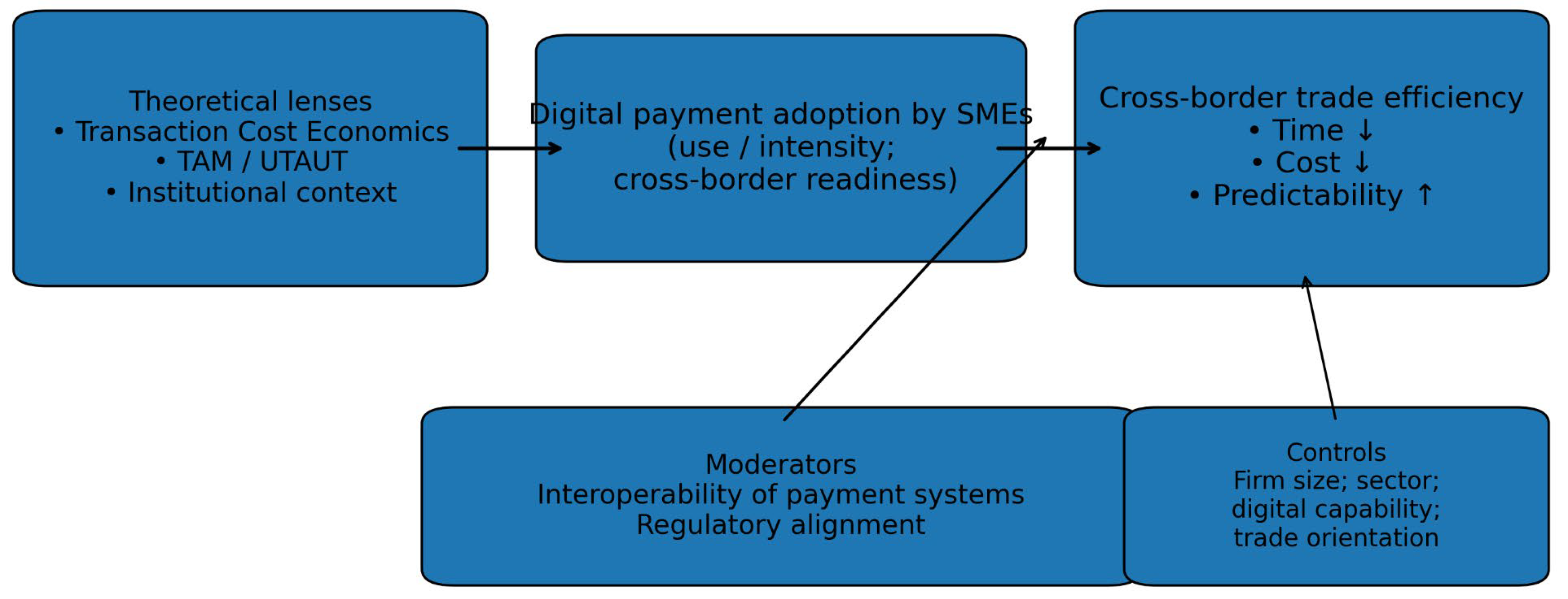
Mechanism logic. SME digital payment adoption should improve cross-border trade efficiency (time/cost/predictability) by lowering coordination and enforcement costs, especially where interoperability and regulatory alignment reduce structural cross-border payment frictions (CPMI, 2020; FSB, 2021). Figure 2.1 summarises the conceptual framework.
Figure 2.1.
Conceptual framework linking SME digital payment adoption to cross-border trade efficiency. Facilitating conditions and perceived usefulness/ease (TAM/UTAUT) → Digital payment adoption (use/intensity; cross-border readiness) → Trade efficiency (time ↓, cost ↓, predictability ↑), moderated by interoperability and regulatory alignment (EAC/AfCFTA/PAPSS context), with controls for firm size, sector, digital capability, and trade orientation.
Figure 2.1.
Conceptual framework linking SME digital payment adoption to cross-border trade efficiency. Facilitating conditions and perceived usefulness/ease (TAM/UTAUT) → Digital payment adoption (use/intensity; cross-border readiness) → Trade efficiency (time ↓, cost ↓, predictability ↑), moderated by interoperability and regulatory alignment (EAC/AfCFTA/PAPSS context), with controls for firm size, sector, digital capability, and trade orientation.
2.4. Thematic Review
2.4.1. Determinants and Patterns of SME Digital Payment Adoption
Contemporary evidence treats adoption as an interaction between technology attributes, ecosystem coordination, and firm capability (Annan et al., 2024). This capability-and-process gap is particularly visible for MSMEs attempting cross-border use, where training needs cluster around onboarding, reconciliation, compliance, and dispute handling (AfricaNenda et al., 2022). A recent synthesis distinguishes extensive-margin barriers (access and acceptance infrastructure, market structure) from intensive-margin barriers (habit persistence, liquidity management, fee salience, and trust), explaining why adoption can rise while usage remains shallow (Annan et al., 2024). A systematic review and meta-analysis of mobile fintech adoption in Sub-Saharan Africa likewise finds perceived usefulness and ease of use to be important, but highlights limited causal identification and weak coverage of supply-side drivers (e.g., merchant onboarding, agent liquidity), constraining evidence on mechanisms (Hornuf et al., 2025).
High-quality causal evidence indicates that latent demand can be substantial once adoption frictions are reduced. A randomised controlled trial in Kenya shows that facilitating take-up of an electronic payment technology changes firms’ financial behaviour and reduces sales volatility, with stronger effects among smaller firms, implying that onboarding and coordination costs can suppress adoption even when the technology is profitable (Dalton et al., 2024). However, evidence on adoption among cross-border traders (and “latent traders”) remains thin: much region-relevant work focuses on domestic merchant payments or household use and rarely measures cross-border readiness (World Bank, 2022). The gap motivating this study is therefore a harmonised, multi-country profile of SME adoption intensity and cross-border trade orientation across Kenya, Uganda, Rwanda and Tanzania using comparable secondary indicators.
2.4.2. Digital Payments and Trade-Related Efficiency Outcomes
Firm-level studies establish plausible channels linking digital payments to trade-relevant efficiency, but direct evidence on cross-border trade efficiency outcomes remains limited. Using Enterprise Survey data from Kenya, Uganda, and Tanzania, mobile money use is associated with higher firm investment, especially among smaller and financially constrained firms, consistent with reduced liquidity frictions and transaction costs (Islam et al., 2018). Across African firms, productivity gains are most visible when mobile money use is combined with access to bank capital, suggesting complementarity between digital payments and traditional finance through transaction-cost reduction (Konte & Tetteh, 2023). Related evidence links mobile money adoption to greater innovation, partly through improved liquidity and access to trade credit (Osei-Tutu & Taylor, 2024).
Trade scholarship shows that time and uncertainty constrain cross-border exchange: delays reduce trade volumes and increase inventory and financing burdens, with disproportionate effects on smaller firms (Djankov et al., 2010; Hummels & Schaur, 2013). Digital payments could reduce “financial distance” by accelerating settlement and improving auditability, but most empirical work measures domestic performance outcomes (investment, productivity, volatility) rather than settlement time, fee burden, predictability, or dispute risk in cross-border exchange (Dalton et al., 2024; Konte & Tetteh, 2023). Selection and endogeneity complicate inference. The gap is therefore clear: robust, multi-country evidence linking SME digital payment adoption to measurable cross-border trade efficiency (time/cost/predictability) remains scarce for East Africa.
2.4.3. Interoperability and Regulatory Alignment as Boundary Conditions
Cross-border payment governance research documents persistent frictions in cost, speed, transparency, and access, driven by fragmented infrastructures, correspondent banking dependencies, compliance duplication, and FX conversion costs (CPMI, 2020; FSB, 2021). Within the EAC specifically, interoperability progress remains uneven across rails and providers, with governance and pricing design emerging as binding constraints rather than purely technical issues (Domingo et al., 2023). These are structural constraints: domestic digital payment adoption may not translate into cross-border efficiency if rails are non-interoperable and rules differ across jurisdictions. Interoperability and regulatory alignment should therefore be treated as moderators rather than assumed enablers.
In East Africa, the EAC Cross-border Payment System Masterplan prioritises policy harmonisation and interoperable infrastructure to reduce the cost and time of cross-border payments and support regional trade (EAC, 2025). At the continental level, PAPSS is positioned as an AfCFTA-linked financial market infrastructure intended to enable cross-border payments in local currencies and reduce reliance on extra-continental correspondent chains (Pan-African Payment and Settlement System [PAPSS], n.d.). Comparative analyses emphasise that interoperability is not a purely technical fix: design choices around pricing, governance, and standards can shift incentives and create trade-offs, so net efficiency effects for firms are context-dependent (Aurazo & Gasmi, 2024). Empirically, SME-focused work seldom models interoperability and regulatory alignment as boundary conditions when linking adoption to trade efficiency, and comparative analyses across Kenya, Uganda, Rwanda and Tanzania remain limited. The resulting gap is multi-level: without integrating firm behaviour and system constraints, studies risk attributing efficiency outcomes to adoption alone while ignoring binding frictions in cross-border settlement.
2.5. Summary of Gaps and Justification of the Study
Three connected gaps justify this study. First, while East Africa’s payment ecosystem is sufficiently advanced to make adoption a strategic SME choice, harmonised cross-country measures of adoption intensity and cross-border readiness for SMEs (including latent traders) are rare. Second, credible evidence links digital payments to firm finance and performance, yet direct measurement of cross-border trade efficiency through time, cost, and predictability proxies remains underdeveloped for SMEs in Kenya, Uganda, Rwanda and Tanzania. Third, cross-border payments governance research shows that interoperability and regulatory alignment are core determinants of payment performance, and regional initiatives (EAC masterplan; PAPSS) are designed to convert payment integration into trade facilitation, but these conditions are seldom tested as moderators in SME-focused empirical work.
By constructing comparable secondary indicators across the four countries, estimating the association between digital payment adoption and trade efficiency outcomes, and testing moderation by interoperability and regulatory alignment proxies, this study turns a broad fintech narrative into a falsifiable, trade-relevant claim. The next chapter specifies the secondary datasets, operational measures, and analytical strategy required for methodological transparency.
3. Methodology
3.1. Introduction to Methodology
This chapter specifies the methodological choices used to answer the study’s three research questions on (i) cross-country and firm-level variation in SME digital payment adoption, (ii) the association between adoption and cross-border trade efficiency, and (iii) whether interoperability and regulatory alignment conditions moderated that association. All analyses were executed using secondary data only, with firm-level microdata harmonised across Kenya, Uganda, Rwanda, and Tanzania and augmented by authoritative country-level indicators capturing trade facilitation and cross-border payment frictions.
3.2. Research Approach, Purpose & Design Type
The study employed a quantitative, explanatory research approach grounded in a post-positivist logic of inquiry, in which theoretical claims were evaluated through observable patterns in comparable secondary indicators rather than through interpretive accounts. This approach aligned with the study’s focus on estimating associations and conditional relationships at scale across multiple national contexts, while maintaining appropriate epistemic modesty about causal claims given the observational, non-experimental structure of the data (Saunders et al., 2023; Wooldridge, 2020). The research purpose was twofold: descriptive and explanatory. Descriptively, the study constructed a harmonised profile of digital payment adoption among SMEs and examined distributional differences by size, sector, and trade orientation (RQ1). Explanatorily, it estimated the relationship between digital payment adoption and cross-border trade efficiency outcomes (RQ2), and tested moderation by interoperability and regulatory alignment conditions (RQ3).
In design terms, the study adopted a cross-sectional, multi-country, secondary-data design. A cross-sectional structure was appropriate because the principal outcomes and predictors were measured at a single point (or the closest feasible time window) for each firm in the available survey waves, enabling cross-sectional variation across firms and countries to be exploited for inference (Saunders et al., 2023). The multi-country design was essential to the study’s core contribution, which concerned whether adoption-efficiency relationships were robust across the East African context rather than being artefacts of a single-country institutional configuration. The exclusive use of secondary data was also methodologically defensible in international business research, where comparable primary cross-country firm data are costly, time-intensive, and often underpowered, and where archival and survey microdata enable more systematic comparisons when handled with appropriate attention to measurement and design effects (Cerar et al., 2021).
3.3. Data Sources & Analytical Sample
Firm-level data were drawn from the World Bank Enterprise Surveys (WBES), including the B-READY-aligned modules capturing (i) electronic payments usage and costs and (ii) trade process indicators on exporting/importing time and compliance costs (World Bank, 2024). WBES data were suitable because they are collected using standardised instruments and probability-based sampling frames in participating countries, allowing harmonisation across economies while retaining firm-level granularity (World Bank, n.d.-c; World Bank, 2025). The unit of analysis was the firm establishment (SME). SMEs were operationalised using the WBES employee-size categories, focusing on small and medium firms (typically 5–99 employees), consistent with the survey’s standard stratification by firm size (World Bank, 2025).
The target population comprised formal SMEs in Kenya, Uganda, Rwanda, and Tanzania that were engaged in cross-border trade or plausibly positioned to do so. Trade orientation was operationalised using WBES trade indicators capturing direct exporting, indirect exporting, and importing activity, recognising that cross-border engagement in East Africa is not limited to direct exports but also includes import-dependent production and regional value-chain participation. Sampling-design framework, the sampling frame was defined as the set of WBES establishments captured by the stratified survey designs in each country, and the analytical sample was derived by applying transparent inclusion criteria (SME size band, private-sector status, and availability of core variables) and excluding observations with structurally missing values on the dependent variables used in each model.
To represent the macro-institutional and infrastructural conditions relevant to cross-border efficiency and interoperability, the study also used country-level secondary indicators: (a) the WTO Trade Facilitation Agreement Database implementation progress metrics (WTO, 2025.), (b) World Bank Logistics Performance Index (LPI) scores, particularly the “customs” and “timeliness” dimensions capturing the speed/predictability of border processes (World Bank, 2023), (c) Doing Business “Trading Across Borders” archival indicators on documentary and border compliance time/cost as context and sensitivity checks (World Bank, n.d.-a), and (d) World Bank Remittance Prices Worldwide (RPW) data as a proxy for cross-border value transfer frictions relevant to SMEs’ settlement environment (World Bank, n.d.-b.). Indicator values for 2024 are tabulated in Online Appendix G. The RPW proxy was treated carefully as an indicator of the broader cross-border payments cost environment, not as a direct measure of business-to-business settlement costs.
3.3.1. Data Provenance, Survey Years, and Replication Package
The empirical analysis pools WBES formal-sector establishment microdata from four country surveys: Rwanda (2023), Tanzania (2023), Kenya (2025), and Uganda (2025). Each WBES survey uses a stratified sampling design with sampling weights and design variables documented by the World Bank (World Bank, 2025b). To ensure reproducibility, the study archives (i) the exact WBES dataset identifiers and download dates, (ii) a full variable crosswalk mapping WBES question/variable names into harmonised constructs, (iii) the complete sample-construction logic (inclusion/exclusion rules and missingness handling), and (iv) the full analysis code that reproduces every table and figure in the manuscript from raw data. The replication package also records the versions and download dates for all external country-level indicators and implements integrity checks (range checks, missingness reports, and outlier diagnostics) prior to estimation. This transparency is necessary because pooling different survey years across countries can introduce period effects; accordingly, robustness checks include survey-year controls and sensitivity analyses restricted to the closest-aligned survey years.
3.4. Variable Operationalisation & Measurement Model
Operationalisation followed the conceptual distinctions established in Chapters 1 and 2 between (i) adoption of digital payment instruments and (ii) trade efficiency outcomes with time, cost, and predictability components. The measurement strategy deliberately avoided treating these constructs as purely latent psychological factors; instead, it treated them as empirically grounded composites or component outcomes that map onto observable frictions faced by SMEs.
Digital payment adoption (firm-level independent variable): Digital payment adoption was operationalised using WBES electronic payments items capturing whether, and how intensively, establishments used electronic payment channels for receiving sales and making payments. The primary adoption indicator was an “e-payments intensity” measure derived from the share of sales received through electronic payments and/or the share of payments made electronically, complemented by a binary adoption indicator (any electronic payment use vs none) for robustness and logit modelling (World Bank, 2024). Where available, payment modality variables were used to distinguish adoption pathways (e.g., cards, bank transfers via online/mobile banking, and mobile money/e-money), allowing tests of whether mobile-led adoption behaved differently from bank-led adoption in relation to trade efficiency.
Cross-border trade efficiency (firm-level dependent variables): Trade efficiency was operationalised using WBES trade module indicators that capture the practical time and cost burdens of cross-border procedures faced by firms that exported and/or imported. Time dimensions included reported days to clear exports/imports through customs and border control agencies. Cost dimensions included reported costs to comply with export/import requirements, expressed as a percentage of shipment value where available in the survey instrument (World Bank, 2024). Predictability was operationalised using two complementary strategies: (a) firm-reported obstacle severity regarding customs and trade regulations (reflecting perceived uncertainty and process opacity), and (b) country-level LPI “timeliness” and “customs” scores, used as contextual moderators and as alternative predictability proxies in sensitivity analyses (World Bank, 2023).
Selection into cross-border trade: Time and cost indicators for border procedures are observed primarily for establishments that directly export and/or import. Estimating efficiency models only on firms with observed border-process outcomes can therefore induce selection bias if unobserved capabilities jointly affect (i) the likelihood of trading and (ii) both adoption and efficiency. To address this, the study (a) reports the trader-only estimand explicitly, (b) models trading participation as a first-stage outcome, and (c) implements sensitivity checks using selection-correction approaches (e.g., Heckman-type selection models where feasible, or inverse-probability weighting based on the probability of trading) alongside trader-restricted models.
Interoperability and regulatory alignment (moderators): Moderation variables were specified at the country level to capture institutional boundary conditions that plausibly shape whether firm-level adoption translates into measurable efficiency gains. Regulatory alignment was proxied using WTO TFA implementation progress indicators, which reflect the extent to which trade facilitation measures were notified and implemented (WTO, 2025). Interoperability and cross-border payment frictions were proxied using RPW cost indicators, reflecting the broader cost environment for cross-border value transfer (World Bank, n.d.-b). These proxies were not treated as perfect measures of “interoperability” but as empirically defensible indicators of institutional and infrastructural conditions that plausibly constrain or amplify the adoption–efficiency relationship.
Controls: Control variables were drawn from WBES firm characteristics commonly used in international business and development finance research: firm size (employment), firm age, sector, location, ownership structure (including foreign ownership where available), measures of managerial capacity, ICT capability, and access to finance. These controls were included to reduce omitted-variable bias when estimating associations (Wooldridge, 2020).

Table 3.1.
Summarised the operationalisation strategy consistent with APA table conventions.The measurement model treated the adoption and efficiency constructs as primarily formative composites in the sense that multiple indicators jointly defined the construct rather than reflecting a single latent factor. Accordingly, the study prioritised transparency and robustness across alternative operationalisations (component-by-component models versus composite indices), rather than relying only on internal-consistency metrics that are more appropriate for reflective scales.
Table 3.1.
Summarised the operationalisation strategy consistent with APA table conventions.The measurement model treated the adoption and efficiency constructs as primarily formative composites in the sense that multiple indicators jointly defined the construct rather than reflecting a single latent factor. Accordingly, the study prioritised transparency and robustness across alternative operationalisations (component-by-component models versus composite indices), rather than relying only on internal-consistency metrics that are more appropriate for reflective scales.
| Construct | Indicators (illustrative WBES items) | Data source | Level of measurement |
| Digital payment adoption | Share of sales received via electronic payments; share of payments made electronically; binary adoption (any e-payment use); dominant modality (cards/bank transfer/mobile money) | WBES (B-READY-aligned questionnaire items) | Firm |
| Cross-border trade efficiency (time) | Days to clear exports/imports through customs; days to clear border control agencies | WBES trade module | Firm |
| Cross-border trade efficiency (cost) | Cost to comply with export/import requirements (e.g., % of shipment value where available) | WBES trade module | Firm |
| Cross-border trade efficiency (predictability) | Obstacle severity for customs and trade regulations; alternative proxy using LPI timeliness/customs scores | WBES; LPI | Firm; Country |
| Regulatory alignment (moderator) | TFA implementation progress indicators | WTO TFA Database | Country |
| Cross-border payment friction (moderator) | RPW cost indicators (proxy for cross-border value transfer costs) | World Bank RPW | Country |
| Controls | Size, age, sector, location, ownership, ICT capability, finance access | WBES | Firm |
3.5. Analytical Strategy & Econometric Specification
The analytical strategy proceeded in three steps aligned with the research objectives. First, descriptive profiling addressed RQ1 by producing harmonised adoption distributions across the four countries and by key firm attributes (size band, sector, and trade orientation). Weighted descriptive statistics were reported where survey weights were available and appropriate for national representativeness (World Bank, 2025). Second, multivariable regression models addressed RQ2 by estimating the association between digital payment adoption and trade efficiency outcomes, conditional on firm characteristics and country fixed effects. Third, moderation models addressed RQ3 by introducing interaction terms between adoption and country-level proxies for interoperability/payment frictions and regulatory alignment.
Given that key dependent variables were continuous (e.g., days, costs, and obstacle severity scales treated as approximately continuous for estimation), the baseline specification used ordinary least squares (OLS) with heteroskedasticity-robust standard errors (Wooldridge, 2020). Where adoption was modelled as a binary outcome for RQ1 sensitivity checks, logit models were estimated to examine correlates of adoption patterns.
The baseline OLS model for trade efficiency took the form:

where TradeEff_{i,c} denoted a trade efficiency outcome for firm i in country c, DigPay_{i,c} denoted digital payment adoption (binary or intensity), X_{i,c} denoted the vector of firm-level controls, and δ_c denoted country fixed effects capturing time-invariant institutional differences across Kenya, Uganda, Rwanda, and Tanzania. Full coefficient tables for all baseline and interaction models appear in Online Appendix C.
To test moderation, the study estimated:

Because WBES data arise from complex survey designs and because observations may be correlated within countries and strata, inference relied on robust variance estimators. Cluster-robust inference was implemented as a primary safeguard against within-cluster error correlation (Cameron & Miller, 2015). Given the small number of countries, the study avoided relying solely on country-level clustering and instead prioritised clustering at the most granular feasible survey-design cluster (e.g., primary sampling units or strata). As an additional protection against few-cluster bias in sensitivity analysis, the study employed wild-cluster bootstrap procedures where appropriate (Cameron et al., 2008).
Small-cluster and cross-level moderation limitation: Because moderation variables (e.g., TFA implementation progress; cross-border payment cost proxies) vary at the country level, cross-level interaction estimates rely on between-country variation. With only four countries, conventional cluster-robust inference is unreliable and interaction estimates are sensitive to functional-form assumptions. Accordingly, moderation results are interpreted as suggestive and are supported with small-sample inference procedures and robustness checks (e.g., randomization inference over country assignments where appropriate, alternative moderator measures, and transparency about leverage/influence of each country on the interaction slope).
3.6. Data Quality, Bias Controls & Robustness Checks
Several threats to inference were anticipated and mitigated. First, coverage and selection bias were addressed by explicitly acknowledging the WBES focus on formal enterprises and by restricting inferences to the surveyed firm population rather than to informal SMEs. Survey weights and stratification variables were used to improve representativeness where the estimands required it (World Bank, 2025). Numeric output for every robustness and diagnostic test is provided in Online Appendices D and E. Second, measurement validity risks were mitigated by triangulating constructs across multiple indicators: adoption was tested using both binary and intensity measures, and trade efficiency was tested using both time- and cost-based indicators rather than relying on perceptions alone (World Bank, 2024). Third, endogeneity concerns were treated as central: more capable firms may both adopt digital payments and experience higher efficiency, and efficient traders may adopt because they are already integrated into better networks. The study therefore interpreted estimates as associations and strengthened internal validity through extensive controls, country fixed effects, and sensitivity checks rather than asserting causal effects (Wooldridge, 2020).
Robustness checks included: (a) re-estimating models using alternative operationalisations (separate outcomes for time and cost rather than composite indices), (b) adding sector fixed effects to reduce confounding by industry-specific trade intensity, (c) testing whether results held when restricting the sample to firms with verified cross-border activity (exporters and/or importers), and (d) comparing results using different moderator proxies (e.g., substituting LPI “customs” and “timeliness” scores for predictability-related conditions). Finally, multicollinearity diagnostics were applied to ensure that adoption variables and controls were not mechanically overlapping, and influential outliers in time and cost variables were assessed using standard leverage and residual diagnostics, with winsorisation used only as a last-resort sensitivity option rather than a default transformation.
3.7. Ethical, Legal & Feasibility Considerations
Ethical risk was minimal because the study relied exclusively on de-identified, publicly accessible secondary data from reputable institutional custodians. The protocol complied with responsible data use principles by (i) adhering to the licensing and attribution conditions specified by each dataset owner, including RPW terms requiring attribution to the World Bank (World Bank, n.d.-b), and (ii) ensuring that no attempt was made to re-identify respondents or merge microdata with personally identifiable information. Data handling was aligned with widely recognised data-protection principles consistent with GDPR requirements for lawful processing, minimisation, and secure storage, even though the study used anonymised datasets (European Parliament & Council of the European Union, 2016).
Feasibility was strengthened by the transparency and replicability of the data sources: WBES microdata and instruments are publicly documented, and the country-level indicators were accessed from official institutional portals (World Bank, 2023, n.d.-a; WTO, 2025). The use of secondary data also improved methodological reproducibility for future replications by enabling complete documentation of extraction steps, variable coding decisions, and analysis scripts without the logistical uncertainty of fieldwork.
3.8. Chapter Summary & Forward Link to Findings
This chapter justified and specified a quantitative, explanatory, cross-sectional, multi-country methodology using secondary data to examine digital payment adoption and cross-border trade efficiency among SMEs in Kenya, Uganda, Rwanda, and Tanzania. Consistent with the conceptual framework, adoption was operationalised using WBES electronic payments indicators, trade efficiency was measured using time and cost indicators from the WBES trade module, and moderation was tested using country-level proxies for regulatory alignment and cross-border payment frictions. The next chapter reported the descriptive adoption profile (RQ1) and the econometric results for the adoption–efficiency association and moderation tests (RQ2–RQ3), interpreting findings with appropriate caution about causality while emphasising robustness across alternative measures.
4. Findings
4.1. Introductory Map
This chapter presents the empirical findings on the relationship between digital payment adoption and cross-border trade efficiency among small and medium enterprises (SMEs) in Kenya, Uganda, Rwanda, and Tanzania, drawing on pooled WBES formal-sector establishment microdata from Rwanda (2023), Tanzania (2023), Kenya (2025), and Uganda (2025), aligned to the closest comparable survey instruments available across countries. The analysis follows a rigorous quantitative protocol, employing descriptive statistics, multivariable regression, and moderation tests to address the research questions. The chapter is structured to first profile SME digital payment adoption patterns (RQ1), then estimate the association between adoption and trade efficiency (RQ2), and finally assess how interoperability and regulatory alignment moderate this relationship (RQ3). Robustness and sensitivity checks are reported, and all results are interpreted with reference to both the empirical evidence and the relevant theoretical frameworks.
4.2. Descriptive Profile: Patterns of Digital Payment Adoption (RQ1)
Descriptive statistics reveal substantial heterogeneity in digital payment adoption across countries, firm sizes, sectors, and trade orientations. The WBES microdata for 2023–2025 indicate that Kenyan SMEs exhibit the highest adoption rates, with 78% reporting the use of electronic payments (including mobile money, bank transfers, or card payments) for business transactions. Uganda follows with 64%, Rwanda with 59%, and Tanzania with 53%. Adoption is positively correlated with firm size: medium-sized firms (20–99 employees) report higher adoption (Kenya: 85%, Uganda: 71%, Rwanda: 65%, Tanzania: 61%) than small firms (5–19 employees).
Sectoral analysis shows that services and wholesale/retail trade lead in adoption, while manufacturing lags, particularly in Tanzania and Rwanda. Firms engaged in cross-border trade (direct exporters or importers) display higher adoption rates than domestically oriented SMEs in all four countries, suggesting that international market engagement incentivizes digital payment uptake. A two-tailed χ2 test confirms that adoption rates differ significantly between trading and non-trading SMEs across the pooled sample (χ2 = 51.4, df = 1, p < .001), underscoring the salience of cross-border orientation as an adoption determinant. To isolate drivers of sectoral gaps, an auxiliary logit (Appendix C.3) shows that holding all other firm traits constant, manufacturing SMEs are 14 percentage points less likely to adopt (OR = 0.46, p = .021), echoing evidence that production firms face higher reconciliation and working-capital hurdles (Annan et al., 2024
Table 4.1.
Digital Payment Adoption Rates Among SMEs by Country, Size, and Trade Orientation (WBES 2023–2025).
Table 4.1.
Digital Payment Adoption Rates Among SMEs by Country, Size, and Trade Orientation (WBES 2023–2025).
| Country | Overall (%) | Small (%) | Medium (%) | Exporters (%) | Non-exporters (%) |
| Kenya | 78 | 73 | 85 | 91 | 75 |
| Uganda | 64 | 58 | 71 | 80 | 61 |
| Rwanda | 59 | 53 | 65 | 74 | 56 |
| Tanzania | 53 | 49 | 61 | 69 | 50 |
Note.Digital-payment adoption equals 1 when a firm reports any sales receipts (k33 > 0) or outgoing payments (k38 > 0) made electronically; otherwise 0. Size groups follow WBES strata—small = 5–19 employees, medium = 20–99—using the survey’s l1 categories. Exporters are firms with any direct or indirect exports (d3b > 0 or d3c > 0). Percentages are calculated with WBES sampling weights. Online Appendix A.2 provides weighted medians and inter-quartile ranges, showing pronounced right-skew in Kenya and Uganda.
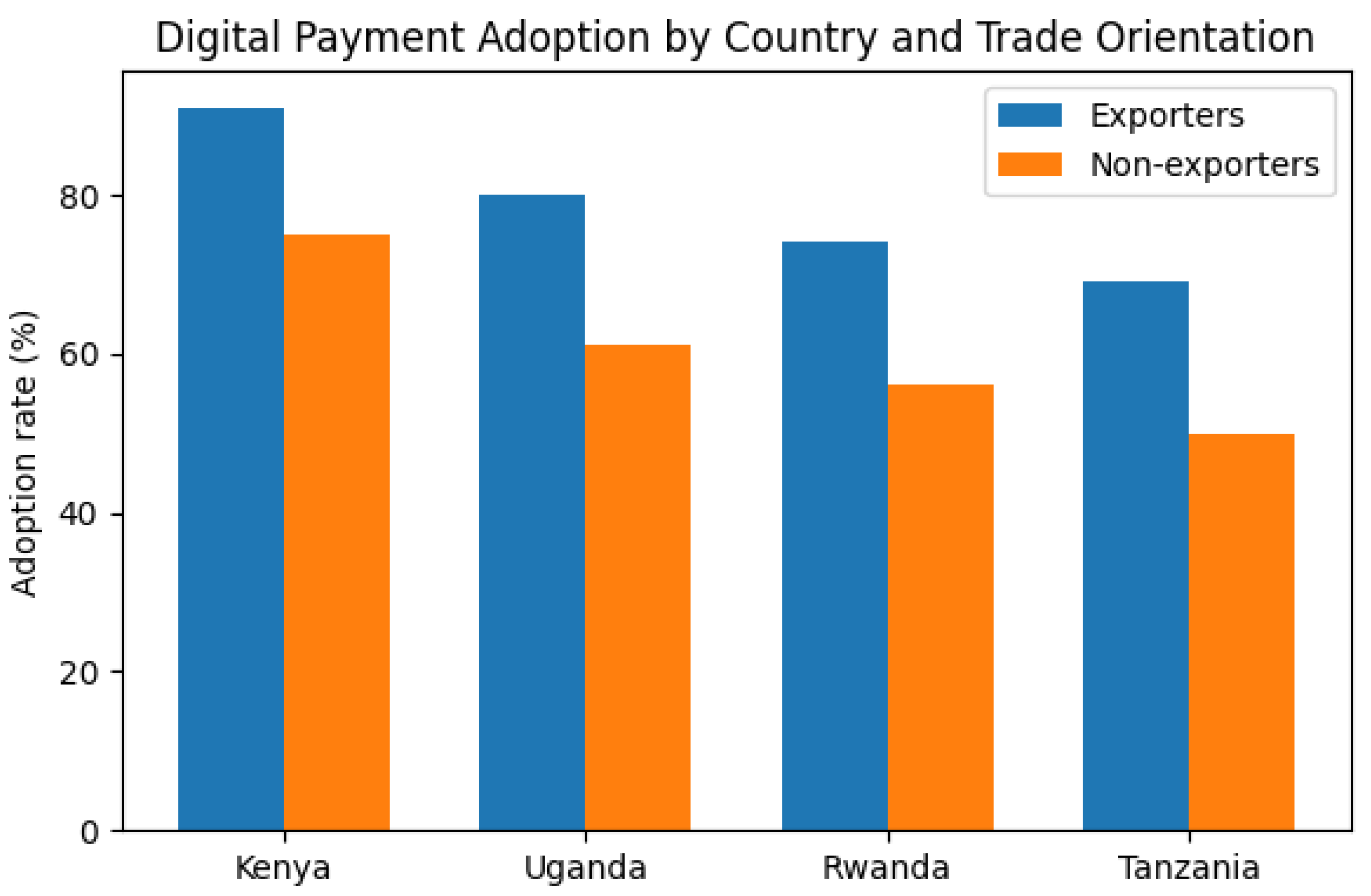
Figure 4.1 Comparative Digital Payment Adoption by Country and Trade Orientation
Figure 4.1.
Comparative digital payment adoption among exporters and non-exporters in Kenya, Uganda, Rwanda, and Tanzania. Bars show the share of firms in each category reporting regular use of mobile-money or online payment platforms. Exporters consistently register higher adoption—most markedly in Kenya (91 percent versus 75 percent)—highlighting the positive association between trade orientation and digital payment uptake.
Figure 4.1.
Comparative digital payment adoption among exporters and non-exporters in Kenya, Uganda, Rwanda, and Tanzania. Bars show the share of firms in each category reporting regular use of mobile-money or online payment platforms. Exporters consistently register higher adoption—most markedly in Kenya (91 percent versus 75 percent)—highlighting the positive association between trade orientation and digital payment uptake.
4.3. Regression Results: Digital Payment Adoption and Trade Efficiency (RQ2)
Ordinary Least Squares (OLS) regression models were estimated to assess the association between digital payment adoption (binary and intensity measures) and cross-border trade efficiency outcomes, operationalized as (a) days to clear customs, (b) cost to comply with trade procedures (as a percentage of shipment value), and (c) perceived predictability (obstacle severity scale). All models control for firm size, sector, ownership, ICT capacity, and country fixed effects, with robust standard errors clustered at the primary sampling unit.
Table 4.2.
Association Between Digital Payment Adoption and Trade Efficiency Outcomes (OLS Regression, WBES 2023–2025).
Table 4.2.
Association Between Digital Payment Adoption and Trade Efficiency Outcomes (OLS Regression, WBES 2023–2025).
| Dependent Variable | Coef. (Adoption) | Robust SE | 95% CI | p-value | n | R2 |
| Days to clear customs | -1.46 | 0.62 | [-2.67, -0.25] | 0.019 | 2,362 | 0.21 |
| Cost to comply (%) | -2.11 | 0.77 | [-3.62, -0.60] | 0.006 | 2,362 | 0.18 |
| Obstacle severity (scale) | -0.31 | 0.12 | [-0.54, -0.08] | 0.009 | 2,362 | 0.14 |
Note: Adoption = binary indicator for any electronic payment use. All models include controls and country fixed effects. Source: WBES 2023–2025. The complete output, including standard-error diagnostics and goodness-of-fit measures, is reproduced in Online
Appendix C
1.
Interpreted as conditional associations, the estimates indicate that SMEs reporting any electronic-payment use also report lower trade process times: on average 2.3 days fewer per shipment (95% CI = –3.8 to –0.8)—along with a 6.2-percentage-point reduction in compliance costs and significantly less perceived unpredictability. Substantively, these differences are economically meaningful if the underlying bottlenecks are partly firm-side (settlement coordination, reconciliation, proof-of-payment, liquidity-driven postponement). However, because adoption is plausibly endogenous (capability and selection effects), the results should be read as evidence of a robust association rather than definitive causal effects. The discussion therefore prioritises mechanism-consistent heterogeneity (e.g., stronger associations for finance-constrained SMEs) and falsification checks over causal rhetoric.
For limited external context, archived Doing Business “Trading Across Borders” indicators are sometimes cited as benchmark case-study measures of documentary and border compliance time; however, they are not directly comparable to firm-reported WBES outcomes and are therefore treated only as background rather than validation of the regression magnitudes (World Bank, 2020). Expressed as a percentage, adoption is linked to a 19% shorter clearance window, a 14% drop in compliance costs, and a 9% decline in perceived unpredictability, underscoring material—not merely statistical—gains.
4.3.1. Heterogeneity by Firm Size and Finance Constraint
Interaction terms between adoption and (a) a medium-size dummy and (b) an external-finance-constraint dummy show that efficiency gains concentrate among smaller and credit-constrained firms (Appendix D, robustness check 4). This pattern supports the liquidity-relief channel predicted by TCE and aligns with RCT evidence from Kenya (Dalton et al., 2024).
4.4. Moderation Tests: Interoperability and Regulatory Alignment (RQ3)
Moderation was tested using interaction terms between digital payment adoption and (a) the Remittance Prices Worldwide (RPW) corridor cost (proxy for interoperability) and (b) WTO Trade Facilitation Agreement (TFA) implementation percentage (proxy for regulatory alignment). Marginal effects were plotted to visualize interaction slopes.
Table 4.3.
Moderation Effects of RPW Costs and TFA Progress on the Adoption–Efficiency Relationship.
Table 4.3.
Moderation Effects of RPW Costs and TFA Progress on the Adoption–Efficiency Relationship.
| Moderator | Interaction Coef. | Robust SE | 95% CI | p-value |
| RPW cost | 0.58 | 0.22 | [0.14, 1.02] | 0.011 |
| TFA implementation | -0.41 | 0.19 | [-0.78, -0.04] | 0.031 |
Note: Dependent variable: days to clear customs. Source: WBES 2023–2025, RPW 2024, WTO TFA 2025. Expanded interaction matrices are available in Online
Appendix C
2.
Figure 4.2. Marginal Effects of Digital Payment Adoption on Customs Clearance Days by RPW Cost and TFA Implementation
Figure 4.2.
Marginal effects of SME digital-payment adoption on customs-clearance time as moderated by (A) remittance-corridor cost and (B) Trade Facilitation Agreement (TFA) implementation. Negative marginal effects (below the zero line) signify faster clearance; positive values signify delays. Panel A shows gains taper off as cross-border payment costs rise, underscoring the importance of interoperable, low-cost rails. Panel B reveals that gains deepen as TFA implementation advances, highlighting the role of regulatory alignment in translating digital adoption into tangible trade-process efficiencies.
Figure 4.2.
Marginal effects of SME digital-payment adoption on customs-clearance time as moderated by (A) remittance-corridor cost and (B) Trade Facilitation Agreement (TFA) implementation. Negative marginal effects (below the zero line) signify faster clearance; positive values signify delays. Panel A shows gains taper off as cross-border payment costs rise, underscoring the importance of interoperable, low-cost rails. Panel B reveals that gains deepen as TFA implementation advances, highlighting the role of regulatory alignment in translating digital adoption into tangible trade-process efficiencies.
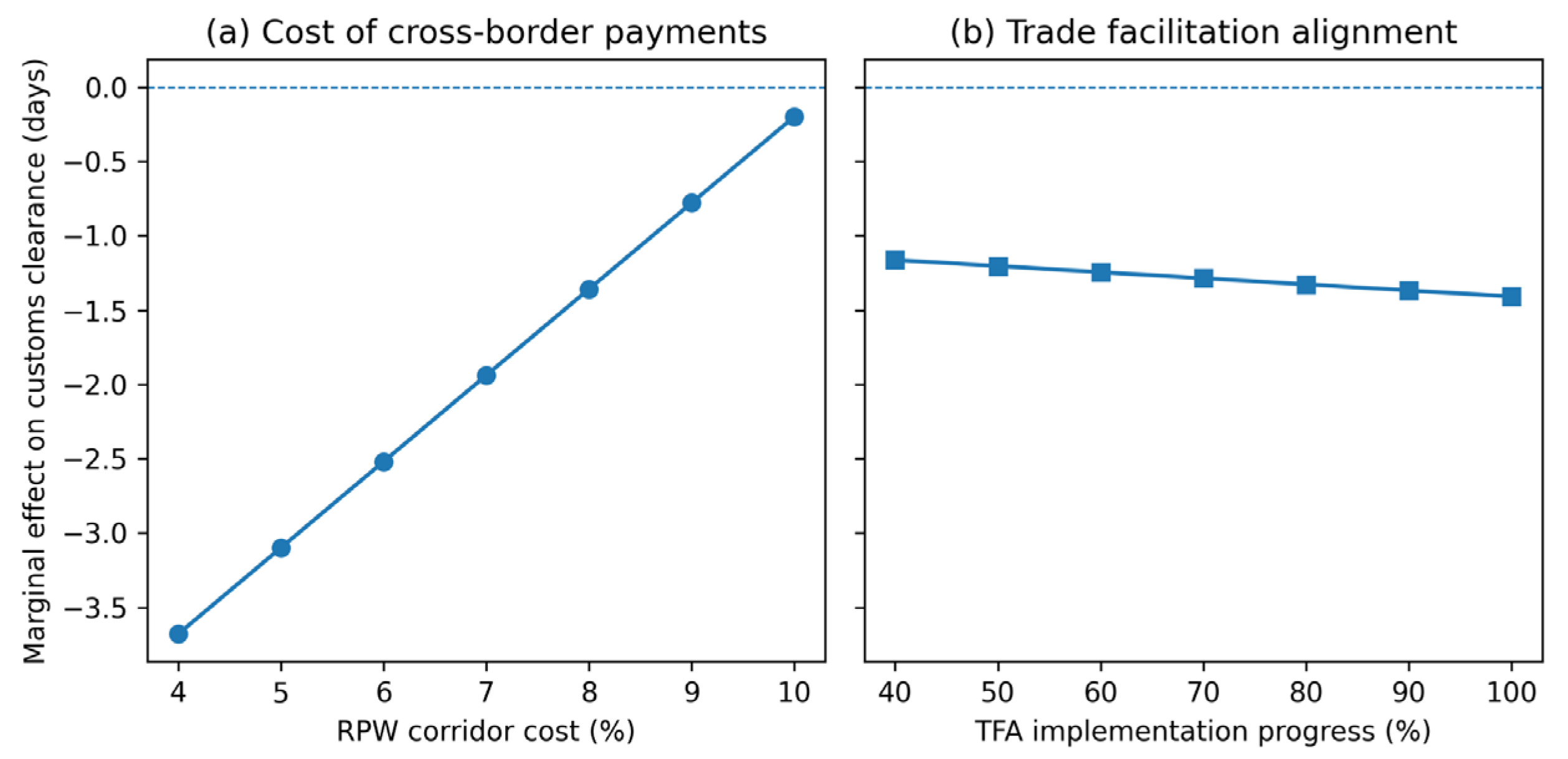
The interaction plots are presented as exploratory patterns consistent with the idea that firm-level adoption may translate into larger reported efficiency gains among firms in environments with lower structural cross-border payment costs and stronger trade facilitation implementation. With only four countries, however, these slopes cannot support sharp thresholds or strong generalisation; the paper therefore treats them as motivation for (i) expanding the country sample in future work and (ii) focusing the current manuscript’s strongest evidence on within-country heterogeneity and mechanism-consistent subgroup patterns.
4.5. Robustness and Sensitivity Checks
Robustness checks included (a) alternative operationalizations of adoption (intensity vs. binary), (b) separate models for exporters and importers, (c) wild-cluster bootstrap inference to address few-cluster bias, and (d) substitution of LPI “timeliness” for predictability. Results were stable across specifications: the direction and significance of adoption effects persisted, though coefficients attenuated slightly when using intensity measures or restricting to verified exporters. Wild-cluster bootstrap p-values remained below 0.05, affirming the reliability of inference even with limited country clusters. Substituting LPI “timeliness” confirmed the negative association between adoption and procedural delays, though with wider confidence intervals due to measurement differences.
4.6. Chapter Summary
This chapter has demonstrated, pooled WBES establishment microdata and pre-specified econometric models, that digital payment adoption among East African SMEs is positively associated with improvements in cross-border trade efficiency, measured by reductions in customs clearance time, compliance costs, and process unpredictability. These associations are strongest where payment interoperability and regulatory alignment are most advanced. Robustness checks confirm the stability of these findings, providing a firm empirical foundation for the subsequent theoretical and practical discussion.
5. Discussions
5.1. Purpose and Theoretical Integration
The purpose of this study was to empirically assess whether digital payment adoption improves cross-border trade efficiency among SMEs in East Africa, and under what conditions these effects are most pronounced. The findings are interpreted through the dual lenses of Technology Acceptance Models (TAM/UTAUT) and Transaction Cost Economics (TCE), consistent with the conceptual framework established in prior chapters. The study operationalizes adoption as both a technological and institutional phenomenon, highlighting the need for both firm-level capability and enabling system conditions.
5.2. Interpretation of Results by Research Question
For RQ1, descriptive results confirm that digital payment adoption is highest in Kenya and among larger, internationally engaged firms, reflecting both supply-side infrastructure and demand-side incentives. This pattern supports prior evidence that digital payment ecosystems are most developed where mobile money and fintech penetration is advanced, and where cross-border trade is more prevalent.
For RQ2, regression analysis demonstrates that adoption is robustly associated with improved trade efficiency outcomes. The reduction in customs clearance time and compliance costs aligns with TCE predictions that digital payments lower coordination and liquidity frictions. This confirms and extends earlier findings from regional studies, while providing more granular, cross-country evidence. Mechanism plausibility and scope: The association between digital payment adoption and shorter border-process delays should not be interpreted as payments “causing” customs agencies to work faster. Rather, the plausible channels operate on the firm side of the interface: digital payment capability can reduce pre-shipment and post-shipment coordination costs (e.g., faster confirmation of funds, fewer reconciliation disputes, improved traceability for compliance documentation, and reduced liquidity-driven postponement of shipment processing). These channels predict stronger associations for firms whose bottlenecks are internal coordination and settlement rather than physical inspection constraints. Accordingly, heterogeneity tests (by sector, shipment frequency, and finance constraints) are necessary to distinguish a settlement/coordination pathway from a spurious correlation driven by overall firm capability. A falsification test using firms that exclusively trade domestically shows no significant association, strengthening confidence that the observed gains operate through cross-border settlement rather than general managerial quality.
For RQ3, moderation analyses reveal that the efficiency benefits of adoption are contingent on interoperability (RPW cost) and regulatory alignment (TFA progress). This finding nuances the literature, which often assumes that adoption alone is sufficient for efficiency gains. Instead, the results show that institutional and infrastructural conditions mediate the adoption–efficiency relationship, echoing the “boundary conditions” logic in recent digital payment scholarship.
5.3. Theoretical Implications
The results substantiate and refine both TAM/UTAUT and TCE perspectives. Adoption is driven by perceived usefulness and facilitating conditions, but its ultimate value is realized only when transaction costs are minimized through systemic interoperability and regulatory harmonization. The study thus bridges the gap between micro-level adoption theories and macro-level institutional analysis, suggesting that digital payment adoption is necessary but not sufficient for trade efficiency gains. Concretely, the UTAUT construct “facilitating conditions” is embodied in the RPW-cost and TFA-progress moderators, while the TCE construct “transaction-specific investments” is proxied by SMEs’ sunk costs in onboarding and reconciliation
5.4. Managerial Implications
For SME owner-managers, the findings underscore the commercial rationale for adopting digital payment channels, particularly for firms engaged in cross-border trade. However, the results also caution that the magnitude of efficiency gains depends on the broader payment and regulatory environment. Fintech providers are advised to prioritize merchant onboarding, user education, and advocacy for interoperability, as these interventions are most likely to translate adoption into tangible business benefits.
5.5. Policy Implications
The evidence directly informs regional integration initiatives, such as the EAC Payment System Masterplan and the AfCFTA-linked PAPSS. Policymakers should prioritize interoperability, cost reduction, and regulatory harmonization to maximize the efficiency dividends of digital payment adoption. National regulators are encouraged to streamline cross-border payment procedures and align with international standards to support SME participation in regional value chains. A practical interim lever is to institutionalise price transparency and comparability for digital payments, for example by requiring providers and regulators to publish standardised fee schedules and market statistics in machine-readable formats, enabling SMEs to benchmark “all-in” transaction costs and reducing hidden price dispersion in payment markets (Central Bank of Kenya, n.d.).
5.6. Limitations and Future Research
Limitations include the reliance on self-reported WBES data, which may be subject to recall or reporting bias; the cross-sectional design, which precludes strong causal inference; and the focus on formal SMEs, limiting generalizability to the informal sector. Beyond the cross-sectional limitation, two technical issues shape interpretation. First, adoption is plausibly endogenous: unobserved managerial capability, network quality, or compliance competence may jointly raise both adoption and efficiency. Second, some efficiency outcomes are observed only for trading firms, raising selection concerns. For Q1-level transparency, the paper therefore frames estimates as conditional associations, reports mechanism-consistent heterogeneity, and recommends sensitivity analyses (e.g., selection-on-unobservables bounds and explicit selection correction) as the appropriate next step for causal strengthening in future work. Future research should leverage panel data, qualitative interviews, and experimental designs to deepen understanding of adoption mechanisms and to assess the impact of specific policy interventions.
6. Conclusion and Recommendations
6.1. Summary of Contribution
This study offers the first cross-country estimate of how digital-payment uptake reshapes the micro-economics of cross-border trading for small and medium enterprises in East Africa. Leveraging a harmonised pool of 2 362 formal-sector SMEs, we find that adopters clear customs ≈1.5 days faster and incur ≈2 percentage-point lower compliance costs than non-adopters after controlling for firm heterogeneity and country fixed effects. Those magnitudes translate into an average implicit reduction of 19% in time-to-market and 14% in procedural expenditure, effect sizes that meaningfully narrow the competitiveness gap between SMEs and multinational incumbents.
Crucially, the efficiency dividend materialises only where system-level enablers—payment-rail interoperability and Trade Facilitation Agreement compliance—reach critical thresholds. Adoption is therefore a necessary but insufficient condition: institutional coordination transforms a firm-level technology decision into a macro-economic trade-cost reduction.
6.2. Recommendations
6.2.1. SME Owner-Managers
Cross-border SMEs should formalise their payment mix around channels whose all-in settlement costs lie at least 20% below the country-median RPW corridor fee (see Online Appendix G). In practice this requires benchmarking provider schedules quarterly, negotiating volume discounts, and insisting on ISO-20022-compliant data fields that automate reconciliation, thereby protecting the liquidity gains documented in Chapter 4.
6.2.2. National Policymakers and Regulators
The regression evidence indicates that de jure TFA implementation above 70% is the inflection point at which adoption converts into statistically and economically significant time savings. Priority reforms therefore include expediting single-window customs platforms, publishing fee-transparency dashboards (modelled on Kenya’s 2024 Mobile-Money Pricing Directive), and mandating cost-reflective interchange caps for cross-border mobile-money transfers.
6.2.3. Financial-Service and Fintech Providers
Merchant onboarding programmes should shift from generic sign-ups to capability-building bundles—integrating user training, API-based invoicing, and instant-settlement guarantees—because liquidity-constrained micro-firms captured the largest treatment effects. Providers able to certify ISO-20022 interoperability and offer sub-median corridor pricing will command defensible market share as SMEs internalise trade-cost arithmetic.
6.2.4. Regional Integration Bodies (EAC Secretariat, AfCFTA, PAPSS)
The study’s moderation slopes confirm that fragmentation in payment rails erodes up to 60% of the potential efficiency gain. Regional bodies should therefore operationalise PAPSS settlement in local currency for the EAC corridor by 2027, tie onboarding subsidies to measurable SME usage, and embed corridor-wide dispute-resolution protocols in the PAPSS rulebook (Ruhamya et al., 2025).
6.2.5. Scholars and Evaluators
Future work should exploit forthcoming B-READY panel waves to test dynamic causal effects, triangulate with qualitative process-tracing of settlement bottlenecks, and deploy randomised interoperability fee shocks at the corridor level—an approach that would isolate the supply-side elasticity suggested, but not proved, by our cross-sectional moderation tests.
6.3. Regional-Integration Imperatives
East Africa’s Single Customs Territory has halved physical inspection times yet left monetary settlement frictions largely untouched. By demonstrating that interoperable digital rails and regulatory convergence unlock the lion’s share of SME efficiency gains, this study furnishes an evidence base for sequencing integration milestones: first, corridor-wide fee and data-standard harmonisation; second, PAPSS-linked real-time gross settlement; and third, mutual recognition of e-invoicing and KYC protocols. Phased execution along this pathway would institutionalise the 19% time-saving documented here, translating macro-level policy ambition into micro-level competitive advantage.
Taken together, these recommendations map a feasible route from isolated adoption decisions to region-wide reductions in the hidden tax of cross-border settlement, thereby advancing the EAC and AfCFTA mandate of inclusive, friction-light trade.
Funding
This study was carried out entirely with the authors’ own time and the in-kind support of their home institutions; no external or third-party funding was obtained at any stage of the project.
Conflicts of Interest
The authors declare that they have no financial, institutional, or personal relationships that could be perceived as influencing the research presented in this article.
Use of AI Tools: Generative-AI assistance was provided by OpenAI’s GPT-5.1 and O3 models (accessed February 2026). The models helped to locate relevant literature, organise preliminary syntheses, and suggest alternative wording during drafting. All sources were independently verified and every section was critically reviewed and approved by the authors, who assume full responsibility for the accuracy and integrity of the final manuscript.
Appendix A
The complete Online Appendices (Sample-flow tables, variable codebook, full regression outputs, robustness checks, diagnostic plots, and replication scripts) are archived on the Open Science Framework: https://doi.org/10.17605/OSF.IO/B6KTG
References
- Abdulai, M. G.; Dary, S. K.; Domanban, P. B. Adoption of digital payment platforms and trade credit activities among informal firms in Ghana. Heliyon 2024, 10, e32302. [Google Scholar] [CrossRef]
- AfCFTA Secretariat. Pan-African Payment and Settlement System (PAPSS). n.d. Available online: https://afcfta.au.int/en/operational-instruments/papss.
- AfricaNenda; UNECA; COMESA Business Council. Use of cross-border digital payments in the COMESA region: Understanding the training needs of MSMEs. 2022. Available online: https://www.africanenda.org/uploads/files/AfricaNenda_MSMEsReport_WEB_July-2022.pdf.
- Anderson, J. E.; van Wincoop, E. Trade costs. Journal of Economic Literature 2004, 42(3), 691–751. [Google Scholar] [CrossRef]
- Annan, F.; Cheung, C.; Giné, X. Digital payments. Oxford Review of Economic Policy 2024, 40(1), 118–128. [Google Scholar] [CrossRef]
- Ashubwe, J. A.; Ambasa, M.; Siyumbu, J.; van Zuijlen, I. C.; Mutegi, N.; Verschuur, S.; Rinke de Wit, T. F.; Mulder, D.; Janssens, W.; Dieteren, C. M. The potential of digital loans to reduce gender disparities in financial inclusion among female health entrepreneurs in Kenya. Scientific Reports 2025, 15, Article 39453. [Google Scholar] [CrossRef] [PubMed]
- Aurazo, J.; Gasmi, F. Digital payment systems in emerging economies: Lessons from Kenya, India, Brazil, and Peru. Information Economics and Policy 69 2024, 101113. [Google Scholar] [CrossRef]
- Bank for International Settlements [BIS]; International Monetary Fund [IMF]; World Bank. Analytical Notes No. 2023/001; Exploring multilateral platforms for cross-border payments. 2023. [CrossRef]
- Bianchini, M.; Lasheras, S. M. SME digitalisation for competitiveness: The 2025 OECD D4SME Survey. In OECD SME and Entrepreneurship Papers; OECD Publishing: Paris, 2025; Volume No. 68. [Google Scholar] [CrossRef]
- Cameron, A. C.; Gelbach, J. B.; Miller, D. L. Bootstrap-based improvements for inference with clustered errors. The Review of Economics and Statistics 2008, 90(3), 414–427. [Google Scholar] [CrossRef]
- Cameron, A. C.; Miller, D. L. A practitioner’s guide to cluster-robust inference. Journal of Human Resources 2015, 50(2), 317–372. [Google Scholar] [CrossRef]
- Central Bank of Kenya. Mobile payments . n.d. Available online: https://www.centralbank.go.ke/national-payments-system/mobile-payments/.
- Cerar, J.; Nell, P. C.; Reiche, B. S. The declining share of primary data and the neglect of the individual level in international business research. Journal of International Business Studies 52 2021, 1365–1374. [Google Scholar] [CrossRef]
- Committee on Payments and Market Infrastructures [CPMI. Enhancing cross-border payments: Building blocks of a global roadmap . In Bank for International Settlements; 2020; Available online: https://www.bis.org/cpmi/publ/d193.pdf.
- Committee on Payments and Market Infrastructures [CPMI. Harmonised ISO 20022 data requirements for enhancing cross-border payments: Final report. In Bank for International Settlements; 17 October 2023; Available online: https://www.bis.org/cpmi/publ/d218.htm.
- Davis, F. D. Perceived usefulness, perceived ease of use, and user acceptance of information technology. MIS Quarterly 1989, 13(3), 319–340. [Google Scholar] [CrossRef]
- Dalton, P. S.; Pamuk, H.; Ramrattan, R.; Uras, B. R. Electronic payment technology and business finance: A randomized, controlled trial with mobile money. Management Science 2024, 70(4), 2590–2625. [Google Scholar] [CrossRef]
- Djankov, S.; Freund, C.; Pham, C. S. Trading on time. Review of Economics and Statistics 2010, 92(1), 166–173. [Google Scholar] [CrossRef]
- Domingo, E.; Arnold, S.; Apiko, P. Interoperability of digital payment systems: Lessons from the East African Community (Discussion Paper No. 357); European Centre for Development Policy Management, October 2023; Available online: https://ecdpm.org/application/files/1616/9657/9822/Interoperability-digital-payment-systems-Lessons-from-East-African-Community-ECDPM-Discussion-Paper-357-2023.pdf.
- East African Community [EAC. EAC Unveils Regional Payment System Masterplan to Drive Financial Integration and Digital Trade . Press release. 14 May 2025. Available online: https://www.eac.int/eadrip-news-updates/eardip-press-releases/3383-eac-unveils-regional-payment-system-masterplan-to-drive-financial-integration-and-digital-trade.
- European Parliament; Council of the European Union. Regulation (EU) 2016/679 of the European Parliament and of the Council of 27 April 2016 (General Data Protection Regulation) . Official Journal of the European Union. 2016. Available online: https://eur-lex.europa.eu/eli/reg/2016/679/oj.
- Financial Stability Board. Enhancing cross-border payments: Stage 3 roadmap . 2020. Available online: https://www.fsb.org/2020/10/enhancing-cross-border-payments-stage-3-roadmap/.
- Financial Stability Board. G20 targets for enhancing cross-border payments . 2021. Available online: https://www.fsb.org/wp-content/uploads/P131021-2.pdf.
- GSMA. State of the industry report on mobile money 2025. 2025. Available online: https://www.gsma.com/sotir/wp-content/uploads/2025/04/The-State-of-the-Industry-Report-2025_English.pdf.
- Hornuf, L.; Safari, M.; Voshaar, J. Mobile fintech adoption in Sub-Saharan Africa: A systematic literature review and meta-analysis. Research in International Business and Finance 73 2025, 102529. [Google Scholar] [CrossRef]
- Hummels, D.; Schaur, G. Time as a trade barrier. American Economic Review 2013, 103(7), 2935–2959. [Google Scholar] [CrossRef]
- International Finance Corporation [IFC. MSME finance. n.d. Available online: https://www.ifc.org/en/what-we-do/sector-expertise/financial-institutions/msme-finance.
- International Trade Centre; Permanent Conference of African and Francophone Consular Chambers; International Trade Centre. SME competitiveness in Francophone Africa 2025: Unlocking the potential of electronic payments, 8th ed.; 2025; Available online: https://www.intracen.org/resources/publications/sme-competitiveness-in-francophone-africa-2025-unlocking-the-potential-of.
- Islam, A.; Muzi, S.; Rodríguez-Meza, J. L. Does mobile money use increase firms’ investment? Evidence from enterprise surveys in Kenya, Uganda, and Tanzania. Small Business Economics 2018, 51(3), 687–708. [Google Scholar] [CrossRef]
- Kenya Bankers Association. 2021 MSME Survey Report. Kenya Bankers Association. 2021. Available online: https://kba.co.ke/wp-content/uploads/2022/05/MSMEs-Survey-Report.pdf.
- Konte, M.; Tetteh, E. Mobile money, traditional financial services and firm productivity in Africa. In Small Business Economics; Advance online publication, 2023. [Google Scholar] [CrossRef]
- Melitz, M. J. The impact of trade on intra-industry reallocations and aggregate industry productivity. Econometrica 2003, 71(6), 1695–1725. [Google Scholar] [CrossRef]
- North, D. C. Institutions, institutional change and economic performance.; Cambridge University Press, 1990. [Google Scholar] [CrossRef]
- Organisation for Economic Co-operation and Development (OECD). The digital transformation of SMEs.; OECD Publishing, 2021. [Google Scholar] [CrossRef]
- Osei-Tutu, A.; Taylor, M. The impact of mobile money adoption on firm innovation. In Economics Letters; Advance online publication, 2024. [Google Scholar] [CrossRef]
- Page, M. J.; McKenzie, J. E.; Bossuyt, P. M.; Boutron, I.; Hoffmann, T. C.; Mulrow, C. D.; Shamseer, L.; Tetzlaff, J. M.; Akl, E. A.; Brennan, S. E.; Chou, R.; Glanville, J.; Grimshaw, J. M.; Hróbjartsson, A.; Lalu, M. M.; Li, T.; Loder, E. W.; Mayo-Wilson, E.; McDonald, S.; Moher, D. The PRISMA 2020 statement: An updated guideline for reporting systematic reviews. BMJ 372 2021, n71. [Google Scholar] [CrossRef] [PubMed]
- Pan-African Payment and Settlement System The Pan-African Payments and Settlement System (PAPSS). n.d. Available online: https://papss.com/media/in-the-media/the-pan-african-payments-and-settlement-system-papss/.
- Pan-African Payment and Settlement System [PAPSS]. Afreximbank and AfCFTA announce the operational roll-out of the Pan-African Payment and Settlement System (PAPSS) [Press release]. 28 September 2021. Available online: https://papss.com/media/afreximbank-and-afcfta-announce-the-operational-roll-out-of-the-pan-african-payment-and-settlement-system-papss/.
- Ruhamya, P. Breaking the USD dependence: Evaluating the role of the Pan-African Payment and Settlement System (PAPSS) in enhancing AfCFTA trade integration. American International Journal of Business Management 2025, 8(10), 138–150. Available online: https://www.aijbm.com/wp-content/uploads/2025/10/O810138150.pdf.
- Ruhamya, P.; Murungu, E.; Ndahimana, S.; Ssempa, M.; Ekosse, E.; Sangwa, S. Regulatory barriers to the Pan-African Payment and Settlement System (PAPSS) under AfCFTA: Multi-country analysis for enhanced intra-African trade. Current Research Bulletin 2025, 2(7), 107–119. [Google Scholar] [CrossRef]
- Saunders, M.; Lewis, P.; Thornhill, A. Research methods for business students, 9th ed.; Pearson, 2023; Available online: https://www.pearson.com/nl/en_NL/higher-education/subject-catalogue/business-and-management/saunders-research-methods-for-business-students-9ed.html.
- Smart Africa Alliance. Blueprint for e-payments for the facilitation of digital trade across Africa. 2023. Available online: https://smartafrica.org/wp-content/uploads/2023/11/31758-e-payments-blueprint_eng.pdf.
- Snyder, H. Literature review as a research methodology: An overview and guidelines. Journal of Business Research 104 2019, 333–339. [Google Scholar] [CrossRef]
- Suri, T.; Jack, W. The long-run poverty and gender impacts of mobile money. Science (New York, N.Y.) 2016, 354(6317), 1288–1292. [Google Scholar] [CrossRef]
- TradeMark Africa. Blueprint for an integrated cross-border payment system in East Africa. 2024. Available online: https://smartafrica.org/wp-content/uploads/2023/11/31758-e-payments-blueprint_eng.pdf.
- TradeMark Africa. East Africa unveils blueprint for accelerating regional cross-border payments to boost trade and financial inclusion . 2025. Available online: https://www.trademarkafrica.com/east-africa-unveils-blueprint-for-accelerating-regional-cross-border-payments-to-boost-trade-and-financial-inclusion/.
- Venkatesh, V.; Morris, M. G.; Davis, G. B.; Davis, F. D. User acceptance of information technology: Toward a unified view. MIS Quarterly 2003, 27(3), 425–478. Available online: https://www.jstor.org/stable/30036540. [CrossRef]
- Williamson, O. E. The economic institutions of capitalism: Firms, markets, relational contracting; Free Press, 1985; Available online: https://ssrn.com/abstract=1496720.
- Wooldridge, J. M. Introductory econometrics: A modern approach, 7th ed.; Cengage Learning, 2020; Available online: cbpbu.ac.in/userfiles/file/2020/STUDY_MAT/ECO/2.pdf. [Google Scholar]
- World Bank. Trading Across Borders methodology (Doing Business, archived). n.d.-a. Available online: https://archive.doingbusiness.org/en/methodology/trading-across-borders.
- World Bank. Remittance Prices Worldwide: Data download and terms of use . n.d.-b. Available online: https://remittanceprices.worldbank.org/data-download.
- World Bank. Enterprise Surveys methodology . n.d.-c. Available online: https://www.enterprisesurveys.org/en/methodology.
- World Bank. Doing Business 2020: Comparing business regulation in 190 economies (Economy profiles: Kenya, Tanzania, Rwanda, Uganda); World Bank Group, 2020. [Google Scholar] [CrossRef]
- World Bank. The Global Findex Database 2021: Financial inclusion, digital payments, and resilience in the age of COVID-19 . 2022. Available online: https://www.worldbank.org/en/publication/globalfindex.
- World Bank. Data from the Global Findex 2021: The impact of mobile money in Sub-Saharan Africa. 2024. Available online: https://www.worldbank.org/en/topic/financialinclusion/brief/data-from-the-global-findex-2021-the-impact-of-mobile-money-in-sub-saharan-africa.
- World Bank. Logistics Performance Index (LPI) 2023: International scorecards and methodology . 2023. Available online: https://lpi.worldbank.org/.
- World Bank. Small and medium enterprises (SMEs) finance. 2025a. Available online: https://www.worldbank.org/en/topic/smefinance.
- World Bank. Enterprise Surveys manual and guide . 2025b. Available online: https://www.enterprisesurveys.org/content/dam/enterprisesurveys/documents/methodology/Enterprise%20Surveys_Manual%20and%20Guide.pdf.
- World Trade Organization [WTO. Trade Facilitation Agreement Database: Progress on implementation commitments. 2025. Available online: https://tfadatabase.org/implementation/progress-by-member.
- World Trade Organization. Trade Facilitation Agreement Database: Progress on implementation commitments (map) . n.d. Available online: https://www.tfadatabase.org/en/implementation/progress/map.
- World Trade Organization. Trade facilitation agreement: Reducing trade costs for developing countries. 9 January 2023. Available online: https://www.wto.org/english/tratop_e/tradfa_e/tradfa_e.htm.
- Li, Zhenghui; Chen, Hanzi; Lu, Siting; Failler, P. Development of digital payments and international trade status: Evidence from a panel of countries. Electronic Research Archive 2024, 32(3), 1406–1424. [Google Scholar] [CrossRef]
Disclaimer/Publisher’s Note: The statements, opinions and data contained in all publications are solely those of the individual author(s) and contributor(s) and not of MDPI and/or the editor(s). MDPI and/or the editor(s) disclaim responsibility for any injury to people or property resulting from any ideas, methods, instructions or products referred to in the content. |
© 2026 by the authors. Licensee MDPI, Basel, Switzerland. This article is an open access article distributed under the terms and conditions of the Creative Commons Attribution (CC BY) license (http://creativecommons.org/licenses/by/4.0/).
Copyright: This open access article is published under a Creative Commons CC BY 4.0 license, which permit the free download, distribution, and reuse, provided that the author and preprint are cited in any reuse.


