

Submitted:
04 March 2026
Posted:
05 March 2026
You are already at the latest version
Abstract
The use of Traditional Chinese Medicine (TCM) is expanding worldwide. In the UK, TCM has developed rapidly since the 1990s, but limited scientific evidence supports its safety, quality, or efficacy. This creates challenges for regulatory governance and public health protection.Objective:To review the development of TCM regulations in the UK and examine how existing regulations address safety, quality, and efficacy through different regulatory instruments, objectives, targets, and enforcement mechanisms. A narrative literature review was conducted, which is supplemented by grey literature searches of government reports and legislative documents published between 1970 and 2020. Thematic and chronological analyses were applied to map regulatory transitions and classify instruments and objectives. Ten key regulations and policy documents were identified, forming a hierarchical and fragmented framework dominated by product-focused oversight. While the system ensures basic safety and quality standards, it lacks consistent mechanisms for enforcement, practitioner regulation, and efficacy assessment. UK-TCM regulation has evolved through a mix of EU and domestic legislation, but gaps in enforcement and practitioner oversight persist. Policymakers should develop proportionate efficacy evaluation methods, enhance enforcement, and establish clearer practitioner standards to ensure safe, evidence-informed practice in post-Brexit UK health policy.
Keywords:
traditional chinese medicine (TCM)
; pharmaceutical regulation
; complementary and alternative medicine
; health law
; healthcare system policy
Background
The early colonial relationship between Britain and Hong Kong established a channel for cultural and material exchange [1]. This started from the late 1970s with the Reform and Opening-up Policy (Gaige Kaifang), an exchange channel that was later expanded. In the 1990s, with the rapid rise of the Asian economy, China was eager to become part of the international economic system. An outcome of this has been an upsurge in Chinese emigration, many attracted by the prospect of financial gain in foreign countries such as the UK [2]. These immigrants carried with them elements of Chinese culture. Some of them set up Chinese medicine shops and this was likely the first phase of the establishing of Traditional Chinese Medicine (TCM) clinics in and around Chinatowns [3].
The development of TCM in the UK and the EU has been well documented. Studies have characterised its development in the EU in positive terms such as “widely used and attracts interests” [4], “embracing unprecedented opportunities” [5], and “[non-Asian countries] recognised the huge therapeutic potential” [6]. At the beginning of the 21st century in the UK, there were approximately 3,000 TCM clinics, 600 of them based in London [7]. The same study also calculated that 2.5 million people use TCM therapies each year with expenditure of more than £90m.
The popularity and widespread use of TCM in the UK leads to concerns about its safety, quality and efficacy, and how it should be appropriately regulated. This study aims to analyse the development of regulations to manage the safety, quality and effectiveness of TCM in the UK. It begins by reviewing the historical regulations related to TCM in the UK and official documents impacting the regulations. It then discusses the existing regulations of TCM according to various categories: regulatory instruments, regulatory targets, regulatory objectives and enforcements. Finally, the article develops a framework to provide an overall understanding of how the existing regulations work to keep TCM compliant with UK legal requirements. Understanding how the regulatory framework for TCM evolved provides critical insights into the governance of complementary medicine within pluralistic health systems and informs future health policy decisions.
Methods
A narrative literature review was conducted to provide an overview of the regulatory landscape of the UK-TCM. The literature searches were performed in ProQuest and PubMed, using the search terms listed in Table 1.
The search identified peer-reviewed articles, reviews, books, conference reports and book chapters published in English and Chinese between 1970 and 2020, across the disciplines of public health, medicine and herbal medicine. Experimental reports, clinical studies, animal studies, and biological or chemical analyses were excluded.
Given the regulatory and policy focus of this review, grey literature was included to capture documents not indexed in academic databases. This included official government and agency reports, consultation papers, policy white papers, and legislative documents retrieved through targeted web searches and reference tracing. The same search terms were adapted for Google Scholar and government portals such as GOV.UK and the MHRA archive. In total, 89 relevant publications were identified after excluding 34 duplicates.
The identified materials were thematically analysed and organised chronologically to capture regulatory transitions, and policy shifts relevant to the governance of TCM. Figure 1 shows the timeline of all regulations (in solid squares) and influential documents (in dotted squares) in a timely order.
Results
The Historical Development of TCM Regulations in the UK
Before 1968, common law enabled people in the UK to choose a healthcare provider for different types of medical treatment [8]. Much freedom was left to the practitioners as to how they should conduct themselves.
Albert Coffin established an early herbalist association called the Friendly Botanic Society of Great Britain in the 1850s. The actual date of the establishment of Coffin’s Society is uncertain. Because membership of this society was automatically given when buying the Botanic Guide to Health and the Natural Pathology of Disease, and this guide was first published in 1848, this research infers the association was set up at that time [9]. In the latter nineteenth century, more herbalists’ societies appeared and began to develop herbalism practices. These societies (Such as the National Association of Medical Herbalists of Great Britain founded in 1864) worked to distinguish herbalism from metaphysics and supernatural powers, developing material medica, producing books and other academic materials, and establishing educational institutions. The contribution of these herbalist societies is considered an early prototype of today’s practitioner association [10].
The first attempt to regulate herbal medicine was the 1941 Pharmacy & Medicines Bill that restricted herbalists by requiring formal labels on medicinal substances [11]. In response, herbal societies sought to professionalise herbalism through education and affiliation with qualified associations, such as the National Institute of Medical Herbalists established in 1864. However, these initial efforts were unsuccessful, and herbalism remained officially unrecognized and was viewed by medical professionals as in opposition to biomedicine [10].
The official right to practise for herbalists was not formally upheld until the Medicines Act 1968 (1968 Act) [12], which was the first legal document to regulate herbal medicine [13,14]. Article 12(1) of the 1968 Act provided herbal medicine practitioners with the legal right to prescribe herbal medicine, and to sell, supply, manufacture or assemble herbal medicines on the herbalists’ premises without a manufacturer’s or wholesale dealer’s licence. Article 12(1) thus sought to protect public safety while flexibly allowing traditional medicine practice. It exempts herbal medicines from licensing as if the medicines are prepared on private premises and supplied only after a personal request and consultation. Article 12(2) allowed over the counter (OTC) pre-packaged herbal remedies to be sold if the medicines were made by drying, crushing or commuting, and the medicines were labelled to indicate the constituent plant or plants, with no recommendations for their medical use.
In the UK, acupuncture is regulated primarily under common law principles relating to bodily and psychological harm [15]. In practice, this means that acupuncture may be lawfully performed provided it does not cause harm to the patient. Formal regulatory frameworks emerged in the late twentieth century. Under the Local Government (Miscellaneous Provisions) Act 1982 (1982 Act) [16], local authorities in England and Wales were given powers to license both practitioners and premises, since acupuncture was categorised as a form of “special treatment” involving the skin. In London, the London Local Authorities Act 1991 (1991 Act) [17], later amended by the London Local Authorities Act 2000 (2000 Act) [18], set out additional requirements for the licensing and registration of acupuncture premises. A distinctive feature of the 1991 Act is that it allows exemptions from premises licensing for practitioners who are members of certain approved professional bodies. The list of such approved bodies is maintained by local councils.
The regulations concerning TCM-related therapies remained fragmented until the end of the twentieth century. At this time, the UK public were turning in relatively high numbers to non-mainstream therapies with their expansion in market, and the UK government was aware that this deserved closer scrutiny. In 2000, the House of Lords Science and Technology Committee published its Sixth Report on complementary and alternative medicine (2000 Report) [19]. The report provided a summary of the regulation of the major CAM therapies in the UK practised at that time and called for regulation to be put in place to ensure public safety. The 2000 Report used the term CAM to identify the complex non-Western or non-biomedical independent therapies or medical systems not in the UK’s “mainstream medical care”.
The 2000 Report categorised CAM therapies in the UK into three groups (see supplementary material 1). Group one indicates the ‘principal disciplines’ that have independent diagnostic methods and important positions in the CAM field. Group two indicates those CAM therapies sometimes used in conventional medicine but without their own diagnostic skills. Group three contains the remainder of CAM therapies that have less scientific evidence to support them. TCM is classified in the third group because of the lack of evidence on its safety, efficacy, and mechanism of action.
According to the 2000 Report, different regulatory routes were suggested for each group of CAM therapies: group one therapies were encouraged to seek statutory regulation (with osteopathy and chiropractic already regulated by statute); group two therapies were advised to pursue statutory self-regulation under a common body; and group three therapies were encouraged to self-regulate while strengthening their evidence base. The 2000 Report emphasised that statutory regulation requires scientific validation recognised by mainstream medicine, which explains the continued voluntary regulatory status of TCM, despite that specific regulations for acupuncture and herbal medicine already exist.
The Government Response to the House of Lords Selected Committee on Science and Technology’s Report on Complementary and Alternative Medicine (2001 Response) was then produced by the Department of Health in 2001 [20]. The 2001 Response emphasised the importance of building up an evidence base for CAM therapies, which could prove the efficacy of therapies beyond placebo. As the evidence base for many CAM therapies at that time was not robust, the 2001 Response stated that voluntary regulation would be the best approach for most CAM therapies. However, the 2001 Response also pointed out that the current grouping and corresponding regulatory route were problematic, because the classification of CAM therapies was too broad and involved many cross-over disciplines. The then current fragmented regulatory system covered all CAM therapies, and some might overlap. To resolve this issue, the 2001 Response suggested an alternative CAM classification. Taking TCM as an example, it suggested that acupuncture and herbal medicines have statutory regulation, and indeed TCM uses acupuncture and herbal medicines as its main therapies. Thus, the 2001 Response suggested that certain group three therapies, including Chinese medicine (with acupuncture) and Ayurveda, be moved into group one. These systems were considered complete traditions, with long histories and a variety of therapies alongside herbal remedies. While incorporated into the herbal medicine and acupuncture categories in group one, they were expected to retain their individual identities and traditions. The idea was that this flexible route to regulation would benefit both patients and practitioners, and such actions were to be implemented as soon as practicable.
The concerns of the 2000 Report and the 2001 Response were shortly after partly addressed by the publication of the EU Directive 2001/83/EC (2001 Directive) [21]. For herbal medicine regulation, the 2001 Directive marked a major change in the legal market position of herbal medicines by setting market access rules for EU member states (then including the UK) for herbal medicine with insufficient clinical data on safety and effectiveness, but which had been used for over 30 years (15 years within the EU) ( Chapter 2a, 2001 Directive). Acceptance of long-term use as a measurement of the safety of the product was a response to the insufficient evidence on the safety of herbal medicine. For medical products that had been used less than 30 years, the 2001 Directive allowed unlicensed medical products to be supplied to individual patients on request but only by an authorised healthcare professional [Section 5(1), 2001 Directive]. As such, the 2001 Directive regulated herbal medicinal products for the first time.
Although the 2001 Directive established a workable model for regulating herbal medicines, problems remained. One key issue was that EU Member States retained discretion to define which “authorised healthcare professionals” could provide unregistered herbal remedies to individual patients, as Article 5(1) of the Directive enables products that are ineligible for registration to be supplied by an authorised healthcare professional upon personal request by individual patients. The former UK regulation on unlicensed herbal medicine, the 1968 Act, however, did not specify the need for a qualified practitioner of herbal medicine, and with this requirement as part of the new Directive, the issue of what qualified practice arose. Because of the urgent need to bridge the gap between the 1968 Act and the 2001 Directive, together with the recommendation on regulating CAM therapies made by the 2000 Report and the 2001 Response, a report was produced by the Herbal Medicine Regulatory Working Group (HMRWG), commissioned by the Department of Health, the Prince of Wales Foundation for Integrated Health and the European Herbal Practitioners Association in 2003 (2003 Report) to make recommendations on the regulation of herbal practitioners in the UK [22]. The 2003 Report suggested changes to the former regulations, especially Section 12 (1) of the 1968 Act. This regulatory tightening applied both to the qualifications of herbal practitioners who prescribe unlicensed medicines, and to herbal products manufactured by third parties. The latter included products made through industrial processes as well as those that failed to comply with GMP standards and the requirements of the 2001 Directive.
Soon after a series of amendments were made to EU regulations on herbal medicine use. In 2003, the EU adopted Directive 2003/94/EC (“2003 Directive”), which laid down the principles and requirements of good manufacturing practice (GMP) for medicinal products for human use and investigational medicinal products, establishing inspections of manufacturers to ensure compliance [23]. In 2004, the 2001 Directive was amended and became the EU Directive 2004/24/EC (2004 Directive) [24] to include a clear definition of herbal medicines and preparations, and certain sections were also modified to simplify applications for market authorisation. Article 16(g) of the 2004 Directive also applies various rules from the 2001 Directive to products granted traditional use registration. These rules include requiring market authorisation, establishing competent authorities in Member States, and conducting pharmacovigilance activities. The 2004 Directive came into force in 2011, and it gave a seven-year period for medicines already in stock to be sold.
Following the 2004 Directive, TCM products falling under the traditional use registration scheme became subject to EU GMP requirements. While the Directive established the legal framework, the detailed GMP standards, including oversight of manufacturer licences, inspections of premises, and staff requirements, were set out in the European Commission’s GMP Guidelines (EudraLex Volume 4) [25].
In 2009, Appendix 7 of Volume 4 of GMP came into force, specifically addressing the manufacture of herbal medicinal products. Appendix 7 applies to the “starting materials” used in such products, including medicinal plants, herbal substances, and herbal preparations. It also sets out guidance on ensuring product quality, covering areas such as agricultural and collection practices, storage, production equipment, documentation, processing, and sampling for quality control.
In parallel, Good Distribution Practice (GDP) was introduced under the 2001 Directive. It is further guided by the EU Commission Guidelines 2013/C 343/01 [26] and 2015/C 95/01 [27], which regulate the distribution of medicinal products.
In the UK, the implementation of GMP and GDP is the responsibility of the Medicines and Healthcare products Regulatory Agency (MHRA) [28]. GMP and GDP inspections start once a person applies for a manufacturer or wholesaler licence. Three types of inspection exist in the UK, including: a risk-based inspection collecting data through compliance reports; product-related inspections operating by assessing a market authorisation application; and a triggered inspection that may be activated by a whistle blower. If the manufacturer/distributor passes the inspection with the outcome confirmed as in compliance with the principles of GMP/GDP, a certificate will be issued to the manufacturer/distributor. The information on the GMP/GDP certificate can be found in the MHRA-GMDP database. In addition, the MHRA requires the registration of manufacturers, importers, and distributors of active substances, since inspections related to active substances are based on risk and thus may escape GMP regulation. Information on such registrations can also be found in the MHRA-GMDP database.
Thereafter, the Department of Health produced the Regulation of Herbal Medicine and Acupuncture- Proposals for Statutory Regulation (2004 Proposal) to make suggestion for the regulation of herbal medicine and acupuncture [29]. The 2004 Proposal recommended establishing a shared CAM Council for the practice and practitioners of herbal medicine, acupuncture, and other CAM therapies such as Ayurveda, TCM, and Western herbal medicine. The functions of this CAM Council would include registering eligible members and providing them with officially recognised titles, determining the standards of education and training, giving advice on standards of conduct, and setting rules on misconduct. However, no such CAM Council exists at the time of this study, and the suggestions of the 2004 Proposal were laid aside for reasons unknown.
In 2005, the UK government enacted the Medicine (Traditional Herbal Medicinal Products for Human Use) Regulations 2005 (2005 Regulations) to implement the requirements of all three EU directives [30]. The 2005 Regulations required herbal medicine registration and set rules for market licences and licence holders (normally indicating manufacturers). Details of how to apply for such a licence were announced in the Traditional Herbal Registration (THR) scheme launched in 2005 by the MHRA [31]. The THR scheme assigns authorisation numbers to herbal medicines that meet the requirements of safety and quality, and which have a long tradition of use [32]. As for medicinal efficacy, the MHRA only requires a medicine to be “plausible” [33].
In 2006, a new point-based immigration system replaced the old work permit scheme [34]. This impacted the UK-TCM industry because the new immigration system required a higher registration fee as a visa sponsor, set new steps to hire a foreign employee and required demonstrable English ability of prospective employees.
In 2007, a white paper titled Trust, Assurance and Safety—The Regulation of Health Professionals in the 21st Century (2007 White paper), was published by the Department of Health and Social Care to call for more standardised regulation of health professionals [35]. While this white paper did not provide specific guidance on the regulation of TCM practitioners, it did set up a working group to investigate the statutory regulation of herbalists, acupuncturists and TCM practitioners.
In response to ongoing debates about practitioner regulation, the Department of Health reviewed the 2003 and 2004 reports, the 2007 White Paper, and other key documents, including the officially commissioned reports Good Doctors, Safer Patients [36] and The Regulation of the Non-Medical Healthcare Professions [37]. Based on this review, the Department established a steering group to address the concerns about practitioner regulation first raised in the 2000 Report and the 2001 Government Response. The steering group emphasised the importance of reforming Section 12 (1) of the 1968 Act and thus to place the unlicensed individually prescribed medicines under the scope of Article 5(1) of the 2001 Directive. The steering group suggested in its Report to Ministers (2008 Report) that a straightforward route for aligning with the 2001 Directive would be to statutorily regulate practitioners to make them qualified to use unlicensed medicine [38]. The 2008 Report agreed with the financial burden of regulation mentioned in the 2003 Report, in that a larger regulatory body would mean a lower average cost. The 2008 Report thus suggested that TCM practitioners (as well as herbalists and acupuncturists) be regulated by the Heath and Care Professional Council (HCPC), as it has experience of regulating health professionals.
However, in 2009 in a joint consultation document, the Department of Health rejected the possibility of statutory regulation [39]. The 2009 Consultation emphasised three types of risk in TCM (and other CAM therapies) in need of urgent regulation. These were: (1) qualifications granted to ineligible practitioners; (2) inappropriate practices leading to unexpected medical outcomes; and (3) hygiene concerns on premises where healthcare services are provided. Statutory regulation was not considered the most appropriate approach to addressing these risks. Statutory regulation is high cost, takes a long time, and requires investment in human resources. The TCM industry stakeholders considered that the UK government would be more willing to spend such time and money on “other more urgent legislation”. The 2009 Consultation thus suggested alternative routes for regulation instead of new legislation. After listing the advantages, disadvantages and explanations concerning multiple regulatory routes, the 2009 Consultation established various questions which required responses from the public, practitioners, and other stakeholders, to decide the preferred way to regulate TCM (and other CAM therapies). The 2009 Consultation appeared on the website of the Department of Health for 15 weeks, and 6,669 responses were received.
The Department of Health provided an assessment of these responses on the public opinion of the regulation of TCM (and other CAM therapies) in a report (2011 Report) [40]. The 2011 Report found that the majority (85%) of the respondents were in favour of statutory regulation to ensure the qualifications of practitioners and the safety of practices. The British Acupuncture Association (BAcC), as the representative of the TCM association, had written to the Secretary of State for Health regarding the issues in the 2009 Consultation, and called for improvement in the statutory regulation of acupuncturists [41]. However, some respondents were against statutory regulation as TCM and other CAM therapies lack robust scientific evidence, and statutory regulation may mislead the public that these therapies are as reliable as mainstream medicine:
“The introduction of statutory regulation for other practitioners will not remedy their lack of knowledge about the differential diagnoses for particular patients, …The introduction of statutory regulation would confer or imply a degree of scientific validity to systems of healthcare for which there is no scientific evidence.” [40]
Alternatively, many in the survey found that professional voluntary regulation was considered as “second best”. No other routes of regulation, such as regulation of business or product regulation, were acceptable. [40]
In the conclusion of the 2011 Report, the Secretary of the Department of Health expressed that the government wished to accelerate the regulation for CAM practitioners, especially herbalists, before the 2004 EU Directive came into force in April 2011. To carry on the regulation of herbalists, the Secretary appealed to the HCPC to establish a statutory registration regime for herbal medicine practitioners, with the aim to have related legislation ready in 2012 for UK health departments. While these legal revisions were under consideration, the MHRA remained in charge of most herbal medicine affairs.
In 2012, the Human Medicines Regulations 2012 were introduced (2012 Regulations) [42]. The 2012 Regulations amended Sections 12(1–2) of the 1968 Medicines Act. Unlicensed herbal medicines could still be exempted if prepared by a practitioner on their private premises, in the presence of, and at the request of, a specific patient. Unlike the 1968 Act, the 2012 Regulations made the practitioner—not the patient—responsible for determining the need for treatment.
The 2012 Regulations also aligned UK law with EU rules on GMP and GDP. They continued to exempt manufacturer and wholesaler licences for TCM products sold to the public, but Regulation 17 required a manufacturer’s licence for anyone producing, assembling, or importing medicines from outside the European Economic Area (EEA). Licence holders had to comply with GMP, including for active substances used as starting materials. Information on manufacture and importation is recorded in the MHRA-GMDP database [43].
A wholesaler licence was required for wholesale distribution, with compliance to GDP. The 2012 Regulations also introduced new rules on labelling, advertising, and restricted ingredients to meet the pharmacovigilance requirements of the 2001 and 2004 Directives.
The Yellow Card Scheme (YCS) is used in the UK to accord with the pharmacovigilance requirements of the 2001 and 2004 Directive as required by the 2012 Regulations. Herbal and homeopathic medicines used in the UK are under the inspection of the YCS [44].
In 2012, the UK government issued guidance on the classification of herbal medicines [45]. Herbal medicines were defined strictly as products containing substances derived only from plants. This excluded CMs containing animal or mineral ingredients, reinforcing restrictions already set out in the Medicines Act 1968. Further clarification followed in 2014, when the MHRA published a list of banned and restricted herbal ingredients, extracted from the 2012 Regulations [46]. These ingredients were restricted under various UK legal provisions, and several were commonly used in TCM. There are two notable aspects of the MHRA’s 2014 list. First, not all the listed ingredients have been proven harmful, with risks often identified only through case reports, small-scale studies, or experimental data. Second, the requirements apply only to oral or internal use; for external (topical) use, additional restrictions apply, such as limited-dose use of Aconitum carmichaelii, doctor-only prescription use of Strychnos nux-vomica, pharmacy supply requirements for Ephedra and Datura metel, and a full ban on ingredients containing aristolochic acid.
An independent Herbal Medicines and Practitioners Working Group was established during the 2013 parliament to find options to regulate herbal practitioners and advise the government. The group produced its report in 2015 (2015 Report) to assess the development of the herbal medicine industry in the UK during the 15 years since the 2000 Report and the 2001 Response were published [47]. There were two parts to the regulations on managing herbal medicines used in the UK. Herbal products achieving the standards of the THR were granted market licences, but the number of herbal products with a licence were small (around 300) in 2015. The other unlicensed herbal medicines were under the scope of the 1968 Act, as amended by the 2012 Regulations, to be used and prepared by practitioners in their own premises after one-to-one consultation. The 2015 Report pointed out three risks under the previous regulations, including permission of off-site manufacturing of products, problematic categorisation of herbal ingredients as food supplements, and an unreviewed list of banned and restricted herbal ingredients. To resolve these risks, further regulations on herbal medicine were urged.
The Department of Health responded to the 2015 Report in 2017 (2017 Response) [48]. It called for further research, the development of clearer professional and product standards, and a review of the banned ingredients lists. At the same time, it rejected proposals to regulate herbal medicines as food, and it rejected calls to change the system under the 2012 Regulations that allows practitioners to prepare unlicensed herbal medicines on their own premises for individual patients. The 2017 Response also set out the need for a future route for regulation and cooperation with the European Commission after Brexit.
Overall, ten key regulations and policy documents between 1968 and 2017 shaped the development of herbal medicine and TCM regulation in the UK (see Figure 1). While their approaches varied—from granting exemptions under the 1968 Act, to introducing EU market authorisation via the 2001 and 2004 Directives, to aligning with GMP/GDP standards in the 2012 Regulations—they consistently sought to balance public safety with practitioner autonomy.
Taken together, these regulatory milestones reflect the UK’s shifting approach to TCM and herbal medicine: moving from permissive common law and broad exemptions, toward closer integration with EU standards and greater emphasis on product safety, pharmacovigilance, and professional accountability. Yet, despite repeated calls for statutory regulation of practitioners, most TCM practice in the UK remains under voluntary or partial regulation, with oversight fragmented between professional bodies and product-based rules.
Discussion
Classification of the Existing Regulations
This article classifies the 10 existing regulations according to their types of regulatory instruments, regulatory objectives, regulatory targets and enforcements. This classification makes clear the roles and functions of these regulations.
(1) Regulatory instruments
Regulatory instruments are often political interventions made to direct social and economic behaviour. The regulatory system for TCM in the UK is hierarchical, from the EU to the district level according to the regulatory instrument (see Table 2). The EU Commission Better Regulation Toolbox classified the types of regulatory instruments as ‘hard’, ‘soft, ‘education and information’ and ‘economic instruments’ [49].
Hard regulatory instruments direct behavioural change through legal enforcement. At the EU level, these take the form of Regulations, Directives, and Decisions. The TCM-related regulatory instruments are the 2001 and 2004 EU Directives. Unlike Regulations, which are directly binding, or Decisions, which apply only to specific cases, Directives allow Member States some discretion in implementation [50]. Accordingly, the UK implemented these Directives in line with its domestic context. Nevertheless, hard instruments are criticised as rigid frameworks that fail to reflect national differences, raising concerns about compliance [51]. Following Brexit, EU legislation in force before December 2020 was transposed into UK law [52], and no changes have been made to TCM-related regulations.
Soft regulations support and supplement the deficits and gaps in hard regulations. Soft regulations include self-regulation, technical standards, recommendations, and open methods of co-ordination (OMC) that is a non-binding policy making process rests on guidelines, indicators, benchmarking etc. Soft regulations are frequently applied to TCM. Firstly, TCM as a medical system in the UK is mainly under self-regulation, allowing the industry to find its own suitable and flexible way to align with the political objectives. Then, GMP and GDP serve as international standards to guide and consolidate the national standards for medical products. Some of the requirements of the 2004 Directive work similarly to the OMC. The 2004 Directive requires Member States to recognise the registration of herbal medicinal products granted in other member countries.
Other EU-level regulatory instruments include education and information guidelines, and economic instruments such as taxes and fines. At the UK level, regulations mainly take the form of acts of parliament, private acts, and statutory instruments (SIs). For TCM, relevant examples include: the 1982 Act; the 1991 Act (and its 2000 amendment); and two key SIs—the 2005 Regulations and the 2012 Regulations. Under these SIs, the THR Scheme and Yellow Card Scheme function as regulatory tools for product registration and pharmacovigilance.
(2) Objectives: safety, quality and efficacy
The goal of pharmaceutical regulation is defined as protecting public health by ensuring the safety, quality, and efficacy of medicines [53]. Achieving this in TCM is challenging, as the 2002 TM Strategy highlighted cultural differences and mechanisms distinct from biomedicine, which complicate the use of conventional standards such as RCTs. Consequently, clear national and international guidelines on TM remain limited. The WHO’s 2014 Strategy reiterated the need for national regulation to guarantee “the quality assurance, safety and effectiveness” of traditional and complementary medicine. In the UK, this responsibility has consistently rested with the national regulator, the MHRA [54].
The objectives of each regulation are summarised in Table 3. As for the current UK-TCM regulatory system, only the 2004 Directive included all three regulatory objectives of safety, quality and efficacy. The other regulations focused on safety and quality issues.
(3) Targets: practice, practitioner, products, premises
The targets of each regulation are summarised in Table 4. This paper finds that relatively few regulations address practitioners directly. The 1982 Act requires a licence for acupuncture practice, while the 2012 Regulations exempt eligible practitioners from manufacturer licences. GMP standards also apply to manufacturing personnel as part of product regulation.
For acupuncture, the National Institute for Health and Care Excellence (NICE) has developed a framework allowing referrals for “biomedically recognised” acupuncture prescribed by doctors or other NHS professionals [55]. Such treatment is delivered by external personnel within NHS community clinics [56]. Outside the NHS, acupuncturists may either voluntarily register with a professional body or practise under other legislation covering skin treatment or commercial activity [57].
Most regulation of TCM focuses on products. Seven key instruments govern the registration of herbal medicines, the exemption of individually prescribed remedies, the manufacture and distribution of products, and the reporting of adverse effects. Premises are regulated through the 1982 Act, the 1991 Act and the 2000 Act to ensure practice safety. The 2012 Regulations exempt practitioner- or manufacturer-occupied premises from licensing, while GMP also sets standards for facilities used in manufacture and storage.
(4) Enforcement
Strong enforcement mechanisms are essential for effective pharmaceutical regulation [58]. In the UK, the MHRA applies an enforcement framework based on the Regulatory, Enforcement and Sanctions Act 2008 [59], which covers five stages: prevention, detection, investigation, sanctions, and outcomes of non-compliance [60]. While not explicitly applied to TCM, similar approaches can be observed in its regulation. Regarding these regulations:
- All TCM-related regulations have been published to stakeholders and the public as a warning approach to prevent non-compliance. The European Commission has issued specialised guidance within the GMP and GDP frameworks to help the industry comply with the latest rules on medicine manufacturing and distribution [61].
- The 1982 Act, the 2004 Directive, and THR Scheme requires evidence to identify and assess compliance, while the GMP and GDP take inspection as an identification approach.
- The THR Scheme follows the principles of the 2005 Regulations to investigate non-compliance by checking related documents; the Yellow Card Scheme involves a more systematic investigation procedure conducted by the MHRA, manufacturers or medical specialists.
- All TCM regulations have sanctions prepared for non-compliance. Sanctions include being guilty of an offence and facing a fine and changes to licence status. The 2005 Regulations can enforce urgent safety restrictions and the withdrawal of products. The 2012 Regulations can impose infringement notices and sentence offenders with penalties applicable to medicines breaching provisions, pharmacovigilance regulations and information and labelling requirements; the 2012 Regulations and its related Yellow Card Scheme can apply penalties and prison sentences for breaching the requirements of the THR, labelling, and advertisements for traditional herbal medicinal products. The GMP and GDP have a compliance escalation procedure to ensure satisfactory improvements in manufacturing and distribution.
- As outcomes, all the regulations expect that illegal activities will cease and, if possible, that no repeat offences occur. Only the two MHRA leading regulatory schemes, the THR and the Yellow Card Scheme, can be mapped across all five stages set by the enforcement framework, but all the regulations clearly define their sanctions for non-compliance to guarantee implementation.
Summary of the Regulatory Structure
UK regulation of TCM spans products, practitioners, and premises, but remains fragmented and product-focused (see Figure 2). Acts of Parliament and statutory instruments primarily govern product safety and quality (e.g., THR, GMP, GDP, and Yellow Card Scheme), with limited oversight of practitioners (1982 Act, 2012 Regulations) and practice settings (1982, 1991, and 2000 Acts). Enforcement varies across instruments, ranging from inspections under the THR and GMP to sanctions such as suspension of licences or fines under general law.
Overall, the regulatory framework for the UK-TCM operates through a multi-layered structure shaped by EU legislation, national statutory instruments, and professional self-regulation. While this structure provides a foundation for product safety and quality assurance, it remains largely product-centred, with limited mechanisms addressing practitioner regulation or the evaluation of treatment efficacy. Enforcement is uneven, with monitoring tools such as the THR and the Yellow Card Scheme offering only partial coverage of TCM activities. Since Brexit, the regulatory environment can become more uncertain, as transposed EU legislation continues to govern the sector without clear long-term direction. Finally, ongoing tension between self-regulation and government oversight highlights the need for a more coordinated approach that balances professional autonomy with public protection.
Conclusions
The regulation of TCM in the UK has developed through a multi-level system shaped by EU Directives, national legislation, and voluntary self-regulation. This regulatory framework has successfully provided mechanisms for product registration, manufacturing oversight, and pharmacovigilance. However, regulation remains fragmented, with limited coordination between institutions and less emphasis on practitioner standards or treatment efficacy.
Future policy should aim to consolidate this fragmented structure and improve regulatory coherence across levels of governance. Specifically, establishing a nationally coordinated framework for practitioner regulation would improve the development of professional standards and accountability, whilst maintaining flexibility for traditional practice. Also, to strengthening post-market surveillance could provide measurable improvements in safety monitoring. For instance, this can be done through expanding the Yellow Card Scheme to cover herbal and compounded products. In the context of post-Brexit, a timely review of transposed EU legislation would help clarify the long-term status of herbal product directives and avoid regulatory gaps. Finally, to develop evaluation methods for efficacy of TCM could enhance the credibility and international alignment. This could follow the suggestion from WHO to add richer design, such as ethnographic or observational consideration, into clinical research related to traditional medicine [62].
These actions are realistic within the UK’s existing legal and institutional settings, and their outcomes could be measured through indicators such as safety reports, registration compliance, and practitioner accreditation. Aligning UK practice with global frameworks would not only support public confidence and patient safety but also contribute to international discussions on the regulation of traditional and complementary medicine.
References
- Ryan, A. Globalisation and the ‘Internal Alchemy’ In Chinese Martial Arts: The Transmission of Taijiquan to Britain. East Asian Science Technology and Society an International Journal 2008, 2. [Google Scholar] [CrossRef]
- Zhuang, G. The Chinese Immigration for the Recent 30 Years: The Example of Fuzhou. World Ethno-National Studies in Chinese. 2006, 3, 77–83. [Google Scholar]
- Latham, K.; Wu, B. Chinese Immigration into the EU: New Trends, Dynamics and Implications; Europe China Research and Advice Network: London, 2013. [Google Scholar]
- Uzuner, Ö.; Solti, I.; Cadag, E. Extracting medication information from clinical text. Journal of the American Medical Informatics Association 2010, 17(no. 5). [Google Scholar] [CrossRef] [PubMed]
- Liu, Y. Barriers and Countermeasures in Developing Traditional Chinese Medicine in Europe. Frontiers of Medicine 2016, 10, 360–76. [Google Scholar] [CrossRef] [PubMed]
- Fung, F. Y.; Linn, Y. C. Developing Traditional Chinese Medicine in the Era of Evidence-Based Medicine: Current Evidences and Challenges. In Evidence-Based Complementary and Alternative Medicine; 2015. [Google Scholar]
- Wang, S.; Kong, D. The Current Status of TCM in Different Countries and Regions of the World. Asian Traditional Medicine in Chinese. 2006, 8, 5–22. [Google Scholar]
- Mills, S. Y. Regulation in Complementary and Alternative Medicine. BMJ 2001, 322(no. 7279), 158–60. [Google Scholar] [CrossRef]
- Denham, M. A.; Onwuegbuzie, A. J. Beyond Words: Using Nonverbal Communication Data in Research to Enhance Thick Description and Interpretation. International Journal of Qualitative Methods 2013, 12(no. 1), 670–96. [Google Scholar] [CrossRef]
- Brown, P. S. The Vicissitudes of Herbalism in Late Nineteenth- and Early Twentieth-Century Britain. Medical History 1985, 29, 71–92. [Google Scholar] [CrossRef]
- Pharmacy and Medicines Bill, 1941 (UK).
- Medicines Act 1968, c. 67 (UK).
- Wilkinson. Professional Perspectives in Health Care; Bloomsbury Publishing: London, 2007. [Google Scholar]
- Dixon, L. Moving in from the Fringes: The Regulation of Complementary and Alternative Medical Practitioners in the UK. PhD diss., London School of Economics and Political Science, 2007. Available online: https://ethos.bl.uk/OrderDetails.do?uin=uk.bl.ethos.443796 (accessed on June 2021).
- Cloatre, E.; Ramas, F. S. The Regulation of Acupuncture in France and the UK: Shifts and Fragmentation in Contrasting Healthcare Systems. Medical Law International 2019, 19, 235–57, at 247. [Google Scholar] [CrossRef] [PubMed]
- Local Government (Miscellaneous Provisions) Act 1982, c. 30 (UK).
- London Local Authorities Act 1991, c. xlv (UK).
- London Local Authorities Act 2000, c. vii (UK).
- UK, House of Lords, Science and Technology Committee, Sixth Report (1999–2000 Session), HL Paper 123. Available online: https://publications.parliament.uk/pa/ld199900/ldselect/ldsctech/123/12301.htm (accessed on June 2021).
- UK, Department of Health, Government Response to the House of Lords Science and Technology Committee’s Report on Complementary and Alternative Medicine (London: Department of Health, 2001). Available online: https://publications.parliament.uk/pa/ld199900/ldselect/ldsctech/123/123resp.htm (accessed on June 2021).
- Directive 2001/83/EC of the European Parliament and of the Council of 6 November 2001 on the Community code relating to medicinal products for human use, 2001 O.J. (L 311) 67.
- UK, Herbal Medicine Regulatory Working Group. A Summary Report from the Herbal Medicine Regulatory Working Group: Key Recommendations on the Regulation of Herbal Practitioners in the UK; Department of Health: London, 2003. [Google Scholar]
- Commission Directive 2003/94, 2003 O.J. (L 262) 22 (EC).
- Directive 2004/24, 2004 O.J. (L 136) 85 (EC).
- European Commission. EudraLex, Volume 4: Good Manufacturing Practice Guidelines (2022). Available online: https://health.ec.europa.eu/system/files/2022-02/20220225_gmp_guidelines_vol4_en.pdf.
- European Commission. Guidelines on Good Distribution Practice of Medicinal Products for Human Use (2013/C 343/01), 2013 O.J. (C 343) 1.
- European Commission. Guidelines on Principles of Good Distribution Practice of Active Substances for Medicinal Products for Human Use (2015/C 95/01), 2015 O.J. (C 95) 1.
- UK Government, Good Manufacturing Practice and Good Distribution Practice (2020). Available online: https://www.gov.uk/guidance/good-manufacturing-practice-and-good-distribution-practice (accessed on Mar. 2021).
- U.K. Dep’t of Health, Regulation of Herbal Medicine and Acupuncture: Proposals for Statutory Regulation; Mar 2004.
- SI 2005/2750 (UK); Medicines (Traditional Herbal Medicinal Products for Human Use) Regulations 2005.
- Medicines & Healthcare Products Regulatory Agency (MHRA), Herbal Medicines Granted a Traditional Herbal Registration (THR) (2014). Available online: https://www.gov.uk/guidance/apply-for-a-traditional-herbal-registration-thr (accessed on June 2021).
- Medicines; Healthcare Products Regulatory Agency (MHRA). Herbal Medicines Granted a Traditional Herbal Registration (THR) (2019). Available online: https://www.gov.uk/government/publications/herbal-medicines-granted-a-traditional-herbal-registration-thr/herbal-medicines-granted-a-traditional-herbal-registration (accessed on June 2021).
- Barber, S. Regulation of Herbal Medicines, House of Commons Library, Science and Environment Section, Standard Note SN/SC/6002; House of Commons Library: London, 4 Apr 2014; p. 4. [Google Scholar]
- Home Office, A Points-Based System: Making Migration Work for Britain; Home Office: Norwich, 2006.
- Department of Health and Social Care, Trust, Assurance and Safety – The Regulation of Health Professionals in the 21st Century; The Stationery Office: London, 2007.
- Chief Medical Officer, Good Doctors, Safer Patients; Department of Health: London, 2006.
- Department of Health, The Regulation of the Non-Medical Healthcare Professions: A Review by the Department of Health; Department of Health: London, 2006.
- Department of Health. Report to Ministers from the Department of Health Steering Group on the Statutory Regulation of Practitioners of Acupuncture, Herbal Medicine, Traditional Chinese Medicine and Other Traditional Medicine Systems Practised in the UK; Department of Health: London, 2008. [Google Scholar]
- Department of Health. Joint Consultation on the Report to Ministers from the Department of Health Steering Group on the Statutory Regulation of Practitioners of Acupuncture, Herbal Medicine, Traditional Chinese Medicine and Other Traditional Medicine Systems Practised in the UK; Department of Health: London, 2009. [Google Scholar]
- Department of Health; Professional Standards Division. Statutory Regulation of Practitioners of Acupuncture, Herbal Medicine, Traditional Chinese Medicine and Other Traditional Medicine Systems Practised in the UK: An Analysis Report on the Consultation; Department of Health: London, 2011. [Google Scholar]
- British Acupuncture Council (BAcC). Statutory Regulation for Acupuncture (2011). Available online: https://www.acupuncture.org.uk/public-content/public-regulation-updates/1323-statutory-regulation-for-acupuncture.html (accessed on January 2022).
- Human Medicines Regulations 2012, SI 2012/1916 (UK).
- Medicines and Healthcare products Regulatory Agency (MHRA), MHRA-GMDP Database. Available online: https://cms.mhra.gov.uk/mhra (accessed on September 2025).
- Medicines and Healthcare products Regulatory Agency (MHRA), Yellow Card Scheme (YCS). Available online: https://yellowcard.mhra.gov.uk/ (accessed on September 2025).
- Gov.uk. Guidance- Classifying vitamins, supplements and herbal medicines for import and export. 2012. Available online: https://www.gov.uk/guidance/classifying-vitamins-supplements-and-herbal-medicines-for-import-and-export.
- Medicines and Healthcare products Regulatory Agency (MHRA), Banned and Restricted Herbal Ingredients (2014). Available online: https://www.gov.uk/government/publications/list-of-banned-or-restricted-herbal-ingredients-for-medicinal-use/banned-and-restricted-herbal-ingredients (accessed on June 2021).
- Walker, Report on the Regulation of Herbal Medicines and Practitioners; Department of Health and the Medicines and Healthcare products Regulatory Agency: London, 2015.
- Blackwood, N. Government Response to Professor Walker’s Advice on Regulation of Herbal Medicines and Practitioners (2017). Available online: https://questions-statements.parliament.uk/written-statements/detail/2017-02-28/HCWS505 (accessed on January 2022).
- European Commission. Better Regulation Toolbox. n.d. Available online: https://ec.europa.eu/info/law/law-making-process/planning-and-proposing-law/better-regulation-why-and-how/better-regulation-guidelines-and-toolbox/better-regulation-toolbox-0_en (accessed on January 2022).
- Hatzopoulos, V. From Hard to Soft: Governance in the EU Internal Market. Cambridge Yearbook of European Legal Studies 2013, 15, 101–37. [Google Scholar] [CrossRef]
- Versluis. “Compliance Problems in the EU—What Potential Role for Agencies in Securing Compliance”. paper presented at the 3rd ECPR General Conference, Budapest, September 8–10, 2005. [Google Scholar]
- European Union (Withdrawal Agreement) Act 2020.
- WHO. Effective Medicines Regulation: Ensuring Safety, Efficacy and Quality; World Health Organization: Geneva, 2003; Available online: https://apps.who.int/iris/handle/10665/68391 (accessed on June 2021).
- House of Commons, Safety, Quality, Efficacy: Regulating Medicines in the UK, Twenty-Sixth Report of Session 2002–03; The Stationery Office Limited: London, 2003; pp. 3–5.
- National Institute for Health and Care Excellence (NICE). Chronic Pain: Assessment and Management—Evidence Review for Acupuncture, NICE Guideline NG193 (London: NICE, 2020). Available online: https://www.nice.org.uk/guidance/ng193/documents/evidence-review-7 (accessed on June 2021).
- NHS, Acupuncture. n.d. Available online: https://www.nhs.uk/conditions/acupuncture/ (accessed on January 2022).
- Cloatre; Ramas, F. S. The Regulation of Acupuncture in France and the UK: Shifts and Fragmentation in Contrasting Healthcare Systems. Medical Law International 2019, 19, 235–57. [Google Scholar] [CrossRef] [PubMed]
- Boxtel, C. J.; Santoso, B.; Edwards, I. R. Drug Benefits and Risks: International Textbook of Clinical Pharmacology, rev. 2nd ed.; IOS Press: Amsterdam, 2008. [Google Scholar]
- Regulatory Enforcement and Sanctions Act 2008, c. 13 (UK).
- Medicines and Healthcare products Regulatory Agency (MHRA), Enforcement Strategy; MHRA: London, 2010.
- Medicines and Healthcare products Regulatory Agency (MHRA), New Essential Orange and Green Guides 2017 – Out Now. 2017. Available online: https://www.gov.uk/government/news/new-essential-orange-and-green-guides-2017-out-now--2 (accessed on June 2021).
- World Health Organization. General Guidelines for Methodologies on Research and Evaluation of Traditional Medicine, WHO/EDM/TRM/2000.1; World Health Organization: Geneva, 2000. [Google Scholar]
Figure 1.
Historical regulation of TCM in the UK.
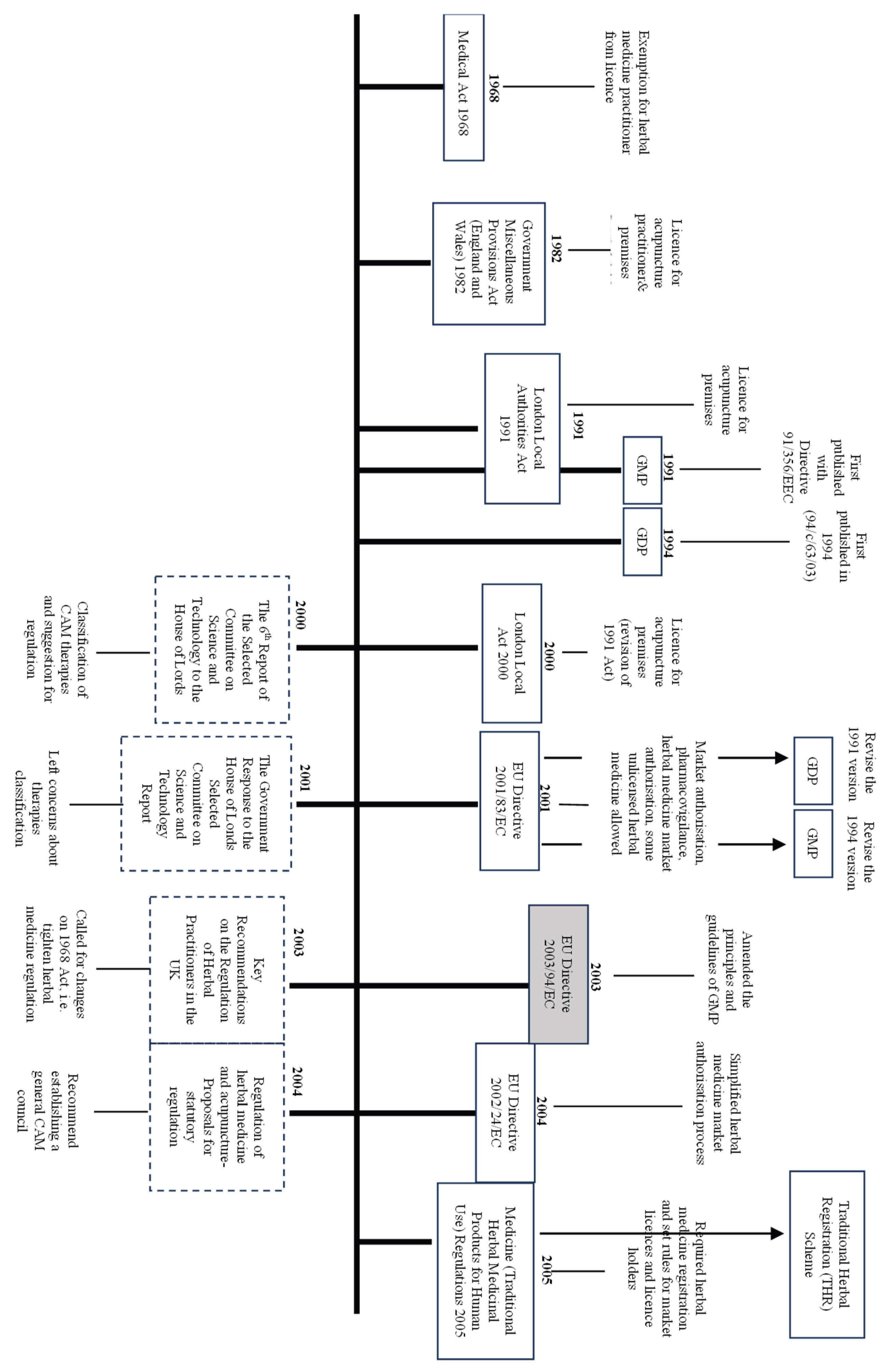
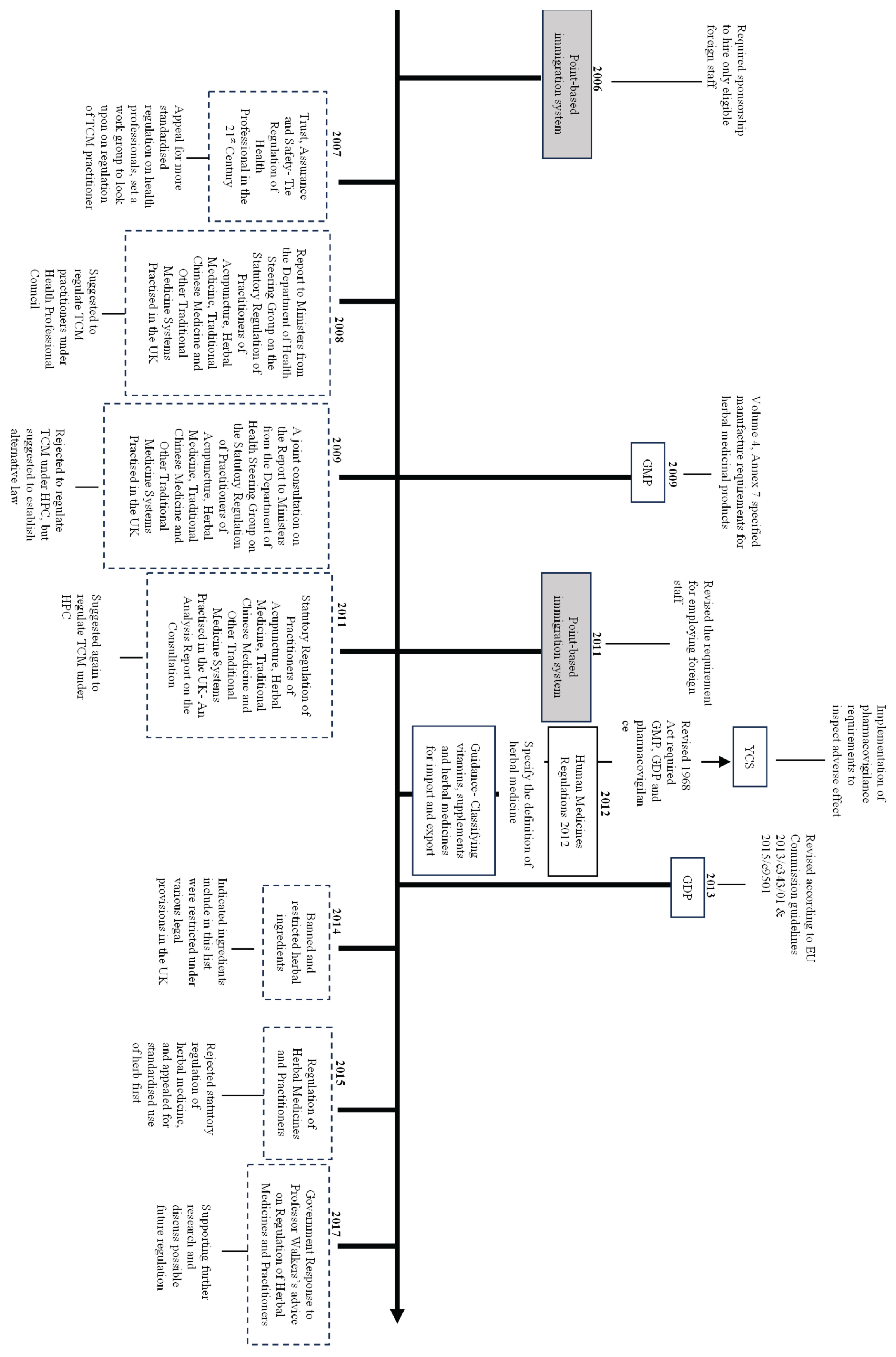
Figure 2.
The UK-TCM regulatory structure.
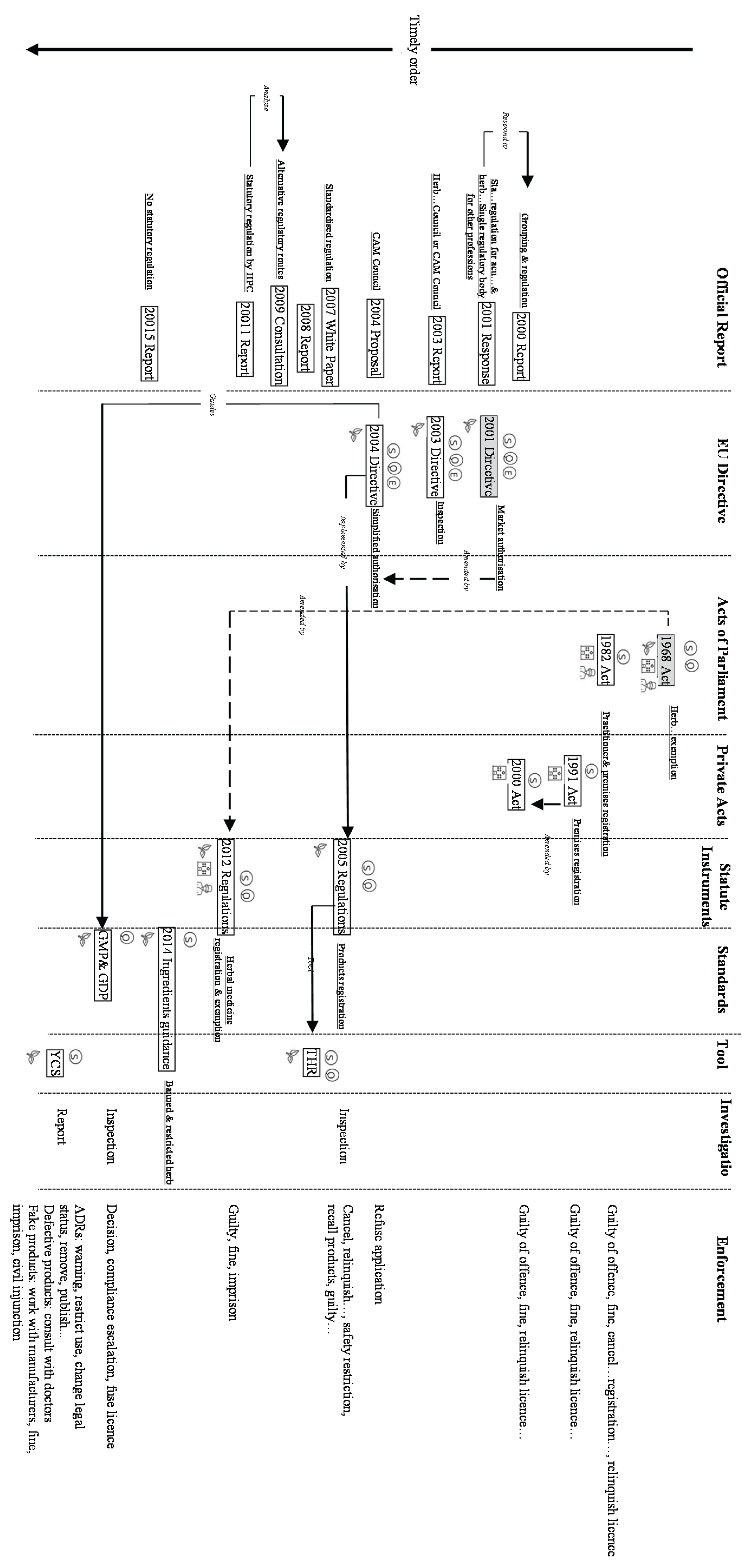


Table 1.
Literature searching terms.
|
Traditional Chinese medicine OR Chinese medicine OR Chinese traditional Medicine OR Herbal medicine OR Acupuncture OR Complementary medicine OR Alternative medicine OR Complementary and alternative medicine |
AND |
OR Develop OR Regulatory system OR Regulatory regime OR Legislation OR Law |
AND |
the UK OR British OR Europe OR European Union |
Table 2.
The regulatory/ policy instruments of the existing regulations.
| Regulation level | Regulatory instruments | Regulation |
| EU level | Hard regulation —Directive | EU Directive 2001/83/EC & 2004/24/EC |
| Soft regulation —self regulation | Industry self-regulation | |
| Soft regulation —technical standards | GMP | |
| GDP | ||
| Soft regulation —OMC | Centralised and decentralised market authorisation | |
| Education and information | Part of hard or soft regulations | |
| Economic instruments | Part of hard or soft regulations | |
| UK level | Acts of parliament | The Local Government (Miscellaneous Provision) Act 1982 |
| Private acts | The London Local Authorities Act 1991 & 2000 | |
| Statutory instruments (Secondary law) | The Medicines (Traditional Herbal Medicinal Products for Human Use) Regulation 2005 | |
| The Human Medicines Regulations 2012 | ||
| Schemes | THR Scheme | |
| Yellow Card Scheme |
Table 3.
Regulatory objectives of the current TCM regulations.
| Regulations | Safety | Quality | Efficacy |
| Local Government (Miscellaneous Provision) Act 1982 | ✓ | ||
| London Local Authorities Act 1991 | ✓ | ||
| London Local Authorities Act 2000 | ✓ | ||
| EU Directive 2004/24/EC | ✓ | ✓ | ✓ |
| The Medicines Regulations 2005 | ✓ | ✓ | |
| Traditional Herbal Registration (THR) Scheme | ✓ | ✓ | |
| Human Medicines Regulations 2012 | ✓ | ✓ | |
| GMP | ✓ | ||
| GDP | ✓ | ||
| Yellow Card Scheme | ✓ |
Table 4.
Regulatory targets of the current TCM regulations.
| Regulation | Practice | Products | People | Premises |
| Local Government Act 1982 | ✓ | ✓ | ||
| London Local Authorities Act 1991 | ✓ | |||
| London Local Authorities Act 2000 | ✓ | |||
| EU Directive 2004/24/EC | ✓ | |||
| The Medicines Regulations 2005 | ✓ | |||
| Traditional Herbal Registration (THR) Scheme |
✓ | |||
| Human Medicines Regulations 2012 | ✓ | ✓ exemption | ✓ exemption | |
| GMP | ✓ | ✓sub-requirements | ✓ sub-requirements | |
| GDP | ✓ | |||
| Yellow Card Scheme | ✓ |
Disclaimer/Publisher’s Note: The statements, opinions and data contained in all publications are solely those of the individual author(s) and contributor(s) and not of MDPI and/or the editor(s). MDPI and/or the editor(s) disclaim responsibility for any injury to people or property resulting from any ideas, methods, instructions or products referred to in the content. |
© 2026 by the authors. Licensee MDPI, Basel, Switzerland. This article is an open access article distributed under the terms and conditions of the Creative Commons Attribution (CC BY) license (http://creativecommons.org/licenses/by/4.0/).
Copyright: This open access article is published under a Creative Commons CC BY 4.0 license, which permit the free download, distribution, and reuse, provided that the author and preprint are cited in any reuse.


