
Submitted:
03 March 2026
Posted:
04 March 2026
You are already at the latest version
Abstract
Groundwater quantification is essential for sustainable water resources management, yet it is often hampered by limited data availability and difficulties in measuring spring discharges. This study investigates three carbonate aquifers in Central Italy’s Abruzzo region: the Genzana–Greco, Morrone, and Marsicano mountains. The aim is to resolve uncertainties in spring attribution, and groundwater flow patterns using isotopic analyses combined with field surveys. The Genzana–Greco aquifer was examined to clarify the sources of the Acquachiara spring and the previously unreported Germina spring, assessing whether recharge occurs locally or from the carbonate massif. In the Morrone mountain aquifer, discharge gains along the Pescara River through the Gole di Popoli were quantified, and spring isotopic compositions were compared to the main basal spring Giardino to better define groundwater contributions. For the Marsicano mountain aquifer, the role of Lake Scanno in feeding the Villalago springs was investigated through isotopic analysis of inflows, downstream springs, and basal aquifer discharge points to constrain the hydrogeological water budget. Overall, the integration of isotopic tracers with hydrological measurements allowed a more precise characterization of aquifer recharge areas, mean residence times, and groundwater flow paths, improving the understanding of regional water resources in a complex carbonate setting.
Keywords:
natural isotope
; aquifer recharge
; Central Apennines
1. Introduction
Accurate quantification of groundwater is critical for the sustainable management of water resources; however, it remains a significant challenge due to the limited availability of hydrogeological data for regional aquifers and the intrinsic difficulties associated with accurately measuring spring discharge.
In Central Italy, the main aquifers are located within the major carbonate massifs [1,2,3], characterized by a large number of basal springs, many of which are exploited for drinking water supply [4,5,6] (Figure 1). Within the study area, three aquifers were investigated to address the uncertainties concerning spring attribution and groundwater flow patterns, the Genzana – Greco mountains’ aquifer, the Morrone mountain and the Marsicano mountain’s ones.
Isotopic analyses of Oxigen18, Deuterium and Tritium, combined with field surveys, were used to address the existing uncertainties. Some isotopic characterizations are available in previous works [7,8,9,10], but none of them fully resolve the questions concerning the aquifers mentioned above.
This study utilized isotopic data from two seasonal surveys conducted within the framework of a research agreement funded by the Central Apennine Basin Authority (AUBAC), aimed at estimating the hydrological balance of Apennine aquifers. Accordingly, this work does not represent a comprehensive isotopic investigation involving multiple samples of numerous springs; rather, it constitutes an effort to leverage the available isotopic data from the agreement to complement the existing hydrogeological knowledge of the three aquifers, integrating both information reported in the literature and newly acquired data.
The marked lithological homogeneity and the very similar elevations among these aquifers have historically limited the ability of chemical and isotopic techniques to provide more detailed discrimination, unless complex and highly articulated artificial-tracer experiments are employed.
It must also be considered that, in additional cases, the boundaries between two or more morphologically defined units lie buried beneath lacustrine or alluvial deposits, where inter-unit hydraulic exchanges occur within these unconsolidated sediments. Such exchanges are neither visible nor directly quantifiable. This condition not only hides the actual discharge points of the units but also prevents the allocation of individual outflow components to one unit or another.
Beyond the approximations inherent in hydrological budget calculations, discharge measurements, and the wholeness of monitored outputs, the delineation of hydrogeological units as currently defined represents a necessary schematization of the regional groundwater flow system, and therefore of the associated hydrological and hydrogeological budgets.
The questions about Genzana–Greco Mts.’ aquifer were about the attribution of the Acquachiara spring to it and the characterization of a tapped spring (Germina), detected during field surveys and previously unreported in the literature.
Despite emerging within the Sulmona plain, the Acquachiara spring has been attributed—based on hydrogeological investigations [11,12] and unreferenced tracer tests—to the Genzana–Greco aquifer and, at least in part, to the Introdacqua alluvial fan (Figure 2).
Given the substantial difference between the spring’s elevation and the mean elevation of the Genzana–Greco aquifer, isotopic analyses were considered the most suitable method for estimating the Mean Isotopic Infiltration Altitude (MIIA) and Mean Residence Time (MRT). These parameters were used to reconstruct the recharge system feeding the spring and to resolve whether it is recharged locally within the plain or by the carbonate aquifer.
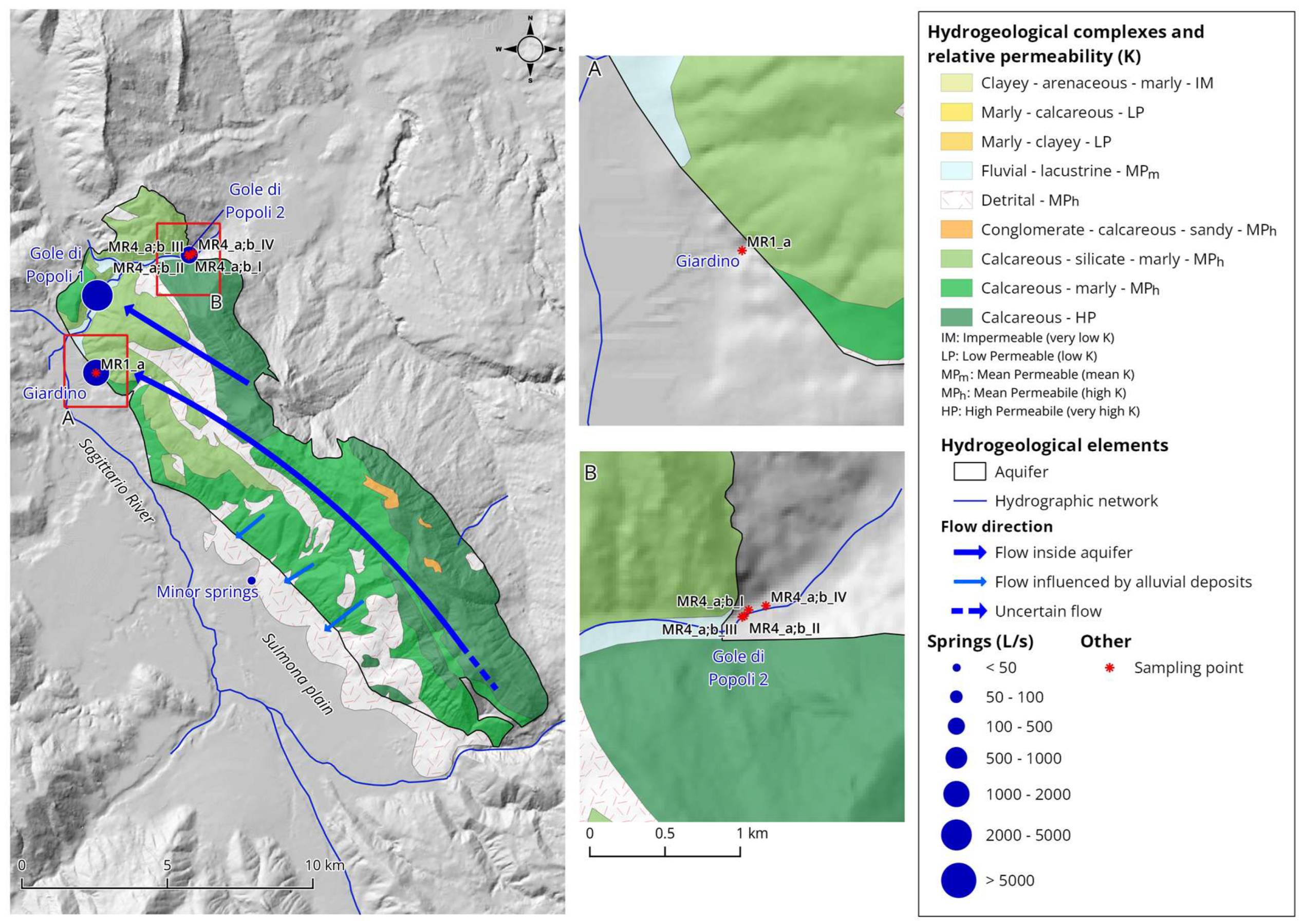
The definition and quantification of discharge gains along the Pescara River through the Gole di Popoli, belonging to the Morrone Mt. aquifer (Figure 3), although addressed in several studies [2,3,13,14,15,16,17], have always been difficult to define due to the high discharge of the Pescara River. Likewise, the assessment of water quality status required further investigation, as river water chemistry was not representative of groundwater composition. For these reasons, in addition to a more precise definition of discharge measurement sections along the gorges, spring sampling and analysis were conducted on visible springs within the gorge area. Their isotopic compositions were compared with that of the Giardino spring, which represents the main and well-defined discharge point of the groundwater body.
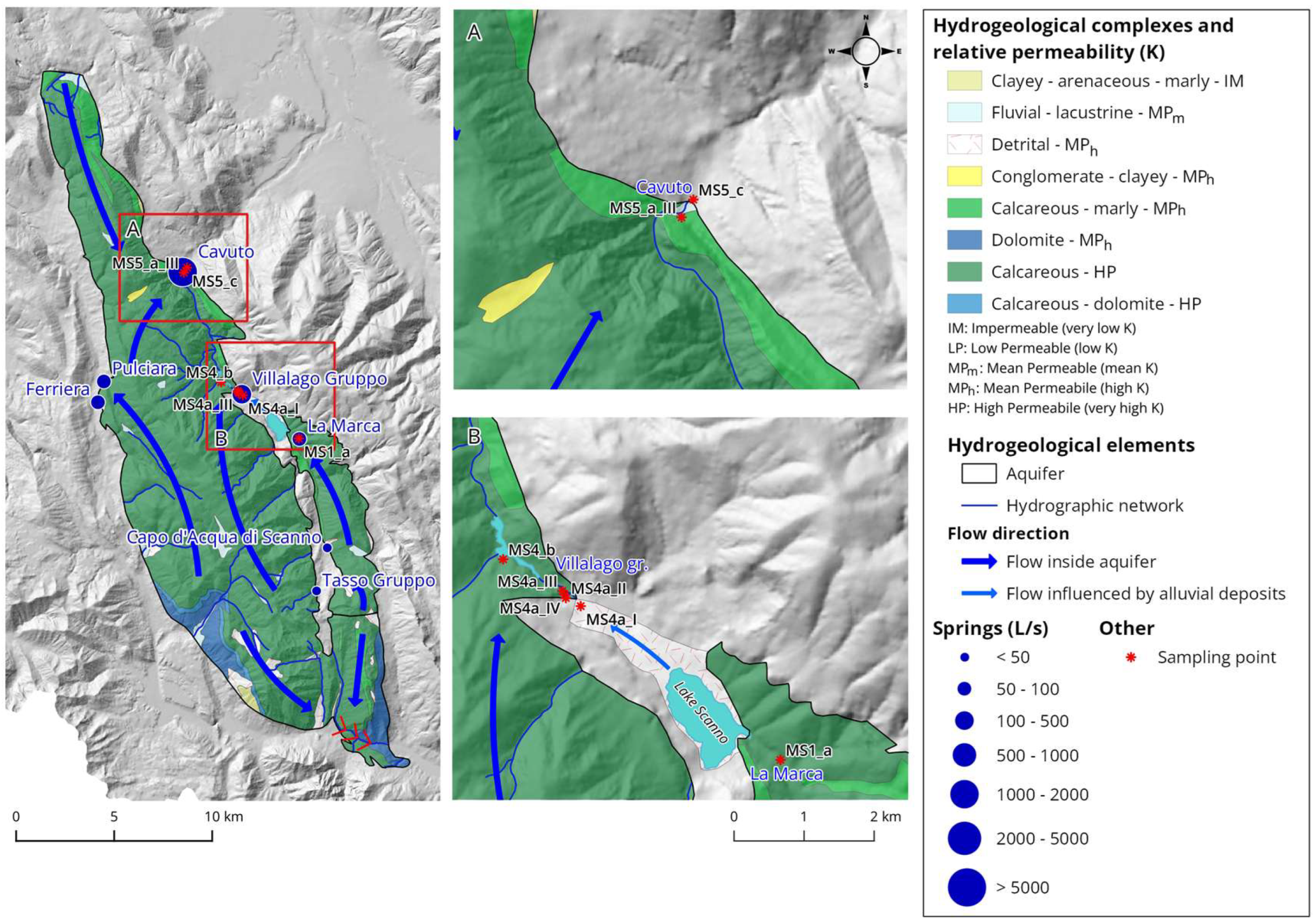
The last aquifer is the Marsicano Mt.’s one (Figure 4), where the role of Lake Scanno in the groundwater circulation feeding the Villalago springs is not clear. The presence of springs downstream of Lake Scanno has long suggested groundwater drainage from the lake, which has two inflowing streams (one of which, the La Marca spring, originates from the same aquifer), several diffuse inflow sources, and an outflow channel active only during high water stages.
In line with recent studies [9], and with the additional aim of more accurately constraining the hydrogeological water budget of the aquifer system, isotopic analyses were conducted on the La Marca inflow spring, on the springs located downstream of the lake, and on the main discharge points of the basal aquifer (Cavuto springs).
2. Materials and Methods
2.1. Study area and major hydrogeological issues
In the central Apennines of Abruzzo region, the boundaries that define the aquifers are primarily controlled by the tectonic relationships between permeable carbonate complexes, characterized by fracturing and karstification, and terrigenous complexes, mainly turbiditic sequences composed of marly–clayey–arenaceous formations that have low permeability, as well as continental lacustrine silty–clayey deposits, which similarly show low or non-permeability.
The contacts between these complexes are embedded within elongated structural domains with an overall northwest–southeast orientation and high continuity. These structures often hinder the precise delineation of aquifers as they appear morphologically at outcrop scale. Consequently, for some aquifers, morphological boundaries do not coincide with hydrogeological ones, which may extend beneath adjacent units. This is the case, already highlighted by Boni et al. [3], of the big aquifer, in which the authors group the Gran Sasso–Sirente Mts., Morrone Mt., Porrara–Rotella Mts., Genzana–Greco Mts., and Marsicano Mt. aquifers (Figure 1) into a single system, as hydraulic exchanges and mutual contributions cannot be excluded, nor can basal springs be located at the boundaries between different morphological units be unequivocally attributed to one aquifer or another.
In detail, the Genzana and Greco aquifer, extending over approximately 279 km², is morphologically characterized by the two homonymous mountain massifs, aligned along the Apennine structural trend. As above mentioned, the hydrogeological boundaries [1,2,11,12] are predominantly controlled by compressional tectonic structures along the eastern slope, where the carbonate succession of the Genzana–Greco unit encounters that of near reliefs. Along this structural alignment, slices of low permeability turbiditic complexes locally occur (Figure 2).
Figure 2.
Genzana – Greco Mts.’ hydrogeological scheme and detail of the sampled springs.
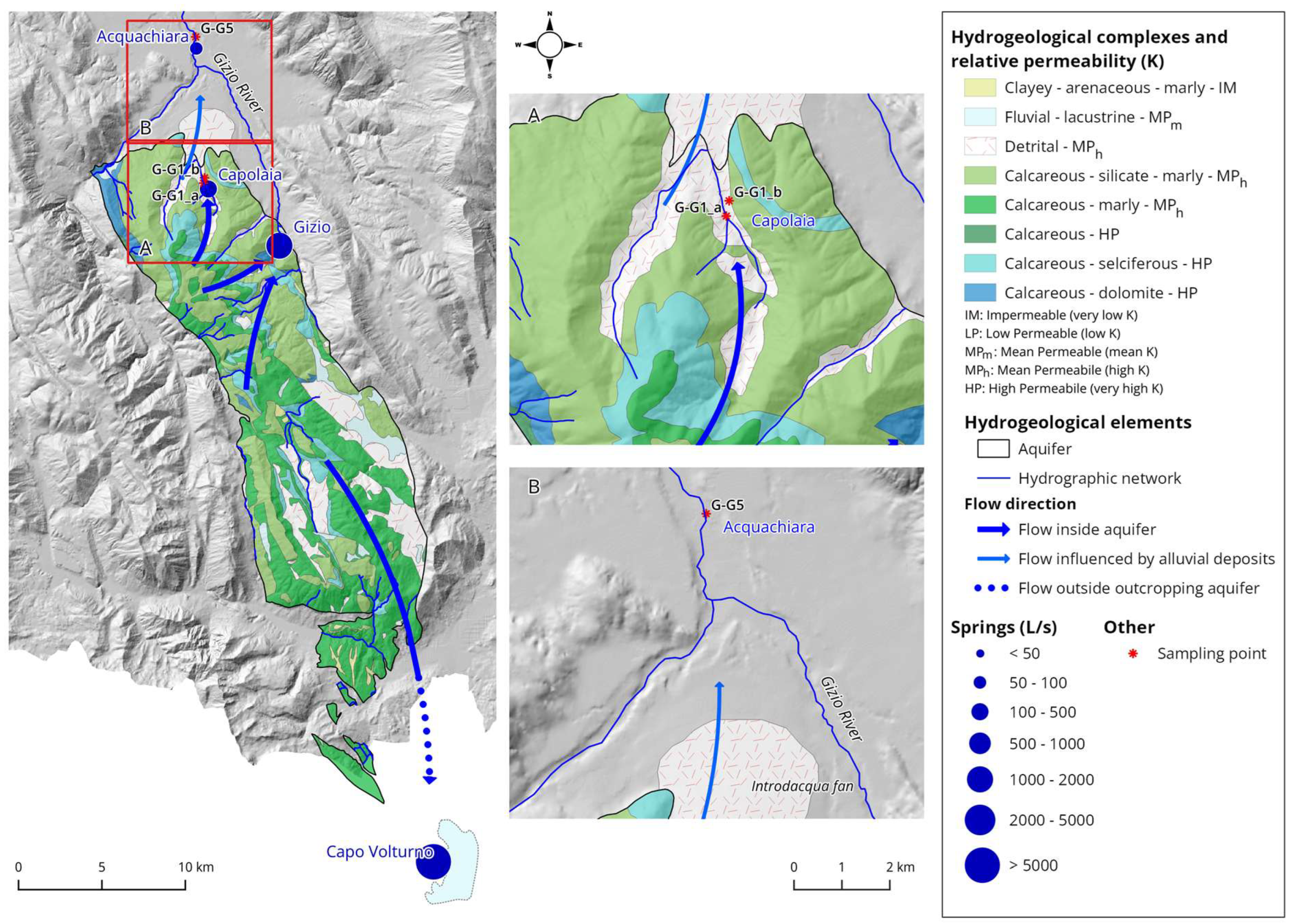
The main springs, Gizio, Capolaia and Acquachiara, are in the north-eastern side of the aquifer and their average discharges are 1.60 m3/s, 0.12 m3/s and 0.70 m3/s, respectively. Another basal spring, Capo Volturno, is in the south-eastern portion of the aquifer, with a discharge of about 6.6 m3/s, obtained from literature data [18].
The Morrone Mt. aquifer extends to 107 km2 and it is characterized by well-defined no-flow boundaries controlled by tectonic and stratigraphic contacts. These contacts put together fractured and karstified carbonate lithologies, with high permeability, against terrigenous and fluvio-lacustrine deposits that are low permeable or nearly impermeable.
Infiltrating waters predominantly recharge the basal aquifer, whose discharge points are located in the most depressed sectors of the carbonate ridge, like the Giardino spring (1.1 m3/s), the Gole di Popoli group 1 (2.1 m3/s) and group2 (~0.3 m3/s). Groundwater circulation is strongly influenced by the tectonic framework, which controls the position of the hydrogeological boundaries, the main flow paths, and the location of contact springs [13].
A secondary hydrogeological role, along the western boundary with the Sulmona plain, is played by the debris deposits, which sustain minor springs (about 21 L/s) and likely contribute to the recharge of both the plain aquifer and the Sagittario River (Figure 3).
Figure 3.
Morrone Mt.’s hydrogeological scheme and detail of the sampled springs.
The Marsicano Mt. aquifer (Figure 4), which extends to 234 km2, is delimited by well-defined no-flow boundaries controlled by tectonic contacts [19]. Along the eastern margin, a thrust set against permeable Cretaceous–Miocene carbonates with low-permeability Miocene flysch deposits. The western and southern boundaries are defined by fault contacts between carbonate successions and Miocene flysch or turbiditic deposits.
Figure 4.
Marsicano Mt.’s hydrogeological scheme and detail of the sampled springs.
2.2. Sampling and Isotopic Analysis
Groundwater sampling was carried out during two field campaigns at nine springs (Figure 1, Figure 2, Figure 3 and Figure 4) located in the Abruzzo Apennines, in August 2024 and May 2025.
During each campaign, a total of 18 samples were collected, and physico-chemical parameters were measured in the field. For each sample, two 100-mL vials and one 1-L bottle were taken.
2.2.1 δ¹⁸O–δD
The estimation of the mean isotopic infiltration altitude from δ¹⁸O and δD isotopic data involves defining and verifying the δ¹⁸O–δD relationship, as well as assessing the correlation between elevation and δ¹⁸O values.The first relationship serves as a methodological check to ensure that the sampled waters belong exclusively to the active hydrological cycle and have not undergone re-evaporation processes during subsurface flow or, more generally, temperature-related fractionation capable of altering the isotopic ratio. This verification step is therefore preliminary to the estimation of mean isotopic infiltration altitude, which can be performed only if a reliable δ¹⁸O–elevation correlation line is available.
2.2.2 Tritium
Tritium (³H or T) is an isotope of hydrogen and the only radioactive one; it heavier than the stable hydrogen and it is a low-energy beta emitter with a 12.31-year half-life [21]. Tritium is produced as a result of cosmic radiation through interactions with 14N, according to the following reactions: 14N +n → 3H + 12C, or 14N + n → 3H +3a, where is a high-energy neutron associated with cosmic rays [22,23].
It becomes part of the water molecule by combining with atmospheric oxygen. Through precipitation, it enters the hydrological cycle and eventually reaches groundwater. As long as the water remains in the atmosphere, the tritium content remains constant, since it is produced at the same rate as it decays, according to the reaction 3H → 3He + β.
The application in hydrogeology is based on the principle that, once tritium enters the subsurface as part of the water molecule, it decays and is no longer regenerated. It can therefore be used for groundwater dating, provided that the initial concentration, i.e. that of meteoric waters at the time of their infiltration into the subsurface domain, is known.
Groundwater progressively becomes depleted in tritium in accordance with its half-life; the time elapsed since infiltration—and consequently the groundwater transit time from infiltration to discharge or to the sampling location—is determined using the radioactive decay equation, which in this case is expressed as follows:
with
Cas = Cp e-λt
Cas = tritium concentration in sampled groundwater,
Cp = tritium concentration in precipitation at the time of infiltration,
λ = tritium radioactive decay constant (equal to 0.693/T1/2 = 0.05575 y-1),
t = time in years between infiltration and analysis.
Solving the above equation for t yields:
t = (1/λ) (ln Cp – ln Cas)
The tritium concentration is expressed in TU (Tritium Units), corresponding to the presence of one tritium atom per 1018 hydrogen atoms. Atmospheric tritium levels increased significantly during the period of thermonuclear weapons testing, rising by about three orders of magnitude (approximately 3000–4000 TU in the early 1960s) compared to the natural background level. Following the ban on nuclear weapons testing, concentrations gradually decreased, reaching pre-nuclear levels (around 5–10 TU) by the early 1990s.
At present, average tritium values in the Mediterranean region and surrounding areas range from about 7 to 3 TU, depending on the season and the degree of continental influence on precipitation [24].
One of the main challenges in using tritium for groundwater dating lies in determining the initial concentration (Cp), since the time of infiltration is generally unknown. However, as more than thirty years have passed since the prohibition and atmospheric tritium levels have largely stabilized, it is now possible to estimate groundwater ages using available Cp data from research institutions and international monitoring agencies.
It should also be noted that groundwater age determinations are subject to additional uncertainties, mainly due to seasonal variations in tritium content in precipitation and to the fact that aquifers—particularly extensive ones—have storage capacities exceeding annual recharge. As a result, they contain groundwater that is infiltrated at different times. Moreover, recharge may occur both near the spring, resulting in relatively short transit times, and at greater distances, leading to longer transit times. Consequently, the calculated age does not represent the actual residence time of a specific water parcel but rather an indicative mean residence time (MRT) within the aquifer [25].
The evaluation of the mean residence time of groundwater within the aquifer relies on the estimation of the initial tritium content (Cp in (1) and (2)).
Table 1 summarizes several estimates provided by different authors and derived from international databases, referring to a reasonable time interval spanning approximately 1990–2010. It should be noted that, unfortunately, no updated estimates have been produced for Italy in subsequent years.
Considering the analysis periods, the morphological conditions of the sampling stations reported in Table 1, it was considered reasonable to use as terms of reference the maximum and minimum values for the entire Italian peninsula equal to 8.5 and 4.5, respectively.
Taking into account the above considerations, particularly the uncertainty associated with the estimation of Cp (the tritium concentration in precipitation at the time of infiltration), the obtained results should be interpreted only in a relative and qualitative sense and cannot be considered quantitatively. Further investigations and/or attempts to achieve greater precision are not warranted, given both the theoretical assumptions underlying the application of the method and the analytical uncertainty inherent to the technique. The standard deviations of the analyses range from 0.2 to 0.8 UT. According to the relationship given in Eq. (2), this level of uncertainty propagates to the Mean Residence Time (MRT), resulting in an uncertainty ranging from approximately 1.5 to 5 years, which adds to the uncertainty associated with the lack of atmospheric data (Cp), thereby rendering the quantitative estimate unreliable.
3. Results and Discussion
3.1. Estimation of Mean Isotopic Infiltration Altitude (MIIA) and Mean Residence Time (MRT)
Table 2 displays δ¹⁸O–δD raw data and physico – chemical parameters for each sample collected.
As above mentioned, estimating the mean isotopic infiltration altitude from δ¹⁸O and δD measurements requires validation of the δ¹⁸O–δD relationship and assessment of the correlation between δ¹⁸O and elevation. All isotopic data are reported as δ values (‰) relative to VSMOW.
The δ¹⁸O– δD relationships (Figure 5) show excellent linear fit, defined by:
for the dry season, and
for the wet season, both with coefficients of determination R2 = 0.98.
δD = 5.91 δ¹⁸O – 5.70
δD = 5.53 δ¹⁸O – 9.02
Mean isotopic infiltration altitude was estimated for each of the three groundwater bodies using locally constrained δ¹⁸O–elevation correlation lines. The following relationships were applied:
for the Genzana–Greco Mts. aquifer [7],
for the Morrone Mt. aquifer [8], and
for the Marsicano Mt. aquifer [9].
h (m a.s.l.) = -769 δ18O – 6460
h (m a.s.l.) = -835 δ18O – 7500
h (m a.s.l.) = -526 δ18O – 3595
3.2. Genzana – Greco Mts. Aquifer
As can be seen in Table 3, the estimated mean isotopic infiltration altitude values for the Germina and Capolaia springs are nearly coincident and exhibit seasonal variations following the same trend. Both observations support recharge from a single sector of the groundwater body, as further supported by the electrical conductivity and temperature steady data reported in the spring datasets (Table 2).
The mean isotopic infiltration altitude estimated for the Acquachiara spring allows the exclusive recharge from the alluvial deposits of the Sulmona plain and from the Introdacqua alluvial fan (Figure 2B) to be unequivocally excluded, as these are located at elevations significantly lower than those indicated by the isotopic results. However, the available data do not allow differentiation between a potential recharge from the Genzana–Greco aquifer and from the adjacent aquifer, whose mean isotopic elevations are comparable.
Regarding the origin of the Acquachiara spring, [29], based on discharge measurements along the Gizio River upstream of the spring area and at the spring itself, assumed a predominant recharge from the carbonate Genzana–Greco aquifer, overlain by a shallower circulation component fed by the Introdacqua alluvial fan and the Gizio River (Figure 2).
In the absence of more detailed investigations the recharge of the Acquachiara spring cannot be attributed with absolute certainty exclusively to the Genzana–Greco aquifer.
Moreover, the wet and dry seasons’ altitudes give more information about the Genzana – Greco aquifer: the slight differences in the seasonal MIIA suggest that the aquifer is sufficiently wide to not be affected by periodic variations. This behavior is supported by the constancy of electric conductivity and temperature values throughout the seasons (Table 2).
Considering the limitations discussed in paragraph 2.2.2, which preclude absolute interpretations and allow only relative assessments, a contribution of more recent surface waters can be observed during the wet season in the Capolaia and Acquachiara springs as the MRT decreases visibly in the wet season. This finding is consistent with the fact that both springs receive inputs from alluvial deposits, at least in proximity to their points of emergence (Table 4).
The results obtained for the Germina spring should be considered preliminary and warrant further monitoring.
3.3 Morrone Mt. aquifer
As can be seen in Table 5, the MIIAs of the wet season are higher than those of the dry season, which indicates a seasonal variation in the aquifer recharge, these higher values during the wet season can also be evidence of the contribution of snowmelt. The aquifers investigated clearly belong to systems whose recharge is partly driven by snowmelt [30,31].
The results obtained for the spring pools located within the Pescara River channel (Figure 3) indicate a mean isotopic infiltration altitude consistent with the mean elevations of the northern sector of the Morrone massif, which reach maximum elevations of approximately 1700 m a.s.l. These values allow local meteoric recharge to be excluded, as it would be expected to occur at significantly lower elevations. Moreover, since the spring pools are located several meters above the riverbed, a direct contribution from river water can also be ruled out.
The results gained for the Giardino spring allow the recharge feeding this spring to be attributed to the central–southern sectors of the aquifer, where the massif elevations reach about 2000 m a.s.l.
Overall, these results confirm the hydrogeological model that identifies the discharge gains within the Pescara River channel as one of the two main basal outlets of the aquifer.
Considering the limitations discussed in paragraph 2.2.2, which allow only relative interpretation of the data, the MRT values (Table 6) of the Pescara River channel gains within the Gole di Popoli are comparable to those of the Giardino spring. This finding further supports the interpretation that these gains originate from the basal aquifer of the Morrone massif. Only one of the in-channel spring (MR4a_b_II) shows evidence of a probable contribution from faster flow paths, likely related to interaction with Pescara River waters.
3.4 Marsicano Mt. aquifer
The δ¹⁸O and δD isotopic analyses, processed and interpreted according to the methodology described in paragraph 2.3.2, yielded the results reported in Table 7; these allow to confirm the hydrogeological model of the Marsicano Mt. aquifer (Figure 4) and to define the discharge monitoring points.
The estimation of mean isotopic infiltration altitude values confirms the findings of Petitta et al. [9] regarding the role of Lake Scanno and the landslide deposits from which it originated. The Villalago springs exhibit mean isotopic infiltration altitude values lower than the average of the aquifer and consistent with the elevation of the lake, or only slightly higher (approximately 800–1100 m a.s.l.). These springs show high variations in seasonal MIIA values, confirming the Lake Scanno influence and, like Morrone Mt. ones, a snowmelt possible contribution during the wet season.
Exceptions are represented by the MS4_a_III spring, whose mean isotopic infiltration altitude, already highlighted in [9], is approximately 1500 m a.s.l., and by the Sega spring, which shows a mean isotopic infiltration altitude of about 1700 m a.s.l., both values are consistent with the highest mean elevations of the Marsicano Mt.
These results are supported by electrical conductivity and temperature data (Table 2), which show lower values than those measured at the Villalago springs, with slight seasonal variability.
Isotopic analyses allow the increase in discharge of the Sagittario River downstream of the Cavuto group (MS5_c in Figure 4A) to be attributed to the same groundwater system feeding the Cavuto springs, with a mean isotopic infiltration altitude of approximately 1600 m a.s.l.
The mean isotopic infiltration altitude estimates for the Cavuto group also suggest that the recharge areas cannot be attributed exclusively to the northern sector of the Marsicano massif [19] but instead receive contributions from higher and more central portions of the system.
In Table 8 are showed the tritium analyses results, which must be considered taking into account the limitations discussed in paragraph 2.2.2; these allow only relative interpretations, the MS4_a_III spring and the Sega spring, besides being recharged from higher isotopic elevations than the rest of the group, are also characterized by slower flow circuits. In contrast, other springs, such as La Marca and the MS4_a_I spring (located along the Sagittario River channel), appear to be influenced by direct precipitation inputs, as indicated by low MTR values during the high-flow season.
For the Cavuto group, tritium analyses indicate seasonally variable transit times. This behavior is likely related to the proximity of the Sagittario stream and its role in recharging the spring.
5. Conclusions
From a general methodological perspective, all results indicate Mean Isotopic Infiltration Altitudes (MIIA) consistent with the morphology of the aquifers. High-flow basal springs show minimal MIIA variations of 20–80 m, with the highest values occurring during the wet season. Larger variations, on the order of 250–300 m, are observed in springs where recharge is influenced by surface water or snowmelt contributions.
At the level of individual aquifers, although not conclusively, MIIA estimations and the seasonal variations in δ¹⁸O–δD helped refine the understanding of the basal spring recharge circuits in the Genzana–Greco Mts., Morrone Mt., and Marsicano Mt. aquifers.
In the Genzana–Greco aquifer, results indicate that the Germina and Capolaia springs share a common recharge sector, while the Acquachiara spring is mainly fed by higher-elevation carbonate areas, excluding significant contributions from local alluvial deposits. For the Morrone aquifer, isotopic and tritium data confirm recharge from the central–southern massif and support the identification of basal springs and Pescara River gains as primary discharge points, with minimal influence from surface water. In the Marsicano aquifer, the analyses highlight Lake Scanno’s role in the recharge of Villalago springs and delineate the Cavuto group as a major discharge system receiving inputs from central and northern sectors of the massif.
Overall, the combination of δ¹⁸O–δD and tritium measurements proved essential in constraining recharge elevations, flow dynamics, and seasonal variations, particularly in regions where morphological boundaries do not correspond to hydrogeological ones.
These findings provide a more robust framework for groundwater management, supporting sustainable exploitation, protection of drinking water resources, and informed planning for the monitoring of karst and alluvial aquifers in the central Apennines.
Tritium-based Mean Residence Time (MRT) estimates yielded tentative results that are only qualitatively reliable and not quantitatively robust. This is due to the limited constraint on atmospheric tritium concentrations, particularly at the time of infiltration, and to the intrinsic approximations of the analytical methods.
Author Contributions
Conceptualization, methodology, investigation, data curation, writing—original draft preparation, writing—review and editing, S.R., A.D.G.; software, A.D.G.; supervision, S.R.; funding acquisition, S.R. All authors have read and agreed to the published version of the manuscript.
Funding
This research was realized with the contribution from the agreement between Department of Science, University “G. d’Annunzio” of Chieti-Pescara and Autorità di Bacino Distrettuale dell’Appennino Centrale (AUBAC).
Data Availability Statement
The original contributions presented in this study are included in the article. Further inquiries can be directed at the corresponding author.
Acknowledgments
The authors acknowledge Dr. Vanni Donatelli, Dr. Joele Pica and Dr. Cristiana Picchi researcher fellows from Department of Science, University “G. d’Annunzio” of Chieti-Pescara and Dr. Giancarlo Boscaino from Hydrographic Service of Abruzzo Civil Protection Agency for their support during field campaign and data elaboration.
Conflicts of Interest
The authors declare no conflicts of interest.
References
- Celico, P. Schema Idrogeologico Dell’Appennino Carbonatico Centro-Meridionale. Memorie e Note dell’Istituto di Geologia Applicata dell’Università di Napoli 1979, 14, 5–97.
- Cassa per il Mezzogiorno; Celico, P. Idrogeologia Dell’Italia Centro-Meridionale. Progetti Speciali per Gli Schemi Idrici Nel Mezzogiorno. Quaderni della Cassa per il Mezzogiorno 1983, 4.2.
- Boni, C.; Bono, P.; Capelli, G. Schema Idrogeologico Dell’Italia Centrale. Memorie della Società Geologica Italiana 1986, 35.
- Fiorillo, F.; Petitta, M.; Preziosi, E.; Rusi, S.; Esposito, L.; Tallini, M. Long-Term Trend and Fluctuations of Karst Spring Discharge in a Mediterranean Area (Central-Southern Italy). Environ. Earth Sci. 2015, 74, 153–172. [CrossRef]
- Medici, G.; Lorenzi, V.; Sbarbati, C.; Manetta, M.; Petitta, M. Structural Classification, Discharge Statistics, and Recession Analysis from the Springs of the Gran Sasso (Italy) Carbonate Aquifer; Comparison with Selected Analogues Worldwide. Sustainability 2023, 15. [CrossRef]
- Giacopetti, M.; Materazzi, M.; Pambianchi, G.; Posavec, K. Analysis of Mountain Springs Discharge Time Series in the Tennacola Stream Catchment (Central Apennine, Italy). Environ. Earth Sci. 2016, 76, 20. [CrossRef]
- Barbieri, M.; D’Amelio, L.; Desiderio, G.; Marchetti, A.; Nanni, T.; Petitta, M.; Rusi, S.; Tallini, M. Gli Isotopi Ambientali (18O, 2H e 87Sr/86Sr) Nelle Acque Sorgive Dell’Appennino Abruzzese: Considerazioni Sui Circuiti Sotterranei Negli Acquiferi Carbonatici; 2003; Proceedings of the 1st National Congress of the Italian Association of Applied and Environmental Geology (AIGA) ISBN 88-86698-40-2.
- Desiderio, G.; Ferracuti, L.; Rusi, S.; Tatangelo, F. Il Contributo Degli Isotopi Naturali 18O e 2H Nello Studio Delle Idrostrutture Carbonatiche Abruzzesi e Delle Acque Mineralizzate Nell’area Abruzzese e Molisana. Giornale di Geologia Applicata 2 2005, 453–458.
- Petitta, M.; Scarascia Mugnozza, G.; Barbieri, M.; Bianchi Fasani, G.; Esposito, C. Hydrodynamic and Isotopic Investigations for Evaluating the Mechanisms and Amount of Groundwater Seepage through a Rockslide Dam. Hydrol. Process. 2010, 24, 3510–3520. [CrossRef]
- Tallini, M.; Adinolfi Falcone, R.; Carucci, V.; Falgiani, A.; Parisse, B.; Petitta, M. Isotope Hydrology and Geochemical Modeling: New Insights into the Recharge Processes and Water–Rock Interactions of a Fissured Carbonate Aquifer (Gran Sasso, Central Italy). Environ. Earth Sci. 2014, 72, 4957–4971. [CrossRef]
- Nanni, T.; Desiderio, G.; Fochi Vici, C.; Petitta, M.; Ruggieri, G.; Rusi, S.; Tallini, M.; Vivalda, P.M. Schema Idrogeologico Dell’Italia Centro-Adriatica. Scala 1:250.000. 2011, ISBN 978-88-906529-1-2.
- Desiderio, G.; D’arcevia, C.F.V.; Nanni, T.; Rusi, S. Hydrogeological Mapping of the Highly Anthropogenically Influenced Peligna Valley Intramontane Basin (Central Italy). J. Maps 2012, 8, 165–168. [CrossRef]
- Conese, M.; Nanni, T.; Peila, C.; Rusi, S.; Salvati, R. Idrogeologia Della Montagna Del Morrone (Appennino Abruzzese): Dati Preliminari. Memorie della Società Geologica 2001, 56, 181–196.
- Massoli-Novelli, R.; Petitta, M.; Salvati, R. La Situazione Idrogeologica e Ambientale Delle Gole Di Popoli (Abruzzo): Primi Risultati e Prospettive Della Ricerca. Memorie della Società Geologica 1998, 53, 563–584.
- Regione Abruzzo; Settore Lavori Pubblici e Politica della Casa; Servizio Difesa e Tutela del Suolo; Aquater Studi Geomorfologici, Idrogeologici e Delle Risorse Idriche Del Territorio Regionale – Geomorfologia, Relazione e Schede; Internal Report 1993;
- Regione Abruzzo Piano Di Tutela Delle Acque (PTA) - Relazione Idrogeologica (Elab. A1.2); 2008, https://www2.regione.abruzzo.it/system/files/urbanistica-territorio/piano-tutela-acque/prop-gr-appr-finale/All_A1_2/RELAZIONE_IDROGEOLOGICA.pdf.
- Di Curzio, D.; Rusi, S.; Semeraro, R. Multi-Scenario Numerical Modeling Applied to Groundwater Contamination: The Popoli Gorges Complex Aquifer Case Study (Central Italy). Acque Sotterranee - Italian Journal of Groundwater 2018, 7(4). [CrossRef]
- Boni, C.; Boni, P.; Capelli, G. Schema Idrogeologico Dell’Italia Centrale - Sheet A. Memorie della Società Geologica Italiana 1986.
- Boni, C.; Ruisi, M. Carta Idrogeologica Della Marsica Orientale (M. Marsicano - M.Gna Grande) Scala 1:50.000; Pubblicazione GNDCI-CNR, Ed.; Rome, 2005.
- Longinelli, A.; Selmo, E. Isotopic Composition of Precipitation in Italy: A First Overall Map. J. Hydrol. (Amst). 2003, 270, 75–88. [CrossRef]
- Eyrolle, F.; Ducros, L.; Le Dizès, S.; Beaugelin-Seiller, K.; Charmasson, S.; Boyer, P.; Cossonnet, C. An Updated Review on Tritium in the Environment. J. Environ. Radioact. 2018, 181, 128–137. [CrossRef]
- Civita, M. Idrogeologia Applicata e Ambientale; Casa Editrice Ambrosiana: Milan, 2005;
- Fornaseri, M. Lezioni Di Geochimica; CEA: Milan, 1988.
- Juhlke, T.R.; Sültenfuß, J.; Trachte, K.; Huneau, F.; Garel, E.; Santoni, S.; Barth, J.A.C.; van Geldern, R. Tritium as a Hydrological Tracer in Mediterranean Precipitation Events. Atmos. Chem. Phys. 2020, 20, 3555–3568. [CrossRef]
- Longinelli, A.; Deganello, S. Introduzione Alla Geochimica. UTET: Turin, 1999.
- IAEA (International Atomic Energy Agency) WISER (Water Isotope System for Data Analysis) Visualization and Electronic Retrieval (Https://Nucleus.Iaea.Org/Wiser/Index.Aspx).
- Bono, P.; Gonfiantini, R.; Alessio, M.; Fiori, C.; D’Amelio, L. Stable Isotopes (Δ18 o, Δ2 h) and Tritium in Precipitation: Results and Comparison with Groundwater Perched Aquifers in Central Italy In, Isotopic Composition of Precipitation in the Mediterranean Basin in Relation to Air Circulation Patterns and Climate. Final Report of a Coordinated Research Project 2000–2004.; 2005.
- Tazioli, A. Landfill Investigation Using Tritium and Isotopes as Pollution Tracers. AQUA MUNDI 2011, 1, 83–91.
- Desiderio, G.; Folchi Vici, C.; Nanni, T.; Ruggeri, G.; Rusi, S. Schema Idrogeologico Della Piana Di Sulmona (AQ). In Proceedings of the CNR GNDCI L.4 U.O. 10N; 2011.
- Chiaudani, A.; Di Curzio, D.; Rusi, S. The Snow and Rainfall Impact on the Verde Spring Behavior: A Statistical Approach on Hydrodynamic and Hydrochemical Daily Time-Series. Science of the Total Environment 2019, 689, 481–493. [CrossRef]
- Rusi, S.; Di Giovanni, A. Assessing the Impact of Often Overlooked Snowfall on the Hydrological Balance of Apennine Mountain Aquifers in Central Italy. Water (Basel). 2025, 17. [CrossRef]
Figure 1.
Overview of the study area and schematic geological structure. The studied aquifers are highlighted in red.
Figure 1.
Overview of the study area and schematic geological structure. The studied aquifers are highlighted in red.
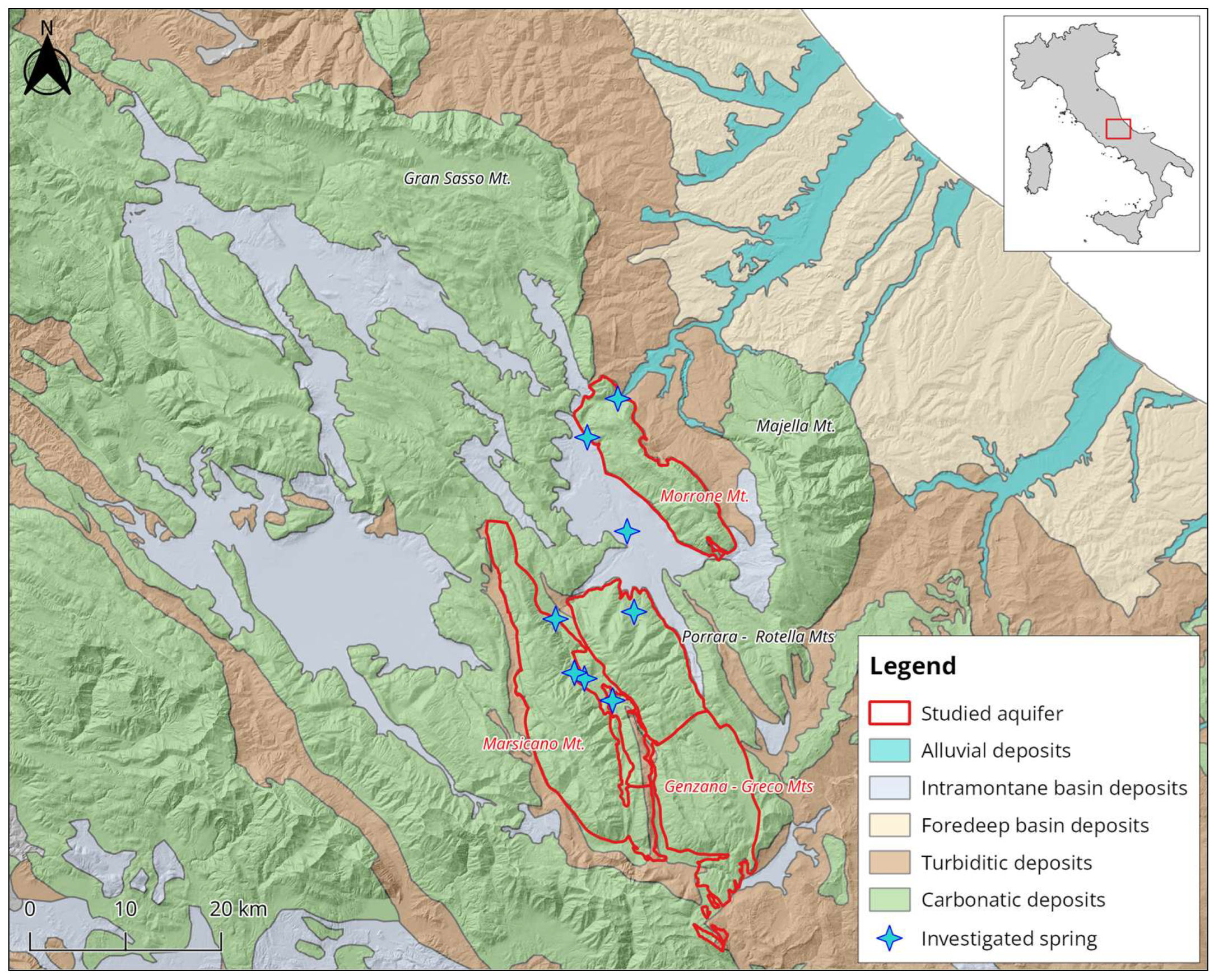
Figure 5.
δ¹⁸O / δD relationship. Left: results from the dry season sampling campaign (August 2024); right: results from the wet season sampling campaign (May 2025).
Figure 5.
δ¹⁸O / δD relationship. Left: results from the dry season sampling campaign (August 2024); right: results from the wet season sampling campaign (May 2025).
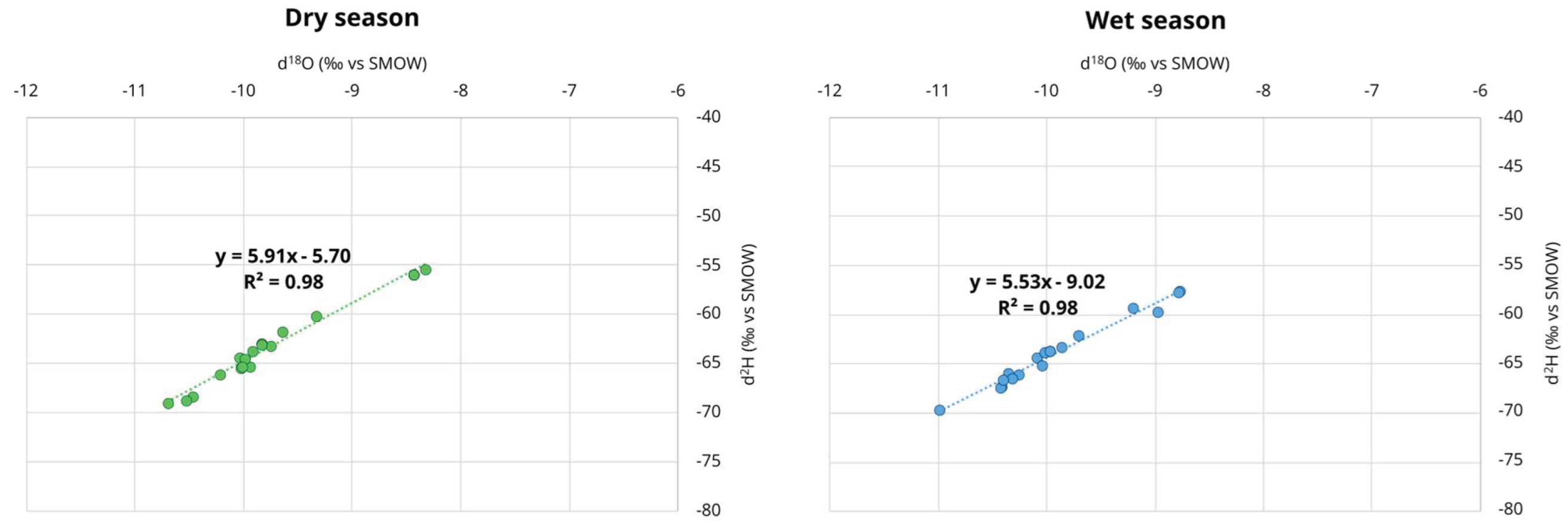

Table 1.
Tritium values from international databases and from literature.
| Site | Altitude (m a.s.l.) | Period | Cp values (UT) | Reference |
|---|---|---|---|---|
| Genova | - | 1990 – 1995 | 5.5 – 7.2 | [26] |
| Pisa | - | 1992 – 1995 | 5.8 – 7.3 | [26] |
| Simbruini Mts. (Marche Region) |
1750 | 2000 – 2001 | 6.1 | [27] |
| Latina (Lazio Region) | 35 | 2000 – 2001 | 4.5 | [27] |
| Roma DST | 66 | 2000 – 2001 | 5.4 – 6.2 | [27] |
| Marche Apennines | 950 | 1991 – 2000 | 8.5 | [28] |
| Marche Apennines | 950 | 2000 – 2001 | 8.2 | [28] |
Table 2.
δ¹⁸O–δD raw data and related electric conductivity and temperature. See Figure 1, Figure 2, Figure 3 and Figure 4 for the location.
| Spring | Label | Sampling date | Aquifer | δ¹⁸O | δD | Χ (µS/cm) | T (°C) |
|---|---|---|---|---|---|---|---|
| Capolaia | G-G1_a | Aug 24 | Genzana-Greco Mts. | -10.47 | -68.35 | 285 | 8.7 |
| May 25 | -10.42 | -67.31 | 288 | 8.4 | |||
| Germina | G-G1_b | Aug 24 | Genzana-Greco Mts. | -10.53 | -68.69 | 290 | 8.5 |
| May 25 | -10.43 | -67.38 | 297 | 8.4 | |||
| Acquachiara | G-G5 | Aug 24 | Genzana-Greco Mts. | -9.95 | -65.34 | 504 | 15.9 |
| May 25 | -10.04 | -65.13 | 523 | 12.9 | |||
| Giardino | MR1_a | Aug 24 | Morrone Mt. | -10.07 | -68.95 | 324 | 10.0 |
| May 25 | -10.99 | -69.66 | 365 | 10.4 | |||
| Pescara River | MR4_a; b_I | Aug 24 | Morrone Mt. | -9.99 | -64.54 | 452 | 14.0 |
| May 25 | -10.35 | -65.96 | 498 | 12.0 | |||
| MR4_a; b_II | Aug 24 | -10.03 | -65.43 | 525 | 12.7 | ||
| May 25 | -10.26 | -66.12 | 517 | 11.7 | |||
| MR4_a; b_III | Aug 24 | -10.02 | -65.28 | 508 | 12.4 | ||
| May 25 | -10.32 | -66.43 | 512 | 11.6 | |||
| MR4_a; b_IV | Aug 24 | -10.22 | -66.13 | 442 | 12.2 | ||
| May 25 | -10.40 | -66.60 | 462 | 11.1 | |||
| La Marca | MS1_a | Aug 24 | Marsicano Mt. | -9.34 | -60.12 | 566 | 9.7 |
| May 25 | -9.20 | -59.38 | 394 | 8.3 | |||
| Villalago gr. | MS4_a_I | Aug 24 | Marsicano Mt. | -8.44 | -55.97 | 321 | 19.8 |
| May 25 | -8.98 | -59.69 | 390 | 12.3 | |||
| MS4_a_II | Aug 24 | -8.44 | -55.89 | 329 | 14.3 | ||
| May 25 | -8.78 | -57.56 | 325 | 11.9 | |||
| MS4_a_III | Aug 24 | -9.65 | -61.70 | 280 | 8.9 | ||
| May 25 | -9.71 | -62.06 | 275 | 7.7 | |||
| MS4_a_IV | Aug 24 | -8.33 | -55.36 | 306 | 14.2 | ||
| May 25 | -8.79 | -57.73 | 320 | 11.0 | |||
| Sega | MS4_b | Aug 24 | Marsicano Mt. | -10.04 | -64.38 | 288 | 7.8 |
| May 25 | -10.10 | -64.31 | 291 | 7.1 | |||
| Cavuto gr. | MS5_a_I | Aug 24 | Marsicano Mt. | -9.84 | -62.88 | 308 | 10.2 |
| May 25 | -9.97 | -63.70 | 314 | 9.4 | |||
| MS5_a_II | Aug 24 | -9.84 | -63.03 | 312 | 8.9 | ||
| May 25 | -10.02 | -63.86 | 316 | 8.9 | |||
| MS5_a_III | Aug 24 | -9.92 | -63.75 | 310 | 9.0 | ||
| May 25 | -9.97 | -63.76 | 318 | 9.0 | |||
| MS5_c | Aug 24 | -9.75 | -63.17 | 340 | 13.4 | ||
| May 25 | -9.86 | -63.28 | 372 | 11.0 |
Table 3.
Mean Isotopic Infiltration Altitude (MIIA) estimated for Genzana – Greco Mts.’ springs using equation (5). See Figure 2 for location
Table 3.
Mean Isotopic Infiltration Altitude (MIIA) estimated for Genzana – Greco Mts.’ springs using equation (5). See Figure 2 for location
| Spring | Label | MIIA Dry season (m a.s.l.) |
MIIA Wet season (m a.s.l.) |
Spring altitude (m a.s.l.) |
|---|---|---|---|---|
| Capolaia | G-G1_a | 1590 | 1550 | 685 |
| Germina | G-G1_b | 1640 | 1560 | 650 |
| Acquachiara | G-G5 | 1190 | 1260 | 310 |
Table 4.
Mean Residence Time (MRT) for Genzana – Greco Mts.’ springs using equation (2). See Figure 2 for location.
Table 4.
Mean Residence Time (MRT) for Genzana – Greco Mts.’ springs using equation (2). See Figure 2 for location.
| Spring name | Spring | MRT (y) (UT 4.5) |
MRT (y) (UT 8.5) |
UT |
|---|---|---|---|---|
| Capolaia | G-G1_a (ds) | 8.3 | 19.7 | 2.8 |
| G-G1_a (ws) | 5.0 | 16.4 | 3.4 | |
| Germina | G-G1_b (ds) | 1.7 | 13.1 | 4.1 |
| G-G1_b (ws) | 6.6 | 18.0 | 3.1 | |
| Acquachiara | G-G5 (s) | 12.3 | 23.8 | 2.3 |
| G-G5 (ws) | 3.2 | 14.6 | 3.8 |
ds: dry season; ws wet season.
Table 5.
Mean Isotopic Infiltration Altitude (MIIA) estimated for Morrone Mt.’s springs using equation (6). See Figure 3 for location.
Table 5.
Mean Isotopic Infiltration Altitude (MIIA) estimated for Morrone Mt.’s springs using equation (6). See Figure 3 for location.
| Spring | Label | MIIA Dry season (m a.s.l.) |
MIIA Wet season (m a.s.l.) |
Spring altitude (m a.s.l.) |
|---|---|---|---|---|
| Giardino | MR1_a | 1420 | 1660 | 250 |
| Pescara river | MR4_a; b_I | 830 | 1130 | 230-215 |
| MR4_a; b_II | 850 | 1050 | 230-215 | |
| MR4_a; b_III | 850 | 1100 | 230-215 | |
| MR4_a; b_IV | 1020 | 1170 | 230-215 |
Table 6.
Mean Residence Time (MRT) estimation for Morrone Mt.’s springs using equation (2). See Figure 3 for location.
Table 6.
Mean Residence Time (MRT) estimation for Morrone Mt.’s springs using equation (2). See Figure 3 for location.
| Spring name | Spring | MRT (y) (UT 4.5) |
MRT (y) (UT 8.5) |
UT |
|---|---|---|---|---|
| Giardino | MR1_a (ds) | 12.4 | 23.8 | 2.3 |
| MR1_a (ws) | 8.1 | 19.5 | 2.9 | |
| Pescara river | MR4_a; b_I (ds) | 8.9 | 20.3 | 2.7 |
| MR4_a; b_I (ws) | 15.5 | 26.9 | 1.9 | |
| MR4_a; b_II (ds) | 5.9 | 17.3 | 3.2 | |
| MR4_a; b_II (ws) | 7.7 | 19.1 | 2.9 | |
| MR4_a; b_III (ds) | 11.6 | 23.0 | 2.4 | |
| MR4_a; b_III (ws) | 8.8 | 20.2 | 2.8 | |
| MR4_a; b_IV (ds) | 12.8 | 24.2 | 2.2 | |
| MR4_a; b_IV (ws) | 11.2 | 22.6 | 2.4 |
ds: dry season; ws wet season.
Table 7.
Mean Isotopic Infiltration Altitude (MIIA) estimated for Marsicano Mt.’s springs using equation (7). See Figure 4 for location.
Table 7.
Mean Isotopic Infiltration Altitude (MIIA) estimated for Marsicano Mt.’s springs using equation (7). See Figure 4 for location.
| Spring | Label | MIIA Dry season (m a.s.l.) |
MIIA Wet season (m a.s.l.) |
Spring altitude (m a.s.l.) |
|---|---|---|---|---|
| La Marca | MS1_a | 1320 | 1250 | 950 |
| Villalago | MS4_a_I | 850 | 1130 | 900 |
| MS4_a_II | 850 | 1020 | 900-800 | |
| MS4_a_III | 1480 | 1510 | 900-800 | |
| MS4_a_IV | 800 | 1030 | 900-800 | |
| Sega | MS4_b | 1690 | 1720 | 800 |
| Cavuto | MS5_c | 1540 | 1600 | 500 |
| MS5_a_I | 1590 | 1650 | 515 | |
| MS5_a_II | 1590 | 1680 | 515 | |
| MS5_a_III | 1630 | 1650 | 515 |
Table 8.
Mean Residence Time (MRT) estimation for Marsicano Mt.’s springs using equation (2). See Figure 4 for location.
Table 8.
Mean Residence Time (MRT) estimation for Marsicano Mt.’s springs using equation (2). See Figure 4 for location.
| Spring name | Spring | MRT (y) (UT 4.5) |
MRT (y) (UT 8.5) |
UT |
|---|---|---|---|---|
| La Marca | MS1_a (ds) | 5.0 | 16.4 | 3.4 |
| MS1_a (ws) | 1.0 | 12.4 | 4.3 | |
| Villalago gr. | MS4_a_I (ds) | 9.8 | 21.2 | 2.6 |
| MS4_a_I (ws) | 0.9 | 12.3 | 4.3 | |
| MS4_a_II (ds) | 7.9 | 19.3 | 2.9 | |
| MS4_a_II (ws) | 8.6 | 20.0 | 2.8 | |
| MS4_a_III (ds) | 10.5 | 22.0 | 2.5 | |
| MS4_a_III (ws) | 11.7 | 23.1 | 2.3 | |
| MS4_a_IV (ds) | 7.3 | 18.7 | 3.0 | |
| MS4_a_IV (ws) | 6.7 | 18.1 | 3.1 | |
| Sega | MS4_b (ds) | 10.5 | 22.0 | 2.5 |
| MS4_b (ws) | 12.4 | 23.8 | 2.3 | |
| Cavuto | MS5_c (ds) | 8.5 | 19.9 | 2.8 |
| MS5_c (ws) | 5.0 | 16.4 | 3.4 | |
| MS5_a_I (ds) | 6.1 | 17.5 | 3.2 | |
| MS5_a_I (ws) | 11.2 | 22.6 | 2.4 | |
| MS5_a_II (ds) | 7.3 | 18.7 | 3.0 | |
| MS5_a_II (ws) MS5_a_III (ds) |
8.9 | 20.3 | 2.7 | |
| 16.0 | 27.4 | 1.8 | ||
| MS5_a_III (ws) | 8.7 | 20.1 | 2.8 |
ds: dry season; ws wet season.
Disclaimer/Publisher’s Note: The statements, opinions and data contained in all publications are solely those of the individual author(s) and contributor(s) and not of MDPI and/or the editor(s). MDPI and/or the editor(s) disclaim responsibility for any injury to people or property resulting from any ideas, methods, instructions or products referred to in the content. |
© 2026 by the authors. Licensee MDPI, Basel, Switzerland. This article is an open access article distributed under the terms and conditions of the Creative Commons Attribution (CC BY) license (http://creativecommons.org/licenses/by/4.0/).
Copyright: This open access article is published under a Creative Commons CC BY 4.0 license, which permit the free download, distribution, and reuse, provided that the author and preprint are cited in any reuse.


