

Submitted:
02 March 2026
Posted:
04 March 2026
You are already at the latest version
Abstract
What are the numbers made of? More precisely, what are prime numbers made of? I posed this question to myself on the evening of August 19, 2025, which prompted prolonged introspection and profound contemplation. Then, I began constructing a numerical pyramid with prime numbers. The number one took the place of the central axis. Therefore, it is possible that large prime numbers could be surrounded by prime numbers on either side of one. However, this property extends to all even and odd non-prime numbers, but without one. The Goldbach ternary conjecture, which was proven by Harald Helfgott and is now recognized as the Goldbach-Helfgott theorem, is applicable to the observation that all odd non-prime numbers can be expressed as a sum of at least three prime numbers. This is due to the fact that non-prime numbers are a subset of all numbers greater than five. Once Goldbach's binary conjecture is proven, it will likely lead to the proof of Riemann's conjecture because we will be able to detect the structure of even numbers preceding prime numbers. For now, we can visualize this in the numerical structure of the first one trillion numbers and even further up to the largest known prime number. Let 3 203 431 780 337 be our number, which is verified as prime. If we subtract another prime number, 3 333 977 , from it, we obtain 3 203 428 446 360$. Subtracting one from the product verifies that 3 203 428 446 359 is prime. If so, then the sum of the two prime numbers plus one equals the proposed prime number above. This study has two objectives. First, it aims to present prime numbers as more than just their primality property. Second, it seeks to define the numbers 2 and 3 as a set of authentic prime numbers.
Keywords:
authentic primes
; common primes
; complete even number
; incomplete odd number
; numerical pyramid
1. Introduction
For many years, I have read and heard great, respected mathematicians say that prime numbers are the building blocks of our vast, majestic number system. At the same time, I wondered how this was possible and how they fit together. I was surely taking it too literally. No one explained how this construction occurred — if they even knew. However, trying to understand what no one else wants to understand shouldn’t be a reason to give up. That is why I am here now, trying to unravel how prime numbers are organized to create the most grandiose and solid monument of our number system. In general, we can try to understand the nature of any number. We can do this by examining the data that constitute it. So, What is a number made of? For obvious reasons, we must declare that a number is made of numbers. "For a number to be a number, it must be made of numbers". However, no number is made up of just any other number because every number, including prime numbers, is made up of prime numbers. Proposition 32, book VII, Euclid’s Elements. "any number either is prime or is measured by some prime." [1] The most common way to understand something is to break it down into its parts until we find the most basic component. Therefore, there are two ways to break a number down:
- 1.
- The partitioning procedure:
- a)
- Local partitions.
- b)
- Extended partitions.
- 2.
- Bridge Theory.1
A brief description of each will be provided subsequently.
- 1.
- Local partition: It reduces the number to those smaller than it, whose sum always equals it.
- 2.
- Extended partition: It extends the number while remaining the algebraic sum of all possible numbers. In other words, each number is all the numbers.
- 3.
-
Bridge Theory: According to the bridge theory, the essence of a number is defined as nothingness itself. The emergence of a number from the realm of nothingness into reality is predicated on the construction of a bridge, founded on the foundations laid by its predecessor and successor.
- It is evident that each number possesses a predecessor and successor, and consequently, it also serves as the predecessor and successor of its neighboring numbers.
- According to the bridge theory, even zero is considered a bridge because, akin to every other number, it serves also as the predecessor and successor of its neighbors.
As we now know, one of the fundamental qualities of every number is that it creates other numbers. If every number is the product of another number and numbers are the intangible part of our universe that also counts and measures it, what does that mean? It could mean that numbers are the essence of information and the most solid part of our intangible reality because information and reality are the same variables in their three points, that is, the extremes and the middle of the same thing.
Therefore, our universe is truly triadic and non-dual. In an emotional field, for example:
- i)
- Love and hate are the extremes.
- ii)
- While wisdom is the midpoint.
In variable motion:
- i)
- The extremes are quantum entanglement and the principle of inertia at its most extreme level in the heaviest body and at the lowest temperature.
- ii)
- The midpoint is the photon field or light. In a material sense, the entire universe is made of light because light is energy that can be clear or transparent, or dark. Any kind of information can be impressed on it and transformed into a numerical field.
By hand with paper and pencil, it can be proven that the condition is met for the first or more prime numbers that every prime number is surrounded by prime numbers. For example, is the prime number 5, and and are the prime numbers 7 and 11, respectively.
2. Pyramid of Prime Numbers
The pyramid of prime numbers is a graphic representation of the relationship between prime numbers. This is how I conceived of them that evening, and I present them to you so that, together, we can deduce how they surround each other, at least among the first hundred numbers. Later, we will establish a larger set of prime numbers graphically to define their mathematical relationship. The pyramid starts at 3 because 2 do not fulfill the established relationship with the others. We will discuss 2 and 3 in the next section because this forces us to categorize prime numbers as either authentic or common. This reclassification is important because it reveals significant differences between the two types that had not been previously observed.
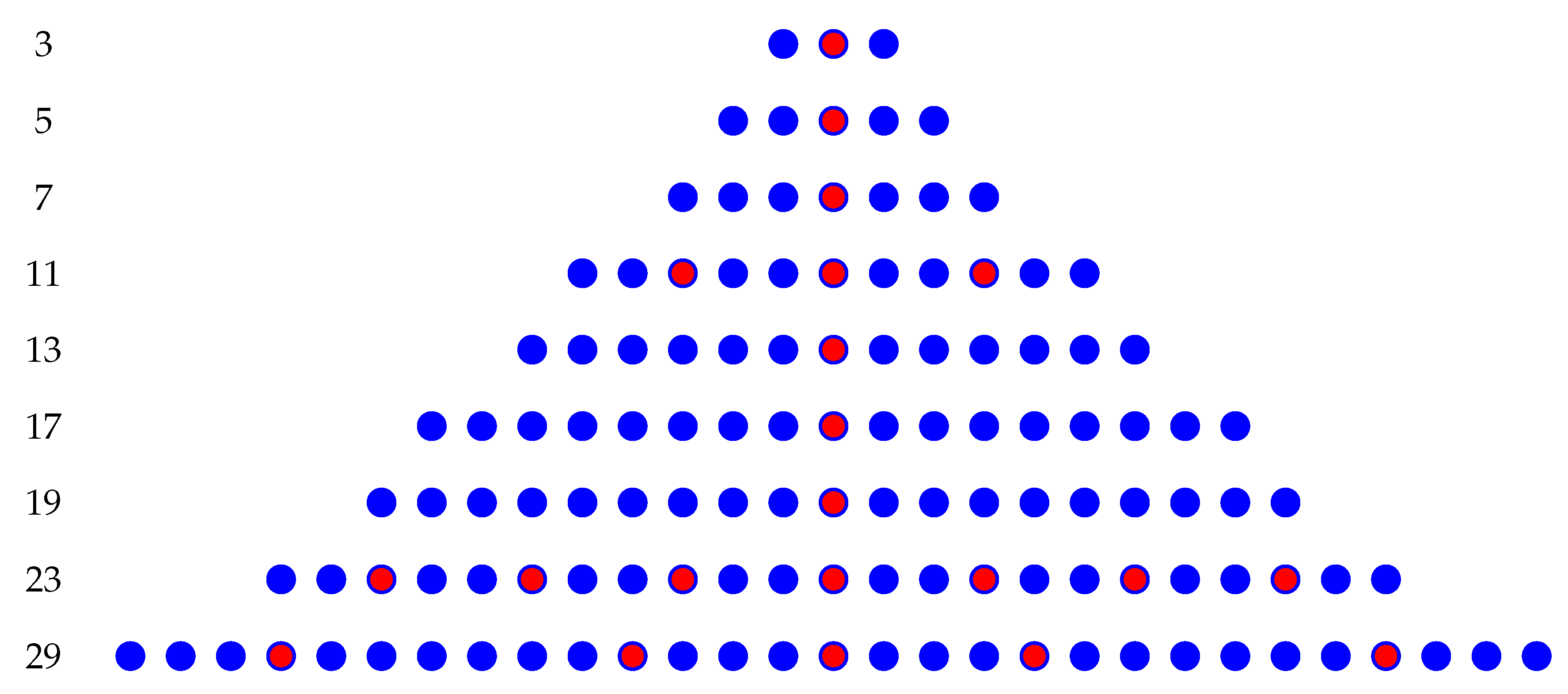
The red dots represent the unit number that are always surrounded by blue prime numbers in a group, which are 2 and 3, and are organized into prime sets, respectively.
The pyramid is the simplest and easiest way to illustrate the relationship between prime numbers, odd numbers that are not prime, and even numbers.
However, there must be a mathematical function that represents this arrangement. Now, if we represent the interrelationship in the form of a numerical pyramid, it would look like the following images. Figure 1 and Figure 2
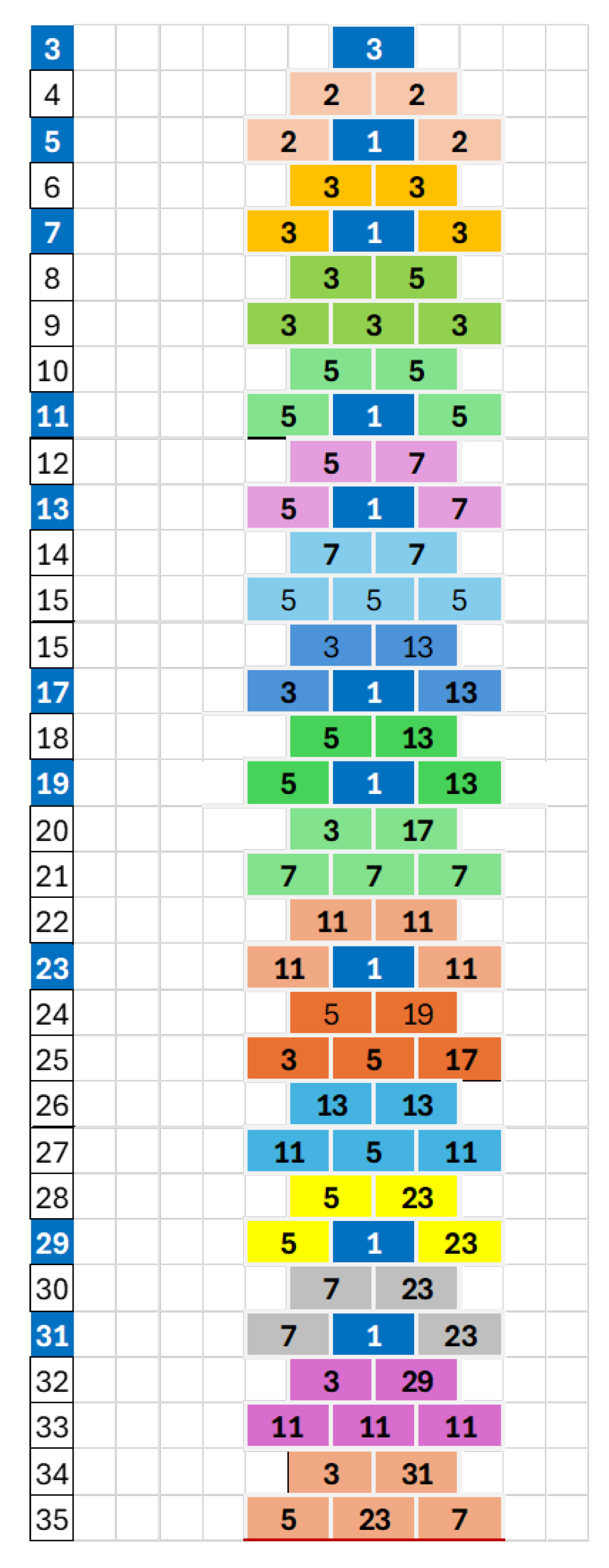
In tree form, each number represents a level of a field number. The place of a prime number is sustained by the number one in the center axis, surrounded by primes. This can be written as a compound number with the number one surrounded by the primes two and three. Compound numbers (evens or odds) do not include the unit and can be written as a combination of threes and twos. This is all according to the Fundamental Theorem of Arithmetic. If we consider the opposite numbers, the pyramid number will decrease from and will be exactly like the positive tree. Both compose a symmetrical structure of the numerical field of the set 2. Another way to represent the distribution of prime numbers is to construct a numerical building where prime numbers are written as we know them, without decomposing them into the prime numbers 2 and 3. This representation is shown in the following figure.
To find this relationship, as shown in Figure 2 it is necessary to apply the following formula:
Where , , , is an even number.
In order to represent the structure of any prime number at any level of the building, the following expression must be used:
In the illustration, each prime number is represented by a brick. As you can see, each level or floor of the building is composed of at least two or three prime numbers. This is achieved by taking the greatest preceding prime number and another of lesser value. In any case, the sum of the values can be used to reach the value of the next level, regardless of whether it is prime or composite but,... Is it possible to maintain the same structure at a very high level? We need to prove it.
We can now categorize the numbers according to the following propositions:
- 1.
- A number is prime if it can be expressed as the sum of at least two prime numbers, which are parts of it, plus one.
- 2.
- If the number is odd but not prime, it means it can be expressed of at least three prime numbers added together.
- 3.
- If the number is even, it means it can be expressed as the sum of at least two prime numbers together.
The verification of Goldbach’s weak conjecture has been proven by Harald A. Helfgott [2] which asserts that "Every integer greater than 5 can be expressed as the sum of three primes." Therefore, our proposal 2 is consistent with Goldbach’s ternary conjecture, now known as the Goldbach-Helfgott theorem. However, given that any prime number greater than 5 is odd, it is necessary to distinguish between an odd prime number and an odd number that is not-prime. This is due to the fact that proposition 1 is considered differently from the ternary conjecture. Propositions 3 is consistent also with Goldbach’s original conjecture written in a June 7, 1742 letter to Euler: "Every integer that can be written as the sum of two primes can also be written as the sum of as many primes (including unity) as one wishes, until all terms are units." Goldbach considered the number one to be prime, as he confirmed in the margin of the same letter: "It seems, at least, that every integer greater than two can be written as the sum of three primes." 3 ternary conjecture Now [3] Goldbach-Helfgott [2] theorem. Before Goldbach, Descartes [4] had stated, "Every even number can be expressed as the sum of at most three primes." In his letter dated June 30 of that same year, Euler responded to the Goldbach binary strong conjecture, reaffirming that "Every even integer is a sum of two primes." "This is certainly true, but it cannot be proven," he stated.
In the three cases described above, the sum of the prime numbers involves several combinations of two or three prime numbers that satisfy the equality with the proposed number, whether it is even or odd. Therefore, in a specific result, you can use the prime numbers that suit you, keeping in mind that they can be used in the coding of a security system, among other possible applications. [5]
Now, we will discuss how it is expressed in the structure of a proposition.
Definition 1
(Surrounded). Surrounding the number one with prime numbers that are part of a large prime number means that their sum equals the product of the large prime number.
Proposition 1
(Prime Number Parts). Every prime number can be decomposed into the sum of at least two prime numbers that are smaller than it, plus one. The following relationships must hold: , where . Here, p and q are prime numbers, always.
Proof.
The following proof is developed in accordance with the propositions 4 and 11 of Book VII of Euclid’s Elements. The number is defined as a prime number, as indicated by proposition 11, and as any number, as indicated by proposition 4. According to Proposition 4, it can be concluded that any is a number. It can be posited that any number is either a part or parts of any number, the less of the greater. Subsequently, the condition stated in the hypothesis is to be applied: . The subsequent subtraction of from results in a subtrahend that is equal to an even quantity. It can be posited that the remainder of this relationship is represented by the symbol , designated as . This is due to the premise that any number that is even must be represented by , as asserted in Proposition 26 of Book IX of Euclid’s Elements. This proposition states that if an odd number is subtracted from another odd number, the resulting remainder will be even. According to the aforementioned proposition 4, the result is expressed as follows: It can be demonstrated that . In the event that is prime, it can be concluded that . This is the condition that must be met. □
Corollary 1.
A surrounding prime number must be a part of a larger prime number.
As stated in Proposition 1, the surrounding prime numbers are and .
Corollary 2.
At least two surrounding prime numbers, when added to one, are sufficient to constitute a larger prime number.
Let’s look at some examples.
Let be a prime number, meaning it can be at least composed of two prime numbers, both of which are less than it, plus one.
Example 1.
Calculating and Then and 23 are the surrounding prime numbers. Therefor, if we add together we get the original prime number:
Example 2.
Now, if we calculate and Then and 61 are the surrounding prime numbers. Therefor, if we add together we get the original prime number:
Example 3.
The calculation yields a result of and . It can be deduced that and 109 are the surrounding prime numbers. Therefore, by adding , the original prime number is obtained: 29 983.
Example 4.
The calculation yields a result of and . It can be deduced that and are the surrounding prime numbers. Therefore, by adding , the original prime number is obtained: 29 983.
As demonstrated, an original prime number can be expressed as a set of two prime numbers surrounding the number one, thereby satisfying Proposition 1. However, it should be noted that this phenomenon does not pertain to all possible pairs of prime numbers. Therefore, in order to satisfy the aforementioned proposition, it is necessary to select the prime number , the result of which is the other prime number . It is only under these conditions that the result will be true.
In the event that the selection does not yield , it can be deduced that the original prime number will be a prime number composed of four surrounding prime numbers. This is due to the fact that would be an odd number, but not prime.
Example 5.
Since is a prime number, we must follow the criteria for one surrounded by at least four prime numbers when is an odd number that is not a prime number. The calculation yields a result of and . It is clear that is not a prime number, then we need to decompose into its prime components, so as 738 is an even number, product of difference of two odd number, where one of them is not prime, we need to find the prime components of 738. so . Therefor are the four surrounding prime numbers around the number one. Adding , the original prime number is obtained: . Here is necessary to be applied the Propositions 2 and 3
The behavior of a non-prime odd number is described in the following proposition.
Proposition 2
(Odd not-prime, on its prime number parts). Every odd number that is non-prime denoted by can be decomposed into the sum of at least three prime numbers that are smaller than it. The following relationships must hold: where and , here is the prime element selected for and is the other prime obtained as part of , p and q are prime numbers, e is even number, as also
Proof.
It is posited herein that "any number either is prime or is measured by some prime". This assertion is documented in Proposition 32 of Book VII of Euclid’s Elements. Let be a non-prime odd number. According to Proposition 22 of Book IX, the sum of many odd numbers by any even odds or times yields an even number. Therefore, since is a non-prime odd number, the product of , thus is an even number. To find the resulting on prime parts of any even number, apply the Proposition 3 [Even number, on its prime number parts]. Then , where is a prime selected as part of and is the remainder of the difference between so must to be a prime number. Subsequently, the set of prime numbers that comprise the original odd number, denoted by , must be selected. This number is expressed as , where , and are at least the three prime elements necessary to measure the original odd, which is known to be non-prime. □
Corollary 3.
A set of three prime numbers constitutes the minimum quantity required to measure any odd non-prime number.
Corollary 4.
Each original number must to be equal to the sum of its parts.
Corollary 5.
Each component of a given number must to be a prime number.
Let’s look at some examples:
Let be an odd not prime number, meaning it can be at least composed of three prime numbers, which are less than it.
Example 6.
Calculating where is prime number, because it has been deliberated chosen. Then we apply Proposition 3 to 16 to find its prime components, which are . Therefore are the prime parts of
Example 7.
Calculating where is prime number, that has been chosen intentionally on this way. Then we apply Proposition 3 at to find its prime components, which are . Therefore are the prime parts of
Example 8.
Calculating where is prime number, that has been chosen intentionally on this way. Then we apply Proposition 3 at to find its prime components, which are . Therefore are the prime parts of
Proposition 3
(Even number, on its prime number parts). Every even number denoted by can be decomposed into the sum of at least two prime numbers that are smaller than it. The following relationships must hold: , here is the prime element selected for and is the other prime obtained as part of , p and q are prime numbers, e is even number,
Proof.
The process of identifying the prime factors of an even number necessitates the subtraction of a prime number, with the subsequent product being required to be prime as well. It is hypothesized that if is a prime number less than , then will be subtracted from . According to Proposition 25 in Book IX of Euclid’s Elements, this will result in an odd number as a remainder. Therefore, we can established that . In this context, the symbol is used to denote any remaining elements in the relationship between . If the number is a prime number, the process is considered complete. In such a case, the second prime number is denoted by . Therefore, it can be concluded that are congruent, with , thus and being the prime parts of .
In the event that is not a prime number, the remainder is odd but not prime. It is imperative to persist in the search for a prime number , until the resulting remainder is itself a prime number and the relationship can be satisfied. □
All above is according to the proposition 4 in Book VII of Euclid’s Elements, which state that: "any number is either a part or parts of any number, the less of the greater". The preceding Propositions 1, 2, 3 elucidate the minimum number of parts into which each type of number can be decomposed, whether from the set of odd or even numbers. Consequently, it is feasible to identify or engage with a broader range of components that extend beyond this fundamental minimum, contingent upon the particular circumstances of each case. Let’s look at some examples for an even number: In this example, let be the even number in question. It can be demonstrated that the number can be composed of at least two prime numbers, each of which is less than the number itself.
Example 9.
It can be determined that the calculation is valid, provided that and are considered prime numbers. It can thus be concluded that these numbers are the component primes of .
Example 10.
It can be determined that the calculation is valid, provided that and are considered prime numbers. It can thus be concluded that these numbers are the component primes of .
Example 11.
It can be determined that the calculation is valid, provided that and 7 are considered prime numbers. It can thus be concluded that these numbers are the component primes of .
Example 12.
It can be determined that the calculation is valid, provided that is prime, but its remainder not. Therefore, It can thus be concluded that these numbers are not the two component primes of , because it is only one of them is prime.
3. Reclassification of Prime Numbers
The concept of prime numbers has existed since antiquity and is universally accepted under definition 11 of Euclid’s Elements, Book VII, which states that "Any prime number is that which is measured by a unit alone". This definition was accepted in their time by Nicomachus, Iamblichus, Theon, and Aristotle, each of whom contributed a better understanding of this property of numbers. Nicomachus established that the first prime number was 3, as it met the condition of being an odd number. However, Aristotle was the first to consider 2 as an even prime number, stating that "as the dyad is the only even number which is prime". The divisibility relationship was thoroughly substantiated from that point forward and has been endorsed consistently since that time. Therefore, from the perspective of divisibility, the assertion is valid and there is no contradiction. However, considering that the components of a whole can be separated not only by division but also by the operations of addition and subtraction, this article endeavors to extend the interaction between prime and non-prime numbers to this point of view.
3.1. The Main Sets of Prime Numbers
According to the established guidelines of the addition process: A considerable number of numbers can be composed adding at least two or more prime numbers, which are well established by Goldbach’s binary conjecture [3] [2] and the Goldbach-Helfgott theorem. However, a limited number of these numbers cannot be composed in this manner. The above is stated in Proposition 32 of Book VII of Euclid’s Elements."any number either is prime or is measured by some prime number." According to this hypothesis, we have two main sets of prime numbers:
- 1.
- The authentic prime numbers.
- 2.
- The common prime numbers.
3.2. Properties of APN
3.2.1. Authentic Prime Numbers
It is an uncontroversial assertion that the number one is not prime.
- Authentic prime numbers
- The authentic prime numbers are denoted as a couple of married primes numbers.
Their main properties are the following.
- i)
- One of them is even and the other is odd. These two numbers constitute a unique pair of primes that possess this particular property.
- ii)
- There is no gap between them.
- iii)
- If we try to break them down into parts of its sum, it is impossible to do so. Then, strictly divisible only by the unit or by itself.
- iv)
- As a binary system, they are the progenitors and builders of all numbers. See 4 [The conjecture]
- v)
- Its structure grows as a natural function when it develops as a succession.
We use Euclid propositions 3 and 11 [1][ p. 280 book VII] and apply them to prove the first and second conditions of the theorem. 1
According to Proposition 3, the definition of a "proper fraction" is as follows:
Definition 2
(Proposition 3). "A number is a part4 of a number, the less of the greater, when it measures the greater".
The definition of "prime number" according to Proposition 11 is as follows:
Definition 3
(Proposition 11). "A prime number is that which is measured by an unit alone".
Our statement that the progenitorial quality of the primes 2 and 3 can only be accepted if it is proven; otherwise, it becomes only a conjecture, as described below.
Definition 4
(Conjecture of progenitors). "If it is possible to prove that all the numbers , and 0 in the set are generated by the prime numbers and using only the arithmetical operators: addition, subtraction and multiplication".
Remark 1.
Since exponentiation is implicit in multiplication, it can be applied using exponential systems, such as the Graham number or any other system.
The following theorem defines the properties of the first classification of prime numbers.
Theorem 1
(Authentic prime numbers). Let p and q be a pair of prime numbers, and to be authentic they must satisfy the following rules:
- 1.
- They must to be according to the property of indivisibility as every prime number does.
- 2.
- They must not be according to the Fundamental Theorem of Arithmetic.
- 3.
- They must not have any element with the property of prime numbers in its sum. This means does not satisfy the Generational Theorem of Primes (GThP).
- 4.
- There is no gap between them.
- 5.
- One of them must be even, and the other is odd.
If a pair of numbers satisfies all of the above conditions, then we can declare them to beauthentic prime, otherwise not.
Proof.
The number 1 is not a prime, which is usually accepted. Obviously, if the numbers p and q are prime and cannot be divisible by any other number, only by 1 and by itself. Then the first condition is satisfied.
The FThA state: "That every natural number , can be factored by a unique set of primes" Then suppose, then 2 and 3 can be factored by primes, but as 2 and 3 are the smallest prime numbers and have no prime number parts that can divide them, therefore this is a contradiction, so they satisfy the fundamental theorem of arithmetic. Technically, the FThA must exclude all primes and declare that only which are compound can be factored by a unique set of primes. See Remark (Completing the FThA) below.
To prove the third condition, we assume that 2 and 3 have prime parts that can form them. The unique number that can build them in a summation process is the number 1, then and , but the hypothesis establishes that the number 1 is not a prime, then we state by contradiction, that the numbers 2 and 3 do not have prime addends.
In a natural sequence of numbers, it is clear that there is no gap between the numbers 2 and 3, and that they are the only pair of primes that really belong together.
It is well known that the number 2 is the unique prime number that is even, everyone else are odd. □
Remark 2
(Completing the FThA). "Every natural number can be written uniquely as a product of prime numbers", where each is an even or odd compound number, but not a prime.
The corollary of "spouses" is declared because there are no integer numbers between them, so the gap is zero. It is important to note that fractions are not taken into account here; that will be a topic to be treated later.
Corollary 6
(Spouses). Let p and q be a pair of prime numbers. If there is no gap between them, then they are "spouses" with the property of being prime numbers.
The properties of the pair consisting of 2 and 3, where one is even and the other is odd, are not coincidental. The same is true if they are the first two elements with the properties of prime numbers. Below this paper I explain the meaning and difference of being even and odd.
Remark 3
(Progenitors numbers). According to the corollary 6, the pair of prime numbers 2 and 3 are the mother and father of all numbers of the set and consequently of all its subsets. Thus, they can form a binary prime number system.
3.3. Properties of CPN
3.3.1. Common Prime Numbers
Common prime numbers are all primes that can be expressed as a sum of its prime parts plus one. Their main properties are the following.
- i)
- All of them are odd.
- ii)
- Strictly divisible only by the unit or by itself.
- iii)
- If we try to break them down into parts of its sum, it is possible to do so.
- iv)
- Every prime number greater than three can be expressed as the sum of two prime numbers plus one.
- v)
- There are random gaps between them, and their distribution in the mathematical field is not determined.
- vi)
- They are essential components in the foundation of mathematical structures.
The following corollary states the category of common prime numbers from the perspective of this hypothesis.
Corollary 7
(Common prime numbers). A number as common prime number is , , , where p is strictly prime.
Proof.
Suppose that all prime number as are prime, according the Proposition 11 3, so strictly all p if if its result is p or 1. Then p is prime. However, if where and if at the same time then p is a common prime number. □
The above is merely a categorization of prime numbers. There are many methods to determine their primality [5] [6] property and find them within the set of natural numbers. These methods include the Sieve of Eratosthenes, the Lucas-Lehmer test to prove for Mersenne primes or method of Fermat primes, and more recently "Great Internet Mersenne Prime Search" (GIMPS) algorithms.
3.4. What Does It Mean to Be Even or Odd?
- i.
- Every even number is complete - Every odd number is incomplete.
Being complete or incomplete has an intrinsic meaning, so I can only define it as a set of insubstantial premises.
- a)
- Being complete means not needing another.
- b)
- It is being everywhere in unity with your pair. This is the reason why a perfect even number can be found along the natural set.
- c)
- If you divide an even number, there is a 44.44… % of chance that you will get an even and the other 55.55… % that you will get an odd.
- d)
- Being incomplete means needing your complementary part.
- e)
- It is being in two parts, with half of your parts in each part.
- f)
- If you divide an odd number, there is a 22.22… % of chance that you will get an even number and the other 77.77… % that you will get an odd.
The concept of an "incomplete" number is important in searching for perfect odd numbers, just as the concept of a "complete" number is important in searching for perfect even numbers. This is because, in searching for any possible odd perfect number, we must consider the set of proper negative divisors plus the positive. In the pursuit of perfect odd numbers, it is expedient to employ the notions of "abundant" and "deficient" numbers. The reason for this is that the proper divisor 1 can be added to or subtracted from the set of proper divisors of any incomplete number. It must be either abundant or deficient by at least one unit, as this characteristic is implicitly present in any incomplete number.
3.5. Conjecture
The conjecture states that: If Is it possible to express each prime number by adding at least two prime numbers plus one?.
This may lead us to consider whether the last infinite prime number could be part of a larger one. This suggests that the expression as a sum of two primes, both of which are smaller than it plus one, could be infinite.
4. Conclusions
From the perspective that numbers are the building blocks of any numerical system and capable of revealing the infinite facets of a universe, describing their properties is utterly fascinating. Grasping the essence of numbers allows us to understand the reality of our universe in the clearest and most precise way possible, especially since we are stuck in a dead end that is becoming increasingly difficult to comprehend.
Therefore, no mental mathematical exercise should be dismissed, no matter how simple, because the beauty of everything around us lies in simplicity. Upon this simplicity, the most extreme and ever-growing complex structures have been built. Our universe is a large, complex structure whose parts are simple and elementary yet extremely intelligent. These parts have built systems that would never have been built otherwise, and they continue to build because their foundation is mathematical. The only way to build a finite universe like ours is to build it on an infinite universe, and the only infinite universe that can exist is the mathematical one.
With an extremely solid structure, one can build a wall or a building with a simple atomic structure. Likewise, one can construct a soft membrane that protects cellular life like a shield. One can also build an active protein or an intelligent brain. Every possible structure has a numerical structure that defines it and distinguishes it from others. First and foremost, each numerical structure defines individuality because it is the primary condition for a structure to interact with others. Second, it determines each structure’s specialized activity and how it interacts with similar and different structures, as well as its internal and external environments. This is the fundamental condition for survival.
In our mental exercise in this article, each prime number surrounding the number one on a given level of the numerical structure is supported by all its predecessors. The larger the number, the more powerful it becomes. At the same time, it becomes the foundation for more complex structures. Thus, each prime number is important, irreplaceable, and indestructible. Each floor of the numerical structure is a solid unit, as a prime number must be.
References
- Euclid, Sr T. L. Heath, J.L.H. The Thirteen Books of Euclid’s Elements; Vol. II, University Press, 1908.
- Helfgott, H.A. The ternary Goldbach conjecture is true. arXiv preprint arXiv:1312.7748 2013.
- Lemmermeyer, F.; Mattmüller, M. Correspondence of leonhard euler with christian goldbach. PUBLIKATIONEN DES BERNOULLI-EULER-ZENTRUMS 2016, 1.
- Pintz, J. On a conjecture of Descartes. In Number Theory in Memory of Eduard Wirsing; Springer, 2023; pp. 257–267.
- Heath-Brown, D. Odd perfect numbers. In Proceedings of the Mathematical Proceedings of the Cambridge Philosophical Society. Cambridge University Press, 1994, Vol. 115, pp. 191–196.
- Joyce, D.E. Euclid’s Elements: Book IX. Clark University, Worchester, MA 1996.
| 1 | The bridge theory is a nascent theoretical construct under active development. |
| 2 | At some point, we must consider describing the behavior of prime numbers that are opposites. In principle, they should behave similarly to prime numbers in the set of natural numbers. However, this must be verified since the rules of signs in division can produce different results |
| 3 | Franz Lemmermeyer and Martin Mattmüller (eds.), Correspondence of Leonhard Euler with Christian Goldbach, Publ. Bernoulli-Euler-Zent., vol. 1, Bernoulli-Euler-Gesellschaft, Basel, 2016, DOI 10.12685/publbez.1.2016; Opera Omnia IVA 4, online edition. |
| 4 | In a Proposition 4 "part", refers to a "proper fraction"
|
Figure 1.
A representation of the number pyramid in tree form. Here, the number three is the second solid brick. The number two is the first solid brick, because only they can be decompose in units.
Figure 1.
A representation of the number pyramid in tree form. Here, the number three is the second solid brick. The number two is the first solid brick, because only they can be decompose in units.
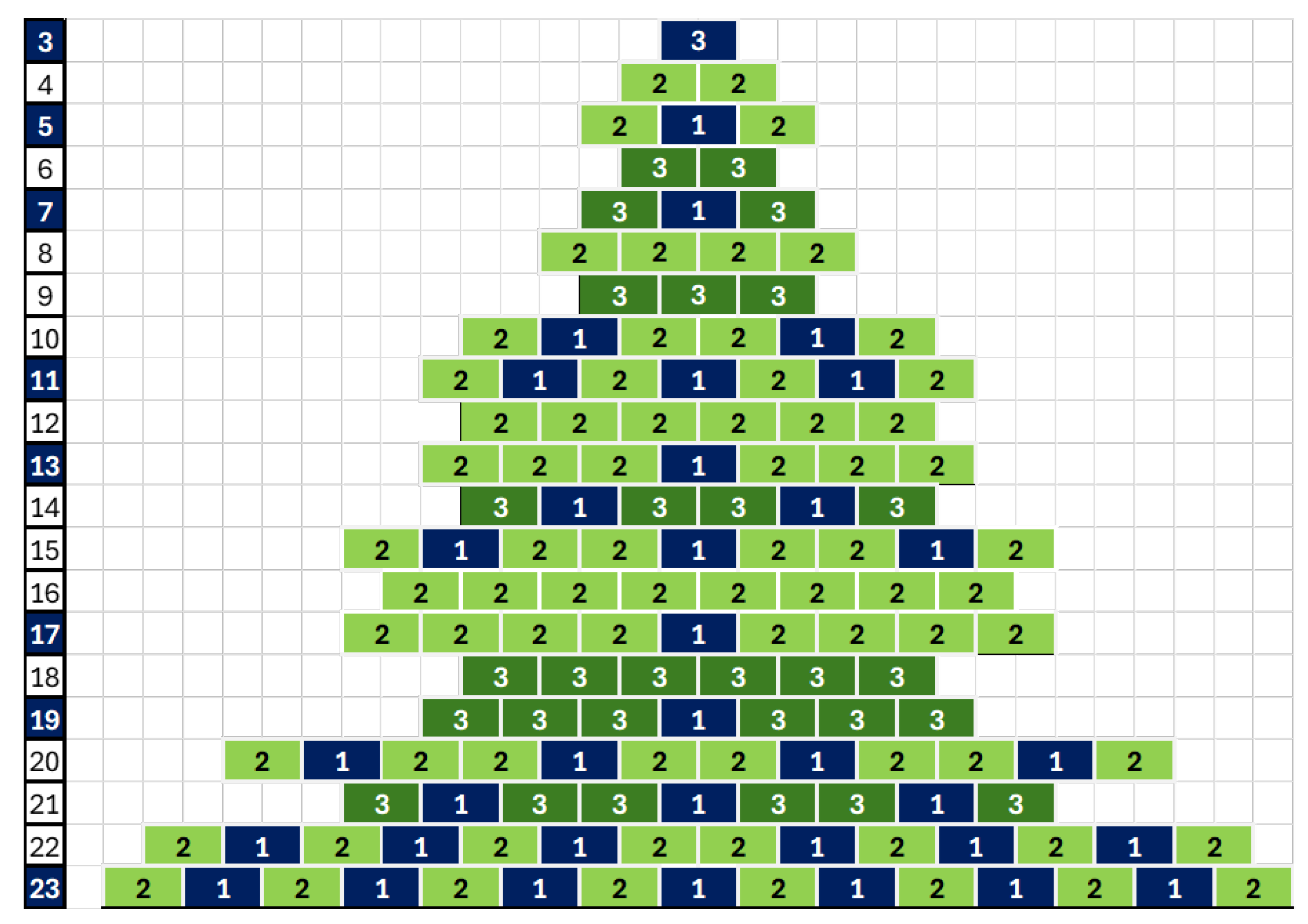
Figure 2.
The illustration depicts the number pyramid as a structured building.
Disclaimer/Publisher’s Note: The statements, opinions and data contained in all publications are solely those of the individual author(s) and contributor(s) and not of MDPI and/or the editor(s). MDPI and/or the editor(s) disclaim responsibility for any injury to people or property resulting from any ideas, methods, instructions or products referred to in the content. |
© 2026 by the authors. Licensee MDPI, Basel, Switzerland. This article is an open access article distributed under the terms and conditions of the Creative Commons Attribution (CC BY) license (http://creativecommons.org/licenses/by/4.0/).
Copyright: This open access article is published under a Creative Commons CC BY 4.0 license, which permit the free download, distribution, and reuse, provided that the author and preprint are cited in any reuse.


