

Submitted:
02 March 2026
Posted:
02 March 2026
You are already at the latest version
Abstract
Background: Quality of Life (QoL) is a multidimensional construct influenced by physical, mental, and psycho-emotional factors. Holistic movement practices (HMPs) have shown potential benefits for well-being; however, empirical evidence supporting the effectiveness of developed protocols remains limited. This study aimed to investigate the effects of the Bio-gymnastic® method, a mind–body exercise protocol, on health-related QoL in adults and to explore possible differences by gender and age. Methods: A pilot longitudinal study was conducted involving 171 adults (female: 151, male: 20) who completed a 10-week Bio-gymnastic program consisting of one supervised session per week. The protocol integrated self-body awareness, postural control, breathing regulation, muscle activation–relaxation, and multisensory stimulation. Quality of life was assessed before and after the intervention using the Italian version of the SF-36 Health Survey. A two-way ANCOVA was applied to evaluate pre-post changes, accounting for the interaction effects of gender and age categories. Results: Significant improvements were observed across several SF-36 domains following the intervention. Notable gains were observed in physical functioning, role-physical, bodily pain, general health, vitality, and mental health, with medium to large effect sizes in the physical domains. Improvements were generally independent of gender and age, although an interaction effect between gender and age emerged for physical functioning in the oldest participants. Conclusions: The proposed method appears to be an effective, low-dose holistic exercise intervention, suggesting that it may enhance multiple dimensions of QoL in adults. These preliminary findings support the potential role of mind–body practices as accessible health-promotion strategies. Further randomised controlled studies with balanced samples and objective outcome measures are needed to confirm and extend these results.
Keywords:
health
; body awareness
; posture
; wellness
; holistic therapy
1. Introduction
The Quality of Life (QoL) concept encompasses various definitions worldwide of general health status, including mental, physical, and psycho-emotional well-being, as well as life satisfaction (Barofsky, 2012). Its complexity lies in the individual’s life context, requiring the validation of multiple questionnaires for patients (Matheson et al., 2023) or for adult populations (Pequeno et al., 2020). To date, the Short Form 36 (SF-36) Health Survey is widely used worldwide due to its psychometric validity and extensive use in both clinical and research settings (Tarlov et al., 1989; Ware, 2000). In 1998, Apolone and Mosconi validated it across different Italian samples, including patients and healthy individuals (Apolone & Mosconi, 1998). Since then, the SF-36 has been applied to evaluate and monitor the QoL of Italian citizens (Kheiraoui et al., 2012; Guerra et al., 2022), defining the social criteria that affect the perceived well-being, such as occupational stress and work role, social and emotional exhaustion, and inactive lifestyle (Yang et al., 2009; Asmar, 2025).
From this perspective, the World Health Organisation (WHO) promotes the Sustainable Development Goals, which encompass several strategies for health promotion, self-care, and overall health and well-being for all at all ages (WHO, 2023). Of these, the promotion of physical activity (PA) and the prevalence of active habits positively affected people’s QoL (Marquez et al., 2020). Strong associations have been found between QoL and active behaviours in more than 20,000 subjects (Choi et al., 2020). Whilst it is evident that 150-600 minutes with moderate PA or 75-300 minutes with vigorous PA are the best dosing to enhance QoL (da Cunha et al., 2025), it is not clear how the specific exercise affected it and whether a rational exercise plan could reduce the PA amount needed to be healthy. A recent study found that different long-term exercise plans, including aerobic, resistance, or traditional Gong, are effective in improving both physical and mental components, with significant effects on physical role and function in aerobic and resistance training, as well as body pain and vitality in Gong (Young et al., 2025). Relevant evidence highlighted the benefits of aerobic and resistance, or combined, exercises on the QoL of cancer patients (Fukushima et al., 2021) and sedentary individuals (Silva et al., 2025).
However, the mind-body exercises, described as a holistic approach that combines postural and breathing control, and balance, such as Traditional Gong and Yoga, have been reported to have a positive effect on the Mental health of patients (Reina-Gutiérrez et al., 2022) and workers (Guerra et al., 2022). Additionally, Tai Chi and Qigong have been shown to induce several benefits for mental health (Yin & Dishman, 2014). The exercise psychologists described them as holistic movement practices (HMPs), which held all the well-being dimensions through distinctive techniques (Vergeer et al., 2021). Behind the territorial and cultural influences that gave rise to numerous nomenclatures, the nature of HMPs revealed standard references, including posture, breath regulation, meditation, and consciousness (Feuerstein, 2008). Whilst meditation and consciousness exercises exhibited a strong association with mood and emotional regulation, helping to foster mental responses (Menezes et al., 2015), postural control and breathing activities reduced musculoskeletal pain and discomfort, thereby enhancing body well-being (Kim et al., 2015; Balban et al., 2023).
Despite their widespread use in Western and Oriental cultures, a significant portion of the world refuses to recognise their benefits due to a lack of empirical evidence (Vergeer et al., 2021). Additionally, it is unclear whether the HMPs’ benefits apply to the entire population, encompassing both gender and age heterogeneity. In light of this, the study aims to examine whether a proposed new exercise protocol could affect participants’ quality of life and whether any differences are observed between Italian females and males of varying ages.
2. Materials and Methods
2.1. Study Design and Sample
This was a pilot longitudinal study with two factors (gender and age) and a single group. The experiment lasted 11 weeks, of which ten included the proposed exercise treatment. All participants were enrolled through email or social network invitation and volunteered to participate. Exclusion criteria were the presence of any metabolic syndrome, cancer, musculoskeletal disorders, or recent musculoskeletal and joint injuries, psycho-emotional disorders, and involvement in any other physical exercise program. Only adults’ demands were considered. Experimental risks were presented, and each participant filled out an informed consent form. The study was conducted in accordance with the Helsinki Declaration ethical guidelines for human treatment (protocol n. 0157696, March 2024). All data were collected concerning participants’ sensitive information, and no metadata was linked to the participants.
A priori sample size calculation was estimated by the following parameters: statistical test = two-way ANCOVA, Type I error = 5%, Type II error = 20%, Statistical power = 80%, number of raw factors = 2 (gender), number of column factors = 4 (age category), delta = 0.25 (effect size). The requested sample size was 171 participants.
2.2. Exercise Protocol
One hour of exercise session per week was proposed, totalling ten sessions. All sessions were conducted in a quiet room at approximately 24 °C and 40-50% humidity. Participants completed the session on a mat, transitioning from lying to sitting and standing. Participants completed the sessions in groups of six. Two trained Kinesiologists conducted each session. The exercise protocol aimed to enhance participants’ self-body awareness by identifying internal muscle tension and postural alterations that could contribute to pain and discomfort. The protocol progression encompasses self-awareness through exercises that activate sensorial feelings, proprioceptive and fibrous sensations, tension and relaxation, and achieve adequate breathing by triggering the deep neuro-muscular system. A well-balanced posture is the cornerstone of improving quality of life. Each session covered a specific focus:
- Reducing the psycho-physical stress. Aimed to feel psycho-emotional stressors through all the senses, and learning how to use one’s own body for ameliorating them.
- Perceiving and acting on postural discomfort. Aimed to discover the body posture and main muscles involved in tone maintenance, perceiving their movement and recruitment.
- Back muscle tension. Aimed to feel the back muscles’ action, perceiving how to contract and relax them, how to reduce their tension and altered tone.
- Discovering the breathing. Aimed to teach the appropriate breathing for involving all the muscles from the thorax to the diaphragm, and feel the flow during inhalation and exhalation.
- Back muscle tension.
- Mobilising ankle and waist. Aimed at the perceived muscles involved in ankle and waist balance and stability, from stronger to stabilisers.
- Perceiving and working on the spine. Aimed at the perceived spine balance and how the back and anterior muscles could alter or balance it.
- Relaxing through movement. Aimed to teach how to encompass all the previous phases to relax the whole body.
- Enforcing through movement. Aimed to perform static and easy movements to strengthen the main muscles involved in postural balance.
- Posture and new balance. Aimed to encompass all the previous phases to feel the new postural assessment and become aware of the new balance.
Also, each session included four main phases:
- Listening, feeling and perceiving. It focused on individual learning of the body consciousness. In this phase, all participants’ senses were stimulated through listening, visual, olfactory, and tactile exercises, using relaxing sounds, room scents, and small tactile tools. This phase lasted about 15 minutes.
- Body structural work. It consisted of three different parts, equally timed during each session. The first part consisted of relaxing exercises, particularly for the abdomen and joint insertions. Breathing exercises were then proposed in both standing and lying down positions. Finally, slow and long isotonic and isometric contractions were proposed to widen the joint range of motion and to feel muscle tension. This phase was about 20 minutes.
- Feedback and postural consolidation. It consisted of proprioceptive exercises, focusing on joint mobility and static posture adaptation. This phase lasted about 10 minutes.
- Social interaction and relaxation. It focused on sharing feelings and the benefits achieved during the session. This phase lasted about 10 minutes.
Table 1 presents exercises that can be performed in various positions and with small instruments within each session.
2.3. Quality of Life
The quality of life was measured by the Italian SF-36 Health Survey (Apolone & Mosconi, 1998). The SF-36 was self-administered during a person-to-person interview in a private room at the gym where participants performed the protocol. Each participant completed the survey without social interaction or external influences. One trained psychologist administered the survey. The validation criteria on healthy people (n = 50) were scale completeness = 96%, response consistency index = 86%, item internal consistency = 91.4%, discriminant validity = 99.6%, internal consistency reliability = 70-90% (Apolone & Mosconi, 1998). The scale consisted of eight items: physical functioning (PF, reliability = 93%), role-physical (RF, reliability = 89%), bodily pain (BP, reliability = 85%), general health (GH, reliability = 77%), vitality (VT, reliability = 78%), social functioning (SF, reliability = 77%), role-emotional (RE, reliability = 85%), mental health (MH, reliability = 85%).
2.4. Statistics
The mean described the measure of central tendency, while the standard deviation represented the dispersion. Categorical variables were expressed as frequencies, and their hypotheses were tested by the chi-squared (χ2). The Kolmogorov-Smirnov test was used to check the distributions of continuous variables. The White and Durbin-Watson tests tested for error sphericity, and when residuals were heterogeneous, a weight based on the reciprocals of predicted residuals was computed (Seber, 1977). Additionally, the variance inflation factor was used to assess the correlation among the model’s variables. The two-way ANCOVA model tested simple, main, and interaction effects of gender and age categories, where the variable value at pre-represented the covariate, and its value at post-represented the dependent variable. The type I error probability (p-value) was set at 0.05. Partial eta-square (η2) represented the effect size of each variable. All analyses were conducted using SAS 9.4 (English version, Windows edition; Cary, North Carolina, USA).
3. Results
Females represent 88.3% of participants, with the majority aged 45-54.99 years (43.71%). Males reported a similar distribution across the 55-64.99 and 65+ age groups (25%), with no significant difference between the groups (χ2(3) = 1.74, p = 0.627). The Cochran-Mantel-Haenszel statistics reported no significant association between gender and age scores (CMH χ2(3) = 1.73, p = 0.629).
Table 1 presents summary statistics categorised by gender and age, while Figure 1 displays adjusted mean plots with 95% confidence intervals for the interaction between gender and age category.

Table 1.
Summary statistics for gender and age category.
| female (n=151) | male (n=20) | ||||||||||||||||
| <45 years (n=32) | 45-54 years (n=66) | 55-64 years (n=28) | >65 years (n=25) | <45 years (n=3) | 45-54 years (n=7) | 55-64 years (n=5) | >65 years (n=5) | ||||||||||
| Var | mean | std | mean | std | mean | std | mean | std | mean | std | mean | std | mean | std | mean | std | |
| PF1 | 89.84 | 9.37 | 83.94 | 14.95 | 84.11 | 13.88 | 76.20 | 20.58 | 91.67 | 2.89 | 80.71 | 13.05 | 85.00 | 9.35 | 87.00 | 8.37 | |
| PF2 | 90.31 | 12.37 | 86.36 | 13.37 | 88.21 | 10.56 | 79.40 | 13.10 | 95.00 | 0.00 | 81.43 | 17.25 | 85.00 | 11.73 | 94.00 | 6.52 | |
| RP1 | 80.47 | 28.21 | 70.45 | 37.44 | 69.64 | 37.49 | 68.00 | 39.21 | 58.33 | 38.19 | 50.00 | 47.87 | 80.00 | 27.39 | 30.00 | 44.72 | |
| RP2 | 83.59 | 28.83 | 84.47 | 25.10 | 84.82 | 20.79 | 83.00 | 28.61 | 100.0 | 0.00 | 71.43 | 41.9 | 85.00 | 33.54 | 80.00 | 44.72 | |
| BP1 | 61.72 | 20.57 | 61.24 | 19.59 | 55.61 | 18.78 | 63.56 | 23.57 | 62.00 | 21.52 | 43.71 | 24.19 | 58.40 | 19.65 | 63.60 | 28.01 | |
| BP2 | 68.06 | 21.13 | 66.02 | 18.86 | 60.79 | 16.50 | 65.48 | 17.91 | 75.33 | 29.96 | 60.71 | 19.27 | 71.40 | 17.71 | 65.40 | 25.26 | |
| GH1 | 62.16 | 17.04 | 62.35 | 17.07 | 72.39 | 12.35 | 60.00 | 15.29 | 65.67 | 18.45 | 58.43 | 16.00 | 70.40 | 6.07 | 63.20 | 20.24 | |
| GH2 | 64.09 | 16.19 | 65.77 | 13.93 | 68.96 | 15.50 | 65.32 | 12.24 | 76.67 | 21.57 | 67.00 | 20.39 | 68.40 | 14.88 | 71.20 | 12.48 | |
| VT1 | 52.81 | 17.87 | 54.47 | 17.76 | 58.57 | 14.07 | 58.00 | 19.95 | 61.67 | 7.64 | 51.43 | 12.82 | 60.00 | 12.75 | 70.00 | 15.41 | |
| VT2 | 54.69 | 16.26 | 57.80 | 17.93 | 61.07 | 13.50 | 62.80 | 11.64 | 61.67 | 7.64 | 60.71 | 21.49 | 67.00 | 10.37 | 74.00 | 12.45 | |
| SF1 | 69.00 | 21.36 | 68.11 | 21.30 | 81.04 | 16.14 | 77.64 | 17.82 | 74.67 | 12.5 | 44.43 | 23.94 | 67.20 | 19.06 | 82.20 | 18.86 | |
| SF2 | 74.81 | 22.91 | 71.56 | 22.83 | 81.07 | 16.45 | 81.80 | 16.56 | 78.67 | 14.43 | 71.29 | 25.63 | 82.20 | 19.19 | 79.80 | 22.76 | |
| RE1 | 76.91 | 32.29 | 71.06 | 37.90 | 78.43 | 34.28 | 81.16 | 30.65 | 44.33 | 50.95 | 47.29 | 37.65 | 80.00 | 44.72 | 93.20 | 15.21 | |
| RE2 | 77.97 | 32.47 | 76.62 | 33.17 | 84.43 | 29.49 | 83.84 | 27.56 | 100.0 | 0.00 | 61.71 | 35.81 | 73.20 | 43.49 | 100.0 | 0.00 | |
| MH1 | 62.88 | 18.32 | 64.18 | 17.46 | 70.00 | 15.64 | 69.44 | 18.61 | 62.67 | 6.11 | 57.71 | 14.58 | 76.80 | 21.05 | 76.80 | 13.08 | |
| MH2 | 63.88 | 15.22 | 67.03 | 17.81 | 72.43 | 10.91 | 70.72 | 14.18 | 74.67 | 16.65 | 72.00 | 12.44 | 74.40 | 16.15 | 80.80 | 10.35 | |
| Note: Var = variable, PF = Physical functioning, RP = Role-physical, BP = Bodily pain, GH = General health, VT = Vitality, SF = Social functioning, RE = Role emotional, MH = Mental health, 1 = pre-treatment, 2 = post-treatment. | |||||||||||||||||
Physical functioning reported an increased mean value at post (95% CI of η2: 0.261, 0.472; F (1, 170) = 142.83, p < 0.001), with an interaction effect of gender and age-categories (η2 = 0.032; F (3, 170) = 3.33, p = 0.021). PF increased by 2.41% (95% CI:0.3%, 4.48%). The adjusted mean contrast between female and male was -1.56 (95% CI: 4.67, 1.53, t = -1.41, p = 0.161), while the adjusted age-category’s means were lowest in 45-54.99 (85.92, F (2, 170) = 0.31, p = 0.737) and highest in younger (88.01, F (3, 170) = 0.27, p = 0.848). The interaction effect was significant only for the oldest group (t = -3.63, p < 0.001), in which females reported a lower mean (95% CI of the contrast: -14.95, -4.91).
Role physical increased by 0.34 (95% CI: 0.22, 0.45; η2 = 0.158, F (1, 170) = 30.71, p < 0.001) at post per each level of pre-treatment, but did not report any interaction effect (F (3, 170) = 0.29, p = 0.831). RP increased by 14.97% (95% CI: 7.48%, 22.44%). Additionally, the main effects did not reveal a significant difference between genders (t = -1.02, p = 0.308) or age categories (t = 0.51, p = 0.853). However, the 45-54.99 female and male groups reported the lowest mean difference (95% CI: -34.42, 34.41), whereas the widest was observed between the youngest females and males (95% CI: -72.72, 37.48).
The bodily pain score at post reported a regression coefficient of 0.46 ± 0.06 (95% CI of η2: 0.143, 0.349; F(1, 170) = 52.42, p < 0.001), with no interaction or main effect. BP improved by 4.24% (95% CI: 0.1%, 9.37%). However, adjusted means showed an overall contrast of -4.77 (95% CI: -12.96, 3.42) with the most significant difference in 45-54 females vs males (contrast = -9.34 ± 8.11, t = -1.15, p = 0.25), while the youngest groups exhibited the highest means (95% CI female: 61.46, 73.13; 95% CI male: 55.38, 93.48).
Concerning general health, it increased by 0.53 (95% CI: 0.41, 0.65; η2 = 0.314, t = 8.87, p < 0.001) per each pre-treatment level, with the greatest absolute improvement in the youngest males (+16.75%). However, the general improvement was not significant (95% CI: -2.38%, 5.46%). The gender contrast was 4.67 (t = -1.53, p = 0.127), with the widest absolute difference observed in the 55-64.99 years age range (contrast = -10.71; t = -1.46, p = 0.148).
Regarding vitality, a significant effect was detected from baseline (95% CI of η2: 0.18, 0.388; F (1, 170) = 81.05, p < 0.001), while no interaction or main effects were detected. However, the overall gender contrast was -4.28 (t = -1.29, p = 0.199), with the most significant difference among the youngest participants (contrast = -4.47, t = -0.85, p = 0.398).
Of all SF-36 domains, the social functioning slope of the pre-treatment effect was the smallest (η2 = 0.10; β = 0.34, t = 4.35, p < 0.001) with no gender effect (t = -0.60, p = 0.549), groups (F (3, 170) = 0.16, p = 0.923) and interaction (F (3, 170) = 0.29, p = 0.835). Although the role emotional slope of the pre-treatment was similar (η2 = 0.122; β = 0.358, t = 4.9, p < 0.001), the youngest group reported the widest effect (F (3, 170) = 1.14, p = 0.335), whereas the interaction of gender within the 55-64.99 years category (t = -1.47, p = 0.284).
Finally, the mental health status reported a slope of 0.477 (95% CI: 0.36, 0.59; η2 = 0.27, F(1, 170) = 65.29, p < 0.001), with no significant interaction or main effects. However, the female vs male contrast was -6.06 (t = -1.86, p = 0.065), with the largest difference observed between the youngest groups (contrast = -8.05, t = -1.55, p = 0.124).
4. Discussion
The following study is a pilot investigation that proposes a new holistic movement practice for improving participants’ quality of Life, taking into consideration its benefits across different gender and age groups. The follow-up lasted 10 weeks, during which participants practised one session per week of combined exercises, including sensorial patterns, postural control, breath regulation, muscular consciousness through activation and relaxation, and joint mobility. We found that the Bio-gymnastic method improved the general QoL of participants, independently of specific items, sex, and age, with the most significant benefits in physical health than in mental health. The SF-36 has been demonstrated to be a valid tool for assessing physical health in exercise treatment, with no difference in validity compared to other scales (Hart & Kang, 2015). This provides good reliability and extendibility to our results, enabling general considerations. However, the study protocol needs further confirmation to achieve full validity.
The Bio-gymnastic® protocol was conceived as a brief, low-dose intervention to examine whether targeted mind–body exercises could improve Quality of Life (QoL) within a limited timeframe. Determining the time required to improve general health through physical exercise is challenging, as numerous factors must be considered. Generally, a recent systematic review found that 59-66 days are required to develop healthy habits induced by physical activity (Singh et al., 2024). When specific physiological adaptations are sought, humans can improve their aerobic capacity after only three weeks, regardless of age (Murias et al., 2010), their muscle hypertrophy after three weeks (DeFreitas et al., 2011), and their strength after four weeks, regardless of gender (Staron et al., 1994). Wernbom and colleagues (2007) highlighted that the training frequency (days per week), intensity and volume also played key roles in inducing the desired benefit. Although HMPs usually lack standardised intensity and volume, such as in endurance and strength training, we assessed one training session per week, lasting about an hour each, for a total of 10 sessions and hours, comparable to the 8 and 9 previously reported. The choice of a 10-session program over ten weeks was informed by evidence showing that mind–body interventions can yield measurable psycho-physical benefits even with low-frequency sessions, provided that breathing, postural awareness, and sensory engagement are integrated (Büssing et al., 2012; Wayne & Kaptchuk, 2008). Additionally, the protocol was designed to be feasible for adults with diverse schedules, supporting adherence and minimising dropout. All the factors mentioned below could justify the expected improvement in physical health, as indicated by physical functioning (up 2.41%) and role-physical (up 14.97%). Although additional variables, such as lesson duration, costs, environment, and facilitations, affected the HMPs’ spread and adherence, our exercise plan aligns with many previous theoretical principles, which pique the interest of a wider female sample than males (Veerger & Klepac-Pogrmilovic, 2021). Motivation and psychosocial differences usually affect gender behaviours. Research found that males are less likely to participate in activities perceived as highly feminine, which is often stereotyped as focusing primarily on flexibility and stress reduction rather than strength and athleticism (Cagas et al., 2022); also, women generally possess greater joint mobility that leads to greater focus and attention during HMPs’ sessions, reflecting significant effects on psycho-social than physical spheres. It justifies the unbalanced sample size, and it is also expected that older women were already accustomed to practising HMPs, reducing the magnitude of variation compared to men.
Similarly, mental health is widely affected by many features such as gender, age, lifestyle behaviours, chronic disease, and physical exercise habits (Zhou et al., 2023). In general, the effects of physical exercise are recognised to affect many human systems and psychological-emotional aspects, and holistic practices are expected to lead to improved global and mental health (Kosma, 2025). HMPs involve several mental, emotional and cognitive components that require an adequate environment, concentration, pedagogical contents and exercise, such as breathing and relaxation (Vergeer & Biddle, 2021). We found a medium effect size (>0.25) of mental health variation adjusted by gender and age, suggesting that our proposal may be compared to popular HMPs such as Yoga, Tai Chi and others, which showed different magnitudes from 0.2 up to 0.8 (Chawla et al., 2023; Sani et al., 2023). Our protocol is grounded in HMPs, which conceptualise posture, breathing, and body awareness as interconnected determinants of physical and psycho-emotional well-being (Mehling et al., 2011). Similar to Yoga, Tai Chi, and Qigong, Bio-gymnastic adopts a holistic, unitary approach to psychophysical well-being, viewing the individual as a complex system striving for balance across physical, emotional, and psychological dimensions. Within this framework, the practice aims to enhance interoceptive and proprioceptive awareness in order to reorganise motor patterns, reduce maladaptive muscle tension, and support emotional regulation (Wayne & Kaptchuk, 2008). Breathing exercises target autonomic modulation and stress reduction, mechanisms widely associated with slow and regulated breathing patterns (Zaccaro et al., 2018). Postural exploration and slow isotonic–isometric contractions addressed musculoskeletal imbalances, stiffness, and discomfort, consistent with movement-based approaches to pain modulation and neuromuscular relaxation. The inclusion of multisensory cues aimed to reinforce attentional focus, a core component of embodied awareness processes linked to improvements in pain perception, vitality, and general well-being (Mehling et al., 2011). However, it seems that there exists an intrinsic relationship between the baseline mental health burden and the percentage of variation, where clinical and severe conditions reported the widest effects. When healthy people are considered, previous HMPs demonstrated heterogeneous variations among mental health components such as anxiety and depression, but only in the elderly (Kuang et al., 2024). We found no difference between younger and older adults, but we investigated mental health as a separate item; specific results are needed. It is crucial to be aware that the role-emotional sphere is also strongly related to mental health, while social functioning, vitality and general health require more insight (McHorney et al., 1993). Whilst we found the smallest effect sizes in role-emotional and social functioning, general health showed the largest effect, suggesting that the experimental protocol may be a valid method for improving health. Previous studies have examined the relationship between physical activity and emotional and community well-being, showing that people who are more physically active (in terms of the number of hours spent engaging in physical activity) tend to be better off (Marques et al., 2016). Considering that our protocols lasted 1 hour per week, this could explain the small effect size observed.
This study presents several limitations. The absence of a control group limits causal inference, as placebo effects and expectancy effects cannot be ruled out. The sample was strongly unbalanced by gender, with a predominance of female participants, reducing the generalizability of gender-related findings. Moreover, outcomes relied exclusively on self-reported QoL measures, such as the SF-36 (Ware & Sherbourne, 1992), without objective assessments of physical or postural changes. Small subgroup sizes and the relatively short intervention duration further limit the ability to draw conclusions regarding between-group differences and long-term effects (McHorney et al., 1993). Finally, the authors selected a statistical design that detects changes in participants’ behaviour before and after the treatment, but cannot identify specific trends. The selection was mandatory because the authors cannot measure lifestyle habits that affect quality of life (such as nutrition).
5. Conclusions
This pilot study suggests that the Bio-gymnastic® protocol may enhance multiple dimensions of Quality of Life in adults, particularly physical functioning, vitality, general health, and mental health. These results support the potential role of mind–body exercises as accessible, low-intensity strategies for promoting well-being, consistent with the existing literature on holistic movement practices. Future studies employing randomised controlled designs, larger and more balanced samples, objective outcome measures, and follow-up assessments are needed to confirm and extend these preliminary findings.
Institutional Review Board Statement
The study was conducted in accordance with the Helsinki Declaration ethical guidelines for human treatment (protocol n. 0157696, March 2024).
Informed Consent Statement
Informed consent was obtained from all subjects involved in the study.
Conflicts of Interest
The authors declare no conflict of interest.
References
- Apolone, G.; Mosconi, P. The Italian SF-36 Health Survey: translation, validation and norming. Journal of clinical epidemiology 1998, 51(11), 1025–1036. [Google Scholar] [CrossRef]
- Asmar, N. E.; Yazbeck Karam, V.; Sakr, R.; Khoury Malhame, M. E.; Chatila, R.; Akiki, Z. Assessing burnout and quality of life among residents and fellows in a high-stress environment: a cross-sectional study. BMC psychology 2025, 13(1), 557. [Google Scholar] [CrossRef] [PubMed]
- Balban, M. Y.; Neri, E.; Kogon, M. M.; Weed, L.; Nouriani, B.; Jo, B.; Holl, G.; Zeitzer, J. M.; Spiegel, D.; Huberman, A. D. Brief structured respiration practices enhance mood and reduce physiological arousal. Cell reports. Medicine 2023, 4(1), 100895. [Google Scholar] [CrossRef] [PubMed]
- Barofsky, I. Can quality or quality-of-life be defined? Qual Life Res 2012, 21, 625–631. [Google Scholar] [CrossRef] [PubMed]
- Büssing, A.; Ostermann, T.; Lüdtke, R.; Michalsen, A. Effects of yoga interventions on pain and pain-associated disability: A meta-analysis. Journal of Pain 2012, 13(1), 1–9. [Google Scholar] [CrossRef]
- Cagas, J. Y.; Biddle, S. J. H.; Vergeer, I. For Exercise, Relaxation, or Spirituality: Exploring Participation Motives and Conformity to Masculine Norms among Male and Female Yoga Participants. International journal of environmental research and public health 2022, 19(2), 770. [Google Scholar] [CrossRef]
- Chawla, V.; Brems, C.; Freeman, H.; Ravindran, A.; Noordsy, D. L. The Future of Yoga for Mental Health Care. International journal of yoga 2023, 16(1), 38–41. [Google Scholar] [CrossRef]
- Choi, MJ.; Park, Y.G.; Kim, Y.H.; et al. Association between type of exercise and health-related quality of life in adults without activity limitations: a nationwide cross-sectional study. BMC Public Health 2020, 20, 599. [Google Scholar] [CrossRef]
- da Cunha, R. A.; de Lira, C. A. B.; Vancini, R. L.; Weiss, K.; Knechtle, B.; Andrade, M. S. Striking the balance: exploring the influence of exercise quantity and intensity on quality-of-life outcomes. Clinics (Sao Paulo, Brazil) 2025, 80, 100782, Advance online publication. [Google Scholar] [CrossRef]
- DeFreitas, J. M.; Beck, T. W.; Stock, M. S.; Dillon, M. A.; Kasishke, P. R., 2nd. An examination of the time course of training-induced skeletal muscle hypertrophy. European journal of applied physiology 2011, 111(11), 2785–2790. [Google Scholar] [CrossRef]
- Feuerstein, G. The Yoga Tradition: Its History, Literature, Philosophy, and Practice, 3rd ed.; Hohm Press, 2008; 514p. [Google Scholar]
- Fukushima, T.; Nakano, J.; Hashizume, K.; Ueno, K.; Matsuura, E.; Ikio, Y.; Ishii, S.; Morishita, S.; Tanaka, K.; Kusuba, Y. Effects of aerobic, resistance, and mixed exercises on quality of life in patients with cancer: A systematic review and meta-analysis. Complementary therapies in clinical practice 2021, 42, 101290. [Google Scholar] [CrossRef]
- Hart, P. D.; Kang, M. Reliability of the Short-Form Health Survey (SF-36) in Physical Activity Research Using Meta-Analysis. World Journal of Preventive Medicine 2015, 3(2), 17–23. [Google Scholar]
- Kim, D.; Cho, M.; Park, Y.; Yang, Y. Effect of an exercise program for posture correction on musculoskeletal pain. Journal of physical therapy science 2015, 27(6), 1791–1794. [Google Scholar] [CrossRef] [PubMed]
- Kosma, M. Editorial: A holistic and embodied approach to movement programming for health and well-being. Frontiers in public health 2025, 13, 1688972. [Google Scholar] [CrossRef] [PubMed]
- Kuang, X; Dong, Y; Song, L; Dong, L; Chao, G; Zhang, X; Yang, J. The effects of different types of Tai Chi exercise on anxiety and depression in older adults: a systematic review and network meta-analysis. Front. Public Health 2024, 11, 1295342. [Google Scholar] [CrossRef] [PubMed]
- Marques, A.; Peralta, M.; Martins, J.; Catunda, R.; Matos, M. G.; Saboga Nunes, L. Associations between physical activity and self-rated wellbeing in European adults: A population-based, cross-sectional study. Preventive medicine 2016, 91, 18–23. [Google Scholar] [CrossRef]
- Marquez, D. X.; Aguiñaga, S.; Vásquez, P. M.; Conroy, D. E.; Erickson, K. I.; Hillman, C.; Stillman, C. M.; Ballard, R. M.; Sheppard, B. B.; Petruzzello, S. J.; King, A. C.; Powell, K. E. A systematic review of physical activity and quality of life and well-being. Translational behavioral medicine 2020, 10(5), 1098–1109. [Google Scholar] [CrossRef]
- McHorney, C. A.; Ware, J. E.; Raczek, A. E. The MOS 36-Item Short-Form Health Survey (SF-36): II. Psychometric and clinical tests of validity. Medical Care 1993, 31(3), 247–263. [Google Scholar] [CrossRef]
- McHorney, C. A.; Ware, J. E., Jr.; Raczek, A. E. The MOS 36-Item Short-Form Health Survey (SF-36): II. Psychometric and clinical tests of validity in measuring physical and mental health constructs. Medical care 1993, 31(3), 247–263. [Google Scholar] [CrossRef]
- Mehling, W. E.; Gopisetty, V.; Daubenmier, J.; Price, C. J.; Hecht, F. M.; Stewart, A. Body awareness: A phenomenological inquiry into the common ground of mind–body therapies. Philosophy, Ethics, and Humanities in Medicine 2011, 6(1), 6. [Google Scholar] [CrossRef]
- Murias, J. M.; Kowalchuk, J. M.; Paterson, D. H. Time course and mechanisms of adaptations in cardiorespiratory fitness with endurance training in older and young men. Journal of applied physiology (Bethesda, Md.: 1985) 2010, 108(3), 621–627. [Google Scholar] [CrossRef]
- Sani, N. A.; Yusoff, S. S. M.; Norhayati, M. N.; Zainudin, A. M. Tai Chi Exercise for Mental and Physical Well-Being in Patients with Depressive Symptoms: A Systematic Review and Meta-Analysis. International journal of environmental research and public health 2023, 20(4), 2828. [Google Scholar] [CrossRef] [PubMed]
- Seber, G.A.F. Linear Regression Analysis; Wiley: New York, 1977. [Google Scholar]
- Silva, F. M.; Ferreira, J. P.; Teixeira, A. M.; Massart, A.; Duarte-Mendes, P. Effects of combined aerobic-resistance training on health-related quality of life and stress in sedentary adults. Frontiers in aging 2025, 6, 1603635. [Google Scholar] [CrossRef] [PubMed]
- Singh, B.; Murphy, A.; Maher, C.; Smith, A. E. Time to Form a Habit: A Systematic Review and Meta-Analysis of Health Behaviour Habit Formation and Its Determinants. Healthcare (Basel, Switzerland) 2024, 12(23), 2488. [Google Scholar] [CrossRef] [PubMed]
- Staron, R. S.; Karapondo, D. L.; Kraemer, W. J.; Fry, A. C.; Gordon, S. E.; Falkel, J. E.; Hagerman, F. C.; Hikida, R. S. Skeletal muscle adaptations during early phase of heavy-resistance training in men and women. Journal of applied physiology (Bethesda, Md.: 1985) 1994, 76(3), 1247–1255. [Google Scholar] [CrossRef]
- Tarlov, A. R.; et al. The medical outcomes study. An application of methods for monitoring the results of medical care. Jama 1989, 262(7), 925–930. [Google Scholar] [CrossRef]
- Vergeer, I.; Biddle, S. Mental health, yoga, and other holistic movement practices: A relationship worth investigating. Mental Health and Physical Activity 2021, 21, 100427. [Google Scholar] [CrossRef]
- Vergeer, I.; Klepac-Pogrmilovic, B. Diversification of Physical Activities: An Exploration of Provision Characteristics of Holistic Movement Practices in a Large Australian City. International journal of environmental research and public health 2021, 18(19), 10365. [Google Scholar] [CrossRef]
- Vergeer, I.; Johansson, M.; Cagas, J. Y. Holistic movement practices – An emerging category of physical activity for exercise psychology. Psychology of Sport and Exercise 2021, 53, 101870. [Google Scholar] [CrossRef]
- Ware, J. E.; Sherbourne, C. D. The MOS 36-Item Short-Form Health Survey (SF-36): I. Conceptual framework and item selection. Medical Care 1992, 30(6), 473–483. [Google Scholar] [CrossRef]
- Ware, Jr. J. E. SF-36 health survey update. Spine 2000, 25(24), 3130–3139. [Google Scholar] [CrossRef]
- Wayne, P. M.; Kaptchuk, T. J. Challenges inherent to T’ai Chi research: Part I—T’ai Chi as a complex multicomponent intervention. Journal of Alternative and Complementary Medicine 2008, 14(1), 95–102. [Google Scholar] [CrossRef]
- Wernbom, M.; Augustsson, J.; Thomeé, R. The influence of frequency, intensity, volume and mode of strength training on whole muscle cross-sectional area in humans. Sports medicine (Auckland, N.Z.) 2007, 37(3), 225–264. [Google Scholar] [CrossRef] [PubMed]
- World Health Organization. (2023, January 13). Health for all. WHO75. Available online: https://www.who.int/multi-media/details/poster-who75-health-for-all.
- Yang, H.; Li, J.; Shan, W.; et al. The effect of different exercise modalities on older adults’ quality of life: an assessor-blinded randomized controlled trial. Sci Rep 2025, 15, 26177. [Google Scholar] [CrossRef]
- Yang, X.; Ge, C.; Hu, B.; Chi, T.; Wang, L. Relationship between quality of life and occupational stress among teachers. Public health 2009, 123(11), 750–755. [Google Scholar] [CrossRef]
- Yin, J.; Dishman, R. K. The effect of Tai Chi and Qigong practice on depression and anxiety symptoms: A systematic review and meta-regression analysis of randomized controlled trials. Mental Health and Physical Activity 2014, 7(3), 135–146. [Google Scholar] [CrossRef]
- Zaccaro, A.; Piarulli, A.; Laurino, M.; Garbella, E.; Menicucci, D.; Neri, B.; Gemignani, A. How breath-control can change your life: A systematic review on psycho-physiological correlates of slow breathing. Frontiers in Human Neuroscience 12 2018, 353. [Google Scholar] [CrossRef]
- Zhou, Y.; Li, C.; Wang, W.; Ding, L. Large-scale data reveal disparate associations between leisure time physical activity patterns and mental health. Communications medicine 2023, 3(1), 175. [Google Scholar] [CrossRef]
Figure 1.
Means plots with 95% CI of adjusted estimation for gender and age categories, considering pre-treatment effect.
Figure 1.
Means plots with 95% CI of adjusted estimation for gender and age categories, considering pre-treatment effect.
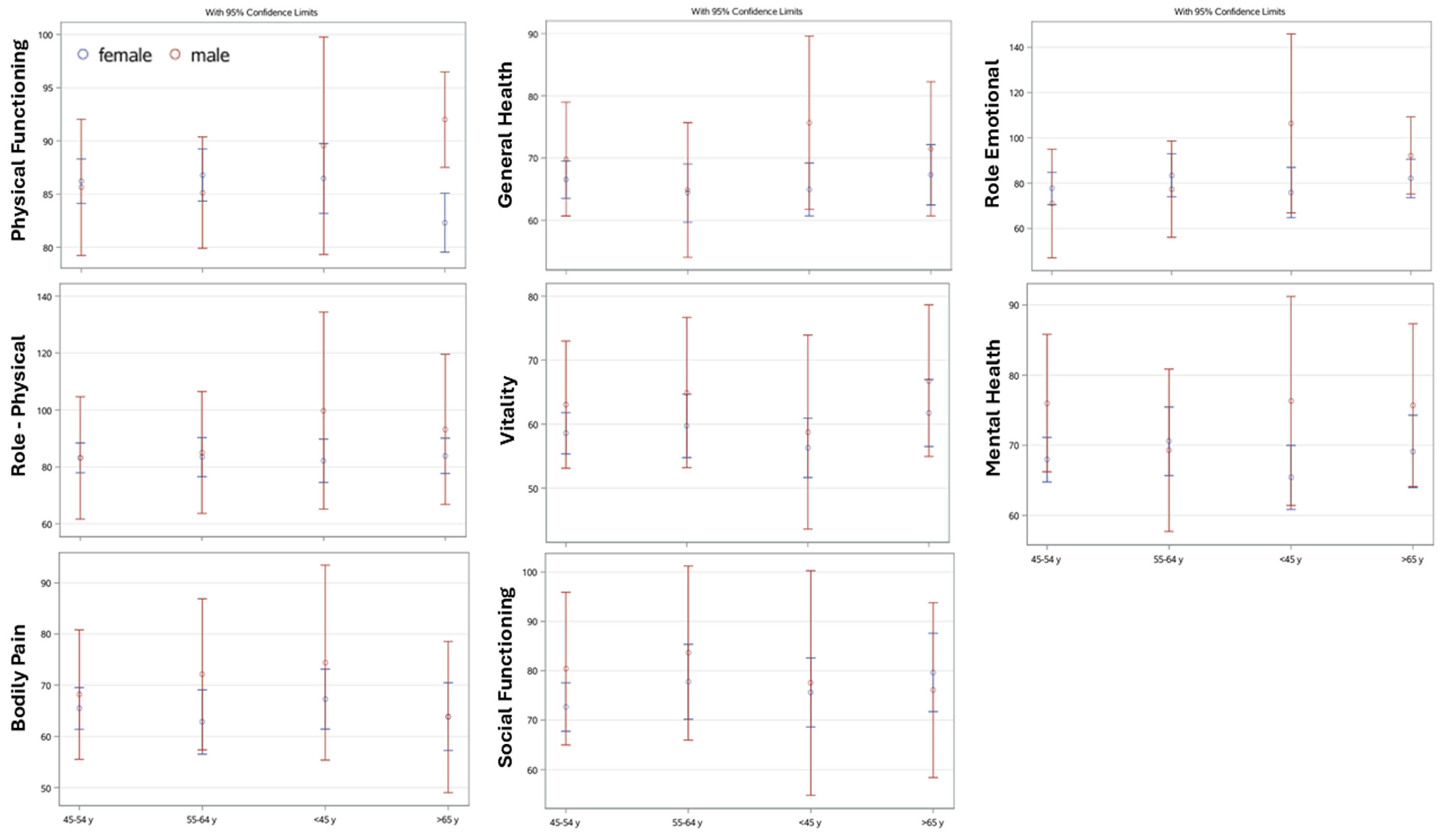
Table 1.
Examples of the exercise, their aims and applications.
| Exercise | Position | Focus | Supportive instrument |
|---|---|---|---|
| Breathing with one hand on the chest and one on the abs. Prolong each breathing phase for at least three seconds, feeling how the muscles act. | Lying on the back. | Global breathing. Perceiving the flow in inhalation and exhalation. | A mat and a towel for laying the head. |
| Breathing using the anterior muscles for enhancing relaxation, perceiving how the shoulder, thigh and leg are involved in inhalation and exhalation. | Lying on the back. | Anterior breathing. | A mat and a towel for laying the head. |
| Breathing using the anterior muscles for enhancing relaxation, perceiving how the head, back, thigh and leg are involved in inhalation and exhalation. | Lying on the back. | Posterior breathing. Head moving for better perception of the back muscles. | Mat. |
| Tilting the pelvis in the anterior and posterior direction, perceiving the action of the glutes, abs, and anterior thigh muscles. | Lying on the back. | Pelvis discovery. | Mat; small ball* for better perceiving specific muscle action. |
| Mobilising the pelvis through slow ankle intra or extra-rotation, thigh flexion and extension. | Lying on the back or sitting. | Pelvis discovering and mobilising. | Mat; small ball* for better perceiving specific muscle action. |
| Mobilising the pelvis through thigh, leg and foot actions. | Lying on the back, sitting or standing. | Pelvis discovering using the lower limbs. | Mat; small ball* |
| Perceiving back role in lying, moving the weight from the low back to the dorsum and scapula, using head rotation for muscle perception. | Lying on the back. | Back discovering. | Mat; small ball* for better perceiving specific muscle action. |
| Mobilising the shoulders through slow arm intra or extra-rotation, arm flexion and extension, abduction and adduction. | Lying on the back, sitting or standing. | Shoulder discovering and mobilising. | Mat; small ball* for better perceiving specific muscle action. |
| Mobilising the shoulders through arm, forearm and hand actions. | Lying on the back, sitting or standing. | Shoulder discovering using the upper limbs. | Mat; small ball* |
| Mobilising the spine through slow thorax and head movements on all the planes. | Lying on the back, sitting or standing. | Shoulder discovering, mobilising and strengthening. | Mat; small ball* for better perceiving specific muscle action. |
| Stretching back muscles. | Lying on the back, sitting or standing. | Relaxation | Mat; small ball*; big ball** |
| Stretching anterior muscles. | Lying on the back, sitting or standing. | ||
| Stretching lower limb muscles. | Lying on the back, sitting or standing. | ||
| Stretching upper limb muscles. | Lying on the back, sitting or standing. | ||
| Note:*small ball has dimension ““; **big ball has dimension ““. | |||
Disclaimer/Publisher’s Note: The statements, opinions and data contained in all publications are solely those of the individual author(s) and contributor(s) and not of MDPI and/or the editor(s). MDPI and/or the editor(s) disclaim responsibility for any injury to people or property resulting from any ideas, methods, instructions or products referred to in the content. |
© 2026 by the authors. Licensee MDPI, Basel, Switzerland. This article is an open access article distributed under the terms and conditions of the Creative Commons Attribution (CC BY) license.
Copyright: This open access article is published under a Creative Commons CC BY 4.0 license, which permit the free download, distribution, and reuse, provided that the author and preprint are cited in any reuse.


