

Submitted:
27 February 2026
Posted:
03 March 2026
You are already at the latest version
Abstract
Virtual Reality (VR) is increasingly recognized as a valuable tool for sports training, providing immersive environments that support skill acquisition and performance improvement. Comparative studies across hand-intensive sports such as basketball, volleyball, and table tennis show substantial research on VR’s effectiveness in basketball and table tennis, yet volleyball remains relatively underexplored, particularly in terms of skill transfer to real-world play.
Research in basketball and table tennis indicates that VR can improve motor coordination, tactical awareness, and user motivation. However, volleyball-specific literature is limited. Existing studies generally focus on areas such as eye–hand coordination and tactical decision-making but provide little evidence on whether VR-acquired skills translate effectively to the court. This paper addresses the gap in volleyball-focused VR research and emphasises the need for further investigation to maximise VR’s potential for volleyball training.
Ten beginner-level volleyball players (mean age = 20.4 years) participated in this study, which examined the effectiveness of VR-based serving training. Participants completed an initial physical pre-test to determine their baseline serving performance, followed by a three-week VR training program consisting of structured serving drills. After the program, a post-test assessment was conducted to measure improvement.
A paired t-test comparing pre- and post-training results showed a statistically significant improvement in serving performance (p = 0.0147), meeting the 0.05 significance threshold. This indicates that the observed performance gains were unlikely due to chance and demonstrates the positive impact of VR training on serving skills in beginner volleyball players.
Keywords:
virtual reality
; volleyball
; skill transferability
; sports training
; immersive environments
1. Introduction
Virtual Reality (VR) has emerged as a powerful tool for enhancing how individuals acquire, refine and transfer skills across various domains. In sports, where motor coordination, timing and decision-making are critical, VR offers a unique opportunity to simulate real-world conditions in a controlled and repeatable environment. Unlike traditional methods of training that rely heavily on physical access to facilities, equipment and coaching, VR provides an immersive and interactive platform where athletes can repeatedly practice targeted skills in a safe and structured setting.
The importance of VR in sports training lies in its ability to replicate task-specific scenarios, create a strong sense of presence, and engage users visually and kinesthetically. These features have been found to improve both motivation and skill retention, especially among beginners. Several studies have demonstrated that VR-based training can support motor learning, increase tactical awareness, and enhance overall performance. For instance, Neumann [1] found that VR interventions improved reaction time and decision making in dynamic sports contexts, while Alhadad and Abood [2] highlighted improvements in engagement and learning outcomes for physical tasks practiced in virtual environments. LaVelle [3] further argued that realistic VR environments stimulate sensory perception in a way that supports cognitive and motor skill development.
While VR has shown promise in hand-intensive sports like basketball and table-tennis, its use in volleyball, particularly for fundamental techniques like serving, is still in its early stages. A few experimental studies in table tennis provide encouraging evidence for VR's potential in skill transfer. For instance, Michalski et al. [4] found that players who trained in VR significantly improved their performance compared to those who didn't train at all, suggesting that VR can simulate a realistic match environment. Oagaz et al. [5] took this further by incorporating realistic physics, haptic feedback, and motion capture into their VR setup. Their findings showed that complex motor skills developed in VR could carry over effectively into real-world play.
Basketball has also seen a number of experimental studies supporting the use of VR for both tactical and technical training. Zamzami [6] looked into how players learned the jump-shot using VR and found it to be an effective tool. Similarly, Tsai et al. [7] reported that VR could help players better understand basketball tactics, while Chan et al. [8] showed improvements in shooting performance and ankle stability after VR-based training. Page et al. [9] added to this by showing that decision-making skills trained in VR outperformed those learned through traditional computer screen training.
In contrast, volleyball still lacks this level of experimental support. Hatira et al. [10] compared eye-hand coordination training using VR, AR, and 2D touchscreen systems, finding that players actually performed better with the 2D interface, pointing to a need for more development in VR tools for volleyball. Chen et al. [11] created a VR setup focused on setter training, but didn't evaluate whether the skills practiced in VR translated into real-world performance. These gaps highlight the need for further research focused specifically on how well VR can support the learning and transfer of individual volleyball skills.
The study evaluates whether beginner volleyball players can improve their serving accuracy and consistency through a structured VR training program. Ten novice participants underwent a three-week training intervention using a VR system built with Unity 3D [12], incorporating realistic ball physics. Pre and post-assessment data were collected to measure changes in serving performance, allowing for a comparison between virtual practice and real-world outcomes. The study also applied ethical principles, such as beneficence – ensuring a safe and beneficial learning environment; equity – providing access to technology-enhanced training regardless of background; and development – contributing to the growing field of tech-integrated sports education.
The results suggest that immersive VR-based training can lead to measurable improvements in serving accuracy for beginners, supporting the potential of virtual tools in enhancing skill acquisition and bridging the gap between simulated and real-world performance. This study provides early but promising evidence for the role of VR in volleyball training, contributing to the broader conversation on how emerging technologies can be integrated into sports training.
2. Materials and Methods
Ethics Statement
The experiment was approved by the Computer Science Faculty Board of the School of Science and Technology (SST), Pan-Atlantic University (PAU) and carried out in the aforementioned institution. All participants of the study were given verbal information about the study and gave their verbal informed consent to participate.
Participants
Nine young males and one female, students of SST at PAU, participated in this study. All subjects reported zero to little prior experience in volleyball in general. None of the participants had ever taken part in any previous virtual reality skill transferability experiment.

Table 1.
Demographic Profile of Study Participants.
| Participant | Age | Gender | Volleyball Experience | Previous VR Use | Comfort with Tech (1-10) |
| P1 | 20 | Male | <1 year | Yes | 10 |
| P2 | 21 | Male | <1 year | Yes | 5 |
| P3 | 21 | Male | <1 year | No | 8 |
| P4 | 20 | Male | <1 year | No | 8 |
| P5 | 21 | Male | <1 year | Yes | 6 |
| P6 | 20 | Female | <1 year | No | 9 |
| P7 | 22 | Male | <1 year | Yes | 10 |
| P8 | 21 | Male | <1 year | Yes | 9 |
| P9 | 18 | Male | <1 year | Yes | 8 |
| P10 | 20 | Male | <1 year | No | 8 |
Apparatus
Laboratory Tests
The volleyball serving skill transferability experiment was conducted using a fully immersive virtual environment, thanks to a Meta Quest 2 head-mounted display in a controlled environment. The headset is a 3D-ready system that allows image projection on two LCD panels with a resolution of 1832 x 1920 pixels per eye, covering a maximal visual field of approximately 90°. The head-mounted display was securely fitted to each participant's head using the adjustable elastic head strap system, ensuring comfort and proper alignment of the display relative to each user’s eye and head size. This experiment was facilitated by a Dell Alienware, powered by an NVIDIA GeForce RTX 2060 graphics card, and a Core i7 processor. The headset was connected to the computer to offer an immersive experience.
Field Tests
Serving skill assessment was conducted before and after the VR training intervention. The assessments were done on a standard volleyball court. Each participant was instructed on how and when a valid serve is made. They were made aware of the service line where they are to stand and how to serve the ball in such a way that it gets to a valid area on the opposite side of the court. Each participant had ten tries to make a valid serve.
Research Instrument
The VR volleyball training system used for this experiment was self-developed. It was developed using Unity [12]; C# scripts were generated using Visual Studio Code, and prefabricated models of the volleyball court, the ball and the sports arena were obtained from sites such as CGTrader and SketchFab. The C# scripts were responsible for defining the overall functionality and logic of the VR training system. In order to meet the objectives of the experiment, this custom VR training system was created, as current VR volleyball systems aren't well known to be used for training. Quantitative data were obtained from the serving accuracy scores generated during the pre- and post-test sessions and then analysed using Microsoft Excel and Stata. Qualitative data was generated from participant feedback via Google Forms.
Serving Skill Assessment
On-field serving skill assessment was recorded using standardised assessment criteria adapted from previous studies [13]. Gabbett et al. [13] developed the standardised skill assessment for junior volleyball players to evaluate the reliability, validity, and sensitivity of the test for detecting training-induced improvements in skill. Their study cut across skills such as spiking, setting, serving, and passing. They defined criteria which made any of the skills carried out valid, and also defined score allocation. For this study, serving was the only skill assessed. The quality of each serve was recorded as 1 for a correct serve and 0 for an incorrect serve, as seen in the criteria in Table 2. This assessment was carried out by an intermediate-level volleyball player with knowledge of how a valid serve is made. This personnel made use of the assessment instrument. The total score of each participant was converted to a percentage for analysis. These percentage accuracy values were established for each participant by dividing the number of correct serves by the total number of serves made and then multiplying by 100.
VR volleyball training system
The VR volleyball training system was accessed when the participant put on the head-mounted display. The participant is then immersed in the Volleyball Training Environment, which is simply a virtual volleyball court with a virtual volleyball. The participant then selects the option to begin the serving drill. The participant makes use of the controllers to grab the virtual ball, and then mimics a serve i.e throws the ball up with the left hand controller, and then hits the ball with the right hand controller. If a successful serve is made, the target area on the other side of the court turns green, and the ball returns to the service area for another serve; otherwise, the ball just returns to the serve position. A scoreboard exists in the environment which lets the user know the number of serves made in total, as well as the number of correct and incorrect serves out of the total number of serves made.
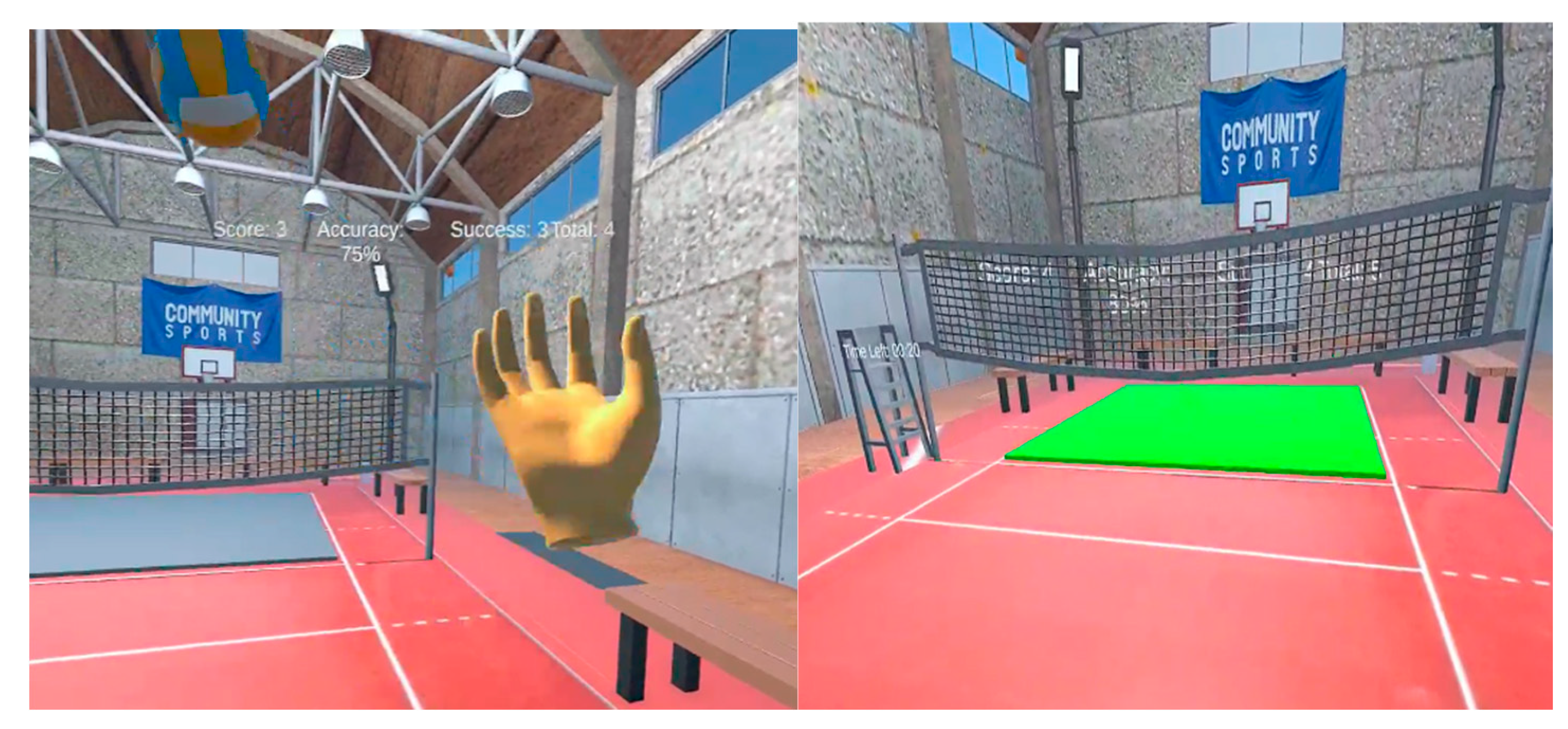
Figure 1.
VR Volleyball Serving Training Illustration. The first part of the image shows a serve being made, while the other shows what happens when a valid serve is made.
Figure 1.
VR Volleyball Serving Training Illustration. The first part of the image shows a serve being made, while the other shows what happens when a valid serve is made.
Procedure
The participants were selected randomly, and only one group was used. This is because we were trying to investigate the impact the VR training system has on the same set of participants. The participants were nine in number (n = 9). All participants completed a pre-test (to validate if they were truly beginners when it comes to serving in volleyball), and a post-test (to validate if their serving skills improved as a result of the VR training intervention). The participants didn’t partake in any other training research interventions.
Analysis
Serving accuracy scores obtained from the pre- and post-test training sessions were compared. To determine if the difference in serving accuracy scores per participant was significant, we conducted a paired samples t-test. The analysis yielded a one-tailed p-value of 0.0147, which indicates a significant improvement in serving accuracy (p < 0.05), suggesting that the VR training positively influenced skill development.
3. Results
Hypotheses
The hypotheses were defined as follows:
- Null Hypothesis (H0): There is no significant difference in the mean scores between the variables Pre-Test and Post-Test variables (i.e., VR training did not impact the serving skill).
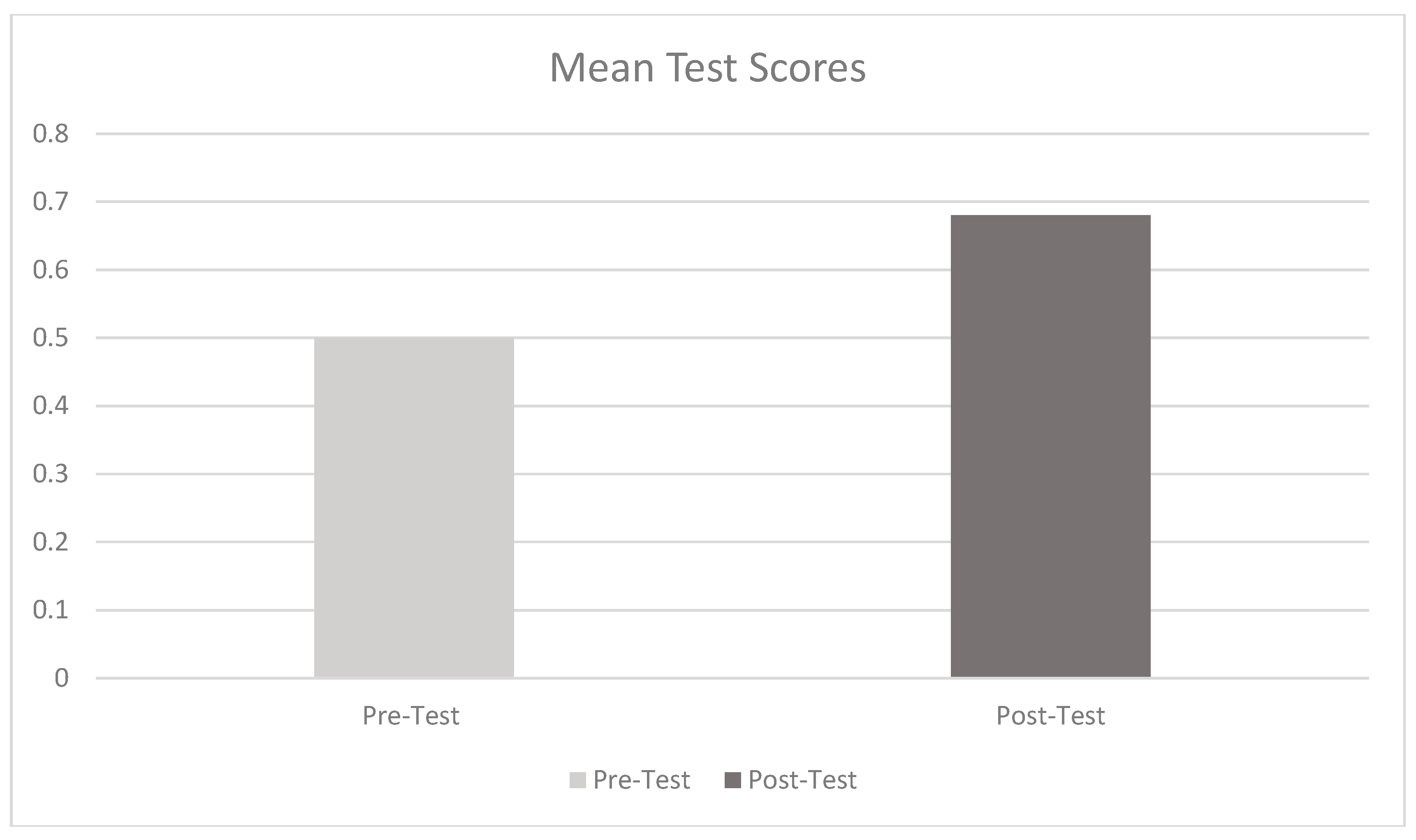
- Alternative Hypothesis (H1): There is a significant difference in the mean scores between the Pre-Test and Post-Test variables (i.e., VR training improved serving skill).Figure 2. A bar chart visualization showing the mean scores of the pre and post test sessions.
Serving Skill Assessment
The paired differences between pre-test and post-test scores were calculated for each participant. Below are the computed statistics:
Table 3.
Paired Samples t-Test Summary for Pre-Test and Post-Test Serving Scores.
| Statistic | Value |
| Mean of Differences (Post - Pre) | 0.1800 |
| Standard Deviation of Differences | 0.2201 |
| Standard Error of the Mean Difference | 0.0696 |
| Degrees of Freedom (df) | 9 |
| t-Statistic | 2.5861 |
| t Critical (one-tailed) | 1.8331 |
| t Critical (two-tailed) | 2.2622 |
| p-Value (one-tailed) | 0.0147 |
| p-Value (two-tailed) | 0.0294 |
| Confidence Interval (95%) – Lower Bound | 0.0227 |
| Confidence Interval (95%) – Upper Bound | 0.3373 |
The results of the paired-samples t-test show that the mean post-test score (0.68) is higher than the mean pre-test score (0.50). With a t-statistic of 2.586 and a p-value (one-tailed) of 0.0147, the difference is statistically significant at the 0.05 significance level (α = 0.05). Since p < 0.05, we reject the null hypothesis and accept the alternative hypothesis. This indicates that the difference in mean scores is not due to chance, suggesting that the VR training positively affected volleyball serving performance.
4. Discussion
This study was conducted to evaluate the effectiveness of a VR-based volleyball training system in improving serving accuracy among beginner players. The main finding was an 18% mean increase in serving accuracy from the pre- to the post-test, a difference that reached statistical significance (p = 0.0147). These results suggest that even a short intervention with the VR system can produce meaningful improvements in the fundamental volleyball skill.
Serving accuracy improvement in VR
Serving requires precise coordination of ball toss, arm swing, timing and placement. The VR environment in this study reproduced these elements within a controlled, repeatable setting, allowing players to perform multiple serves in succession without the physical limitations of a real court. The system provided immediate visual feedback – targets turning green upon successful serves – along with a live scoreboard tracking correct and incorrect attempts. Such real-time knowledge likely contributed to the performance gains observed.
Alignment of training and assessment criteria
A key feature of the design was the consistency between the VR drill's success criteria and the on-court assessment standards adapted from Gabbett et al. [13]. Valid serves were defined identically in both contexts: correct starting position and landing in the designated target area. This overlap may have reinforced correct serving mechanics and promoted direct skill transfer from the virtual to the physical environment.
VR as a supplementary training tool
These findings are consistent with research in other sports showing that immersive simulation can enhance skill acquisition by enabling high-quality, structured, and repeatable practice [1,4,5,6,7,8,9]. Unlike traditional sessions, VR eliminated many logistical constraints such as space, equipment availability, and scheduling, while still engaging players with realistic visual and motor demands. Although the present study focused solely on serving, similar benefits may be achievable for other volleyball skills like passing, setting, or spiking.
Limitations and future directions
This investigation was limited by its small sample size (n = 10) and the focus on beginner players. It is unclear whether experienced players would benefit to the same degree, or how long the gains observed here would be retained without continued VR practice. Future studies should examine skill retention, test performance transfer in competitive match settings, and compare VR training directly with conventional court-based drills. Expanding the scope to include other technical skills would also help determine the broader applicability of VR training in volleyball.
5. Conclusions
In conclusion, the results provide early evidence that VR can be an effective supplementary tool for developing serving accuracy in volleyball. By combining realistic visual environments, consistent task repetition, and immediate performance feedback, VR offers an engaging and accessible means of skill development – particularly valuable in settings where traditional on-court practice is limited.
Author Contributions
Conceptualization, Chima Okwuokei and Clifford Uroh.; methodology, Chima Okwuokei.; software, Chima Okwuokei.; validation, Samuel Oyefusi.; data curation, Chima Okwuokei.; writing—original draft preparation, Chima Okwuokei.; writing—review and editing, Desmond Moru and Clifford Uroh.; visualization, Chima Okwuokei.; supervision, Desmond Moru.; All authors have read and agreed to the published version of the manuscript.
Funding
This research received no external funding.
Institutional Review Board Statement
The experiment was approved by the Computer Science Faculty Board of the School Of Science and Technology (SST), Pan-Atlantic University (PAU) and carried out in the aforementioned institution. All participants of the study were given verbal information about the study and gave their verbal informed consent to participate.
Informed Consent Statement
Informed consent was obtained from all subjects involved in the study.
Data Availability Statement
The datasets supporting the conclusions of this article are included within the article itself.
Conflicts of Interest
The authors declare no conflicts of interest.
References
- Neumann, D. On the use of virtual reality in sport and exercise: applications and research findings. Nova Publishers, 2016.
- Alhadad, S.A.; Abood, O.G. Application of virtual reality technology in sport skill. International Journal of Academic Management Science Research 2018, 2, 31–40. [Google Scholar] [CrossRef]
- LaVelle, S.M. Virtual Reality. Cambridge University Press, 2023.
- Michalski, S.C.; Szpak, A.; Saredakis, D.; Ross, T.J.; Billinghurst, M.; Loetscher, T. Getting your game on: Using virtual reality to improve real table tennis skills. PloS ONE 2019, 14, e0222351. [Google Scholar] [CrossRef] [PubMed]
- Oagaz, H.; Schoun, B.; Choi, M.H. Performance improvement and skill transfer in table tennis through training in virtual reality. IEEE Transactions on Visualization and Computer Graphics 2021, 28, 4332–4343. [Google Scholar] [CrossRef] [PubMed]
- Zamzami, M. The effectiveness of using virtual reality technology on learning the jump-shot skill in basketball. Jurnal MensSana 2020, 5, 191–201. [Google Scholar] [CrossRef]
- Tsai, W.L.; Pan, T.Y.; Hu, M.C. Feasibility study on virtual reality based basketball tactic training. IEEE Transactions on Visualization and Computer Graphics 2020, 28, 2970–2982. [Google Scholar] [CrossRef] [PubMed]
- Chan, C.H.M.; Ma, M.K.I.; Chan, T.K.; Yeung, L.T.; Chan, Y.K. Current applications of virtual reality in basketball training: a systematic review. Sports Engineering 2024, 27, 26. [Google Scholar] [CrossRef]
- Pagé, C.; Bernier, P.M.; Trempe, M. Using video simulations and virtual reality to improve decision-making skills in basketball. Journal of Sports Sciences 2019, 37, 2403–2410. [Google Scholar] [CrossRef] [PubMed]
- Hatira, N.; Aliza, A.; Batmaz, A.U.; Sarac, M. Enhancing Eye-Hand Coordination in Volleyball Players: A Comparative Analysis of VR, AR, and 2D Display Technologies and Task Instructions. In 2024 IEEE International Symposium on Mixed and Augmented Reality (ISMAR), pp. 219–228. IEEE, 2024.
- Chen, Y.H.; Fu, C.W.; Huang, W.L.; Su, M.C.; Huang, H.Y.; Chen, A.; Pan, T.Y. SettterVision: Motion-based tactical training system for volleyball setters in virtual reality. In Proceedings of the 31st ACM International Conference on Multimedia, pp. 9382–9384. 2023.
- Unity Technologies. Build VR experiences with Unity. Retrieved from https://unity.com/solutions/vr.
- Gabbett, T.; Georgieff, B.; Anderson, S.; Cotton, B.; Savovic, D.; Nicholson, L. Changes in skill and physical fitness following training in talent-identified volleyball players. The Journal of Strength & Conditioning Research 2006, 20, 29–35. [Google Scholar] [CrossRef]
Table 2.
Serving Skill Assessment Instrument.
| Decision Criterion | Valid Skill | Invalid Skill |
| Serving | The player made a valid serve when the volleyball was hit from the designated serving point, and the ball landed in a valid target area on the other side of the court. | The player made an invalid serve if the ball was not hit from a valid serving position. Also when the ball is hit from a valid serving position, but the ball doesn’t land on a designated target area on the other side of the court. An invalid serve is made when the ball hits the net. |
Disclaimer/Publisher’s Note: The statements, opinions and data contained in all publications are solely those of the individual author(s) and contributor(s) and not of MDPI and/or the editor(s). MDPI and/or the editor(s) disclaim responsibility for any injury to people or property resulting from any ideas, methods, instructions or products referred to in the content. |
© 2026 by the authors. Licensee MDPI, Basel, Switzerland. This article is an open access article distributed under the terms and conditions of the Creative Commons Attribution (CC BY) license (http://creativecommons.org/licenses/by/4.0/).
Copyright: This open access article is published under a Creative Commons CC BY 4.0 license, which permit the free download, distribution, and reuse, provided that the author and preprint are cited in any reuse.


