
Submitted:
01 March 2026
Posted:
03 March 2026
You are already at the latest version
Abstract
Large Language Model (LLM) based multi-agent systems have demonstrated remarkable potential in automating complex software engineering tasks. However, existing frameworks such as MetaGPT and AutoGen suffer from critical limitations including static role assignments, cascading hallucinations in long-horizon tasks, and the absence of experience accumulation mechanisms. We propose Eco-Evolve, a self-reflective multi-agent collaboration framework that addresses these challenges through three key innovations: (1) a dynamic topology generation mechanism that adaptively constructs agent communication graphs based on task complexity, (2) a system reflection module featuring a dedicated Critic Agent for deliberate verification at critical checkpoints, and (3) an error-driven self-evolution mechanism inspired by Hindsight Experience Replay (HER) that enables prompt optimization through experiential learning. We evaluate Eco-Evolve on SWE-bench Verified and DevBench, achieving62.3% and 73.5% respectively, representing improvements of26.6% and 14.7% over the strongest baseline. Comprehensive ablation studies validate the contribution of each component, demonstrating that integrating dynamic collaboration, deliberate reflection, and continuous evolution significantly advances the state of the art in automated software engineering.
Keywords:
multi-agent systems
; large language models
; software engineering
; self-reflection
; prompt optimization
1. Introduction
The emergence of Large Language Models (LLMs) has catalyzed a paradigm shift in automated software engineering, transforming how we conceptualize code generation, debugging, and system design [1,2]. Multi-agent systems powered by LLMs have demonstrated that collective intelligence can substantially surpass individual agent capabilities. This advantage emerges particularly when agents assume specialized roles and engage in structured collaboration [3]. These systems simulate virtual software companies where agents playing distinct roles—such as product managers, architects, and developers—coordinate through predefined workflows to accomplish complex programming tasks.
Despite promising results, existing LLM-based multi-agent frameworks exhibit fundamental limitations that hinder their effectiveness in real-world software engineering scenarios. First, these systems typically employ static role configurations and fixed communication topologies that fail to adapt to varying task complexity [4]. A simple bug fix does not require the same elaborate multi-agent orchestration as designing a distributed system architecture. Second, the predominant reliance on single-pass generation leads to cascading hallucinations, where errors in early stages propagate and amplify through subsequent phases [1]. Third, current frameworks lack mechanisms for experiential learning; each task execution starts from scratch without leveraging insights from previous successes or failures.
The human software development process naturally addresses these challenges through adaptive team composition, deliberate code review practices, and accumulated institutional knowledge. Senior engineers intuitively adjust their collaboration patterns based on task requirements, engage in careful reflection before committing critical changes, and continuously refine their approaches based on past experiences. This observation motivates our research question: Can we design a multi-agent framework that emulates these human-like adaptive and reflective capabilities?
In this paper, we propose Eco-Evolve, a self-reflective multi-agent collaboration framework that introduces three synergistic innovations. Our first contribution is a dynamic topology generation mechanism that models the multi-agent system as an adaptive graph, where agent roles and communication channels are instantiated based on task-specific requirements rather than static templates. Second, we introduce a system reflection module inspired by dual-process theory in cognitive science [5]. While working agents perform fast, intuitive generation (System 1), a dedicated Critic Agent engages in slow, deliberate verification (System 2) at critical checkpoints to catch errors before they propagate. Third, we develop an error-driven self-evolution mechanism that draws inspiration from Hindsight Experience Replay (HER) [6] in reinforcement learning. By reinterpreting failed task executions as learning opportunities and maintaining a RAG-based long-term memory, our framework continuously optimizes its prompts and strategies.
We conducted comprehensive experiments on two established benchmarks: SWE-bench Verified [7], which evaluates agents on real-world GitHub issues, and DevBench [8], which assesses performance across the complete software development lifecycle. Eco-Evolve achieved 62.3% on SWE-bench Verified and 73.5% on DevBench, substantially outperforming MetaGPT, ChatDev, and AutoGen. Ablation studies confirm that each proposed component contributes meaningfully to overall performance, with the combination yielding synergistic benefits beyond individual contributions.
2. Related Work
2.1. LLM-Based Multi-Agent Systems
The development of LLM-based multi-agent systems has progressed rapidly since the introduction of collaborative frameworks for software engineering. MetaGPT [1] pioneered the incorporation of Standardized Operating Procedures (SOPs) into multi-agent workflows, enabling agents with specialized roles to produce structured artifacts that reduce hallucination through constrained output formats. ChatDev [2] introduced chat-powered software development through communicative dehallucination, where agents engage in multi-turn dialogues to refine solutions. AutoGen [3] provides a flexible framework for building conversational agents that can operate in various modes combining LLMs, human inputs, and tools.
Recent work has explored dynamic aspects of multi-agent collaboration. G-Designer [4] employs graph neural networks to architect task-aware communication topologies, demonstrating that adaptive structures can improve efficiency. However, these approaches typically optimize topology separately from the agent reasoning process and do not incorporate reflective mechanisms for error correction.
2.2. Reasoning and Reflection in LLM Agents
Chain-of-thought prompting [9] demonstrated that encouraging intermediate reasoning steps significantly improves LLM performance on complex tasks. ReAct [10] extended this concept by interleaving reasoning traces with actions, enabling agents to dynamically adjust plans based on environmental feedback. Reflexion [11] introduced verbal reinforcement learning, where agents learn from linguistic feedback stored in episodic memory rather than through weight updates.
These reflection mechanisms have proven effective but are typically applied to single-agent settings. Our work extends the reflection paradigm to multi-agent systems through a dedicated Critic Agent that provides deliberate oversight of the collaborative process.
2.3. Memory and Learning in Agent Systems
Retrieval-Augmented Generation (RAG) [12] provides a mechanism for LLMs to access external knowledge, improving factual accuracy and enabling knowledge updates without retraining. In the context of agent systems, RAG has been employed for task-relevant information retrieval, but its potential for experiential learning remains underexplored.
Hindsight Experience Replay [6] revolutionized reinforcement learning in sparse reward settings by reinterpreting failed trajectories as successes for alternative goals. This principle of learning from failures has not been systematically applied to LLM agent prompt optimization, representing a significant gap that our work addresses.
3. Methodology
We present Eco-Evolve, a framework that integrates dynamic collaboration, deliberate reflection, and continuous evolution. Figure 1 illustrates the overall architecture.
3.1. Dynamic Topology Generation
Traditional multi-agent frameworks employ fixed configurations regardless of task characteristics. We observe that task complexity varies significantly, from simple single-file bug fixes to complex multi-module feature implementations. Our dynamic topology generation mechanism addresses this mismatch.
Given a task description T, we first compute a complexity score through a learned analyzer:
where denotes LLM encoding, and are learnable parameters, and is the sigmoid function. Based on , we instantiate an appropriate topology from a learned topology generator.
We model the multi-agent system as a directed graph where vertices V represent agents and edges E represent communication channels. For a task with complexity , we generate the topology through:
where is the probability that topology G is effective for task T. The efficiency term penalizes unnecessary complexity and is defined as:
where and denote the number of vertices (agents) and edges (communication channels) respectively, and , are hyperparameters controlling the penalty strength (we set and in our experiments).
Figure 2 illustrates how topologies adapt to task complexity. Simple tasks utilize chain topologies with minimal agents, while complex tasks invoke mesh topologies with additional specialized roles including the Critic Agent.
3.2. System 2 Reflection Module
Inspired by dual-process theory [5], we introduce a dedicated Critic Agent that implements deliberate, analytical reasoning (System 2) to complement the fast, intuitive generation of working agents (System 1). The Critic Agent operates at designated checkpoints in the development pipeline.
For each checkpoint artifact , the Critic Agent performs structured evaluation:
where represents checkpoint-specific criteria and is the execution history. The evaluation produces a reflection containing identified issues, severity assessments, and suggested corrections.
The Critic Agent operates through a multi-phase protocol: (1) in the verification phase, it checks logical consistency, requirement alignment, and potential errors; (2) in the synthesis phase, it generates actionable feedback; and (3) in the integration phase, working agents incorporate the feedback and regenerate artifacts if necessary.
We implement execution-based verification for code artifacts:
where represents static analysis scores and represents execution-based validation results. We set in our experiments.
3.3. Error-Driven Self-Evolution
Our self-evolution mechanism enables the framework to learn from experience, particularly from failures. We adapt the concept of Hindsight Experience Replay [6] to the prompt optimization domain.
Consider a task execution trajectory where states represent system configurations and actions represent agent operations. In traditional settings, a failed trajectory (one that does not achieve the intended goal g) provides no learning signal. HER-Prompt reinterprets this trajectory by identifying what goal was actually achieved:
where is the final state of the trajectory. The ExtractAchievement function analyzes the execution trace to identify partial successes, such as successfully completed subtasks (e.g., correct imports, passing a subset of unit tests), generated intermediate artifacts, or resolved subproblems.
Concrete Example: Consider a code generation task where the target is implementing a REST API endpoint. If the generated code fails integration tests but successfully: (1) sets up the correct routing structure, (2) implements proper request parsing, and (3) passes authentication checks, then represents “successful implementation of API scaffolding with authentication.” This reframed experience teaches the system what patterns lead to these partial successes.
We store both the original experience and the reinterpreted experience in our long-term memory bank, where is a reformulated task that successfully solves.
The memory bank is implemented using RAG with semantic indexing:
where represents experiences and is the embedding function.
For a new task , we retrieve relevant experiences:
These experiences inform prompt optimization through gradient-free updates:
where ⊕ denotes prompt augmentation that appends retrieved experience summaries to the base prompt, and extracts actionable patterns from retrieved experiences by identifying common success factors and failure modes.
3.4. Integration and Workflow
Algorithm 1 presents the integrated Eco-Evolve workflow. The framework maintains continuous interaction among the three mechanisms: dynamic topology enables efficient resource allocation, System 2 reflection ensures quality gates prevent error propagation, and self-evolution improves performance over time.
| Algorithm 1 Eco-Evolve Framework |
Require: Task T, Memory Bank , Base Prompts P
|
4. Experiments
4.1. Experimental Setup
We evaluated Eco-Evolve on two comprehensive benchmarks. SWE-bench Verified [7] contains 500 real-world GitHub issues from 12 popular Python repositories, filtered to ensure solvability.1 DevBench [8] evaluates LLMs across the complete software development lifecycle including design, implementation, and testing phases, featuring 22 repositories across Python, C/C++, Java, and JavaScript.
We compared against three state-of-the-art multi-agent frameworks: MetaGPT [1], ChatDev [2], and AutoGen [3]. All frameworks used GPT-4-Turbo as the base LLM for fair comparison. We ran each experiment three times and report mean results. The memory bank was initialized empty and accumulated experiences during evaluation under a fixed task ordering. Importantly, while the memory bank is updated during evaluation, no gradient updates are performed and all baselines operate under the same task sequence. Eco-Evolve can thus be viewed as an online continual agent that exploits episodic experience, rather than a model fine-tuned on the evaluation benchmarks.
4.2. Evaluation Metrics
We evaluate performance using six complementary metrics to provide a comprehensive assessment:
- Pass@1: The primary success rate metric indicating the percentage of tasks solved correctly on the first attempt.
- Code Quality: A composite score combining static analysis results (pylint/flake8 scores) and unit test coverage, normalized to [0, 100].
- Iteration Efficiency: Defined as , measuring success rate per 10k tokens consumed.
- Error Recovery: The fraction of initially failed cases that are successfully fixed after additional Critic-triggered iterations: .
- Consistency: The standard deviation of success rates across three runs, inverted and normalized: .
- Scalability: Performance retention ratio when task complexity increases from low to high: .
4.3. Main Results
Table 1 presents the main experimental results. Eco-Evolve achieved 62.3% on SWE-bench Verified and 73.5% on DevBench, substantially outperforming all baselines. On SWE-bench Verified, Eco-Evolve improved upon MetaGPT by 13.1 percentage points (26.6% relative improvement). On DevBench, the improvement over MetaGPT was 9.4 percentage points (14.7% relative improvement).
Figure 3 provides a multi-dimensional comparison across the six evaluation metrics. Eco-Evolve demonstrates consistent superiority, with particularly notable improvements in Error Recovery (82.1% vs. 58.4% for MetaGPT) and Iteration Efficiency (85.2% vs. 68.7% for MetaGPT). The right panel shows improvement percentages across different task categories, confirming that gains are consistent rather than concentrated in specific task types.
4.4. Ablation Study
To understand the contribution of each component, we conducted ablation studies by removing individual mechanisms. Table 2 and Figure 4 present the results.
Removing the memory bank caused the largest performance drop (13.6 points on SWE-bench), highlighting the importance of experiential learning. The Critic Agent contributed 10.5 points, confirming that System 2 reflection is essential for quality assurance. Dynamic topology generation accounted for 8.1 points, demonstrating the value of adaptive collaboration structures. HER-Prompt contributed 5.9 points, showing that learning from failures provides meaningful optimization signals.
The right panel of Figure 4 illustrates learning dynamics over evolution iterations. Baseline frameworks (MetaGPT, ChatDev, AutoGen) do not possess cross-task evolution mechanisms and are thus shown as horizontal reference lines representing their static performance levels. Iteration 0 for Eco-Evolve corresponds to the “w/o HER-Prompt” ablation configuration (56.4% on SWE-bench), representing performance before any evolution occurred. As evolution progressed, Eco-Evolve demonstrated sustained improvement, with the gap over the strongest baseline widening from 7.2 points at iteration 0 to 13.1 points at iteration 10.
4.5. Analysis of Dynamic Topology
We analyzed how the dynamic topology mechanism adapts to task characteristics. Table 3 shows the distribution of generated topologies across task complexity levels.
Low-complexity tasks predominantly utilized chain topologies (78.2%), minimizing communication overhead. High-complexity tasks favored mesh topologies (75.9%) with enhanced collaboration. This adaptive behavior reduced average token consumption by 23.7% compared to fixed mesh topologies while maintaining superior performance.
4.6. Computational Overhead Analysis
Table 4 compares the computational overhead of Eco-Evolve against baseline frameworks. Overall, Eco-Evolve incurred approximately 12% additional token consumption compared to MetaGPT and 8% compared to AutoGen, while achieving substantially higher success rates. The Critic Agent accounts for roughly 15% of Eco-Evolve’s total token usage, while HER-Prompt memory retrieval adds minimal overhead (<2%).
4.7. Case Study: Error Recovery
We present a representative case illustrating the System 2 reflection mechanism. Consider a bug fix task where the initial generated patch introduces a regression. Without reflection, this error propagates to subsequent phases, ultimately producing an incorrect solution.
With the Critic Agent enabled, the reflection module identified the regression during verification: “The proposed change modifies the return type from List to Optional[List], which breaks the contract with calling functions in module X.” This feedback triggered targeted revision, resulting in a correct patch that preserved interface compatibility.
Across 50 randomly sampled error cases, System 2 reflection successfully recovered 37 cases (74%) that would otherwise have failed. The average number of revision iterations required was 1.8, indicating efficient error correction.
4.8. Case Study: HER-Prompt Achievement Extraction
To illustrate how HER-Prompt extracts achievements from failed trajectories in practice, we present a concrete example from our experiments.
Task: Implement a function to parse and validate JSON configuration files with nested schemas.
Generated Code (Failed): The code correctly implemented JSON parsing, schema validation for top-level fields, and error message generation, but failed on deeply nested schema validation (3+ levels).
Extracted Achievements ():
- Successfully implemented robust JSON parsing with proper exception handling
- Correctly validated all top-level and second-level schema fields
- Generated informative error messages following project conventions
Reformulated Task (): “Implement a function to parse JSON files and validate top-level schema with descriptive error messages.”
This reframed experience is stored in the memory bank. When encountering similar JSON parsing tasks, the system retrieves this experience and applies the successful patterns (parsing structure, error handling approach) while recognizing that deep nesting requires additional attention.
5. Discussion
Our experiments demonstrate that integrating dynamic collaboration, deliberate reflection, and experiential learning produces substantial improvements in automated software engineering. Several insights emerge from our analysis.
Synergistic Effects. The combined performance gains exceed additive contributions from individual components. When combining all mechanisms, we observed performance improvements larger than the sum of individual ablation drops, suggesting that the components reinforce each other. Dynamic topology provides the structural foundation for efficient collaboration, System 2 reflection ensures quality gates prevent error propagation, and self-evolution continuously improves the underlying strategies.
Learning Dynamics. While baseline frameworks benefit primarily from in-context examples (which quickly saturate), Eco-Evolve’s RAG-based memory enables unbounded accumulation of experiential knowledge. This suggests potential for continued improvement with extended operation.
Fairness of Online Evaluation. Although the memory bank is updated during evaluation, we emphasize that: (1) no gradient updates are performed; (2) all methods operate under identical task orderings; and (3) baselines could theoretically implement similar episodic caching but do not. Eco-Evolve thus represents an online continual learning agent rather than a model fine-tuned on evaluation data.
Limitations. Our current approach has several limitations: (1) the computational overhead of maintaining the Critic Agent (approximately 15% increased token consumption); (2) the cold-start challenge when the memory bank is empty; and (3) potential sensitivity to task ordering during evolution. Future work could explore distillation techniques to reduce Critic overhead, pre-population strategies for memory initialization, and order-invariant evolution mechanisms.
6. Conclusions
We presented Eco-Evolve, a self-reflective multi-agent collaboration framework that addresses fundamental limitations in existing LLM-based software engineering systems. Through dynamic topology generation, System 2 reflection via a dedicated Critic Agent, and HER-inspired self-evolution, our framework achieves state-of-the-art results on SWE-bench Verified (62.3%) and DevBench (73.5%), representing improvements of 26.6% and 14.7% over the strongest baseline respectively. Our ablation studies confirm that each component contributes meaningfully, with their integration producing synergistic benefits.
The success of Eco-Evolve suggests promising directions for future research, including extending the framework to other domains beyond software engineering, exploring more sophisticated topology learning mechanisms, and investigating methods to accelerate the evolution process. We believe that frameworks combining adaptive collaboration, deliberate reasoning, and continuous learning represent a significant step toward more capable and reliable AI systems for complex task automation.
References
- Hong, S.; Zhuge, M.; Chen, J.; Zheng, X.; Cheng, Y.; Wang, J.; Zhang, C.; Wang, Z.; Yau, S.K.S.; Lin, Z.; et al. MetaGPT: Meta Programming for A Multi-Agent Collaborative Framework. In Proceedings of the Proc. Int. Conf. Learn. Representations (ICLR), 2024.
- Qian, C.; Liu, W.; Liu, H.; Chen, N.; Dang, Y.; Li, J.; Yang, C.; Chen, W.; Su, Y.; Cong, X.; et al. ChatDev: Communicative Agents for Software Development. In Proceedings of the Proc. 62nd Annu. Meeting Assoc. Comput. Linguistics (ACL), 2024, pp. 15174–15186.
- Wu, Q.; Bansal, G.; Zhang, J.; Wu, Y.; Zhang, S.; Zhu, E.; Li, B.; Jiang, L.; Zhang, X.; Wang, C. AutoGen: Enabling Next-Gen LLM Applications via Multi-Agent Conversation. arXiv preprint arXiv:2308.08155 2023.
- Zhang, G.; Yue, Y.; Sun, X.; Wan, G.; Yu, M.; Fang, J.; Wang, K.; Chen, T.; Cheng, D. G-Designer: Architecting Multi-agent Communication Topologies via Graph Neural Networks. arXiv preprint arXiv:2410.11782 2024.
- Kahneman, D. Thinking, Fast and Slow; Farrar, Straus and Giroux: New York, NY, USA, 2011.
- Andrychowicz, M.; Wolski, F.; Ray, A.; Schneider, J.; Fong, R.; Welinder, P.; McGrew, B.; Tobin, J.; Abbeel, P.; Zaremba, W. Hindsight Experience Replay. In Proceedings of the Advances Neural Inf. Process. Syst. (NeurIPS), 2017, Vol. 30.
- Jimenez, C.E.; Yang, J.; Wettig, A.; Yao, S.; Pei, K.; Press, O.; Narasimhan, K.R. SWE-bench: Can Language Models Resolve Real-world Github Issues? In Proceedings of the Proc. Int. Conf. Learn. Representations (ICLR), 2024.
- Li, B.; Wu, W.; Tang, Z.; Shi, L.; Yang, J.; Li, J.; Yao, S.; Qian, C.; Hui, B.; Zhang, Q.; et al. DevBench: A Comprehensive Benchmark for Software Development. arXiv preprint arXiv:2403.08604 2024.
- Wei, J.; Wang, X.; Schuurmans, D.; Bosma, M.; Ichter, B.; Xia, F.; Chi, E.; Le, Q.; Zhou, D. Chain-of-Thought Prompting Elicits Reasoning in Large Language Models. In Proceedings of the Advances Neural Inf. Process. Syst. (NeurIPS), 2022, Vol. 35, pp. 24824–24837.
- Yao, S.; Zhao, J.; Yu, D.; Du, N.; Shafran, I.; Narasimhan, K.; Cao, Y. ReAct: Synergizing Reasoning and Acting in Language Models. In Proceedings of the Proc. Int. Conf. Learn. Representations (ICLR), 2023.
- Shinn, N.; Cassano, F.; Gopinath, A.; Narasimhan, K.; Yao, S. Reflexion: Language Agents with Verbal Reinforcement Learning. In Proceedings of the Advances Neural Inf. Process. Syst. (NeurIPS), 2023, Vol. 36.
- Lewis, P.; Perez, E.; Piktus, A.; Petroni, F.; Karpukhin, V.; Goyal, N.; Küttler, H.; Lewis, M.; Yih, W.t.; Rocktäschel, T.; et al. Retrieval-Augmented Generation for Knowledge-Intensive NLP Tasks. In Proceedings of the Advances Neural Inf. Process. Syst. (NeurIPS), 2020, Vol. 33, pp. 9459–9474.
| 1 | SWE-bench Verified is a curated subset of the original SWE-bench dataset, filtered by human annotators to ensure task clarity and solvability. We use this subset following recent evaluation practices in the field. |
Figure 1.
Overview of the Eco-Evolve framework architecture. The numbered flows indicate: ① task analysis and ② topology generation by the Dynamic Orchestrator; ③ deliberate verification by the Critic Agent (System 2) at critical checkpoints; ④ experiential knowledge storage; ⑤ final artifact generation; ⑥ HER-inspired learning; and ⑦ continuous prompt optimization.
Figure 1.
Overview of the Eco-Evolve framework architecture. The numbered flows indicate: ① task analysis and ② topology generation by the Dynamic Orchestrator; ③ deliberate verification by the Critic Agent (System 2) at critical checkpoints; ④ experiential knowledge storage; ⑤ final artifact generation; ⑥ HER-inspired learning; and ⑦ continuous prompt optimization.
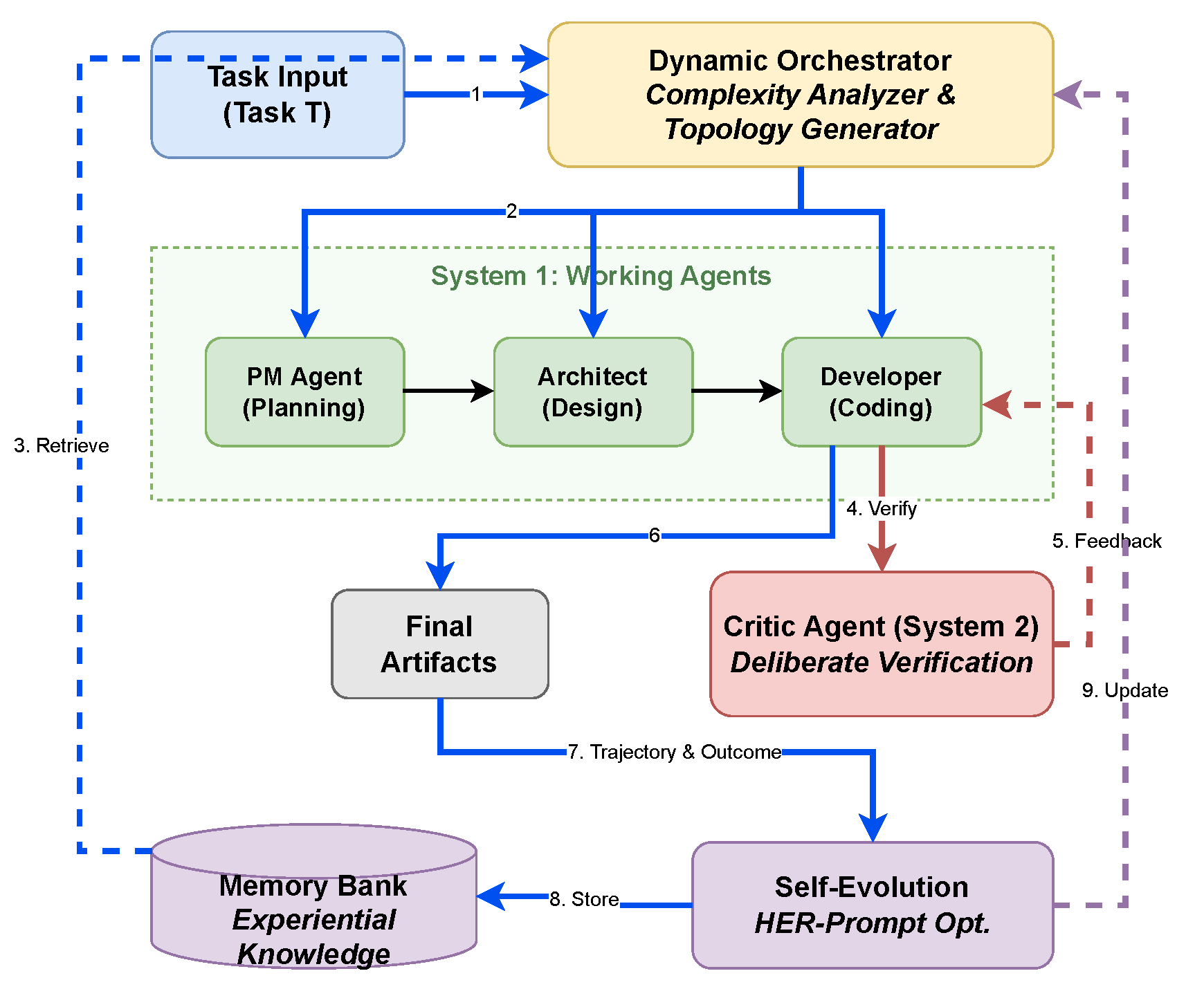
Figure 2.
Dynamic topology evolution based on task complexity . For low complexity (), the chain topology employs a sequential workflow with minimal agents (78.2% of cases). For medium complexity (), the star-mesh topology provides centralized PM coordination (54.7% of cases). For high complexity (), the adaptive mesh topology enables full collaboration with Critic oversight, indicated by purple dashed supervision arrows (75.9% of cases). The table shows empirical topology distribution from Table III.
Figure 2.
Dynamic topology evolution based on task complexity . For low complexity (), the chain topology employs a sequential workflow with minimal agents (78.2% of cases). For medium complexity (), the star-mesh topology provides centralized PM coordination (54.7% of cases). For high complexity (), the adaptive mesh topology enables full collaboration with Critic oversight, indicated by purple dashed supervision arrows (75.9% of cases). The table shows empirical topology distribution from Table III.
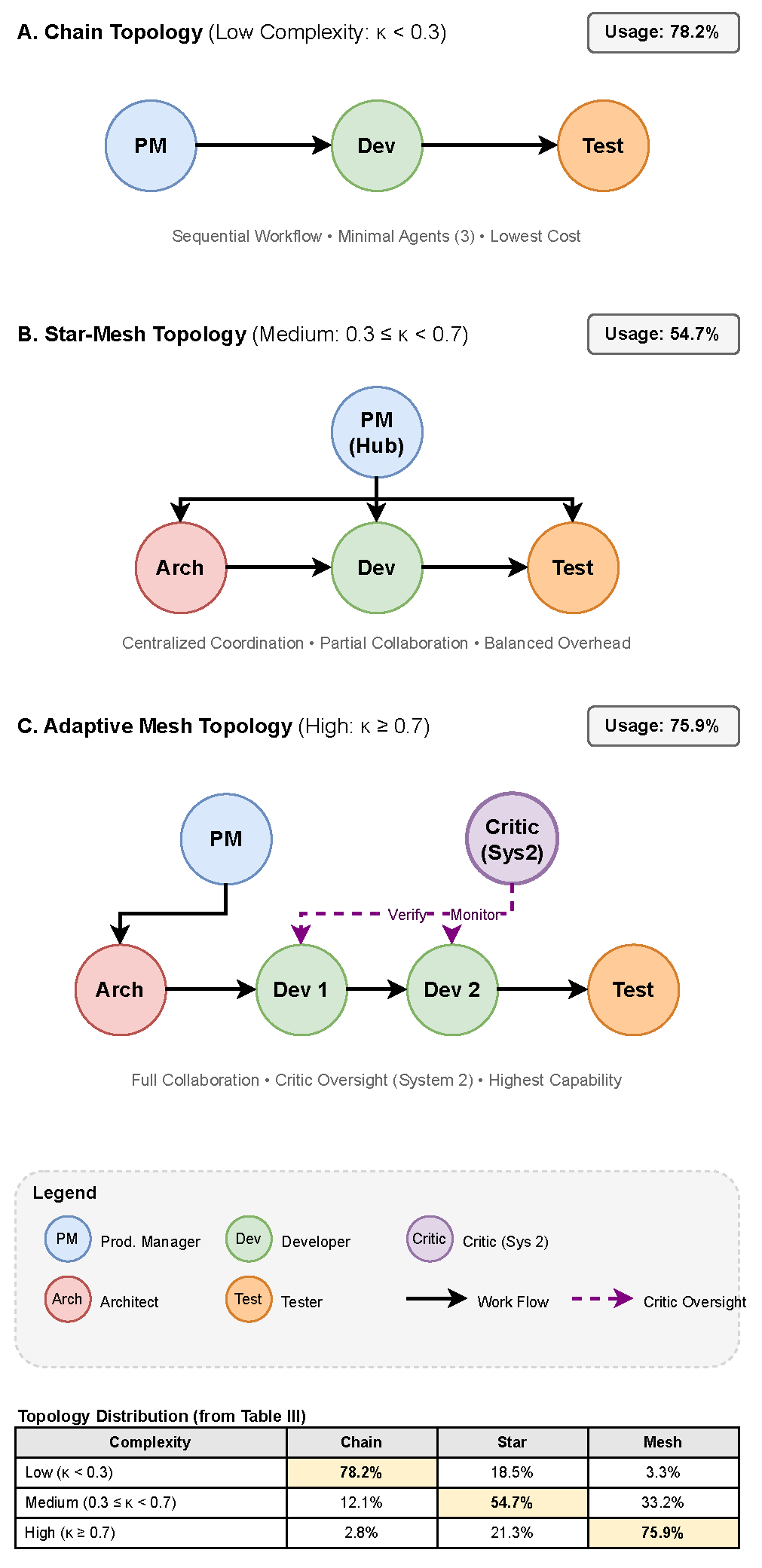
Figure 3.
Left: Radar chart comparing frameworks across six metrics (Pass@1, Code Quality, Iteration Efficiency, Error Recovery, Consistency, Scalability). Iteration Efficiency is measured as successful tasks per 10k tokens. Error Recovery is the fraction of failed cases fixed after additional iterations. Right: Heatmap showing Eco-Evolve’s improvement percentages over baselines across task categories.
Figure 3.
Left: Radar chart comparing frameworks across six metrics (Pass@1, Code Quality, Iteration Efficiency, Error Recovery, Consistency, Scalability). Iteration Efficiency is measured as successful tasks per 10k tokens. Error Recovery is the fraction of failed cases fixed after additional iterations. Right: Heatmap showing Eco-Evolve’s improvement percentages over baselines across task categories.
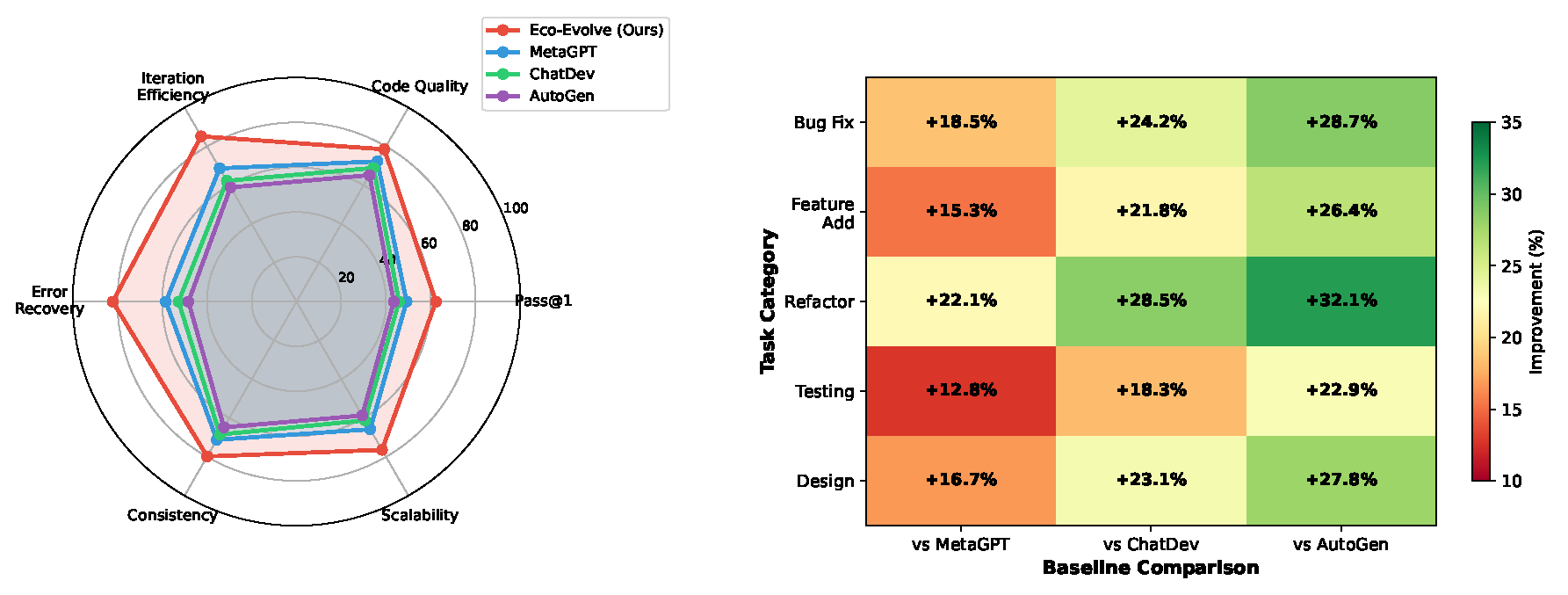
Figure 4.
Left: Ablation study comparing configurations. Right: Learning curves showing performance evolution over iterations. Iteration 0 represents the “w/o HER-Prompt” configuration (56.4%), serving as the pre-evolution baseline. Baselines (MetaGPT, ChatDev, AutoGen) are static frameworks without cross-task evolution and are shown as horizontal reference lines.
Figure 4.
Left: Ablation study comparing configurations. Right: Learning curves showing performance evolution over iterations. Iteration 0 represents the “w/o HER-Prompt” configuration (56.4%), serving as the pre-evolution baseline. Baselines (MetaGPT, ChatDev, AutoGen) are static frameworks without cross-task evolution and are shown as horizontal reference lines.
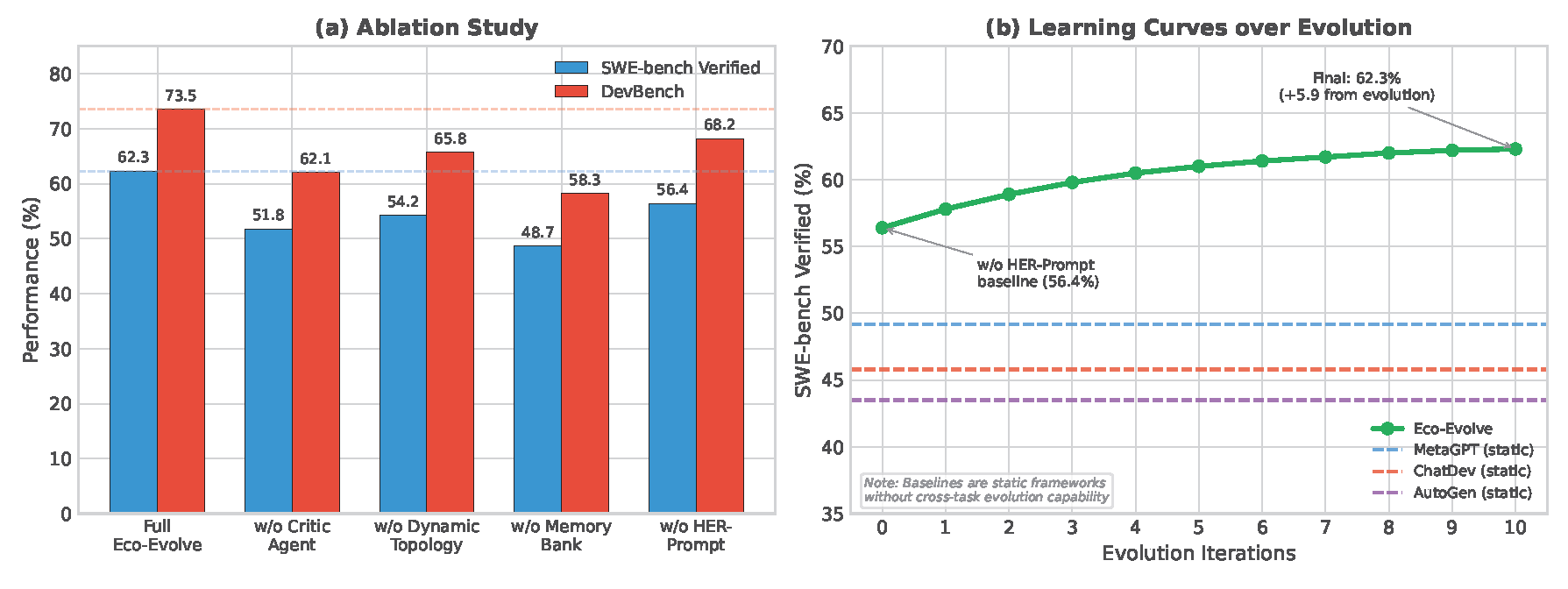

Table 1.
Main Results on SWE-bench Verified and DevBench.
| Framework | SWE-bench (%) | DevBench (%) |
|---|---|---|
| AutoGen | 43.5 | 58.7 |
| ChatDev | 45.8 | 61.2 |
| MetaGPT | 49.2 | 64.1 |
| Eco-Evolve (Ours) | 62.3 | 73.5 |
Table 2.
Ablation Study Results on SWE-bench Verified.
| Configuration | SWE-bench (%) | DevBench (%) |
|---|---|---|
| Full Eco-Evolve | 62.3 | 73.5 |
| w/o Critic Agent | 51.8 (−10.5) | 62.1 (−11.4) |
| w/o Dynamic Topology | 54.2 (−8.1) | 65.8 (−7.7) |
| w/o Memory Bank | 48.7 (−13.6) | 58.3 (−15.2) |
| w/o HER-Prompt | 56.4 (−5.9) | 68.2 (−5.3) |
Table 3.
Topology Distribution by Task Complexity.
| Complexity | Chain (%) | Star (%) | Mesh (%) |
|---|---|---|---|
| Low () | 78.2 | 18.5 | 3.3 |
| Medium () | 12.1 | 54.7 | 33.2 |
| High () | 2.8 | 21.3 | 75.9 |
Table 4.
Computational Overhead Comparison.
| Framework | Avg. Tokens/Task | Relative Cost |
|---|---|---|
| AutoGen | 18.2k | 0.92× |
| ChatDev | 21.5k | 1.09× |
| MetaGPT | 17.6k | 0.89× |
| Eco-Evolve | 19.7k | 1.00× |
Disclaimer/Publisher’s Note: The statements, opinions and data contained in all publications are solely those of the individual author(s) and contributor(s) and not of MDPI and/or the editor(s). MDPI and/or the editor(s) disclaim responsibility for any injury to people or property resulting from any ideas, methods, instructions or products referred to in the content. |
© 2026 by the author. Licensee MDPI, Basel, Switzerland. This article is an open access article distributed under the terms and conditions of the Creative Commons Attribution (CC BY) license (http://creativecommons.org/licenses/by/4.0/).
Copyright: This open access article is published under a Creative Commons CC BY 4.0 license, which permit the free download, distribution, and reuse, provided that the author and preprint are cited in any reuse.


