

Submitted:
02 March 2026
Posted:
03 March 2026
You are already at the latest version
Abstract
Companies frequently utilized multiple sales channels to ensure sustainability. However, attempts to fulfill all incoming orders without sufficient consideration of operational constraints resulted in significant challenges in planning and production processes. Therefore, effective order management was considered essential for optimizing overall business performance. The strategic evaluation of sales orders reduced post-acceptance difficulties, thereby improving both customer satisfaction and operational efficiency. In this context, a machine-learning-based model for sales order classification was proposed for a hybrid production environment accommodating both Make-to-Stock (MTS) and Make-to-Order (MTO) strategies. Initially, the attributes employed in sales order evaluation were identified through an extensive literature review and subsequently refined using a heuristic approach to determine the most relevant classification features. Based on these attributes, sales orders were first clustered into three groups using the k-means algorithm to generate meaningful class labels. The labeled datasets were then utilized to train three supervised machine learning algorithms: Random Forest (RF), Support Vector Machine (SVM), and K-Nearest Neighbor (KNN). The performance of these models was evaluated and compared, resulting in accuracy rates of 99.67%, 99.55%, and 99.49%, respectively. The findings demonstrated that the Random Forest algorithm achieved the highest classification performance.
Keywords:
sales order classification
; hybrid production systems
; machine learning
; MTS/MTO
; random forest algorithm
1. Introduction
Manufacturing companies utilized different production strategies to meet customer demands. A production strategy typically depended on the industry, the company’s size, or its business objectives. Furthermore, product or service attributes, customer composition, and demand conditions collectively shaped the production strategy. The literature also explored which production strategy should be used according to the relevant process [1,2]. A review of the literature revealed that the most commonly used production strategies were MTS and MTO. These strategies had both advantages and disadvantages. In MTS strategies, customer demands were met with pre-stocked products. The most important attributes of such systems included short delivery times, high storage costs, and low flexibility in responding to changing customer needs. In MTO strategies, companies produced according to customer demand. Unlike MTS, MTO systems had fundamental attributes of long delivery times, low storage costs, and greater flexibility in responding to changing demands [3].
As a general assumption in planning problems, the acceptance of all orders was typically expected. However, in practice, certain orders needed to be rejected. In real industrial environments, orders were rejected under various conditions, such as limited production capacity or high production costs. Capacity constraints, machine downtime, the intention to prioritize specific products, or concerns about fulfilling order commitments were among the reasons for rejection. When production systems aimed to maximize profit or minimize costs, the assumption that all orders could be processed no longer held, and an order acceptance problem arose [4].
Accepting or rejecting a sales order had significant consequences in a competitive environment. In this regard, the importance of evaluating orders prior to acceptance or rejection decisions became evident. This study aimed to classify sales orders to support the evaluation process. Sales order classification referred to the systematic grouping of orders based on product attributes, value level, demand structure, or supply and production requirements. This approach was used to manage operational diversity. In the literature, such classifications were commonly associated with models such as ABC classification, product portfolio segmentation, and demand-based product classification. Through classification, companies optimized production planning, inventory management, capacity allocation, and customer service levels by identifying critical, high-value, or highly profitable orders. Consequently, the operational impact of sales orders became more structured and controllable, enabling more efficient decision-making across the supply chain.
Various attributes were employed in the literature to evaluate orders, and these attributes differed depending on the order type. Generally, MTO orders involved attributes related to order cost, delivery dates, delivery conditions, or customer-related factors, whereas MTS orders included attributes associated with demand forecasting, such as order quantity. Although evaluation studies on hybrid systems remained limited, several studies categorized and assessed orders according to order type [5,6,7,8]. Peeters and Ooijen (2020) provided a comprehensive literature review on hybrid systems [9].
The first objective of the approach presented in this study for order classification was to compile the qualitative and quantitative attributes reported in previous studies. The second objective was to present a methodology for identifying the attributes that influenced the company’s acceptance or rejection decisions. The third objective was to classify orders according to their importance levels based on the identified attributes. The remainder of the paper was organized as follows: later section provided information on order selection attributes and related studies in the literature; the subsequent section detailed the proposed methodology; and the final section presented the proposed model, which was applied step by step using real data, and the results were evaluated.
2. Literature Review
A hybrid MTS/MTO structure emerged when production-to-order (MTO) and production-to-stock (MTS) strategies were used together in production and planning processes. Although studies on both pure MTO and pure MTS strategies had been extensively examined separately in the literature, there were not many studies on their combined use [5]. By combining MTS and MTO strategies, the strengths of these methods could be leveraged while their weaknesses were reduced. However, in this combination, the complexity of the problems increased as more objectives and constraints needed to be considered simultaneously. In practice, practitioners had long recognized the potential of hybrid MTS/MTO production systems, and interest in hybrid systems had increased recently [9]. Peeters and van Ooijen (2020), classified the studies on hybrid MTS/MTO production strategies, which were found in different structures in the literature, and re-evaluated the literature using this classification. The authors noted that the growth of the literature in this area was generally non-structured, which made it difficult to review relevant studies and complicated discussions on the subject. To this end, a classification study was conducted for different types of hybrid MTS/MTO production strategies. Furthermore, the authors stated that the hybrid MTS/MTO production strategy was common in real industrial applications [9].
A company’s hybrid structure could be formed in four different ways depending on its planning and production approach. These structures were classified as customer-based hybrid, product-based hybrid, order-based hybrid, and process-based hybrid. In the customer-based structure, products were produced differently according to different customer segments. Therefore, customer order management was involved. Generally, MTO production was carried out for special customers, and MTS production for standard customers. In the product-based structure, products were categorized as either MTS or MTO. This structure generally included standard products with high demand. In contrast, special productions could also be carried out for irregular demands. In this scenario, low-demand, customized products were manufactured as MTO, while high-demand standard products were produced for stock. In a made-to-order structure, some orders for the same product were fulfilled from stock, while others were processed when an order was received. This approach was more flexible than the hybrid structure based on product and customer. In this approach, no distinction was made based on the customer. In a process-based structure, some stages of a product were produced for stock, while the remaining stages were completed after an order was received upon customer request. The MTS/MTO change point in this approach was called the Customer Order Decoupling Point (CODP). The biggest problem in this structure was determining at what point this change would occur. This hybrid approach could also be defined as Assemble-to-Order (ATO). This study focused on the make-to-order hybrid approach. The structure of these approaches was shown in Figure 1.
The use of hybrid systems in production and planning processes made decisions and problems more complex. Some studies in the literature dealt with the problem of how to distribute production plans to machines in the same production environment. For this purpose, various studies had been conducted on capacity coordination [6,7,10,11]. Scheduling, another important problem, became quite complex in hybrid structures. Some studies in the literature focused on this problem [6,12,13,14,15]. In this context, the assumption that all orders had to be fulfilled sometimes led to inappropriate solutions in planning or scheduling problems. To prevent this situation, the contribution of evaluation studies for sales orders was considered valuable. Therefore, how orders were evaluated before a master plan was made, and which orders were accepted or rejected, became an important problem. In the literature, these evaluation studies were addressed under the name of the order acceptance/rejection problem. However, effective order acceptance/rejection decisions depended on the differentiation of orders according to specific attributes. Therefore, order classification studies gained importance. In this study, an order classification study was conducted for use in the order acceptance/rejection problem. Consequently, this literature review was prepared by referencing articles working on the order acceptance/rejection problem.
Some studies in the literature offered a general framework for the order acceptance/rejection problem and examine order acceptance/rejection decisions using step-by-step models. Some of these steps may include qualitative and some quantitative evaluations. Ashayeri and Selen (2001) developed a methodology for the order selection problem using the hierarchical production planning approach. In this study, the aim was to maximize the total cost contribution of the selected orders [7]. The authors applied their methodology in a real hybrid MTS/MTO system. Soman et al. (2004) offered a general framework for deciding on the fundamental problems that will be encountered in the use of a hybrid MTS/MTO system in the food industry. In their study, the authors created a three-stage decision model developed based on the literature. The authors concluded that the study is a valuable contribution to both the definition of the hybrid MTS/MTO production situation and the managerial decision-making process in organizations [16]. Due to the different strategies used to produce products, a hybrid MTS/MTO production system required very different managerial activities than those required in a pure MTO or pure MTS strategy. For example, during periods of low demand for MTO products, MTS products could be produced to fill capacity. However, questions such as how much inventory should be maintained in this case needed to be answered. Furthermore, determining the delivery date in a hybrid strategy presented a separate problem. In their study, Manavizadeh et al. (2013) presented a decision support system for order acceptance/rejection using a hybrid model assembly line approach. Order diversity was the parameter examined, and the authors addressed the problem in four steps. First, customers were prioritized according to their profit value. Then, a mathematical programming model determined the prices and delivery dates of the rejected orders. Next, if the customer was not satisfied with the offered price and due date, renegotiation was suggested. Finally, if the negotiation led to an agreement, the order was accepted and added to the production schedule [17]. In the model discussed by Rafiei and Rabbani (2012), products were classified into three different categories: MTS, MTO, and hybrid MTS/MTO. In this developed model, they presented a study on how to distribute capacities with three different product types. The authors prioritized MTO orders internally according to these four criteria: customer’s profit contribution, customer’s potential purchasing, orders’ lot sizes, and orders’ purchasing range. MTS and hybrid MTS/MTO orders were evaluated pairwise according to these three criteria: estimated contribution, reputation, and potential future sales. In the next stage, they developed a mathematical model to determine the lot size for MTS and hybrid MTS/MTO products. In the study, the initial capacity was allocated to MTO orders, while the remaining capacity was used for MTS and MTS/MTO products [6]. Abedi and Zhu (2020) developed an order acceptance model for a system using a hybrid MTS/MTO strategy. In the proposed model, a Mixed Integer Linear Programming was developed to determine optimum order quantities based on resource availability. The model effectively reduced the risk of unreliable delivery dates due to discrepancies between actual and unused quantities. The model was compatible with systems that include both production-to-order and production-to-stock. The model proposed in the study consists of four stages. First, demand for MTO products was collected daily in batches. For MTS products, a forecasting model was applied to predict orders. In the second stage, a quantity-based Revenue Management approach was used to prioritize orders. In the third stage, an optimization model was developed to evaluate resource availability. In the final stage, orders deemed suitable based on resource availability were accepted. Furthermore, the applicability of the developed approach had been evaluated through two scenarios [5].
The attributes used in this study and their reference information were given in Table 1. Articles working on order acceptance/rejection problems were referenced when determining these attributes.
A general review of the literature reveals that there are very few studies on the classification of orders in order acceptance/rejection problems. Studies that do exist generally classify orders based on customer attributes in an MTO environment. In addition, there are very few studies on decision models prepared for order selection. Therefore, this study aims to contribute to this gap in the literature.
3. Materials and Methods
This section detailed the application steps and formulations. The design of the proposed model was created by compiling studies found in the literature. The qualitative and quantitative attributes used in these studies were also collected to inform the model design. The aim of this study was to classify sales orders according to their importance levels. The application steps of this study were summarized in Figure 2.
In the stage of listing selection attributes, an attribute list was prepared based on the data obtained in the literature review. During the application, the relevant company needed to select from this attribute list.
In the stage of determining selection attributes, decision-makers assigned scores to the attributes obtained in the first stage on a scale of 1–5. The importance levels for each attribute group and for individual attributes were calculated based on the assigned scores. Selection attributes were then determined according to the assigned α importance level, and these attributes were used in the classification model.
In the stage of classifying orders, orders were divided into three classes using machine learning algorithms with the determined attributes. The classes were defined as follows:
- Class 1: Normal importance
- Class 2: High importance
- Class 3: Very high importance
3.1. Listing of Selection Attributes
Based on the literature review conducted in this study, 28 attributes that were important to consider in the sales order selection process were identified and were presented in Table 2. These attributes were grouped into five main categories as: Order-Related Attributes, Product-Related Attributes, Customer-Related Attributes, Financial-Related Attributes, and Management-Related Attributes.
3.2. Determining of Selection Attributes
These listed and grouped attributes were used as a template in the classification model presented in this study. Different firms conducted sales transactions under different conditions. These differences affected the firms’ order management and, consequently, the selection attributes they used. Therefore, the methodology in this study aimed to select the attributes that were important for the firm’s sales decision from among these defined attributes. If new evaluation attributes arose in line with the changing needs of the firms, these attributes could be added to the presented template. The use of inappropriate selection attributes directly affected the model output.
Each decision-maker, KVn (n=1,2,..N), assigned weights to all attributes in Table 2, using the 1-5 scale shown in Table 3. Pairwise comparisons were not used because of the large number of attributes. din, the importance level assigned by the n. decision-maker to the i. main criterion (i = 1,2,…I), dijn , the importance level assigned by the n. decision-maker to the j. sub-criterion of the i. main criterion. The importance level assigned by the decision-maker is defined as as (j = 1,2,…J). The decisions of the decision-makers were combined using the averages shown in Equations 1 and 2:
Here, di, represented the importance of the i. main criterion, and dij, represented the importance of the j. sub-criterion of the i. main criterion. Then, Pdi is defined as the percentage importance of the i. main criterion, and Pdij, as the percentage importance of the j.sub-criterion of the i. main criterion. These values were obtained by dividing the importance levels by the highest value on the scale and multiplying by 100, as in Equations 3 and 4.
In the next stage, relative importance levels were calculated by reflecting the percentage importance levels onto the parent attribute to which each sub-attribute is linked. Relative importance levels were calculated using Equations 5 and 6, where Rdi, was the relative importance level of the i. main criterion, and Rdij, was the relative importance level of the j. sub-criterion of the i. main criterion:
Instead of using all attributes in the model, using only the appropriate ones allowed the model to function more reliably and consequently reduced computational difficulties. At this stage, decision-makers were supported by a simple and intuitive procedure, avoiding the challenges of a complex mathematical model. Additionally, the aim was to reduce the number of selection attributes based on the current situation, thus reducing the burden of data collection, organization, and cleaning in other stages of the process. The use of the proposed 1–5 scale also allowed decision-makers to avoid pairwise comparisons that could have led to confusion. Furthermore, decision-makers could analyze how the final decision would change by using different values of the α importance level. As a result, once this process was complete, the selection attributes and their weights that the firm used to proceed to the next stage were determined.
3.3. Classification of Orders
The implementation flow of the classification model was shown in Figure 3.
3.3.1. Data Collection Phase
A dataset was prepared with the attributes determined in the previous section. Companies received orders from various sales channels. MTO orders came directly from customers, while MTS orders were generated as a result of forecasting studies.
3.3.2. Pre-Processing Phase
For the prepared data to be processed properly, it was first checked and, if necessary, corrected through preprocessing. In this context, the presence of missing, erroneous, duplicate, and outlier data was examined and corrected if found. Furthermore, if the determined attributes were text data, they were converted to numerical values. After preprocessing the data, normalization was performed to ensure accurate calculation of standard deviations. In this study, the data were normalized using the min-max normalization method as in Equation 7 via Python. In this equation, represented the original value, represented the minimum value in the dataset, represented the maximum value in the dataset, and , represented the normalized value in the (0-1) range.
3.3.3. Data Preparation Phase
To train classification models and compare their accuracy, an initial assignment was first made to the orders. In this study, the attributes and the number of classes were known, but since the data did not yet have labels in the initial assignment, a clustering study was first performed using the normalized data. In the initial assignment, the data were divided into three clusters as intended, the values of these clusters were examined, and a class label was then determined for each cluster. The classification models were subsequently run with the labeled data. The classes used in the model were as follows:
- Class 1: Normal importance class
- Class 2: High importance class
- Class 3: Very high importance class
Since the initial assignment was unsupervised learning, the k-means clustering algorithm was used. After assigning class labels to the clustered data, classification models were prepared using the following machine learning models:
- K-nearest neighbor (KNN): A sample-based and parameterless classification and regression algorithm within the scope of supervised learning. The algorithm determined the class or value of an observation based on the majority decision or the average of the K closest neighbors in the feature space. Similarity measurement was usually performed using distance metrics such as Euclidean distance [24].
- Support Vector Machine (SVM): An algorithm used in supervised machine learning that aimed to achieve the separation between classes with the decision plane that had the widest margin. In linearly inseparable data, separation was achieved by projecting the data onto a higher-dimensional space through kernel functions [25].
- Random Forest (RF): An ensemble learning method used in supervised machine learning that consisted of multiple decision trees. The algorithm constructed each tree using randomly sampled subsets of data and randomly selected features; it generated the final prediction through majority vote in classification and averaging in regression. This approach improved the model’s generalization performance by reducing overfitting [26].
Training and test data were separated from the initially assigned data. It was important for model accuracy that the training data constituted at least 70% of the total data and was randomly selected. To evaluate the clustering results, the total cluster “entropy” values were calculated as in Equation 8. In this equation, the notation represented the number of clusters; , represented the number of samples belonging to the class; represented the total number of samples; and represented the probability of the class such that .
A low entropy value indicated a better clustering effort. High entropy, on the other hand, indicated that the clusters were mixed. Therefore, entropy expressed the degree of complexity of a cluster, not its geometry. To understand the degree of cluster separation, the “Silhouette score” was used. This score was calculated as in Equation 9, 10, 11 and 12.
was the average distance of to other points within its set and was calculated as in Equation 9. represented the Euclidean distance between two points.
was the average distance of to the nearest other cluster and was calculated as in Equation 10.
For each data point , the silhouette value was calculated as in Equation 11.
The overall silhoutte value was the average of the silhoutte values of all samples and was calculated as in Equation 12.
A general value close to 1 indicated that the clustering was done very well, a value close to 0 indicated a reasonable result and overlapping clusters, and a negative value indicated incorrectly assigned samples and poor cluster overlap.
3.3.4. Classification Phase
Test data was run through trained models. The results were compared with performance metrics.
3.3.5. Evaluation Phase
Two performance metrics were used in the model evaluation phase: Accuracy score (AS) and F1 score (F1-S). These metrics were calculated using the estimation results from the training and test data.
- AS, was the ratio of correct number of predictions to the total number of predictions.
- F1-S, was a method used as a performance metric in the classification system. It was calculated as follows: The Precision Parameter gave the percentage of positive predictions. The Recall Parameter gave the percentage of correct predictions among true positives. The harmonic means of these two parameters gave the F1 score value.
TP represented true positive; FP represented false positive and FN represented false negative.
4. An Actual Evaluation
The classification model described in the previous section was applied to data from a company in the food industry. The dataset contained a total of 11,014 orders for 937 different materials. Of these orders, 3,589 were MTO orders and 7,425 were MTS orders. The order period was one year. This section presented the application steps and results of the classification model developed for this dataset.
4.1. Determining of Selection Attributes
Initially, a five-person evaluation team was determined within the company to implement the order classification model. The team was responsible for accepting or rejecting of sales orders. Assuming that the team members had sufficient experience and that their evaluations represented the company, all inputs for the model were provided by the team.
To implement the steps of the proposed model, a form containing all the main and sub-criteria shown in Table 2 was prepared in MS Excel. Each team member assigned weights to all main criteria () and sub-criteria () using the 1–5 scale shown in Table 3, in accordance with the criterion hierarchy. These assignments were recorded in the prepared form, and the and values were obtained by combining the decision-makers’ evaluations using the averages defined in Equations 1 and 2.
Subsequently, percentage importance levels were calculated by dividing the importance levels by the highest value on the scale and multiplying by 100, as shown in Equations 3 and 4. The relative importance levels and were calculated using Equations 5 and 6. All calculations were performed using formulas created in MS Excel. Table 4 presented the assignments made by the decision-makers, along with the corresponding percentages and relative importance levels. When determining the attributes, the lower limit of the importance level α was set to 0.8.
The “Importance %” values for the determined attributes were normalized using the min-max normalization method. The normalized weights for the relevant attributes are as follows:
- Order quantity; 0,25
- Order frequency; 0,24
- Due date; 0,23
- Order cost; 0,28
4.2. Order Classification
This section described the application steps for order classification.
4.2.1. Data Collection
In the company, MTO orders were collected by Customer Service Agent, while annual forecasting studies were conducted for MTS orders. MTS orders were prepared according to the results obtained from the forecasting studies.
4.2.2. Preprocessing
After cleaning and organizing the data, the attribute values of the orders were multiplied by the determined weights. Then, the weighted values were normalized using the min-max normalization method via Python software.
4.2.3. Data Preparation
In order to train the classification models, an initial class assignment was made for the normalized orders. The k-means method, an unsupervised learning model, was used in the initial assignment. These methods were implemented in the Python environment.
- Total number of samples 11014,
- Total number of clusters 3,
- Number of data assigned to Cluster 1 ( 3026,
- The number of data points assigned to Cluster 2 ( 3252,
- The number of data points assigned to Cluster 3 ( 4736.
The resulting clustering result, “Entropy” value, was calculated as 1,554. The “Silhouette Score” was calculated as 0,4513. Considering these values, it is seen that the data is separated at an “acceptable level”. When the values of the clusters were examined, it was seen that the following labeling could be done;
- Cluster 1: Normal importance class
- Cluster 2: High importance class
- Cluster 3: Very high importance class
After the clusters were labeled, the training data were randomly separated via Python. 70% of the available data was used for training. All three machine learning models were trained using the same training data.
4.2.4. Classification
The parameters for the machine learning models were as follows;
- For the Random Forest model, the number of decision trees (n_estimators) parameter was used as 100.
- For the SVM model, the decision boundary type (kernel) parameter was used as “rbf”.
- For the KNN model, the neighbor’s parameter was used as “3”.
5. Results
The developed models were run again with randomly separated test data. Accuracy metrics for the classification models were calculated using Python. The accuracy scores were shown in Table 5. According to these values, the performance of the classification models was quite high. Furthermore, the model success rates were very close to each other.
The values for the F1 criterion were shown in Table 6. The confusion matrices of the models were shown in Figure 4. When the values in these tables were compared, it is seen that the Random Forest model showed superior performance compared to other methods by providing the lowest misclassification rate in all classes. The SVM model was close to RF and ranks second. A very successful result was obtained similarly with the KNN model, but it was slightly weaker compared to other models.
6. Discussion and Future Works
This study proposed a machine-learning-based framework for sales order classification to improve planning processes in hybrid MTO/MTS production systems. The attributes used for classification were compiled from the literature regarding order acceptance and rejection issues. In the first step of the study, the list of attributes to be used in the model was determined. The selection of attributes that were not readily accessible posed significant challenges during the data collection phase. Moreover, the accuracy of the developed model was adversely affected by incomplete or inaccurate data. Therefore, the attributes were determined after carefully evaluating these risks. Following the determination of the attributes, the classification study was carried out using these attributes. In this step, k-means clustering method was employed to establish initial class labels, categorized as Very High Importance, High Importance, and Normal Importance. The clustered data was labeled accordingly, and RF, SVM, and KNN machine learning models were implemented using Python. As a result of the classification, the performance metrics of all three models were found to be closely aligned. However, the success ranking was obtained as RF, SVM, and KNN, respectively.
The effective evaluation of sales orders offered valuable implications for managers. Primarily, it directly increased the efficiency of both production and planning operations. Furthermore, sales order classification significantly contributed to improvements in logistics, warehousing, delivery times, and, ultimately, customer satisfaction. By addressing the lack of sufficient studies on this specific subject, this study filled a notable gap in the literature. Consequently, the proposed model served as a viable component for a decision support system regarding the acceptance or rejection of orders in hybrid production environments.
The results presented in this study were based on a classification model developed under specific assumptions. Since the parameters used in the model were defined by the company’s decision-makers, the effects encountered in models built for different companies or industries may have altered the model results. Moreover, these changing conditions directly affected the performance of the algorithms. In addition to the parameters used in classification, the size, quality, and randomness of the training data also directly affected the performance of the developed model. Therefore, the findings could vary with different parameters or data. In future studies, the proposed classification approach can be applied with different datasets and parameters. Additionally, model performances can be compared using different machine learning and deep learning-based classification algorithms. Furthermore, constraints such as cost, capacity, and periodicity can be added to the developed models.
Author Contributions
The first objective of the approach presented in this study for order classification was to compile the qualitative and quantitative attributes reported in previous studies. The second objective was to present a methodology for identifying the attributes that influenced the company’s order acceptance or rejection decisions. The third objective was to classify orders according to their importance levels based on the identified attributes. By addressing the lack of sufficient studies on this specific subject, the study filled a notable gap in the literature. Consequently, the proposed model served as a viable component of a decision support system for order acceptance and rejection in hybrid production environments.
Funding
This research received no external funding.
Data Availability Statement
The data supporting the findings of this study are not publicly available due to confidentiality restrictions imposed by the company.
Conflicts of Interest
The authors declare no conflicts of interest.
Abbreviations
The following abbreviations are used in this manuscript:
| MTS | Make-to-Stock |
| MTO | Make-to-Order |
| ATO | Assembly-to-Order |
| CODP | Customer Order Decoupling Point |
| RF | Random Forest |
| SVM | Support Vector Machine |
| KNN | K-Nearest Neighbor |
References
- Williams, T.M. Special products and uncertainty in production/inventory systems. European Journal of Operations Research 1984, 15, 46–54.
- Rajagopalan, S. Make-to-order or make-to-stock: Model and application. Management Science 2002, 48 (2), 241–256.
- Bitran, G.R.; Hax, A.C. On the design of hierarchical production planning systems. Decision Sciences 1977, 8 (1), 28–55.
- Ziaee, M.; Mortazavi, J.; Amra, M. Flexible job shop scheduling problem considering machine and order acceptance, transportation costs, and setup times. Soft Computing 2021. 26(7), 3527–3543. [CrossRef]
- Abedi, A.; Zhu, W. An advanced order acceptance model for hybrid production strategy. Journal of Manufacturing Systems 2020, 55, 82–93. [CrossRef]
- Rafiei, H.; Rabbani, M. Capacity coordination in hybrid make-to-stock/make-to-order production environments. International Journal of Production Research 2012, 50(3), 773–789. [CrossRef]
- Ashayeri, J.; Selen, W. J. Order selection optimization in hybrid make-to-order and make-to-stock markets. Journal of the Operational Research Society 2001, 52(10), 1098–1106. [CrossRef]
- Das, S.K.; Kuthambalayan, T.S. Matching Supply and Demand with Lead-Time Dependent Price and with Safety Stocks in a Make-to-Order Production System. Systems 2022, 10, 256. [CrossRef]
- Peeters, K.; van Ooijen, H. Hybrid make-to-stock and make-to-order systems: a taxonomic review. International Journal of Production Research 2020, 58(15), 4659–4688. [CrossRef]
- Wester, F. A. W.; Wijngaard, J.; Zijm, W. R. M. Order acceptance strategies in a production-to-order environment with setup times and due-dates. International Journal of Production Research 1992, 30(6), 1313–1326. [CrossRef]
- Kilic, O. A.; van Donk, D. P.; Wijngaard, J.; Tarim, S. A. Order acceptance in food processing systems with random raw material requirements. OR Spectrum 2010, 32(4), 905–925. [CrossRef]
- Kapadia, M. S.; Uzsoy, R.; Starly, B.; Warsing, D. P. A genetic algorithm for order acceptance and scheduling in additive manufacturing. International Journal of Production Research 2021, 60(21), 6373–6390. [CrossRef]
- Wang, H.-K.; Mönch, L. A matheuristic for making order acceptance decisions in multi-product, multi-stage manufacturing systems. Applied Soft Computing 2021, 111, 107640. [CrossRef]
- Beemsterboer, B.; Land, M.; Teunter, R. Hybrid MTO-MTS production planning: An explorative study. European Journal of Operational Research 2016, 248(2), 453–461. [CrossRef]
- Wang, Z.; Qi, Y.; Cui, H.; Zhang, J. A hybrid algorithm for order acceptance and scheduling problem in make-to-stock/make-to-order industries. Computers and Industrial Engineering 2019, 127(February), 841–852. [CrossRef]
- Soman, C. A.; Van Donk, D. P.; Gaalman, G. Combined make-to-order and make-to-stock in a food production system. International Journal of Production Economics 2004, 90(2), 223–235. [CrossRef]
- Manavizadeh, N.; Hasani Goodarzi, A.; Rabbani, M.; Jolai, F. Order acceptance/rejection policies in determining the sequence in mixed model assembly lines. Applied Mathematical Modelling 2013, 37(4), 2531–2551. [CrossRef]
- Wang, J.; Yang, J. Q.; Lee, H. Multicriteria order acceptance decision support in over-demanded job shops: A neural network approach. Mathematical and Computer Modelling 1994, 19(5), 1–19. [CrossRef]
- Kuo, R. J.; Chen, J. A. A decision support system for order selection in electronic commerce based on fuzzy neural network supported by real-coded genetic algorithm. Expert Systems with Applications 2004, 26(2), 141–154. [CrossRef]
- Ivǎnescu, V. C.; Fransoo, J. C.; Bertrand, J. W. M. A hybrid policy for order acceptance in batch process industries. OR Spectrum 2006, 28(2), 199–222. [CrossRef]
- Arredondo, F., & Martinez, E. Learning and adaptation of a policy for dynamic order acceptance in make-to-order manufacturing. Computers and Industrial Engineering 2010, 58(1), 70–83. [CrossRef]
- Kalantari, M., Rabbani, M., & Ebadian, M. A decision support system for order acceptance/rejection in hybrid MTS/MTO production systems. Applied Mathematical Modelling 2011, 35(3), 1363–1377. [CrossRef]
- Wei, J.; Ma, Y. S. Design of a feature-based order acceptance and scheduling module in an ERP system. Computers in Industry 2014, 65(1), 64–78. [CrossRef]
- Cover, T. M.; Hart, P. E. Nearest neighbor pattern classification. IEEE Trans. Inf. Theory 1967, pp. 21–27, vol. IT-12.
- Cortes, C.; Vapnik, V. Support-Vector Networks. Machine Learning 1995, 20, 273-297. [CrossRef]
- Breiman, L. Random Forests. Machine Learning 2001, 45, 5-32. [CrossRef]
Figure 1.
Hybrid structures according to the planning and production approach.
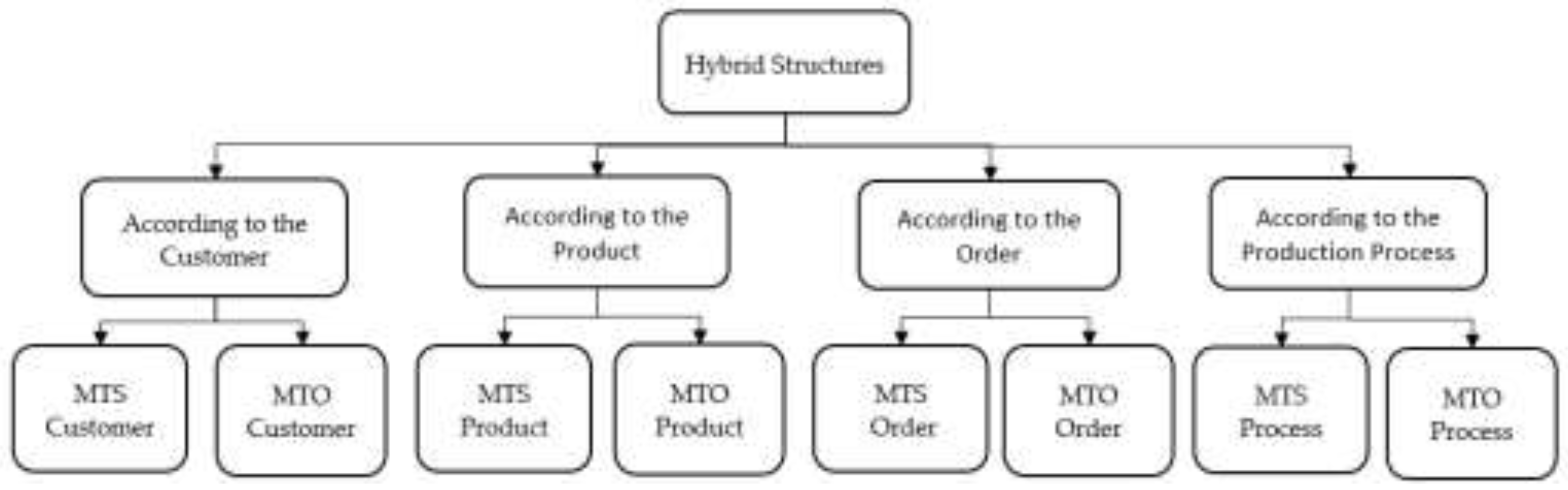
Figure 2.
Implementation steps of the proposed model.
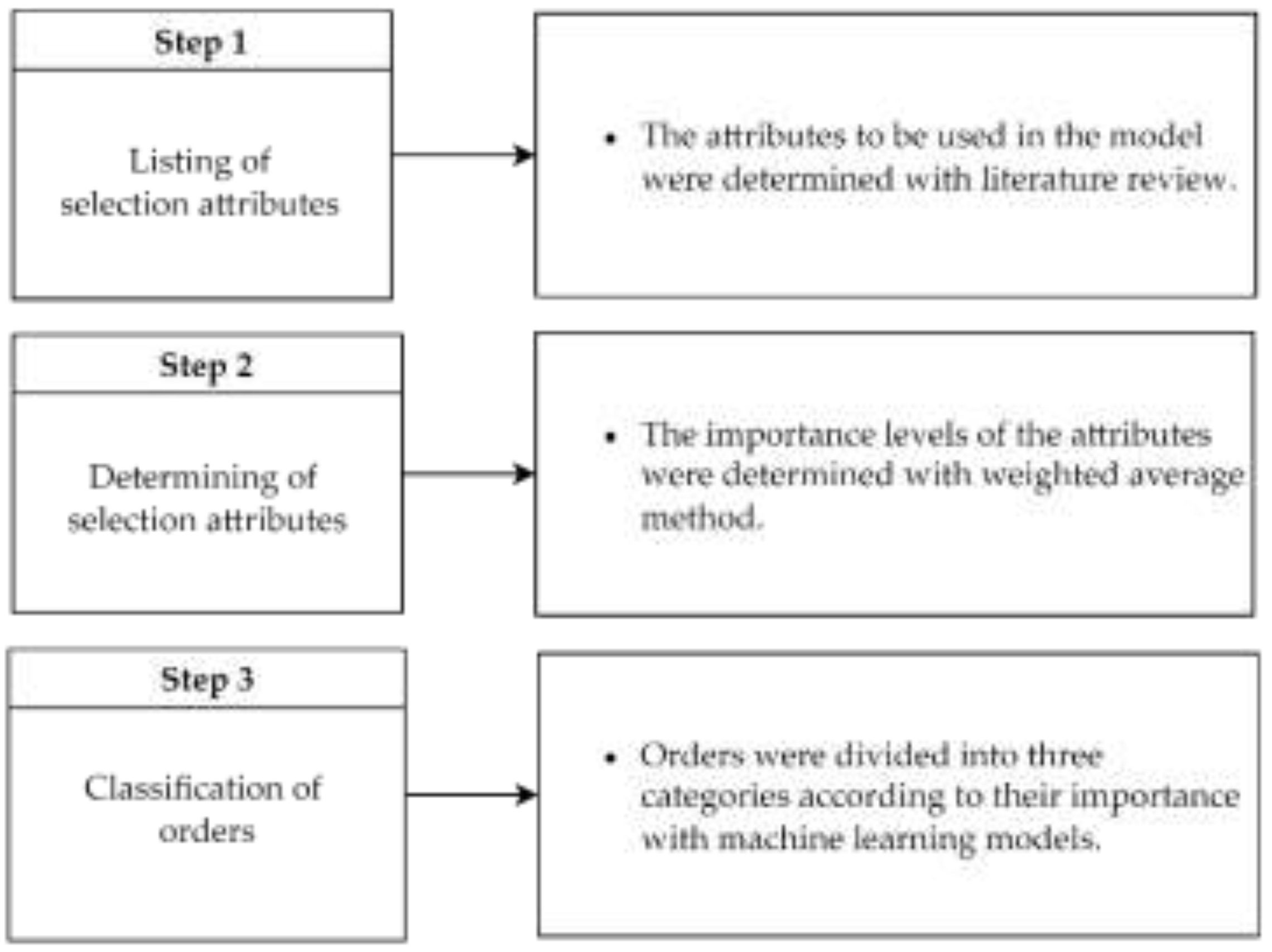
Figure 3.
Phases of the classification.
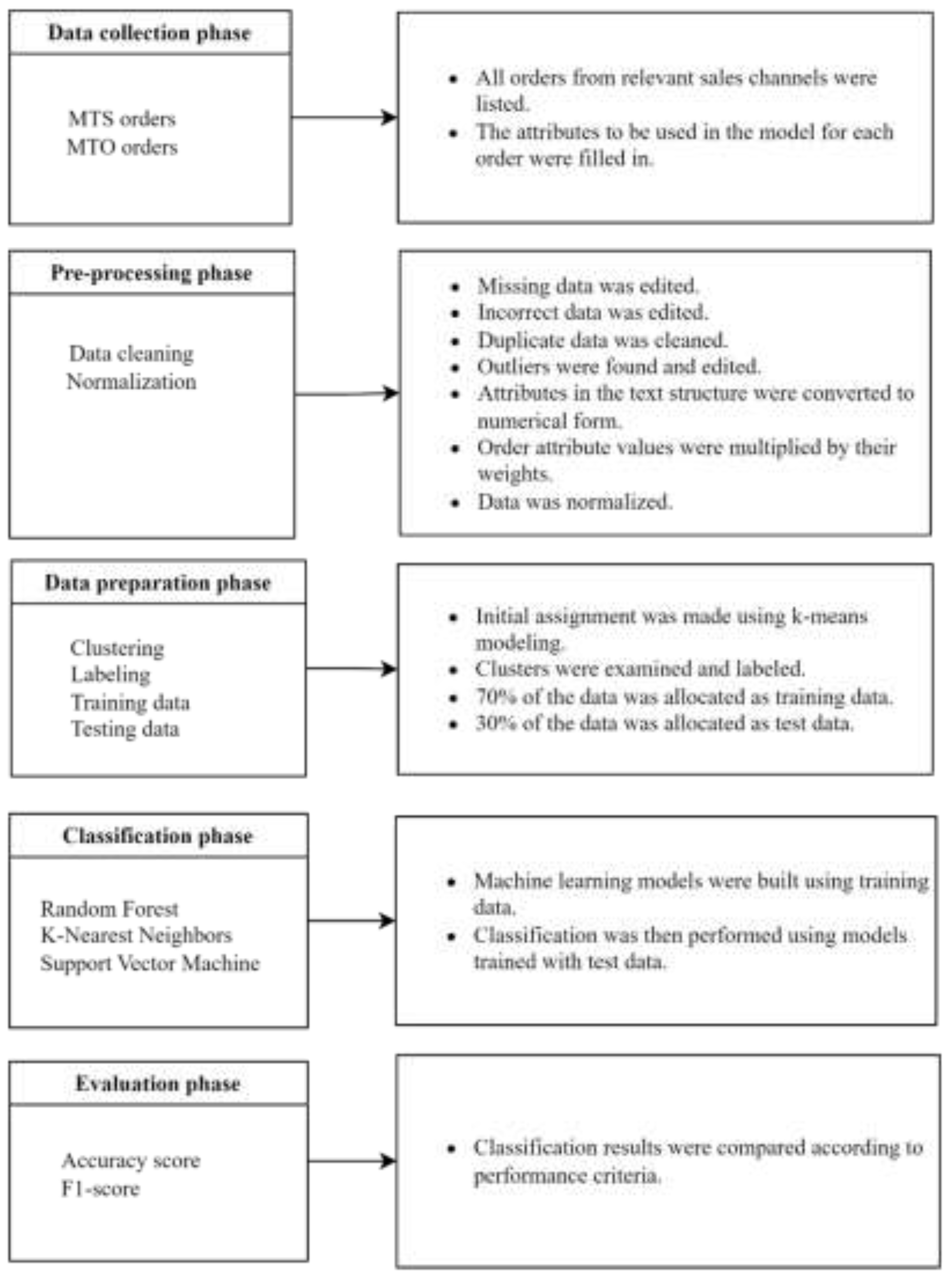
Figure 4.
Confusion matrices for RF, SVM and KNN models, respectively.
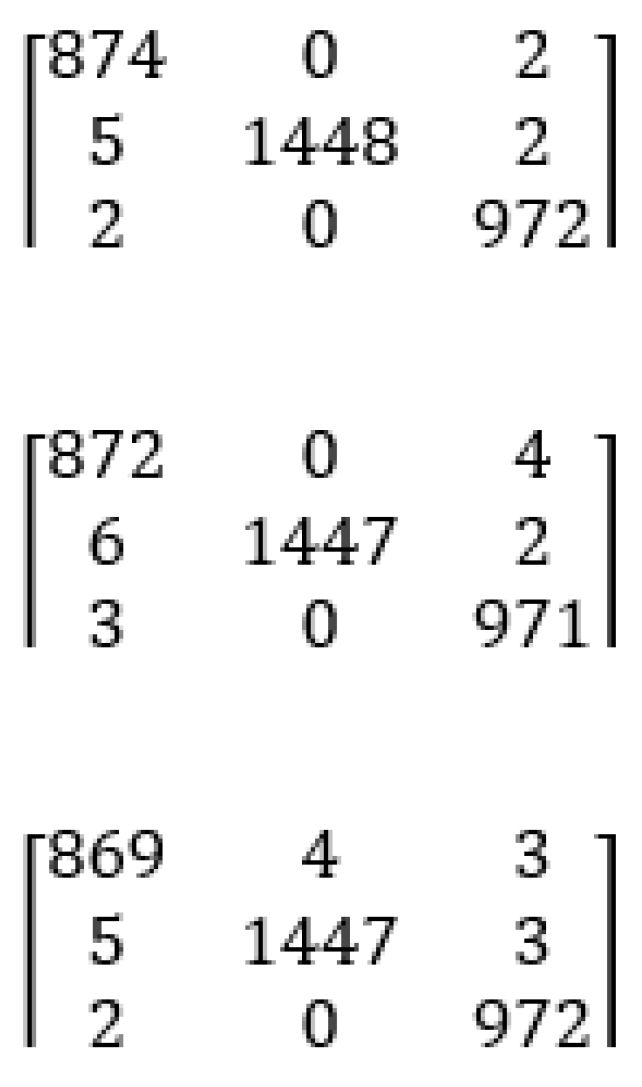

Table 1.
Order selection attributes in the literature.
| Reference | Attribute | Approach | Methodology | Scope |
|---|---|---|---|---|
| Wester et al, 1992 [10] | Simulation | Order acceptance decisions were examined using four basic approaches. | ||
|
Setup time Due date |
Monolithic approach Hierarchical approach Myopic approach Extended myopic approach |
|||
| Wang et al. 1994 [18] | Customer credit Order quantity Due date Decision period Order preference Profit rate Capacity constraints |
Neural networks | Simulation | A neural network-based model for order prioritization and acceptance decision-making was described. |
| Kuo and Chen, 2004 [19] | Fuzzy neural networks | Genetic algorithm | Aimed to develop a decision support system for order selection. | |
| Due date Order preference Technical difficulty Order profit | ||||
|
Ivănescu et al. 2006 [20] |
Scheduling policy Regression policy |
Simulated annealing |
A new hybrid order acceptance policy developed and evaluated through simulation. | |
| Capacity Product variety Workload balancing level Level of uncertainty | ||||
| Arredondo and Martinez, 2010 [21] | Product variety Due date Order price Order quantity |
ARLOA algorithm |
Simulation | A novel approach was proposed for the simulation-based development and online adaptation of a policy for dynamic order acceptance under uncertainty. |
| Kalantari et al. 2011 [22] | Transaction volume Customer loyalty Order frequency Customer reputation Customer communication Capacity Order price Due date |
Fuzzy TOPSIS Mixed integer mathematical model |
Decision support system | A five-stage decision support model developed for order acceptance/rejection problems. |
| Wei and Ma, 2014 [23] | Order date Quality Quantity required Delivery conditions Order production flexibility Discount level Pricing and payment terms Occupational health and safety Environmental impact Order quantity Due date Order frequency Order preference Technical difficulty Order profit Order cost |
A new application procedure | Designing of an ERP integrated feature-based acceptance and scheduling module | Proposed a detailed framework and a general feature association methodology that can combine product and process models to meet customer orders with small batch sizes and high variety. |
Table 2.
Grouped attribute list.
| Level of attributes | Attributes |
|---|---|
| 1 | Order-related attributes |
| 1.1 | Order quantity |
| 1.2 | Order date |
| 1.3 | Order frequency |
| 1.4 | Order preference |
| 1.5 | Quantity required |
| 1.6 | Capacity |
| 1.7 | Delivery conditions |
| 1.8 | Due date |
| 1.9 | Decision period |
| 1.10 | Level of uncertainty |
| 2 | Product-related attributes |
| 2.1 | Setup time |
| 2.2 | Workload balancing level |
| 2.3 | Product variety |
| 2.4 | Quality |
| 2.5 | Technical difficulty |
| 2.6 | Transaction volume |
| 2.7 | Order production flexibility |
| 3 | Customer-related attributes |
| 3.1 | Customer credit |
| 3.2 | Customer loyalty |
| 3.3 | Customer reputation |
| 3.4 | Customer communication |
| 4 | Financial-related attributes |
| 4.1 | Discount level |
| 4.2 | Order profit |
| 4.3 | Order price |
| 4.4 | Order cost |
| 4.5 | Pricing and payment terms |
| 5 | Management-related attributes |
| 5.1 | Occupational health and safety |
| 5.2 | Environmental impact |
Table 3.
Level of importance and descriptions.
| Level of importance | Description |
|---|---|
| 1 | Not important |
| 2 | Partially important |
| 3 | Important |
| 4 | Very important |
| 5 | Absolutely important |
Table 4.
Determined attributes and importance levels.
| Level | Attributes | Relative importance | DM1 | DM2 | DM3 | DM4 | DM5 | Average of first level | Importance % | Average of second level | Importance % |
|---|---|---|---|---|---|---|---|---|---|---|---|
| 1 | 88,00% | 5 | 4 | 4 | 5 | 4 | 4,4 | 88,00% | |||
| 1.1 | Order quantity | 77,44% | 4 | 5 | 5 | 4 | 4 | 4,4 | 88,00% | ||
| 1.3 | Order frequency | 70,40% | 5 | 4 | 4 | 4 | 3 | 4 | 80,00% | ||
| 1.8 | Due date | 73,92% | 4 | 4 | 5 | 4 | 4 | 4,2 | 84,00% | ||
| 4 | 96,00% | 4 | 5 | 5 | 5 | 5 | 4,8 | 96,00% | |||
| 4.4 | Order cost | 88,32% | 5 | 5 | 4 | 5 | 4 | 4,6 | 92,00% |
Table 5.
Accuracy scores of the models.
| Model | Accuracy score |
|---|---|
| RF | 99,67% |
| SVM | 99,55% |
| KNN | 99,49% |
Table 6.
Values of the F1-score.
| Model | Class | Precision | Recall | F1-score | Number of data |
|---|---|---|---|---|---|
| RF | 1 | 0,99 | 1,00 | 0,99 | 876 |
| RF | 2 | 1,00 | 1,00 | 1,00 | 1455 |
| RF | 3 | 1,00 | 1,00 | 1,00 | 974 |
| SVM | 1 | 0,99 | 1,00 | 0,99 | 876 |
| SVM | 2 | 1,00 | 0,99 | 1,00 | 1455 |
| SVM | 3 | 0,99 | 1,00 | 1,00 | 974 |
| KNN | 1 | 0,99 | 0,99 | 0,99 | 876 |
| KNN | 2 | 1,00 | 0,99 | 1,00 | 1455 |
| KNN | 3 | 0,99 | 1,00 | 1,00 | 974 |
Disclaimer/Publisher’s Note: The statements, opinions and data contained in all publications are solely those of the individual author(s) and contributor(s) and not of MDPI and/or the editor(s). MDPI and/or the editor(s) disclaim responsibility for any injury to people or property resulting from any ideas, methods, instructions or products referred to in the content. |
© 2026 by the authors. Licensee MDPI, Basel, Switzerland. This article is an open access article distributed under the terms and conditions of the Creative Commons Attribution (CC BY) license (http://creativecommons.org/licenses/by/4.0/).
Copyright: This open access article is published under a Creative Commons CC BY 4.0 license, which permit the free download, distribution, and reuse, provided that the author and preprint are cited in any reuse.


