

Submitted:
02 March 2026
Posted:
02 March 2026
You are already at the latest version
Abstract
Economic freedom is increasingly recognized as a key element of sustainable social and economic development, significantly affecting resilience and competitiveness, which translates into long-term stability of economies around the world. In this study, we analyze the extent to which state intervention, measured by the level of fiscal freedom, government spending, and monetary freedom, affects the sustainability of economic management in EU member states. Using the Index of Economic Freedom (IEF) and macroeconomic indicators such as GDP per capita and the Human Development Index (HDI), we analyze 27 EU countries [1,2, 32]. The study covers the period 2015–2025. The study uses correlation analysis and an econometric model estimated by the least squares method to assess how selected dimensions of economic freedom contribute to sustainable economic performance. The results confirm significant heterogeneity among EU countries and show that higher levels of economic freedom are associated with better socio-economic outcomes, including improved competitiveness, innovation capacity, and long-term growth potential. Countries that improved their IEF scores during the period under review tended to strengthen the foundations for sustainable development by improving regulatory efficiency and reducing excessive state intervention. The results of the study highlight the importance of predictable fiscal and monetary policies as factors conducive to sustainable economic management, thus providing evidence that economic freedom supports the conditions necessary for achieving resilient and inclusive economic growth in the European Union, which also translates into microeconomic aspects in the context of functioning of business entities.
Keywords:
sustainable development
; competitiveness
; companies
; EU member states
; economic freedom index
1. Introduction
Freedom of economic activity is a fundamental right that enables individuals and enterprises to start, operate, and terminate a business within the framework of legally defined rules [3,4]. In contemporary economic systems, this freedom is increasingly viewed not only as a market principle but also as a foundation of sustainable socio-economic development. Economic freedom underestimated as the ability to conduct business without excessive state intervention-supports the efficient allocation of resources, strengthens institutional stability, and enhances the long-term resilience of economies. It is also closely linked to broader human capabilities, including freedom of labor, freedom of association, property rights, and civil liberties, which together form essential components of sustainable human development.
Economic freedom contributes to sustainability in multiple ways. It promotes entrepreneurship and innovation, which are key drivers of sustainable economic growth; it enhances competitiveness, leading to higher-quality goods and services; it supports social stability through job creation and rising living standards; and it reinforces the protection of human rights by safeguarding the autonomy of economic actors [5,6,7]. These mechanisms illustrate that economic freedom is not merely an economic construct but a multidimensional factor shaping the long-term well-being and development potential of societies.
The three selected sub-indices-fiscal freedom, government spending, and monetary freedom capture the degree of state involvement in the economy and reflect the sustainability of fiscal and monetary governance. Mainstream macroeconomic theories (Keynesian and neoclassical) emphasize that macroeconomic policy should be rule-based, predictable, and transparent to ensure long-term stability. Monetary policy aims to maintain price stability, while fiscal policy seeks to balance public finances and create conditions conducive to sustainable growth. In practice, monetary policy supports economic expansion, strengthens confidence, and mitigates deflationary pressures, whereas fiscal policy through taxation and public expenditure directly shapes the environment in which businesses operate [8,9]. By influencing costs, profitability, and investment decisions, fiscal policy becomes a central instrument for achieving macroeconomic objectives such as stable growth, controlled inflation, and reduced unemployment [10]. During periods of economic instability, governments often rely on fiscal tools to stimulate economic activity and support economic resilience [11].
Tax policy, as a key component of fiscal policy, determines the structure of the tax system, including tax types, rates, exemptions, and reliefs. These decisions affect both public revenues and the behavior of businesses and consumers, influencing investment patterns, consumption, and the sustainability of public finances.
To assess socio-economic development in a broader sustainability context, the Human Development Index (HDI) is widely used as a synthetic measure capturing essential dimensions of human well-being. HDI integrates indicators related to health (life expectancy), education (literacy and school enrollment), and income (GDP per capita), enabling comprehensive international comparisons of social development. Its inclusion in analyses of economic freedom provides a multidimensional perspective on how institutional and regulatory conditions shape sustainable socio-economic progress.
2. Review of the Literature
Going back to the times of Adam Smith, economic freedom has proven to be the best way to achieve stability and prosperity. This is the main goal pursued by countries around the world. However, in order to be considered progress, it must be accompanied not only by economic progress, but also by social and spiritual progress. Economic growth means real growth achieved in a specific time and space. Its main measure is the aggregate economic indicator, i.e., GDP [31].
Economic freedom is a term that often appears in publications assessing the impact of doctrinal, political, and systemic factors on the economies of individual countries. In practice, it is used to compare the extent and degree to which public authorities directly or indirectly influence economic processes. State interference in economic management is most often contrasted with the free market model, in which there are no authoritarian measures regulating not only the functioning of the economy, but even the social environment that influences entrepreneurs’ decisions [10,11].
Publications using the term “economic freedom” usually do not define the content of this concept, which is rather identified with several fields of knowledge using different instruments to describe this economic phenomenon. Identifying the factors shaping the process of economic freedom has a significant impact on the development of entrepreneurship, as well as on the shaping of economic reality by public authorities at both the central and local levels [12,13].
The literature emphasizes that economic freedom has a direct impact on the functioning of enterprises. Small and medium-sized enterprises, which form the backbone of the EU economy, are particularly affected by changes in fiscal and regulatory policy. Countries with higher levels of economic freedom see more dynamic start-ups, higher innovation, and greater competitiveness, while restrictive fiscal and monetary regulations limit companies’ ability to invest and grow [14,15].
Economic freedom is a constitutional principle that means the freedom of individuals to establish, operate, and liquidate a business with minimal state interference. It is the right to freely dispose of property and labor, which manifests itself in the ability to freely produce, consume, and invest (Table 1). EU member states are very diverse in economic terms (according to selected variables, mainly GDP), but does this also mean that they are equally diverse in terms of economic freedom? This issue is the subject of analysis in this article.
The Index of Economic Freedom (IWF) reflects the restrictiveness of regulations and the extent to which authorities use various methods of coercion in the economic sphere [16,17] and is measured on the basis of 12 qualitative and quantitative factors, which are divided into four categories of economic freedom (Table 1). The Index of Economic Freedom covers:
- the rule of law, i.e., property rights, judicial effectiveness, government integrity,
- size of government, i.e., tax burden, government spending, condition of public finances,
- regulatory efficiency, i.e.: freedom to conduct business, freedom of labor, monetary freedom,
- open markets, i.e.: freedom of trade, freedom of investment, financial freedom.
3. Materials and Methods
The article uses statistical data from the World Bank, Eurostat, and the Fraser Institute. The study covered 27 European countries (NUE 27) and the period 2015-2025. The research issues were considered from both static and dynamic perspectives. A set of statistical and econometric tools was used to examine the relationship between the Index of Economic Freedom and selected macroeconomic factors, including economic development and GDP per capita.
In the first stage, a linear correlation analysis was performed using Pearson’s correlation coefficient. This allowed for the assessment of the strength and direction of linear relationships between the Economic Freedom Index and variables describing countries’ economic conditions (including GDP per capita, economic growth rate, investment indicators, and social development). The calculated Pearson correlation coefficient enabled the identification of basic relationships and served as a prelude to further model analysis.
In the second stage, an econometric model was constructed to provide a more in-depth analysis of the impact of selected factors on the value of the Economic Freedom Index. The model was estimated using the classical least squares method (LSM). The statistical significance of individual parameters was verified, and the model fit was assessed using the coefficient of determination (R²) and standard test statistics.
Model diagnostics were also performed, including tests for normality of residuals, autocorrelation, and heteroscedasticity, which allowed assessment of the validity of the assumptions of the classical linear regression model. This enabled confirmation of the reliability of the estimated relationships and assessment of which factors statistically significantly determine the level of economic freedom.
The study used the Summary Index of Economic Freedom (IWF), which is published in the Economic Freedom of the World reports, to measure economic freedom. The IEF has a hierarchical structure covering five areas. The summary index of economic freedom is the arithmetic mean of the scores for the five areas, which are [17,18,19]:
1) size of government, including government spending, transfers and subsidies paid by the government, taxes,
2) legal system and property rights, including judicial independence, impartiality of courts, protection of property rights, influence of the military on the rule of law and politics, integrity of the legal system, ease of contract enforcement, legal restrictions on real estate transactions, independence of the police, and economic costs of doing business,
3) sound money, determining the growth of the money supply, the inflation rate, the standard deviation of the inflation rate, and the possibility of holding bank accounts in foreign currencies,
4) freedom to trade internationally, covering customs duties, regulations, and barriers to foreign trade, black market exchange rates, restrictions on capital and labor mobility,
5) regulation, which includes regulation of the credit market, labor market, and business activities.
Each indicator is assigned a score from 0 to 100 (100 represents the widest area of freedom). At each level, the indicators are calculated as an unweighted arithmetic mean. For the purposes of the analysis, five classes of economic freedom were created (author’s proposal), which are presented in Table 2. In addition, trend lines were estimated to determine the dynamics of changes for individual areas of economic freedom [20,21].
Each of the above-mentioned factors within these categories is assessed on a scale of 0 to 100. The score for each country is obtained by averaging the 12 factors, each given the same weight. This is how the ranking of countries, from the most economically free to the least, is created. Based on the results achieved, countries are divided into five categories:
-free (80-100),
-mostly free (70–79.9)
-moderately free (60–69.9),
-moderately unfree (50–59.9)
-largely unfree (0–49.9)
-no freedom (0).
This index is a simple average of its constituent elements and ranges from 0 to 100 points. In this sense, “0” means no economic freedom and “100” means complete freedom. The indicators that make up the index are [22,23,24]:
- property rights: refer to the extent to which a country’s legal framework guarantees the accumulation of property for individuals. In this case, it considers the degree to which property rights are protected, for example, against expropriation,
- freedom from corruption: this indicator measures the level of corruption. The greater the corruption, the greater the uncertainty and insecurity regarding economic stability,
- fiscal freedom: this refers to the measurement of the tax burden on taxpayers in each country, as well as the forms and methods of measuring it. Taxes reduce residents’ effective income. Therefore, the ideal is to keep the tax burden as low as possible,
-public spending: indicates the expenditure that the government imposes on its residents, based on its own expenditure. At some point, expenditure levels become excessive, to the detriment of the population,
-trade freedom refers to legal restrictions that burden businesses. Restricting the optimal functioning of businesses discourages investment and production,
-labor freedom: in this case, it is intended to measure working conditions and restrictions on companies in this area. In this sense, measures such as retirement severance pay, seniority, and participation rates are considered,
-monetary freedom: considers elements such as price stability and the establishment of disruptive controls,
-trade freedom: the index considers the existence of trade barriers such as tariffs and quotas. These measures discourage trade and investment in favor of local industry development,
-investment freedom: the fewer restrictions on capital flows, the greater the incentives for investment. A free economy does not restrict these flows or discriminate between domestic and foreign investment. The existence of exchange controls is also considered,
-financial freedom: This indicator refers to the freedom of the domestic banking sector to operate. The ideal scenario is minimal Central Bank interference, with government intervention driven by economic needs.
The economic potential of a country is measured by its share of the EU member states’ total GDP. Eurostat has been estimating data in this area since 2004, currently for the 27 EU members. Data from global financial institutions were used to show the position of EU member states in various competitiveness rankings, i.e., the following indicators published by Eurostat were used: HDI[1] , IEF[2] , GDP[3].
4. Results and Discussion
EU member states are very diverse, particularly in terms of inflation and the share of foreign direct investment. In all Member States, many institutions are taking steps to develop various measures of economic freedom that allow for comparisons between different countries and provide answers to questions such as where there is more freedom and where there is less, which countries are more economically free, and in which countries this freedom is low or even non-existent.
Economic freedom indices not only allow comparisons of the conditions for entrepreneurship across countries but also indicate which countries are expanding their freedoms. Given the openness of many countries’ economies and the ongoing process of globalization, this knowledge is undoubtedly essential for investors seeking to deploy capital outside their home country.
There are many measures of economic freedom. Their practical usefulness is assessed very differently. It is widely believed that at least two of them are considered the most representative, i.e., (1) Economic Freedom of the World (EFW) published by the Canadian Fraser Institute in cooperation with the American Cato Institute, (2) The Index of Economic Freedom (IEF) published by the American Heritage Foundation in cooperation with The Wall Street Journal. In addition to these, there are also others that are considered representative, such as Doing Business (an indicator of the ease of doing business) developed by the World Bank, or competitiveness indicators published, for example, by the World Economic Forum or the Institute Management Development in Lausanne, or the Regulation Index (an indicator of interventionism) published by the Institute der Wirtschaft in Cologne. The oldest, conducted for decades, is the global economic freedom ranking compiled by the Canadian economic research and education center, The Fraser Institute , published annually as the Economic Freedom of the World Annual Report [25,26].
The concept of economic freedom encompasses various measures that enable the free pursuit of economic activity. Therefore, the greater the freedom, the greater the incentives to increase production and improve the quality of life. The Economic Freedom Index is an indicator consisting of 12 variables that measure the economic freedom of 186 countries. The Economic Freedom Index has been compiled by the US-based Heritage Foundation since 1995. In its early years, the index was based on 10 indicators rated on a scale of 1 to 5, including trade policy, taxation, monetary policy, foreign investment, private property, government spending, and regulation. The higher the index value, the greater the economic freedom. A lower value meant a higher level of economic freedom.
There is a close relationship between economic freedom and the prosperity of societies. Countries with higher levels of economic freedom tend to have higher per capita incomes and better living conditions [27,28]. On average, a 0.05-point decrease in the index, i.e., an increase in economic freedom, results in a US$1,000 increase in GDP per capita per year. However, there are exceptions to this correlation. Among developed countries, Greece, Israel, France, and Norway have lower economic freedom than their GDP levels would suggest. Above-average economic freedom is found in the US, New Zealand, Australia, Canada, Ireland, the UK, and the Bahamas. Among newly industrialized countries, Malaysia, Thailand, South Korea, and Taiwan have greater economic freedom than their GDP levels would suggest. Singapore and Hong Kong, countries with exceptional economic freedom, are beyond comparison. Among Central and Eastern European countries, only two have achieved a higher level of economic freedom than their income would suggest. These are the Czech Republic and Estonia. In Poland, the economic freedom index typically aligns with GDP levels, with scores of 64.2 in 2015 and 69.7 in 2025.
This suggests that the impact of fiscal and monetary policy on the elasticity between selected economic freedom indices and GDP growth in 2015–2025 was not significantly different from that in the previous period. The government did not take any special adjustment measures within the framework of regulations defining the scope of economic freedom, acting according to the rules rather than in a discretionary manner. Some decisions involved the “loosening” of monetary policy, which led to an increase in inflation during and immediately after the crisis. However, when interpreting the above results, one should bear in mind the short time series and, consequently, the small number of observations. Confirmation of the results and conclusions requires further research using a larger number of indicators describing fiscal and monetary policy, which would allow for the estimation of equations based on a larger number of observations (e.g., quarterly data). It is also advisable to repeat the study for other regions of the world.
Singapore achieved the highest economic freedom index score in the 2025 ranking, with a score of 84.4, making its economy the freest in the 2022 Index. [29,30]. The next places are taken by: Switzerland (84.2), Ireland (82.0), New Zealand (80.6), Luxembourg (80.6), Taiwan (80.1), and Estonia (80.0) (Figure 1).
An analysis of the 2025 IEF index compared with 2015 showed that all EU member states improved their positions in the economic freedom ranking. This applied, among others, to the IEF index of Switzerland (from 80.2 to 83.1), Ireland (from 75.7 to 82), Estonia (from 73.1 to 79.2), Finland (from 72.8 to 77.3), Sweden (from 71.0 to 78.2), and Bulgaria (from 68.1 to 69.5) (Figure 2).
The research shows that the group of 27 EU countries is significantly diverse in terms of economic freedom. The category of EU member states according to the 2015 and 2025 freedom rankings has improved significantly. According to the 2025 ranking, three countries (Ireland, Estonia, and Luxembourg) were classified as “free,” while in 2015, only one country, Switzerland, was classified as free. Fourteen countries were classified as “mostly free,” up from 11 in 2015. The “moderately free” category included 10 countries in 2025, up from 10 in 2015. In addition, in 2015, there was a category of “moderately unfree” countries (Croatia, Greece, Spain, Italy, France) (Table 2).
Research shows that the group of 27 EU countries is highly diverse in terms of economic freedom, GDP, and the degree of internationalization of their economies. The 2015 Freedom Index ranking showed that EU countries ranked between 10 (Ireland), 12 (the Netherlands), 13 (Finland), 14 (Denmark), and 86 (Greece) and 57 (Romania) out of a total of 186 countries. In the 2025 ranking, the index position for EU countries improved, with these countries ranking from 3 (Ireland), 5 (Luxembourg), 7 (Estonia), to 86 (Greece) and 81 (Italy). In 2015 and 2025, Poland ranked 45th. (Figure 3).
Between 2015 and 2025, the classification of the countries surveyed, based on a synthetic variable combining assessments of economic freedom and economic growth, underwent minor changes. In 2025, the highest-ranked countries were Cyprus, Estonia, and, since 2015, the Czech Republic, while the lowest-ranked countries were Romania, Croatia, and Bulgaria.
The calculated Pearson correlation coefficient determines the extent to which the variables (IEF freedom index and HDI index) are related. In this case, there is a significant correlation between the HDI index and the freedom index. This means that the higher a country’s HDI, the greater its freedom. [4]’s correlation classification, with an R² of 0.229 (indicating an average positive relationship (Figure 4).
The calculated Pearson linear correlation coefficient (for 27 EU countries) between the IEF freedom index and the HDI social development index was 0.478528. This indicates a moderate positive correlation between the analyzed variables: an increase in the freedom index is associated with a tendency for the HDI to increase. In other words, countries with higher levels of freedom also tend to achieve higher levels of human development, although this relationship is not strong enough to allow one variable to be accurately predicted from the other.
Interpreting the result according to J. Guilford’s correlation classification (1 ), a value between 0.40 and 0.70 indicates a moderate correlation. This indicates clear, though not exceptionally strong, interdependence between the IEF and the HDI. This result confirms a significant link between freedom and social development, while emphasizing that this relationship is more a general trend than a strict statistical law.
Based on the correlation analysis, an econometric model was constructed to examine the relationship between the freedom index (IEF) and the human development index (HDI). The model results indicate that the explanatory variable—the freedom index—significantly affects HDI levels. The value of the coefficient of determination R² = 0.22899 means that approximately 23% of the variation in the HDI can be explained by the variability of the freedom index. Although this is not a very high value, it indicates a noticeable influence of this variable, consistent with the earlier assessment of the correlation as moderate.
The significance test of the entire model confirms its statistical accuracy—the F statistic is 7.4249 and the p-value is 0.01157, allowing us to reject the null hypothesis of no relationship between the variables at the standard 0.05 significance level. This means that the model is statistically significant and that the freedom index has real predictive power for the HDI index.
The model’s structural parameters also confirm this relationship. The coefficient for the explanatory variable (Index) is 0.0025688 and is statistically significant (p = 0.01157). This means that an increase of 1 unit in the freedom index is associated with an average increase in the HDI of approximately 0.00257 points. The confidence interval (0.00063; 0.00451) is entirely above zero, which indicates a clearly positive effect of this variable. The free term of the model, which takes the value 0.7324, is also statistically significant, indicating that at a hypothetical zero level of freedom, the expected HDI would be approximately 0.73.
In summary, the econometric results confirm that greater freedom, as measured by the IEF index, promotes greater social development. Although the HDI’s variability also depends on many other factors, the freedom index itself is a significant, positive determinant of the HDI’s value. The model fits well within the context of previous correlation analyses, indicating a moderate but clear relationship between the variables.
In summary, it should be noted that the Index of Economic Freedom “is a kind of hybrid between typical macroeconomic indices and indices of non-economic phenomena [27] that assesses economic policy in countries that strive for greater economic dynamism and prosperity. The rules for interpreting it are not complicated, and its value indicates prosperity resulting from a sustained commitment to limited government intervention, strong private property rights, openness to global trade and financial flows, and transparent, open legal regulations. All these interrelated factors contribute to the empowerment of individuals and stimulate dynamic entrepreneurial activity.
Per capita GDP has increased significantly in the EU over the last few years. While the average per capita GDP in the 27 EU member states was €24,000 at the beginning of 2014, this figure had risen to around €40,000 by the beginning of 2024. In 2024, Luxembourg (€127,000), Ireland (€104,500), and Denmark (€104,500) had the highest GDP per capita, while Bulgaria (€16,100), Romania (€18,500), and Latvia (€21,600) had the lowest. Denmark (€65,600), while the lowest was in Bulgaria (€16,100), Romania (€18,500), and Latvia (€21,600) (Figure 5).
An econometric model was also constructed to analyze the relationship between the freedom index and GDP per capita in the European Union member states (27 countries). The results of the model indicate a much stronger relationship than in the previous case, which is reflected in both the statistical values and the significance of the coefficients.
The value of the coefficient of determination R² = 0.4005 means that approximately 40% of the variation in the freedom index can be explained by the level of GDP per capita. This is a relatively high result for a single-factor model, suggesting that the level of economic prosperity plays an important role in shaping the level of freedom in EU countries. The adjusted R² (0.3765) indicates that even after taking into account the number of variables, the model remains a good fit for the data.
The significance of the entire model is confirmed by the analysis of variance. The F statistic is 16.70 and the significance level is p = 0.000396, which allows us to clearly reject the null hypothesis of no relationship between GDP per capita and the freedom index. This means that the model is highly statistically significant and describes a relationship that is not a coincidence.
The analysis of structural parameters provides additional important information. The coefficient for the explanatory variable GDP per capita is 0.0001493 and is statistically significant (p = 0.000396). The interpretation of the coefficient indicates that a $1,000 increase in GDP per capita is associated with an average increase in the freedom index of approximately 0.149 points. The confidence interval (0.000074; 0.000225) is entirely above zero, which emphasizes the positive and stable impact of this variable. The free term of the model, equal to 64.75, is also statistically significant and indicates that at zero GDP per capita, the hypothetical level of the freedom index would be approximately 64.7 points.
In summary, the econometric model showed a strong and statistically significant relationship between GDP per capita and the freedom index in the countries of the European Union. The results suggest that a higher level of economic prosperity promotes a higher level of freedom, which is consistent with theoretical approaches linking economic development with institutional development and the quality of governance. This model explains a significant part of the variation in the freedom index and provides convincing evidence of a strong relationship between the variables analyzed.
The significance of the entire model is confirmed by the analysis of variance. The F statistic is 16.70, and the p-value is 0.000396, allowing us to clearly reject the null hypothesis of no relationship between GDPs per capita and the freedom index. This means the model is highly statistically significant and describes a relationship that is not coincidental.
The analysis of structural parameters provides additional important information. The coefficient for the explanatory variable GDP per capita is 0.0001493 and is statistically significant (p = 0.000396). The coefficient indicates that a $1,000 increase in GDP per capita is associated with an average increase in the freedom index of approximately 0.149 points. The confidence interval (0.000074; 0.000225) is entirely above zero, indicating a positive and stable impact of this variable. The free term of the model, equal to 64.75, is also statistically significant and indicates that at zero GDP per capita, the hypothetical level of the freedom index would be approximately 64.7 points.
In summary, the econometric model showed a strong, statistically significant relationship between GDPs per capita and the freedom index across European Union countries. The results suggest that higher economic prosperity promotes greater freedom, consistent with theoretical approaches linking economic development with institutional development and the quality of governance. This model explains a significant portion of the variation in the freedom index and provides convincing evidence of a strong relationship between the variables.
The analysis confirmed a significant correlation between economic freedom and economic growth in approximately 70% of the countries studied. An analysis of the dynamics of changes in the freedom index and GDP per capita for EU member states confirmed that economic growth accompanies an increase in economic freedom (Figure 6). In all countries, higher economic freedom was associated with higher GDP per capita. A positive aspect is that all EU countries are classified as countries with moderate economic freedom. An analysis of the pillars of economic freedom helps us identify areas for improvement to increase economic freedom in individual countries. In EU countries, the areas that need improvement are primarily those related to property rights, the fight against corruption, and fiscal freedom and government spending.
The study found that the average scores of EU countries are significantly higher than the global average. Compared to other countries worldwide, EU countries are more economically free. The spread between the extreme values for individual categories is significant for most European Union countries. In terms of freedom to conduct business, Poland scored the lowest (53.7), while Denmark scored the highest (99.9), coming close to the ideal. Regarding trade freedom, these values do not differ greatly: Cyprus, France, and Greece score 80.8, and the other EU member states score 85.8.
Analysis of the results indicates that differences in the level of economic freedom between EU member states have a direct impact on the functioning of enterprises. Countries with higher IWG have seen greater dynamism in the establishment of new companies, a higher level of innovation, and a greater propensity for companies to expand abroad. Examples include Estonia and Ireland, where favorable fiscal regulations and simplified administrative procedures encourage the development of technology start-ups and innovative companies.
In contrast, in countries with lower levels of economic freedom, such as Greece and France, companies more often encounter barriers related to high labor costs, a complicated tax system, and extensive bureaucracy. This limits their ability to invest, innovate, and compete in international markets.
The results of the study also confirm that economic freedom affects the resilience of companies in times of crisis. Companies operating in countries with higher IWG recover more quickly from recessions, benefiting from flexible labor market regulations and open capital markets. In countries with lower levels of economic freedom, this process is slower, and companies more often require state support in the form of subsidies or rescue programs.
In summary, economic freedom not only shapes macroeconomic conditions, but also directly influences corporate strategies, their ability to innovate, competitiveness, and resilience to crises. Incorporating a microeconomic perspective into the analysis provides a better understanding of how differences in IWG levels translate into the day-to-day functioning of businesses in EU countries.
5. Conclusions
Economic freedom should, in principle, promote business activity and thus contribute to a country’s economic growth. According to the definition of economic freedom, the higher its rating, the higher the level of economic development of a given country should be. Based on the analyses presented, it is difficult to answer unequivocally whether economic growth, as measured by GDP, has contributed to improving economic freedom in EU countries. This requires additional in-depth research and analysis of specific areas of economic freedom. Compliance with EU regulations required EU member states to meet the Copenhagen criteria, prompting countries to strive to improve conditions across all areas studied, which in turn led to an increase in the overall economic freedom index rating. Most EU member states improved their ratings in individual areas of economic freedom.
The research shows that the group of 27 EU countries is highly diverse in terms of economic freedom, GDP levels, and the degree of internationalization of their economies. The 2025 Freedom Index ranking of countries showed that EU countries ranked from 10 (Ireland), 12 (the Netherlands), 13 (Finland), 14 (Denmark), to 86 (Greece) and 57 (Romania) out of a total of 186 countries covered by the IEF ranking. The highest-rated area is “sound money,” in which all countries except Cyprus are rated as having full economic freedom. Similarly, in “international trade freedom,” eight countries meet the criteria for full economic freedom. The weakest area, requiring measures to improve economic freedom, is “government stability,” which refers to public consumption expenditure, transfers, and subsidies paid by the government, state-owned enterprises, and public investment. The second area with a similar rating is “legal system and property rights.” Both indices are rated at an average and above-average level.
References
- Cieślik E., 2008, Selected alternative methods of measuring the level of economic development, Equilibrium, 2008, 1-2 (1).
- Gwartey J., Lawson R., Hall J, Economic Freedom of the World. Annual Report 2016, https://www. fraserinstitute.org/studies/economic-freedom-of-the-world-2016-annual-report (13.02.2017).
- European Neighbourhood Policy and Enlargement Negotiations, https://ec.europa.eu/neighbourhood-enlargement/policy/conditions-membership_en (13.03.2023).
- Enlargement and Eastern Neighbourhood Conditions for membership, https://enlargement.ec.europa.eu/enlargement-policy/conditions-membership_en [accessed on July 7, 2025].
- Enlargement and Eastern Neighbourhood https://enlargement.ec.europa.eu/european-neighbourhood-policy_en, https://enlargement.ec.europa.eu/index_en [accessed on 7 July 2025].
- Kawala P., Measures of economic development, or how to objectively measure the world, Analysis European Union.org, 2012, 4 (12), (January 16, 2024).
- Kondratowicz A., Economic freedom. Measurement, perception, institutional changes, TEP, Warsaw, 2013.
- Christensen J., Economic knowledge and the scientization of policy advice, Policy Sciences, 2018, Volume LI, Issue 3, 291-311. [CrossRef]
- Nowak E., An outline of econometric methods, PWN Scientific Publishers, Warsaw 2002.
- Strahl D. (ed.), Methods of assessing regional development, Wrocław University of Economics Press, Wrocław 2006.
- Wasilewska-Trenkner H. “Relations between fiscal and monetary policy.” Scientific Journals of the Poznań School of Banking, 2006, 19.
- Biernat, S., Wasilewski, A., Economic Freedom in Europe, Zakamycze, Krakow 2000, Bill of Rights 2015 (draft). Retrieved from: http://industry.sharepoint.com/Pages/NewBritishBillofRights.aspx.
- Chrupczalski, S., The concept of economic freedom and liberties and prosperity 2010, Retrieved from: www.nbportal.pl/wiedza/artykuly/na-poczatek/pojecie_wolnosci.
- Drenda, L., The principle of responsibility and the essence of the relationship between the state and the market. Economic Studies, Scientific Journals of the University of Economics in Katowice, 2015, 210.
- Economic Freedom Index for India. Retrieved from: www.rediff.com/money/2004/mar/08spec.htm.
- Encyclopédie ou Dictionnaire raisonné des sciences, des arts et des métiers, V, Paris 1755; IX, Paris 1765.
- Friedman, M., Capitalism and Freedom. Fortieth Anniversary Edition. Chicago-London: University of Chicago Press 2009.
- Gładziuk, N., Druga Babel. Antynomie siedemnastowiecznej angielskiej myśli politycznej, ISP PAN, Warsaw 2005, Guide to the Case Law of the European Court of Justice on Articles 56 et seq. TFEU.
- Freedom to provide services. (2015). Brussels: European Commission. Gwartney, J., Lawson, R., Block, W. (1996). Economic Freedom of the World: 1975-1995. Vancouver: The Fraser Institute. Haan, J. de, Siermann, J.C.L. (1998). Further evidence on the relationship between economic freedom and economic growth. Public Choice, 95(3-4).
- Heckelman, J.C., Stroup, M.D., Which Economic Freedoms Contribute to Growth? Kyklos, 2000, 53, fasc. 4. Retrieved from: https://onlinelibrary.wiley.com/doi/pdf/10.1111/1467-6435.00132).
- Heckelman, J.C., Stroup, M.D., Which Economic Freedoms Contribute to Growth? Reply. Kyklos, 2002 55, fasc. 3. Retrieved from: http://users.wfu.edu/heckeljc/papers/published/Kyklos_reply.pdf.
- Huntigton, S.P., The Clash of Civilizations? Foreign Affairs, vol. 72, 1993, 3.
- Huntington, S.P. (2007). The Clash of Civilizations and the Remaking of World Order, WWL Muza, Warsaw 2007.
- Karmowska, G., Economic development of selected European Union countries as assessed by the Index of Economic Freedom. In: T. Borys, T. Brzozowski, S. Zalewska-Warnke (eds.), Sustainable development of organisations – social aspects. Scientific Papers of the University of Economics in Wrocław, 2017, 475.
- Kondratowicz, A., Economic freedom in Poland and worldwide. INFOS, Social and economic issues, Sejm Analysis Office, 2013, 2(139).
- Kondratowicz, A., Economic Freedom. Measurement, Perception, Institutional Changes, TEP Warsaw 213b.
- Kondratowicz, A. (2015). Economic freedom and the theory of institutional change [in:] E. Mączyńska Patrick Tyrrell and Anthony Kim, 2022 Index of Economic Freedom: Economic Freedom Declining Worldwide, February 14, 2022, https://www.heritage.org/trade/report/2022-index-economic-freedom-economic-freedom-declining-worldwide [accessed: 07.07.2025].
- Miller T., Kim Anthony B., Roberts James M with Patrick Tyrrell, The Heritage Foundation 2021 INDEX OF ECONOMIC FREEDOM https://humvenezuela.com/wp-content/uploads/2022/01/2021_IndexOfEconomicFreedom_FINAL.pdf [accessed: 07.07.2025].
- James Gwartney, Robert Lawson, Joshua Hall and Ryan Murphy with Simeon Djankov and Fred McMahon, Annual Report Economic Freedom of the World, Fraser Institute 2022, 8 September 2022, https://iea.org.uk/publications/economic-freedom-of-the-world-2022-annual-report/ [accessed on: 07.07.2025].
- Walenia A., Wilczyńska M., Lew A., Lew G., Pomykała M., Nycz E., Competitiveness of EU Member States According to the Index Institute of Management Development, European Research Studies Journal, 2024, Volume XXVIΙ, Issue 4, 1610-1628. [CrossRef]
- Asandului L., Iacobuta A., Cautisanu C., Modelling Economic Growth Based on Economic Freedom and Social Progress, European Journal of Sustainable Development, 2016, Volume V, Issue 3, 229-238. [CrossRef]
- Ejsmont A., Financial stability of joint-stock companies from the energy industries listed on the NewConnect market and their sustainable development in the context of the armed conflict in Ukraine, M. Baudry, S.I. Bukowski, M.B. Lament (Ed.), Financial Stability, Economic Growth and Sustainable Development, Routledge, Taylor & Francis Group, London 2023, p. 123-132. [CrossRef]
| 1 |
When calculating the correlation between two variables, we obtain a value whose absolute value (in some correlation coefficients, we obtain both negative and positive values) is called the strength of correlation, the strength of the relationship between two variables. Classification according to J. Guilford:
|r|=0 - no correlation
0.0<|r|≤0.1 - weak correlation
0.1<|r|≤0.3 - weak correlation
0.3<|r|≤0.5 - average correlation
0.5<|r|≤0.7 - high correlation
0.7<|r|≤0.9 - very high correlation
0.9<|r|<1.0 - almost perfect correlation
|r|=1 - perfect correlation (can also be called functional dependence)
0.9<|r|<1.00.9<|r|<1.0 - almost perfect correlation
|r|=1|r|=1 - perfect correlation
|
Figure 1.
Index of Economic Freedom for 2025 for European countries.
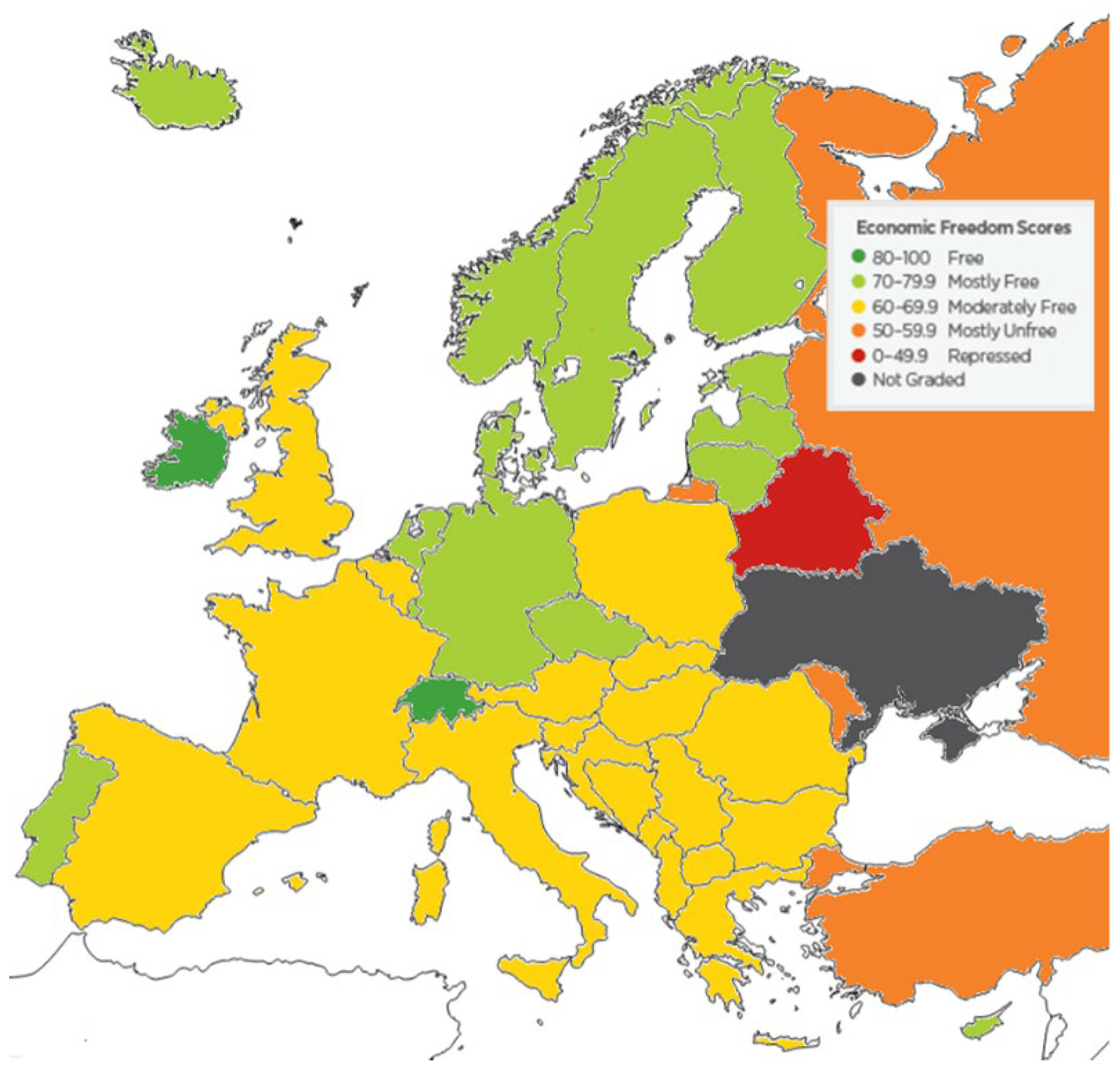
Figure 2.
Index of Economic Freedom (according to the 2015 and 2025 rankings) for EU Member States. Source: https://www.heritage.org/index/.
Figure 2.
Index of Economic Freedom (according to the 2015 and 2025 rankings) for EU Member States. Source: https://www.heritage.org/index/.
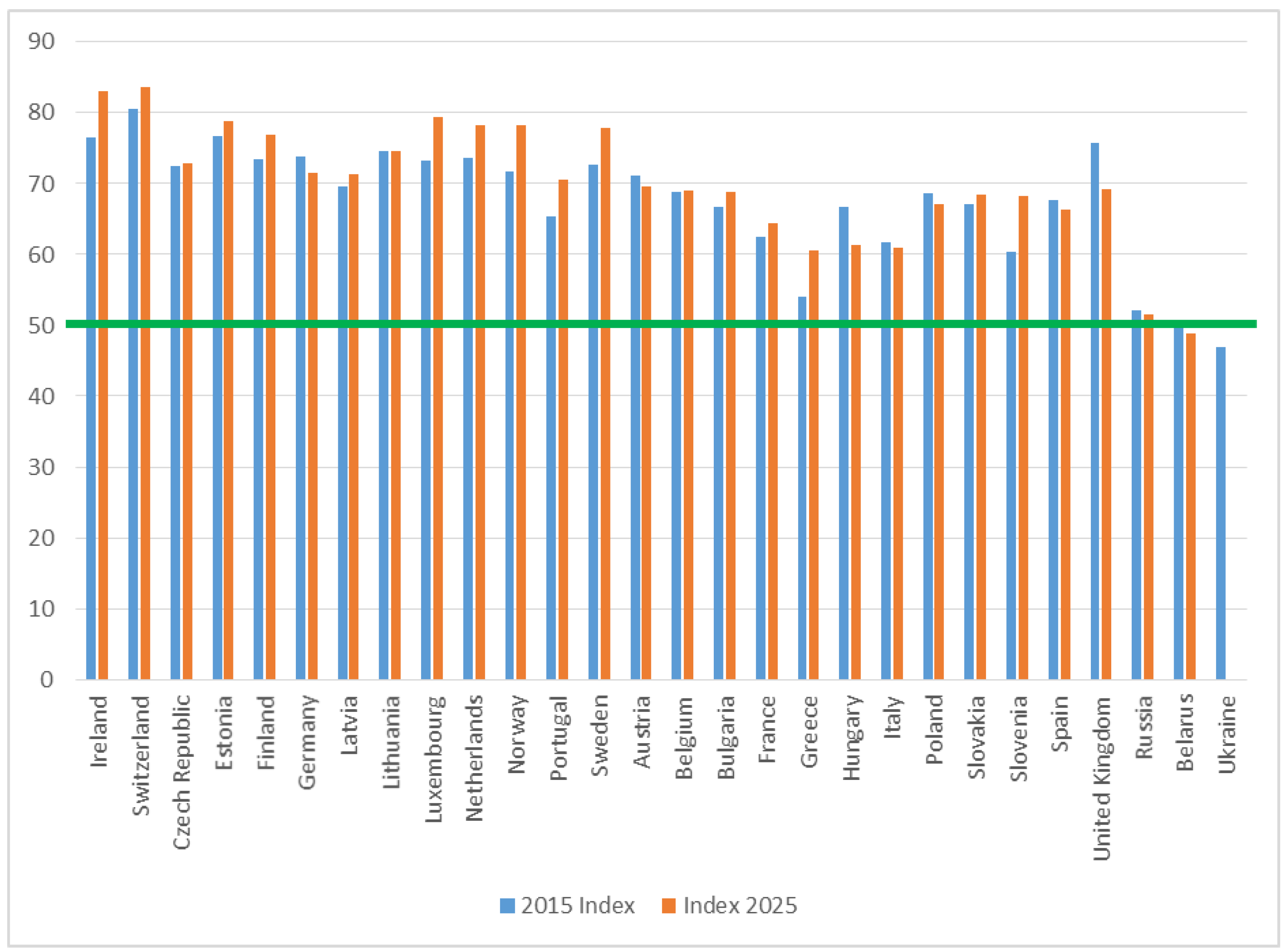
Figure 3.
Position of individual EU countries in the freedom index (IEF) ranking in 2015 and 2025. Source: https://www.heritage.org/index/.
Figure 3.
Position of individual EU countries in the freedom index (IEF) ranking in 2015 and 2025. Source: https://www.heritage.org/index/.
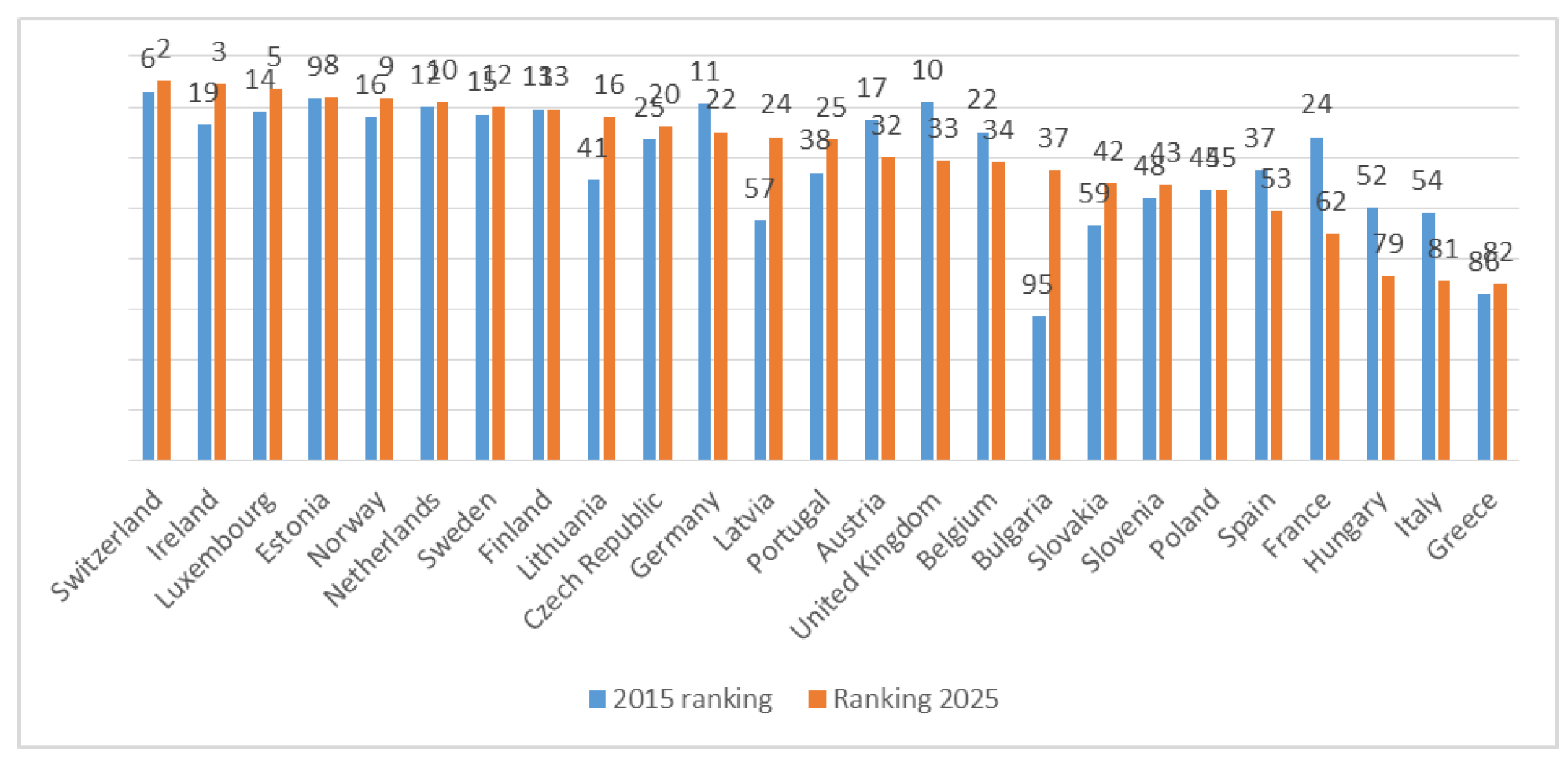
Figure 4.
Relationship between the freedom index (IEF 2025) and the HDI (according to the 2023 ranking). Sources: (https://hdr.undp.org/data-center/documentation-and-downloads), https://hdr.undp.org/data-center/human-development-index#/indicies/HDI.
Figure 4.
Relationship between the freedom index (IEF 2025) and the HDI (according to the 2023 ranking). Sources: (https://hdr.undp.org/data-center/documentation-and-downloads), https://hdr.undp.org/data-center/human-development-index#/indicies/HDI.
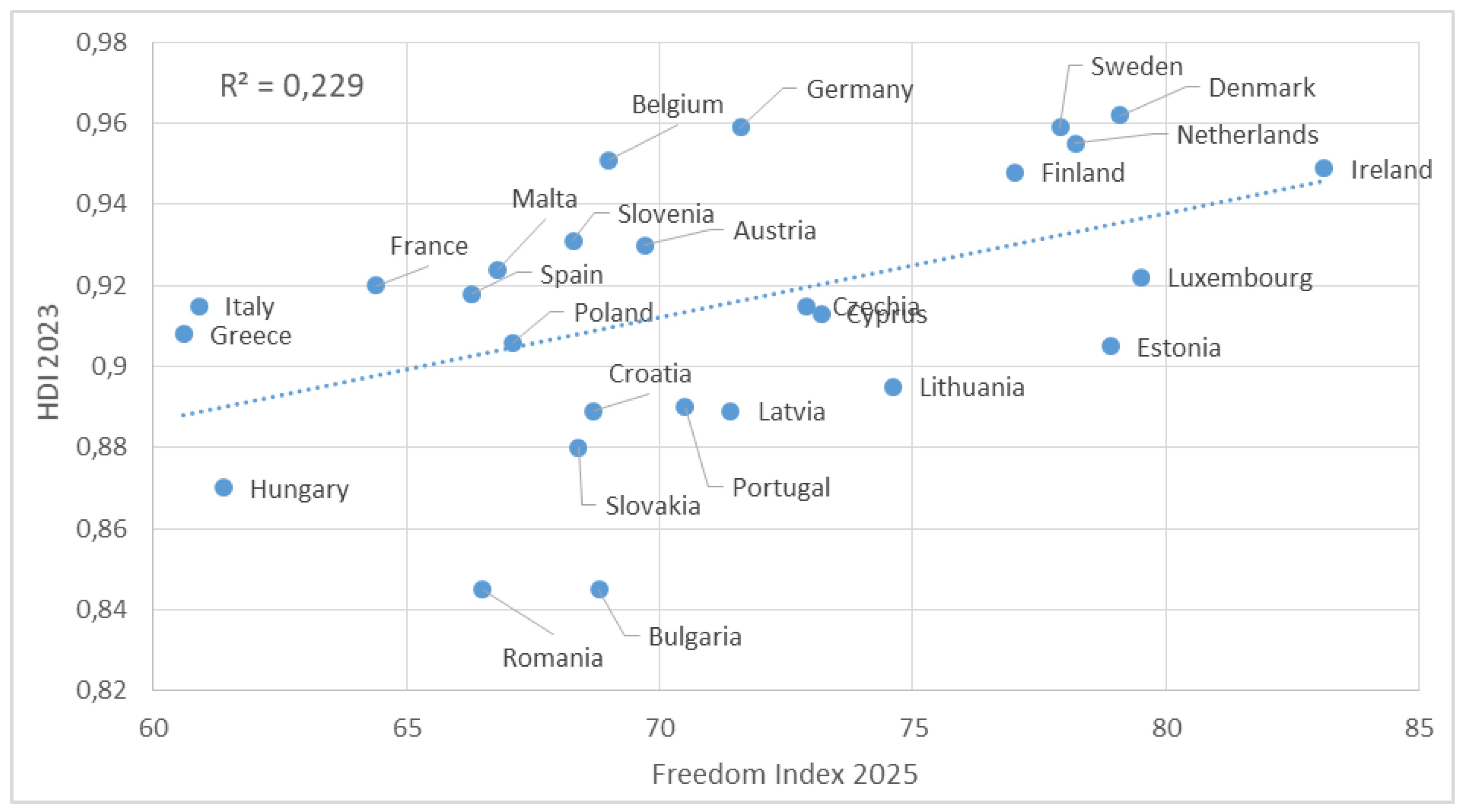
Figure 5.
Gross Domestic Product in EU Member States per capita at market prices in euros in 2014 and 2024. Source: https://ec.europa.eu/eurostat/databrowser/view/tec00001/default/table?lang=en.
Figure 5.
Gross Domestic Product in EU Member States per capita at market prices in euros in 2014 and 2024. Source: https://ec.europa.eu/eurostat/databrowser/view/tec00001/default/table?lang=en.
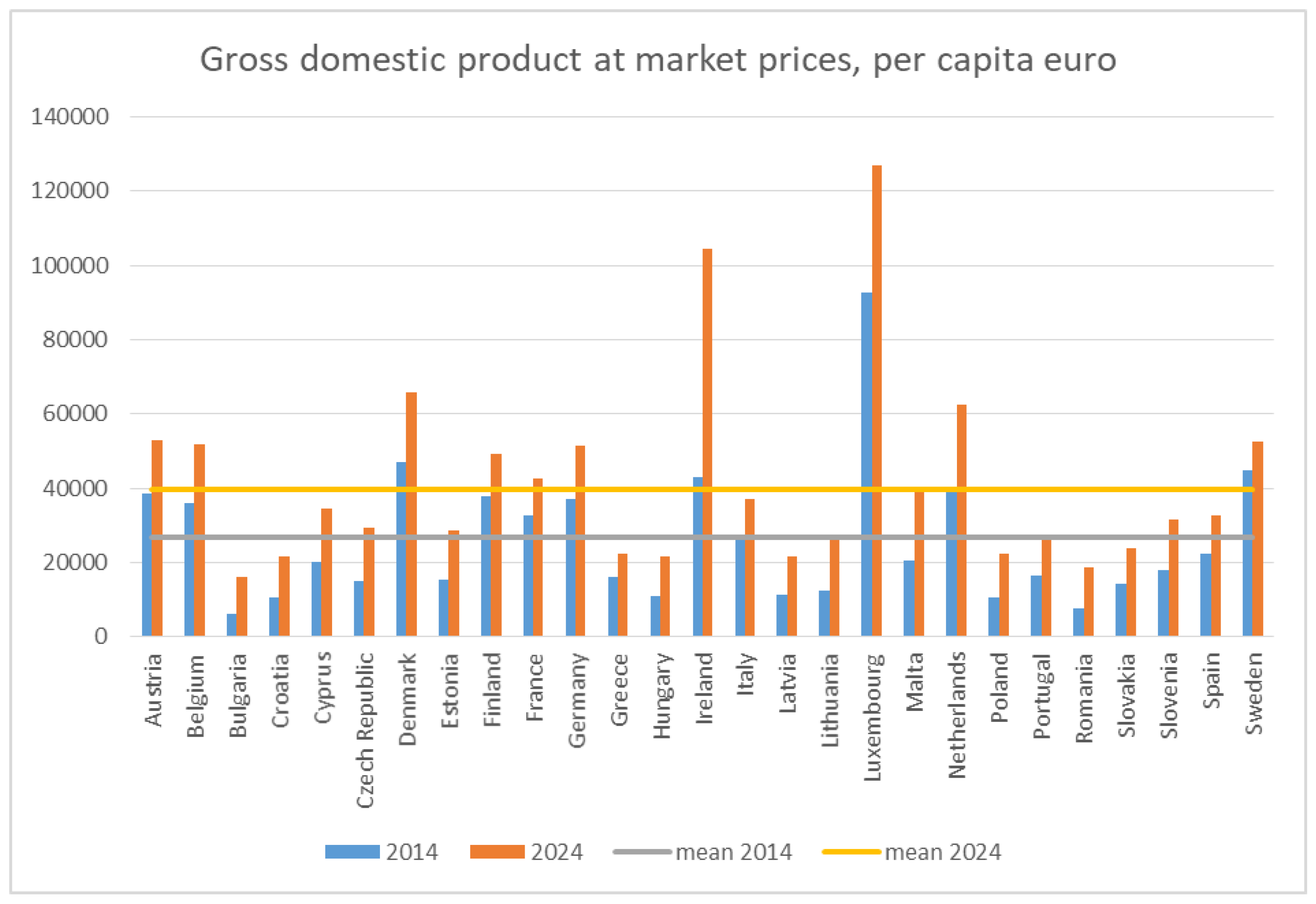
Figure 6.
Relationship between the freedom index (IEF) and GDP per capita for individual EU Member States (according to the 2024 ranking). Source: https://ec.europa.eu/eurostat/databrowser/view/tec00001/default/table?lang=en.
Figure 6.
Relationship between the freedom index (IEF) and GDP per capita for individual EU Member States (according to the 2024 ranking). Source: https://ec.europa.eu/eurostat/databrowser/view/tec00001/default/table?lang=en.
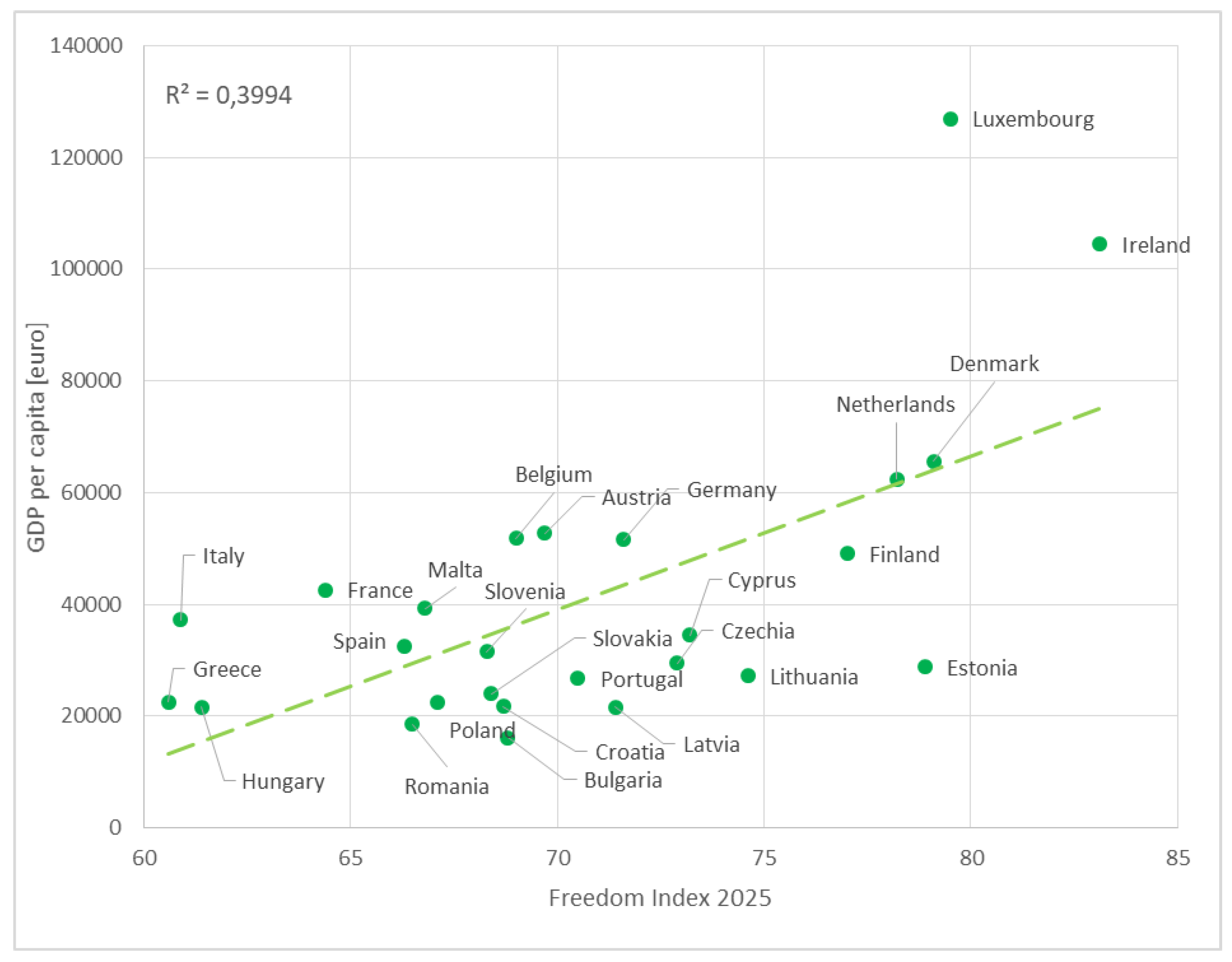

Table 2.
Freedom index (IEF) according to the 2015 and 2025 rankings and categories of European countries.
Table 2.
Freedom index (IEF) according to the 2015 and 2025 rankings and categories of European countries.
| Country | Index 2025 | 2015 category | 2025 Index | 2025 category |
|---|---|---|---|---|
| Ireland | 76.6 | Mostly free | 83.1 | Free |
| Switzerland | 80.5 | Free | 83.7 | Free |
| Cyprus | 67.9 | Moderately free | 73.2 | Mostly free |
| Czech Republic | 72.5 | Mostly free | 72.9 | Mostly free |
| Denmark | 76.3 | Mostly free | 79.1 | Mostly free |
| Estonia | 76.8 | Mostly free | 78.9 | Mostly free |
| Finland | 73.4 | Mostly free | 77 | Mostly free |
| Germany | 73.8 | Mostly free | 71.6 | Mostly free |
| Iceland | 72 | Mostly free | 72.8 | Mostly free |
| Latvia | 69.7 | Moderately free | 71.4 | Mostly free |
| Lithuania | 74.7 | Mostly free | 74.6 | Mostly free |
| Luxembourg | 73.2 | Mostly free | 79.5 | Mostly free |
| Netherlands | 73.7 | Mostly free | 78.2 | Mostly free |
| Norway | 71.8 | Mostly free | 78.3 | Mostly free |
| Portugal | 65.3 | Moderately free | 70.5 | Mostly free |
| Sweden | 72.7 | Mostly free | 77.9 | Mostly free |
| Albania | 65.7 | Moderately free | 66.6 | Moderately free |
| Armenia | 67.1 | Moderately free | 65.4 | Moderately free |
| Austria | 71.2 | Mostly free | 69.7 | Moderately free |
| Azerbaijan | 61 | Moderately free | 62.5 | Moderately free |
| Belgium | 68.8 | Moderately free | 69 | Moderately free |
| Bosnia and Herzegovina |
59 | Moderately limited | 63.5 | Moderately free |
| Bulgaria | 66.8 | Moderately free | 68.8 | Moderately free |
| Croatia | 61.5 | Moderately free | 68.7 | Moderately free |
| France | 62.5 | Moderately free | 64.4 | Moderately free |
| Georgia | 73 | Mostly free | 69 | Moderately free |
| Greece | 54 | Moderately limited | 60.6 | Moderately free |
| Hungary | 66.8 | Moderately free | 61.4 | Moderately free |
| Italy | 61.7 | Moderately free | 60.9 | Moderately free |
| Malta | 66.5 | Moderately free | 66.8 | Moderately free |
| Montenegro | 64.7 | Moderately free | 63.8 | Moderately free |
| North Macedonia |
67.1 | Moderately free | 63.2 | Moderately free |
| Poland | 68.6 | Moderately free | 67.1 | Moderately free |
| Romania | 66.6 | Moderately free | 66.5 | Moderately free |
| Serbia | 60 | Moderately free | 64.4 | Moderately free |
| Slovakia | 67.2 | Moderately free | 68.4 | Moderately free |
| Slovenia | 60.3 | Moderately free | 68.3 | Moderately free |
| Spain | 67.6 | Moderately free | 66.3 | Moderately free |
| United Kingdom | 75.8 | Mostly free | 69.3 | Moderately free |
| Moldova | 57.5 | Moderately restricted | 58.3 | Moderately limited |
| Turkey | 63.2 | Moderately free | 56.1 | Moderately limited |
| Russia | 52.1 | Moderately limited | 51.6 | Moderately limited |
| Belarus | 49.8 | Repressed | 48.9 | Repressed |
| Ukraine | 46.9 | Repressed | No index |
Source: https://www.heritage.org/index/
Disclaimer/Publisher’s Note: The statements, opinions and data contained in all publications are solely those of the individual author(s) and contributor(s) and not of MDPI and/or the editor(s). MDPI and/or the editor(s) disclaim responsibility for any injury to people or property resulting from any ideas, methods, instructions or products referred to in the content. |
© 2026 by the authors. Licensee MDPI, Basel, Switzerland. This article is an open access article distributed under the terms and conditions of the Creative Commons Attribution (CC BY) license (http://creativecommons.org/licenses/by/4.0/).
Copyright: This open access article is published under a Creative Commons CC BY 4.0 license, which permit the free download, distribution, and reuse, provided that the author and preprint are cited in any reuse.


