

Submitted:
01 March 2026
Posted:
02 March 2026
You are already at the latest version
Abstract
Machine Learning (ML) is fundamentally reshaping education, offering tools to personalize instruction, automate assessment, and predict student outcomes. This paper provides a comprehensive overview of ML's role in education, tracing its evolution from early computer-assisted instruction to today's generative artificial intelligence (AI). We explore key applications, including intelligent tutoring systems, early warning systems for at-risk students, and automated essay scoring, highlighting their potential to address the long-standing challenge of individualized learning at scale. However, this technological integration is fraught with significant challenges. Ethical concerns regarding algorithmic bias, data privacy, and the "black box" nature of complex models threaten to exacerbate existing educational inequities. The recent proliferation of generative AI, exemplified by tools like ChatGPT, has further disrupted traditional paradigms of assessment and academic integrity, prompting urgent questions about the nature of learning itself. By synthesizing current research, this paper argues that while ML holds immense transformative promise, its successful and equitable implementation depends not on technological prowess alone, but on a concerted, ethically-grounded effort involving educators, researchers, and policymakers to ensure these tools augment human expertise and serve all learners.
Keywords:
machine learning
; education
; historical development
; applications
; challenges
1. Introduction
Machine Learning (ML), a core subfield of artificial intelligence (AI), has emerged as a transformative force with the potential to fundamentally reshape educational practices, pedagogical methodologies, and institutional administration (Elbasi et al., 2025). Unlike traditional software systems that follow explicitly programmed instructions, ML enables computers to learn from data, identify patterns, and make predictions or decisions without being explicitly programmed for every conceivable scenario (Haenlein & Kaplan, 2019). In the educational context, this capability translates into systems that can analyze vast quantities of learner data, adapt instructional content in real-time, predict student outcomes, and provide personalized support at scale (Chen et al., 2020).
The integration of ML into education represents a paradigm shift that has been accelerating over the past decade. The global AI in education market was valued at USD 5.88 billion in 2024 and is projected to expand at a compound annual growth rate (CAGR) of 31.2% from 2025 to 2030 (Elbasi et al., 2025). This remarkable growth trajectory is driven by several converging factors: rising demand for personalized learning solutions, the rapid shift toward e-learning platforms accelerated by the COVID-19 pandemic, increasing investments in educational technology (EdTech) startups, and growing recognition of ML’s potential to address long-standing challenges in educational access and quality (Alam, 2021; Zawacki-Richter et al., 2019). By technology segment, ML led the market with a 64.7% revenue share in 2024, underscoring its central role in enabling adaptive and personalized learning experiences (Elbasi et al., 2025).
The significance of ML in education extends beyond market metrics. For decades, educators have grappled with the fundamental tension between the need to provide individualized attention to each student and the practical constraints of classroom settings with limited resources (Bloom, 1984). ML-powered systems offer a pathway to address this tension by automating routine administrative tasks—such as class planning and grading—thereby freeing educators to focus on high-impact activities, including mentorship, discussion facilitation, and personalized student support (Holmes et al., 2019). Furthermore, ML enables data-driven decision-making at unprecedented scales, allowing educators, administrators, and policymakers to derive actionable insights from the large volumes of student data now being generated through digital learning platforms (Kalita et al., 2025; Siemens, 2013).
Contemporary ML applications in education span the entire educational lifecycle, from student admissions and course scheduling to content generation, instructional delivery, performance assessment, and outcome prediction (Mallik & Gangopadhyay, 2023). Intelligent tutoring systems, powered by ML algorithms, can now imitate human tutors by providing real-time feedback and adapting instruction to individual learning preferences without human intervention (VanLehn, 2011). Learning analytics platforms leverage ML to identify at-risk students, predict dropout probabilities, and enable timely interventions (Romero & Ventura, 2020). Natural language processing (NLP) techniques, particularly transformer-based models such as BERT and GPT, are increasingly being deployed to provide automated feedback on student writing, power conversational agents, and support language learning (Devlin et al., 2018; Rodríguez-Ortiz et al., 2025).
However, the integration of ML into education is not without challenges and ethical considerations. Concerns regarding data privacy, algorithmic bias, the “black-box” nature of many ML models, and the potential for technology to undermine rather than enhance learning outcomes have been raised by researchers and practitioners alike (Akgun & Greenhow, 2022; Williamson & Eynon, 2020). The recent proliferation of generative AI tools, in particular, has introduced new complexities around academic integrity and the assessment of authentic student learning (Askari, 2025). These challenges underscore the need for careful, ethically-grounded approaches to ML deployment in educational contexts (see Georgiou, 2025a).
This paper provides a comprehensive overview of ML in education. It traces the historical development of ML applications in educational settings, examines the current landscape of ML applications across administrative, instructional, and assessment domains, critically analyzes the challenges and limitations facing ML adoption in education, and concludes with reflections on future directions. By synthesizing insights from the rapidly growing body of research in this field, this work aims to serve as a foundational reference for educators, researchers, policymakers, and technologists seeking to understand and shape the role of ML in the future of education.
2. Historical Development of ML in Education
2.1. Early Foundations: Computer-Assisted Instruction and Intelligent Tutoring Systems
The history of applying computational methods to education long predates the emergence of ML as a distinct field. The 1960s witnessed the development of computer-assisted instruction (CAI), which leveraged technology to deliver learning materials and provide feedback to users (Suppes, 1966). The Programmed Logic for Automatic Teaching Operations (PLATO), developed in 1960 at the University of Illinois, stands as the first large-scale CAI system, serving a diverse range of learners from school pupils to university students and even prison inmates across subjects including mathematics, Latin, and the sciences (Grimbley-Smith, 2025). PLATO’s innovations included personalized learning paths, immediate feedback, and sophisticated student tracking capabilities, features that would later become central to ML-based educational systems (Bitzer & Easley, 1965).
The late 1960s and 1970s saw the emergence of more sophisticated intelligent tutoring systems (ITS). The Time-shared, Interactive Computer-Controlled Instructional Television (TICCIT) system, developed in 1968, delivered individualized, multimedia-based content to users and allowed learners to progress at their own pace (Merrill et al., 1980). These early systems were grounded in contemporary learning theories, particularly the work of B.F. Skinner on programmed instruction and Benjamin Bloom on mastery learning, which emphasized the importance of individualized tutoring and immediate feedback (Skinner, 1958). Bloom’s influential “2 sigma” study, which demonstrated that one-on-one tutoring produced learning outcomes two standard deviations above conventional instruction, provided a compelling rationale for developing computer-based systems that could approximate the benefits of human tutoring at scale (Bloom, 1984).
2.2. The Emergence of AI and ML in Education (1980s–2000s)
The 1980s and 1990s witnessed the gradual integration of artificial intelligence (AI) techniques into educational systems. Early intelligent tutoring systems, such as SCHOLAR (teaching South American geography) and WHY (teaching causes of rainfall), incorporated knowledge representation and reasoning capabilities that allowed them to engage in dialogue with students and answer questions (Carbonell, 1970). The development of cognitive tutors at Carnegie Mellon University, grounded in John Anderson’s Adaptive Control of Thought (ACT) theory, represented a significant advance by incorporating cognitive models that could trace student problem-solving steps and provide targeted hints and feedback (Anderson et al., 1985; Anderson et al., 1995).
The invention of the World Wide Web in 1989 fundamentally transformed the landscape for AI in education (Berners-Lee et al., 1992). Web-based learning environments could collect unprecedented amounts of data on user interactions, which could then be used to train software agents and improve system performance (Brusilovsky, 2001). The 1990s also saw the emergence of learning management systems (LMS) such as FirstClass and Blackboard, which organized content, tracked student progress, and managed online education (Watson & Watson, 2007). While early LMS platforms relied primarily on basic automation rules, they laid the groundwork for the data collection infrastructure that would later enable sophisticated ML applications (Coates et al., 2005).
The turn of the millennium brought advances in hardware capabilities, data mining techniques, and ML algorithms that accelerated the development of AI in education. The emergence of educational data mining (EDM) as a distinct research field in the early 2000s formalized the application of data analytics to educational questions (Baker & Inventado, 2014). Researchers began applying ML techniques to predict student performance, identify at-risk learners, and uncover patterns in learning behaviors (Koedinger et al., 2015; Peña-Ayala, 2014). The launch of Massive Open Online Courses (MOOCs) in the late 2000s created new imperatives for automated assessment and personalization, as courses with tens of thousands of students rendered traditional instructional methods infeasible (Pappano, 2012).
2.3. The Deep Learning Revolution and Modern Era (2012–Present)
The deep learning revolution, catalyzed by AlexNet’s landmark performance in the 2012 ImageNet competition, profoundly impacted educational applications (Krizhevsky et al., 2012). Deep neural networks offered new capabilities for analyzing complex, high-dimensional educational data, including student writing, discussion forum posts, and multimodal learning interactions (LeCun et al., 2015). Related advances in speech-and-language ML—such as the use of biomarkers for early neurological detection—illustrate the broader maturation of ML methods that are increasingly transferable to educational language data and analytics (Georgiou, 2025b). The introduction of the Transformer architecture in 2017, with its self-attention mechanism, fundamentally transformed NLP and opened new possibilities for AI in education (Vaswani et al., 2017).
The release of BERT (Bidirectional Encoder Representations from Transformers) by Google in 2018 demonstrated the power of pre-trained language models for understanding context-dependent language, enabling more sophisticated analysis of student writing and more natural conversational agents for tutoring (Devlin et al., 2018). OpenAI’s GPT series, introduced between 2018 and 2020, progressively expanded the capabilities of generative language models, with GPT-3 demonstrating remarkable few-shot learning abilities across diverse tasks (Radford et al., 2018; Brown et al., 2020). These developments laid the foundation for the integration of generative AI into educational applications, from automated feedback generation to intelligent tutoring (Bommasani et al., 2021).
The COVID-19 pandemic served as a powerful accelerant for ML adoption in education. The rapid shift to remote learning created urgent demand for technologies that could support online instruction, maintain student engagement, and provide continuity in assessment (Hodges et al., 2020). Educational institutions that had previously been hesitant to adopt AI-powered tools found themselves compelled to explore digital solutions (World Bank, 2020). The pandemic also generated vast new datasets of online learning interactions, providing rich material for training and refining ML models (Lang et al., 2022).
The release of ChatGPT in November 2022 marked a watershed moment for AI in education (OpenAI, 2022). For the first time, generative AI capabilities became accessible to the general public through an intuitive interface, sparking widespread experimentation by students and educators alike (Baidoo-Anu & Owusu Ansah, 2023). Subsequent developments, including GPT-5 and specialized educational tools, have continued to expand the possibilities for ML in education while also raising profound questions about academic integrity, assessment practices, and the nature of learning in an AI-augmented world (Achiam et al., 2023; Choi & Chang, 2025; Mollick & Mollick, 2023). Figure 1 presents a timeline of ML-in-Education milestones.
2.4. Evolution of Research Themes
The research literature on ML in education has evolved significantly over the past two decades. Early work focused primarily on prediction tasks, forecasting student performance, identifying at-risk learners, and modeling knowledge acquisition (Shahiri et al., 2015). As ML techniques matured, researchers increasingly turned their attention to personalization and adaptation, developing systems that could dynamically adjust content and feedback based on learner characteristics (Xie et al., 2019). More recently, the focus has expanded to include affective computing (detecting and responding to student emotions), multimodal learning analytics (integrating data from multiple sources such as clickstreams, facial expressions, and physiological sensors), and the application of generative AI for content creation and feedback (D’Mello & Graesser, 2015; Blikstein & Worsley, 2016; Wang et al., 2025).
A systematic analysis of research published between 2003 and 2022 reveals the growing diversity of ML applications in education (Mallik & Gangopadhyay, 2023). Performance assessment has been the most extensively studied category, accounting for a substantial portion of published work, followed by content generation, learning content design, and student admission logistics (Ouyang & Jiao, 2021). The COVID-19 pandemic period (2020-2022) saw increased attention to online learning contexts and the challenges of maintaining educational quality in remote settings (Bozkurt & Sharma, 2020).
3. Applications of ML in Education
3.1. Student Performance Prediction and Early Warning Systems
One of the most extensively developed applications of ML in education is the prediction of student performance and the identification of learners at risk of academic difficulty or dropout (Hellas et al., 2018). Educational institutions at all levels face the challenge of identifying students who may need additional support before they fall irreparably behind (Arnold & Pistilli, 2012). ML models trained on historical student data, including demographics, prior academic performance, engagement metrics, and clickstream data from learning management systems, can predict outcomes with accuracy that often exceeds traditional methods (Arévalo-Cordovilla & Peña, 2024; Márquez-Vera et al., 2013; Sweeney et al., 2015).
A wide range of ML algorithms has been applied to performance prediction tasks. Logistic regression and decision trees provide interpretable models that can identify key risk factors (Bahadir, 2016; Bilal et al., 2022). Random forests and gradient boosting machines often achieve high predictive accuracy by capturing complex, non-linear relationships in the data (Beaulac & Rosenthal, 2019). Moreover, support vector machines and neural networks have been employed for more challenging prediction tasks involving high-dimensional data (Huang & Fang, 2013; Livieris et al., 2012). Finally, deep learning approaches, particularly recurrent neural networks (RNNs) and long short-term memory (LSTM) networks, have proven effective for modeling temporal patterns in student learning trajectories (Piech et al., 2015; Xiong et al., 2016).
Early warning systems based on these predictive models enable timely interventions. When a model identifies a student as at-risk, institutions can trigger automated alerts to advisors, instructors, or the students themselves, prompting targeted support (Jayaprakash et al., 2014). Research has demonstrated that such systems, when properly implemented, can significantly reduce dropout rates and improve academic outcomes (Essa & Ayad, 2012; Krumm et al., 2014). However, the effectiveness of early warning systems depends critically on the quality of the underlying data, the appropriateness of the prediction horizon, and the availability of effective interventions to offer at-risk students (Ferguson & Clow, 2017).
3.2. Personalized and Adaptive Learning
Personalization stands at the core of ML’s promise for education. The principle that instruction should be tailored to individual learner needs has deep roots in educational theory, but practical constraints have historically limited its implementation (Walkington, 2013). ML offers the potential to deliver personalized learning at scale by continuously adapting content, pacing, and pedagogical strategies based on individual learner characteristics and performance (Abeynayake et al., 2024; Peng et al., 2019).
Adaptive learning systems employ ML algorithms to build and continuously update models of student knowledge, often referred to as knowledge tracing (Corbett & Anderson, 1994). Bayesian Knowledge Tracing (BKT), one of the earliest and most influential approaches, models student mastery of individual knowledge components and updates probability estimates based on performance on related tasks (Corbett & Anderson, 1994). More recent deep learning approaches, such as Deep Knowledge Tracing (DKT), use recurrent neural networks to capture more complex patterns of knowledge acquisition and forgetting (Piech et al., 2015).
Content recommendation represents another key dimension of personalization. Collaborative filtering techniques, similar to those used by e-commerce and streaming platforms, can recommend learning resources based on what similar learners have found helpful (Bobadilla et al., 2009). Content-based recommendation systems analyze the characteristics of learning materials and match them to learner profiles (Pazzani & Billsus, 2007). Hybrid approaches combining multiple techniques often achieve the best results (Burke, 2002).
Personalized learning systems have been developed across diverse educational contexts and subject areas. In Sri Lanka, researchers developed an ML-powered personalized learning system for secondary mathematics that creates individualized learning paths, implements chatbot-based tutoring, and provides real-time feedback on student progress (Abeynayake et al., 2024). In Hong Kong, researchers applied recurrent neural networks to detect mindset states—including concentration, motivation, perseverance, engagement, and self-initiative—among secondary students in online courses, demonstrating the potential for real-time adaptation to affective as well as cognitive states (Wang et al., 2025).
3.3. Intelligent Tutoring Systems and Conversational Agents
Intelligent tutoring systems (ITS) represent one of the most mature applications of AI in education, with research spanning more than four decades. Modern ITS integrate multiple ML capabilities: they model student knowledge, track progress through curricula, generate appropriate problems and examples, provide targeted feedback, and offer hints when students struggle (Kestin et al., 2025; Ma et al., 2014). Cognitive Tutors, widely used in mathematics classrooms, exemplify this approach, having demonstrated significant learning gains in rigorous evaluations (Koedinger & Corbett, 2006; Koedinger et al., 1997).
Recent advances in NLP have enabled the development of increasingly sophisticated conversational agents for education (Winkler & Söllner, 2018; Wu & Yu, 2024). These agents can engage students in dialogue, answer questions, and provide explanations in natural language (Graesser et al., 2005). Early systems such as AutoTutor demonstrated the feasibility of tutorial dialogue systems, showing that conversational agents could produce learning gains comparable to human tutors in some domains (Graesser et al., 2004). Contemporary systems leverage large language models (LLMs) to engage in more flexible and contextually appropriate dialogue (Wollny et al., 2021; Pérez et al., 2020).
Chatbots have emerged as a scalable approach to providing on-demand support to learners. In higher education, chatbots are being deployed to answer administrative questions, provide academic advising, and offer course-specific tutoring (Prashant et al., 2025; Sandu & Gide, 2019). Research on chatbot effectiveness has shown positive effects on student engagement and learning outcomes, though results vary considerably depending on design and implementation (Winkler & Söllner, 2018). The RASA framework, an open-source platform for building conversational AI, has been employed to develop educational chatbots with natural language understanding capabilities (Bocklisch et al., 2017).
3.4. Automated Assessment and Feedback
Assessment represents both a significant opportunity and a significant challenge for ML in education. Automated assessment offers the promise of reducing the grading burden on educators, providing students with more immediate feedback, and enabling more frequent formative assessment (Shermis & Burstein, 2013). However, assessing complex student work—particularly writing and other open-ended responses—requires sophisticated natural language understanding (Burrows et al., 2015).
Automated essay scoring (AES) has been an active area of research and development since the 1960s (Page, 1966). Modern AES systems employ a variety of ML techniques to evaluate essays on dimensions including organization, argumentation, grammar, and style. While these systems have achieved sufficient reliability for use in high-stakes assessments such as the GRE and GMAT, concerns remain about their ability to validly assess authentic writing ability and their susceptibility to gaming (Perelman, 2014; Ramesh & Sanampudi, 2022).
ML is also being applied to provide more fine-grained feedback on student work. Systems can identify specific errors, suggest improvements, and provide explanatory comments (Dikli, 2006; Liu, 2024). In programming education, automated feedback systems can evaluate code correctness, efficiency, and style, providing students with detailed guidance for improvement (Ihantola et al., 2010; Keuning et al., 2018). In mathematics, intelligent assessment systems can analyze student problem-solving steps, identify misconceptions, and generate personalized practice problems (Heffernan & Heffernan, 2014).
The emergence of generative AI has created new challenges for assessment. Students can now use tools like ChatGPT to generate convincing text, code, and problem solutions, potentially undermining the validity of traditional assessment formats (Susnjak, 2022; Georgiou, 2025c; 2026a). This has prompted calls for assessment reform, including a shift toward process-oriented assessment, oral examinations, and tasks that require integration of AI tools rather than their prohibition (Cotton et al., 2023; Lodge et al., 2023). Some institutions are exploring “AI-resilient” assessment designs that emphasize higher-order thinking skills and authentic performance (Bearman & Ajjawi, 2023).
3.5. Learning Analytics and Institutional Decision-Making
Learning analytics, defined as the measurement, collection, analysis, and reporting of data about learners and their contexts for purposes of understanding and optimizing learning, has emerged as a distinct field at the intersection of education, data science, and ML (Siemens, 2013). Learning analytics platforms integrate data from multiple sources—learning management systems, student information systems, library usage, and other institutional data sources—to provide dashboards and reports that inform decision-making by educators, administrators, and students themselves (Ferguson, 2012; Gasevic et al., 2015).
ML plays an increasingly central role in learning analytics. Predictive models identify students who may benefit from additional support (Agudo-Peregrina et al., 2014). Clustering algorithms reveal patterns in student learning strategies and engagement (Kizilcec et al., 2013). Social network analysis maps patterns of interaction in online learning communities (Dawson, 2010). NLP analyzes discussion forum content to identify topics of interest, confusion, or concern (Crossley et al., 2015; Wise et al., 2017).
At the institutional level, ML-powered analytics support strategic planning and resource allocation (Norris & Baer, 2012). Enrollment management, curriculum planning, and program evaluation can all be informed by predictive models and pattern analysis (Picciano, 2012). However, researchers caution against over-reliance on analytics without appropriate human interpretation and contextual understanding (Selwyn, 2019). Ethical considerations, including student privacy, algorithmic fairness, and transparency, are central to responsible learning analytics implementation (Slade & Prinsloo, 2013; Prinsloo & Slade, 2017).
3.6. Content Creation and Curriculum Design
ML is increasingly being applied to the creation of educational content and the design of curricula (Rutecka et al., 2025). Natural language generation techniques can produce instructional texts, practice problems, and assessment items (Rus & Graesser, 2009). In language learning, ML-powered systems can generate exercises tailored to individual learner proficiency levels and interests (Heilman & Smith, 2010). In science and mathematics education, systems can generate problems with specified parameters and difficulty levels (Singh et al., 2012).
Generative AI, particularly LLMs, has dramatically expanded the possibilities for automated content creation (Cooper, 2023). Educators can use tools like GPT-4 to generate lesson plans, explanations, examples, and assessment items, significantly reducing preparation time (Trust et al., 2023). However, concerns about accuracy, appropriateness, and pedagogical quality require careful review and adaptation of AI-generated content (Zhai, 2022; Alfarwan, 2025).
Curriculum design, traditionally a labor-intensive process requiring extensive expertise, can be informed by ML analysis of learning trajectories, prerequisite relationships, and effectiveness data (Falmagne et al., 2006). Sequence mining techniques can identify optimal ordering of learning activities (Tang et al., 2016). Reinforcement learning approaches can optimize curriculum sequencing to maximize learning outcomes (Clement et al., 2015; Doroudi & Brunskill, 2019).
3.7. Supporting Diverse Learners and Inclusive Education
ML has significant potential to support diverse learners and advance inclusive education (Koutsouris et al., 2022). For students with disabilities, ML-powered tools can provide alternative means of accessing content and demonstrating learning (Seale, 2013). Text-to-speech and speech-to-text technologies, enhanced by deep learning, have become increasingly accurate and accessible. Computer vision systems can describe visual content to students with visual impairments (Bigham et al., 2010).
For students learning in a second language, ML-powered tools can provide real-time translation, simplified language, and vocabulary support (Simonnet et al., 2025). Adaptive systems can adjust linguistic complexity based on individual proficiency levels (Heift & Schulze, 2007). For students with learning disabilities, personalized learning systems can provide additional practice, alternative explanations, and multi-modal representations of content (Ok & Rao, 2019; Rose & Meyer, 2002).
However, researchers caution that ML systems must be carefully designed to avoid exacerbating existing inequities (Noble, 2018). If training data reflects historical biases—for example, if certain demographic groups are underrepresented or if assessment instruments contain cultural biases—ML models may perpetuate or amplify these biases (Benjamin, 2019; O’Neil, 2016). Ensuring that ML applications serve all learners equitably requires attention to diverse data sources, fairness-aware algorithms, and inclusive design processes (Holstein & Doroudi, 2021). Figure 2 displays a circular dendrogram of ML applications in Education.
4. Challenges of ML in Education
4.1. Ethical Challenges and Algorithmic Fairness
The deployment of ML in education raises profound ethical questions that must be addressed to ensure responsible innovation (Akgun & Greenhow, 2022; Georgiou, 2025d). Perhaps the most fundamental concern is algorithmic fairness: the risk that ML systems may produce systematically different outcomes for different demographic groups, potentially exacerbating existing educational inequities (Baker & Hawn, 2021). Research has documented instances where predictive models for student success exhibited bias based on race, socioeconomic status, or gender (Gardner et al., 2019; Georgiou, 2025e; Loukina et al., 2019). These biases often originate in training data that reflects historical patterns of inequality, but they can be amplified or obscured by algorithmic processing (Riazy et al., 2020).
Fairness in educational ML is complicated by the multiple, sometimes conflicting, definitions of what constitutes a fair algorithm (Barocas et al., 2023). Should a model aim for demographic parity (equal outcomes across groups), equal opportunity (equal true positive rates), or counterfactual fairness (outcomes that would be the same if sensitive attributes were different)? The choice among these definitions has substantive implications for system behavior and requires careful consideration of educational values and goals (Corbett-Davies & Goel, 2018; Kleinberg et al., 2016).
Beyond fairness, ethical challenges include transparency and explainability (Selbst & Barocas, 2018). Many of the most powerful ML models, particularly deep neural networks, operate as “black boxes” whose internal workings are opaque even to their developers (Castelvecchi, 2016). When these models influence consequential decisions about students—such as identifying at-risk learners or determining course placements—the inability to explain how decisions are reached undermines accountability and trust (Burrell, 2016). Explainable AI (XAI) techniques that provide interpretable explanations for model predictions are an active area of research with particular importance for educational applications (Conati et al., 2018; Khosravi et al., 2022).
4.2. Data Privacy and Security
ML in education depends on data—often large volumes of detailed data about students, their behaviors, and their performance (Reidenberg & Schaub, 2018). This data dependency creates significant privacy and security concerns (Zeide, 2017). Educational data may include personally identifiable information, academic records, behavioral traces from learning platforms, and increasingly, biometric data from facial analysis or other sensors (Regalia, 2020). The collection and analysis of such data raises questions about consent, data ownership, and the potential for misuse (Lupton & Williamson, 2017).
Student privacy is protected by legal frameworks in many jurisdictions, including the Family Educational Rights and Privacy Act (FERPA) in the United States and the General Data Protection Regulation (GDPR) in the European Union (Biegel, 2019). These frameworks impose obligations on educational institutions and technology providers regarding data collection, storage, and sharing (Hoofnagle et al., 2019). However, the rapid pace of technological change often outstrips legal frameworks, creating ambiguities about how existing regulations apply to novel ML applications (Crawford & Schultz, 2014).
Privacy-preserving ML techniques offer potential approaches to reducing privacy risks (Papernot et al., 2016). Federated learning enables model training across distributed data sources without centralizing raw data, reducing the risk of data breaches (McMahan et al., 2017; Kairouz et al., 2021). Differential privacy adds calibrated noise to query results to protect individual privacy while enabling aggregate analysis (Dwork, 2008). Homomorphic encryption allows computation on encrypted data without decryption (Gentry, 2009). However, these techniques involve trade-offs between privacy protection, computational efficiency, and model accuracy that must be carefully navigated (Abadi et al., 2016).
4.3. Pedagogical Appropriateness and Effectiveness
A fundamental challenge for ML in education is ensuring pedagogical appropriateness—that systems are designed in ways that align with sound educational principles and actually enhance learning (Watters, 2021). Too often, ML applications are developed with primary attention to technical sophistication rather than pedagogical effectiveness (Selwyn, 2020). Systems may optimize for easily measurable outcomes (such as quiz completion or time-on-task) while neglecting deeper learning goals (Williamson, 2017). They may provide feedback that is technically accurate but pedagogically unhelpful (Pardo & Siemens, 2014).
The evidence base for ML effectiveness in education remains uneven. While some applications, particularly intelligent tutoring systems in well-defined domains like mathematics, have demonstrated significant learning gains in rigorous studies (Kulik & Fletcher, 2016), others have been subject to minimal evaluation (Du Boulay, 2019). Many published studies report positive results but suffer from methodological limitations, including small sample sizes, short intervention periods, and lack of appropriate control groups (Bulger, 2016; Reich, 2020). The rapid pace of technological change means that evidence often lags behind deployment (Luckin et al., 2016).
Integrating ML systems into existing educational practices presents additional challenges. Systems designed without adequate attention to teacher workflows and classroom contexts may be underutilized or misused (Hanshaw & Sullivan, 2025; Zhao, 2018). Teachers may lack the training and support needed to interpret ML-generated insights and translate them into effective action (Philipsen et al., 2019; Sailer et al., 2021). The most successful implementations treat ML systems as tools to augment, not replace, teacher expertise, and involve educators deeply in design and implementation (Holstein et al., 2019).
4.4. The “Black Box” Problem and Interpretability
The opacity of many ML models poses particular challenges in educational contexts where decisions affect students’ educational trajectories and opportunities (Rudin, 2019). When a model identifies a student as at-risk or recommends a particular intervention, educators and students need to understand the basis for these determinations to respond appropriately (Kay & Kummerfeld, 2019). Without interpretability, it is difficult to verify that decisions are fair, to identify potential errors, or to build trust in the system (Miller, 2019).
Interpretability needs vary by stakeholder group (Abdul et al., 2018): educators benefit from knowing which features most influenced a prediction to guide pedagogical responses (Molenaar, 2022); students and families need understandable rationales to participate and advocate for support (Tsai et al., 2021); developers and researchers rely on interpretability to audit, debug, and refine models (Kizilcec & Lee, 2021); and regulators/policymakers use explanations to assess legal and ethical compliance (Yeung, 2017). Designing ML systems that can meet these diverse interpretability needs is an ongoing research challenge (Barredo Arrieta et al., 2020).
Posthoc explanation methods, such as LIME (Local Interpretable Model-agnostic Explanations) and SHAP (SHapley Additive exPlanations), can provide approximations of model reasoning after the fact (Lundberg & Lee, 2017; Ribeiro et al., 2016). However, these explanations have limitations and may not faithfully represent actual model decision processes (Rudin & Radin, 2019). Some researchers advocate for inherently interpretable models—such as decision trees, logistic regression, or attention-based neural networks—over black-box models, even if they achieve slightly lower predictive accuracy (Rudin, 2019). The choice between accuracy and interpretability involves trade-offs that must be made with educational values in mind (Doshi-Velez & Kim, 2017).
4.5. Infrastructure and Implementation Barriers
Implementing ML in education requires substantial infrastructure that remains lacking in many contexts. Reliable internet connectivity, adequate computing devices, and robust data systems are prerequisites for most ML applications (Van Deursen & Van Dijk, 2019). Schools and institutions serving under-resourced communities often lack this infrastructure (Arias Ortiz et al., 2025), raising concerns that ML may exacerbate rather than reduce educational inequities (Dolan, 2016). The “digital divide” encompasses not only access to technology but also the capacity to use it effectively (Hargittai, 2002).
Data quality presents another significant barrier (Kitchin, 2014). ML models are only as good as the data they are trained on, and educational data is often messy, incomplete, or inconsistently recorded (Baker, 2016). Different systems may use incompatible data formats; historical data may be unavailable or of questionable quality; privacy concerns may limit data access for model development (Romero & Ventura, 2017). Building the data infrastructure needed for effective ML requires significant investment in data governance, cleaning, and integration (Bichsel, 2012).
Implementation challenges extend beyond technical infrastructure to include organizational capacity and culture (Weller, 2020). Educational institutions may lack personnel with the data science and ML expertise needed to develop, deploy, and maintain systems (Daniel, 2015). Existing staff may require substantial professional development to use ML tools effectively (Starkey, 2020). Institutional policies and procedures may need updating to address novel issues raised by ML deployment (Ahn & Chen, 2021). Sustained commitment from leadership is essential but not always present (Scherer et al., 2019).
4.6. Academic Integrity and Evolving Nature of Learning
The emergence of generative AI has fundamentally disrupted traditional conceptions of academic integrity (Nishihara et al., 2025). Students can now use tools like ChatGPT to generate essays, solve problems, and complete assignments in ways that are difficult to detect (Eaton, 2021). This has created what some describe as an “AI arms race” between students using generative tools and institutions attempting to detect misuse (Bretag, 2019). Traditional plagiarism detection systems, designed to identify copied text, are largely ineffective against AI-generated content (Georgiou, 2026b; Rogerson & McCarthy, 2017).
Institutions are grappling with how to respond. Some have attempted to ban or restrict AI tool use, though enforcement is challenging (Dawson, 2020). Others have chosen to embrace generative AI as a reality to be worked with rather than against, redesigning assessments to assume AI access and focus on higher-order skills (Morris, 2018; Swauger, 2020). These approaches include process-oriented assessment (evaluating drafts and revisions), oral examinations, collaborative projects, and authentic tasks that require integration of AI tools with original thinking (Bertram Gallant, 2017).
More fundamentally, the availability of powerful AI tools raises questions about the nature of learning and the goals of education (Williamson & Eynon, 2020). If AI can perform many of the tasks traditionally used to assess learning, what does it mean to be educated? How should curricula and pedagogy evolve to prepare students for a world where AI capabilities are ubiquitous? These questions lack simple answers and require ongoing dialogue among educators, students, policymakers, and the broader public (Cope et al., 2021; Peters, 2023). Figure 3 shows the main challenges of ML in Education. Figure 4 illustrates a suggested ML-in-Education pipeline with governance checkpoints.
5. Conclusions
ML has emerged as a transformative force in education, offering powerful tools for personalizing instruction, predicting student outcomes, automating assessment, and supporting institutional decision-making. The historical trajectory from early computer-assisted instruction to contemporary generative AI systems reflects decades of technological advancement and pedagogical innovation. Today, ML applications span the entire educational lifecycle, from admissions and course planning through instruction and assessment to outcome prediction and alumni engagement.
The potential benefits of ML in education are substantial. Personalized learning at scale can help address the long-standing challenge of providing individualized attention to every student. Routine administrative and assessment tasks can also be automated, allowing educators to devote more time to high-value work such as mentorship, discussion facilitation, and targeted student support. In addition, analysis of large-scale educational data can generate actionable insights that strengthen evidence-based decisions about curricula, pedagogy, and institutional policy. For learners, ML-enabled tools can deliver timely feedback, adapt the level of challenge, and offer support aligned with individual needs and circumstances.
Yet realizing this potential requires navigating significant challenges. Ethical concerns, including algorithmic fairness, data privacy, and transparency, demand careful attention. The pedagogical appropriateness of ML applications must be rigorously evaluated, with attention to whether they genuinely enhance learning rather than merely optimizing easily measurable proxies. Infrastructure and capacity barriers must be addressed to ensure that ML benefits all learners, not only those in well-resourced contexts. The disruption of generative AI to traditional assessment practices requires fundamental rethinking of how we evaluate and certify learning.
Several directions for future development merit attention. First, advancing explainable AI techniques tailored to educational contexts can enhance transparency and trust, enabling educators and learners to understand and appropriately rely on ML systems. Second, developing privacy-preserving ML approaches, including federated learning and differential privacy, can enable valuable analysis while protecting student data. Third, creating robust evidence bases through rigorous evaluation of ML applications in diverse contexts can guide effective implementation. Fourth, fostering interdisciplinary collaboration among ML researchers, educators, learning scientists, and ethicists can ensure that technical development is guided by pedagogical wisdom and ethical reflection.
Ultimately, the integration of ML into education is not primarily a technical challenge but a human one. The question is not whether ML will be used in education—it already is, and its role will surely grow—but how. Will ML systems be designed to augment and empower educators, or to replace them? Will they serve all learners equitably, or exacerbate existing disparities? Will they promote deep learning and authentic understanding, or incentivize strategic compliance and gaming? The answers to these questions will be determined not by technology alone but by the values, choices, and actions of educators, researchers, policymakers, and technologists. The future of ML in education is not yet written; it is ours to shape.
Funding
This study received no funding.
Conflicts of Interest
There are no competing interests to disclose.
References
- Abadi, M.; Chu, A.; Goodfellow, I.; McMahan, H. B.; Mironov, I.; Talwar, K.; Zhang, L. Deep learning with differential privacy. In Proceedings of the 2016 ACM SIGSAC Conference on Computer and Communications Security, 2016; pp. 308–318. [Google Scholar]
- Abdul, A.; Vermeulen, J.; Wang, D.; Lim, B. Y.; Kankanhalli, M. Trends and trajectories for explainable, accountable and intelligible systems: An HCI research agenda. In Proceedings of the 2018 CHI Conference on Human Factors in Computing Systems, 2018; pp. 1–18. [Google Scholar]
- Abeynayake, D. N.; Hakmanage, N. M.; Chamini, A. M. L. A personalized learning system for mathematics utilizing artificial intelligence and machine learning for ordinary-level students in Sri Lanka. 2024 International Conference on Advances in Technology and Computing (ICATC), 2024; IEEE; pp. 1–6. [Google Scholar]
- Achiam, J.; Adler, S.; Agarwal, S.; Ahmad, L.; Akkaya, I.; Aleman, F. L.; McGrew, B. Gpt-4 technical report. arXiv 2023, arXiv:2303.08774. [Google Scholar] [CrossRef]
- Agudo-Peregrina, Á. F.; Iglesias-Pradas, S.; Conde-González, M. Á.; Hernández-García, Á. Can we predict success from log data in VLEs? Classification of interactions for learning analytics and their relation with performance in VLE-supported F2F and online learning. Computers in Human Behavior 2014, 31, 542–550. [Google Scholar] [CrossRef]
- Ahn, J.; Chen, Y. Artificial intelligence in education: A policy-oriented research agenda. Educational Policy 2021, 35(5), 723–751. [Google Scholar]
- Akgun, S.; Greenhow, C. Artificial intelligence in education: Addressing ethical challenges in K-12 settings. AI and Ethics 2022, 2(3), 431–440. [Google Scholar] [CrossRef]
- Alam, A. Should robots replace teachers? Mobilisation of AI and learning analytics in education. 2021 International Conference on Advances in Computing, Communication, and Control, 2021; pp. 1–12. [Google Scholar]
- Alfarwan, A. Generative AI use in K-12 education: A systematic review. Frontiers in Education 2025, 10, 1647573. [Google Scholar] [CrossRef]
- Anderson, J. R.; Boyle, C. F.; Reiser, B. J. Intelligent tutoring systems. Science 1985, 228(4698), 456–462. [Google Scholar] [CrossRef] [PubMed]
- Anderson, J. R.; Corbett, A. T.; Koedinger, K. R.; Pelletier, R. Cognitive tutors: Lessons learned. The Journal of the Learning Sciences 1995, 4(2), 167–207. [Google Scholar] [CrossRef]
- Arévalo-Cordovilla, F. E.; Peña, M. Comparative analysis of machine learning models for predicting student success in online programming courses: a study based on LMS data and external factors. Mathematics 2024, 12(20), 3272. [Google Scholar] [CrossRef]
- Arias Ortiz, E.; Castro Vergara, N.; Forero Pabón, T.; Della Nina Gambi, G.; Giambruno, C.; Pérez Alfaro, M.; Rodríguez Segura, D. AI and education: Building the future through digital transformation; Inter-American Development Bank; IDB Technical Note No. IDB-TN-03122, 2025. [Google Scholar]
- Arnold, K. E.; Pistilli, M. D. Course signals at Purdue: Using learning analytics to increase student success. In Proceedings of the 2nd International Conference on Learning Analytics and Knowledge, 2012; pp. 267–270. [Google Scholar]
- Askari, M. The AI dilemma: When innovation outpaces integrity. AACSB Insights. October 2025. Available online: https://www.aacsb.edu/insights/articles/2025/10/the-ai-dilemma-when-innovation-outpaces-integrity.
- Baidoo-Anu, D.; Owusu Ansah, L. Education in the era of generative artificial intelligence (AI): Understanding the potential benefits of ChatGPT in promoting teaching and learning. Journal of AI 2023, 7(1), 52–62. [Google Scholar] [CrossRef]
- Baker, R. S. Stupid tutoring systems, intelligent humans. International Journal of Artificial Intelligence in Education 2016, 26(2), 600–614. [Google Scholar] [CrossRef]
- Baker, R. S.; Hawn, A. Algorithmic bias in education. International Journal of Artificial Intelligence in Education 2021, 1–25. [Google Scholar] [CrossRef]
- Baker, R. S.; Inventado, P. S. Educational data mining and learning analytics. In Learning analytics; Springer, 2014; pp. 61–75. [Google Scholar]
- Barocas, S.; Hardt, M.; Narayanan, A. Fairness and machine learning: Limitations and Opportunities; MIT Press, 2023. [Google Scholar]
- Bahadir, E. Using Neural Network and Logistic Regression Analysis to Predict Prospective Mathematics Teachers’ Academic Success upon Entering Graduate Education. Educational Sciences: Theory and Practice 2016, 16(3), 943–964. [Google Scholar]
- Barredo Arrieta, A.; Díaz-Rodríguez, N.; Del Ser, J.; Bennetot, A.; Tabik, S.; Barbado, A.; Herrera, F. Explainable artificial intelligence (XAI): Concepts, taxonomies, opportunities and challenges toward responsible AI. Information Fusion 2020, 58, 82–115. [Google Scholar] [CrossRef]
- Bearman, M.; Ajjawi, R. Learning to work with the black box: Assessment for learning in the age of generative AI. Assessment & Evaluation in Higher Education 2023, 1–11. [Google Scholar]
- Beaulac, C.; Rosenthal, J. S. Predicting university students’ academic success and major using random forests. Research in Higher Education 2019, 60(7), 1048–1064. [Google Scholar] [CrossRef]
- Benjamin, R. Race after technology: Abolitionist tools for the new Jim code; Polity Press, 2019. [Google Scholar]
- Berners-Lee, T.; Cailliau, R.; Groff, J. F.; Pollermann, B. World-Wide Web: the information universe. Internet Research 1992, 2(1), 52–58. [Google Scholar]
- Bertram Gallant, T. Academic integrity as a teaching & learning issue: From theory to practice. Theory Into Practice 2017, 56(2), 88–94. [Google Scholar] [CrossRef]
- Bichsel, J. Analytics in higher education: Benefits, barriers, progress, and recommendations; EDUCAUSE Center for Applied Research, 2012. [Google Scholar]
- Biegel, S. Education and the law, 4th ed.; West Academic Publishing, 2019. [Google Scholar]
- Bigham, J. P.; Jayant, C.; Ji, H.; Little, G.; Miller, A.; Miller, R. C.; Yeh, T. VizWiz: Nearly real-time answers to visual questions. In Proceedings of the 23nd Annual ACM Symposium on User Interface Software and Technology, 2010; pp. 333–342. [Google Scholar]
- Bilal, M.; Omar, M.; Anwar, W.; Bokhari, R. H.; Choi, G. S. The role of demographic and academic features in a student performance prediction. Scientific reports 2022, 12(1), 12508. [Google Scholar] [CrossRef]
- Bitzer, D.; Easley, J. PLATO: A computer-controlled teaching system. Computer-based instruction 1965, 89–103. [Google Scholar]
- Blikstein, P.; Worsley, M. Multimodal learning analytics and education data mining: Using computational technologies to measure complex learning tasks. Journal of Learning Analytics 2016, 3(2), 220–238. [Google Scholar] [CrossRef]
- Bloom, B. S. The 2 sigma problem: The search for methods of group instruction as effective as one-to-one tutoring. Educational Researcher 1984, 13(6), 4–16. [Google Scholar] [CrossRef]
- Bobadilla, J.; Serradilla, F.; Hernando, A. Collaborative filtering adapted to recommender systems of e-learning. Knowledge-Based Systems 2009, 22(4), 261–265. [Google Scholar] [CrossRef]
- Bocklisch, T.; Faulkner, J.; Pawlowski, N.; Nichol, A. Rasa: Open source language understanding and dialogue management. arXiv 2017, arXiv:1712.05181. [Google Scholar] [CrossRef]
- Bommasani, R.; Hudson, D. A.; Adeli, E.; Altman, R.; Arora, S.; von Arx, S.; Liang, P. On the opportunities and risks of foundation models. arXiv 2021, arXiv:2108.07258. [Google Scholar] [CrossRef]
- Bozkurt, A.; Sharma, R. C. Emergency remote teaching in a time of global crisis due to CoronaVirus pandemic. Asian Journal of Distance Education 2020, 15(1), i–vi. [Google Scholar]
- Bretag, T. Academic integrity. In Oxford Research Encyclopedia of Education; 2019. [Google Scholar]
- Brown, T. B.; Mann, B.; Ryder, N.; Subbiah, M.; Kaplan, J.; Dhariwal, P.; Amodei, D. Language models are few-shot learners. arXiv 2020, arXiv:2005.14165. [Google Scholar] [CrossRef]
- Brusilovsky, P. Adaptive hypermedia. User Modeling and User-Adapted Interaction 2001, 11(1), 87–110. [Google Scholar] [CrossRef]
- Bulger, M. Personalized learning: The conversations we’re not having; Data and Society Research Institute, 2016. [Google Scholar]
- Burke, R. Hybrid recommender systems: Survey and experiments. User Modeling and User-Adapted Interaction 2002, 12(4), 331–370. [Google Scholar] [CrossRef]
- Burrell, J. How the machine ‘thinks’: Understanding opacity in machine learning algorithms. Big Data & Society 2016, 3(1), 1–12. [Google Scholar] [CrossRef]
- Burrows, S.; Gurevych, I.; Stein, B. The eras and trends of automatic short answer grading. International Journal of Artificial Intelligence in Education 2015, 25(1), 60–117. [Google Scholar] [CrossRef]
- Carbonell, J. R. AI in CAI: An artificial-intelligence approach to computer-assisted instruction. IEEE Transactions on Man-Machine Systems 1970, 11(4), 190–202. [Google Scholar] [CrossRef]
- Castelvecchi, D. Can we open the black box of AI? Nature News 2016, 538(7623), 20. [Google Scholar] [CrossRef]
- Chen, L.; Chen, P.; Lin, Z. Artificial intelligence in education: A review. IEEE Access 2020, 8, 75264–75278. [Google Scholar] [CrossRef]
- Choi, W. C.; Chang, C. I. ChatGPT-5 in education: New capabilities and opportunities for teaching and learning; Preprints.org, 2025. [Google Scholar]
- Clement, B.; Roy, D.; Oudeyer, P. Y.; Lopes, M. Multi-armed bandits for intelligent tutoring systems. Journal of Educational Data Mining 2015, 7(2), 20–48. [Google Scholar]
- Coates, H.; James, R.; Baldwin, G. A critical examination of the effects of learning management systems on university teaching and learning. Tertiary Education and Management 2005, 11(1), 19–36. [Google Scholar] [CrossRef]
- Conati, C.; Porayska-Pomsta, K.; Mavrikis, M. AI in education needs interpretable machine learning: Lessons from open learner modelling. arXiv 2018, arXiv:1807.00154. [Google Scholar] [CrossRef]
- Cooper, G. Examining science education in ChatGPT: An exploratory study of generative artificial intelligence. Journal of Science Education and Technology 2023, 32(3), 444–452. [Google Scholar] [CrossRef]
- Cope, B.; Kalantzis, M.; Searsmith, D. Artificial intelligence for education: Knowledge and its assessment in AI-enabled learning ecologies. Educational Philosophy and Theory 2021, 53(12), 1229–1245. [Google Scholar] [CrossRef]
- Corbett, A. T.; Anderson, J. R. Knowledge tracing: Modeling the acquisition of procedural knowledge. User Modeling and User-Adapted Interaction 1994, 4(4), 253–278. [Google Scholar] [CrossRef]
- Corbett-Davies, S.; Goel, S. The measure and mismeasure of fairness: A critical review of fair machine learning. arXiv 2018, arXiv:1808.00023. [Google Scholar]
- Cotton, D. R.; Cotton, P. A.; Shipway, J. R. Chatting and cheating: Ensuring academic integrity in the era of ChatGPT. Innovations in Education and Teaching International 2023, 1–12. [Google Scholar] [CrossRef]
- Crawford, K.; Schultz, J. Big data and due process: Toward a framework to redress predictive privacy harms. Boston College Law Review 2014, 55, 93. [Google Scholar]
- Crossley, S.; McNamara, D. S.; Baker, R.; Wang, Y.; Paquette, L.; Barnes, T.; Bergner, Y. Language to completion: Success in an educational data mining massive open online class. In Proceedings of the 8th International Conference on Educational Data Mining, 2015; pp. 388–391. [Google Scholar]
- Daniel, B. Big Data and analytics in higher education: Opportunities and challenges. British Journal of Educational Technology 2015, 46(5), 904–920. [Google Scholar] [CrossRef]
- Dawson, P. Defending assessment security in a digital world: Preventing e-cheating and supporting academic integrity in higher education; Routledge, 2020. [Google Scholar]
- Dawson, S. ‘Seeing’ the learning community: An exploration of the development of a resource for monitoring online student networking. British Journal of Educational Technology 2010, 41(5), 736–752. [Google Scholar] [CrossRef]
- Devlin, J.; Chang, M. W.; Lee, K.; Toutanova, K. BERT: Pre-training of deep bidirectional transformers for language understanding. arXiv 2018, arXiv:1810.04805. [Google Scholar]
- Dikli, S. An overview of automated scoring of essays. The Journal of Technology, Learning and Assessment 2006, 5(1). [Google Scholar]
- D’Mello, S. K.; Graesser, A. C. Feeling, thinking, and computing with affect-aware learning technologies. The Oxford Handbook of Affective Computing 2015, 419–434. [Google Scholar]
- Dolan, J. E. Splicing the divide: A review of research on the evolving digital divide among K-12 students. Journal of Research on Technology in Education 2016, 48(1), 16–37. [Google Scholar] [CrossRef]
- Doroudi, S.; Brunskill, E. Fairer but not fair enough: On the equitability of knowledge tracing. In Proceedings of the 9th International Conference on Learning Analytics & Knowledge, 2019; pp. 335–339. [Google Scholar]
- Doshi-Velez, F.; Kim, B. Towards a rigorous science of interpretable machine learning. arXiv 2017, arXiv:1702.08608. [Google Scholar] [CrossRef]
- Du Boulay, B. Escape from the Skinner Box: The case for contemporary intelligent learning environments. British Journal of Educational Technology 2019, 50(6), 2902–2919. [Google Scholar] [CrossRef]
- Dwork, C. Differential privacy: A survey of results. International Conference on Theory and Applications of Models of Computation, 2008; Springer; pp. 1–19. [Google Scholar]
- Eaton, S. E. Plagiarism in higher education: Tackling tough topics in academic integrity; ABC-CLIO, 2021. [Google Scholar]
- Elbasi, E.; Nadeem, M.; Alzoubi, Y. I.; Topcu, A. E.; Varghese, G. Machine learning in education: Innovations, impacts, and ethical considerations. IEEE Access 2025, 13, 128741–128770. [Google Scholar] [CrossRef]
- Essa, A.; Ayad, H. Improving student success using predictive models and data visualisations. In Proceedings of the 2nd International Conference on Learning Analytics and Knowledge, 2012; pp. 58–67. [Google Scholar]
- Falmagne, J. C.; Cosyn, E.; Doignon, J. P.; Thiéry, N. The assessment of knowledge, in theory and in practice. In Formal Concept Analysis; Springer, 2006; pp. 61–79. [Google Scholar]
- Ferguson, R. Learning analytics: Drivers, developments and challenges. International Journal of Technology Enhanced Learning 2012, 4(5-6), 304–317. [Google Scholar] [CrossRef]
- Ferguson, R.; Clow, D. Where is the evidence? A call to action for learning analytics. In Proceedings of the 7th International Conference on Learning Analytics and Knowledge, 2017; pp. 56–65. [Google Scholar]
- Gardner, J.; Brooks, C.; Baker, R. Evaluating the fairness of predictive student models through slicing analysis. In Proceedings of the 9th International Conference on Learning Analytics & Knowledge, 2019; pp. 225–234. [Google Scholar]
- Gasevic, D.; Dawson, S.; Siemens, G. Let’s not forget: Learning analytics are about learning. TechTrends 2015, 59(1), 64–71. [Google Scholar] [CrossRef]
- Gentry, C. A fully homomorphic encryption scheme. Stanford University PhD Dissertation. 2009. [Google Scholar]
- Georgiou, G. P. Transforming speech-language pathology with AI: Opportunities, challenges, and ethical guidelines. Healthcare 2025a, 13(19), 2460. [Google Scholar] [CrossRef]
- Georgiou, G. P. Enhancing developmental language disorder identification with artificial intelligence: Development of an explainable screening app using real and synthetic data. Journal of Autism and Developmental Disorders 2025b. [Google Scholar] [CrossRef]
- Georgiou, G. P. Differentiating between human-written and AI-generated texts using automatically extracted linguistic features. Information 2025c, 16(11), 979. [Google Scholar]
- Georgiou, G. P. Mapping the ethical discourse in generative artificial intelligence: A topic modeling analysis of scholarly communication. Language, Technology, and Social Media 2025d, 3(2), 250–265. [Google Scholar] [CrossRef]
- Georgiou, G. P. ChatGPT exhibits bias towards developed countries over developing ones, as indicated by a sentiment analysis approach. Journal of Language and Social Psychology 2025e, 44(1), 132–141. [Google Scholar] [CrossRef]
- Georgiou, G. P. Envisioning the futures of language education in the era of artificial intelligence. Journal of Futures Studies 2026a. [Google Scholar]
- Georgiou, G. P. What distinguishes AI-generated from human writing? A rapid review of the literature. Big Data and Cognitive Computing 2026b, 10(2), 55. [Google Scholar]
- Graesser, A. C.; Chipman, P.; Haynes, B. C.; Olney, A. AutoTutor: An intelligent tutoring system with mixed-initiative dialogue. IEEE Transactions on Education 2005, 48(4), 612–618. [Google Scholar] [CrossRef]
- Graesser, A. C.; Lu, S.; Jackson, G. T.; Mitchell, H. H.; Ventura, M.; Olney, A.; Louwerse, M. M. AutoTutor: A tutor with dialogue in natural language. Behavioral Research Methods, Instruments, and Computers 2004, 36(2), 180–192. [Google Scholar] [CrossRef] [PubMed]
- Grimbley-Smith, J. From 1960 to 2025: A brief history of AI in education. In Bromcom Blogs; September 2025. [Google Scholar]
- Haenlein, M.; Kaplan, A. A brief history of artificial intelligence: On the past, present, and future of artificial intelligence. California Management Review 2019, 61(4), 5–14. [Google Scholar] [CrossRef]
- Hanshaw, G.; Sullivan, C. Exploring barriers to AI course assistant adoption: A mixed-methods study on student non-utilization. Discover Artificial Intelligence 2025, 5(1), 178. [Google Scholar] [CrossRef]
- Hargittai, E. Second-level digital divide: Differences in people’s online skills. First Monday 2002, 7(4). [Google Scholar]
- Heffernan, N. T.; Heffernan, C. L. The ASSISTments ecosystem: Building a platform that brings scientists and teachers together for minimally invasive research on human learning and teaching. International Journal of Artificial Intelligence in Education 2014, 24(4), 470–497. [Google Scholar] [CrossRef]
- Heift, T.; Schulze, M. Errors and intelligence in computer-assisted language learning: Parsers and pedagogues; Routledge, 2007. [Google Scholar]
- Heilman, M.; Smith, N. A. Good question! Statistical ranking for question generation. Human Language Technologies: The 2010 Annual Conference of the North American Chapter of the ACL, 2010; pp. 609–617. [Google Scholar]
- Hellas, A.; Ihantola, P.; Petersen, A.; Ajanovski, V. V.; Gutica, M.; Hynninen, T.; Liao, S. N. Predicting academic performance: A systematic literature review. In Proceedings of the 23rd Annual ACM Conference on Innovation and Technology in Computer Science Education, 2018; pp. 175–199. [Google Scholar]
- Hodges, C.; Moore, S.; Lockee, B.; Trust, T.; Bond, A. The difference between emergency remote teaching and online learning. Educause Review 2020, 27, 1–12. [Google Scholar]
- Holmes, W.; Bialik, M.; Fadel, C. Artificial intelligence in education promises and implications for teaching and learning. Center for Curriculum Redesign. 2019. [Google Scholar]
- Holstein, K.; Doroudi, S. Equity and artificial intelligence in education: A literature review. In The Ethics of Artificial Intelligence in Education; Routledge, 2021; pp. 31–55. [Google Scholar]
- Holstein, K.; McLaren, B. M.; Aleven, V. Co-designing a real-time classroom orchestration tool to support teacher-AI complementarity. Journal of Learning Analytics 2019, 6(2), 27–52. [Google Scholar] [CrossRef]
- Hoofnagle, C. J.; van der Sloot, B.; Borgesius, F. Z. The European Union general data protection regulation: What it is and what it means. Information & Communications Technology Law 2019, 28(1), 65–98. [Google Scholar] [CrossRef]
- Huang, S.; Fang, N. Predicting student academic performance in an engineering dynamics course: A comparison of four types of predictive mathematical models. Computers & Education 2013, 61, 133–145. [Google Scholar] [CrossRef]
- Ihantola, P.; Ahoniemi, T.; Karavirta, V.; Seppälä, O. Review of recent systems for automatic assessment of programming assignments. In Proceedings of the 10th Koli Calling International Conference on Computing Education Research, 2010; pp. 86–93. [Google Scholar]
- Jayaprakash, S. M.; Moody, E. W.; Lauría, E. J.; Regan, J. R.; Baron, J. D. Early alert of academically at-risk students: An open source analytics initiative. Journal of Learning Analytics 2014, 1(1), 6–47. [Google Scholar] [CrossRef]
- Kairouz, P.; McMahan, H. B.; Avent, B.; Bellet, A.; Bennis, M.; Bhagoji, A. N.; Zhao, S. Advances and open problems in federated learning. Foundations and Trends in Machine Learning 2021, 14(1-2), 1–210. [Google Scholar] [CrossRef]
- Kalita, E.; Oyelere, S. S.; Gaftandzhieva, S.; Rajesh, K. N.; Jagatheesaperumal, S. K.; Mohamed, A.; Ali, T. Educational data mining: a 10-year review. Discover Computing 2025, 28(1), 81. [Google Scholar] [CrossRef]
- Kay, J.; Kummerfeld, B. From data to personal user interfaces for decision-making. In Personalizing Learning; Springer, 2019; pp. 35–56. [Google Scholar]
- Kestin, G.; Miller, K.; Klales, A.; Milbourne, T.; Ponti, G. AI tutoring outperforms in-class active learning: An RCT introducing a novel research-based design in an authentic educational setting. Scientific Reports 2025, 15(1), 17458. [Google Scholar] [CrossRef] [PubMed]
- Keuning, H.; Jeuring, J.; Heeren, B. A systematic literature review of automated feedback generation for programming exercises. ACM Transactions on Computing Education 2018, 19(1), 1–43. [Google Scholar] [CrossRef]
- Khosravi, H.; Shum, S. B.; Chen, G.; Conati, C.; Gasevic, D.; Kay, J.; Martinez-Maldonado, R. Explainable artificial intelligence in education. Computers and Education: Artificial Intelligence 2022, 3. [Google Scholar] [CrossRef]
- Kitchin, R. The data revolution: Big data, open data, data infrastructures and their consequences; Sage, 2014. [Google Scholar]
- Kizilcec, R. F.; Lee, H. Algorithmic fairness in education. In The Ethics of Artificial Intelligence in Education; Routledge, 2021; pp. 173–196. [Google Scholar]
- Kizilcec, R. F.; Piech, C.; Schneider, E. Deconstructing disengagement: Analyzing learner subpopulations in massive open online courses. In Proceedings of the Third International Conference on Learning Analytics and Knowledge, 2013; pp. 170–179. [Google Scholar]
- Kleinberg, J.; Mullainathan, S.; Raghavan, M. Inherent trade-offs in the fair determination of risk scores. arXiv 2016, arXiv:1609.05807. [Google Scholar] [CrossRef]
- Koedinger, K. R.; Corbett, A. T. Cognitive tutors: Technology bringing learning sciences to the classroom. The Cambridge Handbook of the Learning Sciences 2006, 61–78. [Google Scholar]
- Koedinger, K. R.; Anderson, J. R.; Hadley, W. H.; Mark, M. A. Intelligent tutoring goes to school in the big city. International Journal of Artificial Intelligence in Education 1997, 8, 30–43. [Google Scholar]
- Koedinger, K. R.; D’Mello, S.; McLaughlin, E. A.; Pardos, Z. A.; Rosé, C. P. Data mining and education. In Wiley Interdisciplinary Reviews: Cognitive Science; 2015; Volume 6, 4, pp. 333–353. [Google Scholar]
- Koutsouris, G.; Stentiford, L.; Norwich, B. A critical exploration of inclusion policies of elite UK universities. British Educational Research Journal 2022, 48(4), 730–748. [Google Scholar] [CrossRef]
- Krizhevsky, A.; Sutskever, I.; Hinton, G. E. ImageNet classification with deep convolutional neural networks. Advances in Neural Information Processing Systems 2012, 25, 1097–1105. [Google Scholar] [CrossRef]
- Krumm, A. E.; Waddington, R. J.; Teasley, S. D.; Lonn, S. A practical guide to learning analytics. In Learning Analytics; Springer, 2014; pp. 77–96. [Google Scholar]
- Kulik, J. A.; Fletcher, J. D. Effectiveness of intelligent tutoring systems: A meta-analytic review. Review of Educational Research 2016, 86(1), 42–78. [Google Scholar] [CrossRef]
- Lang, C.; Siemens, G.; Wise, A.; Gasevic, D. Handbook of learning analytics, 2nd ed.; Society for Learning Analytics Research, 2022. [Google Scholar]
- LeCun, Y.; Bengio, Y.; Hinton, G. Deep learning. Nature 2015, 521(7553), 436–444. [Google Scholar] [CrossRef] [PubMed]
- Liu, W. A Systematic Review of Automated Writing Evaluation Feedback: Validity, Effects and Students’ Engagement. Language Teaching Research Quarterly 2024, 45, 86–105. [Google Scholar] [CrossRef]
- Livieris, I. E.; Drakopoulou, K.; Pintelas, P. Predicting students’ performance using artificial neural networks. 8th PanHellenic Conference with International Participation, 2012; pp. 321–328. [Google Scholar]
- Lodge, J. M.; Thompson, K.; Corrin, L. Mapping out a research agenda for generative artificial intelligence in tertiary education. Australasian Journal of Educational Technology 2023, 39(1), 1–8. [Google Scholar] [CrossRef]
- Loukina, A.; Madnani, N.; Zechner, K. The many dimensions of algorithmic fairness in educational applications. In Proceedings of the 14th Workshop on Innovative Use of NLP for Building Educational Applications, 2019; pp. 1–10. [Google Scholar]
- Luckin, R.; Holmes, W.; Griffiths, M.; Forcier, L. B. Intelligence unleashed: An argument for AI in education; Pearson Education, 2016. [Google Scholar]
- Lundberg, S. M.; Lee, S. I. A unified approach to interpreting model predictions. Advances in Neural Information Processing Systems 2017, 30. [Google Scholar]
- Lupton, D.; Williamson, B. The datafied child: The dataveillance of children and implications for their rights. New Media & Society 2017, 19(5), 780–794. [Google Scholar] [CrossRef]
- Ma, W.; Adesope, O. O.; Nesbit, J. C.; Liu, Q. Intelligent tutoring systems and learning outcomes: A meta-analysis. Journal of Educational Psychology 2014, 106(4), 901–918. [Google Scholar] [CrossRef]
- Mallik, S.; Gangopadhyay, A. Proactive and reactive engagement of artificial intelligence methods for education: a review. Frontiers in Artificial Intelligence 2023, 6, 1151391. [Google Scholar] [CrossRef]
- Márquez-Vera, C.; Cano, A.; Romero, C.; Ventura, S. Predicting student failure at school using genetic programming and different data mining approaches with high dimensional and imbalanced data. Applied Intelligence 2013, 38(3), 315–330. [Google Scholar] [CrossRef]
- McMahan, B.; Moore, E.; Ramage, D.; Hampson, S.; y Arcas, B. A. Communication-efficient learning of deep networks from decentralized data. In Artificial Intelligence and Statistics; PMLR, 2017; pp. 1273–1282. [Google Scholar]
- Merrill, M. D.; Schneider, E. W.; Fletcher, K. A. TICCIT; Educational Technology Publications, 1980. [Google Scholar]
- Miller, T. Explanation in artificial intelligence: Insights from the social sciences. Artificial Intelligence 2019, 267, 1–38. [Google Scholar] [CrossRef]
- Molenaar, I. Towards hybrid human-AI learning technologies. European Journal of Education 2022, 57(4), 632–647. [Google Scholar] [CrossRef]
- Mollick, E. R.; Mollick, L. Using AI to implement effective teaching strategies in classrooms: Five strategies, including prompts. SSRN Electronic Journal. 2023. [Google Scholar] [CrossRef]
- Morris, E. J. Academic integrity matters: Five considerations for addressing academic dishonesty. Handbook of Academic Integrity 2018, 1–12. [Google Scholar]
- Nishihara, T. W.; Kalaw, F. G. P.; Engmann, A.; Motoyoshi, A.; Mensah-Kane, P.; Gupta, D.; Baxter, S. L. Fostering Multidisciplinary Collaboration in Artificial Intelligence and Machine Learning Education: Tutorial Based on the AI-READI Bootcamp. JMIR Medical Education 2025, 11, e83154. [Google Scholar] [CrossRef] [PubMed]
- Noble, S. U. Algorithms of oppression: How search engines reinforce racism; New York University Press, 2018. [Google Scholar]
- Norris, D. M.; Baer, L. Building organizational capacity for analytics: panel proposal. In Proceedings of the 2nd International Conference on Learning Analytics and Knowledge, 2012; pp. 18–19. [Google Scholar]
- Ok, M. W.; Rao, K. Digital tools for the inclusive classroom: Google Chrome as assistive and instructional technology. Journal of Special Education Technology 2019, 34(3), 204–211. [Google Scholar] [CrossRef]
- O’Neil, C. Weapons of math destruction: How big data increases inequality and threatens democracy; Crown Publishing, 2016. [Google Scholar]
- OpenAI Introducing ChatGPT. OpenAI Blog 2022.
- Ouyang, F.; Jiao, P. Artificial intelligence in education: The three paradigms. Computers and Education: Artificial Intelligence 2021, 2, 100020. [Google Scholar] [CrossRef]
- Page, E. B. The imminence of grading essays by computer. The Phi Delta Kappan 1966, 48(5), 238–243. [Google Scholar]
- Papernot, N.; Abadi, M.; Erlingsson, U.; Goodfellow, I.; Talwar, K. Semi-supervised knowledge transfer for deep learning from private training data. arXiv 2016, arXiv:1610.05755. [Google Scholar]
- Pappano, L. The year of the MOOC. The New York Times 2012, 2(12). [Google Scholar]
- Pardo, A.; Siemens, G. Ethical and privacy principles for learning analytics. British Journal of Educational Technology 2014, 45(3), 438–450. [Google Scholar] [CrossRef]
- Pazzani, M. J.; Billsus, D. Content-based recommendation systems. In The Adaptive Web; Springer, 2007; pp. 325–341. [Google Scholar]
- Peña-Ayala, A. Educational data mining: A survey and a data mining-based analysis of recent works. Expert Systems with Applications 2014, 41(4), 1432–1462. [Google Scholar] [CrossRef]
- Peng, H.; Ma, S.; Spector, J. M. Personalized adaptive learning: An emerging pedagogical approach enabled by a smart learning environment. Smart Learning Environments 2019, 6(1), 1–14. [Google Scholar] [CrossRef]
- Perelman, L. When “the state of the art” is counting words: A critique of the new generation of automated writing evaluation software. Assessing Writing 2014, 21, 1–14. [Google Scholar] [CrossRef]
- Pérez, J. Q.; Daradoumis, T.; Puig, J. M. M. Rediscovering the use of chatbots in education: A systematic literature review. Computer Applications in Engineering Education 2020, 28(6), 1549–1565. [Google Scholar] [CrossRef]
- Peters, M. A. The future of education in the age of AI. Educational Philosophy and Theory 2023, 55(5), 549–553. [Google Scholar]
- Philipsen, B.; Tondeur, J.; Pareja Roblin, N.; Vanslambrouck, S.; Zhu, C. Improving teacher professional development for online and blended learning: A systematic meta-aggregative review. Educational Technology Research and Development 2019, 67(5), 1145–1174. [Google Scholar] [CrossRef]
- Picciano, A. G. The evolution of big data and learning analytics in American higher education. Journal of Asynchronous Learning Networks 2012, 16(3), 9–20. [Google Scholar] [CrossRef]
- Piech, C.; Bassen, J.; Huang, J.; Ganguli, S.; Sahami, M.; Guibas, L. J.; Sohl-Dickstein, J. Deep knowledge tracing. Advances in Neural Information Processing Systems 2015, 28, 505–513. [Google Scholar]
- Prashant; Poriye, M.; Mittal, P.; Sharma, N. Automating University Administration: A Systematic Review of Chatbot Applications in Higher Education. AIJR Proceedings 2025, 7(6), 314–323. [Google Scholar]
- Prinsloo, P.; Slade, S. An elephant in the learning analytics room: The obligation to act. In Proceedings of the Seventh International Learning Analytics & Knowledge Conference, 2017; pp. 46–55. [Google Scholar]
- Radford, A.; Narasimhan, K.; Salimans, T.; Sutskever, I. Improving language understanding by generative pre-training. In OpenAI; 2018. [Google Scholar]
- Ramesh, D.; Sanampudi, S. K. An automated essay scoring systems: A systematic literature review. Artificial Intelligence Review 2022, 55(3), 2495–2527. [Google Scholar] [CrossRef] [PubMed]
- Regalia, S. A. The use of facial recognition technology in schools: A survey of current practices. Seton Hall Legislative Journal 2020, 44, 333. [Google Scholar]
- Reich, J. Failure to disrupt: Why technology alone can’t transform education; Harvard University Press, 2020. [Google Scholar]
- Reidenberg, J. R.; Schaub, F. Achieving big data privacy in education. Theory and Research in Education 2018, 16(3), 263–279. [Google Scholar] [CrossRef]
- Riazy, S.; Simbeck, K.; Schreck, V. Fairness in learning analytics: A systematic review. In Proceedings of the 13th International Conference on Educational Data Mining, 2020; pp. 544–549. [Google Scholar]
- Ribeiro, M. T.; Singh, S.; Guestrin, C. “Why should I trust you?” Explaining the predictions of any classifier. In Proceedings of the 22nd ACM SIGKDD International Conference on Knowledge Discovery and Data Mining, 2016; pp. 1135–1144. [Google Scholar]
- Rodríguez-Ortiz, M. Á.; Santana-Mancilla, P. C.; Anido-Rifón, L. E. Machine learning and generative AI in learning analytics for higher education: A systematic review of models, trends, and challenges. Applied Sciences 2025, 15(15), 8679. [Google Scholar] [CrossRef]
- Rogerson, A. M.; McCarthy, G. Using Internet based paraphrasing tools: Original work, patchwriting or facilitated plagiarism? International Journal for Educational Integrity 2017, 13(1), 1–15. [Google Scholar] [CrossRef]
- Romero, C.; Ventura, S. Educational data science in massive open online courses. In Wiley Interdisciplinary Reviews: Data Mining and Knowledge Discovery; 2017; Volume 7, 1, p. e1187. [Google Scholar]
- Romero, C.; Ventura, S. Educational data mining and learning analytics: An updated survey. Wiley Interdisciplinary Reviews: Data Mining and Knowledge Discovery 2020, 10(3), e1355. [Google Scholar] [CrossRef]
- Rose, D. H.; Meyer, A. Teaching every student in the digital age: Universal design for learning. Association for Supervision and Curriculum Development. 2002. [Google Scholar]
- Rudin, C. Stop explaining black box machine learning models for high stakes decisions and use interpretable models instead. Nature Machine Intelligence 2019, 1(5), 206–215. [Google Scholar] [CrossRef]
- Rudin, C.; Radin, J. Why are we using black box models in AI when we don’t need to? A lesson from an explainable AI competition. Harvard Data Science Review 2019, 1(2). [Google Scholar]
- Rus, V.; Graesser, A. C. The question generation shared task and evaluation challenge. In Proceedings of the 13th European Workshop on Natural Language Generation (ENLG), 2009; Association for Computational Linguistics; pp. 318–320. [Google Scholar]
- Rutecka, P.; Cicha, K.; Rizun, M.; Strzelecki, A. Generative ai in curriculum design: Empirical insights into model performance and educational constraints. In IEEE Transactions on Learning Technologies; 2025. [Google Scholar]
- Sailer, M.; Schultz-Pernice, F.; Fischer, F. Contextual facilitators for learning activities involving technology in higher education: The C♭-model. Computers in Human Behavior 2021, 121, 106794. [Google Scholar] [CrossRef]
- Sandu, N.; Gide, E. Adoption of AI-chatbots to enhance student learning experience in higher education in India. 18th International Conference on Information Technology Based Higher Education and Training, 2019; pp. 1–5. [Google Scholar]
- Scherer, R.; Siddiq, F.; Tondeur, J. The technology acceptance model (TAM): A meta-analytic structural equation modeling approach to explaining teachers’ adoption of digital technology in education. Computers & Education 2019, 128, 13–35. [Google Scholar] [CrossRef]
- Seale, J. E-learning and disability in higher education: Accessibility research and practice; Routledge, 2013. [Google Scholar]
- Selbst, A. D.; Barocas, S. The intuitive appeal of explainable machines. Fordham Law Review 2018, 87, 1085. [Google Scholar] [CrossRef]
- Selwyn, N. What’s the problem with learning analytics? Journal of Learning Analytics 2019, 6(3), 11–19. [Google Scholar] [CrossRef]
- Selwyn, N. Should robots replace teachers? AI and the future of education; Polity Press, 2020. [Google Scholar]
- Shahiri, A. M.; Husain, W.; Rashid, N. A. A review on predicting student’s performance using data mining techniques. Procedia Computer Science 2015, 72, 414–422. [Google Scholar] [CrossRef]
- Shermis, M. D.; Burstein, J. Handbook of automated essay evaluation: Current applications and new directions; Routledge, 2013. [Google Scholar]
- Siemens, G. Learning analytics: The emergence of a discipline. American Behavioral Scientist 2013, 57(10), 1380–1400. [Google Scholar] [CrossRef]
- Simonnet, E.; Loiseau, M.; Lavoué, É. A systematic literature review of technology-assisted vocabulary learning. Journal of Computer Assisted Learning 2025, 41(1), e13096. [Google Scholar] [CrossRef]
- Singh, R.; Gulwani, S.; Rajamani, S. Automatically generating algebra problems. In Proceedings of the AAAI Conference on Artificial Intelligence, 2012; pp. 1620–1626. [Google Scholar]
- Skinner, B. F. Teaching machines. Science 1958, 128(3330), 969–977. [Google Scholar] [CrossRef]
- Slade, S.; Prinsloo, P. Learning analytics: Ethical issues and dilemmas. American Behavioral Scientist 2013, 57(10), 1510–1529. [Google Scholar] [CrossRef]
- Starkey, L. A review of research exploring teacher preparation for the digital age. Cambridge Journal of Education 2020, 50(1), 37–56. [Google Scholar] [CrossRef]
- Suppes, P. The uses of computers in education. Scientific American 1966, 215(3), 206–223. [Google Scholar] [CrossRef]
- Susnjak, T. ChatGPT: The end of online exam integrity? arXiv 2022, arXiv:2212.09292. [Google Scholar] [CrossRef]
- Swauger, S. Our bodies encoded: Algorithmic test proctoring in higher education. In Hybrid Pedagogy; 2020. [Google Scholar]
- Sweeney, M.; Lester, J.; Rangwala, H. Next-term student performance prediction: A recommender systems approach. Journal of Educational Data Mining 2015, 8(1), 22–51. [Google Scholar]
- Tang, S.; Peterson, J. C.; Pardos, Z. A. Modelling student behavior using granular large scale action data from a MOOC. In Proceedings of the 9th International Conference on Educational Data Mining, 2016; pp. 474–479. [Google Scholar]
- Trust, T.; Whalen, J.; Mouza, C. Editorial: ChatGPT: Challenges, opportunities, and implications for teacher education. Contemporary Issues in Technology and Teacher Education 2023, 23(1), 1–23. [Google Scholar]
- Tsai, Y. S.; Whitelock-Wainwright, A.; Gasevic, D. More than figures? The role of teacher conversations in learning analytics implementation. In Proceedings of the 11th International Conference on Learning Analytics and Knowledge, 2021; pp. 382–392. [Google Scholar]
- Van Deursen, A. J.; Van Dijk, J. A. The first-level digital divide shifts from inequalities in physical access to inequalities in material access. New Media & Society 2019, 21(2), 354–375. [Google Scholar]
- VanLehn, K. The relative effectiveness of human tutoring, intelligent tutoring systems, and other tutoring systems. Educational Psychologist 2011, 46(4), 197–221. [Google Scholar] [CrossRef]
- Vaswani, A.; Shazeer, N.; Parmar, N.; Uszkoreit, J.; Jones, L.; Gomez, A. N.; Polosukhin, I. Attention is all you need. Advances in Neural Information Processing Systems 2017, 30. [Google Scholar]
- Walkington, C. A. Using adaptive learning technologies to personalize instruction to student interests: The impact of relevant contexts on performance and learning outcomes. Journal of Educational Psychology 2013, 105(4), 932–945. [Google Scholar] [CrossRef]
- Wang, E. C.; Guan, X.; Chen, X.; Ng, T. K. Assessing mindset states of Hong Kong secondary students using machine learning in real-world online learning environment. Computers & Education 2025, 105554. [Google Scholar]
- Watson, W. R.; Watson, S. L. An argument for clarity: What are learning management systems, what are they not, and what should they become? TechTrends 2007, 51, 28–34. [Google Scholar] [CrossRef]
- Watters, A. Teaching machines: The history of personalized learning; MIT Press, 2021. [Google Scholar]
- Weller, M. 25 years of EdTech; Athabasca University Press, 2020. [Google Scholar]
- Williamson, B. Big data in education: The digital future of learning, policy and practice; Sage, 2017. [Google Scholar]
- Williamson, B.; Eynon, R. Historical threads, missing links, and future directions in AI in education. Learning, Media and Technology 2020, 45(3), 223–235. [Google Scholar] [CrossRef]
- Winkler, R.; Söllner, M. Unleashing the potential of chatbots in education: A state-of-the-art analysis. Academy of Management Proceedings (p. 15903), 2018. [Google Scholar]
Figure 1.
Timeline of ML-in-Education milestones (1960–2026).
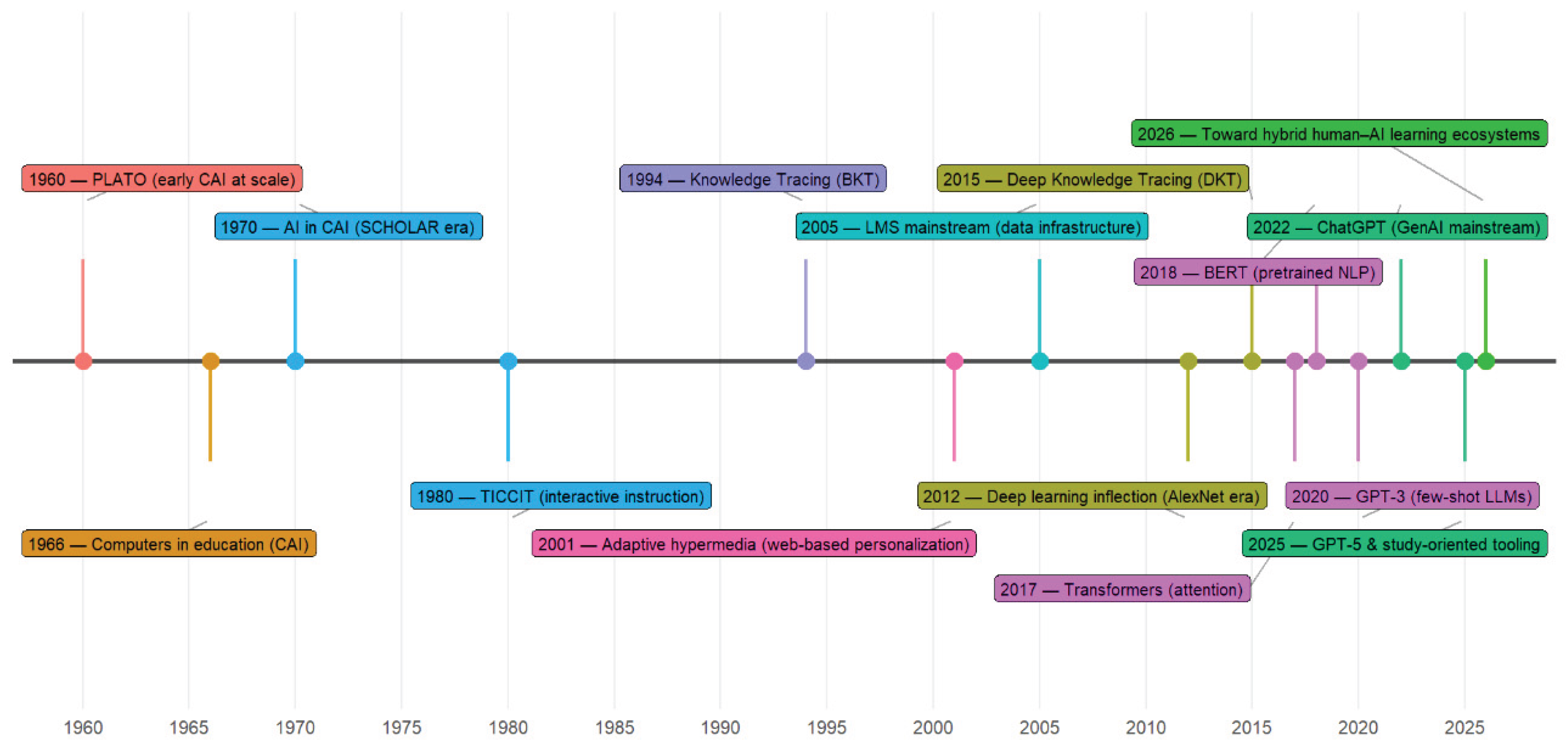
Figure 2.
A circular dendrogram of ML applications in Education.
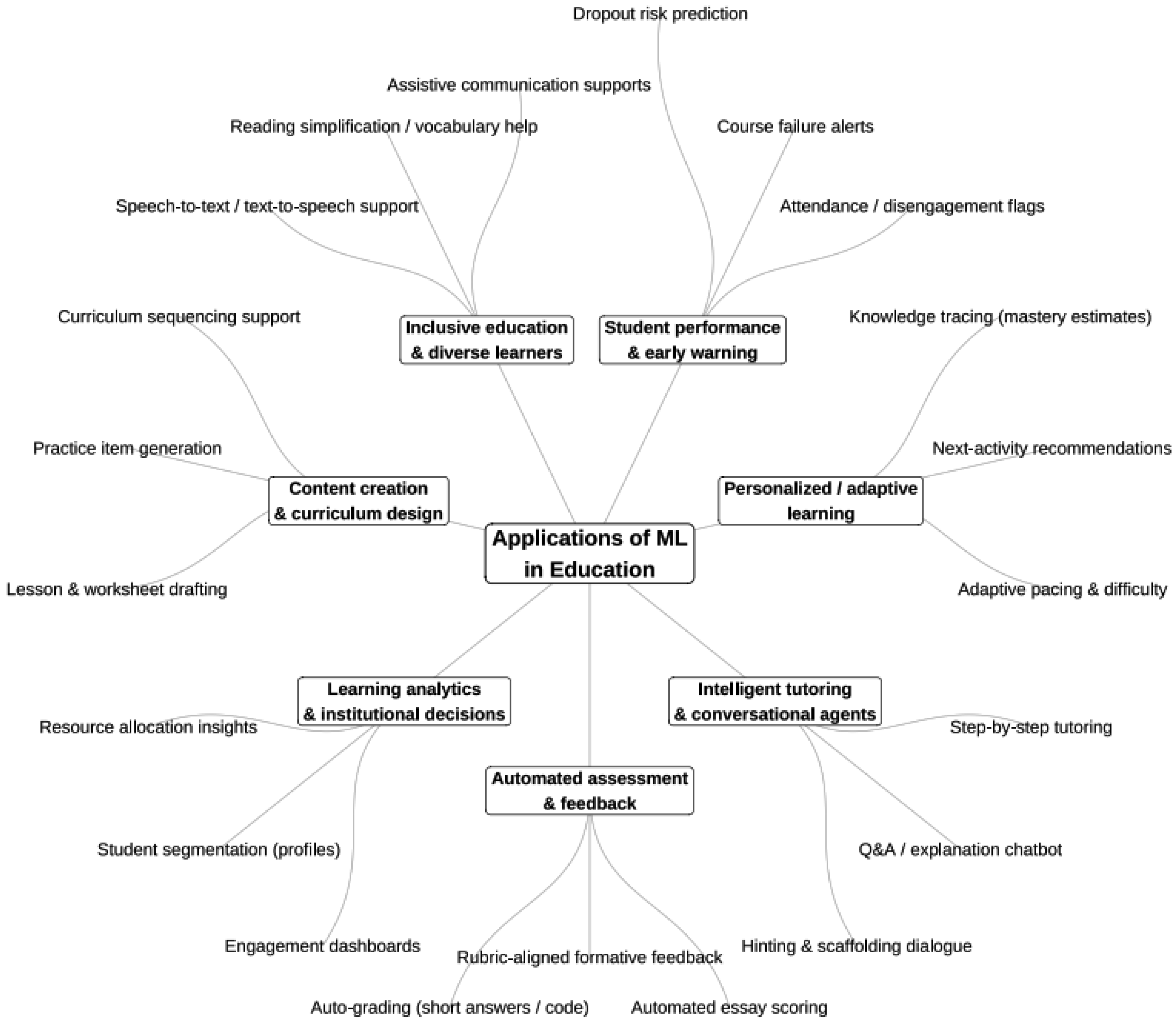
Figure 3.
Main challenges of ML in Education.
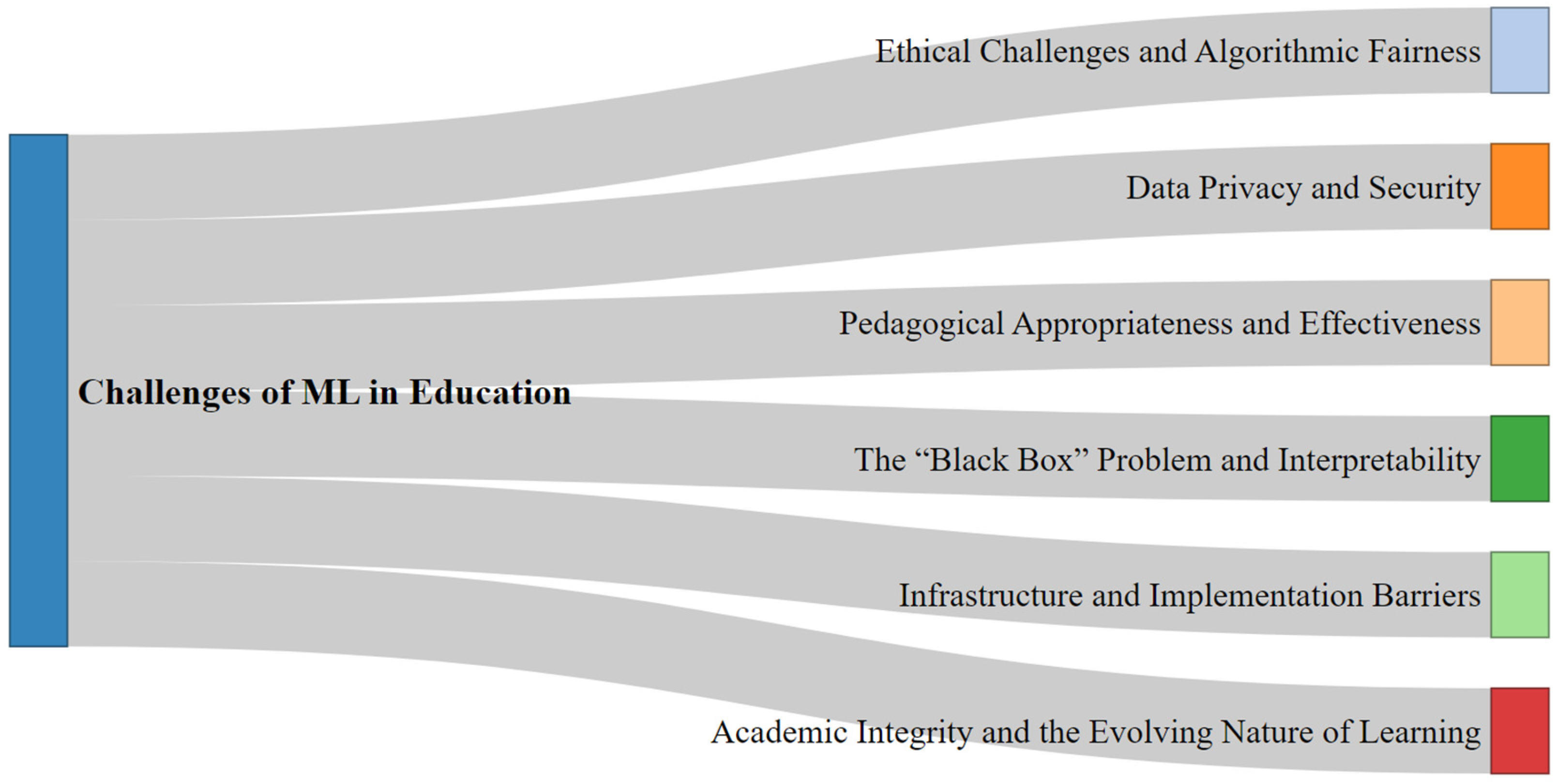
Figure 4.
ML-in-Education pipeline with governance checkpoints.
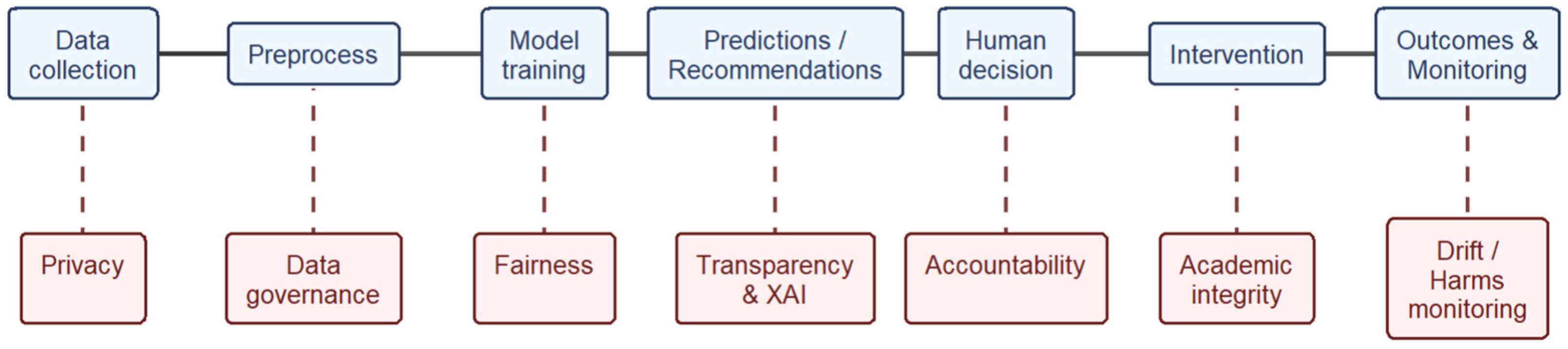
Disclaimer/Publisher’s Note: The statements, opinions and data contained in all publications are solely those of the individual author(s) and contributor(s) and not of MDPI and/or the editor(s). MDPI and/or the editor(s) disclaim responsibility for any injury to people or property resulting from any ideas, methods, instructions or products referred to in the content. |
© 2026 by the authors. Licensee MDPI, Basel, Switzerland. This article is an open access article distributed under the terms and conditions of the Creative Commons Attribution (CC BY) license (http://creativecommons.org/licenses/by/4.0/).
Copyright: This open access article is published under a Creative Commons CC BY 4.0 license, which permit the free download, distribution, and reuse, provided that the author and preprint are cited in any reuse.