

Submitted:
28 February 2026
Posted:
02 March 2026
You are already at the latest version
Abstract
Background/Objectives: Congestion is a hallmark of heart failure (HF) and a major determinant of outcomes. Non-invasive tools enable detection of subclinical congestion, but their correlation and prognostic relevance remain incompletely defined. We aimed to assess the prevalence, evolution, interrelationship, and prognostic impact of clinical and subclinical congestion markers in patients hospitalized for HF. Methods: This single-centre, prospective cohort study included adults admitted with HF who underwent serial evaluations at admission, 72 hours, pre-discharge, early outpatient follow-up and at 6-month. Clinical congestion was assessed using a standardized physical examination score. Subclinical congestion was evaluated using lung ultrasound (LUS), Venous Excess Ultrasound Score (VExUS), and Remote Dielectric Sensing (ReDS). Patients were classified according to the presence of clinical and/or subclinical congestion at discharge. The primary endpoint was a composite of all-cause mortality, HF readmission, or unscheduled visits requiring intravenous diuretics within six months of follow-up. Results: Ninety-four patients (mean age 74±11 years, 68% male) were included. While clinical congestion improved significantly during hospitalization, approximately 30% of patients remained clinically congested at discharge. Among clinically euvolemic patients, only 47% showed no evidence of subclinical congestion. Correlations between congestion markers were weak to moderate, suggesting complementary pathophysiological information. At discharge, pulmonary B-lines were the strongest predictor of the composite endpoint (hazard ratio [HR] 3.50, 95% CI 1.41–8.72), followed by clinical congestion (HR 2.67, 95% CI 1.13–6.30). Patients with both clinical and subclinical congestion had the lowest event-free survival, approximately 50% at six months of follow-up (log-rank p = 0.03). Conclusions: Subclinical congestion is common despite apparent clinical euvolemia and is associated with worse outcomes. Integrating clinical assessment with non-invasive congestion markers may improve post-discharge risk stratification and patient management in HF.
Keywords:
VExUS
; congestion
; subclinical
; LUS
; heart failure
1. Introduction
Heart failure (HF) represents a significant and growing public health challenge, with a prevalence increasing rapidly (1). Congestion is a hallmark of this complex syndrome and serves as an independent predictor of hospitalization, disease progression, and adverse outcomes (2).
Importantly, increased intracardiac filling pressures frequently precede the development of overt congestive symptoms by days or even weeks (3). Consequently, early detection of congestion before clinical decompensation occurs is of utmost importance. However, in its initial stages, subclinical congestion frequently remains undetected by routine clinical assessments, including physical examination (PE) or chest radiography (4).
In recent years, several novel non-invasive methods have been developed to detect subclinical congestion, increasingly recognized as a critical precursor of worsening HF and hospitalization. Among these, lung ultrasound (LUS) has emerged as a particularly robust tool with substantial evidence (5,6). Additionally, the Venous Excess Ultrasound Score (VExUS) has been proposed as a comprehensive assessment of systemic venous congestion, integrating evaluation of the inferior vena cava (IVC), suprahepatic, portal, and renal veins (7). Other promising tools include radar-based technology such as the Remote Dielectric Sensing (ReDS) system (8), as well as circulating biomarkers, which may contribute to the early detection of fluid overload. Despite these advances, the optimal strategies for congestion identification, the degree of correlation among these modalities, and their prognostic implications remain incompletely understood.
Therefore, the aim of this study was to evaluate the prevalence, temporal evolution, interrelationship, and prognostic impact of multiple clinical and subclinical congestion markers in patients hospitalized for HF.
2. Methods
2.1. Study Design and Population
This single-centre, prospective cohort study was conducted between June 2021 and March 2023 at a tertiary hospital. All consecutive adults admitted to the cardiology ward with a primary diagnosis of HF, defined according to current European HF guidelines (9) were included. Patients on dialysis, presenting cardiogenic shock at admission, or with an estimated life expectancy of less than six months due to non-cardiovascular causes were excluded.
2.2. Study Protocol
Participants underwent five predefined assessments: (1) at hospital admission (within 24 hours), (2) at 72 hours, (3) prior to discharge, (4) at an outpatient HF clinic visit 1–2 weeks after discharge, and (5) a 6-month follow-up telephone call to collect events. Each visit included a standardized clinical evaluation, measurement of NT-proBNP, lung ultrasound (LUS), VExUS, and ReDS. Patients’ management was left to the discretion of the treating physicians and was not guided by protocol. Additional details of the study protocol are provided in the Supplementary Material.
Briefly, the clinical congestion score comprised the presence of orthopnea, jugular venous distension, and peripheral edema. LUS was performed by assessing eight lung zones (four in each hemithorax), with the transducer oriented perpendicular to the ribs and the patient in a semi-recumbent position, considering as positive the presence of three or more B-lines per zone. ReDS was obtained using the Pro System version of the device. Values equal or less than 35% were considered normal, whereas values above 35% were considered indicative of pulmonary congestion. The VExUS score evaluated four parameters: IVC size, hepatic vein Doppler waveform, portal vein pulsatility, and renal vein flow pattern. Congestion severity was categorized as mild (one abnormal parameter), moderate (two abnormal parameters), or severe (three abnormal parameters).
Based on discharge findings, patients were categorized into four groups according to the presence or absence of clinical and subclinical congestion. Subclinical congestion was defined by any of the following criteria: more than two lung zones with more than 3 B-lines, ReDS >35% or VExUS ≥1.
2.3. Study Outcomes
The primary outcome was a composite endpoint of all-cause mortality, HF readmissions (>24 hours), or unscheduled visits due to HF requiring intravenous diuretics at a 6-month follow-up.
2.4. Statistical Analysis
Continuous variables were expressed as mean ± standard deviation or median with interquartile range and compared using ANOVA or Wilcoxon tests. Categorical variables were presented as counts and percentages, with χ² or Fisher’s tests. Time-to-event analyses utilized Kaplan–Meier curves, and Cox proportional hazards regression identified predictors of the primary outcome. Statistical significance was set at P value < 0.05. Analyses were conducted using STATA version 13 (Stata Corp, Texas, USA).
3. Results
3.1. Clinical Characteristics of the Study Population
A total of 94 patients (68% males, mean age of 74±11 years) were included in the study, with 5 in-hospital deaths. Patients presented with cardiovascular risk factors and a high burden of comorbidities. Most patients were in NYHA functional class II or III. The most frequent HF aetiologies were valvular heart disease and ischemic cardiomyopathy.
The mean left ventricular ejection fraction (LVEF) was 46 ± 15%. Baseline clinical characteristics are summarized in Table 1.
3.2. Trajectories of Clinical and Subclinical Congestion
The clinical congestion score decreased significantly from 4.0 ± 2.1 at admission to 0.3 ± 0.6 at discharge (p < 0.001). However, approximately 30% of patients remained clinically congested at discharge. Regarding subclinical congestion, around 33% of patients remained congested according to LUS, 30% according to VExUS, and up to 22% according to ReDS. When considering these three complementary diagnostic methods, only 47% of patients who were clinically deemed euvolemic at discharge showed no signs of subclinical congestion. While both clinical and subclinical congestion parameters improved during the hospital stay, they worsened at the first outpatient visit. The temporal evolution of congestion is detailed in Table 2A and 2B.
3.3. Correlation Between Clinical and Subclinical Congestion
The correlation between congestion parameters is shown in Table 3. Pulmonary B-lines showed a moderate correlation with crackles (0.54) and weakly with ReDS (0.38), while ReDS correlated minimally with other measures. Right-sided congestion assessed by VExUS showed moderate correlations with hepatomegaly (0.40), peripheral oedema (0.31), hepatojugular reflux (0.29), and the clinical congestion score (0.38).
3.4. Prognostic Impact
In a Cox regression model (Table 4), the presence of B-lines emerged as the strongest predictor of the six-month composite endpoint, with a hazard ratio (HR) of 3.5 (95% confidence interval [CI]: 1.41–8.72), followed by clinical congestion at discharge (HR 2.67; 95% CI: 1.13–6.30), portal vein pulsatility (HR 1.92; 95% CI: 1.01–3.66), and IVC diameter (HR 1.07; 95% CI: 1.01–1.13). Figure 1 presents the Kaplan–Meier curves stratified by the presence of clinical or subclinical congestion at discharge. Patients exhibiting both clinical and subclinical congestion experienced the lowest event-free survival, approximately 50% at six months of follow-up (Log-rank test = 0.03).
4. Discussion
This study provides novel insights into the prevalence and clinical significance of subclinical venous congestion at hospital discharge in patients with acute HF. Although most patients were assessed as euvolemic on physical examination, a substantial proportion remained congested when evaluated with other tools such as LUS, VExUS, or ReDS. Notably, less than half of the clinically euvolemic patients were free of any subclinical congestion, highlighting the limitations of relying solely on conventional bedside assessment. Interestingly, markers of clinical and subclinical congestion exhibited only weak to moderate correlations, supporting the complementary role of these parameters in capturing different facets of congestion and suggesting that congestion distribution is heterogeneous.
4.1. Prognostic Relevance of Congestion
Congestion continues to be a major determinant of outcomes in HF, contributing to both readmissions and mortality. In our cohort, the six-month combined event rate was substantial, reflecting the persistent vulnerability of this population. Importantly, patients with subclinical and clinical congestion at discharge experienced the worst prognosis with event-free survival decreasing to approximately 50% at six months. These findings underscore the need to detect and address congestion that is not apparent on routine examination.
4.2. Prognostic Value of Pulmonary Ultrasound (B-Lines)
One of the most consistent findings in our cohort was the prognostic role of B-lines at discharge. B-lines emerged as a strong predictor of adverse events, with patients displaying B-lines at discharge having a threefold higher risk of the composite endpoint at six months. The presence of three or more B-lines per scan field was associated with a higher risk of events. These findings are consistent with previous trials and meta-analyses, showing that a higher B-line count predicts adverse outcomes, with an AUC near 0.8 when ≥5 B-lines are detected. Ultrasound-guided diuretic therapy has demonstrated clinical benefit, reducing composite endpoints by 45–49%, with a number needed to treat as low as 5–8 patients (10,11).
4.3. Prognostic Value of ReDS
ReDS also identified residual pulmonary congestion in a substantial proportion of patients, although its prognostic value appeared less robust than B-lines. Evidence also supports the use of ReDS for guiding therapy. Alvarez-García et al. demonstrated that ReDS-guided management significantly reduced adverse events (2% vs. 20%) using a discharge threshold of <35% (12). Although statistical significance was not reached in our cohort, we observed a mean reduction in ReDS values at discharge, which is clinically relevant and consistent with prior studies.
4.4. Prognostic value of Systemic Venous Congestion (VExUS)
Interest has recently emerged in systemic venous congestion as a prognostic determinant, assessed by the VExUS score, initially developed in cardiac surgery patients (13). Prior studies have shown that VExUS predicts elevated filling pressures, renal deterioration, and diuretic response in decompensated HF patients (14, 15, 16, 17, 18).
Although VExUS ≥1 did not reach statistical significance in predicting the composite endpoint, it correlated moderately with clinical signs such as oedema, hepatomegaly, and hepatojugular reflux and we observed a trend toward a higher risk of adverse events, suggesting that systemic venous congestion may still provide incremental prognostic information, particularly IVC size and portal vein pulsatility.
Correlations among congestion parameters were mostly weak to moderate. B-lines correlated with crackles, VExUS with systemic clinical signs of congestion, and ReDS showed minimal association with other measures. From a practical perspective, these findings highlight the partial complementarity of the different tools. Lung ultrasound appears to align more closely with clinical pulmonary findings, whereas VExUS may better reflect systemic venous congestion. In contrast, ReDS showed limited concordance with other parameters in this cohort. Therefore, if simplification of congestion assessment is desired in routine clinical practice, combining focused lung ultrasound with selected systemic venous markers (such as IVC diameter and portal vein pulsatility) may provide a pragmatic and clinically informative approach.
4.5. Limitations
Several limitations of this study should be acknowledged. First, the lack of blinding may have introduced bias, potentially limiting the generalizability of our results. The choice of the primary endpoint was influenced by two factors: 1) the need to achieve sufficient statistical power in a single-centre study with a relatively small sample and six-month follow-up, and 2) the structure of our HF unit, which provides rapid access to unscheduled visits to prevent hospital readmissions. Concerns regarding the cost, accessibility, and learning curve of the protocol may restrict its broader implementation. Future studies assessing alternative US parameter combinations could improve feasibility. Finally, offline echocardiographic review and interobserver variability analyses were not performed, highlighting the need for caution in interpreting these results and supporting the hypothesis-generating nature of this study.
5. Conclusions
Our findings indicate that most patients who appeared clinically euvolemic exhibited residual congestion. The presence of both clinical and subclinical congestion was associated with lower event-free survival at a six-month follow-up. These results underscore the importance of enhanced post-discharge risk stratification and suggest that integrating non-invasive tools such as VExUS, LUS, and ReDS may enhance post-discharge risk stratification and patient management. Larger prospective studies are warranted to validate these observations and establish their role in routine clinical practice.
Supplementary Materials
The following supporting information can be downloaded at website of this paper posted on Preprints.org, Study protocol for the assessment of subclinical congestion.
Author Contributions
Conceptualization, Mercedes Rivas-Lasarte, Jesús Álavarez-García, Javier Segovia-Cubero; methodology: Mercedes Rivas-Lasarte, Jesús Álavarez-García, Sara Lozano-Jiménez; formal analysis, Mercedes Rivas-Lasarte, Jesús Álavarez-García, Sara Lozano-Jiménez; investigation, Mercedes Rivas-Lasarte, Jesús Álavarez-García, Sara Lozano-Jiménez, Paula Vela Martín, Alba Martín-Centellas, Daniel de Castro, Cristina Mitroi, Francisco José Hernández-Pérez, Marta Cobo Marcos, Sergio Martínez -Álvarez, Manuel Gómez Bueno; writing—original draft preparation: Mercedes Rivas-Lasarte, Jesús Álavarez-García, Sara Lozano-Jiménez, Javier Segovia-Cubero; writing—review and editing, Mercedes Rivas-Lasarte, Jesús Álavarez-García, Sara Lozano-Jiménez, Paula Vela-Martin, Alba Martín-Centellas, Daniel de Castro, Cristina Mitroi, Francisco José Hernández-Pérez, Marta Cobo Marcos, Sergio Martínez -Álvarez, Manuel Gómez Bueno, Javier Segovia-Cubero; visualization, X.X.; supervision: Manuel Gómez Bueno, Javier Segovia-Cubero, Mercedes Rivas-Lasarte, Jesús Álvarez-García; funding acquisition: Mercedes Rivas-Lasarte, Javier Segovia-Cubero. All authors have read and agreed to the published version of the manuscript.
Funding
This study was funded by Instituto de Salud Carlos III (PI22/04120).
Institutional Review Board Statement
The study was conducted in accordance with the Declaration of Helsinki, reviewed and approved by the Institutional Review Board of Hospital Universitario Puerta de Hierro PI60/21 on the 1 March 2021.
Informed Consent Statement
Informed consent was obtained from all subjects involved in the study.
Data Availability Statement
The data presented in this study are available on request from the corresponding authors.
Conflicts of Interest
The authors declare no conflict of interest.
References
- Farré, N; Vela, E; Clèries, M; et al. Real-world heart failure epidemiology and outcome: A population-based analysis of 88,195 patients. PLoS One 2017, 12(2), e0172745. [Google Scholar] [CrossRef] [PubMed]
- O’Connor, CM; Miller, AB; Blair, JE; et al. Efficacy of Vasopressin Antagonism in heart Failure Outcome Study with Tolvaptan (EVEREST) investigators. Causes of death and rehospitalization in patients hospitalized with worsening heart failure and reduced left ventricular ejection fraction: results from Efficacy of Vasopressin Antagonism in Heart Failure Outcome Study with Tolvaptan (EVEREST) program. Am Heart J 2010, 159(5), 841–849. [Google Scholar] [PubMed]
- Nohria, A; Tsang, SW; Fang, JC; et al. Clinical assessment identifies hemodynamic profiles that predict outcomes in patients admitted with heart failure. J Am Coll Cardiol. 2003, 41(10), 1797–804. [Google Scholar] [CrossRef] [PubMed]
- Mullens, W; Damman, K; Harjola, VP; et al. The use of diuretics in heart failure with congestion — a position statement from the Heart Failure Association of the European Society of Cardiology. Eur J Heart Fail 2019, 21(2), 137–55. [Google Scholar] [CrossRef]
- Araiza-Garaygordobil, D; Gopar-Nieto, R; Martinez-Amezcua, P; et al. A randomized controlled trial of lung ultrasound-guided therapy in heart failure (CLUSTER-HF study). Am Heart J 2020, 227, 31–9. [Google Scholar] [CrossRef]
- Marini, C; Fragasso, G; Italia, L; et al. Lung ultrasound-guided therapy reduces acute decompensation events in chronic heart failure. Heart 2020, 106(24), 1934–9. [Google Scholar] [CrossRef]
- Beaubien-Souligny, W; Rola, P; Korbin, H; et al. Quantifying systemic congestion with Point-Of-Care ultrasound: development of the venous excess ultrasound grading system. Ultrasound J 2020, 12(16). [Google Scholar] [CrossRef]
- Sattar, Y; Zghouzi, M; Suleiman, ARM; et al. Efficacy of remote dielectric sensing (ReDS) in the prevention of heart failure rehospitalizations: a meta-analysis. J Community Hosp Intern Med Perspect. 2021, 11(5), 646–52. [Google Scholar] [CrossRef]
- McDonagh, TA; Metra, M; Adamo, M; et al. ESC Guidelines for the diagnosis and treatment of acute and chronic heart failure. Eur Heart J 2021, 42(36), 3599–726. [Google Scholar] [CrossRef]
- Rivas-Lasarte, M; Álvarez-García, J; Fernández-Martínez, J; et al. Lung ultrasound- guided treatment in ambulatory patients with heart failure: a randomized controlled clinical trial (LUS-HF study). Eur J Heart Fail 2019, 21(12), 1605–13. [Google Scholar] [CrossRef]
- Platz, E; Lewis, EF; Uno, H; et al. Detection and prognostic value of pulmonary congestion by lung ultrasound in ambulatory heart failure patients. Eur Heart J 2016, 37(15), 1244–51. [Google Scholar] [CrossRef]
- Álvarez García, J; Lala, A; Rivas-Lasarte, M; et al. Remote Dielectric Sensing before and after discharge in patients with ADHF: The ReDS-SAFE HF trial. JACC Heart Fail 2024, 12(4), 695–706. [Google Scholar] [CrossRef]
- Beaubien-Souligny, W; Benkreira, A; Robillard, P; et al. Alterations in portal vein flow and intrarenal venous flow are associated with acute kidney injury after cardiac surgery: a prospective observational cohort study. J Am Heart Assoc. 2018, 7(19), e009961. [Google Scholar] [CrossRef] [PubMed]
- Longino, A; Martin, K; Leyba, K; et al. Prospective Evaluation of Venous Excess Ultrasound for Estimation of Venous Congestion. CHEST 2024, 165(3), 590–600. [Google Scholar] [CrossRef] [PubMed]
- Islas-Rodríguez, JP; Miranda-Aquino, T; Romero-González, G; et al. Effect on.
- Kidney Function Recovery Guiding Decongestion with VExUS in Patients with Cardiorenal Syndrome: A Randomized Control Trial. Cardiorenal Med 2024, 14(1), 1–11.
- Aslaner, MA; Helvacı, Ö; Haycock, K; et al. Diagnostic accuracy of venous system ultrasound for subtypes of acute kidney injury. Emerg Med J 2024, 41(5), 304–10. [Google Scholar] [CrossRef] [PubMed]
- Sovetova, S; Charaya, K; Erdniev, T; et al. Venous Excess Ultrasound Score is.
- associated with Worsening Renal Function and reduced natriuretic response in patients with Acute Heart Failure. J Clin Med. 2024, 13(20), 6272. [CrossRef]
- Kanitkar, S; Soni, K; Vaishnav, B; et al. Venous Excess Ultrasound for fluid.
- assessment in complex cardiac patients with acute kidney injury. Cureus 2024, 16(8), e66003. [CrossRef] [PubMed]
Figure 1.
Kaplan–Meier curves according to the presence of clinical or subclinical congestion at discharge. Green: No congestion. Blue: subclinical congestion. Yellow: Isolated clinical congestion. Red: both, clinical and subclinical congestion.
Figure 1.
Kaplan–Meier curves according to the presence of clinical or subclinical congestion at discharge. Green: No congestion. Blue: subclinical congestion. Yellow: Isolated clinical congestion. Red: both, clinical and subclinical congestion.
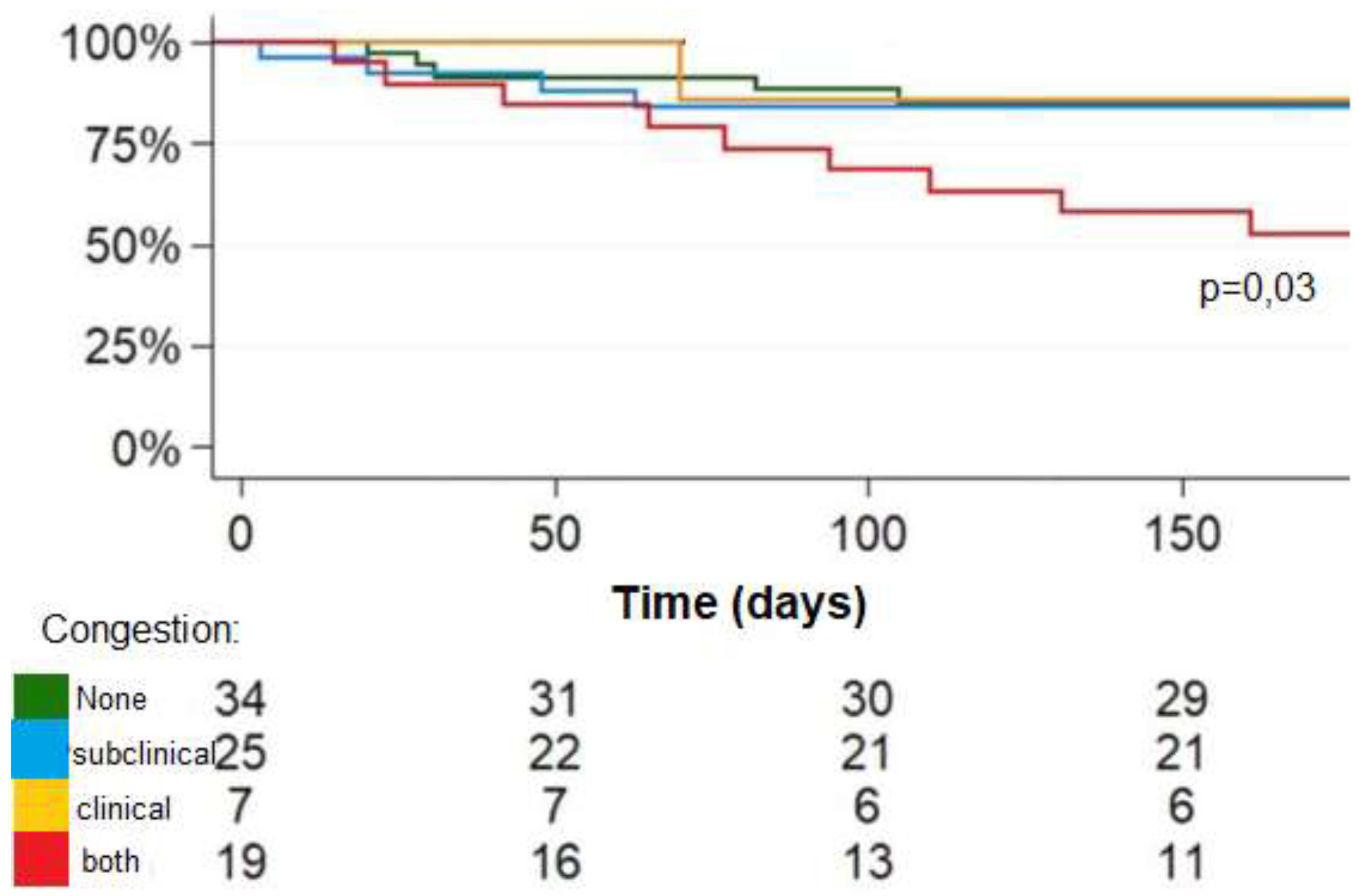

Table 1.
Baseline characteristics of the study population.
| Variable | N (%) |
|---|---|
| Sex, male | 64 (68.0) |
| Comorbidities: | |
| Hypertension | 65 (69.1) |
| Diabetes mellitus | 35 (37.2) |
| Dyslipidaemia | 49 (52.1) |
| History of smoking | 39 (41.5) |
| Alcohol abuse | 18 (19.1) |
| Atrial fibrillation | |
| – None | 25 (26.7) |
| – Paroxysmal | 21 (22.3) |
| – Persistent | 13 (13.8) |
| – Permanent | 35 (37.2) |
| Chronic kidney disease (glomerular filtration <60 ml/min/m²) | 37 (39.4) |
| Chronic obstructive pulmonary disease | 16 (17.0) |
| Sleep apnoea-hypopnea syndrome | 10 (10.9) |
| Stroke | 9 (9.9) |
| Peripheral vascular disease | 5 (5.4) |
| HF profile: | |
| First episode of HF | 8 (8.5) |
| NYHA functional class | |
| – I | 2 (2.1) |
| – II | 58 (61.7) |
| – III | 31 (33.0) |
| – IV | 3 (3.2) |
| Aetiology | |
| – Valvular | 25 (26.7) |
| – Ischemic | 20 (21.6) |
| – Idiopathic | 15 (16.0) |
| – Hypertensive | 14 (14.9) |
| – Restrictive | 10 (10.9) |
| – Other | 9 (9.9) |
| LVEF category | |
| – Preserved (≥50%) | 55 (58.5) |
| – Intermediate (41-49%) | 20 (21.3) |
| – Reduced (<40%) | 19 (20.2) |
Abbreviations: NYHA: New York Heart Association, HF: heart failure; LVEF: left ventricular ejection fraction.
Table 2.
a: Evolution of clinical congestion through HF admission.
| Variable | Admission (n=94) | 72 hours (n=93)* | Pre-Discharge (n=89)* | HF clinic visit after discharge (n=79) | P value |
|---|---|---|---|---|---|
| Orthopnoea |
<0.001 |
||||
| - None | 28 (29.8) | 67 (72.0) | 86 (96.6) | 68 (90.6) | |
| - Sometimes | 14 (14.9) | 22 (23.6) | 3 (3.4) | 4 (5.5) | |
| - Always | 18 (19.1) | 1 (1.1) | 0 | 1 (1.3) | |
| - Paroxysmal nocturnal dyspnoea | 34 (36.2) | 3 (3.3) | 0 | 2 (2.6) | |
| Crackles |
<0.001 |
||||
| - None | 20 (21.3) | 69 (74.2) | 86 (96.6) | 67 (89.3) | |
| - Basal | 64 (68.1) | 23 (24.7) | 3 (3.4) | 8 (10.7) | |
| - Mid | 10 (10.6) | 1 (1.1) | 0 | 0 | |
| Pleural effusion | 26 (27.6) | 8 (8.6) | 3 (3.4) | 6 (8.1) | <0.001 |
| Weight, kg | 75.8 ±18.1 | 73.5 ±16.9 | 71.7 ±17.2 | 72.6 ±15.6 | <0.001 |
| Oedema |
<0.001 |
||||
| - None | 18 (19.1) | 54 (58.1) | 77 (86.5) | 54 (72.0) | |
| - Malleolar | 36 (38.3) | 27 (29.0) | 12 (13.5) | 16 (21.3) | |
| - Knee | 17 (18.1) | 8 (8.6) | 0 | 3 (4.0) | |
| - Above knee | 23 (24.5) | 4 (4.3) | 0 | 2 (2.7) | |
| Hepatomegaly |
<0.001 |
||||
| - None | 46 (48.9) | 69 (74.2) | 81 (91.0) | 52 (69.6) | |
| - 1–2 fingerbreadths | 28 (29.8) | 21 (22.6) | 7 (7.9) | 19 (24.0) | |
| - >2 fingerbreadths | 20 (21.3) | 3 (3.2) | 1 (1.1) | 4 (6.4) | |
| Jugular venous distension |
<0.001 |
||||
| - None | 39 (41.5) | 62 (66.7) | 72 (80.9) | 47 (62.7) | |
| - < SCM | 33 (35.1) | 27 (29.0) | 17 (19.1) | 24 (32.0) | |
| - SCM | 14 (14.9) | 3 (3.2) | 0 | 3 (4.0) | |
| - Mandible | 8 (8.5) | 1 (1.1) | 0 | 1 (1.3) | |
| Hepatojugular reflux | 37 (39.4) | 19 (20.7) | 7 (7.9) | 14 (18.9) | <0.001 |
| Clinical congestion score | 4.0 ±2.1 | 1.5 ±1.6 | 0.3 ±0.6 | 0.8 ±1.3 | <0.001 |
*N=93 at 72 hours due to death of 1 patient; n=89 at discharge due to death of 5. Abbreviations: SCM: Sternocleidomastoid muscle. P value for the overall comparison among the four columns.
Table 2.
b: Evolution of subclinical congestion through HF admission.
| Variable | Admission (n=94) | 72 hours (n=93) |
Pre-Discharge (n=89) | HF clinic visit after discharge (n=79) | P value |
|---|---|---|---|---|---|
| NT-ProBNP, pg/mL | 6,180 (3,749–11,162) | 3,406 (1,655–7,085) | 2,713 (1,046–5,423) | 3,414 (818–6,642) | 0.003 |
| CA125, U/mL | 37.5 (21–62) | 48 (12–86) | 40 (11–40) | Not available | <0.001 |
| Creatinine, mg/dL | 1.4 (0.7) | 1.5 (0.8) | 1.4 (0.7) | 1.6 (0.7) | 0.472 |
| Presence of B-lines, n (%) |
97% | 82% | 52% | 54% | <0.001 |
| No. of zones with ≥3 B-lines | 4.8 ± 2.0 | 2.7 ± 2.1 | 1.3 ± 1.8 | 1.8 ± 2.2 | <0.001 |
| ReDS, % | 34.0 ± 7.6 | 32.3 ± 6.1 | 29.9 ± 6.5 | 29.2 ± 5.9 | <0.001 |
| IVC diameter, mm | 22.6 ± 5.1 | 19.7 ± 4.9 | 18.2 ± 5.3 | 18.7 ± 6.1 | <0.001 |
| Suprahepatic veins |
<0.001 |
||||
| - S>D | 28 (33.7) | 37 (43.5) | 41 (51.2) | 35 (54.7) | |
| - D>S | 21 (25.3) | 20 (23.5) | 13 (16.2) | 6 (25.0) | |
| - Inversion | 34 (41.0) | 28 (33.0) | 26 (32.6) | 23 (20.3) | |
| Portal vein pulsatility |
<0.001 |
||||
| - <30% | 31 (39.7) | 47 (58.8) | 53 (61.7) | 35 (54.7) | |
| - 30–50% | 29 (37.2) | 22 (27.5) | 16 (25.0) | 13 (20.3) | |
| - >50% | 18 (23.1) | 11 (13.7) | 13 (20.3) | 8 (10.1) | |
| Renal Doppler |
<0.001 |
||||
| - Continuous | 26 (32.1) | 43 (50.6) | 48 (59.3) | 30 (46.9) | |
| - Biphasic | 41 (50.6) | 37 (42.0) | 26 (32.1) | 22 (34.4) | |
| - Monophasic | 14 (17.3) | 6 (7.4) | 7 (8.6) | 12 (18.7) | |
| VExUS score, mean ± SD | 1.3 ± 1.0 | 0.95 ± 1.0 | 0.64 ± 1.0 | 0.97 ± 1.3 | |
| VExUS points, n (%) | <0.001 | ||||
| - 0 | 22 (25.6) | 45 (51.1) | 60 (69.8) | 39 (57.4) | |
| - 1 | 30 (34.9) | 21 (23.9) | 8 (9.3) | 9 (13.2) | |
| - 2 | 20 (23.2) | 14 (15.9) | 11 (12.8) | 5 (7.4) | |
| - 3 | 14 (16.3) | 8 (9.1) | 7 (8.1) | 15 (22.0) | |
Abbreviations: CA125: Cancer Antigen 125. D: Diastolic. HF: Heart Failure. IVC: Inferior Vena Cava. Mg/dL: Milligrams per decilitre. mm = Millimetres. NT-proBNP: N-terminal pro–B-type Natriuretic Peptide. Pg/mL: Picograms per millilitre. ReDS: Remote Dielectric Sensing. SD: Standard deviation. S: Systolic.U/mL: Units per millilitre. VExUS: Venous Excess Ultrasound Score.
Table 3.
Correlation between clinical and subclinical congestion markers.
| Variable | VExUS | B-lines | NT-proBNP | Creatinine | ReDS | Congestion | Crackles | Hepatomegaly | HJR |
|---|---|---|---|---|---|---|---|---|---|
| B-lines | 0.36* | ||||||||
| NT-proBNP | 0.26* | 0.29* | |||||||
| Creatinine | 0.11* | -0.02 | 0.25* | ||||||
| ReDS | 0.23* | 0.38* | 0.09 | 0.11 | |||||
| Congestion | 0.38* | 0.53* | 0.30* | 0.02 | 0.23* | ||||
| Crackles | 0.17* | 0.54* | 0.18* | -0.03 | 0.26* | 0.57* | |||
| Hep | 0.40* | 0.38* | 0.29* | 0.10 | 0.03 | 0.63* | 0.25* | ||
| HJR | 0.29* | 0.21* | 0.19* | 0.09 | 0.08 | 0.53* | 0.23* | 0.51* | |
| Oedema | 0.31* | 0.41* | 0.21* | -0.03 | 0.11 | 0.83* | 0.46* | 0.53* | 0.41* |
*Statistically significant. Congestion: clinical congestion. ReDS: Remote Dielectric Sensing system. HJR: hepatojugular reflux.
Table 4.
Cox regression model for the composite endpoint.
| Variable | HR | 95% CI | P value |
|---|---|---|---|
| Presence of B-lines | 3.50 | 1.41–8.72 | 0.007 |
| NT-ProBNP | 1.00 | 0.99–1.00 | 0.09 |
| ReDS >35% | 2.05 | 0.69–6.13 | 0.20 |
| Clinical congestion | 2.67 | 1.13–6.30 | 0.02 |
| VExUS ≥1 | 1.84 | 0.73–4.68 | 0.20 |
| IVC diameter | 1.07 | 1.01–1.13 | 0.01 |
| Portal vein pulsatility | 1.92 | 1.01–3.66 | 0.05 |
| SH | 1.38 | 0.82–2.32 | 0.22 |
| Renal Doppler | 1.44 | 0.77–2.68 | 0.25 |
HR: Hazard ratio; CI: Confidence interval; ReDS: Remote Dielectric Sensing; SH: Suprahepatic veins; IVC: Inferior vena cava; VExUS: Venous Excess Ultrasound.
Disclaimer/Publisher’s Note: The statements, opinions and data contained in all publications are solely those of the individual author(s) and contributor(s) and not of MDPI and/or the editor(s). MDPI and/or the editor(s) disclaim responsibility for any injury to people or property resulting from any ideas, methods, instructions or products referred to in the content. |
© 2026 by the authors. Licensee MDPI, Basel, Switzerland. This article is an open access article distributed under the terms and conditions of the Creative Commons Attribution (CC BY) license (http://creativecommons.org/licenses/by/4.0/).
Copyright: This open access article is published under a Creative Commons CC BY 4.0 license, which permit the free download, distribution, and reuse, provided that the author and preprint are cited in any reuse.


